TIME AND PURPOSE OF PROBLEMS
Problem 9-1 (Time 10–15 minutes)
Purpose—to provide the student with an understanding of the lower-of-cost-or-market approach to
inventory valuation, similar to Problem 9-2. The major difference between these problems is that
Problem 9-1 provides some ambiguity to the situation by changing the catalog prices near the end of
the year.
Problem 9-2 (Time 25–30 minutes)
Problem 9-3 (Time 30–35 minutes)
Problem 9-4 (Time 20–30 minutes)
Problem 9-5 (Time 40–45 minutes)
Purpose—to provide the student with a complex problem involving a fire loss where the gross profit
Problem 9-6 (Time 20–30 minutes)
Purpose—to provide the student with a problem on the retail inventory method. The problem is relatively
Problem 9-7 (Time 20–30 minutes)
Purpose—to provide the student with a problem on the retail inventory method. This problem is similar
to Problem 9-6, except that a few different items must be evaluated in finding ending inventory at retail
and cost. Unusual items in this problem are employee discounts granted and loss from breakage.
A good problem that summarizes the essentials of the retail inventory method.
Problem 9-8 (Time 20–30 minutes)
Problem 9-9 (Time 30–40 minutes)
Problem 9-10 (Time 30–40 minutes)
Purpose—to provide the student with an opportunity to write a memo explaining what is designated
market value and how it is computed. As part of this memo, the student is required to compute
inventory on the lower-of-cost-or-market basis using the individual item approach.
Time and Purpose of Problems (Continued)
*Problem 9-11 (Time 30–35 minutes)
Purpose—to provide the student with a retail inventory problem where both the conventional retail and
dollar-value LIFO method must be computed. An excellent problem for highlighting the difference
between these two approaches to inventory valuation. It should be noted that the cost-to-retail per-
centage is given for LIFO so less computation is necessary.
*Problem 9-12 (Time 30–40 minutes)
Purpose—to provide the student with a comprehensive problem covering the retail and LIFO retail
*Problem 9-14 (Time 40–50 minutes)
Purpose—to provide the student with a retail inventory problem where both the conventional retail and
dollar-value LIFO method must be computed. The problem is similar to Problem 9-10, except that the
SOLUTIONS TO PROBLEMS
PROBLEM 9-1
Item
Cost
Replacement
Cost
Ceiling*
Floor**
Designated
Market
Lower-of–
Cost-or–
Market
A
$470
$ 460
$ 450
$350
$ 450
$450
B
C
D
PROBLEM 9-2
(a) 1. The balance in the Allowance to Reduce Inventory to Market at
May 31, 2014, should be $34,600, as calculated in Exhibit 1 below.
Exhibit 1
CALCULATIONS OF PROPER BALANCE
in the Allowance to Reduce Inventory to Market
At May 31, 2014
Cost
Replace-
ment
Cost
NRV
(Ceiling)
NRV less
normal
profit
(Floor)
LCM
Aluminum siding
$ 70,000
$ 62,500
$ 56,000
$ 50,900
$ 56,000
Cedar shake siding
86,000
79,400
84,800
77,400
79,400
Louvered glass doors
Thermal windows
Totals
$408,000
2. For the fiscal year ended May 31, 2014, the loss that would be
recorded due to the change in the Allowance to Reduce Inventory
to Market would be $7,100, as calculated below.
PROBLEM 9-2 (Continued)
(b) The use of the lower-of-cost-or-market (LCM) rule is based on both the
expense recognition principle and the concept of conservatism. The
PROBLEM 9-3
(a)
12/31/14 (Cost-of–Goods-Sold Method)
Cost of Goods Sold …………………………………………………
68,000
Allowance to Reduce Inventory to Market
($780,000 – $712,000) ……………………………………
68,000
Cost of Goods Sold …………………………………………………
(b)
12/31/14 (Loss Method)
To write down inventory to market:
Loss Due to Market Decline of Inventory ………………….
68,000
Allowance to Reduce Inventory to Market …………
To write down inventory to market:
Loss Due to Market Decline of Inventory ………………….
Allowance to Reduce Inventory to Market
PROBLEM 9-4
Beginning inventory ……………………………………………..
$ 80,000
Purchases ……………………………………………………………
290,000
370,000
Purchase returns ………………………………………………….
(28,000)
Total goods available ……………………………………………
342,000
Sales revenue …………………………..………………………….
Sales returns ……………………………………………………….
Net sales ……………………………………………………………..
Less: Gross profit (35% of $394,000) …………………….
Ending inventory (unadjusted for damage) …………….
Inventory damaged ………………………………………………
Less: Salvage value of damaged inventory……………
8,150
PROBLEM 9-5
STANISLAW CORPORATION
Computation of Inventory Fire Loss
April 15, 2015
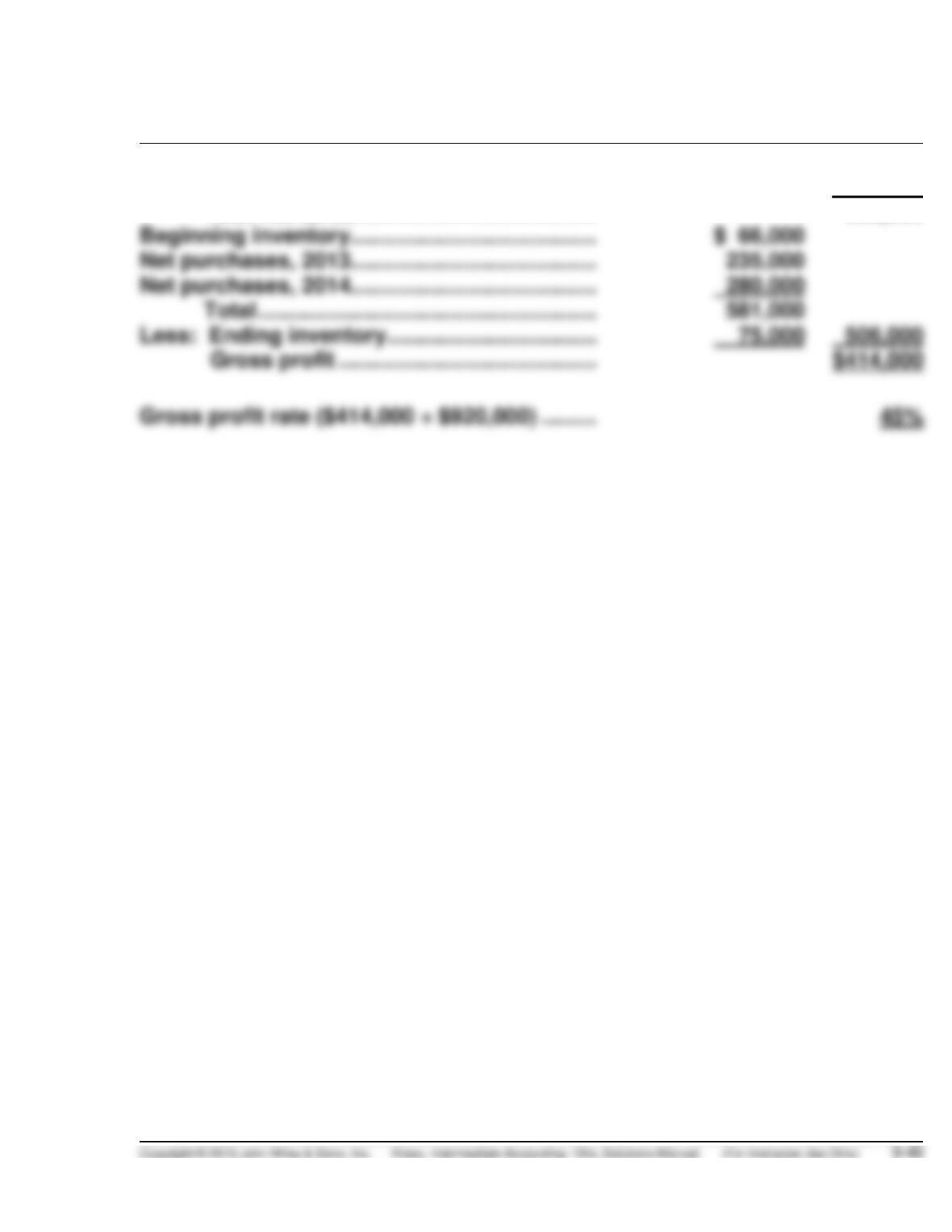
Inventory, 1/1/15 …………………………..………..
$ 75,000
Purchases, 1/1/ – 3/31/15…………………………
52,000
April merchandise shipments paid ………….
3,400
Unrecorded purchases on account ………….
Total …………………………………………….
Less: Shipments in transit ……………………..
Merchandise returned ………………….
Merchandise available for sale ………………..
Less estimated cost of sales:
Sales revenue, 4/1/ – 4/15/15
Receivables acknowledged
at 4/15/15 ………………………………
$46,000
Estimated receivables not
acknowledged ………………………
8,000
Total ……………………………………….
54,000
Add collections, 4/1/ – 4/15/15
Total ……………………………………….
66,000
Less receivables, 3/31/15 ………………
26,000
Less gross profit (45%* X $161,000) ………..
54,200
Less: Sale of salvaged inventory ……………
PROBLEM 9-5 (Continued)
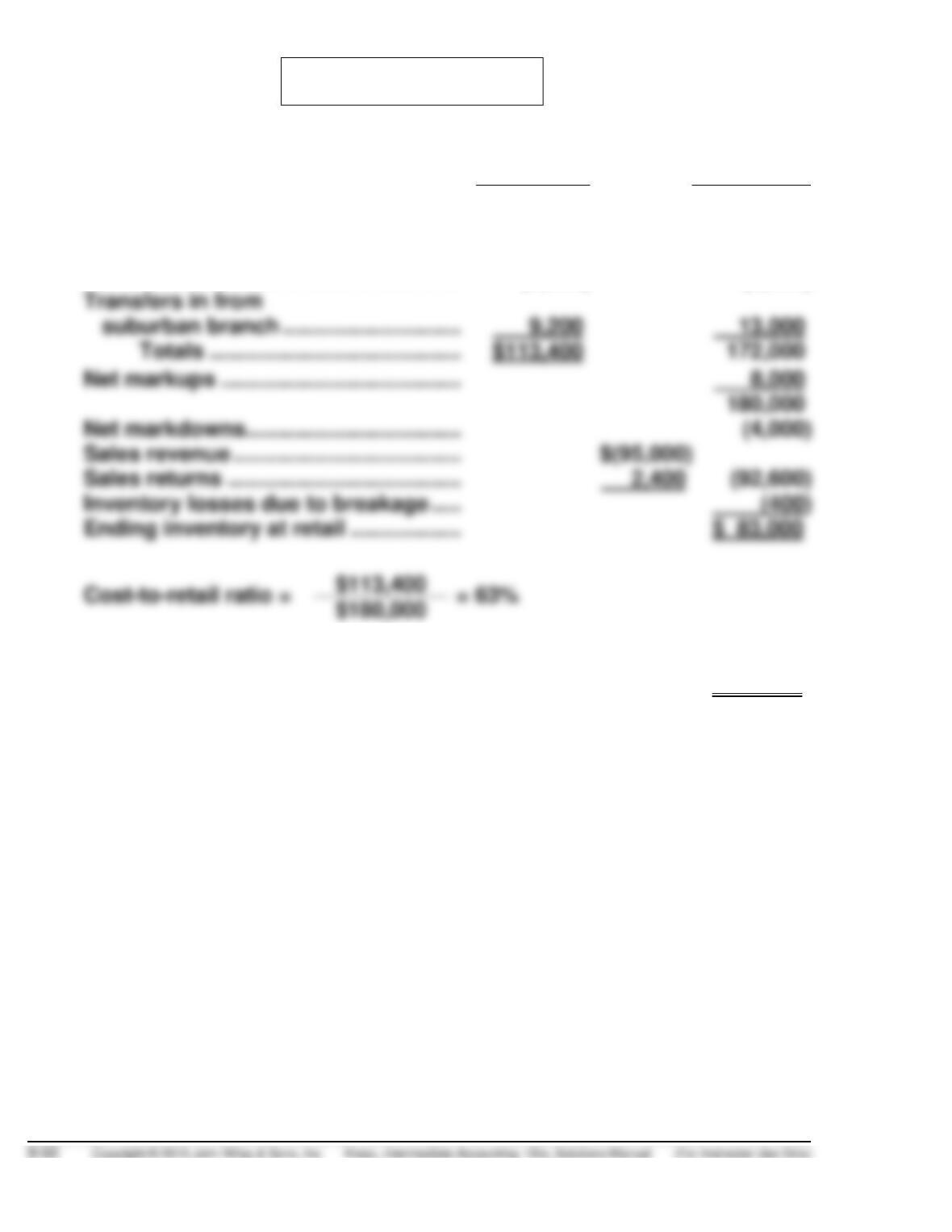
*Computation of Gross Profit Rate
Net sales, 2013 …………………………………………
$390,000
Net sales, 2014 …………………………………………
530,000
Total net sales …………………………………
920,000
Beginning inventory ………………………………….
Net purchases, 2013 ………………………………….
Net purchases, 2014 ………………………………….
Total ……………………………………………….
Less: Ending inventory …………………………....
506,000
PROBLEM 9-6
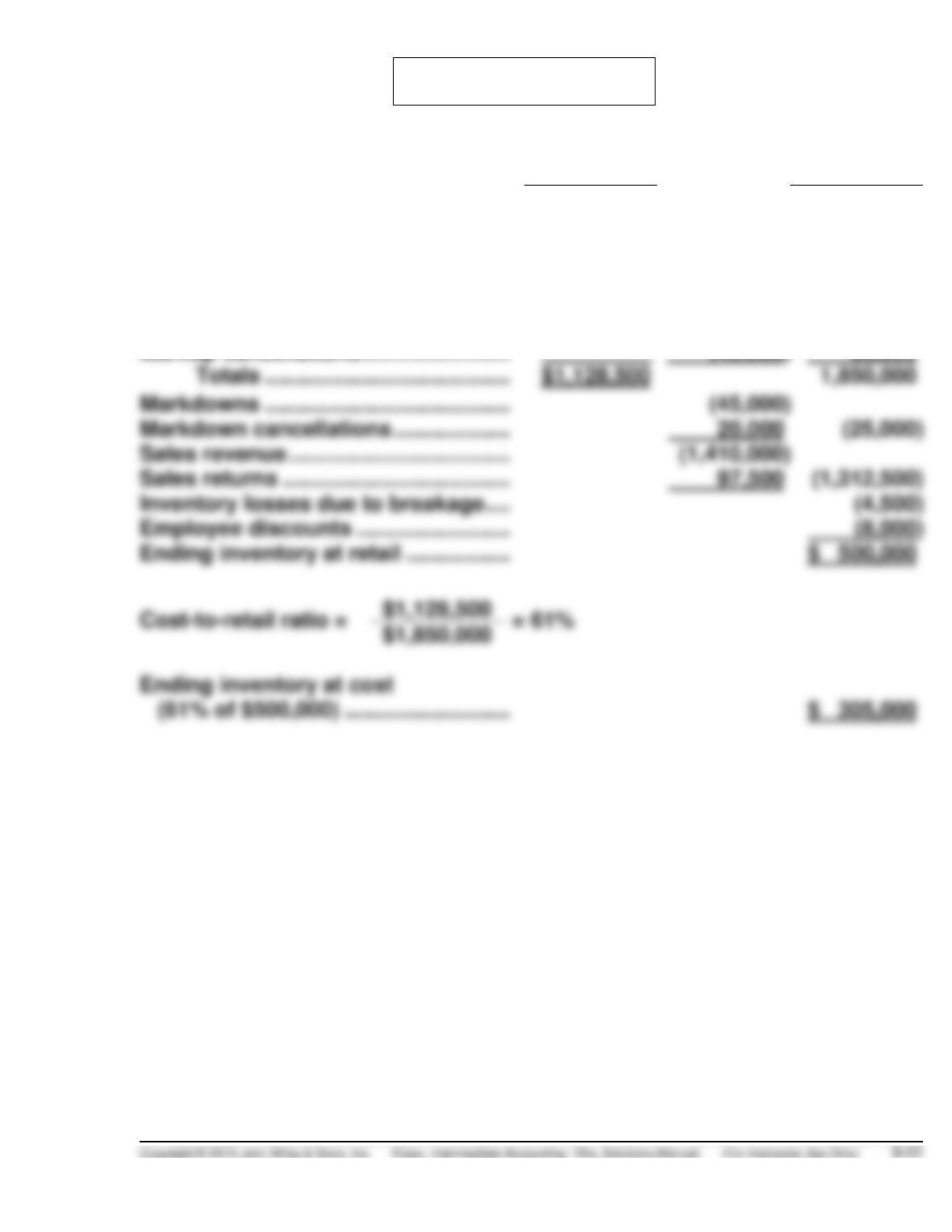
(a)
Cost
Retail
Beginning inventory ………………………
$ 17,000
$ 25,000
Purchases …………………………………….
82,500
137,000
Freight-in ………………………………………
7,000
Purchase returns …………………………..
(2,300)
(3,000)
Totals …………………………………..
180,000
Net markdowns ……………………………..
(4,000)
Sales revenue ……………………………….
$(95,000)
Sales returns ………………………………..
Inventory losses due to breakage …..
Ending inventory at retail ………………
$ 83,000
(b)
Ending inventory at lower-of-average-cost-or-market
(63% of $83,000) …………………………
$ 52,290
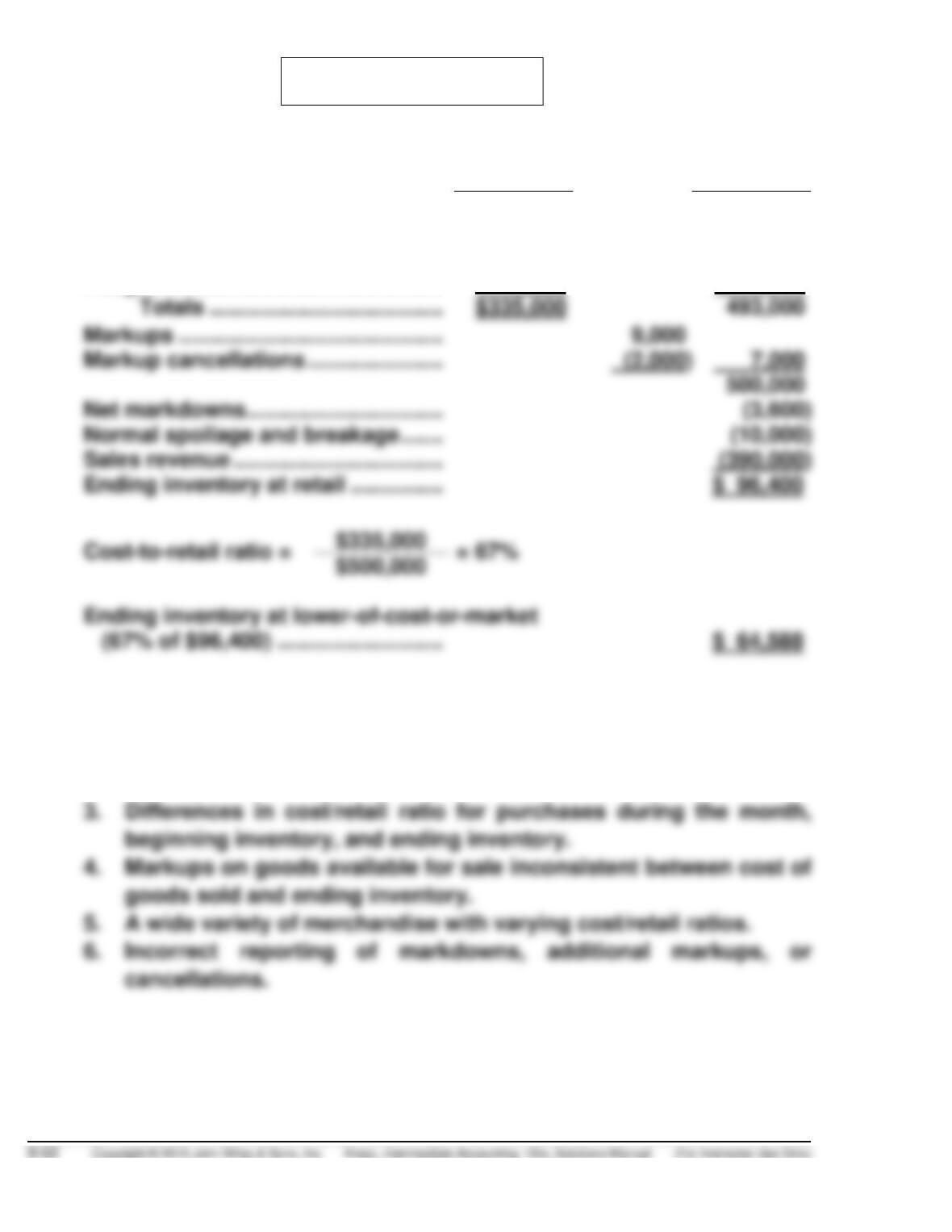
PROBLEM 9-7
Cost
Retail
Beginning inventory ……………………..
$ 250,000
$ 390,000
Purchases ……………………………………
914,500
1,460,000
Purchase returns ………………………….
(60,000)
(80,000)
Purchase discounts ……………………..
(18,000)
Freight-in …………………………………….
42,000
Markups ………………………………………
$ 120,000
Markup cancellations ……………………
(40,000)
80,000
Markdowns ………………………………….
Markdown cancellations ……………….
20,000
(25,000)
Sales revenue …………………………..….
Sales returns ……………………………….
Inventory losses due to breakage ….
Employee discounts …………………….
(8,000)
PROBLEM 9-8
(a)
Cost
Retail
Inventory (beginning) ………………….
$ 52,000
$ 78,000
Purchases ………………………………….
272,000
423,000
Purchase returns ………………………..
(5,600)
(8,000)
Freight-in ……………………………………
16,600
Markups …………………………………….
Markup cancellations ………………….
7,000
Net markdowns …………………………..
Normal spoilage and breakage …….
Sales revenue …………………………….
$335,000
$500,000
Ending inventory at lower-of-cost-or-market
(b) The difference between the inventory estimate per retail method and
the amount per physical count may be due to:
1. Theft losses (shoplifting or pilferage).
2. Spoilage or breakage above normal.
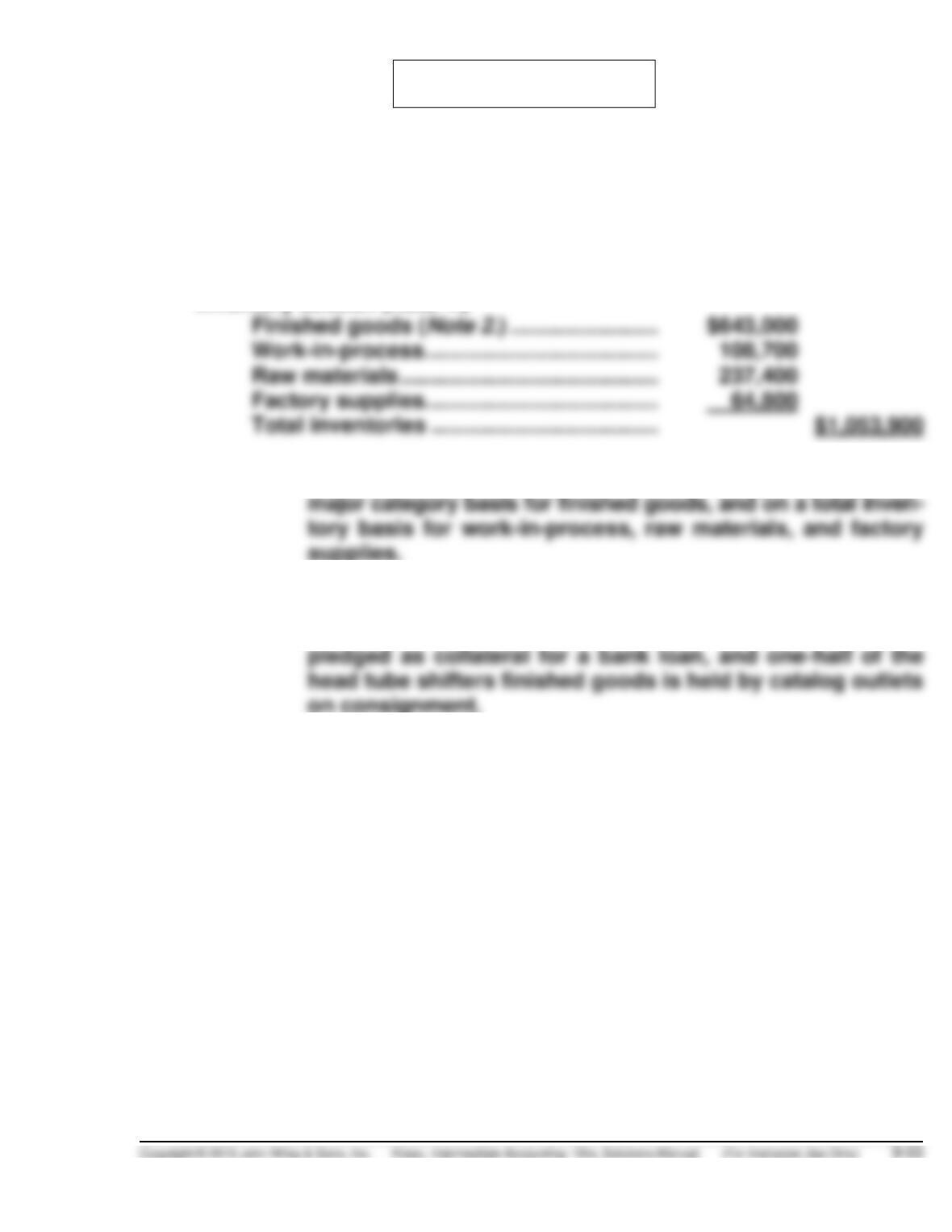
PROBLEM 9-9
(a) The inventory section of Maddox’s balance sheet as of November 30,
2014, including required footnotes, is presented below. Also presented
below are the inventory section supporting calculations.
Current assets
Inventory section (Note 1.)
Finished goods (Note 2.) ……………………
Work-in-process ………………………………..
Raw materials ……………………………………
Factory supplies………………………………..
Note 1. Lower-of-cost (first-in, first-out) or-market is applied on a
Note 2. Seventy-five percent of bar end shifters finished goods
inventory in the amount of $136,500 ($182,000 X .75) is
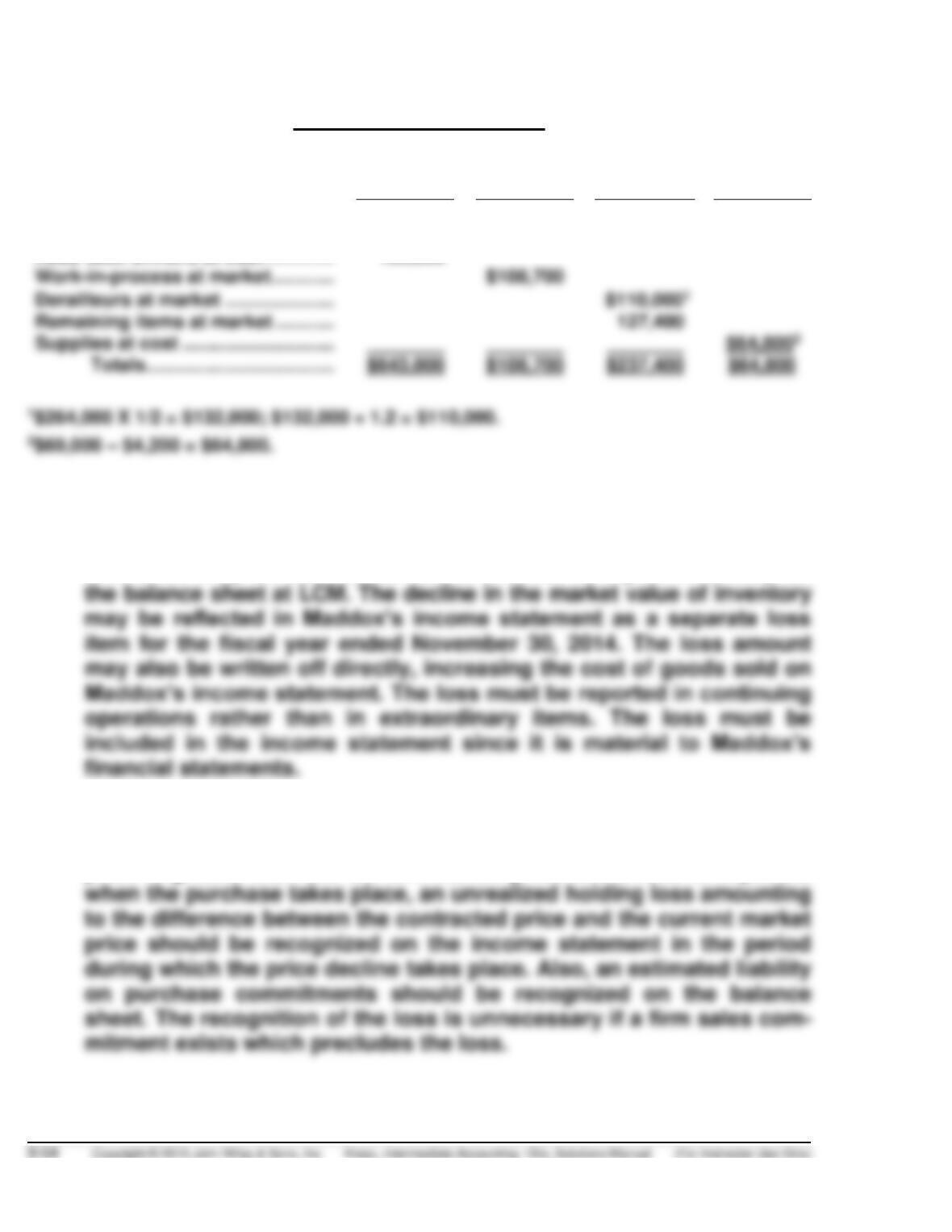
PROBLEM 9-9 (Continued)
Supporting Calculations
Finished
Goods
Work-in-
Process
Raw
Materials
Factory
Supplies
Down tube shifters at market ……..
$266,000
Bar end shifters at cost ……………..
182,000
Head tube shifters at cost ………….
195,000
$108,700
Derailleurs at market …………………
Remaining items at market ………..
Supplies at cost ………………………..
(b) The decline in the market value of inventory below cost may be
reported using one or two alternate methods, the direct write-down of
inventory (cost-of-goods-sold method) or the (loss method). An
allowance may be used under either method to report inventory on
(c) Purchase contracts for which a firm price has been established should
be disclosed on the financial statements of the buyer. If the contract
price is greater than the current market price and a loss is expected
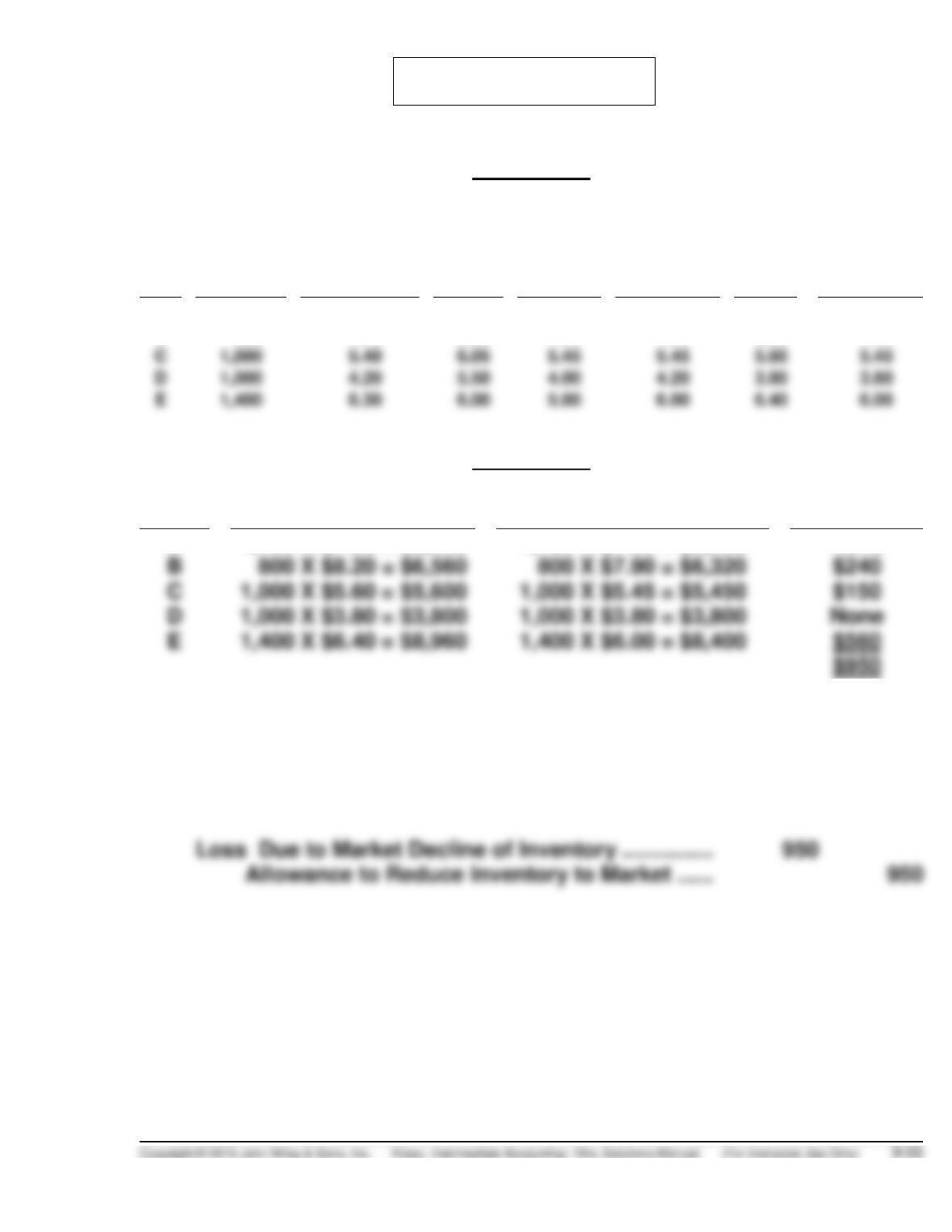
PROBLEM 9-10
(a) Schedule A
Item
On Hand
Quantity
Replacement
Cost/Unit
NRV
(Ceiling)
NRV—
Normal
Profit
(Floor)
Designated
Market
Cost
Lower-of–
Cost-or–
Market
A
1,100
$8.40
$9.00
$7.20
$8.40
$7.50
$7.50
B
800
7.90
8.50
7.30
7.90
8.20
7.90
C
1,000
5.40
6.05
5.45
5.45
5.60
5.45
D
4.20
5.50
4.00
4.20
3.80
3.80
E
1,400
6.30
6.00
5.00
6.00
6.40
6.00
Schedule B
Item
Cost
Lower-of-Cost-or-Market
Difference
A
1,100 X $7.50 = $8,250
1,100 X $7.50 = $8,250
None
C
1,000 X $5.60 = $5,600
1,000 X $5.45 = $5,450
D
1,000 X $3.80 = $3,800
1,000 X $3.80 = $3,800
None
(b) Cost of Goods Sold ……………………………………………………….
950
Allowance to Reduce Inventory to Market …………………
950
or
Loss Due to Market Decline of Inventory …………………………
950
Allowance to Reduce Inventory to Market …………………
950
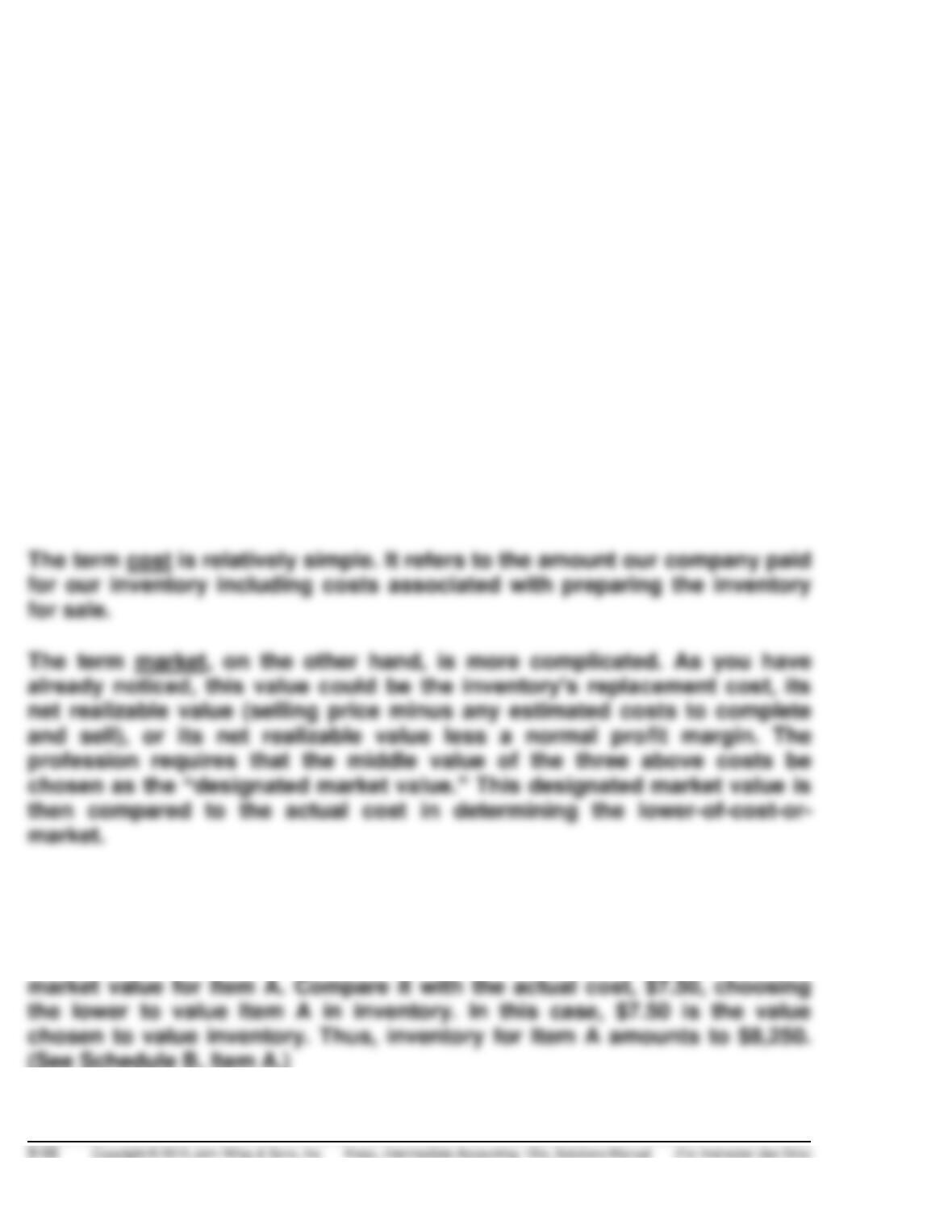
PROBLEM 9-10 (Continued)
(c)
To: Greg Forda, Clerk
From: Accounting Manager
Date: January 14, 2015
Subject: Instructions on determining lower–of-cost-or-market for inven-
tory valuation
This memo responds to your questions regarding our use of lower–of–cost-
or-market for inventory valuation. Simply put, value inventory at whichever
is the lower: the actual cost or the market value of the inventory at the time
of valuation.
Refer to Item A on the attached schedule. The values for the replacement
cost, net realizable value, and net realizable value less a normal profit margin
are $8.40, $9.00 ($10.50 – $1.50), and $7.20 ($9.00 – $1.80) respectively. The
middle value is the replacement cost, $8.40, which becomes the designated
PROBLEM 9-10 (Continued)
Proceed in the same way, always choosing the middle value among replace-
ment cost, net realizable value, and net realizable value less a normal profit,
and compare that middle value to the actual cost. The lower of these will
always be the amount at which you value the particular item.
After you have aggregated the total lower–of-cost-or-market for all items,
you will be likely to have a loss on inventory which must be accounted for.
In our example, the loss is $950. You can journalize this loss in one of two
ways:
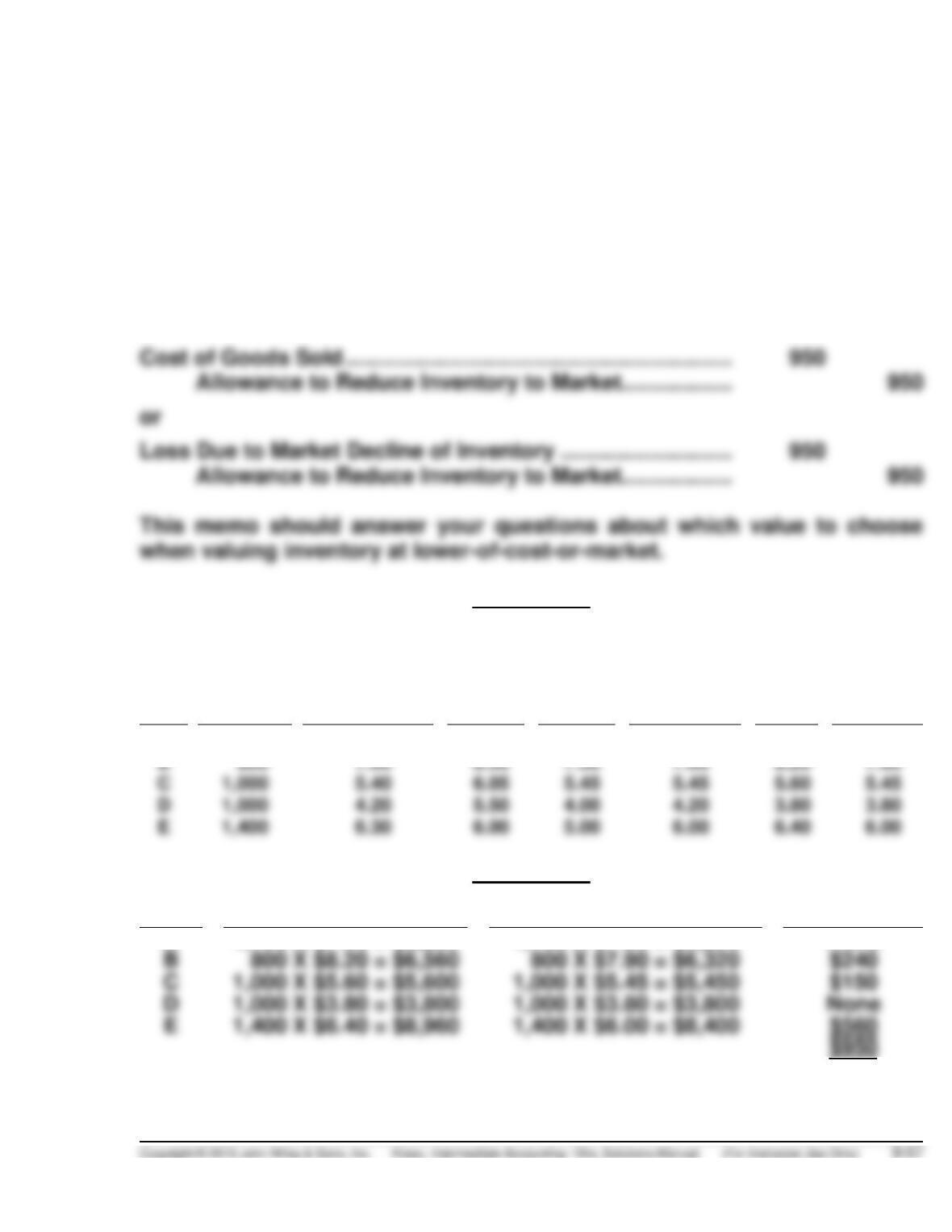
Schedule A
Item
On Hand
Quantity
Replacement
Cost/Unit
NRV
Ceiling
NRV—
Normal
Profit
(Floor)
Designated
Market
Cost
Lower-of–
Cost-or–
Market
A
1,100
$8.40
$9.00
$7.20
$8.40
$7.50
$7.50
B
C
1,000
D
1,000
E
1,400
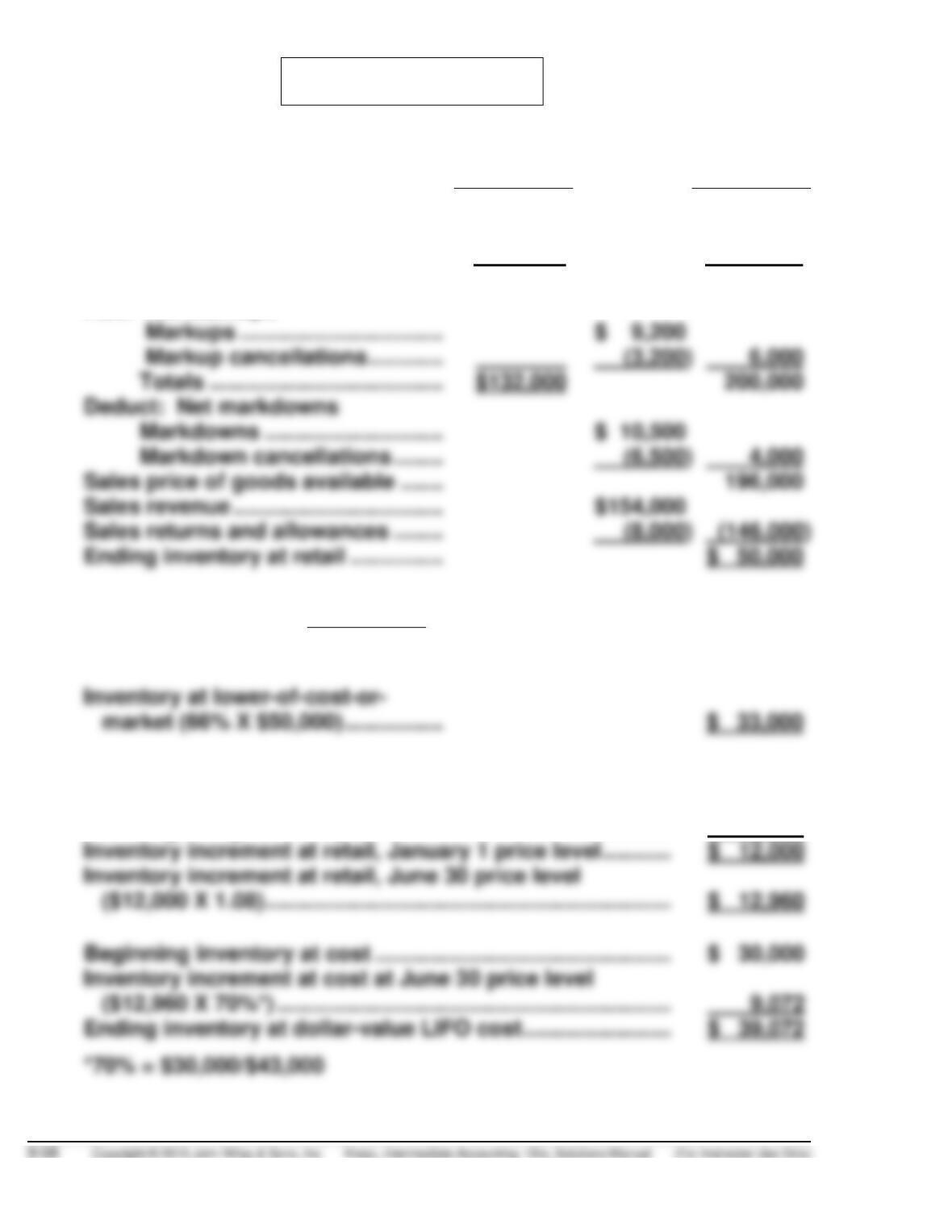
Schedule B
Item
Cost
Lower-of-Cost-or-Market
Difference
A
1,100 X $7.50 = $8,250
1,100 X $7.50 = $8,250
None
B
800 X $8.20 = $6,560
800 X $7.90 = $6,320
C
1,000 X $5.60 = $5,600
1,000 X $5.45 = $5,450
D
1,000 X $3.80 = $3,800
1,000 X $3.80 = $3,800
None
1,400 X $6.40 = $8,960
1,400 X $6.00 = $8,400
*PROBLEM 9-11
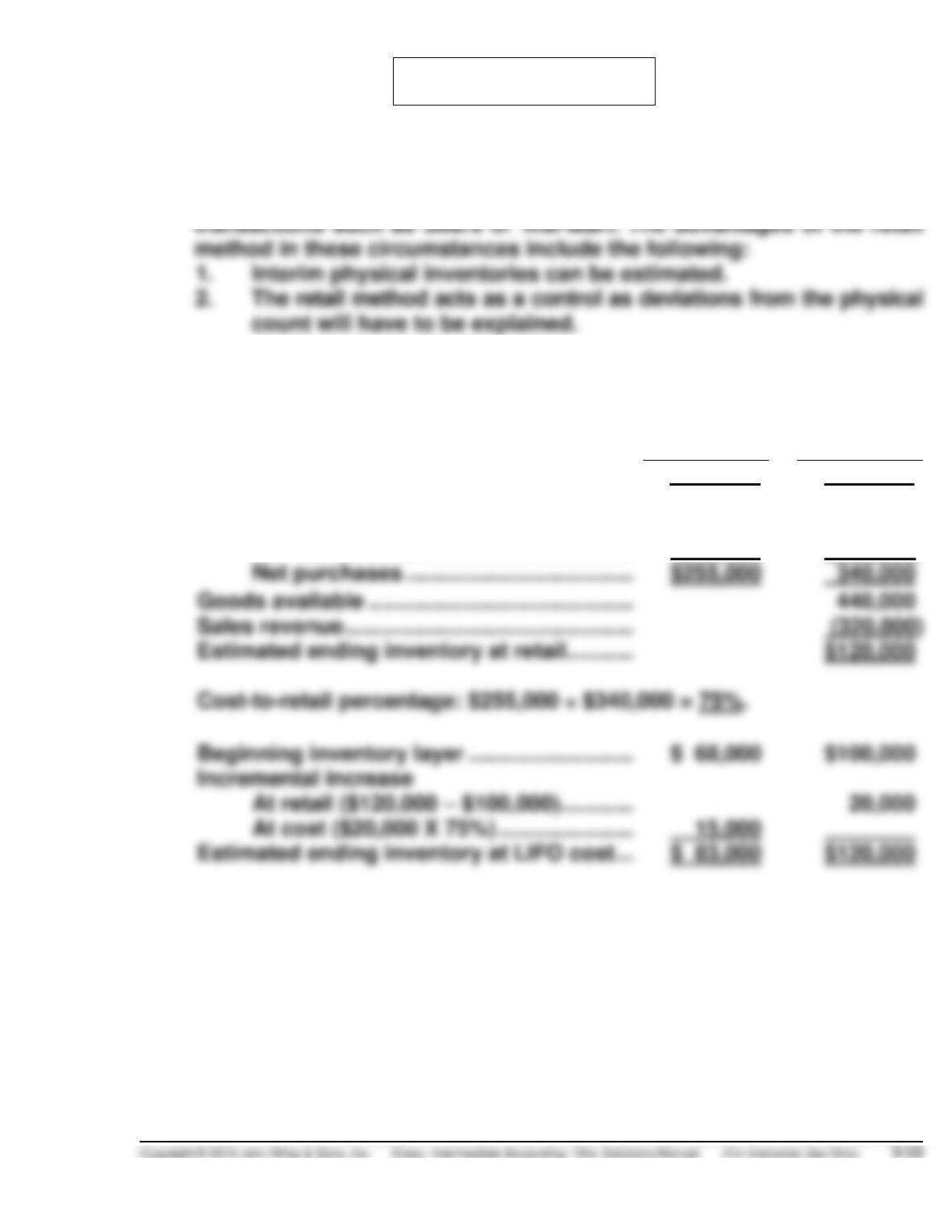
(a)
Cost
Retail
Inventory, January 1 …………………..
$ 30,000
$ 43,000
Purchases ………………………………….
104,800
155,000
Purchase returns ………………………..
(2,800)
(4,000)
Totals ………………………………..
132,000
194,000
Add: Net markups
Markups …………………………...
Markup cancellations …………
(3,200)
6,000
Deduct: Net markdowns
Markdowns ………………………..
Markdown cancellations ……..
4,000
Sales price of goods available …….
196,000
Sales revenue …………………………….
Sales returns and allowances ……..
Ending inventory at retail ……………
$ 50,000
Cost-to-retail ratio =
$132,000
= 66%
$200,000
(b)
Ending inventory at retail at January 1 price level
($59,400 ÷ 1.08) …………………………………………………………
$ 55,000
Less beginning inventory at retail ………………………………..
43,000
Inventory increment at retail, January 1 price level ………..
Beginning inventory at cost …………………………………………
Ending inventory at dollar-value LIFO cost ……………………
*PROBLEM 9-12
(a) The retail method is appropriate in businesses that sell many different
items at relatively low unit costs and that have a large volume of
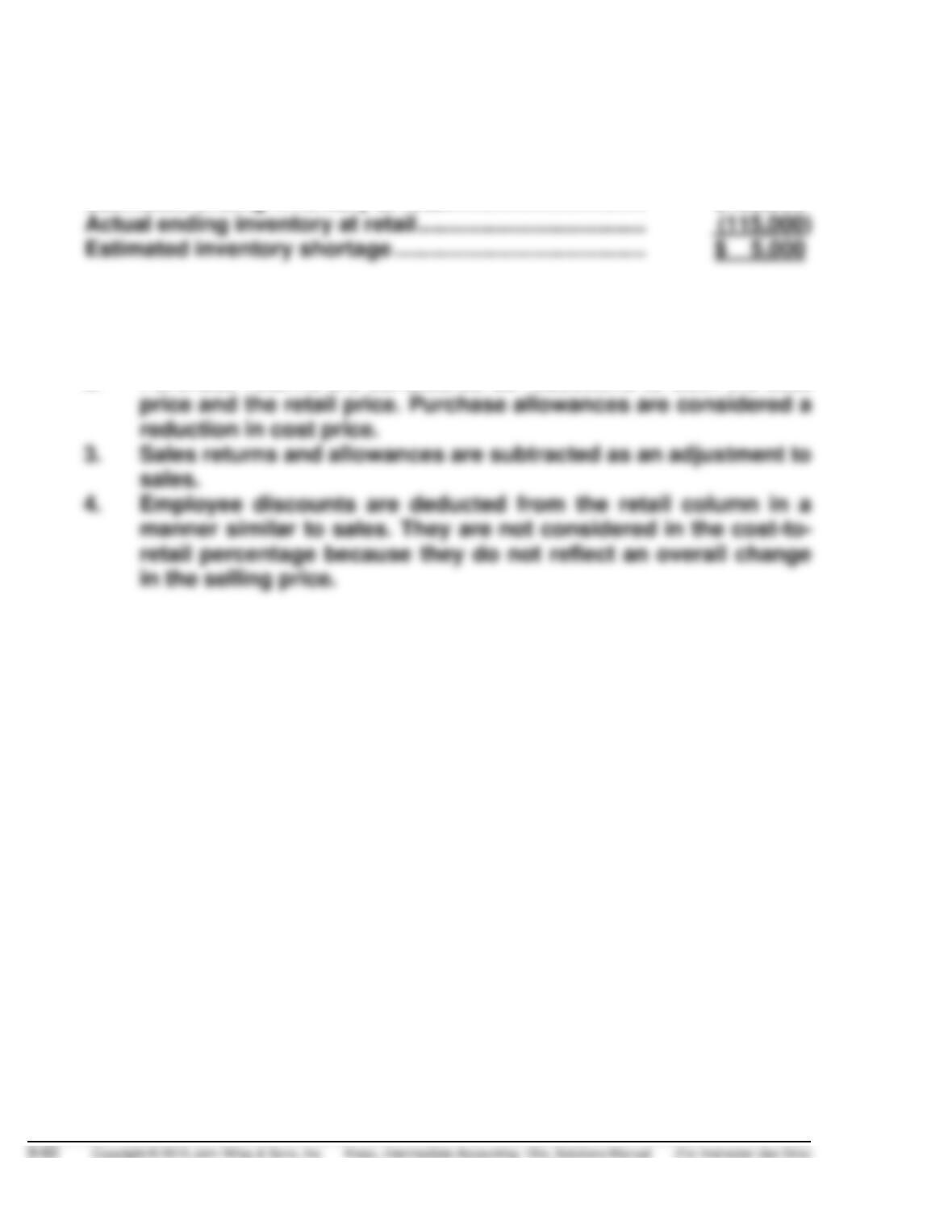
(b) Becker Department Stores’ ending inventory value, at cost, is $83,000,
calculated as follows:
Cost
Retail
Beginning inventory ………………………………
$ 68,000
$100,000
Purchases ……………………………………………..
$255,000
$400,000
Net markups ………………………………….
50,000
Net markdowns ……………………………..
(110,000)
Goods available …………………………………….
440,000
Sales revenue ………………………………………..
(320,000)
Estimated ending inventory at retail ………..
$120,000
Beginning inventory layer ………………………
$ 68,000
$100,000
Incremental increase
20,000
At cost ($20,000 X 75%) ………………….
15,000
*PROBLEM 9-12 (Continued)
(c) The estimated shortage amount, at retail, for Becker Department Stores
is $5,000 calculated as follows:
Estimated ending inventory at retail ………………………….
$120,000
Actual ending inventory at retail ……………………………….
(d) When using the retail inventory method, the four expenses and allow–
ances noted are treated in the following manner:
1. Freight costs are added to the cost of purchases.
2. Purchase returns are considered as reductions to both the cost