PROBLEM 9.88
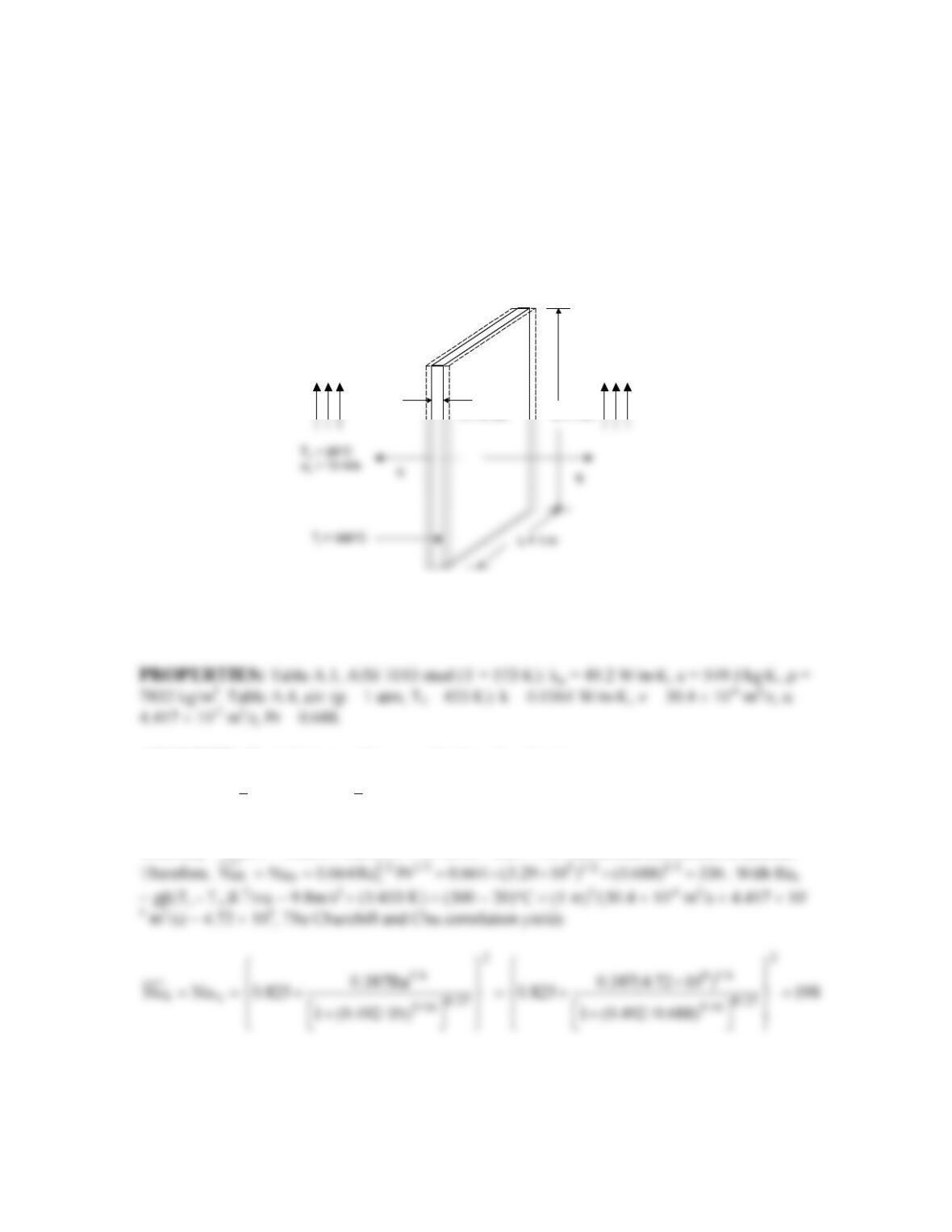
KNOWN: Plate dimensions and initial temperature. Velocity and temperature of air in parallel
flow over plates.
FIND: Initial rate of heat transfer from plate. Initial rate of change of plate temperature. Graph
of the free, forced and mixed convection heat transfer coefficients over the range 2 ≤ u∞ ≤ 10 m/s.
SCHEMATIC:
ASSUMPTIONS: (1) Negligible radiation, (2) Negligible effect of conveyor velocity on
boundary layer development, (3) Lumped capacitance behavior, (4) Negligible heat transfer from
sides of plate.
ANALYSIS: The initial rate of heat transfer from the plate is
i si i
q 2hA (T T ) 2hL(T T )
∞∞
= −= =
With ReL = u∞L/ν = 10m/s × 1m/30.4 × 10–6m2/s = 3.29 × 10⁵, the forced convection is laminar.
Continued…
L = 1 md= 6 mm
T
∞
= 20°C
u
∞
= 10 m/s
L = 1 md= 6 mm
T
∞
= 20°C
u
∞
= 10 m/s
PROBLEM 9.88 (Cont.)
Since the forced and free convection induced flows are transverse,
( )
1/3
33
FN
Nu Nu Nu= +
=
Performing an energy balance at an instant in time for the plate,
out st
EE−=
, we obtain
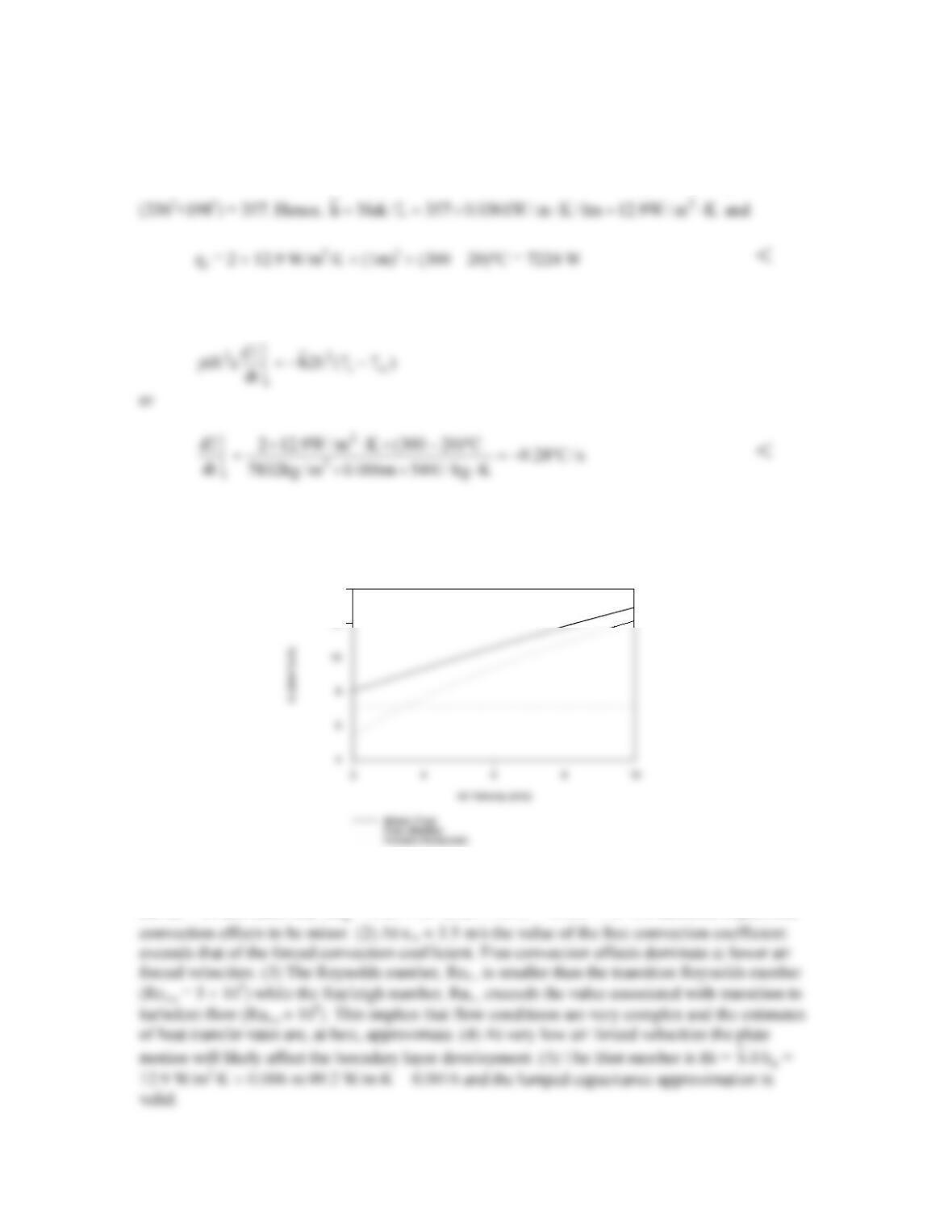
The heat transfer coefficient may be evaluated over the velocity range 2 ≤ u∞ ≤ 10 /ms, yielding
Convection Coefficient vs. Air Velociy
12
14
COMMENTS: (1) The Grashof number is GrL = RaL/Pr = 4.72 × 10⁹/0.688 = 6.86 × 10⁹. For
the u∞ = 10 m/s case, GrL/
2
Re
= 6.86 × 10⁹/(3.29 × 105)2 = 0.063 <<1. We therefore expect free
PROBLEM 9.89
KNOWN: Very small sphere.
FIND: Minimum value of the convection heat transfer coefficient expressed in terms of the sphere
diameter and the thermal conductivity of air.
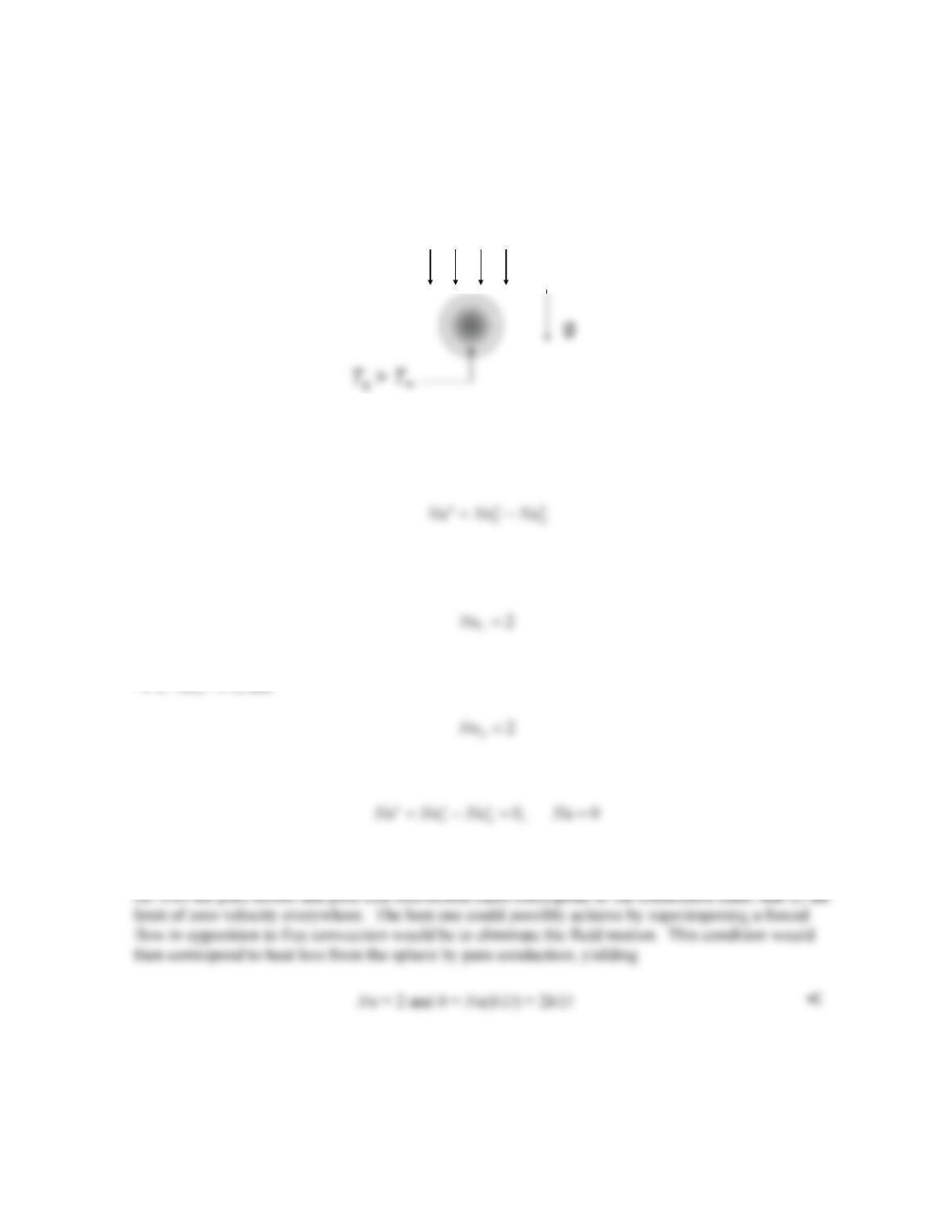
SCHEMATIC:
ASSUMPTIONS: Steady-state conditions.
ANALYSIS: According to Eq. 9.64, the Nusselt number for opposing flow is given by
The Nusselt number for pure forced convection past a sphere is given by Eq. 7.56. In the limit as D →
0, ReD → 0, and
For pure free convection past a sphere, the Nusselt number is given by Eq. 9.35, and in the limit as D
→ 0, RaD → 0, and
Therefore, according to Eq. 9.64,
Thus, Eq. 9.64 implies that convection heat losses could be entirely eliminated by incorporating the
assistant’s suggestion. However, this conclusion is flawed. The limiting values of Nusselt numbers
COMMENTS: (1) It is not possible to completely eliminate heat losses, since heat transfer by
conduction cannot be eliminated (except in a vacuum). (2) This exercise illustrates the approximate
nature of Eq. 9.64, which is not correct in the limit of pure conduction. (3) In reality, it is not possible
to completely eliminate motion at all points in the flow by superimposing a uniform downward flow
on free convection.
V, T∞
PROBLEM 9.90
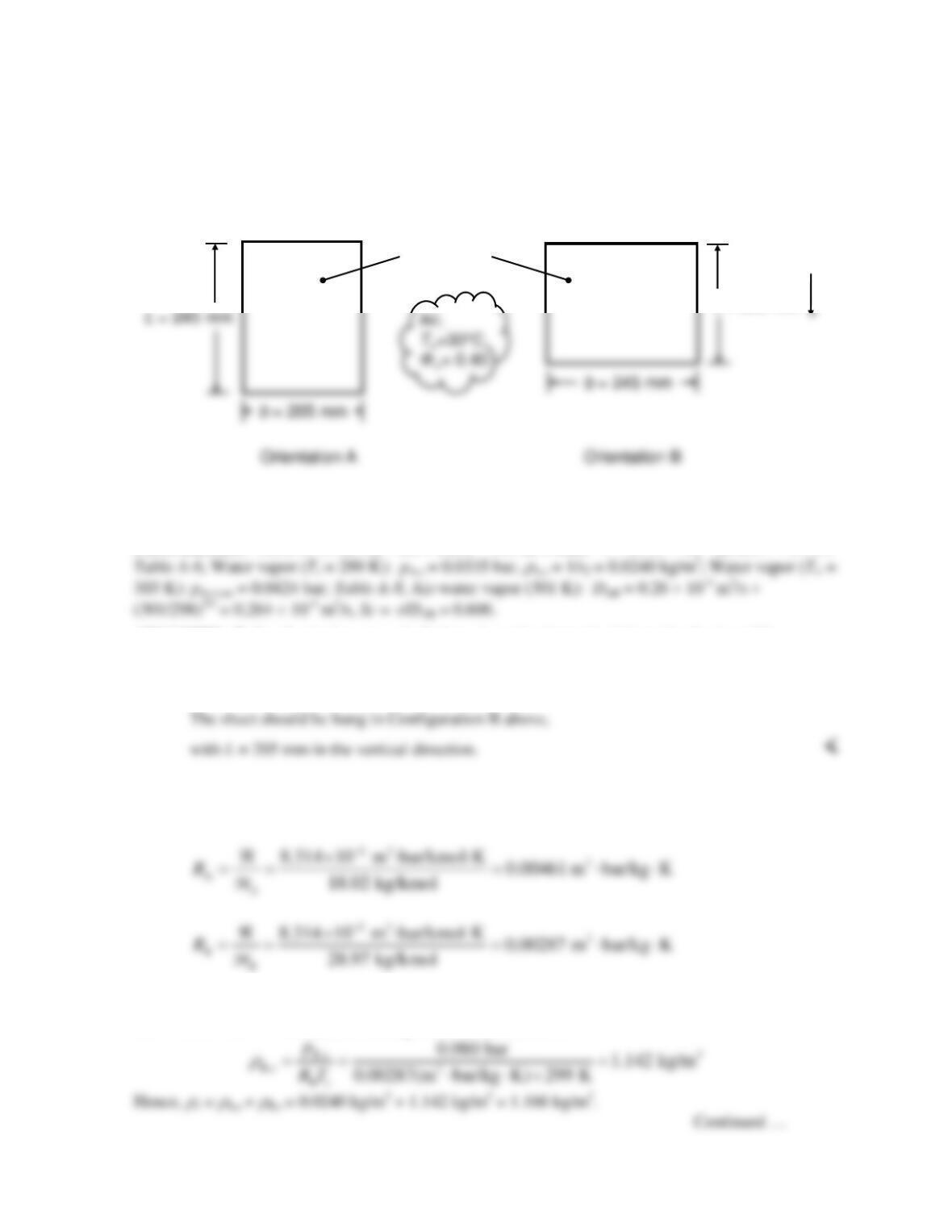
KNOWN: Dimensions and temperature of a wet sheet of fabric. Temperature and relative humidity
of surrounding still air
FIND: Should the sheet be hung with its long or short dimension in the vertical direction? What is
the maximum drying rate?
SCHEMATIC:
T
s
= 26°C
g
L= 205 mm
ASSUMPTIONS: (1) Analogy between heat and mass transfer applies, (2) Water vapor at garment
surface is saturated at Ts, (3) Ideal gas behavior of water vapor and air.
PROPERTIES: Table A-4, Air (Tf = (Ts + T∞)/2 = 301 K, 1 atm):
ν
= 15.99 × 10⁻⁶ m2/s, Pr = 0.707;
ANALYSIS: Before beginning any calculations, it can be determined from the physics of the
problem that a shorter vertical dimension will give rise to a thinner boundary layer on average, which
enhances evaporation. Therefore:
We proceed to calculate all of the needed densities. First, we will need the gas constants for water (A)
and air (B):
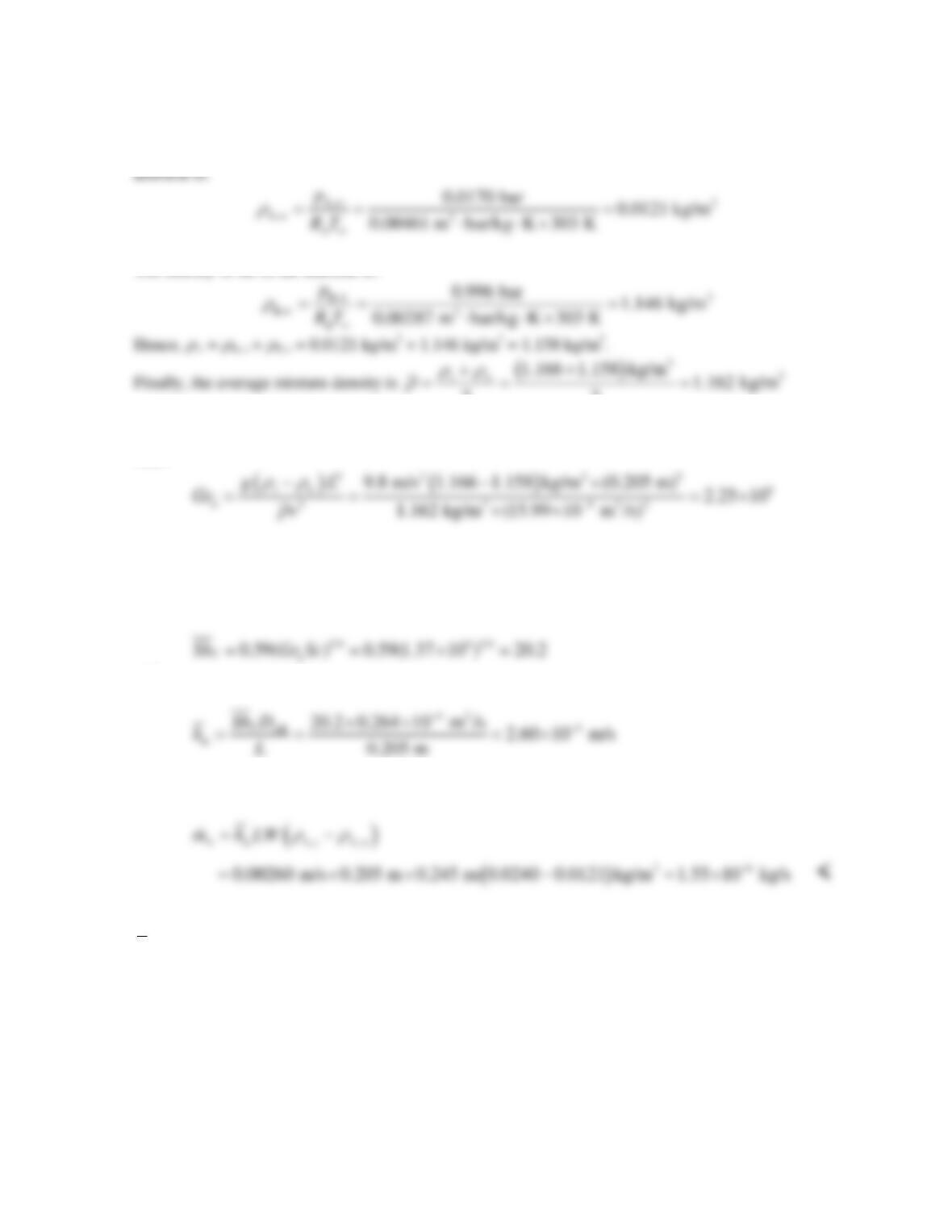
The density of the air/vapor mixture at the surface is
r
s =
r
A,s +
r
B,s. With pB,s = 1 atm – pA,s = 1.0133
bar – 0.0335 bar = 0.980 bar, the density of air at the surface is:
PROBLEM 9.90 (Cont.)
The partial pressure of water vapor in the ambient is pA,∞ = pA,∞,sat ×
φ
∞ = 0.0424 bar × 0.4 = 0.0170
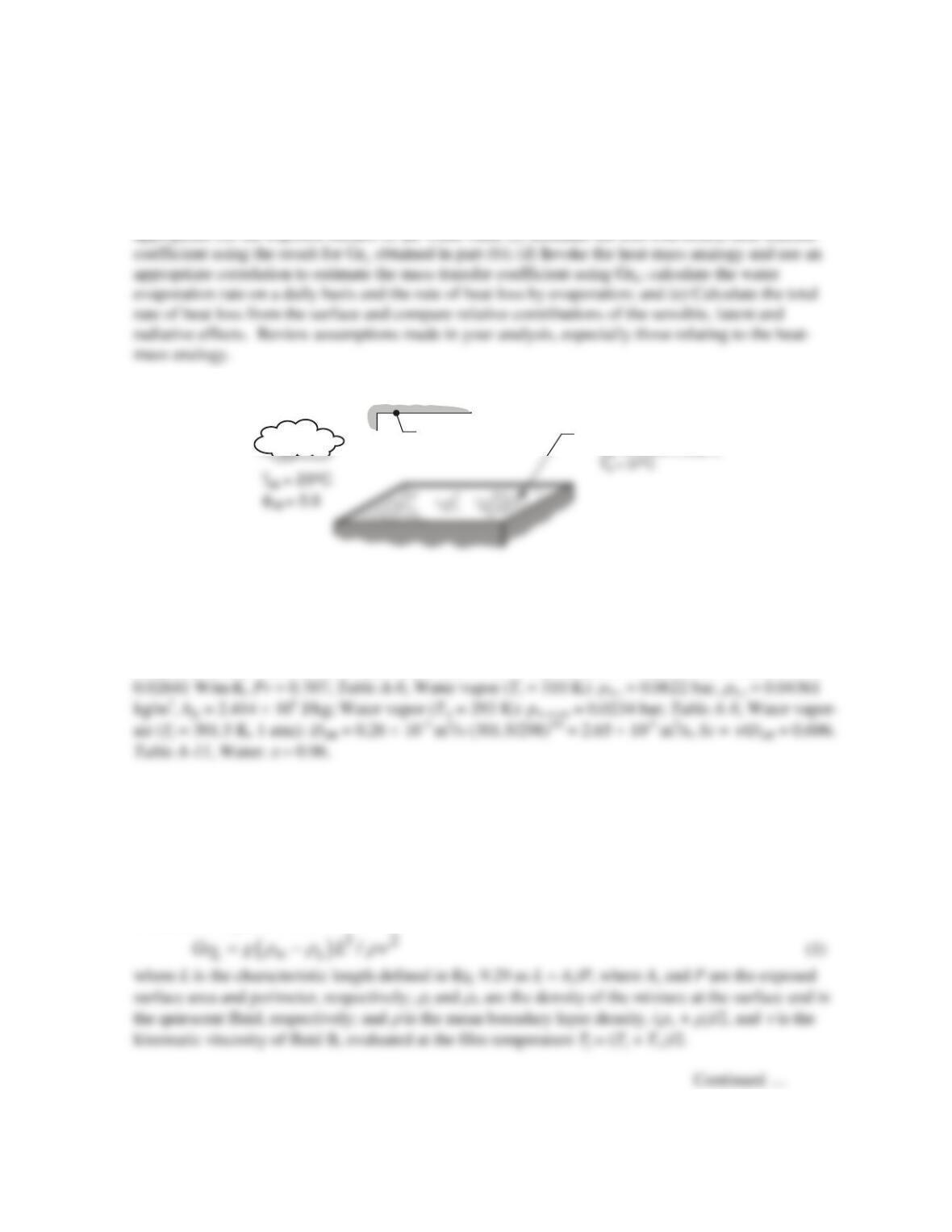
bar. Then pB,∞ = 1 atm – pA,∞ = 1.0133 bar – 0.0170 bar = 0.996 bar. The density of water vapor in the
The density of air in the ambient is:
22
With all of the needed densities determined, the Grashof number can be calculated from Equation
9.65:
The Sherwood number is given by Equation 9.66, where
6
2.25 10 0.606
L
Gr Sc = ××
6
1.37 10= ×
is
analogous to the Rayleigh number. Referring to the beginning of Section 9.6.1, C = 0.59 and n = ¼
are the appropriate values, therefore:
and
Finally, the drying rate is:
COMMENTS: (1) Since
r
s >
r
∞, the buoyancy driven flow descends along the fabric. (2) Note that
1/ 4
m
hL
−
−
, so the drying rate is only weakly dependent on L. For turbulent flow, with n = 1/3, there is
no dependence on L, and it doesn’t matter which direction the sheet hangs.
PROBLEM 9.91
KNOWN: A water bath maintained at a uniform temperature of 37°C with top surface exposed to
draft–free air and uniform temperature walls in a laboratory.
FIND: (a) The rate of heat loss from the surface of the bath by radiation exchange with the
surroundings; (b) Calculate the Grashof number using Eq. 9.65 with a characteristic length L that is
appropriate for the exposed surface of the water bath; (c) Estimate the free convection heat transfer
SCHEMATIC:
T
sur
= 25 C
o
A = 0.25 m x 0.50 m
Water surface
Quiescent
air
ASSUMPTIONS: (1) Steady-state conditions, (2) Laboratory air is quiescent, (3) Laboratory walls
are isothermal and large compared to water bath exposed surface, (4) Heat–mass analogy is applicable,
(5) Water vapor at surface is saturated at Ts, (6) Ideal gas behavior of water vapor and air.
PROPERTIES: Table A-4, Air (Tf = (Ts + T∞)/2 = 301.5 K, 1 atm):
ν
= 16.04 × 10⁻⁶ m2/s, k =
ANALYSIS: (a) The radiation heat rate can be estimated as
()
44
rad surss
q AT T
εs
= −
( )
()
8 24 2 4 4
rad 0.96 5.67 10 W/m K 0.25 0.50 m 310 298 K 9.18 Wq−
= × × ⋅× × × − =
<
(b) The general form of the Grashof number, Eq. 9.65, applied to natural convection flows driven by
concentration gradients is
PROBLEM 9.91 (Cont.)
We proceed to calculate all of the needed densities. First, we will need the gas constants for water (A)
and air (B):
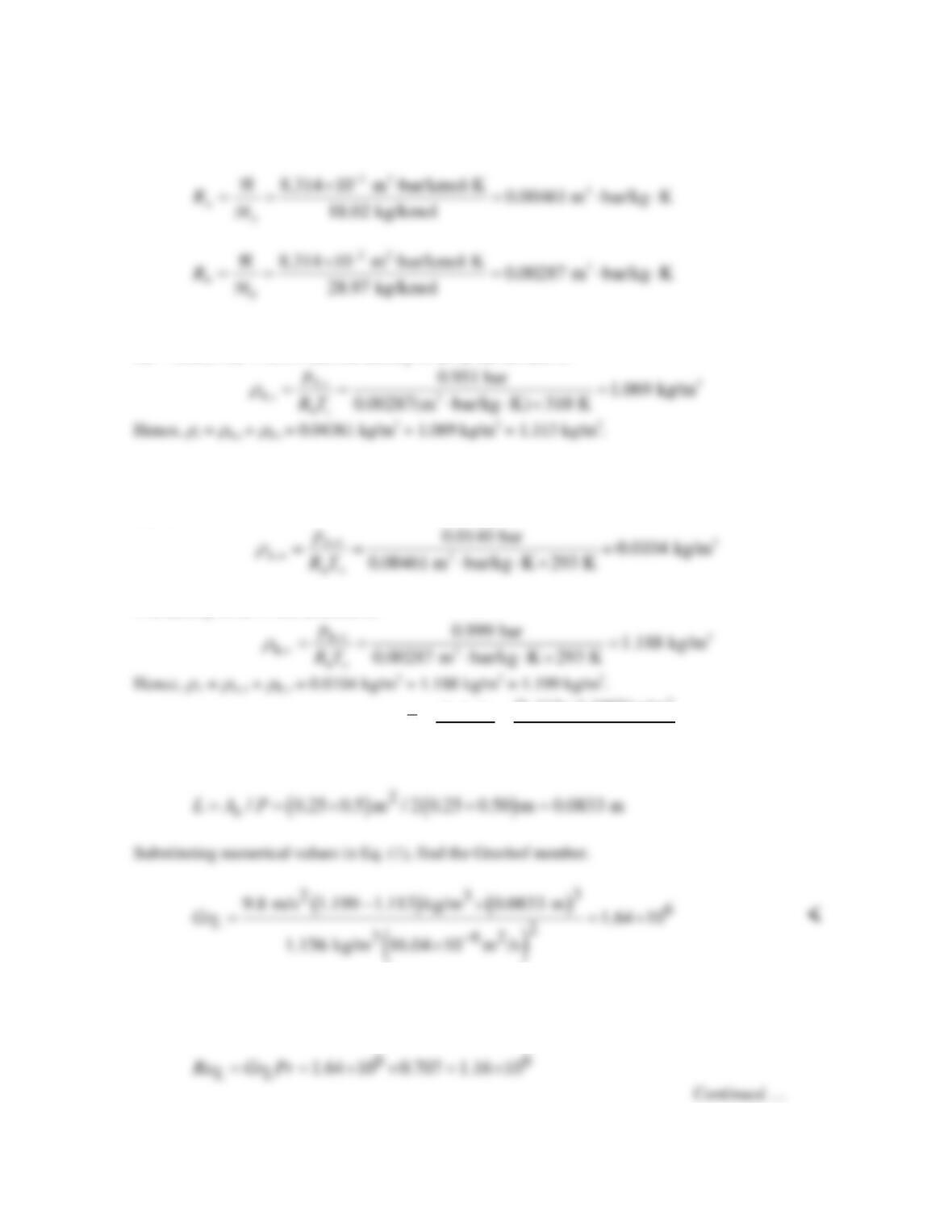
The density of the air/vapor mixture at the surface is
r
s =
r
A,s +
r
B,s. With pB,s = 1 atm – pA,s = 1.0133
bar – 0.0622 bar = 0.951 bar, the density of air at the surface is:
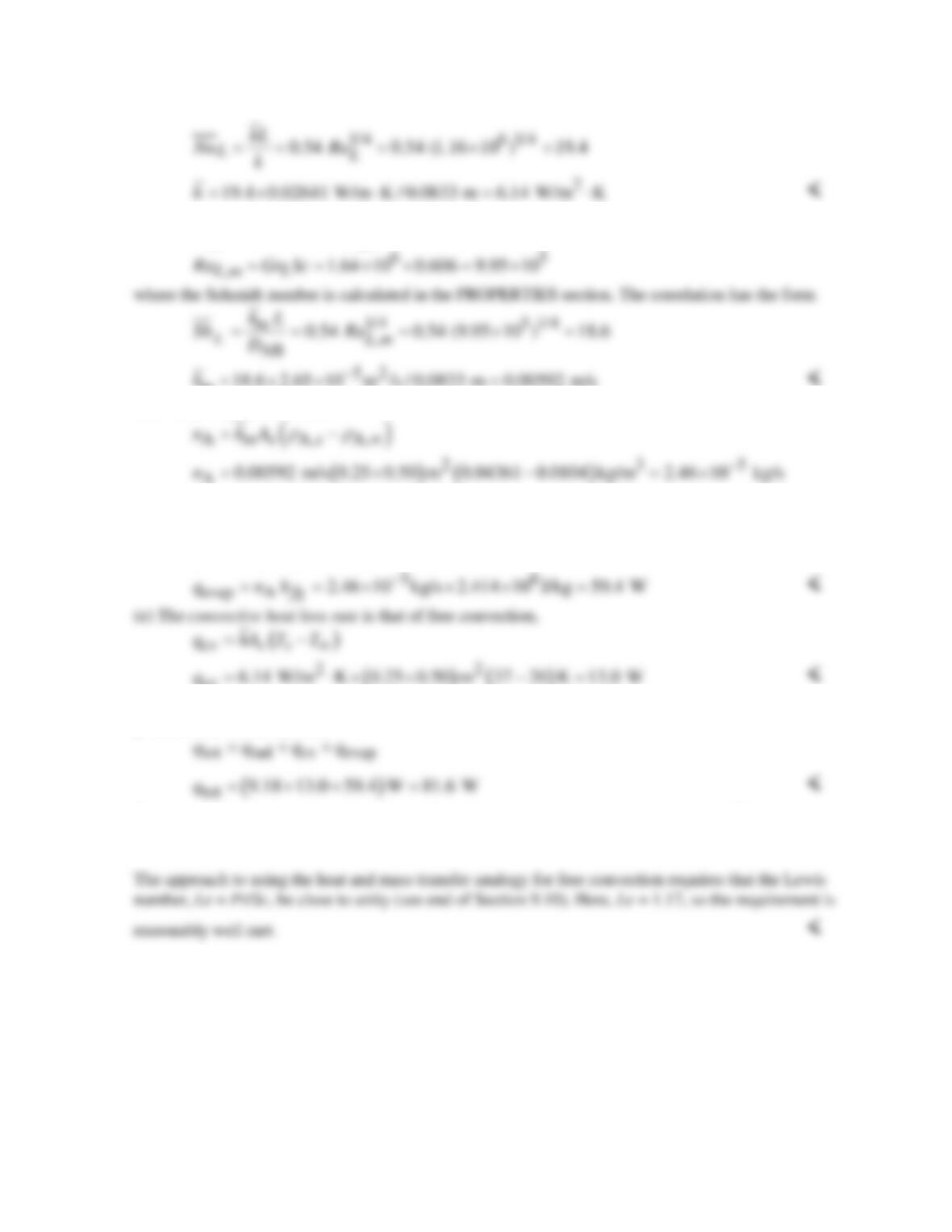
The partial pressure of water vapor in the ambient is pA,∞ = pA,∞,sat ×
φ
∞ = 0.0234 bar × 0.6 = 0.0140
bar. Then pB,∞ = 1 atm – pA,∞ = 1.0133 bar – 0.0140 bar = 0.999 bar. The density of water vapor in the
ambient is:
The density of air in the ambient is:
Finally, the average mixture density is
( )
3
3
1.113 1.199 kg/m 1.156 kg/m
22
s
rr
r
∞
+
+
= = =
The characteristic length is defined by Eq. 9.29,
(c) The free convection heat transfer coefficient for the horizontal surface, Eq. 9.30, for upper surface
of hot plate, is estimated as follows:
PROBLEM 9.91 (Cont.)
(d) Invoking the heat–mass analogy, the mass transfer coefficient is estimated as follows,
18.6 2.65 10 m /s / 0.0833 m 0.00592 m/s
m
h−
=×× =
<
The water evaporation rate is
or on a daily basis
5
A2.46 10 kg/s 2.12 kg/dayn−
=×=
<
and the heat loss rate by evaporation is
cv 6.14 W/m K 0.25 0.50 m 37 20 K 13.0 Wq= ⋅× × − =
In summary, the total heat loss rate from the surface of the bath, which must be supplied as electrical
power to the bath heaters, is
The sensible heat losses are by radiation and convection (qrad + qcv), which represent 27% of the
total; the balance is the latent loss by evaporation, 73%.
COMMENTS: It has been assumed that the lab air is quiescent, that is, that the scenario is one of
pure free convection. In order for this to be valid, it requires GrL/ReL
2 >> 1 or ReL << GrL
1/2 = 1280.
Taking L = 0.25 m as an example, this requires V << 0.08 m/s. It is unlikely that this condition is met,
so the actual situation is probably characterized by mixed free and forced convection. The condition
could be met in the lab by placing the experiment in an enclosure.
PROBLEM 9.92
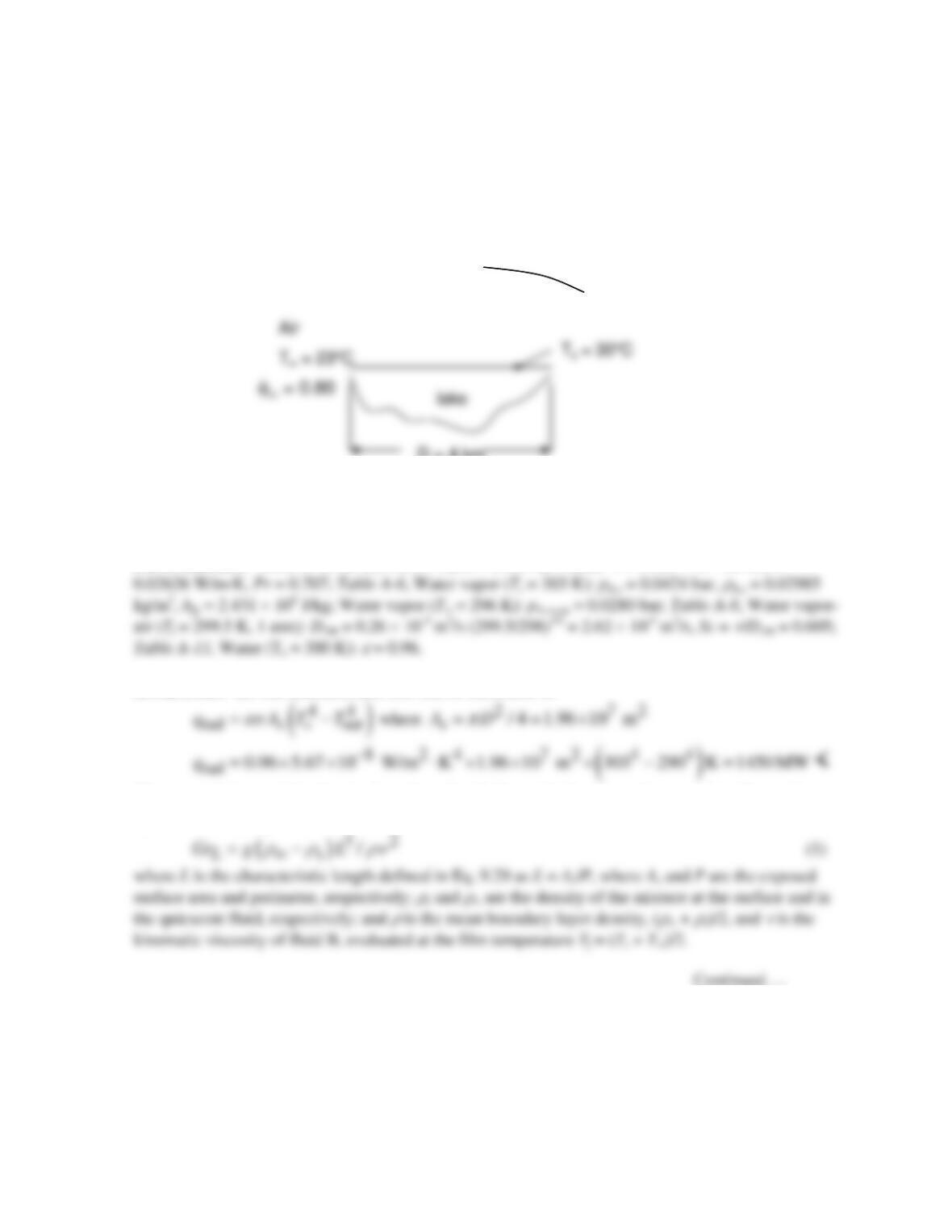
KNOWN: Diameter and surface temperature of lake. Temperature and relative humidity of air.
Surroundings temperature.
FIND: Rate of heat loss from lake by radiation, free convection, and evaporation. Justify use of heat
transfer correlation outside of RaL range.
SCHEMATIC:
D = 4 km
Surroundings, Tsur = 285 K
D = 4 km
Surroundings, Tsur = 285 K
ASSUMPTIONS: (1) Steady–state conditions. (2) Negligible breeze. (3) Heat–mass transfer analogy
is applicable. (4) Heat transfer correlation can be used outside of RaL range. (5) Water vapor at
surface is saturated at Ts. (6) Ideal gas behavior of water vapor and air.
PROPERTIES: Table A-4, Air (Tf = (Ts + T∞)/2 = 299.5 K, 1 atm):
ν
= 15.85 × 10⁻⁶ m2/s, k =
ANALYSIS: (a) The radiation heat rate can be calculated as
The general form of the Grashof number, Eq. 9.65, applied to natural convection flows driven
by concentration gradients is
PROBLEM 9.92 (Cont.)
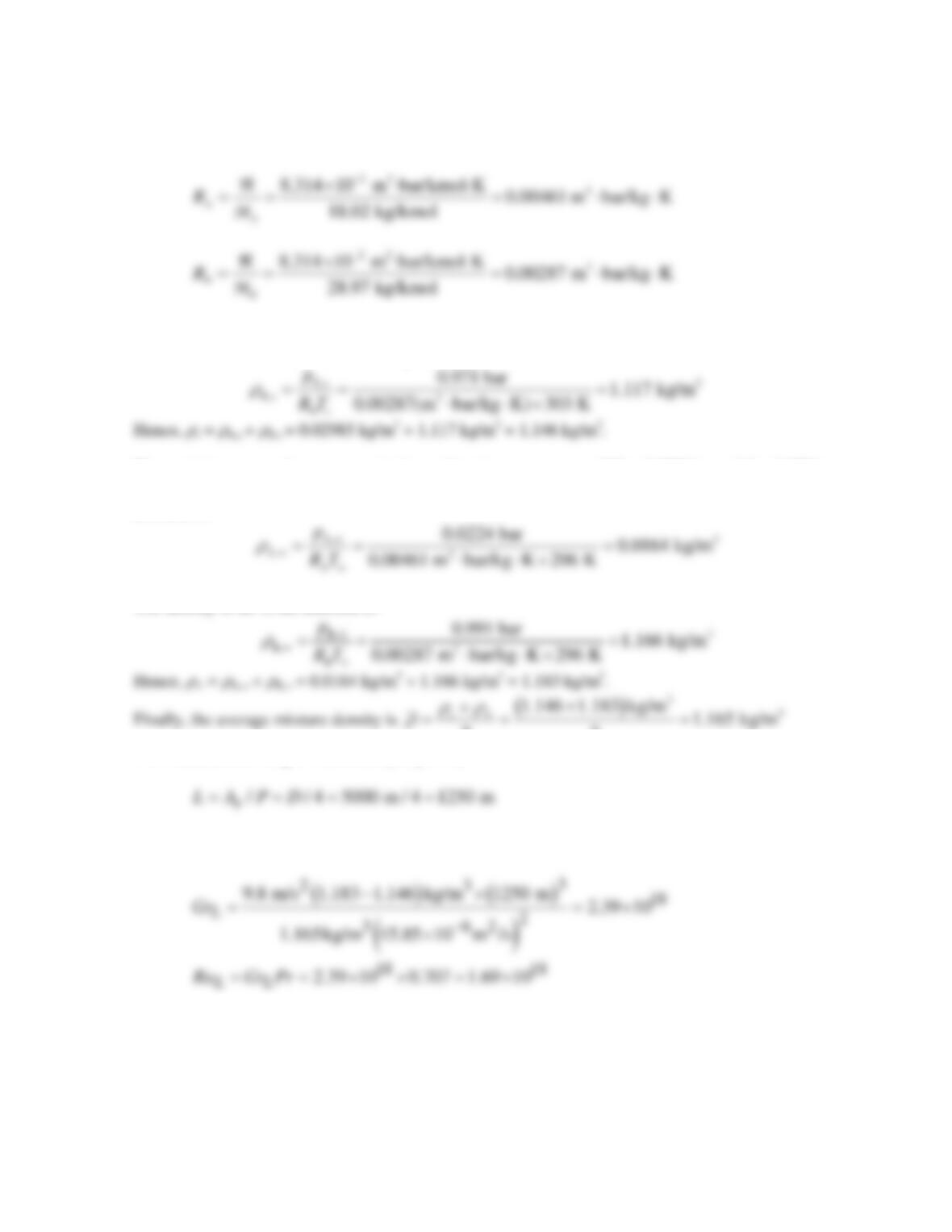
We proceed to calculate all of the needed densities. First, we will need the gas constants for water (A)
and air (B):
The density of the air/vapor mixture at the surface is
r
s =
r
A,s +
r
B,s. With pB,s = 1 atm – pA,s = 1.0133
bar – 0.0424 bar = 0.971 bar, the density of air at the surface is:
The partial pressure of water vapor in the ambient is pA,∞ = pA,∞,sat × RH = 0.0280 bar × 0.8 = 0.0224
bar. Then pB,∞ = 1 atm – pA,∞ = 1.0133 bar – 0.0224 bar = 0.991 bar. The density of water vapor in the
ambient is:
The density of air in the ambient is:
22
The characteristic length is defined by Eq. 9.29,
Substituting numerical values in Eq. (1), find the Grashof number.
The free convection heat transfer coefficient for the upper surface of a hot plate is given by Equation
9.31, but the Rayleigh number is larger than the upper limit specified for this correlation. However,
since RaL is raised to the 1/3 power, this correlation yields a heat transfer coefficient which is
independent of L. Therefore it is reasonable to expect that the heat transfer coefficient calculated by
this correlation is valid even though RaL is outside the range. <
Continued …
PROBLEM 9.92 (Cont.)
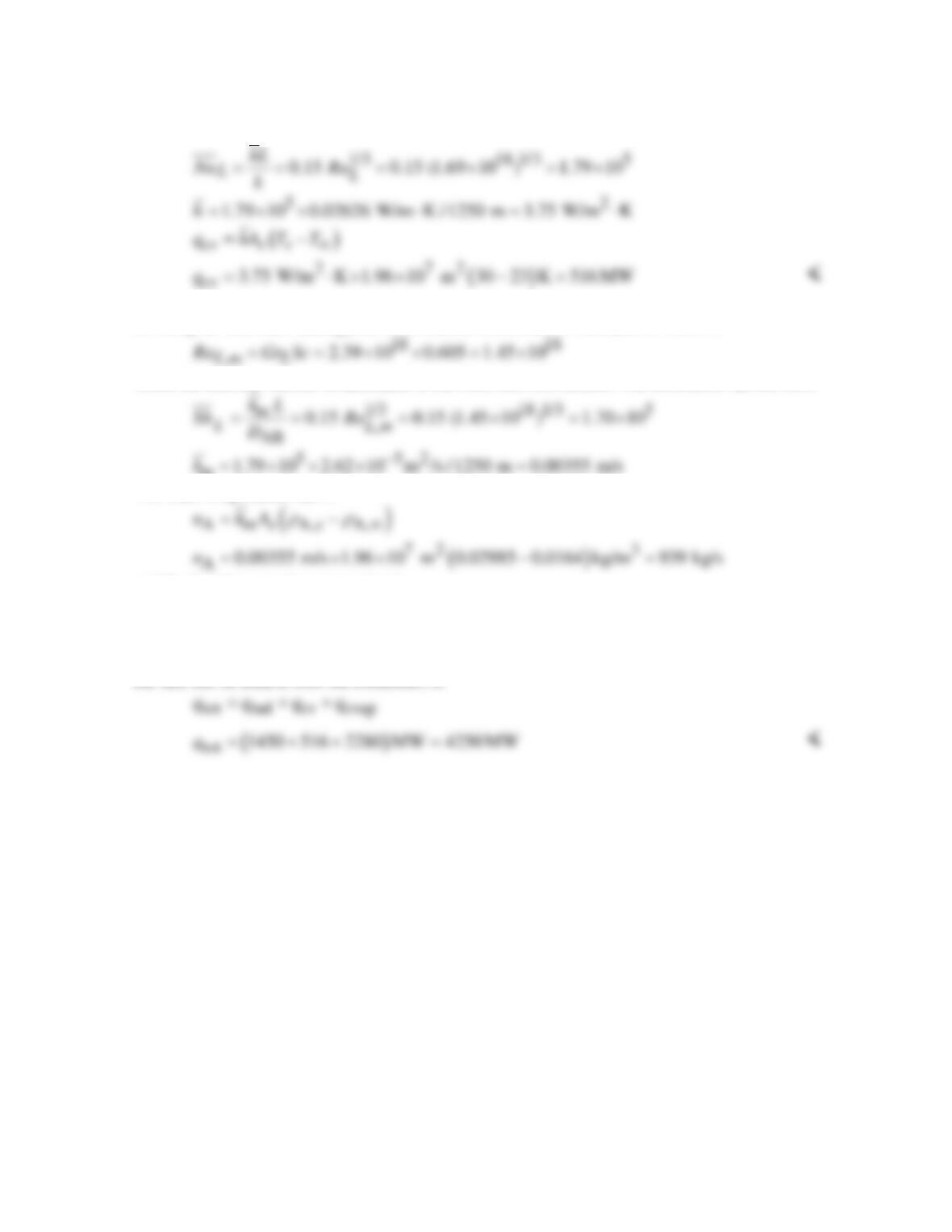
Proceeding,
Invoking the heat-mass analogy, the mass transfer coefficient is estimated as follows,
where the Schmidt number is calculated in the PROPERTIES section. The correlation has the form
m
The water evaporation rate is
and the heat loss rate by evaporation is
6
evap A 939 kg/s 2.431 10 J/kg 2280 MW
fg
q nh= = ×× =
<
In summary, the total rate of heat loss from the surface of the lake, which determines the rate at which
the lake can be used to cool the condenser, is
COMMENTS: The latent heat loss by evaporation accounts for 54% of the total.