CHAPTER 9
Inventories: Additional Valuation Issues
SOLUTIONS TO B PROBLEMS
PROBLEM 9-1
Item
Cost
Replacement
Cost
Ceiling*
Floor**
Designated
Market
Lower-of–
Cost-or–
Market
A
$470
$ 460
$ 450
$350
$ 450
$450
B
450
430
480
372
430
430
C
830
610
820
640
640
640
D
960
1,000
1,070
830
1,000
960
PROBLEM 9-2
(a) 1. The balance in the Allowance to Reduce Inventory to Market at
May 31, 2012, should be $34,600, as calculated in Exhibit 1 below.
Exhibit 1
CALCULATIONS OF PROPER BALANCE
in the Allowance to Reduce Inventory to Market
At May 31, 2012
Cost
Replace-
ment
Cost
NRV
(Ceiling)
NRV less
normal
profit
(Floor)
LCM
Aluminum siding
$ 70,000
$ 62,500
$ 56,000
$ 50,900
$ 56,000
Cedar shake siding
86,000
79,400
84,800
77,400
79,400
Louvered glass doors
Thermal windows
Totals
$408,000
2. For the fiscal year ended May 31, 2012, the loss that would be
recorded due to the change in the Allowance to Reduce Inventory
to Market would be $7,100, as calculated below.
PROBLEM 9-2 (Continued)
(b) The use of the lower-of-cost–or–market (LCM) rule is based on both the
expense recognition principle and the concept of conservatism. The
PROBLEM 9-3
(a)
12/31/12 (Cost-of–goods-sold Method)
Cost of Goods Sold …………………………………………………
68,000
Inventory …………………………..…………………………..
Cost of Goods Sold …………………………………………………
75,000
Inventory …………………………..…………………………..
(b)
12/31/12 (Loss Method)
To write down inventory to market:
Loss Due to Market Decline of Inventory ………………….
68,000
Allowance to Reduce Inventory to Market …………
To write down inventory to market:
Loss Due to Market Decline of Inventory ………………….
Allowance to Reduce Inventory to Market
[($905,000 – $830,000) – $68,000] …………………..
PROBLEM 9-4
Beginning inventory ……………………………………………..
$ 80,000
Purchases ……………………………………………………………
290,000
370,000
Purchase returns ………………………………………………….
(28,000)
Total goods available ……………………………………………
342,000
Sales ……………………………………………………………………
Sales returns ……………………………………………………….
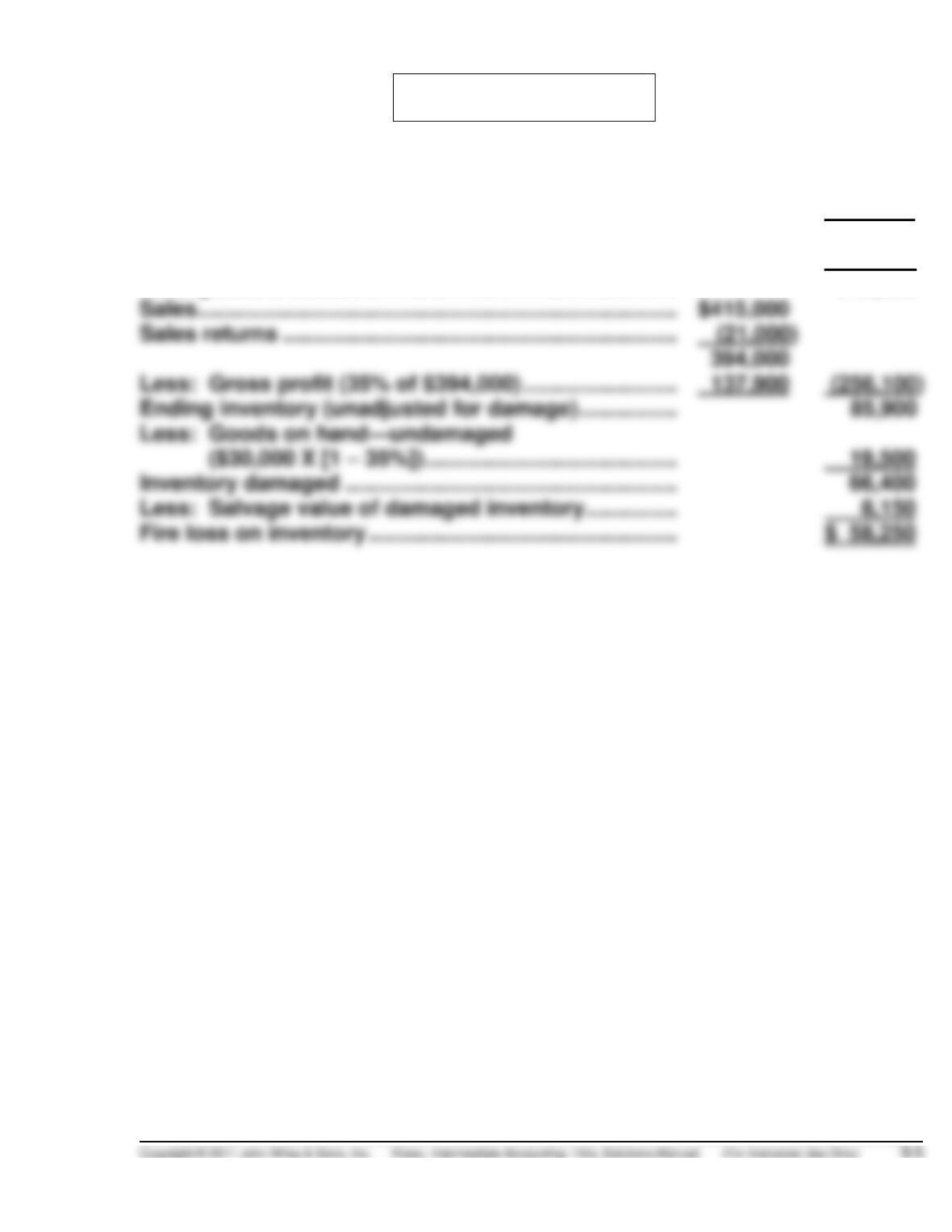
Less: Gross profit (35% of $394,000) …………………….
Ending inventory (unadjusted for damage) …………….
Less: Goods on hand—undamaged
($30,000 X [1 – 35%]) …………………………………..
Inventory damaged ………………………………………………
Less: Salvage value of damaged inventory……………
PROBLEM 9-5
STANISLAW CORPORATION
Computation of Inventory Fire Loss
April 15, 2013
Inventory, 1/1/13 …………………………………….
$ 75,000
Purchases, 1/1/ – 3/31/13…………………………
52,000
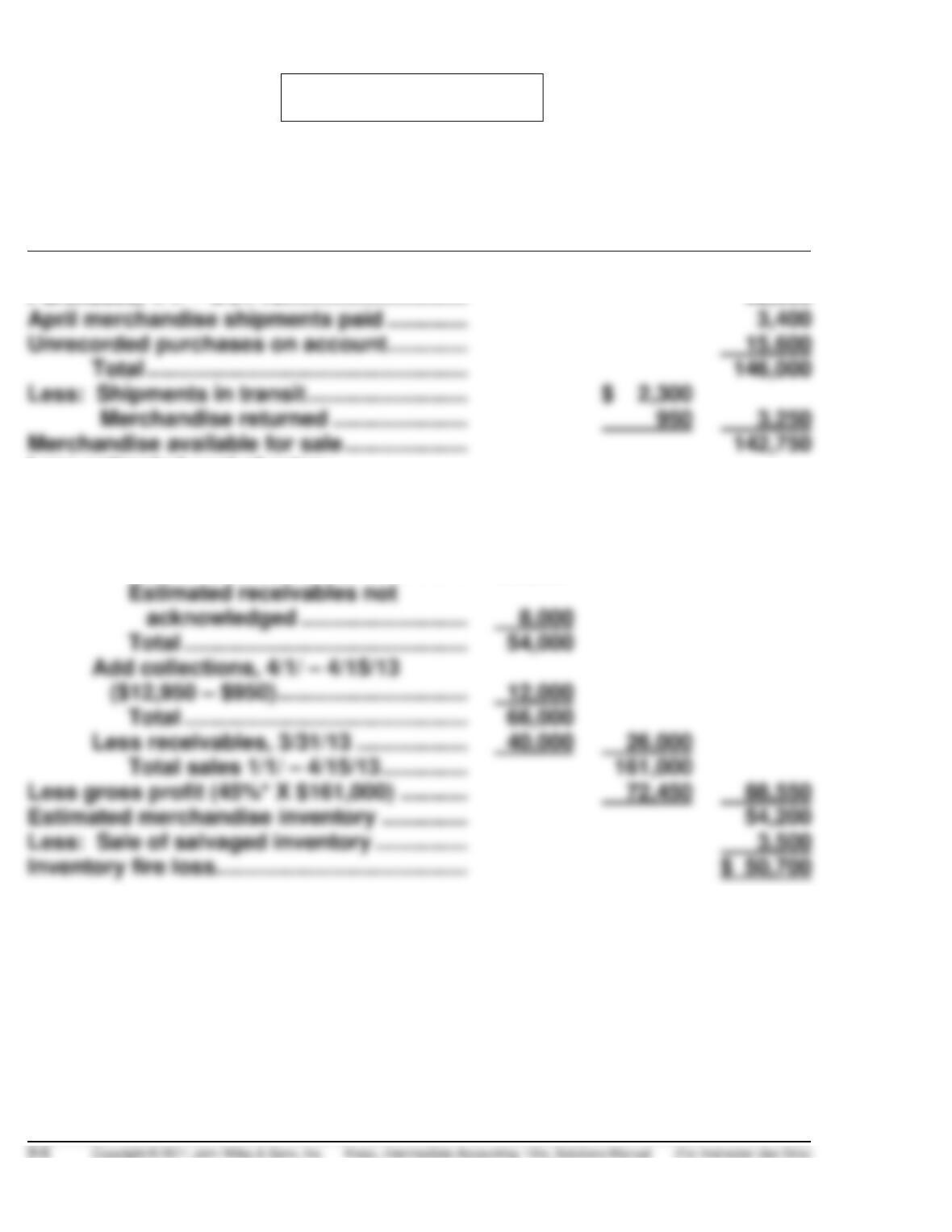
April merchandise shipments paid ………….
Unrecorded purchases on account ………….
Total …………………………………………….
146,000
Less: Shipments in transit ……………………..
$ 2,300
Merchandise returned ………………….
Merchandise available for sale ………………..
142,750
Less estimated cost of sales:
Sales, 1/1/ – 3/31/13 ……………………….
135,000
Sales, 4/1/ – 4/15/13
Receivables acknowledged
at 4/15/13 ………………………………
$46,000
Estimated receivables not
acknowledged ………………………
Add collections, 4/1/ – 4/15/13
($12,950 – $950) ………………………….
Total ……………………………………….
Less receivables, 3/31/13 ………………
Total sales 1/1/ – 4/15/13 …………..
Less gross profit (45%* X $161,000) ………..
Estimated merchandise inventory …………..
54,200
Less: Sale of salvaged inventory ……………
3,500
PROBLEM 9-5 (Continued)
*Computation of Gross Profit Rate
Net sales, 2011 …………………………………………
$390,000
Net sales, 2012 …………………………………………
530,000
Total net sales …………………………………
920,000
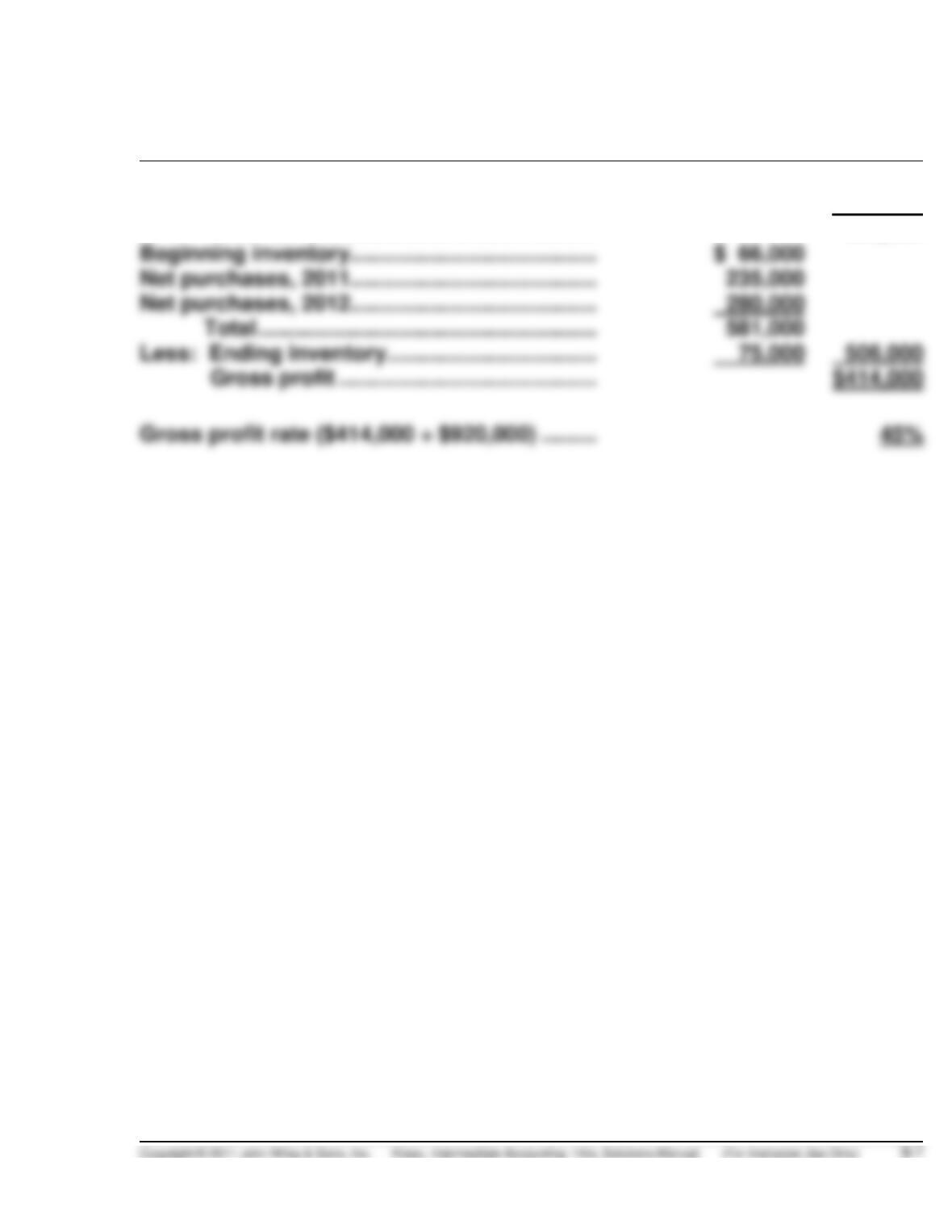
Net purchases, 2011 ………………………………….
235,000
Net purchases, 2012 ………………………………….
280,000
Less: Ending inventory …………………………....
506,000
PROBLEM 9-6
(a)
Cost
Retail
Beginning Inventory ………………………
$ 17,000
$ 25,000
Purchases …………………………………….
82,500
137,000
Freight-in ………………………………………
7,000
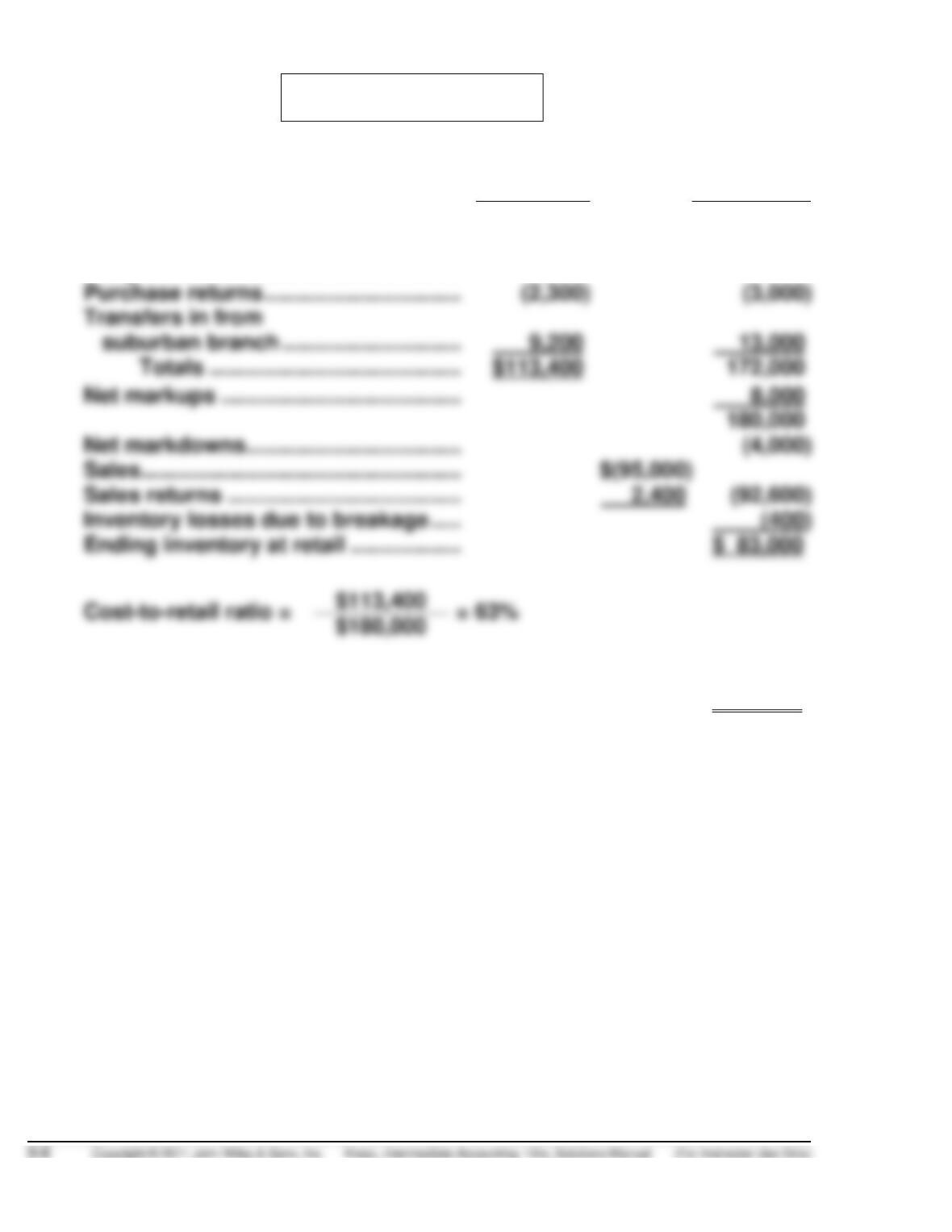
Purchase returns …………………………..
Totals …………………………………..
Net markups …………………………………
180,000
Net markdowns ……………………………..
Sales …………………………………………….
$(95,000)
Sales returns ………………………………..
Inventory losses due to breakage …..
Ending inventory at retail ………………
$ 83,000
(b)
Ending inventory at lower-of-average-cost-or-market
(63% of $83,000) …………………………
$ 52,290
Copyright © 2011 John Wiley & Sons, Inc. Kieso, Intermediate Accounting, 14/e, Solutions Manual (For Instructor Use Only) 9-9
PROBLEM 9-7
Cost
Retail
Beginning Inventory ……………………..
$ 250,000
$ 390,000
Purchases ……………………………………
914,500
1,460,000
Purchase returns ………………………….
(60,000)
(80,000)
Purchase discounts ……………………..
(18,000)
Markdowns ………………………………….
(45,000)
Markdown cancellations ……………….
20,000
(25,000)
Sales ……………………………………………
(1,410,000)
Sales returns ……………………………….
(1,312,500)
Inventory losses due to breakage ….
Employee discounts …………………….
Markups ………………………………………
$ 120,000
Markup cancellations ……………………
PROBLEM 9-8
(a)
Cost
Retail
Inventory (beginning) ………………….
$ 52,000
$ 78,000
Purchases ………………………………….
272,000
423,000
Purchase returns ………………………..
(5,600)
(8,000)
Freight-in ……………………………………
16,600
Totals ………………………………..
$335,000
493,000
Markups …………………………………….
Markup cancellations ………………….
Net markdowns …………………………..
(3,600)
Normal spoilage and breakage …….
Sales ………………………………………….
Ending inventory at retail ……………
$ 96,400
Ending inventory at lower-of-cost-or-market
(67% of $96,400) ………………………
$ 64,588
(b) The difference between the inventory estimate per retail method and
the amount per physical count may be due to:
1. Theft losses (shoplifting or pilferage).
PROBLEM 9-9
(a) The inventory section of Maddox’s balance sheet as of November 30,
2012, including required footnotes, is presented below. Also presented
below are the inventory section supporting calculations.
Current assets
Finished goods (Note 2.) ……………………
Work-in-process ………………………………..
Factory supplies………………………………..
Note 1. Lower-of-cost (first-in, first-out) or-market is applied on a
major category basis for finished goods, and on a total inven-
tory basis for work-in-process, raw materials, and factory
supplies.