Problem 9.73
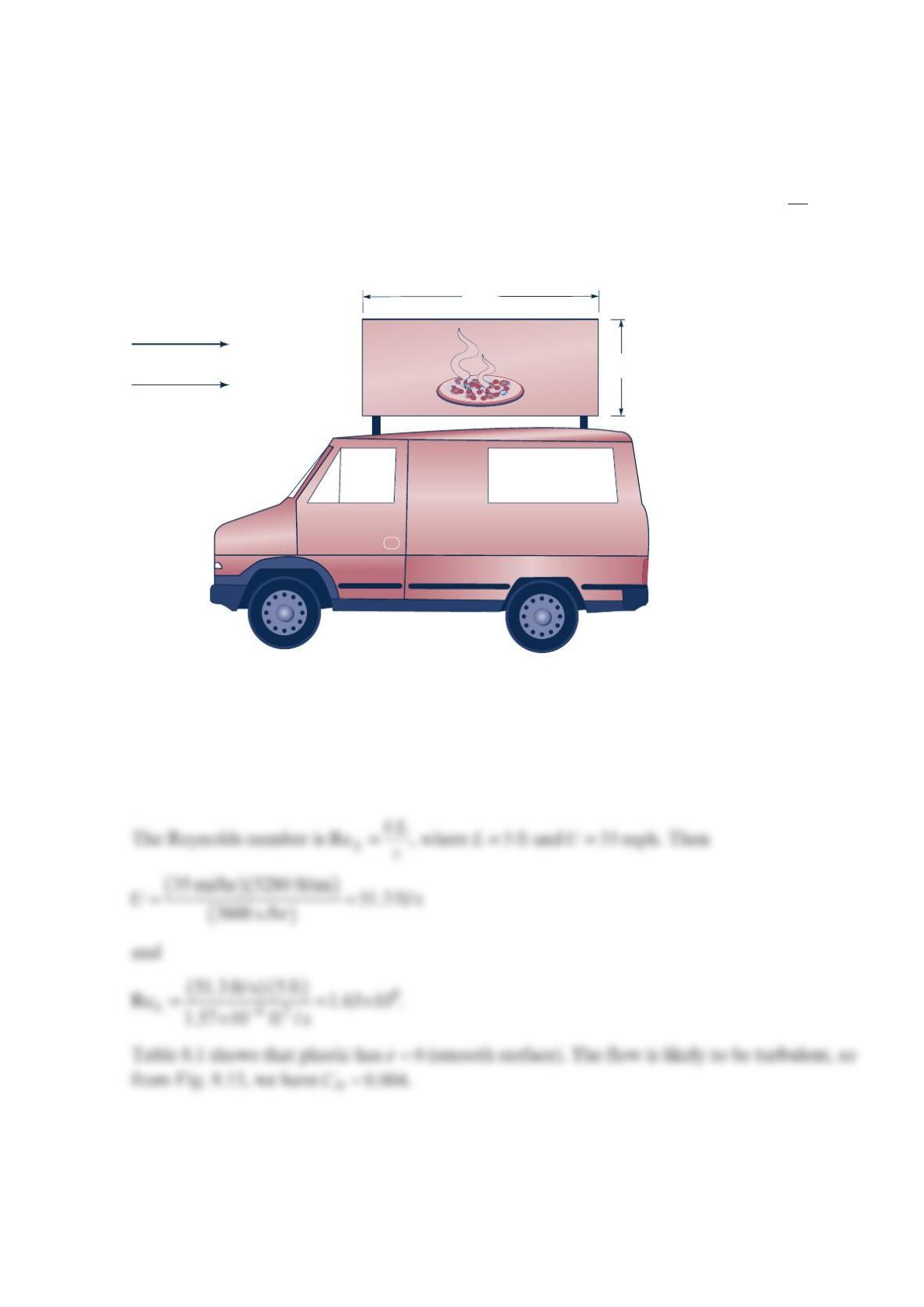
Phil’s Pizza Parlor decides to place a thin, rectangular, plastic sign on top of its delivery van
as shown in the figure below. The sign measures 2 ft by5 ft . (a) Estimate the extra power
required to drive the van in standard still air at 35 mph if the sign faces forward rather than
sideways. (b) The supports for the sign consist of two steel pipes 10 in. long and of 5
1
in.
16
outside diameter. Estimate the power required to overcome air drag on these two supports
with the sign facing forward.
Solution 9.73
(a) We assume that the sign is far enough away from the van that the air flow over the sign
is not influenced by the van, so we may use Figs. 9.15 and 9.20. We first consider the sign
placed sideways.
PHIL’S
PIZZA
35 mph
5 ft
2 ft
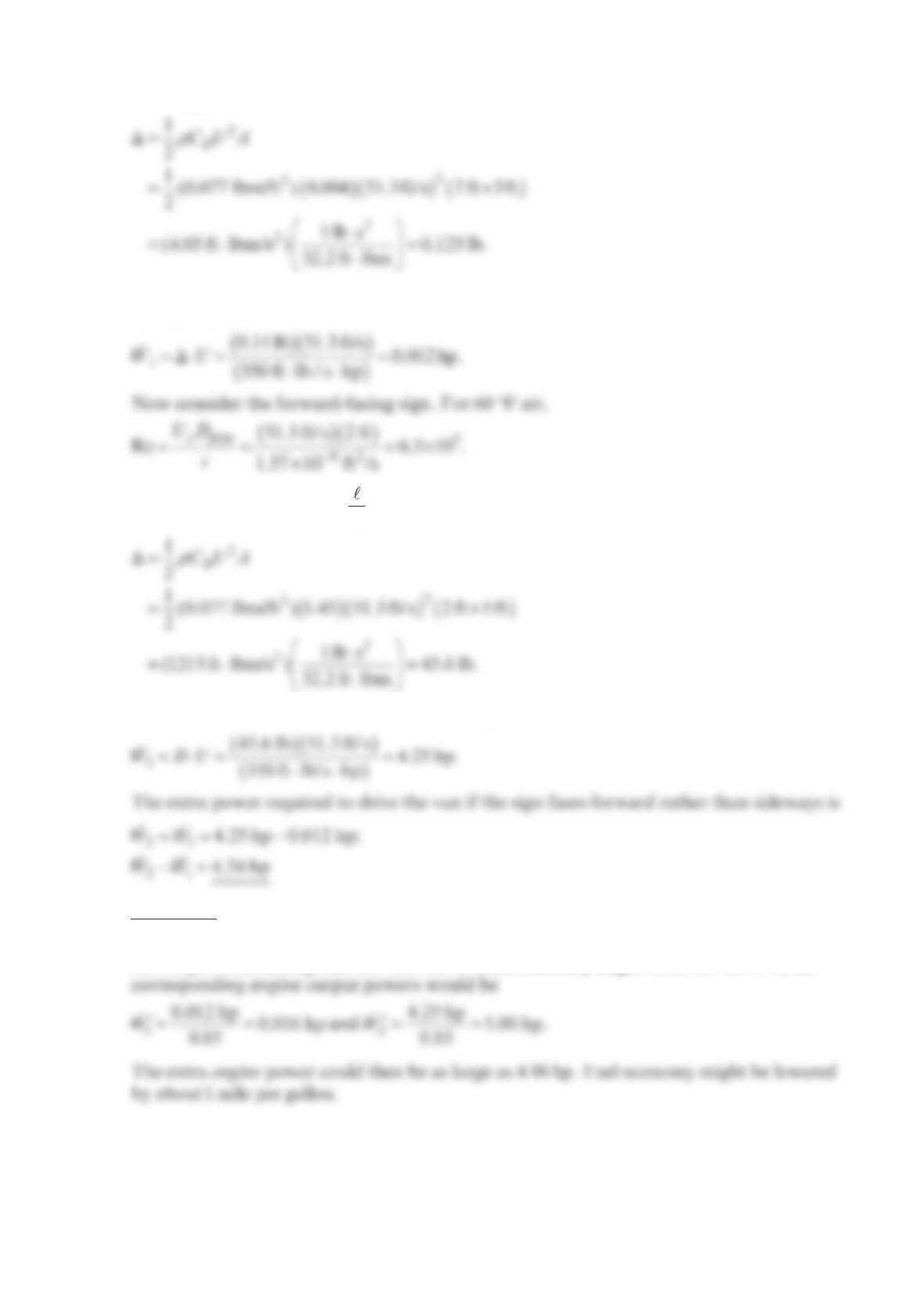
The drag is
The power required to overcome this air drag is the product of the drag force and the
van speed:
6
We then use Fig. 9.30 with =2.5
D to obtain ≈1.45
D
C.
The power required to overcome this air drag is
Comments
The magnitudes of 0.012 hp and 4.25 hp represent the power required to overcome air drag
at
3
5mph
. Considering that the van’s drive-train efficiency might be as low as
8
5%, the
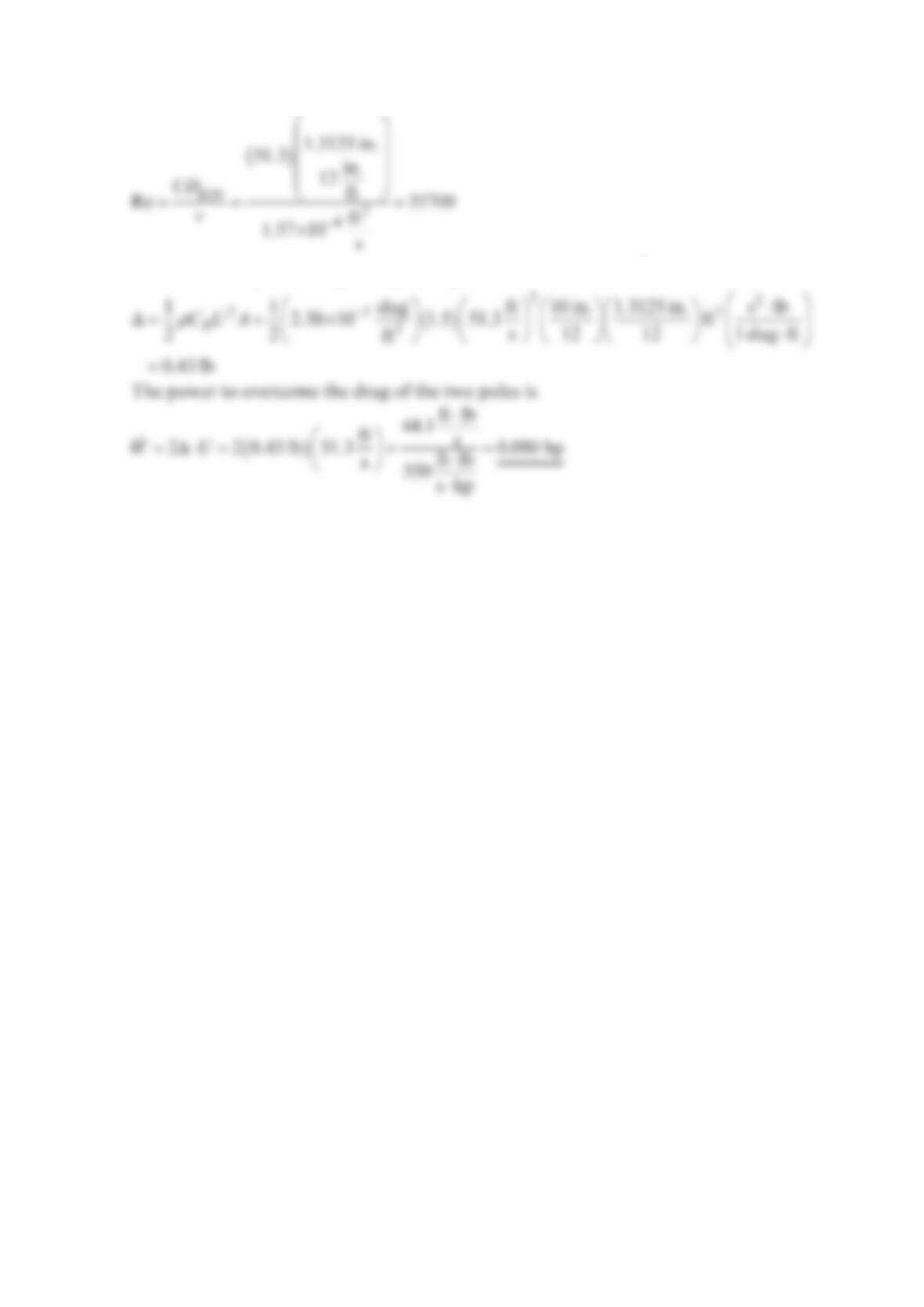
(b) The pipe Reynolds number is
For a circular cylinder, Fig. 9.23 gives ≈1.5
D
C for =×
4
Re 3.6 10 so
Problem 9.74
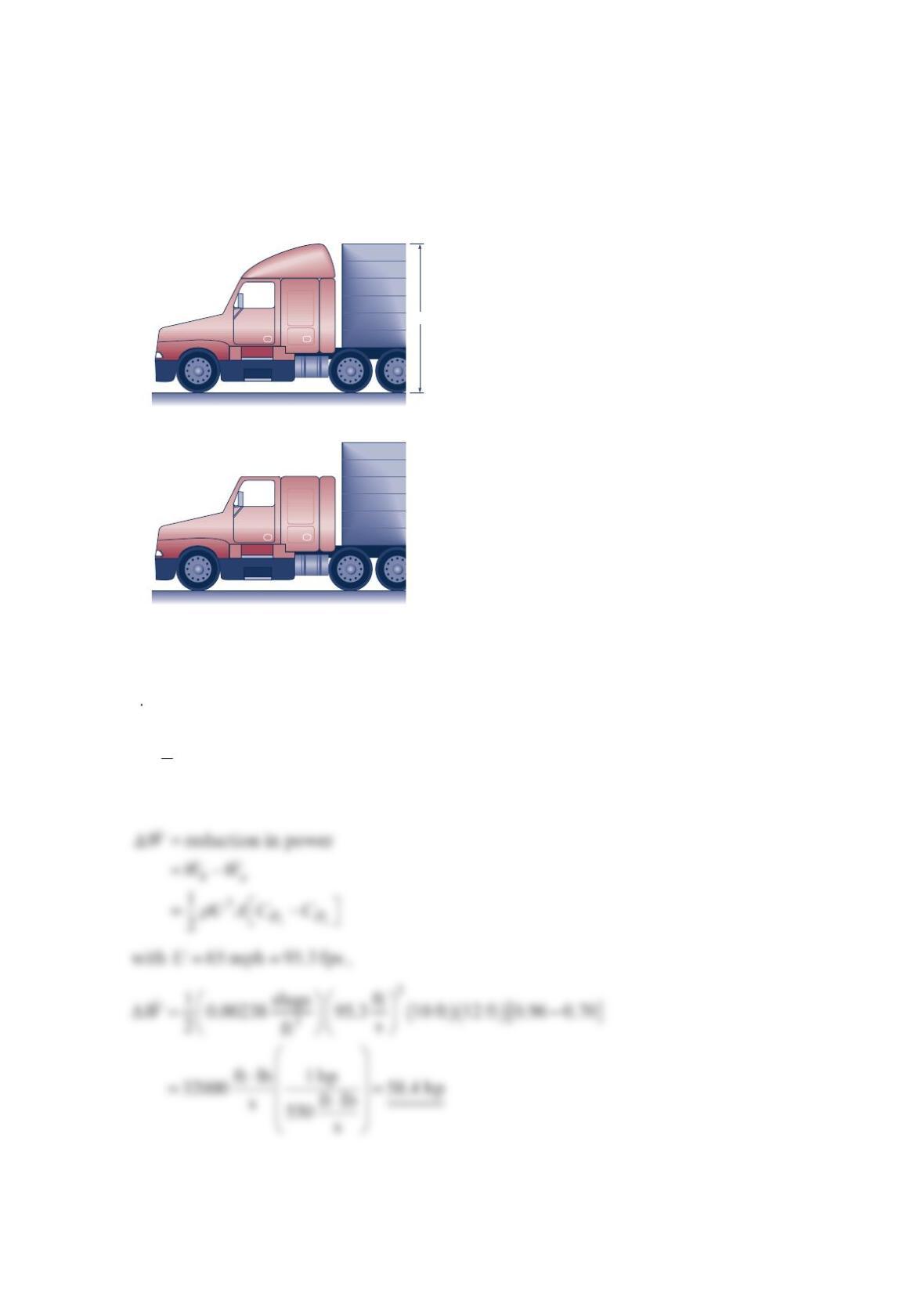
As shown in the figure below, the aerodynamic drag on a truck can be reduced by the use
of appropriate air deflectors. A reduction in drag coefficient from =0.96
D
C to 0.70
D
C
=
corresponds to a reduction of how many horsepower needed at a highway speed of
65 mph ?
Solution 9.74
power
W
U==Δ
where
2
1
2D
UC A
ρ
Δ
=
Thus,
(a) C
D
= 0.70
b = width = 10 ft
Isabelle
2001
Isabelle
2001
(b) C
D
= 0.96
12 ft
Problem 9.75
A full-sized automobile has a frontal area of 2
2
4 ft , and a compact car has a frontal area of
2
1
3 ft . Both have a drag coefficient of 0.5 based on the frontal area. Find the horsepower
required to move each automobile along a level road in still air at 55 mph. Assume that the
power required to deform the tires continuously at this speed (called rolling resistance) is
equal to the power to overcome the air resistance. Estimate the gas mileage of both
automobiles if the energy supplied to the drive wheels is 1
4 that available in the fuel. A
gallon of fuel has ×⋅
8
1.0 10 ft 1b available energy.
Solution 9.75
Assume standard air so the density is 3
0.077 lbm ft
.
air
ρ
= The velocity is
mi ft s ft
55 1.47 80.9
hr mi hr s
U
==
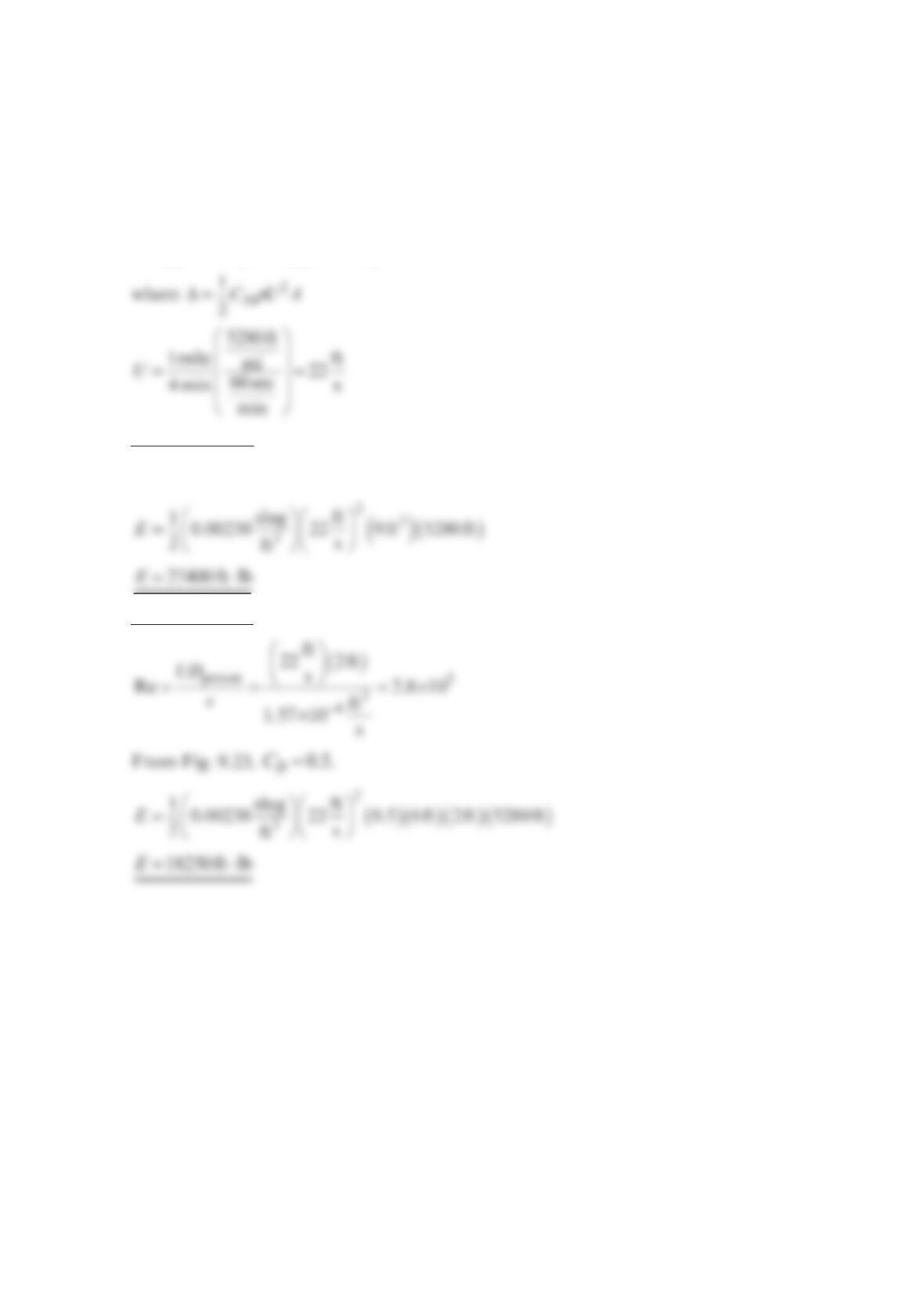
The power is given by
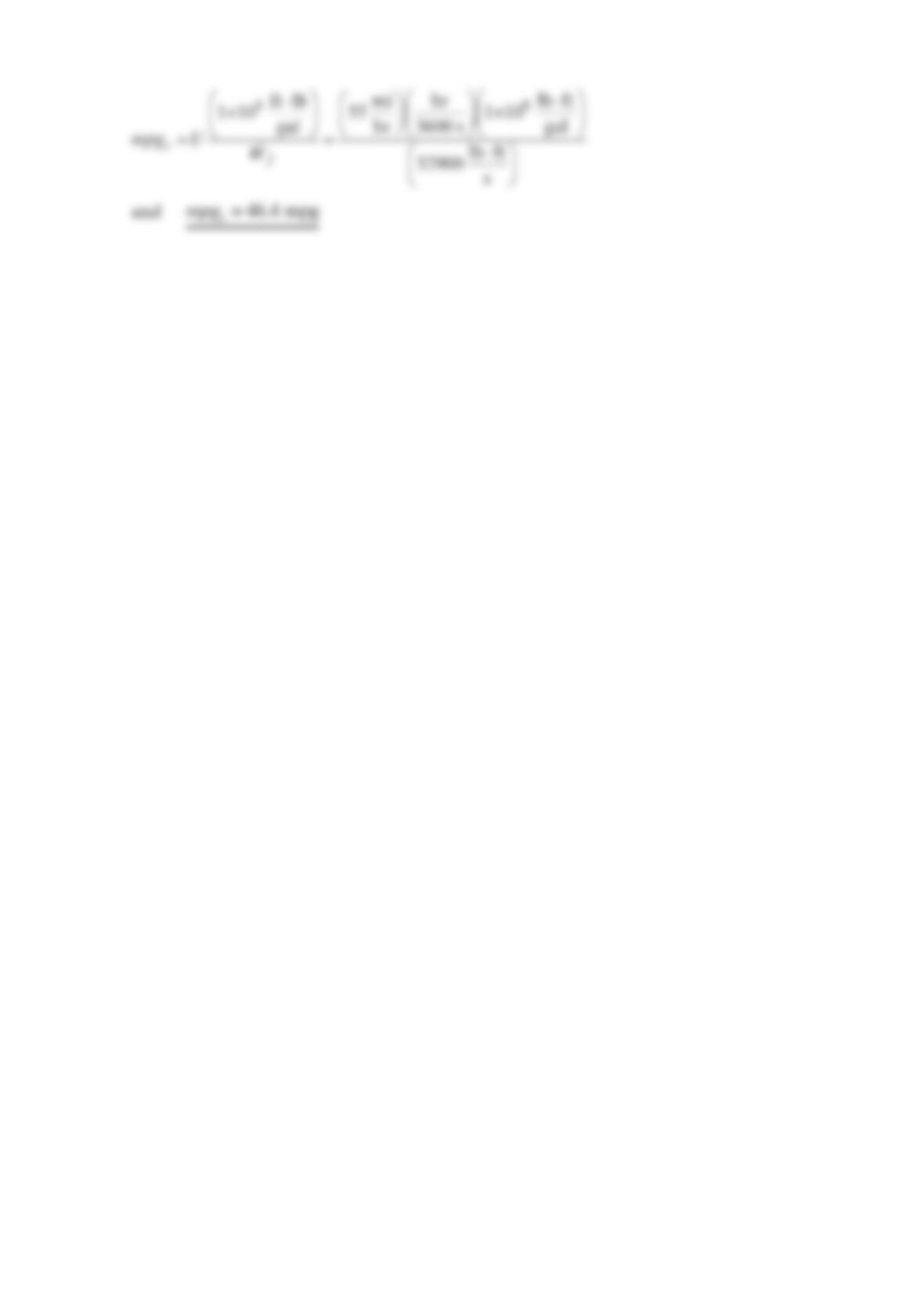
For the compact car,
The amount of power expended by the fuel to maintain 55 mph is found from
()
lb ft lb ft
4 27.62 hp 550 60800
shp s
f
W
⋅⋅
==
⋅
W
Problem 9.76
Estimate the energy required for an average person (see Fig. 9.32) to run a mile in 4
minutes in still standard air. Compare your estimate if you instead modeled the person as a
cylinder 6 ft tall and 2 ft in diameter.
Solution 9.76
()( )
E
nergy Force distanceEL== =Δ
Average person
From Fig. 9.32, =2
9ft
D
CA
Cylinder model
Problem 9.77
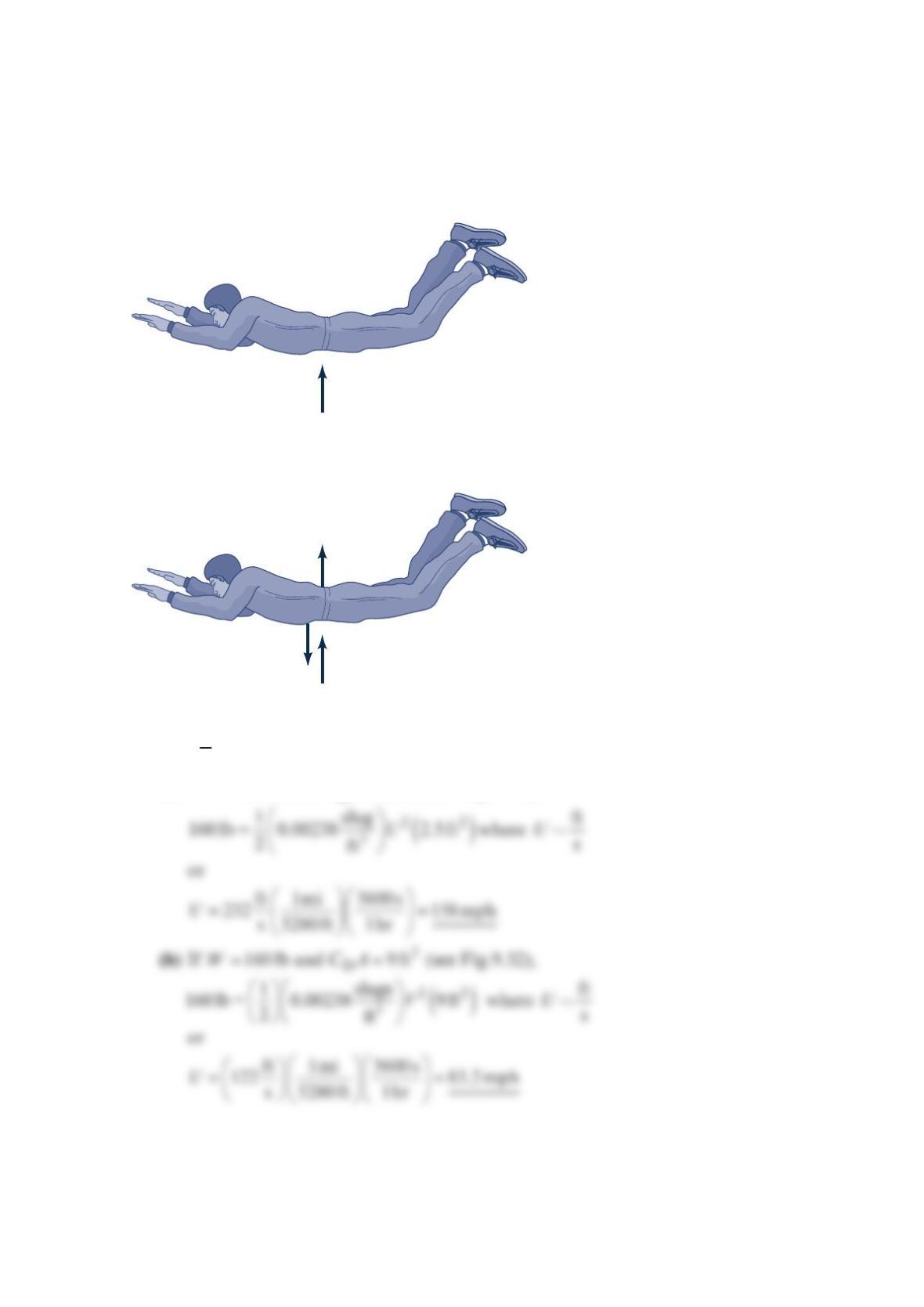
As shown in Video V9.11 and the figure below, a vertical wind tunnel can be used for
skydiving practice. Estimate the vertical wind speed needed if a 160-lb person is to be able
to “float” motionless when the person (a) curls up as in a crouching position or (b) lies flat.
See Fig. 9.32 for appropriate drag coefficient data.
Solution 9.77
For equilibrium conditions
2
1
2D
W
CUA
ρ
=Δ=
(a) If D
160 lb and C 2.5 ft
W
A==
(see Fig. 9.32),
U
U
W
𝒟
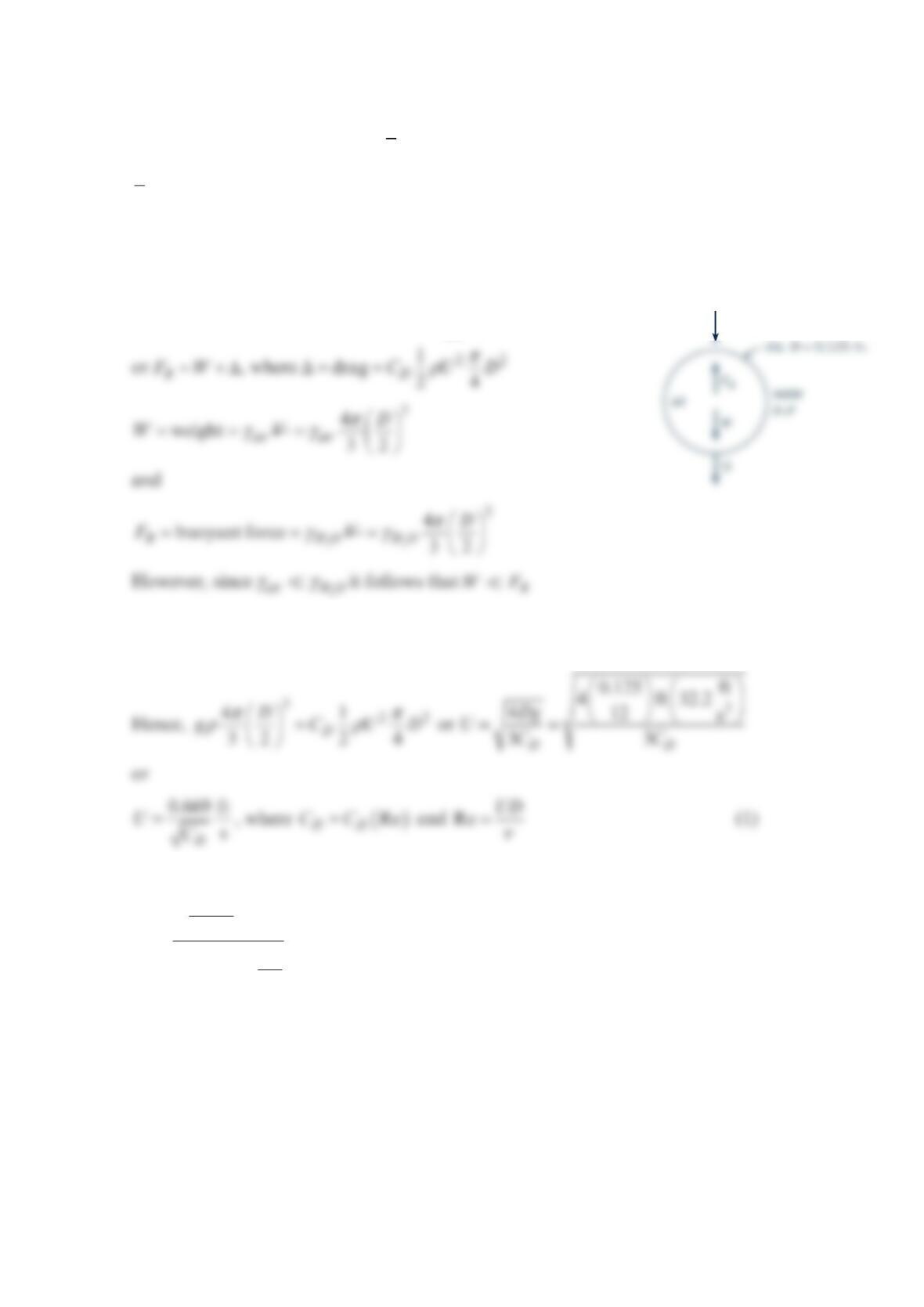
Problem 9.78
Compare the rise velocity of an 1-in.-diameter
8 air bubble in water to the fall velocity of an
1-in.-diameter
8water drop in air. Assume each to behave as a solid sphere.
Solution 9.78
(a) Air bubble in water: For steady rise 0
Z
F=
or
B
F
=Δ
or
2
5
0.125 ft
12
Re 861
ft
1.21 10 s
U
U
−
==
×
(2)
U
F
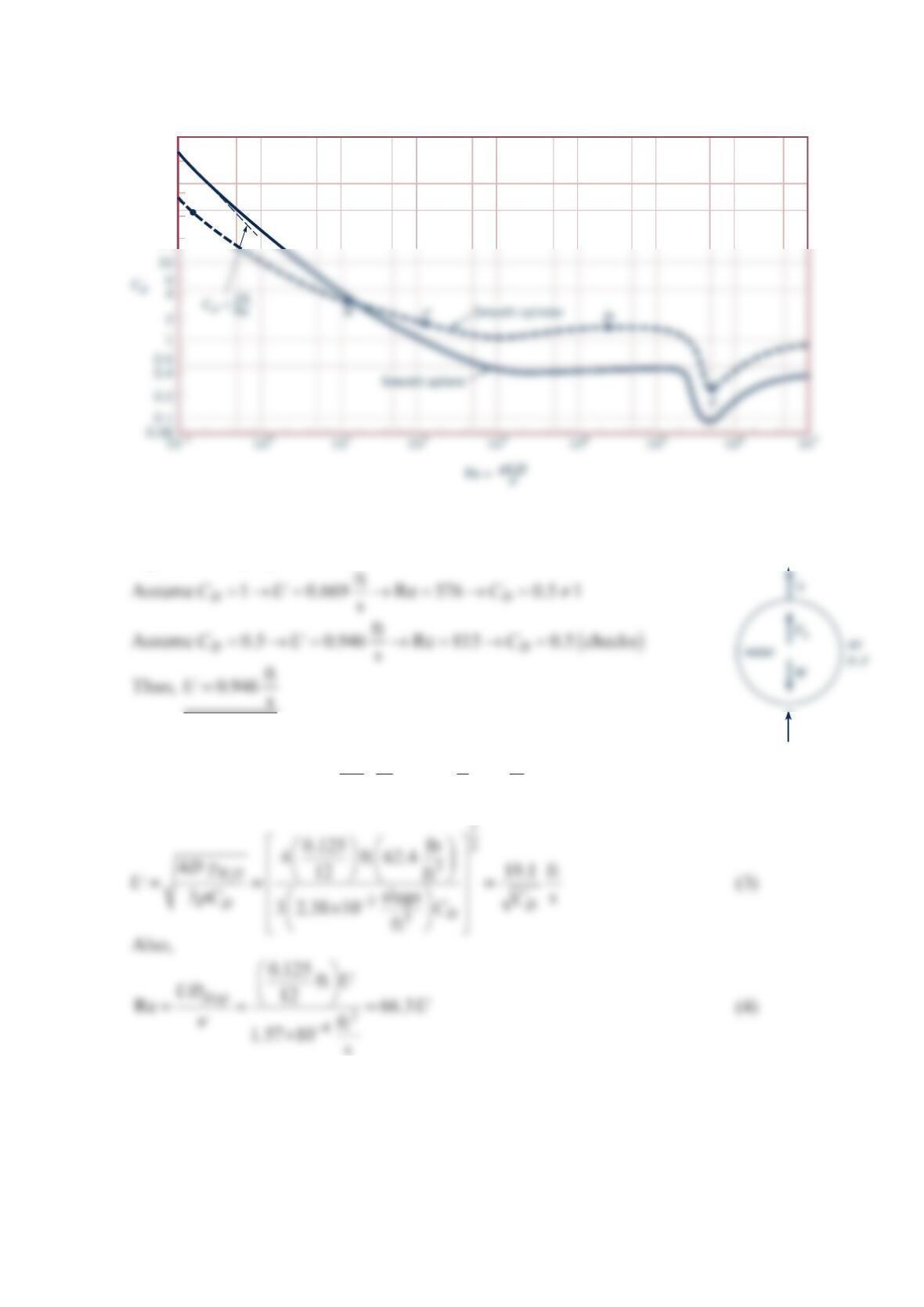
From the figure below (3)
Trial and error solution for
U
: Assume D
C
; obtain U from Eq. (1), Re from Eq. (2); check
D
C from the graph.
(b) Water drop in air: Since 2,
air H O B
F
W
γγ
Thus, 2
3
22
41
,or 32 2 4
HO D
D
WCUD
ππ
γρ
==
D
or
A
400
200
100
60
40
20
U
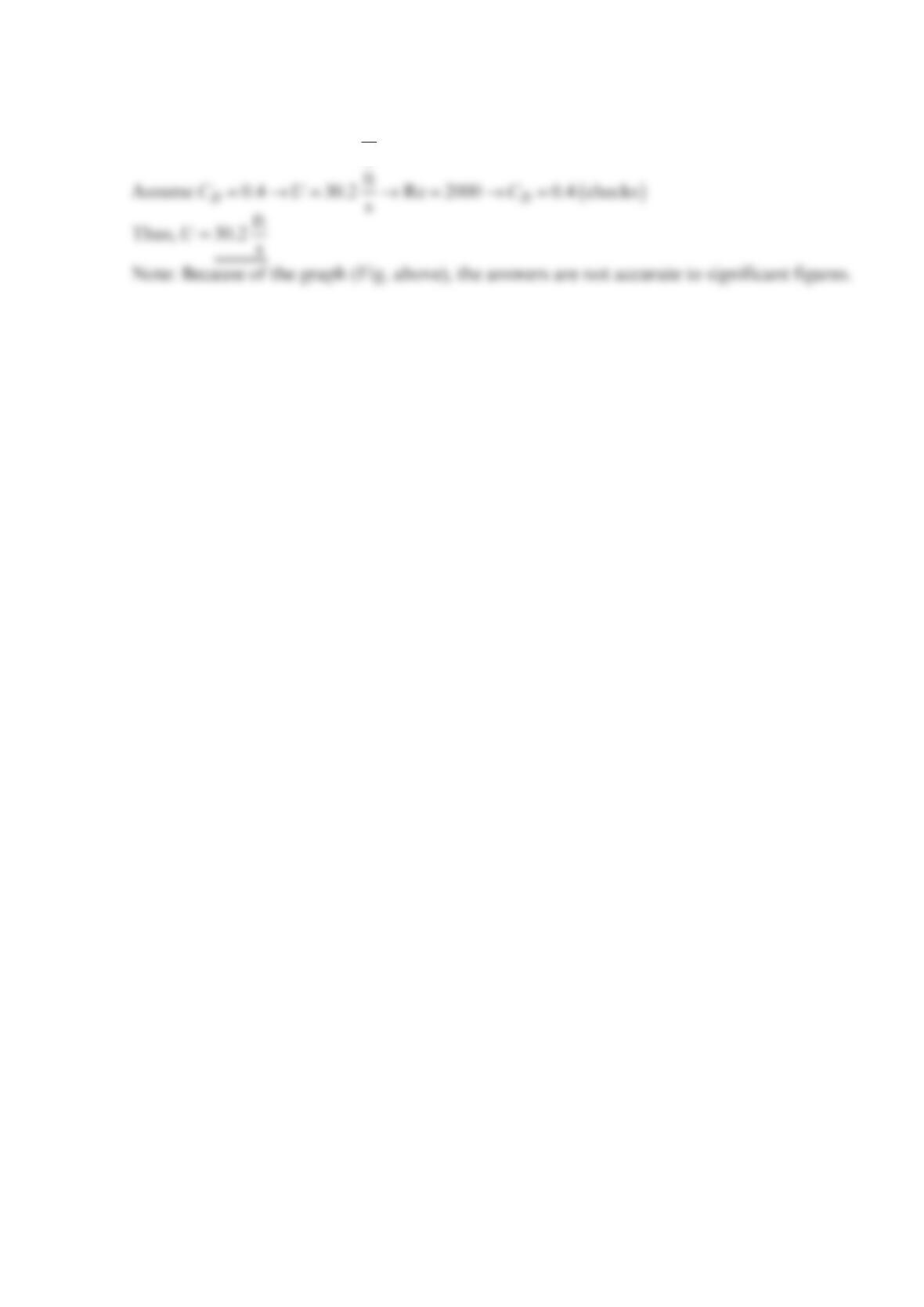
Trial and error solution of Eqs. (3), (4), and the graph:
ft
A
ssume 0.5 27.0 Re 1790 0.4 0.5
s
DD
CU C
=→= →= →=≠
A
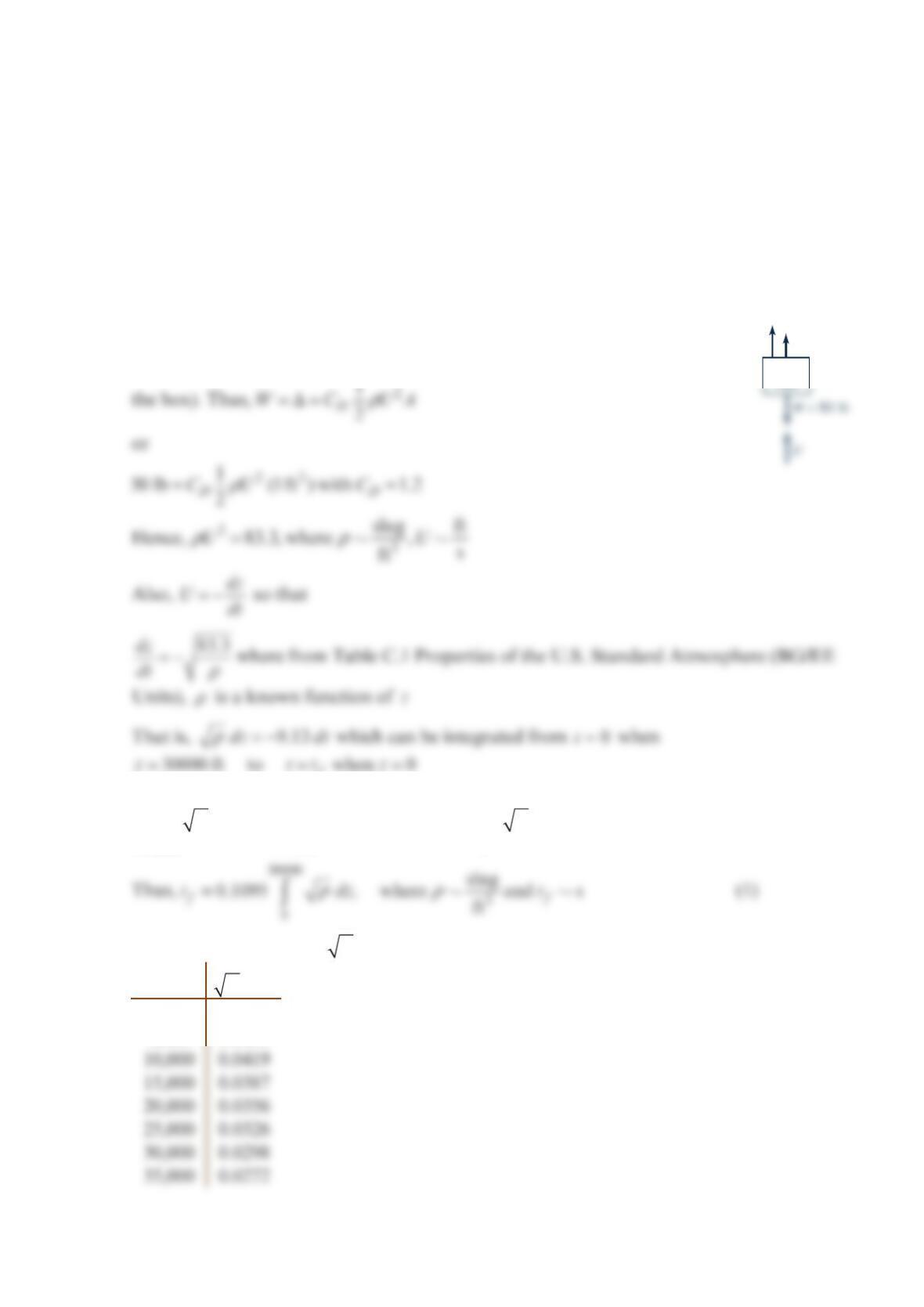
Problem 9.79
A 50-lb box shaped like a 1-ft cube falls from the cargo hold of an airplane at an altitude of
30,000 ft . If the drag coefficient of the falling box is 1.2, determine the time it takes for the
box to hit the ocean. Assume that it falls at the terminal velocity corresponding to its
current altitude and use a standard atmosphere (see Table C.1 Properties of the U.S.
Standard Atmosphere [BG/EE Units]).
Solution 9.79
For terminal velocity 0or
zB
FWF==+Δ
Assume B
W
F (i.e., the specific weight of the air is much less than that of
f
f
0 30000
30000 0 0
9.13 or 9.13
tt
z
f
zt
dz dt t dz
ρρ
=
=
==
=− =
Values of the integrand,
ρ
, are given in the table below.
z (ft)
ρ
0 0.0488
5,000 0.0453
Air
mail
FB
,
ρ μ
𝒟

Problem 9.80
s
if the cube falls (a) as oriented in figure (a) below,
(b) as oriented in figure (b) below.
Solution 9.80
For steady fall, ==
0Fma
or
B
W
F=Δ+ , (1)
𝒟
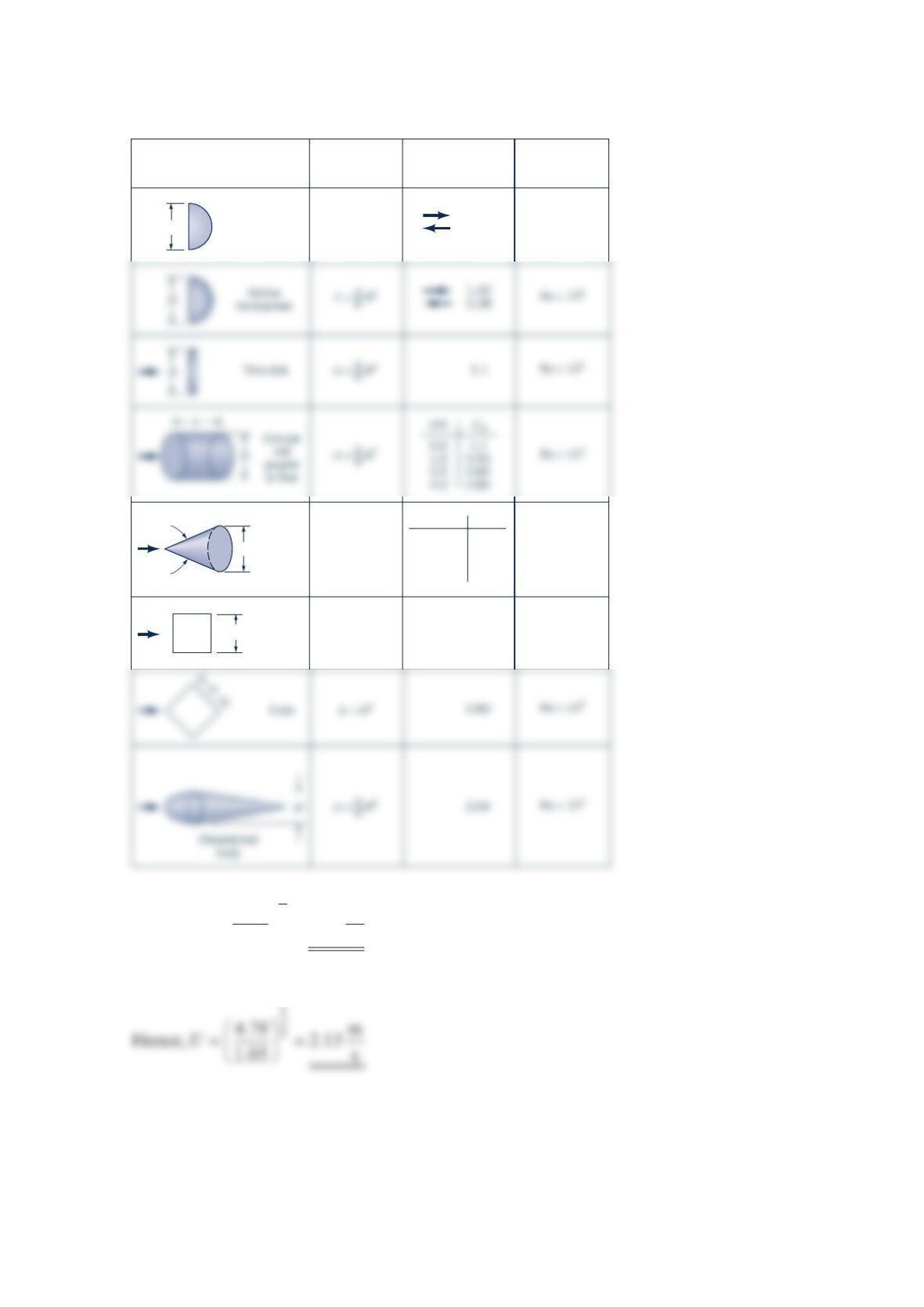
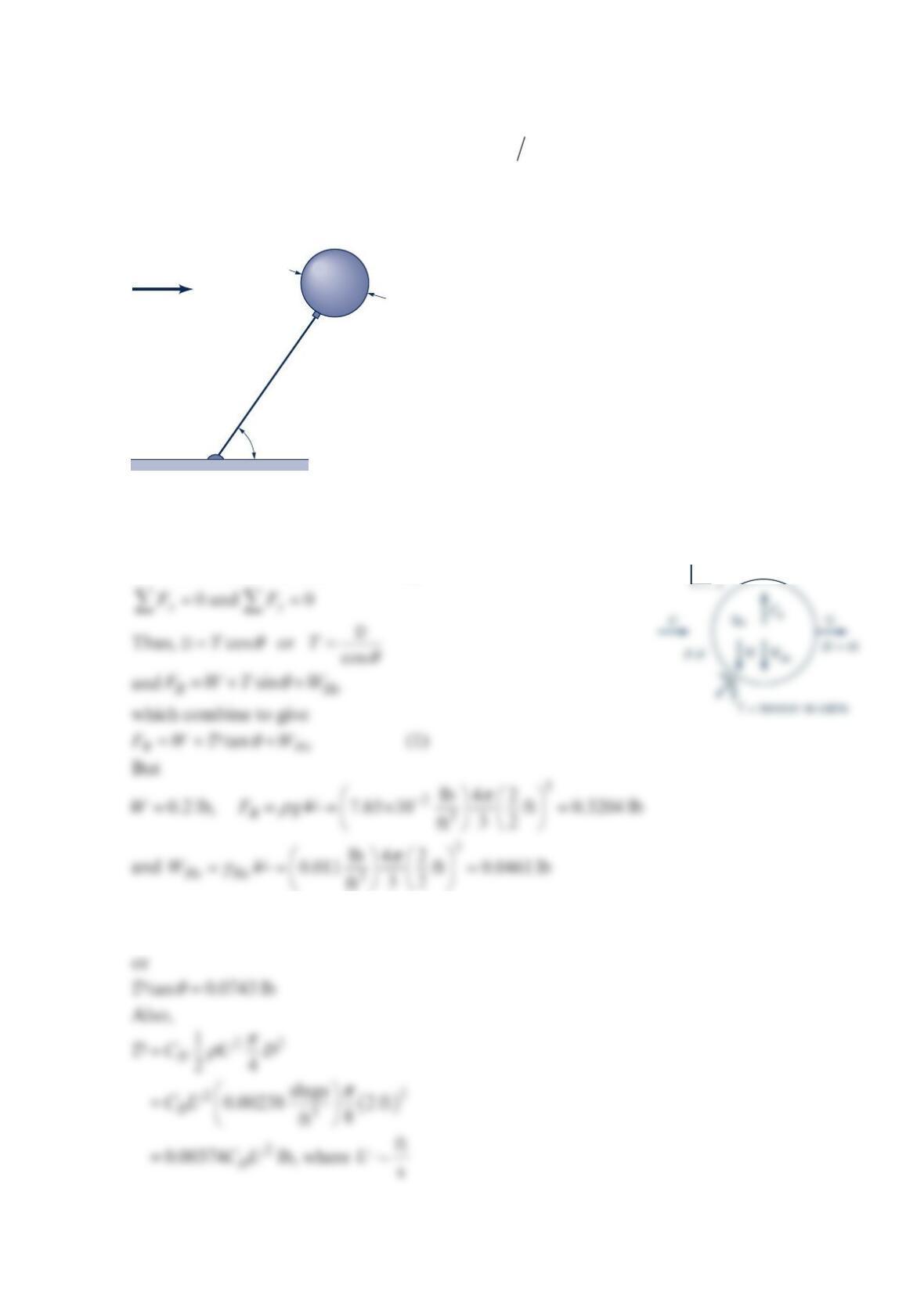
(a) For case (a) =0.80
D
C (see the figure below)
Hence,
1
2
4.78 m
2.44
0.80 s
U
==
(b) For case (b) =1.05
D
C
U
D
Solid
hemisphere
D
Cone
Cube
D
Shape Reference area
A
A
=
D
2
__
4
π
A
=
D
2
__
4
π
A
=
D
2
Drag coefficient
C
D
1.17
0.42
(°)
C
D
10
30
60
90
0.30
0.55
0.80
1.15
θ
1.05
Re > 10
4
Re > 10
4
Re > 10
4
Reynolds number
Re =
UD
/
ρμ
θ
Problem 9.81
The helium-filled balloon shown in the figure below is to be used as a wind-speed indicator.
The specific weight of the helium is 3
0.011 lb ft
γ
=, the weight of the balloon material is
0.20 lb, and the weight of the anchoring cable is negligible. Plot a graph of
θ
as a function
of Ufor
1
50mphU≤≤ . Would this be an effective device over the range of
U
indicated?
Explain.
Solution 9.81
For the balloon to remain stationary
Thus, Eq. (1) becomes
0.3204 lb 0.2 lb tan 0.0461 lbD
θ
=+ +
U
2-ft diameter
θ
y
Hence,
θθ
==
2
2
19.9
0.00374 tan 0.0743 or tan
D
D
CU CU (2)
Also,
and from the figure below: (4)
Thus, select various ≤≤1mph 50mphUft ft
i.e., 1.47 73.3
ss
U
≤≤
and use Eqs. (2), (3), (4)
to obtain
θ
. Plotted results are shown below.
U (mph) Re CD °
0 0 — 90.00
1 12700 0.40 87.52
A
400
200
100
60
40
20
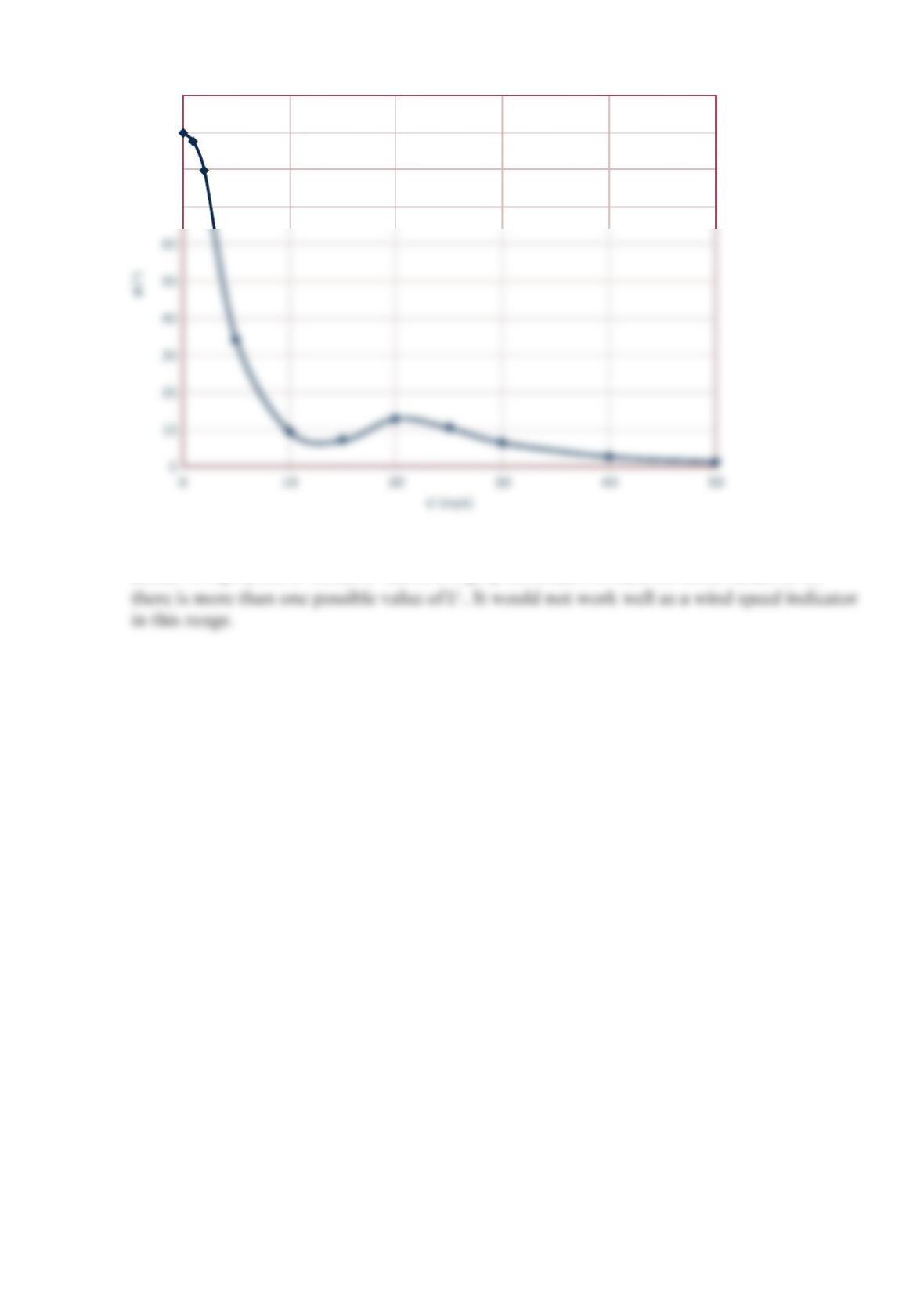
Note: Because of the sudden change in D
C when the boundary layer becomes turbulent (at
about 15 mph ), the
θ
versus U curve is highly nonlinear. In fact, for some values of
θ
,
70
80
90
100
Problem 9.82
A 0.30-m-diameter cork ball
()
= 0.21SG is tied to an object on the bottom of a river as is
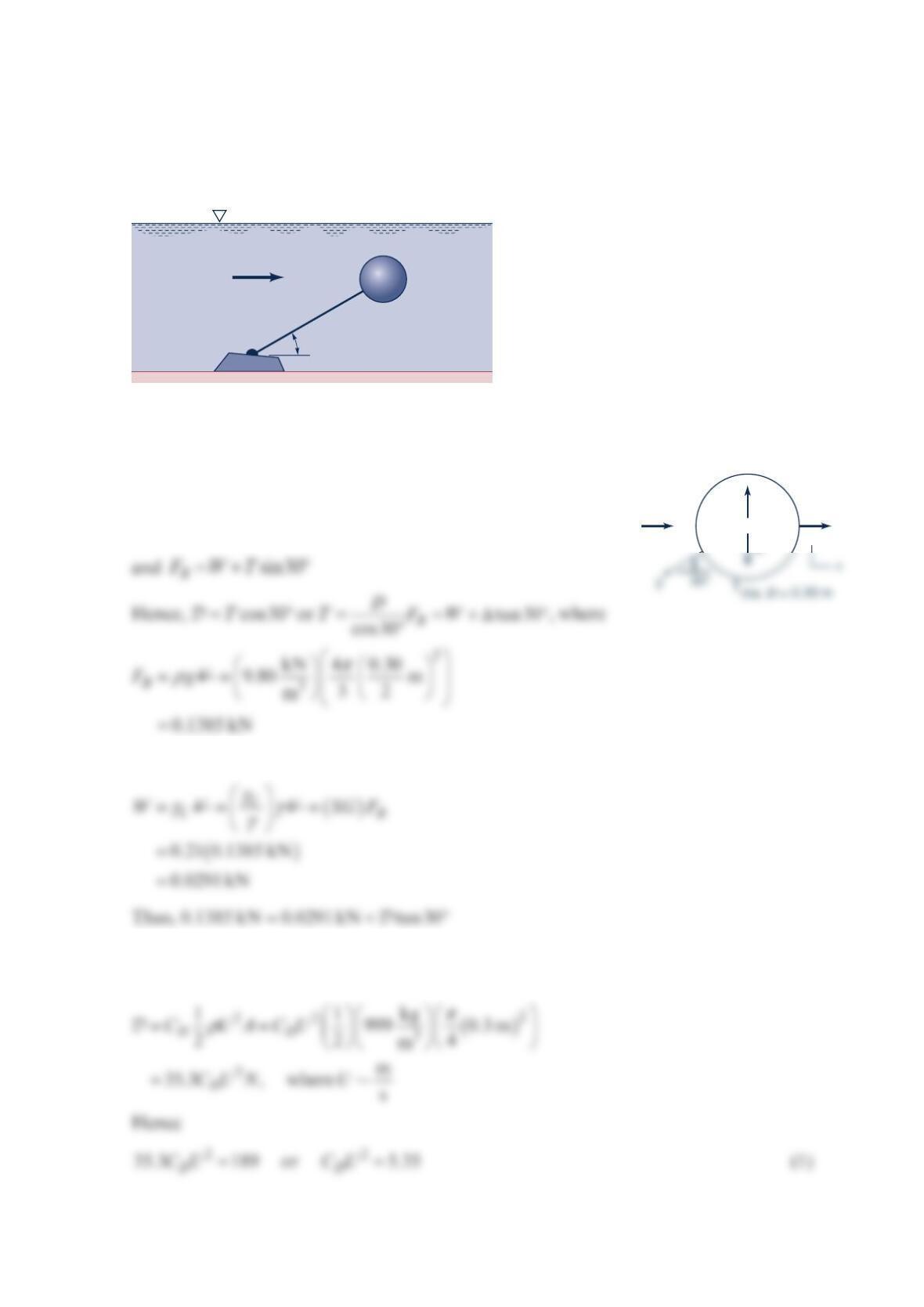
shown in the figure below. Estimate the speed of the river current. Neglect the weight of the
cable and the drag on it.
Solution 9.82
For the ball to remain stationary ==
0and 0
xy
FF
Thus,
and
or
0.189 kN=D, where
U
30
°
FB
U
y
,
ρ μ
c
γ
𝒟
Also,
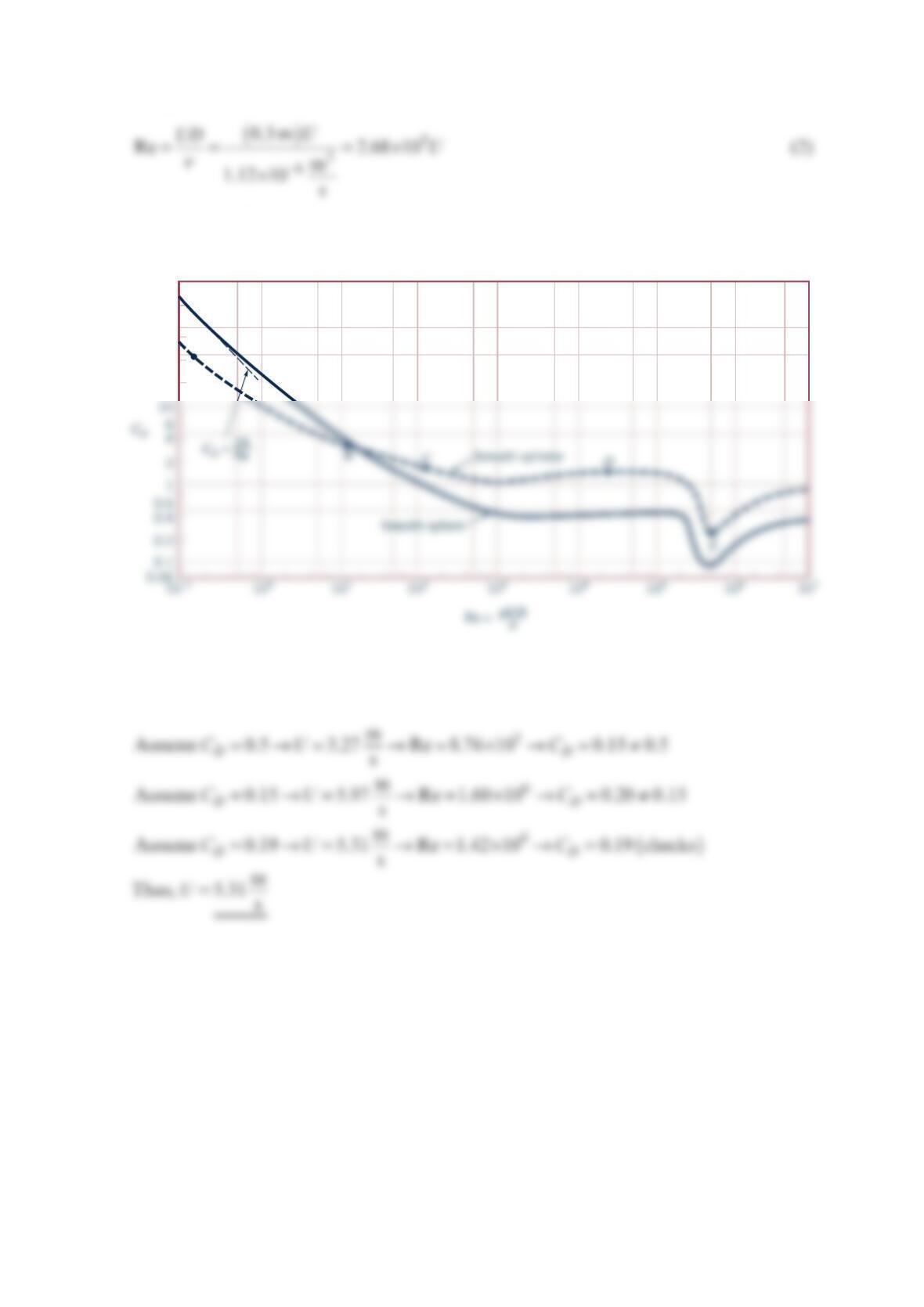
and from the figure below: (3)
Trial and error solution for
U
: Assume D
C; calculate U from Eq. (1) and Re from Eq. (2);
check D
C from Eq. (3), the graph.
A
400
200
100
60
40
20