*PROBLEM 9-13
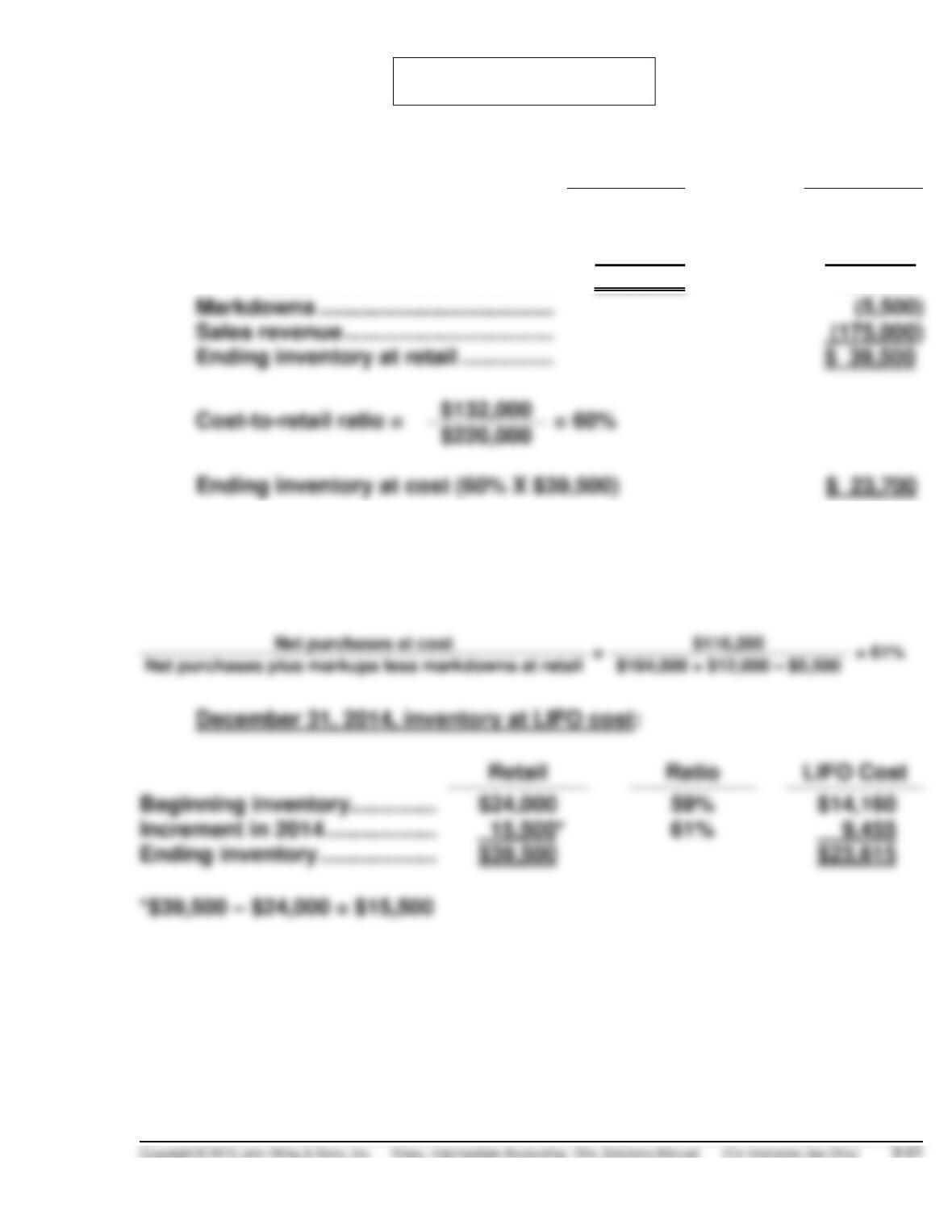
(a)
Cost
Retail
Inventory (beginning) ………………….
$ 15,800
$ 24,000
Purchases ………………………………….
116,200
184,000
Markups …………………………………….
12,000
Totals ………………………………..
$132,000
220,000
Markdowns ………………………………..
Sales revenue …………………………….
Ending inventory at retail ……………
Ending inventory at cost (60% X $39,500)
(b)
Ending inventory for 2014 under the LIFO method:
The cost-to-retail ratio for 2014 can be computed as follows:
Beginning inventory …………..
Increment in 2014 ………………
Ending inventory ……………….
*$39,500 – $24,000 = $15,500
*PROBLEM 9-14
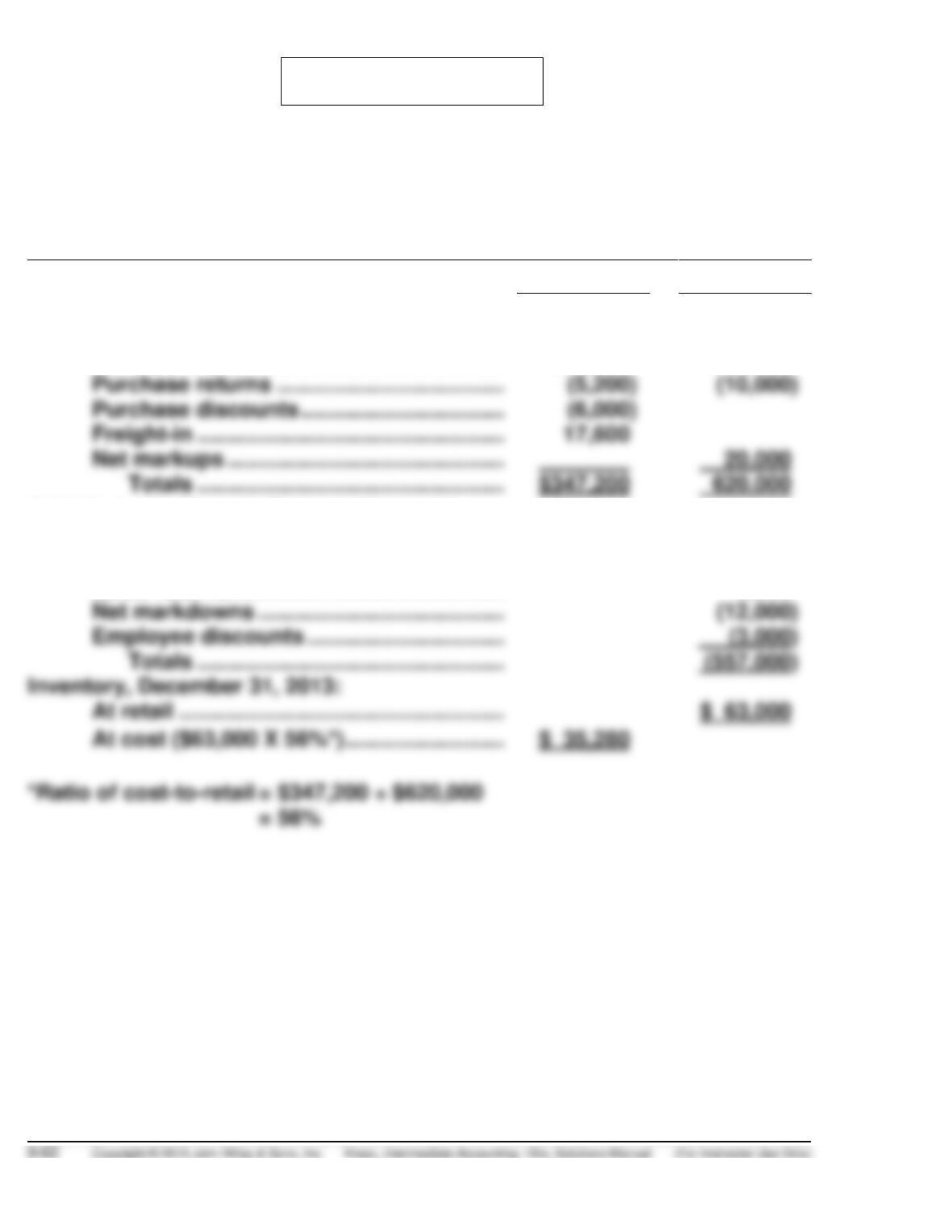
(a) DAVENPORT DEPARTMENT STORE
COMPUTATION OF COST
OF DECEMBER 31, 2013, INVENTORY
BASED ON THE CONVENTIONAL RETAIL METHOD
At Cost
At Retail
Beginning inventory, January 1, 2013 …………..
$ 29,800
$ 56,000
Add (deduct) transactions affecting cost ratio:
Purchases ………………………………………….
311,000
554,000
Purchase returns ……………………………….
Purchase discounts …………………………...
Freight-in …………………………………………..
Net markups ………………………………………
20,000
Add (deduct) other retail transactions not
considered in computation of cost ratio:
Gross sales ……………………………………….
(551,000)
Sales returns ……………………………………..
9,000
Net markdowns ………………………………….
Employee discounts …………………………..
Totals …………………………………………..
Inventory, December 31, 2013:
*PROBLEM 9-14 (Continued)
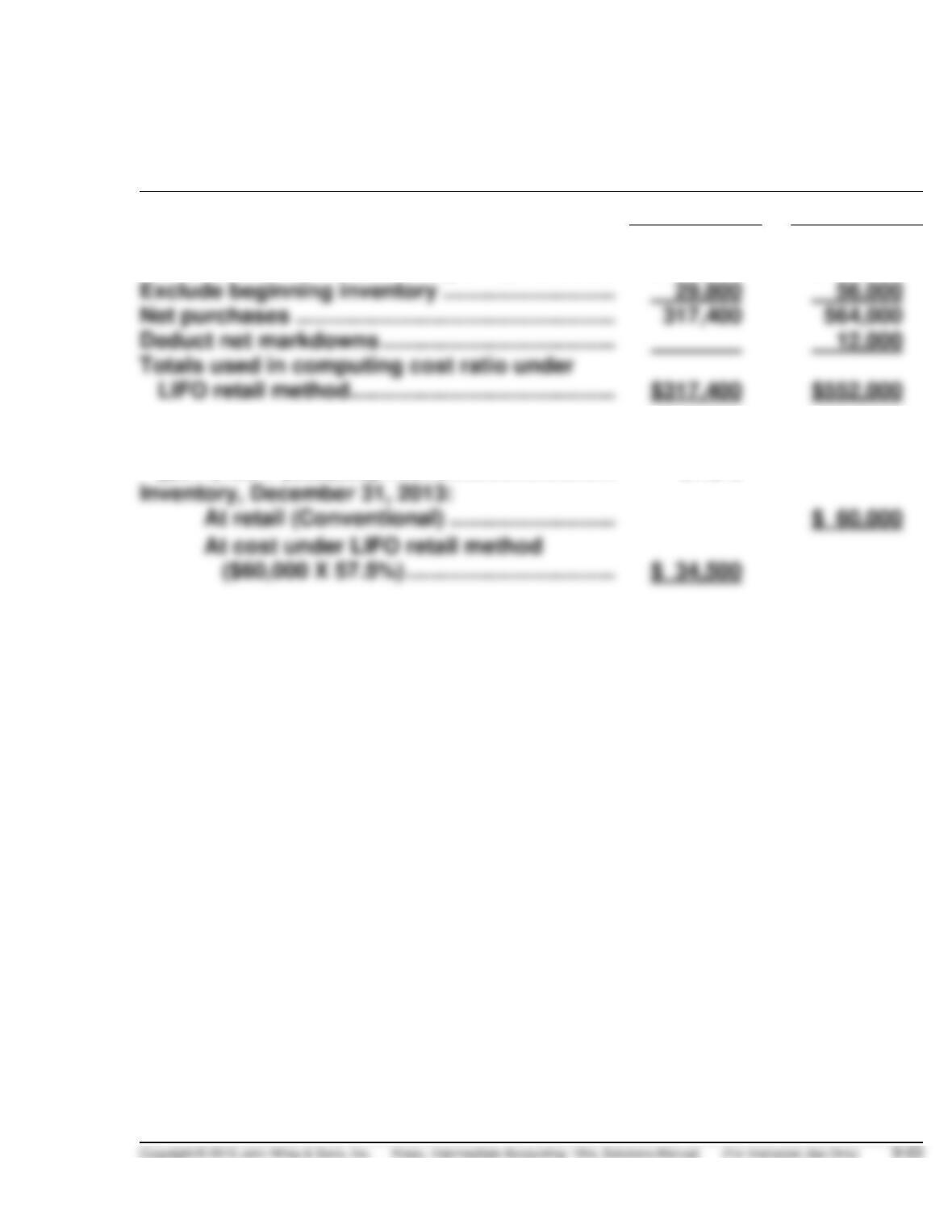
(b) COMPUTATION OF COST
OF DECEMBER 31, 2013 INVENTORY
UNDER THE LIFO RETAIL METHOD
Cost
Retail
Totals used in computing cost ratio under
conventional retail method (part a) …………….
$347,200
$620,000
Exclude beginning inventory ……………………….
Net purchases …………………………………………….
Deduct net markdowns ………………………………..
12,000
Totals used in computing cost ratio under
Cost ratio under LIFO retail method
($317,400 ÷ $552,000) ………………………………..
57.5%
Inventory, December 31, 2013:
At cost under LIFO retail method
*PROBLEM 9-14 (Continued)
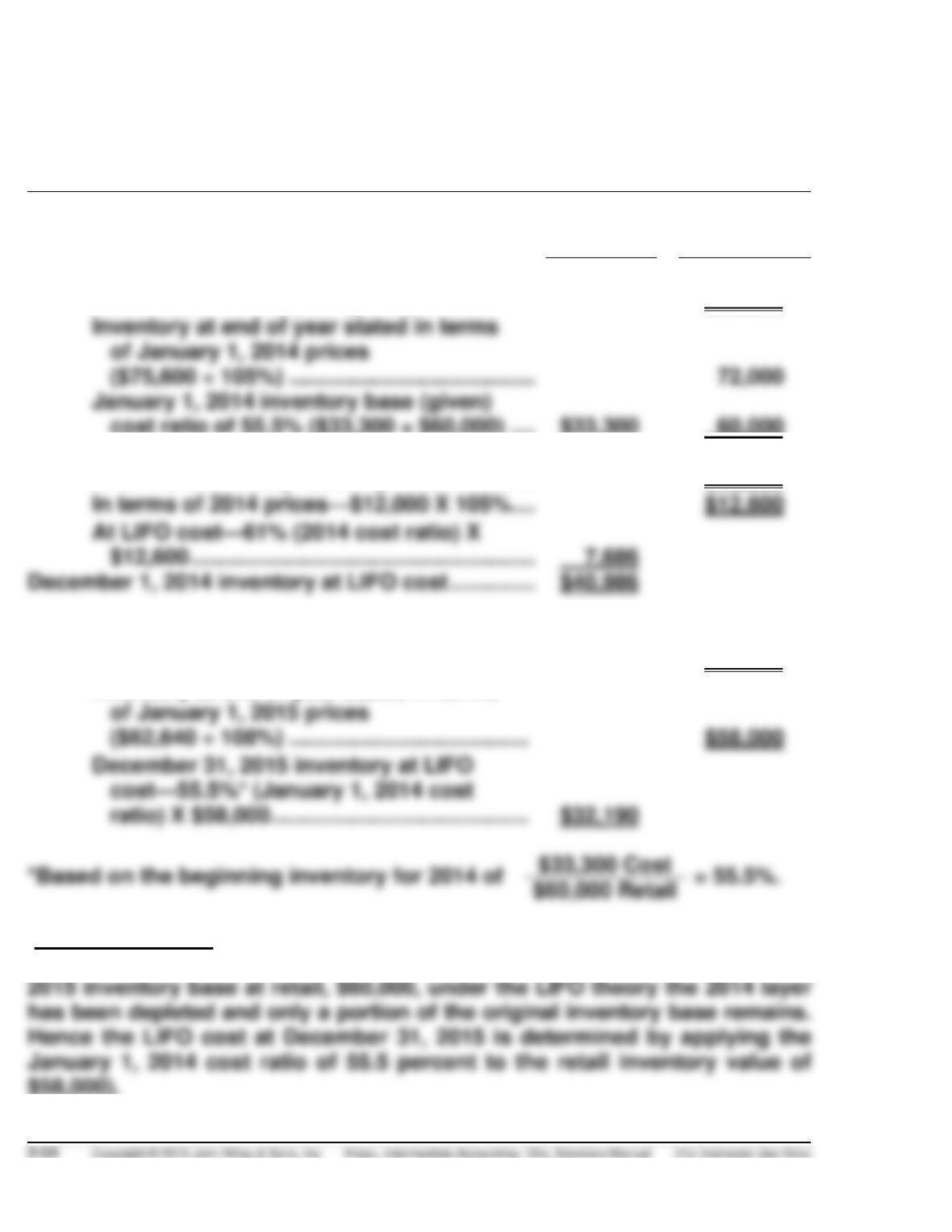
(c) COMPUTATION OF 2014 AND 2015
YEAR-END INVENTORIES
UNDER THE DOLLAR-VALUE LIFO METHOD
Computation of retail values on the basis of January 1, 2014, price levels
Cost
Retail
2014:
Inventory at end of year (given) ……………….
$75,600
Inventory at end of year stated in terms
of January 1, 2014 prices
($75,600 ÷ 105%) ………………………………….
January 1, 2014 inventory base (given)
cost ratio of 55.5% ($33,300 ÷ $60,000) ….
$33,300
60,000
Increment in inventory:
In terms of January 1, 2014 prices ……………
$12,000
In terms of 2014 prices—$12,000 X 105%….
$12,600
At LIFO cost—61% (2014 cost ratio) X
$12,600 ………………………………………………..
7,686
December 1, 2014 inventory at LIFO cost …………..
2015:
Inventory at end of year (given) ………………
$62,640
Inventory at end of year stated in terms
of January 1, 2015 prices
($62,640 ÷ 108%) …………………………………
$58,000
December 31, 2015 inventory at LIFO
cost—55.5%* (January 1, 2014 cost
ratio) X $58,000 ……………………………………
$33,300 Cost
$60,000 Retail
(Note to instructor: Because the retail inventory stated in terms of January 1,
2014 prices at December 31, 2015, $58,000, has fallen below the January 1,
TIME AND PURPOSE OF CONCEPTS FOR ANALYSIS
CA 9-1 (Time 15–25 minutes)
Purpose—to provide the student with an opportunity to discuss the purpose, the application, and the
CA 9-2 (Time 20–30 minutes)
Purpose—to provide the student with an opportunity to examine ethical issues related to lower-of-cost-
or-market on an individual-product basis. A relatively straightforward case.
CA 9-3 (Time 15–20 minutes)
CA 9-4 (Time 25–30 minutes)
Purpose—to provide the student with an opportunity to discuss the main features of the retail inventory
CA 9-5 (Time 15–25 minutes)
Purpose—the student discusses which costs are inventoriable, the theoretical arguments for the lower–
CA 9-6 (Time 10–15 minutes)
Purpose—to provide the student with a case that allows examination of ethical issues related to the
recording of purchase commitments.
SOLUTIONS TO CONCEPTS FOR ANALYSIS
CA 9-1
(a) The purpose of using the lower-of-cost-or-market method is to reflect the decline of inventory value
below its original cost. A departure from cost is justified on the basis that a loss of utility should be
reported as a charge against the revenues in the period in which it occurs.
(b) The term “market” in the phrase “the lower–of-cost-or-market” generally means the cost to replace
the item by purchase or reproduction. Market is limited, however, to an amount that should not ex–
(c) The lower-of-cost-or-market method may be applied either directly to each inventory item, to a
category, or to the total inventory. The application of the rule to the inventory total, or to the total
(d) Conceptually, the lower-of-cost-or-market method has some deficiencies. First, decreases in the
value of the asset and the charge to expense are recognized in the period in which loss in utility
occurs—not in the period of sale. On the other hand, increases in the value of the asset are
recognized only at the point of sale. This situation is inconsistent and can lead to distortions in the
presentation of income data.
From the standpoint of accounting theory there is little to justify the lower-of-cost-or-market rule.
Although conservative from the balance sheet point of view, it permits the income statement to
show a larger net income in future periods than would be justified if the inventory were carried
CA 9-2
(a) The accountant’s ethical responsibility is to provide fair and complete financial information. In this
case, the loss method distorts the cost of goods sold and hides the decline in market value.
CA 9-3
2. The lower-of-cost-or-market rule is used to report the inventory in the balance sheet at its
future utility value. It also recognizes a decline in the utility of inventory in the income state–
ment in the period in which the decline occurs.
CA 9-4
(a) The retail inventory method can be employed to estimate retail, wholesale, and manufacturing
finished goods inventories.
The valuation of inventory under this method is arrived at by reducing the ending inventory at retail
to an estimate of the lower-of-cost-or-market. The retail value of ending inventory can be computed
CA 9-4 (Continued)
(b) Since the retail method is based on an estimated cost ratio involving total merchandise available
during the period, its validity depends on the underlying assumption that the merchandise in
ending inventory is a representative mixture of all merchandise handled. If this condition does not
exist, the cost ratio may not be appropriate for the merchandise in ending inventory and can result
in significant error.
Material quantities of special sale merchandise handled during the period may also bias the result
of this method because merchandise data included in arriving at the estimated cost ratio may
not be proportionately represented in ending inventory. This condition may be avoided by
accumulating special sale merchandise data in separate accounts.
(c) The advantages of using the retail method as compared to cost methods include the following:
1. Approximate inventory values can be determined without maintaining perpetual inventory records.
(d) The treatments to be accorded net markups and net markdowns must be considered in light of
their effects on the estimated cost ratio. If both net markups and net markdowns are used in
CA 9-5
(a) 1. Olson’s inventoriable cost should include all costs incurred to get the lighting fixtures ready for
2. No, administrative costs are assumed to expire with the passage of time and not to attach to
the product. Furthermore, administrative costs do not relate directly to inventories, but are
2. The net realizable value less a normal profit margin should be used to value the inventories
because market should not be less than net realizable value less a normal profit margin. To
carry the inventories at net realizable value less a normal profit margin provides a means of
measuring residual usefulness of an inventory expenditure.
(c) Olson’s beginning inventories at cost and at retail would be included in the calculation of the cost
ratio.
Net markdowns would be excluded from the calculation of the cost ratio. This procedure reduces
CA 9-6
(a) Accounting standards require that when a contracted price is in excess of market, as it is in this
case (market is $5,000,000 and the contract price is $6,000,000), and it is expected that losses will
(b) If the loss is material, new and continuing shareholders are harmed by nonrecognition of the loss.
Herman should insist on statement preparation in accordance with GAAP. If Hands will not accept
Herman’s position, Herman will have to consider alternative courses of action such as contacting
higher-ups at Prophet and assess the consequences of each course of action.
FINANCIAL REPORTING PROBLEM
(a) Inventories are valued at the lower-of-cost–or-market value. Product-
related inventories are primarily maintained on the first-in, first-out
(b) Inventories are reported on the balance sheet simply as “inventories”
with sub-totals reported for (1) Materials and supplies, (2) Work in
process, and (3) Finished goods.
(c) In its note describing Cost of Products Sold, P&G indicates that cost of
products sold is primarily comprised of direct materials and supplies
(d)
Inventory turnover =
Cost of Goods Sold
=
$40,768
Average Inventory
$7,379 + $6,384
2
Its gross profit percentages for 2011 and 2010 are as follows:
2011
2010
Net sales ………………………
$82,559
$78,938
Cost of goods sold ………..
Gross profit …………………..
Gross profit percentage …
P&G had an increase in its gross profit but a decrease gross profit
percentage. Sales in 2011 showed a 4.6% increase. It appears that
P&G has not been able to manage its costs to increase gross margin
levels on these higher sales.
COMPARATIVE ANALYSIS CASE
(a) Coca-Cola reported inventories of $3,092 million, which represents 3.9%
of total assets. PepsiCo reported inventories of $3,827 million, which
represents 5.3% of its total assets.
(b) Coca-Cola determines the cost of its inventories on the basis of average
cost or first-in, first-out (FIFO) methods; its inventories are valued at
(d) Inventory turnover ratios and days to sell inventory for 2011:
Coca-Cola
PepsiCo
$18,216
= 6.3 times
$31,593
= 8.8 times
$3,092 + $2,650
$3,827 + $3,372
365 ÷ 8.8 = 41 days
FINANCIAL STATEMENT ANALYSIS CASE 1
(a) Although no absolute rules can be stated, preferability for LIFO can
ordinarily be established if (1) selling prices and revenues have been
increasing, whereas costs have lagged, to such a degree that an unre–
alistic earnings picture is presented, and (2) LIFO has been traditional,
(b) It may provide this information (although it is not required to do so)
because it believes that this information tells the reader that both its
income and inventory would be higher if FIFO had been used.
(c) The LIFO liquidation reduces operating costs because low price goods
FINANCIAL STATEMENT ANALYSIS CASE 2
(a) There are probably no finished goods because gold is a highly liquid
commodity, and so it can be sold as soon as processing is complete.
Ore in stockpiles is probably a noncurrent asset because processing
takes more than one year.
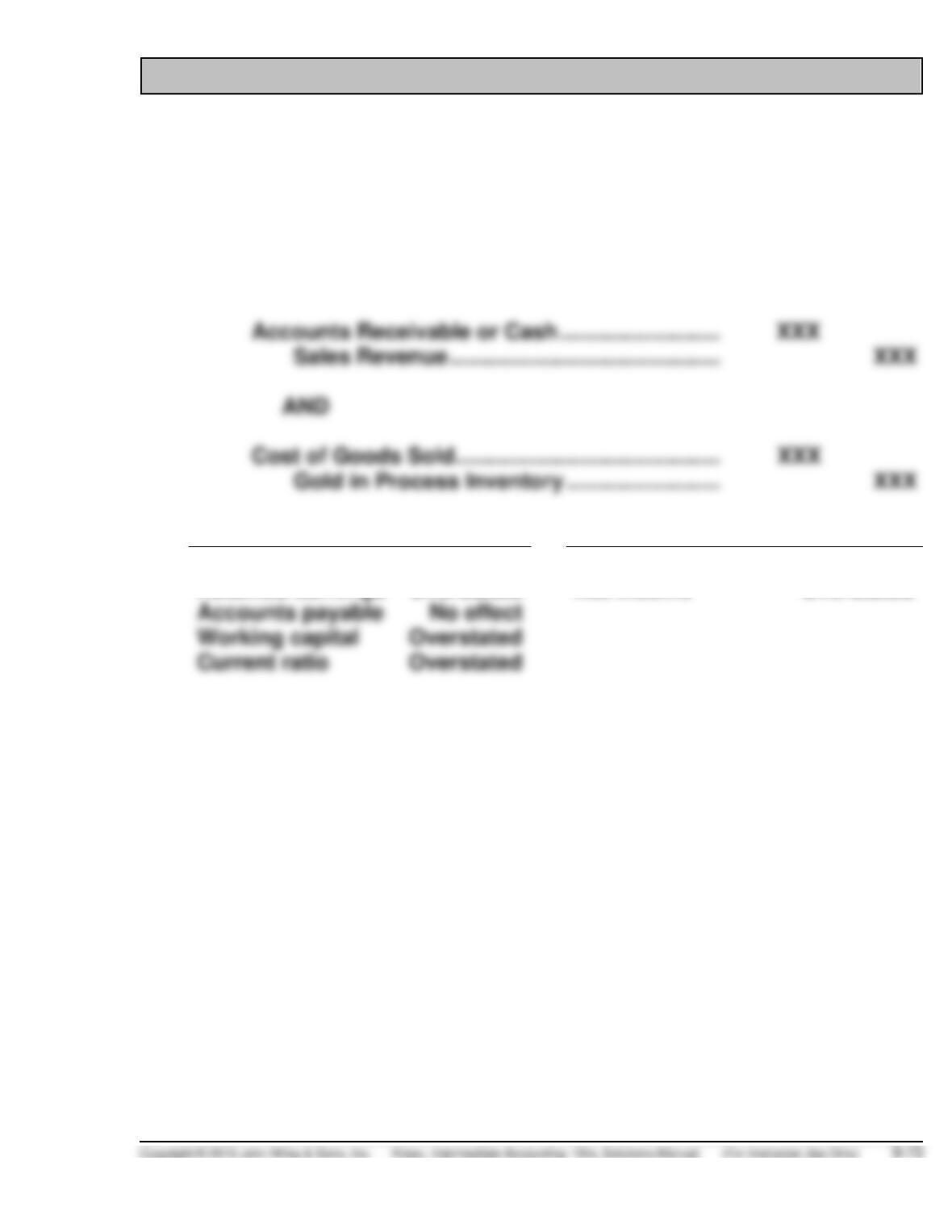
(b) Sales are recorded as follows:
(c)
Balance Sheet
Income Statement
Inventory
Overstated
Cost of goods sold
Understated
Retained earnings
Overstated
Net income
Overstated
Accounts payable
Working capital
Overstated
Current ratio
Overstated