9-1
CHAPTER 9
INVENTORIES: SPECIAL VALUATION PROBLEMS
CONTENT ANALYSIS OF EXERCISES AND PROBLEMS
Number
Content
Time Range
(minutes)
E9-1
Lower of Cost or Market. (Easy) Determination of inventory
value.
5-10
E9-5
Purchase Commitment. (Moderate) Loss. Journal entries to
record transactions.
5-10
E9-6
Estimation of Fire Loss. (Easy) Determination of inventory value
immediately prior to fire.
5-15
E9-10
Retail Inventory Method. (Moderate) Average cost, FIFO, lower
of cost or market, LIFO. Computation of ending inventory.
15-20
9-2
Number
Content
Time Range
(minutes)
E9-15
(AICPA adapted). Dollar-Value LIFO Retail. (Easy)
Determination of the cost of inventory for one year.
10-15
E9-16
Errors. (Moderate) Impact of misstated purchases and ending
inventory on the income statement and balance sheet.
10-15
methods, periodic and perpetual systems. Journal entries.
P9-3
Lower of Cost or Market. (Moderate) Interim financial
statement disclosure.
5-10
P9-6
Estimation of Theft Loss. (Moderate) Computation of inventory
lost.
5-10
P9-7
Estimation of Fire Loss. (Moderate) Computation of inventory
lost. Interim financial reporting.
10-15
P9-12
(AICPA adapted). Retail Inventory Method. (Moderate) Lower
of average cost or market. Includes estimated normal
shrinkage.
15-20
P9-13
Retail Inventory and Dollar-Value Methods. (Moderate) Retail
inventory method using lower of cost or market. Dollar-value
retail LIFO method. Determination of inventory value.
20-30
9-3
Number
Content
Time Range
(minutes)
P9-14
Dollar-Value LIFO Retail. (Challenging) Determination of cost of
ending inventory for three years.
30-40
ANSWERS TO QUESTIONS
Q9-1 Cost is the cost incurred to purchase or manufacture the inventory. Market value of
Q9-2 The upper constraint on market value is the net realizable value, which is the
estimated selling price less reasonably predictable cost of completion and disposal.
Q9-3 A company may apply the lower of cost or market method to inventory in three
Q9-4 There are several arguments against the lower of cost or market rule. First, the rule is
a departure from the principle of historical cost. Second, the rule is inconsistent,
Q9-5 In applying the lower of cost or market method to value inventory, IFRS define market
9-4
Q9-6 When inventory is written down under the lower of cost or market method, IFRS differ
from U.S. GAAP in two major respects:
Q9-7 A company recognizes anticipated price declines as losses on certain purchase
Q9-8 A company discloses an unconditional purchase obligation made at a definite price
in a note to its financial statements. When a company has an unconditional
Q9-9 One exception to historical cost valuation of inventory is the lower of cost or market
rule. It is applied when the market value of inventory has declined below its original
Q9-10 The gross profit method of inventory estimation would be useful in the following
situations:
1. At an interim date, the gross profit method is acceptable for estimating inventory
rather than taking a physical count, as long as the method is disclosed.
2. It can be used to check on the reasonableness of the inventory value developed
Q9-11 The underlying assumption of the gross profit method is that the rate of gross profit in
the current period is not materially different from the rate in prior periods. If the costs
Q9-12 To provide valid results for inventory estimation using the retail inventory method,
Q9-13 A markup is the original amount added to the cost of inventory to establish the first
selling price. An additional markup is an increase above the original selling price. A
markup cancellation is a reduction in the additional markup, but it cannot reduce
Q9-14 Under the FIFO cost flow assumption, the beginning inventory is not used in
computing the cost-to-retail ratio for the period. The ratio for the period includes
both net markups and markdowns. This method separately values the beginning
inventory and the current purchases and retains the FIFO flow assumption.
Q9-15 For the lower of average cost or market retail inventory method actually to produce
an inventory valuation equal to the lower of cost or market, one of two conditions
must exist:
Q9-16 First, it must be remembered that the retail inventory method is an estimate of
inventory and thus discrepancies are likely to occur. One cause may be inventory
breakage or theft that would not be reflected in the cost-to-retail ratio, but does
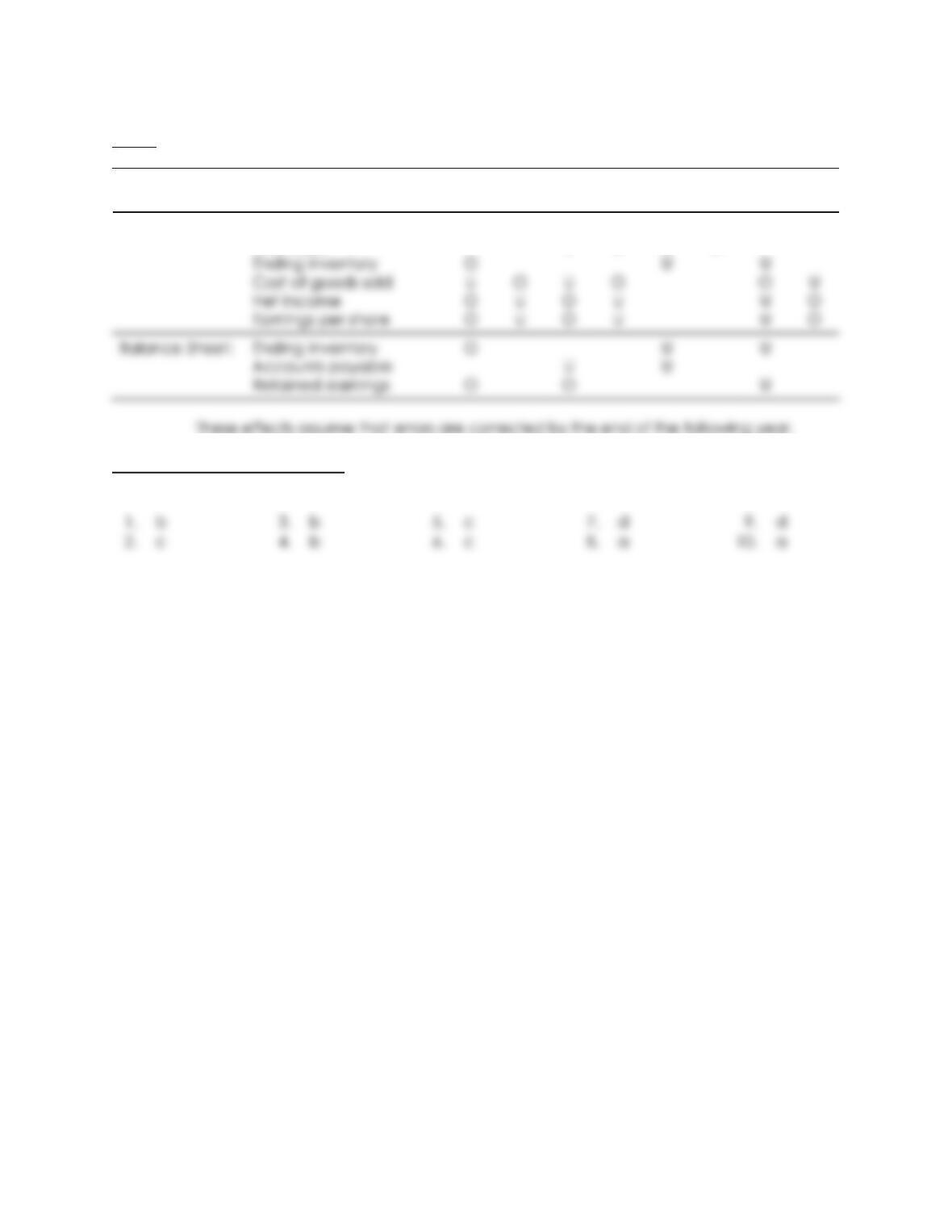
9-6
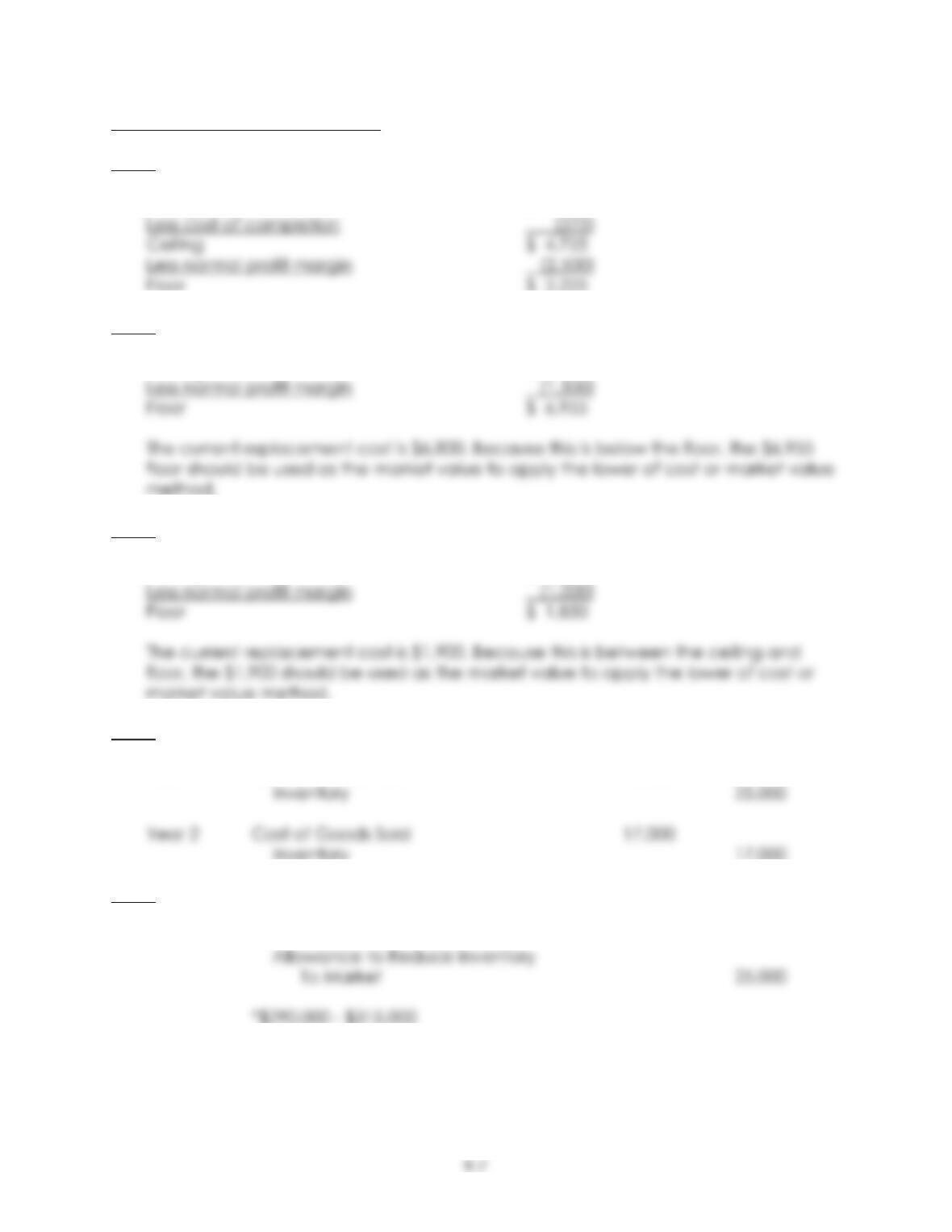
Q9-17 O = Overstated; U = Understated; CY = Current Year; SY = Succeeding Year
(a) (b) (c) (d)
CY SY CY SY CY SY CY SY
Net Income:
Beginning inventory
Purchases
O
U
O
U
U
O
U
These effects assume that errors are corrected by the end of the following year.
ANSWERS TO MULTIPLE CHOICE
SOLUTIONS TO REVIEW EXERCISES
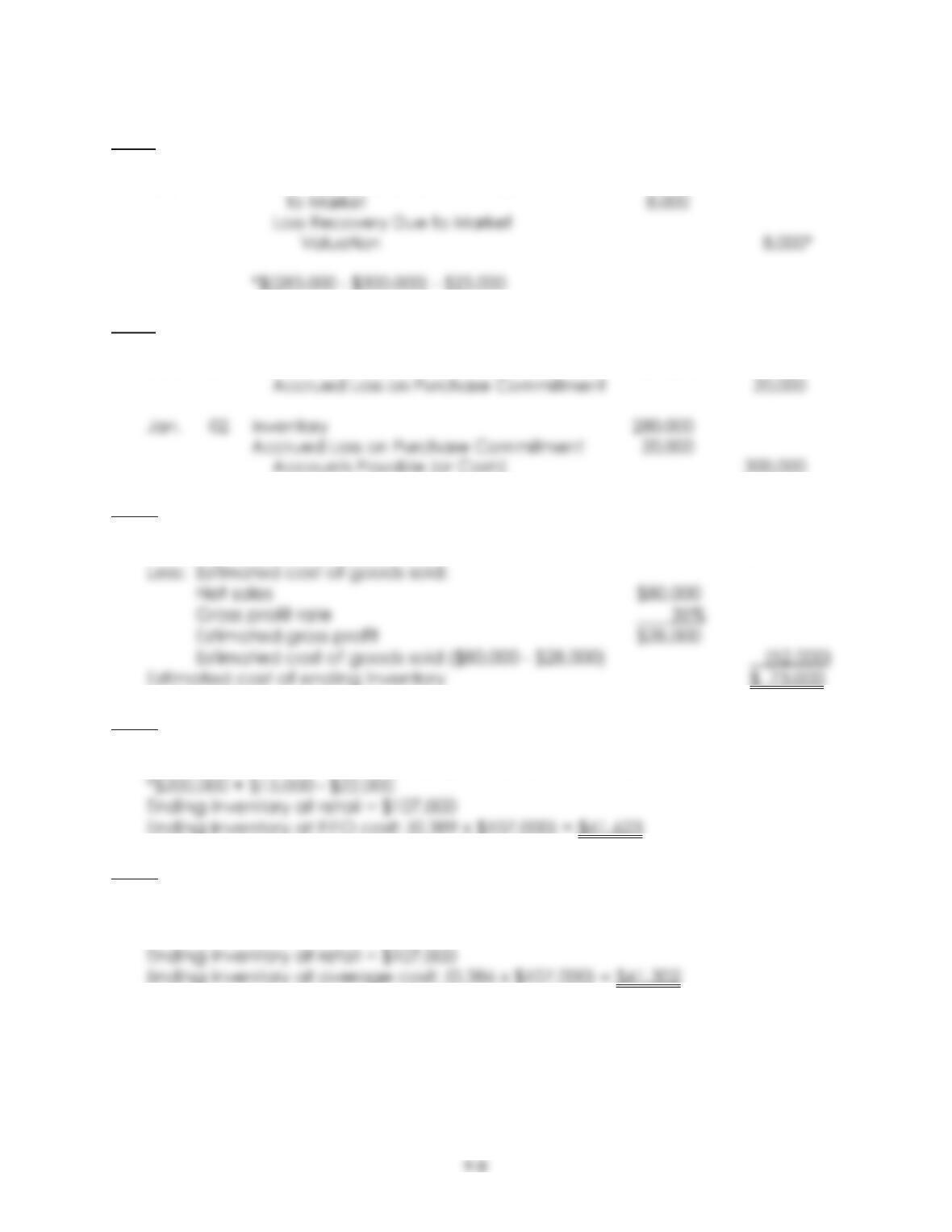
RE9-1
Selling price $ 5,000
RE9-2
Ceiling $ 8,455
RE9-3
Ceiling $ 2,850
RE9-4
Year 1 Cost of Goods Sold 25,000
RE9-5
Year 1 Loss Due to Market Valuation 25,000*
RE9-5 (continued)
Year 2 Allowance to Reduce Inventory
RE9-6
Dec. 31 Loss on Purchase Commitment 20,000
RE9-7
Cost of goods available for sale $125,000
RE9-8
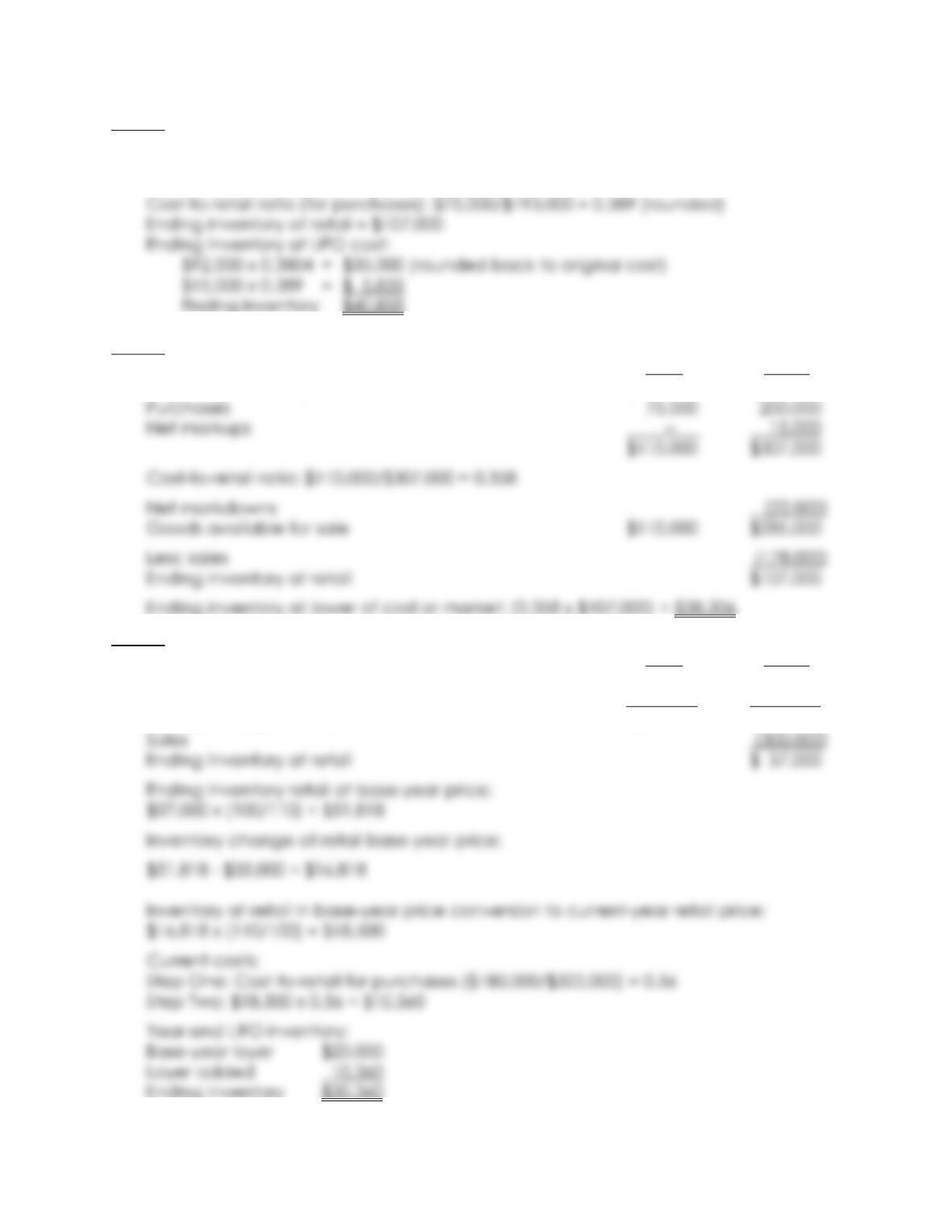
Cost to retail ratio (for purchases): $75,000/$193,000* = 0.389
RE9-9
Cost to retail ratio: ($35,000 + $75,000)/($92,000 + $200,000 + $15,000 – $22,000)
= 0.386 (rounded)
9-9
RE9-10
Cost-to-retail ratio (for beginning inventory): $35,000/$92,000 = 0.3804 (rounded)
Net purchases: $200,000 + $15,000 – $22,000 = $193,000
RE9-11
Cost Retail
Beginning inventory $ 35,000 $ 92,000
RE9-12
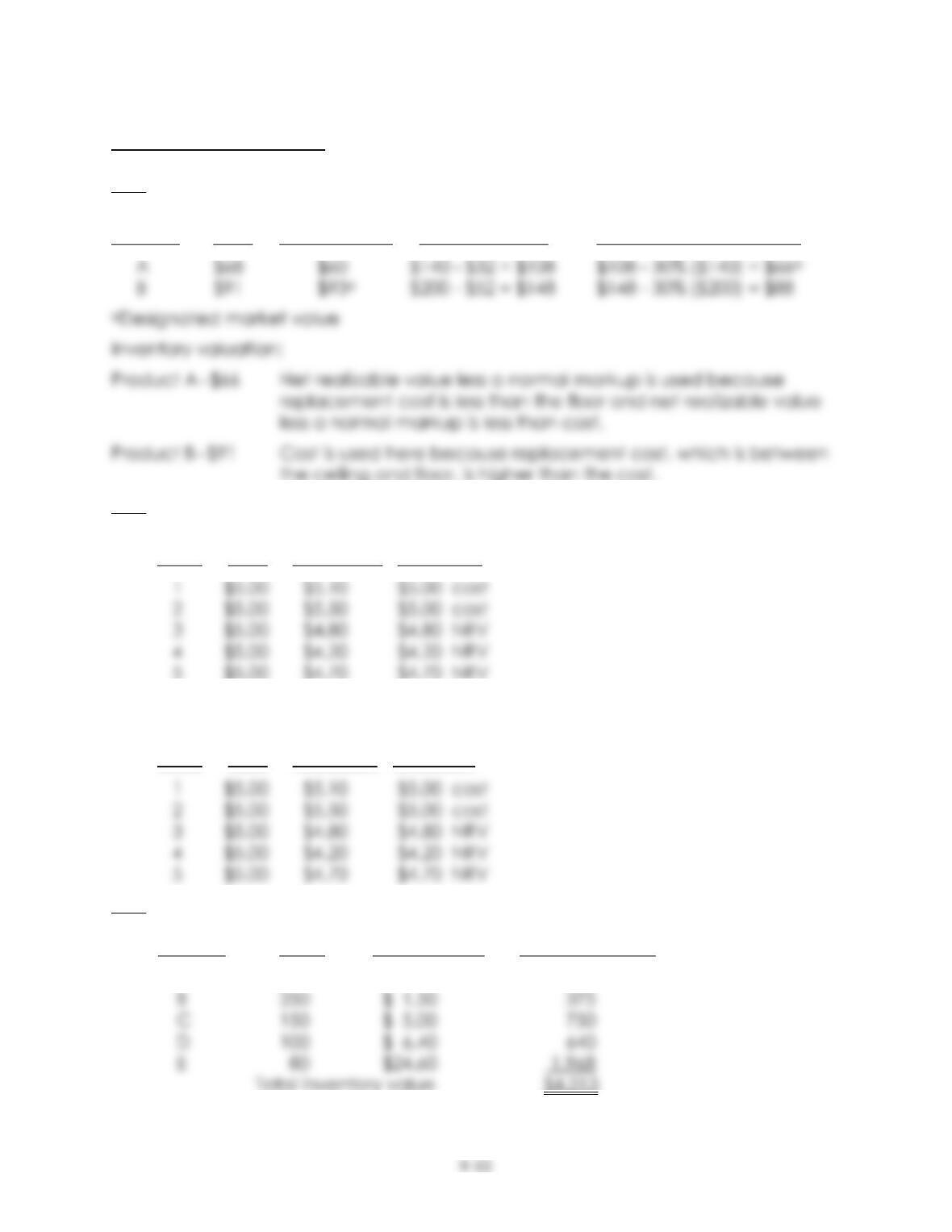
Cost Retail
Beginning inventory $ 20,000 $ 35,000
Purchases 180,000 322,000
Goods available for sale $200,000 $357,000
SOLUTIONS TO EXERCISES
E9-1
Replacement Net Realizable Net Realizable Value Less
Product Cost Cost Value (Ceiling) Normal Markup (floor)
E9-2
1. Designated Inventory
Case Cost Market Value
2. Net
Realizable Inventory
Case Cost Value Value
E9-3
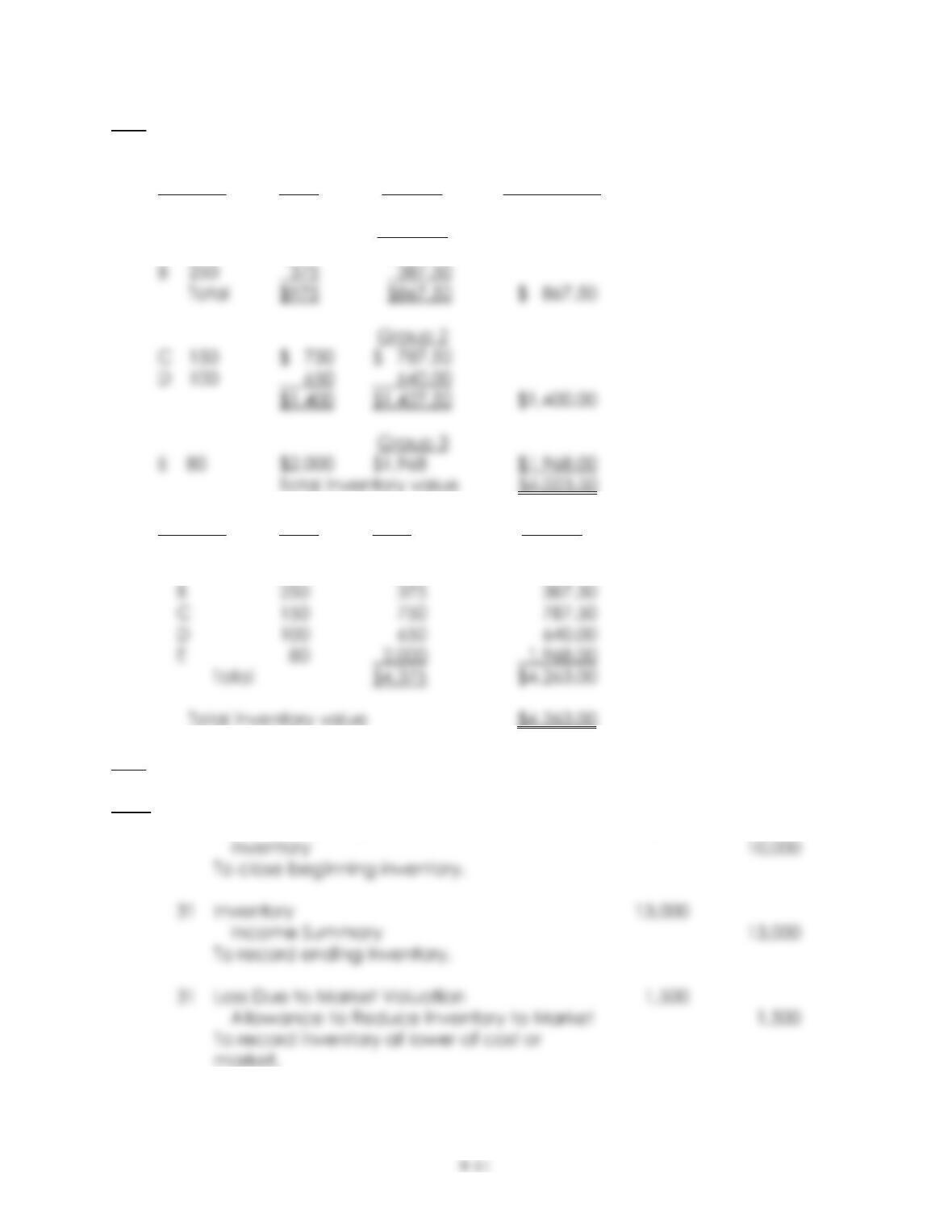
Lower of Cost
1. Product Units or Market Inventory Value
A 600 $ 0.80 $ 480
E9-3 (continued)
2. Lower of Cost
Product Cost Market or Market
Group 1
A 600 $600 $480.00
3. Product Units Cost Market
A 600 $ 600 $ 480.00
E9-4
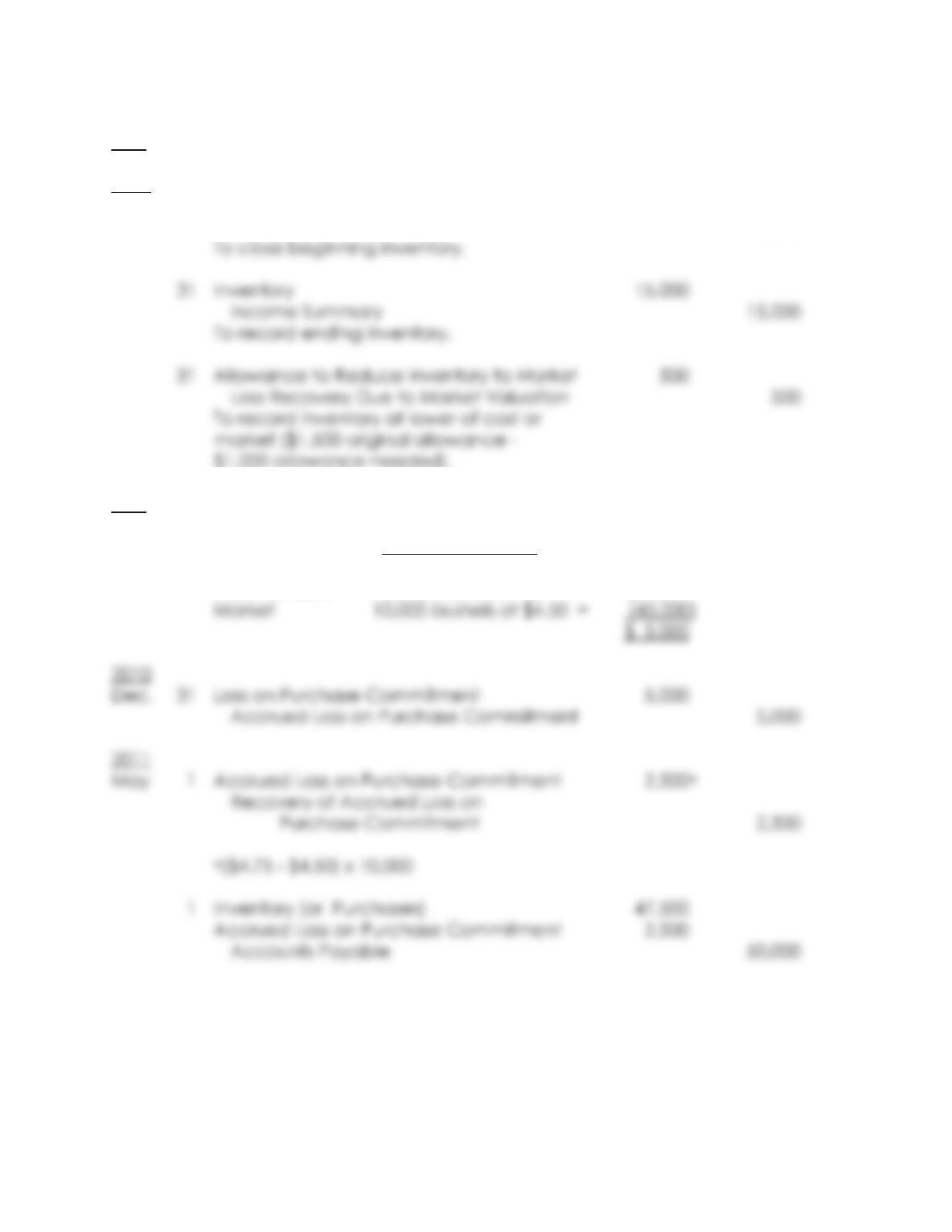
2010
Dec. 31 Income Summary 10,000
9-12
E9-4 (continued)
2011
Dec. 31 Income Summary 13,000
Inventory 13,000
E9-5
Loss Computation
Commitment 10,000 bushels at $5 = $50,000
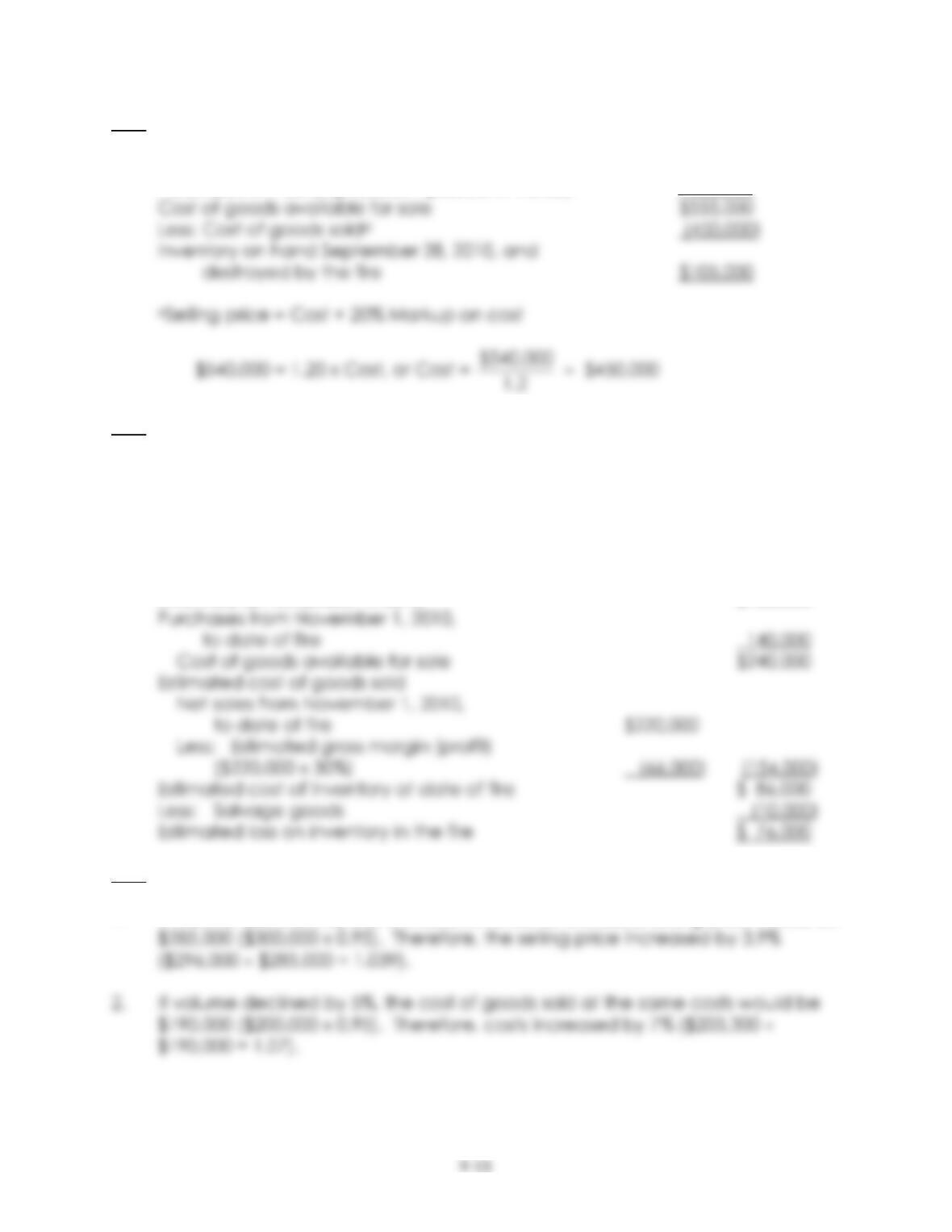
E9-6
Beginning inventory $150,000
Purchases on hand ($465,000 – $60,000 in transit) 405,000
E9-7 (AICPA adapted solution)
HODGE COMPANY
Calculation of Estimated Loss on Inventory
in the Fire Using Gross Margin
(Profit) Method
November 21, 2010
Inventory at November 1, 2010 $100,000
E9-8
1. If volume declined by 5%, the sales revenue at the same selling price would be
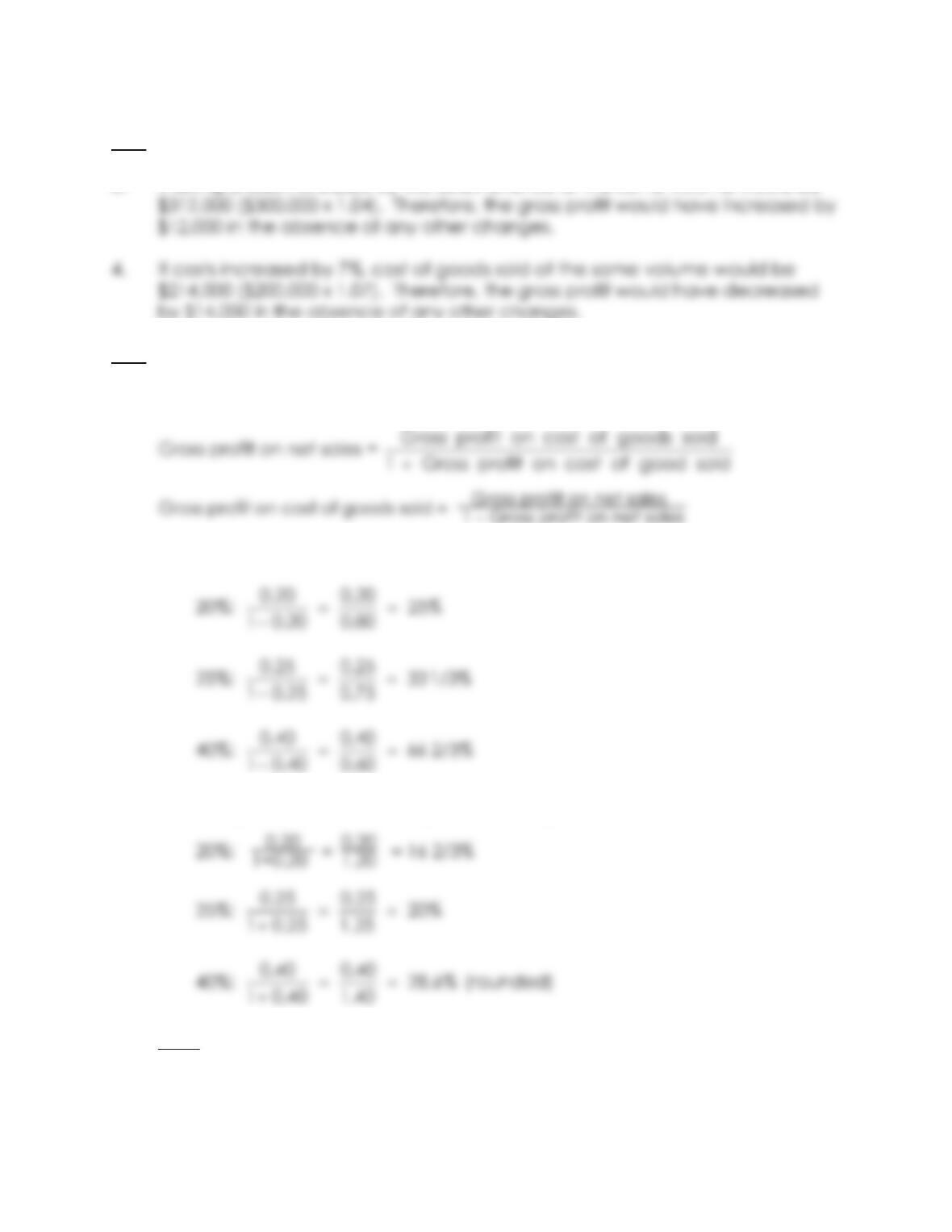
9-14
E9-8 (continued)
3. If selling prices increased by 4%, sales revenue at the same volume would be
by $14,000 in the absence of any other changes.
E9-9
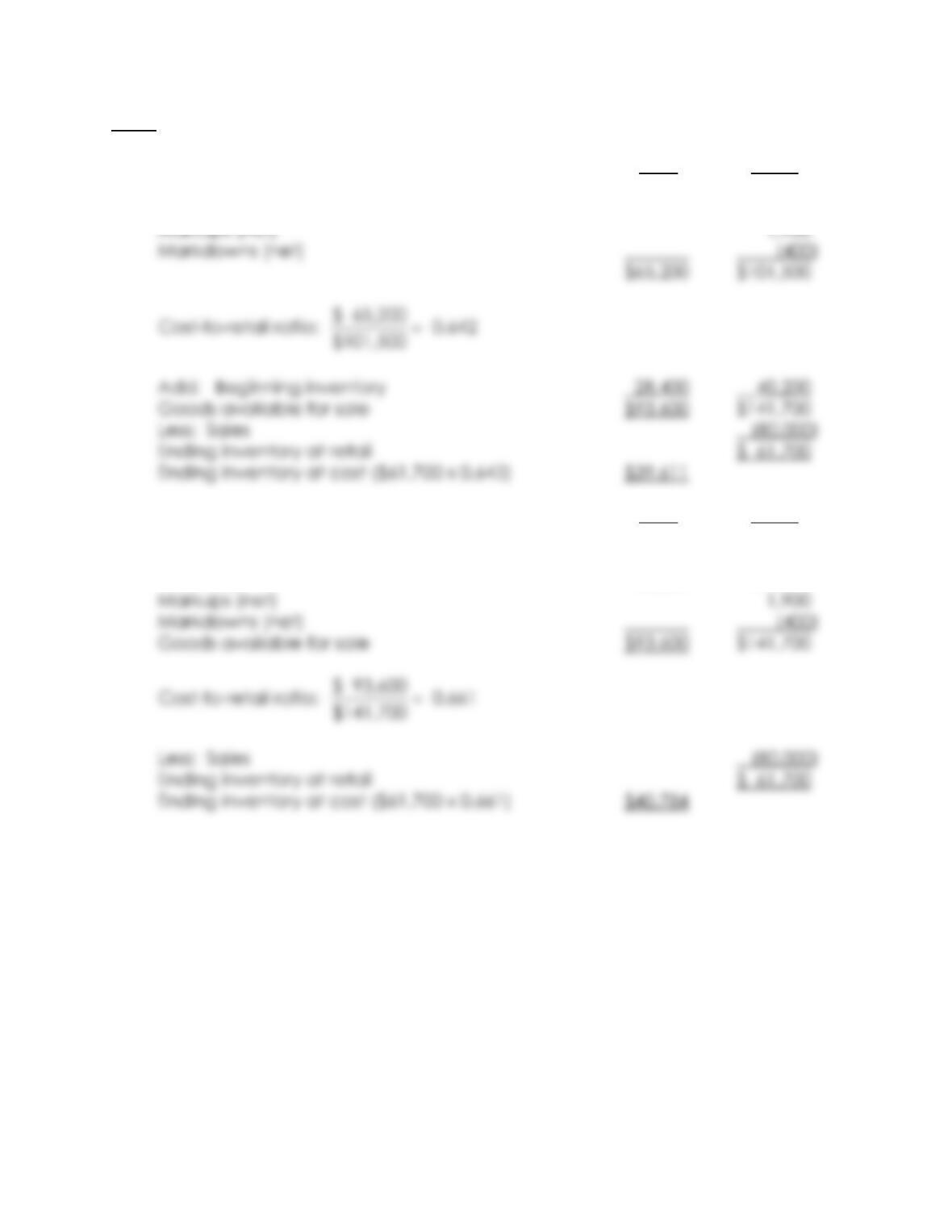
The following formulas are useful in solving this problem:
1. Convert gross profit on net sales to gross profit on cost of goods sold
2. Convert gross profit on cost of goods sold to gross profit on net sales
Note: In any profitable situation, gross profit on net sales is less than gross profit
on cost of goods sold.
9-15
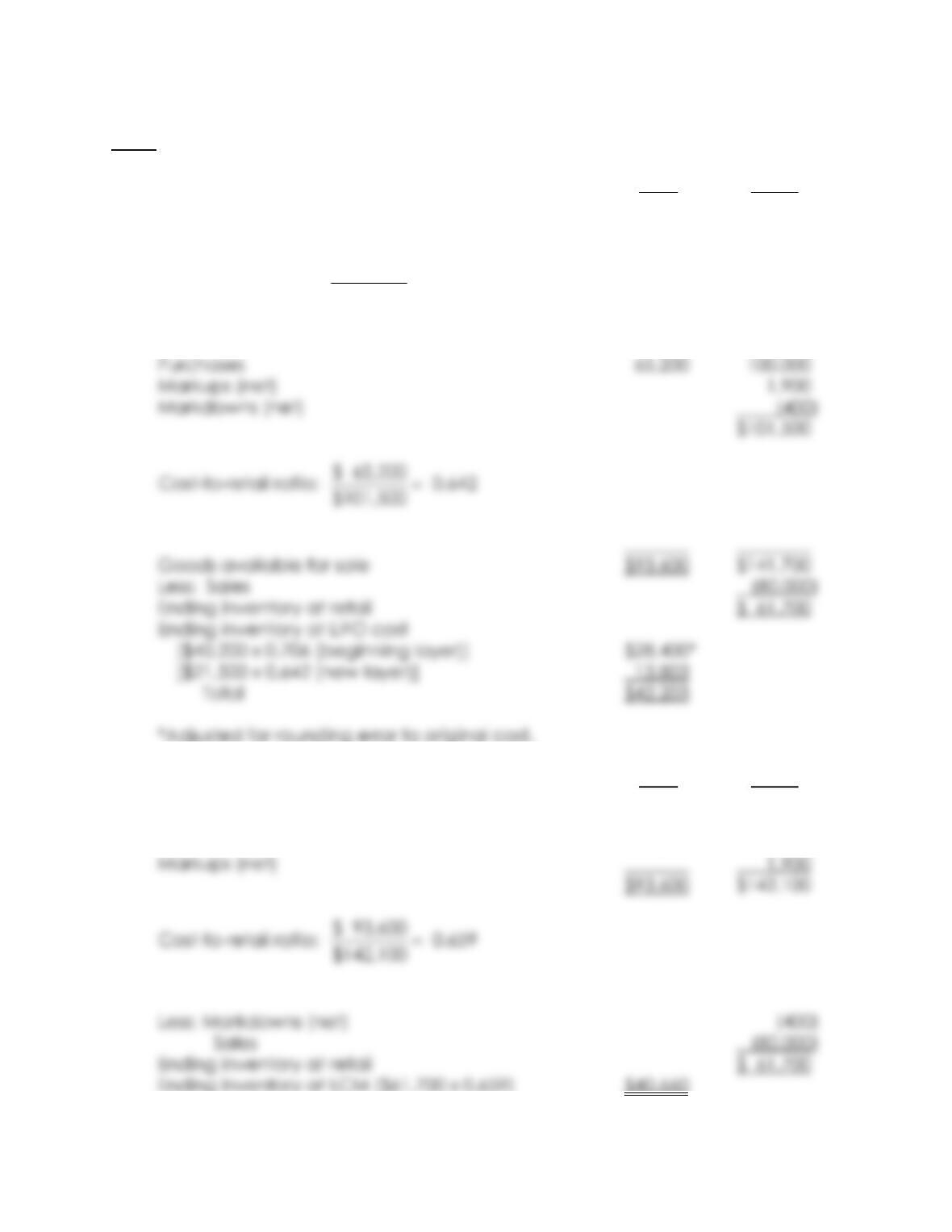
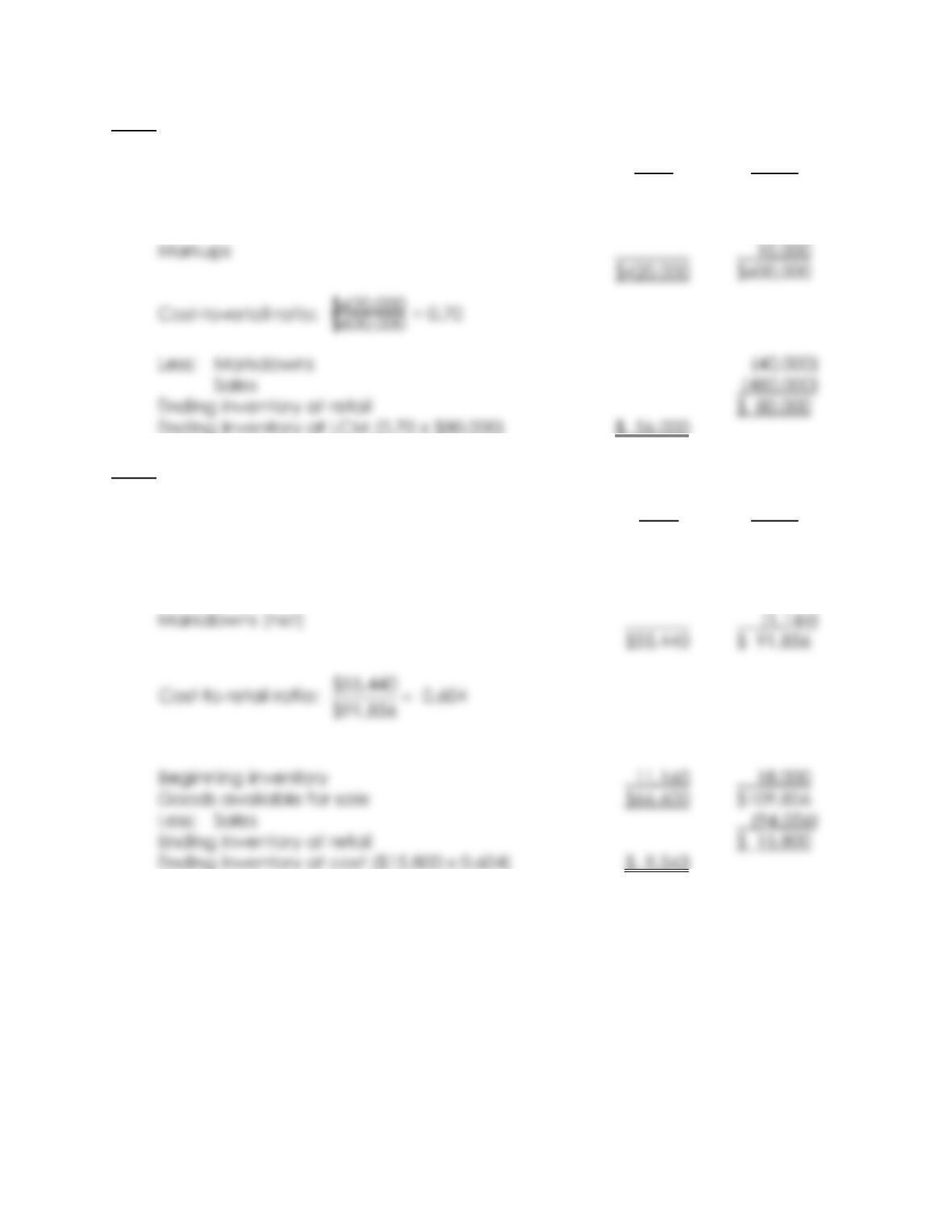
E9-10
1. Cost Retail
Purchases $65,200 $100,000
2. Cost Retail
Beginning inventory $28,400 $ 40,200
Purchases 65,200 100,000
9-16
E9-10 (continued)
3. Cost Retail
Beginning inventory $28,400 $ 40,200
Cost-to-retail ratio: 0.706
40,200$
28,400$ =
4. Cost Retail
Beginning inventory $28,400 $ 40,200
Purchases 65,200 100,000
9-17
E9-11 (AICPA adapted solution)
Cost Retail
Beginning inventory $ 90,000 $130,000
Purchases 330,000 460,000
E9-12
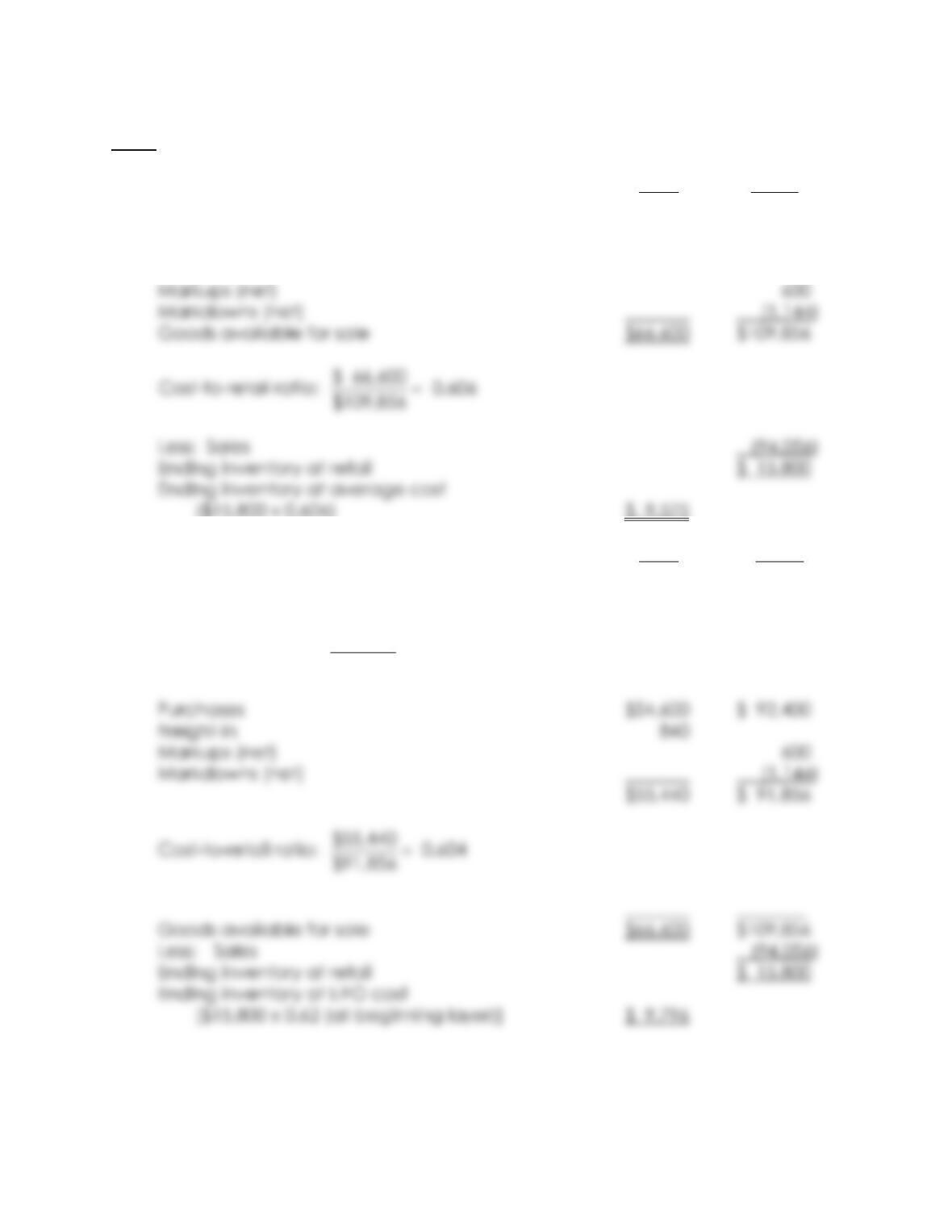
1. Cost Retail
Purchases $54,600 $ 92,400
Freight-in 840
Markups (net) 600
9-18
E9-12 (continued)
2. Cost Retail
Beginning inventory $11,160 $ 18,000
Purchases 54,600 92,400
Freight-in 840
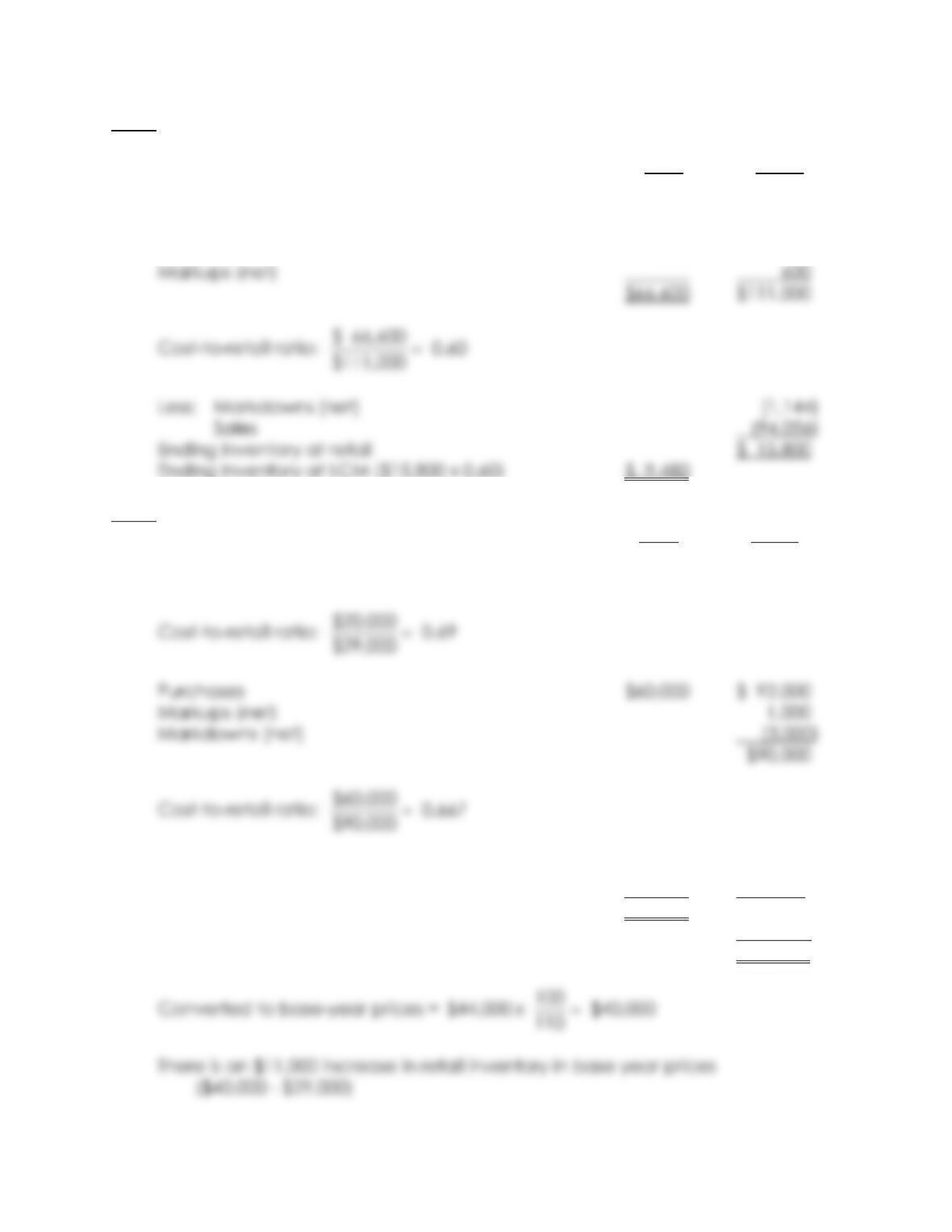
3. Cost Retail
Beginning inventory $11,160 $ 18,000
Cost-to-retail ratio: 0.62
$18,000
$11,160 =
9-19
E9-12 (continued)
4. Cost Retail
Beginning inventory $11,160 $ 18,000
Purchases 54,600 92,400
Freight-in 840
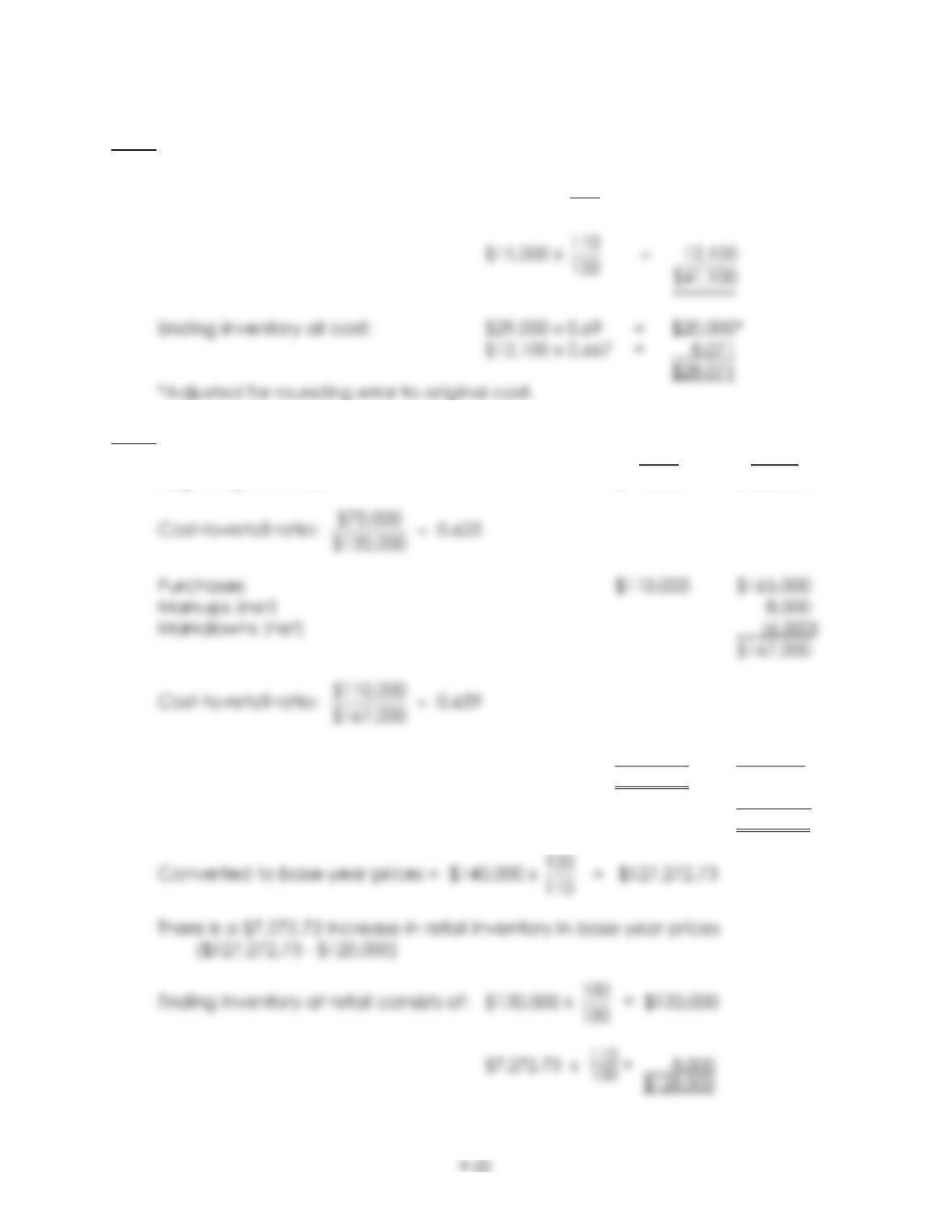
E9-13
Cost Retail
Beginning inventory $20,000 $ 29,000
Goods available for sale $80,000 $119,000
Less: Sales (75,000)
Ending inventory at retail $ 44,000
E9-13 (continued)
Ending inventory at retail consists of: $29,000 x 100
100 = $29,000
E9-14
Cost Retail
Beginning inventory $ 75,000 $120,000
Goods available for sale $185,000 $287,000
Less: Sales (147,000)
Ending inventory at retail $140,000