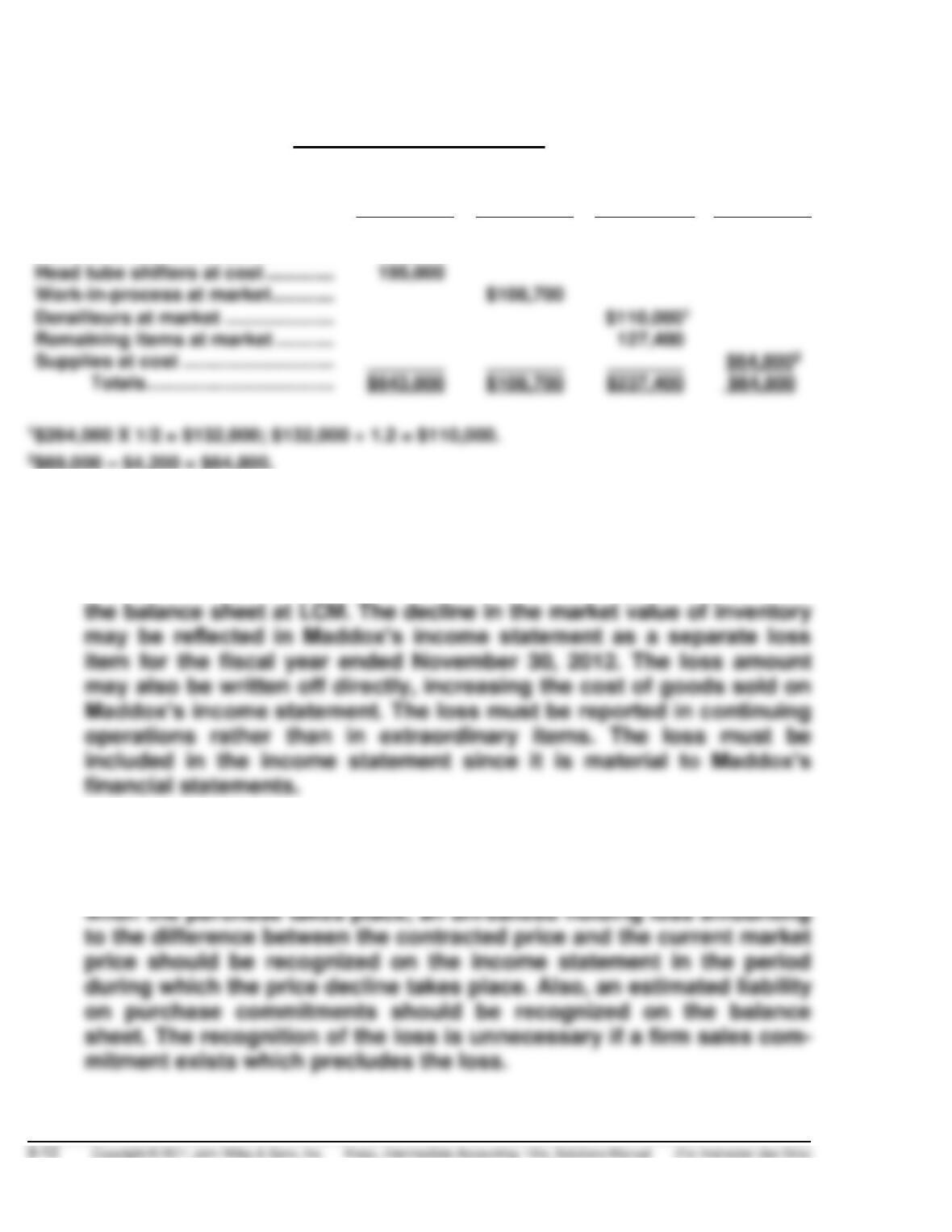
PROBLEM 9-9 (Continued)
Supporting Calculations
Finished
Goods
Work-in–
Process
Raw
Materials
Factory
Supplies
Down tube shifters at market ……..
$266,000
Bar end shifters at cost ……………..
182,000
Head tube shifters at cost ………….
195,000
$108,700
Derailleurs at market …………………
Remaining items at market ………..
Supplies at cost ………………………..
(b) The decline in the market value of inventory below cost may be
reported using one or two alternate methods, the direct write-down of
inventory (cost-of-goods-sold method) or the (loss method). An
allowance may be used under either method to report inventory on
(c) Purchase contracts for which a firm price has been established should
be disclosed on the financial statements of the buyer. If the contract
price is greater than the current market price and a loss is expected
PROBLEM 9-10
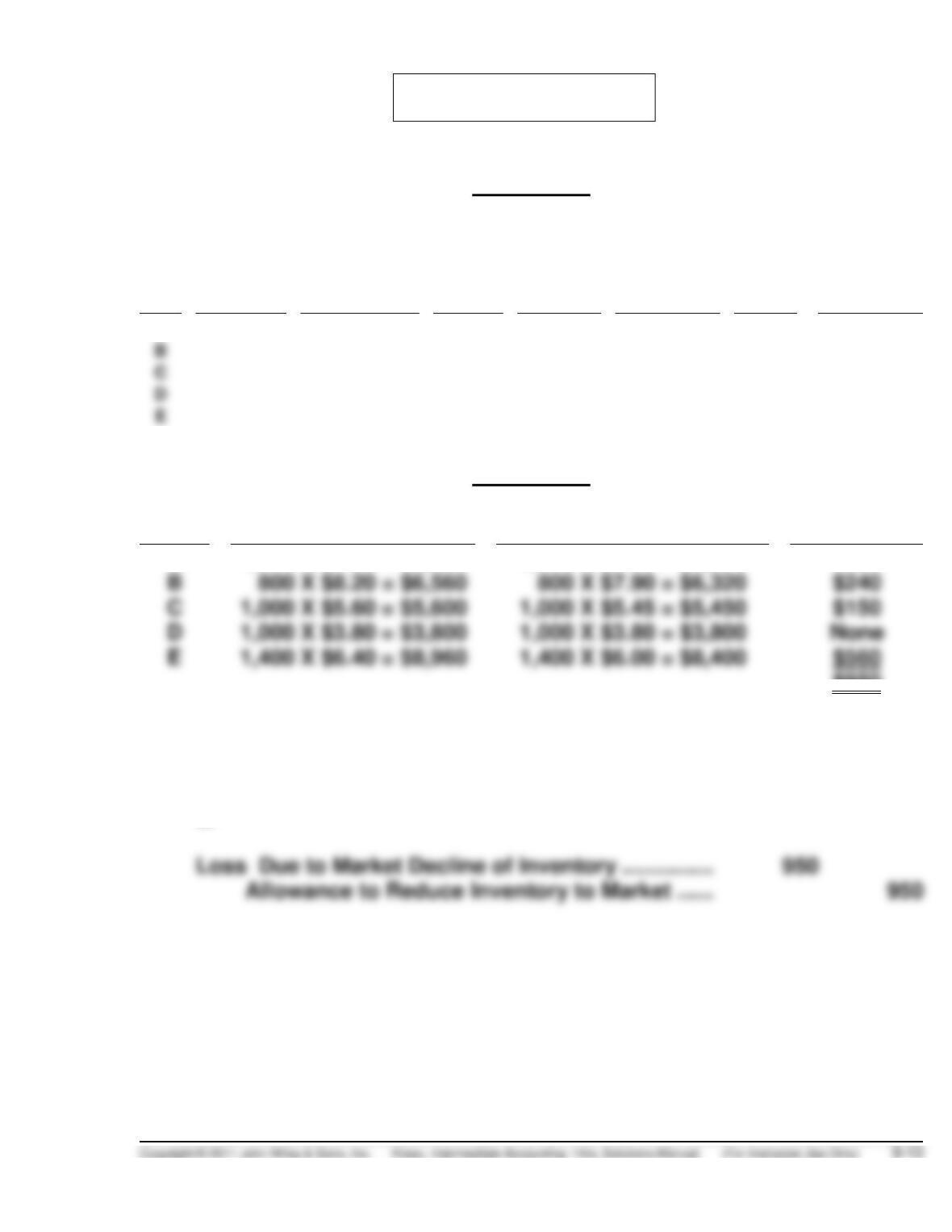
(a) Schedule A
Item
On Hand
Quantity
Replacement
Cost/Unit
NRV
(Ceiling)
NRV—
Normal
Profit
(Floor)
Designated
Market
Cost
Lower-of–
Cost-or–
Market
A
B
C
D
E
Schedule B
Item
Cost
Lower-of-Cost-or-Market
Difference
A
1,100 X $7.50 = $8,250
1,100 X $7.50 = $8,250
None
1,000 X $5.60 = $5,600
D
1,000 X $3.80 = $3,800
1,000 X $3.80 = $3,800
None
1,400 X $6.40 = $8,960
$950
(b) Cost of Goods Sold ……………………………………………………….
950
Allowance to Reduce Inventory to Market …………………
950
or
Loss Due to Market Decline of Inventory …………………………
Allowance to Reduce Inventory to Market …………………
950
PROBLEM 9-10 (Continued)
(c)
To: Greg Forda, Clerk
From: Accounting Manager
Date: January 14, 2013
Subject: Instructions on determining lower-of-cost-or-market for inven-
tory valuation
This memo responds to your questions regarding our use of lower-of-cost-
or-market for inventory valuation. Simply put, value inventory at whichever
is the lower: the actual cost or the market value of the inventory at the time
of valuation.
The term market, on the other hand, is more complicated. As you have
already noticed, this value could be the inventory’s replacement cost, its
net realizable value (selling price minus any estimated costs to complete
and sell), or its net realizable value less a normal profit margin. The
profession requires that the middle value of the three above costs be
chosen as the “designated market value.” This designated market value is
then compared to the actual cost in determining the lower–of-cost-or–
market.
PROBLEM 9-10 (Continued)
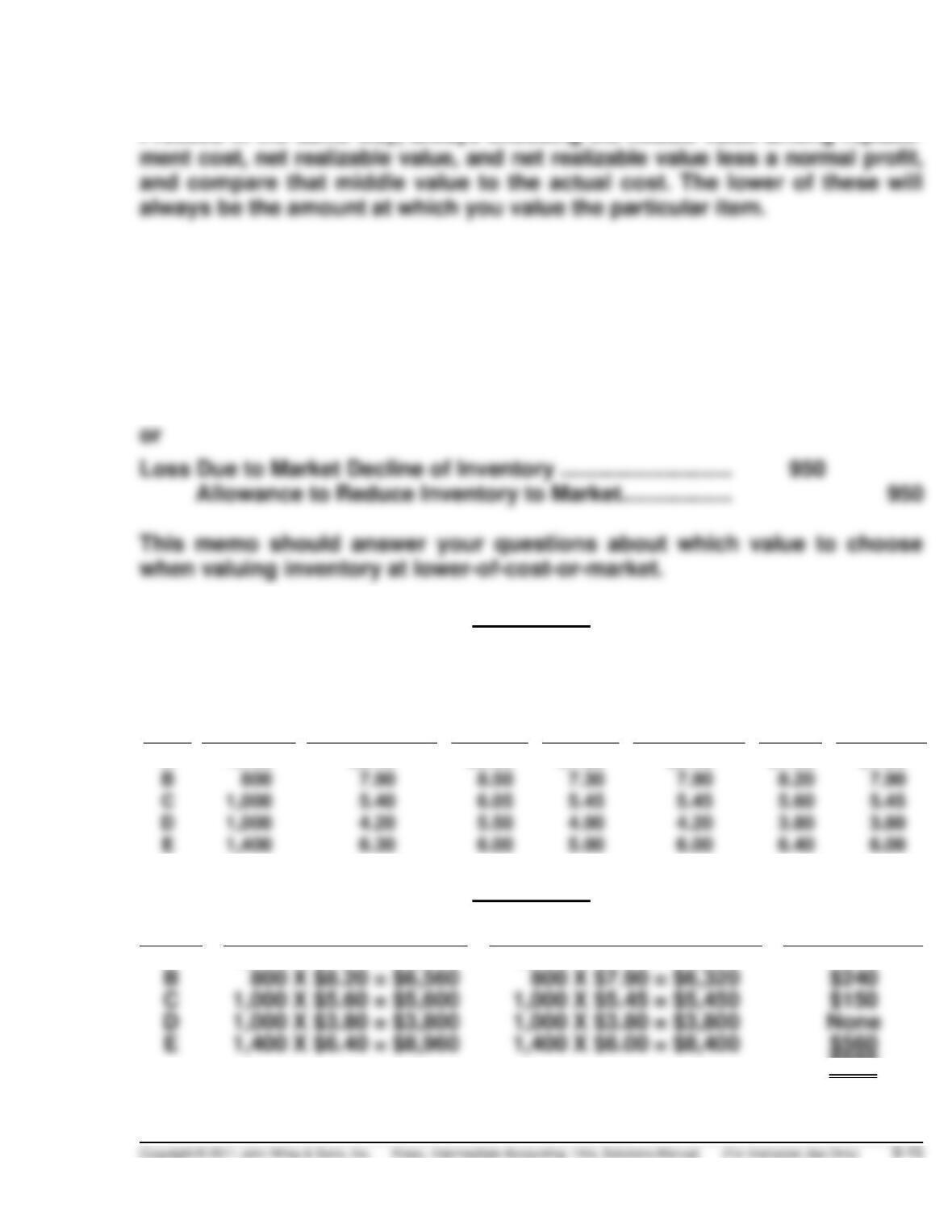
Proceed in the same way, always choosing the middle value among replace-
After you have aggregated the total lower-of-cost-or-market for all items,
you will be likely to have a loss on inventory which must be accounted for.
In our example, the loss is $950. You can journalize this loss in one of two
ways:
Cost of Goods Sold ………………………………………………………
950
Allowance to Reduce Inventory to Market ………………
950
Loss Due to Market Decline of Inventory ……………………….
950
Allowance to Reduce Inventory to Market ………………
950
Schedule A
Item
On Hand
Quantity
Replacement
Cost/Unit
NRV
Ceiling
NRV—
Normal
Profit
(Floor)
Designated
Market
Cost
Lower-of–
Cost-or–
Market
A
1,100
$8.40
$9.00
$7.20
$8.40
$7.50
$7.50
Schedule B
Item
Cost
Lower-of-Cost-or-Market
Difference
A
1,100 X $7.50 = $8,250
1,100 X $7.50 = $8,250
None
B
800 X $8.20 = $6,560
800 X $7.90 = $6,320
C
1,000 X $5.60 = $5,600
1,000 X $5.45 = $5,450
D
1,000 X $3.80 = $3,800
1,000 X $3.80 = $3,800
None
E
1,400 X $6.40 = $8,960
1,400 X $6.00 = $8,400
$950
*PROBLEM 9-11
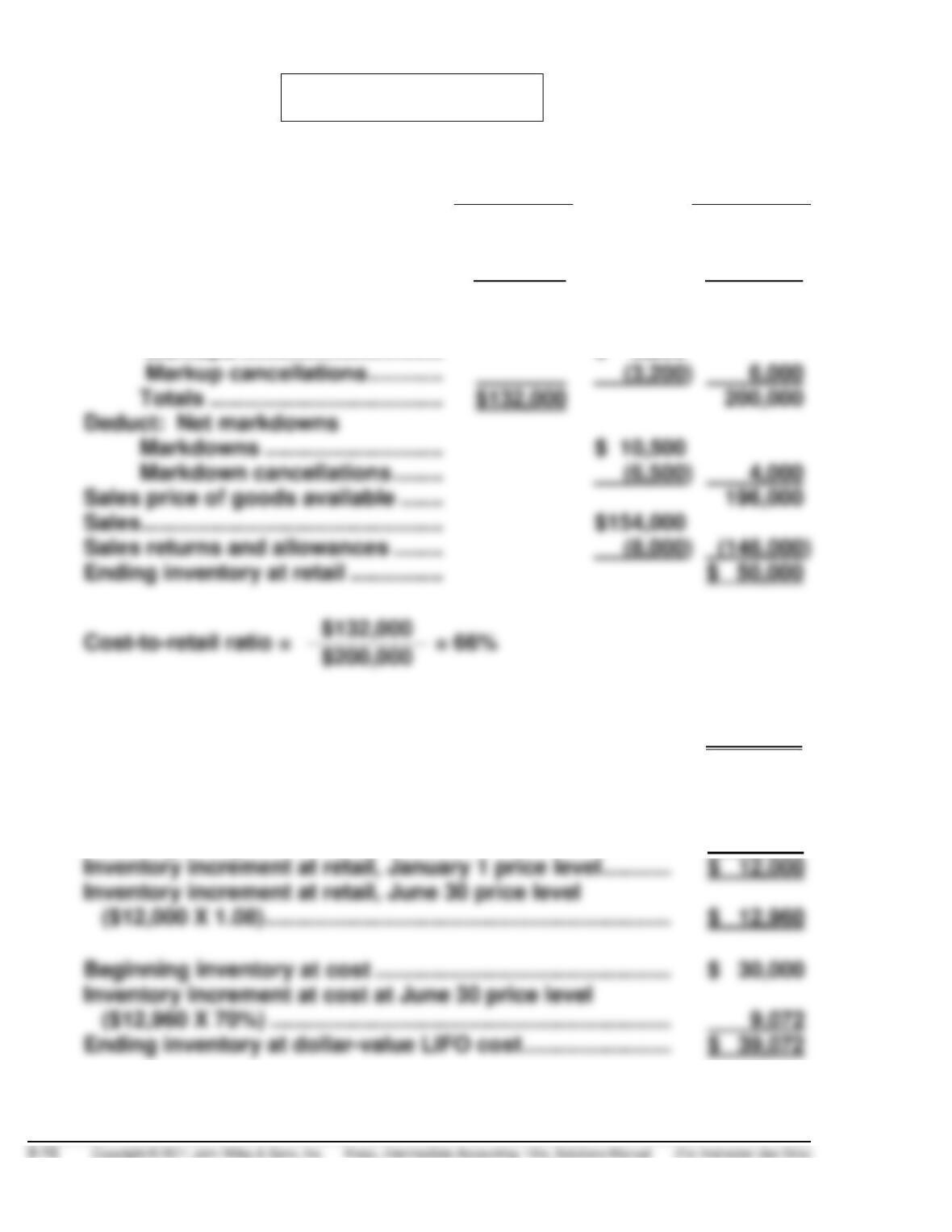
(a)
Cost
Retail
Inventory, January 1 …………………..
$ 30,000
$ 43,000
Purchases ………………………………….
104,800
155,000
Purchase returns ………………………..
(2,800)
(4,000)
Totals ………………………………..
132,000
194,000
Add: Net markups
Markups …………………………...
$ 9,200
Markup cancellations …………
(3,200)
6,000
Totals ………………………………..
$132,000
200,000
Deduct: Net markdowns
Markdowns ………………………..
$ 10,500
Markdown cancellations ……..
4,000
Sales price of goods available …….
196,000
Sales ………………………………………….
$154,000
Sales returns and allowances ……..
Ending inventory at retail ……………
Inventory at lower-of-cost-or–
market (66% X $50,000) …………….
$ 33,000
(b)
Ending inventory at retail at January 1 price level
($59,400 ÷ 1.08) …………………………………………………………
$ 55,000
Less beginning inventory at retail ………………………………..
43,000
Inventory increment at retail, January 1 price level ………..
$ 12,000
($12,000 X 1.08) ………………………………………………………...
$ 12,960
Beginning inventory at cost …………………………………………
$ 30,000
Inventory increment at cost at June 30 price level
Ending inventory at dollar-value LIFO cost ……………………
*PROBLEM 9-12
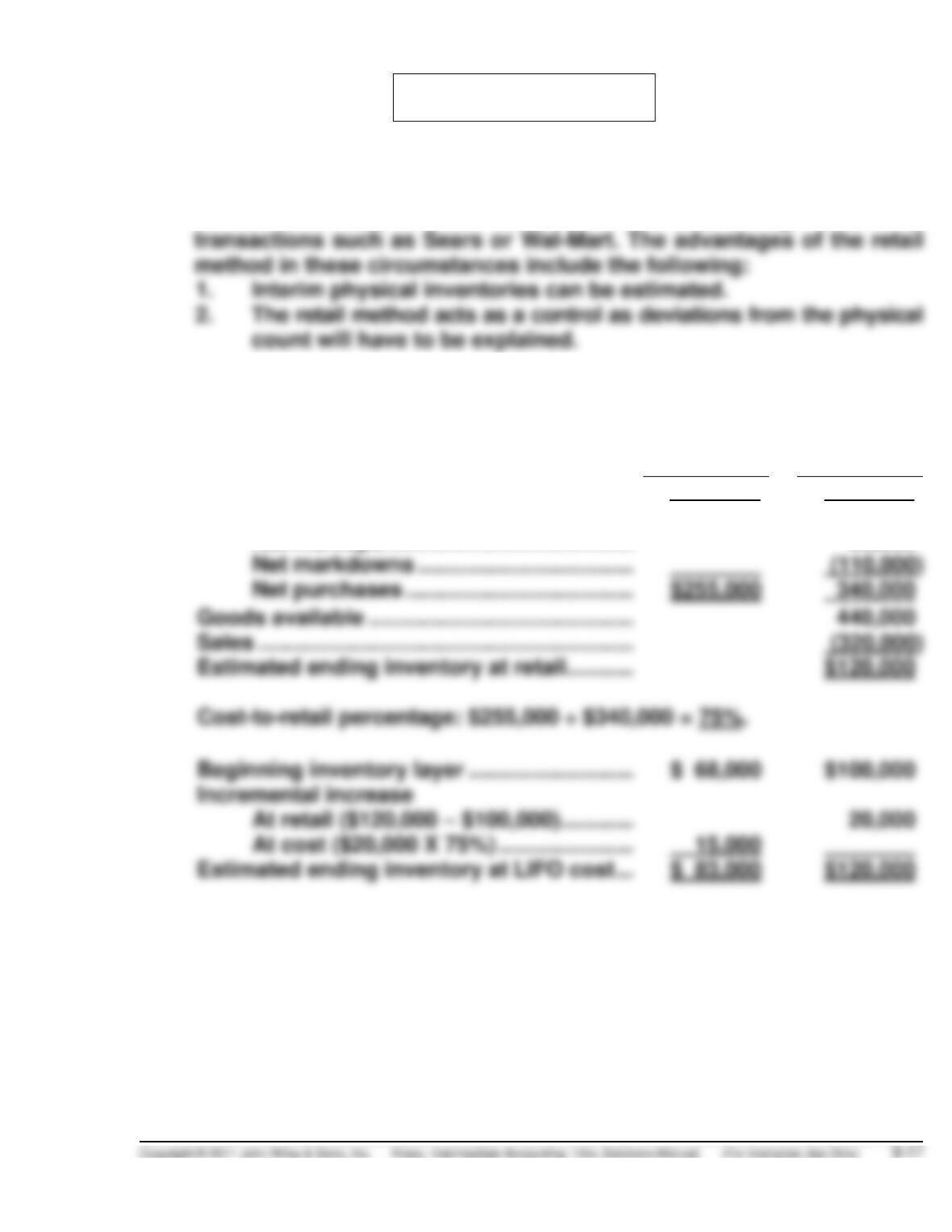
(a) The retail method is appropriate in businesses that sell many different
items at relatively low unit costs and that have a large volume of
(b) Becker Department Stores’ ending inventory value, at cost, is $83,000,
calculated as follows:
Cost
Retail
Beginning inventory ………………………………
$ 68,000
$100,000
Purchases ……………………………………………..
$255,000
$400,000
Net markups ………………………………….
50,000
Net markdowns ……………………………..
(110,000)
Goods available …………………………………….
440,000
Estimated ending inventory at retail ………..
$120,000
Beginning inventory layer ………………………
$ 68,000
$100,000
Incremental increase
20,000
At cost ($20,000 X 75%) ………………….
15,000
*PROBLEM 9-12 (Continued)
(c) The estimated shortage amount, at retail, for Becker Department Stores
is $5,000 calculated as follows:
(d) When using the retail inventory method, the four expenses and allow-
ances noted are treated in the following manner:
1. Freight costs are added to the cost of purchases.
2. Purchase returns and allowances are considered as reductions
*PROBLEM 9-13
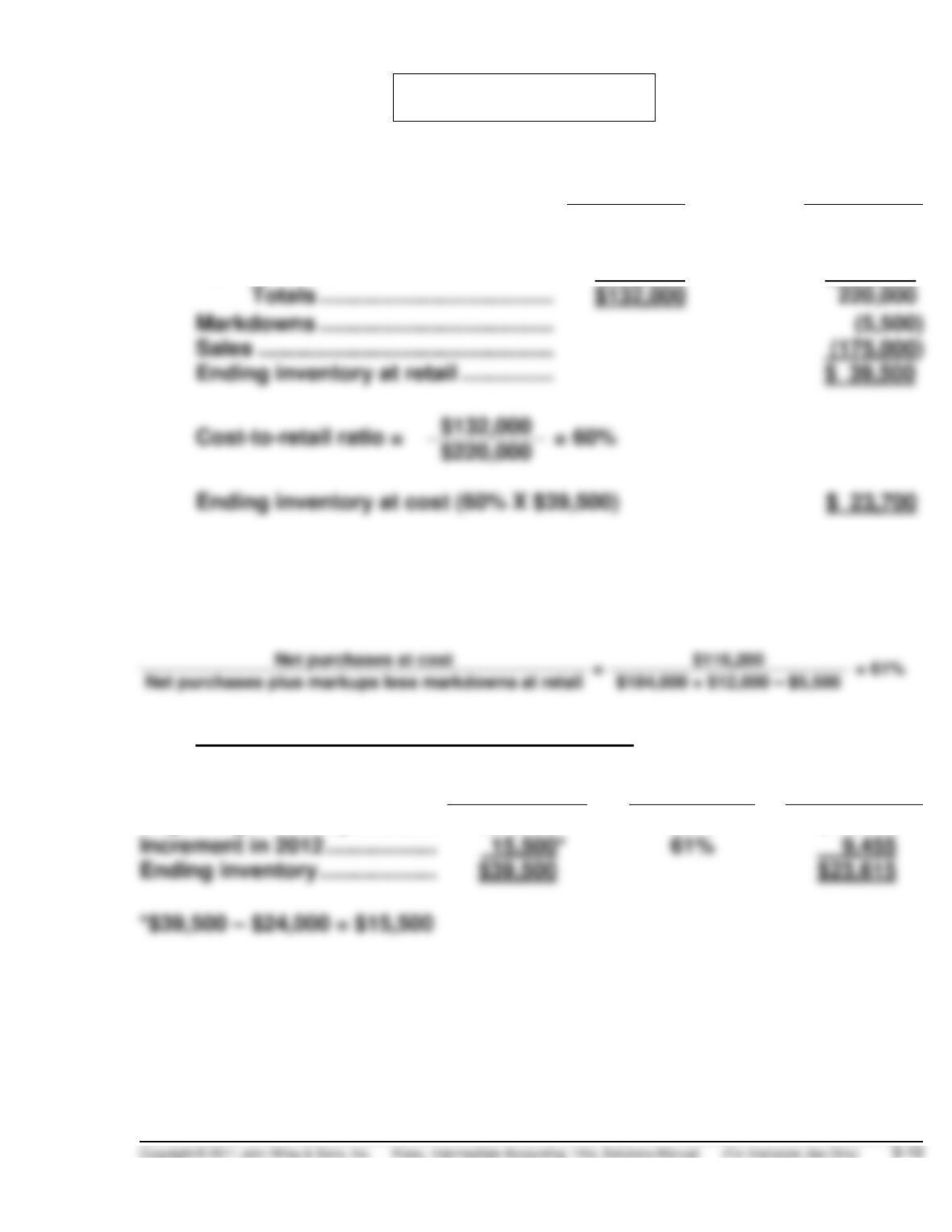
(a)
Cost
Retail
Inventory (beginning) ………………….
$ 15,800
$ 24,000
Purchases ………………………………….
116,200
184,000
Markups …………………………………….
12,000
Totals ………………………………..
Markdowns ………………………………..
Sales …………………………………………
Ending inventory at retail ……………
Ending inventory at cost (60% X $39,500)
$ 23,700
(b)
Ending inventory for 2012 under the LIFO method:
The cost-to-retail ratio for 2012 can be computed as follows:
December 31, 2012, inventory at LIFO cost:
Retail
Ratio
LIFO Cost
Beginning inventory …………..
$24,000
59%
$14,160
Increment in 2012 ………………
Ending inventory ……………….
*PROBLEM 9-14
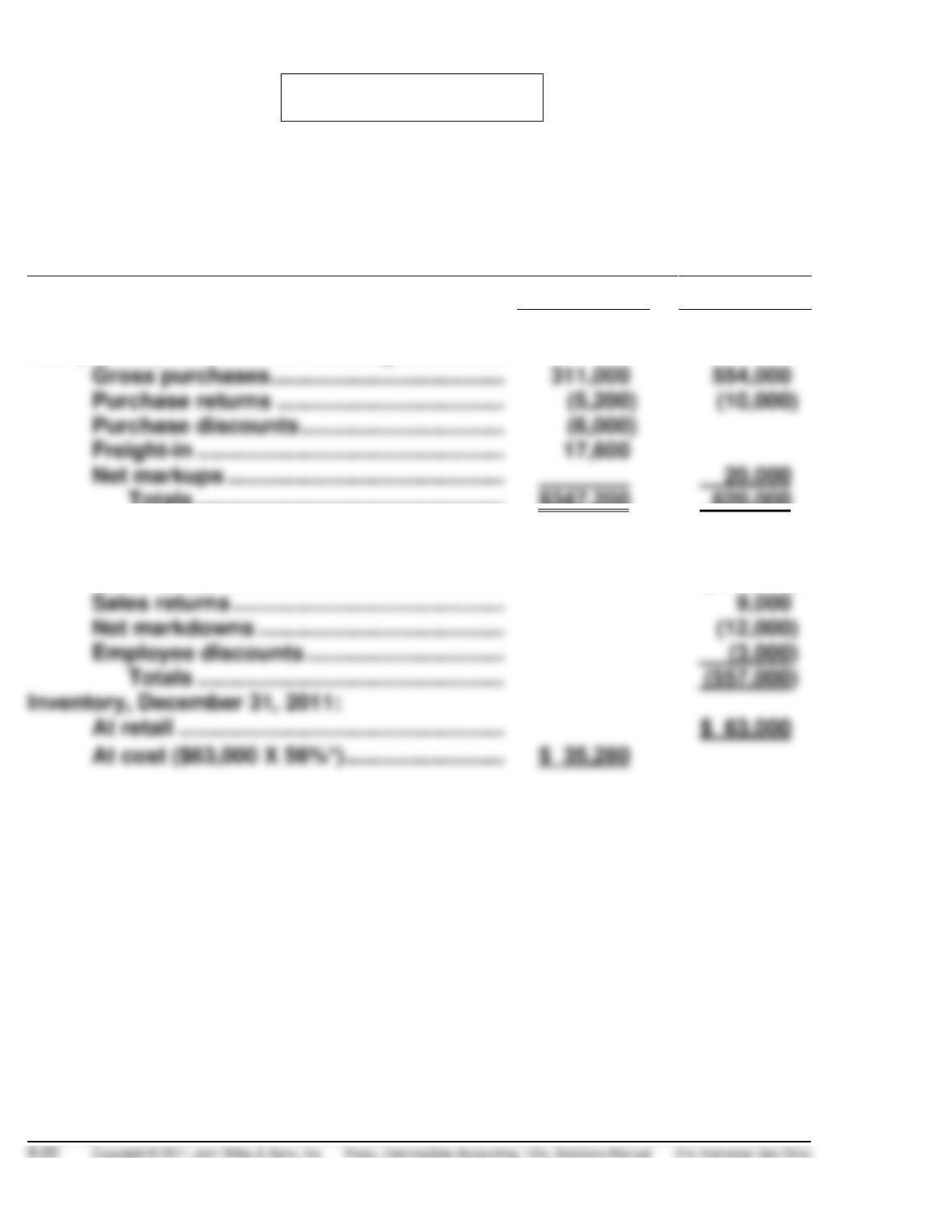
(a) DAVENPORT DEPARTMENT STORE
COMPUTATION OF COST
OF DECEMBER 31, 2011, INVENTORY
BASED ON THE CONVENTIONAL RETAIL METHOD
At Cost
At Retail
Beginning inventory, January 1, 2011 …………..
$ 29,800
$ 56,000
Add (deduct) transactions affecting cost ratio:
Gross purchases ………………………………..
Purchase returns ……………………………….
Purchase discounts …………………………...
Freight-in …………………………………………..
Net markups ………………………………………
Totals …………………………..………………
$347,200
620,000
Add (deduct) other retail transactions not
considered in computation of cost ratio:
Gross sales ……………………………………….
(551,000)
Sales returns ……………………………………..
Net markdowns ………………………………….
Employee discounts …………………………..
Totals …………………………..………………
Inventory, December 31, 2011:
At retail ……………………………………………..
$ 63,000
At cost ($63,000 X 56%*) ……………………..
$ 35,280
*Ratio of cost-to-retail = $347,200 ÷ $620,000
= 56%
*PROBLEM 9-14 (Continued)
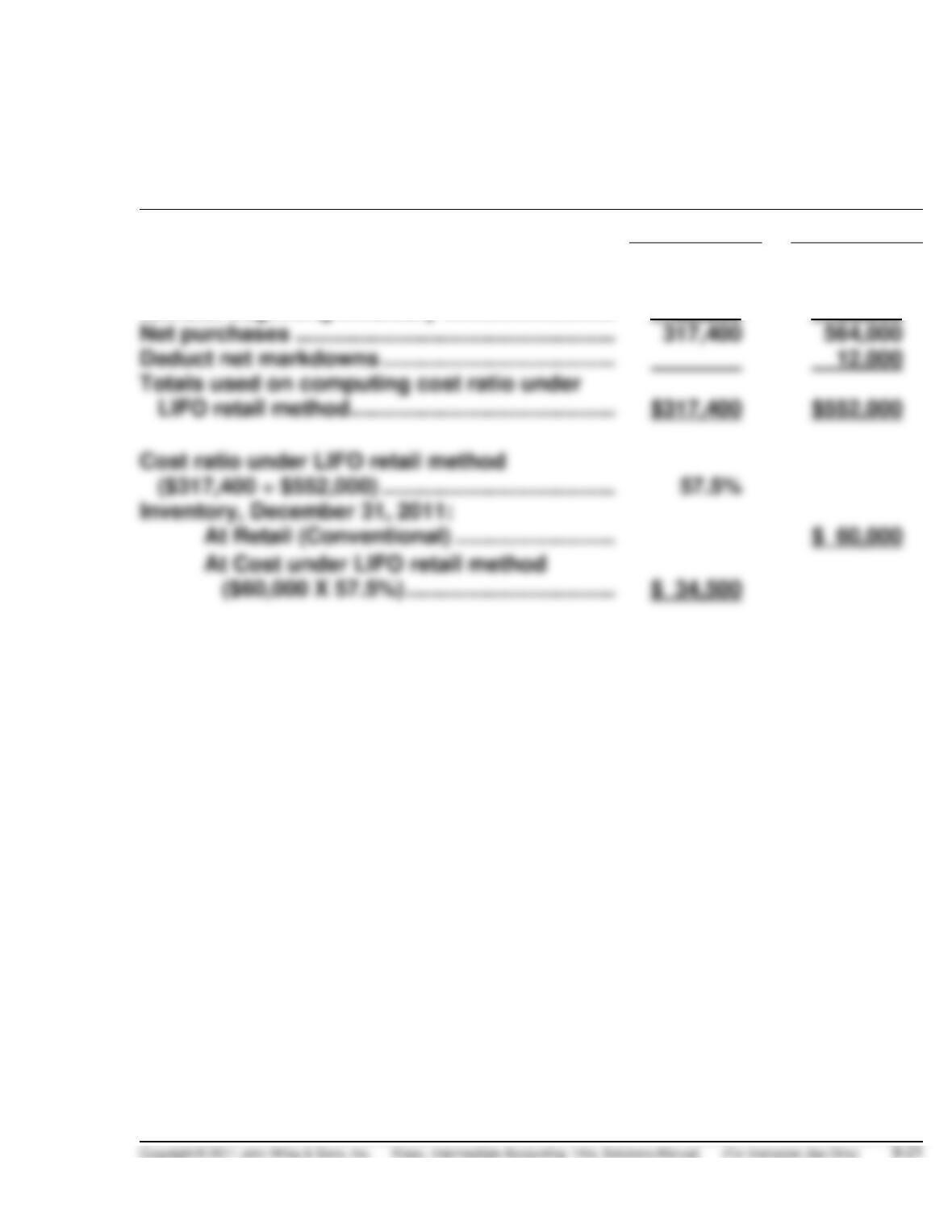
(b) COMPUTATION OF COST
OF DECEMBER 31, 2011 INVENTORY
UNDER THE LIFO RETAIL METHOD
Cost
Retail
Totals used in computing cost ratio under
conventional retail method (part a) …………….
$347,200
$620,000
Exclude beginning inventory ……………………….
29,800
56,000
Net purchases …………………………………………….
Deduct net markdowns ………………………………..
12,000
Totals used on computing cost ratio under
Cost ratio under LIFO retail method
($317,400 ÷ $552,000) ………………………………..
Inventory, December 31, 2011:
At Cost under LIFO retail method
*PROBLEM 9-14 (Continued)
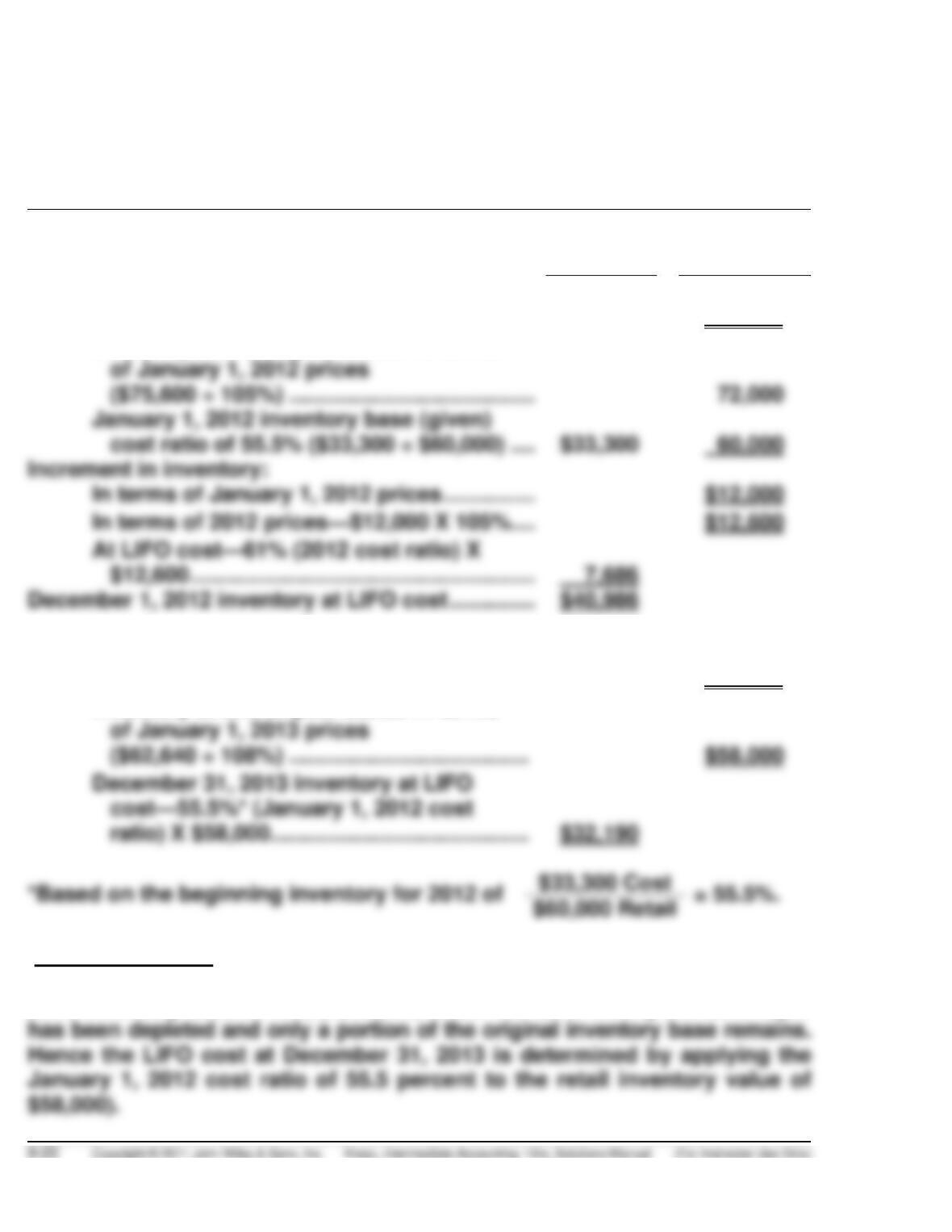
(c) COMPUTATION OF 2012 AND 2013
YEAR-END INVENTORIES
UNDER THE DOLLAR-VALUE LIFO METHOD
Computation of retail values on the basis of January 1, 2012, price levels
Cost
Retail
2012:
Inventory at end of year (given) ……………….
$75,600
Inventory at end of year stated in terms
of January 1, 2012 prices
($75,600 ÷ 105%) ………………………………….
January 1, 2012 inventory base (given)
cost ratio of 55.5% ($33,300 ÷ $60,000) ….
Increment in inventory:
In terms of January 1, 2012 prices ……………
$12,000
$12,600
$12,600 ………………………………………………..
December 1, 2012 inventory at LIFO cost …………..
2013:
Inventory at end of year (given) ………………
$62,640
Inventory at end of year stated in terms
of January 1, 2013 prices
($62,640 ÷ 108%) …………………………………
$58,000
December 31, 2013 inventory at LIFO
ratio) X $58,000 ……………………………………
$60,000 Retail
(Note to instructor: Because the retail inventory stated in terms of January 1,
2012 prices at December 31, 2012, $58,000, has fallen below the January 1,
2013 inventory base at retail, $60,000, under the LIFO theory the 2013 layer