PROBLEM 9.1
KNOWN: Thickness and thermal conductivity of plane wall. Fluid temperatures.
FIND: Expected minimum and maximum steady-state heat fluxes through the wall for (a) free
convection in gases, (b) free convection in liquids, (c) forced convection in gases, (d) forced
convection in liquids, and (e) convection with phase change.
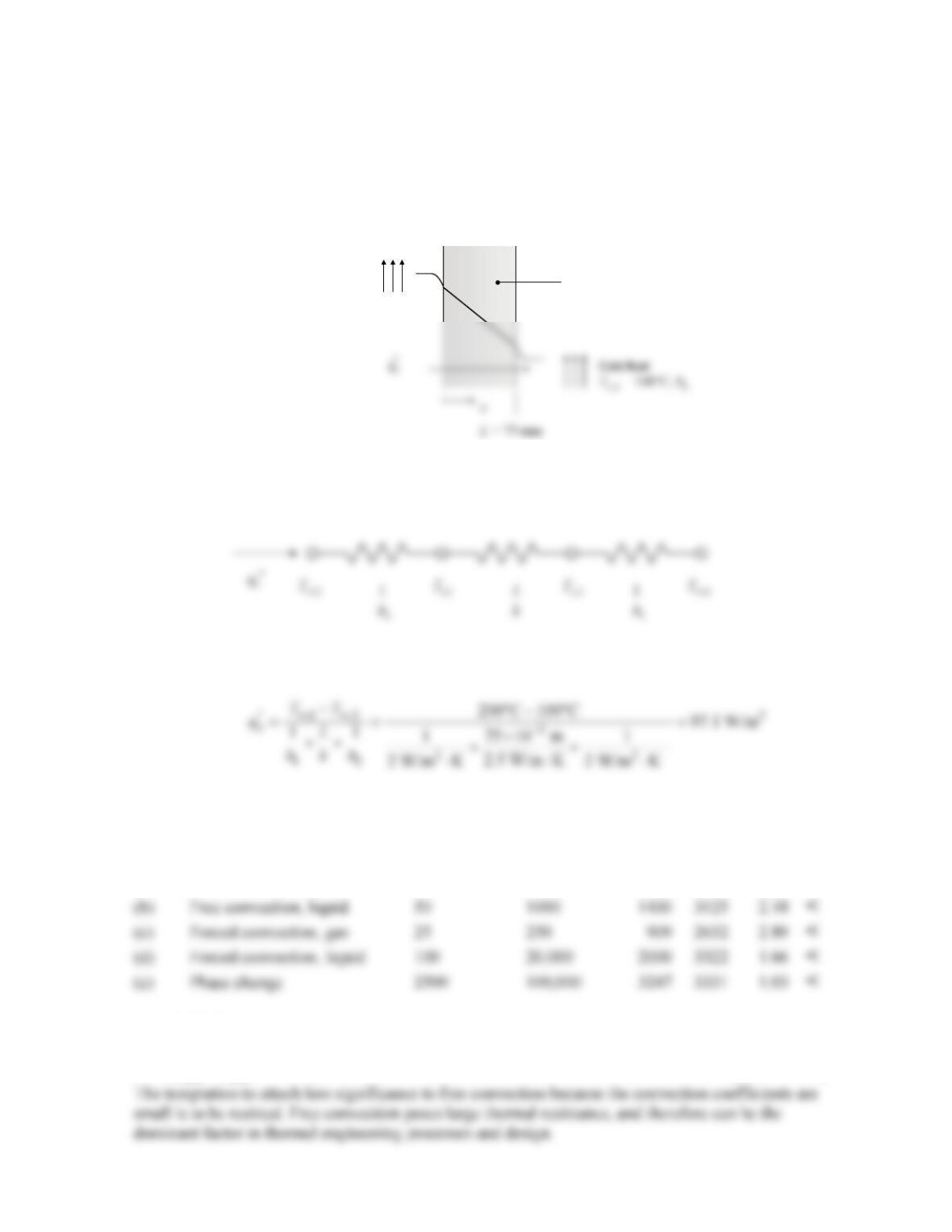
SCHEMATIC:
ASSUMPTIONS: (1) Constant properties. (2) Steady state conditions. (3) Negligible radiation.
ANALYSIS: The thermal resistance network is
From Table 1.1 for free convection in gases, the minimum convective heat transfer coefficient is h = 2
W/m2⋅K. Therefore, the corresponding heat flux is
Proceeding in the same manner, we find the following results
Process hmin (W/m2⋅K) hmax (W/m2⋅K)
,minx
q′′
,maxx
q′′
,max ,min
/
xx
qq
′′ ′′
(a) Free convection, gas 2 25 97.1 909 9.36 <
COMMENTS: For either gases or liquids, the dependence of the heat flux on the range of convection
coefficients associated with each type of convective heat transfer process, as quantified by the
ratio
,max ,min
/
xx
qq
′′ ′′
, is strongest for free convection, and weakest for convection involving phase change.
Hot fluid
T
∞,1
= 200°C, h
1
k= 5 W/m∙K
k= 2.5 W/m∙K
PROBLEM 9.2
KNOWN: Tabulated values of density for water and definition of the volumetric thermal
expansion coefficient, β.
FIND: Value of the volumetric expansion coefficient at 300K; compare with tabulated
values.
PROPERTIES: Table A-6, Water (300K): r = 1/vf = 1/1.003 × 10–3 m3/kg = 997.0 kg/m3,
1/vf = 1/1.005 × 10–3 m3/kg = 995.0 kg/m3.
ANALYSIS: The volumetric expansion coefficient is defined by Eq. 9.3 as
The density change with temperature at constant pressure can be estimated as
where the subscripts (1,2) denote the property values just above and below, respectively, the
condition for T = 300K denoted by the subscript (o). That is,
Substituting numerical values, find
Compare this value with the tabulation, β = 276.1 × 10⁻⁶ K-1, to find our estimate is 8.7%
high.
COMMENTS: (1) The poor agreement between our estimate and the tabulated value is due
to the poor precision with which the density change with temperature is estimated. The
T
s
=T
∞
+10°C
L
T
PROBLEM 9.3
KNOWN: Characteristic length of object. Temperature difference between object and environment.
Velocity of flow past object. Film temperature range.
FIND: Grashof number, Reynolds number, and 2
/
LL
Gr Re for air and water over a range of film
temperatures.
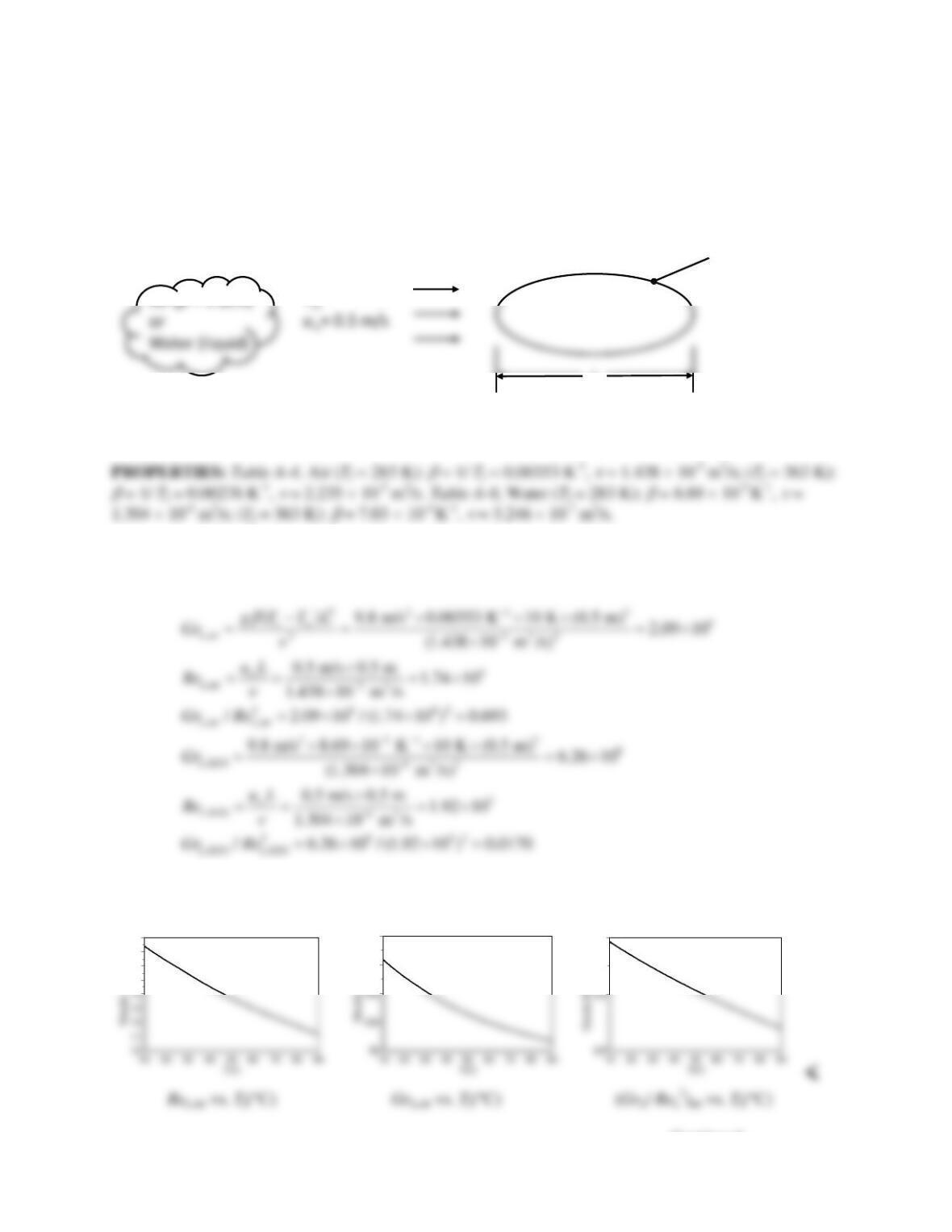
SCHEMATIC:
ASSUMPTIONS: (1) Constant properties evaluated at the film temperature. (2) The thermal expansion
coefficient for air is 1/Tf.
ANALYSIS: The Grashof number and Reynolds number are evaluated from their definitions, Equations
9.10 and 6.41 (with V = u∞ in Eq. 6.41). Evaluating for Tf = 283 K:
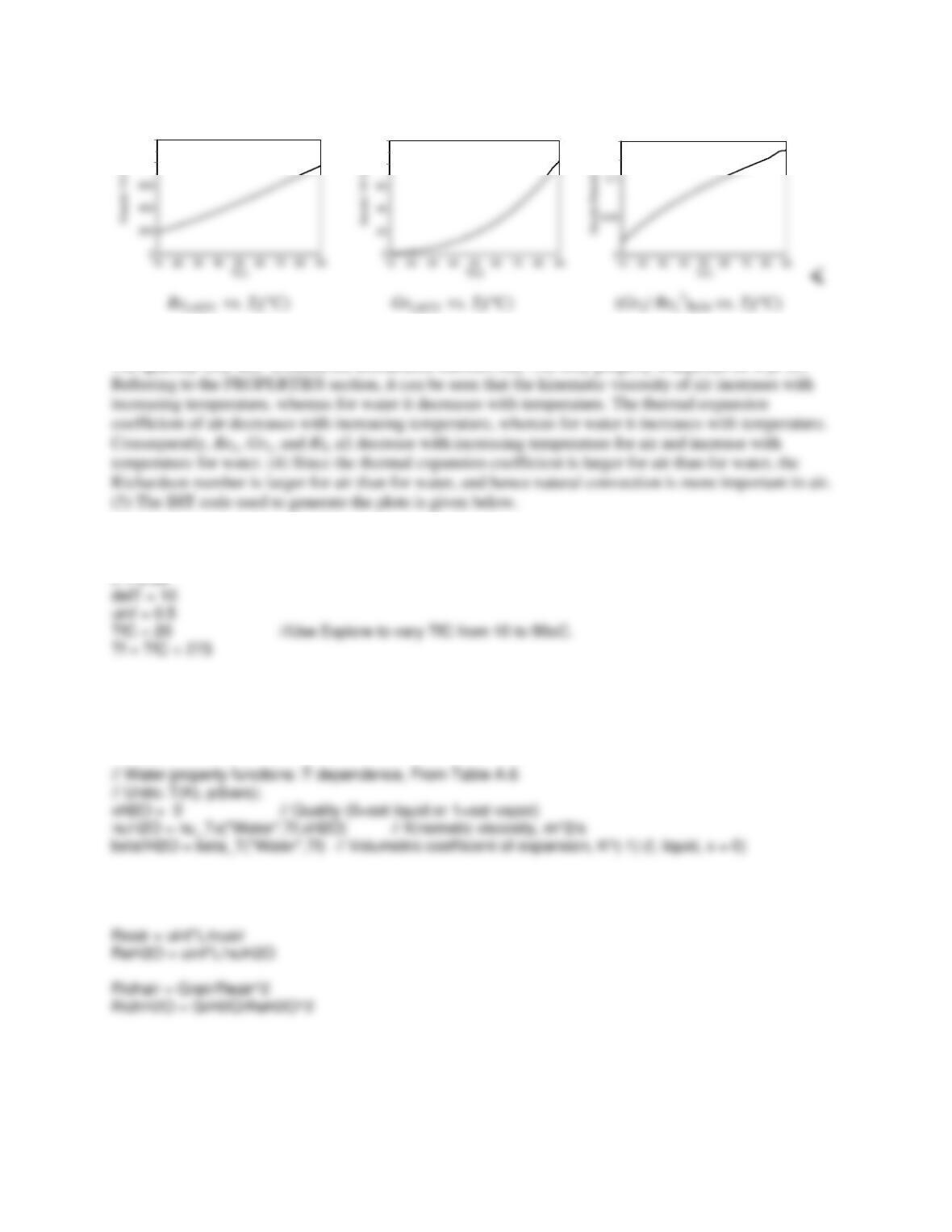
Results are plotted below over the specified temperature range.
Air
18
17
16
15
Air
250
200
Air
0.7
Continued…
PROBLEM 9.3 (Cont.)
Water
1,000
800
Water
100
80
Water
0.15
COMMENTS: (1) The only properties that affect the Grashof and Reynolds numbers are
β
and
ν
. (2)
The quantity GrL/ ReL
2 is called the Richardson number, RiL. The only property it depends on is
β
. (3)
//Parameter inputs
g = 9.8
// Air property functions : From Table A.4
// Units: T(K); 1 atm pressure
nuair = nu_T(“Air”,Tf) // Kinematic viscosity, m^2/s
betaair = 1/Tf // Volumetric coefficient of expansion, K^(-1); ideal gas
Grair = g*betaair*delT*L^3/nuair^2
GrH2O = g*betafH2O*delT*L^3/nuH2O^2
PROBLEM 9.4
KNOWN: Relation for the Rayleigh number.
FIND: Rayleigh number for four fluids for prescribed conditions.
SCHEMATIC:
ASSUMPTIONS: (1) Perfect gas behavior for specified gases.
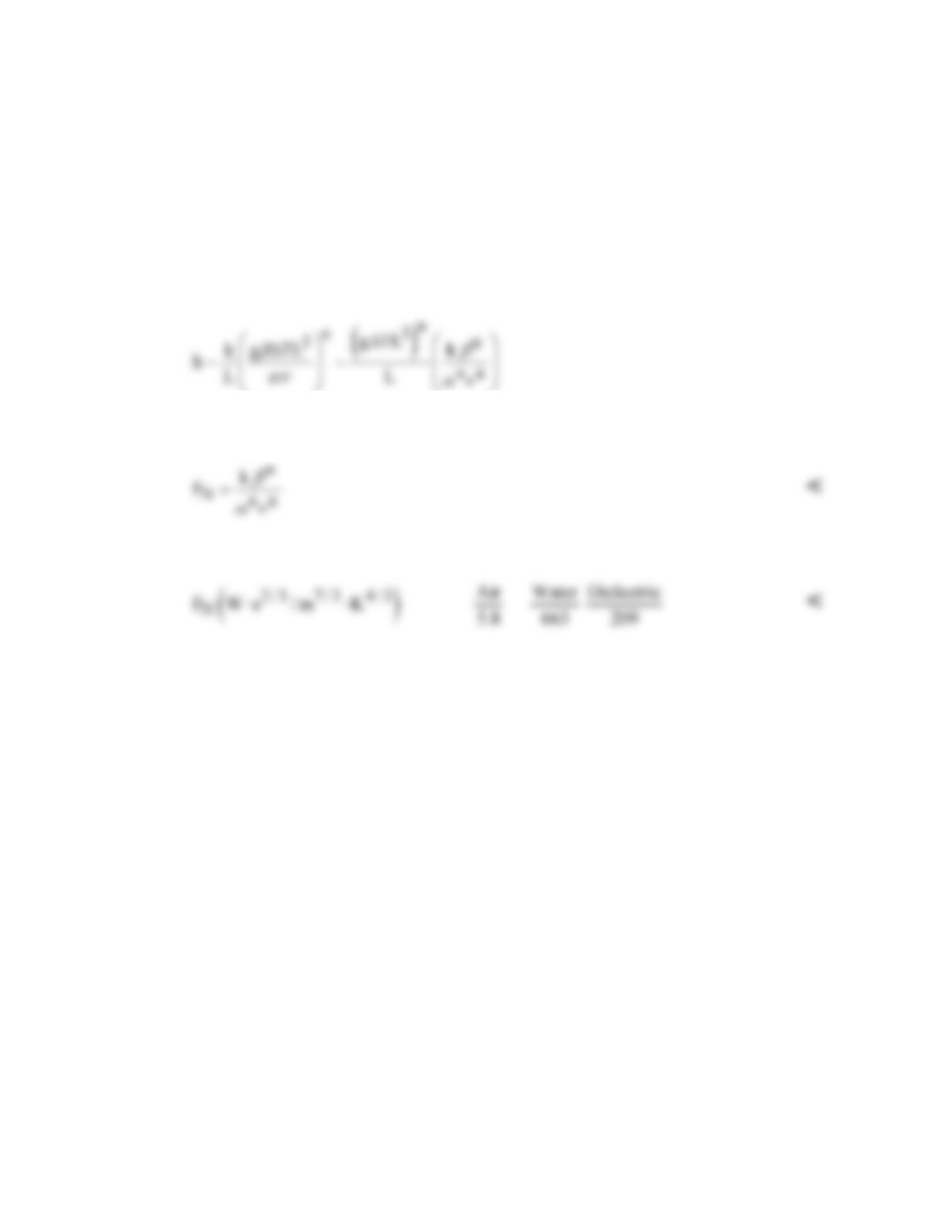
PROPERTIES: Table A-4, Air (400K, 1 atm): ν = 26.41 × 10⁻⁶ m2/s, a = 38.3 × 10⁻⁶ m2/s, β =
1/T = 1/400K = 2.50 × 10⁻³ K–1; Table A-4, Helium (400K, 1 atm): ν = 199 × 10-6 m2/s, a = 295 ×
ANALYSIS: The Rayleigh number, a dimensionless parameter used in free convection analysis, is
defined as the product of the Grashof and Prandtl numbers.
( )
33 3
cc
g TL g TL g TL
pp
Ra Gr Pr
L22
kk
µ νr
ββ β
νa
νν
∆∆ ∆
≡⋅= = ⋅ =
where a = k/rcp and ν = µ/r. The numerical values for the four fluids follow:
Air (400K, 1 atm)
COMMENTS: (1) Note the wide variation in values of Ra for the four fluids. A large value of Ra
implies enhanced free convection, however, other properties affect the value of the heat transfer
coefficient.
PROBLEM 9.5
KNOWN: Form of the Nusselt number correlation for natural convection and fluid properties.
FIND: Expression for figure of merit FN and values for air, water and a dielectric liquid.
PROPERTIES: Prescribed. Air: k = 0.026 W/m⋅K,
β
= 0.0035 K-1, ν = 1.5 × 10⁻⁵ m2/s, Pr = 0.70.
Water: k = 0.600 W/m⋅K,
β
= 2.7 × 10⁻⁴ K-1, ν = 10-6 m2/s, Pr = 5.0. Dielectric liquid: k = 0.064
W/m⋅K,
β
= 0.0014 K-1, ν = 10-6 m2/s, Pr = 25
ANALYSIS: With
n
L
Nu ~ R a ,
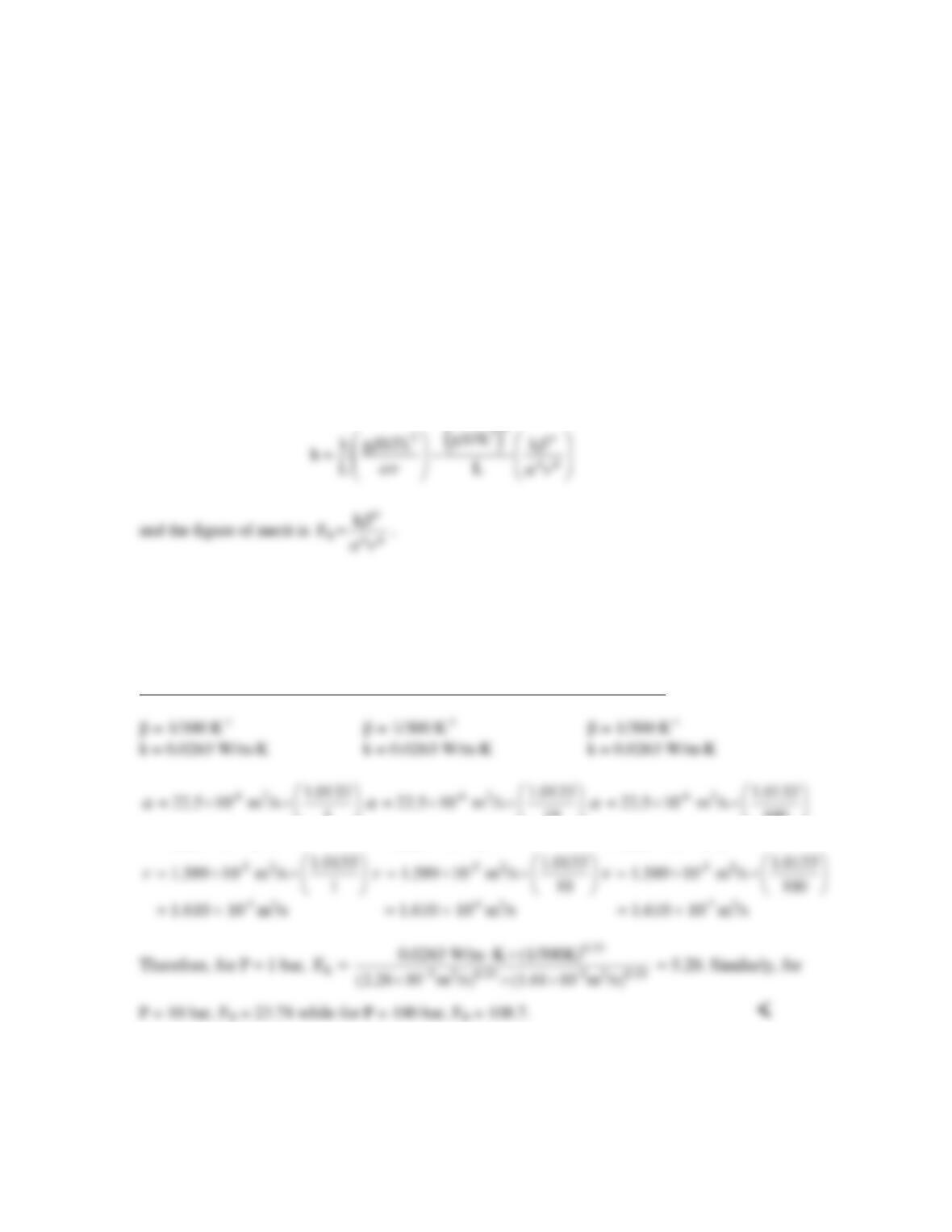
the convection coefficient may be expressed as
The figure of merit is therefore
and for the three fluids, with n = 0.33 and
/ Pr
aν
=
,
Water is clearly the superior heat transfer fluid, while air is the least effective.
COMMENTS: The figure of merit indicates that heat transfer is enhanced by fluids of large k, large
β
and small values of
a
and ν.
PROBLEM 9.6
KNOWN: Temperature and pressure of air in a free convection application.
FIND: Figure of merit for T = 27°C and P = 1, 10 and 100 bar.
ASSUMPTIONS: (1) Ideal gas, (2) Thermal conductivity, dynamic viscosity and specific heat
are independent of pressure.
PROPERTIES: Table A.4, air: (Tf = 300 K, p = 1 atm): k = 0.0263 W/m⋅K, cp = 1007 J/kg⋅K,
ν = 15.89 × 10⁻⁶ m2/s, a = 22.5 × 10⁻⁶ m2/s.
ANALYSIS: With
n
L
Nu Ra≈
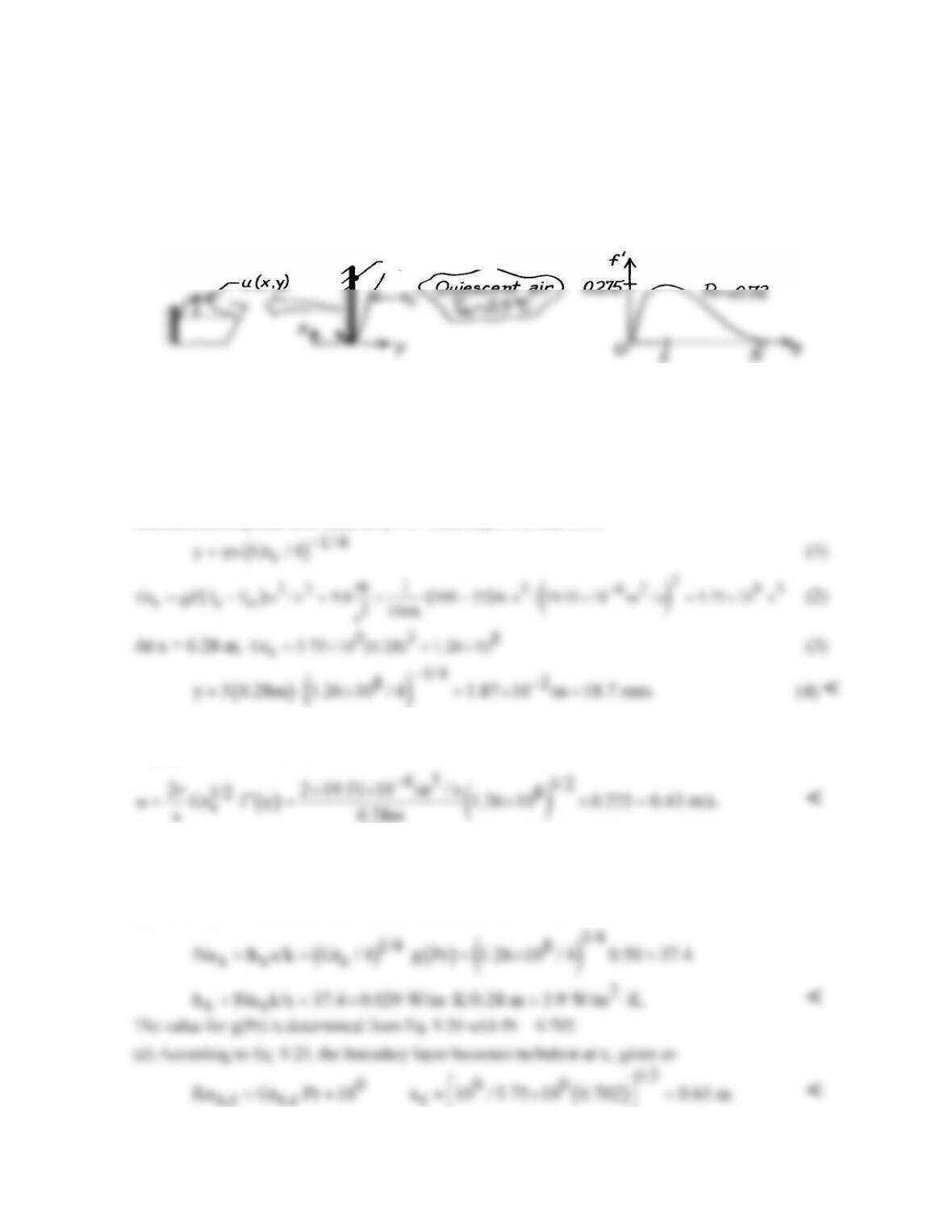
, the convection coefficient may be expressed as
n
For an ideal gas, β = 1/T. The thermal diffusivity is a = k/rcp. Since k and cp are independent of
pressure, and the density is proportional to pressure for an ideal gas, a ∝ 1/p. The kinematic
viscosity is ν = µ/r. Therefore, for an ideal gas, ν ∝ 1/p. Thus, the properties and the figure of
merit, using n = 0.33, at the three pressures are
p = 1 bar = 1 × 10⁵ N/m2 p = 10 bar p = 100 bar
= 2.28 × 10⁻⁵ m2/s = 2.28 × 10⁻⁶ m2/s = 2.28 × 10⁻⁷ m2/s
COMMENTS: The efficacy of natural convection cooling within sealed enclosures can be
increased significantly by increasing the pressure of the gas.
PROBLEM 9.7
KNOWN: Large vertical plate with uniform surface temperature of 100°C suspended in quiescent air
at 25°C and atmospheric pressure.
FIND: (a) Boundary layer thickness at 0.28 m from lower edge, (b) Maximum velocity in boundary
layer at this location and position of maximum, (c) Heat transfer coefficient at this location, (d)
Location where boundary layer becomes turbulent.
SCHEMATIC:
ASSUMPTIONS: (1) Isothermal, vertical surface in an extensive, quiescent medium, (2) Boundary
layer assumptions valid.
PROPERTIES: Table A-4, Air
( )
( )
T T T / 2 336K, 1 atm :
fs
=+=
∞
ν = 19.51 × 10⁻⁶ m2/s, k =
0.029 W/m⋅K, Pr = 0.702.
ANALYSIS: (a) From the similarity solution results, Fig. 9.4 (see above right), the boundary layer
thickness corresponds to a value of η ≈ 5. From Eqs. 9.13 and 9.10,
(b) From the similarity solution shown above, the maximum velocity occurs at η ≈ 1 with
( )
f 0.275.
η
′=
From Eq. 9.15, find
The maximum velocity occurs at a value of η = 1; using Eq. (4), it follows that this corresponds to a
position in the boundary layer given as
( )
y 1/ 5 18.7 mm 3.7 mm.
max = =
<
(c) From Eq. 9.19, the local heat transfer coefficient at x = 0.28 m is
COMMENTS: Note that β = 1/Tf is a suitable approximation for air.
T
s
= 100°C
PROBLEM 9.8
KNOWN: Laminar free convection on a vertical plate.
FIND: Exact values of C from the similarity solution for Pr = 0.01, 1, 10 and 100.
ASSUMPTIONS: (1) Constant properties. (2) Steady state conditions. (3) Parameter n = ¼.
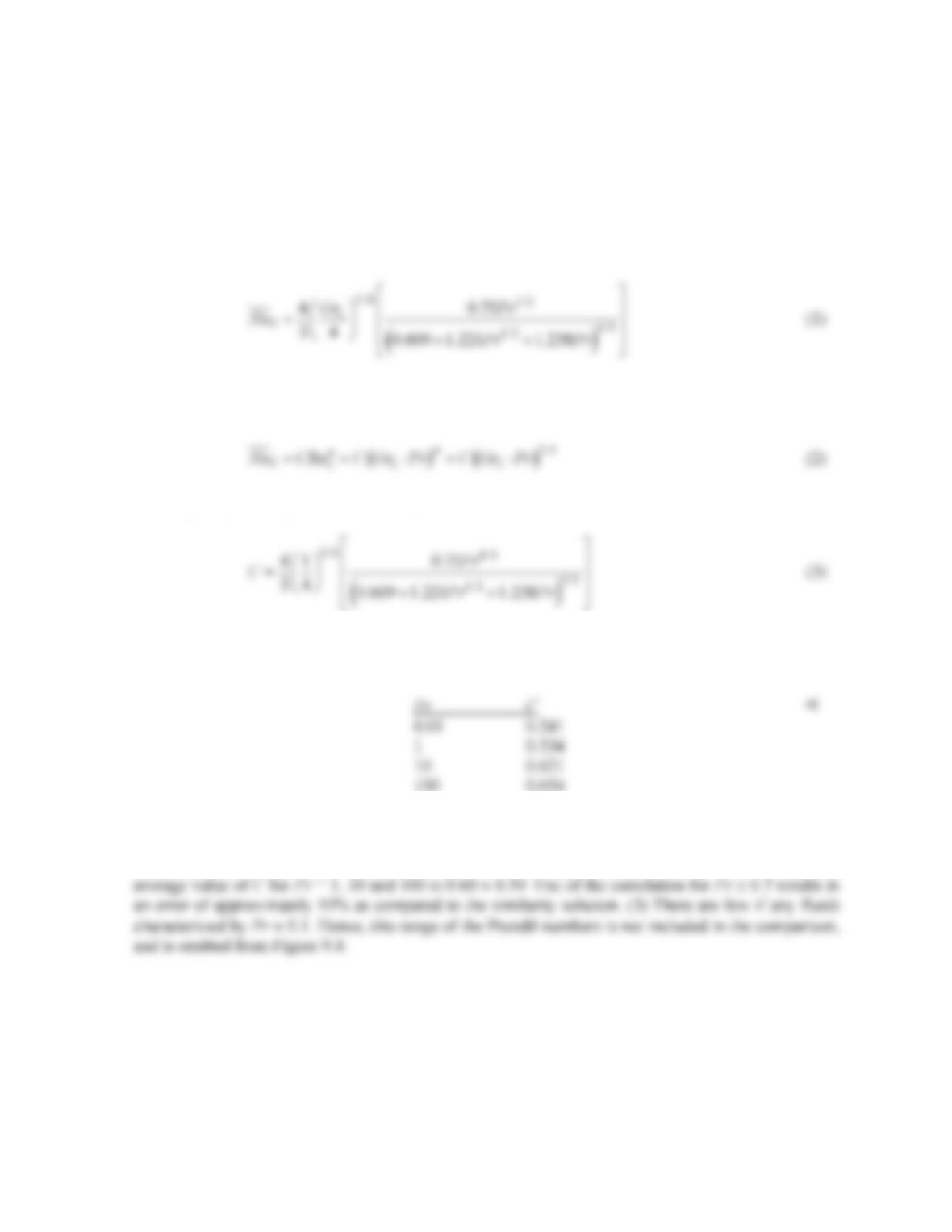
ANALYSIS: The similarity solution for the average Nusselt number is
while the correlation for the average Nusselt number is expressed as
Equating the preceding two expressions yields
Values of C may be determined by substituting Pr = 0.01, 1, 10 and 100 into Equation 3.
100 0.654
COMMENTS: (1) The correlation should not be used for liquid metals (i.e. low Pr fluids). (2) The
PROBLEM 9.9
KNOWN: Dimensions of vertical rectangular fins. Temperature of fins and quiescent air.
FIND: (a) Optimum fin spacing, (b) Rate of heat transfer from an array of fins at the optimal spacing.
SCHEMATIC:
ASSUMPTIONS: (1) Fins are isothermal, (2) Radiation effects are negligible, (3) Air is quiescent.
PROPERTIES: Table A-4, Air (Tf = 325K, 1 atm): ν = 18.41 × 10⁻⁶ m2/s, k = 0.0282 W/m⋅K, Pr =
0.703.
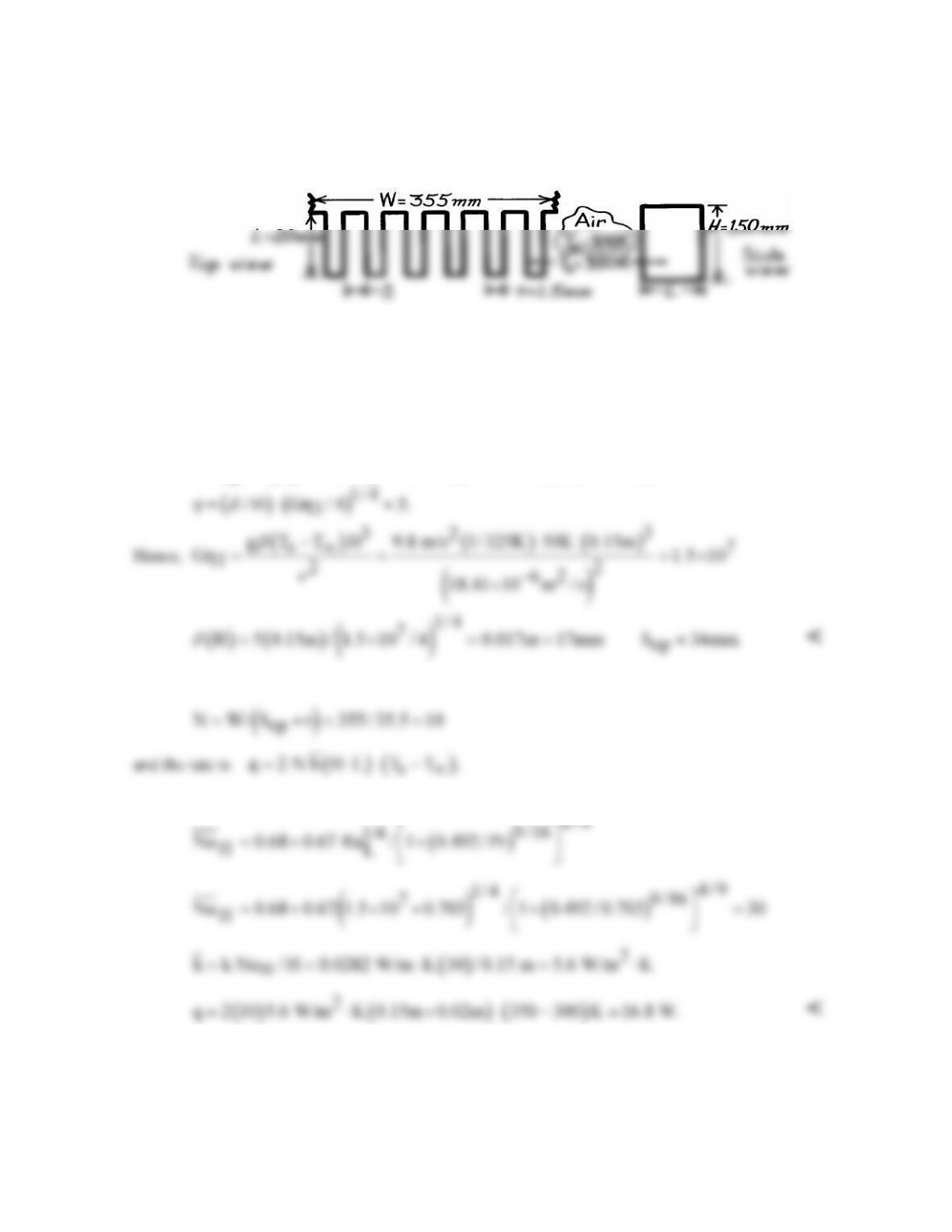
ANALYSIS: (a) If fins are too close, boundary layers on adjoining surfaces will coalesce and heat
transfer will decrease. If fins are too far apart, the surface area becomes too small and heat transfer
decreases. Sop ≈ δx=H. From Fig. 9.4, the edge of boundary layer corresponds to
(b) The number of fins N can be found as
For laminar flow conditions
COMMENTS: Part (a) result is a conservative estimate of the optimum spacing. The increase in
area resulting from a further reduction in S would more than compensate for the effect of fluid
entrapment due to boundary layer merger. From a more rigorous treatment (see Section 9.7.1), Sop ≈
10 mm is obtained for the prescribed conditions.
PROBLEM 9.10
KNOWN: Thin, vertical plates of length 0.10 m at 60°C being cooled in a water bath at 20°C.
FIND: Minimum spacing between plates such that no interference will occur between free–
convection boundary layers.
SCHEMATIC:
ASSUMPTIONS: (a) Water in bath is quiescent, (b) Plates are at uniform temperature.
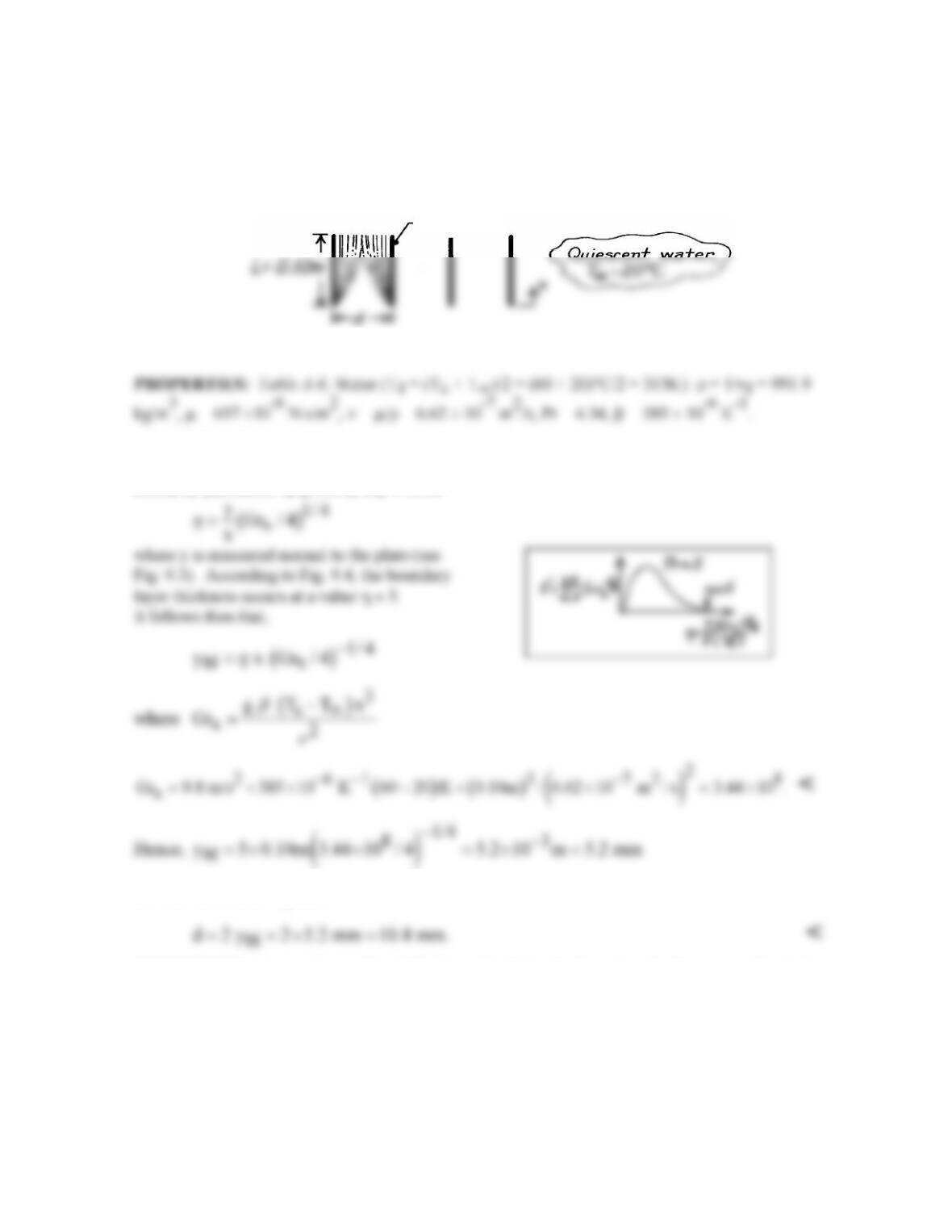
ANALYSIS: The minimum separation distance will be twice the thickness of the boundary layer at
the trailing edge where x = 0.10 m. Assuming laminar, free convection boundary layer conditions, the
similarity parameter, η, given by Eq. 9.13, is
and the minimum separation is
COMMENTS: According to Eq. 9.23, the critical Grashof number for the onset of turbulent
conditions in the boundary layer is Grx,c Pr ≈ 109. For the conditions above, Grx Pr = 3.44 ×
108 × 4.34 = 1.5 × 10⁹. We conclude that the boundary layer is indeed turbulent at x = 0.10 m
and our calculation is only an estimate which is likely to be low. Therefore, the plate
separation should be greater than 10.4 mm.
T
s
= 60°C
PROBLEM 9.11
KNOWN: Square aluminum plate at 15°C suspended in quiescent air at 75°C.
FIND: Average heat transfer coefficient by two methods – using results of boundary layer similarity
and results from an empirical correlation.
SCHEMATIC:
ASSUMPTIONS: (1) Uniform plate surface temperature, (2) Quiescent room air, (3) Surface
radiation exchange with surroundings negligible, (4) Perfect gas behavior for air, β = 1/Tf.
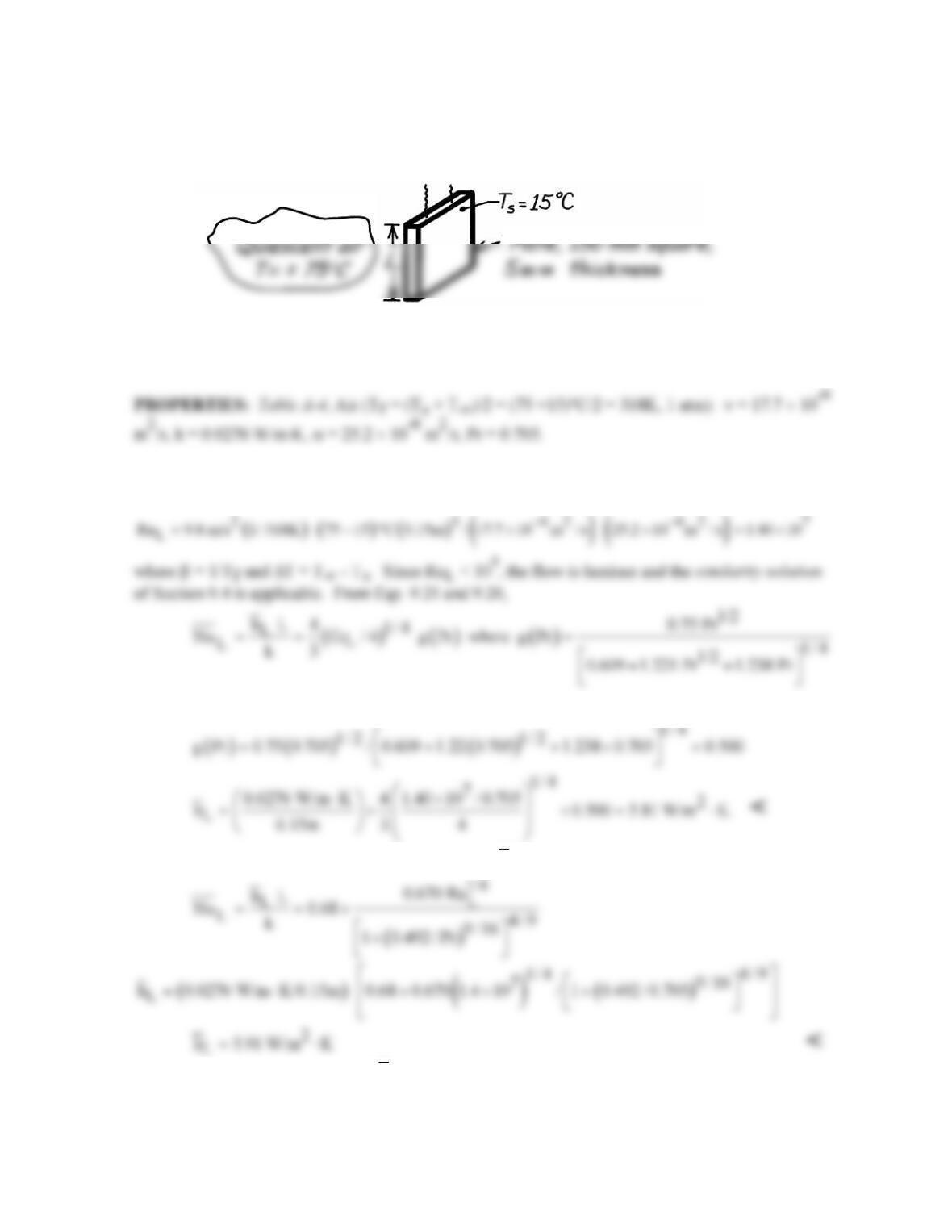
ANALYSIS: Calculate the Rayleigh number to determine the boundary layer flow conditions,
3
Ra g T L /
L
β νa
= ∆
and substituting numerical values with GrL = RaL/Pr, find
The appropriate empirical correlation for estimating
hL
is given by Eq. 9.27,
COMMENTS: The agreement of
hL
calculated by these two methods is excellent.
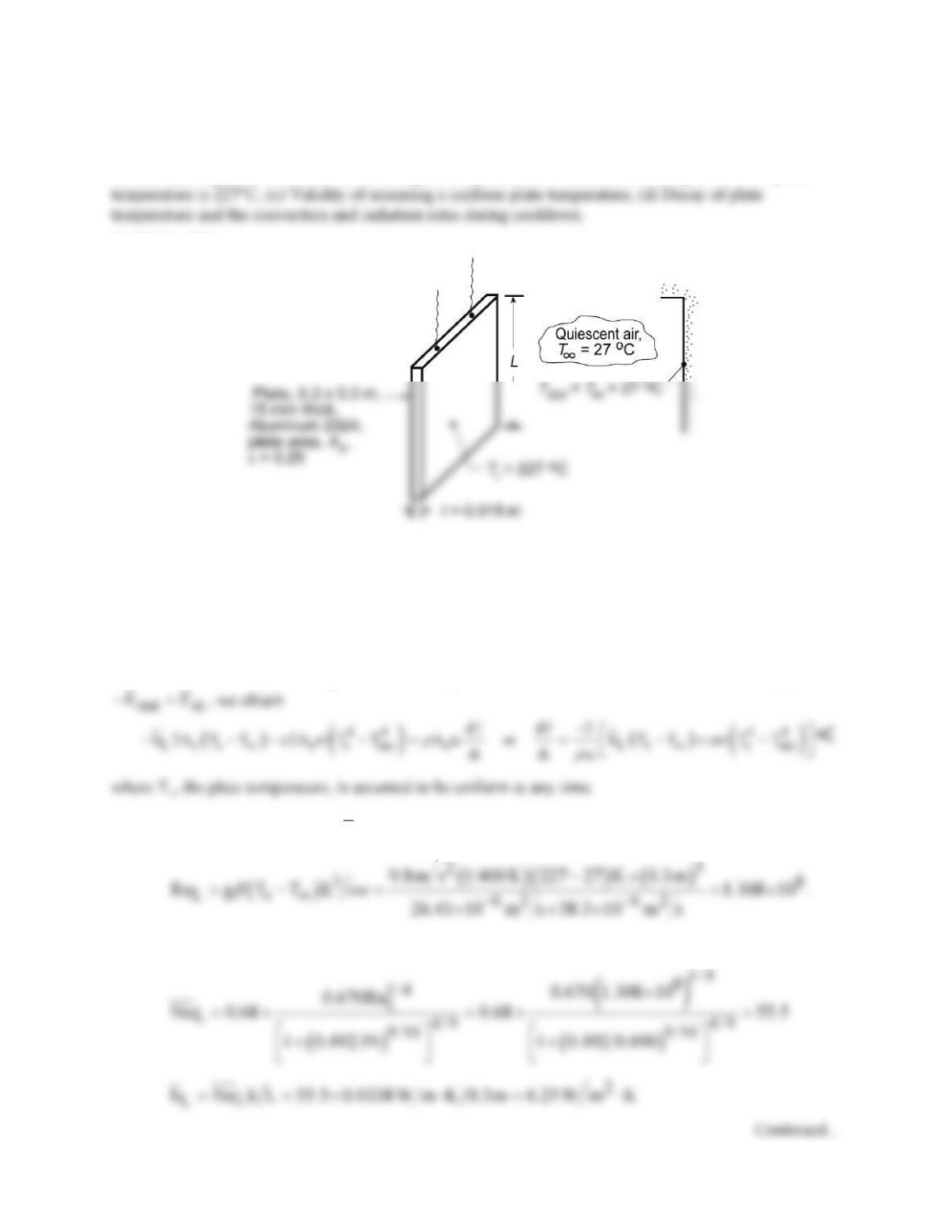
PROBLEM 9.12
KNOWN: Aluminum plate (alloy 2024) at an initial uniform temperature of 227°C is suspended in a
room where the ambient air and surroundings are at 27°C.
FIND: (a) Expression for time rate of change of the plate, (b) Initial rate of cooling (K/s) when plate
SCHEMATIC:
ASSUMPTIONS: (1) Plate temperature is uniform, (2) Ambient air is quiescent and extensive, (3)
Surroundings are large compared to plate.
PROPERTIES: Table A.1, Aluminum alloy 2024 (T = 500 K): r = 2770 kg/m3, k = 186 W/m⋅K, c =
983 J/kg⋅K; Table A.4, Air (Tf = 400 K, 1 atm): ν = 26.41 × 10⁻⁶ m2/s, k = 0.0388 W/m⋅K, a = 38.3 ×
10-6 m2/s, Pr = 0.690.
ANALYSIS: (a) From an energy balance on the plate with free convection and radiation exchange,
(b) To evaluate (dT/dt), estimate
L
h
. First, find the Rayleigh number,
Eq. 9.27 is appropriate; substituting numerical values, find
PROBLEM 9.12 (Cont.)
(c) The uniform temperature assumption is justified if the Biot number criterion is satisfied. With Lc ≡
(V/2As) = (As⋅t/2As) = (t/2) and
tot conv rad
hh h= +
, Bi =
( )
tot
h t2 k
≤ 0.1. Using the linearized
radiation coefficient relation, find
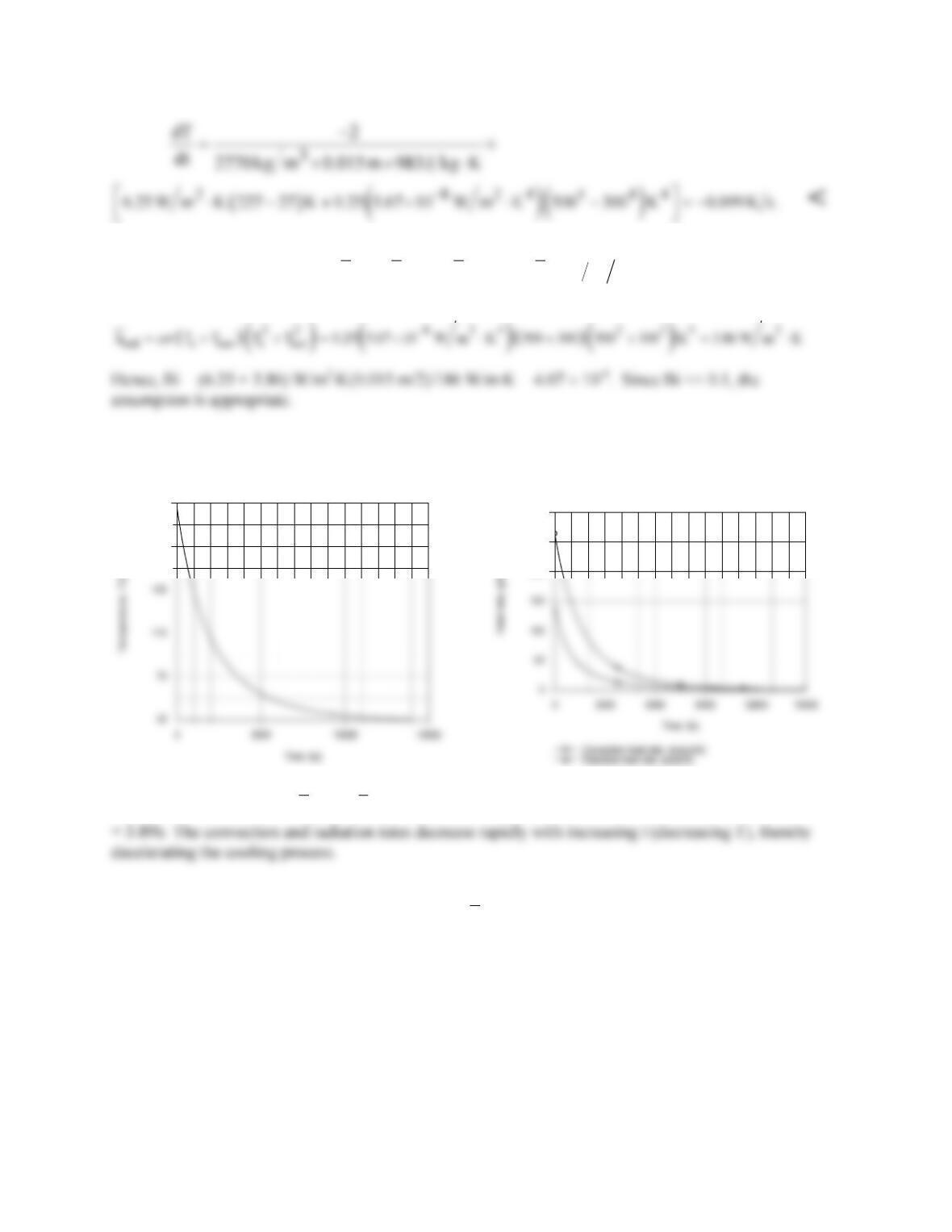
(d) The temperature history of the plate was computed by combining the Lumped Capacitance Model of
IHT with the appropriate Correlations and Properties Toolpads.
190
230
200
250
300
Due to the small values of
L
h
and
rad
h
, the plate cools slowly and does not reach 30°C until t ≈ 14000s
COMMENTS: The reduction in the convection rate with increasing time is due to a reduction in the
thermal conductivity of air, as well as the values of
L
h
and T.
PROBLEM 9.13
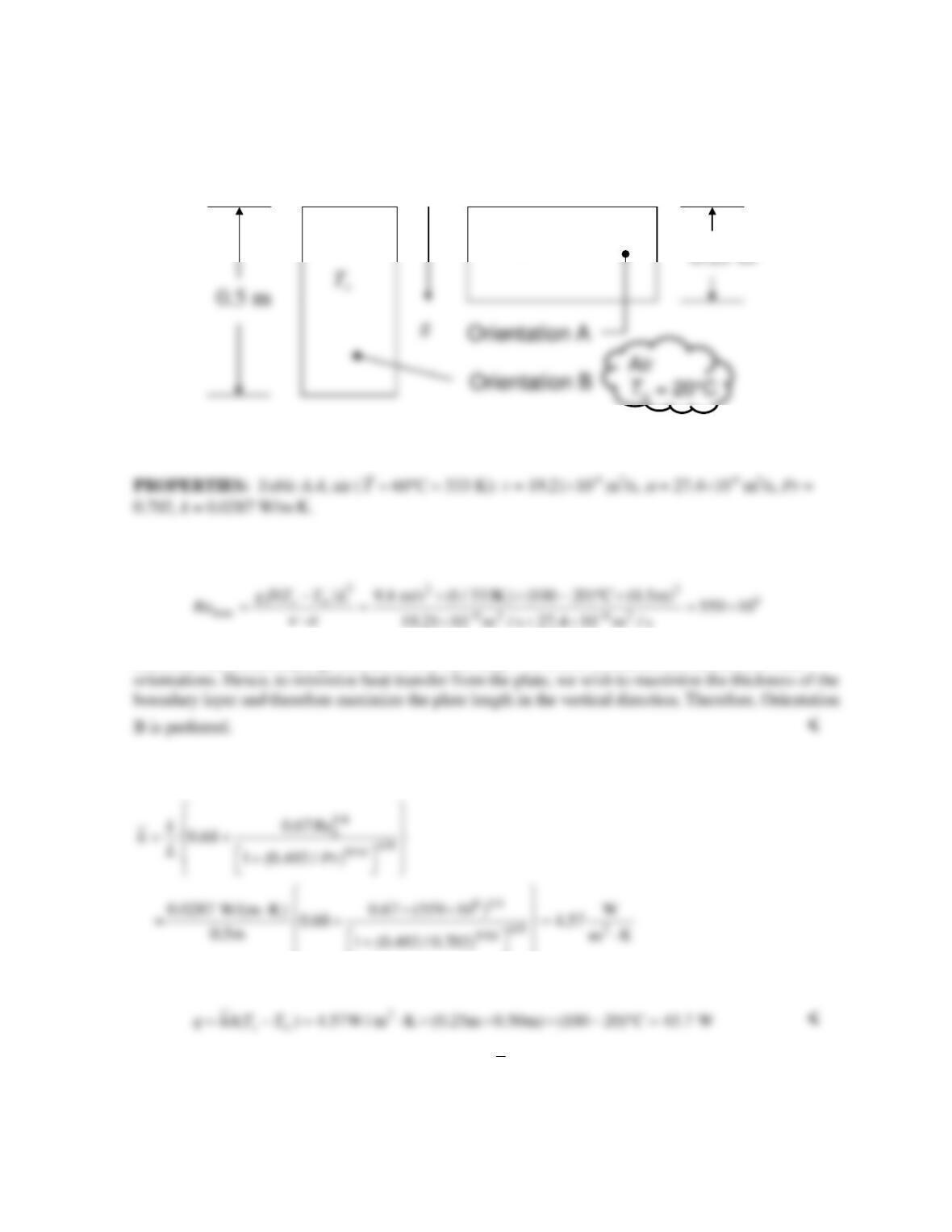
KNOWN: Dimensions of vertical plate. Plate and ambient temperatures.
FIND: Preferred orientation to minimize convective heat transfer and convective heat transfer rate for
that orientation.
SCHEMATIC:
T
s
= 100°C
ASSUMPTIONS: (1) Steady–state conditions, (2) Constant properties, (3) Ideal gas, (4) Quiescent
environment.
ANALYSIS: Note that the maximum value of the Rayleigh number is associated with Orientation B.
Since the maximum Rayleigh number is less than Rax,c = 109, flow conditions are laminar for both
Selecting Eq. 9.27,
and
COMMENTS: (1) For Orientation A, Ra = 7× 10⁷,
5.48h=
W/m2⋅K and q = 54.8 W. Although the
Rayleigh and Nusselt numbers are smaller for Orientation A, the length scale in the Nusselt number is
half that of Orientation B, leading to an overall increase in the convection coefficient and heat transfer
rate. (2) Radiation heat transfer will be significant.
PROBLEM 9.14
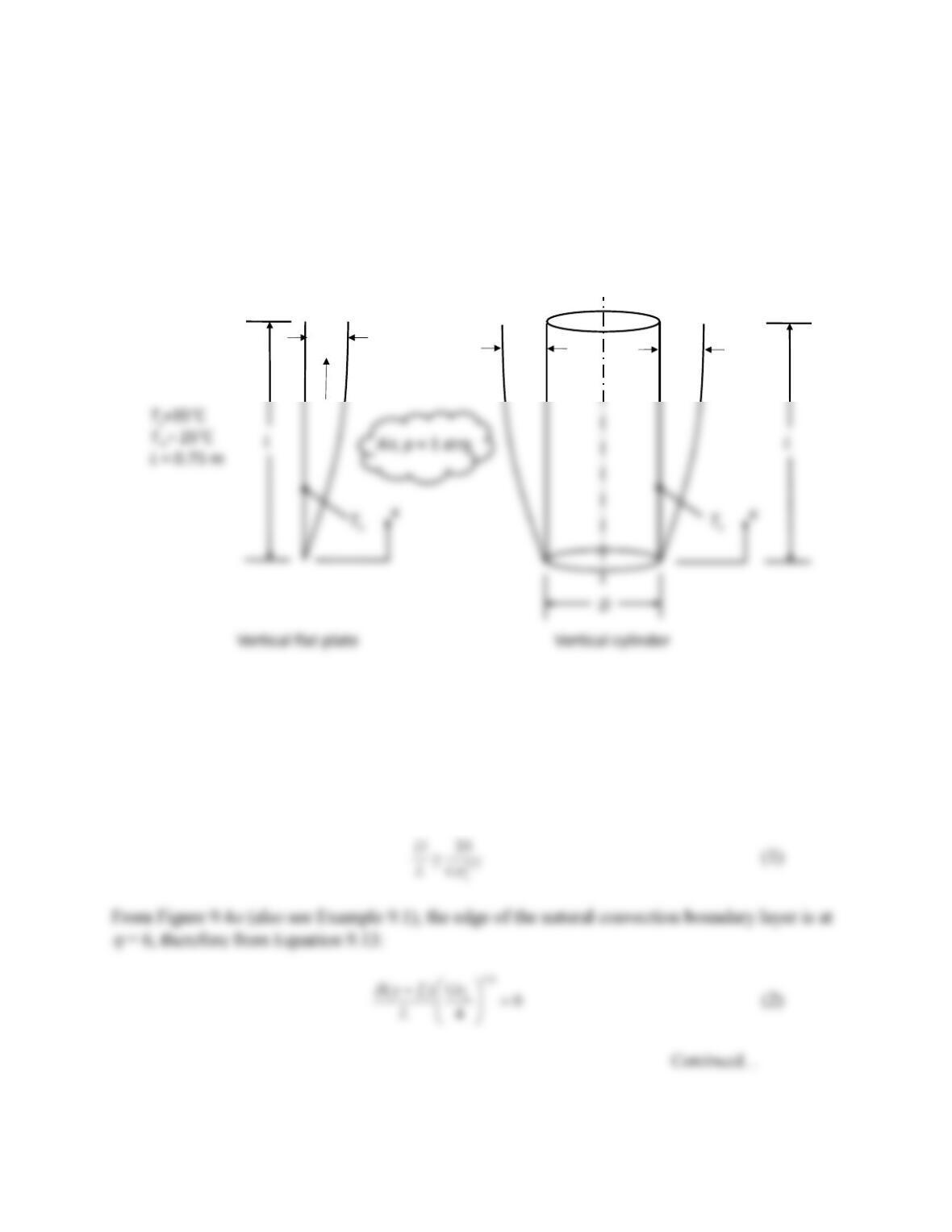
KNOWN: Free convection on vertical plate of height L and vertical cylinder of diameter D and height L.
Temperatures of surface and surrounding air.
FIND: Show that correlations for vertical plate can be applied to vertical cylinder if boundary layer
thickness at top of cylinder is approximately one-fourth the cylinder diameter. Determine, for specified
conditions, critical cylinder diameter below which flat plate correlations cannot be applied. Find the rate
of free convection heat transfer corresponding to critical cylinder diameter.
SCHEMATIC:
δ
δ
δ
ASSUMPTIONS: (1) Steady–state conditions, (2) Constant properties.
PROPERTIES: Table A-4, Air, (Tf = 303 K):
ν
= 16.19 × 10⁻⁶ m2/s, k = 0.0265 W/m⋅K,
β
= 1/Tf =
0.0033 K-1, Pr = 0.707.
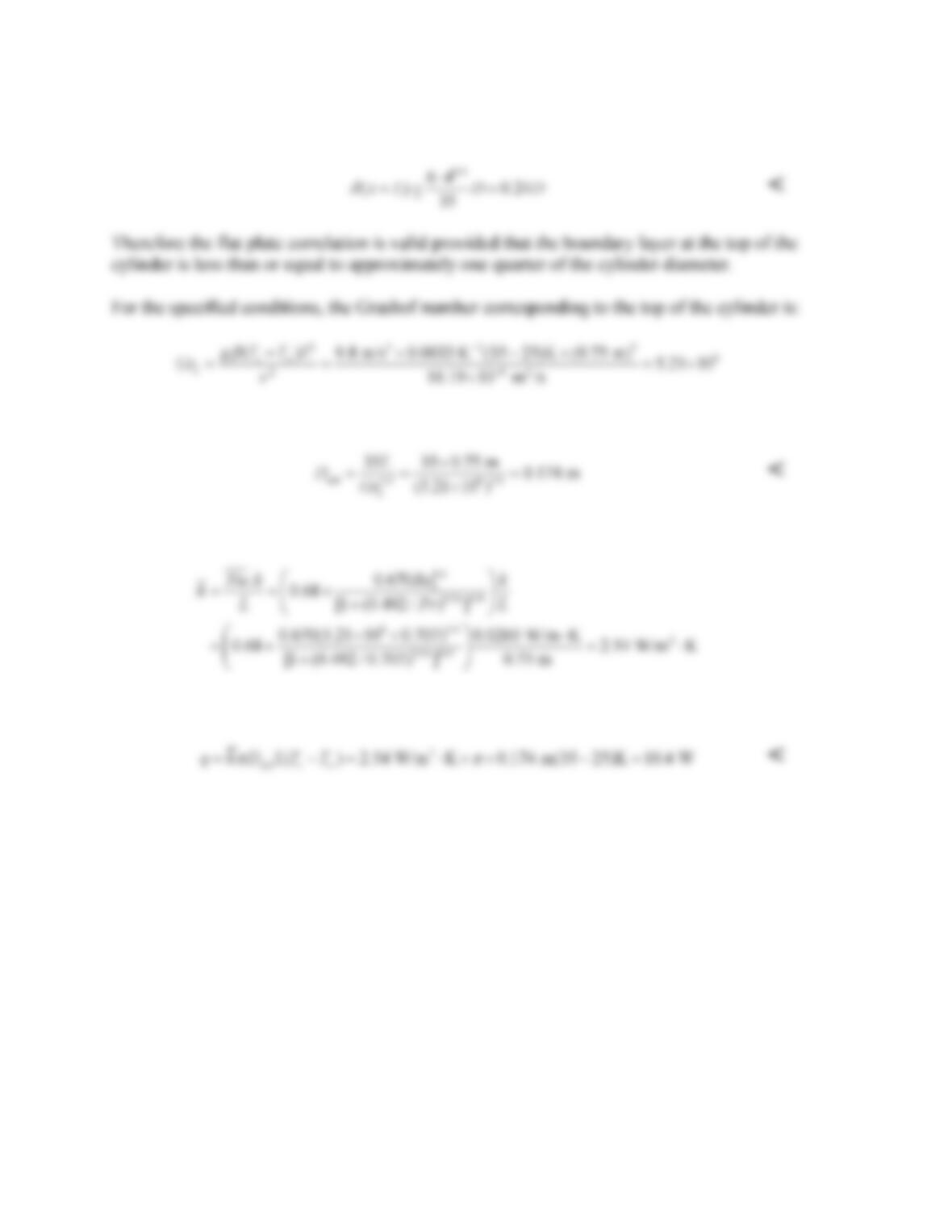
ANALYSIS: The following criterion is given (beneath Equation 9.28) for when it is valid to use a
vertical plate free convection correlation for a vertical cylinder:
PROBLEM 9.14 (Cont.)
Combining Eqs. (1) and (2), the flat plate correlation can be used provided that:
From Eq. (1),
The heat transfer coefficient can be found using Equation 9.27:
Then,
COMMENTS: Cylinders that are thinner than the criterion have enhanced heat transfer. Therefore the
flat plate correlation can be used as an underestimate of the heat transfer rate for thin cylinders.
PROBLEM 9.15
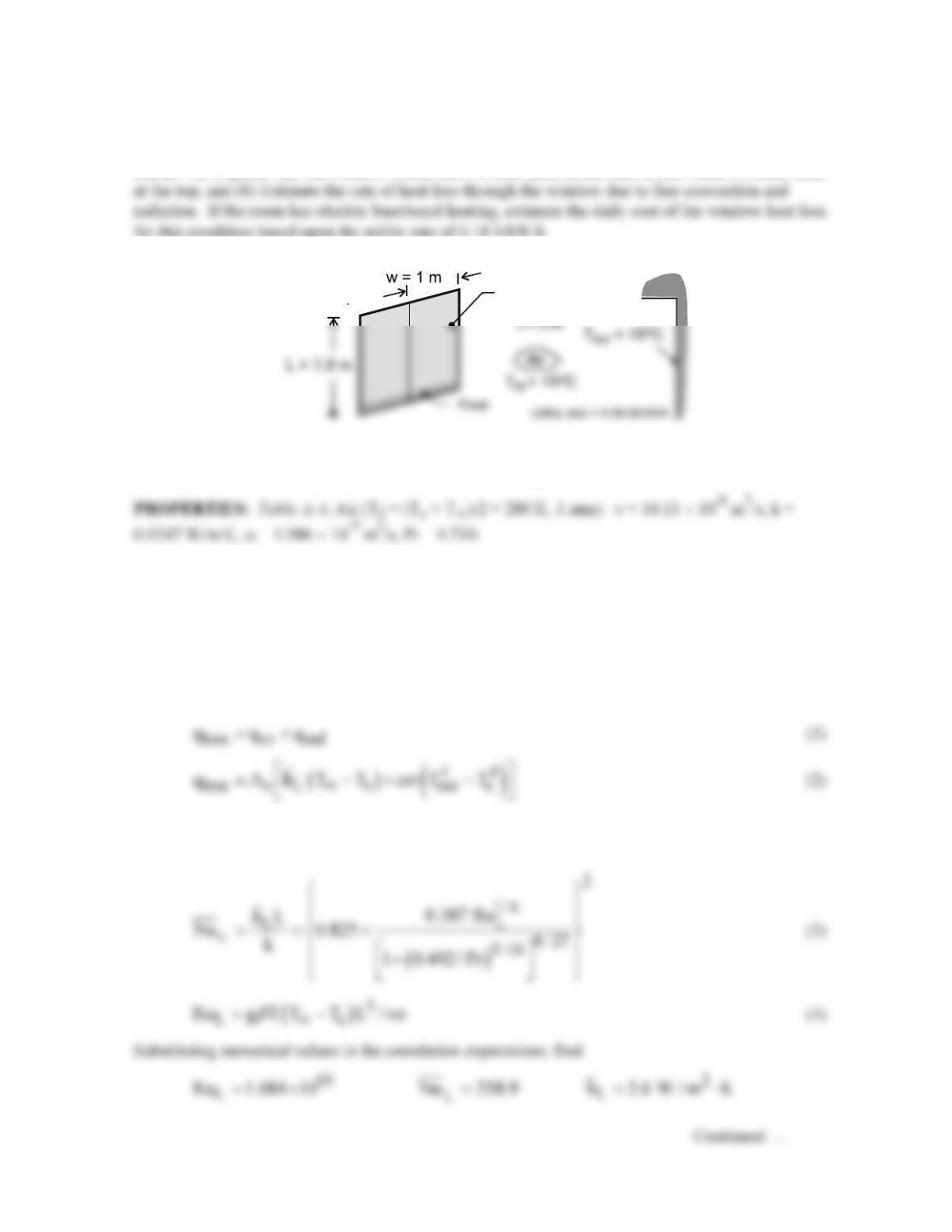
KNOWN: During a winter day, the window of a patio door with a height of 1.8 m and width of 1.0 m
shows a frost line near its base.
FIND: (a) Explain why the window would show a frost layer at the base of the window, rather than
for this condition based upon the utility rate of 0.18 $/kW⋅h.
SCHEMATIC:
Window
T
s
= 0oC
ASSUMPTIONS: (1) Steady-state conditions, (2) Window has a uniform temperature, (3) Ambient
air is quiescent, and (4) Room walls are isothermal and large compared to the window.
ANALYSIS: (a) For these winter conditions, a frost line could appear and it would be at the bottom
of the window. The boundary layer is thinnest at the top of the window, and hence the heat flux from
the warmer room is greater than compared to that at the bottom portion of the window where the
boundary layer is thicker. Also, the air in the room may be stratified and cooler near the floor
compared to near the ceiling.
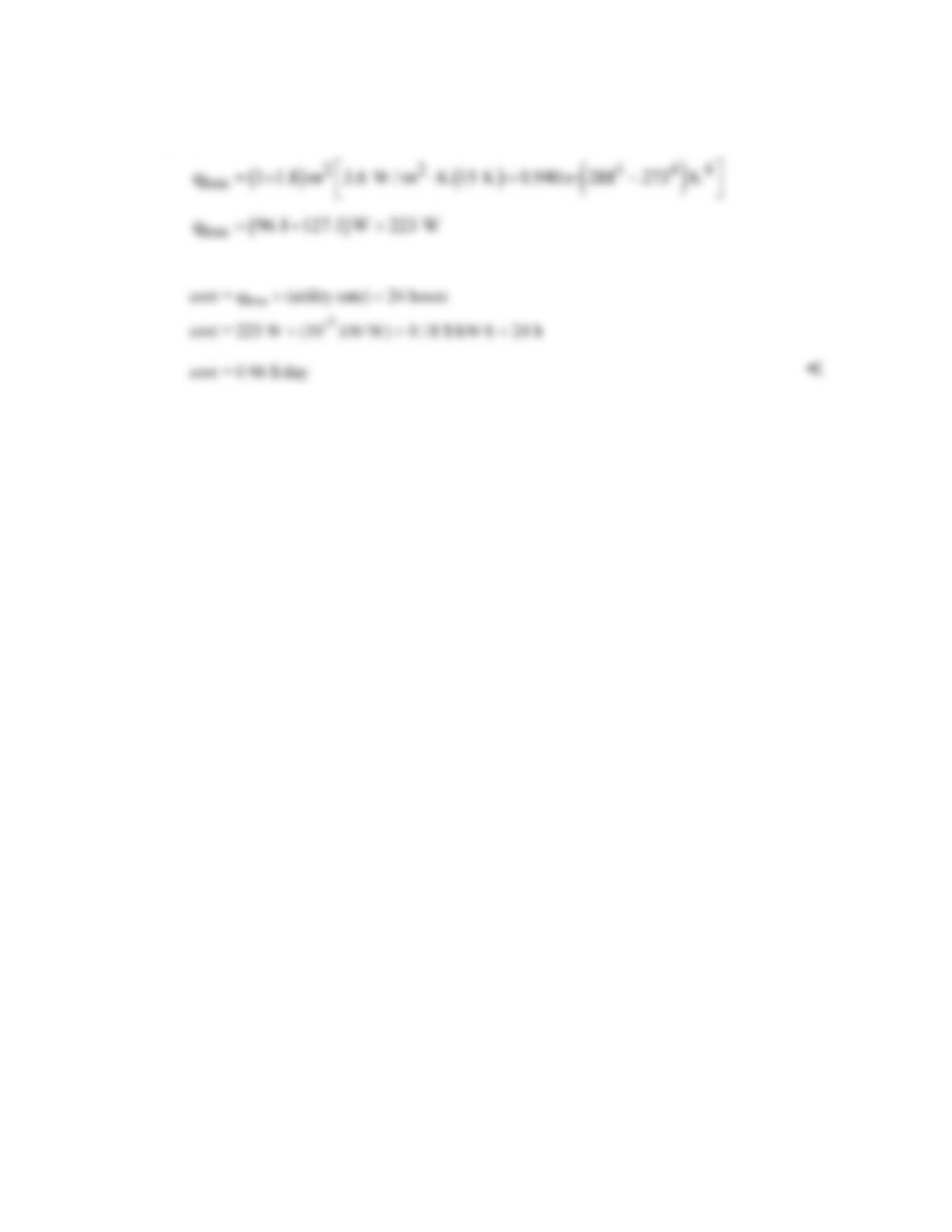
(b) The rate of heat loss from the room to the window having a uniform temperature Ts = 0°C by
convection and radiation is
The average convection coefficient is estimated from the Churchill-Chu correlation, Eq. 9.26, using
properties evaluated at Tf = (Ts + T∞)/2.
PROBLEM 9.15 (Cont.)
Using Eq. (2), the rate of heat loss with s = 5.67 × 10⁻⁸ W/m2⋅K4 is
The daily cost of the window heat loss for the given utility rate is
COMMENTS: Note that the heat loss by radiation is 30% larger than by free convection.
PROBLEM 9.16
KNOWN: Room and ambient air conditions for window glass.
FIND: Temperature of the glass and rate of heat loss.
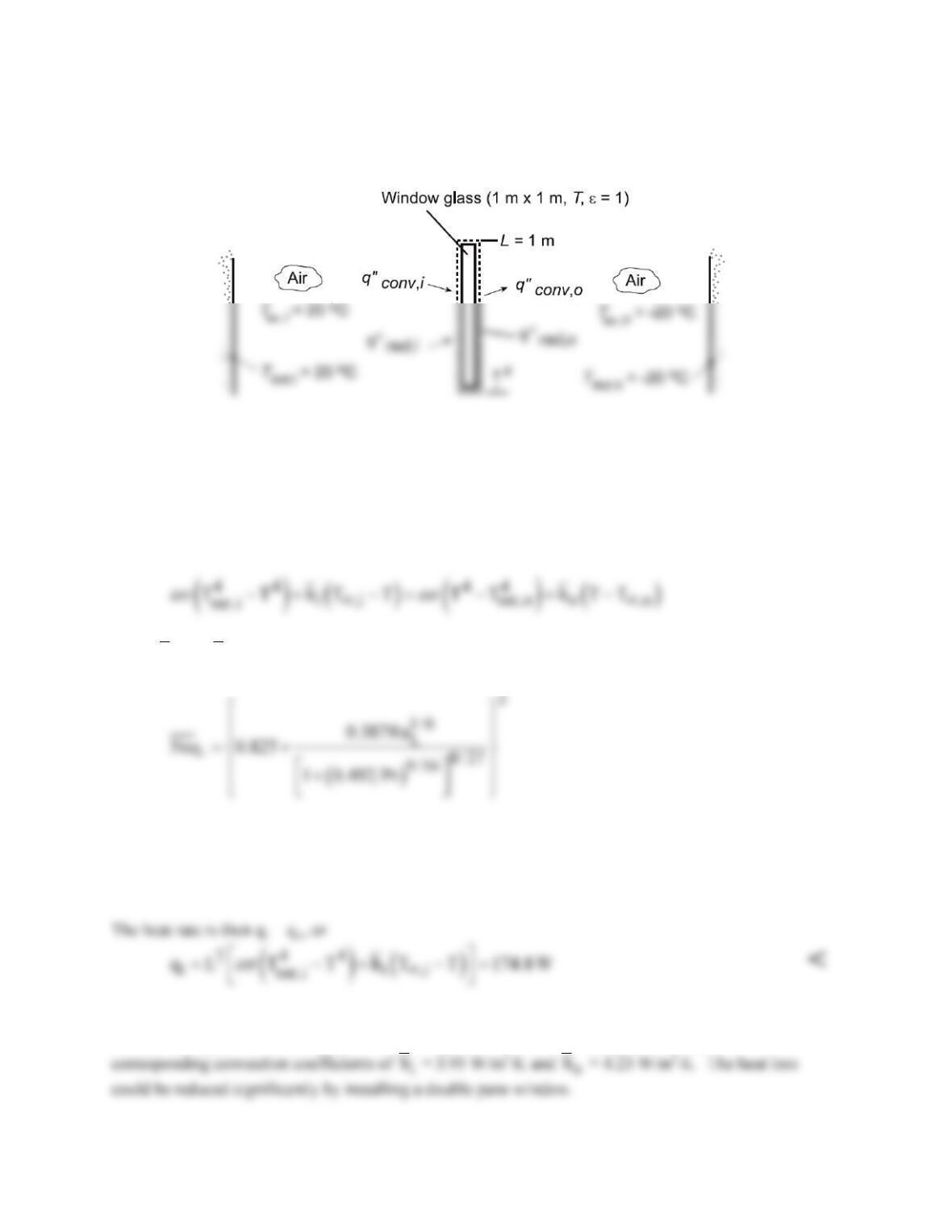
SCHEMATIC:
ASSUMPTIONS: (1) Steady-state conditions, (2) Negligible temperature gradients in the glass, (3)
Inner and outer surfaces exposed to large surroundings.
PROPERTIES: Table A.4, air (Tf,i and Tf,o): Obtained from the IHT Properties Tool Pad.
ANALYSIS: Performing an energy balance on the window pane, it follows that
in out
EE=
, or
where
i
h
and
o
h
may be evaluated from Eq. 9.26.
Using the First Law Model for an Isothermal Plane Wall and the Correlations and Properties Tool Pads
of IHT, the energy balance equation was formulated and solved to obtain
T = 273.8 K <
COMMENTS: The radiative and convective contributions to heat transfer at the inner and outer
surfaces are qrad,i = 99.04 W, qconv,i = 75.73 W, qrad,o = 86.54 W, and qconv,o = 88.23 W, with