Time Rate of Consolidation Chapter 9
9-16. A certain compressible layer has a thickness of 3.8 m. After 1.5 yr, when the clay is 50%
consolidated, 7.3 cm of settlement has occurred. For a similar clay and loading conditions, how
much settlement would occur at the end of 1.5 yr and 5 yr if the thickness of this new layer were
38 m?
SOLUTION:
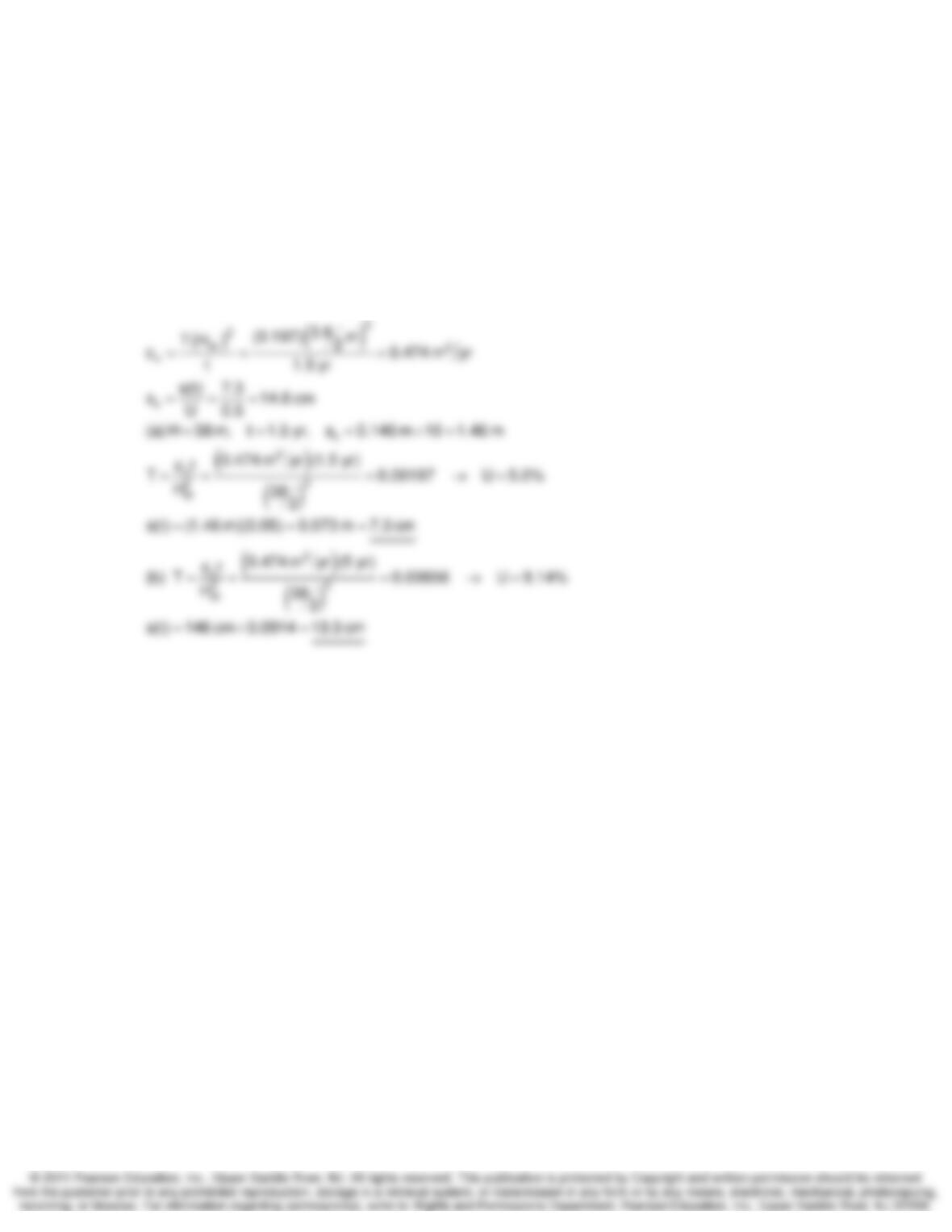
H 3.8 m, t 1.5 yr, s(t) 7.3 cm, assume double layer drainage
for U 50%, T 0.197
== = −
==
Time Rate of Consolidation Chapter 9
9-17. In a laboratory consolidation test on a representative sample of cohesive soil, the original
height of a doubly-drained sample was 25.4 mm. Based on the log time versus dial reading data,
the time for 50% consolidation was 8.5 min. The laboratory sample was taken from a soil layer
which is 14 m thick in the field, doubly drained, and is subjected to a similar loading. Determine:
(a) How long will it take until the layer consolidates 50%? (b) If the final consolidation settlement
is predicted to be 22 cm, how long will it take for a settlement of 6 cm to take place?
SOLUTION:
()
()
50
2
2
dr 2
v
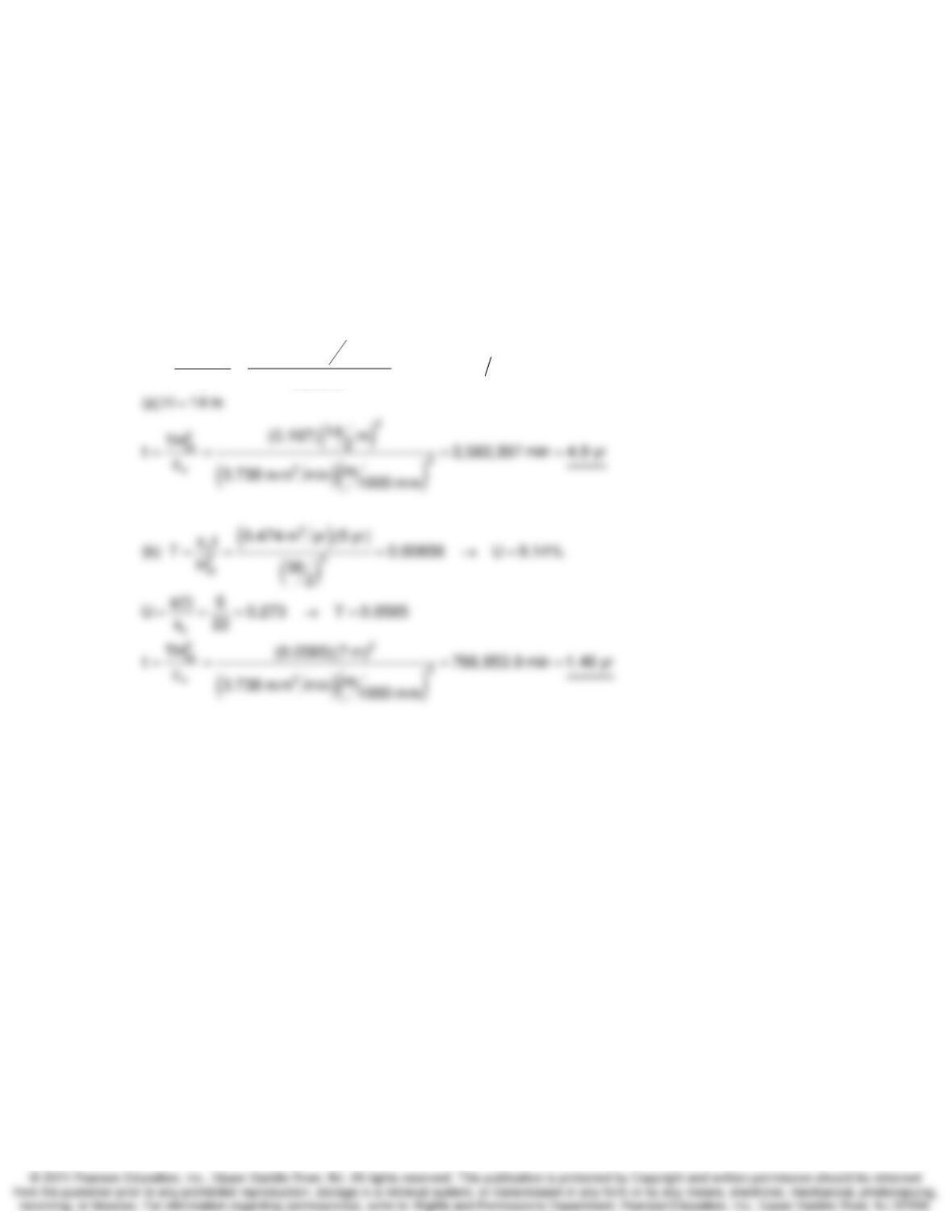
H 25.4 mm, t 8.5 min
for U 50%, T 0.197
25.4
(0.197) mm
TH 2
c 3.738 mm min
t8.5min
==
==
== =
Time Rate of Consolidation Chapter 9
9-18. A layer of normally consolidated clay 4.2 m thick has an average void ratio of 1.1. Its
compression index is 0.52 and its coefficient of consolidation is 0.8 m2/yr. When the existing
vertical pressure on the clay layer is doubled, what change in thickness of the clay layer will
result?
SOLUTION:
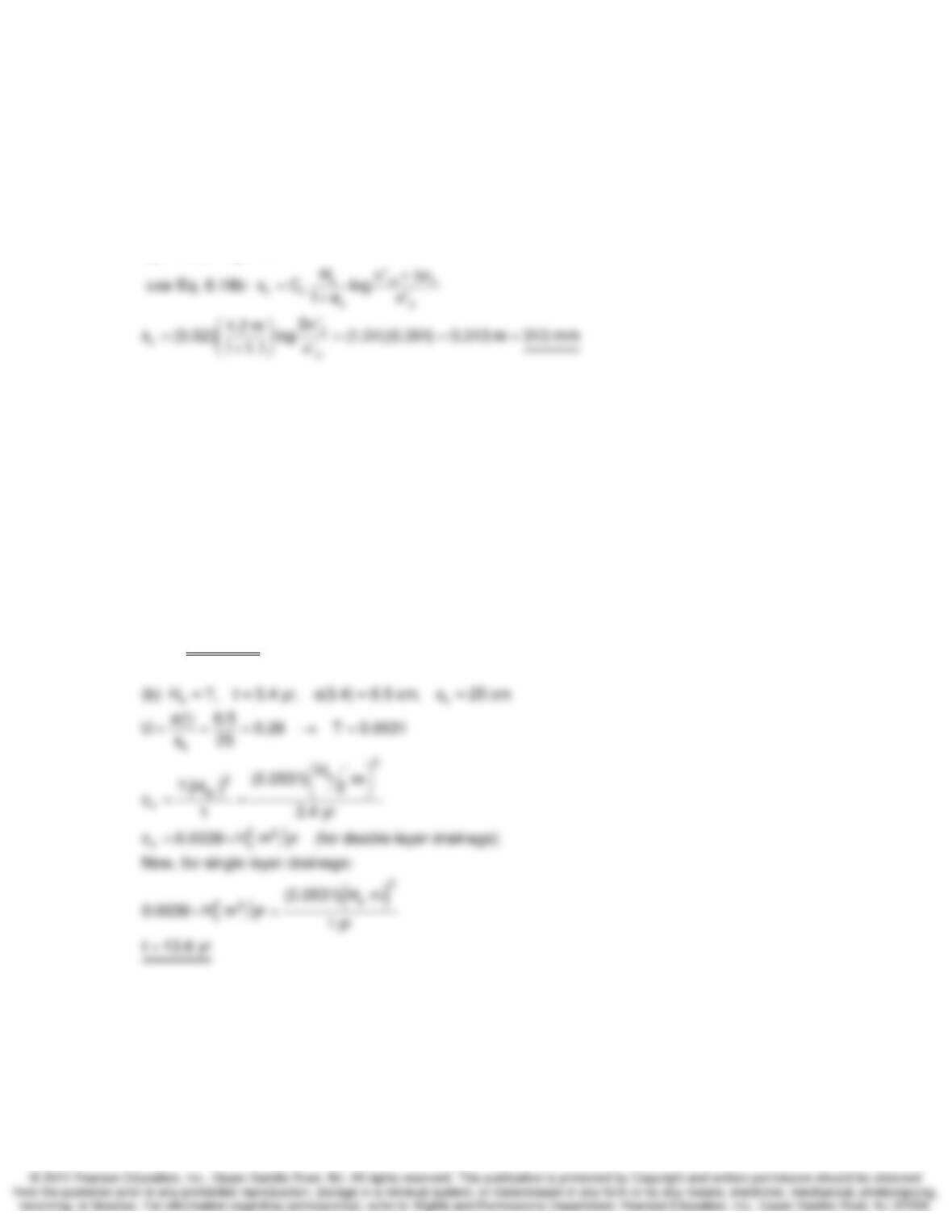
==
co
C 0.52, e 1.1
9-19. The settlement analysis for a proposed structure indicates that 6.5 cm of settlement will
occur in 3.4 yr and that the ultimate total settlement will be about 25 cm. The analysis is based on
the assumption that the compressible clay layer is drained at both its top and bottom surfaces.
However, it is suspected that there may not be drainage at the bottom surface. For the case of
single drainage, estimate (a) the ultimate total settlement and (b) the time required for 6.5 cm of
settlement. (After Taylor, 1948.)
SOLUTION:
=
c
(a) The ultimate total settlement calculation is not affected by drainage layer thickness.
Thus, s 25 cm
Time Rate of Consolidation Chapter 9
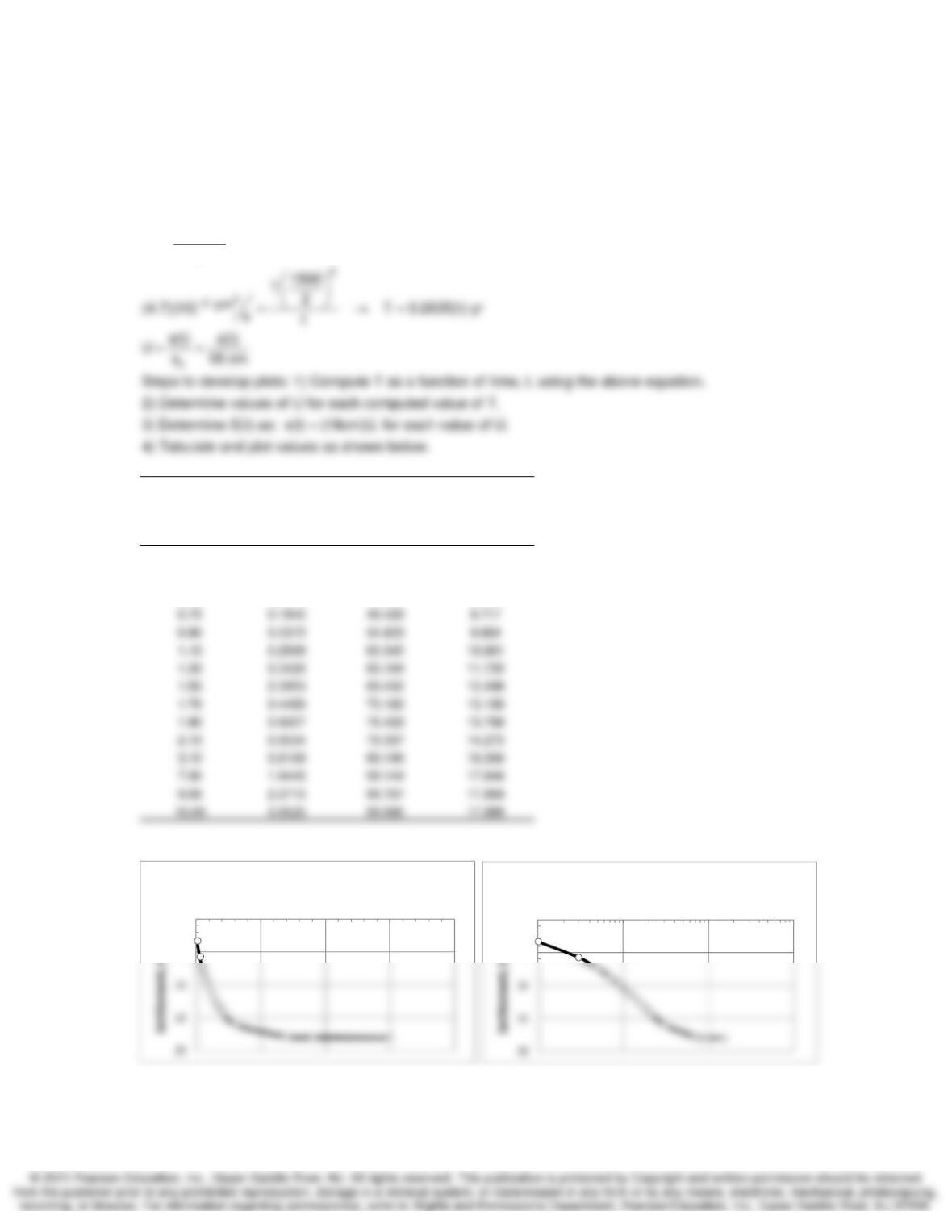
9-20. The structure of Problem 9.19 was constructed and performed essentially as expected
during the first 3.4 yr (that is, the settlement of the building was about 6.5 cm). The owner decides
to build a duplicate of the first structure nearby. During foundation investigations, it is discovered
that the clay layer under the new building would be about 25% thicker than under the first
structure. Otherwise, the properties of the clay are the same. Estimate for the new structure: (a)
the ultimate total settlement, and (b) the settlement in 4.5 yr. (After Taylor, 1948.)
SOLUTION:
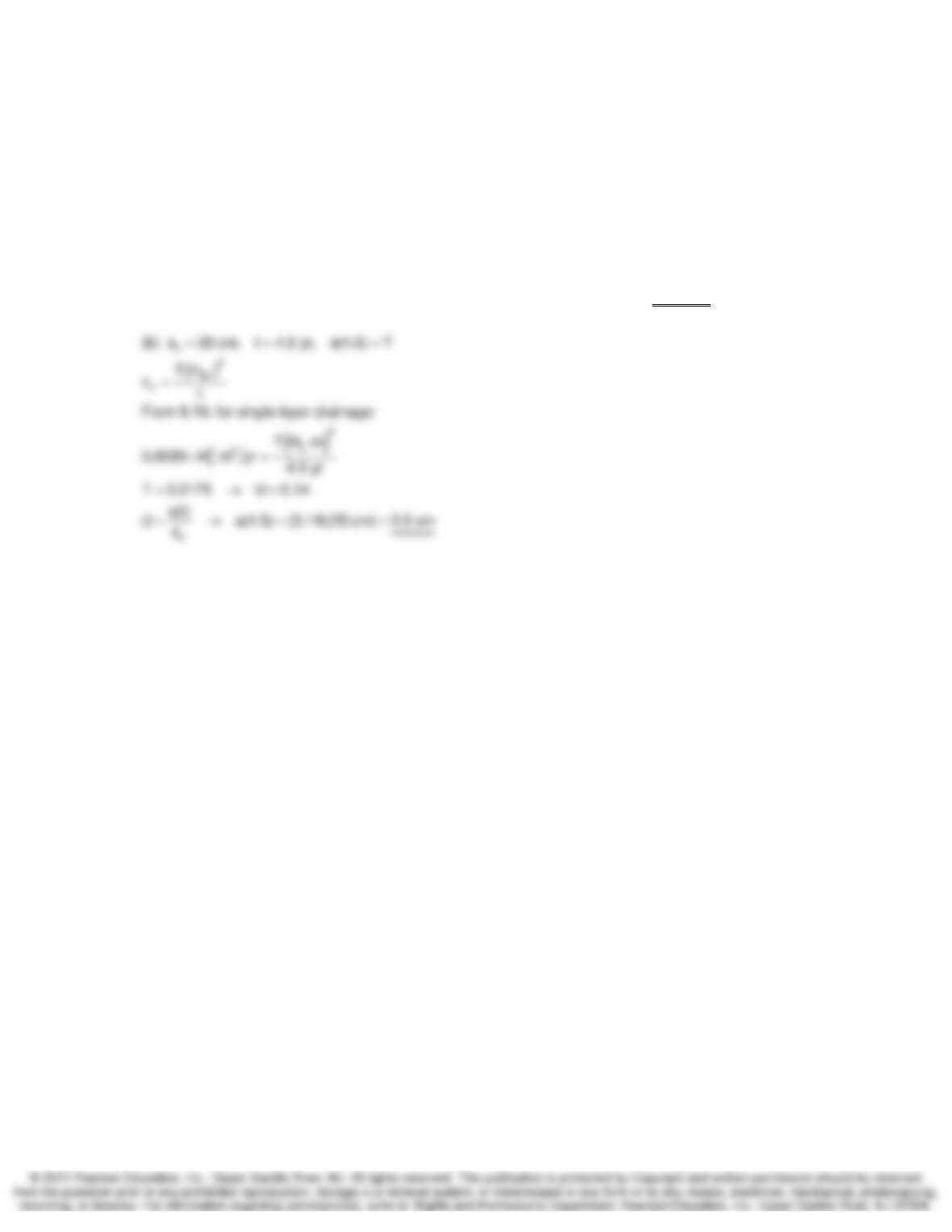
==
c
(a) Ultimate settlement is directly proportional to H. Thus, s (1.25)(25 cm) 31.25 cm
Time Rate of Consolidation Chapter 9
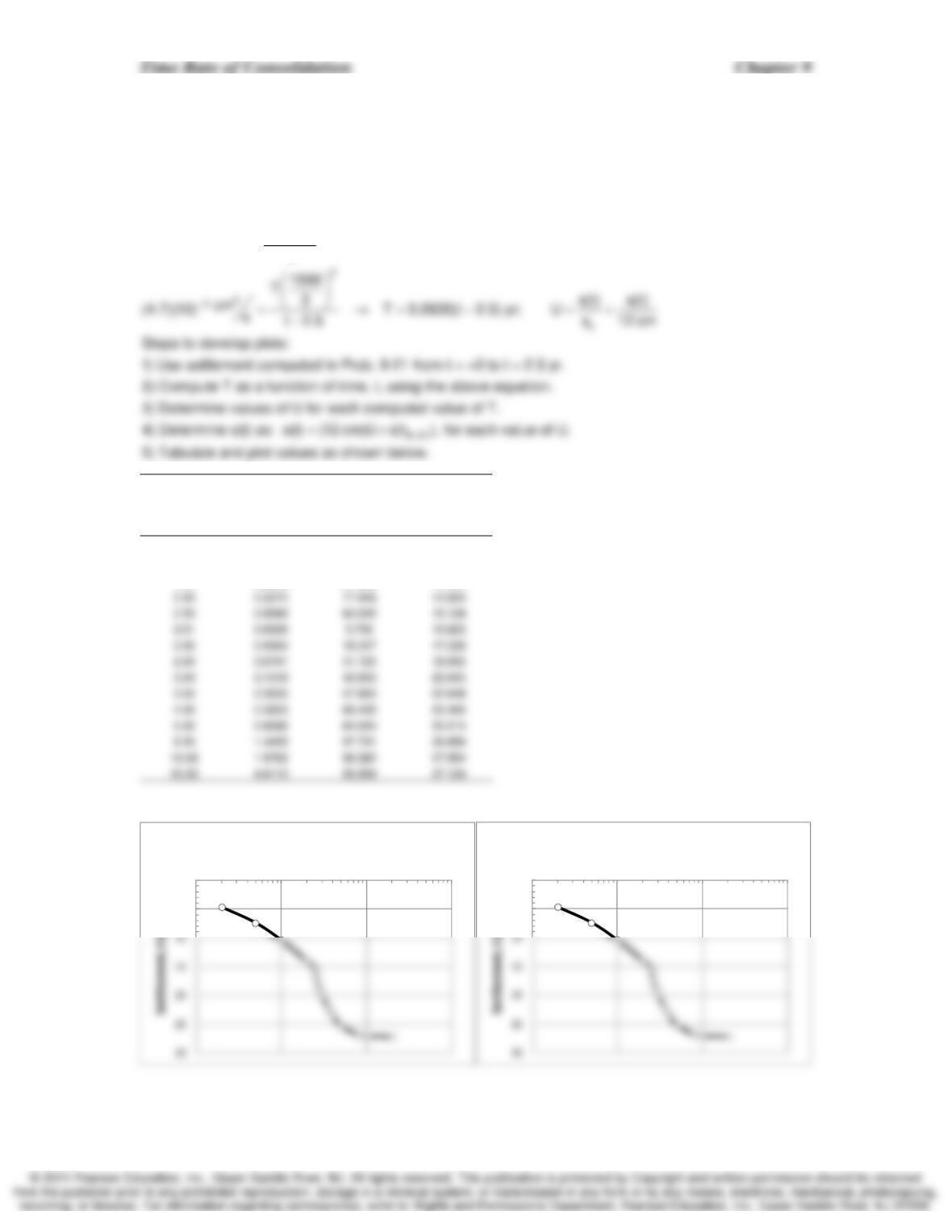
9-21. A certain doubly drained clay layer has an expected ultimate settlement sc 18 cm. The clay
layer, which is 15 m thick, has a coefficient of consolidation of 4.7 x 10⁻³ cm2/s. Plot the sc-time
relationship to: (a) an arithmetic time scale and (b) a semilog time scale.
SOLUTION:
()
=
2
dr
v
TH
ct
Real Time Factor Avg. Degree o
f
Settlement
Time, t = (0.2635)t Consolidation at time t
(yr) (%) (cm)
tT
Uavg s(t)
0.10 0.0264 18.317 3.297
0.30 0.0791 31.725 5.711
0.50 0.1318 40.955 7.372
0
5
0.0 5.0 10.0 15.0 20.0
Time,t(yr)
0
5
0.1 1.0 10.0 100.0
Time,t(yr)
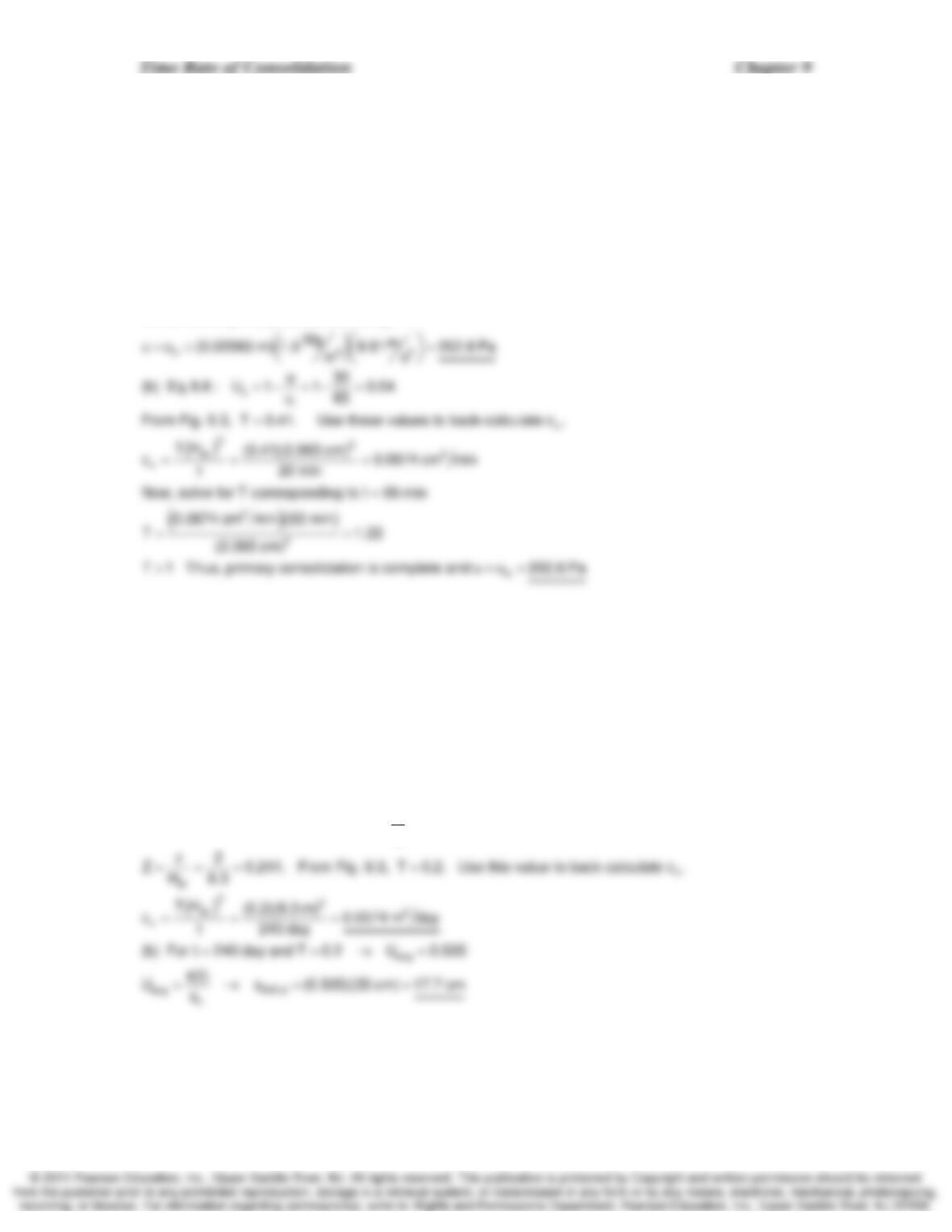
9-22. Given soil data from Prob. 9.21. After 2.5 yr, an identical load is placed, causing an
additional 12 cm of consolidation settlement. Plot the time rate of settlement under these
conditions, assuming that the load causing consolidation settlement is placed instantaneously.
SOLUTION:
()
==
2
dr
cv
TH
s12cm;c t
Real Time Factor Avg. Degree o
f
Settlement
Time, t = (0.2635)t Consolidation at time t
(yr) (%) (cm)
tT
Uavg s(t)
0.20 0.0527 25.904 4.663
0.50 0.1318 40.955 7.372
1.00 0.2635 57.665 10.380
0
5
0.1 1.0 10.0 100.0
Time,t(yr)
0
5
0.1 1.0 10.0 100.0
Time,t(yr)
9-24. A specimen of clay in a special consolidation device (with drainage at the top only) has a
height of 2.065 cm when fully consolidated under a pressure of 65 kPa. A pressure transducer is
located at the base of the sample to measure the pore water pressure. (a) When another stress
increment of 65 kPa is applied, what would you expect the initial reading on the transducer to be?
(b) If, after 20 min has elapsed, the transducer records a pressure of 30 kPa, what would you
expect it to read 45 min later (total elapsed time of 1.25 h)? (After G.A. Leonards.)
SOLUTION:
=+
=
ox
x
(a) u u u
At the end of primary consolidation, u 0.
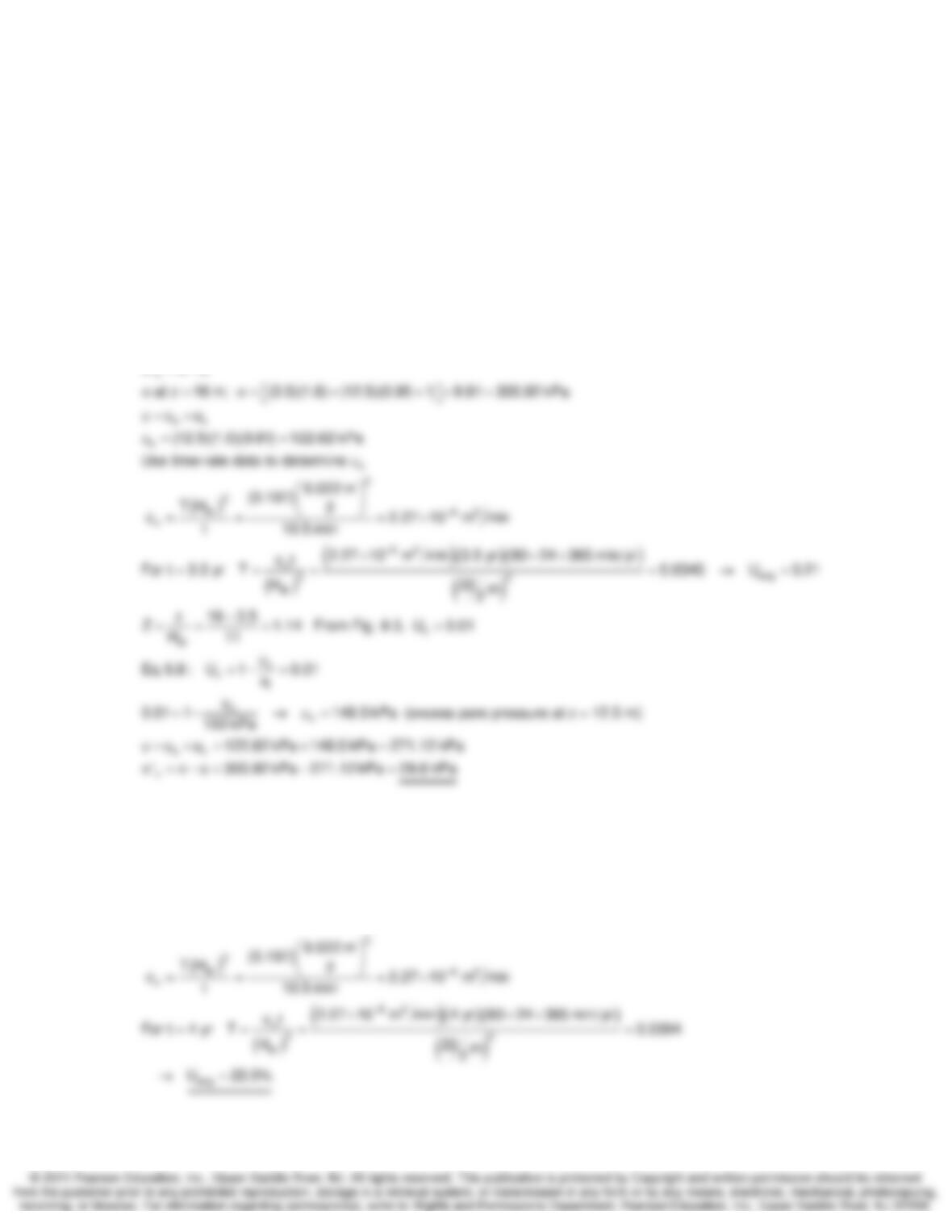
9-25. The total consolidation settlement for a compressible layer 8.3 m thick is estimated to be
about 35 cm. After about 8 mo (240 d) a point 2 m below the top of the singly drained layer has a
degree of consolidation of 70%. (a) Compute the coefficient of consolidation of the material in
m2/day. (b) Compute the settlement for 240 d.
SOLUTION:
=− =
z
i
u
(a) Eq. 9.8 : After 8 months, U 1 70%
u
Time Rate of Consolidation Chapter 9
9-26. A 22 m thick normally consolidated clay layer has a load of 150 kPa applied to it over a
large areal extent. The clay layer is located below a granular fill (
ρ
= 1.8 Mg/m3) 3.5 m thick. A
dense sandy gravel is found below the clay. The groundwater table is located at the top of the
clay layer, and the submerged density of the soil is 0.95 Mg/m3. Consolidation tests performed on
2.20 cm thick doubly drained samples indicate t50 = 10.5 min for a load increment close to that of
the loaded clay layer. Compute the effective stress in the clay layer at a depth of 16 m below the
ground surface 3.5 yr after application of the load.
SOLUTION:
Assume clay at equilibrium with stress increase caused by the granular fill (i.e., fill has been in
place a relatively long time). Assume clay layer is doubly drained.
σ=σ−
‘u
9-27. Given the same data as for Problem 9.24 for t = 4 yr. At what is the average degree of
consolidation for the clay layer?
SOLUTION:
Time Rate of Consolidation Chapter 9
9-28. Again, given the same data as for Problem 9.26. If the clay layer were singly drained from
the top only, compute the effective stress at a depth of 16 m below the ground surface and 3.5 yr
after placement of the external load.
SOLUTION:
σ=σ−
σ= σ= + +×=
⎡⎤
v
‘u
at z 16 m; (3.5)(1.8) (12.5)(0.95 1) 9.81 300.92 kPa
Time Rate of Consolidation Chapter 9
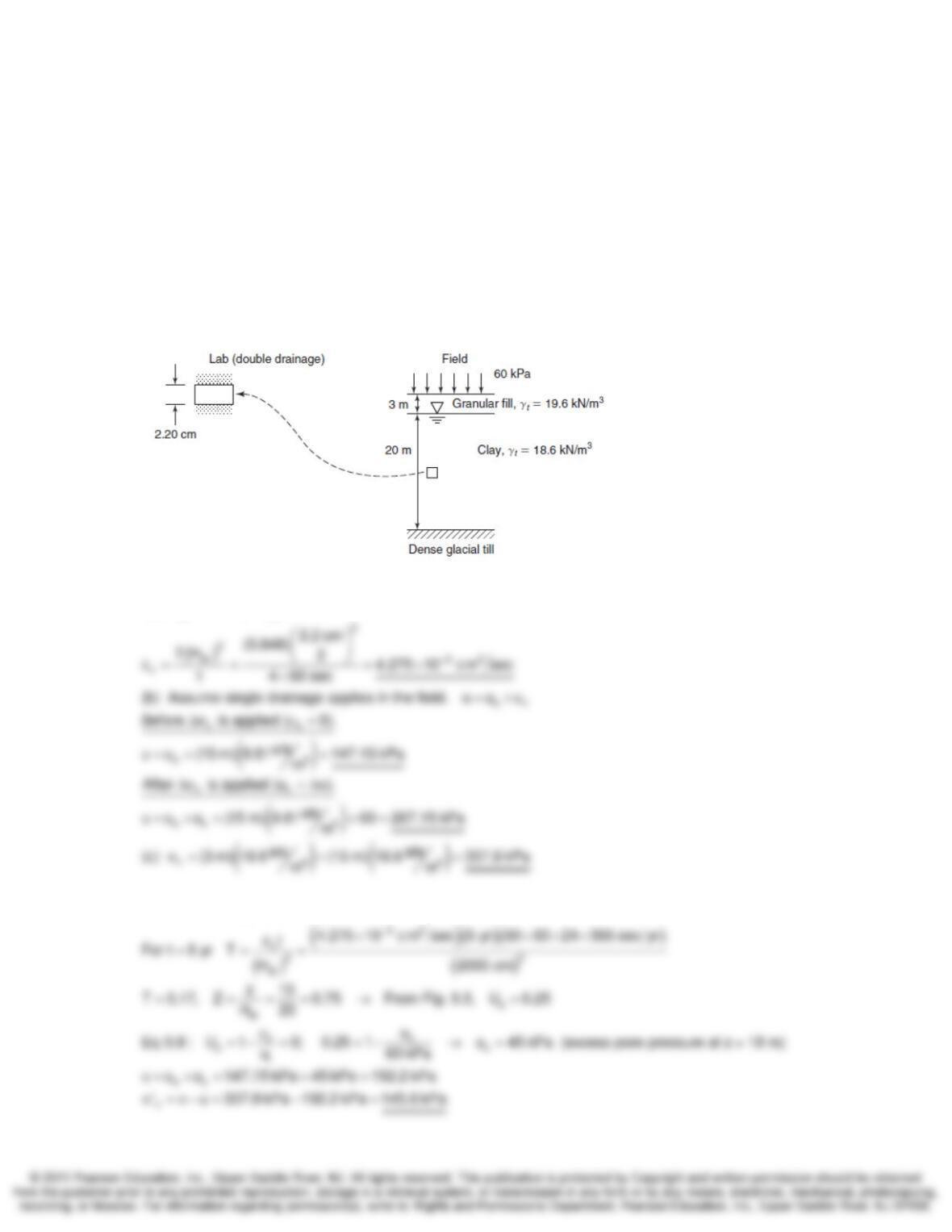
9-29. A doubly drained soil specimen is 3 cm thick. It is loaded from
σ
’v = 150 kPa to 300 kPa,
leading to a change in void ratio from 1.30 to 1.18. Its original void ratio at the start of the test, eo
= 1.42. (a) If the time required for 50% consolidation is 20 min, what is the coefficient of
consolidation, cv, of the soil in cm2/s? (b) How much vertical strain occurs during the loading from
150 to 300 kPa? (c) What is the coefficient of permeability for this soil, in cm/s, based on these
results?
SOLUTION:
()
−
==
⎛⎞
⎜⎟
⎝⎠
== =×
×
50
2
2
dr 42
v
(a) t 20 min, T 0.197
3cm
(0.197)
TH 2
c 3.694 10 c m sec
t2060sec
Time Rate of Consolidation Chapter 9
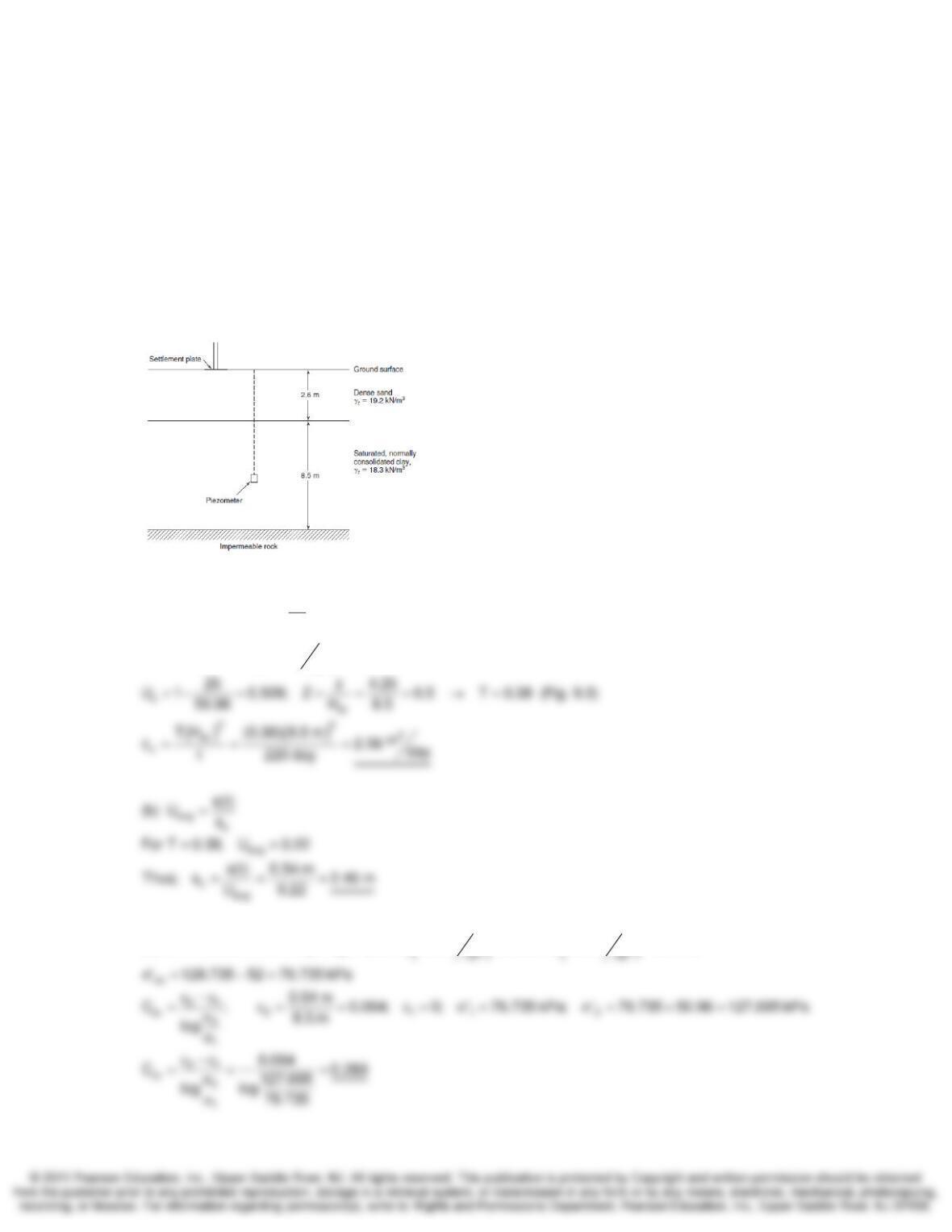
9-30. Figure P9.30 shows a 20 m thick layer of normally consolidated clay (
γ
t = 18.6 kN/m3) that
is one-dimensionally loaded by
Δσ
v = 60 kPa. The clay layer is below a 3 m thick layer of granular
fill (
γ
t = 19.6 kN/m3), and a dense, compacted glacial till underlies the clay. The water table is
located at the top of the clay layer. A 1-D consolidation test is performed on a 2.20 cm thick,
doubly drained specimen from the middle of the clay layer. When the stress conditions from the
field (including
Δσ
v = 60 kPa) are applied to this specimen, it takes 4 min for 90% average
consolidation to occur. (a) From the lab test data, determine cv for the soil. (b) Compute the pore
pressure at depth 18 m before and immediately after the 60 kPa stress is applied. (c) Compute
the total vertical (
σ
v) stress at depth 18 m after the 60 kPa stress is applied in the field. (d) At
depth 18 m, compute the effective vertical stress (
σ
‘v) 5 years after the 60 kPa is applied.
SOLUTION:
==
90 90
(a) t 4 min, T 0.848
x
(d) Determine u at 18 m depth, 5 yr after load is applied.
Time Rate of Consolidation Chapter 9
9-31. Figure P9.31 shows a soil profile at a certain site, including an 8.5 m thick stratum of
saturated, normally consolidated clay overlying an impermeable rock formation. The groundwater
location is not known; however, a pore pressure measurement device (piezometer) has been
installed in the middle of the clay and reads 52 kPa. A settlement plate has also been installed at
the top of the clay to measure the deformation of the clay layer only (doesn’t include any
deformation of overlying materials). (a) A 2.6 m deep layer of fill (unit weight 19.2 kN/m3) is
placed on the ground surface. At 220 days after the fill is placed, the piezometer reads 77 kPa of
pore pressure, and the settlement plate has moved downward by 0.54 m. What is the cv for the
clay? (b) Based on these readings at 220 days, what total settlement can be expected at the end
of consolidation? (c) Compute the modified compression index, Cce for this loading increment.
SOLUTION:
()
=− =
=Δσ = = = = − =
x
z
i
iv o x
3
u
(a) Eq. 9.8 : U 1 0
u
kN
u (2.6 m) 19.6 50.96 kPa; u 52 kPa; u 77 52 25 kPa (at t = 220 day)
m
()()
σ= + −
vo 33
kN kN
(c) At the center of the clay, ‘ (2.6 m) 19.6 (4.25 m) 18.3 52 kPa
Time Rate of Consolidation Chapter 9
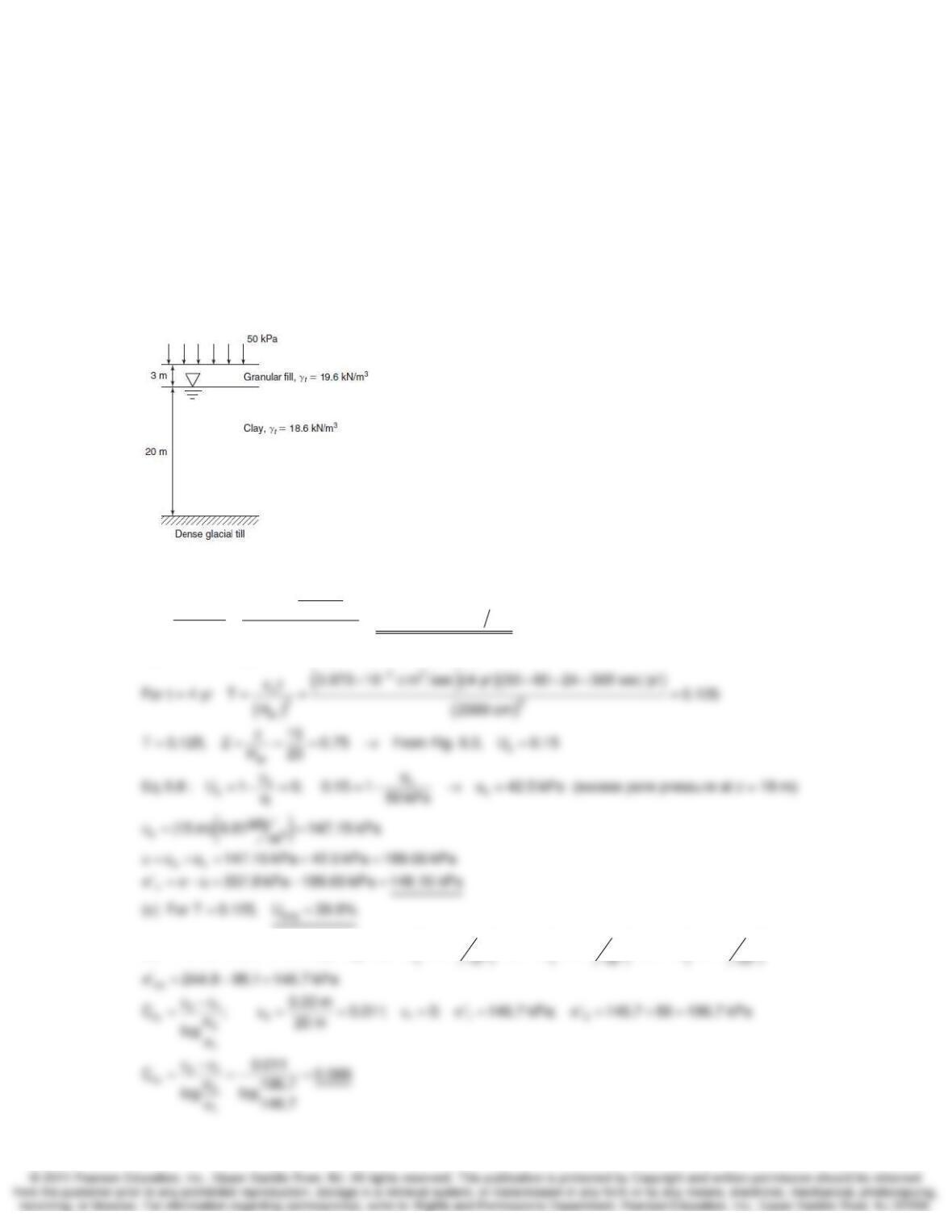
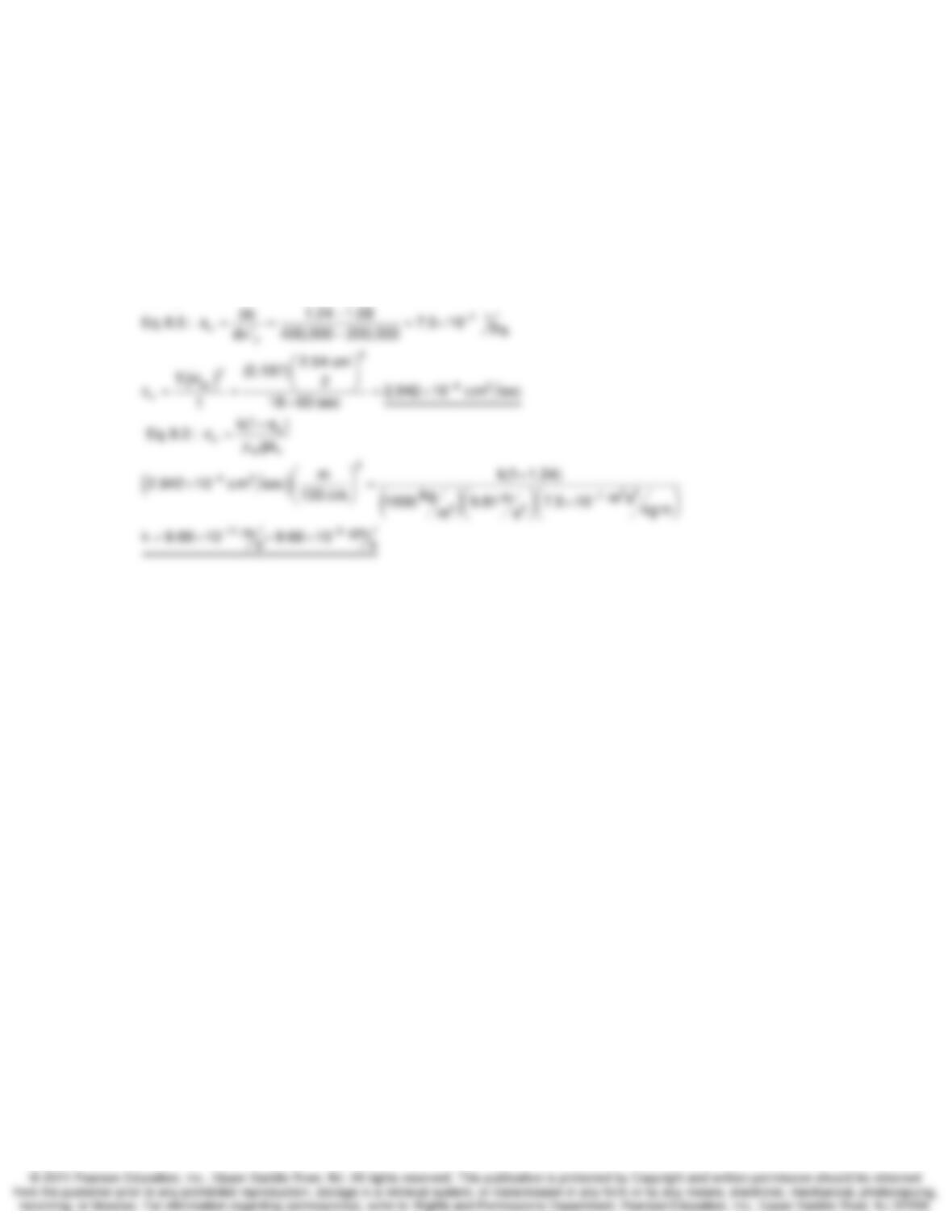
9-32. Figure P9.32 shows a 20 m thick layer of normally consolidated clay (
γ
t = 18.6 kN/m3) that
is one-dimensionally loaded by
Δσ
v = 50 kPa. The clay layer is below a 3 m thick layer of granular
fill (
γ
t = 19.6 kN/m3), and a dense, compacted glacial till underlies the clay. The water table is
located at the top of the clay layer. A 1-D consolidation test is performed on a 2.20 cm thick,
doubly drained specimen from the middle of the clay layer. When the stress conditions from the
field (including the
Δσ
v = 50 kPa) are applied to this specimen, it takes 1 minute for 50% average
consolidation to occur. (a) From the lab test data, determine cv for the soil. (b) Compute effective
stress at 18 m depth 4 years after the
Δσ
v is applied to the clay layer. (c) Compute the average
degree of consolidation 4 years after
Δσ
v application. (d) If the settlement after 4 years is 22 cm,
what is the estimated Cce for the clay?
SOLUTION:
()
−
==
⎛⎞
⎜⎟
⎝⎠
== =×
×
50 50
2
2
dr 32
v
x
(a) t 1min, T 0.197
2.2 cm
(0.197)
TH 2
c 3.973 10 c m sec
t160sec
(b) Determine u at 18 m depth, 4 yr after load is applied.
()()()
σ= + −
vo 333
kN kN kN
(d) At the center of the clay, ‘ (3 m) 19.6 (10 m) 18.6 (10 m) 9.81
Time Rate of Consolidation Chapter 9
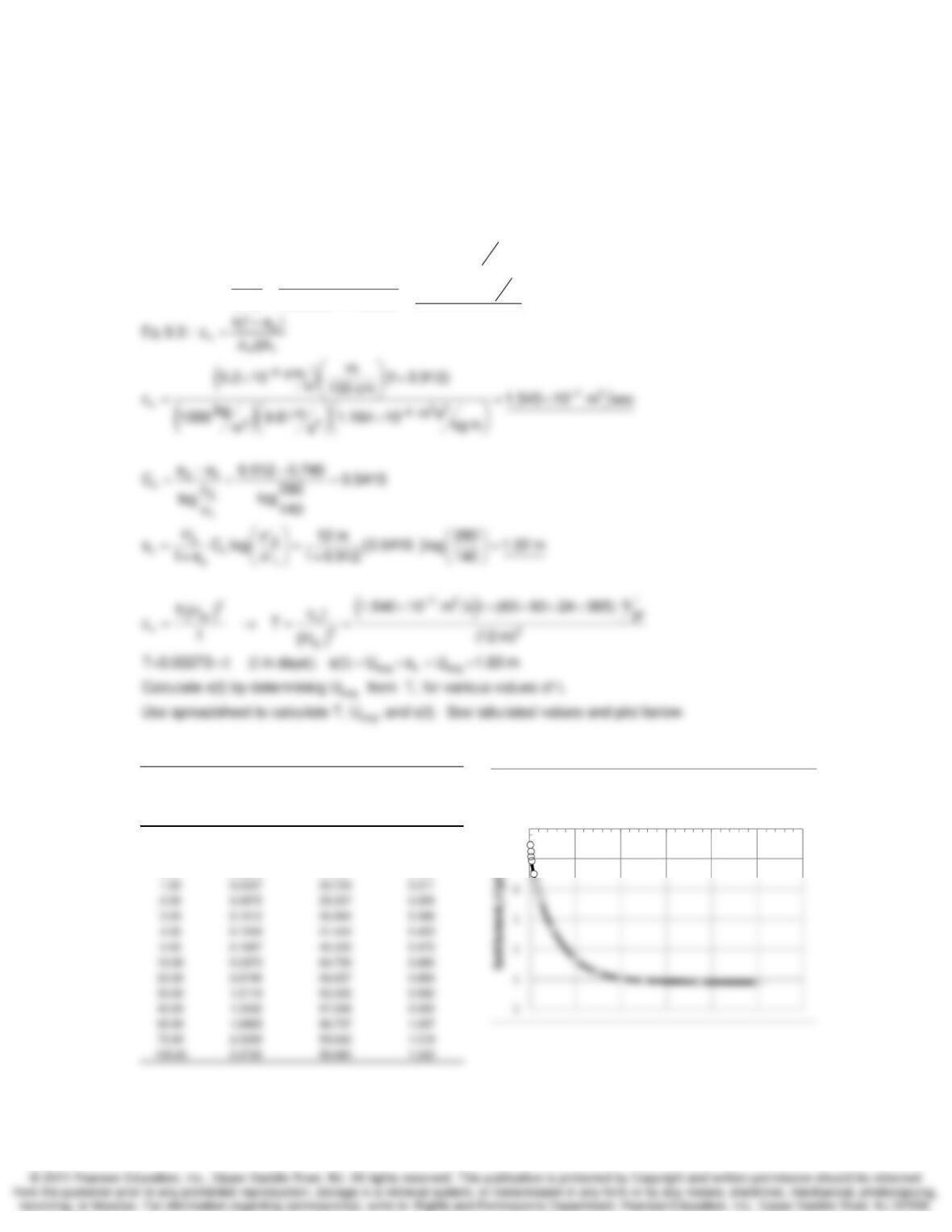
9-33. Determine the average coefficient of permeability, corrected to 20°C, of a clay specimen for
the following consolidation increment:
σ
1 = 200 kPa, e1 = 1.24,
σ
2 = 400 kPa, e2 = 1.09
Height of specimen = 25.4 mm, Drainage at both top and bottom faces
Time required for 50% consolidation = 18 min, Test temperature = 23 deg C
SOLUTION:
==
50
(a) t 18 min, T 0.197
Time Rate of Consolidation Chapter 9
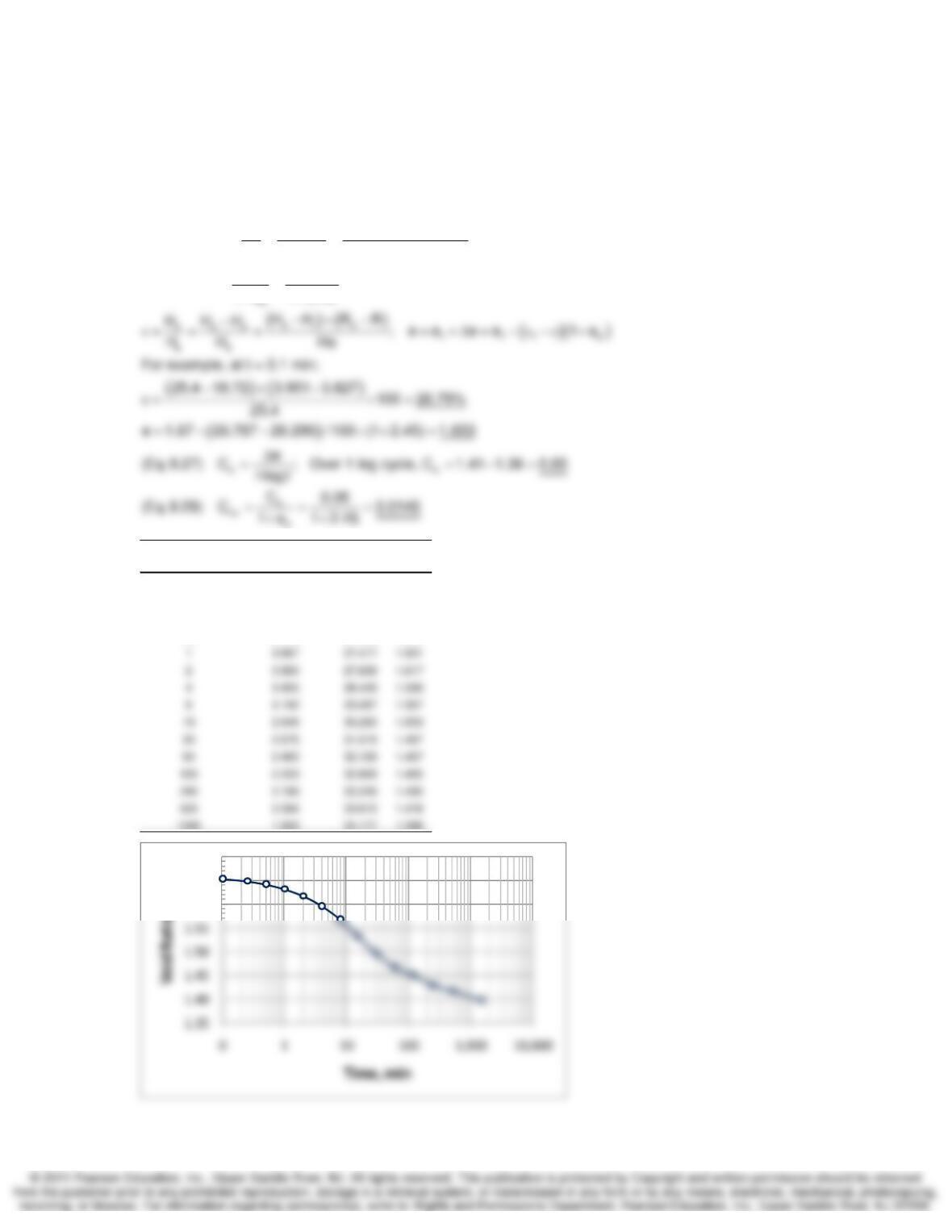
9-34. The following data were obtained from a consolidation test on an undisturbed clay sample:
The average value of the coefficient of permeability of the clay in this pressure increment range is
9.2 x 10⁻⁸ cm/s. Compute and plot the decrease in thickness with time for a 12 m layer of this clay
which is drained.
σ
1 = 140 kPa, e1 = 0.912
σ
2 = 280 kPa, e2 = 0.749
SOLUTION:
−
−
==×
−
== =×
σ−
8
dr
6
v
v
cm
H 12 m (single-layer drainage); k 9.2 10 s
de 0.912 0.749 1
Eq. 8.5 : a 1.164 10 Pa
d ‘ 280,000 140,000
Real Time Facto
r
Avg. Degree of Settlement
Time, t T= (0.03373)t Consolidation at time t
(yr) (%) (m)
tT U
avg
s(t)
0.25 0.0084 10.362 0.106
0.50 0.0169 14.654 0.149
0.75 0.0253 17.947 0.183
0
0
0.0 20.0 40.0 60.0 80.0 100.0 120.0
Time,t(yr)
Time Rate of Consolidation Chapter 9
9-36. Given the data of Problem 9.13. Evaluate (a) the secondary compression index and (b) the
modified secondary compression index if: eo = 2.45, Ho = 2.54 cm,
ρ
s = 2.69 Mg/m3
At t = 0, e = 1.67, H = 1.872 cm. At t = 1485 min, e = 1.387, H = 1.646 cm
SOLUTION:
()
(
)
−−−
−
== =
== =
++
os o
os
v
ss s
o
s
HH RR
HH
H
Eq. 9.31: e HH H
H2.54 cm
where, H 0.736
1e 12.45
Elapsed Time, t Dial Reading Strain e
(min) (mm) (%)
0 3.951 26.299 1.670
0.1 3.827 26.787 1.653
0.25 3.789 26.937 1.648
0.5 3.740 27.130 1.641
1485 1.950 34.177 1.398
1.60
1.65
1.70

Time Rate of Consolidation Chapter 9
9-39. Estimate the secondary compression per log cycle of time for Problem 9.26.
SOLUTION:
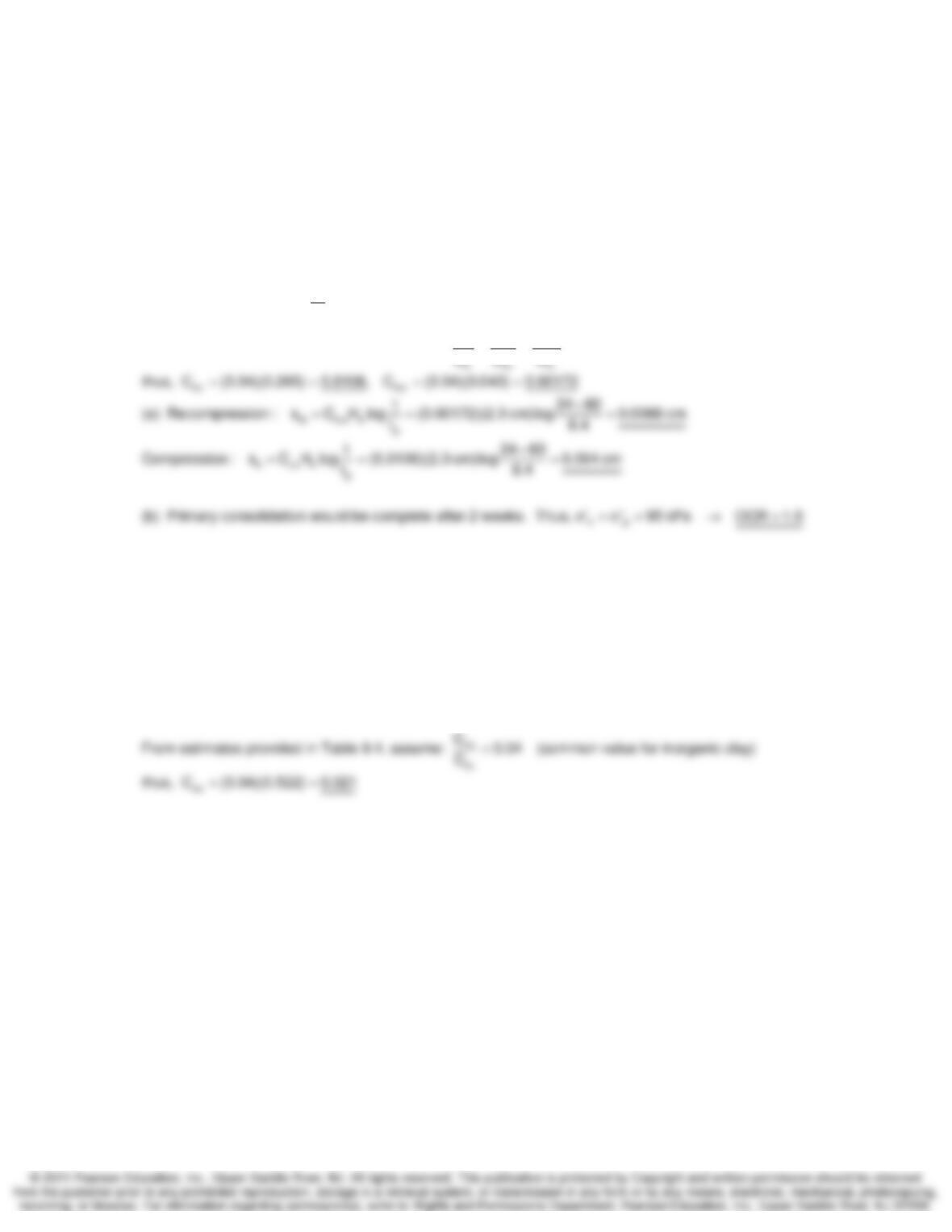
Time Rate of Consolidation Chapter 9
9-40. A consolidation test was performed on a specimen of inorganic clay 2.3 cm thick (doubly
drained) and gave the following results: Cr
ε
= 0.043, Cc
ε
= 0.265, and
σ
’p = 75 kPa. The typical t100
in the recompression range was 8.4 min, and in the virgin compression range it was 32.5 min. (a)
If each increment is left on for 24 hours, determine the amount of secondary compression strain
that will occur in both the recompression and the virgin compression ranges. (b) One increment
was left on at
σ
’v = 95 kPa for two weeks. What overconsolidation ratio resulted?
SOLUTION:
αε
ααε αε
=
== =
so
p
r
t
Eq. 9.30 : s C H log t
CC C
From estimates provided in Table 9.4, assume: 0.04 for inorganic clays
9-41. The liquid limit of a soil is 68. Estimate the value of the modified secondary compression
index.
SOLUTION:
=−= −=
cc
EstimateC using Eq. 8.25: C 0.009(LL 10) (0.009)(68 10) 0.522