CASE 9
SUGGESTED ANSWERS TO DISCUSSION QUESTIONS
(1)
Any company which does not maintain an extensive accounting staff will often
(2)
Where possible, expense accounting follows the matching principle which states
(3)
Theoretically, the management of the client company prepares all financial
(4)
This question offers another opportunity for interesting class discussion.
Students often view accounting as a discipline in which all questions can be
ultimately resolved by an adequate knowledge of accounting standards. In this
instance, they face a case of financial statement manipulation that is being
students in analyzing this case. Paragraph 29 of this pronouncement states:
“Insofar as the separate financial statements of the related parties are
concerned, the classification and accounting shall be the same as for
After reading FASB Statement 13, students may argue that the lease is actually
for a number of years (probably the life of the building) and that the proposed
The auditors also need to verify that the $21,000 payment for the building has not
been “significantly affected” by the relationship between Lakeside and Rogers.
Regardless of the accounting, as a related party transaction, the auditors must
ensure that the nature and extent of the lease has been fully disclosed within the
104
(5)
The recording of accounting information is normally based on objective evidence
gathered by analyzing the impact of transactions that occur between the
(6)
The potential impairment of value of Store Six has been an underlying problem
throughout the Lakeside audit. In discussing this issue, students frequently
concentrate on the wrong issues: client retention versus safety from litigation.
Audit opinions, however, should be based on the actual evidence accumulated
Students can be asked to list the kinds of evidence Abernethy and Chapman
might seek in evaluating the possibility of a material impairment of value in
connection with Store Six. This exercise is a good technique for demonstrating
the necessity of creativity in the auditor’s work. The auditor needs to consider all
possible ways to gain assurance about the future of this store. A few of the
evidence-gathering procedures that might be carried out would include:
Discussion with the owners and managers of the shopping center as to their
strategies for renting more space and improving customer traffic.
105
One final point should be made in connection with this potential impairment of
(7)
Little doubt exists that Rogers has issued a subtle threat to the new audit firm.
One of the primary reasons for investigating the integrity of management prior to
SUGGESTED ANSWERS TO EXERCISE
(1)
This assignment requires the students to analyze the client’s Warehouse
account. In this case, for the first time, no audit program is available. The
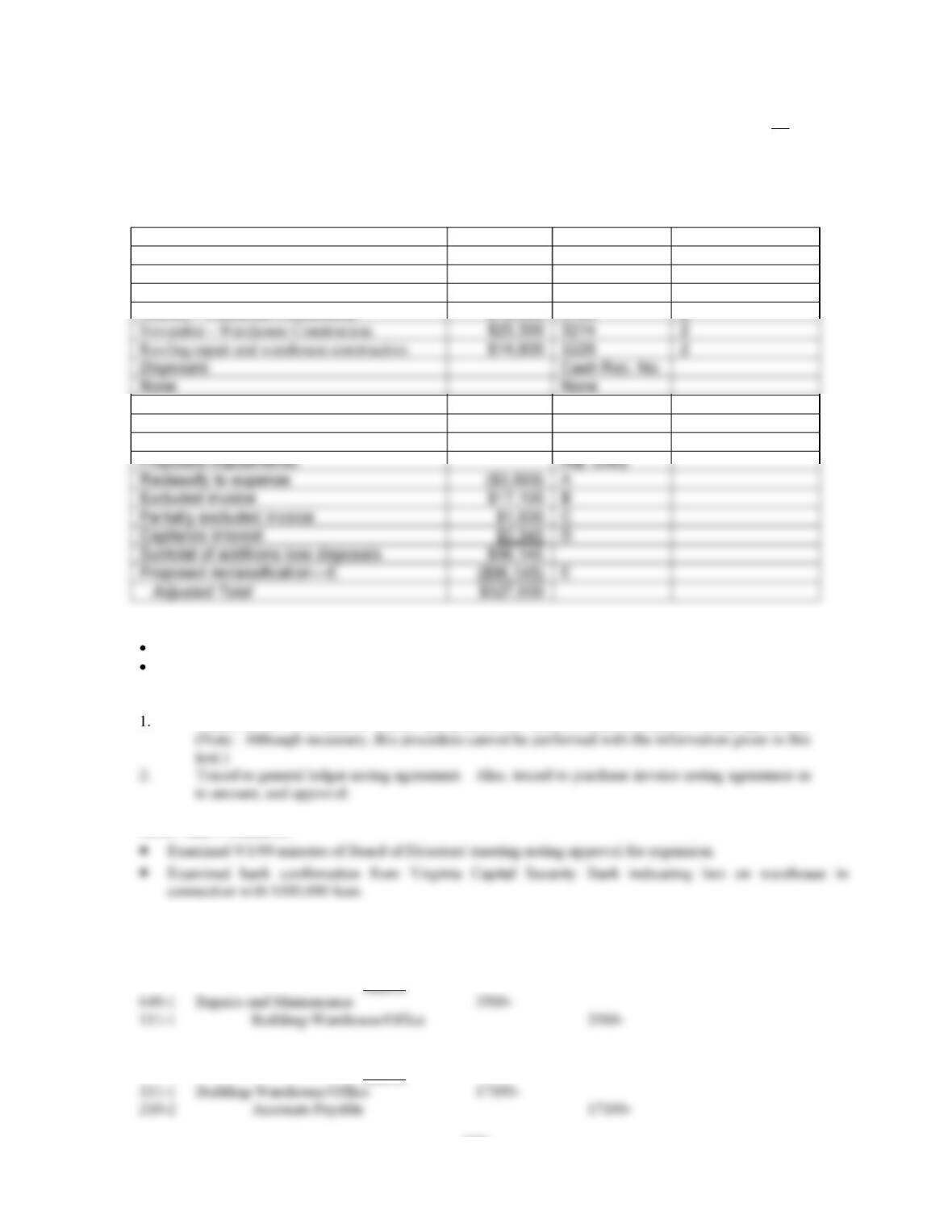
106
LAKESIDE COMPANY Doc. No. I-3
Building-Warehouse/Office A/C 111-1
12/31/12 Prepared by: AH
Date: 1/14/13
Description Amount
Audit Procedures
Balance per books – Beg. of Year $327,000
1
Additions:
Invoice No.
Grade land and pour foundation $21,800
3145 2
October – Warehouse Construction $16,900
3189 2
Balance per books – End of Year 405,600
Audit Objective: To verify the fair presentation of the “Building–Warehouse/Office” account.
Scope: All charges and potential charges to the account.
Audit Procedures:
Traced to 12/31/11 audited balance per predecessor auditor’s audit documents noting agreement.
Other Audit Procedures:
Proposed Adjustments:
A $3,500 roof repair incorrectly classified in asset account.
AJE 1
B Invoice #3316 for December work by Heilman Construction received after year-end.
AJE 2
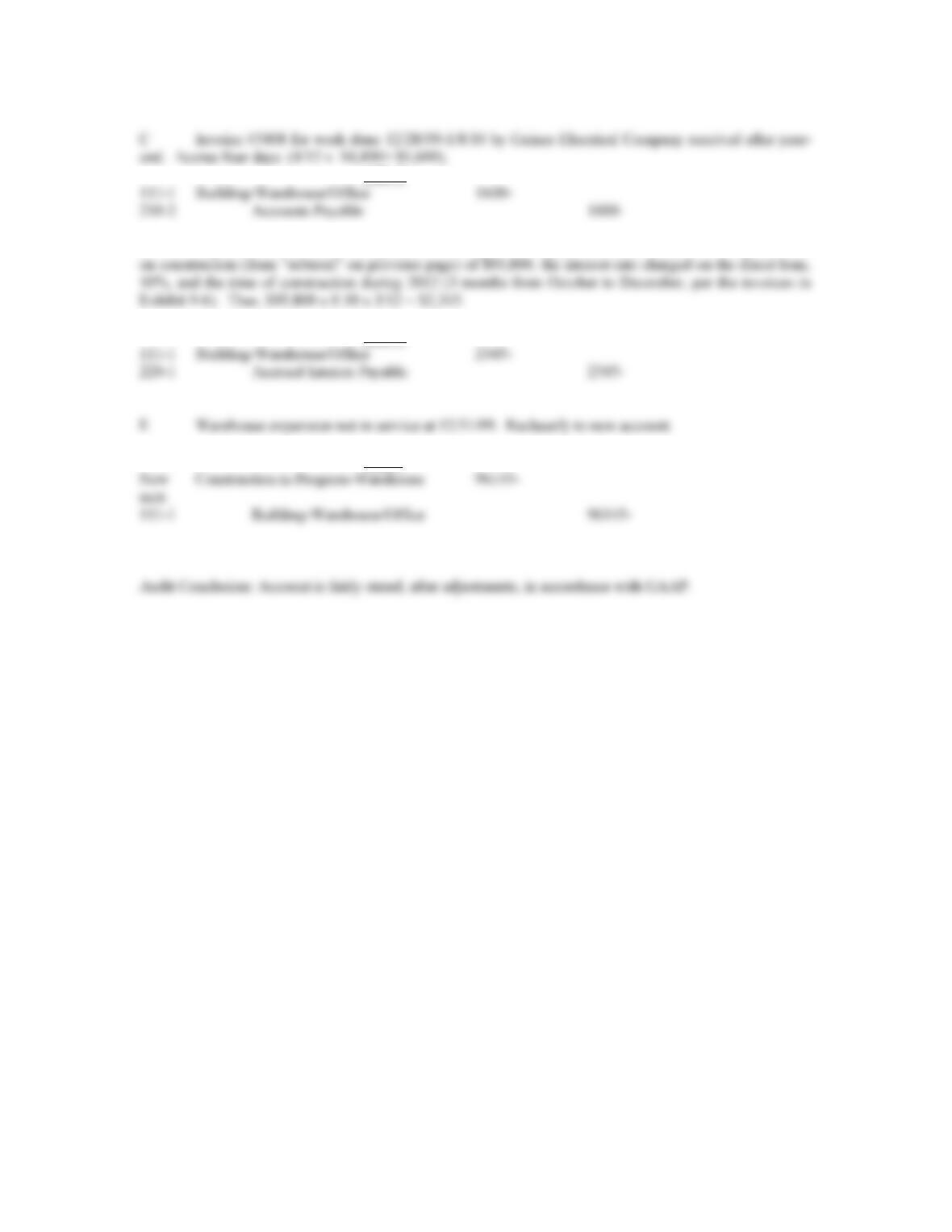
107
AJE 3
D Capitalize interest on building loans. This figure is roughly estimated based on the expenditures
AJE 4
AJE 5
108
(2)
Lakeside Company
Impairment Test Store 6
December 31, 2012
Prepared by: AH
Date: 1/13/13
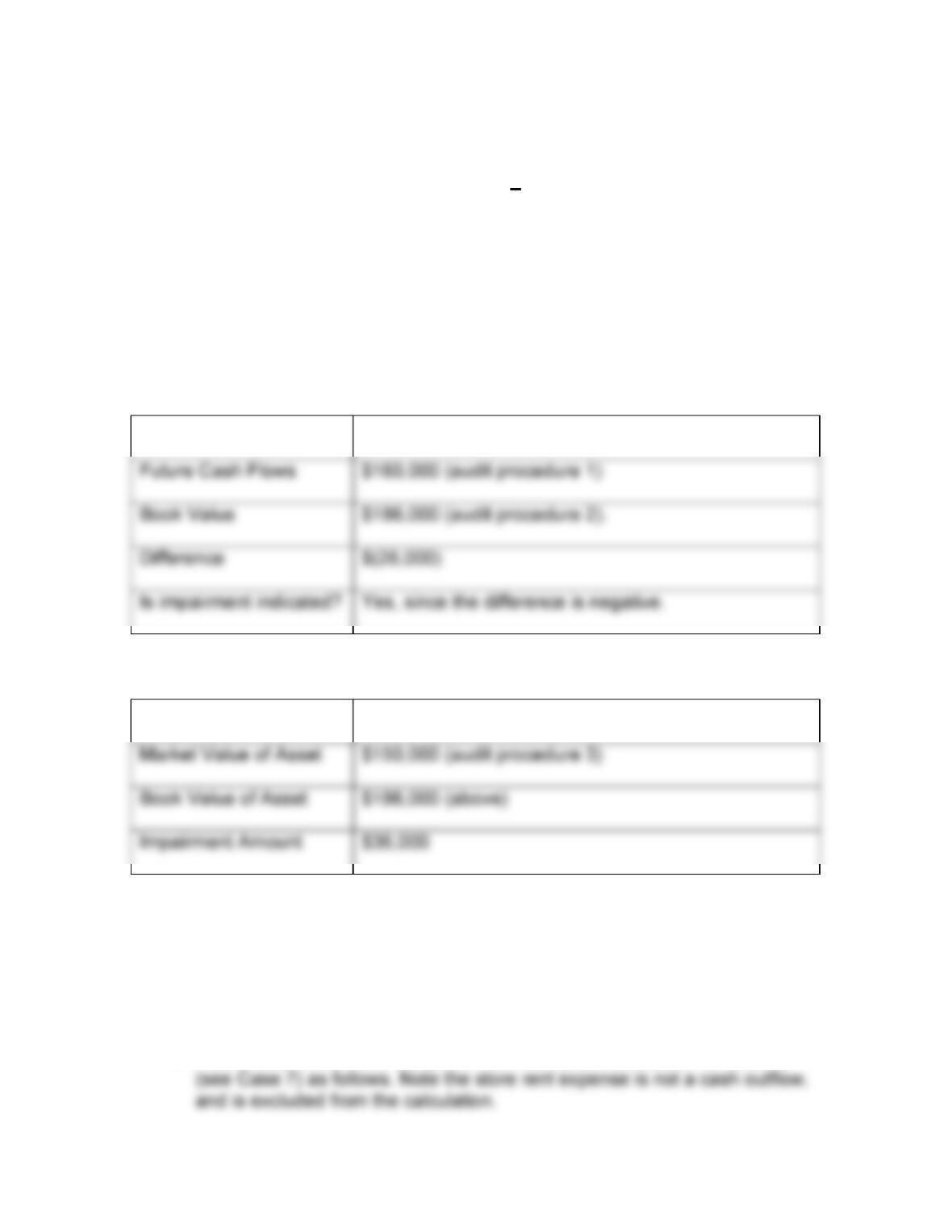
Instructions: Using the two-step approach, perform an impairment test given the
information available.
Step One: Recoverability Test
Source of Information
Store profitability report/bonus calculation
Step Two: Measurement of Impairment
Source of Information
Prior years work papers, appraisal
Audit Objective: To determine whether or not the value of Store 6 is impaired.
Scope: An estimate of future cash flows derived from Store 6 and the market
value of Store 6.
Audit Procedures: Used a two step approach as required by the FASB.
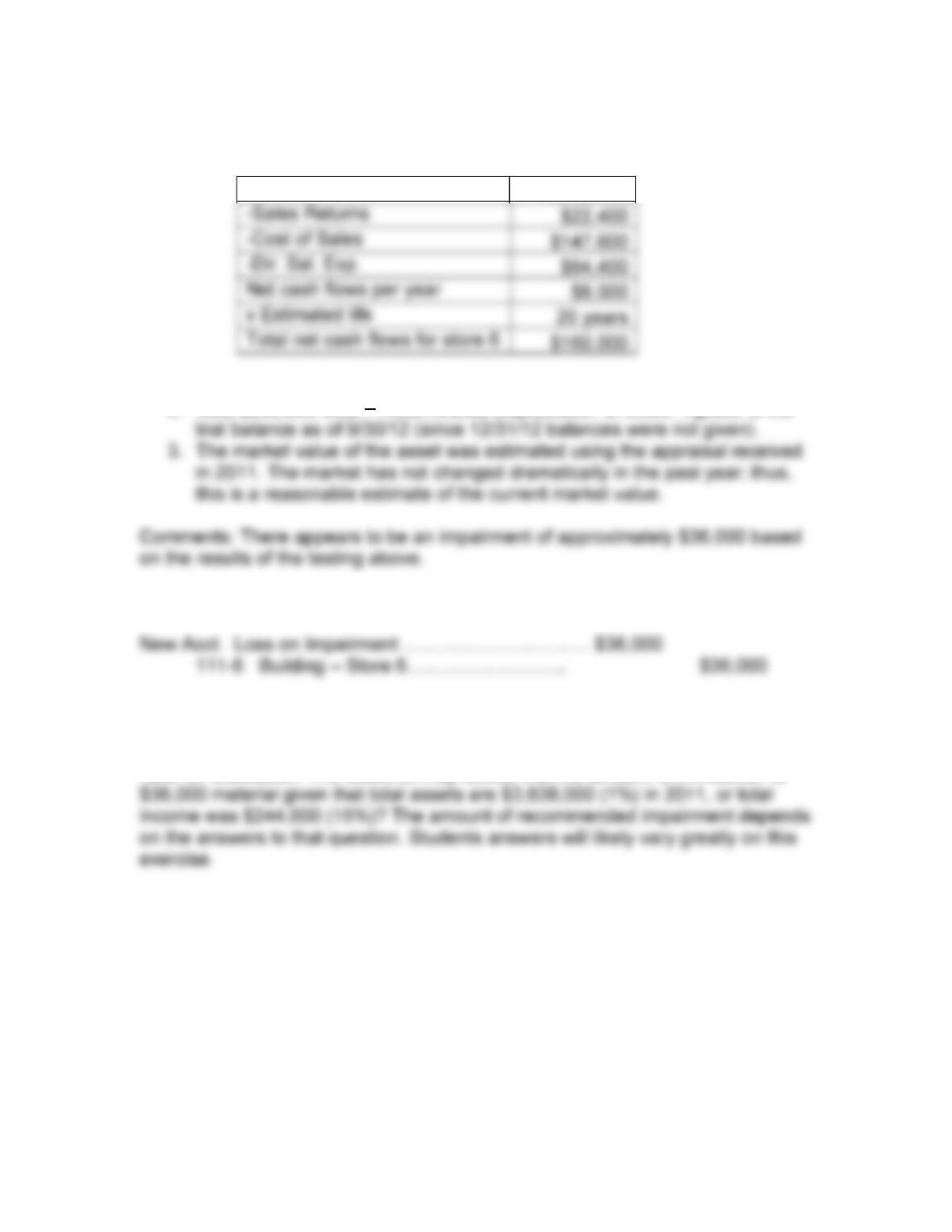
1. Future cash flows were computed from the bonus calculation for Store 6
109
Sales
$242,400
2. Cost $256,800 Cost Accumulated Depreciation $70,800. Agreed to the
Recommended Adjustment:
Audit Conclusion: After the recommend adjustment, the carrying value of Store 6
is fairly stated.
Note for discussion: The students may decide that the amount is immaterial. Is
SUGGESTED ANSWERS TO SARBANES-OXLEY QUESTIONS
(1)
Quoting from the Act:
Section 301: Public Company Audit Committees.
Each member of the audit committee shall be a member of the board of directors
(2)
Quoting from the act:
Section 302: Corporate Responsibility For Financial Reports.