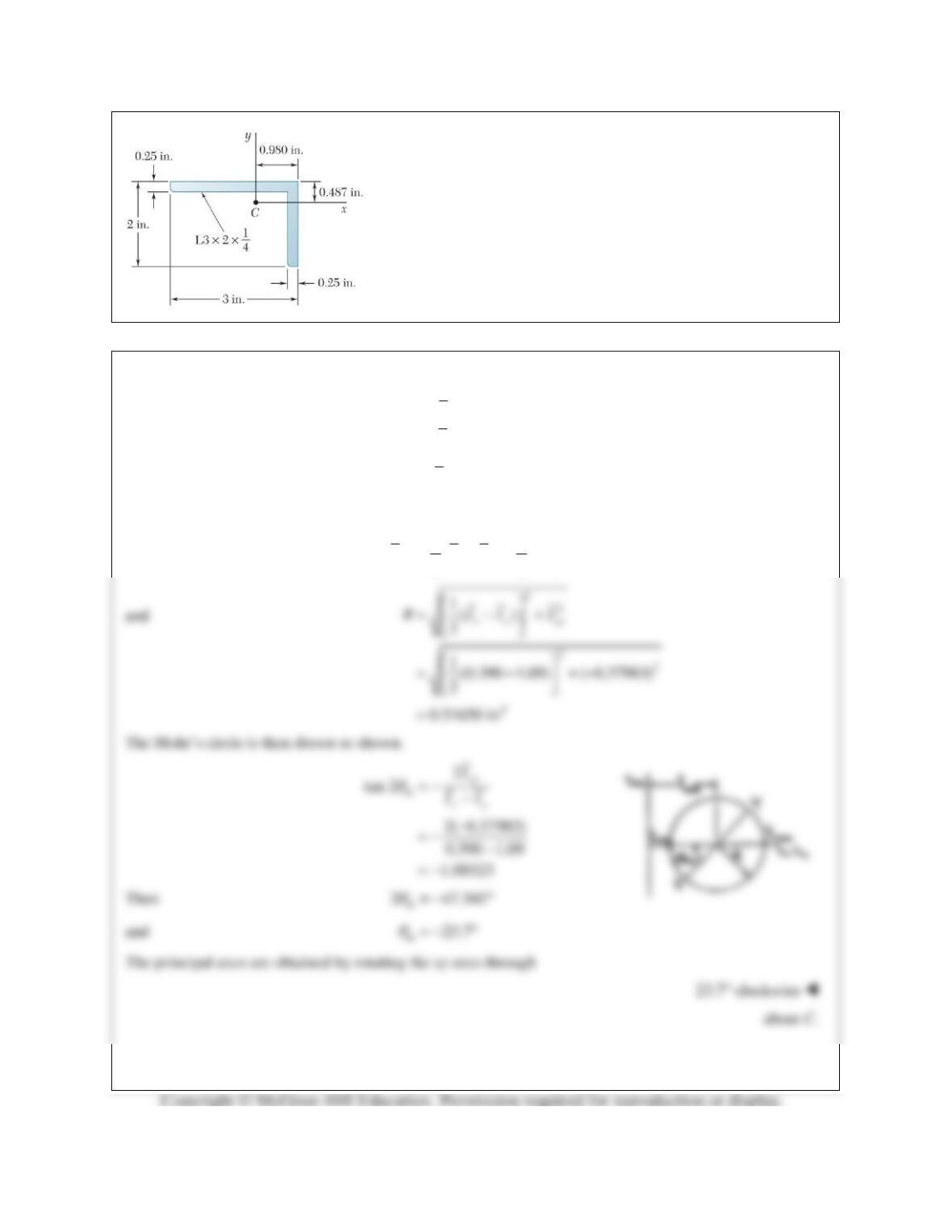
PROBLEM 9.101
Using Mohr’s circle, determine for the area indicated the
orientation of the principal centroidal axes and the corresponding
values of the moments of inertia.
Area of Problem 9.74.
SOLUTION
From Problem 9.83:
4
4
0.390 in
1.09 in
x
y
I
I
Problem 9.74: 4
0.37983 in
xy
I
The Mohr’s circle is defined by the diameter XY, where
(0.390, 0.37983) and (1.09, 0.37983).XY
Now
4
ave
11
( ) (0.390 1.09) 0.740 in
22
xy
III
PROBLEM 9.101 (Continued)
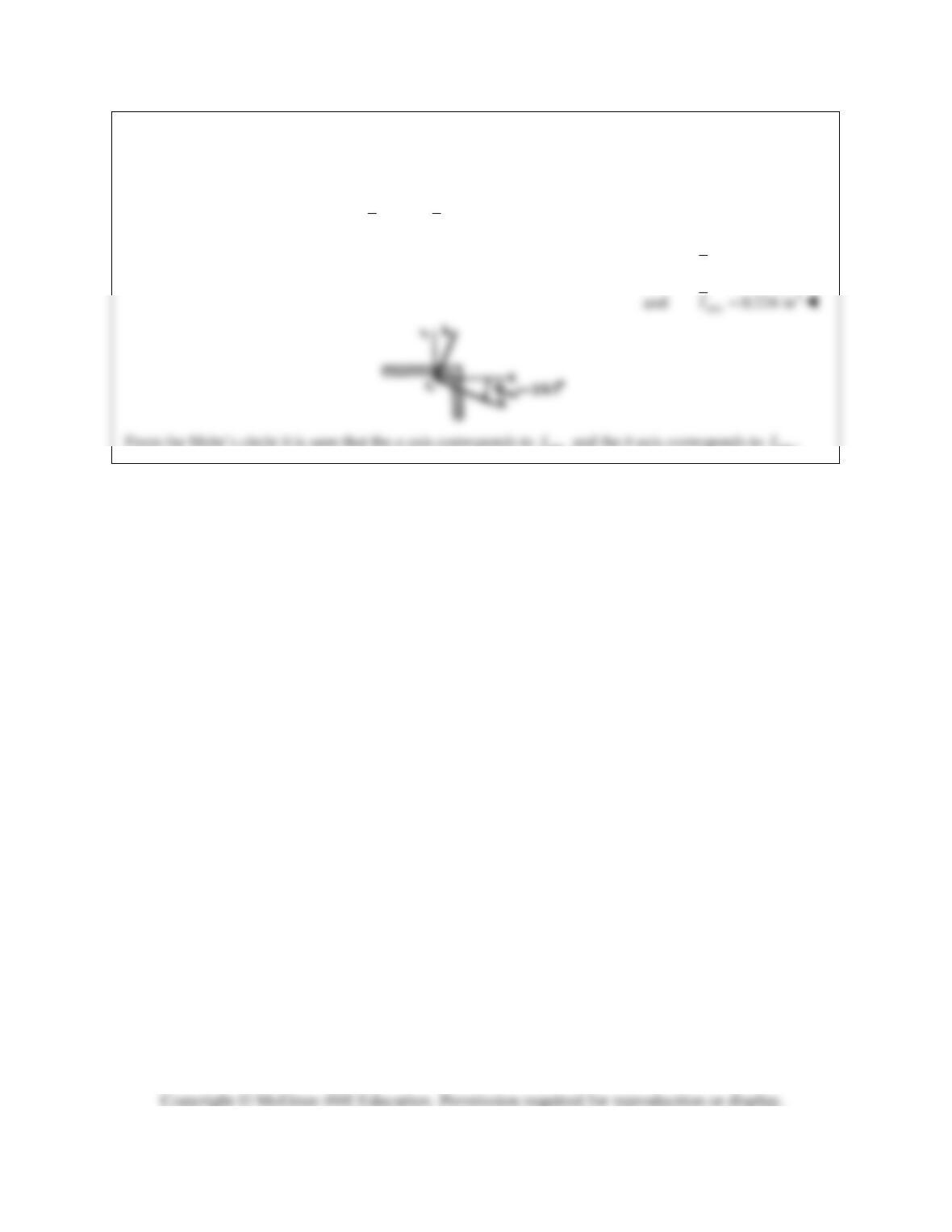
Now
max, min ave 0.740 0.51650
IIR
or
4
max
1.257 inI
min
max
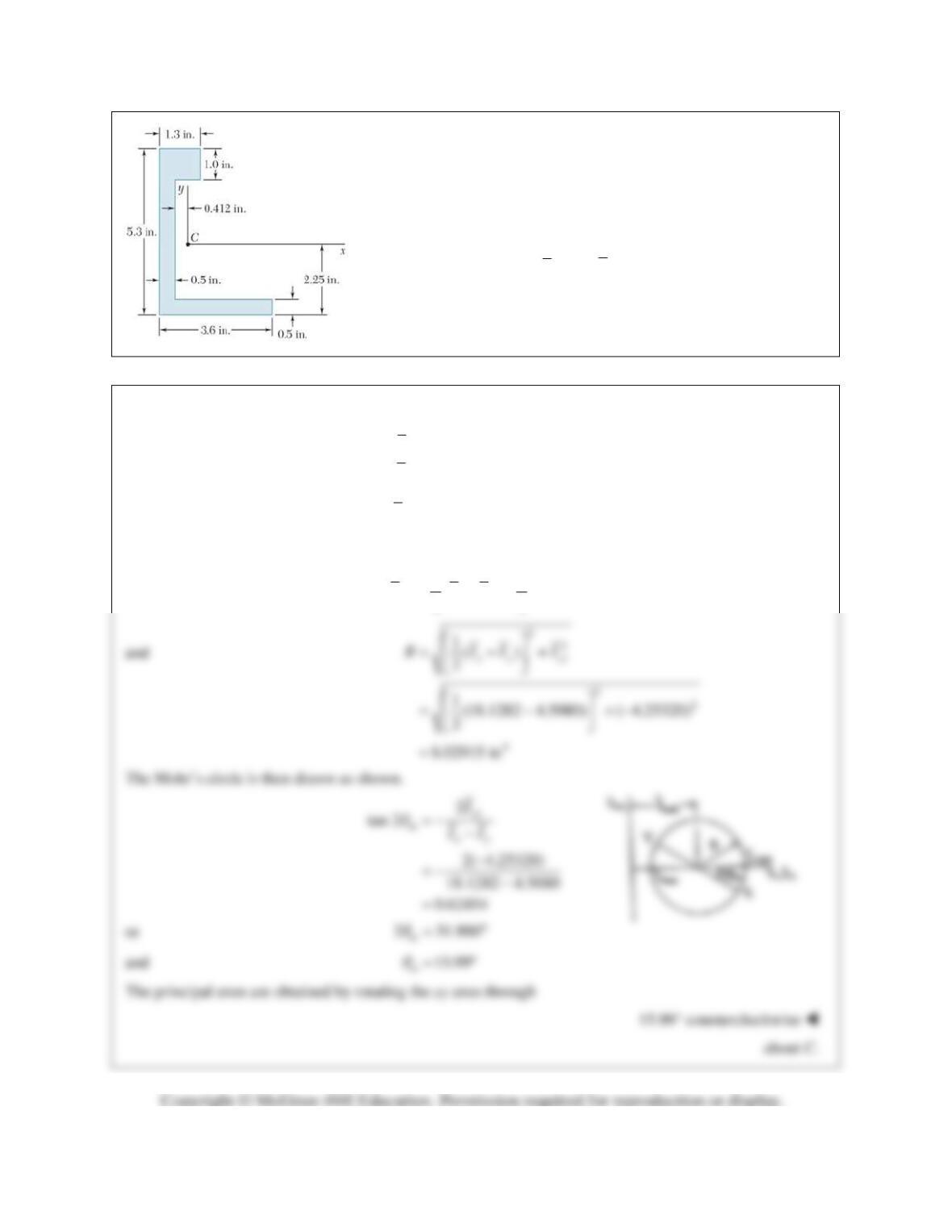
PROBLEM 9.102
Using Mohr’s circle, determine for the area indicated the orientation of
the principal centroidal axes and the corresponding values of the
moments of inertia.
Area of Problem 9.77
(The moments of inertia
x
I
and
y
I
of the area of Problem 9.102
were determined in Problem 9.44).
SOLUTION
From Problem 9.44:
4
4
18.1282 in
4.5080 in
x
y
I
I
Problem 9.77: 4
4.25320 in
xy
I
The Mohr’s circle is defined by the diameter XY, where
(18.1282, 4.25320) and (4.5080, 4.25320).XY
Now
4
ave
11
( ) (18.1282 4.5080) 11.3181 in
22
xy
III
PROBLEM 9.102 (Continued)
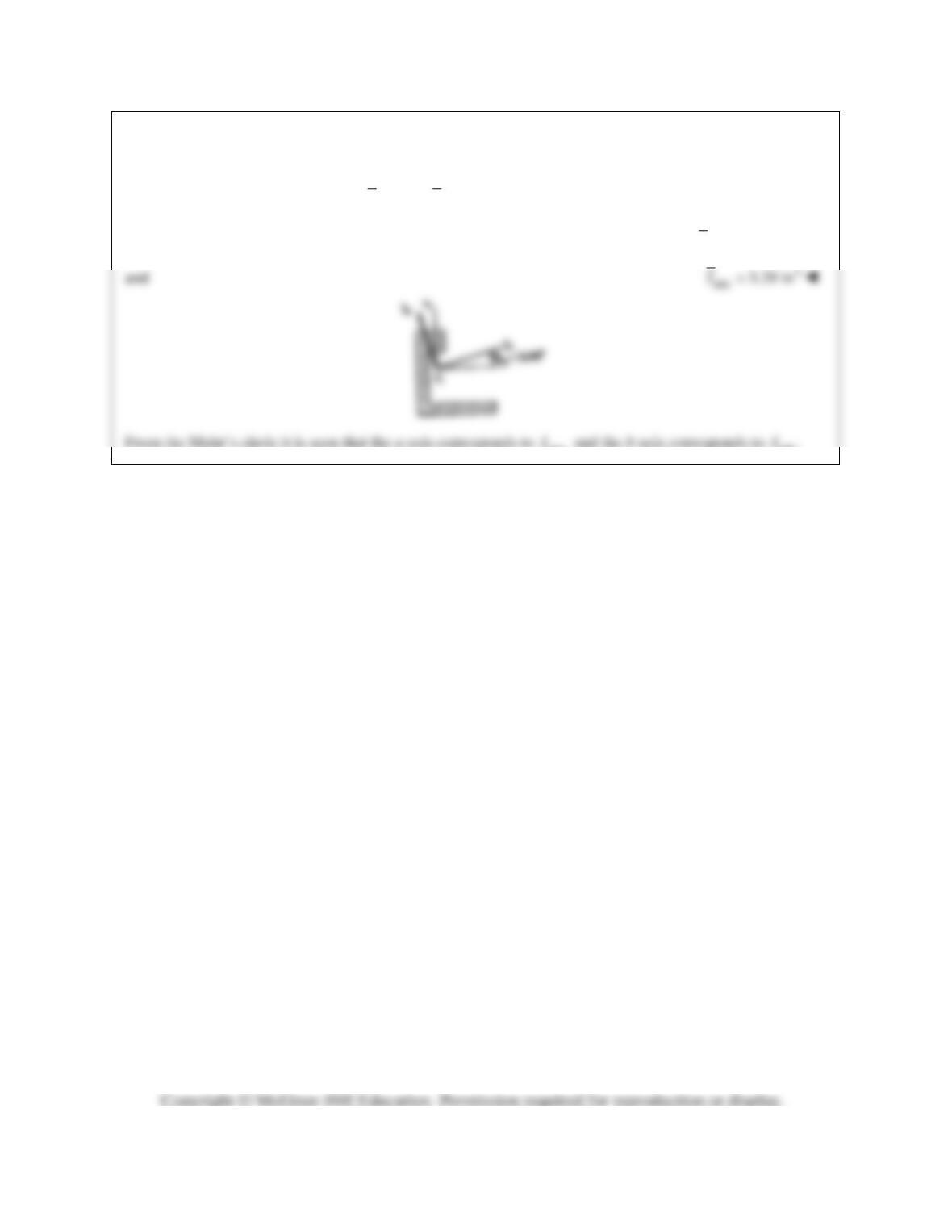
Now
max, min ave 11.3181 8.02915
IIR
or
4
max 19.35 inI
max
min
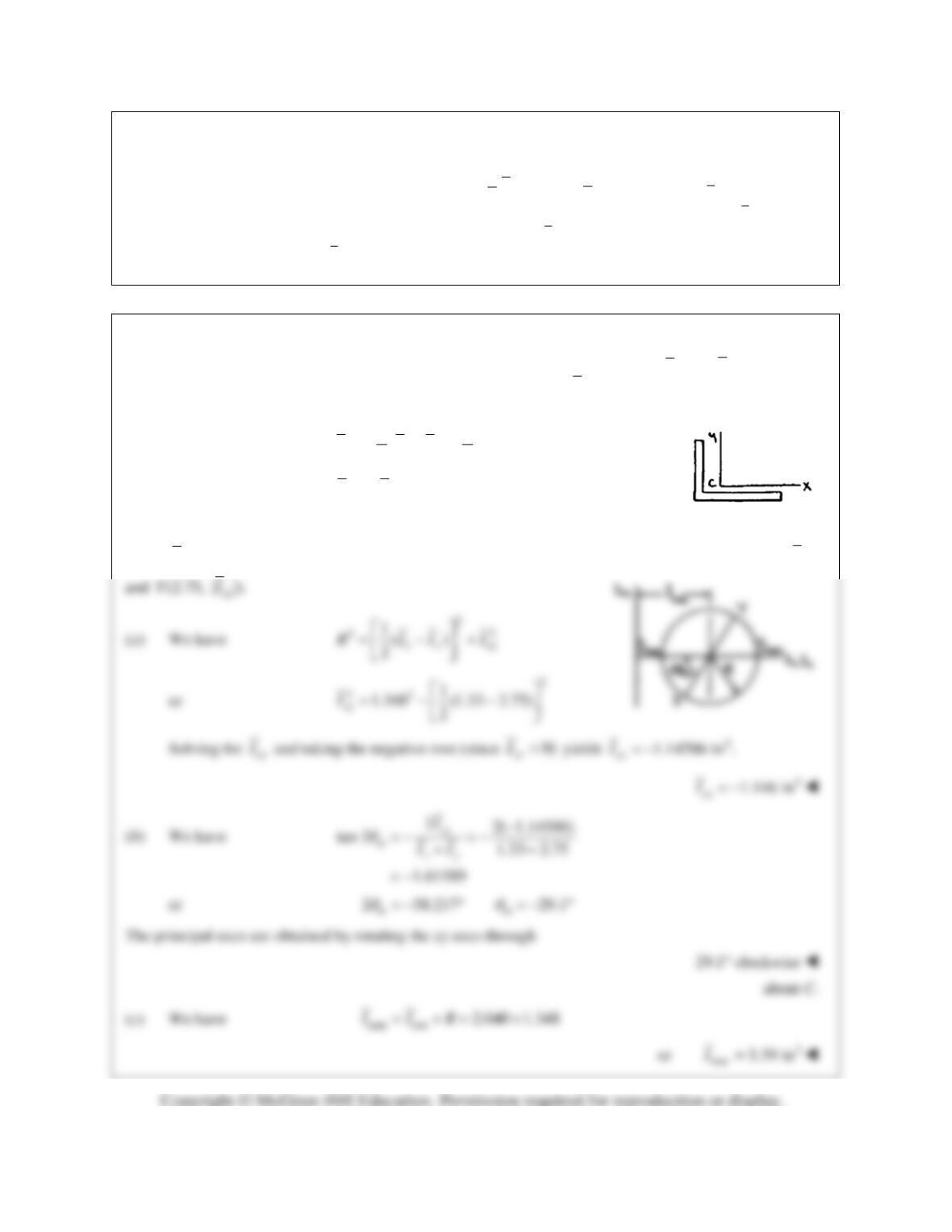
PROBLEM 9.103
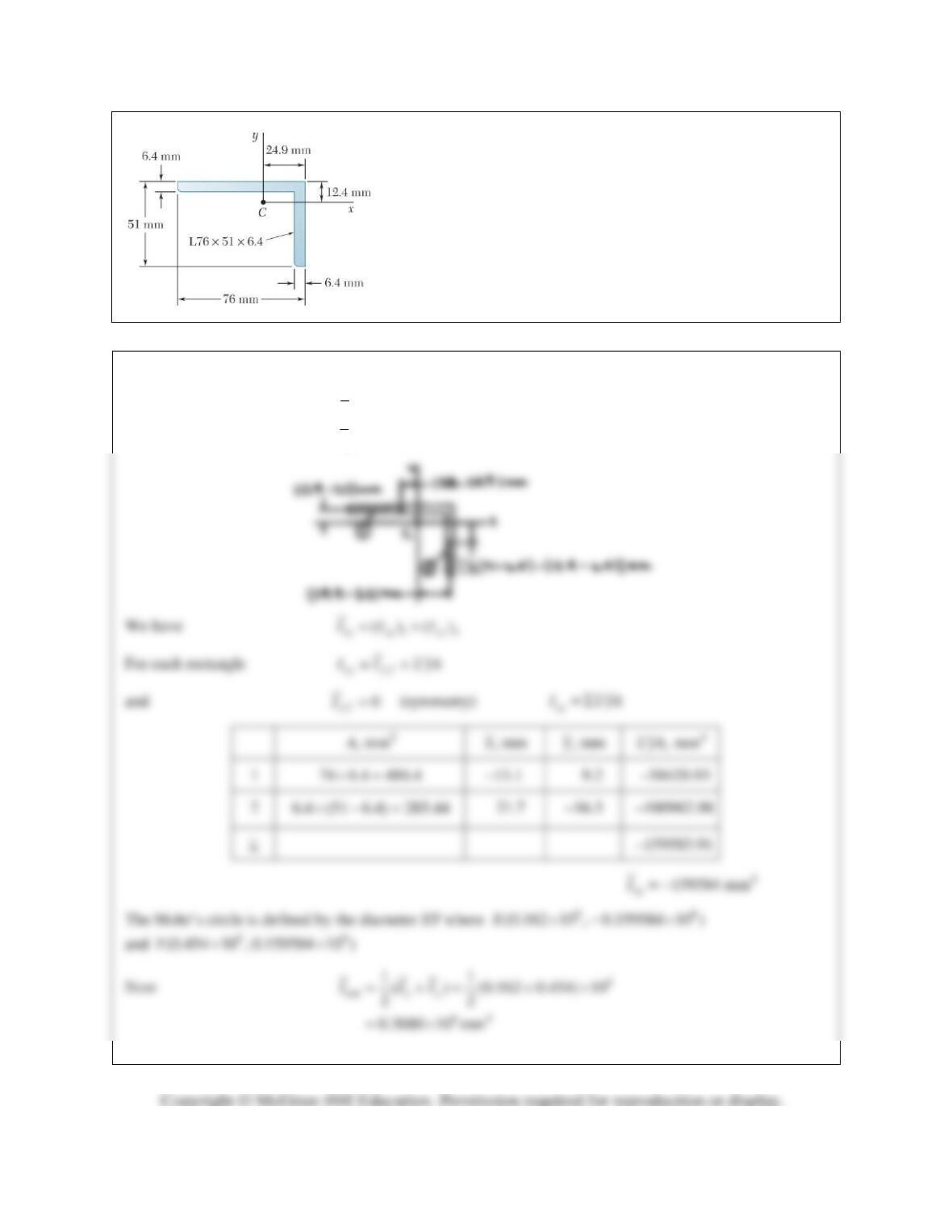
The moments and product of inertia of an L4 3
1
4
-in. angle cross section with respect to two
rectangular axes x and y through C are, respectively,
x
I
1.33 in
4
,
y
I
2.75 in
4
, and
0,
xy
I
with the
minimum value of the moment of inertia of the area with respect to any axis through C being
min
I
0.692
in
4
. Using Mohr’s circle, determine (a) the product of inertia
x
y
I
of the area, (b) the orientation of the
principal axes, (c) the value of
max
.I
SOLUTION
(Note: A review of a table of rolled-steel shapes reveals that the given values of
x
I
and
y
I
are obtained
when the 4-in. leg of the angle is parallel to the x axis. Further, for
0,
xy
I
the angle must be oriented as
shown.)
Now
4
ave
11
()(1.332.75)2.040 in
22
xy
III
and
min ave
or 2.040 0.692 IIR R
4
1.348 in
Using
ave
I
and R, the Mohr’s circle is then drawn as shown; note that for the diameter XY,
(1.33, )
xy
XI
PROBLEM 9.104
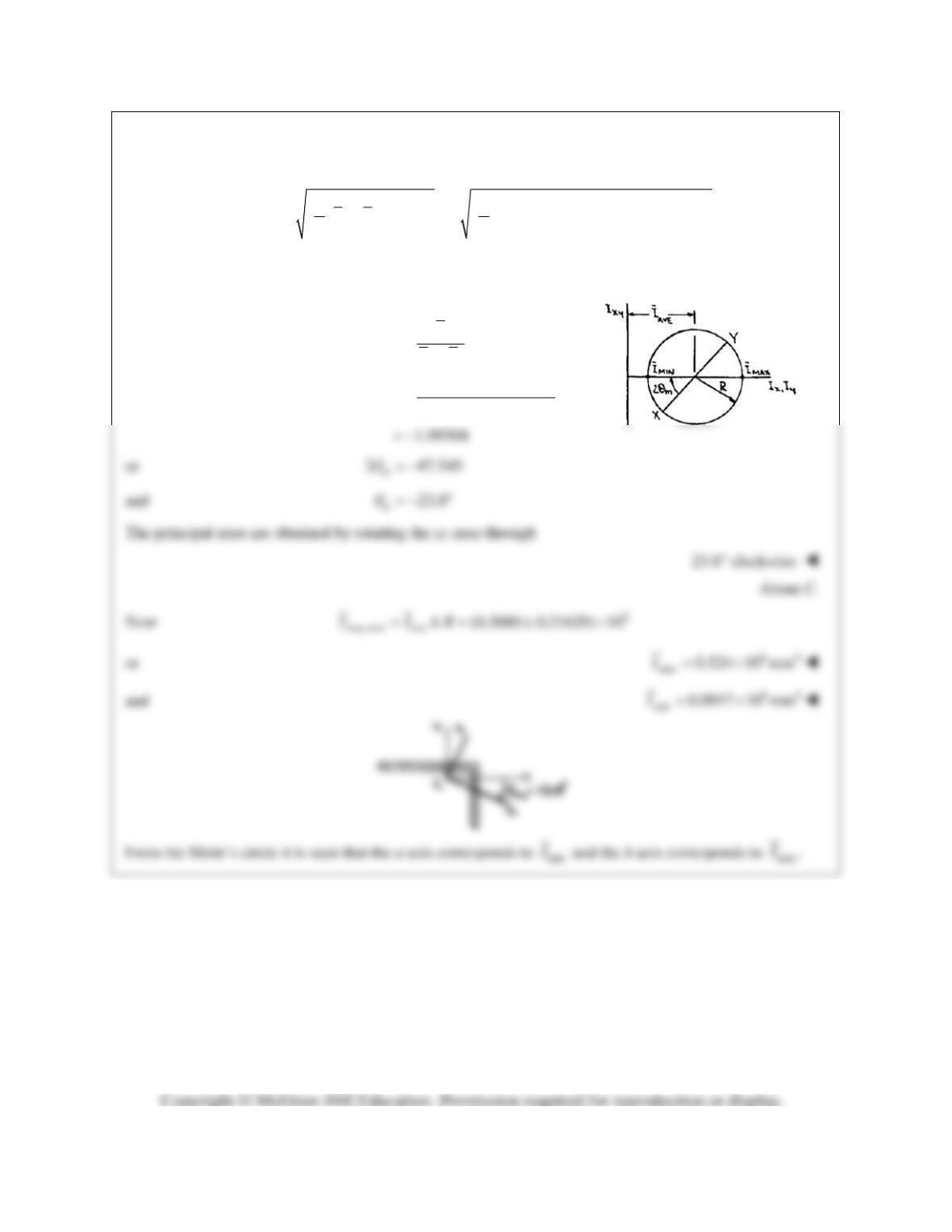
Using Mohr’s circle, determine for the cross section of the
rolled-steel angle shown the orientation of the principal
centroidal axes and the corresponding values of the moments of
inertia. (Properties of the cross sections are given in Figure 9.13.)
SOLUTION
From Figure 9.13B:
64
64
0.162 10 mm
0.454 10 mm
x
y
I
I
PROBLEM 9.104 (Continued)
and
22
226
64
11
( ) (0.162 0.454) ( 0.159584) 10
22
0.21629 10 mm
xy xy
RIII
The Mohr’s circle is then drawn as shown.
6
6
2
tan 2
2( 0.159584 10 )
(0.162 0.454) 10
xy
m
xy
I
II
PROBLEM 9.105
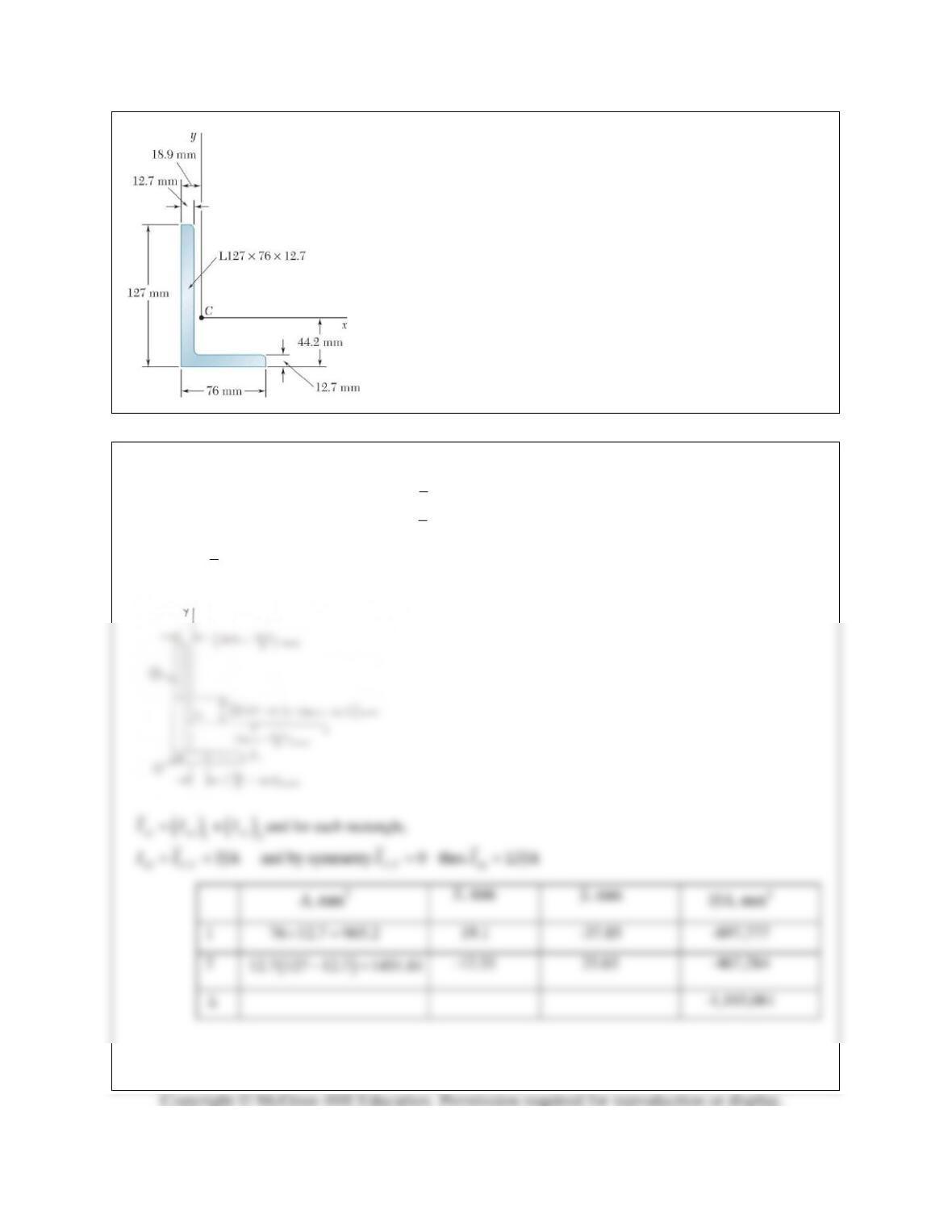
Using Mohr’s circle, determine for the cross section of the rolled-
steel angle shown the orientation of the principal centroidal axes
and the corresponding values of the moments of inertia.
(Properties of the cross sections are given in Figure 9.13.)
SOLUTION
From Figure 9.13B:
64
64
3.93 10 mm
1.06 10 mm
x
y
I
I
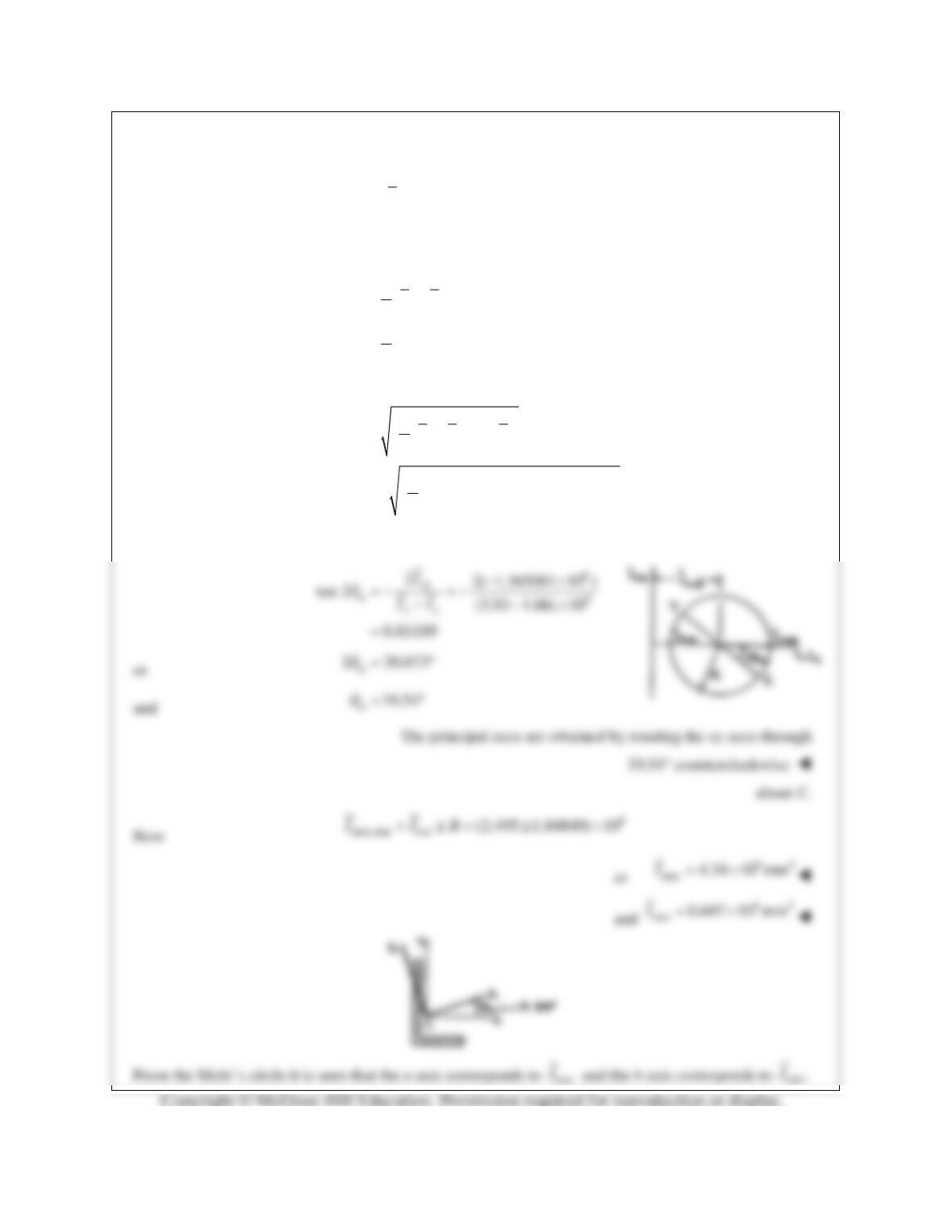
Determine
xy
I
:
PROBLEM 9.105 (Continued)
64
1.16506 10 mm
xy
I
The Mohr’s circle is defined by the diameter
XY
, where
66
(3.93 10 , 1.165061 10 )X
and
66
(1.06 10 ,1.165061 10 ).Y
Now
ave
6
64
1()
2
1(3.93 1.06) 10
2
2.495 10 mm
xy
III
and
2
2
2
26 64
1()
2
1(3.93 1.06) ( 1.165061) 10 1.84840 10 mm
2
xy xy
RIII
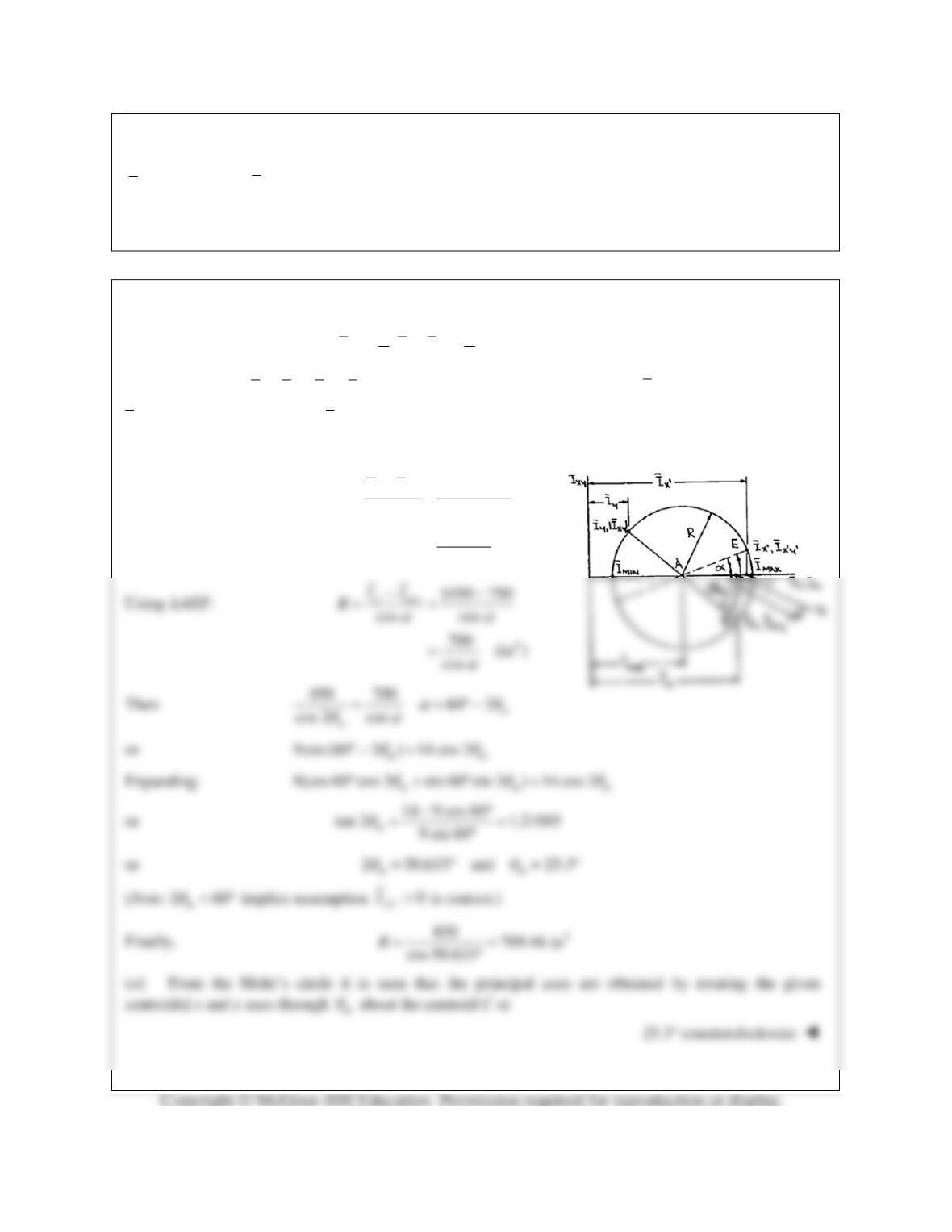
The Mohr’s circle is then drawn as shown.
PROBLEM 9.106*
For a given area the moments of inertia with respect to two rectangular centroidal
x
and
y
axes are
x
I
1200 in
4
and
y
I
300 in
4
, respectively. Knowing that after rotating the
x
and
y
axes about the
centroid 30
counterclockwise, the moment of inertia relative to the rotated
x
axis is 1450 in
4
, use Mohr’s
circle to determine (
a
) the orientation of the principal axes, (
b
) the principal centroidal moments of inertia.
SOLUTION
We have
4
ave
11
( ) (1200 300) 750 in.
22
xy
III
Now observe that
ave
,
x
II,
xx
II
and
260.
This is possible only if
0.
xy
I
Therefore, assume
0
xy
I
and (for convenience)
0.
xy
I
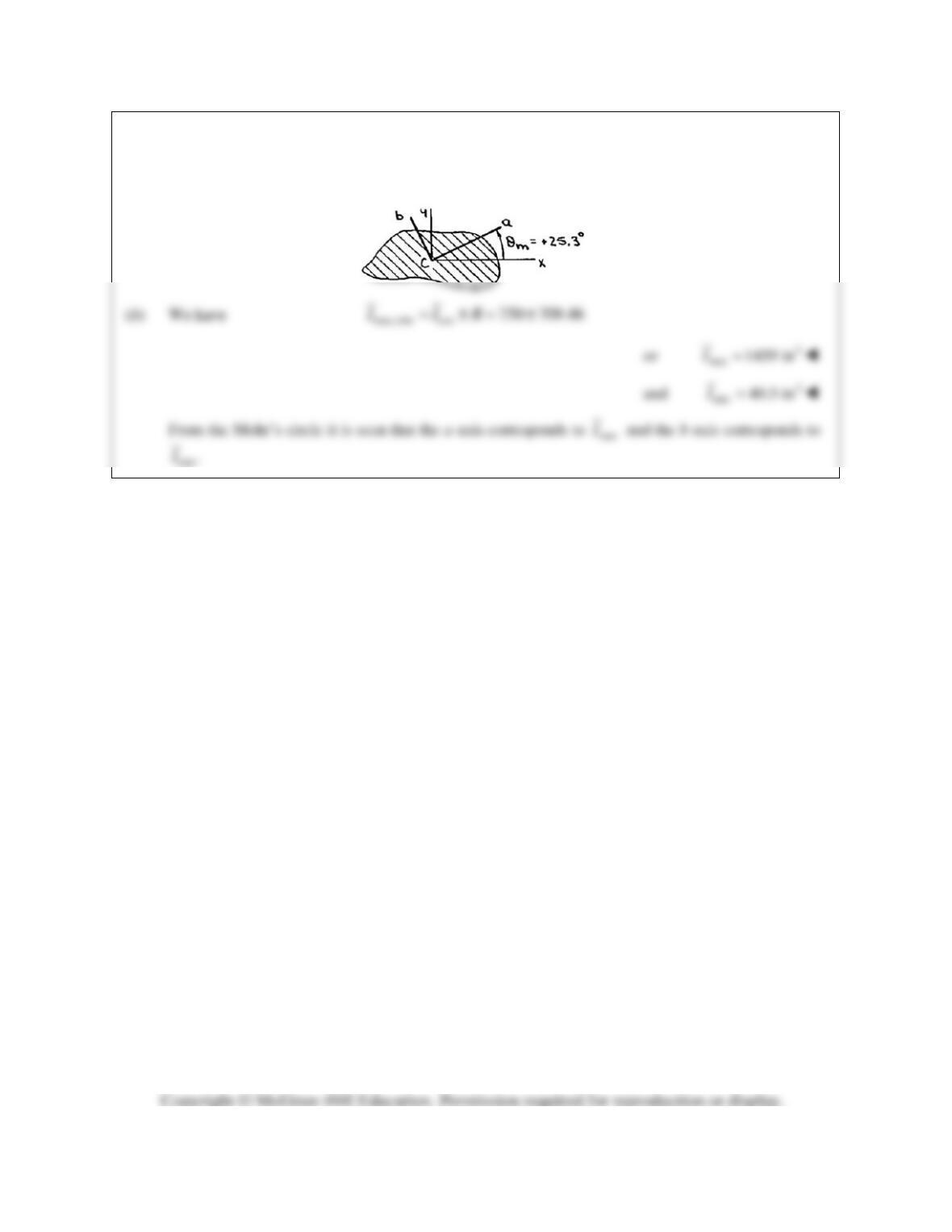
Mohr’s circle is then drawn as shown.
We have
260
m
Now using
ABD
:
ave
4
1200 750
cos 2 cos 2
450 (in )
cos 2
x
mm
m
II
R
PROBLEM 9.106* (Continued)
PROBLEM 9.107
It is known that for a given area
y
I
48
10
6
mm
4
and
x
y
I
–20
10
6
mm
4
, where the
x
and
y
axes are
rectangular centroidal axes. If the axis corresponding to the maximum product of inertia is obtained by
rotating the
x
axis 67.5
counterclockwise about
C
, use Mohr’s circle to determine (
a
) the moment of inertia
x
I
of the area, (
b
) the principal centroidal moments of inertia.
SOLUTION
First assume
x
y
II
and then draw the Mohr’s circle as shown. (
Note:
Assuming
x
y
II
is not consistent
with the requirement that the axis corresponding to
max
()
xy
I
is obtained after rotating the
x
axis through 67.5°
CCW.)
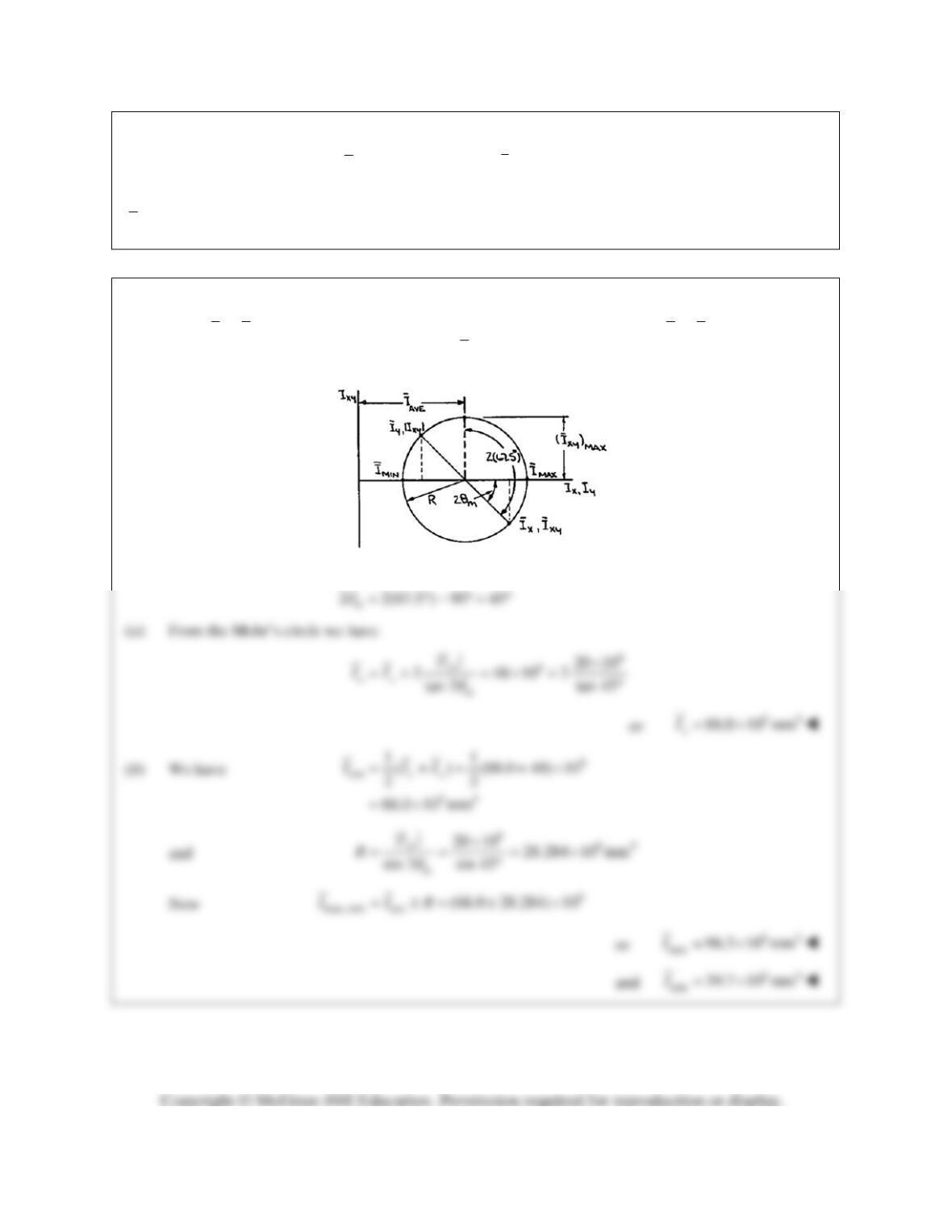
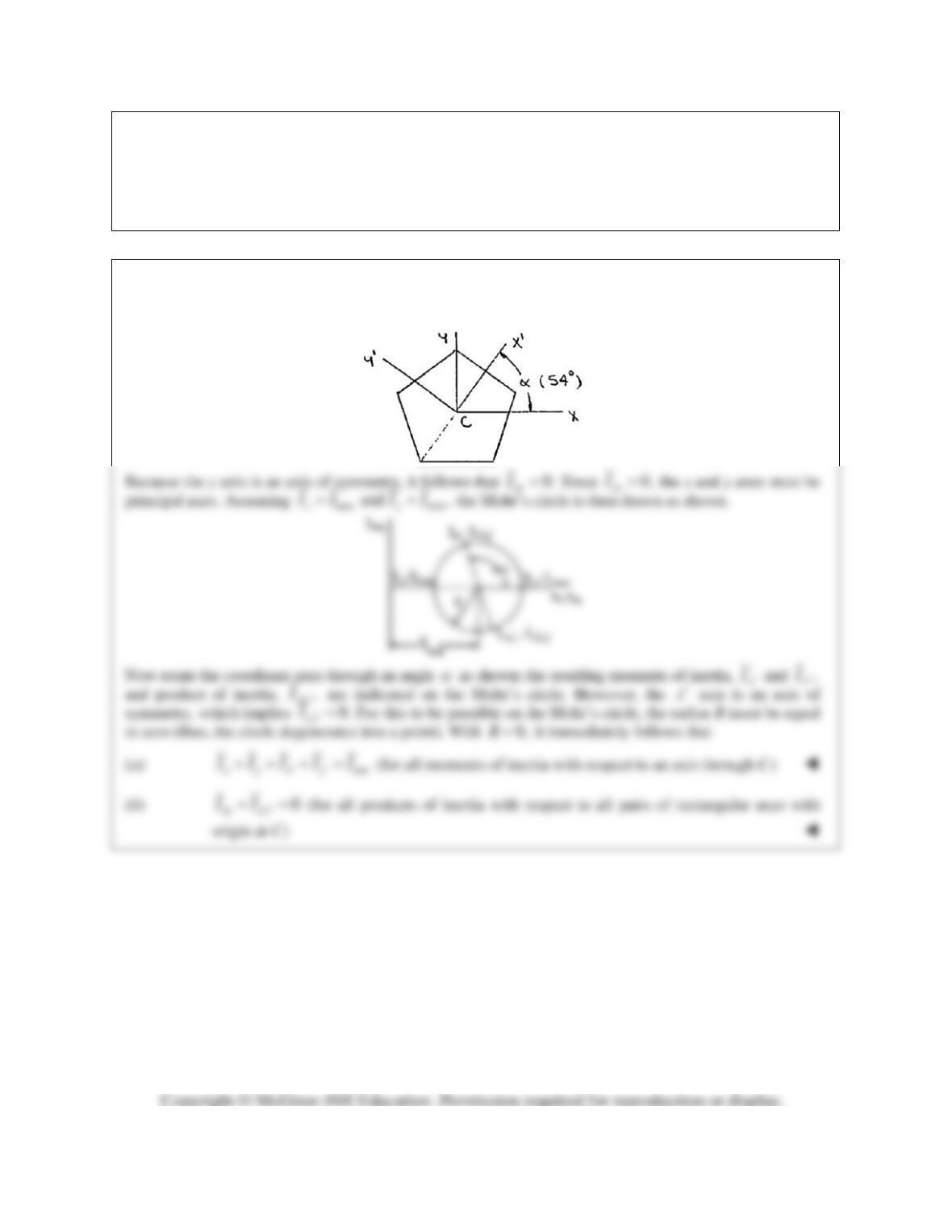
From the Mohr’s circle we have
PROBLEM 9.108
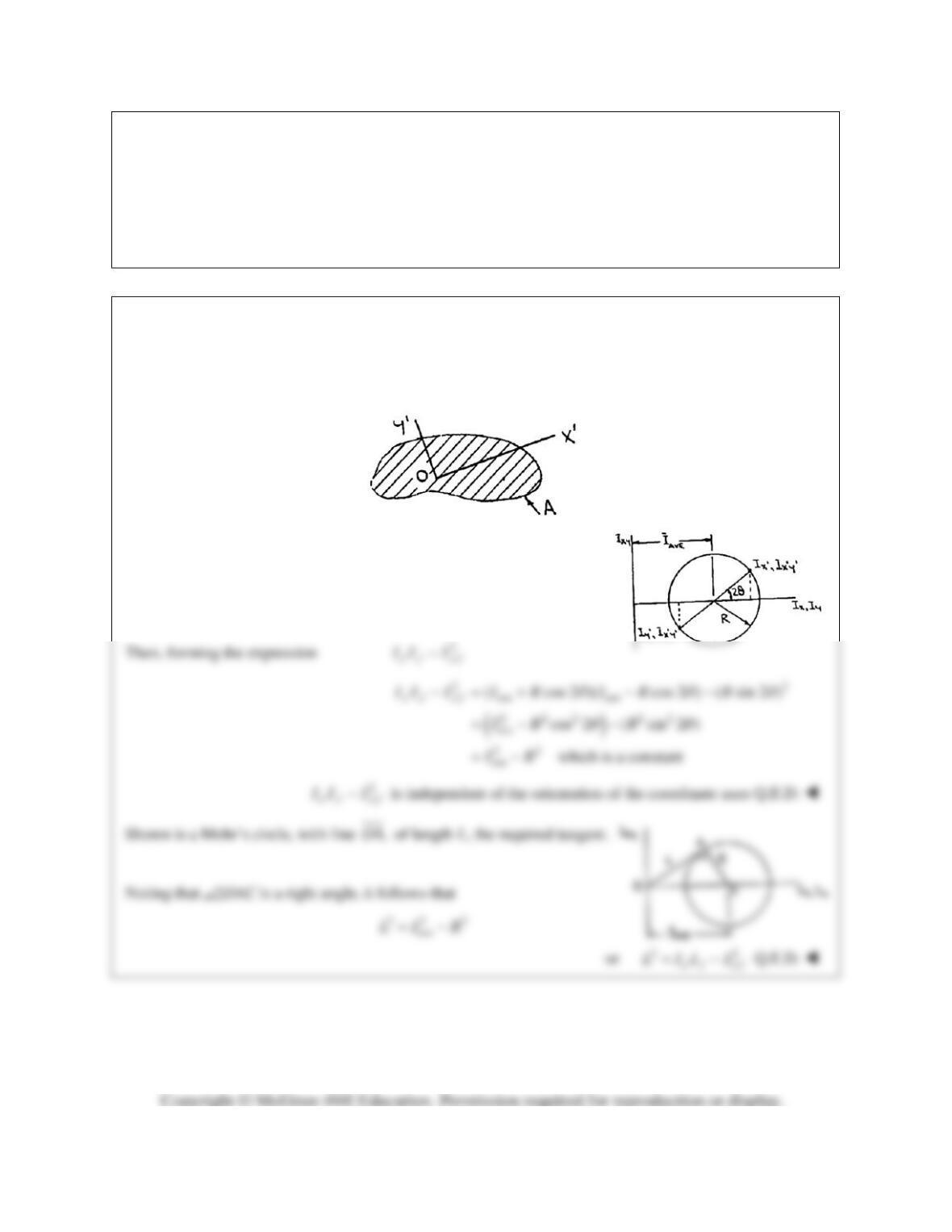
Using Mohr’s circle, show that for any regular polygon (such as a pentagon) (
a
) the moment of inertia
with respect to every axis through the centroid is the same, (
b
) the product of inertia with respect to every
pair of rectangular axes through the centroid is zero.
SOLUTION
Consider the regular pentagon shown, with centroidal axes
x
and
y
.
PROBLEM 9.109
Using Mohr’s circle, prove that the expression 2
x
yxy
I
II
is independent of the orientation of the
x
and
y
axes, where
I
x
,
I
y
, and
I
x
y
represent the moments and product of inertia, respectively, of a given area
with respect to a pair of rectangular axes
x
and
y
through a given Point
O
. Also show that the given
expression is equal to the square of the length of the tangent drawn from the origin of the coordinate
system to Mohr’s circle.
SOLUTION
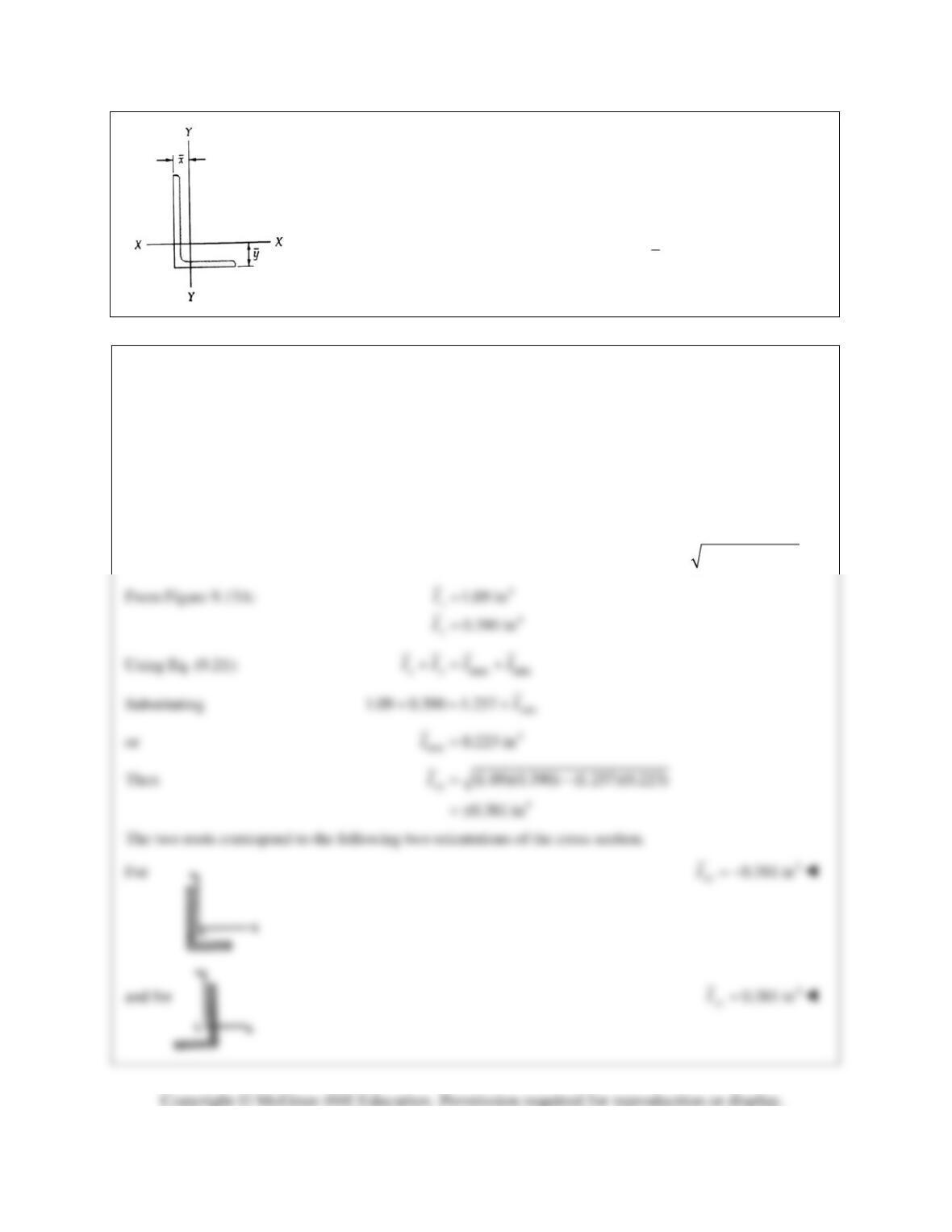
First observe that for a given area
A
and origin
O
of a rectangular coordinate system, the values of
ave
I
and
R
are the same for all orientations of the coordinate axes. Shown below is a Mohr’s circle, with the
moments of inertia,
x
I
and
,
y
I
and the product of inertia,
,
x
y
I
having been computed for an arbitrary
orientation of the
x
y
axes.
From the Mohr’s circle
ave
ave
cos 2
cos 2
sin 2
x
y
xy
II R
II R
IR
x
L
PROBLEM 9.110
Using the invariance property established in the preceding problem, express
the product of inertia
I
xy
of an area
A
with respect to a pair of rectangular axes
through
O
in terms of the moments of inertia
I
x
and
I
y
of
A
and the principal
moments of inertia
I
min
and
I
max
of
A
about
O
. Use the formula obtained to
calculate the product of inertia
I
xy
of the L3
2
1
4
-in. angle cross section
shown in Figure 9.13A, knowing that its maximum moment of inertia is 1.257
in
4
.
SOLUTION
Consider the following two sets of moments and products of inertia, which correspond to two different
orientations of the coordinate axes whole origin is at Point
O
.
Case 1:
,,
xxyyxyxy
IIIII I
Case 2:
max min
,,0
xyxy
II II I
The invariance property then requires
2
max minxy xy
II I I I
or
max minxy x y
IIIII
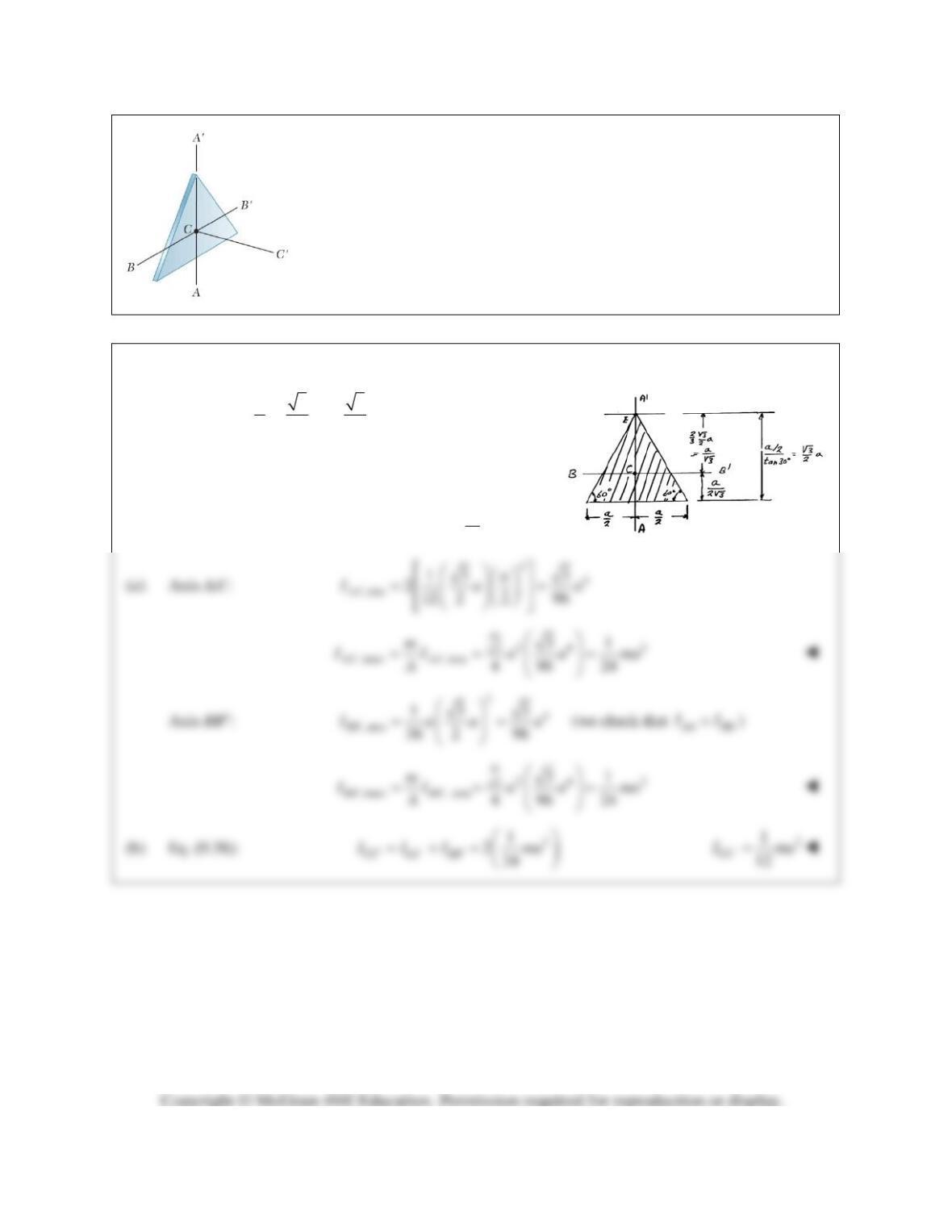
PROBLEM 9.111
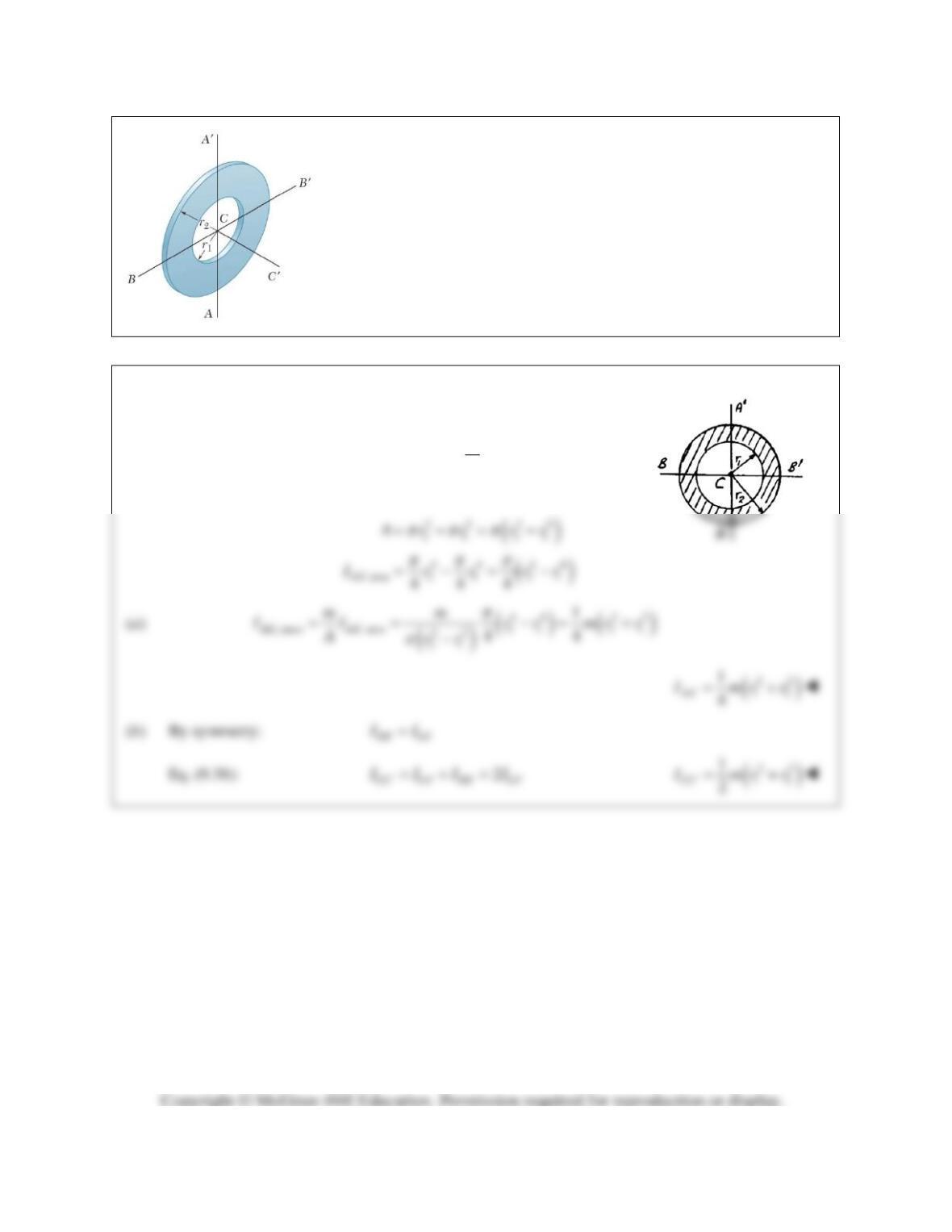
A thin plate of mass m is cut in the shape of an equilateral triangle of side a.
Determine the mass moment of inertia of the plate with respect to (a) the
centroidal axes AA and BB, (b) the centroidal axis CC that is perpendicular
to the plate.
SOLUTION
2
13 3
Area 22 4
aa a
mass area area
Mass mV tA
m
I
tI I
A
I
I
PROBLEM 9.112
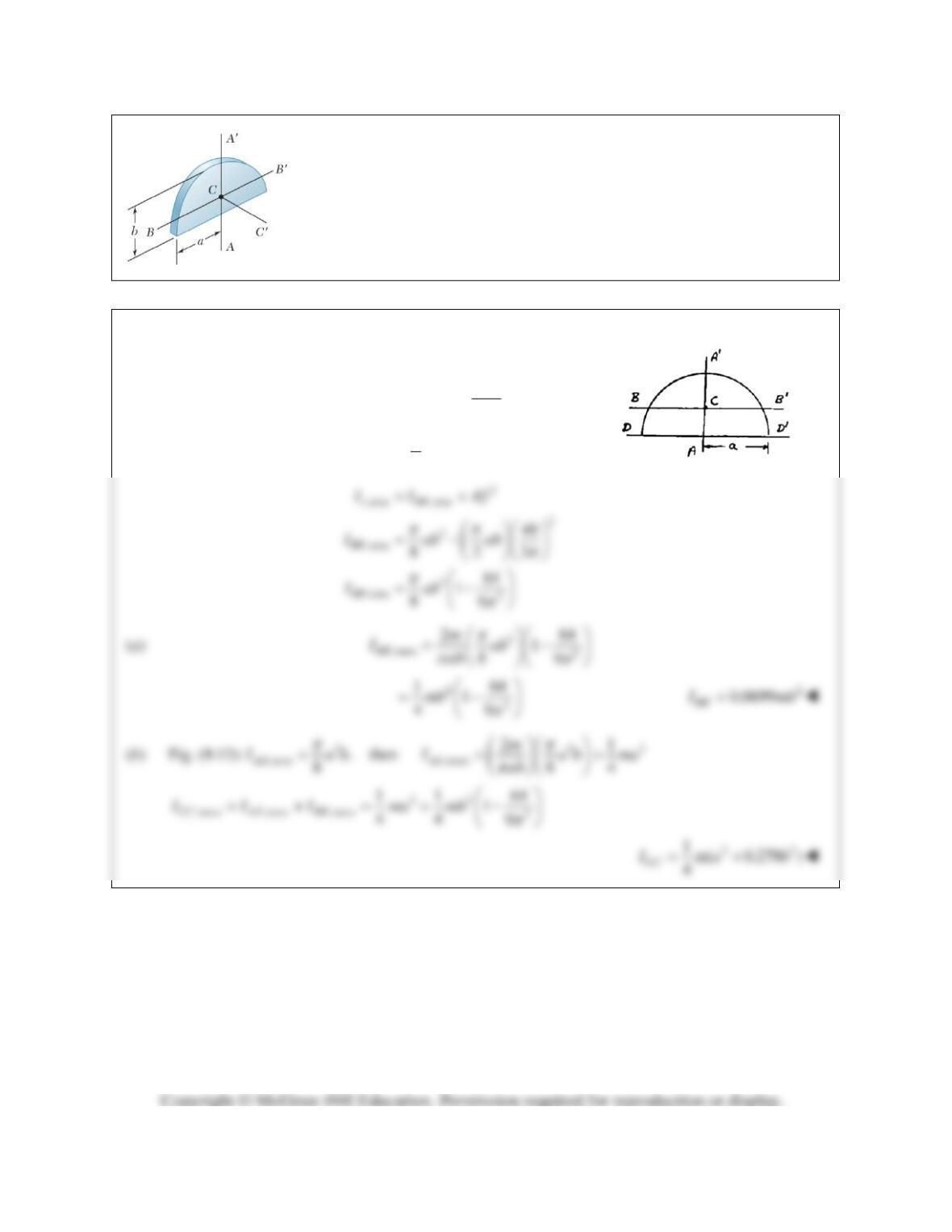
Determine the mass moment of inertia of a ring of mass
m
, cut from a
thin uniform plate, with respect to (
a
) the axis
AA
, (
b
) the centroidal axis
CC
that is perpendicular to the plane of the ring.
SOLUTION
mass area area
Mass mV tA
m
ItI I
A
We first determine
PROBLEM 9.113
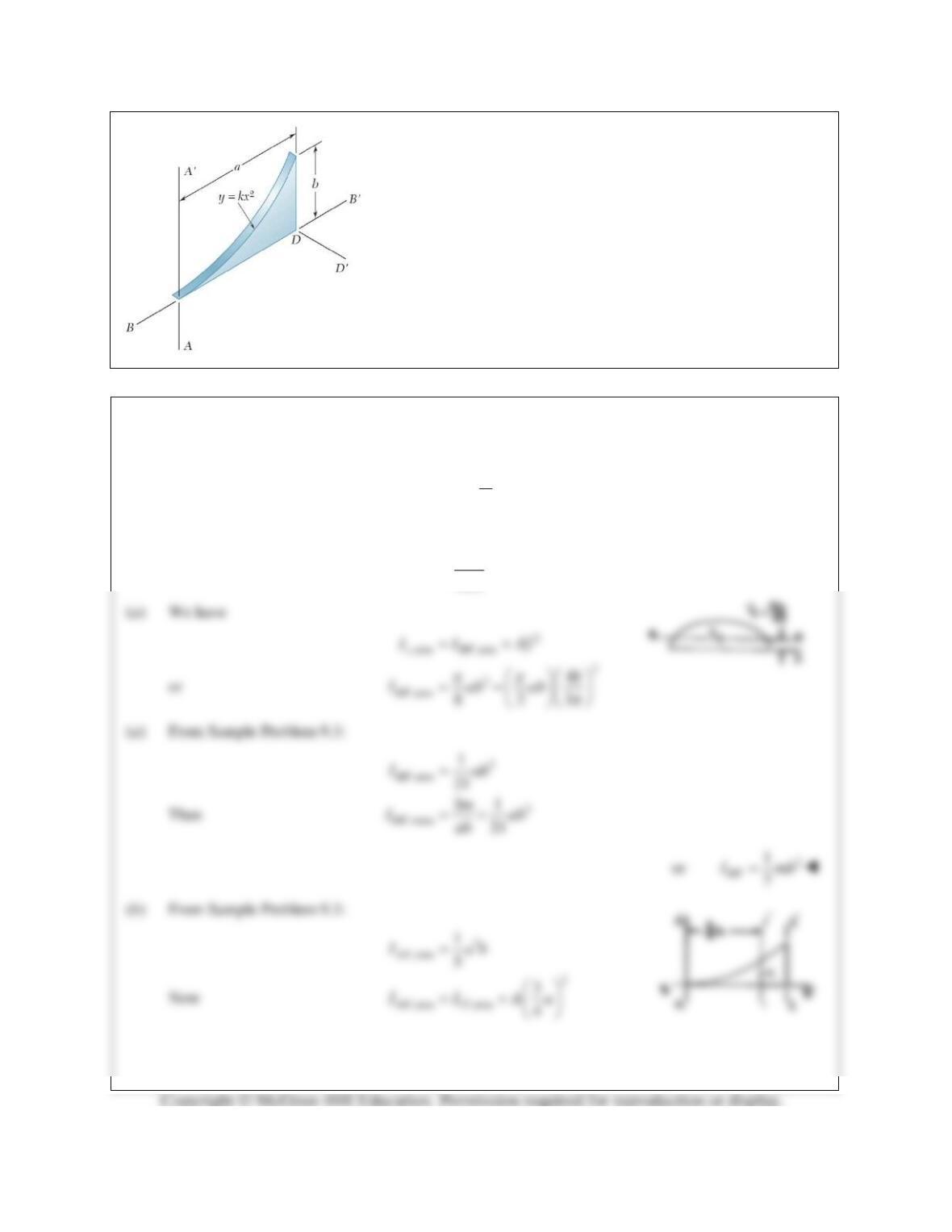
A thin, semielliptical plate has a mass
m
. Determine the mass moment of
inertia of the plate with respect to (
a
) the centroidal axis
BB
, (
b
) the
centroidal axis
CC
that is perpendicular to the plate.
SOLUTION
mass area area
mass
2
mtA
m
ItI I
ab
Area:
2
1
2
Aa
PROBLEM 9.114
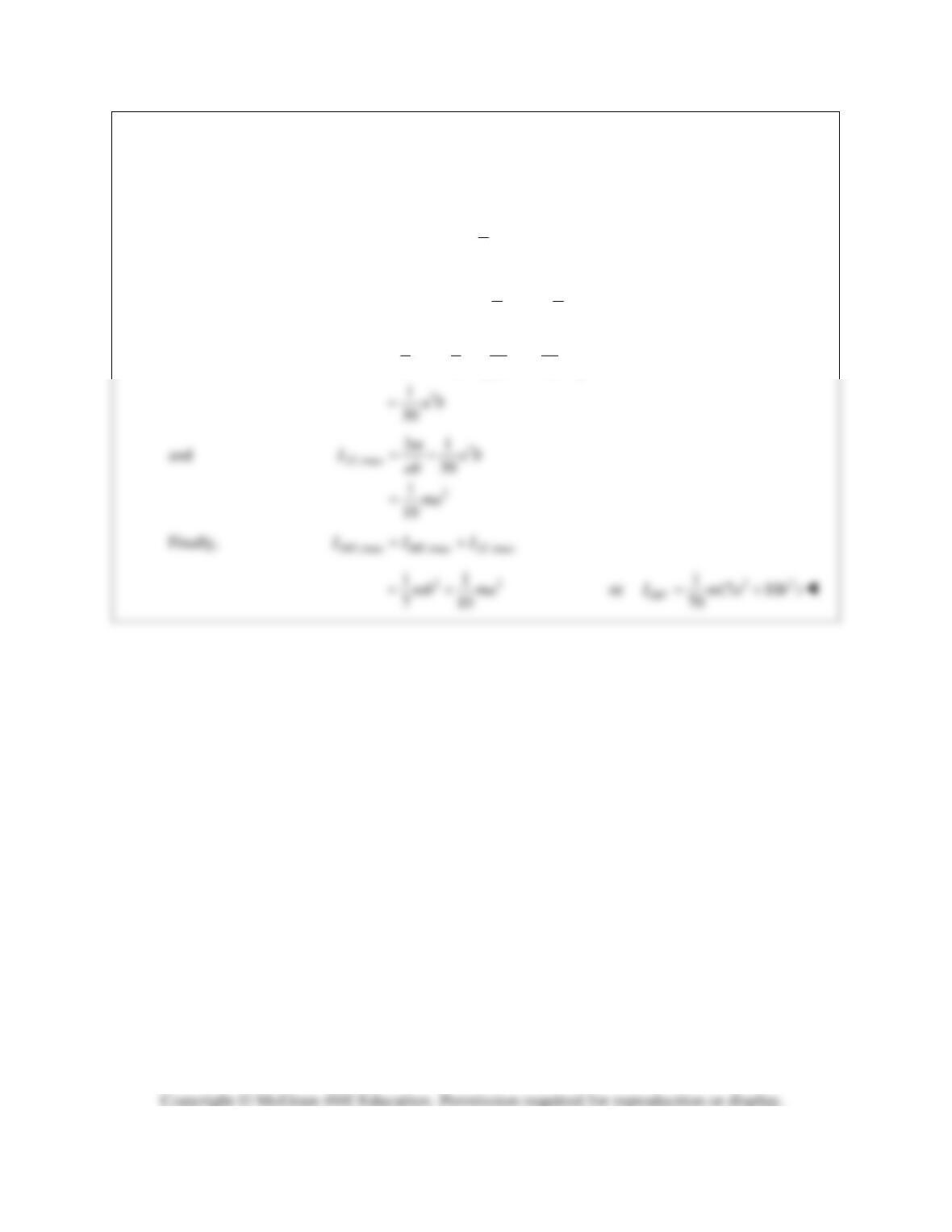
The parabolic spandrel shown was cut from a thin, uniform plate.
Denoting the mass of the spandrel by
m
, determine its mass
moment of inertia with respect to (
a
) the axis
BB
, (
b
) the axis
DD
that is perpendicular to the spandrel. (
Hint:
See Sample
Problem 9.3.)
SOLUTION
First note
mass
2
mV tA
tab
Also mass area
area
2
ItI
mI
ab
PROBLEM 9.114 (Continued)
and
2
22 ,area 11 ,area
1
4
I
IAa
Then
22
22 ,area ,area
322
13
44
1119
5 3 16 16
AA
II Aaa
ab ab a a