PROBLEM 9.127 (Continued)
and
22 22
113 31
(479.96) (183.41)
848 82
AA
I
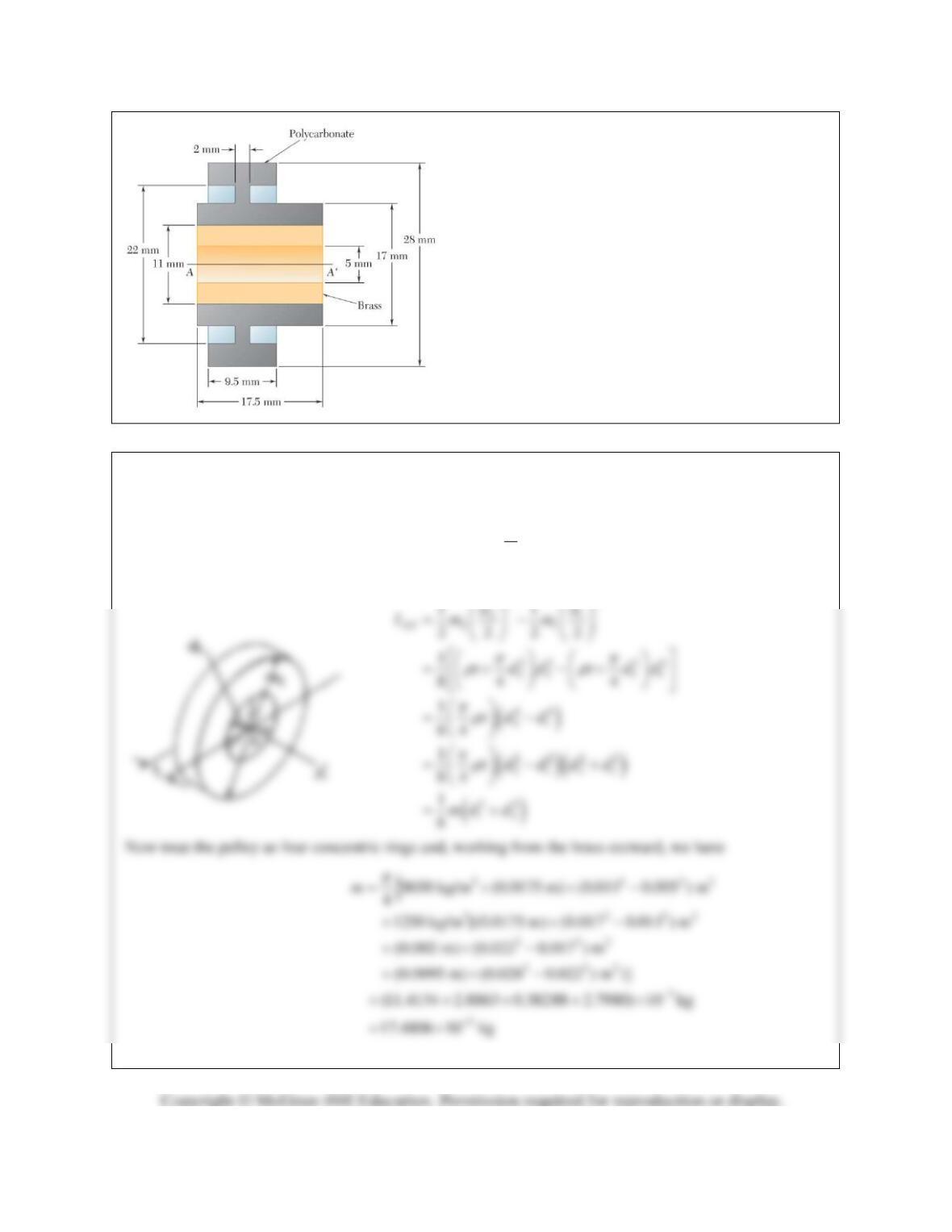
PROBLEM 9.128
Shown is the cross section of a molded flat-belt
pulley. Determine its mass moment of inertia and its
radius of gyration with respect to the axis AA. (The
density of brass is 8650 kg/m
3
and the density of the
fiber-reinforced polycarbonate used is 1250 kg/m
3
.)
SOLUTION
First note for the cylindrical ring shown that
22
21
4
mV t dd
and, using Figure 9.28, that
22
PROBLEM 9.128 (Continued)
and 22 2 2
22
2232
1[(11.4134)(0.005 0.011 ) (2.8863)(0.011 0.017 )
8
(0.38288)(0.017 0.022 )
(2.7980)(0.022 0.028 )] 10 kg m
AA
I
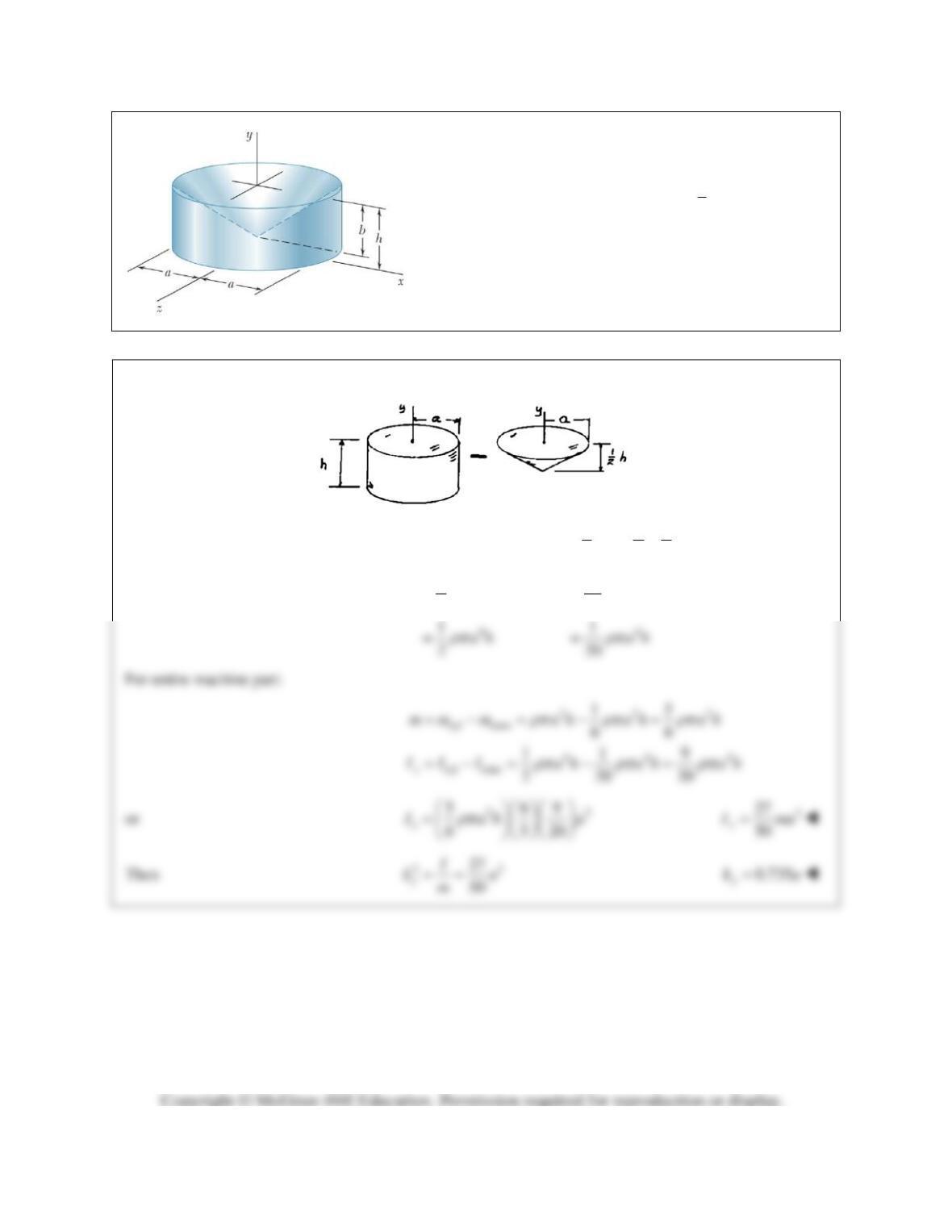
PROBLEM 9.129
The machine part shown is formed by machining a conical
surface into a circular cylinder. For
1
2
,bh
determine the
mass moment of inertia and the radius of gyration of the
machine part with respect to the y axis.
SOLUTION
Mass:
222
cyl cone
11
326
h
mahm a ah
22
cyl cyl cone cone
13
:210
y
II ma I ma
PROBLEM 9.130
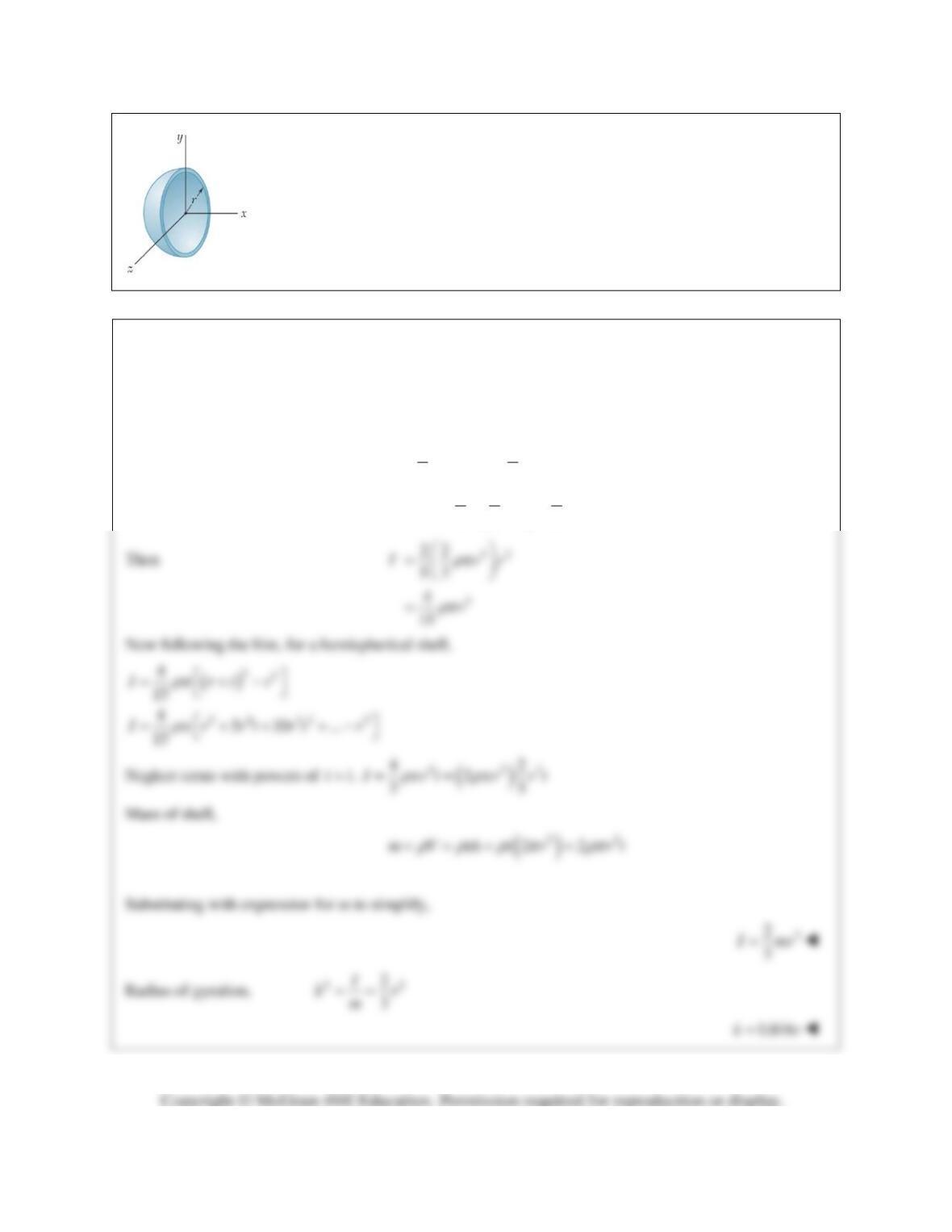
Knowing that the thin hemispherical shell shown has a mass m and thickness t,
determine the mass moment of inertia and the radius of gyration of the shell with
respect to the x axis. (Hint: Consider the shell as formed by removing a hemisphere
of radius r from a hemisphere of radius r + t; then neglect the terms containing t2
and t3 and keep those terms containing t.)
SOLUTION
Consider shell to be formed by removing hemisphere of radius r from hemisphere of radius .rt
For a hemisphere,
222
33
21
; 4 2
52
14 2
23 3
I
mr A r r
mV r r
I
PROBLEM 9.131
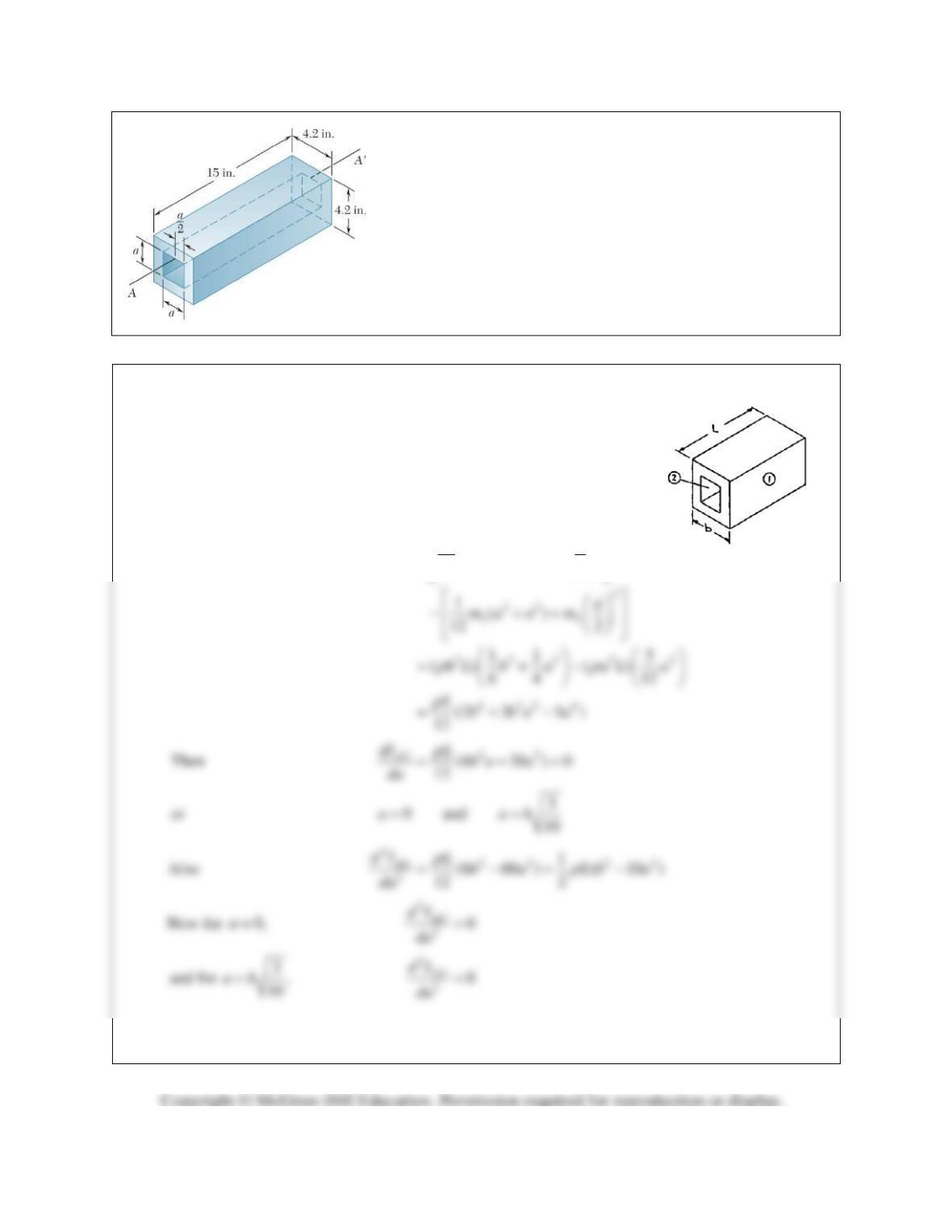
A square hole is centered in and extends through the aluminum
machine component shown. Determine (a) the value of a for
which the mass moment of inertia of the component with respect
to the axis AA, which bisects the top surface of the hole, is
maximum, (b) the corresponding values of the mass moment of
inertia and the radius of gyration with respect to the axis AA.
(The specific weight of aluminum is 0.100 lb/in
3
.)
SOLUTION
First note
2
11
mVbL
and
2
22
mVaL
(a) Using Figure 9.28 and the parallel-axis theorem, we have
12
2
22
11
()()
1()
12 2
AA AA AA
II I
a
mb b m
PROBLEM 9.131 (Continued)
max
()
AA
I
occurs when 3
10
ab
Then 3
(4.2 in.) 10
a
or 2.30 in.a
(b) From part a:
24
42 4
max
2
3349
() 2 3 5
12 10 10 240
AA
L
Ibbbb Lb
PROBLEM 9.132
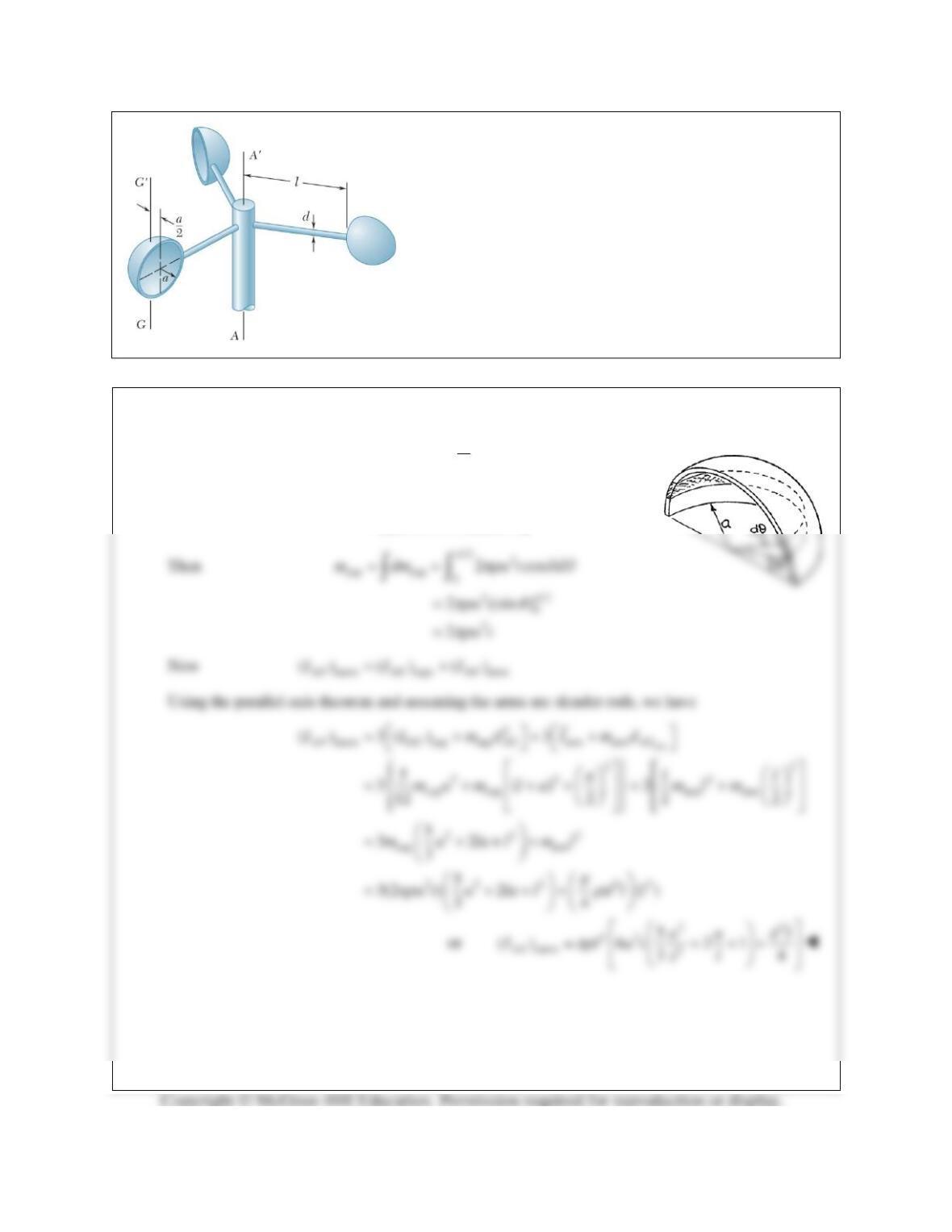
The cups and the arms of an anemometer are fabricated from
a material of density
. Knowing that the mass moment of
inertia of a thin, hemispherical shell of mass m and thickness
t with respect to its centroidal axis GG is
2
5/12,ma
determine (a) the mass moment of inertia of the anemometer
with respect to the axis AA, (b) the ratio of a to l for which
the centroidal moment of inertia of the cups is equal to 1
percent of the moment of inertia of the cups with respect to
the axis AA.
SOLUTION
(a) First note
2
arm arm
4
mV dl
and
cup cup
[(2 cos )( )( )]
dm dV
atad
PROBLEM 9.132 (Continued)
(b) We have cup
cup
() 0.01
()
GG
AA
I
I
or 222
cup cup
55
0.01 2 (from part )
12 3
ma m a lal a
Now let .
a
l
PROBLEM 9.133
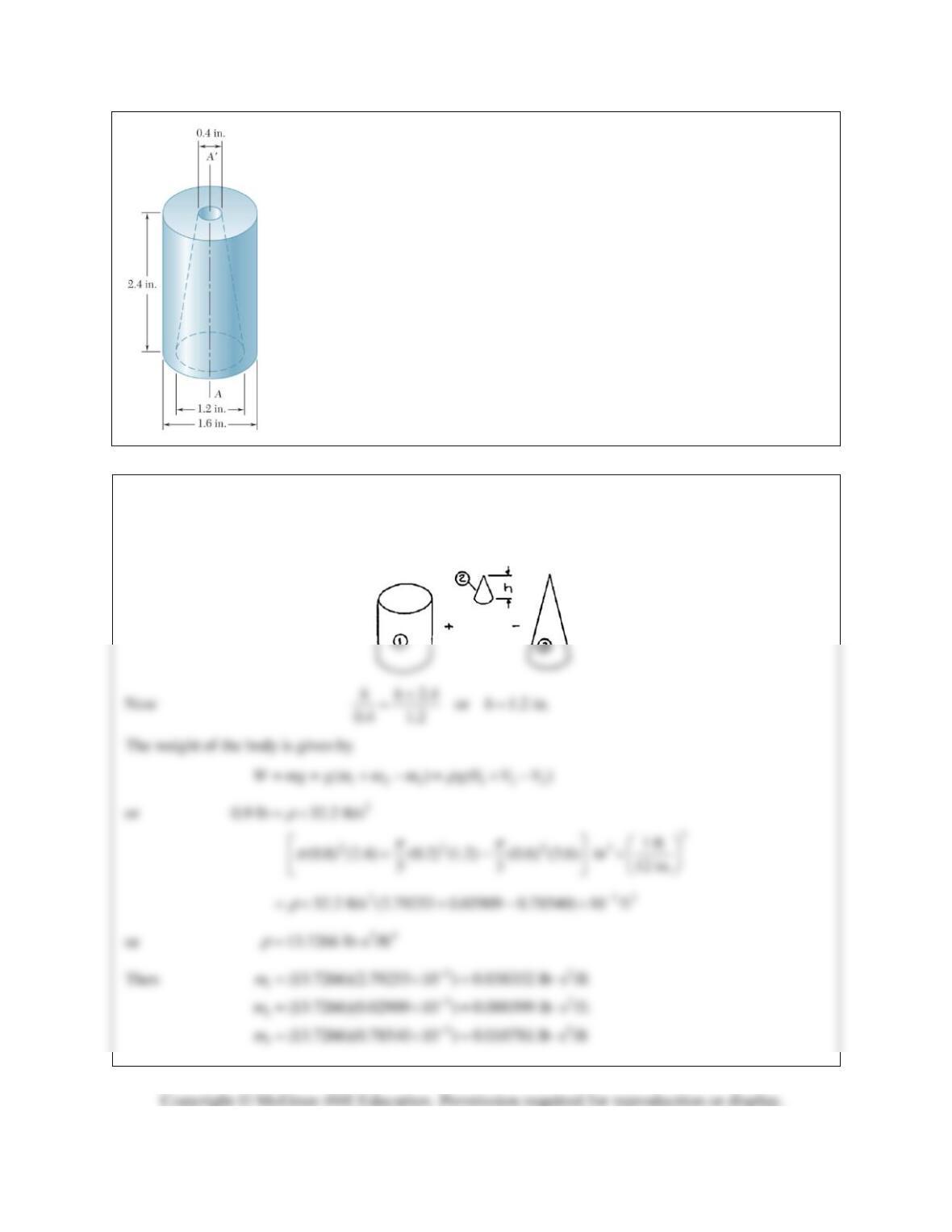
After a period of use, one of the blades of a shredder has been worn to
the shape shown and is of mass 0.18 kg. Knowing that the mass
moments of inertia of the blade with respect to the AA and BB axes are
2
0.320 g m
and
2
0.680 g m ,
respectively, determine (a) the location
of the centroidal axis GG, (b) the radius of gyration with respect to axis
GG.
SOLUTION
(a) We have
(0.08 ) m
BA
dd
and, using the parallel axis
2
AA GG A
IImd
PROBLEM 9.134
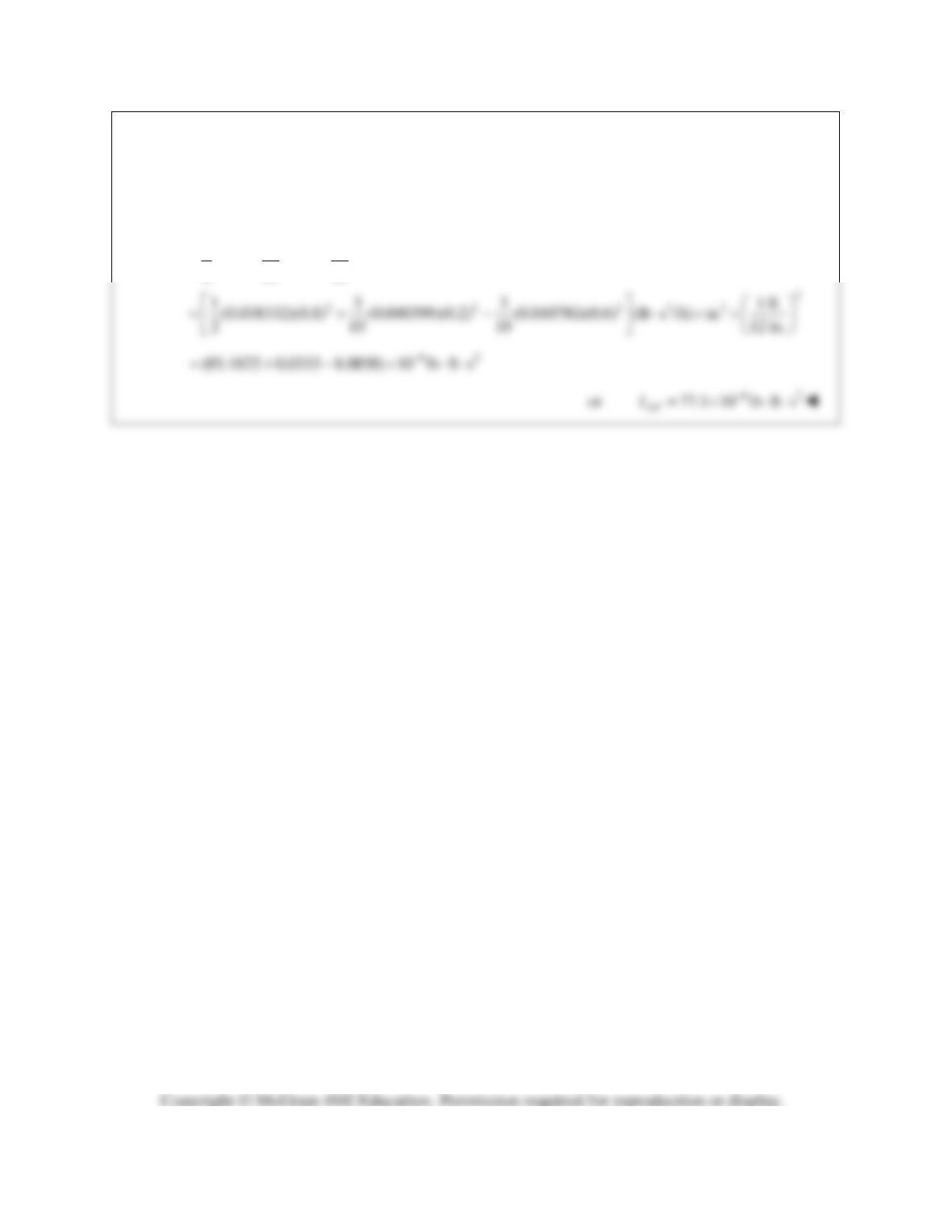
Determine the mass moment of inertia of the 0.9-lb machine component shown
with respect to the axis AA.
SOLUTION
First note that the given shape can be formed adding a small cone to a cylinder and then removing a larger
cone as indicated.
PROBLEM 9.134 (Continued)
Finally, using Figure 9.28, we have
123
222
11 2 2 3 3
()()()
13 3
21010
AA AA AA AA
II I I
ma m a ma
To the instructor:
The following formulas for the mass moment of inertia of thin plates and a half cylindrical shell are
derived at this time for use in the solutions of Problems 9.135 through 9.140.
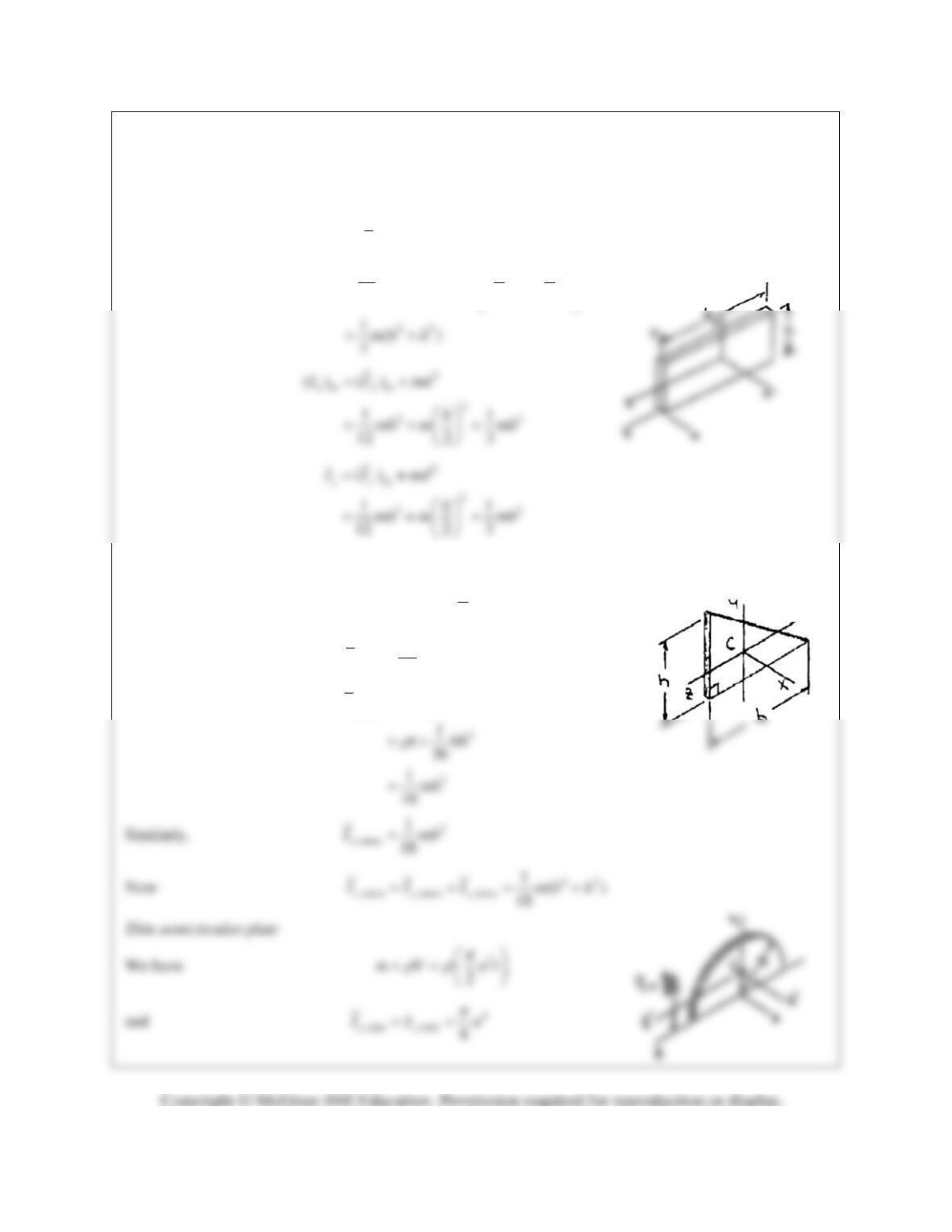
Thin rectangular plate
2
22
22
() ( )
1()
12 2 2
xm x m
IImd
bh
mb h m
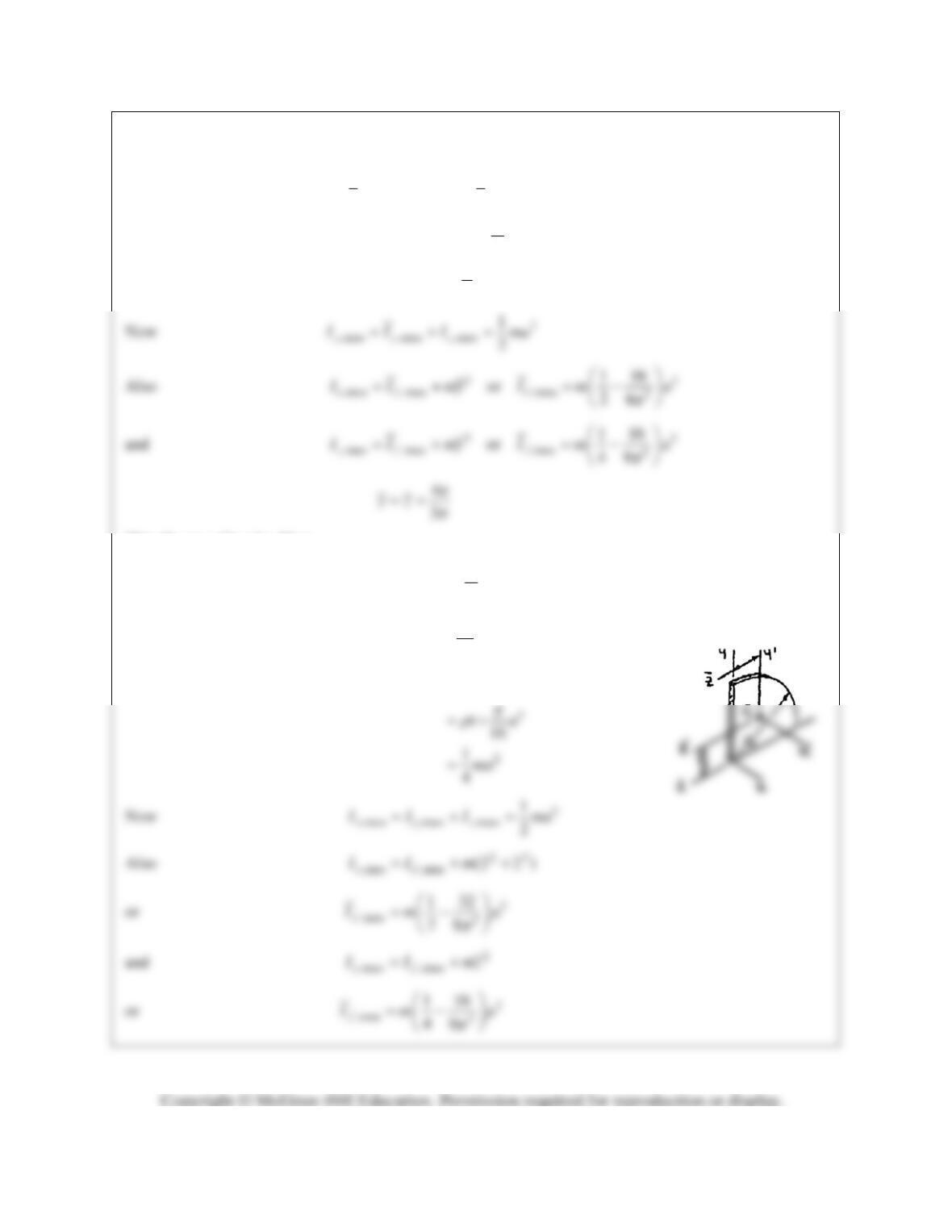
Thin triangular plate
We have
1
2
mV bht
and
3
,area
1
36
z
Ibh
Then
,mass ,area
zz
ItI
(Continued)
Then
,mass ,mass ,area
4
2
8
1
4
yz y
II tI
ta
ma
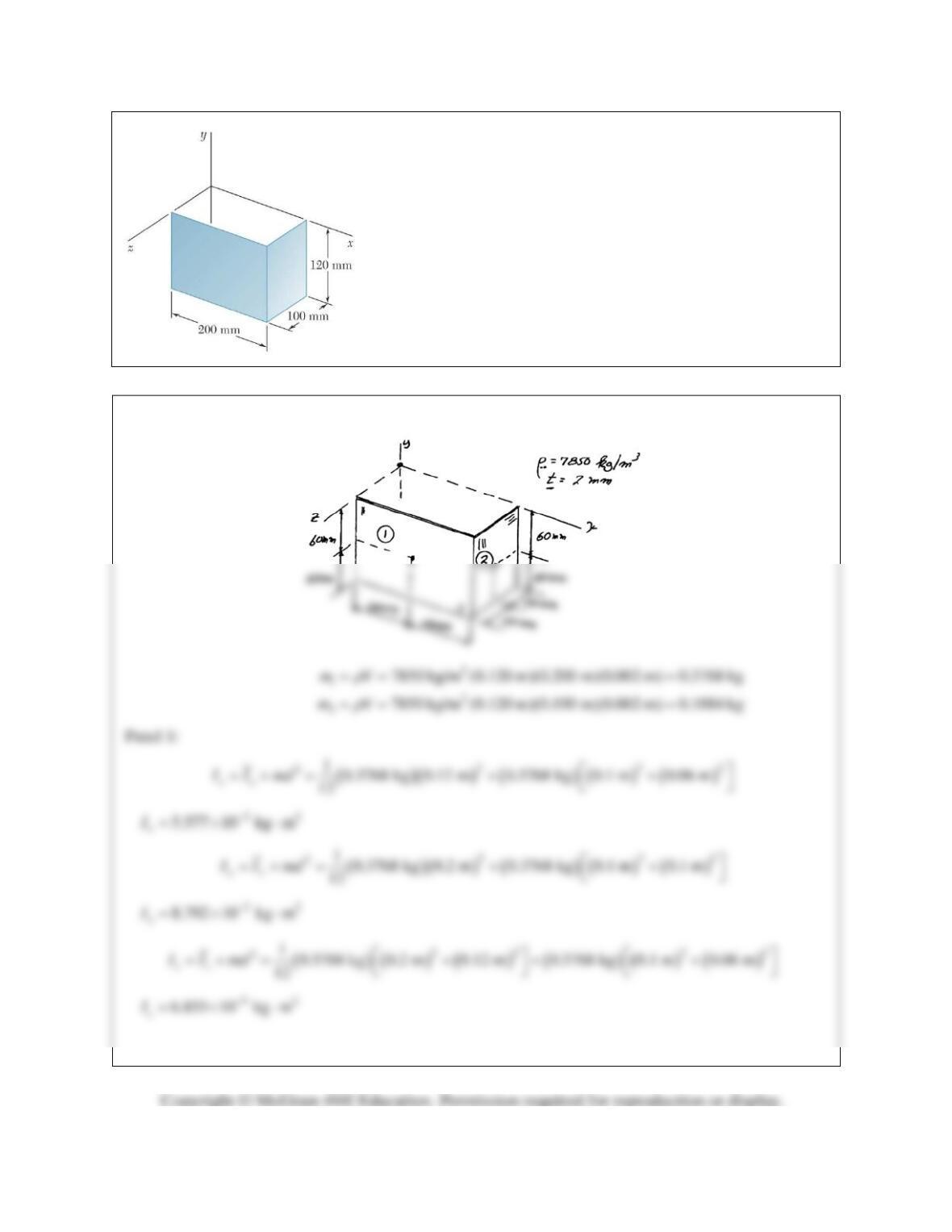
Thin Quarter-Circular Plate
We have
2
4
mV at
and
4
,area ,area
16
yz
II a
Then
,mass ,mass ,area
yz y
II tI
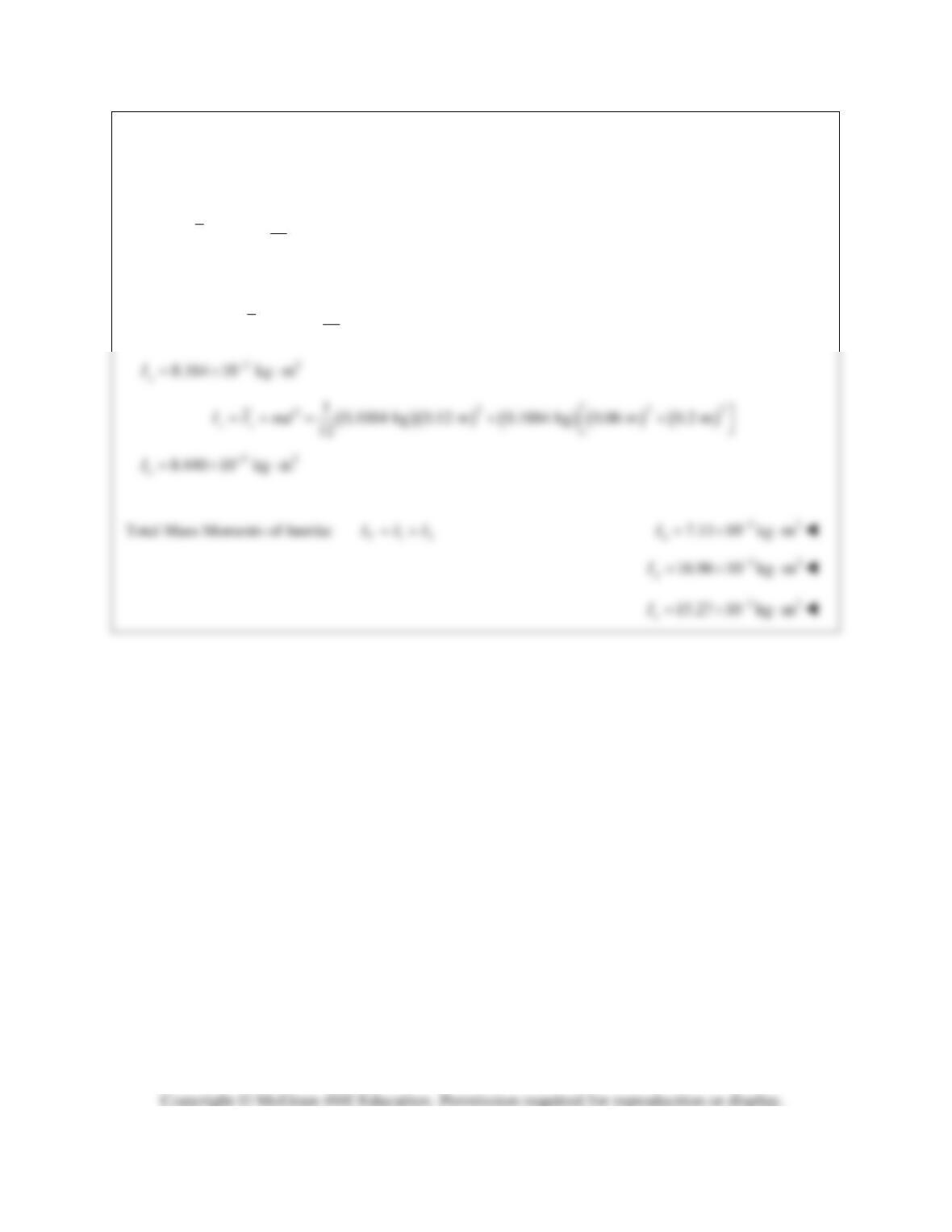
PROBLEM 9.135
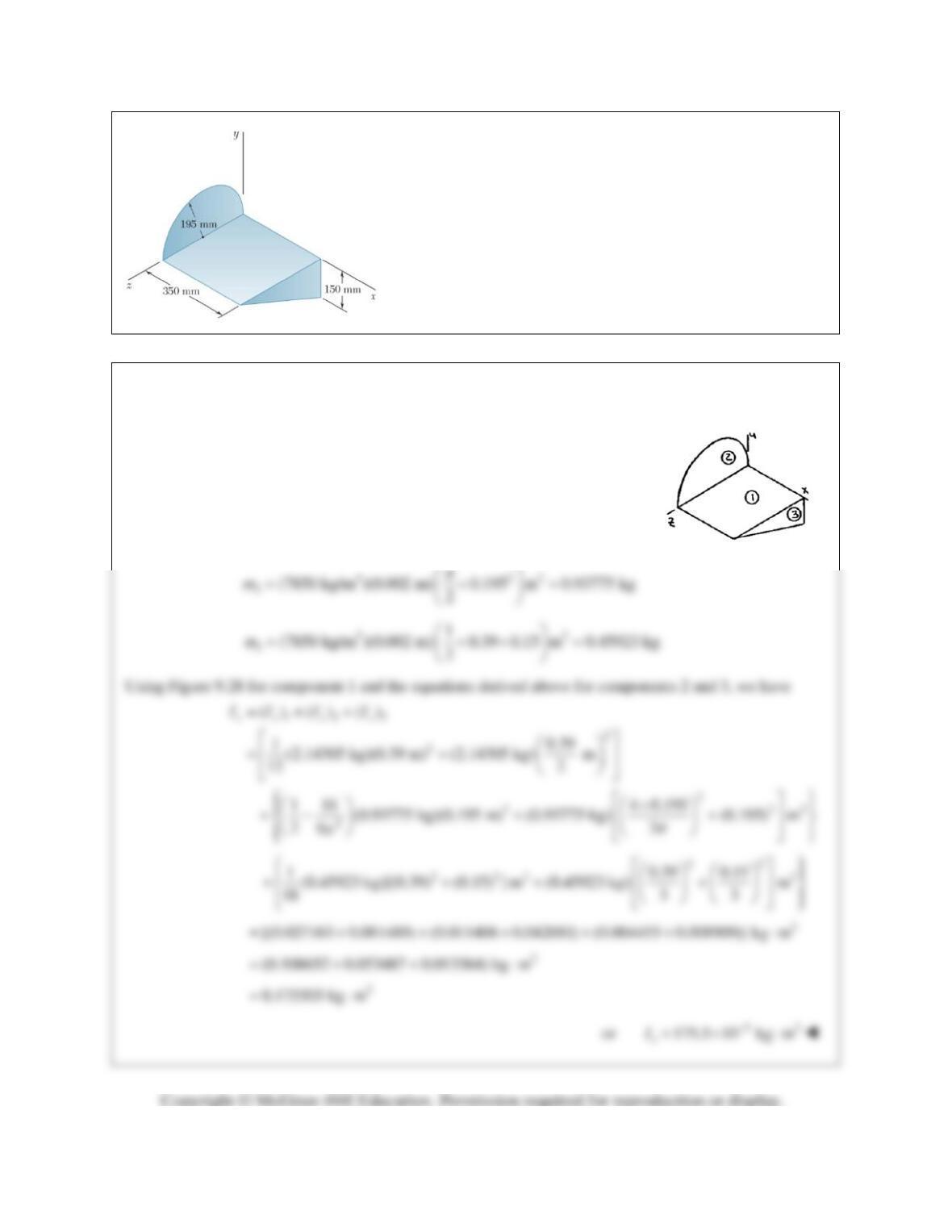
A 2-mm thick piece of sheet steel is cut and bent into the machine
component shown. Knowing that the density of steel is 7850 kg/m3,
determine the mass moment of inertia of the component with
respect to each of the coordinate axes.
SOLUTION
PROBLEM 9.135 (Continued)
Panel 2:
22 2 2
210.1884 kg 0.12 m 0.1 m 0.1884 kg 0.05 m 0.06 m
12
xx
IImd
32
1.532 10 kg m
x
I
222
210.1884 kg 0.1 m 0.1884 kg 0.05 m 0.2 m
12
yy
IImd
PROBLEM 9.136
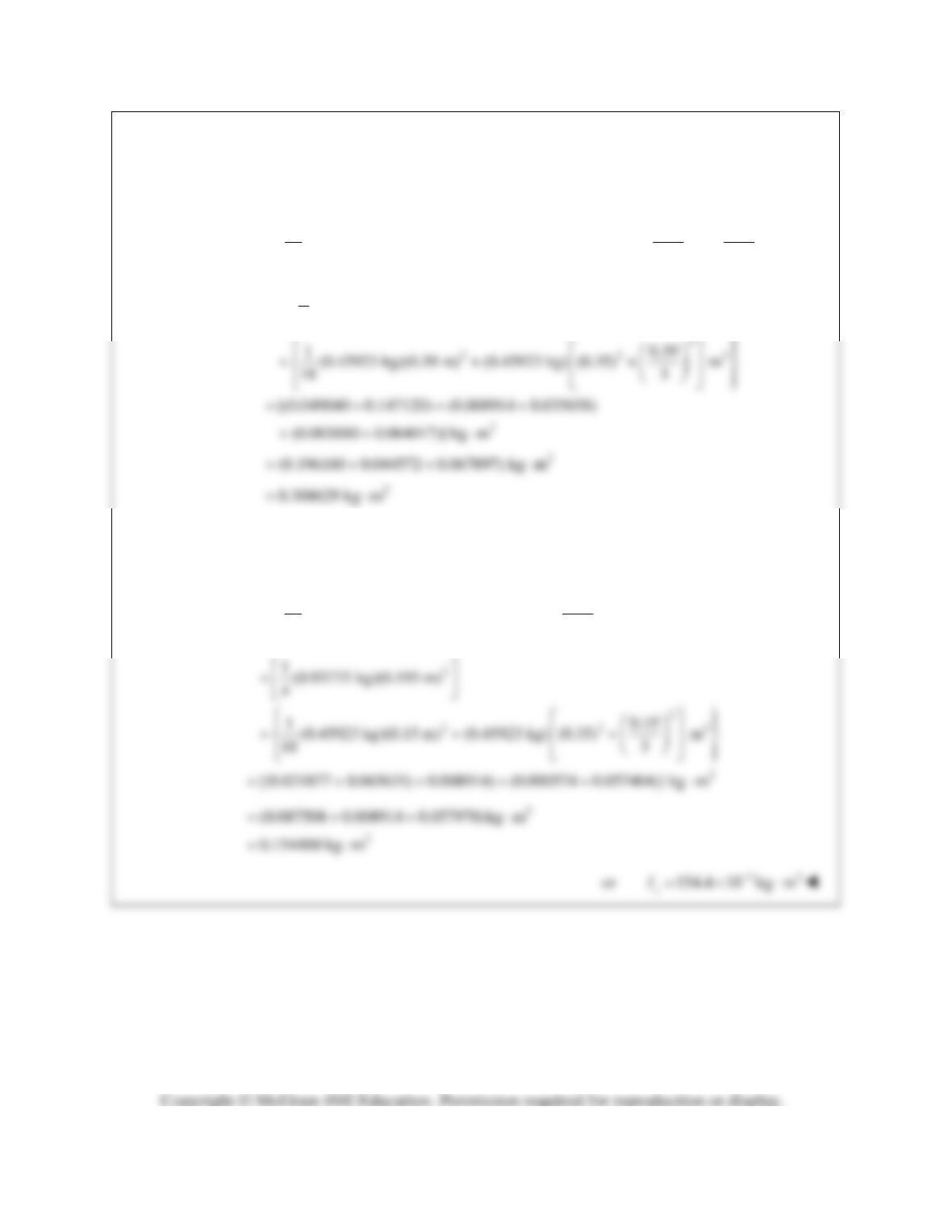
A 2-mm thick piece of sheet steel is cut and bent into the
machine component shown. Knowing that the density of steel is
7850 kg/m
3
, determine the mass moment of inertia of the
component with respect to each of the coordinate axes.
SOLUTION
First compute the mass of each component. We have
ST ST
mV tA
Then
32
1(7850 kg/m )(0.002 m)(0.35 0.39) m
2.14305 kg
m
PROBLEM 9.136 (Continued)
123
22
222 2
() () ()
10.350.39
(2.14305 kg)[(0.35) (0.39) ] m (2.14305 kg) m
12 2 2
yy y y
II I I
22
1(0.93775 kg)(0.195 m) (0.93775 kg)(0.195 m)
4
or
32
309 10 kg m
y
I
123
2
2
() () ()
10.35
(2.14305 kg)(0.35 m) (2.14305 kg) m
12 2
zz z z
II I I
PROBLEM 9.137
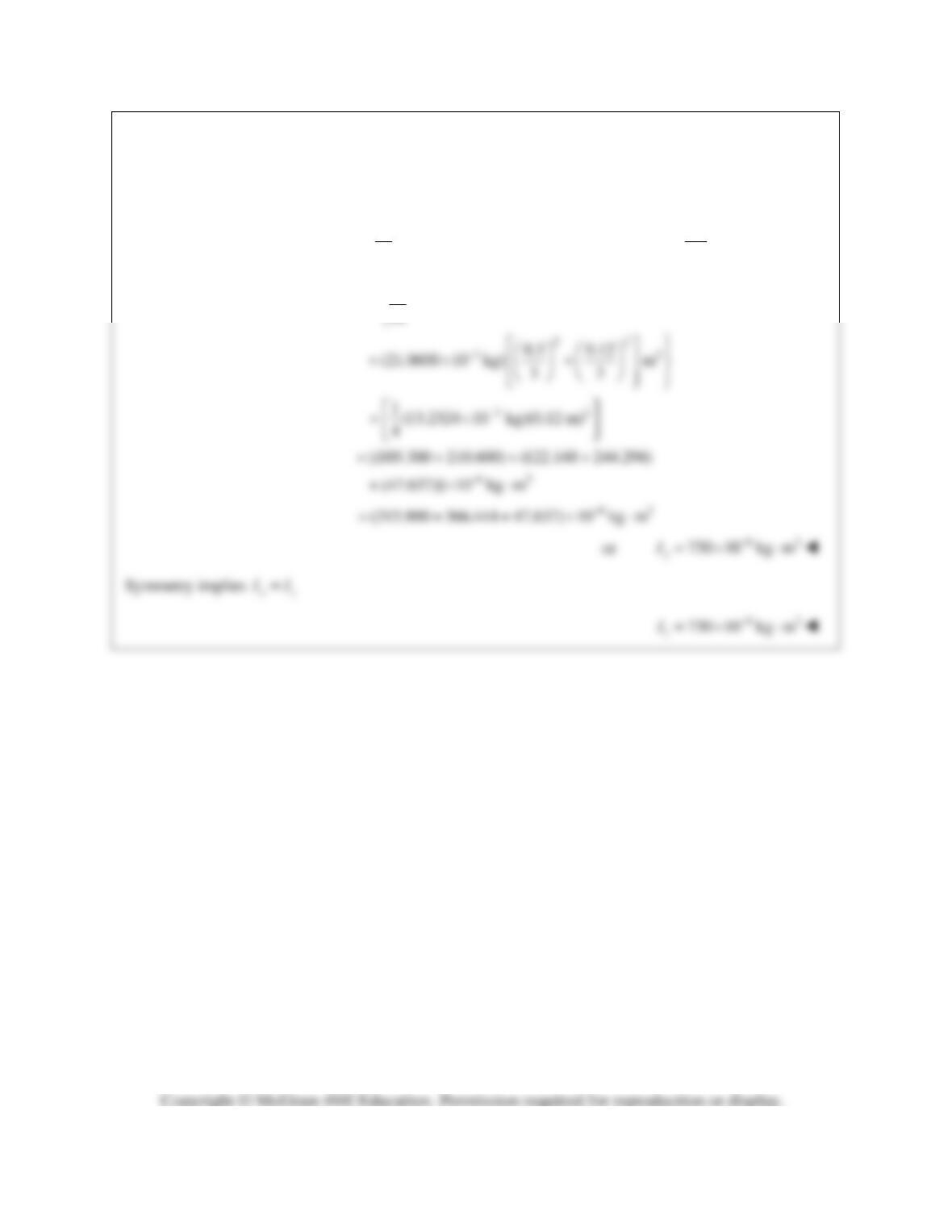
A subassembly for a model airplane is fabricated from three pieces of 1.5-
mm plywood. Neglecting the mass of the adhesive used to assemble the
three pieces, determine the mass moment of inertia of the subassembly
with respect to each of the coordinate axes. (The density of the plywood
is
3
780 kg/m .)
SOLUTION
First compute the mass of each component. We have
mV tA
Then
PROBLEM 9.137 (Continued)
123
2
32
() () ()
10.3
(21.0600 10 kg)(0.3 m) (21.0600 kg) m
18 3
yy y y
II I I
3222
1(21.0600 10 kg)[(0.3) (0.12) ] m
18