E9-20 Computing depreciation—three methods
Learning Objective 2
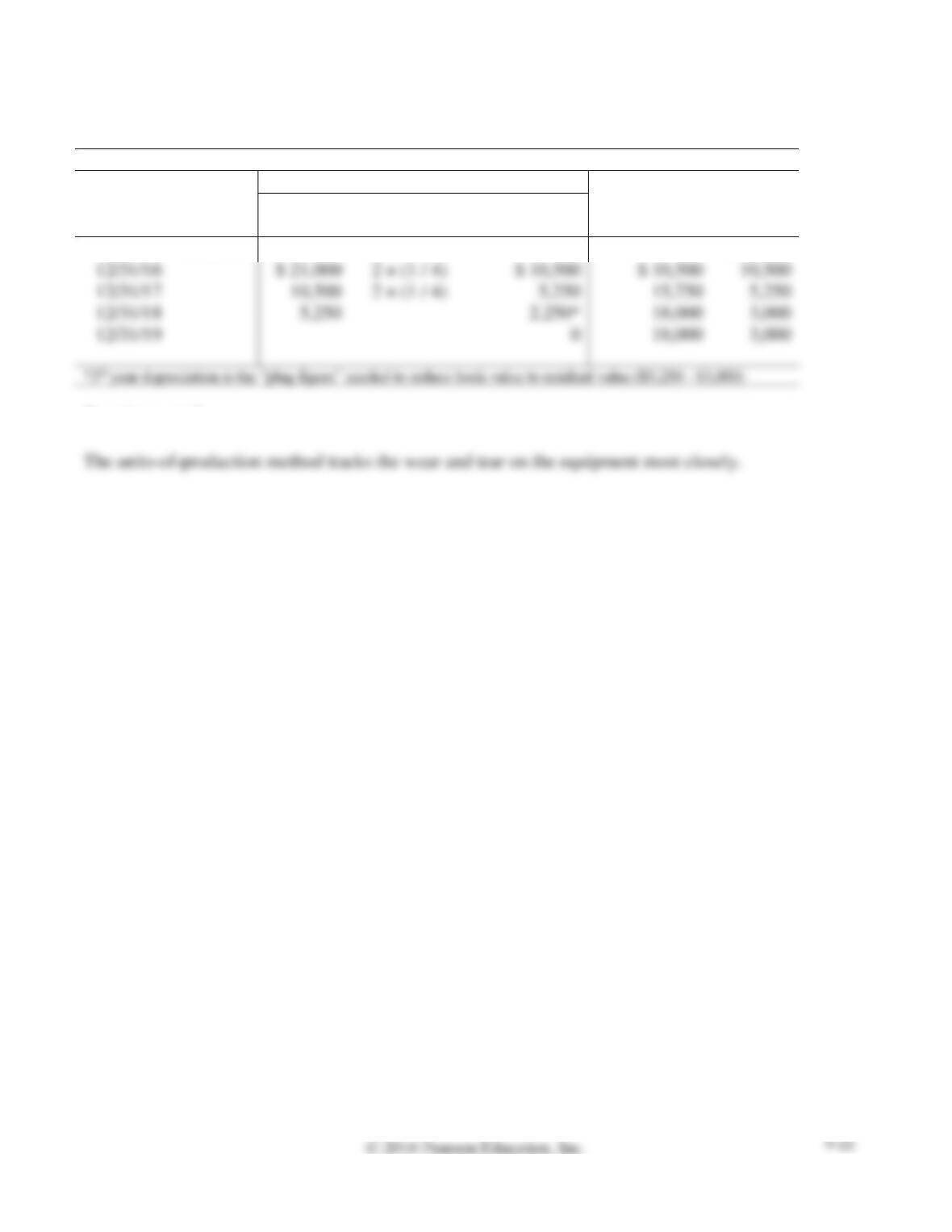
1. Double-declining-balance, 12/31/17, Exp. $5,250
(Requirement 1 only)
Crackling Fried Chicken bought equipment on January 2, 2016, for $21,000. The equipment was
expected to remain in service for four years and to perform 3,600 fry jobs. At the end of the equipment’s
useful life, Crackling’s estimates that its residual value will be $3,000. The equipment performed 360
jobs the first year, 1,080 the second year, 1,440 the third, and 720 the fourth year.
Requirements
1. Prepare a schedule of depreciation expense, accumulated depreciation, and book value per year for
the equipment under the three depreciation methods. Show your computations. Note: Three
depreciation schedules must be prepared.
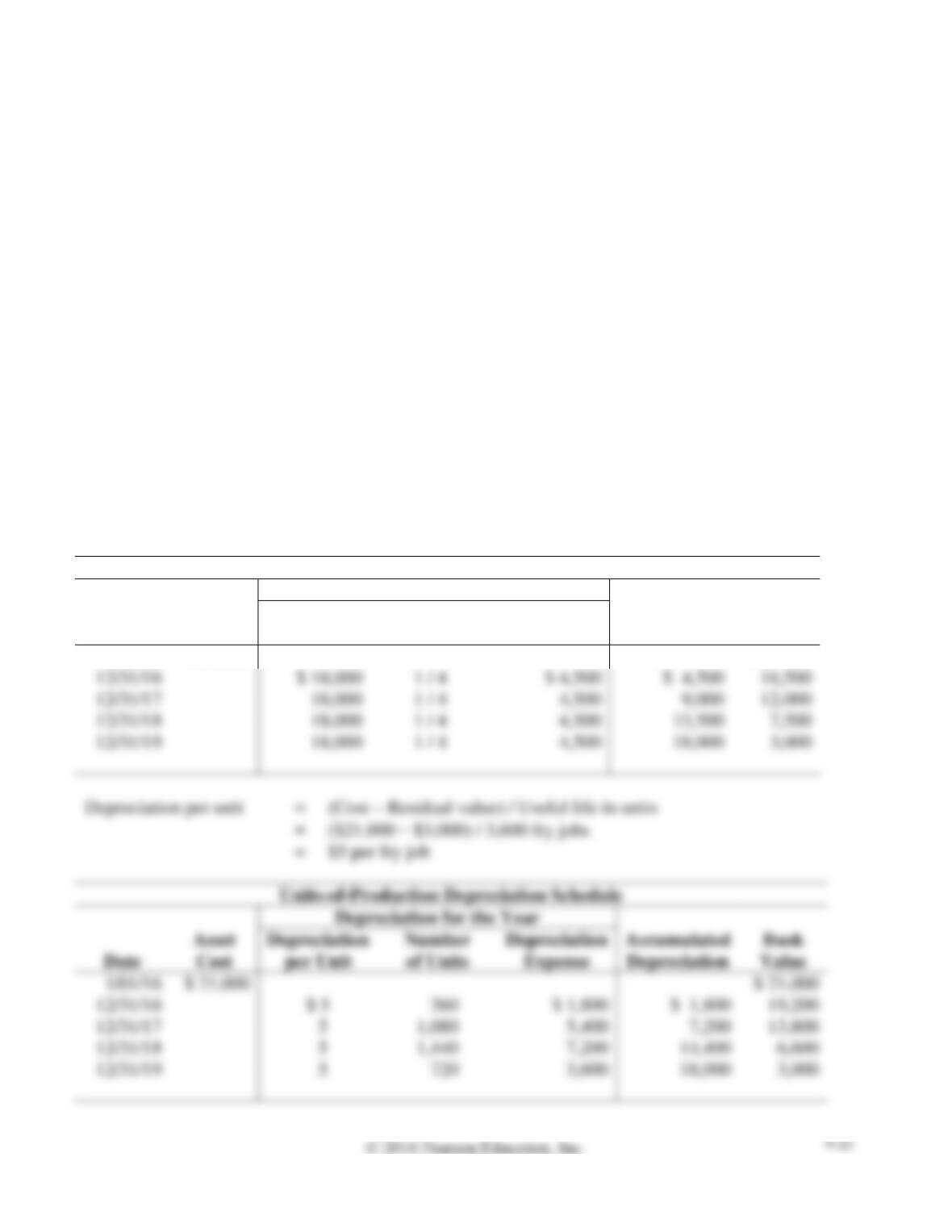
2. Which method tracks the wear and tear on the equipment most closely?
SOLUTION
Requirement 1
Depreciable cost = Cost − Residual value = $21,000 − $3,000 = $18,000
Straight-Line Depreciation Schedule
Depreciation for the Year
Date
Asset
Cost
Depreciable
Cost
Depreciation
Rate
Depreciation
Expense
Accumulated
Depreciation
Book
Value
1/01/16
$ 21,000
$ 21,000
16,500
12,000
Depreciation per unit
=
(Cost – Residual value) / Useful life in units
=
$5 per fry job
Date
Asset
Cost
Depreciation
per Unit
of Units
Depreciation
Expense
Accumulated
Depreciation
Book
Value
1/01/16
$ 21,000
$ 21,000
19,200
13,800
E9-20, cont.
Requirement 1, cont.
Double-Declining-Balance Depreciation Schedule
Depreciation for the Year
Date
Asset
Cost
Book
Value
DDB
Rate
Depreciation
Expense
Accumulated
Depreciation
Book
Value
1/01/16
$ 21,000
$ 21,000
10,500
Requirement 2
E9-21 Changing an asset’s useful life and residual value
Learning Objective 2
Yr. 16 $42,400
Budget Hardware Consultants purchased a building for $452,000 and depreciated it on a straight-line
basis over a 35-year period. The estimated residual value is $102,000. After using the building for 15
years, Budget realized that wear and tear on the building would wear it out before 35 years and that the
estimated residual value should be $90,000. Starting with the 16th year, Budget began depreciating the
building over a revised total life of 20 years using the new residual value. Journalize depreciation
expense on the building for years 15 and 16.
SOLUTION
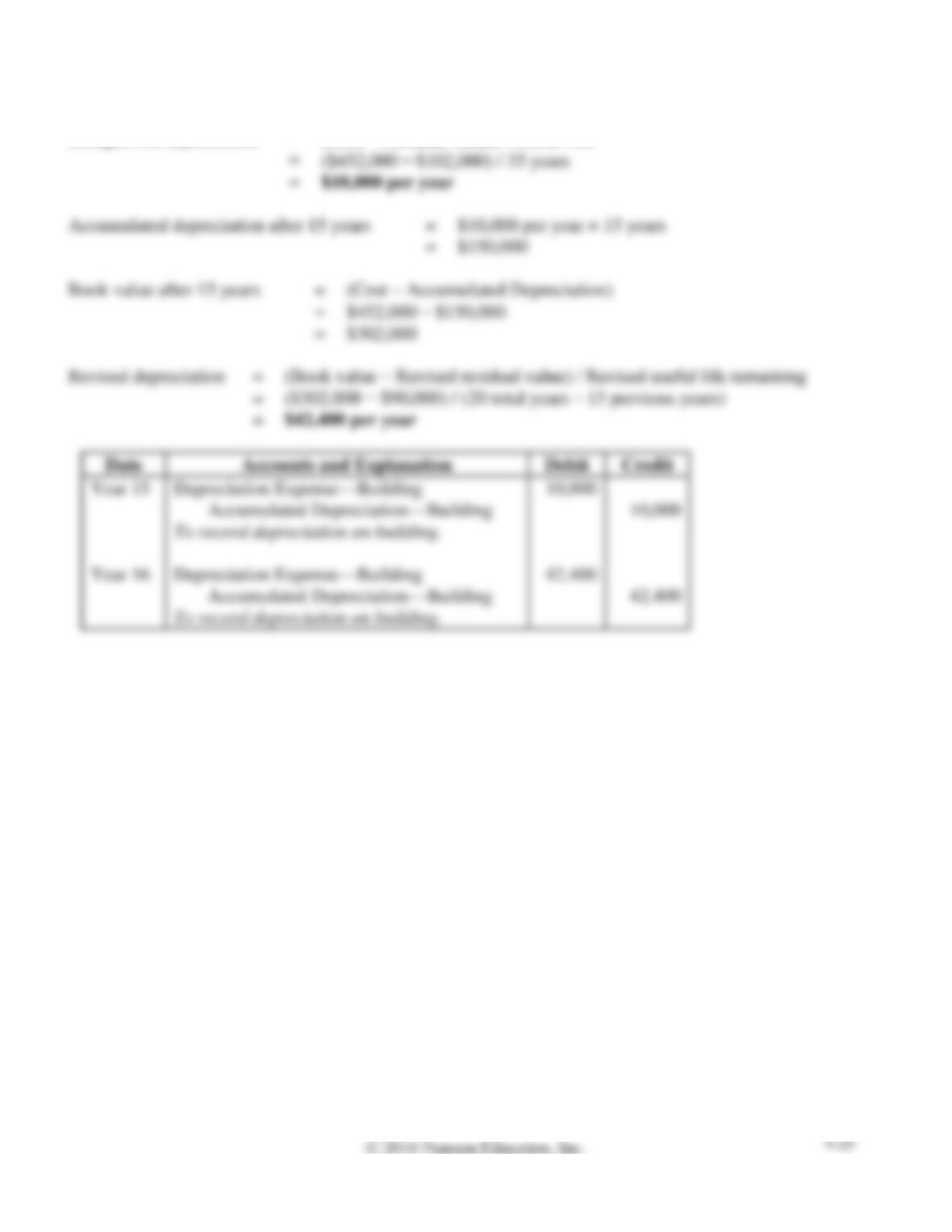
Straight-line depreciation
=
(Cost − Residual value) / Useful life
=
Accumulated depreciation after 15 years
=
$10,000 per year × 15 years
=
$150,000
Book value after 15 years
=
(Cost – Accumulated Depreciation)
=
$302,000
Revised depreciation
=
(Book value − Revised residual value) / Revised useful life remaining
=
($302,000 − $90,000) / (20 total years – 15 previous years)
=
E9-22 Recording partial-year depreciation and sale of an asset
Learning Objectives 2, 3
Depr. Exp. $2,400
On January 2, 2015, Ditto Clothing Consignments purchased showroom fixtures for $12,000 cash,
expecting the fixtures to remain in service for five years. Ditto has depreciated the fixtures on a double-
declining-balance basis, with zero residual value. On October 31, 2016, Ditto sold the fixtures for
$5,900 cash. Record both depreciation expense for 2016 and sale of the fixtures on October 31, 2016.
SOLUTION
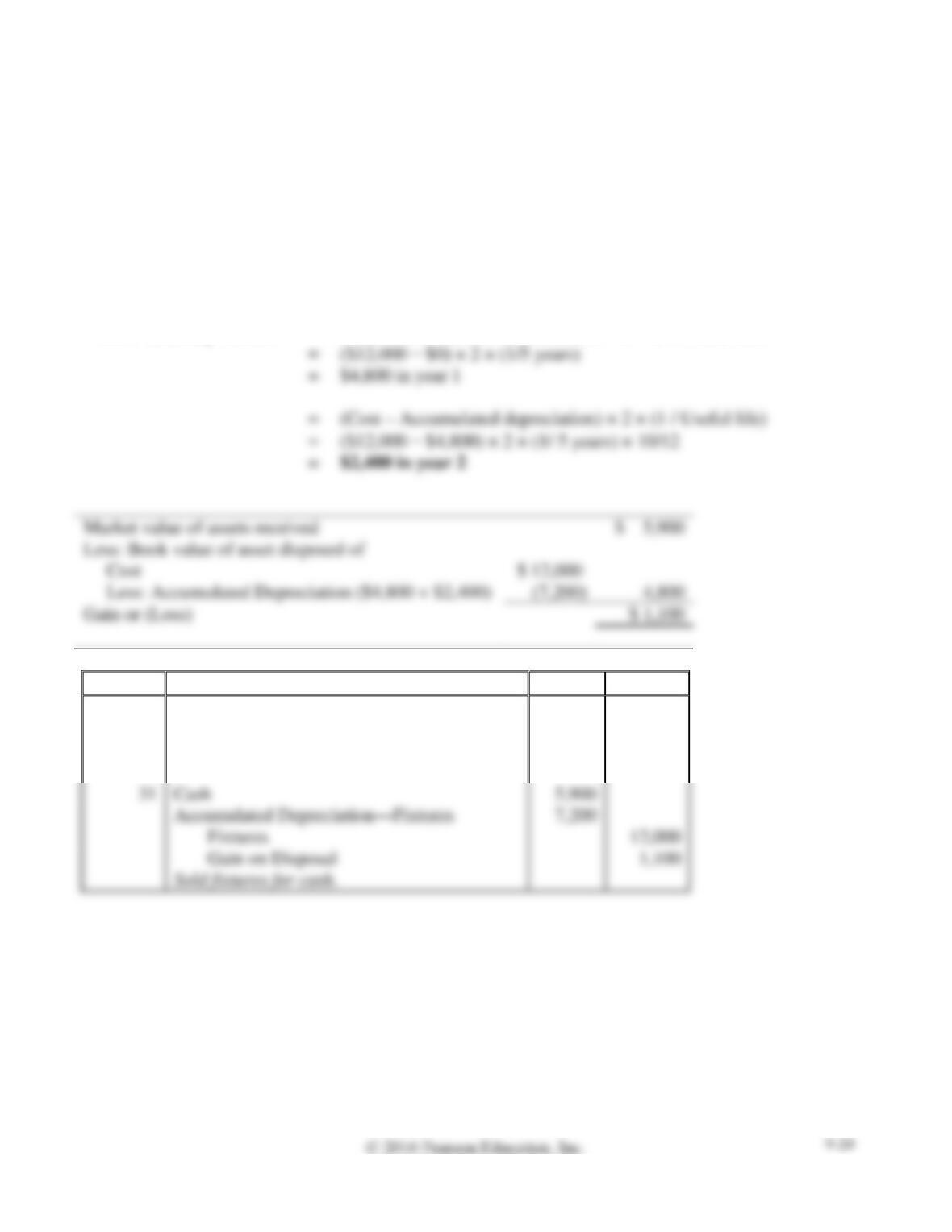
Double-declining-balance
=
(Cost – Accumulated depreciation) × 2 × (1 / Useful life)
=
$4,800 in year 1
=
(Cost – Accumulated depreciation) × 2 × (1 / Useful life)
=
Market value of assets received
Less: Book value of asset disposed of
Cost
$ 12,000
Less: Accumulated Depreciation ($4,800 + $2,400)
Gain or (Loss)
Date
Accounts and Explanation
Debit
Credit
Oct. 31
Depreciation Expense—Fixtures
2,400
Accumulated Depreciation—Fixtures
2,400
To record depreciation on fixtures.
Cash
5,900
Accumulated Depreciation—Fixtures
7,200
Fixtures
Gain on Disposal
1,100
Sold fixtures for cash.
E9-23 Recording partial-year depreciation and sale of an asset
Learning Objectives 2, 3
Loss $(6,000)
On January 2, 2014, Pet Salon purchased fixtures for $48,200 cash, expecting the fixtures to remain in
service for nine years. Pet Salon has depreciated the fixtures on a straight-line basis, with $5,000
residual value. On May 31, 2016, Pet Salon sold the fixtures for $30,600 cash. Record both depreciation
expense for 2016 and sale of the fixtures on May 31, 2016.
SOLUTION
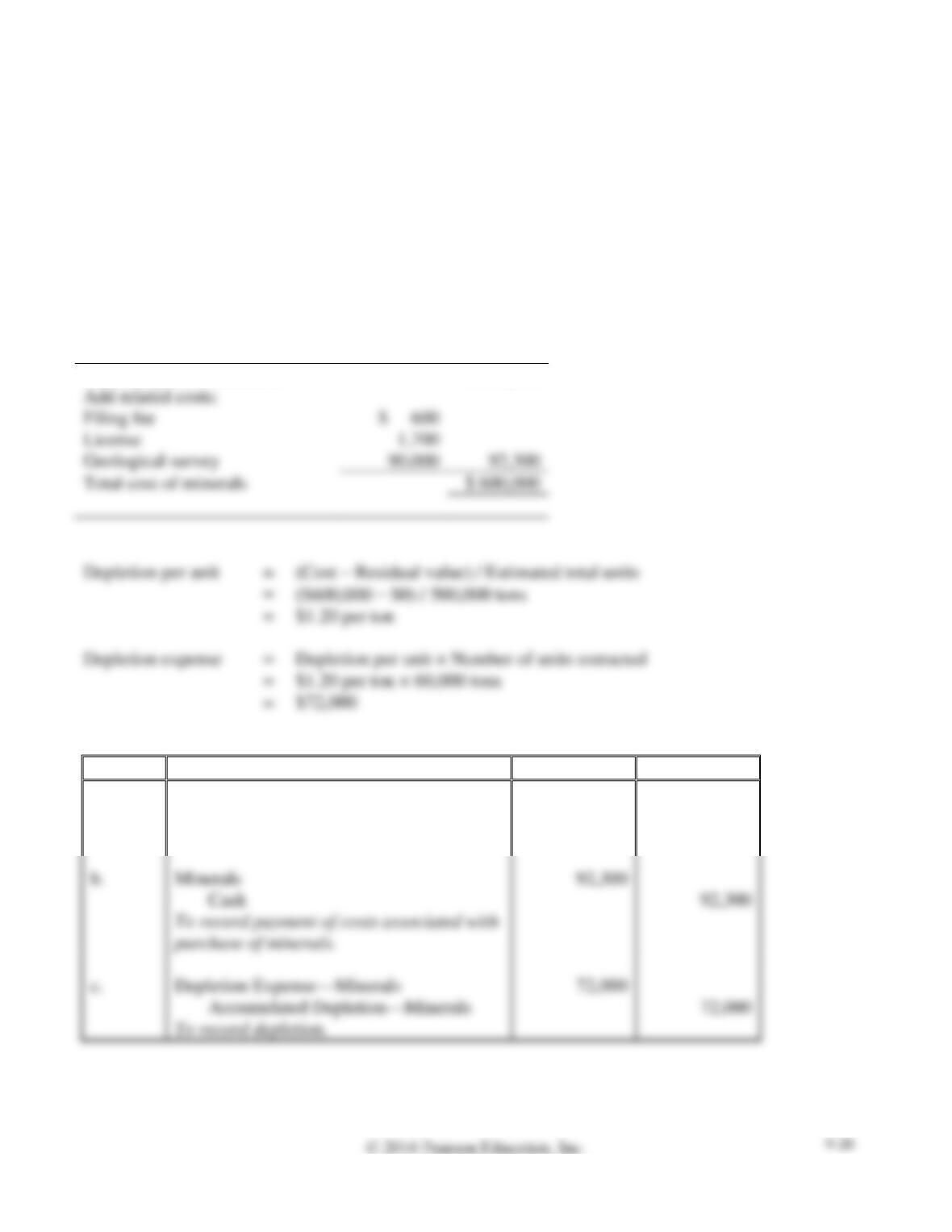
Straight-line depreciation
=
(Cost − Residual value) / Useful life
=
$4,800 per year (2014 and 2015)
=
(Cost − Residual value) / Useful life
=
Market value of assets received
Less: Book value of asset disposed of
Cost
$ 48,200
Less: Accumulated Depreciation ($4,800 + $4,800 + $2,000)
Gain or (Loss)
Date
Accounts and Explanation
Debit
Credit
May 31
Depreciation Expense—Fixtures
2,000
Accumulated Depreciation—Fixtures
2,000
To record depreciation on fixtures.
Cash
30,600
Accumulated Depreciation—Fixtures
11,600
Loss on Disposal
6,000
Fixtures
E9-24 Journalizing natural resource depletion
Learning Objective 4
$1.20 per ton
Colorado Mountain Mining paid $507,700 for the right to extract mineral assets from a 500,000-ton
deposit. In addition to the purchase price, Colorado also paid a $600 filing fee, a $1,700 license fee to
the state of Nevada, and $90,000 for a geological survey of the property. Because Colorado purchased
the rights to the minerals only, it expects the asset to have zero residual value. During the first year,
Colorado removed and sold 60,000 tons of the minerals. Make journal entries to record (a) purchase of
the minerals (debit Minerals), (b) payment of fees and other costs, and (c) depletion for the first year.
SOLUTION
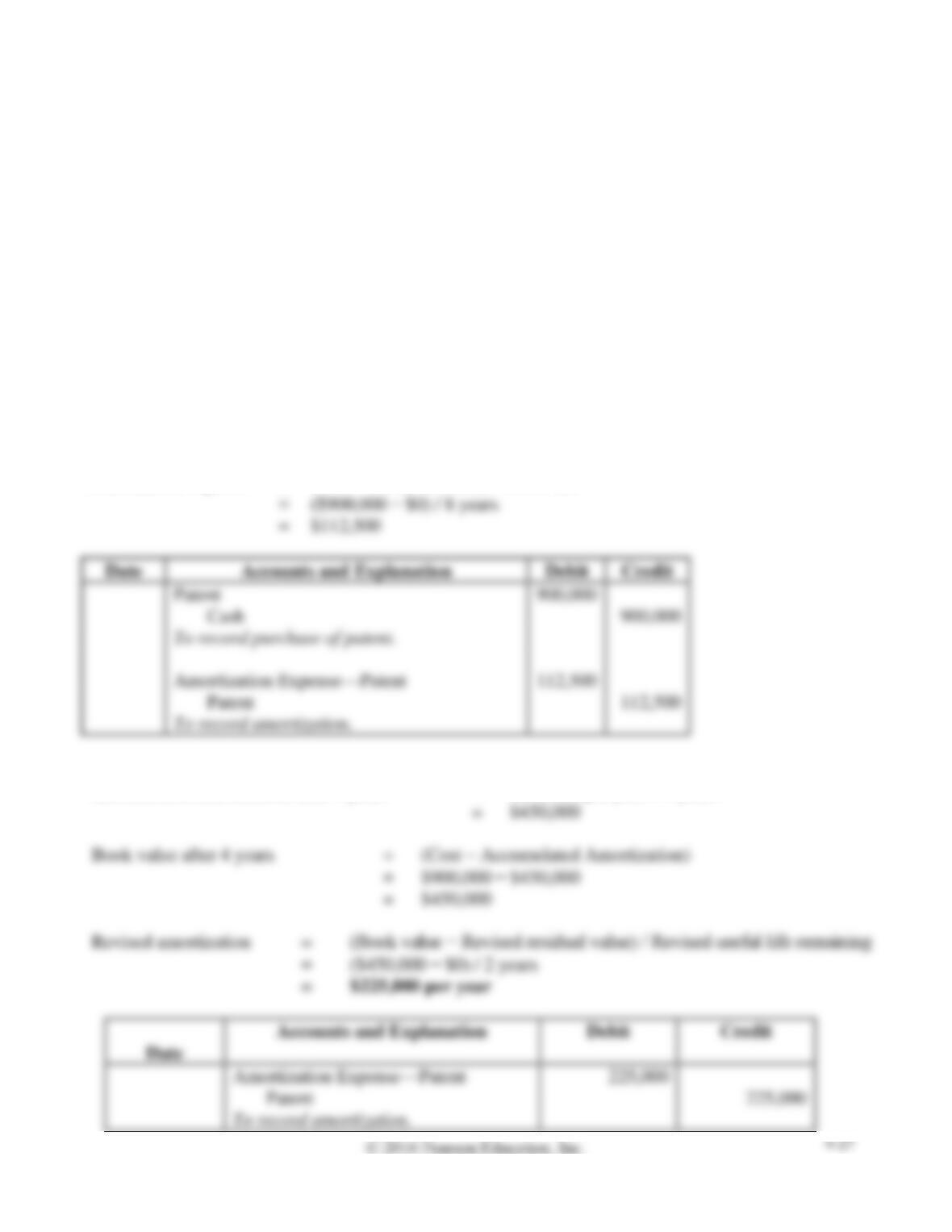
Purchase price of minerals
$ 507,700
Add related costs:
Filing fee
License
Geological survey
92,300
Total cost of minerals
$ 600,000
Depletion per unit
(Cost – Residual value) / Estimated total units
$1.20 per ton
Depletion expense
Depletion per unit × Number of units extracted
$1.20 per ton × 60,000 tons
$72,000
Date
Accounts and Explanation
Debit
Credit
a.
Minerals
507,700
Cash
507,700
To record purchase of mineral rights.
b.
Minerals
Cash
purchase of minerals.
c.
Depletion Expense—Minerals
Accumulated Depletion—Minerals
To record depletion.
E9-25 Handling acquisition of patent, amortization, and change in useful life
Learning Objectives 2, 5
2. Amort. Exp. $225,000
Medway Printers (MP) manufactures printers. Assume that MP recently paid $900,000 for a patent on a
new laser printer. Although it gives legal protection for 20 years, the patent is expected to provide a
competitive advantage for only eight years.
Requirements
1. Assuming the straight-line method of amortization, make journal entries to record (a) the purchase of
the patent and (b) amortization for the first full year.
2. After using the patent for four years, MP learns at an industry trade show that another company is
designing a more efficient printer. On the basis of this new information, MP decides, starting with
year 5, to amortize the remaining cost of the patent over two remaining years, giving the patent a
total useful life of six years. Record amortization for year 5.
SOLUTION
Requirement 1
Amortization expense
=
(Cost – Residual value) / Useful life
=
$112,500
900,000
112,500
Requirement 2
Accumulated amortization after 4 years
=
$112,500 per year × 4 years
=
$450,000
Book value after 4 years
(Cost – Accumulated Amortization)
$450,000
Revised amortization
=
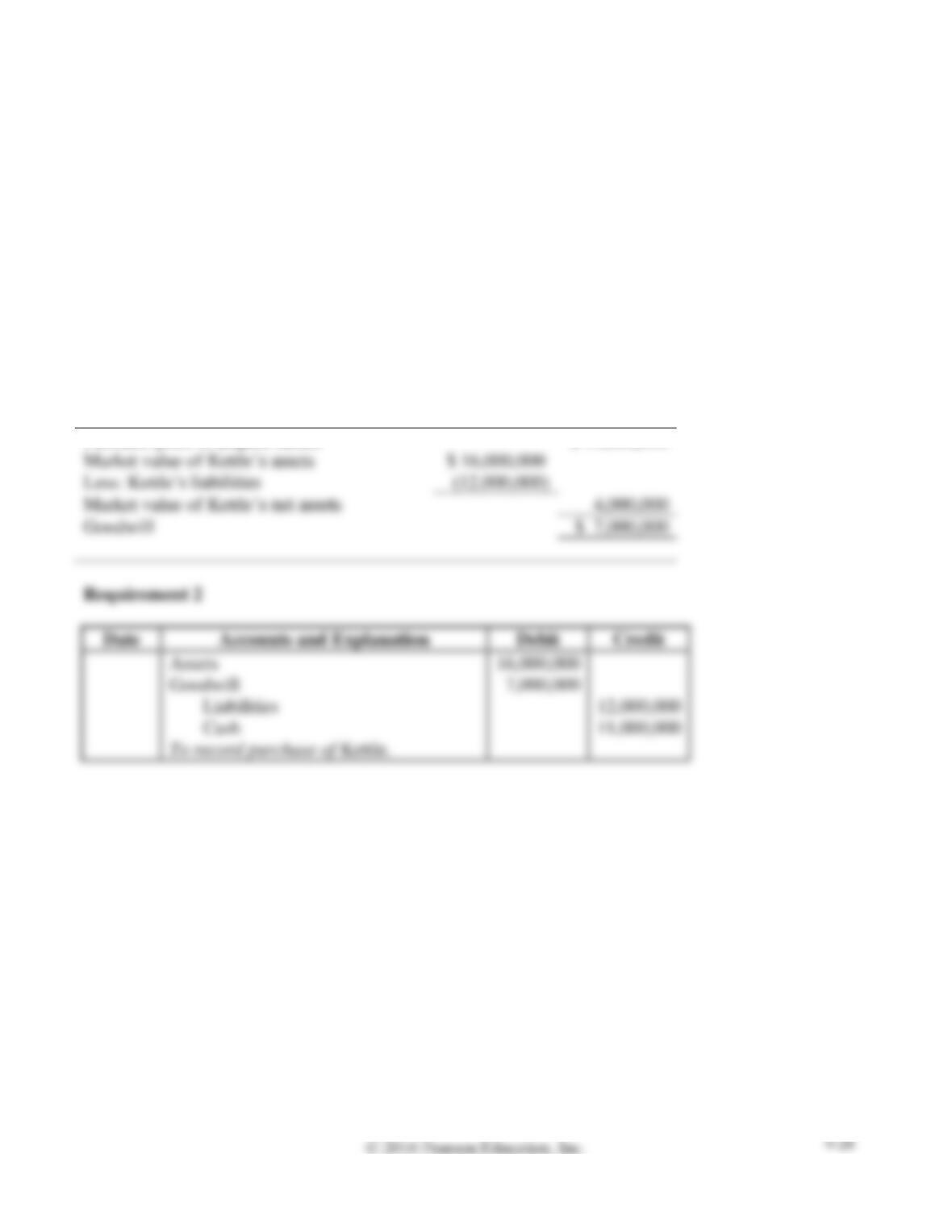
E9-26 Measuring and recording goodwill
Learning Objective 5
2. Goodwill $7,000,000
Princess has acquired several other companies. Assume that Princess purchased Kettle for $11,000,000
cash. The book value of Kettle’s assets is $12,000,000 (market value,
$16,000,000), and it has liabilities of $12,000,000 (market value, $12,000,000).
Requirements
1. Compute the cost of the goodwill purchased by Princess.
2. Record the purchase of Kettle by Princess.
SOLUTION
Requirement 1
Purchase price to acquire Kettle
$ 11,000,000
Market value of Kettle’s assets
$ 16,000,000
Less: Kettle’s liabilities
Market value of Kettle’s net assets
Goodwill
E9-27 Computing asset turnover ratio
Learning Objective 6
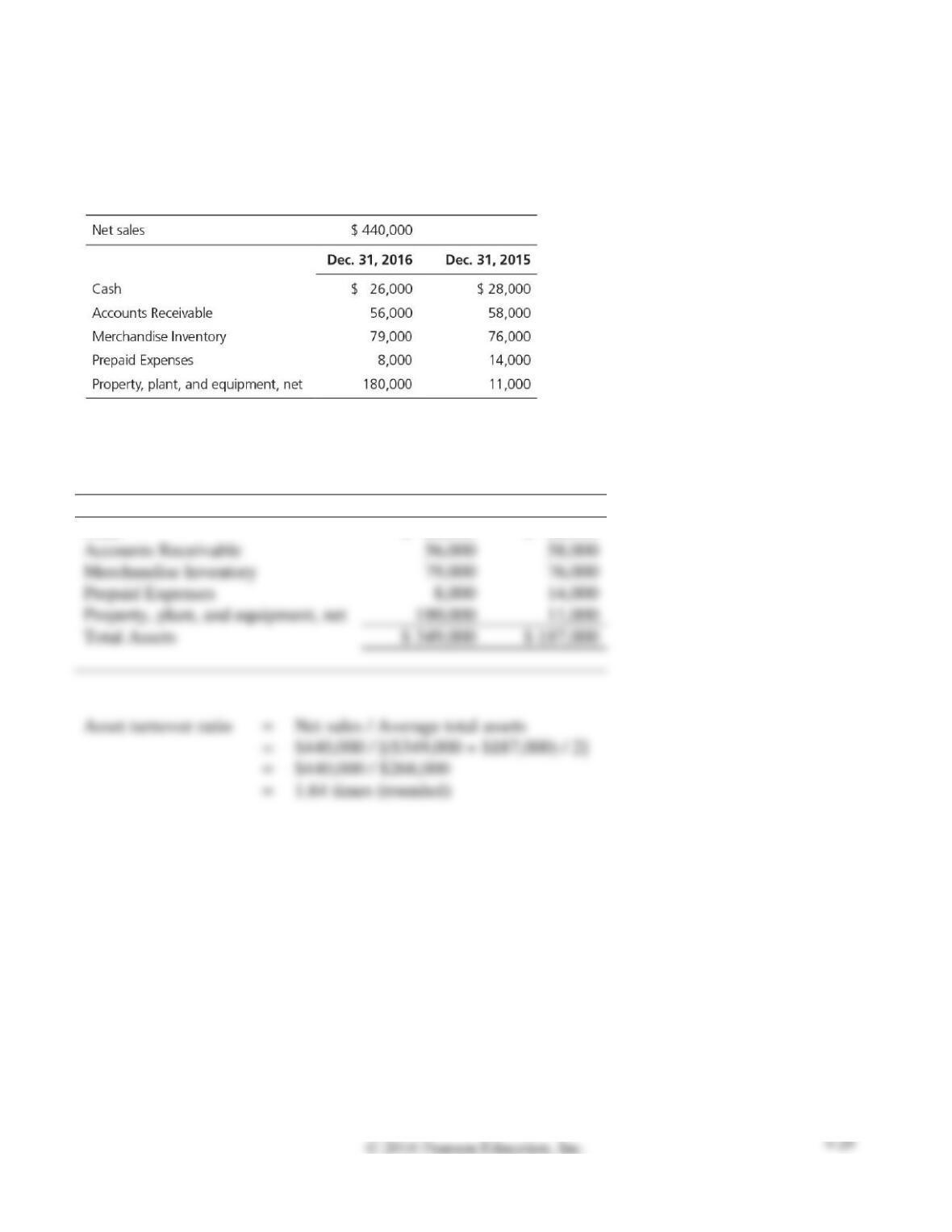
Snap Dragon Photo reported the following figures on its December 31, 2016, income statement and
balance sheet:
Compute the asset turnover ratio for 2016.
SOLUTION
Dec. 31, 2016
Dec. 31, 2015
Cash
$ 26,000
$ 28,000
Accounts Receivable
Merchandise Inventory
Prepaid Expenses
Property, plant, and equipment, net
Total Assets
$ 349,000
$ 187,000
Asset turnover ratio
Net sales / Average total assets
$440,000 / [($349,000 + $187,000) / 2]
$440,000 / $268,000
1.64 times (rounded)
E9A-28 Exchanging assets—two situations
Learning Objective 7
Appendix 9A
2. Loss $(7,000)
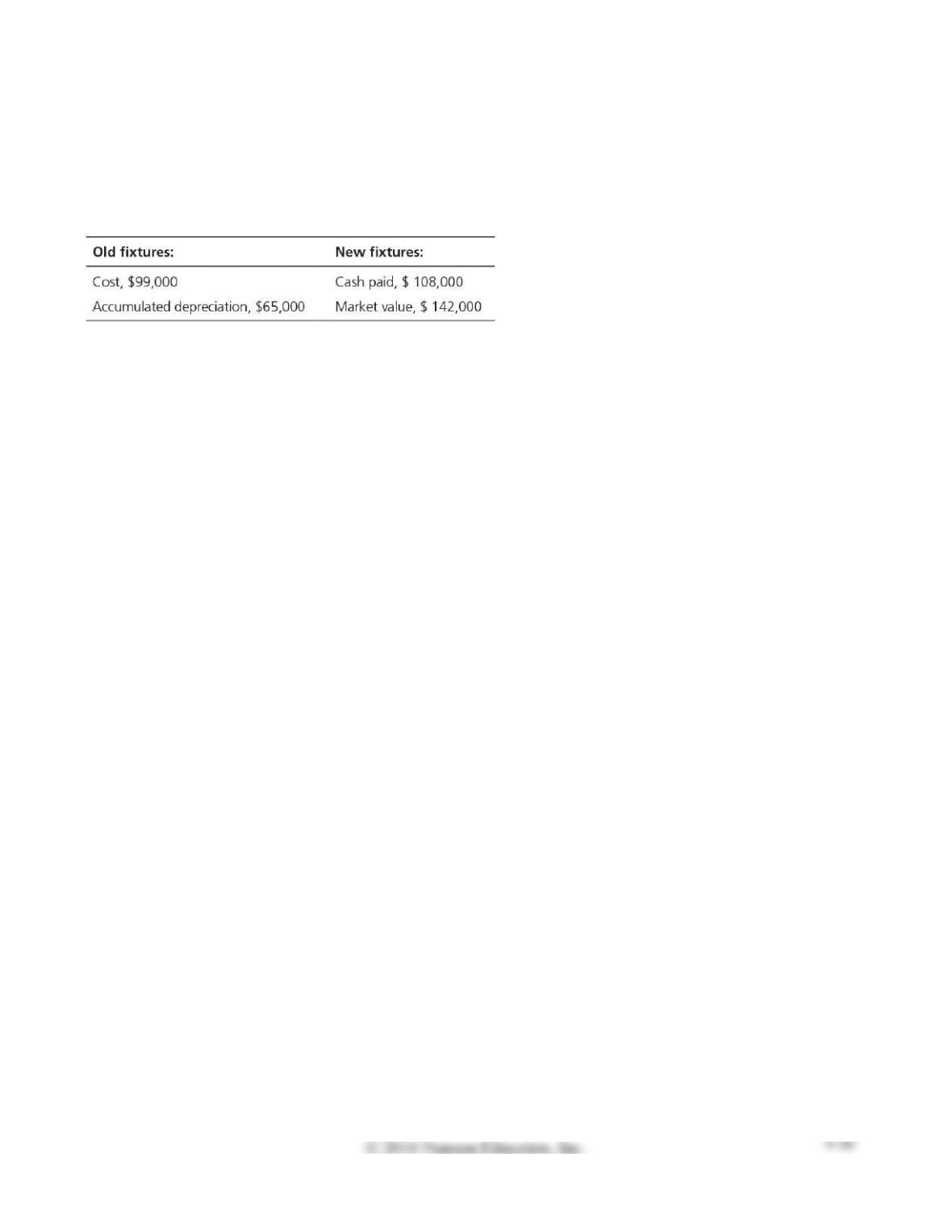
Commerce Bank recently traded in office fixtures. Here are the facts:
equirements
1. Record Commerce Bank’s trade-in of old fixtures for new ones. Assume the exchange had
commercial substance.
2. Now let’s change one fact. Commerce Bank feels compelled to do business with Shoreside
Furniture, a bank customer, even though the bank can get the fixtures elsewhere at a better price.
Commerce Bank is aware that the new fixtures’ market value is only $135,000. Record the trade-in.
Assume the exchange had commercial substance.
SOLUTION
Requirement 1
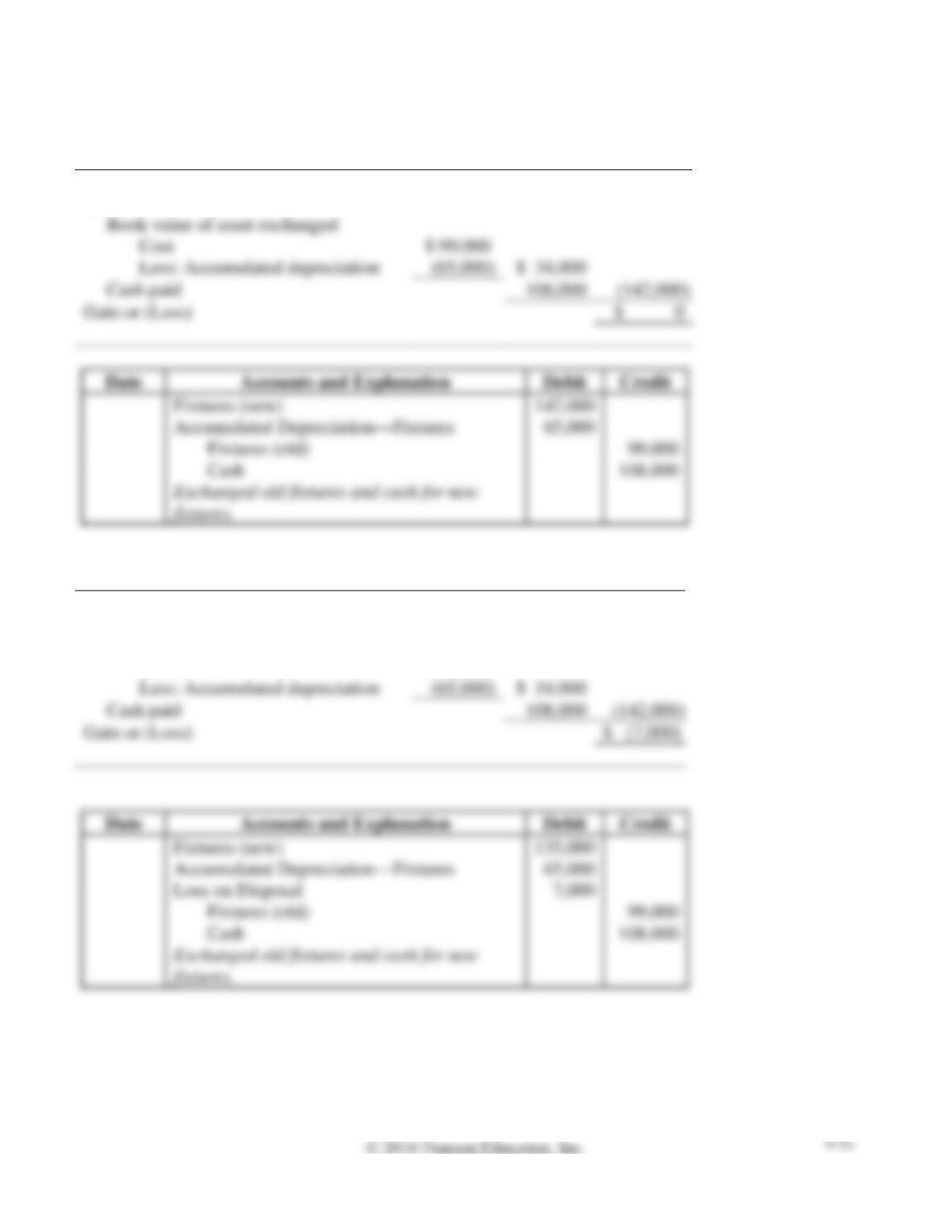
Market value of assets received
$ 142,000
Less:
Book value of asset exchanged
Cost
$ 99,000
Less: Accumulated depreciation
$ 34,000
Cash paid
Gain or (Loss)
108,000
Requirement 2
Market value of assets received
$ 135,000
Less:
Book value of asset exchanged
Cost
$ 99,000
Less: Accumulated depreciation
$ 34,000
Cash paid
(142,000)
Gain or (Loss)
$ (7,000)
108,000

E9A-29 Measuring asset cost, units-of-production depreciation, and asset trade
Learning Objectives 1, 2, 7
Appendix 9A
1. $12,870
Pact Trucking Corporation uses the units-of-production depreciation method because units-of–
production best measures wear and tear on the trucks. Consider these facts about one Mack truck in the
company’s fleet.
When acquired in 2013, the rig cost $450,000 and was expected to remain in service for 10 years or
1,000,000 miles. Estimated residual value was $120,000. The truck was driven 82,000 miles in 2013,
122,000 miles in 2014, and 162,000 miles in 2015. After 39,000 miles, on March 15, 2016, the company
traded in the Mack truck for a less expensive Freightliner. Pact also paid cash of $27,000. Fair market
value of the Mack truck was equal to its net book value on the date of the trade.
Requirements
1. Record the journal entry for depreciation expense in 2016.
2. Determine Pact’s cost of the new truck.
3. Record the journal entry for the exchange of assets on March 15, 2016. Assume the exchange had
commercial substance.
SOLUTION
Requirement 1
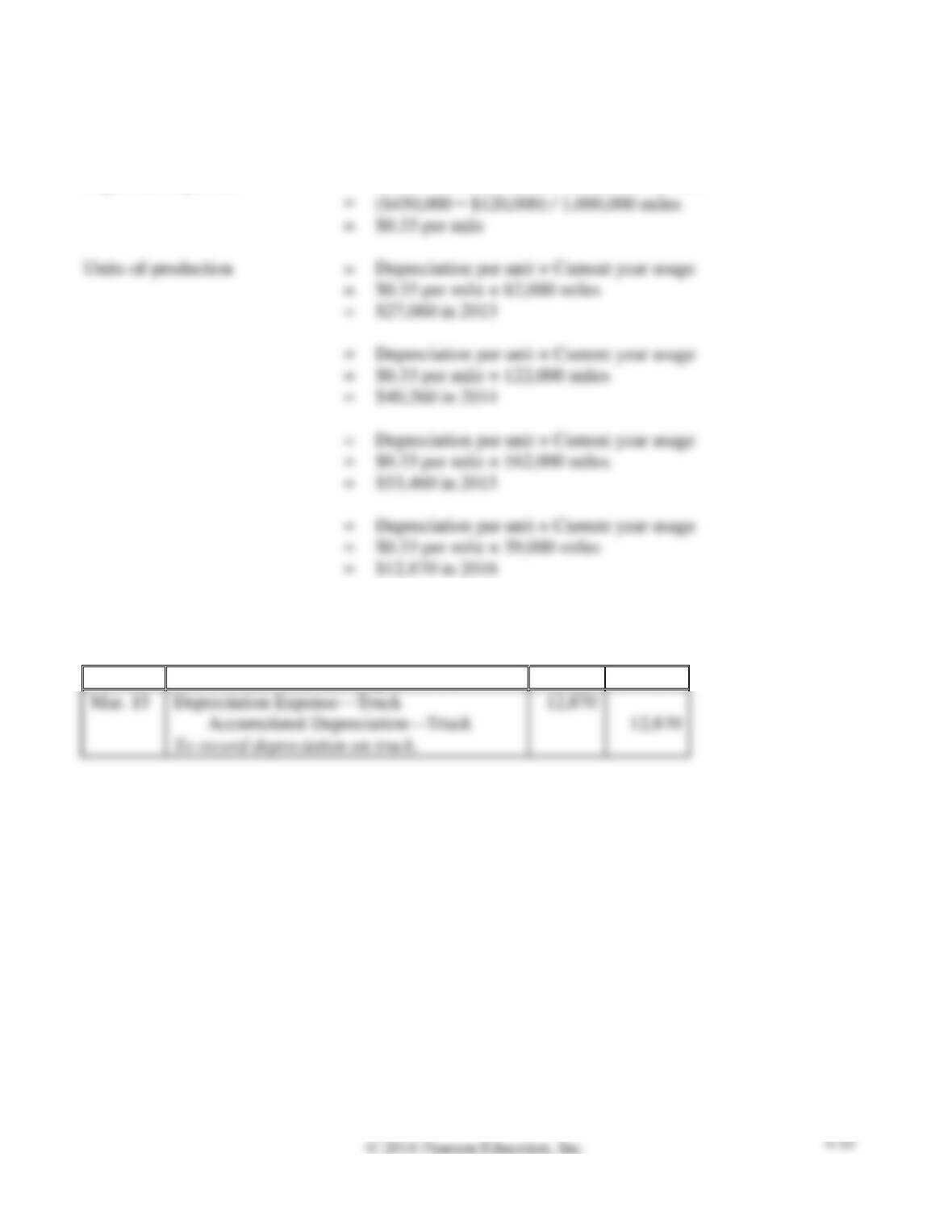
Depreciation per unit
=
(Cost – Residual value) / Useful life in units
=
$0.33 per mile
Units-of-production
=
Depreciation per unit × Current year usage
=
$0.33 per mile × 82,000 miles
=
$27,060 in 2013
=
Depreciation per unit × Current year usage
=
$0.33 per mile × 122,000 miles
=
$40,260 in 2014
=
Depreciation per unit × Current year usage
=
$0.33 per mile × 162,000 miles
=
$53,460 in 2015
=
Depreciation per unit × Current year usage
=
$0.33 per mile × 39,000 miles
=
$12,870 in 2016
Total accumulated depreciation
=
$27,060 + $40,260 + $53,460 + $12,870
=
$133,650
Date
Accounts and Explanation
Debit
Credit
E9A-29, cont.
Requirement 2
Market value of assets received
$ 343,350
Less:
Book value of asset exchanged
Cost
$ 450,000
Less: Accumulated depreciation
(133,650)*
$ 316,350
Cash paid
27,000
343,350
Gain or (Loss)
$ 0
*from Requirement 1
If the fair market value of the old truck is equal to its net book value, then the “trade–in” value of the old
truck is equal to the book value and there is no gain or loss on the exchange. Therefore, the cost of the
new truck is $343,350—the book value of the old truck plus the cash paid.
Requirement 3
Date
Accounts and Explanation
Debit
Credit
Mar. 15
Truck (new)
343,350
Accumulated Depreciation—Truck
133,650
Truck (old)
450,000
Cash
27,000
Exchanged old truck and cash for new truck.
Problems (Group A)
P9-30A Determining asset cost and recording partial-year depreciation
Learning Objectives 1, 2
1. Bldg. $446,100
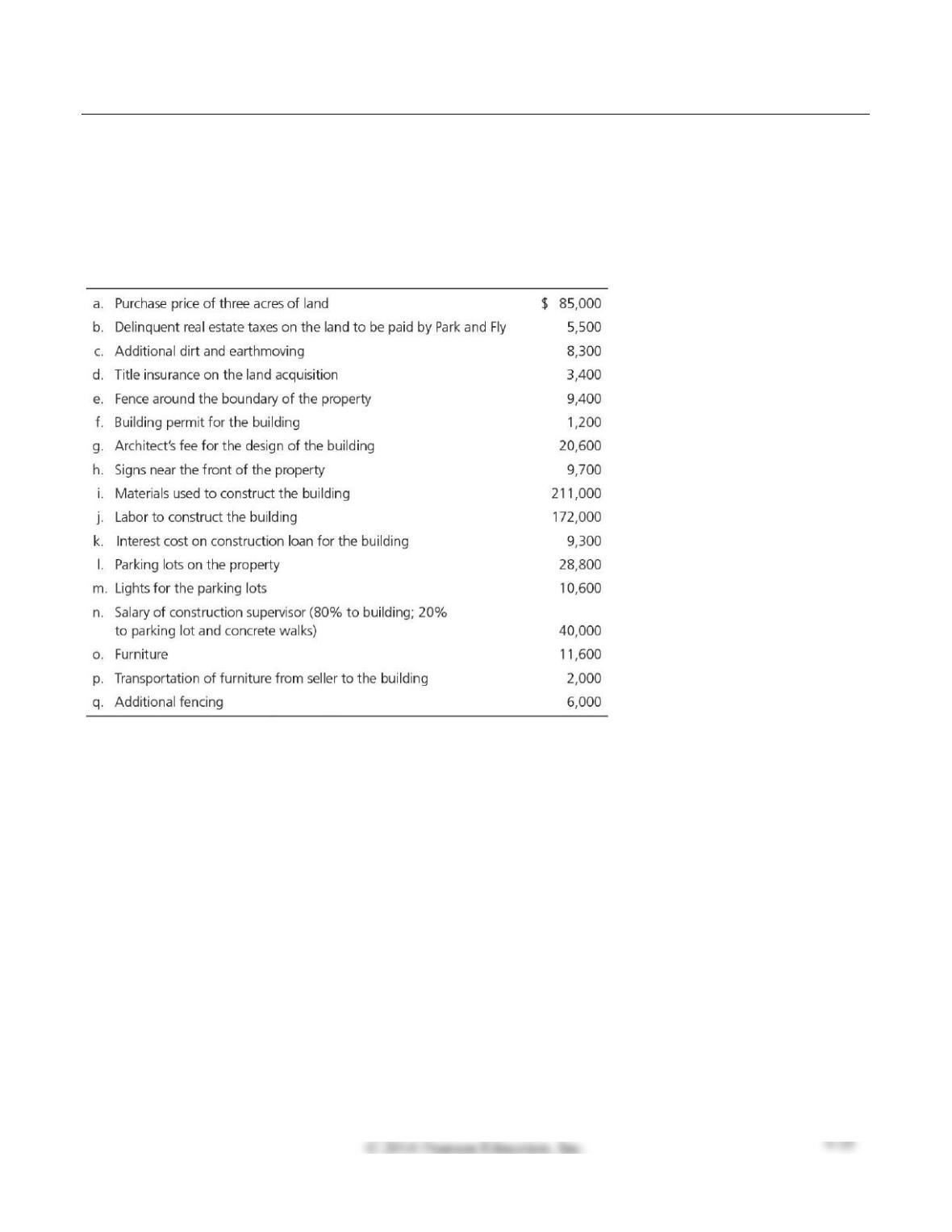
Park and Fly, near an airport, incurred the following costs to acquire land, make land improvements, and
construct and furnish a small building:
Park and Fly depreciates land improvements over 20 years, buildings over 40 years, and furniture over
eight years, all on a straight-line basis with zero residual value.
Requirements
1. Set up columns for Land, Land Improvements, Building, and Furniture. Show how to account for
each cost by listing the cost under the correct account. Determine the total cost of each asset.
2. All construction was complete and the assets were placed in service on October 1. Record partial-
year depreciation expense for the year ended December 31.
SOLUTION
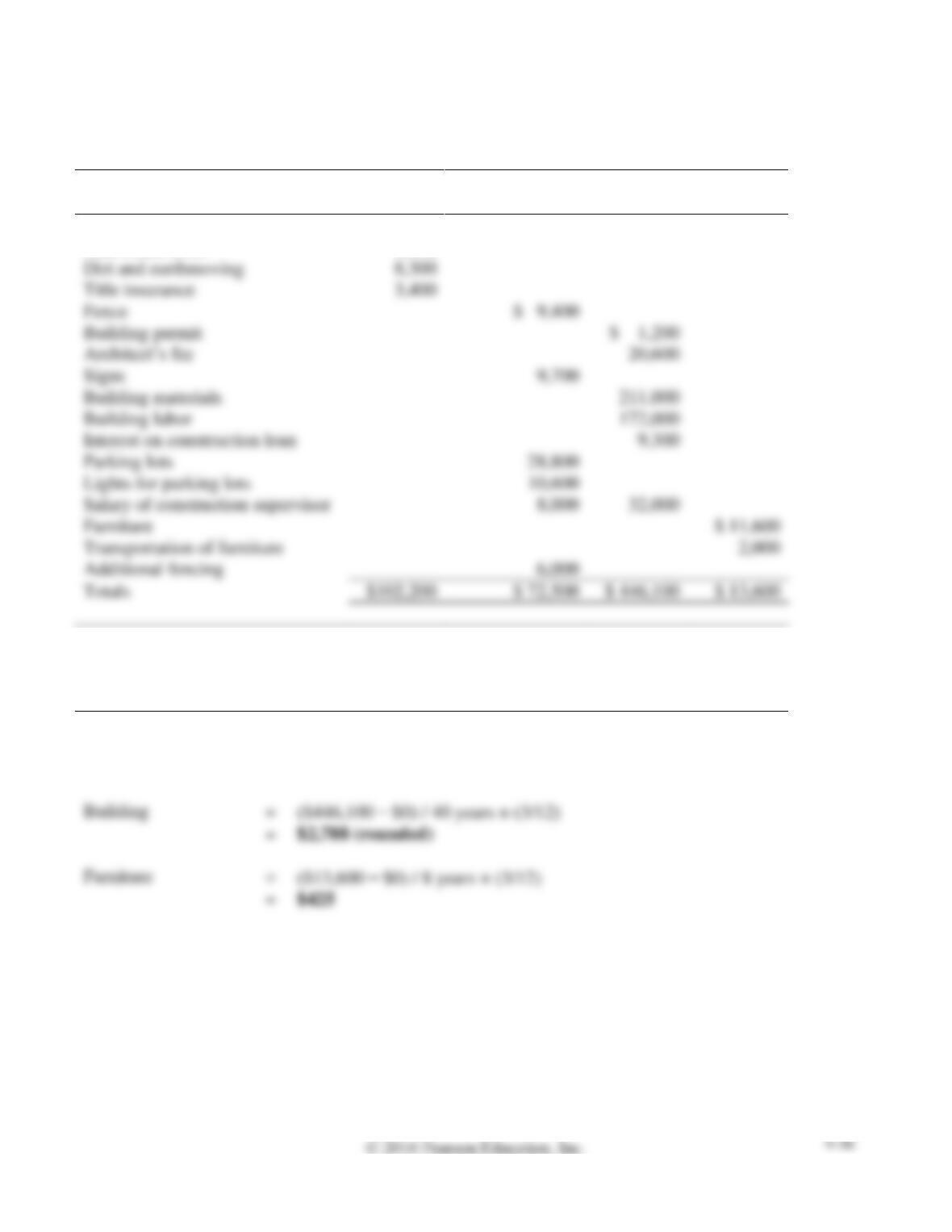
Requirement 1
Land
Land
Improvements
Building
Furniture
Purchase price
$ 85,000
Real estate taxes
5,500
Dirt and earthmoving
8,300
Title insurance
3,400
Fence
Building permit
Architect’s fee
Signs
Building materials
Building labor
Interest on construction loan
Parking lots
Lights for parking lots
Salary of construction supervisor
Furniture
Transportation of furniture
Additional fencing
Totals
$102,200
$ 446,100
Requirement 2
Straight-line
=
(Cost − Residual value) / Useful life × (Number of Months / 12)
Land Improvements
=
($72,500 ̶ $0) / 20 years × (3/12)
=
$906 (rounded)
=
$2,788 (rounded)
Furniture
=
=
$425
P9-30A, cont.
Requirement 2, cont.
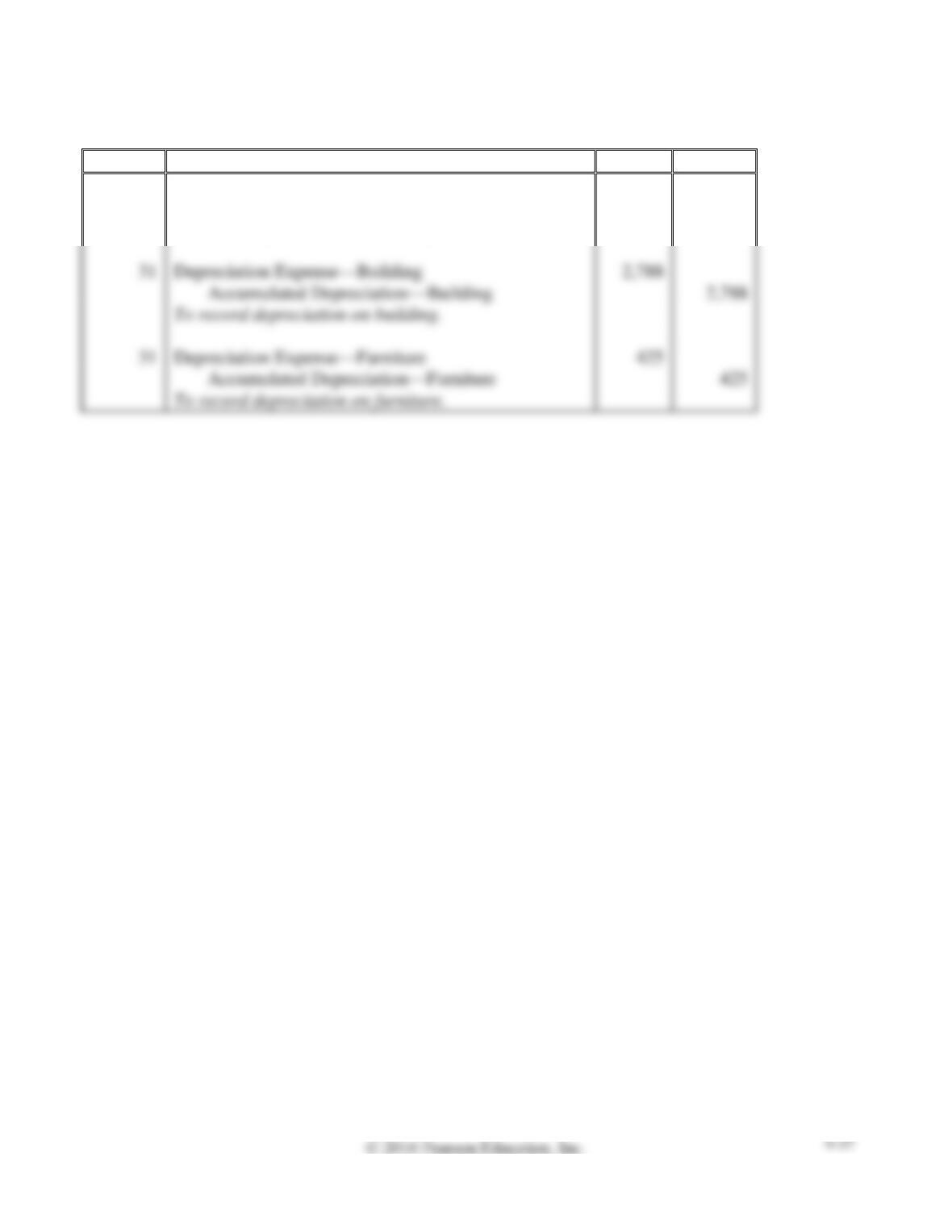
Date
Accounts and Explanation
Debit
Credit
Dec. 31
Depreciation Expense—Land Improvements
906
Accumulated Depreciation—Land Improvements
906
To record depreciation on land improvements.
Depreciation Expense—Building
Accumulated Depreciation—Building
To record depreciation on building.
Depreciation Expense—Furniture
425
Accumulated Depreciation—Furniture
425
To record depreciation on furniture.
P9-31A Determining asset cost, recording first-year depreciation, and identifying depreciation
results that meet management objectives
Learning Objectives 1, 2
1. Units-of-production, 12/31/16, Dep. Exp. $14,000
On January 3, 2016, Fast Delivery Service purchased a truck at a cost of $62,000. Before placing the
truck in service, Fast spent $3,000 painting it, $1,500 replacing tires, and $3,500 overhauling the engine.
The truck should remain in service for five years and have a residual value of $5,000. The truck’s annual
mileage is expected to be 28,000 miles in each of the first four years and 18,000 miles in the fifth year—
130,000 miles in total. In deciding which depreciation method to use, Steven Kittridge, the general
manager, requests a depreciation schedule for each of the depreciation methods (straight-line, units-of-
production, and double- declining-balance).
Requirements
1. Prepare a depreciation schedule for each depreciation method, showing asset cost, depreciation
expense, accumulated depreciation, and asset book value.
2. Fast prepares financial statements using the depreciation method that reports the highest net income
in the early years of asset use. Consider the first year that Fast uses the truck. Identify the
depreciation method that meets the company’s objectives.
SOLUTION
Requirement 1
Purchase price of truck
$ 62,000
Add related costs:
Painting
$ 3,000
Tires
1,500
Engine overhaul
3,500
8,000
Total cost of truck
$ 70,000
Depreciable cost = Cost − Residual value = $70,000 − $5,000 = $65,000
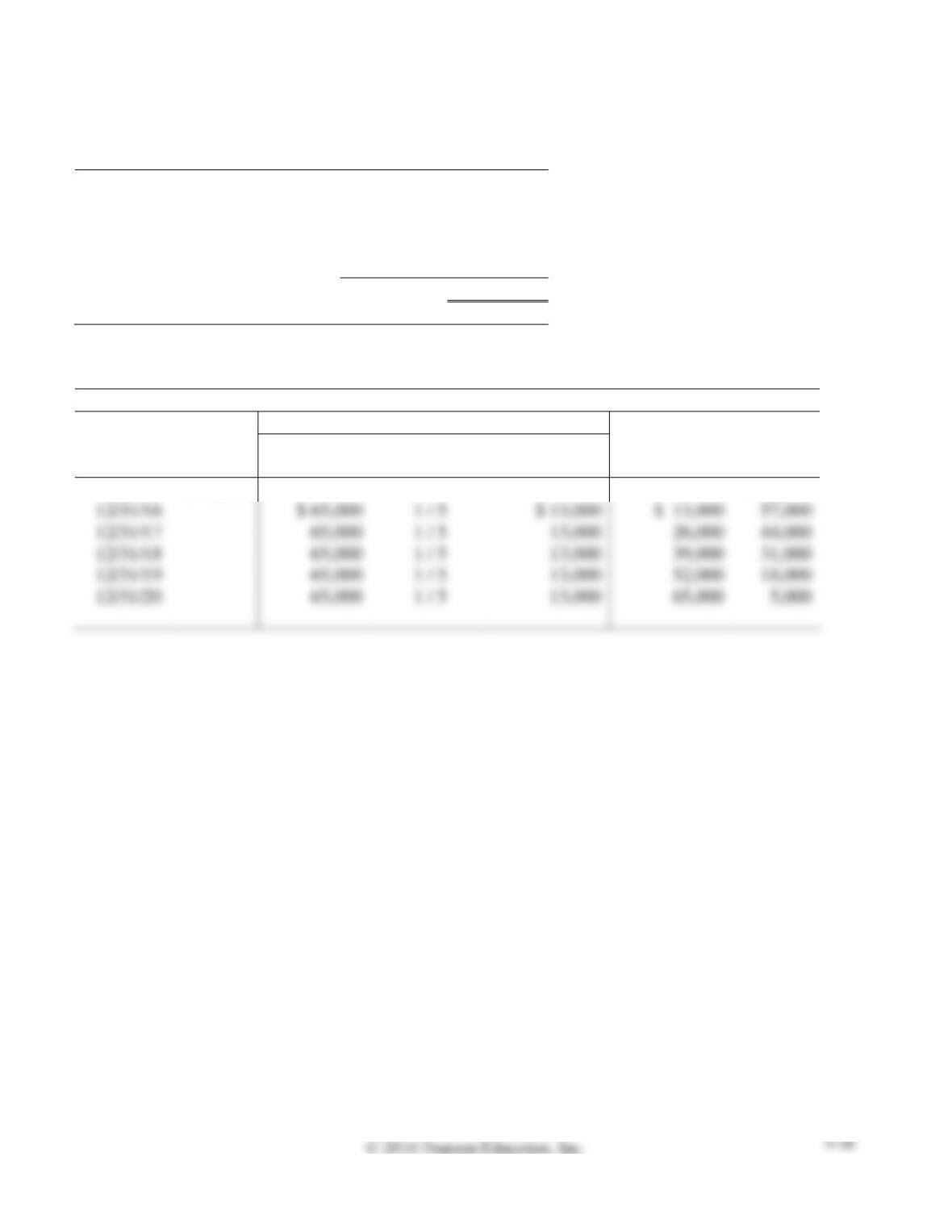
Straight-Line Depreciation Schedule
Depreciation for the Year
Date
Asset
Cost
Depreciable
Cost
Depreciation
Rate
Depreciation
Expense
Accumulated
Depreciation
Book
Value
1/03/16
$ 70,000
$ 70,000
1 / 5
1 / 5
1 / 5
1 / 5
1 / 5
P9-31A, cont.
Requirement 1, cont.
Depreciation per unit
=
(Cost – Residual value) / Useful life in units
=
($70,000 ̶ $5,000) / 130,000 miles
=
$0.50 per mile
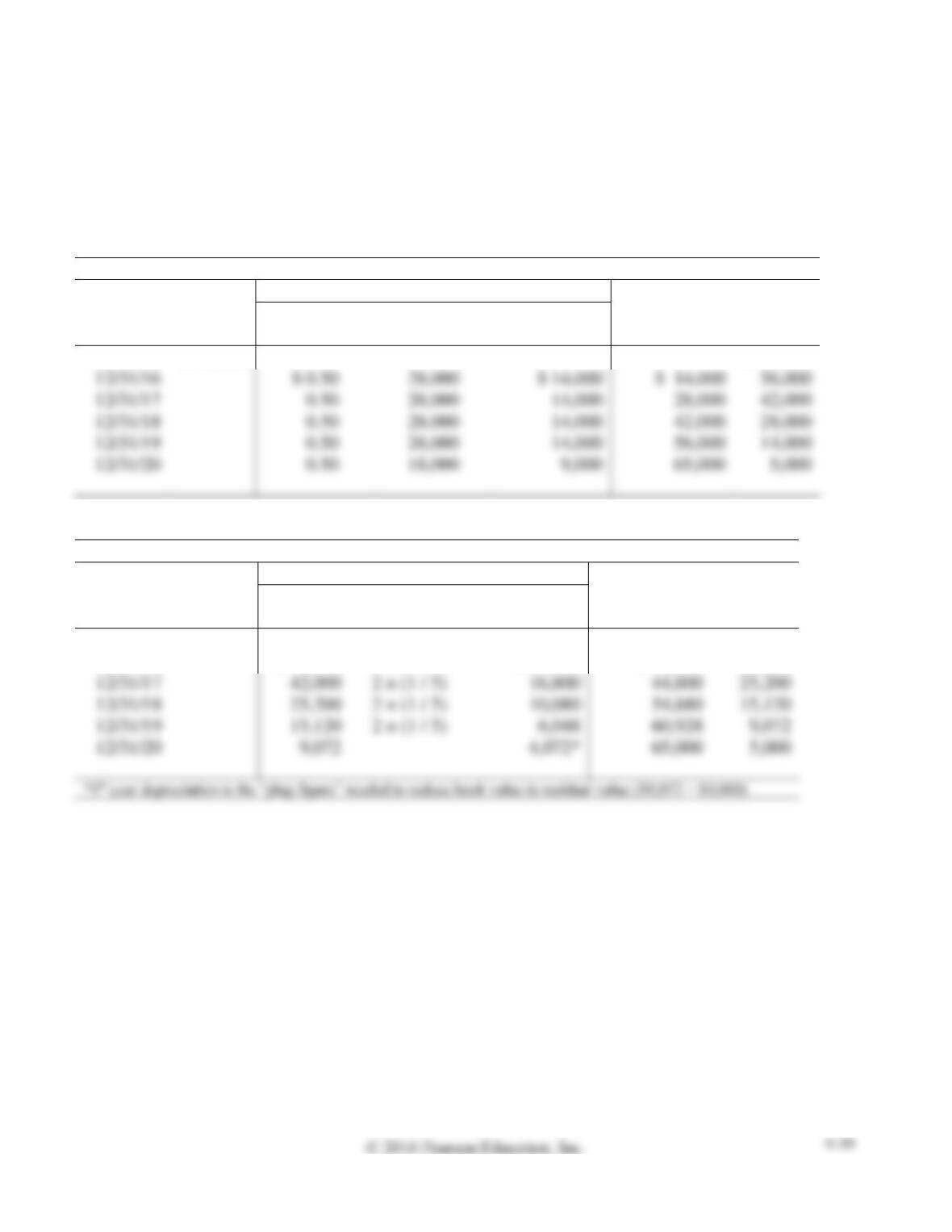
Units-of-Production Depreciation Schedule
Depreciation for the Year
Date
Asset
Cost
Depreciation
per Unit
Number
of Units
Depreciation
Expense
Accumulated
Depreciation
Book
Value
1/03/16
$ 70,000
$ 70,000
12/31/16
$ 14,000
12/31/17
12/31/18
12/31/19
12/31/20
Double-Declining-Balance Depreciation Schedule
Depreciation for the Year
Date
Asset
Cost
Book
Value
DDB
Rate
Depreciation
Expense
Accumulated
Depreciation
Book
Value
1/03/16
$ 70,000
$ 70,000
12/31/16
$ 70,000
2 × (1 / 5)
$ 28,000
$ 28,000
42,000
12/31/17
2 × (1 / 5)
25,200
12/31/18
2 × (1 / 5)
15,120
12/31/19
2 × (1 / 5)
12/31/20
Requirement 2
The depreciation method that reports the highest net income in the first year is the straight-line method.
It produces the lowest depreciation expense ($13,000) and therefore the highest net income.
P9-32A Recording lump-sum asset purchases, depreciation, and disposals
Learning Objectives 1, 2, 3
Sep. 1 Gain $88,000
Grace Carol Associates surveys American eating habits. The company’s accounts include Land,
Buildings, Office Equipment, and Communication Equipment, with a separate Accumulated
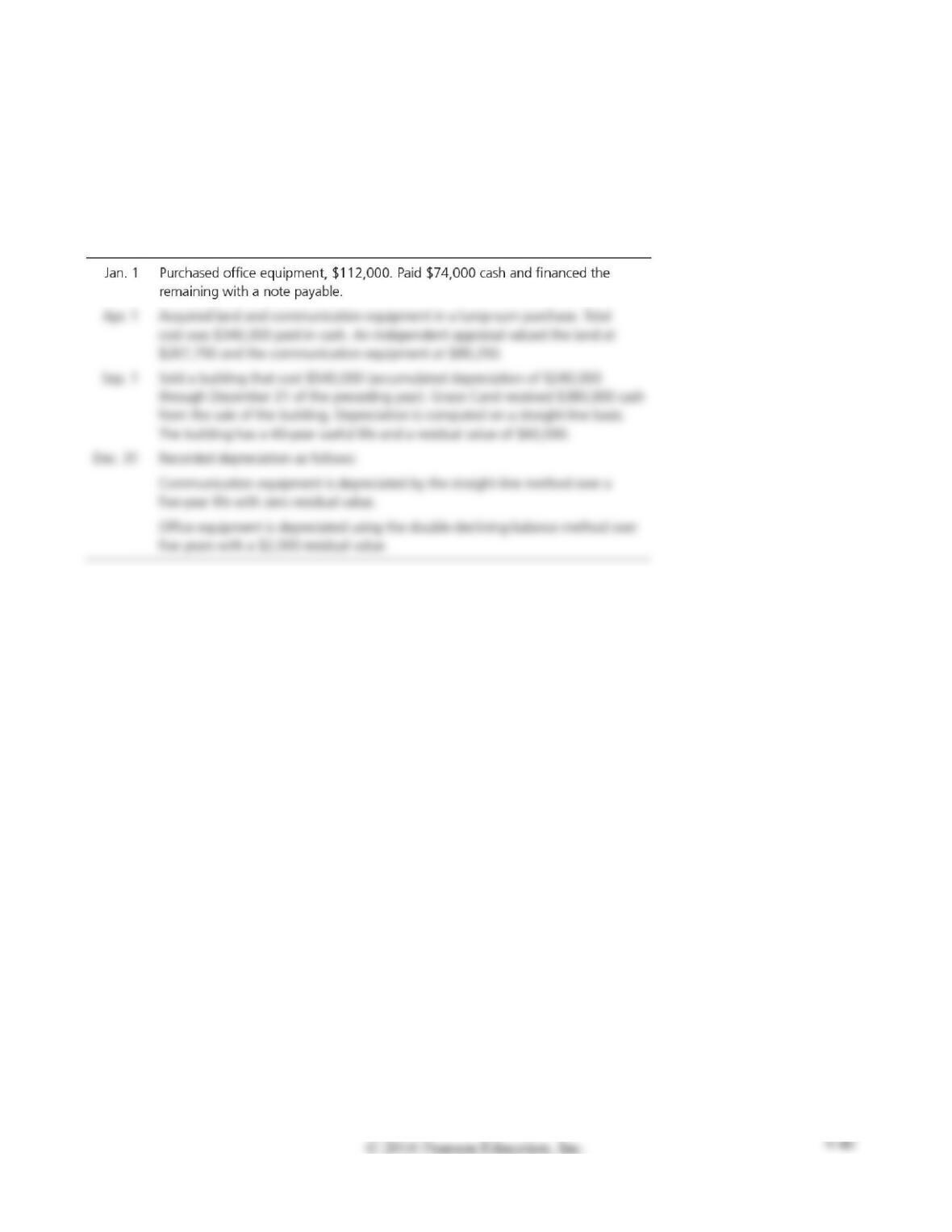
Depreciation account for each asset. During 2016, Grace Carol completed the following transactions:
Record the transactions in the journal of Grace Carol Associates.