9-61
*PROBLEM 9-13
(a)
Cost
Retail
Inventory (beginning) ………………….
$ 15,800
$ 24,000
Purchases ………………………………….
116,200
184,000
Markups …………………………………….
12,000
Totals ………………………………..
$132,000
220,000
Cost-to-retail ratio =
$132,000
= 60%
$220,000
Ending inventory at cost (60% X $39,500)
$ 23,700
(b)
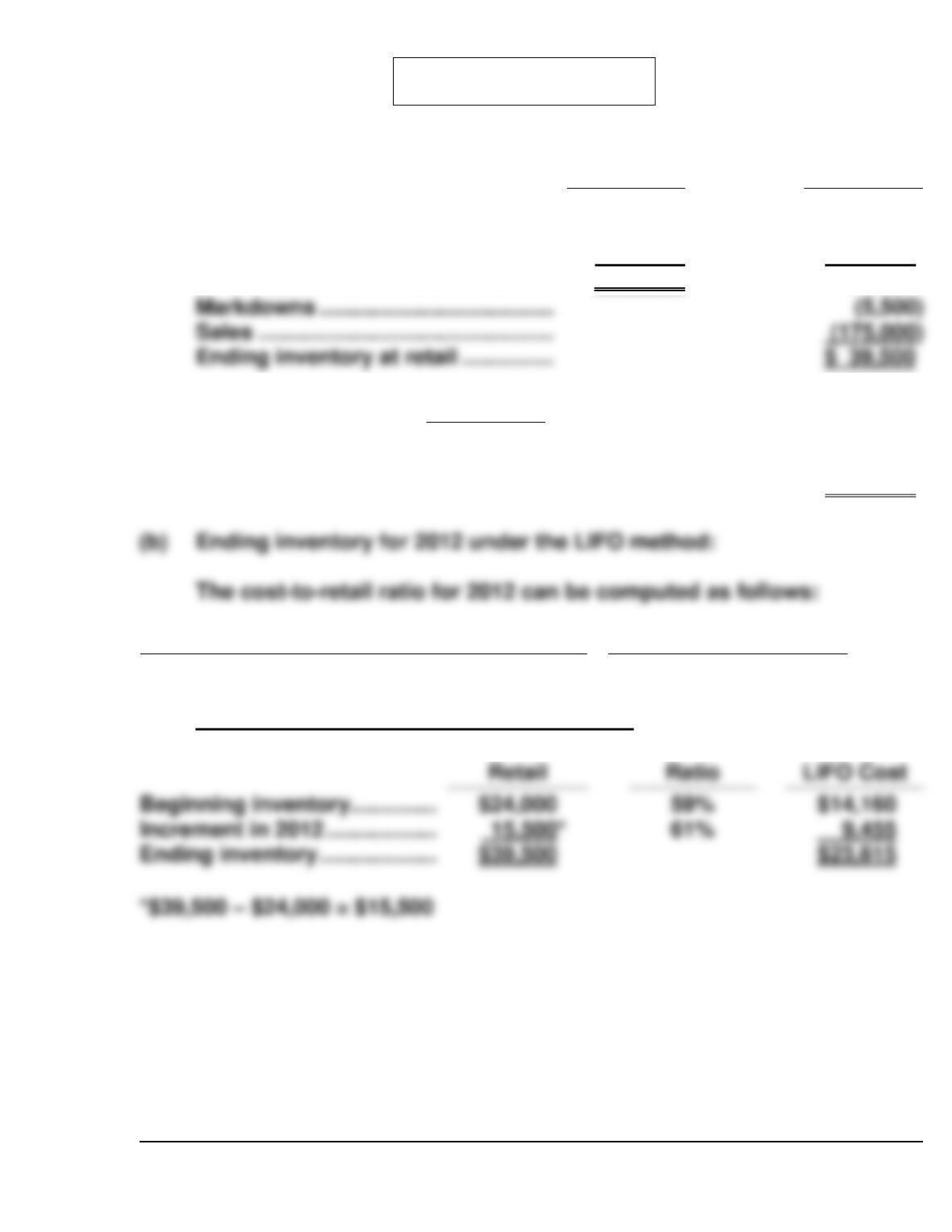
Ending inventory for 2012 under the LIFO method:
The cost-to-retail ratio for 2012 can be computed as follows:
Net purchases at cost
=
$116,200
= 61%
Net purchases plus markups less markdowns at retail
$184,000 + $12,000 – $5,500
December 31, 2012, inventory at LIFO cost:
Beginning inventory …………..
Increment in 2012 ………………
Ending inventory ……………….
*$39,500 – $24,000 = $15,500
Markdowns ………………………………..
Sales …………………………………………
9-62
*PROBLEM 9-14
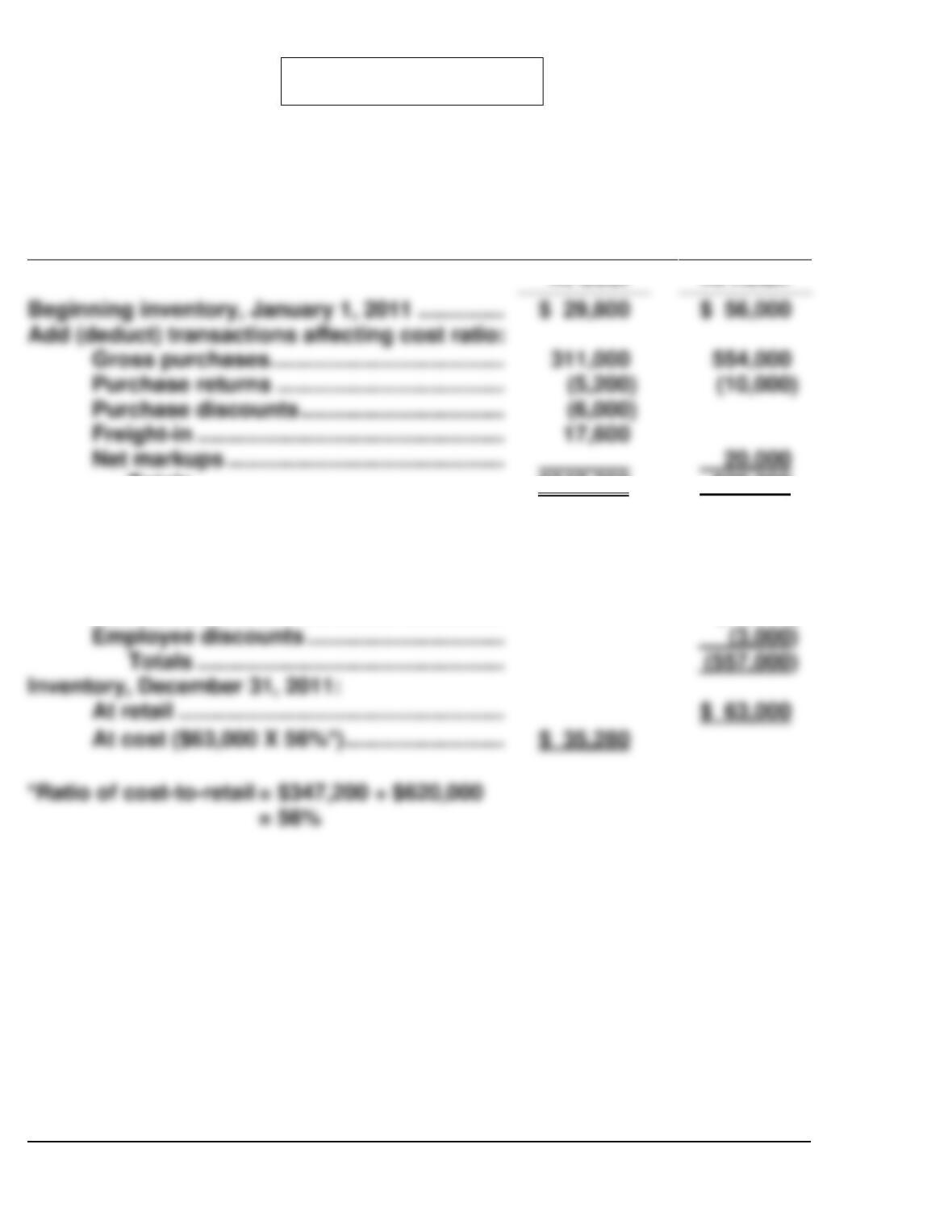
(a) DAVENPORT DEPARTMENT STORE
COMPUTATION OF COST
OF DECEMBER 31, 2011, INVENTORY
BASED ON THE CONVENTIONAL RETAIL METHOD
At Cost
At Retail
Totals …………………………………………..
$347,200
620,000
Add (deduct) other retail transactions not
considered in computation of cost ratio:
Gross sales ……………………………………….
(551,000)
Sales returns ……………………………………..
9,000
Net markdowns ………………………………….
(12,000)
Employee discounts …………………………..
Totals …………………………………………..
Inventory, December 31, 2011:
At retail ……………………………………………..
$ 63,000
At cost ($63,000 X 56%*) ……………………..
$ 35,280
Beginning inventory, January 1, 2011 …………..
Add (deduct) transactions affecting cost ratio:
Gross purchases ………………………………..
Purchase returns ……………………………….
Purchase discounts …………………………...
Freight-in …………………………………………..
Net markups ………………………………………
9-63
*PROBLEM 9-14 (Continued)
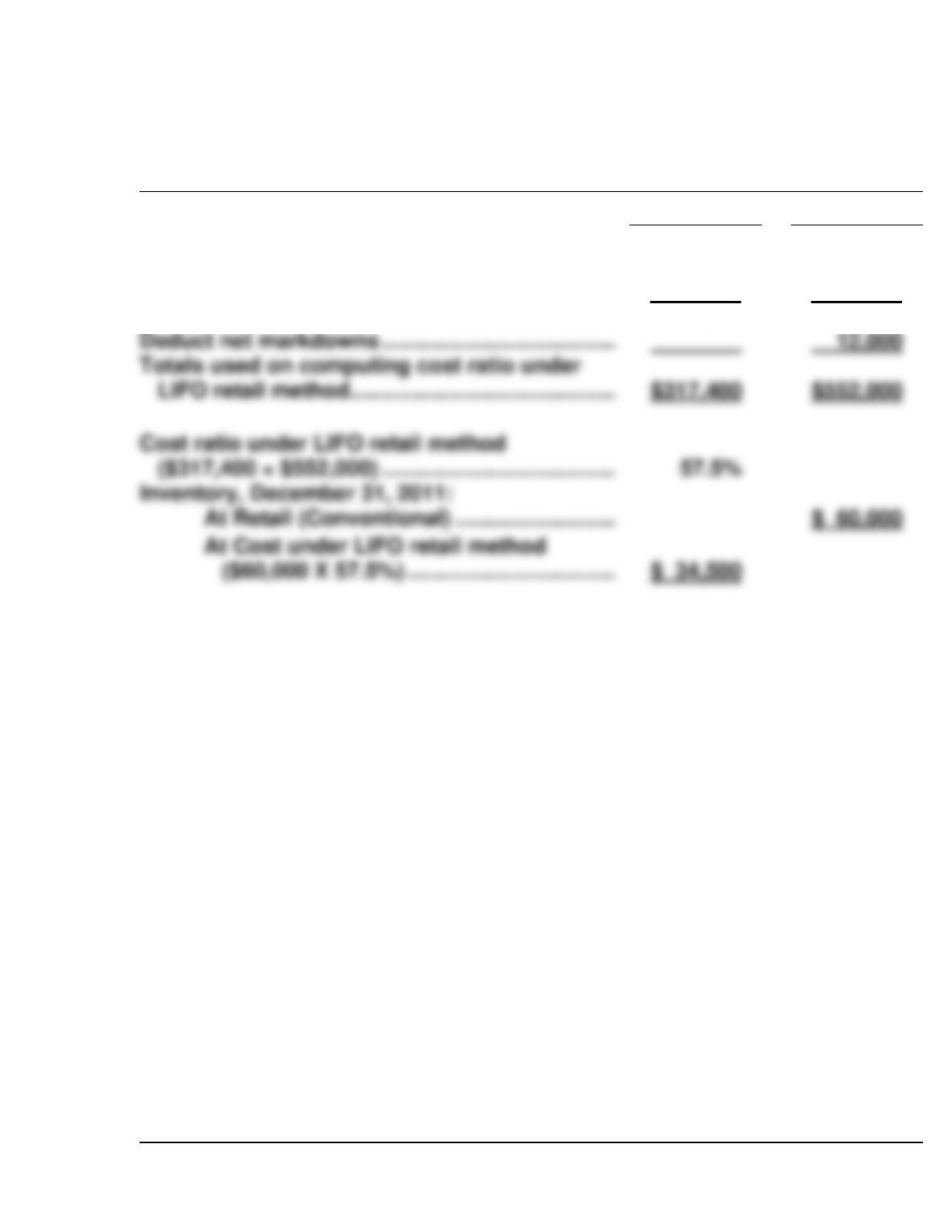
(b) COMPUTATION OF COST
OF DECEMBER 31, 2011 INVENTORY
UNDER THE LIFO RETAIL METHOD
Cost
Retail
Totals used in computing cost ratio under
conventional retail method (part a) …………….
$347,200
$620,000
Exclude beginning inventory ……………………….
29,800
56,000
Net purchases …………………………………………….
317,400
564,000
Deduct net markdowns ………………………………..
12,000
Totals used on computing cost ratio under
Cost ratio under LIFO retail method
($317,400 ÷ $552,000) ………………………………..
Inventory, December 31, 2011:
At Cost under LIFO retail method
*PROBLEM 9-14 (Continued)
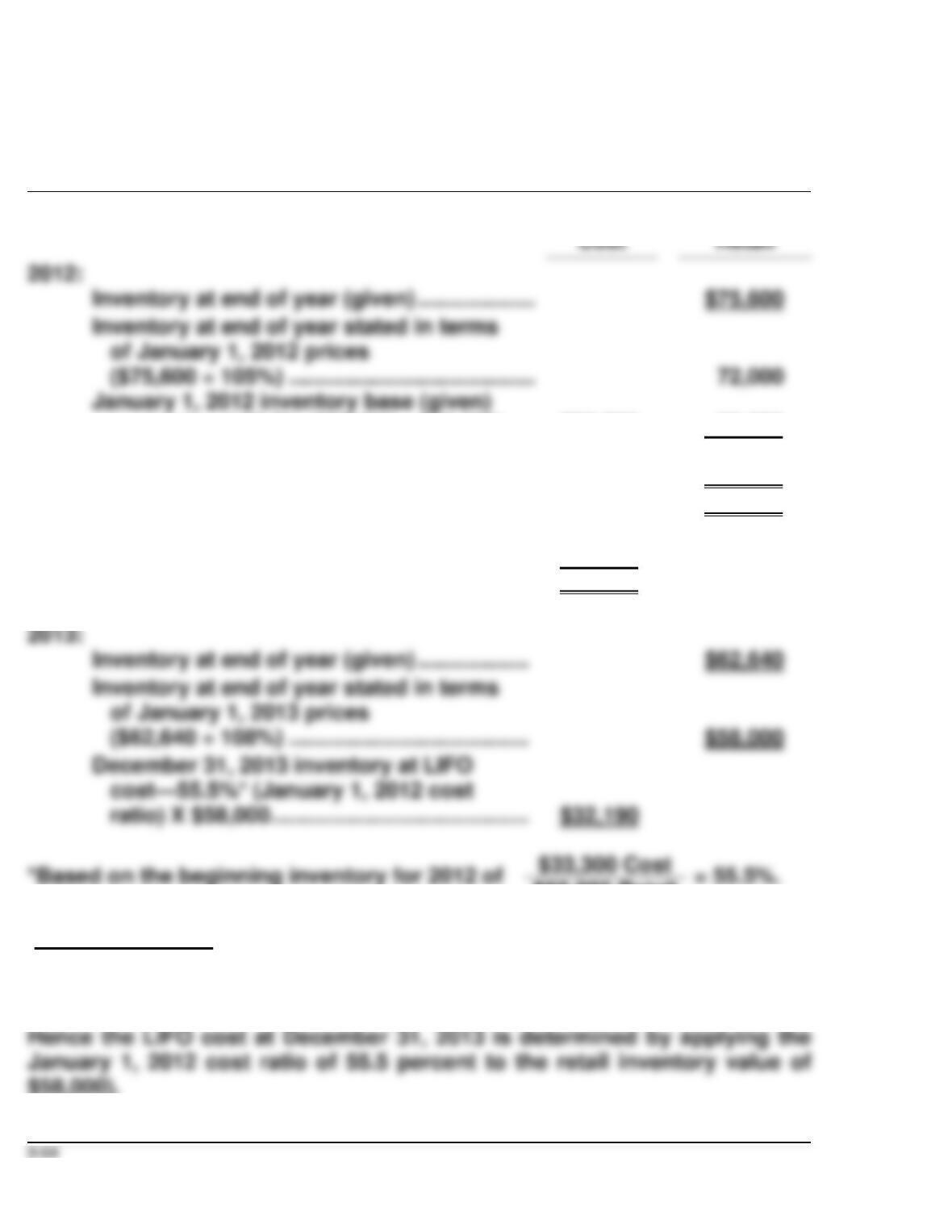
(c) COMPUTATION OF 2012 AND 2013
YEAR-END INVENTORIES
UNDER THE DOLLAR-VALUE LIFO METHOD
Computation of retail values on the basis of January 1, 2012, price levels
Inventory at end of year (given) ……………….
$75,600
Inventory at end of year stated in terms
of January 1, 2012 prices
($75,600 ÷ 105%) ………………………………….
January 1, 2012 inventory base (given)
cost ratio of 55.5% ($33,300 ÷ $60,000) ….
$33,300
60,000
Increment in inventory:
In terms of January 1, 2012 prices ……………
$12,000
In terms of 2012 prices—$12,000 X 105%….
$12,600
At LIFO cost—61% (2012 cost ratio) X
$12,600 ………………………………………………..
7,686
December 1, 2012 inventory at LIFO cost …………..
$40,986
Inventory at end of year (given) ………………
$62,640
Inventory at end of year stated in terms
of January 1, 2013 prices
($62,640 ÷ 108%) …………………………………
$58,000
December 31, 2013 inventory at LIFO
cost—55.5%* (January 1, 2012 cost
ratio) X $58,000 ……………………………………
$32,190
$33,300 Cost
$60,000 Retail
(Note to instructor: Because the retail inventory stated in terms of January 1,
2012 prices at December 31, 2012, $58,000, has fallen below the January 1,
2013 inventory base at retail, $60,000, under the LIFO theory the 2013 layer
has been depleted and only a portion of the original inventory base remains.

9-65
TIME AND PURPOSE OF CONCEPTS FOR ANALYSIS
CA 9-1 (Time 15–25 minutes)
Purpose—to provide the student with an opportunity to discuss the purpose, the application, and the
potential disadvantages of the lower-of–cost–or-market method. In addition, the student is asked to
discuss the ceiling and floor constraints for determining “market” value.
CA 9-2 (Time 20–30 minutes)
Purpose—to provide the student with an opportunity to examine ethical issues related to lower–of-cost-
or-market on an individual-product basis. A relatively straightforward case.
CA 9-3 (Time 15–20 minutes)
Purpose—to provide the student with a case that requires an application and an explanation of the
lower-of-cost-or-market rule and a differentiation of the LIFO and the average cost methods.
CA 9-4 (Time 25–30 minutes)
Purpose—to provide the student with an opportunity to discuss the main features of the retail inventory
system. In this case, the following must be explained: (a) accounting features of the method, (b) conditions
that may distort the results under the method, (c) advantages of using the retail method versus using a
cost method, and (d) the accounting theory underlying net markdowns and net markups. A relatively
straightforward case.
CA 9-5 (Time 15–25 minutes)
Purpose—the student discusses which costs are inventoriable, the theoretical arguments for the lower–
of-cost-or-market rule, and the amount that should be used to value inventories when replacement cost
is below the net realizable value less a normal profit margin. The treatment of beginning inventories and
net markdowns when using the conventional retail inventory method must be explained.
CA 9-6 (Time 10–15 minutes)
Purpose—to provide the student with a case that allows examination of ethical issues related to the
recording of purchase commitments.
*CA 9-7 (Time 10–15 minutes)
Purpose—to provide the student with a number of items that might be encountered when a conventional
retail or LIFO retail problem develops. The student must determine whether items, such as markdowns,
markdown cancellations, sales discounts, etc. should be considered in computing the cost-to-retail
percentage.
SOLUTIONS TO CONCEPTS FOR ANALYSIS
CA 9-1
(a) The purpose of using the lower-of-cost-or-market method is to reflect the decline of inventory value
below its original cost. A departure from cost is justified on the basis that a loss of utility should be
reported as a charge against the revenues in the period in which it occurs.
(c) The lower-of-cost-or-market method may be applied either directly to each inventory item, to a
category, or to the total inventory. The application of the rule to the inventory total, or to the total
components of each category, ordinarily results in an amount that more closely approaches cost
than it would if the rule were applied to each individual item. Under the first two methods,
increases in market prices offset, to some extent, the decreases in market prices. The most
common practice is, however, to price the inventory on an item–by-item basis. Companies favor
the individual item approach because tax rules require that an individual item basis be used unless
it involves practical difficulties. In addition, the individual item approach gives the most conservative
valuation for balance sheet purposes.
Net realizable value reflects the future service potential of the asset and, for that reason, it is
conceptually sound. But net realizable value cannot often be measured with any certainty.
Therefore, we revert to replacement cost because net realizable value less a normal markup is
9-67
CA 9-2
(a) The accountant’s ethical responsibility is to provide fair and complete financial information. In this
case, the direct method distorts the cost of goods sold and hides the decline in market value.
CA 9-3
(a) 1. Ogala’s inventory should be reported at net realizable value. According to the lower-of-cost-or–
market rule, market is defined as replacement cost. However, market cannot exceed net
realizable value. In this instance, net realizable value is below original cost.
2. The lower-of-cost-or-market rule is used to report the inventory in the balance sheet at its
future utility value. It also recognizes a decline in the utility of inventory in the income state-
ment in the period in which the decline occurs.
CA 9-4
(a) The retail inventory method can be employed to estimate retail, wholesale, and manufacturing
finished goods inventories.
CA 9-4 (Continued)
(b) Since the retail method is based on an estimated cost ratio involving total merchandise available
during the period, its validity depends on the underlying assumption that the merchandise in
ending inventory is a representative mixture of all merchandise handled. If this condition does not
exist, the cost ratio may not be appropriate for the merchandise in ending inventory and can result
in significant error.
Material quantities of special sale merchandise handled during the period may also bias the result
of this method because merchandise data included in arriving at the estimated cost ratio may
not be proportionately represented in ending inventory. This condition may be avoided by
accumulating special sale merchandise data in separate accounts.
Distortion of the ending inventory approximation under this method is often caused by an inadequate
system of inventory control. Adequate accounting controls are necessary for the accurate
accumulation of the data needed to arrive at a valid cost ratio. Physical controls are equally important
because, for interim purposes, this method is usually applied without taking a physical inventory.
(d) The treatments to be accorded net markups and net markdowns must be considered in light of
their effects on the estimated cost ratio. If both net markups and net markdowns are used in
arriving at the cost ratio, ending inventory will be converted to an estimated average cost figure.
Excluding net markdowns will result in the inventory being stated at an estimate of the lower-of–
cost-or-market.
9-69
CA 9-5
(a) 1. Olson’s inventoriable cost should include all costs incurred to get the lighting fixtures ready for
sale to the customer. It includes not only the purchase price of the fixtures but also the other
associated costs incurred on the fixtures up to the time they are ready for sale to the customer,
for example, freight-in.
2. The net realizable value less a normal profit margin should be used to value the inventories
because market should not be less than net realizable value less a normal profit margin. To
carry the inventories at net realizable value less a normal profit margin provides a means of
measuring residual usefulness of an inventory expenditure.
CA 9-6
(a) Accounting standards require that when a contracted price is in excess of market, as it is in this
case (market is $5,000,000 and the contract price is $6,000,000), and it is expected that losses will
occur when the purchase is effected, losses should be recognized in the period during which such
declines in market prices take place. It would be unethical to ignore recognition of the loss now if a
loss is expected to occur when the purchase is effected.
9-70
*CA 9-7
(a)
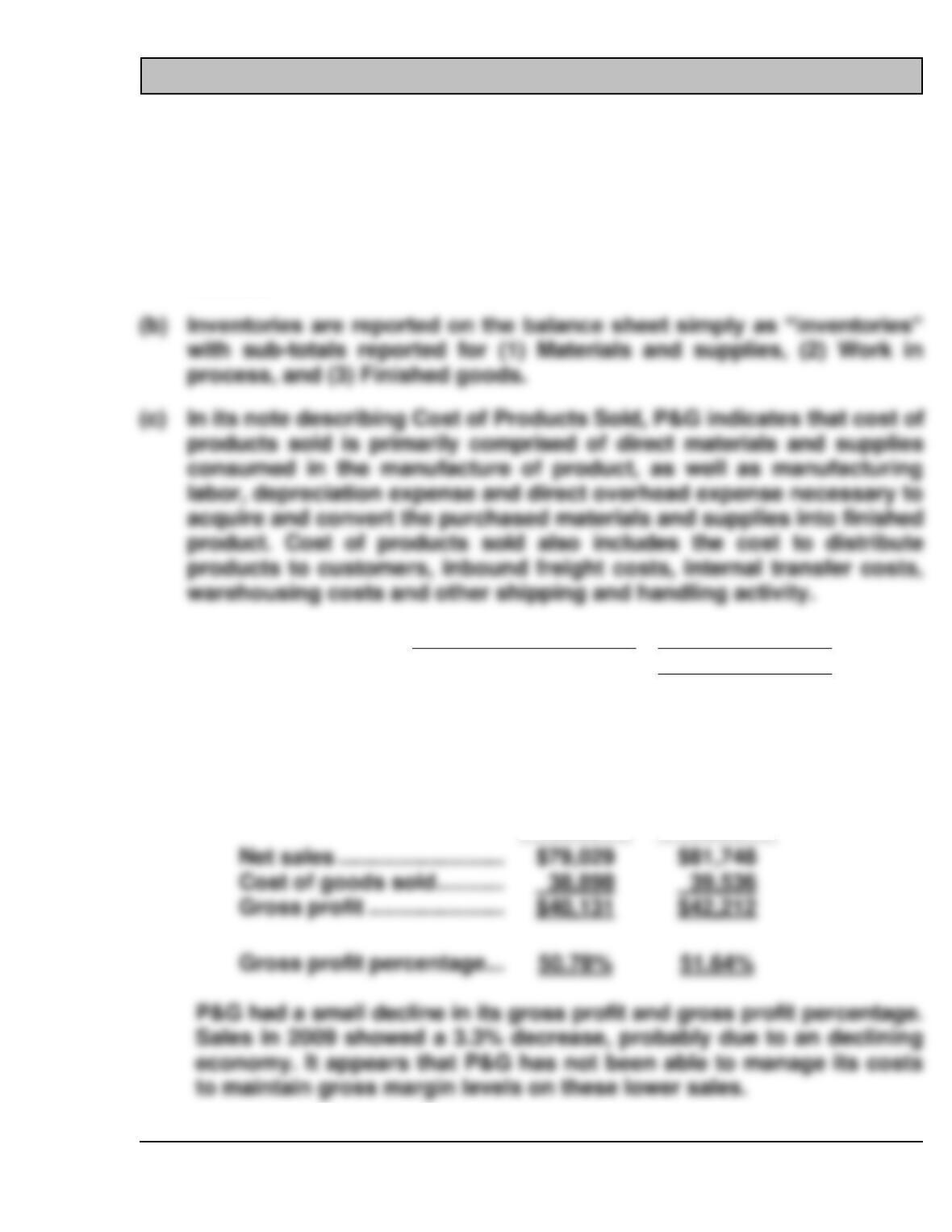
Conventional retail
(b)
LIFO retail
3.
Cost of items transferred in from
1.
Markdowns.
other departments.
2.
Markdown cancellations.
4.
Retail value of items transferred in
3.
Cost of items transferred in from
(Note to instructor: If the goods broken or stolen are abnormal shrinkage, they are deducted from
both the cost and retail columns.)
from other departments.
other departments.
6.
Purchase discounts.
4.
Retail value of items transferred in
8.
Cost of beginning inventory.
from other departments.
9.
Retail value of beginning
6.
Purchase discounts.
inventory.
Cost of purchases.
Cost of purchases.
Retail value of purchases.
Retail value of purchases.
Markups.
Markups.
Markup cancellations.
Markup cancellations.
9-71
FINANCIAL REPORTING PROBLEM
(a) Inventories are valued at the lower-of–cost-or-market value. Product-
related inventories are primarily maintained on the first-in, first-out
method. Minor amounts of product inventories, including certain cos-
metics and commodities are maintained on the last-in, first–out method.
The cost of spare part inventories is maintained using the average cost
method.
(d)
Inventory turnover =
Cost of Goods Sold
=
$38,898
Average Inventory
$6,880 + $8,416
2
= 5.09 or approximately 72 days to turn its inventory, which is a
relatively the same as 2008 (5.19 or 70 days).
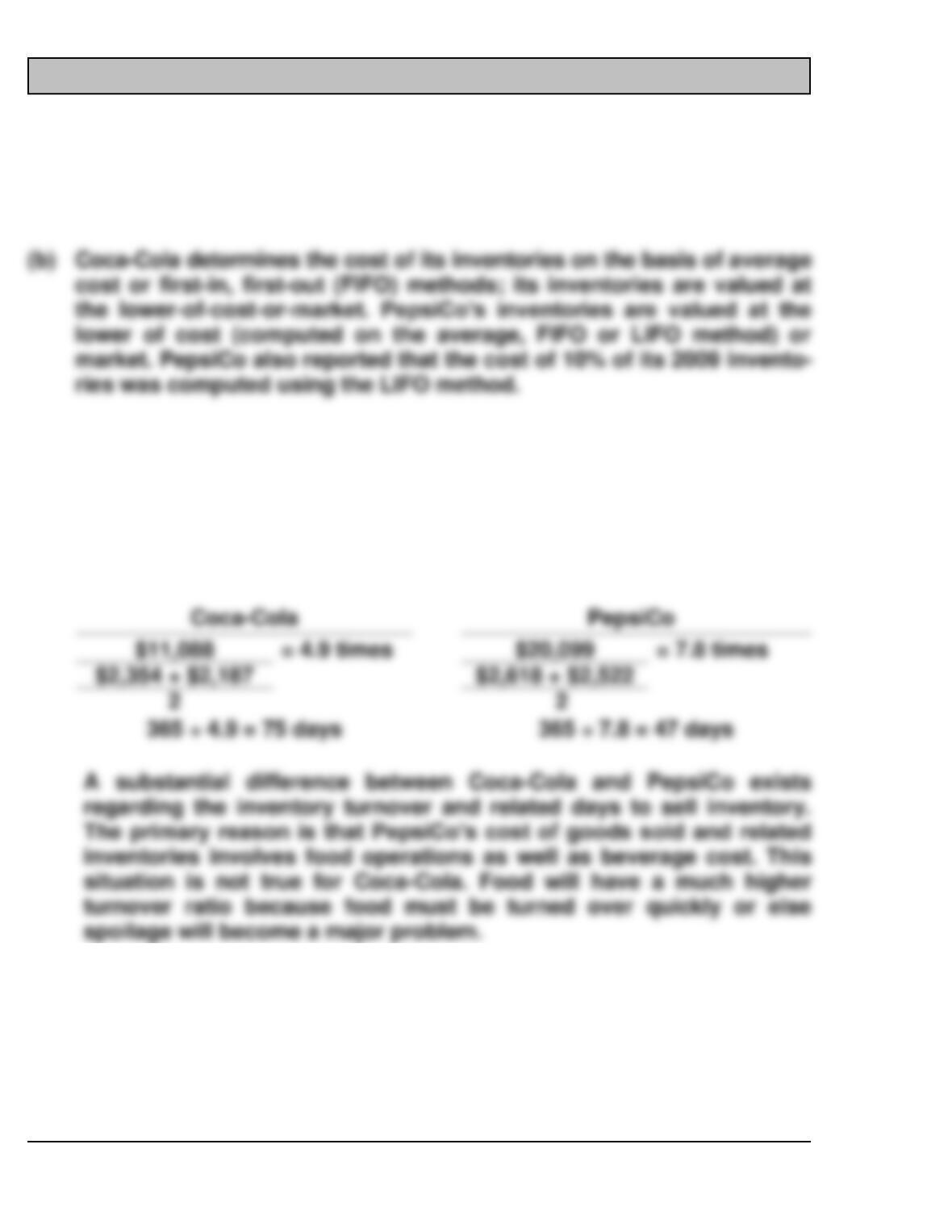
Its gross profit percentages for 2009 and 2008 are as follows:
2009
2008
Cost of goods sold ………..
Gross profit ………………….
Gross profit percentage …
9-72
COMPARATIVE ANALYSIS CASE
(a) Coca–Cola reported inventories of $2,354 million, which represents 4.8%
of total assets. PepsiCo reported inventories of $2,618 million, which
represents 6.6% of its total assets.
(c) Coca-Cola classifies and describes its inventories as primarily raw
materials and packaging and finished goods. PepsiCo classifies and
describes its inventories as (1) raw materials, (2) work-in-process and
(3) finished goods.
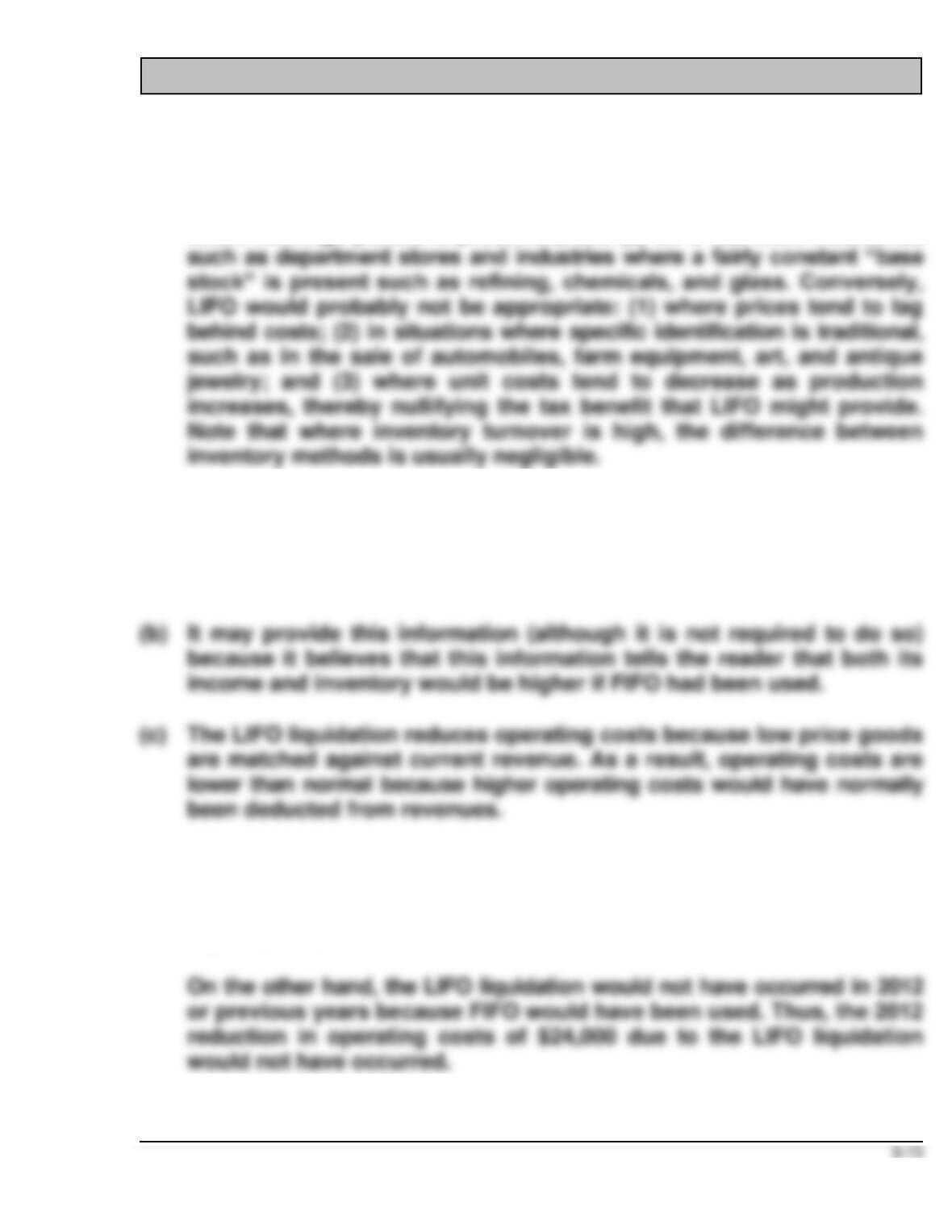
(d) Inventory turnover ratios and days to sell inventory for 2009:
FINANCIAL STATEMENT ANALYSIS CASE 1
(a) Although no absolute rules can be stated, preferability for LIFO can
ordinarily be established if (1) selling prices and revenues have been
increasing, whereas costs have lagged, to such a degree that an unre–
alistic earnings picture is presented, and (2) LIFO has been traditional,
In this case, it is impossible to determine what conditions exist, but it
seems probable that the characteristics of certain parts of the inventory
make LIFO desirable, whereas other parts of the inventory provide
higher benefits if FIFO is used.
(d) It would probably have reported more income if it had been on a FIFO
basis. For example, its inventory as of December 31, 2012 was stated
at $1,635,040. Its inventory under FIFO would have been $364,960
higher (2012) if FIFO had been used.