Leading Across Cultures
at Michelin
TEACHING NOTE
409-008-8
The Cases
The Leading Across Cultures series has three parts:
A From Clermont-Ferrand to Greenville
B Awareness to action
C Strategies for cross-cultural effectiveness
The case follows the French executive Olivier Chalon as he struggles to adapt his leadership
style to an American cultural context. In Case (A), Chalon is approached by the head of
Human Resources North America and told that his management style is not appreciated by his
Target Audience
This case is appropriate for any individuals interested in improving their ability to work more
effectively in cross-cultural or multi-cultural business settings. It can be used both for MBA
Teaching Objectives
This is a case about cross-cultural leadership. It helps students and executives to better
understand the types of challenges that can arise when conducting business across national
cultures. The case is written from the perspective of a European executive. It illustrates a
number of cultural elements that typically impact Europeans when working with Americans
409-008-8
Beyond illustrating differences in European and American business cultures, the case is
intended to:
1. Help participants of any nationality understand the complexity of leading in a multi-
cultural environment
Session Format
We usually entitle the session “Conducting Business Across Cultures”, “Managing Cross-
Cultural Teams”, “Leading Across Cultures” or simply “Communicating Across Culturals”.
Cases (A), (B) and (C) can be taught in the same 4-hour session for an Executive Education
management.
Session Description for MBAs and Executive Education
In a session devoted to cross-cultural management, the case study follows a Michelin
executive, Olivier Chalon, as he struggles to adapt his leadership style to an American
context. While discussing the case we explore topics related to motivating employees,
providing constructive feedback and relationship-building techniques in order to begin to
Possible Assignment Questions
Participants are invited to reflect on the following questions while reading Case (A):
1. What mistakes did Chalon make as he took over this large North American division?
2. What differences in American value systems and French value systems might be at the
root of the difficulties Chalon is facing as he implements a new strategy?
409-008-8
01/2009-5538
Participants are invited to reflect on the following questions while reading Case (B):
1. Now that Chalon is aware of how his American staff perceive his management style, what
steps would you recommend that he take in order to improve the way he motivates his
staff?
Session Timeline
We use this case in a four-hour slot or two shorter sessions. The following is a suggested class
timeline.
0:00 – 0:15 Session introduction
0:15 – 0:45 Small group discussions of Case (A)
0:45 – 2:15 Large group Case (A) discussion and exploration of cultural dimension
impacting the case.
Case Analysis
The following sub-sections explore Cases (A), (B) and (C) in detail.
Main discussion questions – useful to open major areas of the discussion
409-008-8
01/2009-5538
Case (A): From Clermont-Ferrand to Greenville
After a short introduction, split participants into small groups and ask them to discuss the
Case (A) assignment questions.
When the groups return to the class, ask one or two groups to present their responses to the
Case (A) assignment questions. Probe groups to think further by asking:
In what way are American managers trained to give positive and negative feedback?
How do these feedback preferences differ from those of other cultures (i.e., Japan, France,
Germany or Mexico).
1. Implicit positive feedback and more direct negative feedback
2. Expectation that, when criticised, an employee will push back and defend his position,
leading to a debate that will help clarify the situation for both the manager and employee
3. Absence of personal details during office talk.
Chalon’s American colleagues display behaviour that is indicative of an American
management style:
1. Providing and expecting a good deal of explicit positive feedback
Draw out examples from European students in the group who may have been surprised
to experience how much American’s praise one another in a management setting. Encourage
participants from various backgrounds to speak openly about their perceptions.
Europeans may experience the American feedback style as empty or difficult to
409-008-8
01/2009-5538
Americans may share experiences about working for a manager who is less focused on
positive feedback and more blunt in his negative feedback (“We all felt he was arrogant. No
one liked working for him.” Or perhaps – “We came to appreciate that when he said
something positive, you could take that compliment very seriously”).
In teaching this case study, our experience has been that some students will disagree that
the French management feedback style is direct. The fact that the French are much more
implicit (or “high-context” as defined by Edward Hall’s writing and research on cross-cultural
communication) in their general communication patterns leads to a stereotyping of the French
as having an indirect feedback style.1 This is, in fact, one of the reasons why this case raises
such interesting debate. If Chalon were Dutch or German (cultures that are stereotyped by
communication styles is presented in relation to other cultures. Cultural perceptions are
relative; while some cultures may perceive the Americans as showering employees with
positive feedback, others may perceive them as providing little positive encouragement. It is
also important that class discussion does not dwell on national stereotypes but addresses the
fact that what is considered appropriate by one culture can be misinterpreted by members of
another culture, leading to costly workplace conflicts. Chalon’s interactions with his
colleagues are driven by culturally derived ideas about communication, providing feedback
and motivating subordinates, and would be considered appropriate workplace behaviours in
their respective countries of origin.
409-008-8
01/2009-5538
Case (A) continued: Further Background Comparing the American and
French Normative Communication Styles
What aspects of French and American corporate culture might have led Chalon’s
leadership style to be considered appropriate and positive by one cultural group but
demoralising and inappropriate by another?
What cultural differences are at the root of these various leadership styles? What is it
about the history of the American people or the history of the French people that have led to
these different cultural norms?
Research indicates that Americans have one of the most explicit (or lowest-context)
While their explicit communication style gives Americans a reputation for lacking
subtlety, often Europeans are surprised to come across a second American communication
Because of the strong emphasis American society places on risk-taking and fostering self-
esteem, modern-day American childrearing goes to extreme lengths to ensure that children
feel competent and confident. This includes showering the child with positive recognition
and providing any necessary criticism in a delicate way. In businesses settings, managers
carry on this motivational role, “catching employees doing things right” and providing
“three positives for every negative” when giving feedback.
409-008-8
01/2009-5538
The French educational system instills, from an early age, respect for logical, analytical
thinking, along with a mindset that values nuance and complexity. The French school
environment is often quite demanding, with children competing against one another for
selective rankings from an early stage. During evaluations, teachers (and later, managers)
tend to focus on what can be improved, not what the student (or employee) already does well.
After debriefing the assignment questions, we usually take 30 minutes to present and
discuss the main cultural dimensions impacting the case. If the information on pages 6 and
7 about the roots of the cultural differences has not come out in the debrief discussion, we
present that information as we go through the cultural dimensions.
Further explanations of the various cultural dimensions impacting Chalon’s challenges are
outlined below:
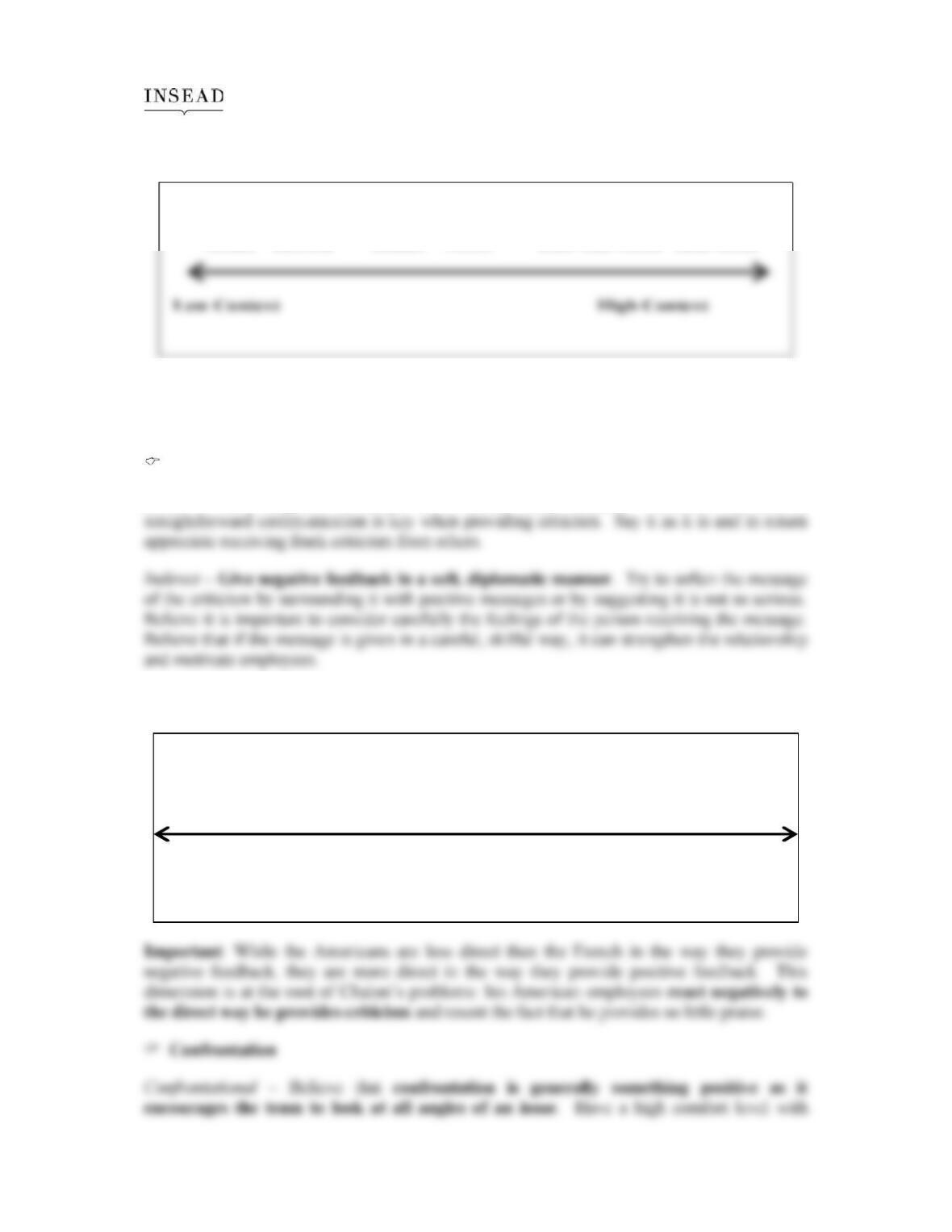
Context Dimension:
Low Context – Believe that good communication is clear, simple, explicit. Take words at
face value and don’t try to understand hidden meanings or to read between the lines. Believe
409-008-8
01/2009-5538
Sample country placements on a low- to high- context scale might be:
US Dutch UK Finland Russia Kenya China Japan
Canada Germany Sweden Poland Brazil Italy France Saudi Korea
Important: Differences in low- and high-context communication patterns lead to the
stereotyped impressions that Americans are direct communicators and the French are indirect
communicators.
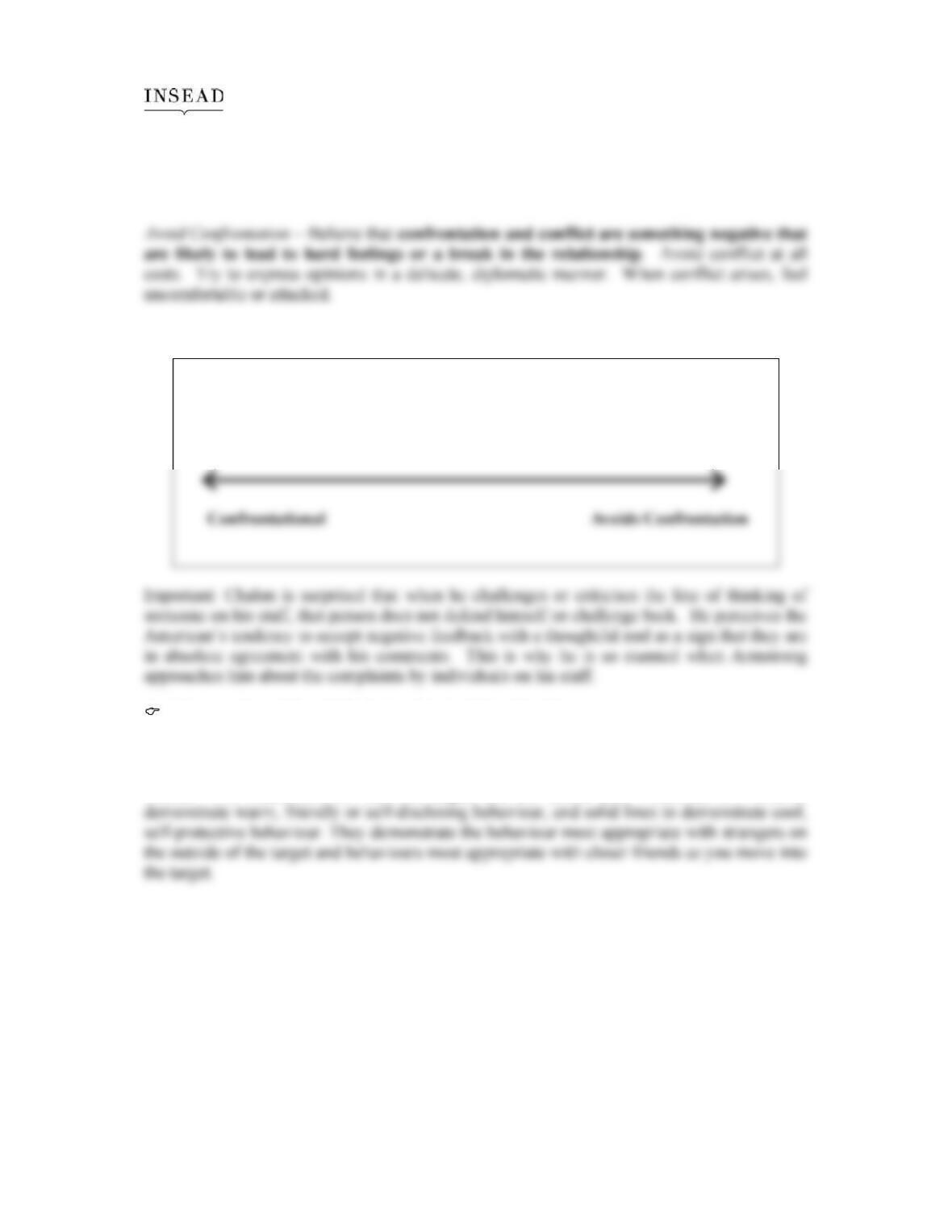
Negative Feedback
Direct – Give negative feedback in a clear, frank manner. Believe that honest,
Sample country placements on a Negative Feedback scale might be:
Direct Indirect
Germany France Denmark US UK Portugal Saudi Japan
Dutch Russia Belgium Brazil Mexico Korea China
409-008-8
01/2009-5538
debate and disagreement. May play devil’s advocate in order to encourage a lively
discussion. May appear to other cultures to be arguing, although this level of disagreement
causes no hard feelings or rift in the relationship among the parties discussing.
Sample country placements on a Confrontation scale might be:
Germany Dutch Denmark U.S. Portugal UK HK Saudi Japan
Israel France Russia Canada Italy Brazil Mexico India China Nigeria
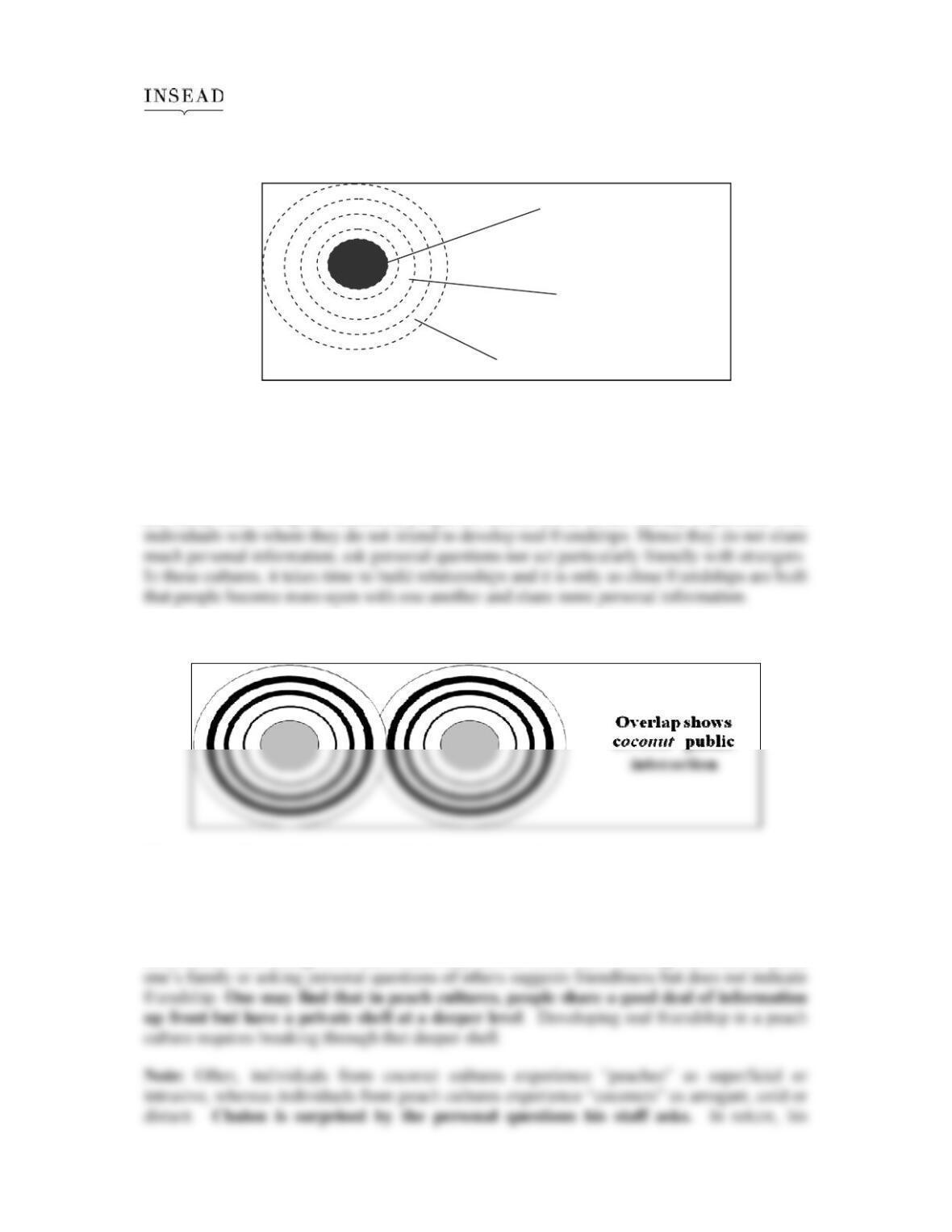
“Coconut” vs. “Peach” Relationship-building Models:
The models below can be used as a teaching tool to demonstrate how different cultures have
different ideas about what is appropriate behaviour towards strangers, colleagues, and close
friends. The models (which look like targets and are named after fruits) use thin lines to
409-008-8
01/2009-5538
Example:
Coconut Cultures: (Soft on the inside/ Hard shell on the outside)
Coconut cultures build relationships from the outside in. In coconut cultures (such as France
and many other European countries), people are careful not to be too friendly or personal with
Illustration of how relationships are built in coconut cultures.
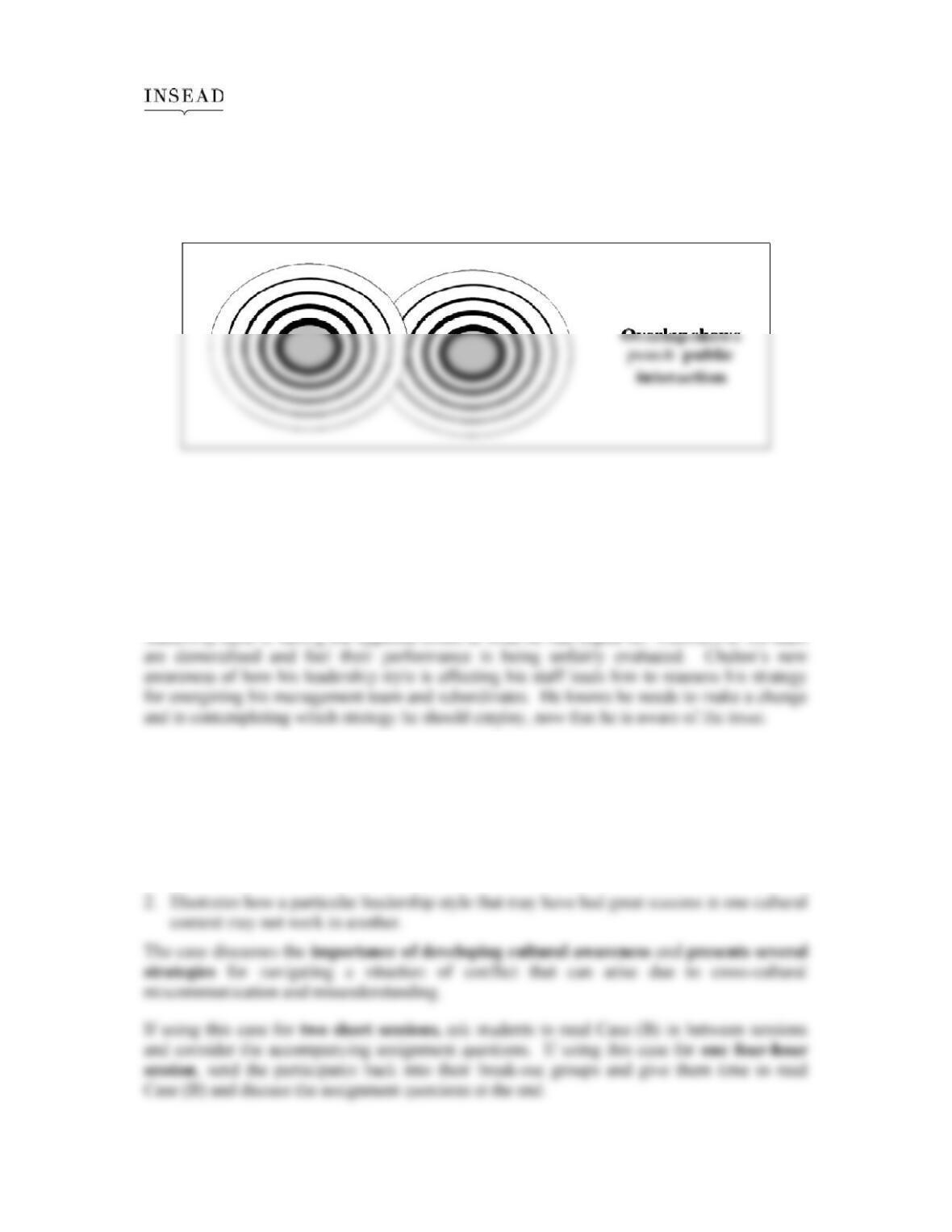
Peach Cultures: (Soft on the outside/ Hard shell part way inside)
In a peach culture (such as the US or Canada) people share a good deal of personal
information with strangers or individuals they do not know well. Sharing information about
Closest Friends
Personal
Most Public
409-008-8
01/2009-5538
American staff perceive him as cold, arrogant and distant. These are common perceptions
rooted in the peach/coconut modelling.
Illustration of how relationships are built in a peach culture.
After presenting and discussing the above cultural elements and exploring how they impact
Chalon’s success, give out Case (B) which briefly reviews the above elements.
Case (B) Awareness to Action
In Case (B), Chalon agrees to meet with a cross-cultural consultant and realises that his
Case (B) addresses how different cultures (in this case American and French, but the case can
be extrapolated to other cultures) perceive feedback differently and how leadership style and
culturally based expectations for office behaviour can lead to workplace conflicts. Moreover,
this case:
1. Addresses the influence of cultural conditioning on how one manages and motivates
colleagues and subordinates
409-008-8
01/2009-5538
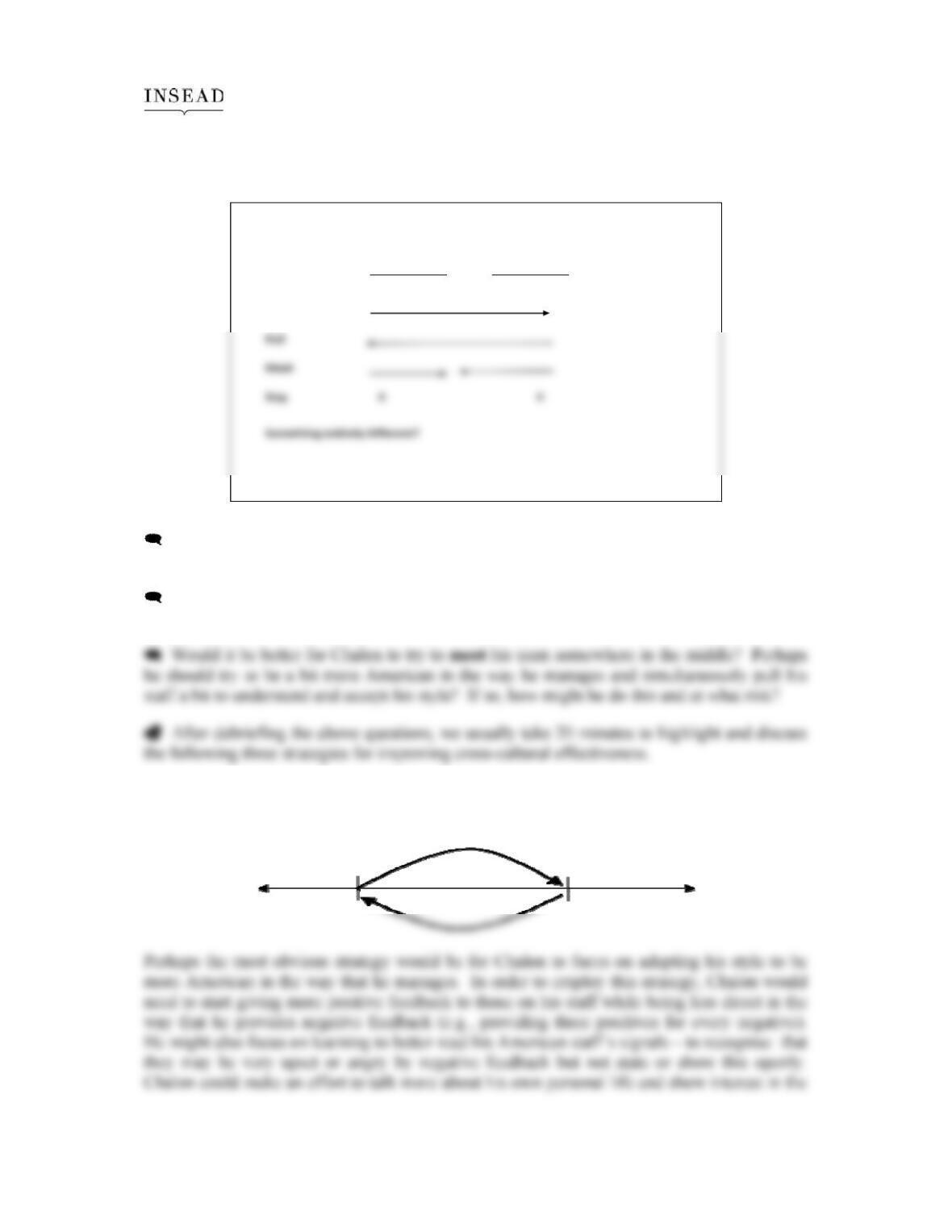
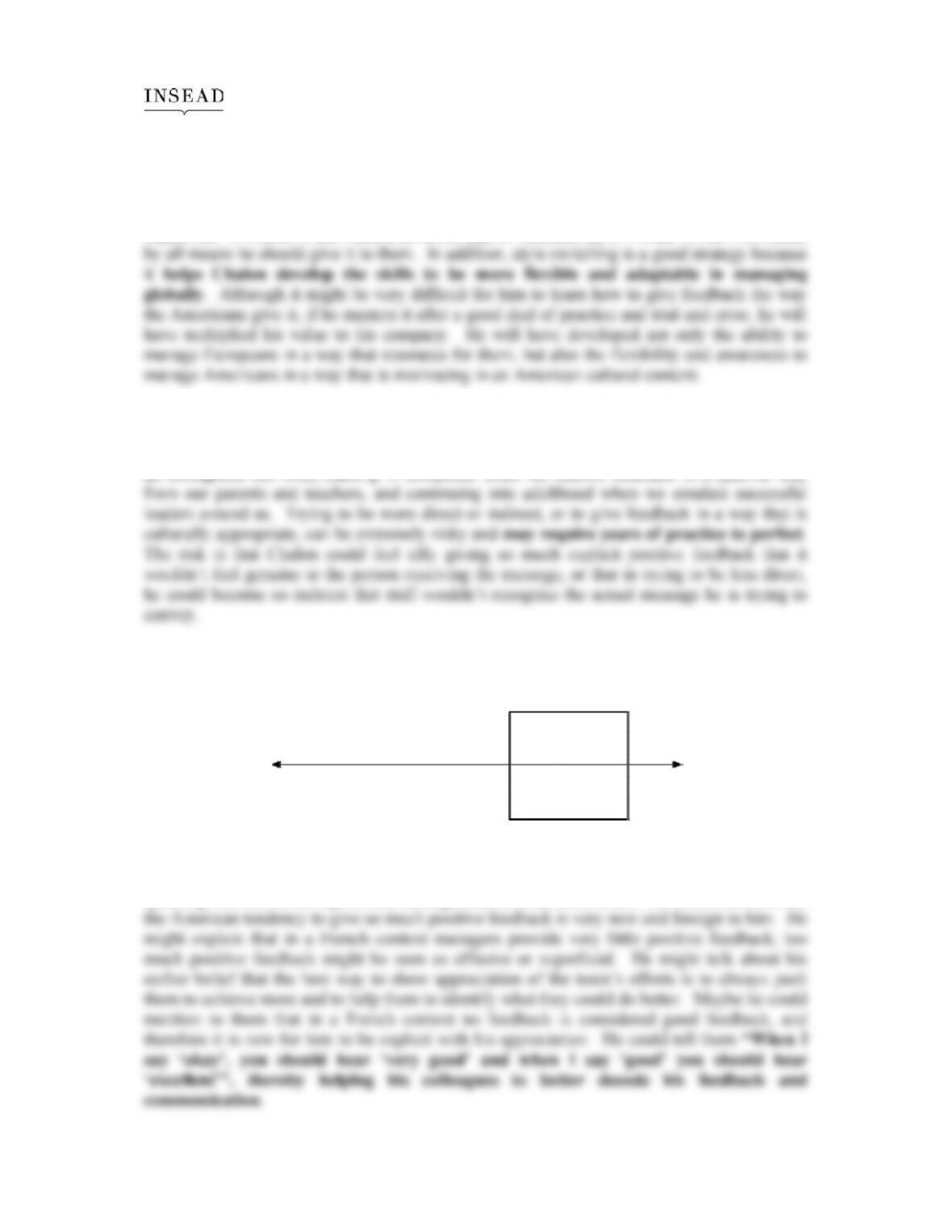
When the groups return to the class, we often start by showing the model below and asking
them to choose the best strategy for Chalon to adopt.
Culture Style A Culture Style B
Adapt
Would it be better for Chalon to try to adapt his style to be more American in the way he
manages his teams? If so, how specifically might he do this and at what risk?
Would it be better for Chalon to try to pull his team to better understand and accept
(maybe even adopt) his style? If so, how specifically might he do this and at what risk?
Possible Strategies:
A Style Switching:
409-008-8
01/2009-5538
personal lives of his staff. In short, he should do everything possible to be the leader these
Americans expect and desire.
Strengths: In the end, the best strategy is the strategy that helps Chalon to meet his business
objectives. If Chalon’s staff need a different type of feedback style in order to feel motivated,
Risks: One of the biggest risks while trying to style switch is that Chalon could overshoot and
therefore appear disingenuous or lacking authenticity in the eyes of his team. Providing
feedback in a culturally appropriate way is something that we are conditioned and trained to
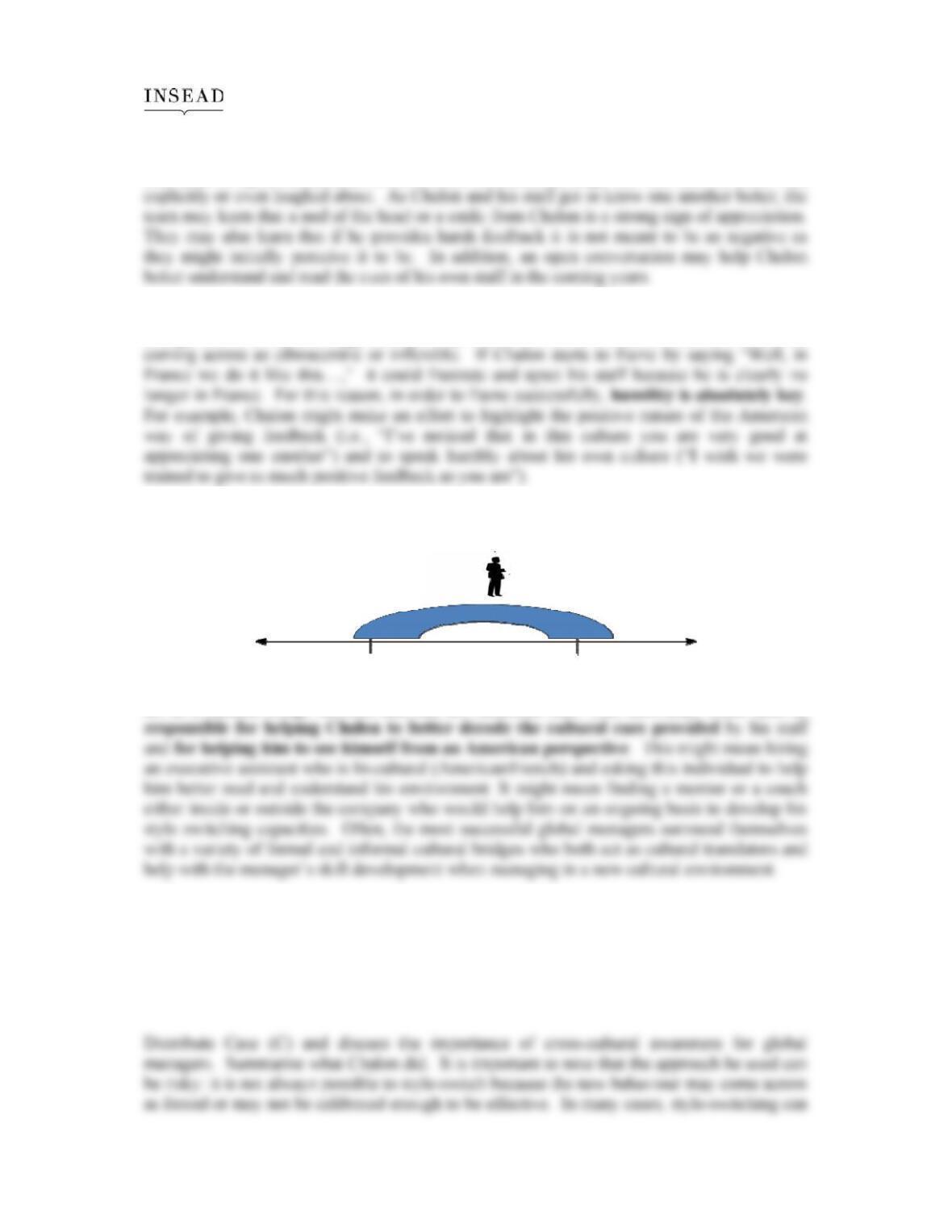
B Framing:
A second possible strategy for Chalon would be to try to frame his behaviour so that his staff
is better able to understand the messages that he means to convey. Chalon might start by
speaking with his direct reports and talking about cultural differences. He could mention that
409-008-8
01/2009-5538
Strengths: The biggest strength to framing is that it builds awareness for all parties and
may lead to open discussions about cultural misunderstandings that can later be dealt with
Risks: Perhaps the biggest risk for Chalon when framing would be to discuss his own cultural
background in a way that suggested that he preferred the French context to the American one,
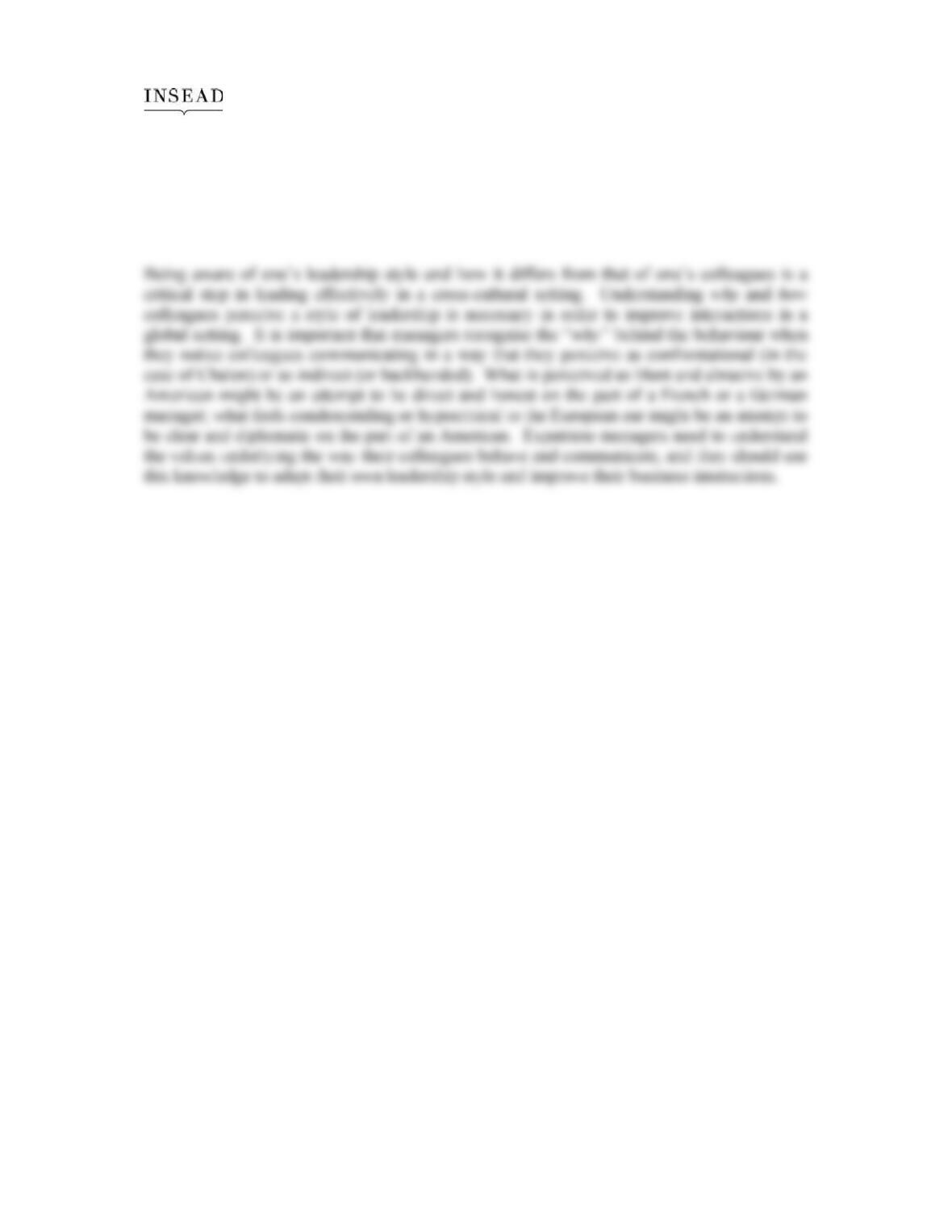
C Using a Bridge:
A third possible strategy would be for Chalon to identify one or several individuals who could
act as a cultural bridge between him and his American staff. This individual would then be
Case (C) Managing in a Cross-Cultural Environment
In Case (C), we learn that Chalon used a combination of style-switching and framing to regain
the trust and goodwill of his team and subordinates. His management team undergoes the
same training that he has received in order to build awareness on both sides. The division
surpasses its goals for sales and market share several years in a row.
409-008-8
01/2009-5538
take years because it requires a willingness to question one’s own cultural programming as
well as a fair amount of emotional intelligence. Framing carries the risk of coming across as
ethnocentric or rigid. Chalon was successful because he was open to radically changing his
leadership style while explaining his management style with a certain amount of self-
deprecation, which won his colleagues over.
409-008-8

01/2009-5538
Appendix 1
Additional Related Readings
Baudry, P. 2003. French and Americans: The Other Shore. Village Mondial.
Hall, E. 1990. Understanding Cultural Differences: Germans, French and Americans. Intercultural
Press.
409-008-8