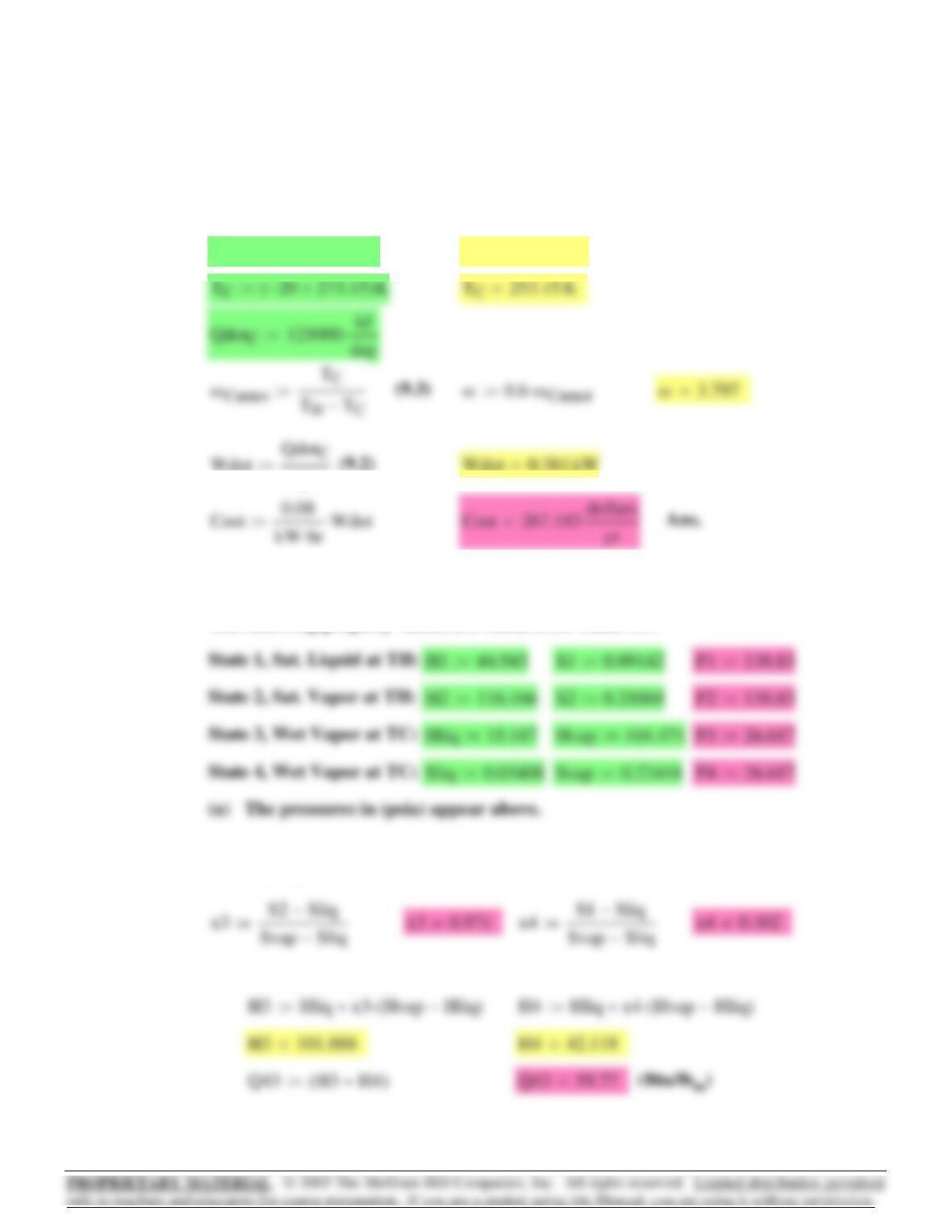
(b) Steps 3–2 and 1–4 (Fi
g
. 8.2) are isentropic, for which S3=S2 and S1=S4
.
Thus by Eq. 6.82):
(c) Heat addition, Step 4–3:
Chapter 9 – Section A – Mathcad Solutions
9.2 TH20 273.15+()K:= TH293.15K=
ω
9.4 Basis: 1 lbm of tetrafluoroethane
The following property values are found from Table 9.1:
298
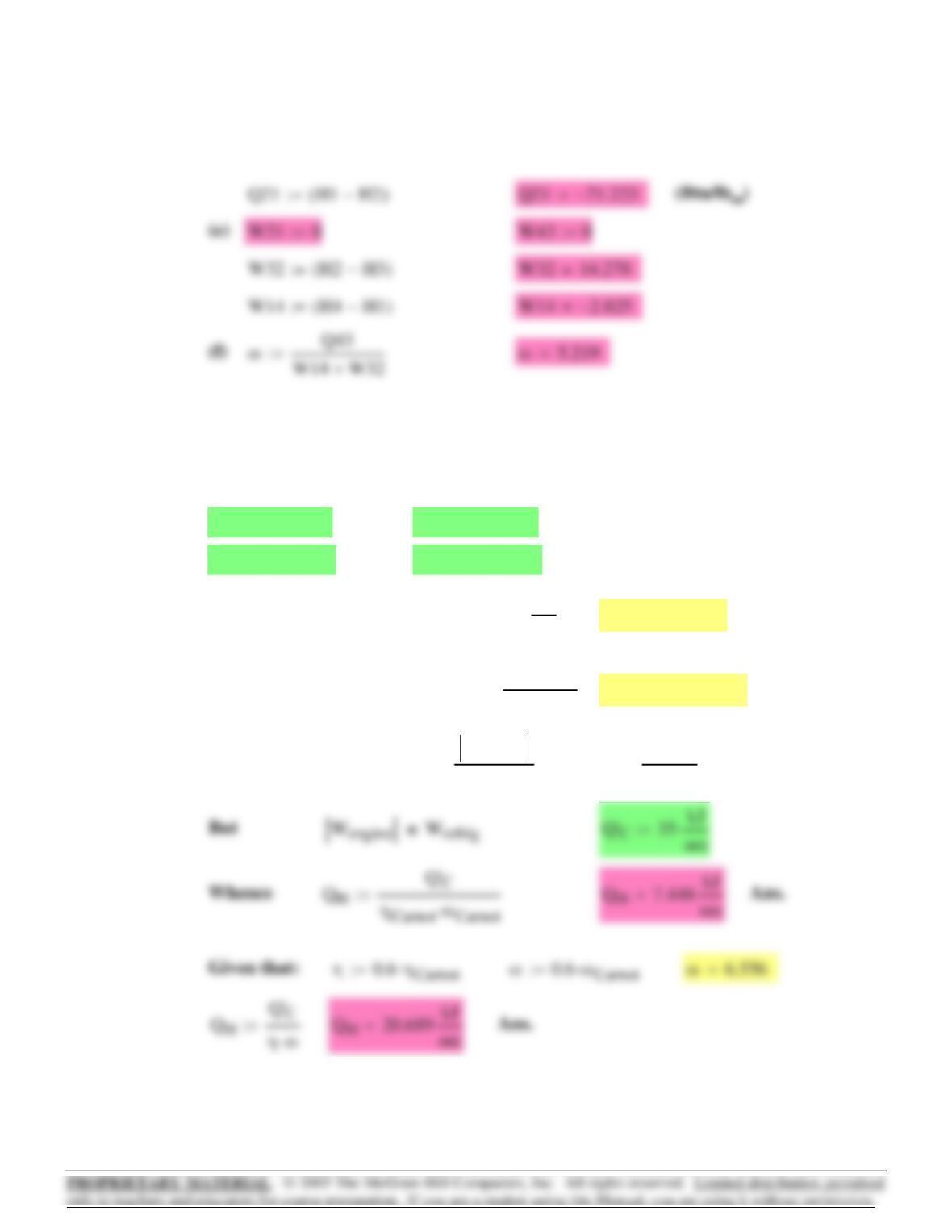
(Refrigerator)
By Eq. (5.8): ηCarnot 1TC
TH
−:= ηCarnot 0.43=
By Eq. (9.3): ωCarnot T’C
T’HT’C
−
:= ωCarnot 10.926=
By definition: ηWengine
QH
=ωQ’C
Wrefrig
=
(d) Heat rejection, Step 2–1:
Note that the first law is satisfied:
ΣQ Q21 Q43+:= ΣW W32 W14+:= ΣQΣW+0=
9.7 TC298.15 K⋅:= TH523.15 K⋅:= (Engine)
T’C273.15 K⋅:= T’H298.15 K⋅:=
299

(isentropic compression)
S’3S2
=
H437.978 Btu
lbm
⋅:=T4539.67 rankine⋅:= From Table 9.1
for sat. liquid
S2
0.22244
0.22325
0.22418
0.22525
0.22647
⎛
⎜
⎜
⎜
⎜
⎜
⎝
⎞
⎟
⎟
⎟
⎠
Btu
lbmrankine⋅
⋅:=H2
107.320
105.907
104.471
103.015
101.542
⎛
⎜
⎜
⎜
⎜
⎜
⎝
⎞
⎟
⎟
⎟
⎠
Btu
lbm
⋅:=
QdotC
600
500
400
300
200
⎛
⎜
⎜
⎜
⎜
⎜
⎝
⎞
⎟
⎟
⎟
⎠
Btu
sec
⋅:=η
0.79
0.78
0.77
0.76
0.75
⎛
⎜
⎜
⎜
⎜
⎜
⎝
⎞
⎟
⎟
⎟
⎠
:=T2
489.67
479.67
469.67
459.67
449.67
⎛
⎜
⎜
⎜
⎜
⎜
⎝
⎞
⎟
⎟
⎟
⎠
rankine⋅:=
The following vectors contain data for parts (a) through (e). Subscripts
refer to Fig. 9.1. Values of H2 and S2 for saturated vapor come from
Table 9.1.
9.9
9.8 (a) QC4kJ
sec
⋅:= W 1.5 kW⋅:=
300
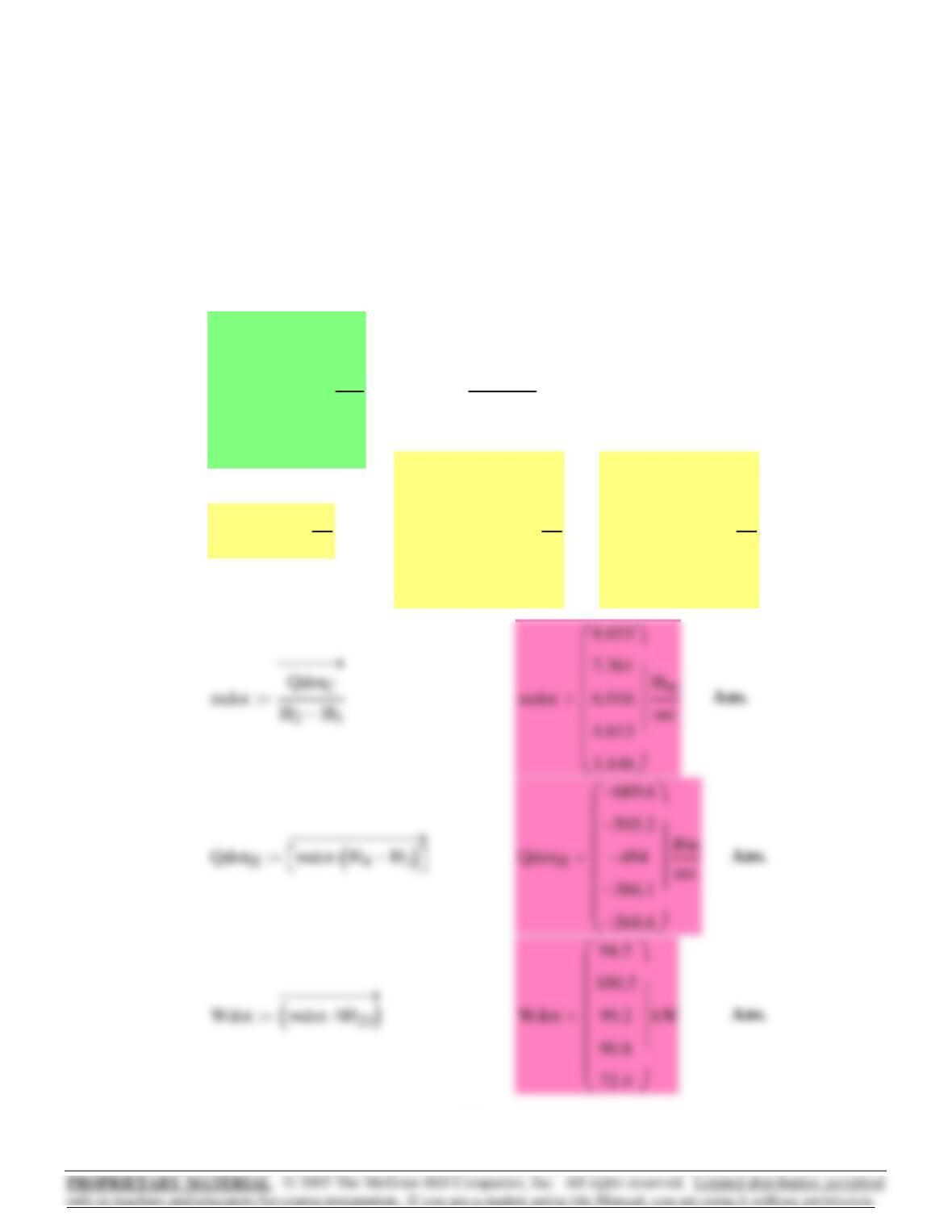
H3
273.711
276.438
279.336
283.026
286.918
⎛
⎜
⎜
⎜
⎜
⎜
⎝
⎞
⎟
⎟
⎟
⎠
kJ
kg
=∆H23
24.084
30.098
36.337
43.414
50.732
⎛
⎜
⎜
⎜
⎜
⎜
⎝
⎞
⎟
⎟
⎟
⎠
kJ
kg
=H188.337 kJ
kg
=
H1H4
:=
H3H2∆H23
+:=∆H23 H’3H2
−
η
→
⎯
⎯
⎯
:=H’3
115.5
116.0
116.5
117.2
117.9
⎛
⎜
⎜
⎜
⎜
⎜
⎝
⎞
⎟
⎟
⎟
⎠
Btu
lbm
⋅:=
The saturation pressure at Point 4 from Table 9.1 is 101.37(psia). For
isentropic compression, from Point 2 to Point 3′, we must read values for
the enthalpy at Point 3′ from Fig. G.2 at this pressure and at the entropy
values S2. This cannot be done with much accuracy. The most
satisfactory procedure is probably to read an enthalpy at S=0.22 (H=114)
and at S=0.24 (H=126) and interpolate linearly for intermediate values of
H. This leads to the following values (rounded to 1 decimal):
301
⎜
⎯
⎯
⎯
⎯
⎜
⎯
⎯
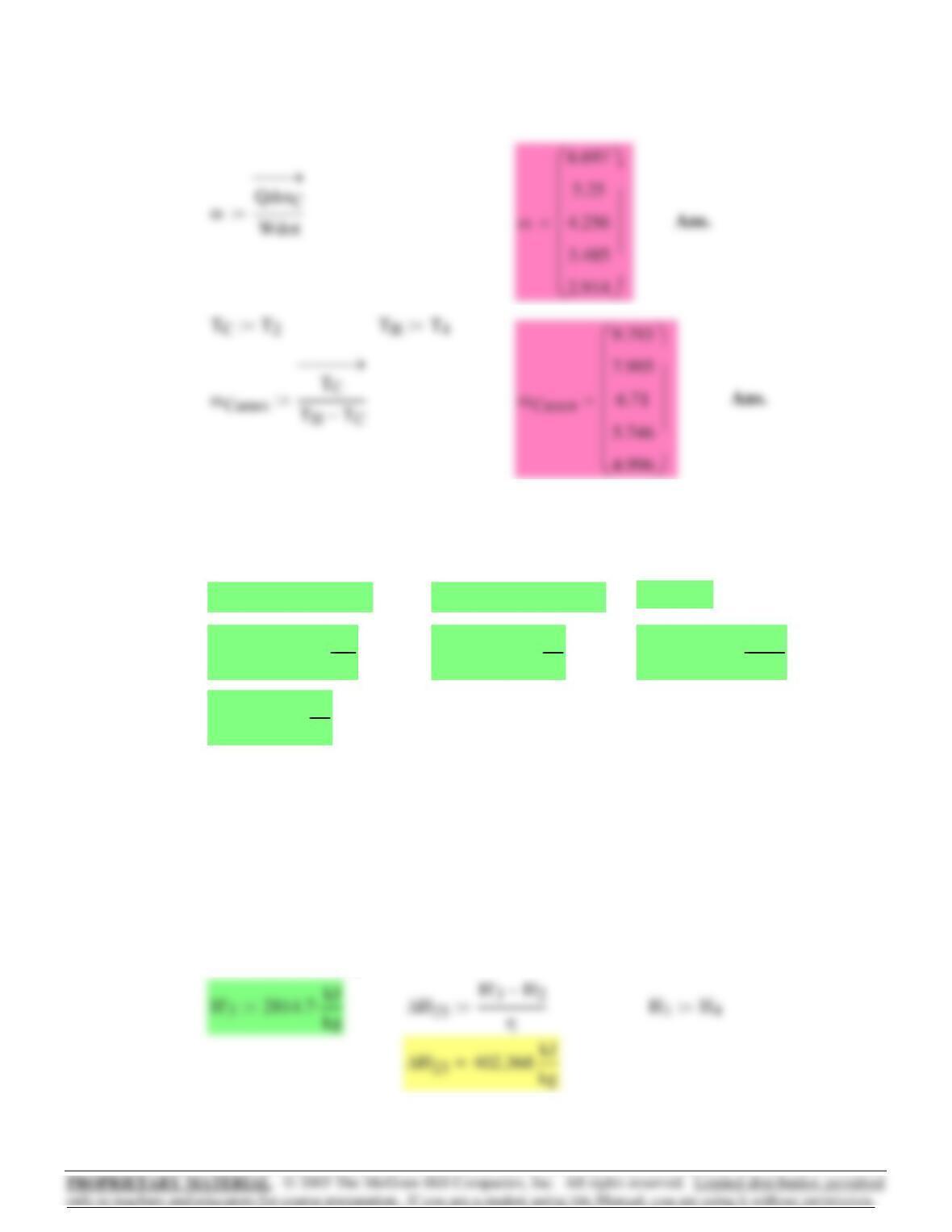
The saturation pressure at Point 4 from Table F.1 is 5.318 kPa. We must
find in Table F.2 the enthalpy (Point 3′) at this pressure and at the
entropy S2. This requires double interpolation. The pressure lies
between entries for pressures of 1 and 10 kPa, and linear interpolation
with P is unsatisfactory. Steam is here very nearly an ideal gas, for
which the entropy is linear in the logarithm of P, and interpolation must
be in accord with this relation. The enthalpy, on the other hand, changes
very little with P and can be interpolated linearly. Linear interpolation
with temperture is satisfactory in either case.
The result of interpolation is
(isentropic compression)
S’2S2
=H4142.4 kJ
kg
⋅:=
S29.0526 kJ
kg K⋅
⋅:=H22508.9 kJ
kg
⋅:=QdotC1200 kJ
sec
⋅:=
η0.76:=T434 273.15+()K⋅:=T24 273.15+()K⋅:=
Subscripts in the following refer to Fig. 9.1. All property values come from
Tables F.1 and F.2.
9.10
302
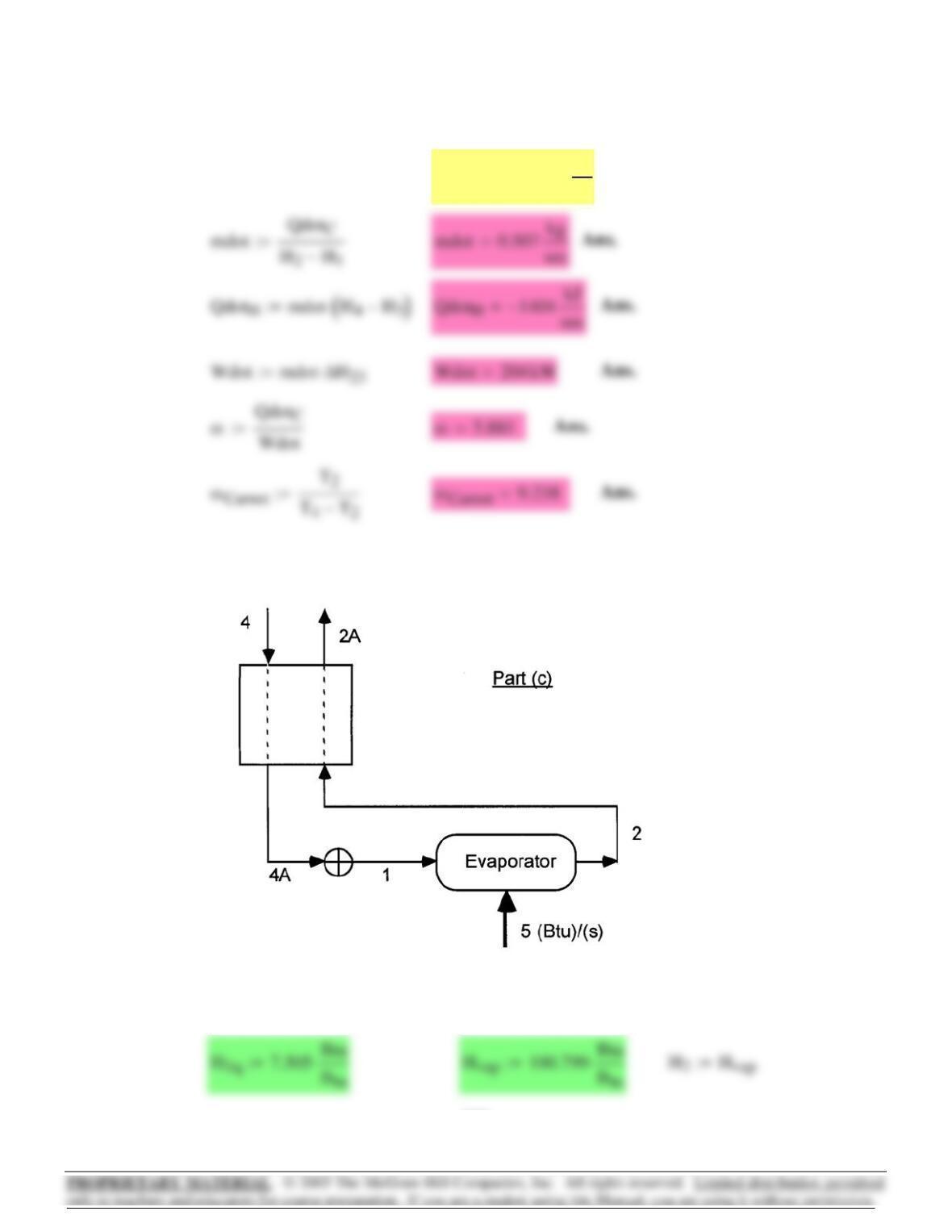
At the conditions of Point 2 [t = -15 degF and
P = 14.667(psia)] for sat. liquid and sat. vapor from Table 9.1:
Parts (a) & (b): subscripts refer to Fig. 9.19.11
H32.911 103
×kJ
kg
=H3H2∆H23
+:=
303
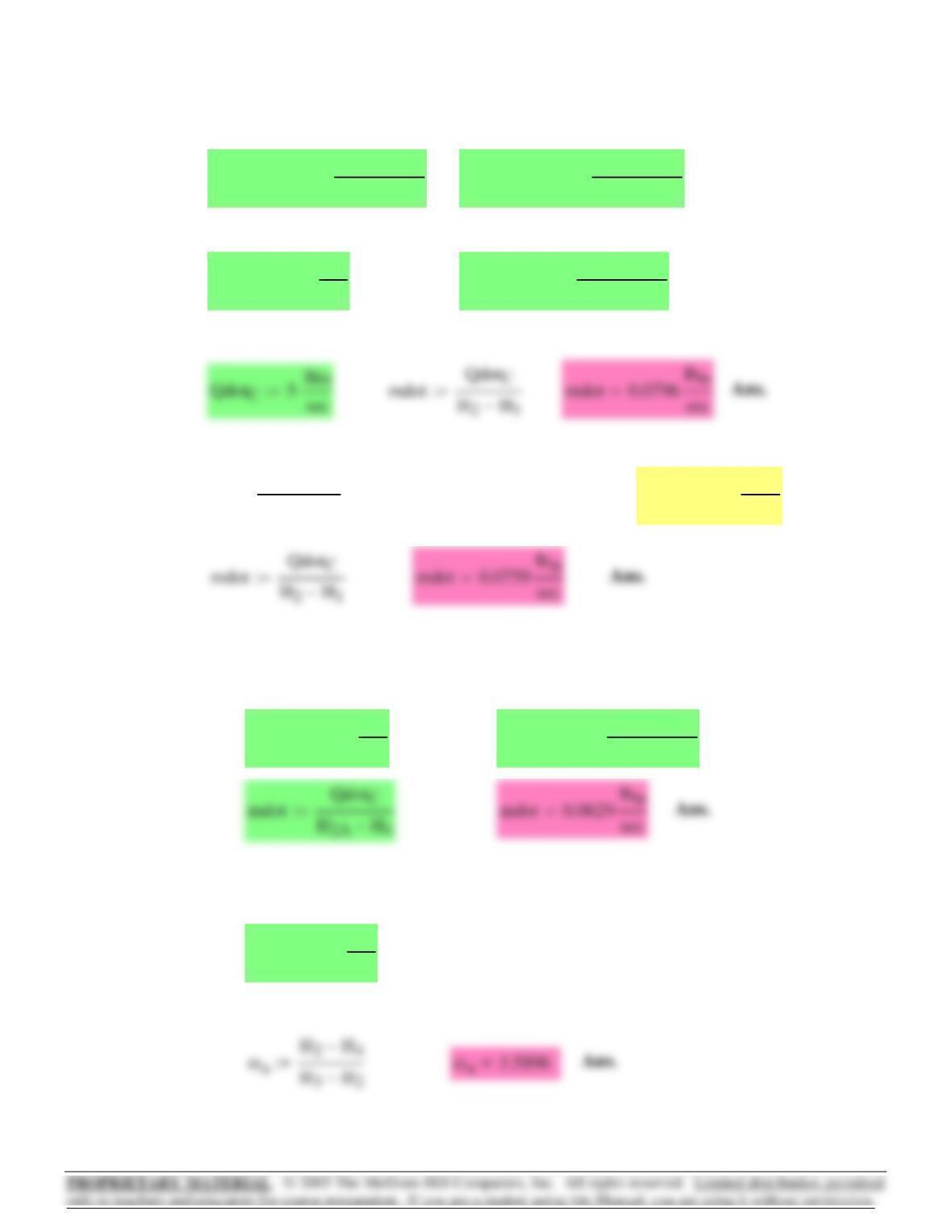
(c) The sat. vapor from the evaporator is superheated in the heat
exchanger to 70 degF at a pressure of 14.667(psia). Property values
for this state are read (with considerable uncertainty) from Fig. G.2:
H2A 117.5 Btu
lbm
⋅:= S2A 0.262 Btu
lbmrankine⋅
⋅:=
(d) For isentropic compression of the sat. vapor at Point 2,
S3Svap
:= and from Fig. G.2 at this entropy and P=101.37(psia)
H3118.3 Btu
lbm
⋅:= Eq. (9.4) may now be
applied to the two cases:
In the first case H1 has the value of H4:
Sliq 0.01733 Btu
lbmrankine⋅
⋅:= Svap 0.22714 Btu
lbmrankine⋅
⋅:=
For sat. liquid at Point 4 (80 degF):
H437.978 Btu
lbm
⋅:= S40.07892 Btu
lbmrankine⋅
⋅:=
(a) Isenthalpic expansion: H1H4
:=
(b) Isentropic expansion: S1S4
:=
x1S1Sliq
−
Svap Sliq
−
:= H1Hliq x1Hvap Hliq
−
()
⋅+:= H134.892 BTU
lbm
=
304
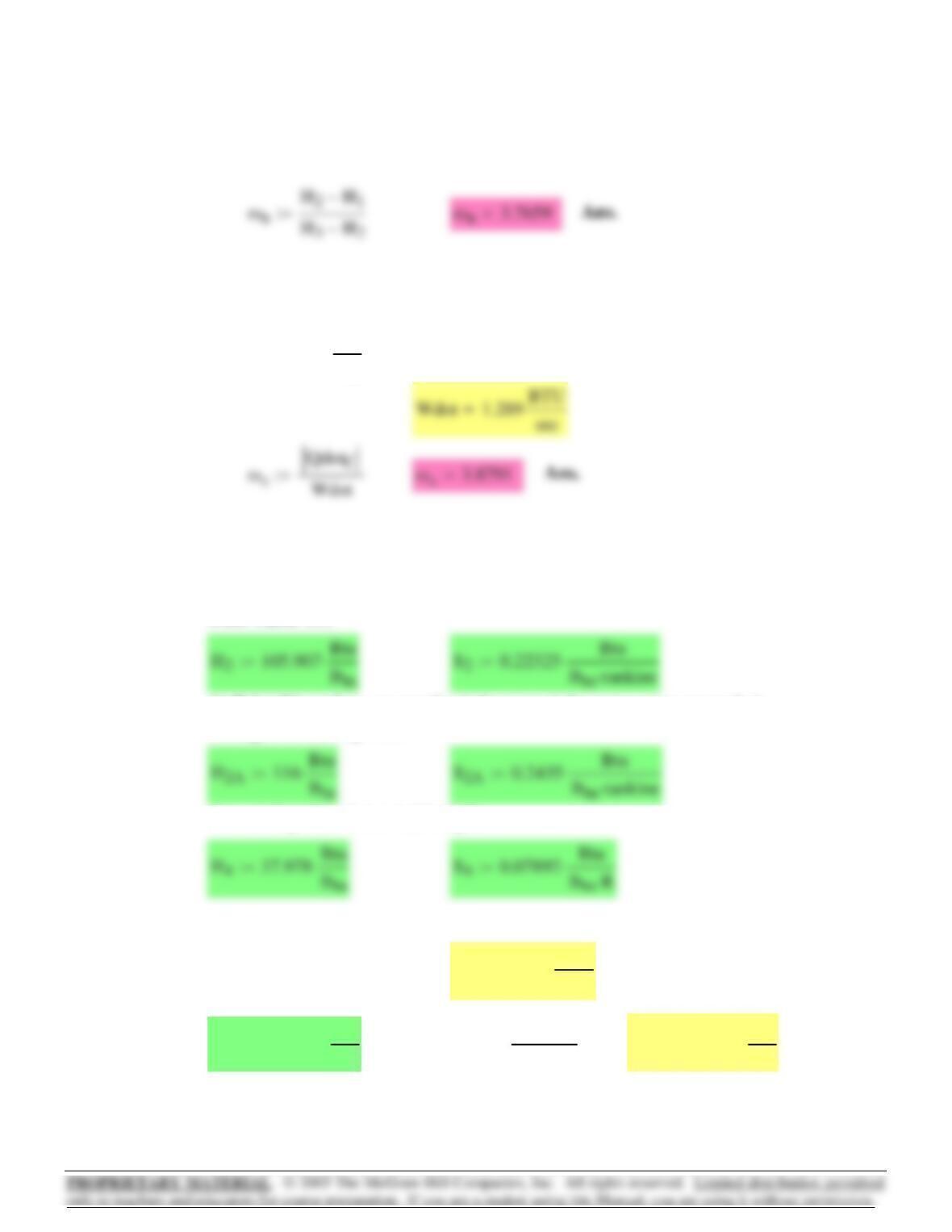
mdot 25.634 lbm
sec
=mdot QdotC
H2H1
−
:=QdotC2000 Btu
sec
⋅:=
H127.885 BTU
lbm
=H1H4H2A
−H2
+:=
Energy balance, heat exchanger:
For sat. liquid at Point 4 (80 degF):
At Point 2A we have a superheated vapor at the same pressure and at
70 degF. From Fig. G.2:
At the conditions of Point 2 [sat. vapor, t = 20 degF and P = 33.110(psia)]
from Table 9.1:
Subscripts: see figure of the preceding problem. 9.12
Wdot H3H2A
−
()
mdot⋅:=H3138 Btu
lbm
⋅:= (Last calculated
value of mdot)
In Part (c), compression is at constant entropy of 0.262 to the
final pressure. Again from Fig. G.2:
In the second case H1 has its last calculated value [Part (b)]:
305

H1H4
:=H’3
113.3
116.5
119.3
⎛
⎜
⎜
⎜
⎝
⎞
⎟
⎠
Btu
lbm
⋅:=H4
31.239
37.978
44.943
⎛
⎜
⎜
⎜
⎝
⎞
⎟
⎠
Btu
lbm
⋅:=
H values for sat. liquid at Point 4 come from Table 9.1 and H values
for Point 3` come from Fig. G.2. The vectors following give values for
condensation temperatures of 60, 80, & 100 degF at pressures of
72.087, 101.37, & 138.83(psia) respectively.
S’3S2
:=S20.22418 Btu
lbmR⋅
⋅:=H2104.471 Btu
lbm
⋅:=
Subscripts refer to Fig. 9.1.
At Point 2 [sat. vapor @ 10 degF] from Table 9.1:
9.13
∆Hcomp 13.457 Btu
lbm
=Wdot mdot ∆Hcomp
⋅:=
∆Hcomp H’3H2
−
η
:=H’3116 Btu
lbm
⋅:=mdot QdotC
H2H4
−
:=
If the heat exchanger is omitted, then H1 = H4.
Points 2A & 2 coincide, and compression is at a constant entropy of
0.22325 to P = 101.37(psia).
∆Hcomp H’3H2A
−
η
:=η 0.75:=H’3127 Btu
lbm
⋅:=
For compression at constant entropy of 0.2435 to the final pressure of
101.37(psia), by Fig. G.2:
306
TCFind TC
()
:=
Wdot
0.75 THTC
−
()
⋅
THTC
−
TH
=
Given
(Guess)
TC250:=
Wdot
QdotH
THTC
−
TH
=
QdotH0.75−THTC
−
()
⋅=
Wdot 1.5:=
TH293.15:=
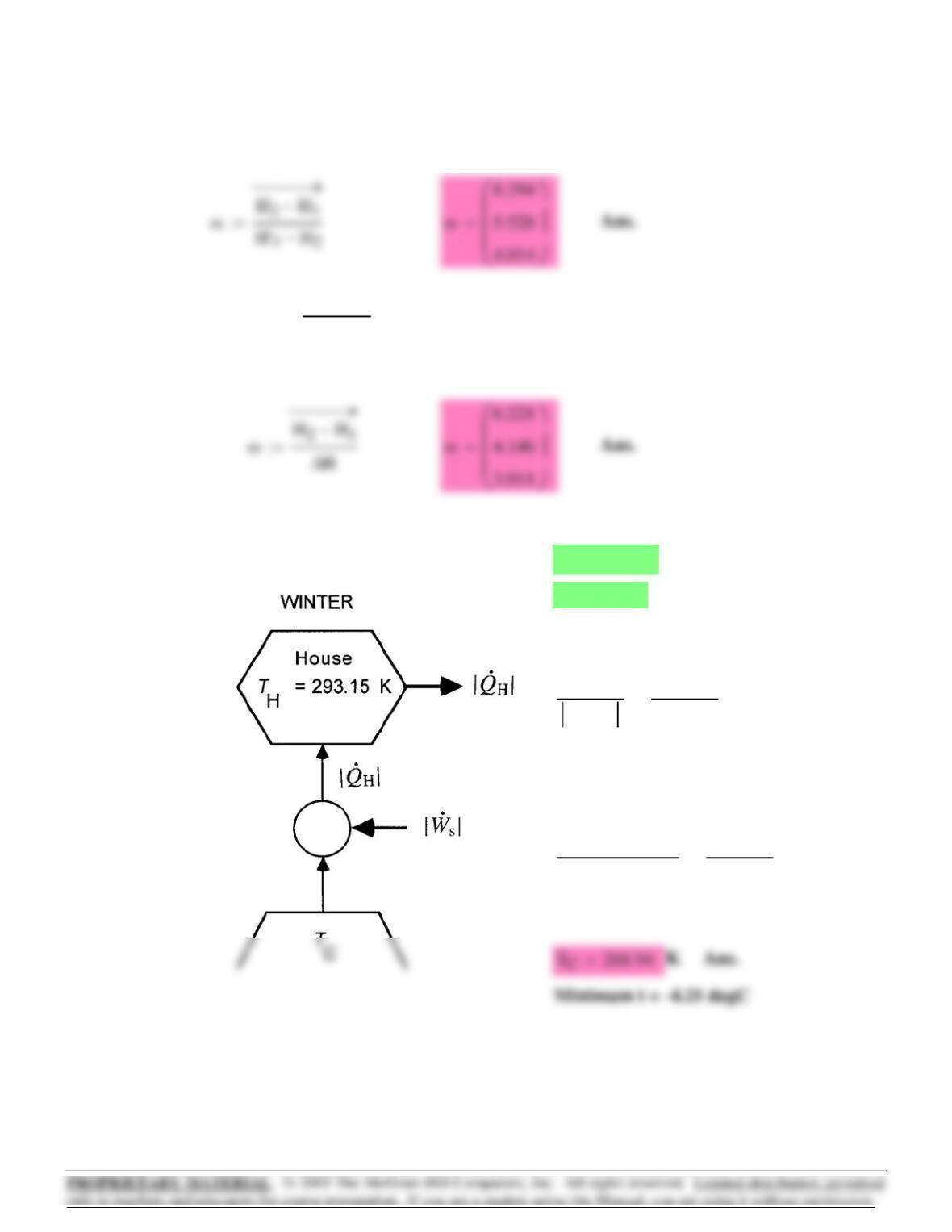
WINTER9.14
Eq. (9.4) now becomes
∆HH
3H2
−=
Since
∆HH’3H2
−
0.75
:=
(b)
By Eq. (9.4):(a)
307
H41033.5
785.3
⎛
⎜
⎝
⎞
⎠
kJ
kg
⋅:= H9284.7 kJ
kg
⋅:= H15 1186.7
1056.4
⎛
⎜
⎝
⎞
⎠
kJ
kg
⋅:=
9.17 Advertized combination unit:
TH150 459.67+( ) rankine⋅:= TC30 459.67+( ) rankine⋅:=
TH609.67rankine=TC489.67rankine=
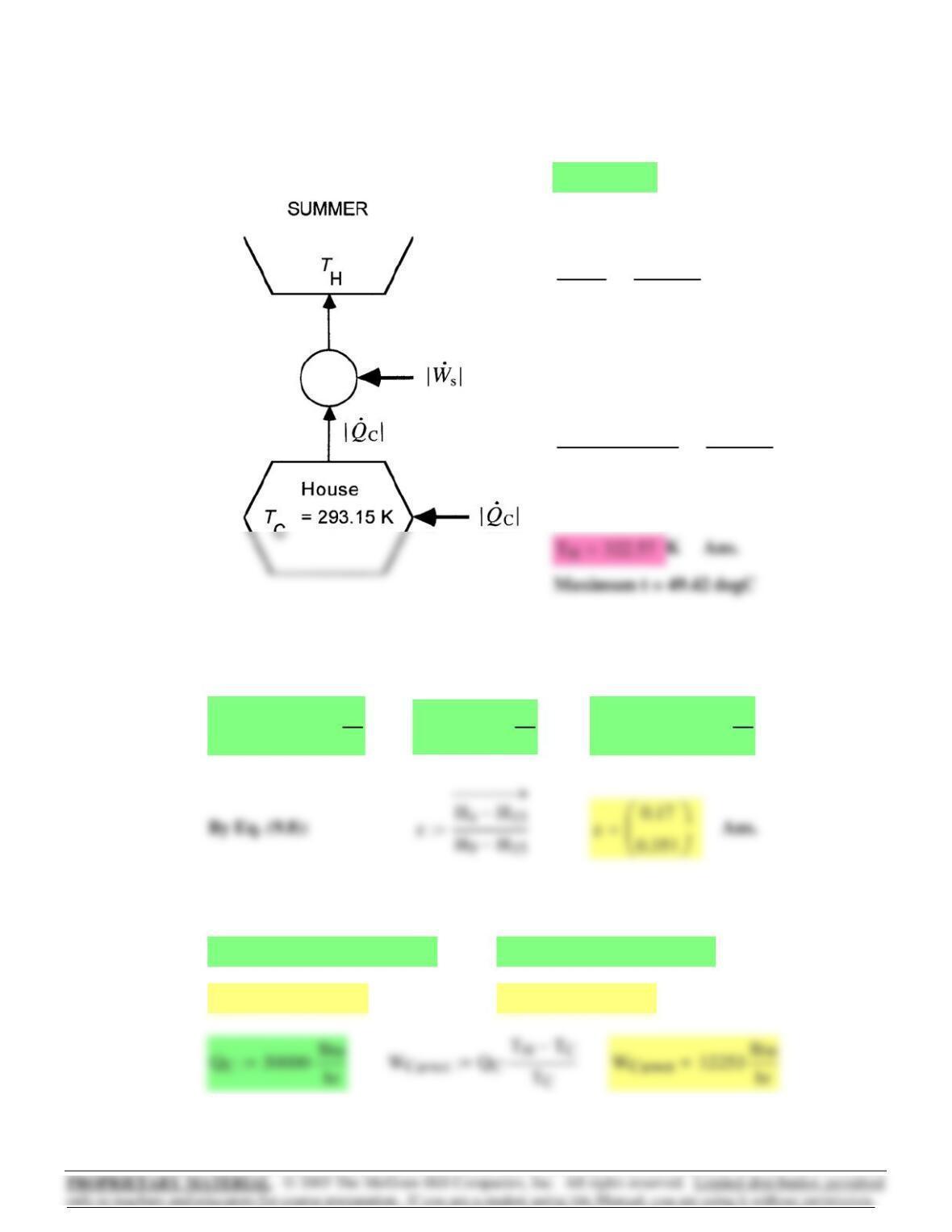
SUMMER TC298.15:=
QdotC0.75 THTC
−
()
⋅:=
Wdot
QdotC
THTC
−
TC
=
TH300:= (Guess)
Given
Wdot
0.75 THTC
−
()
⋅
THTC
−
TC
=
THFind TH
()
:=
Data in the following vectors for Pbs. 9.15 and 9.16 come from
Perry’s Handbook, 7th ed.
9.15 and 9.16
308
⎜
TC210:= T’H260:= T’C255:= TH305:=
By Eq. (9.3):
ωTC
THTC
−
:= ωI0.65 TC
T’HTC
−
⋅:= ωII 0.65 T’C
THT’C
−
⋅:=
9.19 This problem is just a reworking of Example 9.3 with different values of x.
It could be useful as a group project.
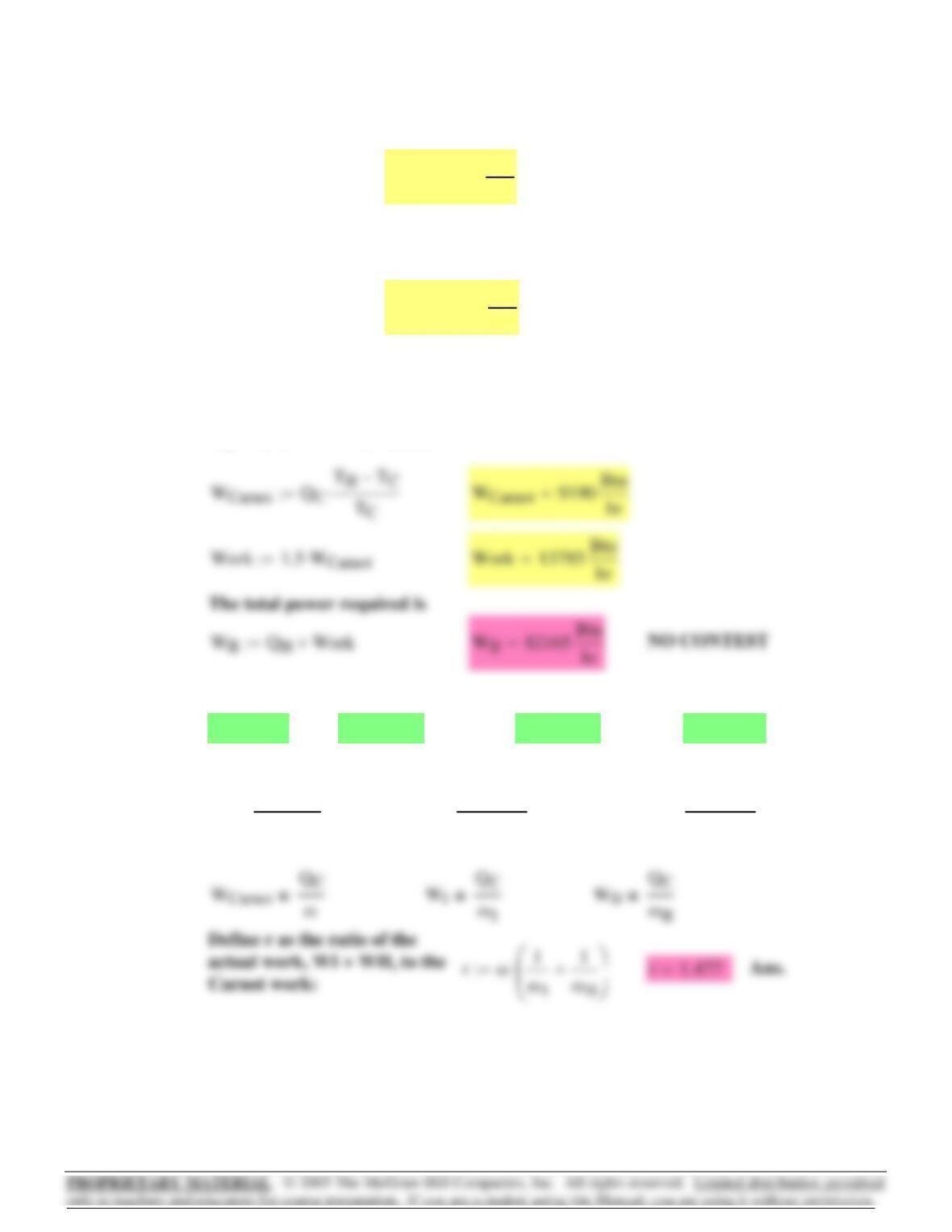
WI1.5 WCarnot
⋅:= WI18380 Btu
hr
=
This is the TOTAL power requirement for the advertized combination unit.
The amount of heat rejected at the higher temperature of
150 degF is
QHWIQC
+:= QH68380 Btu
hr
=
For the conventional water heater, this amount of energy must be supplied
by resistance heating, which requires power in this amount.
For the conventional cooling unit,
TH120 459.67+( ) rankine⋅:=
9.18
309
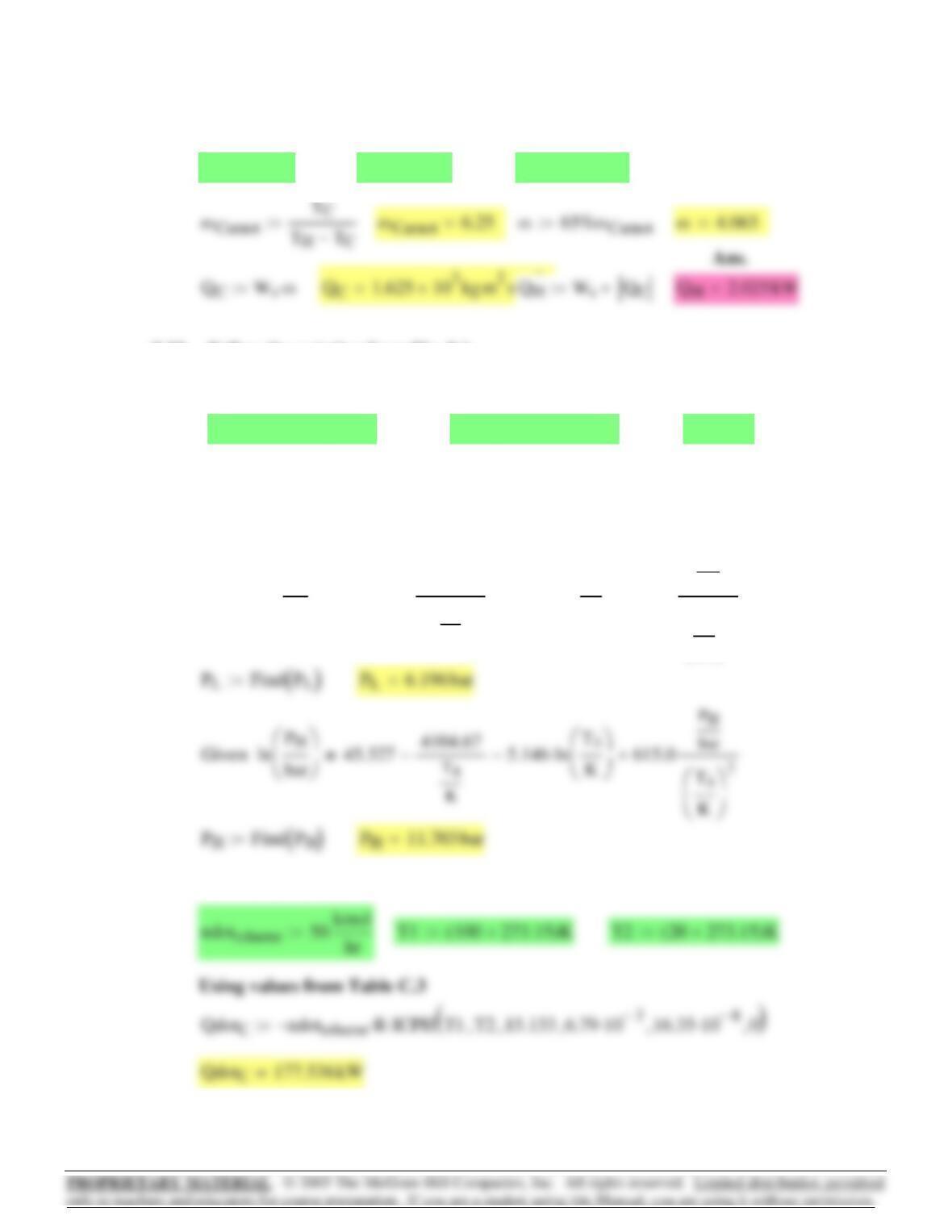
Calculate the high and low operating pressures using the given vapor
pressure equation
Guess: PL1bar:= PH2bar:=
Given ln PL
bar
⎛
⎜
⎝
⎞
⎠45.327 4104.67
T1
K
−5.146 ln T1
K
⎛
⎜
⎝
⎞
⎠
⋅− 615.0
PL
bar
T1
K
⎛
⎜
⎝
⎞
⎠
2
+=
Calculate the heat load
9.22 TH290K:= TC250K:= Ws0.40kW:=
9.23 Follow the notation from Fig. 9.1
With air at 20 C and the specification of a minimum approach ∆T = 10 C:
T110 273.15+()K:= T430 273.15+()K:= T2T1
:=
310
⎜
⎜
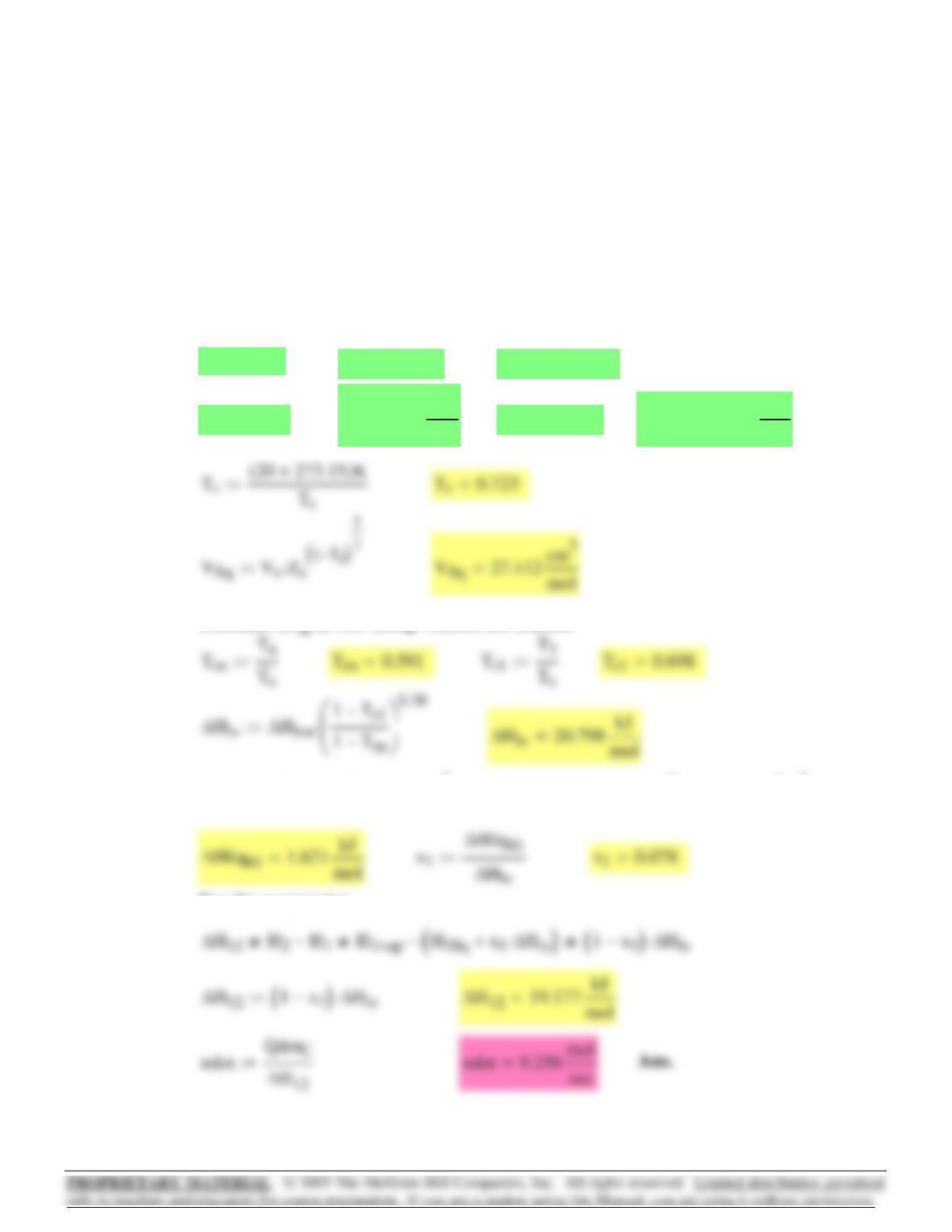
Estimate ∆Hlv at 10C using Watson correlation
∆Hliq41 Vliq PHPL
−
()
⋅R ICPH T1T4
,22.626,100.75−10 3−
⋅, 192.71 10 6−
⋅, 0,
()
⋅+:=
For the evaporator
Since the throttling process is adiabatic: H4H1
=
But: Hliq4Hliq1x1∆Hlv1
⋅+=so: Hliq4Hliq1
−x1∆Hlv⋅=
and: Hliq4Hliq1
−Vliq P4P1
−
()
⋅
T1
T4
TCpliq T()
⌠
⎮
⌡d+=
Estimate Vliq using the Rackett Eqn.
ω0.253:= Tc405.7K:= Pc112.80bar:=
Zc0.242:= Vc72.5 cm3
mol
:= Tn239.7K:= ∆Hlvn 23.34 kJ
mol
:=
311