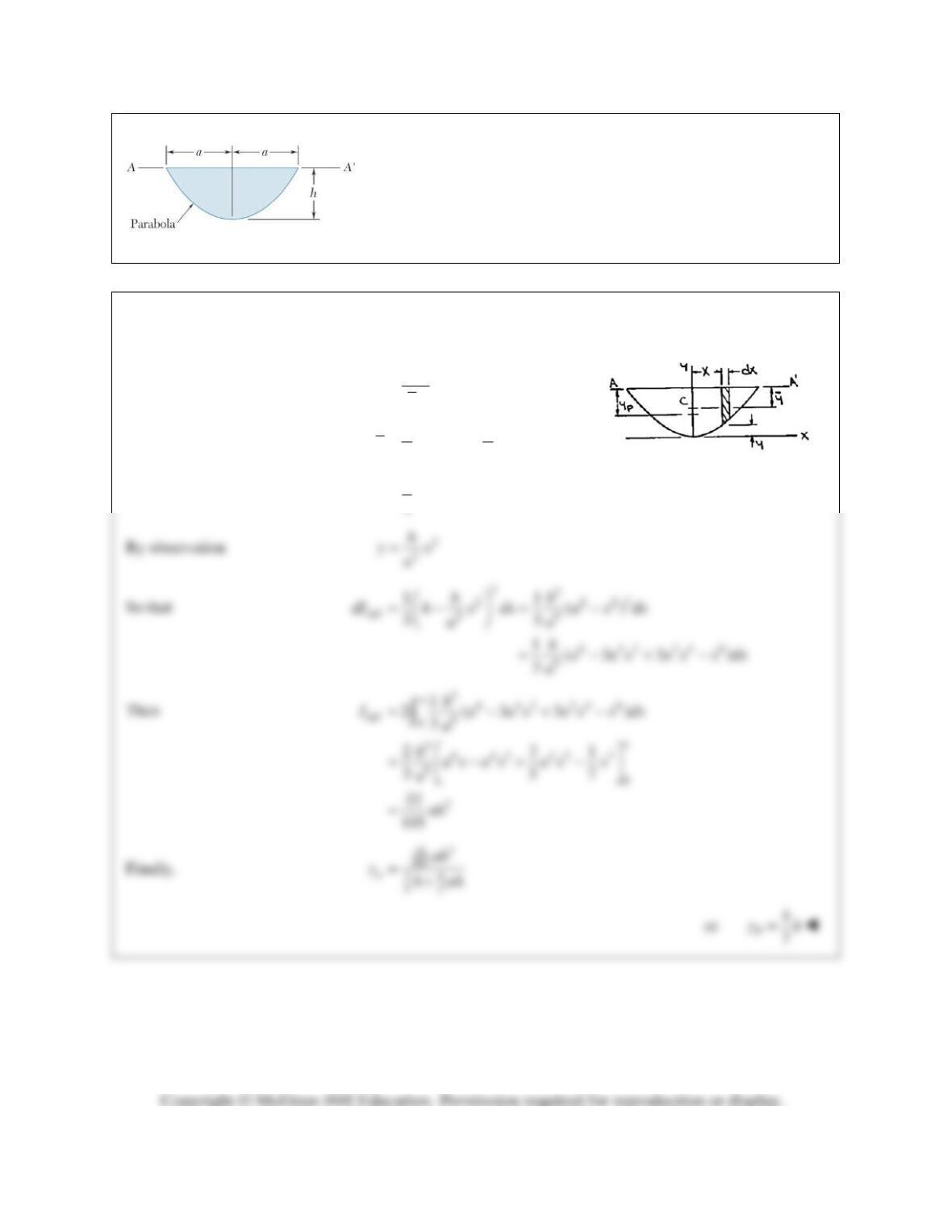
PROBLEM 9.60*
The panel shown forms the end of a trough that is filled with water
to the line AA. Referring to section 9.2, determine the depth of the
point of application of the resultant of the hydrostatic forces acting
on the panel (the center of pressure).
SOLUTION
Using the equation developed on page 506 of the text:
AA
P
I
yyA
For a parabola: 24
53
yh Aah
Now
3
1()
3
AA
dI h y dx
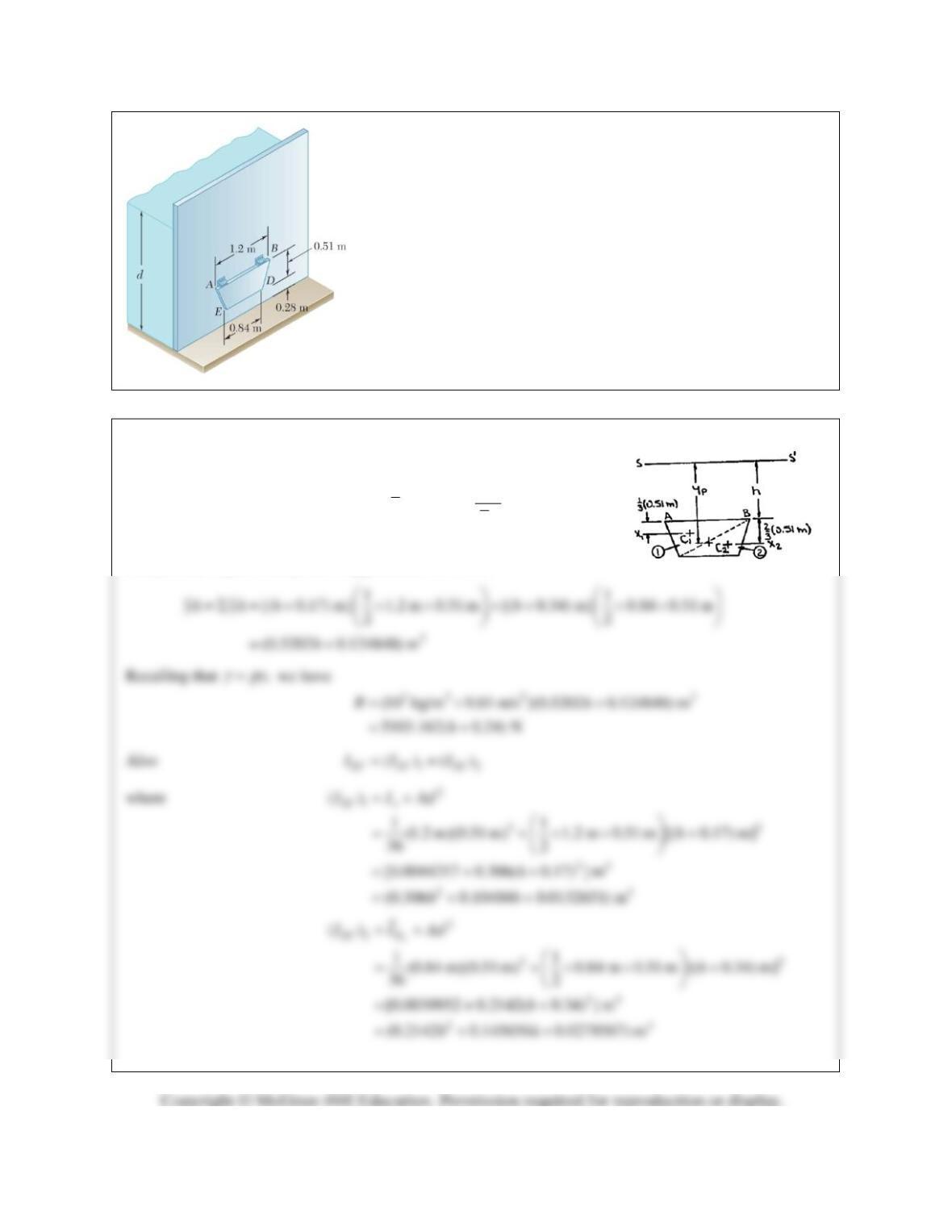
PROBLEM 9.61
A vertical trapezoidal gate that is used as an automatic valve is held
shut by two springs attached to hinges located along edge AB.
Knowing that each spring exerts a couple of magnitude 1470 N · m,
determine the depth d of water for which the gate will open.
SOLUTION
From section 9.2:
SS
P
I
RyA y yA
where R is the resultant of the hydrostatic forces acting on the gate
and y
P
is the depth to the point of application of R. Now
PROBLEM 9.61 (Continued)
Then 12
24
()()
(0.5202 0.249696 0.0411218) m
SS SS SS
II I
hh
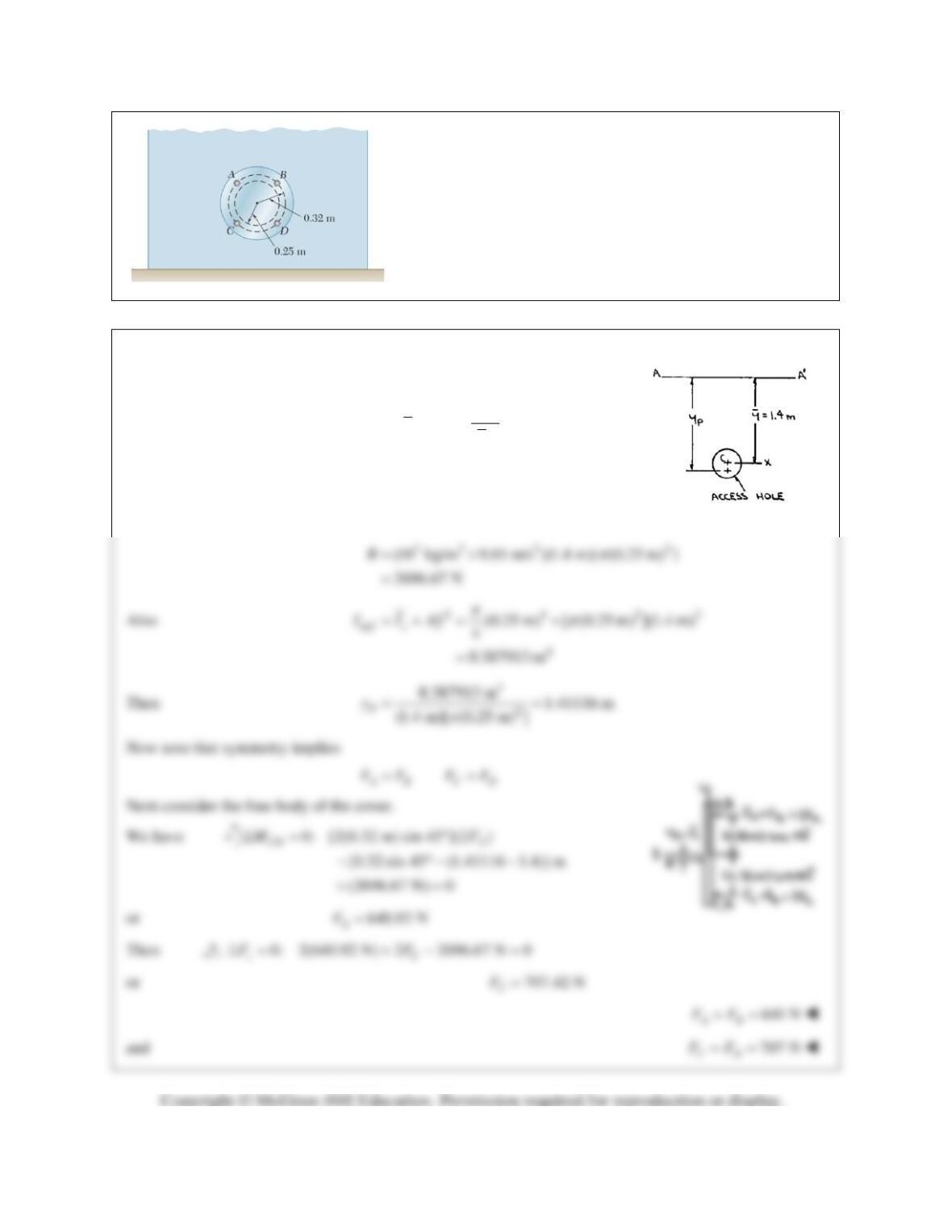
PROBLEM 9.62
The cover for a 0.5-m-diameter access hole in a water storage
tank is attached to the tank with four equally spaced bolts as
shown. Determine the additional force on each bolt due to the
water pressure when the center of the cover is located 1.4 m
below the water surface.
SOLUTION
From section 9.2:
AA
P
I
RyAy yA
where R is the resultant of the hydrostatic forces acting on the cover
and y
P
is the depth to the point of application of R.
Recalling that
,py
we have
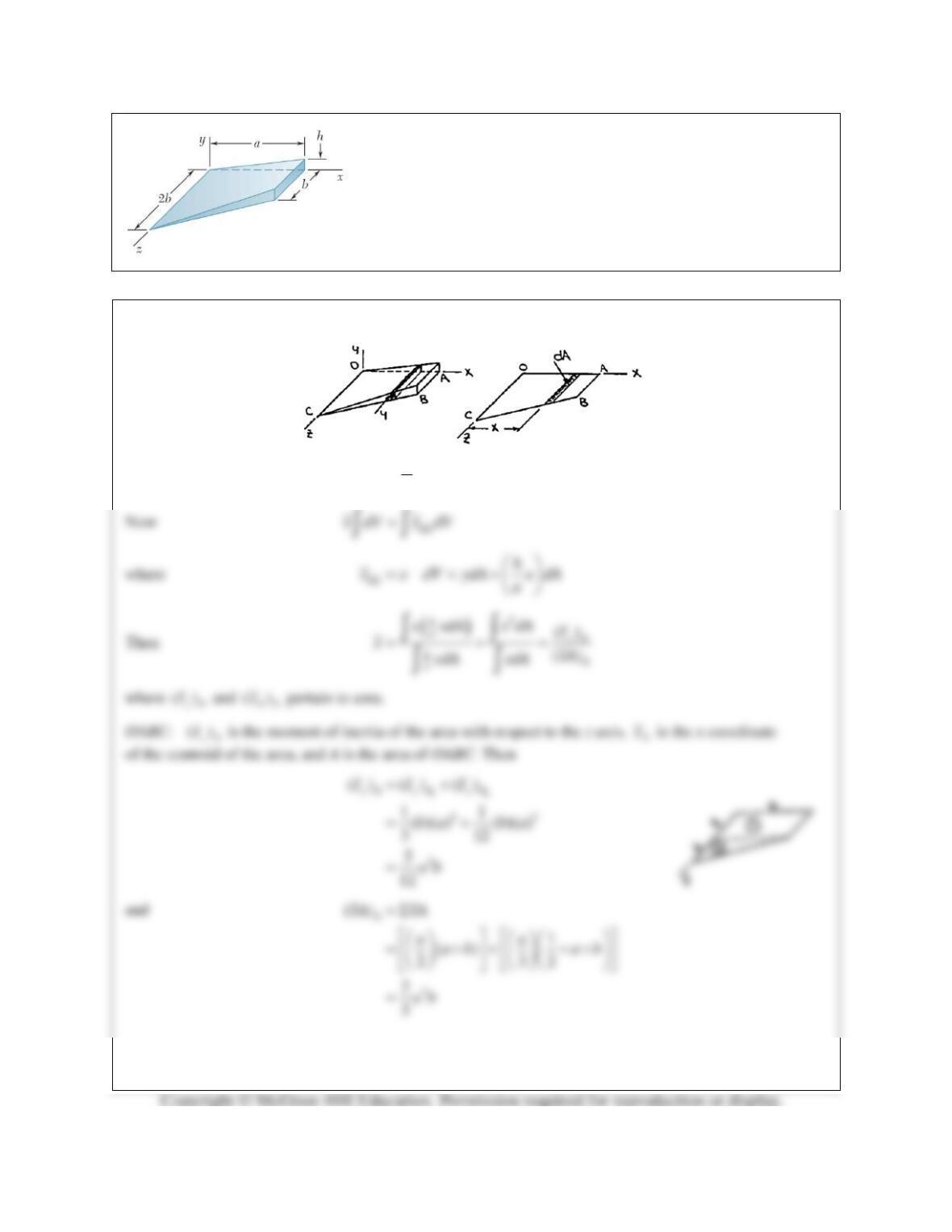
PROBLEM 9.63*
Determine the x coordinate of the centroid of the volume shown.
(Hint: The height y of the volume is proportional to the x coordinate;
consider an analogy between this height and the water pressure on a
submerged surface.)
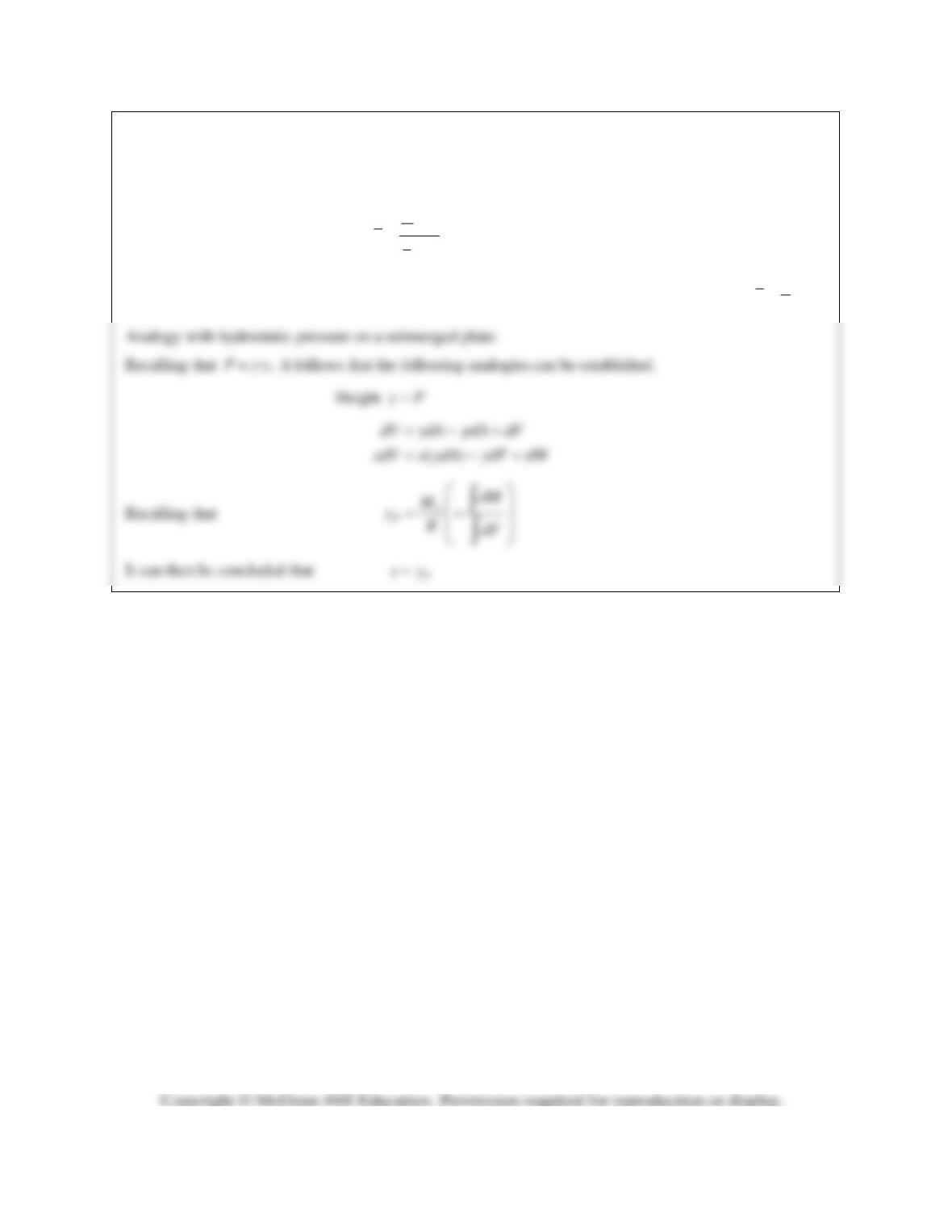
SOLUTION
First note that h
yx
a
PROBLEM 9.63* (Continued)
Finally,
3
5
12
2
2
3
ab
xab
or 5
8
x
a
PROBLEM 9.64*
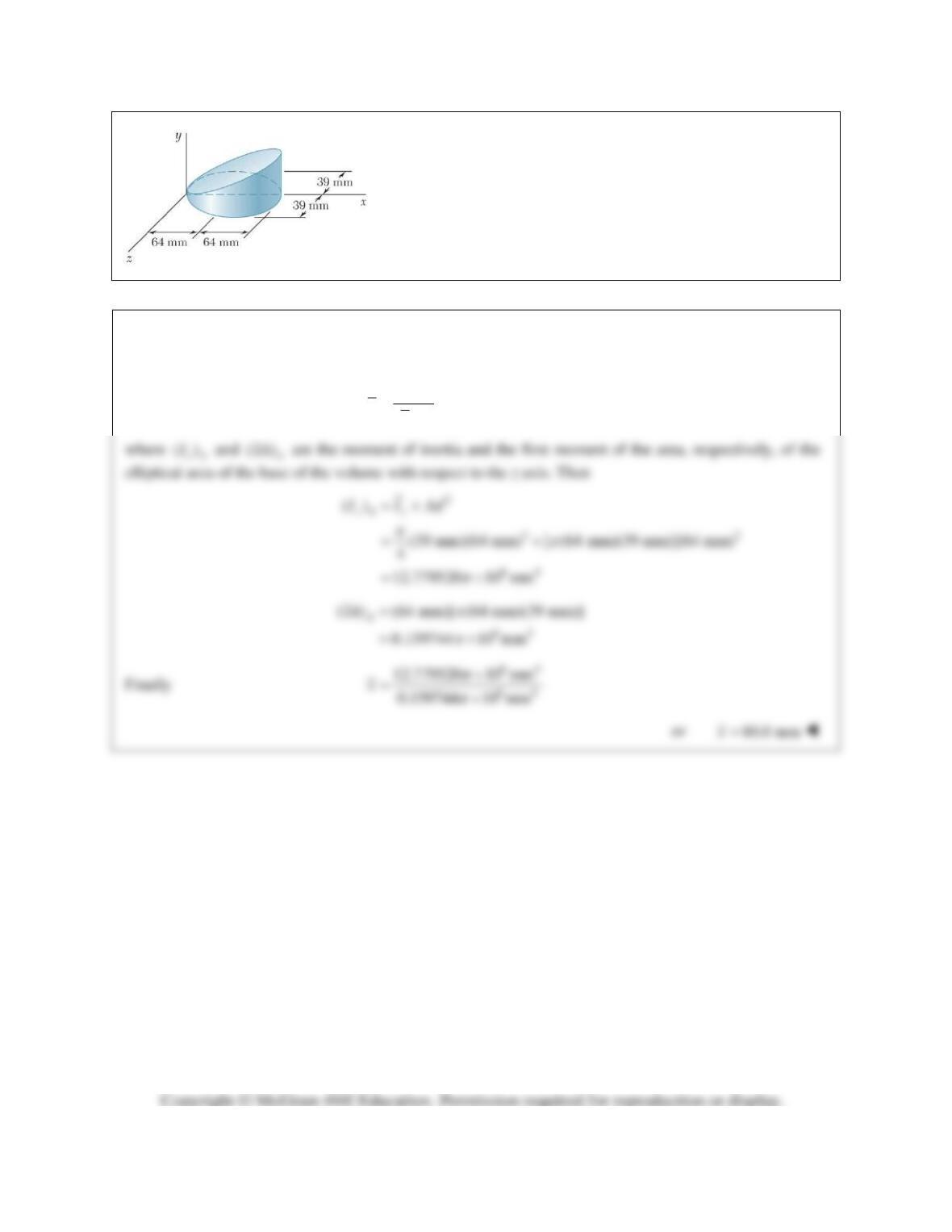
Determine the x coordinate of the centroid of the volume shown;
this volume was obtained by intersecting an elliptic cylinder with
an oblique plane. (Hint: The height y of the volume is
proportional to the x coordinate; consider an analogy between this
height and the water pressure on a submerged surface.)
SOLUTION
Following the “Hint,” it can be shown that (see solution to Problem 9.63)
()
()
zA
A
I
x
x
A
x
PROBLEM 9.65*
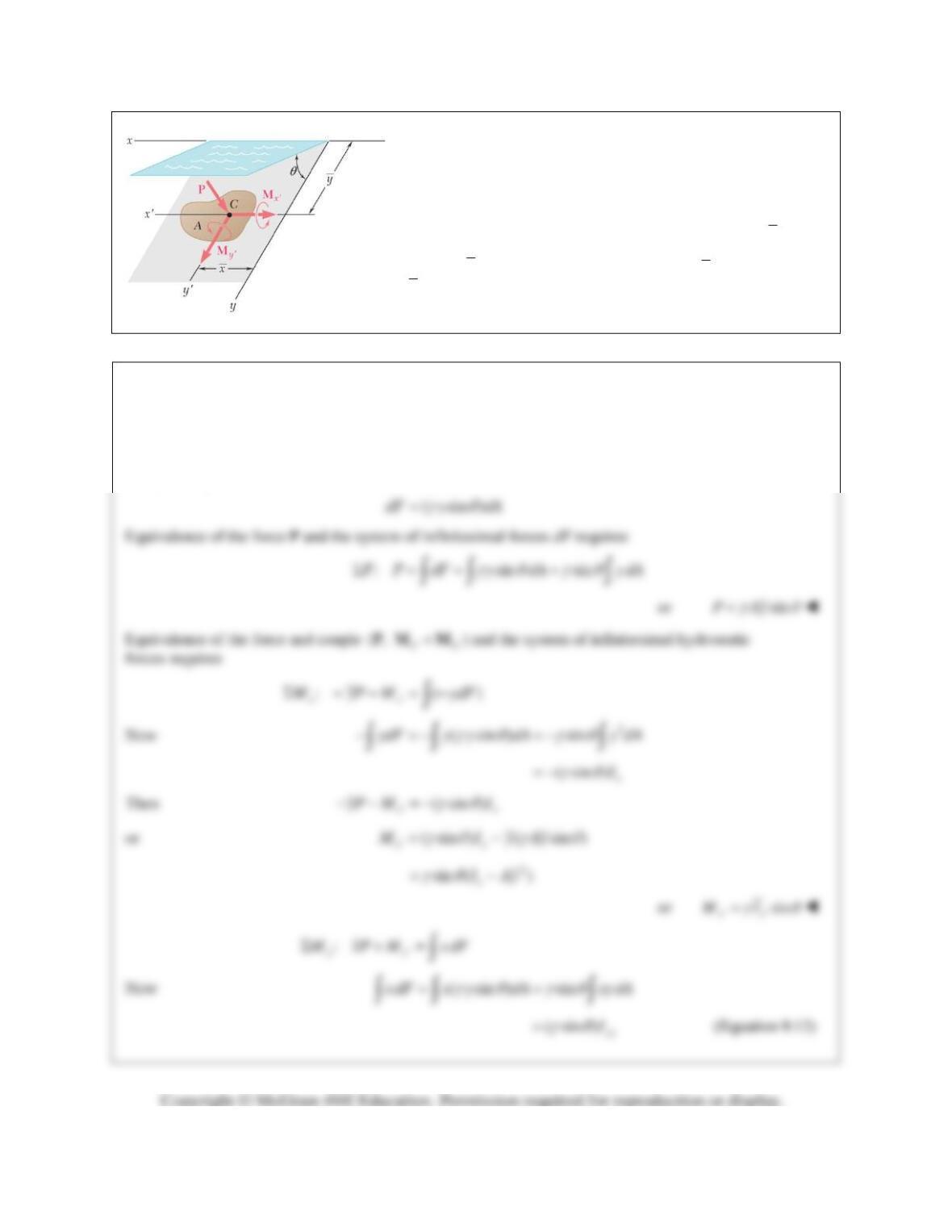
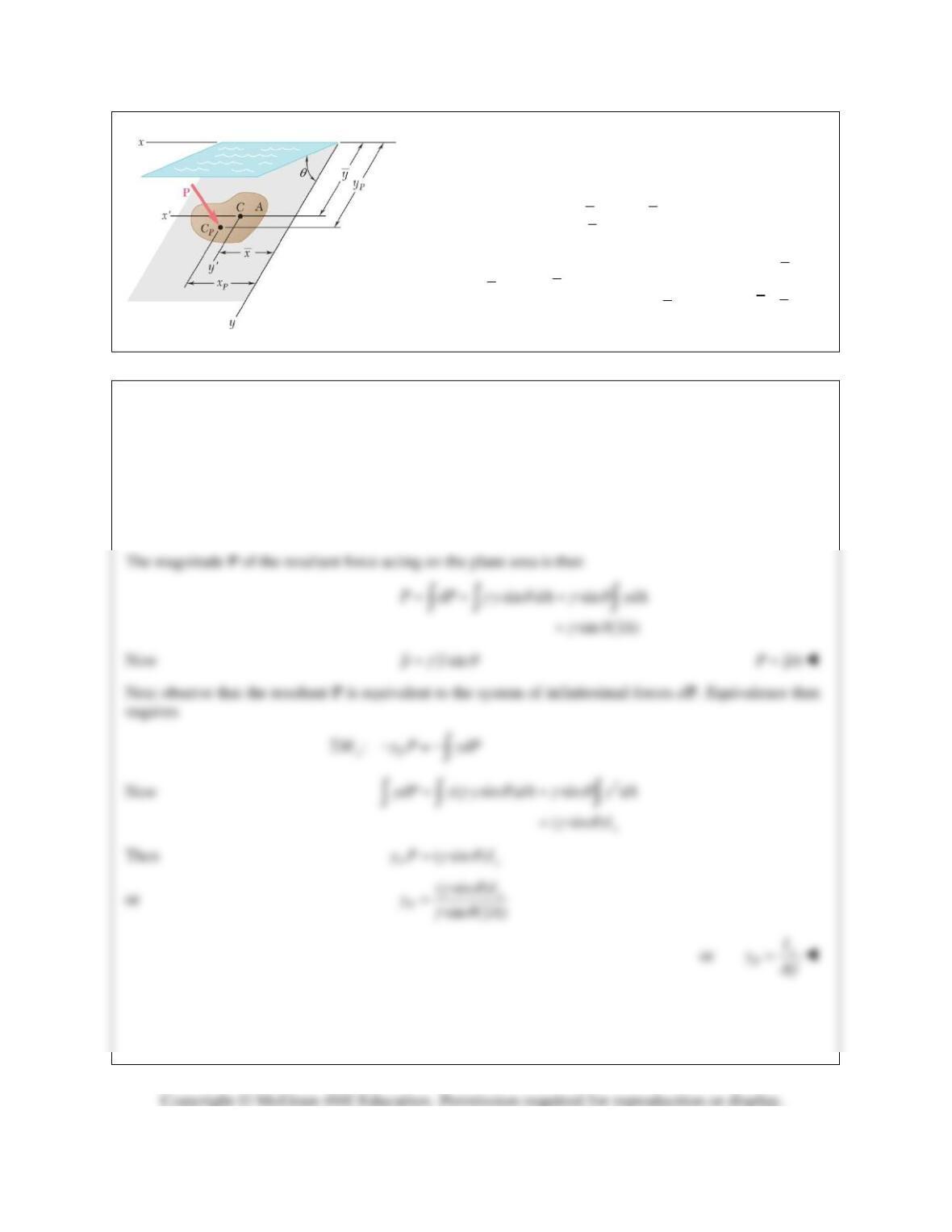
Show that the system of hydrostatic forces acting on a
submerged plane area A can be reduced to a force P at the
centroid C of the area and two couples. The force P is
perpendicular to the area and is of magnitude Psin ,Ay
where
is the specific weight of the liquid, and the couples are
(sin)
xx
I
Mi
and (sin),
yxy
I
M
j
where
xy
I
xy dA
(see section 9.8). Note that the couples are
independent of the depth at which the area is submerged.
SOLUTION
The pressure p at an arbitrary depth (sin)y
is
(sin)py
so that the hydrostatic force dF exerted on an infinitesimal area dA is
PROBLEM 9.65* (Continued)
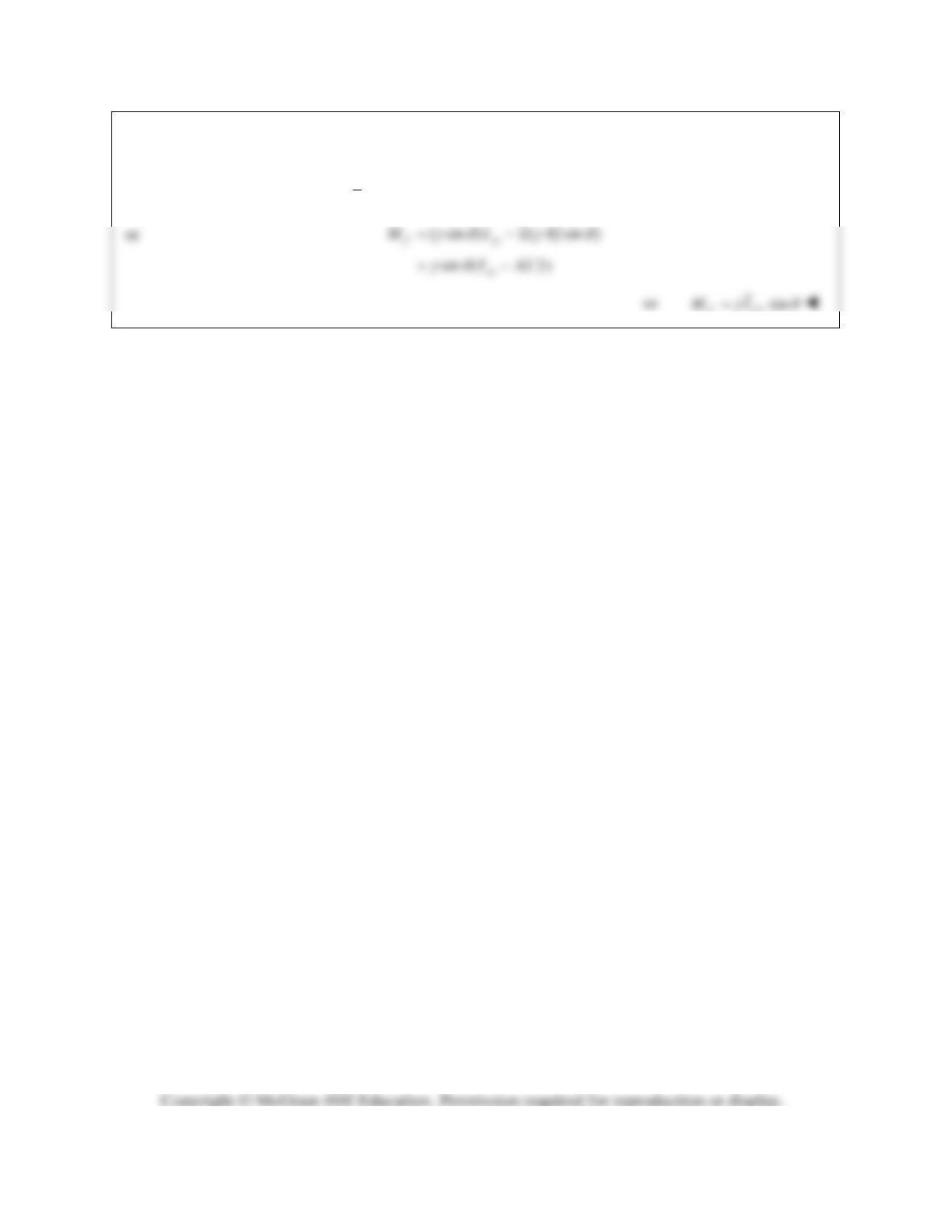
Then (sin)
y
xy
x
PM I
yxy
PROBLEM 9.66*
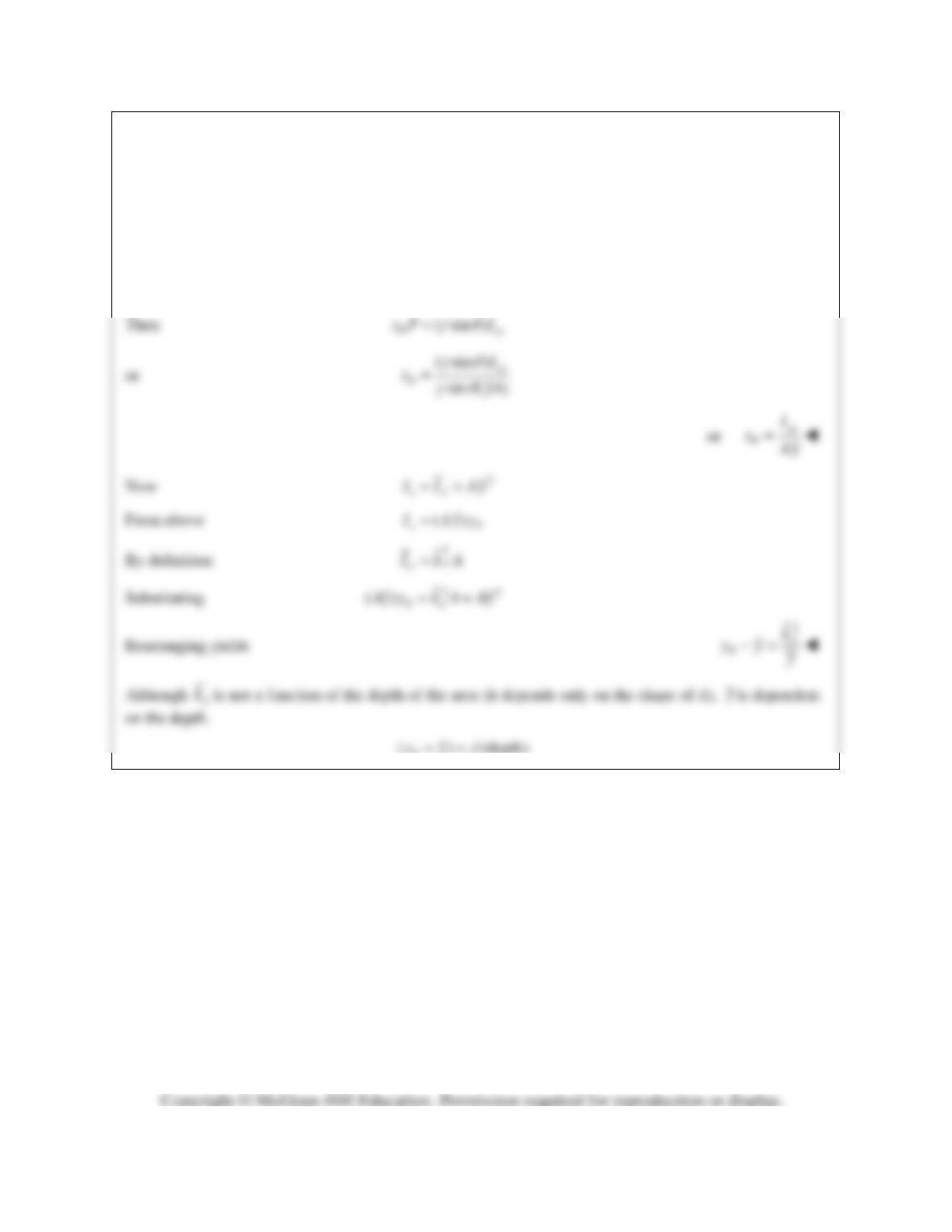
Show that the resultant of the hydrostatic forces acting on a
submerged plane area A is a force P perpendicular to the area
and of magnitude Psin ,
A
ypA
where
is the specific
weight of the liquid and
p
is the pressure at the centroid C
of the area. Show that P is applied at a Point CP, called the
center of pressure, whose coordinates are /
Pxy
x
IAyand
/,
Px
yIAywhere xy
I
xydA (see section 9.8). Show also
that the difference of ordinates P
yy
is equal to 2/
x
ky
and
thus depends upon the depth at which the area is submerged.
SOLUTION
The pressure P at an arbitrary depth (sin)y
is
(sin)Py
so that the hydrostatic force dP exerted on an infinitesimal area dA is
(sin)dP y dA
P
PROBLEM 9.66* (Continued)
:
yP
M
xP xdP
Now (sin) sin
x
dP x y dA xydA
(sin)
x
y
I
(Equation 9.12)
x
A
P
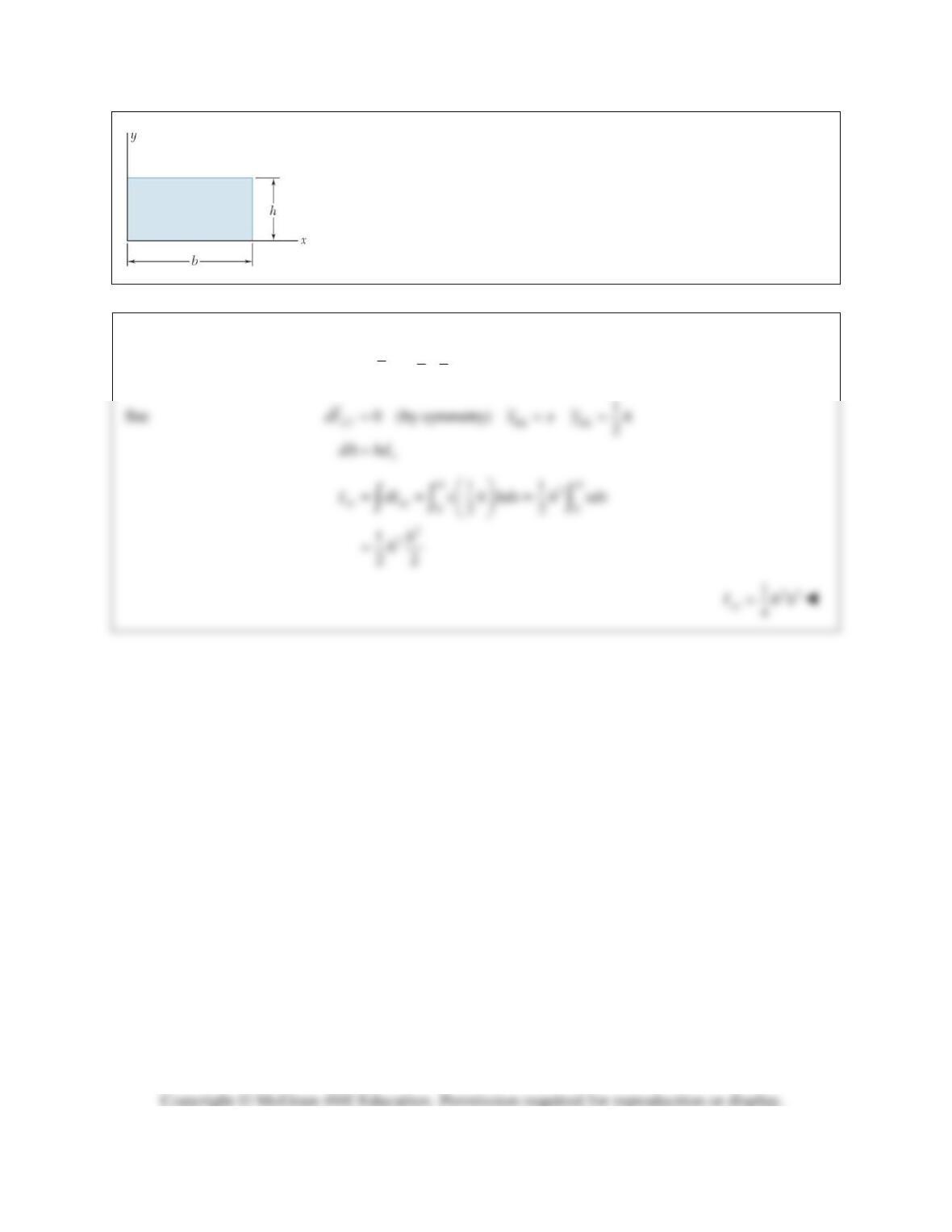
PROBLEM 9.67
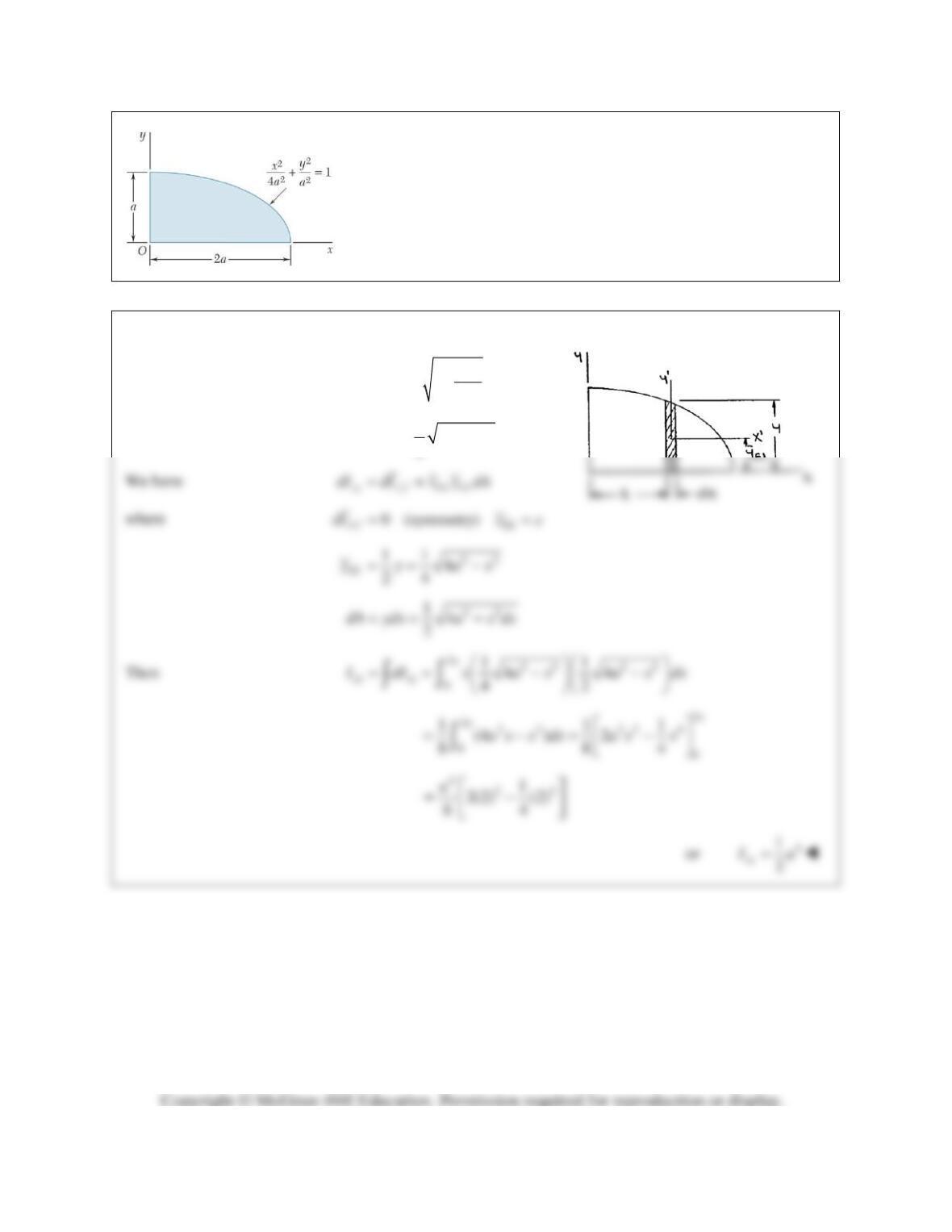
Determine by direct integration the product of inertia of the given area
with respect to the x and y axes.
SOLUTION
First note
2
2
14
x
ya a
22
14
2ax
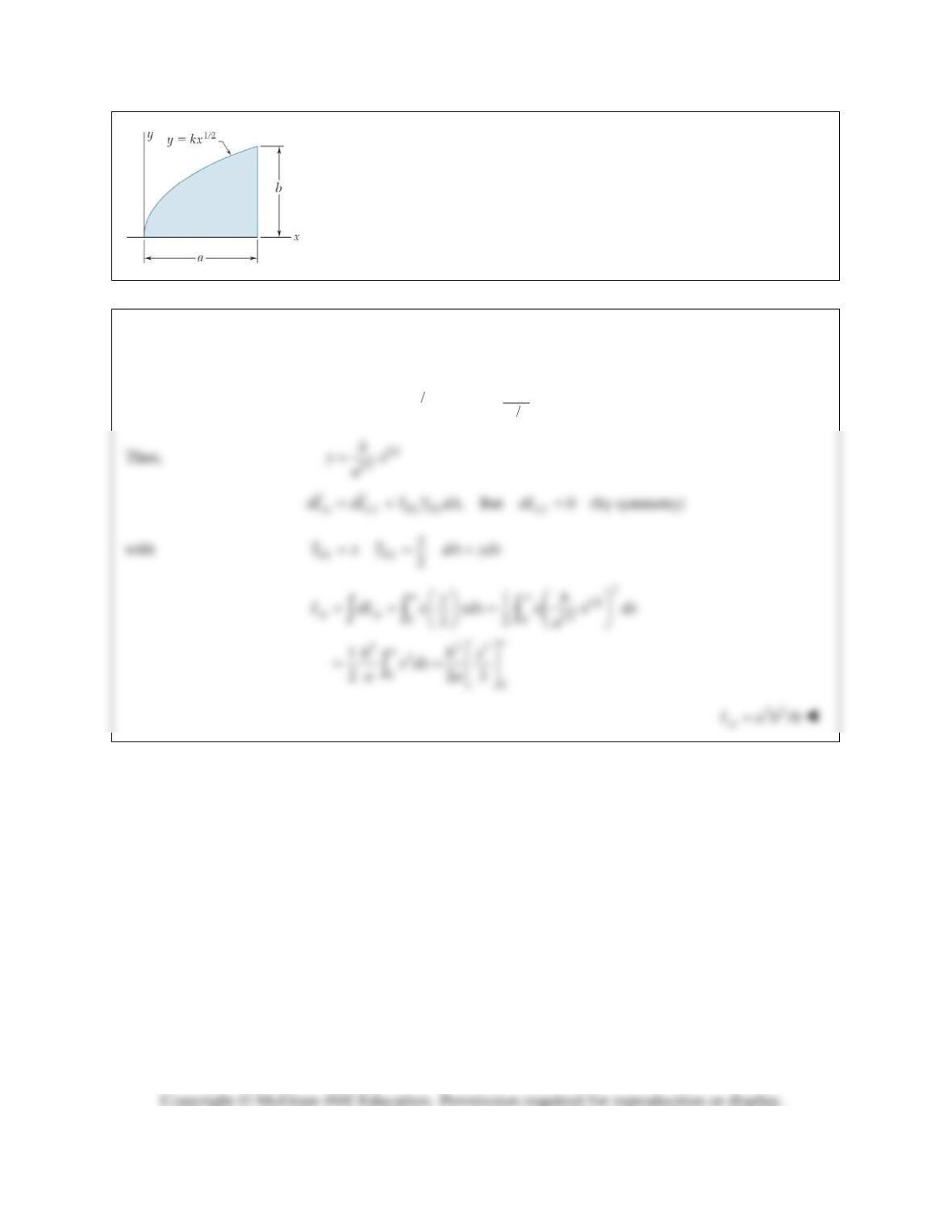
PROBLEM 9.68
Determine by direct integration the product of inertia of the given area
with respect to the x and y axes.
SOLUTION
xy x y EL EL
dI dI x y dA
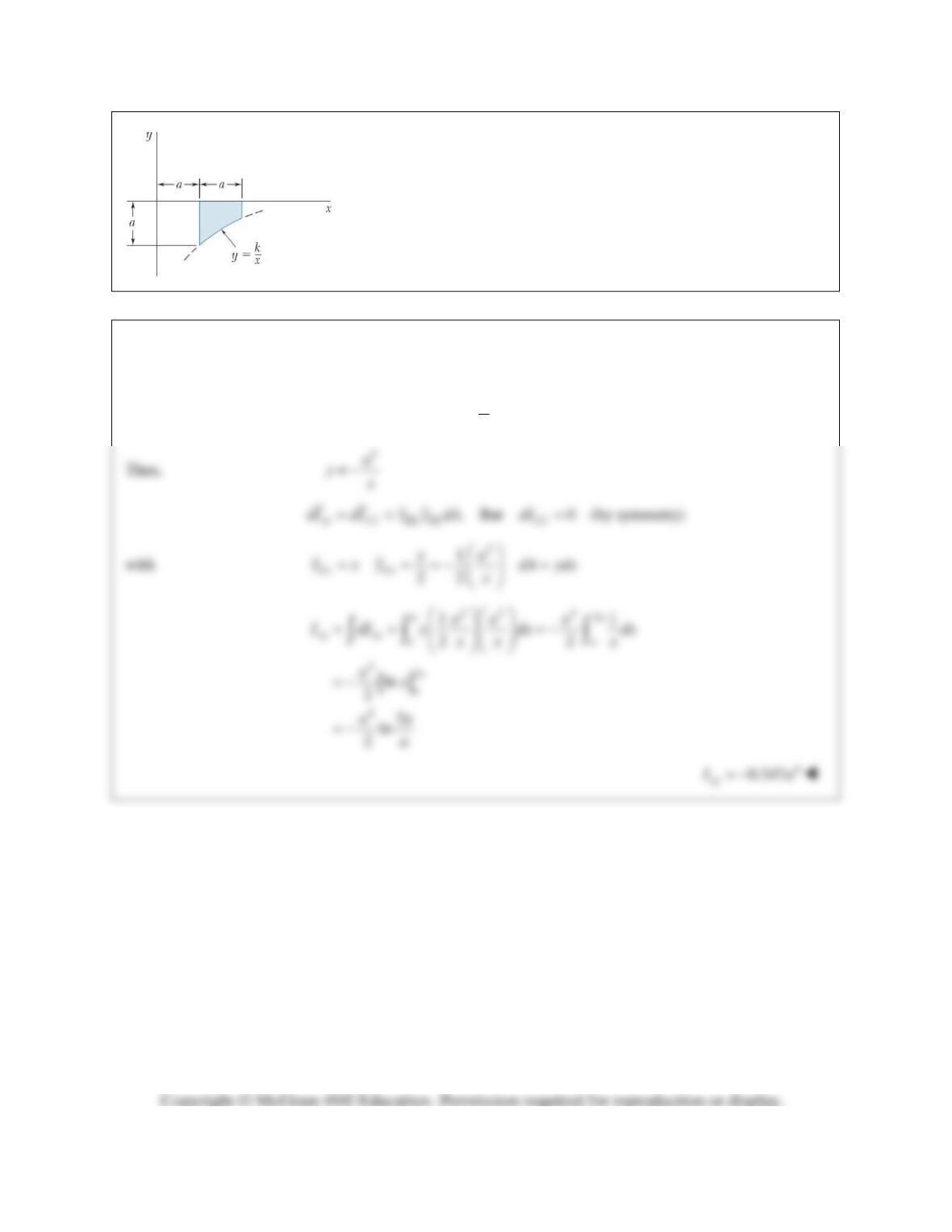
PROBLEM 9.69
Determine by direct integration the product of inertia of the given area with
respect to the x and y axes.
SOLUTION
For 12
12
,or
b
xa bka k a
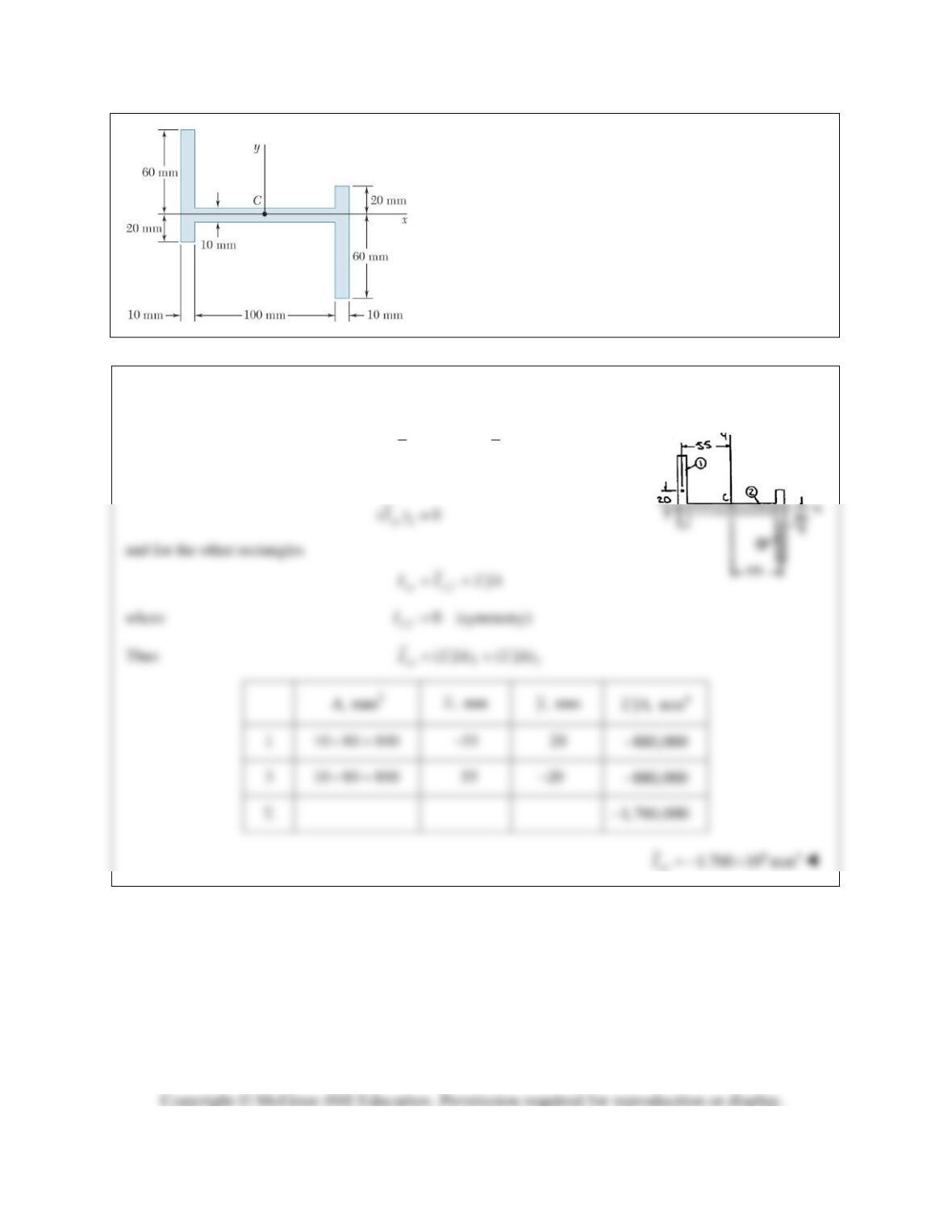
PROBLEM 9.70
Determine by direct integration the product of inertia of the given area
with respect to the x and y axes.
SOLUTION
For 2
, ; or
k
x
ay a a k a
a
I
PROBLEM 9.71
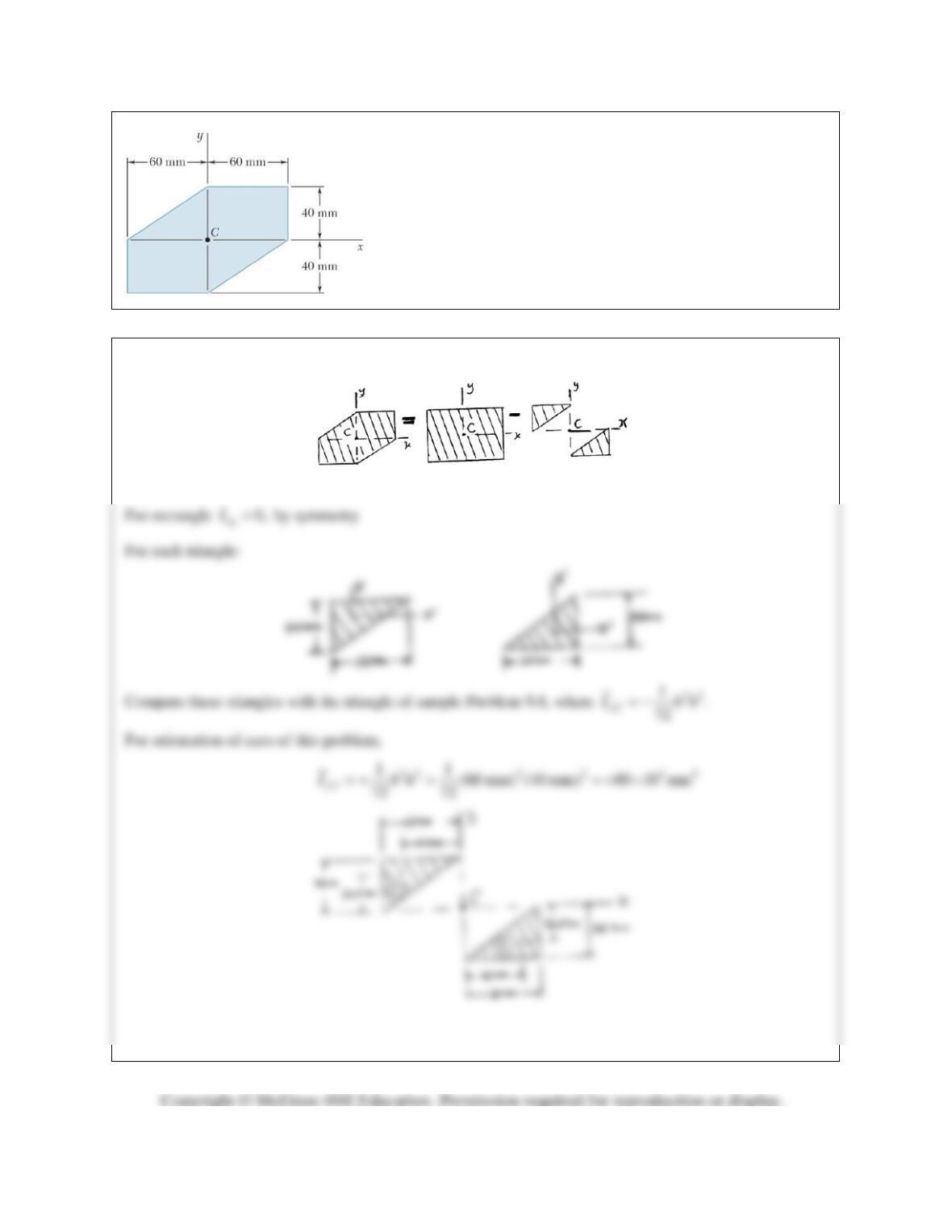
Using the parallel-axis theorem, determine the product of
inertia of the area shown with respect to the centroidal x
and y axes.
SOLUTION
Dimensions in mm
We have
123
()() ()
xy xy xy xy
II I I
Now symmetry implies
PROBLEM 9.72
Using the parallel-axis theorem, determine the product of inertia
of the area shown with respect to the centroidal x and y axes.
SOLUTION
Given area Rectangle (Two triangles)
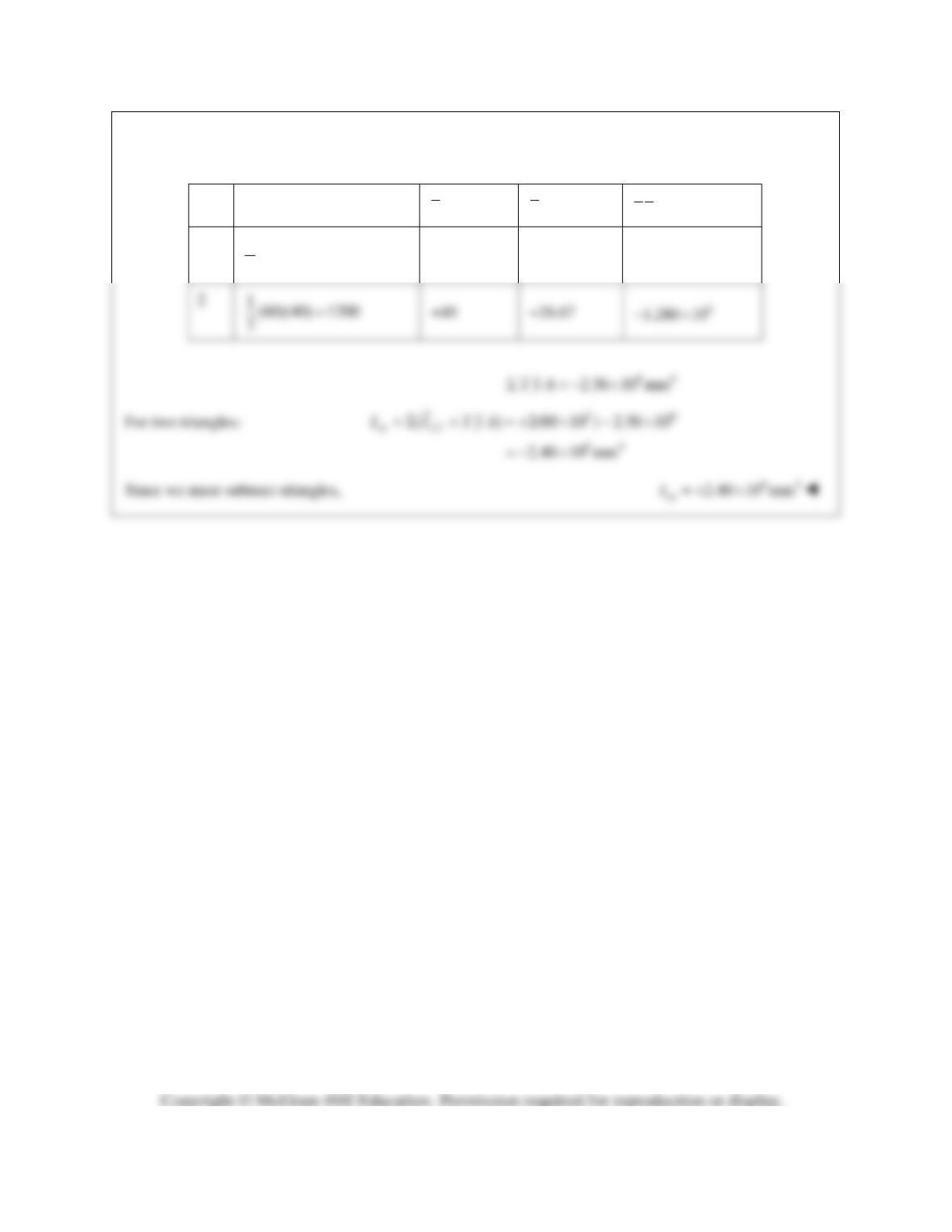
PROBLEM 9.72 (Continued)
2
Area, mm , mm
x
, mmy 4
, mmxyA
1 1(60)(40) 1200
2 40
26.67
6
1.280 10
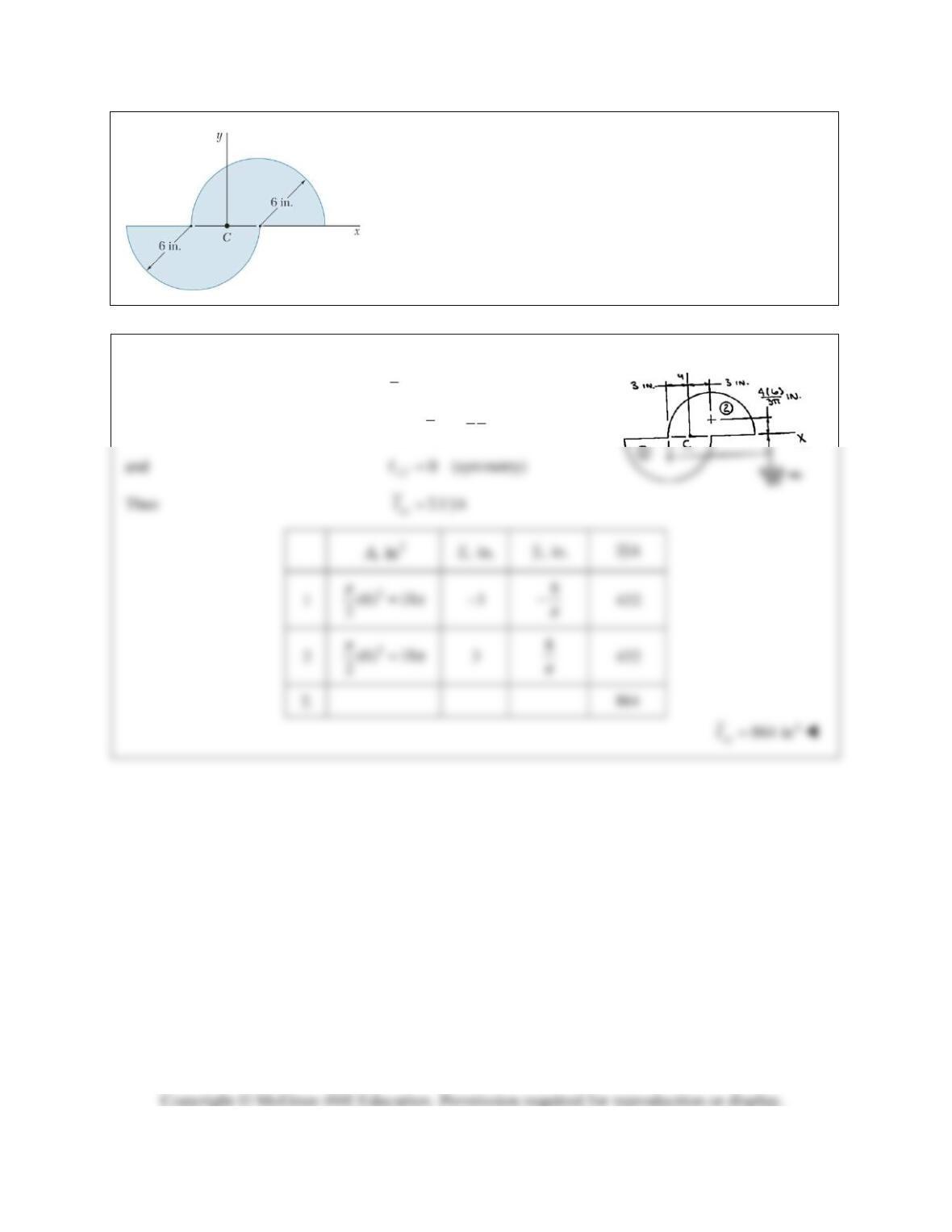
PROBLEM 9.73
Using the parallel-axis theorem, determine the product of inertia of
the area shown with respect to the centroidal x and y axes.
SOLUTION
We have
12
()()
xy xy xy
II I
For each semicircle
xy x y
II xyA
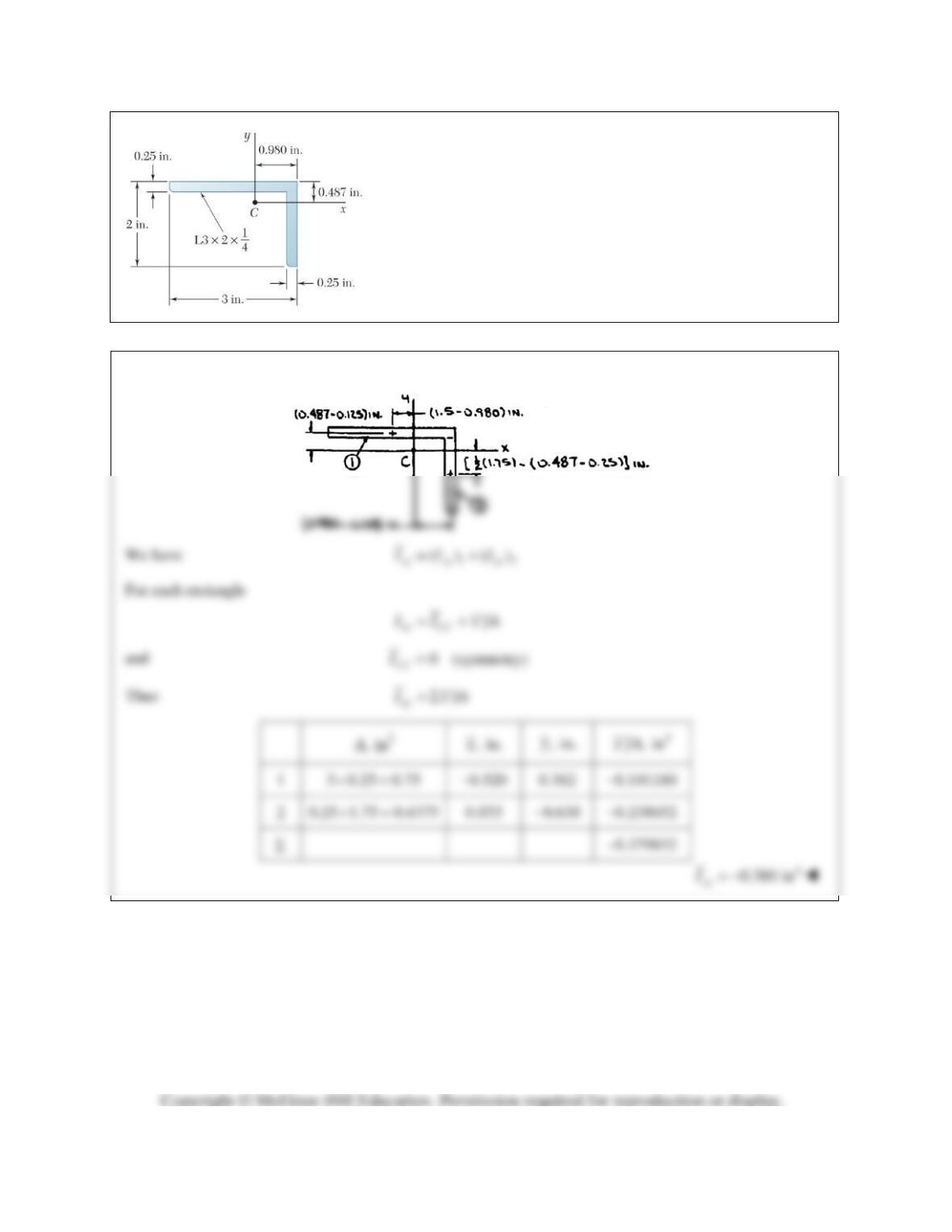
PROBLEM 9.74
Using the parallel-axis theorem, determine the product of inertia
of the area shown with respect to the centroidal x and y axes.
SOLUTION