Chapter 9
Plant Assets, Natural Resources, and Intangibles
Review Questions
1. What are plant assets? Provide some examples.
2. Plant assets are recorded at historical cost. What does the historical cost of a plant asset include?
3. How do land improvements differ from land?
Land improvements are depreciable improvements to land, such as fencing, sprinklers, paving, signs,
and lighting. Land is not depreciated.
4. What does the word capitalize mean?
5. What is a lump-sum purchase, and how is it accounted for?
A lump-sum purchase, also called a basket purchase, is the purchase of several assets as a group.
The total cost paid (100%) is divided among the assets according to their relative market values.
6. What is the difference between a capital expenditure and a revenue expenditure? Give an example of
each.
A capital expenditure is debited to an asset account because it increases the asset’s capacity or
7. What is depreciation? What are the methods described in the chapter that can be used to compute
depreciation?
Depreciation is the allocation of a plant asset’s cost to expense over its useful life. Depreciation
8. Which depreciation method ignores residual value until the last year of depreciation? Why?
9. How does a business decide which depreciation method is best to use?
A business should match an asset’s expense against the revenue that the asset produces when
10. What is the depreciation method that is used for tax accounting purposes? How is it different than
the methods that are used for financial accounting purposes?
Modified Accelerated Cost Recovery System (MACRS) is a method used for tax purposes. Under
11. If a business changes the estimated useful life or estimated residual value of a plant asset, what must
the business do in regard to depreciation expense?
When a company makes an accounting change in estimate, generally accepted accounting principles
12. What financial statement is plant assets reported on, and how?
Plant assets are reported at book value on the balance sheet. Companies may choose to report plant
and the related accumulated depreciation should be disclosed.
13. How is discarding of a plant asset different from selling a plant asset?
Discarding of plant assets involves disposing of the asset for no cash. Selling an asset involves
receiving cash in exchange for the asset.
14. How is gain or loss determined when disposing of plant assets? What situation constitutes a gain?
What situation constitutes a loss?
Gain or loss is determined by comparing the cash received and the market value of any other assets
15. What is a natural resource? What is the process by which businesses spread the allocation of a
natural resource’s cost over its usage?
16. What is an intangible asset? Provide some examples.
Intangible assets are assets that have no physical form. Instead, these assets convey special rights
from patents, copyrights, trademarks, and other creative works.
17. What is the process by which businesses spread the allocation of an intangible asset’s cost over its
useful life?
18. What is goodwill? Is goodwill amortized? What happens if the value of goodwill has decreased at
the end of the year?
Goodwill is the excess of the cost of an acquired company over the sum of the market values of its
19. What does the asset turnover ratio measure, and how is it calculated?
20A. What does it mean if an exchange of plant assets has commercial substance? Are gains and losses
recorded on the books because of the exchange?
An exchange has commercial substance if the future cash flows change as a result of the
Short Exercises
S9-1 Determining the cost of an asset
Learning Objective 1
Alton Clothing purchased land, paying $88,000 cash plus a $250,000 note payable. In addition, Alton
paid delinquent property tax of $1,900, title insurance costing $500, and $4,200 to level the land and
remove an unwanted building. Record the journal entry for purchase of the land.
SOLUTION
Purchase price of land
$ 338,000
Add related costs:
Title insurance
Removal of building
6,600
Total cost of land
$ 344,600
S9-2 Making a lump-sum asset purchase
Learning Objective 1
Foley Distribution Service paid $130,000 for a group purchase of land, building, and equipment. At the
time of the acquisition, the land had a market value of $70,000, the building $42,000, and the equipment
$28,000. Journalize the lump-sum purchase of the three assets for a total cost of $130,000, the amount
for which the business signed a note payable.
SOLUTION
Asset
Market
Value
Percentage of Total Value
× Total
Purchase
Price
= Assigned
Cost of
Each Asset
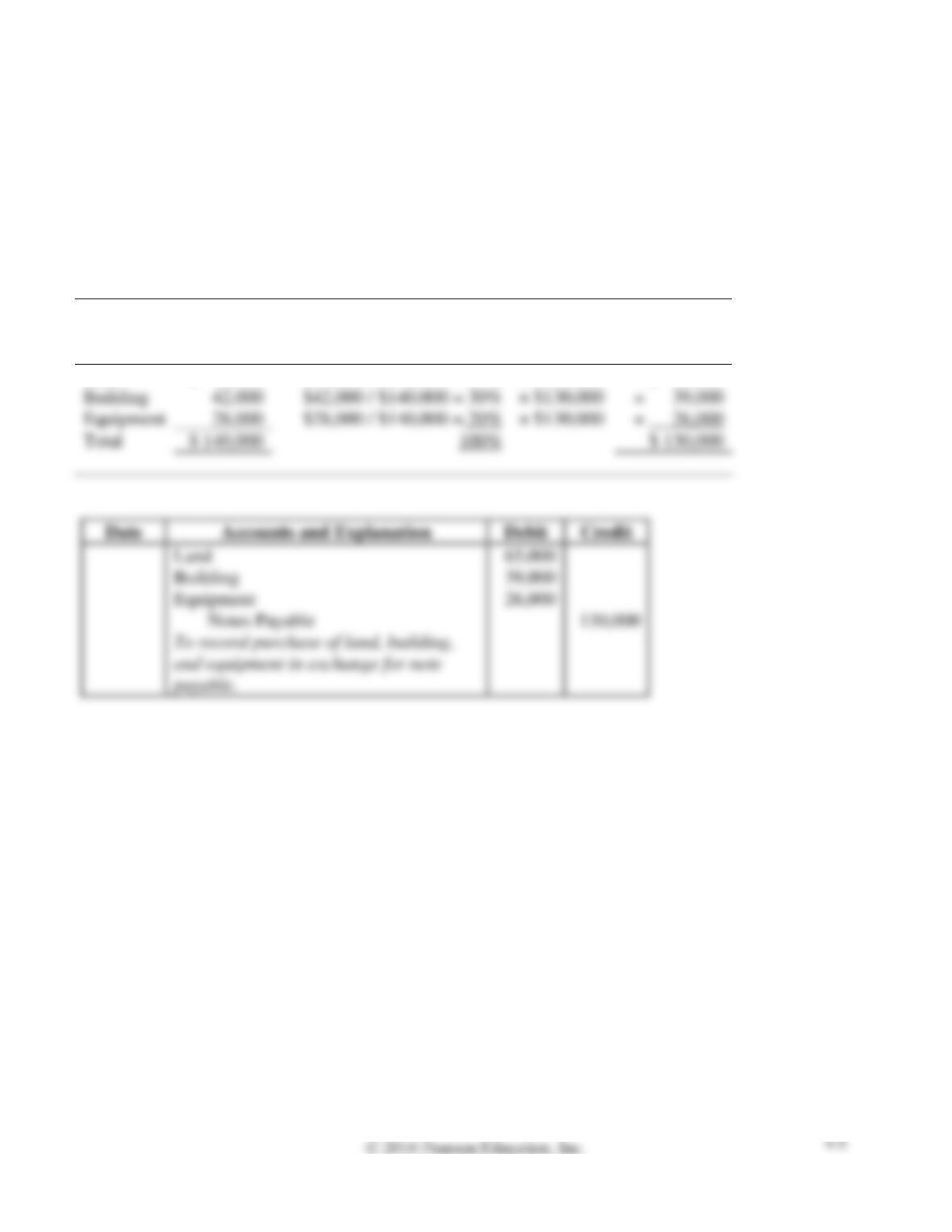
Land
$ 70,000
$70,000 / $140,000 = 50%
× $130,000
= $ 65,000
Building
$42,000 / $140,000 = 30%
× $130,000
= 39,000
Equipment
$28,000 / $140,000 = 20%
× $130,000
Total
$ 140,000
S9-3 Computing first-year depreciation and book value
Learning Objective 2
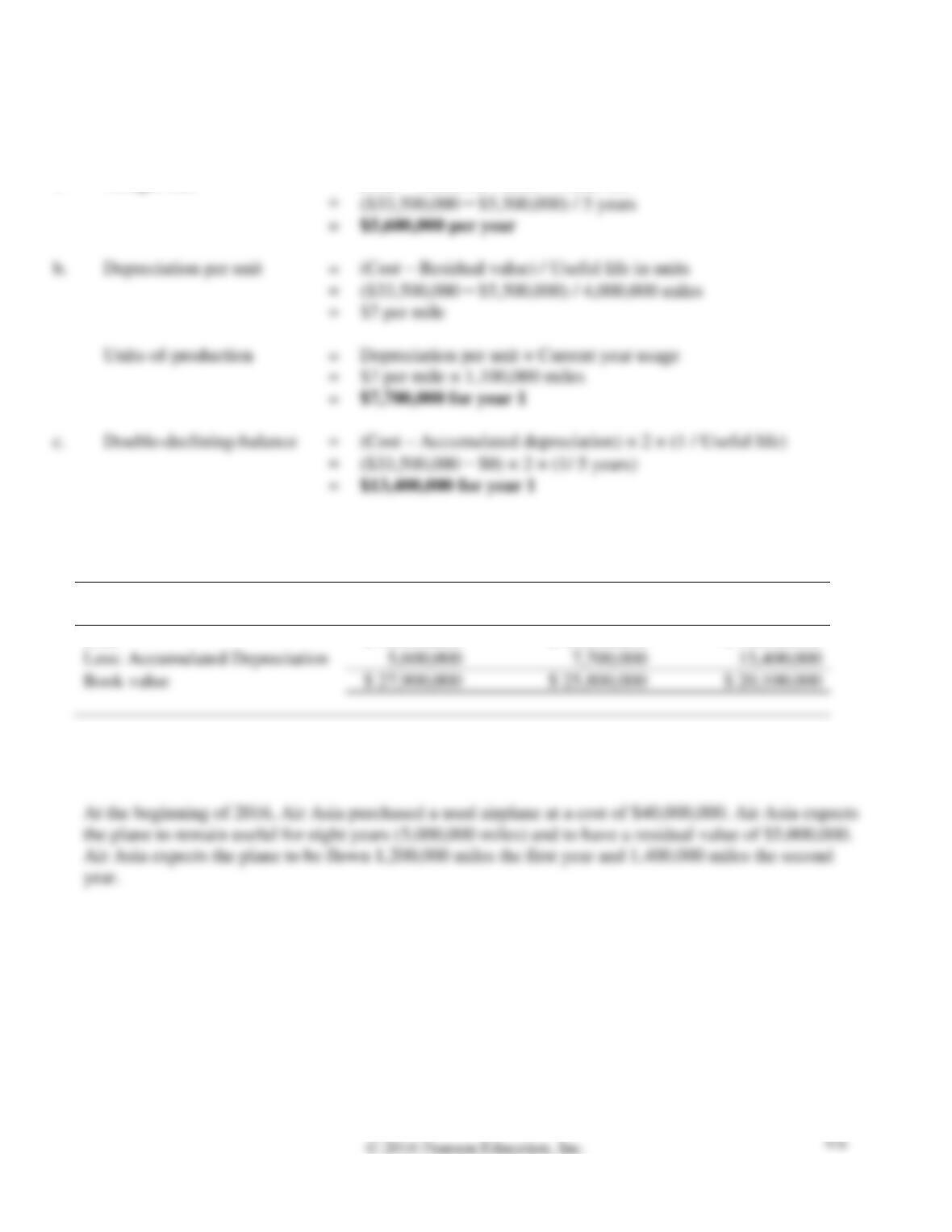
At the beginning of the year, Austin Airlines purchased a used airplane for $33,500,000. Austin Airlines
expects the plane to remain useful for five years (4,000,000 miles) and to have a residual value of
$5,500,000. The company expects the plane to be flown 1,100,000 miles during the first year.
Requirements
1. Compute Austin Airlines’s first-year depreciation expense on the plane using the following methods:
a. Straight-line
b. Units-of-production
c. Double-declining-balance
2. Show the airplane’s book value at the end of the first year for all three methods.
SOLUTION
Requirement 1
a.
Straight-line
=
(Cost − Residual value) / Useful life
=
b.
Depreciation per unit
=
(Cost – Residual value) / Useful life in units
=
$7 per mile
Units-of-production
=
Depreciation per unit × Current year usage
=
$7 per mile × 1,100,000 miles
=
c.
Double-declining-balance
=
(Cost – Accumulated depreciation) × 2 × (1 / Useful life)
=
Requirement 2
Straight-line
Units-of-production
Double-declining-
balance
Cost
$ 33,500,000
$ 33,500,000
$ 33,500,000
Less: Accumulated Depreciation
Book value
$ 27,900,000
$ 25,800,000
$ 20,100,000
S9-4 Computing second-year depreciation and accumulated depreciation
Learning Objective 2
Requirements
1. Compute second-year (2017) depreciation expense on the plane using the following methods:
a. Straight-line
b. Units-of-production
c. Double-declining-balance
2. Calculate the balance in Accumulated Depreciation at the end of the second year for all three
methods.
SOLUTION
Requirement 1
a.
Straight-line
=
(Cost − Residual value) / Useful life
=
b.
Depreciation per unit
=
(Cost – Residual value) / Useful life in units
=
$7 per mile
Units-of-production
=
Depreciation per unit × Current year usage
=
$7 per mile × 1,200,000 miles
=
$8,400,000 in year 1
=
Depreciation per unit × Current year usage
=
$7 per mile × 1,400,000 miles
=
c.
Double-declining-balance
=
(Cost – Accumulated depreciation) × 2 × (1 / Useful life)
=
$10,000,000 in year 1
=
(Cost – Accumulated depreciation) × 2 × (1 / Useful life)
=
Requirement 2
Straight-line
Units-of-
production
Double-declining-
balance
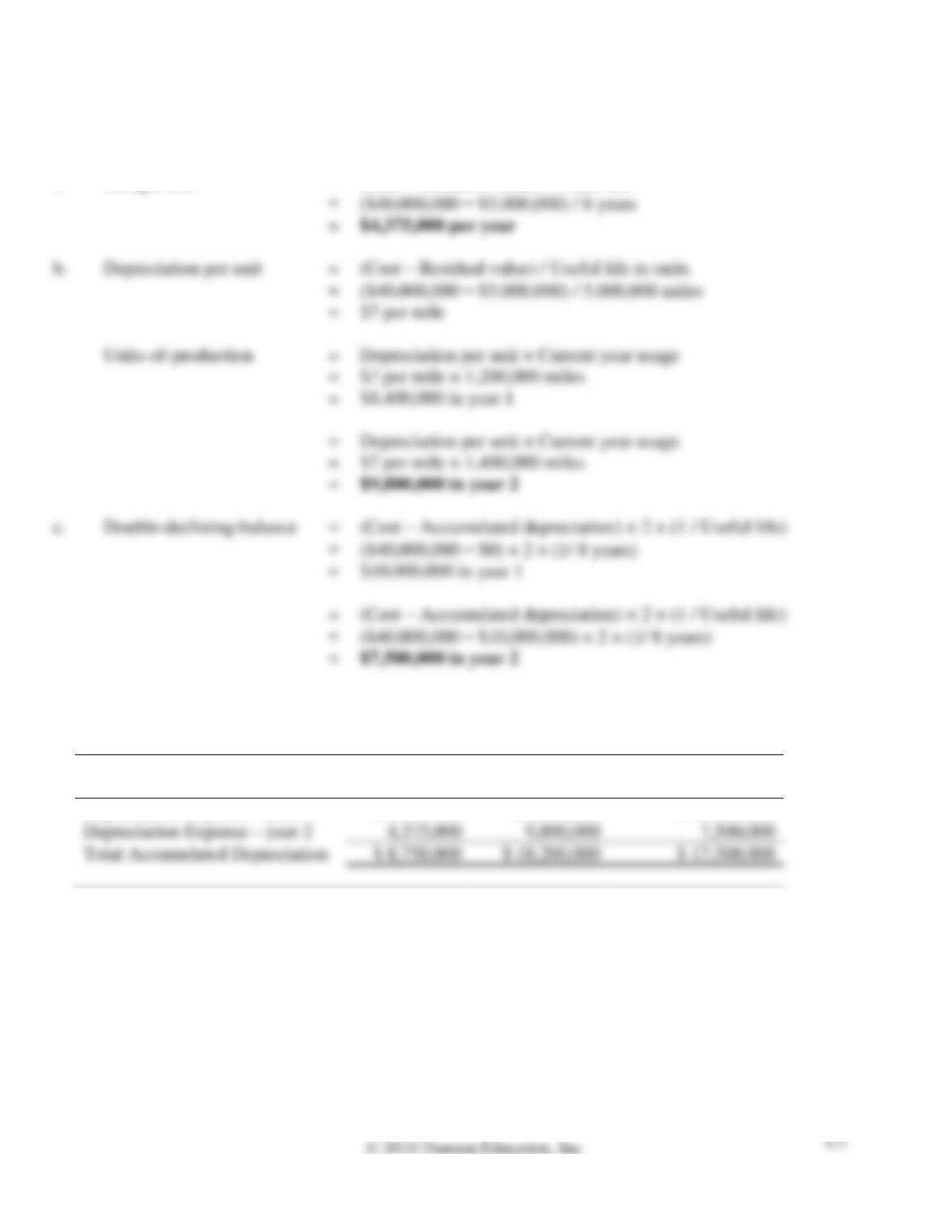
Depreciation Expense – year 1
$ 4,375,000
$ 8,400,000
$ 10,000,000
Depreciation Expense – year 2
4,375,000
Total Accumulated Depreciation
$ 8,750,000
$ 17,500,000
S9-5 Calculating partial-year depreciation
Learning Objective 2
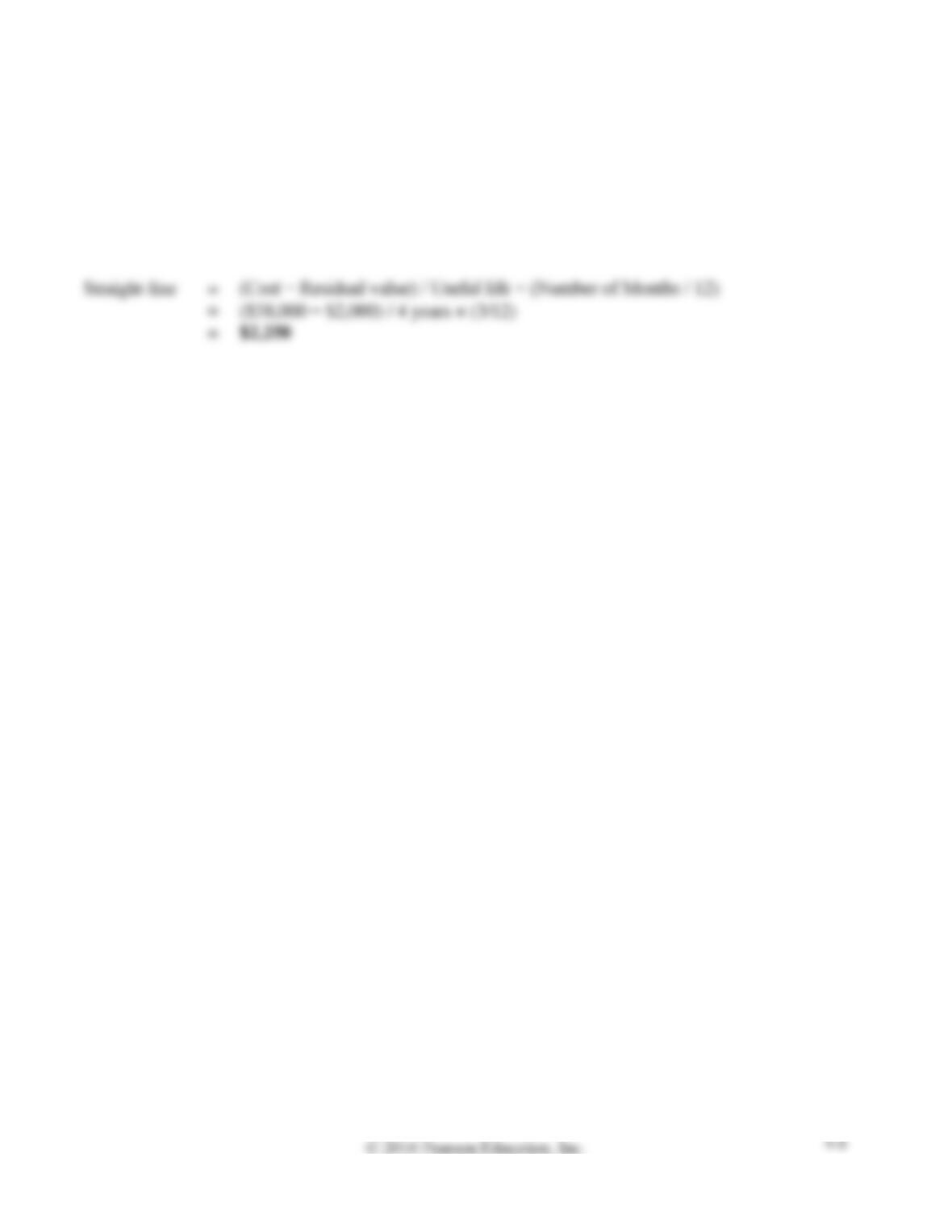
On September 30, 2015, Meggie Services purchased a copy machine for $38,000. Meggie Services
expects the machine to last for four years and have a residual value of $2,000. Compute depreciation
expense on the machine for the year ended December 31, 2015, using the straight-line method.
SOLUTION
Straight-line
S9-6 Changing the estimated life of an asset
Learning Objective 2
Assume that ABC Catering Services paid $20,000 for equipment with a 10-year life and zero expected
residual value. After using the equipment for four years, the company determines that the asset will
remain useful for only three more years.
Requirements
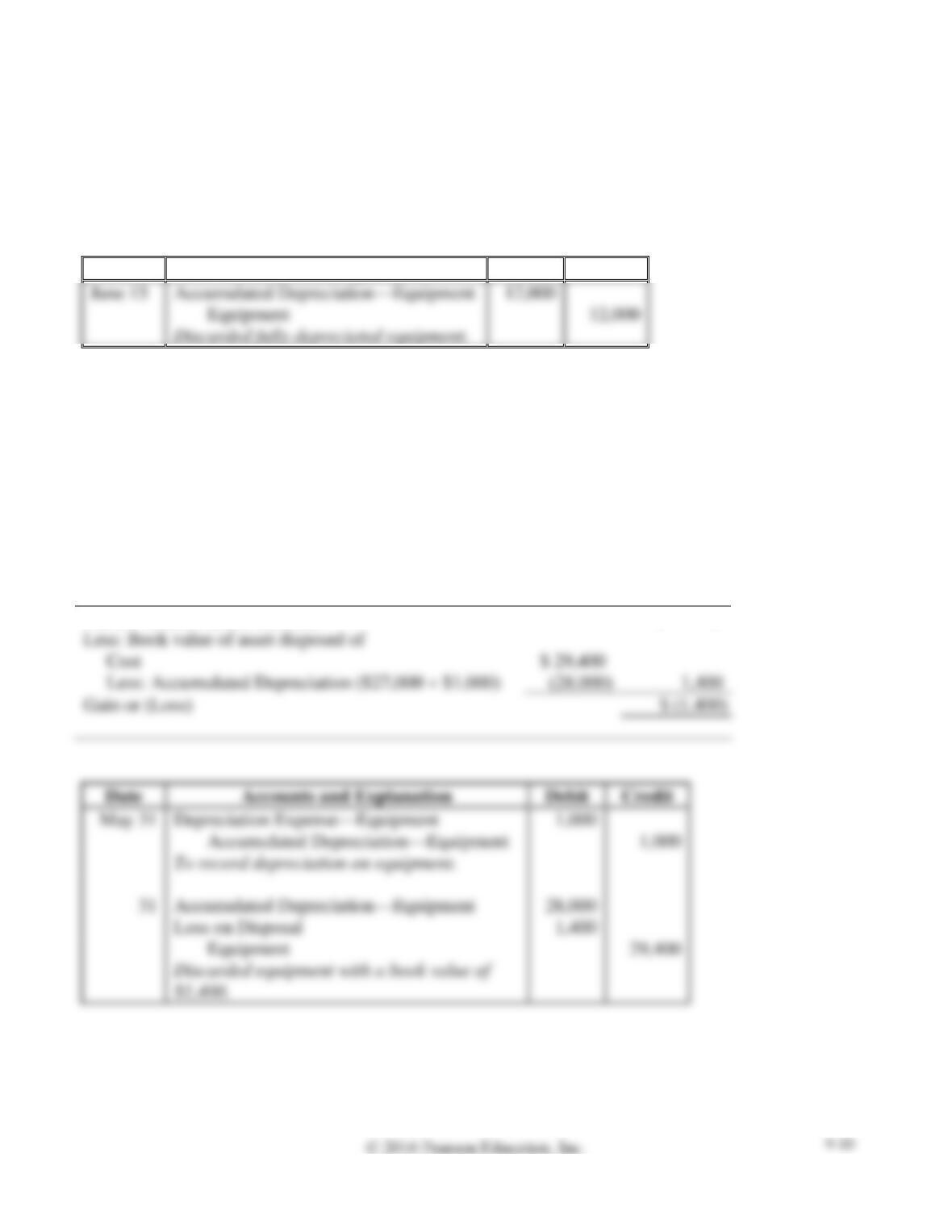
1. Record depreciation expense on the equipment for year 5 by the straight-line method.
2. What is accumulated depreciation at the end of year 5?
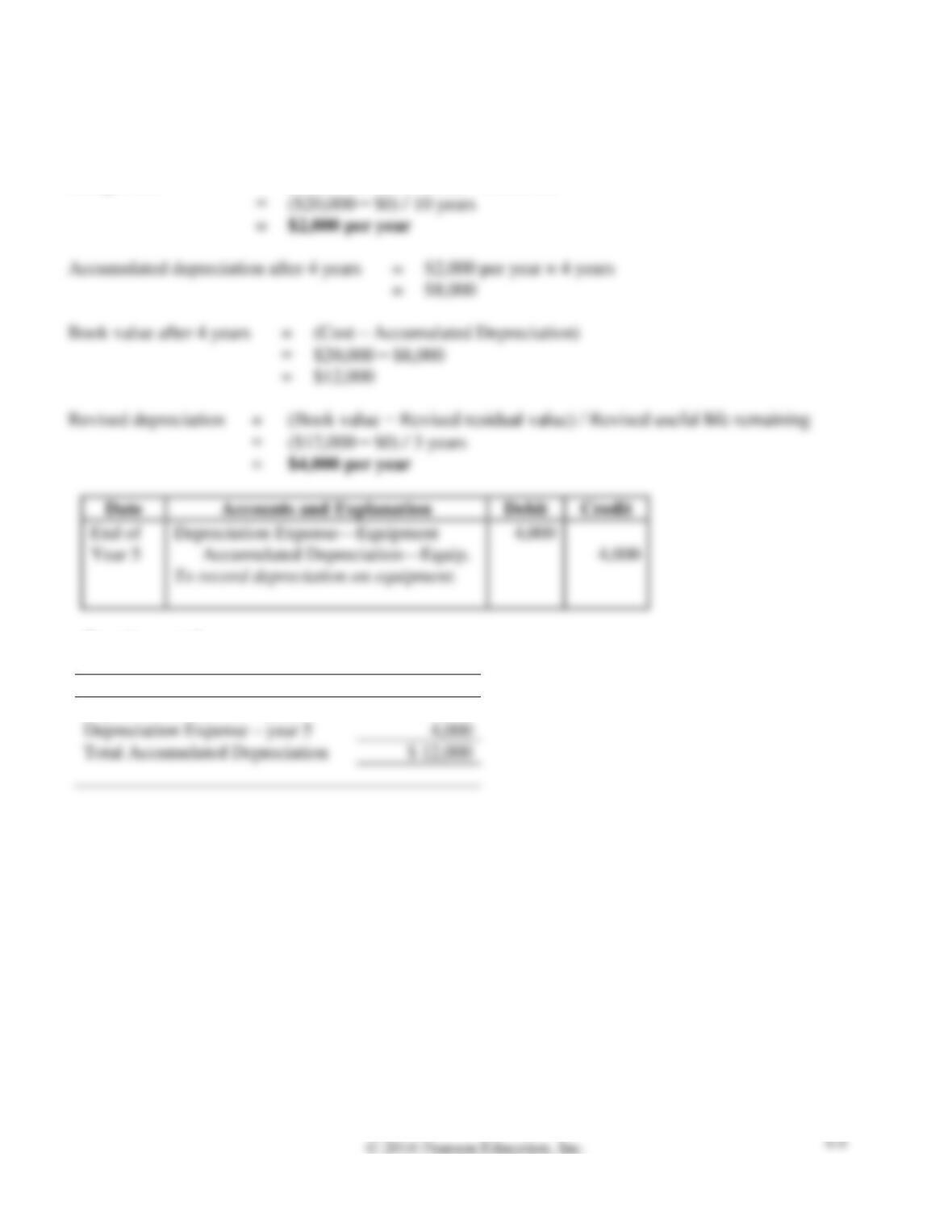
SOLUTION
Requirement 1
Straight-line
=
(Cost − Residual value) / Useful life
=
Accumulated depreciation after 4 years
=
$2,000 per year × 4 years
=
$8,000
Book value after 4 years
=
(Cost – Accumulated Depreciation)
=
$12,000
Revised depreciation
=
(Book value − Revised residual value) / Revised useful life remaining
=
Requirement 2
Straight-line
Depreciation Expense – years 1– 4
$ 8,000
Depreciation Expense – year 5
Total Accumulated Depreciation
S9-7 Discarding of a fully depreciated asset
Learning Objective 3
On June 15, 2015, Perfect Furniture discarded equipment that had a cost of $12,000, a residual value of
$0, and was fully depreciated. Journalize the disposal of the equipment.
SOLUTION
Date
Accounts and Explanation
Debit
Credit
S9-8 Discarding an asset
Learning Objective 3
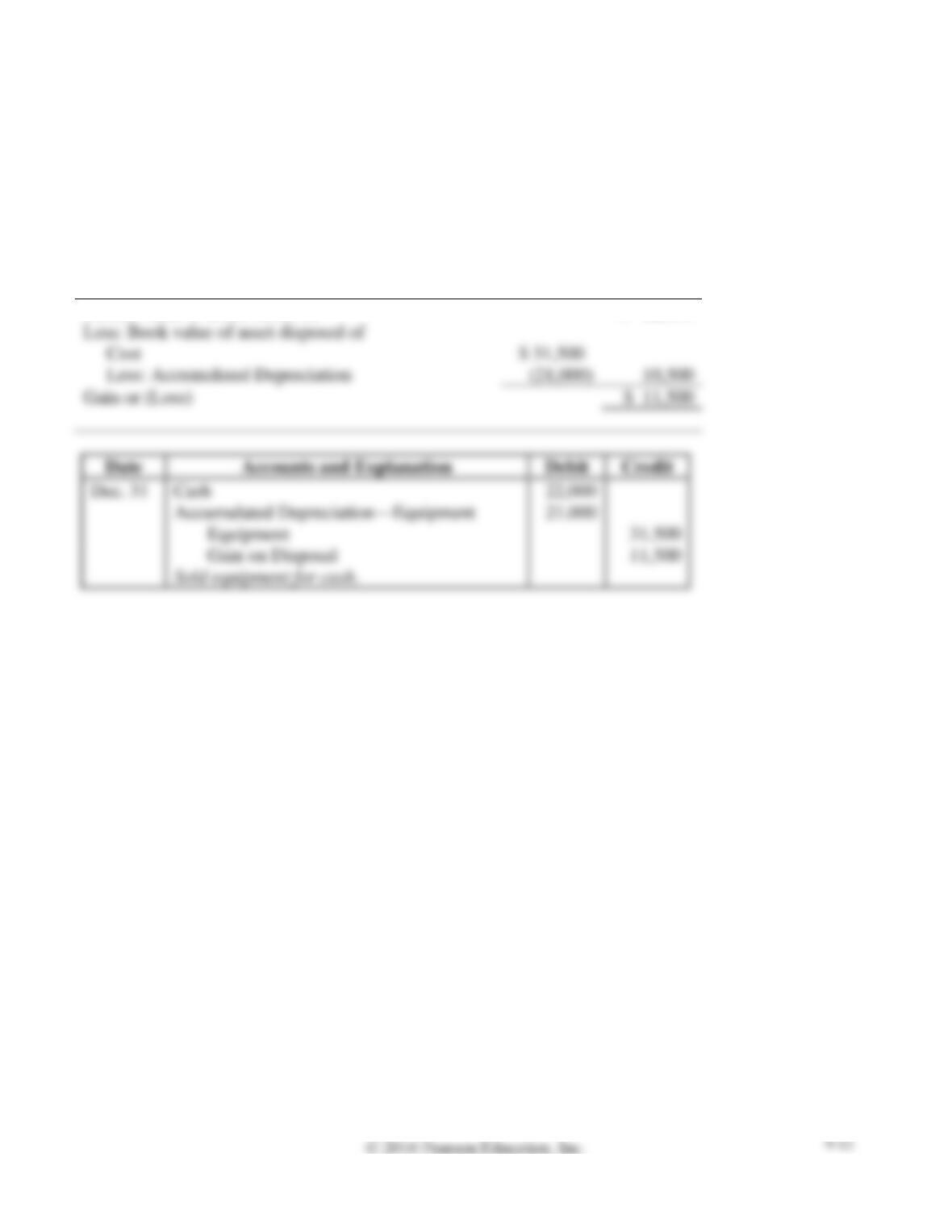
On May 31, 2016, Choice Landscapes discarded equipment that had a cost of $29,400. Accumulated
Depreciation as of December 31, 2015, was $27,000. Assume annual depreciation on the equipment is
$2,400. Journalize the partial-year depreciation expense and disposal of the equipment.
SOLUTION
Partial year depreciation = $2,400 × 5/12 = $1,000
Market value of assets received
$ 0
Less: Book value of asset disposed of
Cost
Less: Accumulated Depreciation ($27,000 + $1,000)
(28,000)
Gain or (Loss)
Date
Debit
Credit
S9-9 Selling an asset at gain or loss
Learning Objective 3
Mill Creek Golf Club purchased equipment on January 1, 2016, for $31,500. Suppose Mill Creek Golf
Club sold the equipment for $22,000 on December 31, 2018. Accumulated Depreciation as of December
31, 2018, was $21,000. Journalize the sale of the equipment, assuming straight-line depreciation was
used.
SOLUTION
Market value of assets received
$ 22,000
Less: Book value of asset disposed of
Cost
$ 31,500
Less: Accumulated Depreciation
Gain or (Loss)
S9-10 Selling an asset at gain or loss
Learning Objective 3
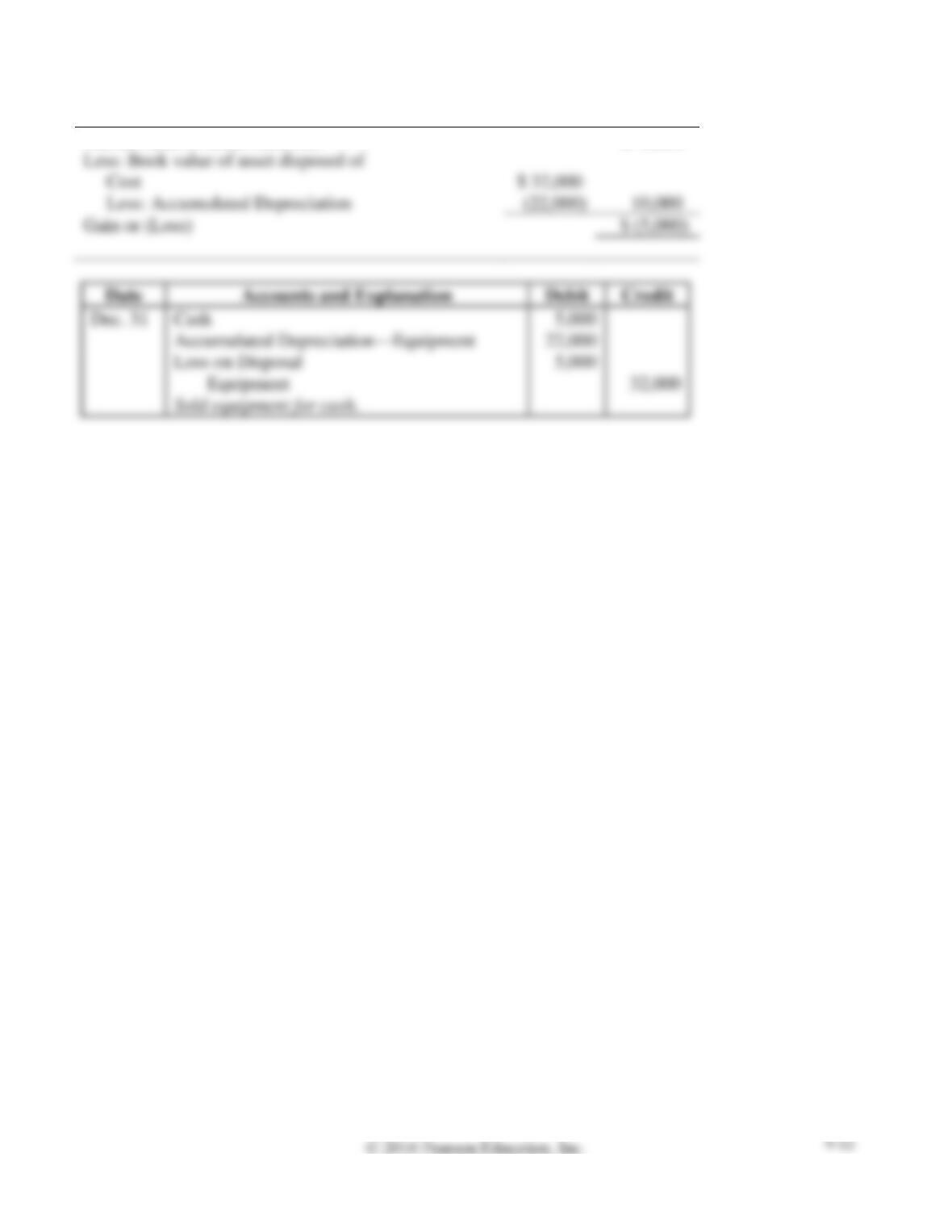
Pelman Company purchased equipment on January 1, 2016, for $32,000. Suppose Pelman sold the
equipment for $5,000 on December 31, 2017. Accumulated Depreciation as of December 31, 2017, was
$22,000. Journalize the sale of the equipment, assuming straight-line depreciation was used.
SOLUTION
Market value of assets received
$ 5,000
Less: Book value of asset disposed of
Cost
Less: Accumulated Depreciation
(22,000)
10,000
Gain or (Loss)
S9-11 Accounting for depletion of natural resources
Learning Objective 4
North Coast Petroleum holds huge reserves of oil assets. Assume that at the end of 2016, North Coast
Petroleum’s cost of oil reserves totaled $60,000,000,000, representing 5,000,000,000 barrels of oil.
Requirements
1. Which method does North Coast Petroleum use to compute depletion?
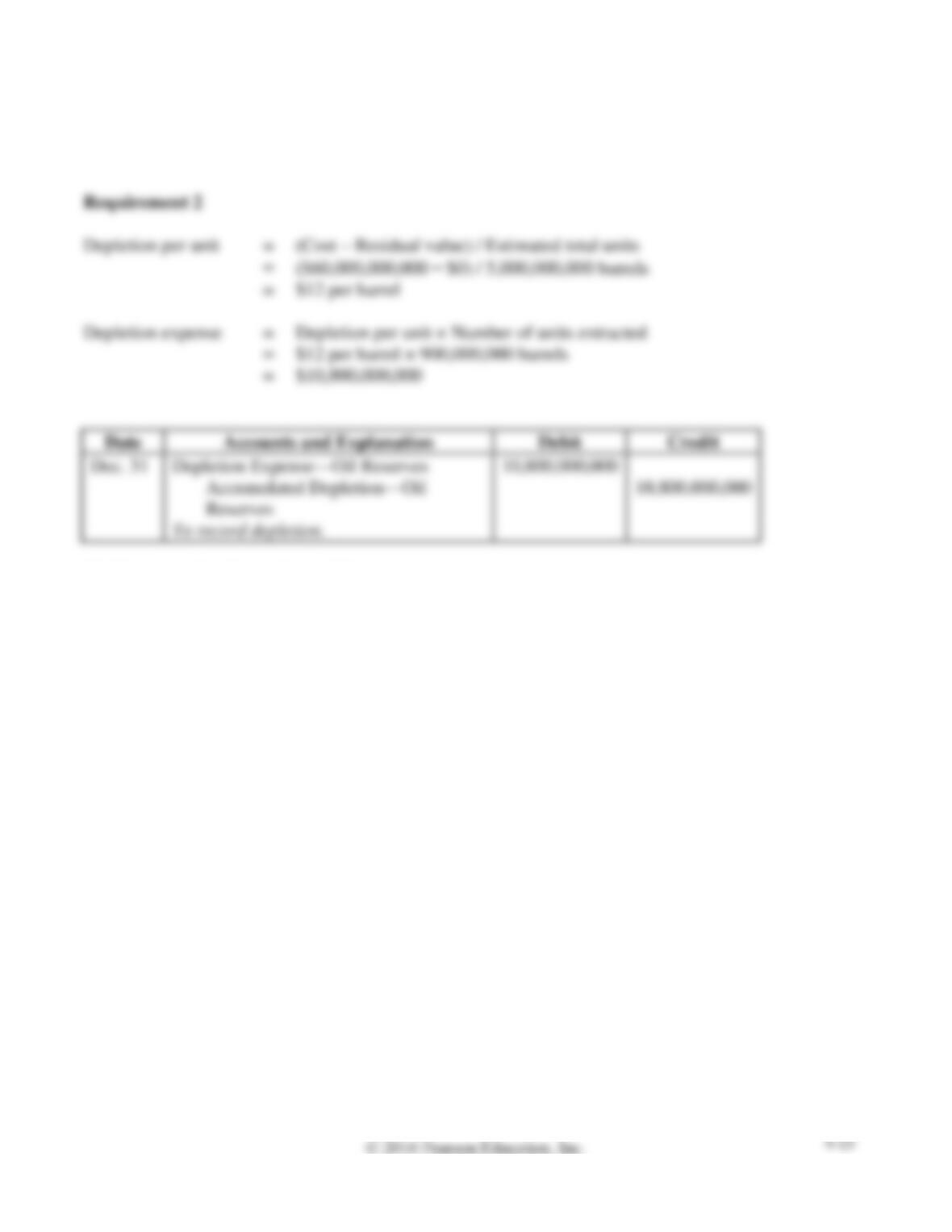
2. Suppose North Coast Petroleum removed and sold 900,000,000 barrels of oil during 2017.
Journalize depletion expense for 2017.
SOLUTION
Requirement 1
Units-of-production is the method used to compute depletion.
S9-12 Accounting for an intangible asset
Learning Objective 5
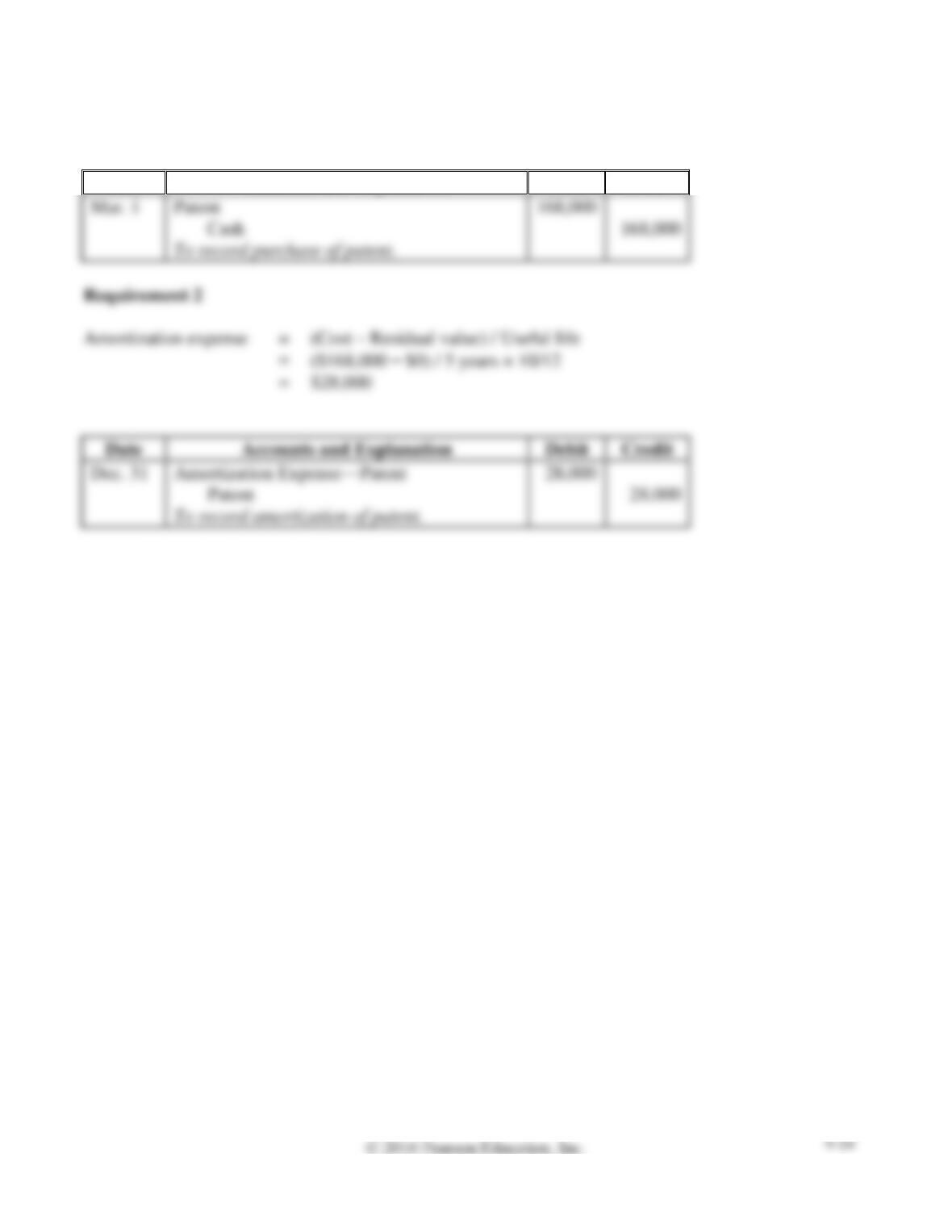
On March 1, 2016, Twist Company purchased a patent for $168,000 cash. Although the patent gives
legal protection for 20 years, the patent is expected to be used for only five years.
Requirements
1. Journalize the purchase of the patent.
2. Journalize the amortization expense for the year ended December 31, 2016. Assume straight-line
amortization.
SOLUTION
Requirement 1
Date
Accounts and Explanation
Debit
Credit
Date
Accounts and Explanation
Debit
Credit
S9-13 Accounting for goodwill
Learning Objective 5
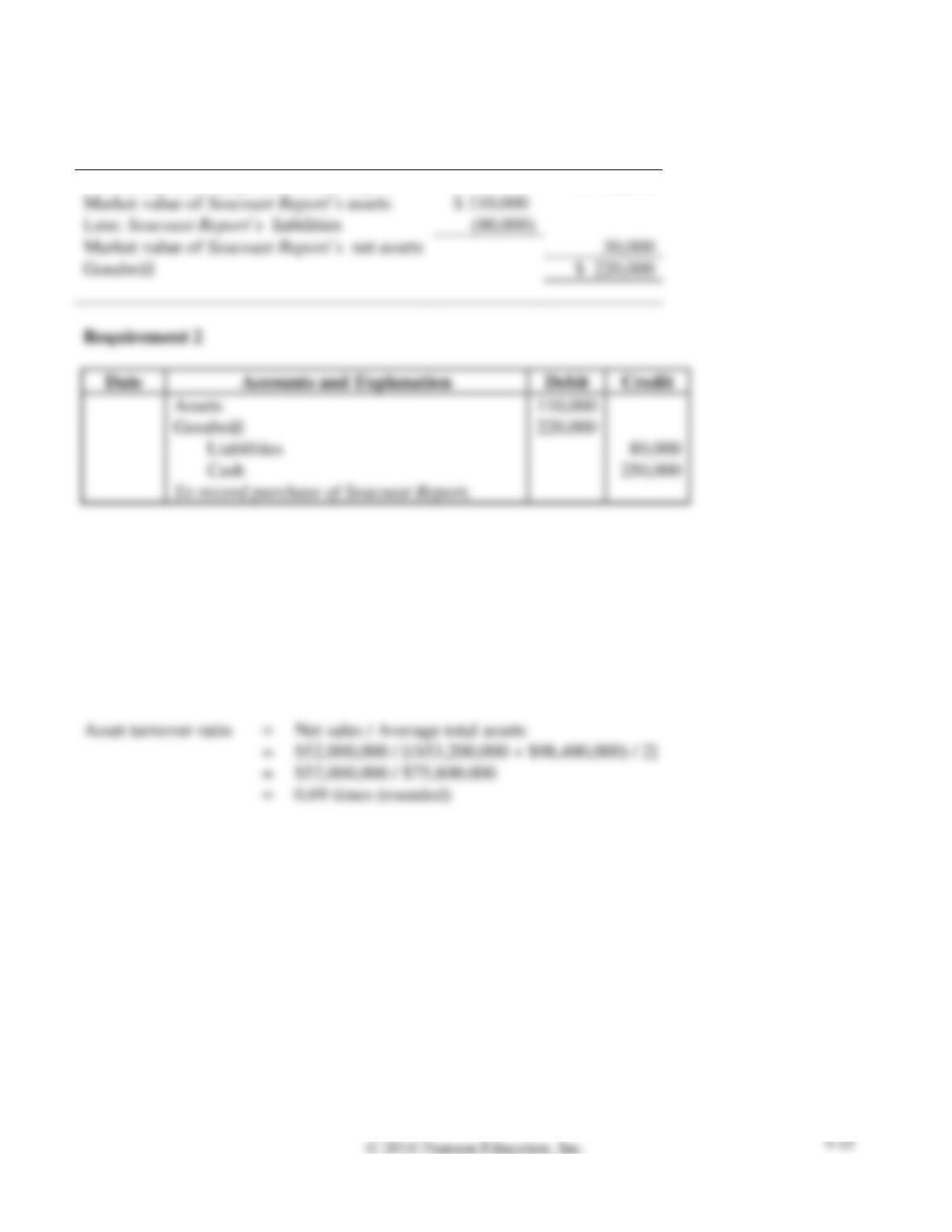
TXL Advertising paid $250,000 to acquire Seacoast Report, a weekly advertising paper. At the time of
the acquisition, Seacoast Report’s balance sheet reported total assets of $140,000 and liabilities of
$80,000. The fair market value of Seacoast Report’s assets was $110,000. The fair market value of
Seacoast Report’s liabilities was $80,000.
Requirements
1. How much goodwill did TXL Advertising purchase as part of the acquisition of Seacoast Report?
2. Journalize TXL Advertising’s acquisition of Seacoast Report.
SOLUTION
Requirement 1
Purchase price to acquire Seacoast Report
$ 250,000
Market value of Seacoast Report’s assets
Less: Seacoast Report’s liabilities
Market value of Seacoast Report’s net assets
S9-14 Computing the asset turnover ratio
Learning Objective 6
Balani, Inc. had net sales of $52,000,000 for the year ended May 31, 2016. Its beginning and ending
total assets were $53,200,000 and $98,400,000, respectively. Determine Balani’s asset turnover ratio for
year ended May 31, 2016.
SOLUTION
S9A-15 Exchanging plant assets
Learning Objective 7
Appendix 9A
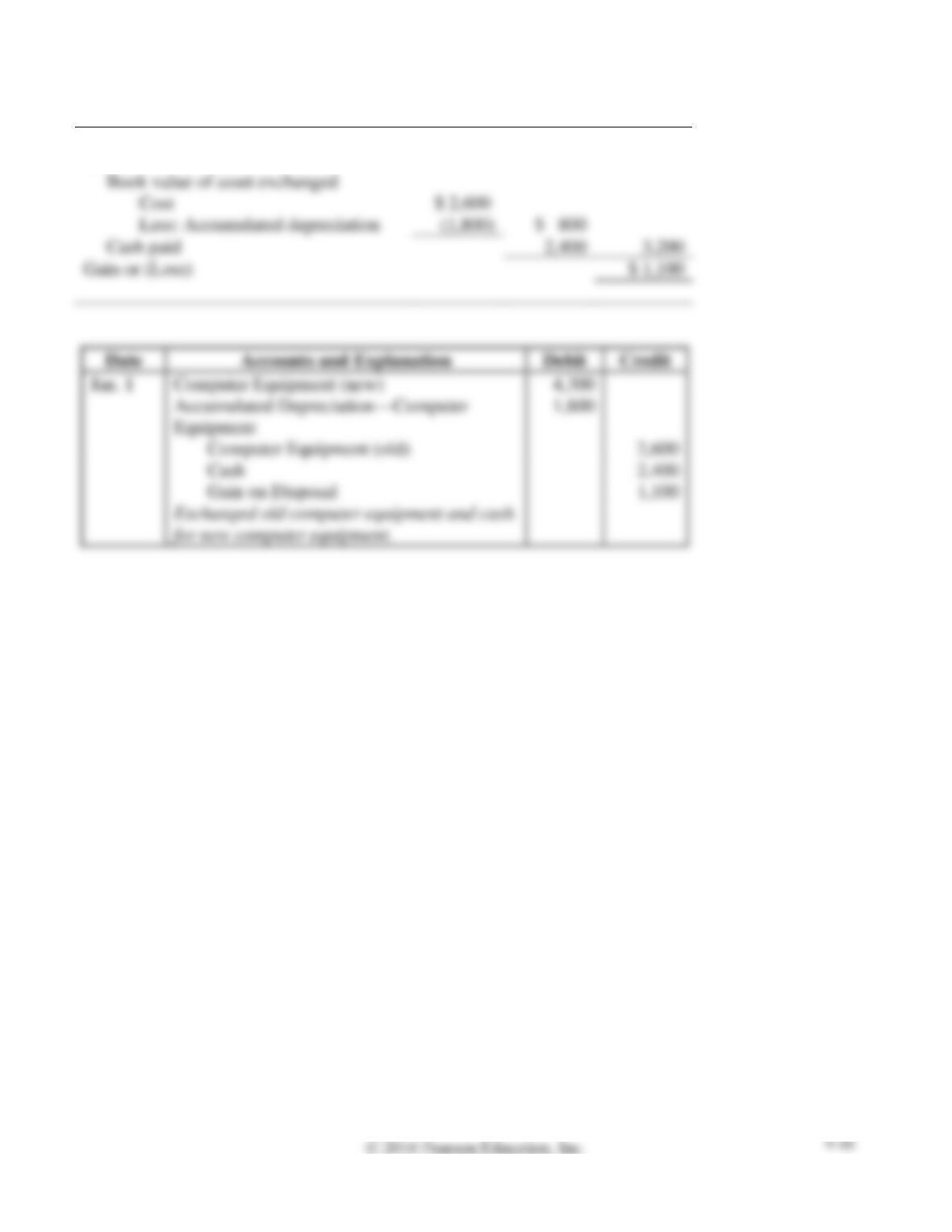
Alpha Communications, Inc. purchased a computer for $2,600, debiting Computer Equipment. During
2014 and 2015, Alpha Communications, Inc. recorded total depreciation of $1,800 on the computer. On
January 1, 2016, Alpha Communications, Inc. traded in the computer for a new one, paying $2,400 cash.
The fair market value of the new computer is $4,300. Journalize Alpha Communications, Inc.’s
exchange of computers. Assume the exchange had commercial substance.
SOLUTION
Market value of assets received
$ 4,300
Less:
Book value of asset exchanged
Cash paid
Gain or (Loss)
$ 1,100
S9A-16 Exchanging plant assets
Learning Objective 7
Appendix 9A
Orange Corporation purchased equipment for $30,000. Orange recorded total depreciation of $24,000 on
the equipment. On January 1, 2016, Orange traded in the equipment for new equipment, paying $23,500
cash. The fair market value of the new equipment is $28,500. Journalize Orange Corporation’s exchange
of equipment. Assume the exchange had commercial substance.
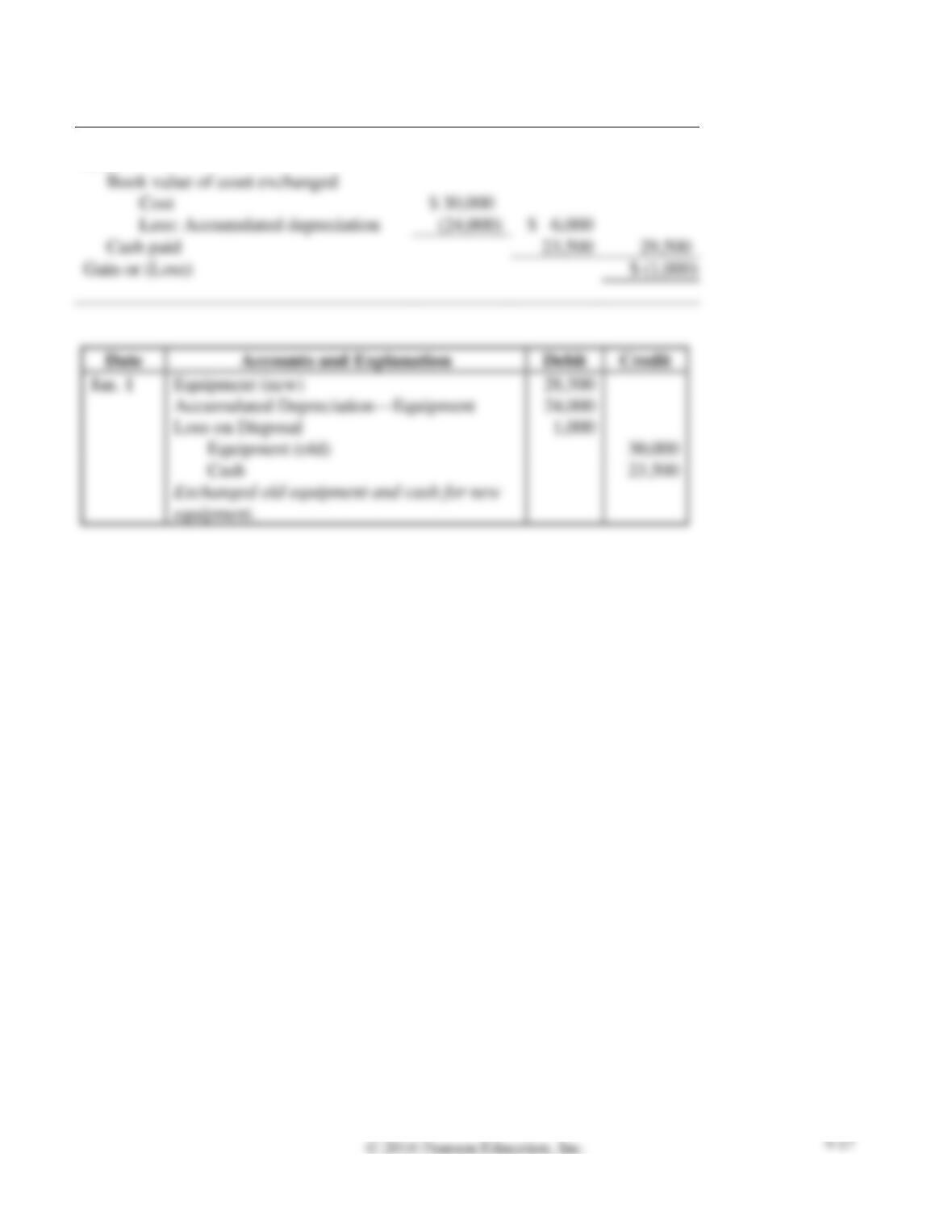
SOLUTION
Market value of assets received
$ 28,500
Less:
Book value of asset exchanged
(24,000)
Cash paid
Gain or (Loss)
Exercises
E9-17 Determining the cost of assets
Learning Objective 1
1. Land $365,000
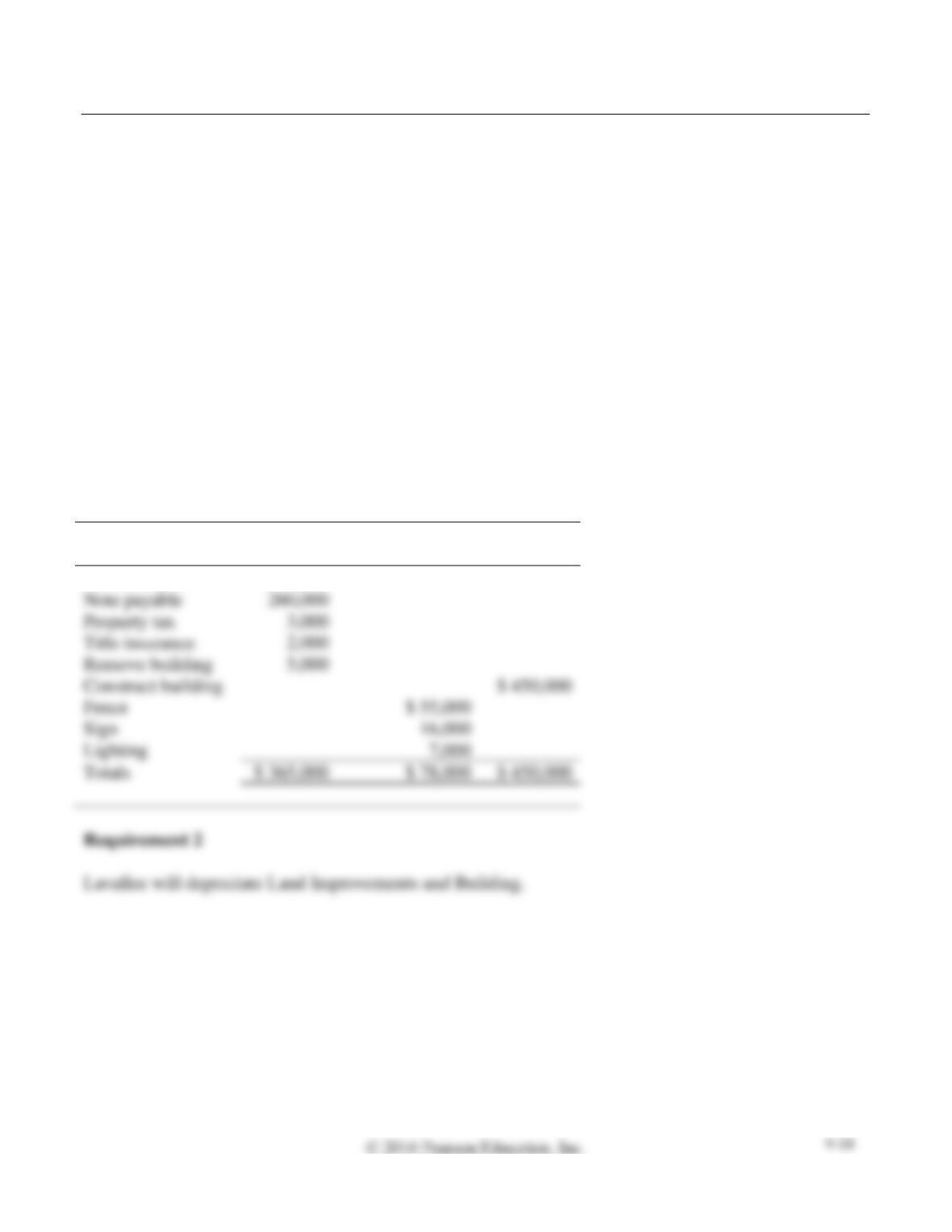
Lavallee Furniture purchased land, paying $95,000 cash plus a $260,000 note payable. In addition,
Lavallee paid delinquent property tax of $3,000, title insurance costing $2,000, and $5,000 to level the
land and remove an unwanted building. The company then constructed an office building at a cost of
$450,000. It also paid $55,000 for a fence around the property, $16,000 for a sign near the entrance, and
$7,000 for special lighting of the grounds.
Requirements
1. Determine the cost of the land, land improvements, and building.
2. Which of these assets will Lavallee depreciate?
SOLUTION
Requirement 1
Land
Land
Improvements
Building
Purchase price
$ 95,000
Note payable
Property tax
Remove building
Construct building
$ 450,000
Fence
Sign
Lighting
7,000
Totals
$ 450,000
E9-18 Making a lump-sum purchase of assets
Learning Objective 1
Lot 3 $108,750
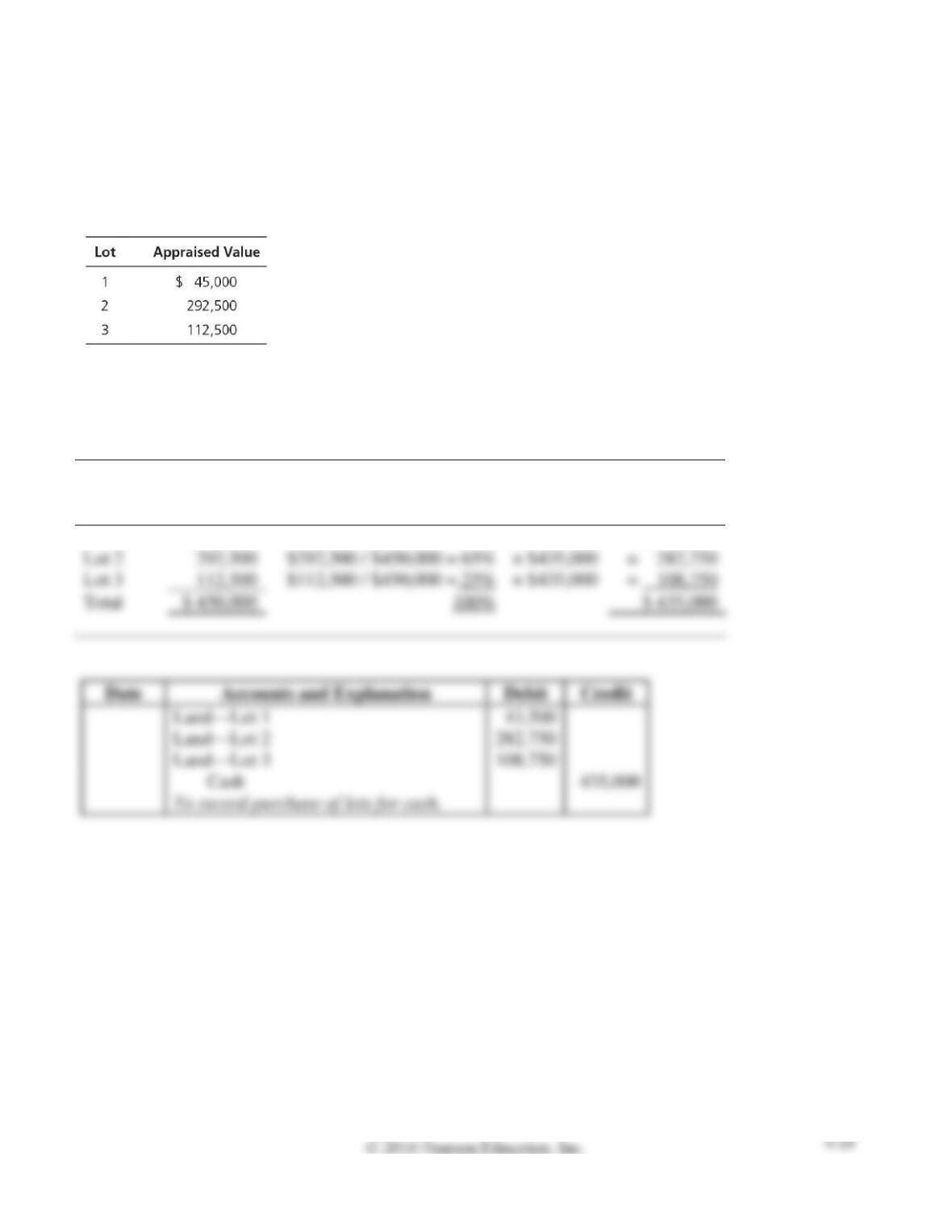
Dearwood Properties bought three lots in a subdivision for a lump-sum price. An independent appraiser
valued the lots as follows:
Dearwood paid $435,000 in cash. Record the purchase in the journal, identifying each lot’s cost in a
separate Land account. Round decimals to two places, and use the computed percentages throughout.
SOLUTION
Asset
Market
Value
Percentage of Total Value
× Total
Purchase
Price
= Assigned
Cost of
Each Asset
Lot 1
$ 45,000
$45,000 / $450,000 = 10%
× $435,000
= $ 43,500
Lot 2
× $435,000
= 282,750
Lot 3
× $435,000
Total
$ 450,000
Debit
Credit
E9-19 Distinguishing capital expenditures from revenue expenditures
Learning Objective 1
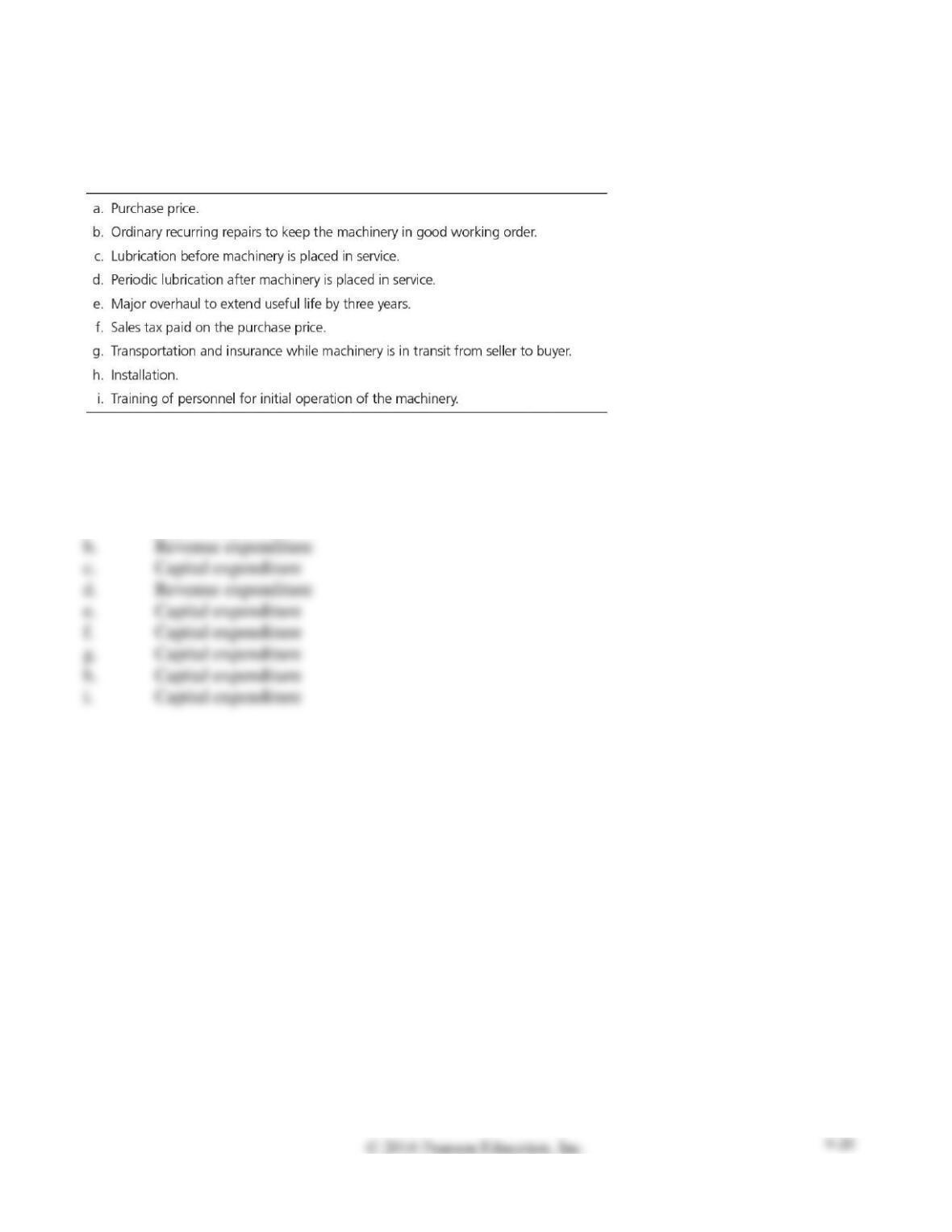
Consider the following expenditures:
Classify each of the expenditures as a capital expenditure or a revenue expenditure related to machinery.
SOLUTION
a.
Capital expenditure
Revenue expenditure
c.
Capital expenditure
Revenue expenditure
e.
Capital expenditure
Capital expenditure
Capital expenditure
Capital expenditure
Capital expenditure