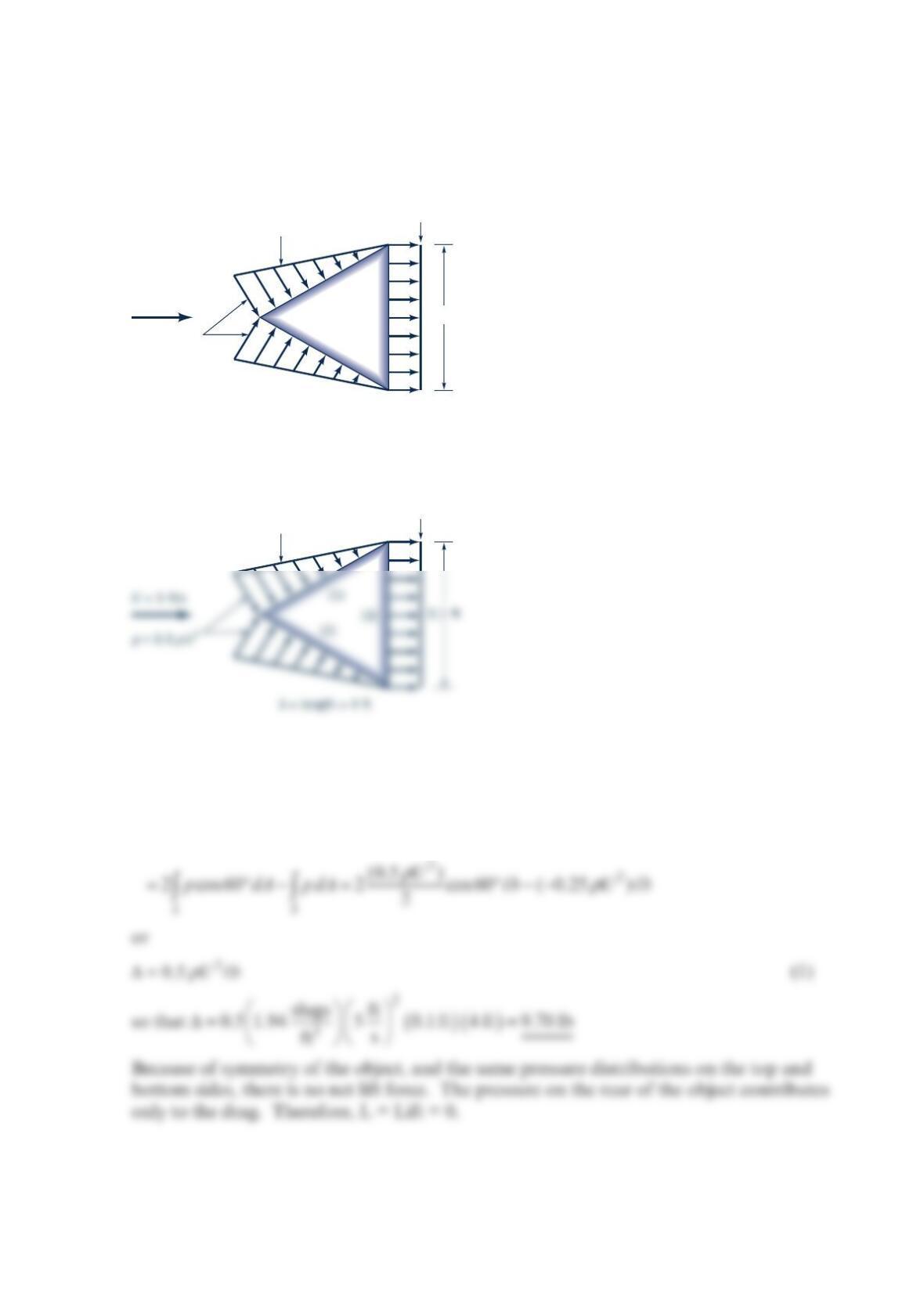
Problem 9.1
Assume that water flowing past the equilateral triangular bar shown in the figure below
produces the pressure distributions indicated. Determine the lift and drag on the bar and
the corresponding lift and drag coefficients (based on frontal area). Neglect shear forces.
Solution 9.1
θτθ
Δ
=+
cos sin
p
dA dA
w, where
τ
=0w
Thus,
123
Δ
cos cos cos
pdApdApdA
θθθ
Δ
=++
p
= 0.5 U2
U
= 5 ft/s
p
= –0.25
U
2
b
= length = 4 ft
Linear distribution
0.1 ft
ρ
ρ
p
= –0.25
U
2
Linear distribution
ρ
Also, from Eq. (1)
ρ
ρρ
Δ
== =
2
22
0.5 1.00
11
22
D
Ub
C
UA U b
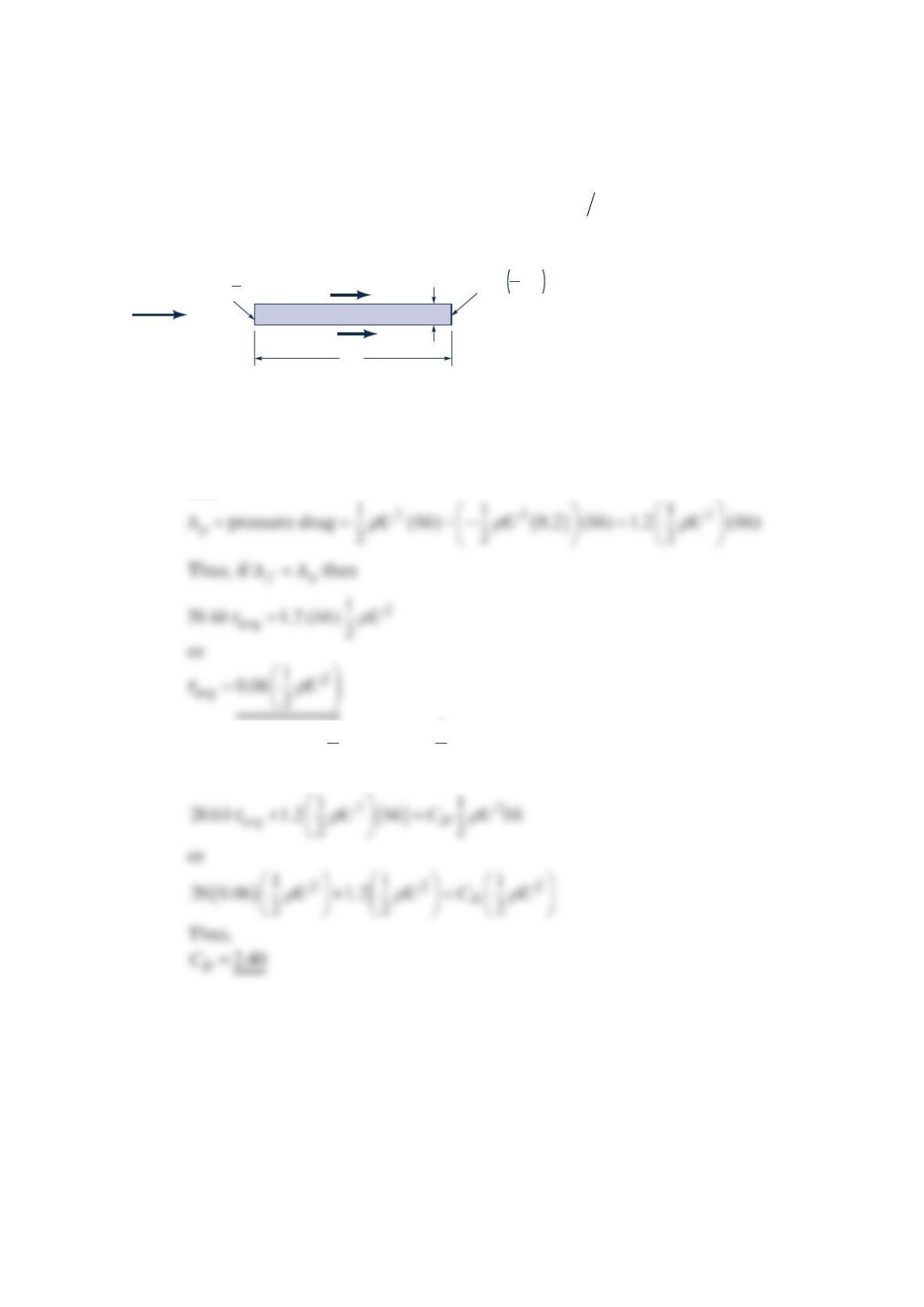
Problem 9.2
Fluid flows past the two-dimensional bar shown in the figure below. The pressures on the
ends of the bar are as shown, and the average shear stress on the top and bottom of the bar
is
τ
avg . Assume that the drag due to pressure is equal to the drag due to viscous effects.
(a) Determine
τ
avg in terms of the dynamic pressure,
ρ
22U. (b) Determine the drag
coefficient for this object.
Solution 9.2
(a)
()
avg avg
friction drag 2 10 20
fhb hb
ττ
Δ
===
and
(b) 22
11
22
fpD D
CUACUb
h
Δ
=Δ +Δ = =
ρρ
Thus,
10h
U
Width = b
p
= –0.2 U2
1
2
h
τ
avg
τ
ρρ
avg
p
= U2
1
2
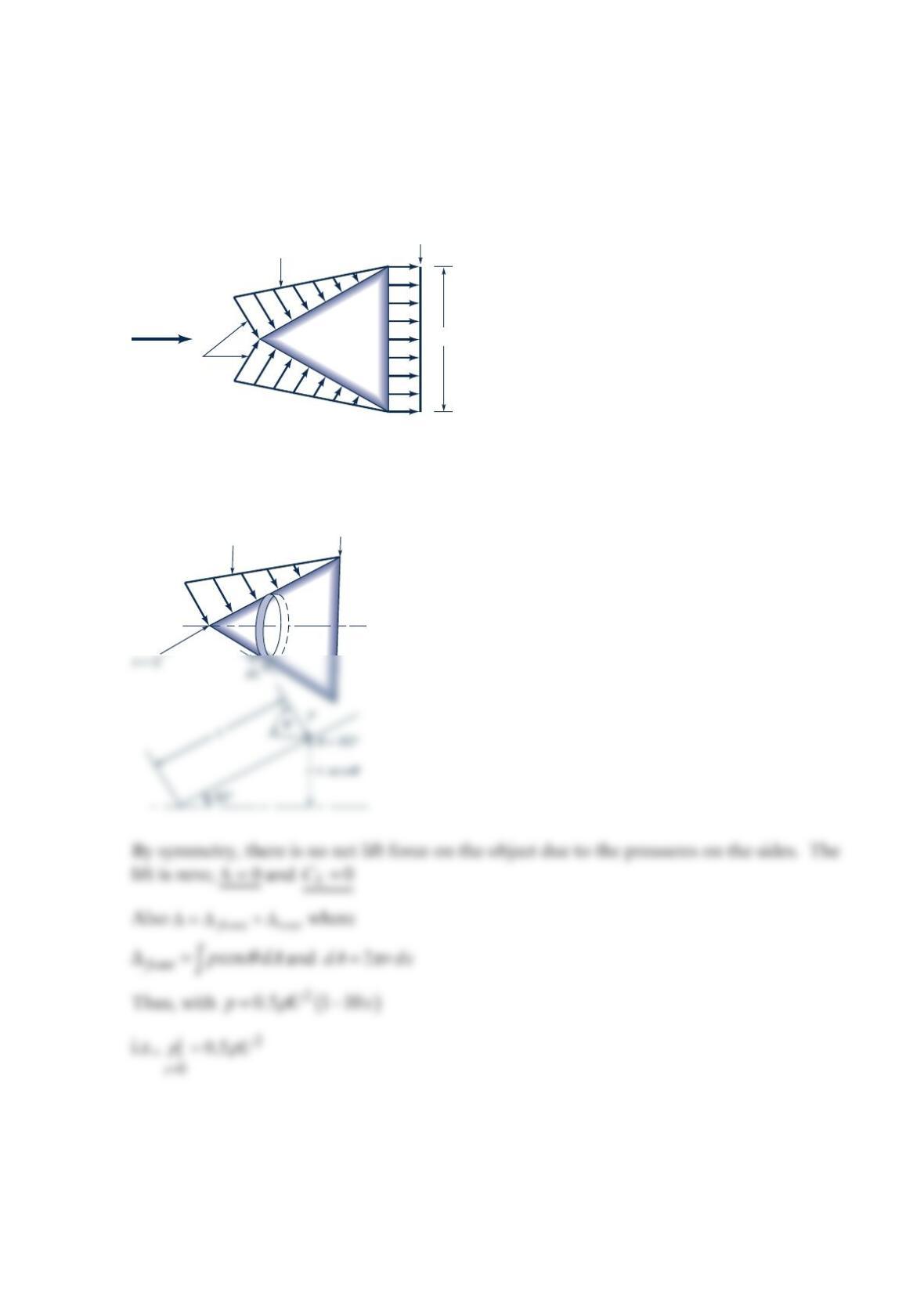
Problem 9.3
Assume that water flowing past the cone (made by rotating an equilateral triangle about the
horizontal axis through its tip) produces the pressure distributions indicated in the figure
below. Determine the lift and drag on the bar and the corresponding lift and drag
coefficients (based on frontal area). Neglect shear forces.
Solution 9.3
p
= 0.5 U2
U
= 5 ft/s
p
= –0.25
U
2
b
= length = 4 ft
Linear distribution
0.1 ft
ρ
ρ
x
= 0.1 m
p(x)
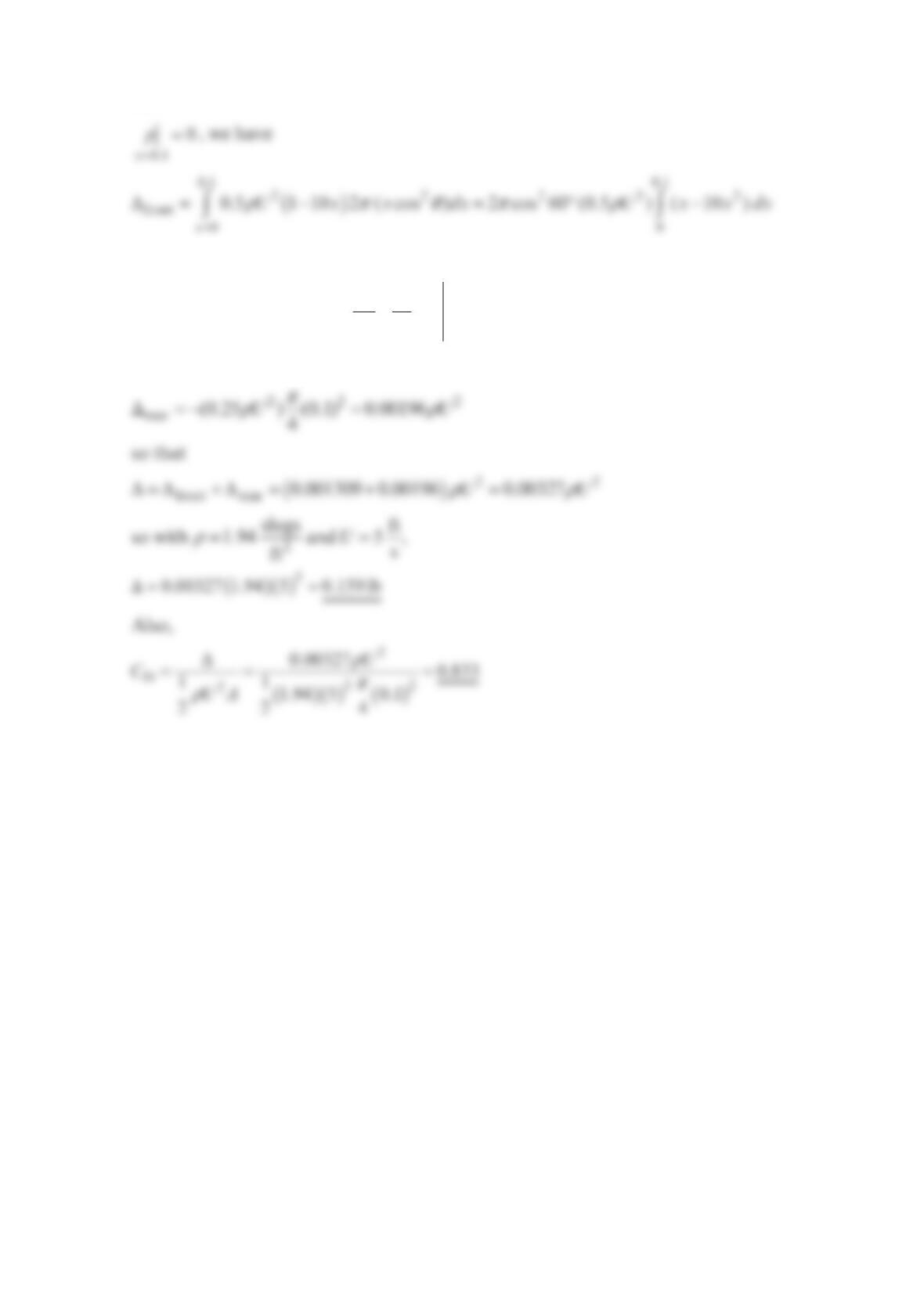
and
or
()
0.1
2
223
front
0
10
2 0.5 (0.5 ) 23
x
Ux
πρ
Δ
=−
, or 2
front 0.001309 U
Δ
=
ρ
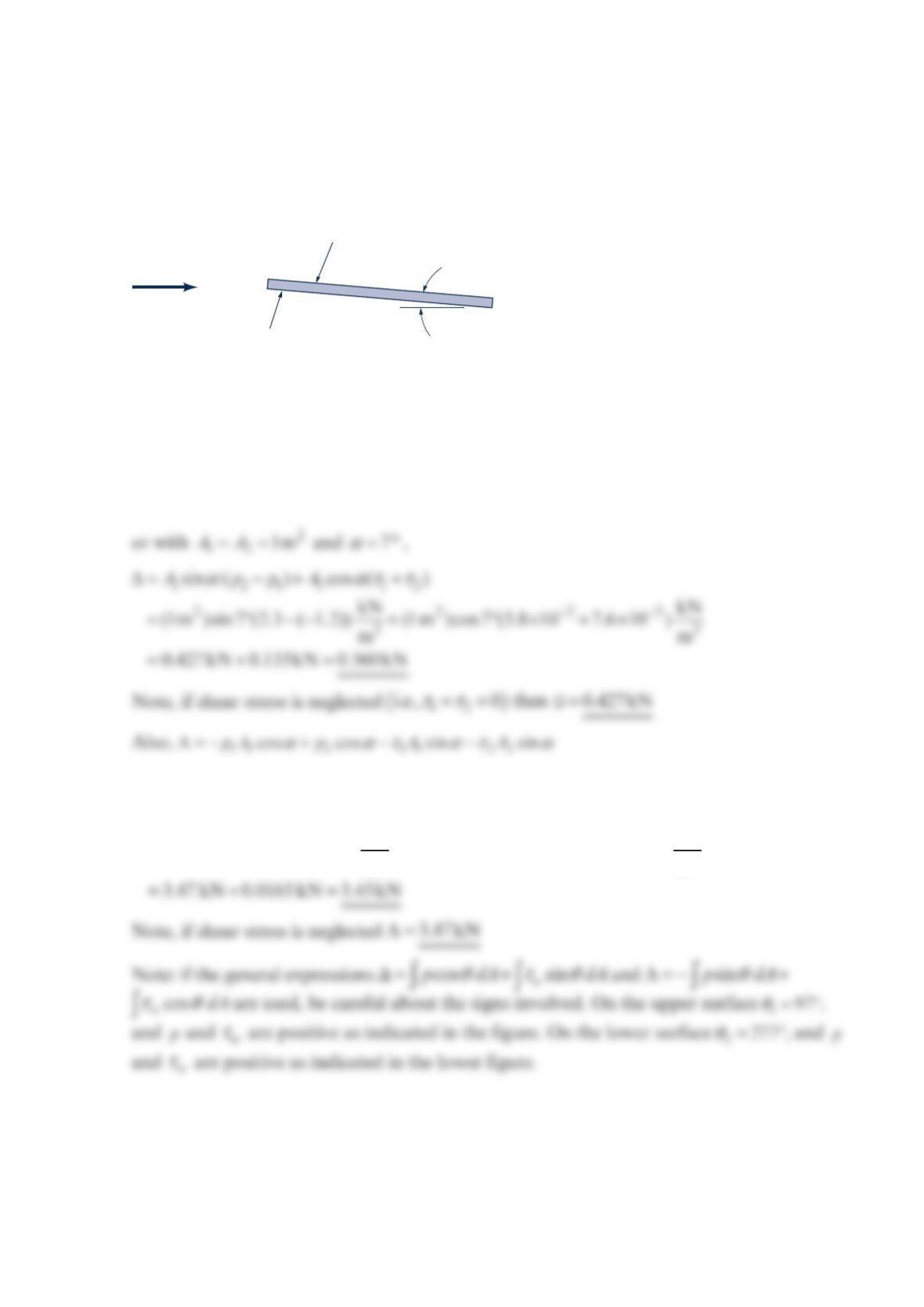
Also,
Problem 9.4
The average pressure and shear stress acting on the surface of the 1-m-square flat plate are
as indicated in the figure below. Determine the lift and drag generated. Determine the lift
and drag if the shear stress is neglected. Compare these two sets of results.
Solution 9.4
Since =
ave
p
dA p A and
ττ
=
avewdA A it follows that
11 2 2 11 2 2
sin sin cos cos
p
ApA A A
αατατ
α
Δ
=− + + +
or
() ()
121112
2222
22
cos sin
kN kN
(1m )cos 7 (2.3 ( 1.2)) (1m )sin7 (5.8 10 7.6 10 )
mm
AppA
ααττ
−−
Λ
=−−+
=°−−−°×+×
U
pave
= –1.2 kN/m
2
ave
= 5.8 × 10
–2
kN/m
2
τ
pave
= 2.3 kN/m
2
ave
= 7.6 × 10
–2
kN/m
2
τ
α
= 7°
p
Λ
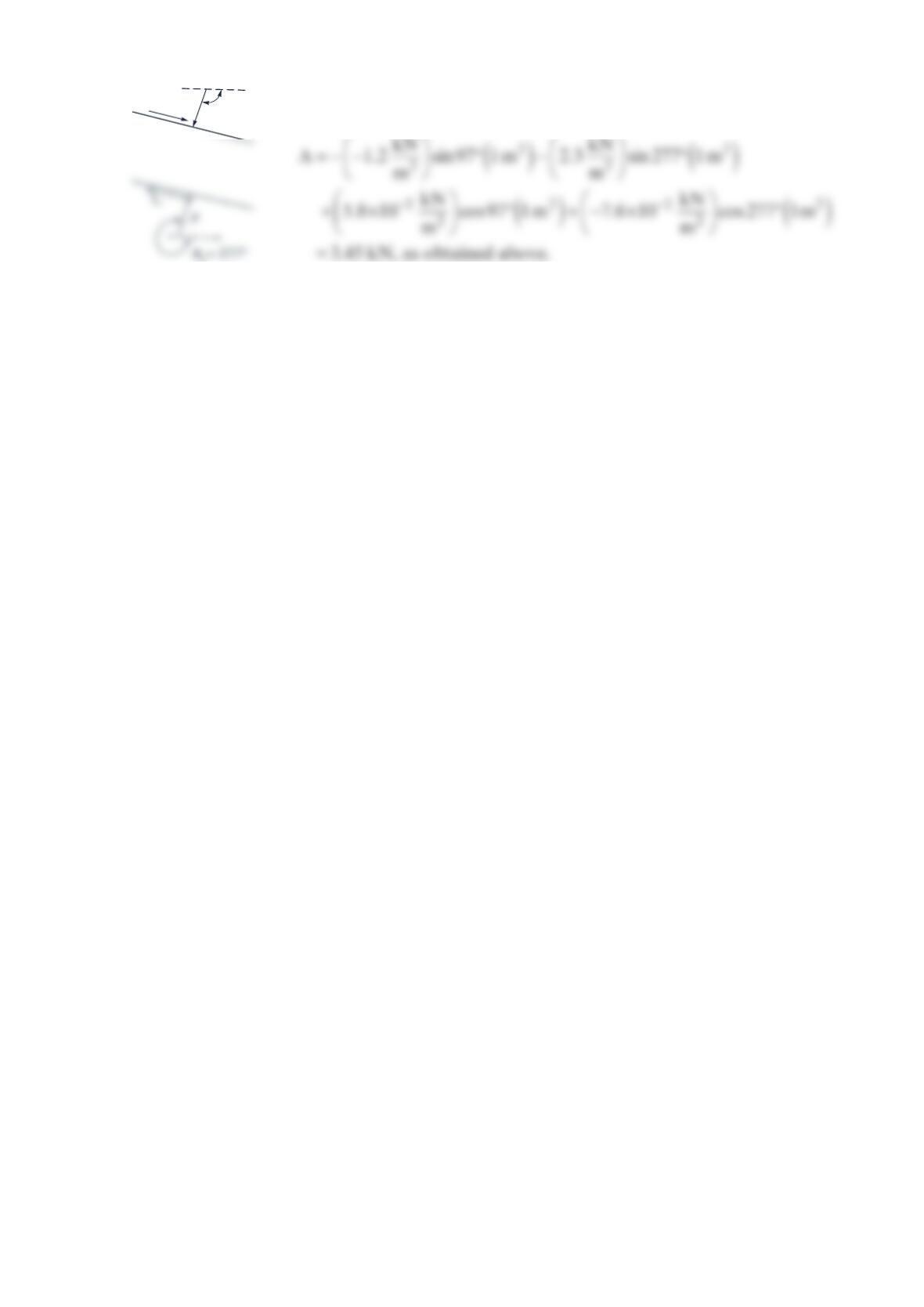
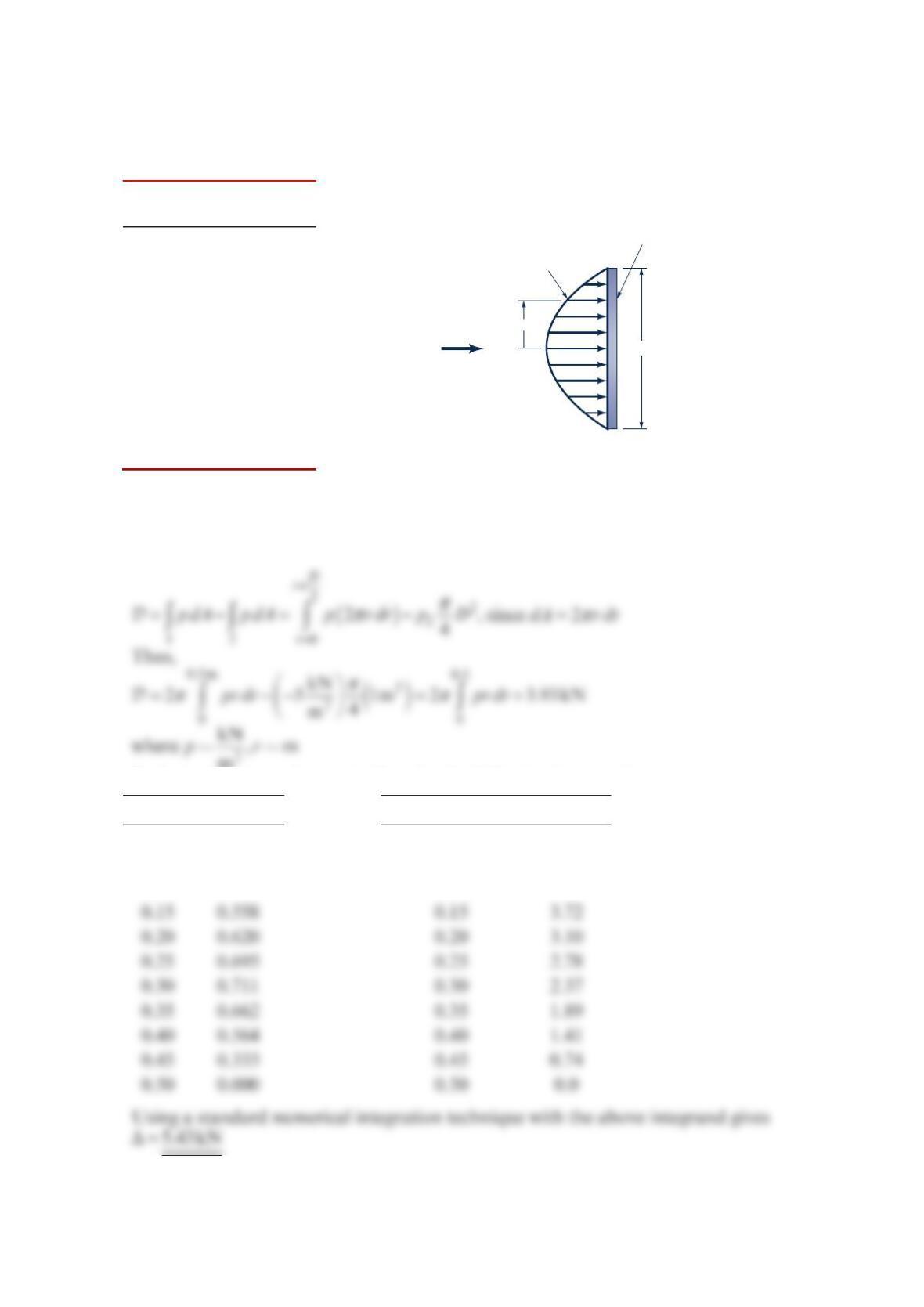
For example, with this notation
τ
<0
w on the lower surface.
p
θ
= 97°
1
τ
w
Problem 9.5
The pressure distribution on the l-m-diameter circular disk in the figure below is given in
the table. Determine the drag on the disk.
Solution 9.5
m
Evaluate the integral numerically using the following integrand:
r(m) pr(kN/m) r(m) p(kN/m2)
0 0.000 0 4.34
0.05 0.214 0.05 4.28
0.10 0.406 0.10 4.06
r
D
= 1m
p
=
p
(
r
)
p
= –5 kN/m2
U
r(m) 2
(kN/m )
p
0 4.34
0.05 4.28
0.10 4.06
0.15 3.72
0.20 3.10
0.25 2.78
0.30 2.37
0.35 1.89
0.40 1.41
0.45 0.74
0.50 0.0
Problem 9.6
A nonspinning ball having a mass of 3 oz. is thrown vertically upward with a velocity of
100 mph and has zero velocity at a height 250 ft above the release point. Assume that the
air drag on the ball is constant and find this constant “average” air drag. Neglect the
buoyant force of air on the ball.
Solution 9.6
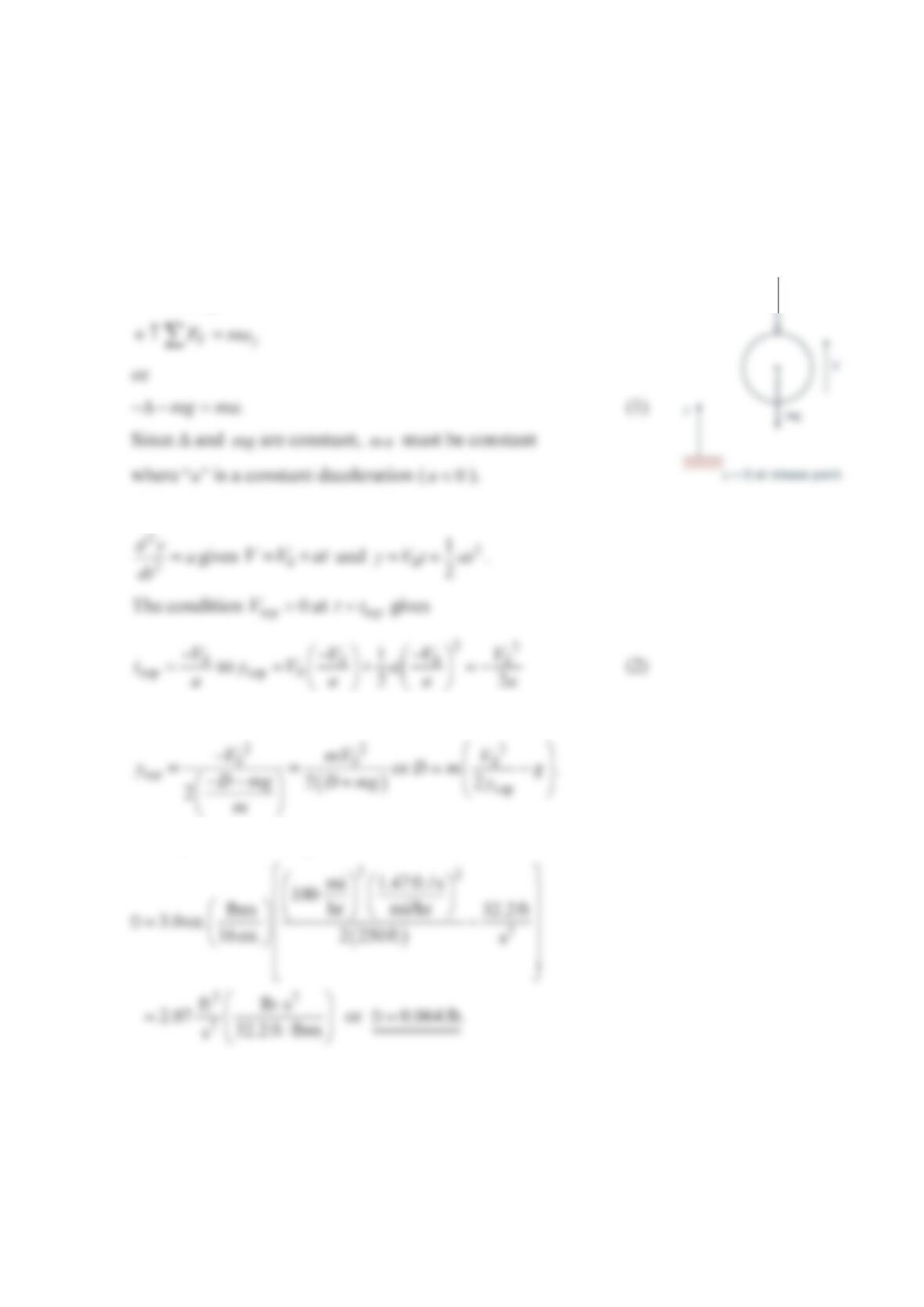
See free body diagram on right. Newton’s second law in the Y
direction gives
For constant “
a
”, integration of
Eliminating “
a
” from Eqs. (1) and (2) gives
The numerical values give
𝒟
Problem 9.8
A 0.10-m-diameter circular cylinder moves through air with a speed U. The pressure
distribution on the cylinder’s surface is approximated by the three straight-line segments
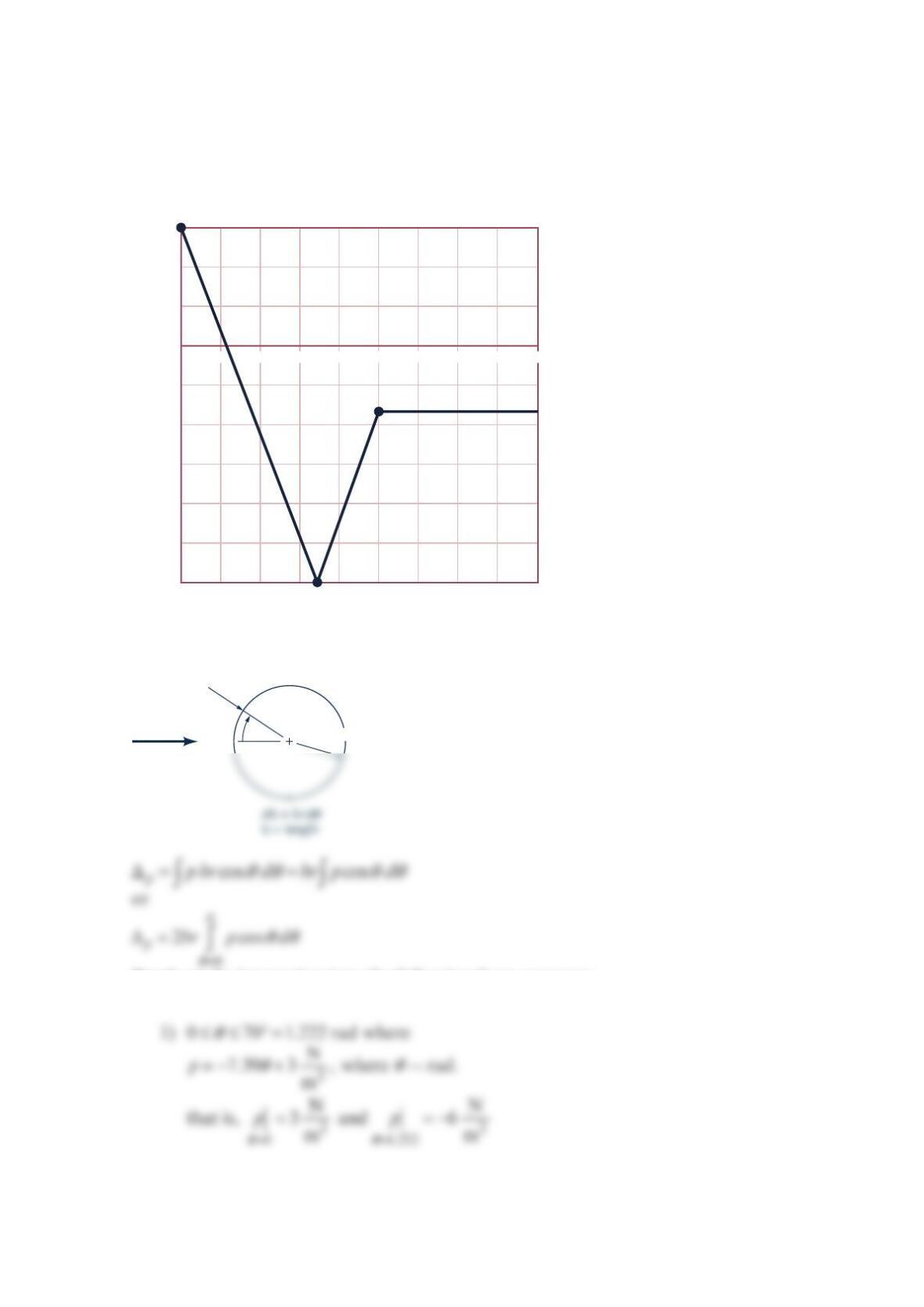
shown in the figure below. Determine the drag coefficient on the cylinder. Neglect shear
forces.
Solution 9.8
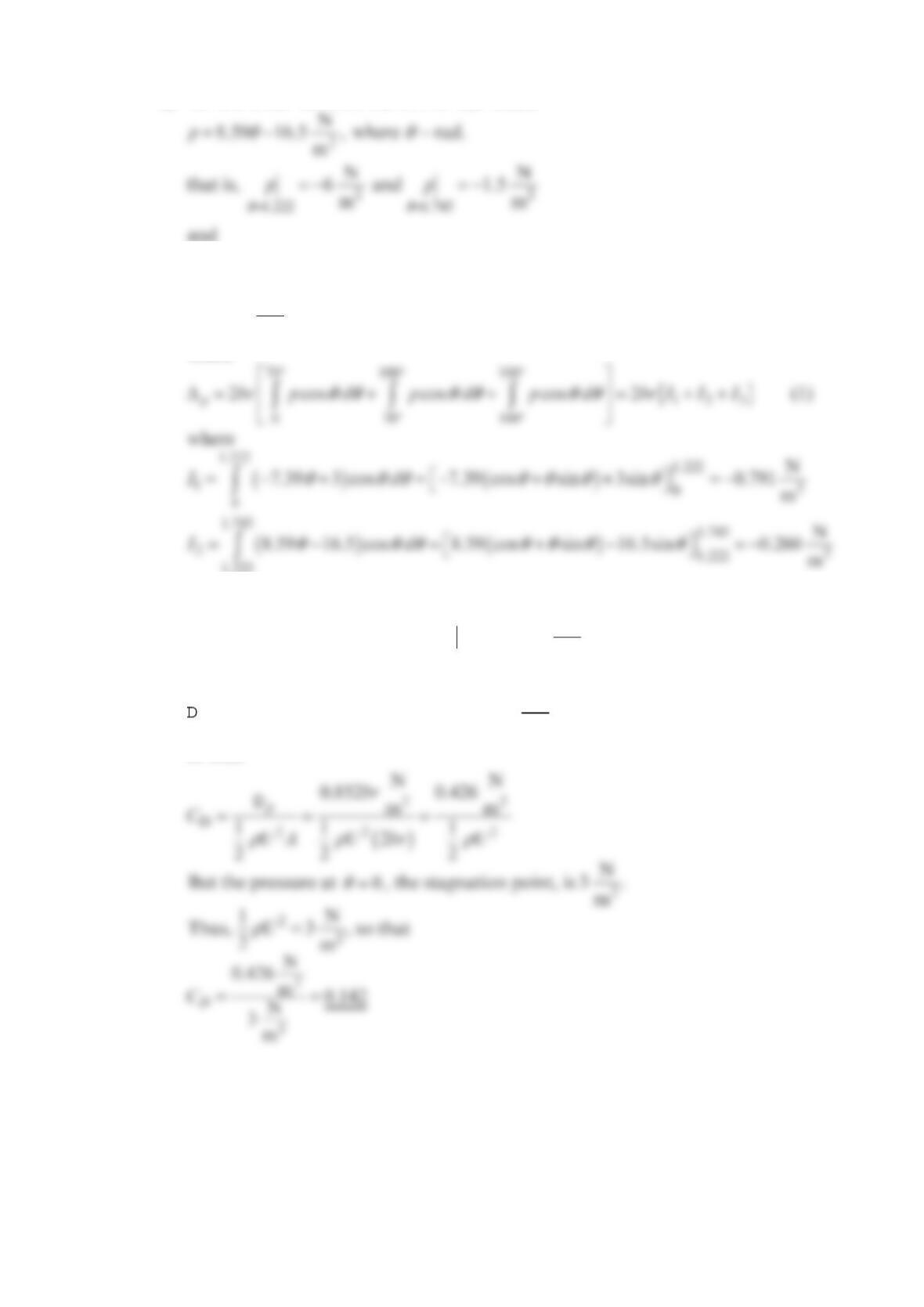
Break up the integration into the following three segments:
3
2
1
0
–1
–2
p
(N/m
2
)
–3
–4
–5
–6
20 40 60 80 100 120 140 160 180
θ
(°)
p
θ
Ur = 0.05 m
2)
θθ
°≤ ≤ ° ≤ ≤70 100 or 1.222 1.745 rad where
3)
θθ
°≤ ≤ ° ≤ ≤100 180 or 1.745 3.14 rad where
2
N
1.5 m
p
=−
Thus,
()
1.222
3.14 3.14
31.745 2
1.745
a
nd
N
1.5 cos 1.5sin 1.477 m
I
d
θθ θ
=− =− =
Hence,
[]
2
N
2 0.791 0.260 1.477 0.852 m
or with
p
br br
=− − + =
Problem 9.9
Typical values of the Reynolds number for various animals moving through air or water
are listed below. For which cases is inertia of the fluid important? For which cases do
viscous effects dominate? For which cases would the flow be laminar; turbulent? Explain.
Animal Speed Re
(a) large whale 10 m/s 300,000,000.
(b) flying duck 20 m/s 300,000.
(c) large dragonfly 7 m/s 30,000.
(d) invertebrate larva 1 mm/s 0.3
(e) bacterium 0.01 mm/s 0.00003
Solution 9.9
Inertia is important if ≥Re 1 (i.e., whale, duck, dragonfly). Viscous effects dominate if
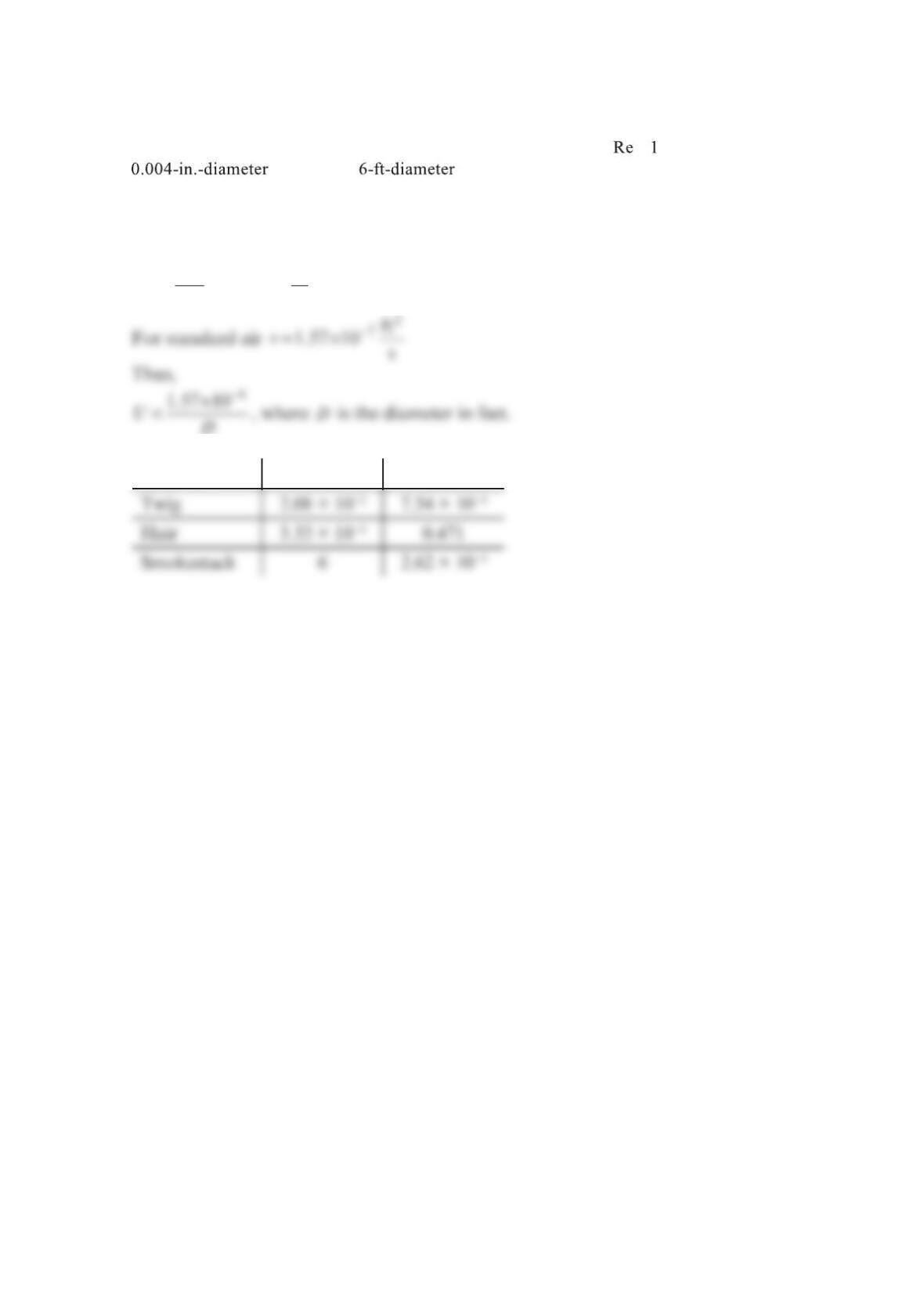
Problem 9.11
Approximately how fast can the wind blow past a 0.25-in.-diameter twig if viscous effects
are to be of importance throughout the entire flow field (i.e., <)? Explain. Repeat for a
hair and a smokestack.
Solution 9.11
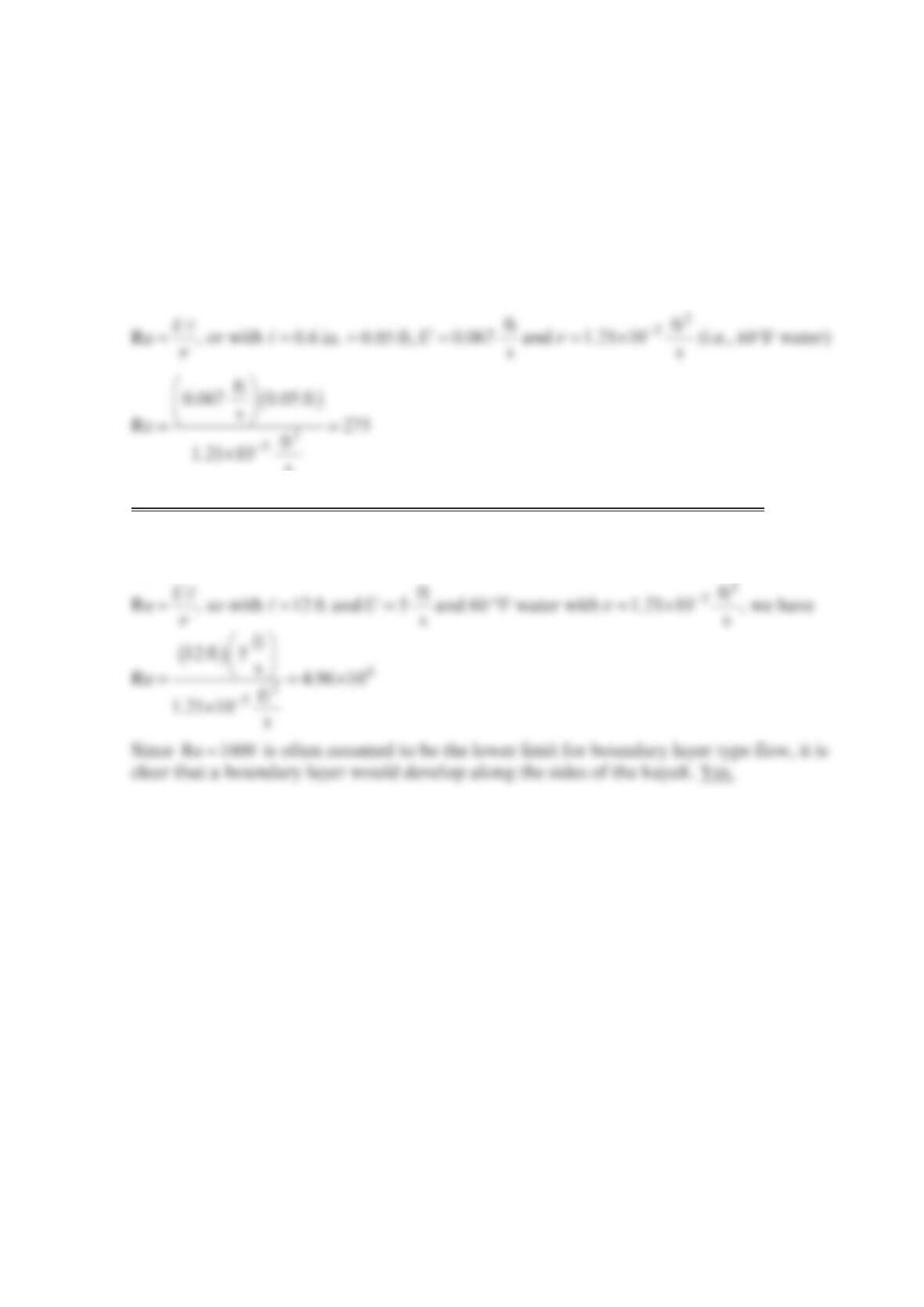
=< <Re 1 or
UD v
U
vD
if viscous effects are to be important throughout the flow.
Object D (ft) (ft / s)
U
Problem 9.12
Consider the following cases. (a) A small 0.6-in.-long fish swims with a speed of 0.8 in./s.
Would a boundary layer type flow be developed along the sides of the fish? Explain.
(b) A
1
2-ft-long kayak moves with a speed of 5 ft/s . Would a boundary layer type flow be
developed along the sides of the boat? Explain.
Solution 9.12
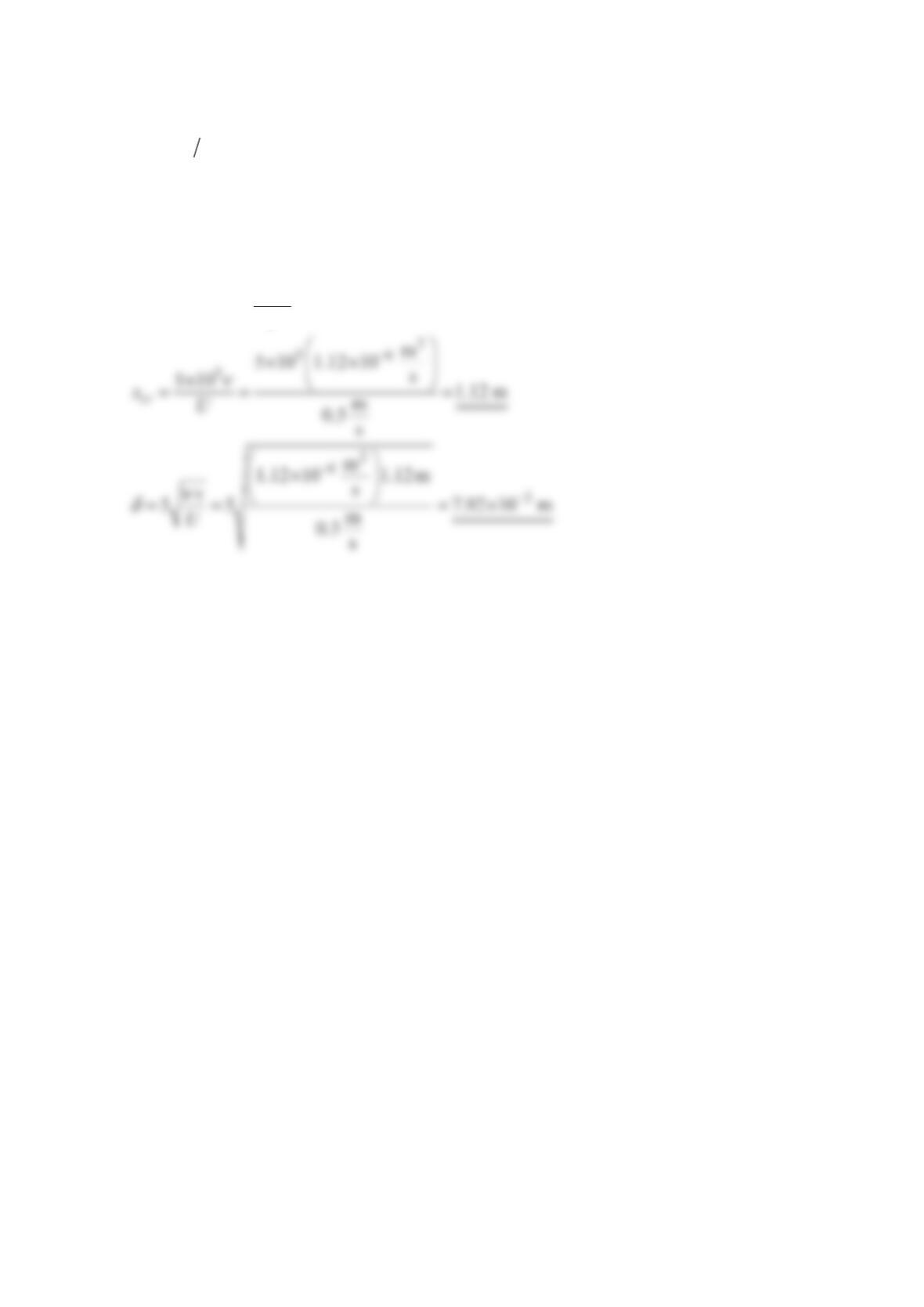
(a)
T
his Reynolds number is not large enough to have true boundary layer type flow.
(
Re 1000 is often assumed to be the lower limit.)≈
(b)
Problem 9.13
Water flows past a flat plate that is oriented parallel to the flow with an upstream velocity
of 0.5 m s. Determine the approximate location downstream from the leading edge where
the boundary layer becomes turbulent. What is the boundary layer thickness at this
location?
Solution 9.13
5
Re 5 10
cr
cr
Ux
ν
=× =
Problem 9.14
A viscous fluid flows past a flat plate such that the boundary layer thickness at a distance
1
.3 m from the leading edge is
1
2mm
. Determine the boundary layer thickness at distances
of 0.20, 2.0, and 20 m from the leading edge. Assume laminar flow.
Solution 9.14
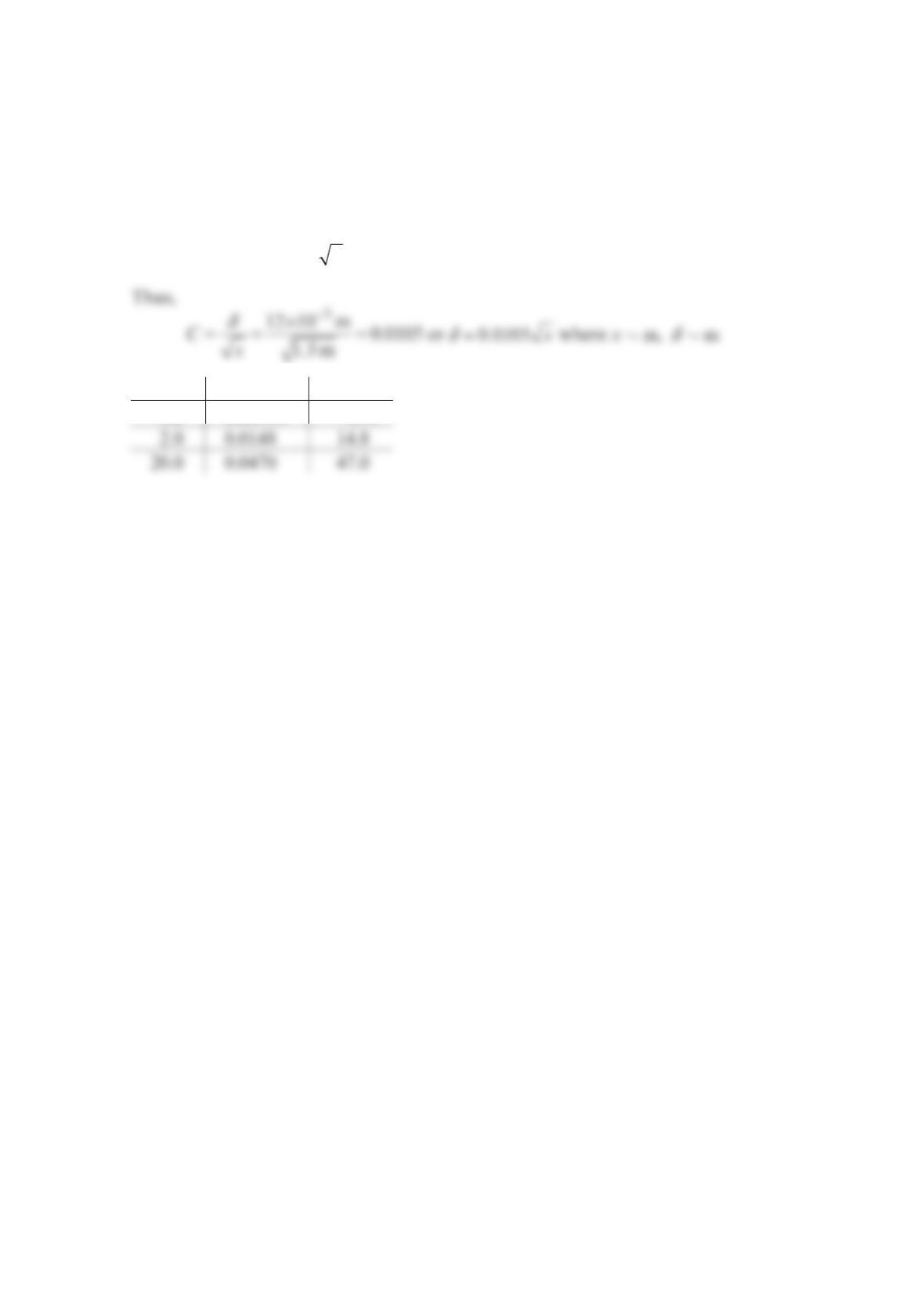
For laminar flow
δ
=Cx
, where C is a constant.
x (m)
δ
(m)
δ
(mm)
0.2 0.00470 4.70
Problem 9.15
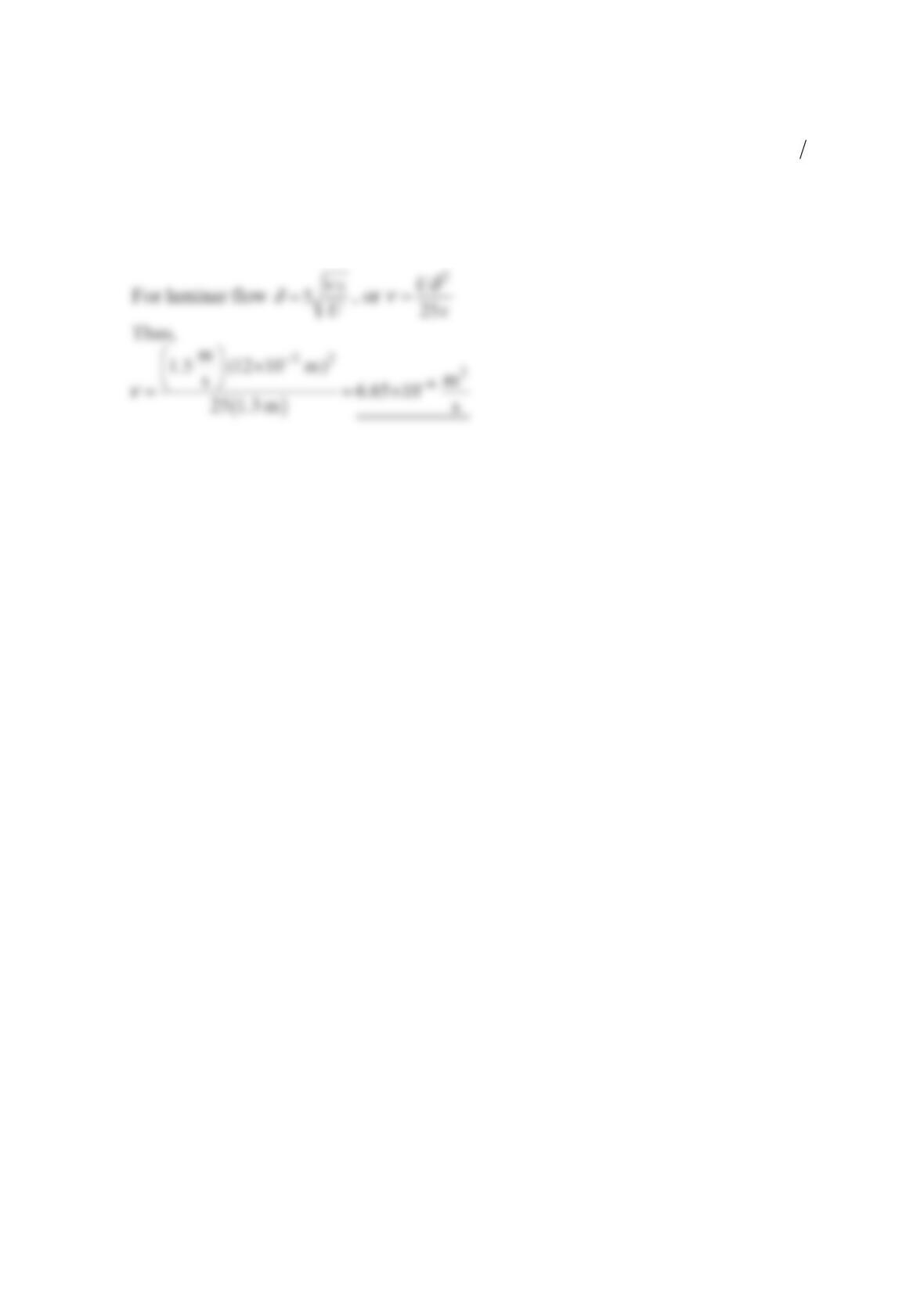
A viscous fluid flows past a flat plate such that the boundary layer thickness at a distance
1.3m from the leading edge is 12 mm . The upstream velocity of the flow is =1.5 m s.U
Determine the kinematic viscosity of the fluid. Assume laminar flow.
Solution 9.15
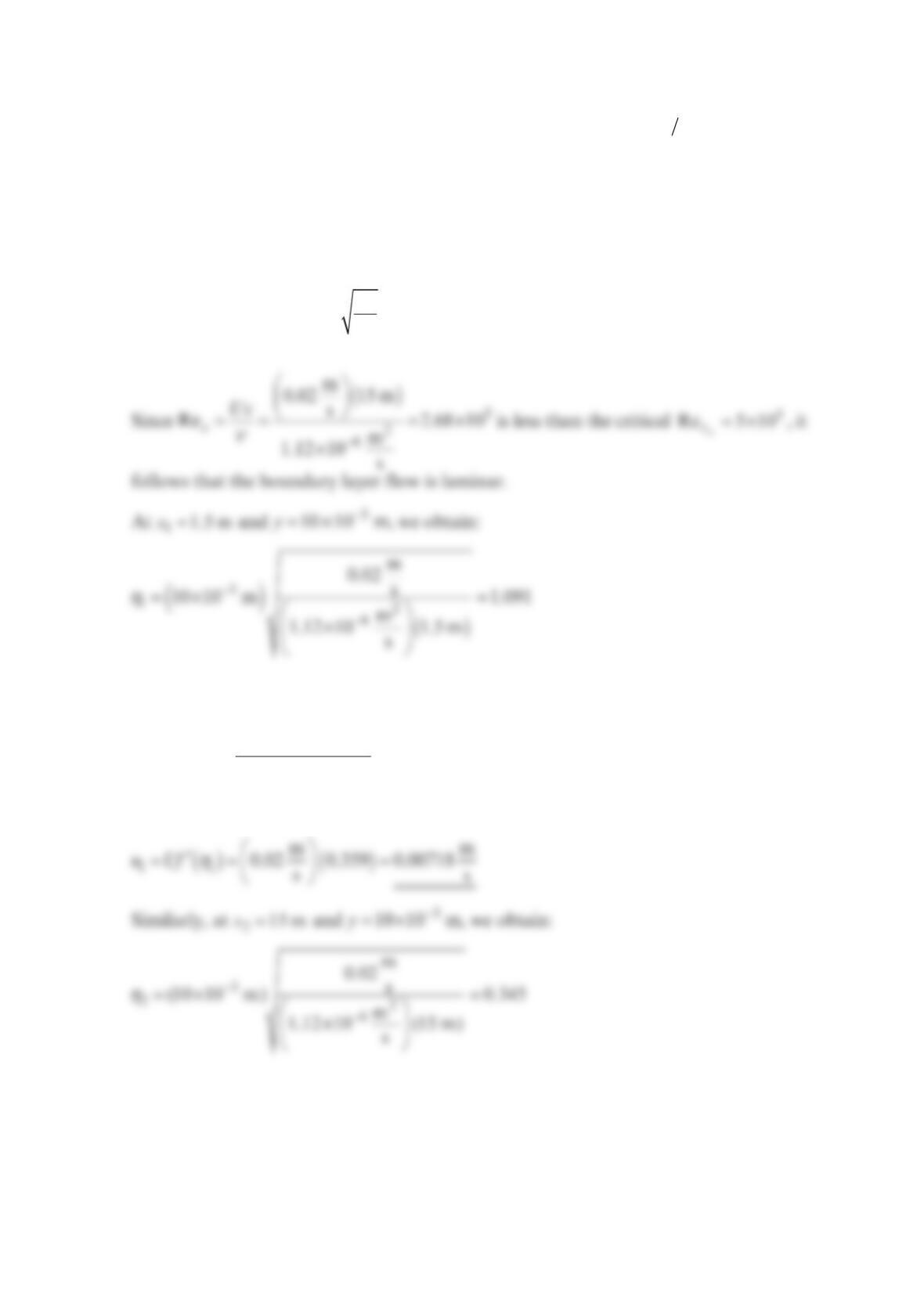
Problem 9.16
Water flows past a flat plate with an upstream velocity of 0.02 m s
U
=. Determine the water
velocity a distance of
1
0mm
from the plate at distances of 1.5 mx= and 15 mx= from the
leading edge.
Solution 9.16
From the Blasius Solution for boundary layer flow on a flat plate,
()
uUf
η
′
=, where
η
, the
similarity variable, is U
yx
η
ν
=. Values of
()
f
η
′ are given in Table 9.1 Laminar Flow along
a Flat Plate (the Blasius Solution)
Linear interpolation from Table 9.1 Laminar Flow along a Flat Plate (the Blasius Solution)
gives:
()
()
()
0.3938 0.2647
0.2647 1.091 0.8 0.35
9
1.2 0.8
f
−
′=+ −=
−
Hence,
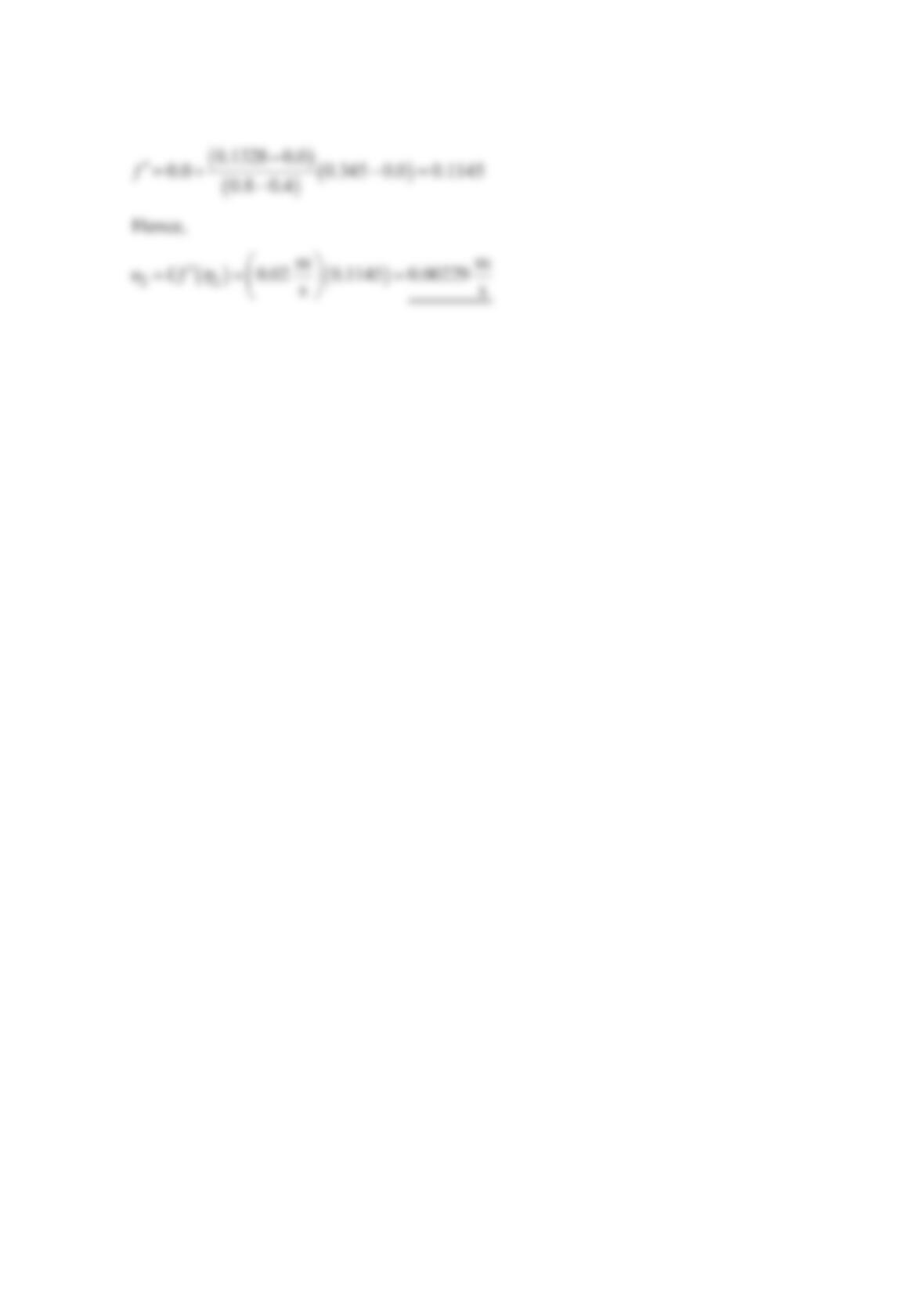
Linear interpolation from Table 9.1 Laminar Flow along a Flat Plate (the Blasius Solution)
gives:
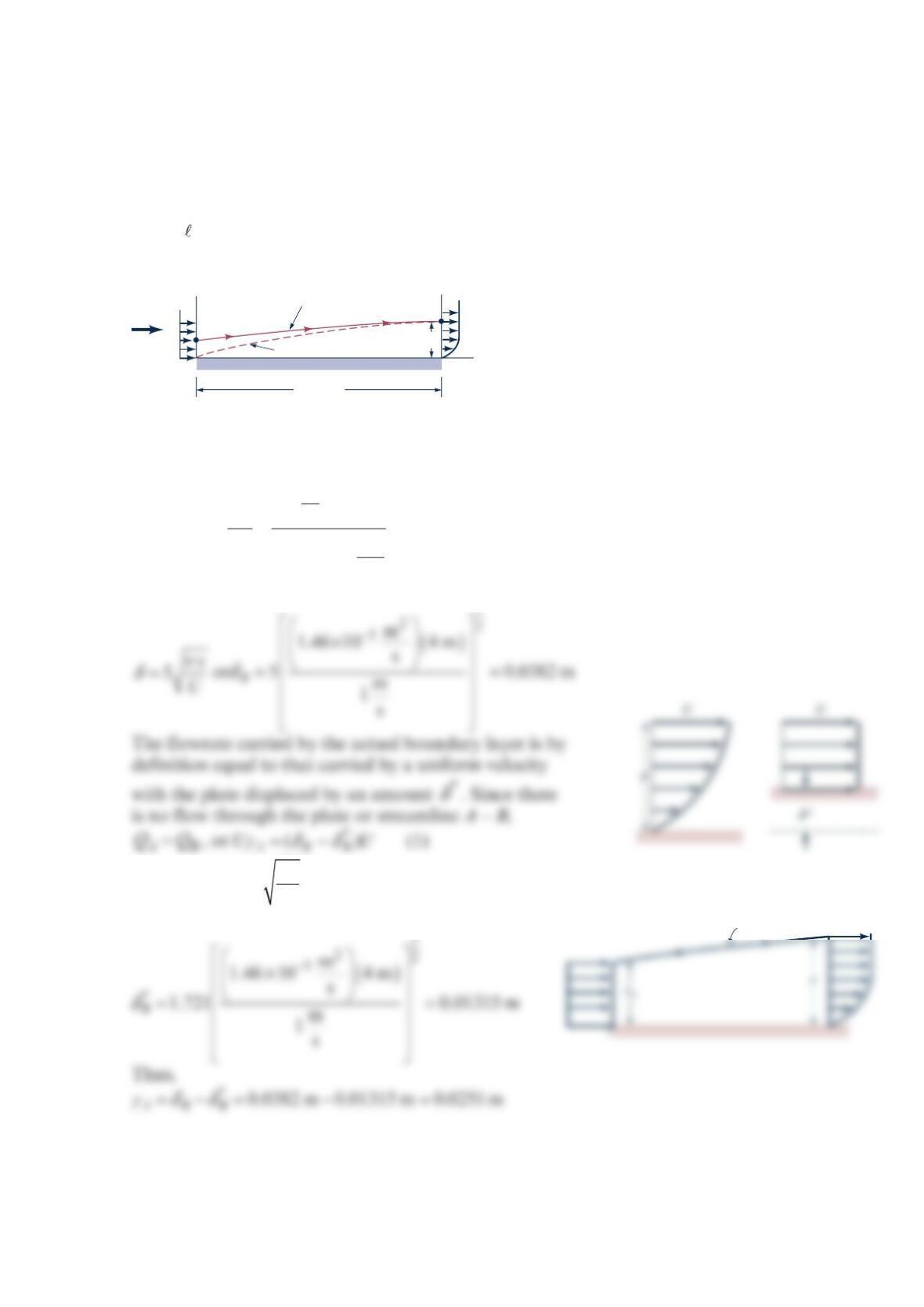
Problem 9.18
Because of the velocity deficit, −Uu
, in the boundary layer, the streamlines for flow past a
flat plate are not exactly parallel to the plate. This deviation can be determined by use of
the displacement thickness,
δ
*. For air blowing past the flat plate shown in the figure
below, plot the streamline A − B that passes through the edge of the boundary layer (
δ
=B
y
at =
x) at point B. That is, plot
()
=
y
yx for streamline A − B. Assume laminar boundary
layer flow.
Solution 9.18
Since
()
55
2
5
m
14m
s
Re 2.74 10 5 10
m
1.46 10 s
U
ν
−
== = ×<×
×
, the boundary layer flow remains
laminar along the entire plate. Hence,
1
where
ν
δ
=
*1.721 x
U
or
y
U
=
1 m/s
x
𝓵 = 4 m
Edge of boundary layer
Streamline A–B
δ
B
B
A
Streamline
ν