PROBLEM 9.82
KNOWN: Diameter and temperature of cylinder. Velocity and temperature of fluid in cross flow.
Four different fluids.
FIND: Whether heat transfer by free convection is significant.
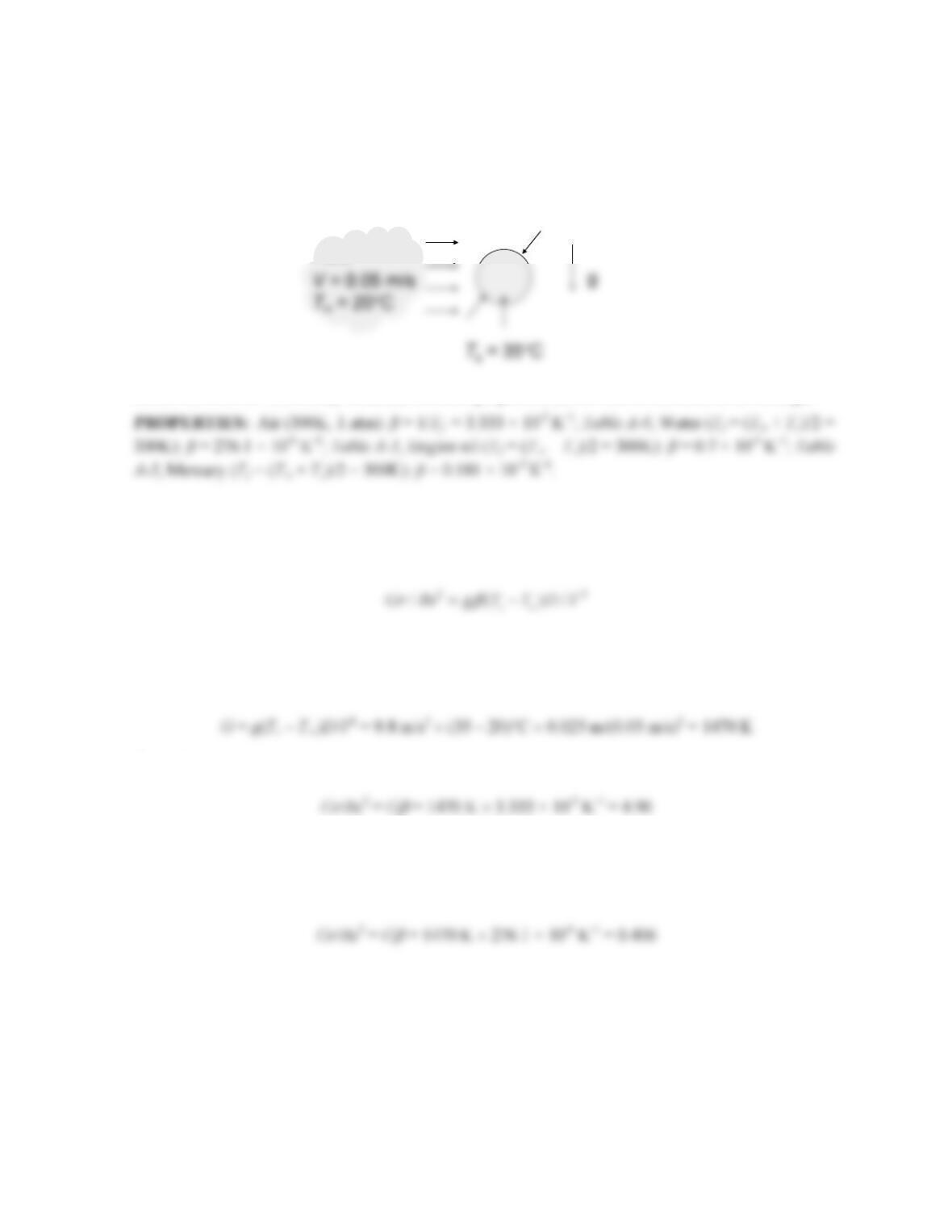
SCHEMATIC:
ASSUMPTIONS: (1) Steady state, (2) Constant properties, (3) Air can be modeled as an ideal gas.
ANALYSIS: Following the discussion of Section 9.9, the general criterion for delineating the relative
significance of free and forced convection depends upon the value of Gr/Re2. Free convection is
insignificant if Gr/Re2 << 1, where Gr = g
β
(Ts – T∞)D3/ν2 and Re = VD/ν. Thus,
The only material property that impacts the determination of the significance of free convection is the
thermal expansion coefficient,
β
. Furthermore with all other parameters held fixed, it is useful to
express Gr/Re2 = G
β
, where
Thus, for air,
Since Gr/Re2 > 1, free convection is significant. <
For water,
Since Gr/Re2 is not small compared to 1, free convection is likely to be important. <
Continued…
Fluid
Fluid
D = 25 mm
PROBLEM 9.82 (Cont.)
For engine oil,
Since Gr/Re2 is of order 1, free and forced convection are likely to be equally important. <
For mercury,
Since Gr/Re2 is somewhat small compared to 1, free convection might be negligible, depending on the
desired accuracy of the solution. <
COMMENTS: (1) None of the situations considered here correspond to conditions where heat
PROBLEM 9.83
KNOWN: Parallel air flow over a uniform temperature, heated vertical plate; the effect of free
FIND: Minimum vertical velocity required of air flow such that free convection effects will be less
than 5% of the heat rate.
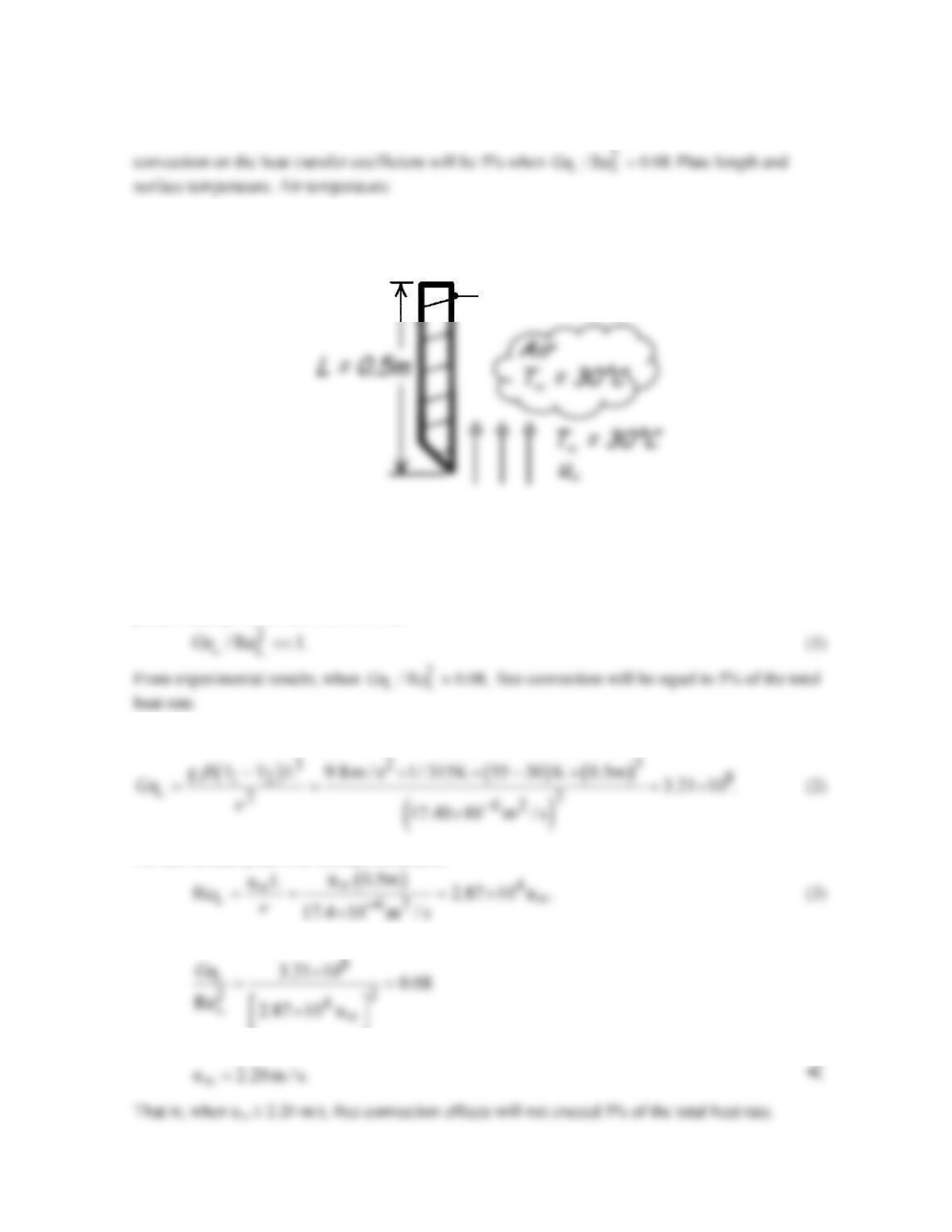
SCHEMATIC:
T
s
= 55°C
ASSUMPTIONS: (1) Steady-state conditions, (2) Criterion for combined free-forced convection
determined from experimental results.
PROPERTIES: Table A-4, Air (Tf = (Ts + T∞)/2 = 315K, 1 atm): ν = 17.40 × 10⁻⁶ m2/s, β = 1/Tf.
ANALYSIS: To delineate flow regimes, according to Section 9.9, the general criterion for
predominately forced convection is that
For the vertical plate using Eq. 9.10,
For the vertical plate with forced convection,
By combining Eqs. (2) and (3),
find that
PROBLEM 9.84
KNOWN: Vertical array of circuit boards 0.15m high with maximum allowable uniform surface
temperature for prescribed ambient air temperature.
FIND: Allowable electrical power dissipation per board,
[ ]
q W/m ,
′
for these cooling arrangements:
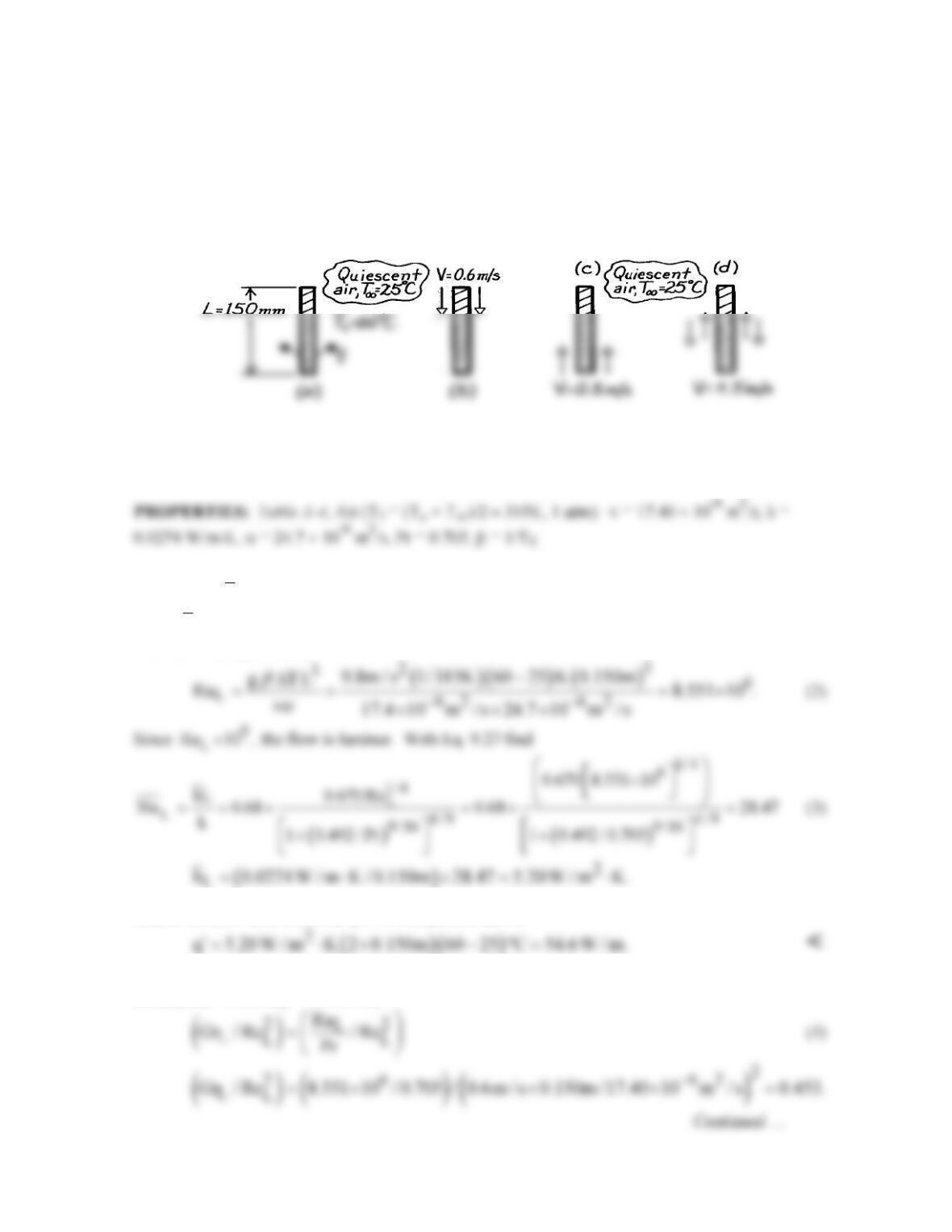
(a) Free convection only, (b) Air flow downward at 0.6 m/s, (c) Air flow upward at 0.3 m/s, and (d)
Air flow upward or downward at 5 m/s.
SCHEMATIC:
ASSUMPTIONS: (1) Uniform surface temperature, (2) Board horizontal spacing sufficient that
boundary layers don’t interfere, (3) Ambient air behaves as quiescent medium, (4) Perfect gas
behavior.
ANALYSIS: (a) For free convection only, the allowable electrical power dissipation rate is
( )( )
Ls
q h 2L T T
∞
′= −
(1)
where
L
h
is estimated using the appropriate correlation for free convection from a vertical plate.
Find the Rayleigh number,
Hence, the allowable electrical power dissipation rate is,
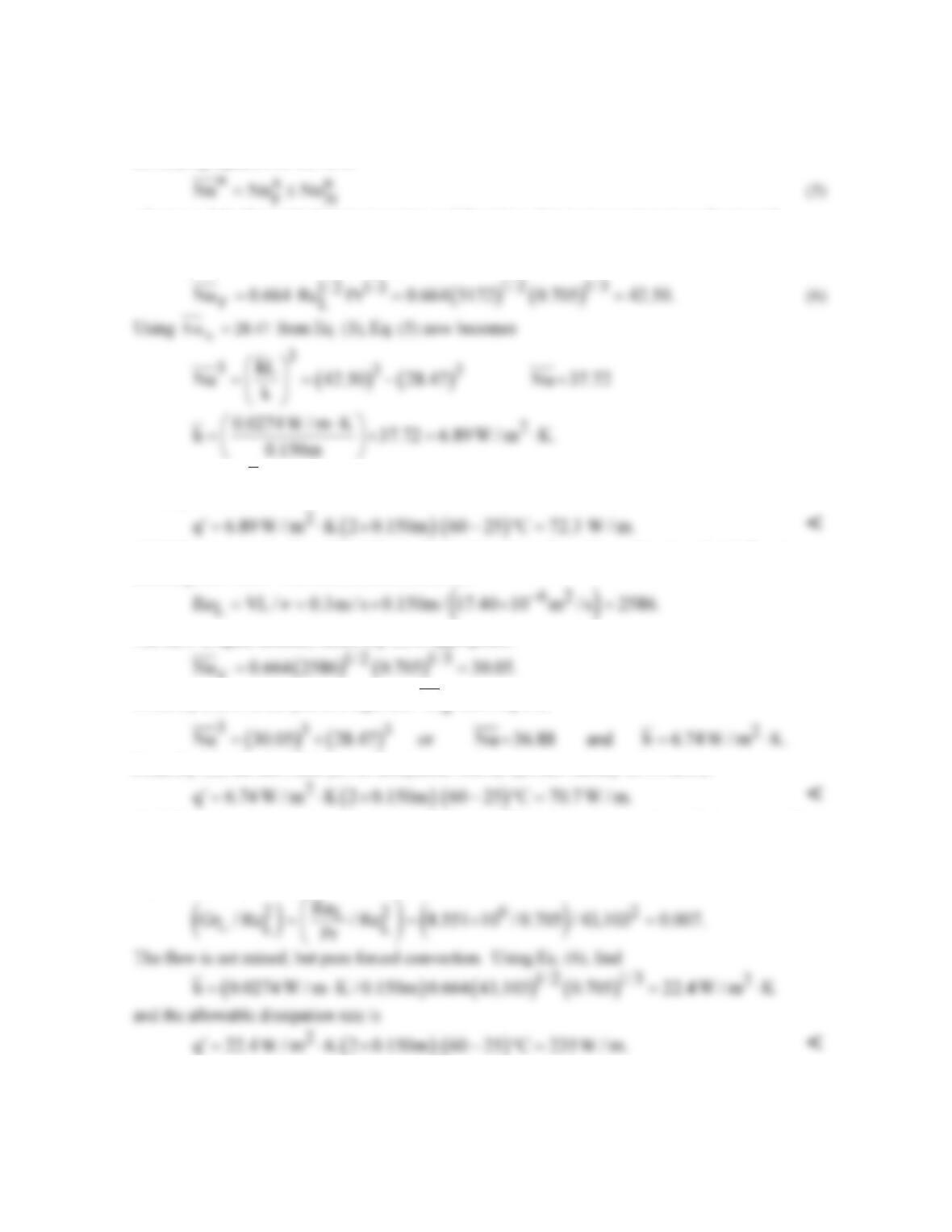
(b) With downward velocity V = 0.6 m/s, the possibility of mixed forced-free convection must be
considered. With ReL = VL/ν, find
PROBLEM 9.84 (Cont.)
Since
( )
2
LL
Gr / Re ~ 1,
flow is mixed and the average heat transfer coefficient may be found from a
correlating equation of the form
where n = 3 for the vertical plate geometry and the minus sign is appropriate since the natural
convection (N) flow opposes the forced convection (F) flow. For the forced convection flow, ReL =
5172 and the flow is laminar; using Eq. 7.30,
Substituting for
h
into the rate equation, Eq. (1), the allowable power dissipation with a downward
velocity of 0.6 m/s is
(c) With an upward velocity V = 0.3 m/s, the positive sign of Eq. (5) applies since the N-flow is
assisting the F–flow. For forced convection, find
The flow is again laminar, hence Eq. (6) is appropriate.
F
From Eq. (5), with the positive sign, and
Nu
from Eq. (4),
From Eq. (1), the allowable power dissipation with an upward velocity of 0.3 m/s is
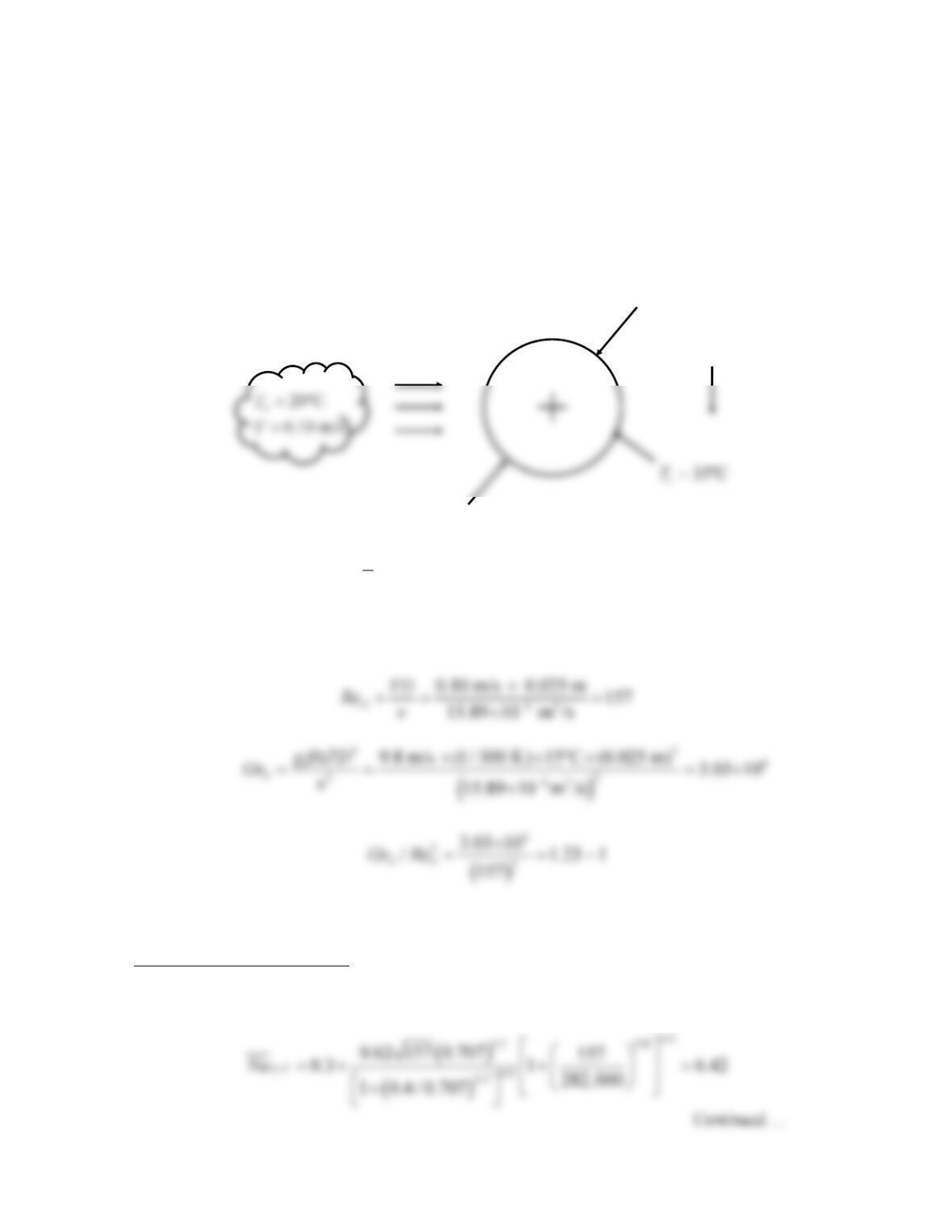
(d) With a forced convection velocity V = 5 m/s, very likely forced convection will dominate. Check
by evaluating whether
( )
2
LL
Gr Re 1
/
<<
where ReL = VL/ν = 5 m/s × 0.150m/(17.40 × 10-6 m2/s) =
43,103. Hence,
COMMENTS: Be sure to compare dissipation rates to see relative importance of mixed flow
conditions.
PROBLEM 9.85
KNOWN: Horizontal cylinder of known diameter and temperature, subjected to cross flow of air at
known temperature and velocity.
FIND: Convection heat rate per unit cylinder length. Method to maintain the warm temperature of
the cylinder if the cylinder surface is adiabatic.
SCHEMATIC:
g
D = 25 mm
ASSUMPTIONS: (1) Steady-state conditions, (2) Constant properties, ideal gas.
PROPERTIES: Table A.4, air (
300KT=
): k = 0.0263 W/m∙K,
α
= 22.5 × 10⁻⁶ m2/s,
ν
= 15.89 ×
10-6 m2/s, Pr = 0.707.
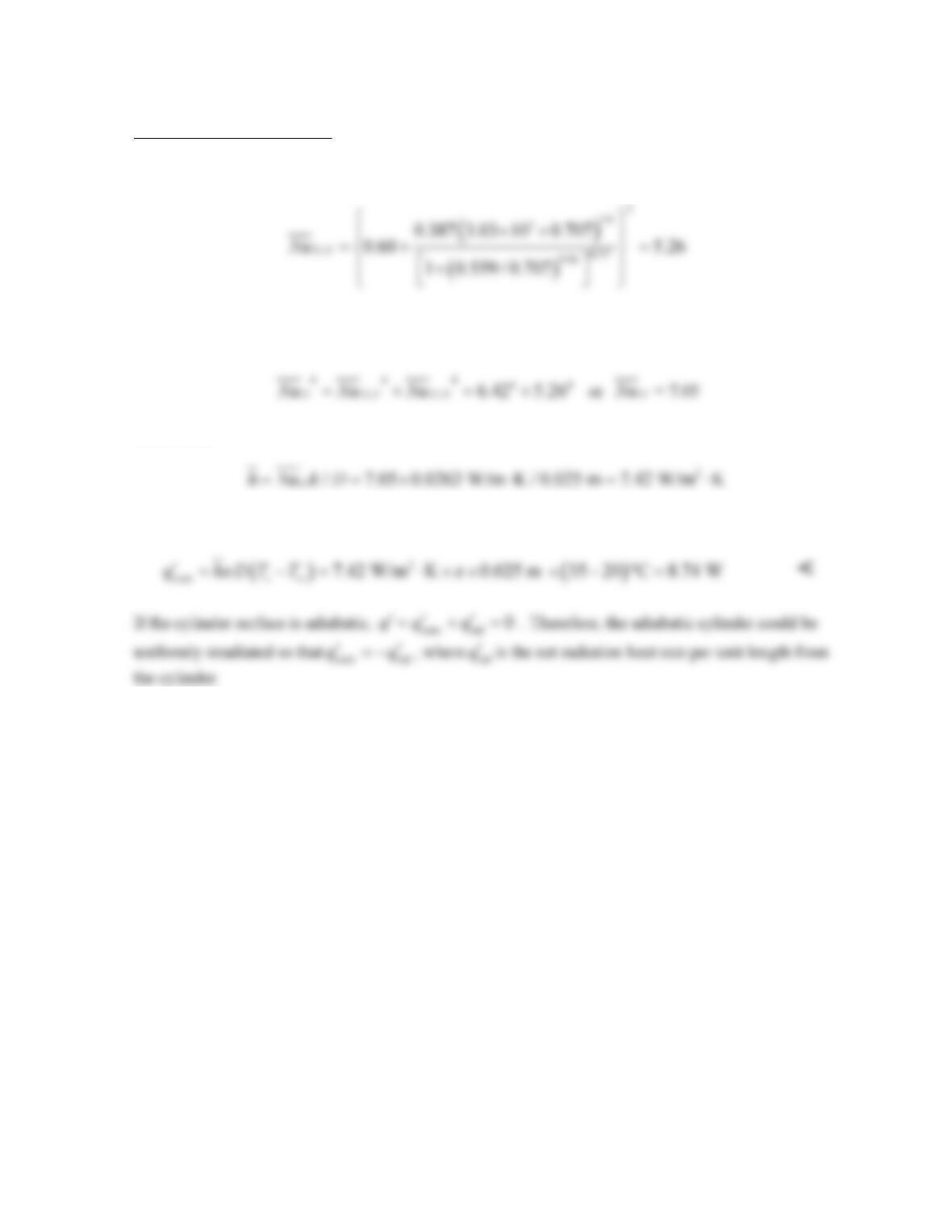
ANALYSIS: Check for mixed convection conditions. The Reynolds and Grashof numbers are:
Therefore, mixed convection conditions are expected to exist.
Forced Convection Component
From the Churchill and Bernstein correlation (7.54):
PROBLEM 9.85 (Cont.)
Free Convection Component
From the Churchill and Chu correlation (9.34):
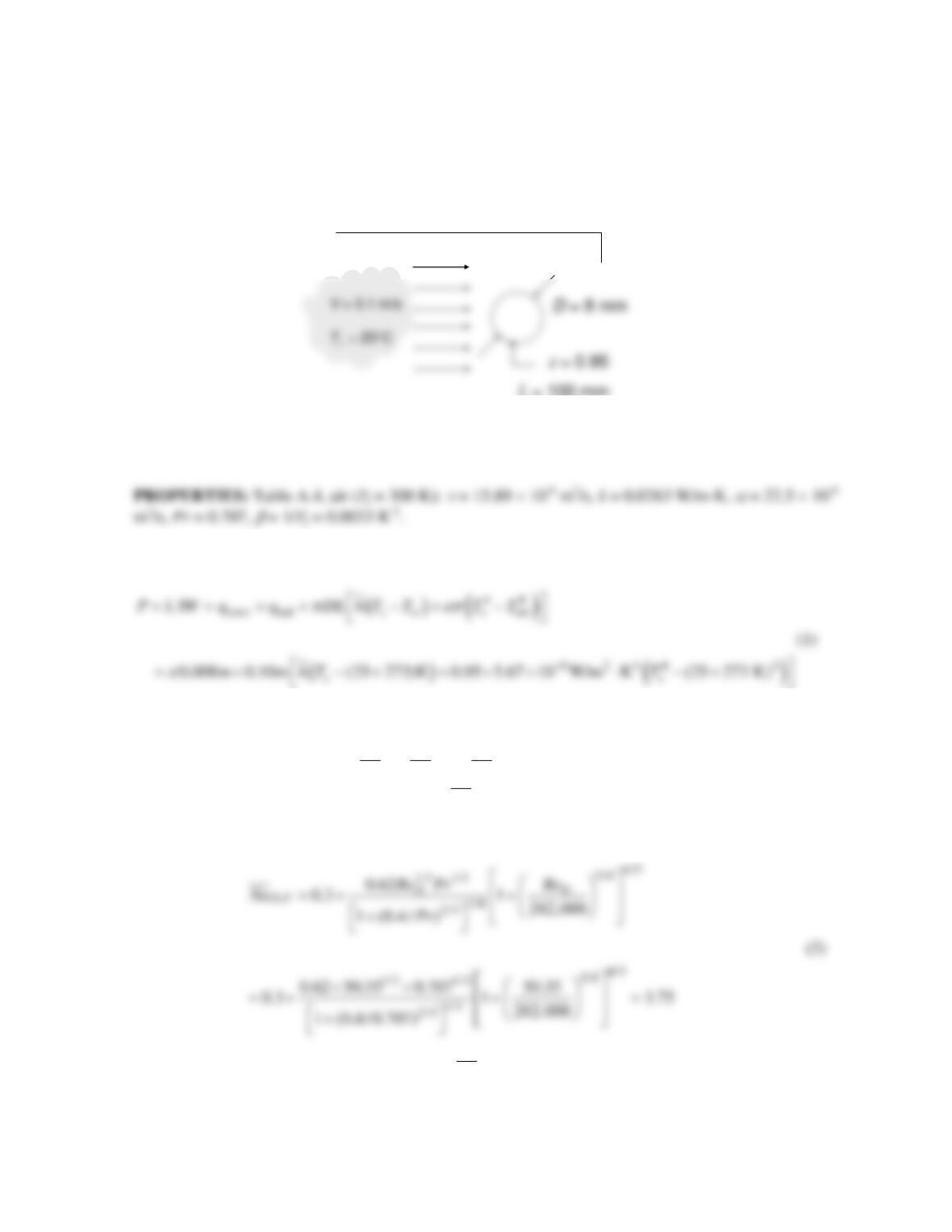
Employing the superposition embodied in Equation 9.64:
from which
Therefore,
COMMENTS: (1) Recognize the importance of both inertial and buoyancy forces (forced and free
convection) in determining the value of the average convection heat transfer coefficient. It would be
inappropriate to assume either effect is negligible. (2) Recognize that adiabatic surfaces have no net
heat flux. This does not mean that the convection and radiation fluxes are both equal to zero.
PROBLEM 9.86
KNOWN: Dimensions of horizontal tube in wind tunnel. Air velocity and temperature, surroundings
temperature, emissivity of tube surface, power dissipation.
FIND: (a) Tube surface temperature for T∞ = 25C, V = 0.1 m/s, (b) Plot of the tube surface
temperature versus the cross flow velocity for 0.05 m/s ≤ V ≤ 1 m/s.
SCHEMATIC:
ASSUMPTIONS: (1) Constant properties, (2) Large surroundings, (3) Steady-state conditions, (4)
Ideal gas.
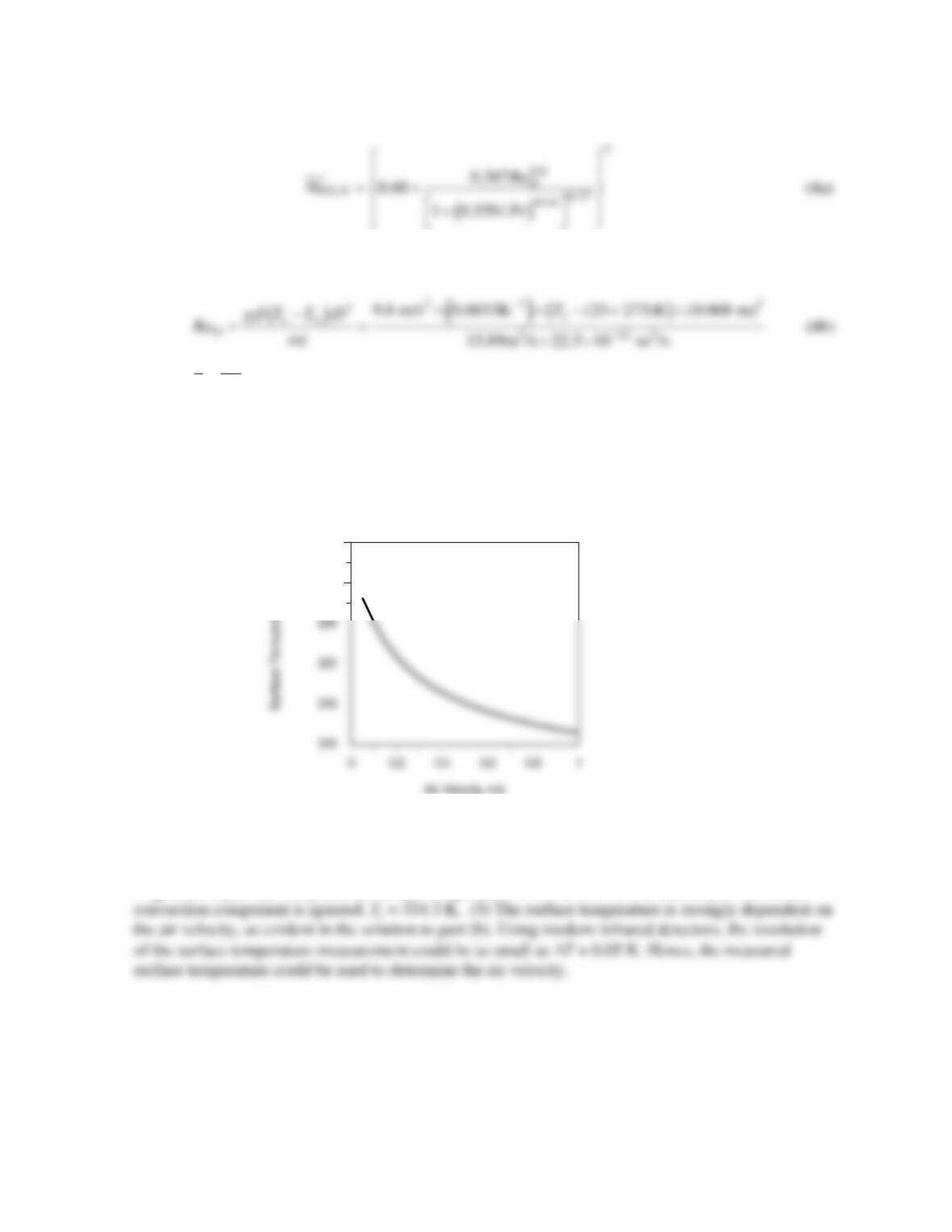
ANALYSIS: (a) An energy balance on the cylinder yields
From Equation 9.64 for mixed convection from a cylinder in transverse flows,
44 4
,,
D
DF DN
Nu Nu Nu=+ (2)
where the forced convection Nusselt number, ,
D
F
Nu , is provided by the Churchill and Bernstein
correlation of Chapter 7, and 62
/ (0.1 m/s 0.008 m) /15.89 10 m /s = 50.35
D
Re VD
ν
−
== × × .
The natural (free) convection Nusselt number, ,
D
N
Nu , is found from the Churchill and Chu
correlation,
Continued…
T
sur
= 25°C
L= 100 mm
PROBLEM 9.86 (Cont.)
where the Rayleigh number is,
Finally, /
D
hNukD= (5)
Simultaneous solution of Equations (1) through (5) yields Ts = 328.1 K = 55.1C <
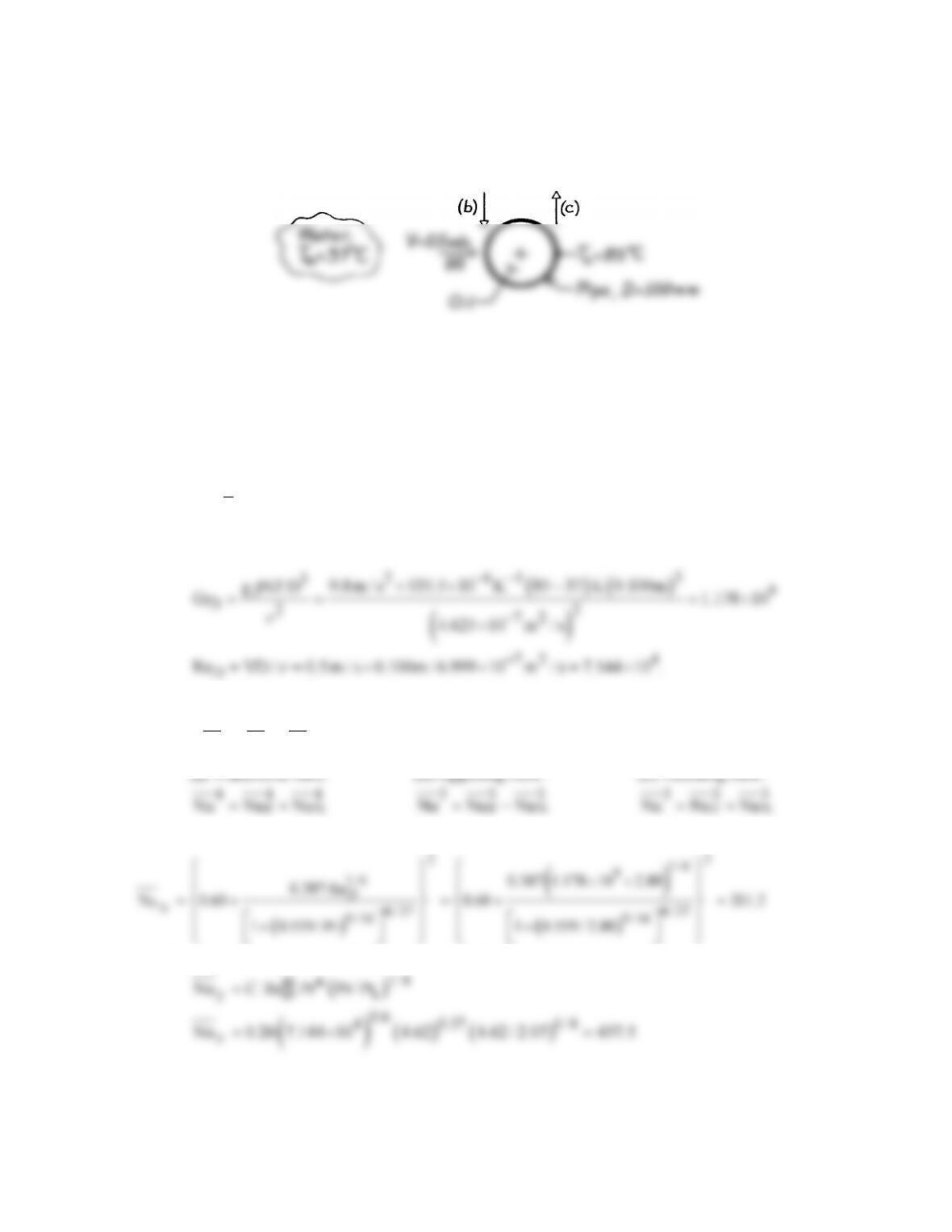
(b) The dependence of the surface temperature on the air velocity is shown below.
COMMENTS: (1) In part (a), the convective and radiative heat rates are qconv = 1W and qrad = 0.5 W,
respectively. Therefore, it is important to include radiative losses in the analysis, (2) If free convection
is ignored in part (a), the predicted surface temperature is Ts = 329.4 K. Alternatively, if the forced
Sur face Temper atur e versus Air Velocity
334
340
PROBLEM 9.87
KNOWN: Horizontal pipe passing hot oil used to heat water.
FIND: Effect of water flow direction on the heat rate.
SCHEMATIC:
ASSUMPTIONS: (1) Uniform pipe surface temperature, (2) Constant properties.
PROPERTIES: Table A-6, Water (Tf = (Ts + T∞)/2 ≈ 335K): ν = µf vf = 4.625 × 10⁻⁷ m2/s, k =
0.656 W/m⋅K, α = k vf/cp = 1.595 × 10⁻⁷ m2/s, Pr = 2.88, β = 535.5 × 10⁻⁶ K-1; Table A-6, Water (T∞
= 310K): ν = µf νf = 6.999 × 10⁻⁷ m2/s, k = 0.028 W/m⋅K, Pr = 4.62; Table A-6, Water (Ts = 358K):
Pr = 2.07
ANALYSIS: The rate equation for the flow situations is of the form
( ) ( )
s
q hDTT.
π
∞
′= −
To determine whether mixed flow conditions are present, evaluate
()
2
DD
Gr / Re .
It follows that
( )
2
DD
Gr / Re 0.231;=
since this ratio is of order unity, the flow condition is mixed. Using
Eq. 9.64,
n nn
FN
Nu Nu Nu= ±
and for the three flow arrangements,
For natural convection from the cylinder, use Eq. 9.34 with Ra = Gr⋅Pr.
For forced convection in cross flow over the cylinder, from Table 7-4 use
Continued …
PROBLEM 9.87 (Cont.)
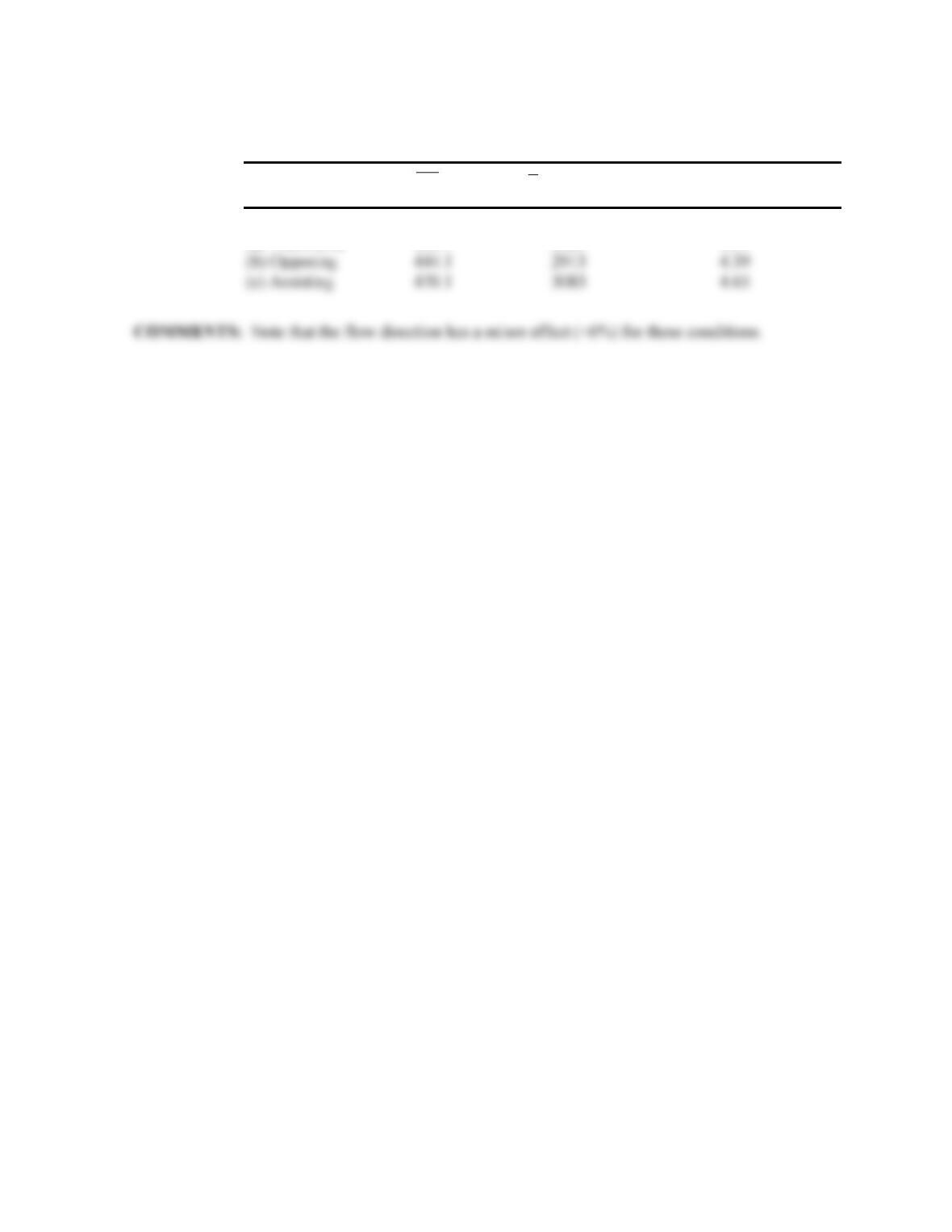
where n = 0.37 since Pr ≤ 10. The results of the calculations are tabulated.
Flow
Nu
()
2
h W/m K⋅
( )
4
q 10 W / m
−
′×
(a) Transverse 461.7 3029 4.57