P9-12 (AICPA adapted solution)
RED DEPARTMENT STORE
Computation of Estimated Inventory
Using Retail Inventory Method
December 31, 2010
Cost Retail
P9-13
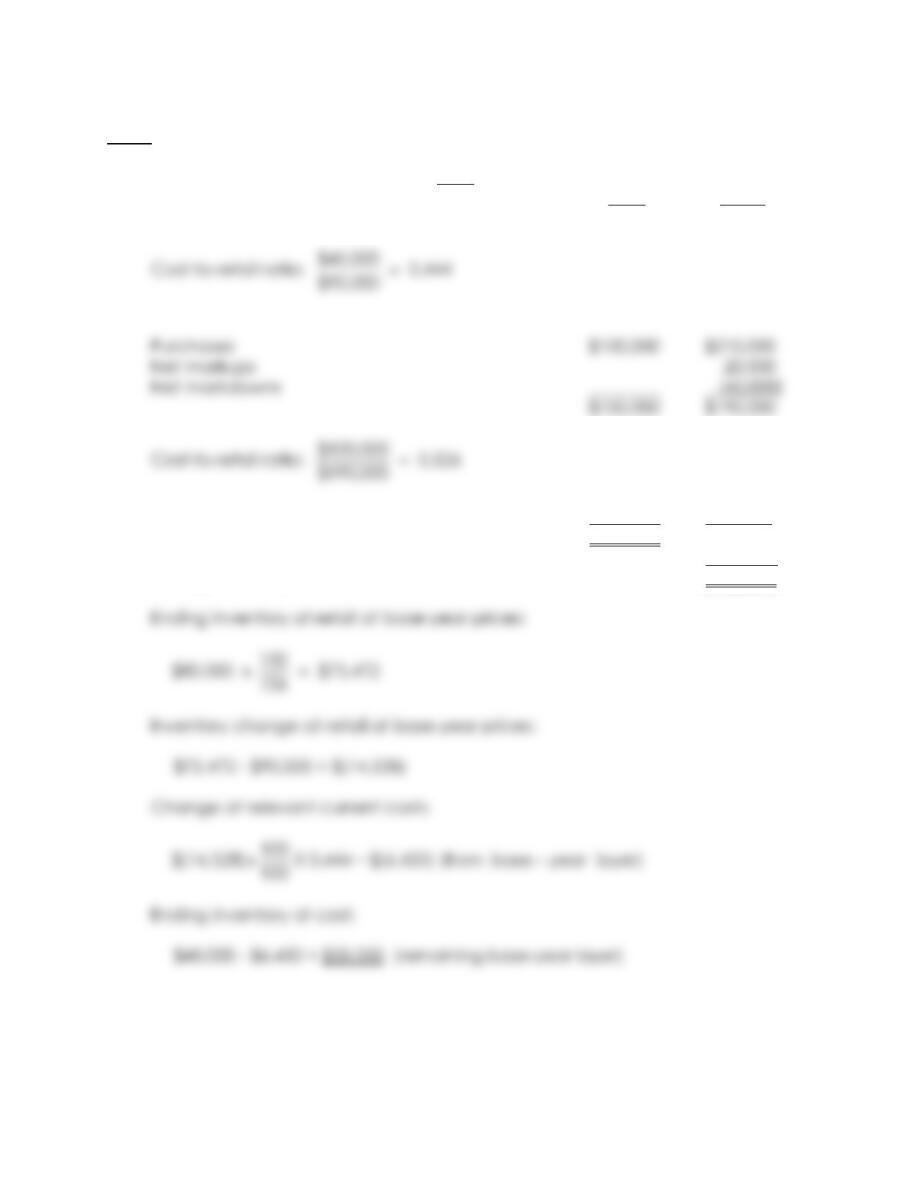
1. Cost Retail
Beginning inventory $ 25,000 $ 60,000
Net purchases ($75,000 – $2,000;
$180,000 – $5,000) 73,000 175,000
P9-13(continued)
2.
Ending inventory at retail: $80,000
Ending inventory at retail in base-year prices: $80,000 ÷ 1.05 = $76,190
P9-14
2010
Cost Retail
Beginning inventory $ 50,000 $100,000
9-39
P9-14(continued)
Change at relevant current costs:
$10,2300.465x
100
108
x$20,370 =
Ending inventory at cost:
Goods available for sale $310,230 $670,000
Less: Sales (600,000)
Ending inventory at retail $ 70,000
P9-14 (continued
Ending inventory at cost:
$60,230 – $29,795 = $30,435 (remaining base-year layer)
2012
Cost Retail
Beginning inventory $ 30,435 $ 70,000
Ending inventory at retail at base-year prices:

2009 2010 2011 2012
Cost Retail Cost Retail Cost Retail Cost Retail
Beginning inventory $ 40,000 $ 80,000 $ 33,333 $ 70,000 $ 39,999 $ 90,000 $ 44,963 $110,000
Cost-to-retail ration: 0.59
80,000$
40,000$
=
125
100
x130,000
104,000
Inventory change at retail at base-year prices:
$ 66,667 – $80,000
(13,333)
P9-15
9-41
P9-16
2010
Cost Retail
Beginning inventory $ 40,000 $ 90,000
Goods available for sale $140,000 $280,000
Less: Sales (200,000)
Ending inventory at retail $ 80,000
9-42
P9-16 (continued)
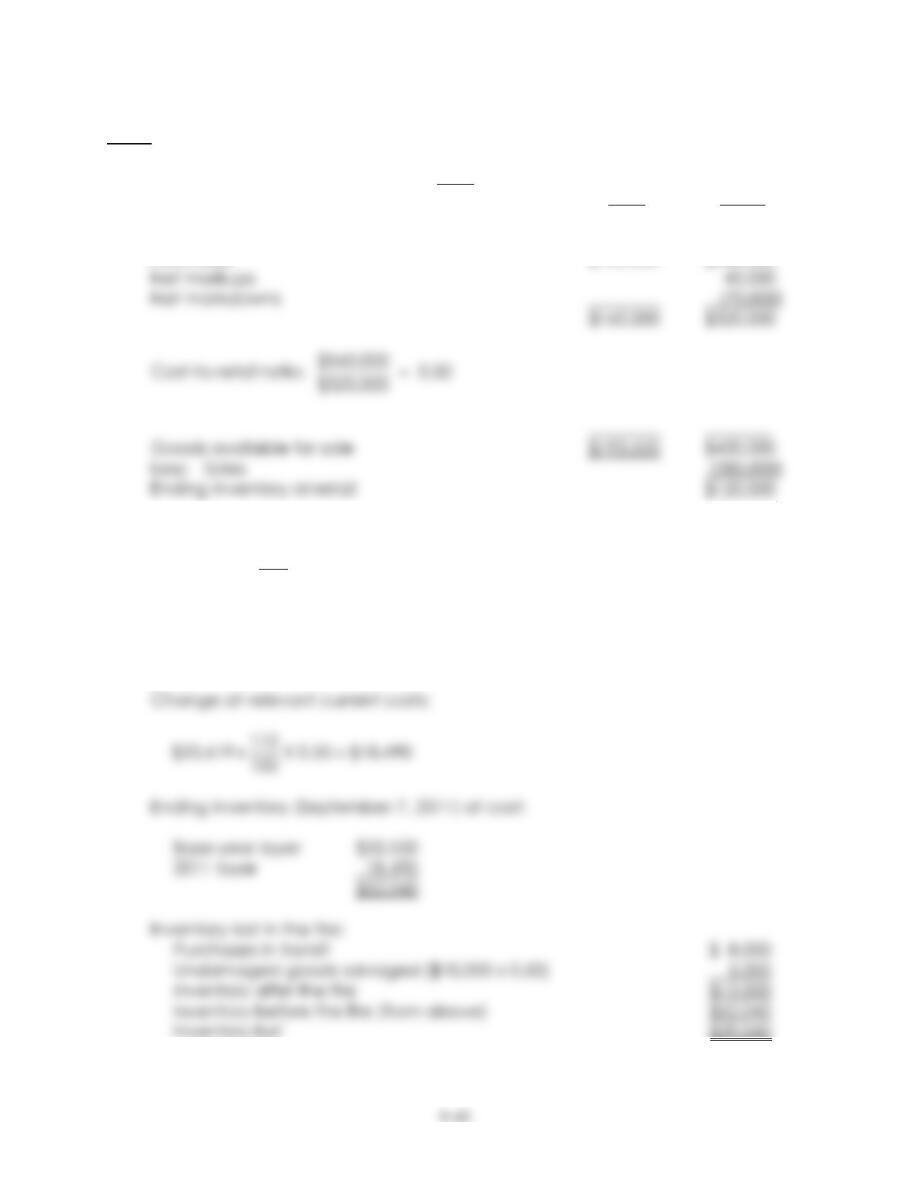
2011
Cost Retail
Beginning inventory $ 33,550 $ 80,000
Purchases $160,000 $350,000
Ending inventory at retail at base-year prices:
100
$120,000 x = $109,091
110
Inventory change at retail at base-year prices:
$109,091 – $75,472 = $33,619

P9-17
1. Current year: Ending inventory is correctly stated. Net income is overstated
by $17,500 because purchases are understated and, therefore, cost of goods
2. Current year: Ending inventory is understated by $4,300. Net income is
understated by $4,300, because cost of goods sold is overstated.
3. Current and following year: The results for both years will be the same as in 2.
4. Current year: Ending inventory is understated. Net income is correct because
5. Current year: Ending inventory is overstated. Net income is overstated
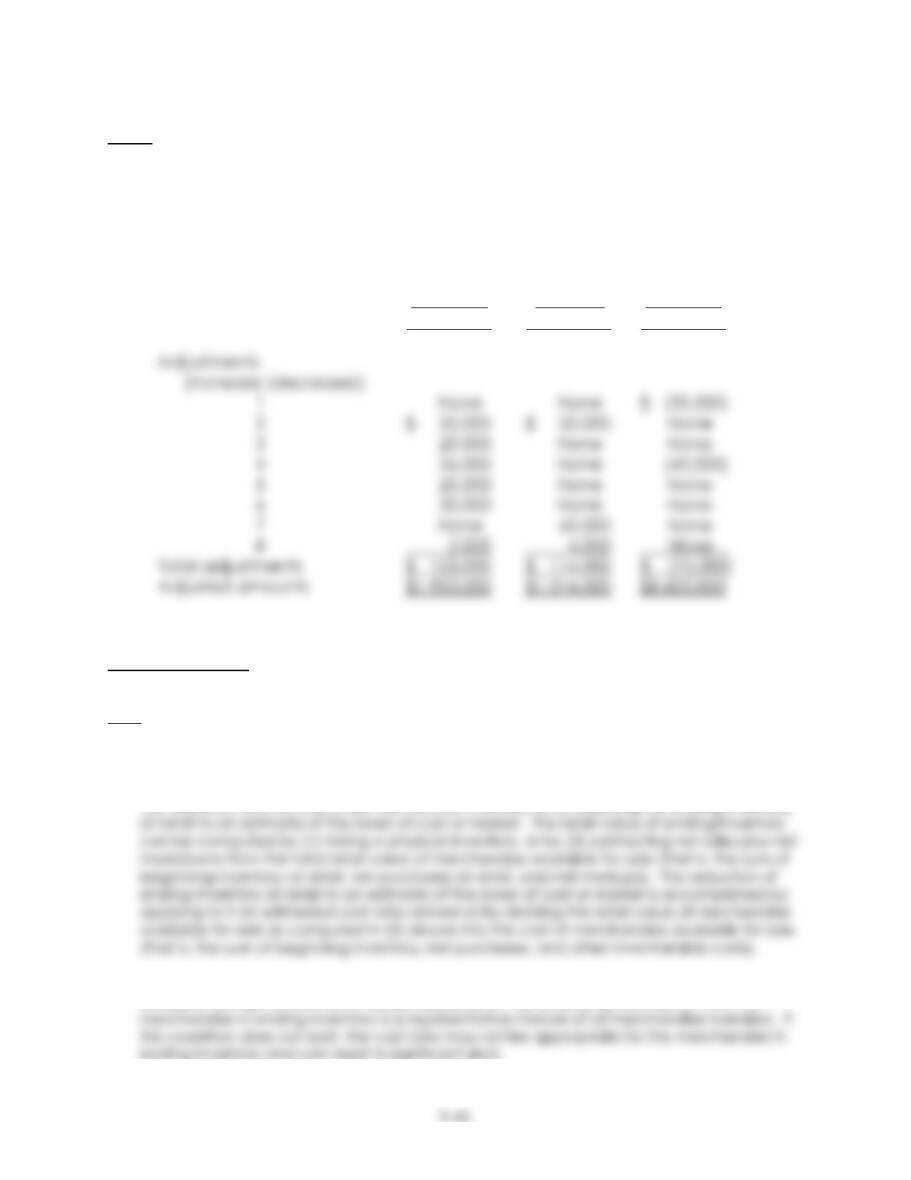
P9-18 (AICPA adapted solution)
LAYNE CORPORATION
Adjustments to Initial Amounts
As of December 31, 2010
Inventory
Accounts
Payable
Net Sales
Initial amounts
$1,750,000
$1,200,000
$8,500,000
ANSWERS TO CASES
C9-1 (AICPA adapted solution)
1. The retail inventory method can be employed to estimate retail, wholesale, and
manufacturing finished goods inventories.
2. Since the retail method is based on an estimated cost ratio involving total merchandise
available during the period, its validity depends on the underlying assumption that the
C9-1 (continued)
2. (continued)
Where there are a number of inventory subdivisions for which differing rates of markon are
maintained, there is no assurance that the ending inventory mix will be representative of the
total merchandise handled during the period. In such cases, accurate results can be
obtained by subclassifications by rate of markon.
3. The advantages of using the retail method as compared with cost methods include the
following:
4. The treatments to be accorded net markups and net markdowns must be considered in
light of their effects on the estimated cost ratio. If both net markups and net markdowns
are used in arriving at the cost ratio, ending inventory will be converted to an estimated
C9-2 (AICPA adapted solution)
1. THE SHELLY CORPORATION
Computation of Gross Profit Ratio
Sales $840,000
Cost of goods sold
2. Computation of Cost of Goods Sold During June 2010
9-48
C9-2 (continued)
3. Computation of Inventory at June 30, 2010,
by the Gross Profit Method
Inventory, May 31, 2010 $ 95,000
Purchases to June 30, 2010 per
general ledger 800,000
C9-3 (AICPA adapted solution)
a. 1. For its 2011 models, Blaedon should include in inventory carrying amounts all necessary
average net realizable value less the profit margin, if any, assigned.
b. 1. Using FIFO, Blaedon would assign the earliest lawnmower costs to cost of goods sold.
9-49
C9-4 (AICPA adapted solution)
1. If the terms of the purchase are FOB shipping point (manufacturer’s plant), Retail, Inc.,
4. Because Retail, Inc., calculates the estimated cost of its ending inventory using the
conventional (lower-of-cost-or-market) retail inventory method, net markdowns are
5. Products on consignment represent inventories owned by Retail, Inc., which are physically
C9-5 (AICPA adapted solution)
1. (a) Diane’s inventoriable cost includes all costs incurred to get the lighting fixtures ready for
sale to the customer. It includes not only the purchase price of the fixtures but also the
2. (a) The lower of cost or market rule is used for valuing inventories because of the concept
of balance sheet conservatism and because the decline in the utility of the inventories
9-50
C9-5 (continued)
3. Diane’s beginning inventories at cost and at retail are included in the calculation of the cost
ratio.
C9-6 (AICPA adapted solution)
1. Purchases from various suppliers are generally included in Caddell’s inventory when Caddell
3. (a) The advantages of using the dollar value LIFO inventory cost flow method are to
reduce the cost of accounting for inventory according to the LIFO method and to
4. Caddell should account for the inventories consigned to Reed Company as part of
inventory. Caddell retains title to the goods until their sale by Reed; therefore the earnings
process has not been completed.
5. In applying the lower of cost or market method, market does not exceed the ceiling or fall
below the floor. The ceiling is equal to the net realizable value, i.e., estimated selling price
C9-7 (AICPA adapted solution)
1. The insurance costs on the raw materials while they were in transit from the supplier should
2. a. Hanlon’s inventory should be reported at net realizable value. According to the lower
C9-7 (continued)
3. Generally, ending inventory would have been higher and cost of goods sold would have
been lower had Hanlon used the LIFO inventory method. Inventory quantities increased
C9-8 (AICPA adapted solution)
1. Hudson should account for the warehousing costs related to its wholesale inventories as
2. a. The lower of cost or market method produces a more realistic estimate of future cash
flows to be realized from assets, which is consistent with the principle of conservatism,
and recognizes (matches) the anticipated loss in the income statement in the period in
3. a. Hudson’s freight-in costs should be included only in the cost amounts to determine the
cost to retail percentage.
4. By not deducting net markdowns from the retail amounts to determine the cost to retail
percentage, Hudson produces a lower cost to retail percentage than would result if net

9-52
C9-9
Note to Instructor: This case does not have a definitive answer. From a financial reporting
perspective, GAAP is identified and summarized. From an ethical perspective, various issues
are raised for discussion purposes.
From a financial reporting perspective, there are two primary issues. First, if the purchase is
made in the current year, the cost to retail ratio (for purchases) will be reduced because of
From an ethical perspective, both issues involve whether management should make
decisions for the purpose of affecting the amount of income that is reported. Obviously
management may, but should it? The primary stakeholders are the company’s current and
potential stockholders and creditors. Kelly has two incentives for delaying the purchase, but
the effects are short-run and will be counterbalanced in the next period. Also, since the