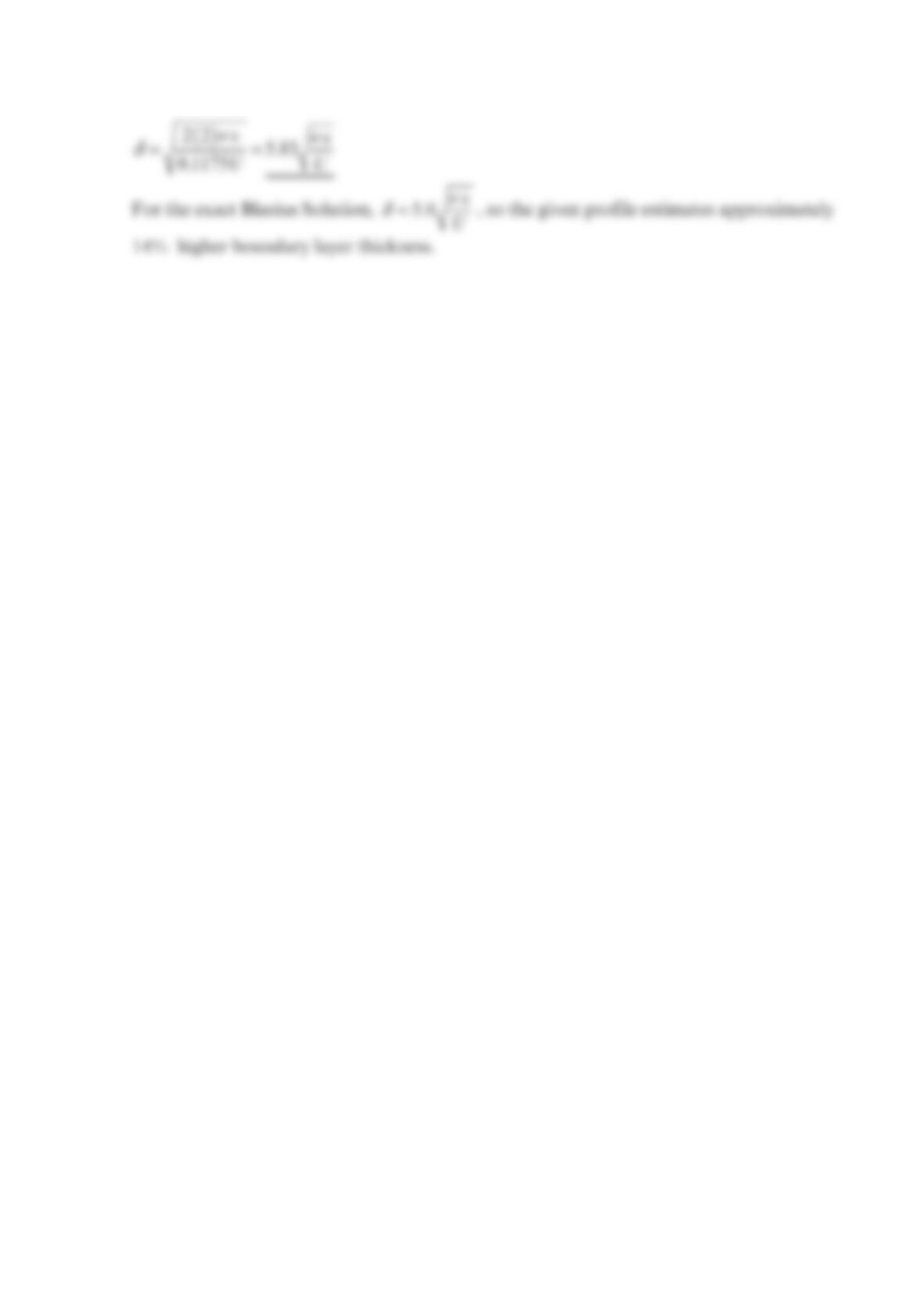
Hence,
Problem 9.32
Consider
2
0C° water flowing over a thin, wide, smooth flat plate aligned with the flow.
The approach velocity is 60 km/hr and the Reynolds number based on the plate length is
5
2
10×. Calculate the drag per unit width of the plate for each of the velocity profiles listed in
Table 9.2. Next calculate the drag coefficient D
C
as used in Fig. 9.15. Which velocity
profile(s) provide the best estimation of D
C
? Why?
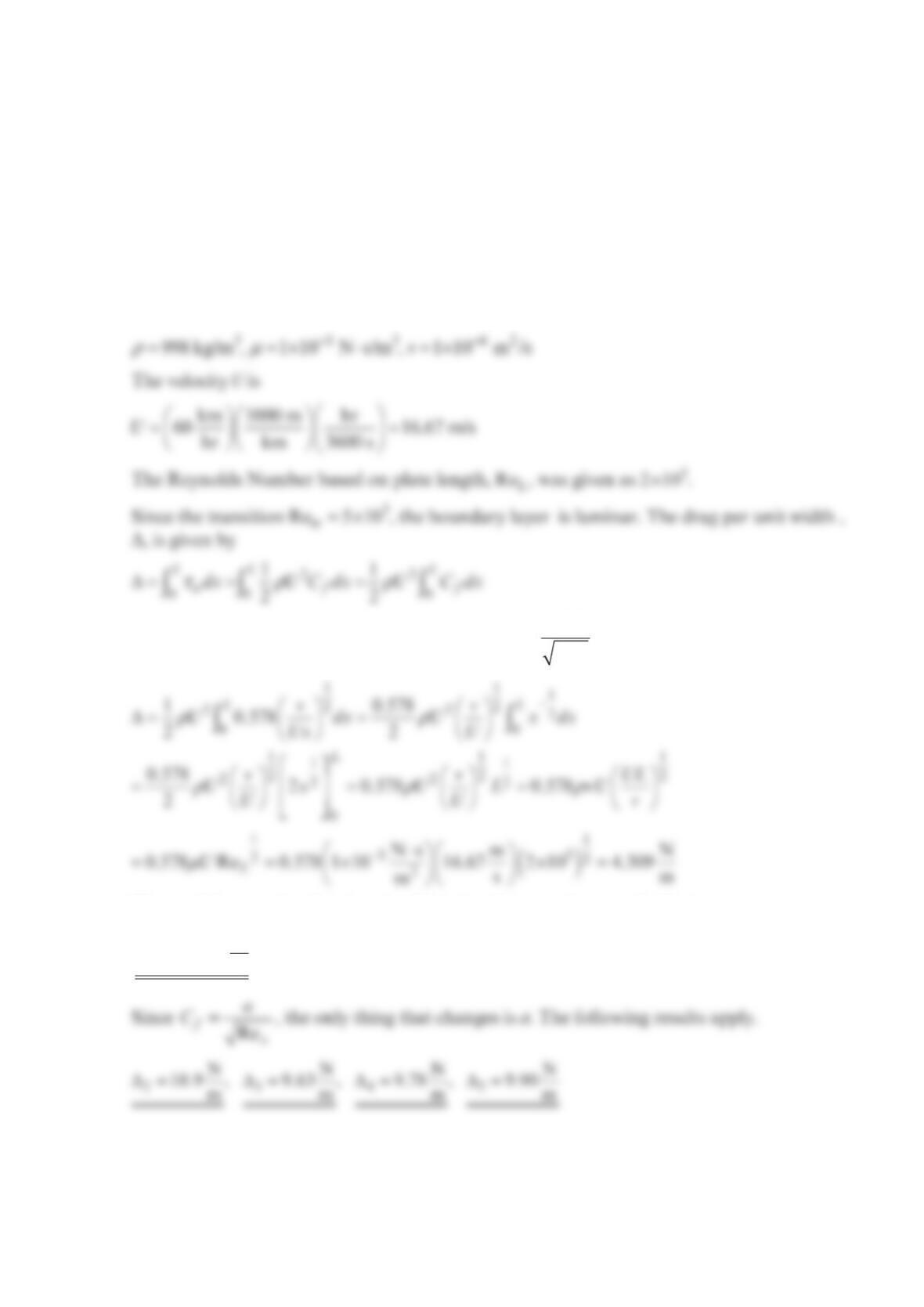
Solution 9.32
The properties for water at
2
0C° are
For the linear velocity profile, Table 9.2 gives =0.578
Re
f
x
C so
The total drag on the plate is twice this value (because there are 2 sides)
=N
8.62 m
Drag
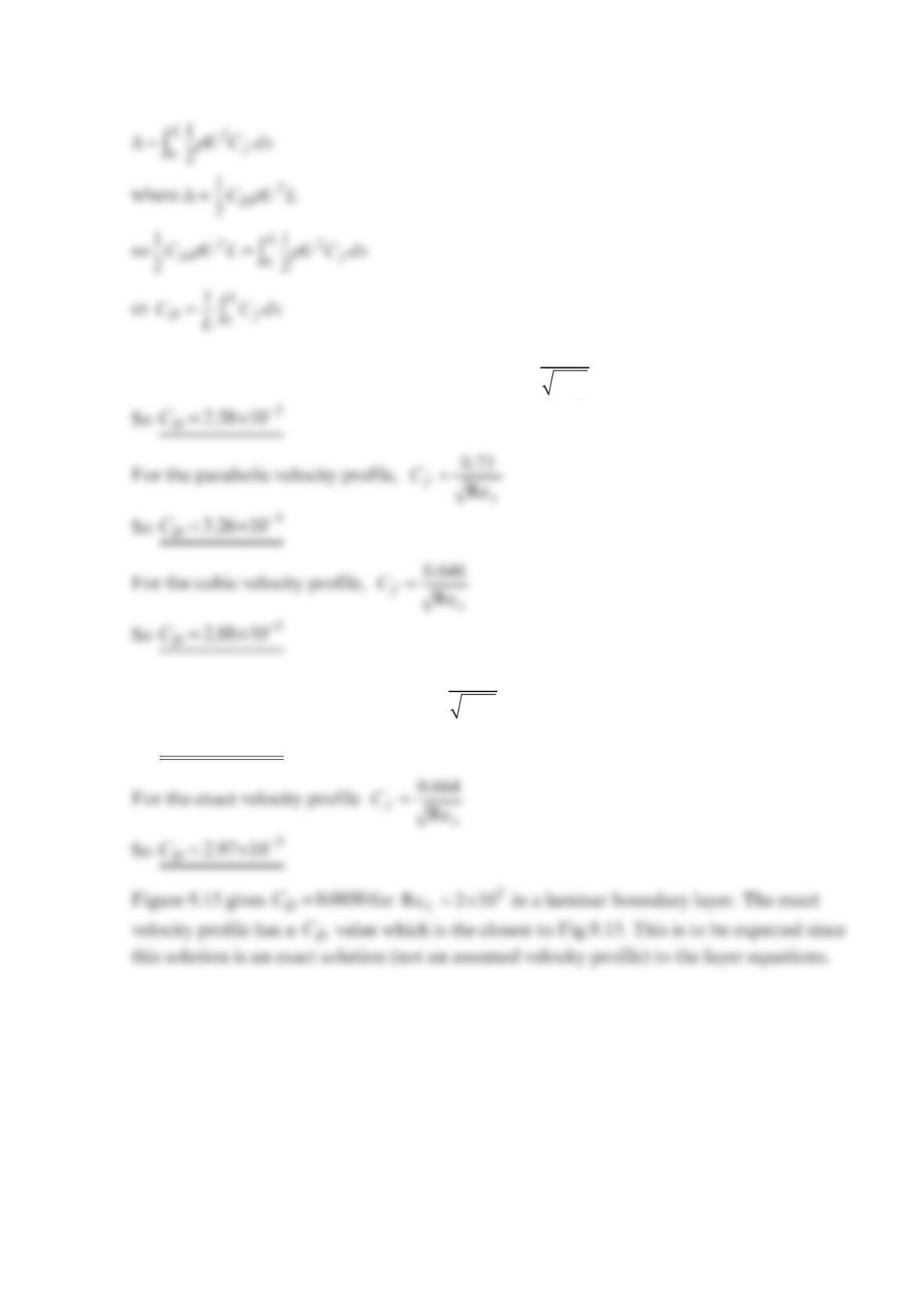
The drag coefficient, D
C
, is found from
For the linear velocity profile, Table 9.2 gives =0.578
Re
f
x
C
For the sine wave velocity profile =0.656
Re
f
x
C
So −
=×
3
2.93 10
D
C
Problem 9.33
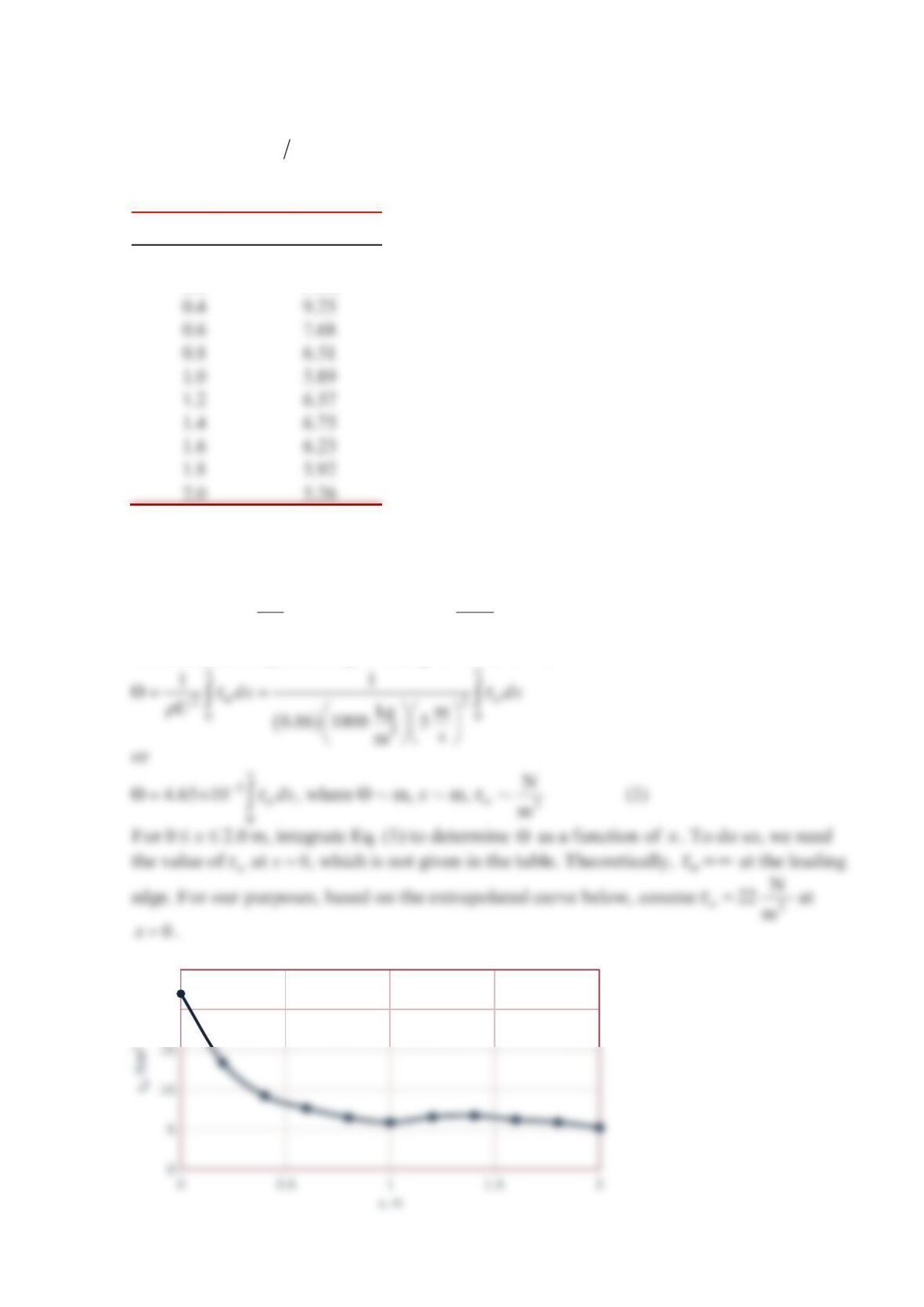
For a fluid of specific gravity = 0.86SG flowing past a flat plate with an upstream
velocity of 5 m sU=, the wall shear stress on the flat plate was determined to be as
indicated in the table below. Use the momentum integral equation to determine the
boundary layer momentum thickness,
()
Θ=Θ x. Assume Θ=0at the leading edge, =0x.
x(m)
τ
2
(N/m )
w
0 –
0.2 13.40
Solution 9.33
Since
τρ
Θ
=2
w
d
Udx , it follows that
τ
ρ
Θ= 2
w
ddx
U
which can be integrated to give (using Θ=0 at =0x)
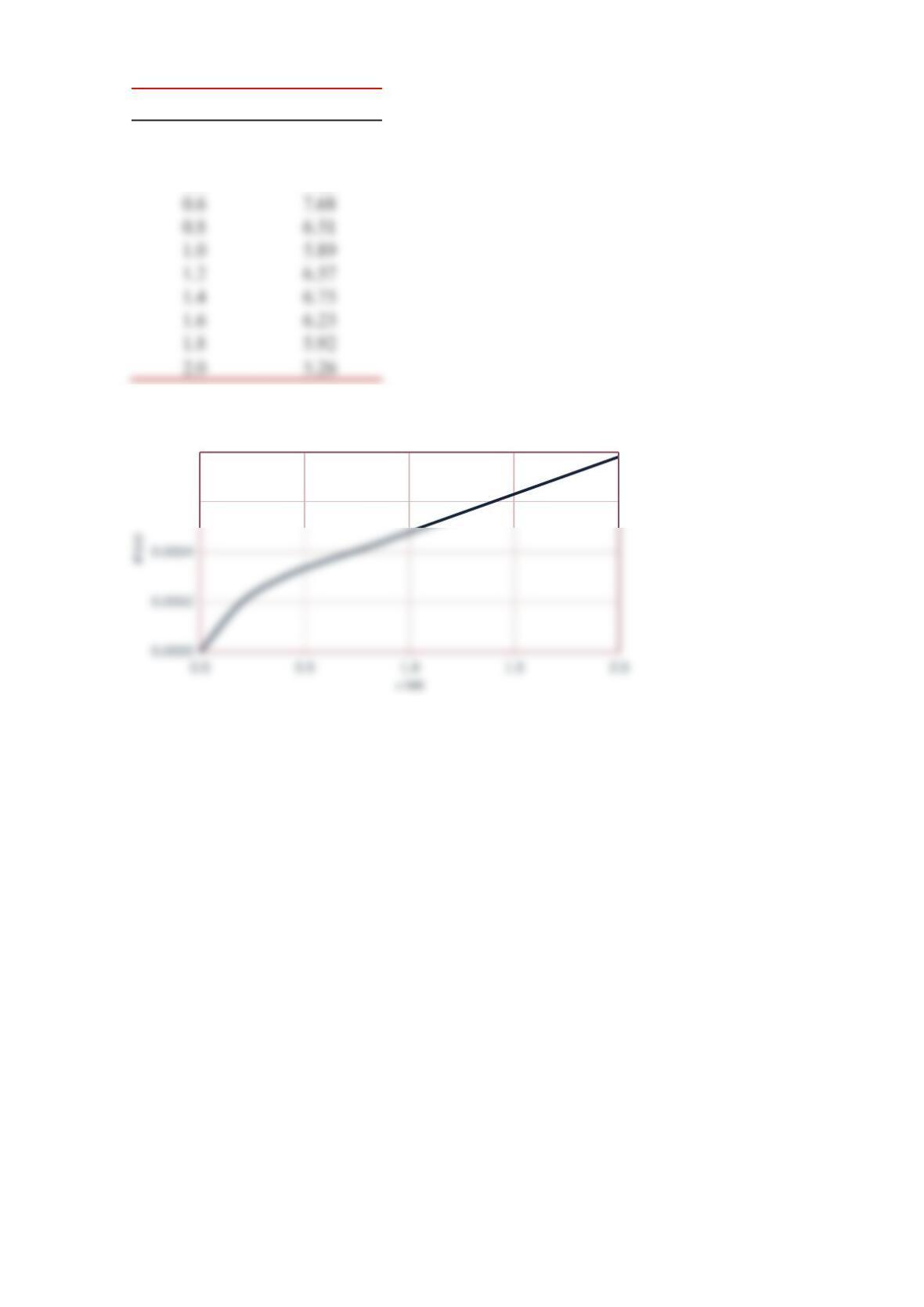
20
25
x(m)
τ
2
(N/m )
w
0 –
0.2 13.40
0.4 9.25
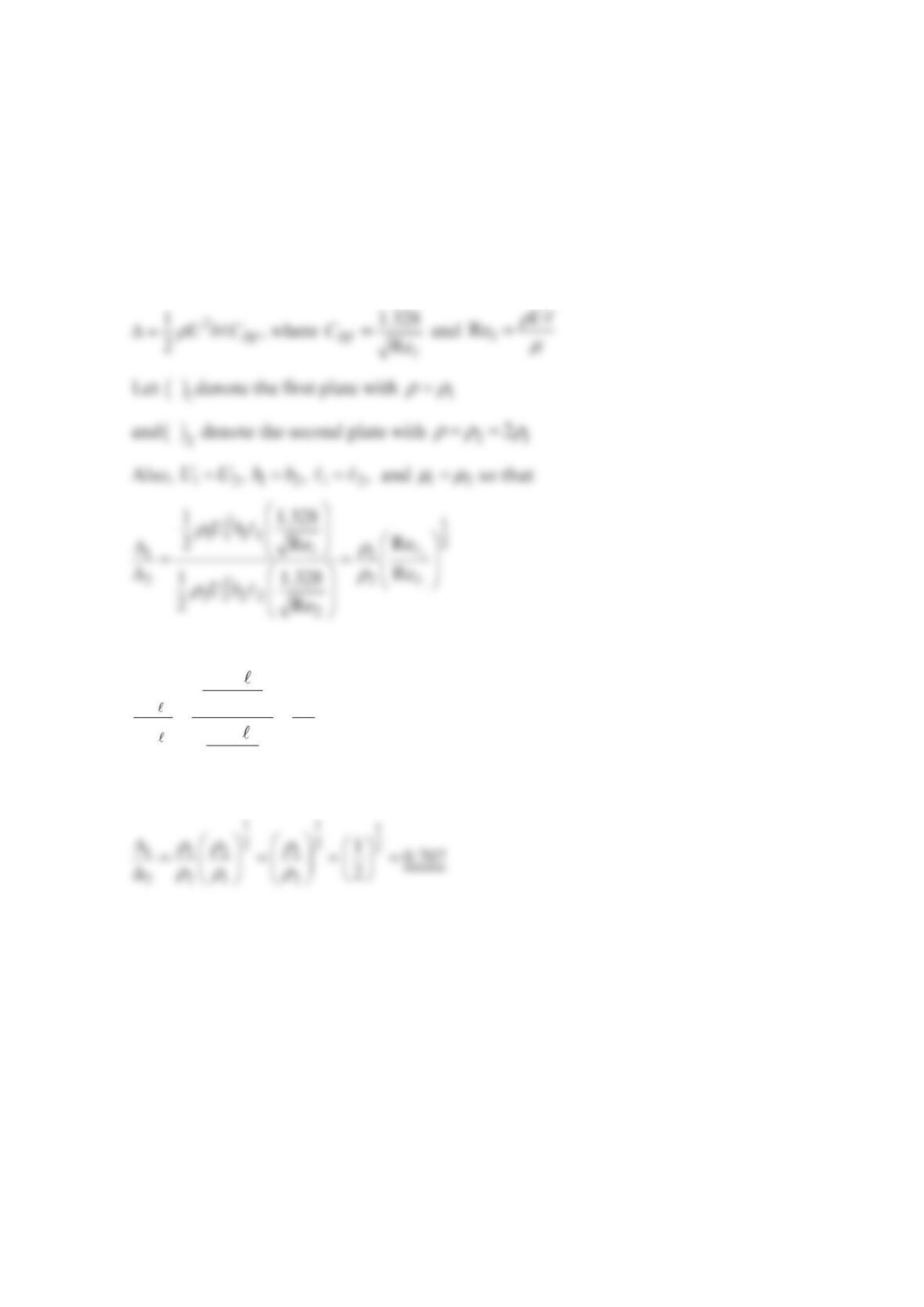
A standard numerical integration technique gives the following results.
0.0006
0.0008
Problem 9.35
Two different fluids flow over two identical flat plates with the same laminar free-stream
velocity. Both fluids have the same viscosity, but one is twice as dense as the other. What is
the relationship between the drag forces for these two plates?
Solution 9.35
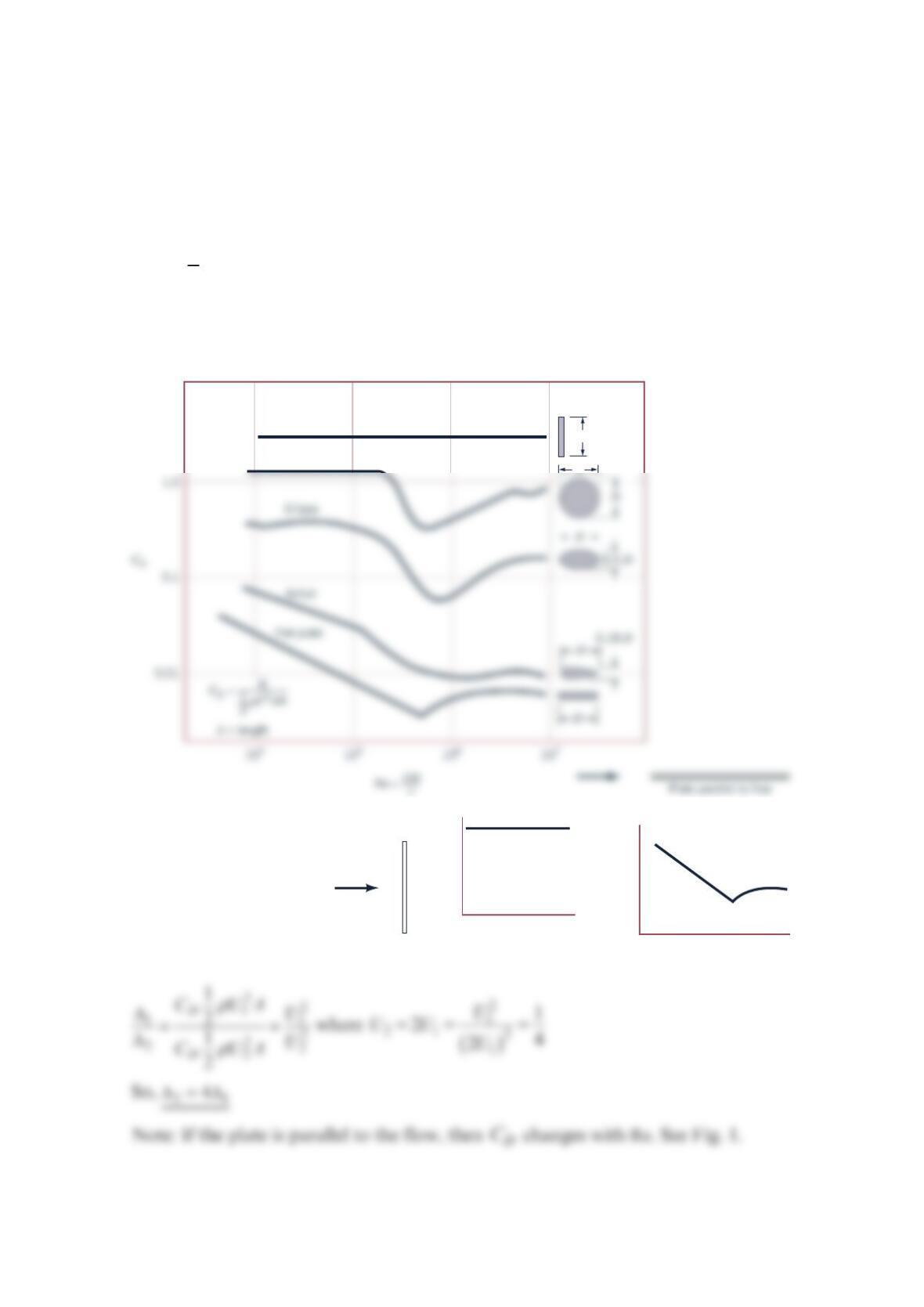
For each plate
but
ρ
µ
ρ
ρ
ρ
µ
==
2
1
222
22
1
111
1
Re
Re
U
U
Hence,
Problem 9.36
Fluid flows past a flat plate with a drag force 1
Δ
. If the free-stream velocity is doubled, will
the new drag force, 2
Δ
, be larger or smaller than 1
Δ
and by what amount?
Solution 9.36
2
1
2
D
CUA
ρ
Δ
==
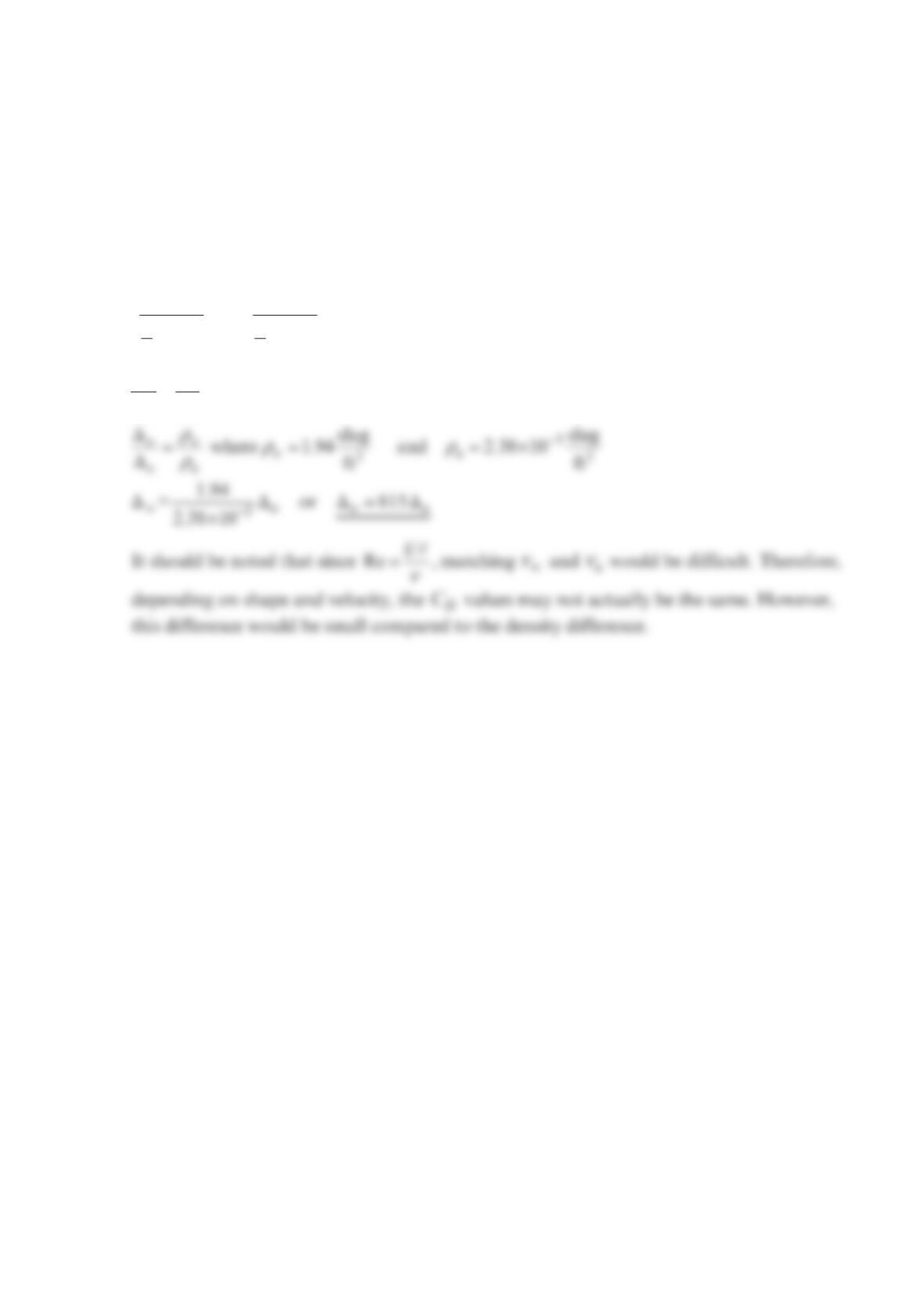
If you assume that the doubling of
U
, which will change Re, does not significantly change
D
C (see Fig. 1), then
Flat plate
Plate normal to flow
Circle
D
CD
U
Re
CD
Re
Figure 1

Problem 9.37
A model is placed in an airflow at standard conditions with a given velocity and then placed
in water flow at standard conditions with the same velocity. If the drag coefficients are the
same between these two cases, how do the drag forces compare between the two fluids?
Solution 9.37
22
11
22
wa
wa
wa
UA UA
ρρ
ρρ
ΔΔ
=
ΔΔ
=
Problem 9.38
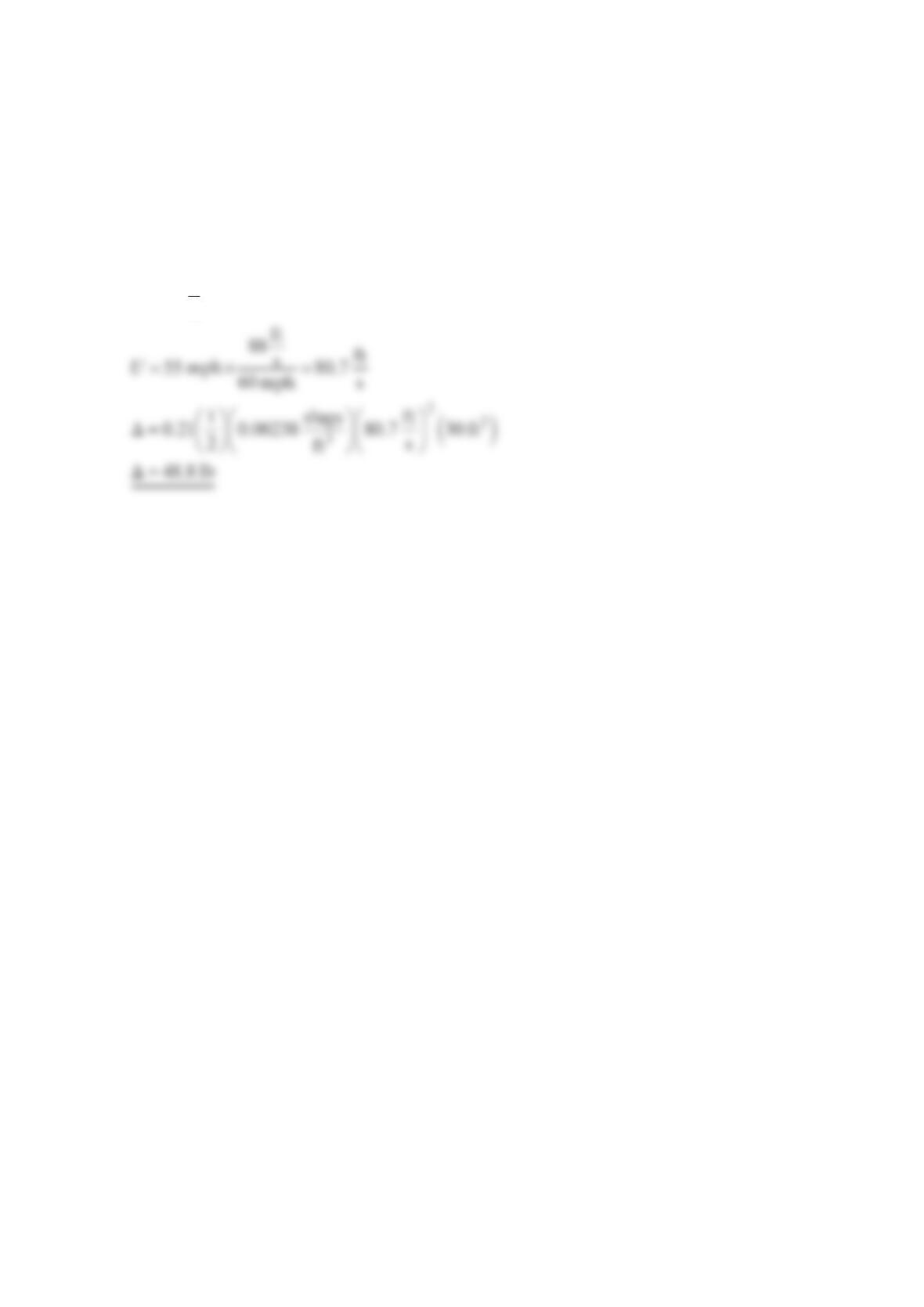
The drag coefficient for a newly designed hybrid car is predicted to be 0.21. The cross-
sectional area of the car is 2
3
0ft . Determine the aerodynamic drag on the car when it is
driven through still air at 55 mph.
Solution 9.38
2
1
2
D
CUA
ρ
Δ
=
Problem 9.39
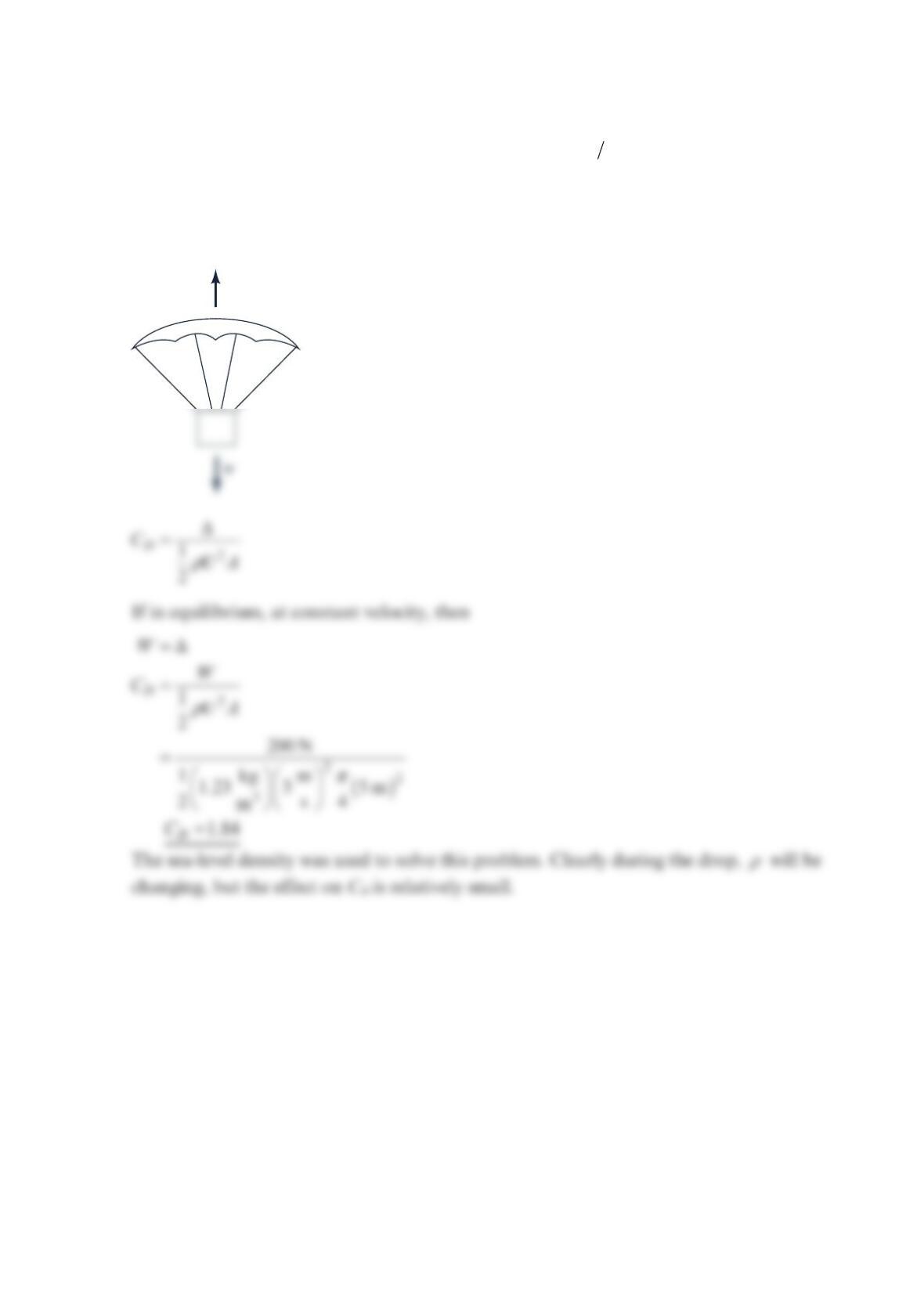
A
5
-m-diameterparachute of a new design is to be used to transport a load from flight
altitude to the ground with an average vertical speed of
3
ms
. The total weight of the load
and parachute is
2
00 N. Determine the approximate drag coefficient for the parachute.
Solution 9.39
𝒟
Problem 9.40
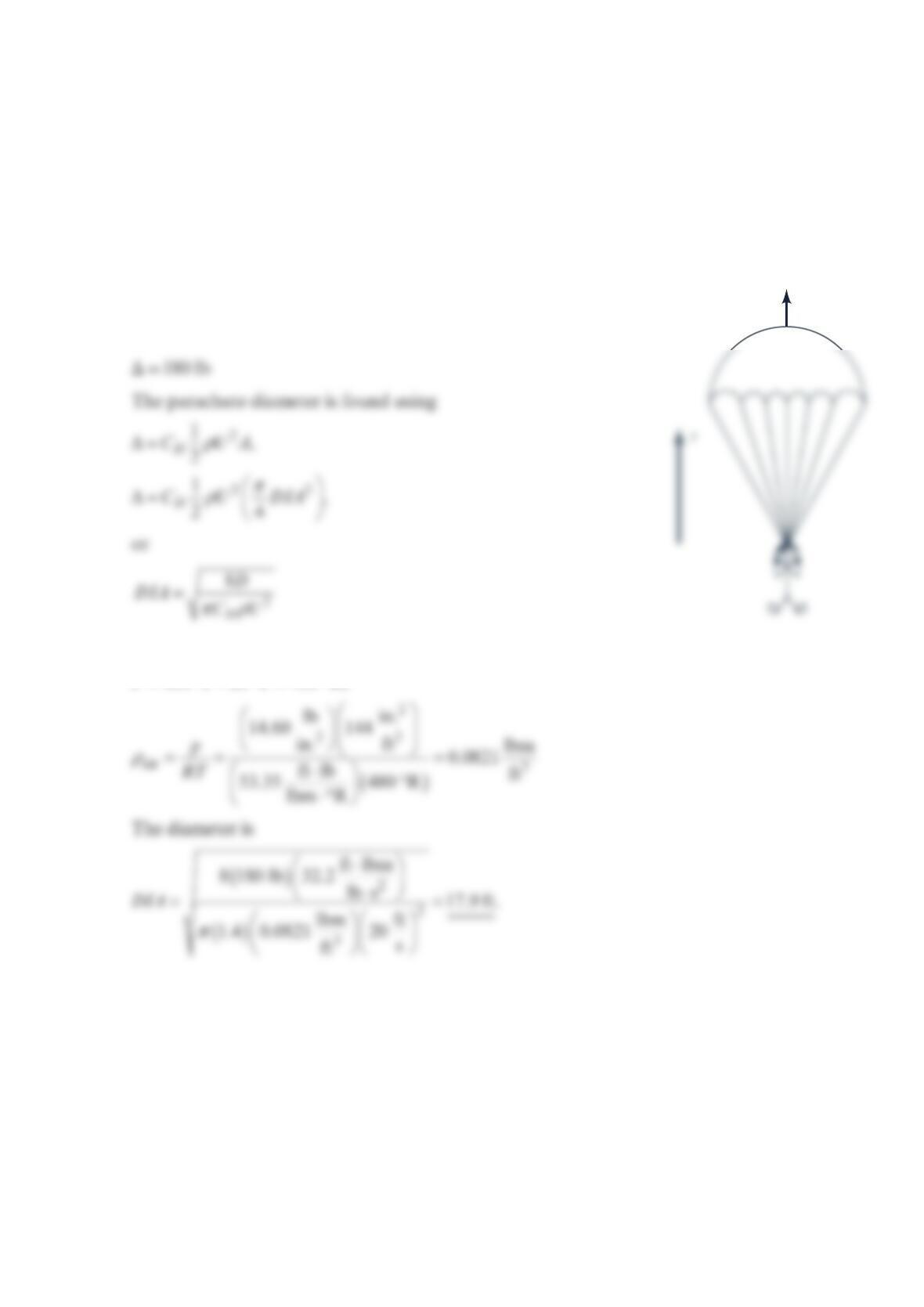
A 180-1b man parachutes from a plane using a hemispherical parachute in air at
2
0F° and
14.60 psia.Calculate the parachute diameter required for the man’s terminal velocity not to
exceed
2
0 ft/s. Neglect the weight of the parachute.
Solution 9.40
Summation of forces in the y-direction gives
0 180 lb
y
F== −
Δ
or
Figure 9.32 gives 1.4
D
C
=, The air density is found by the ideal gas law with
460 F 20 F 480 RT=°+°=°
,
.
D
Problem 9.41
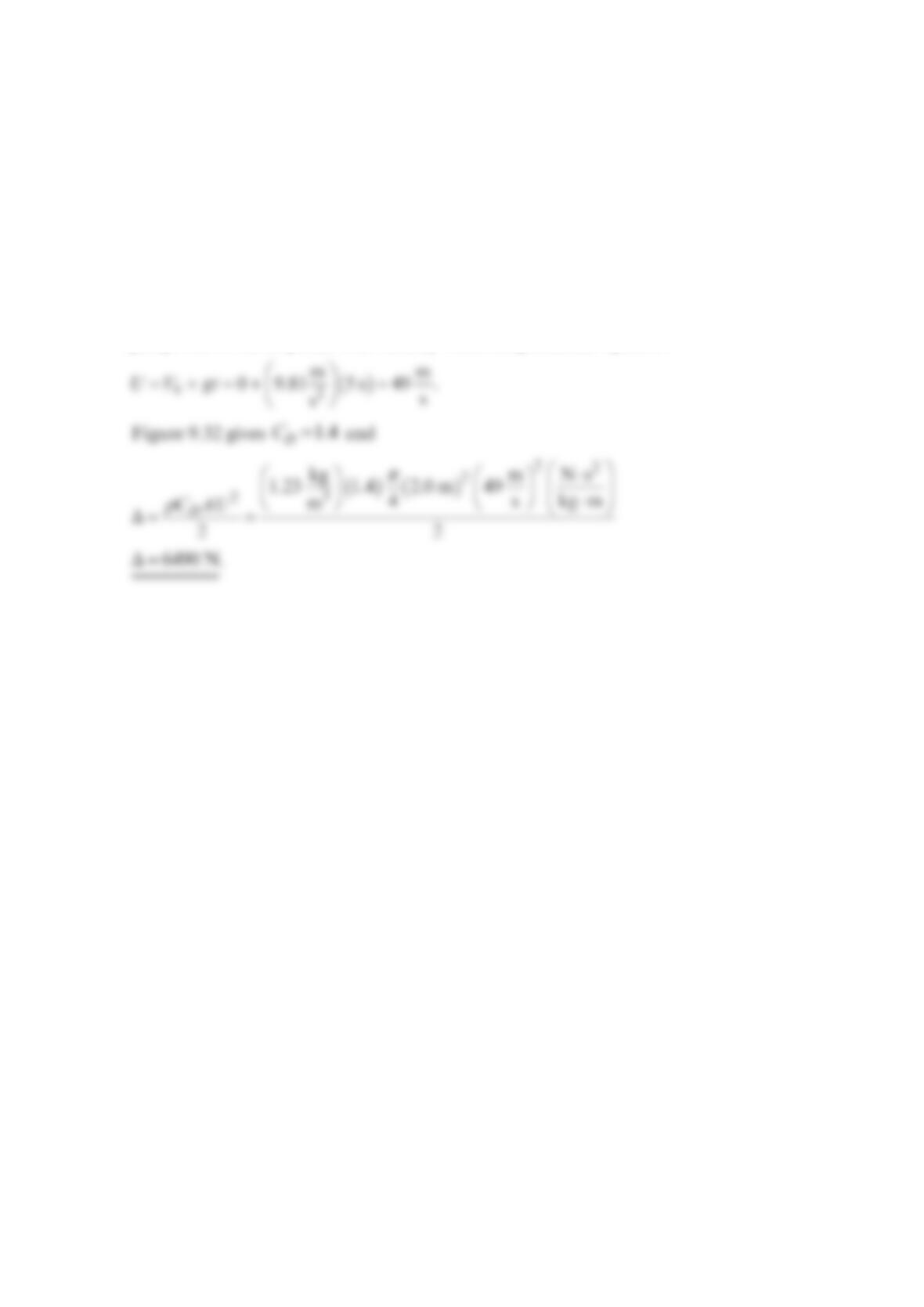
A
7
0-kg soldier on a secret mission has to parachute from an airplane over the desert. It
takes 5 s for him to release his parachute after he jumps. Taking the mass of the parachute
as 5 kg, estimate the force acting on the soldier as he releases the parachute. The diameter
of the parachute is
2
.0 m. Neglect drag on the soldier’s body prior to the opening of the
parachute. The air is at 20 °C.
Solution 9.41
Assume constant gravitational acceleration and the soldier has zero vertical velocity as he
jumps out of the airplane. The velocity when the parachute opens is
Problem 9.42
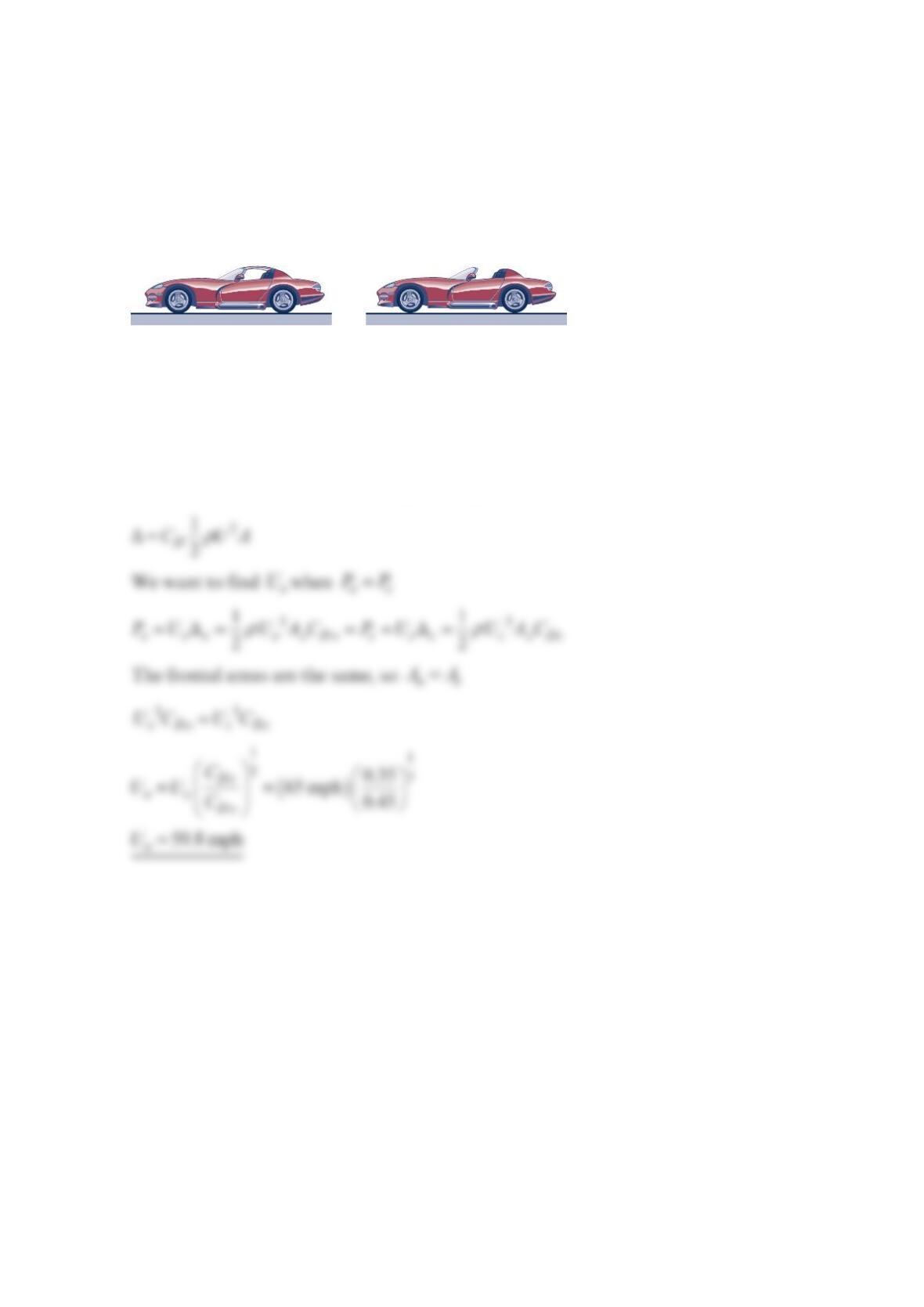
The aerodynamic drag on a car depends on the “shape” of the car. For example, the car
shown in figure below has a drag coefficient of 0.35 with the windows and roof closed.
With the windows and roof open, the drag coefficient increases to 0.45. With the windows
and roof open, at what speed is the amount of power needed to overcome aerodynamic
drag the same as it is at 65 mph with the windows and roof closed? Assume the frontal area
remains the same. Recall that power is force times velocity.
Solution 9.42
==⋅Power PFV
The force is the drag force. Let
()
cand
()
odenote closed and open.
Windows and roof
closed:
CD
= 0.35
Windows open; roof
open:
CD
= 0.45
Problem 9.43
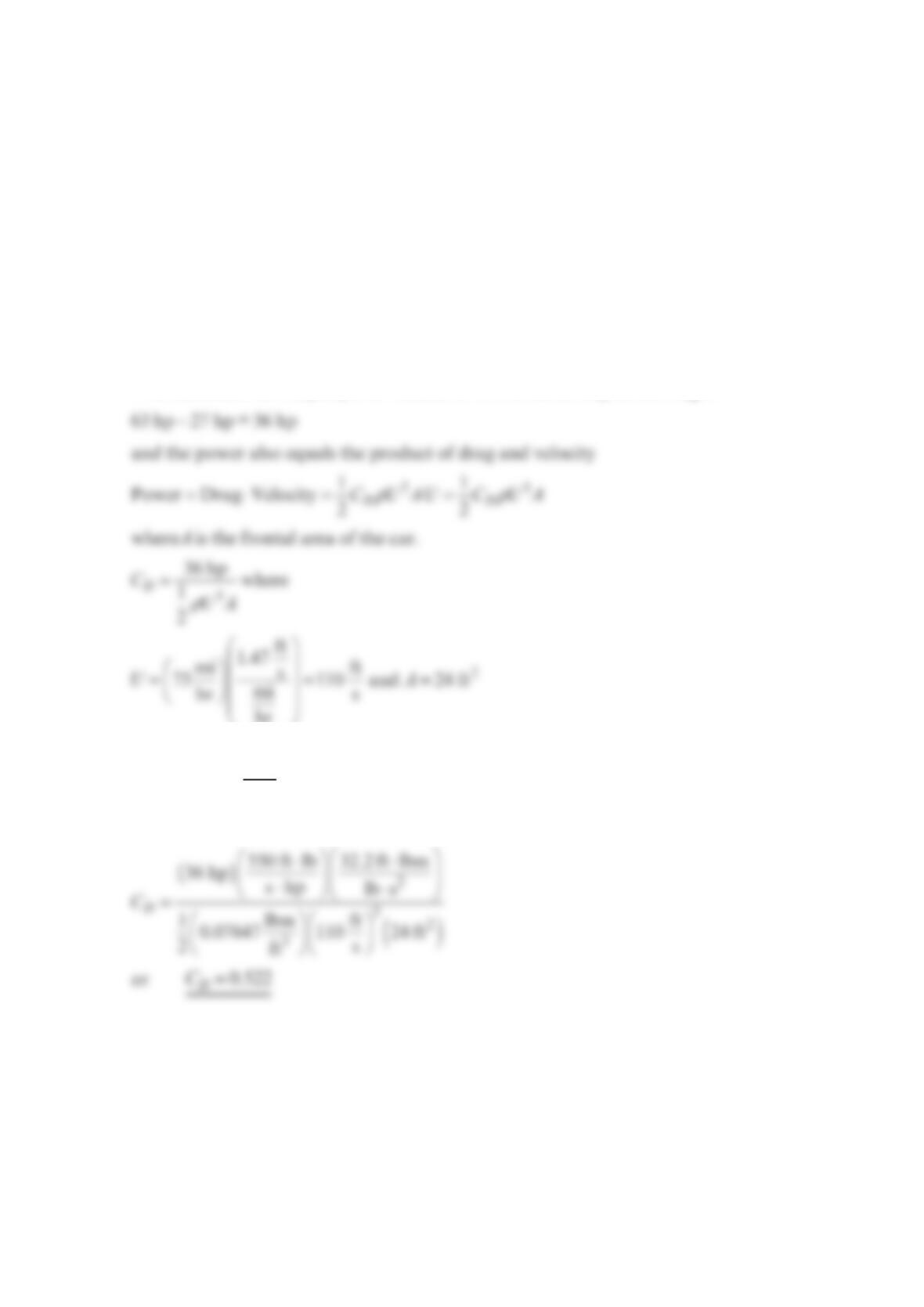
An automobile engine has a maximum power output of
7
0 hp, which occurs at an engine
speed of
2
200 rpm. A 10% power loss occurs through the transmission and differential. The
rear wheels have a radius of 15.0 in. and the automobile is to have a maximum speed of
75 mph along a level road. At this speed, the power absorbed by the tires because of their
continuous deformation is
2
7 hp. Find the maximum permissible drag coefficient for the
automobile at this speed. The car’s frontal area is 2
2
4.0 ft .
Solution 9.43
Maximum engine output power 70 hp
=
and the maximum output power at differential is
7
0 hp (0.10) (70 hp) 70 7 hp 63 hp−=−=
.
The maximum net output power needed to overcome aerodynamic drag is
hr
From Table C.1 Properties of the U.S. Standard Atmosphere (BG/EE Units) at sea level,
air 3
lbm
0.07647 ft
ρ
=.
Then
Problem 9.44
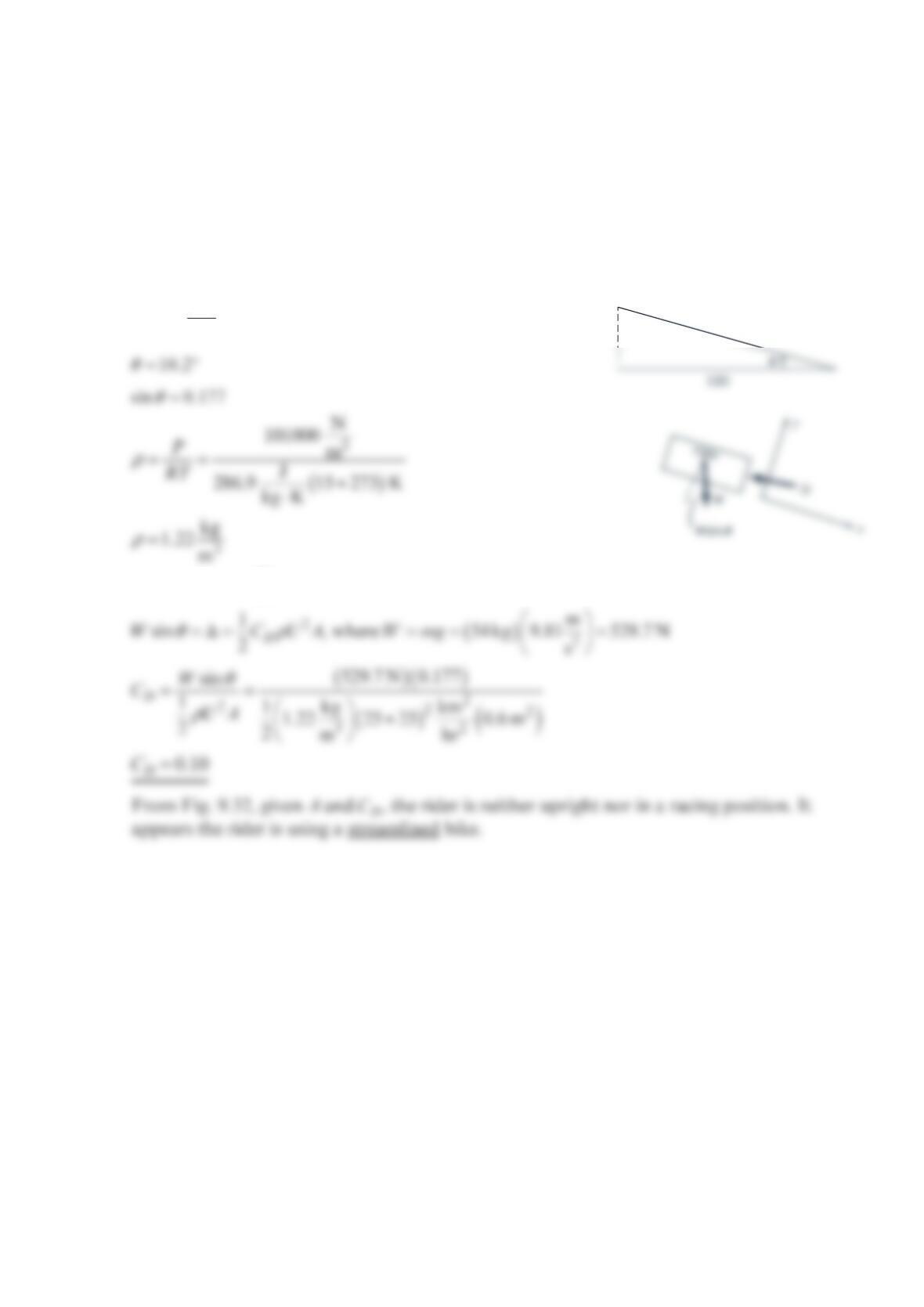
A woman is riding a bicycle down a
1
8% slope. Her velocity is
2
5 km/hr into an oncoming
2
5-km/hr wind. The air is at
1
5 C° and
1
01 kPa. Assuming that the only forces affecting the
speed are the weight and drag, calculate the drag coefficient if the frontal area is 2
0.6 m and
the combined mass is 54 kg. Speculate whether the rider is in the upright or racing position.
Solution 9.44
18
t
an 0.18
100
θ
==
In equilibrium, 0
x
F=
18
Problem 9.45
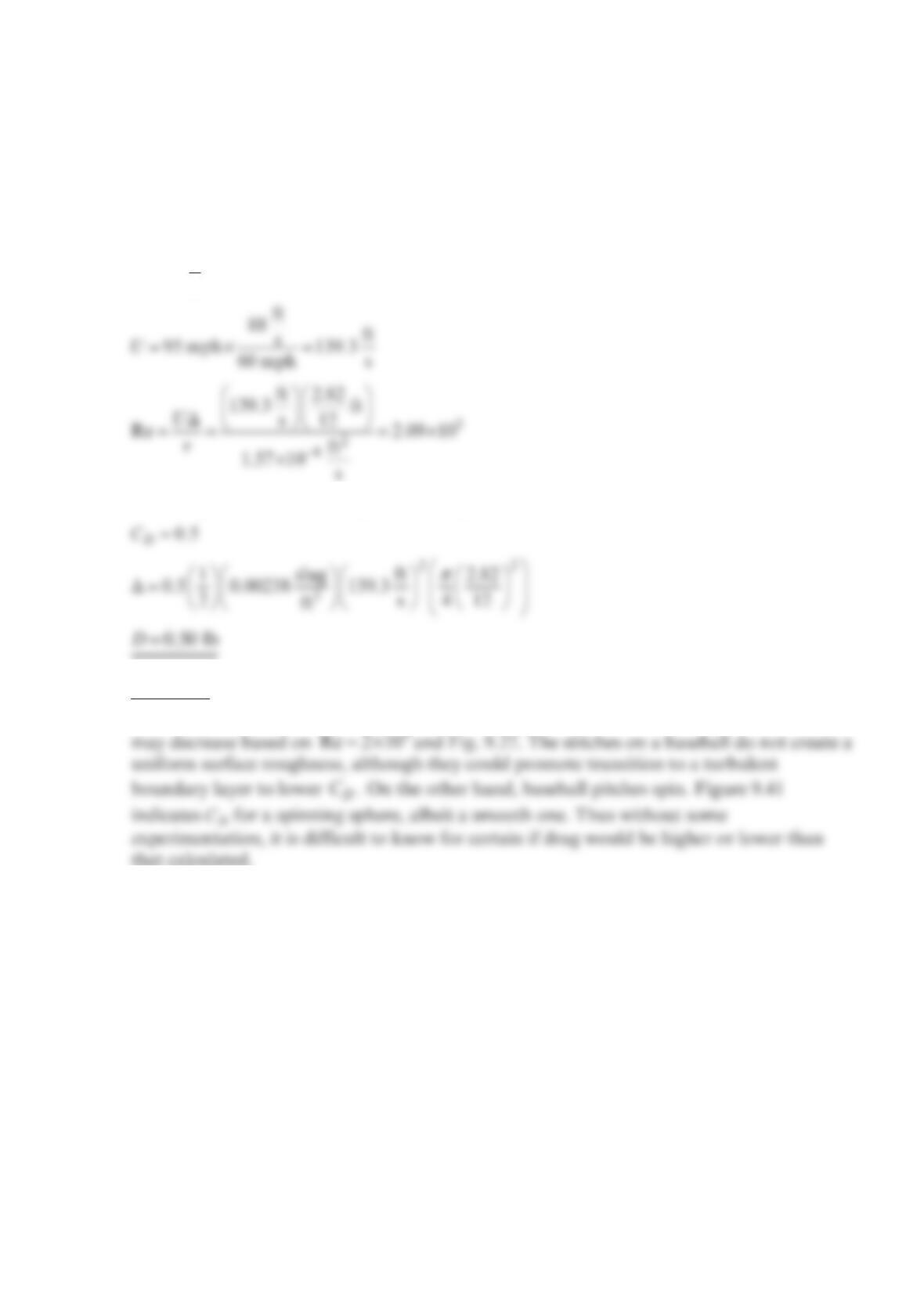
A baseball is thrown by a pitcher at
9
5 mph through standard air. The diameter of the
baseball is 2.82 in. Estimate the drag force on the baseball. Explain how the actual drag
force may be different than your estimate.
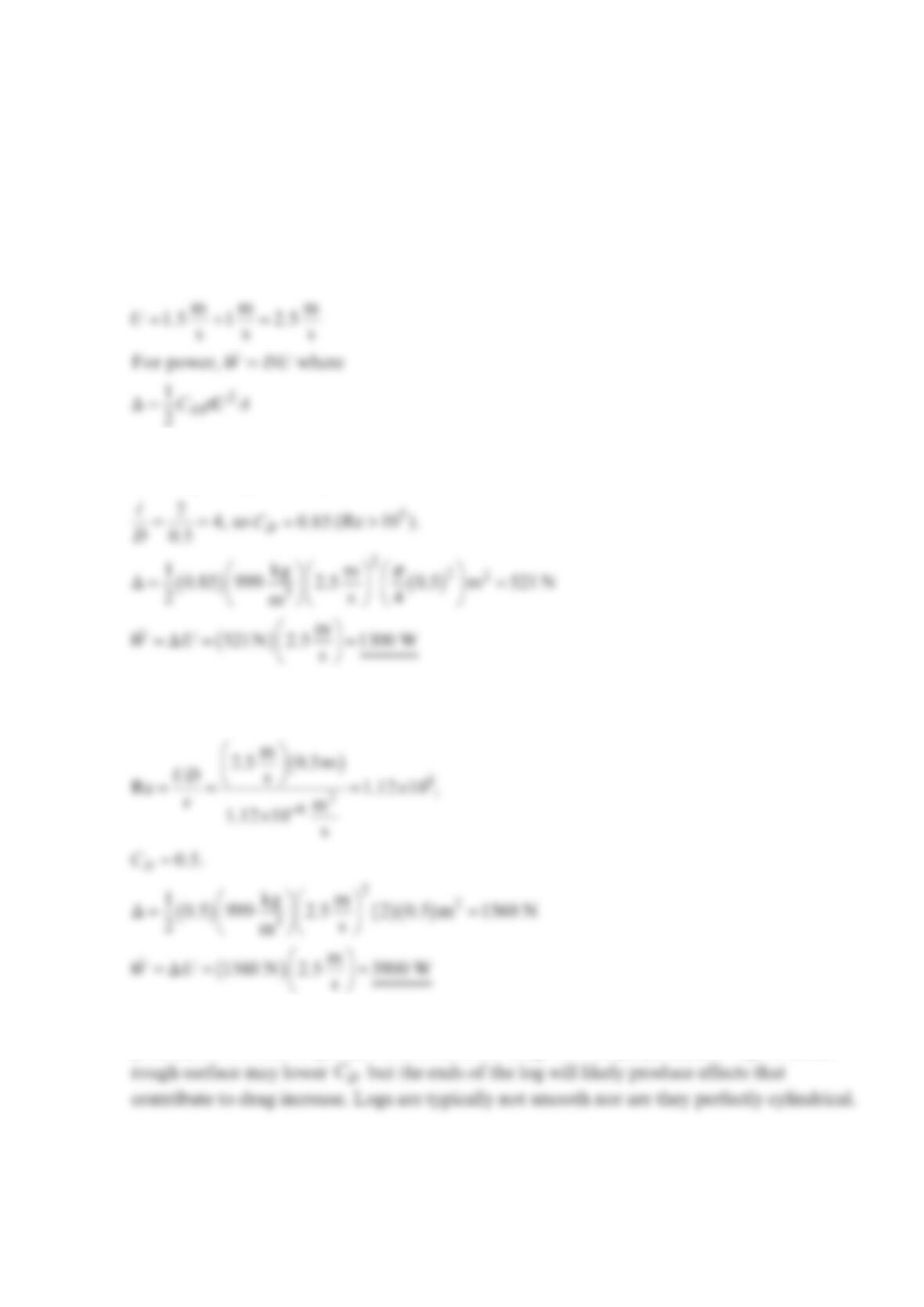
Solution 9.45
2
1
2
D
CUA
ρ
=Δ
From Fig. 9.27, and assuming a smooth sphere,
Comment
Of course, a baseball is not a smooth sphere. One may believe then that the drag coefficient
Problem 9.46
A logging boat is towing a log at
1
.5 m/s against a river current that is 1m/s . The log is
0.5 m in diameter and
2
m long. (a) Estimate the power required if the axis of the log is
parallel to the flow. (b) Estimate the power required if the axis of the log is perpendicular to
the flow. (c) Explain any reason(s) why the actual power required may be different than
your estimates.
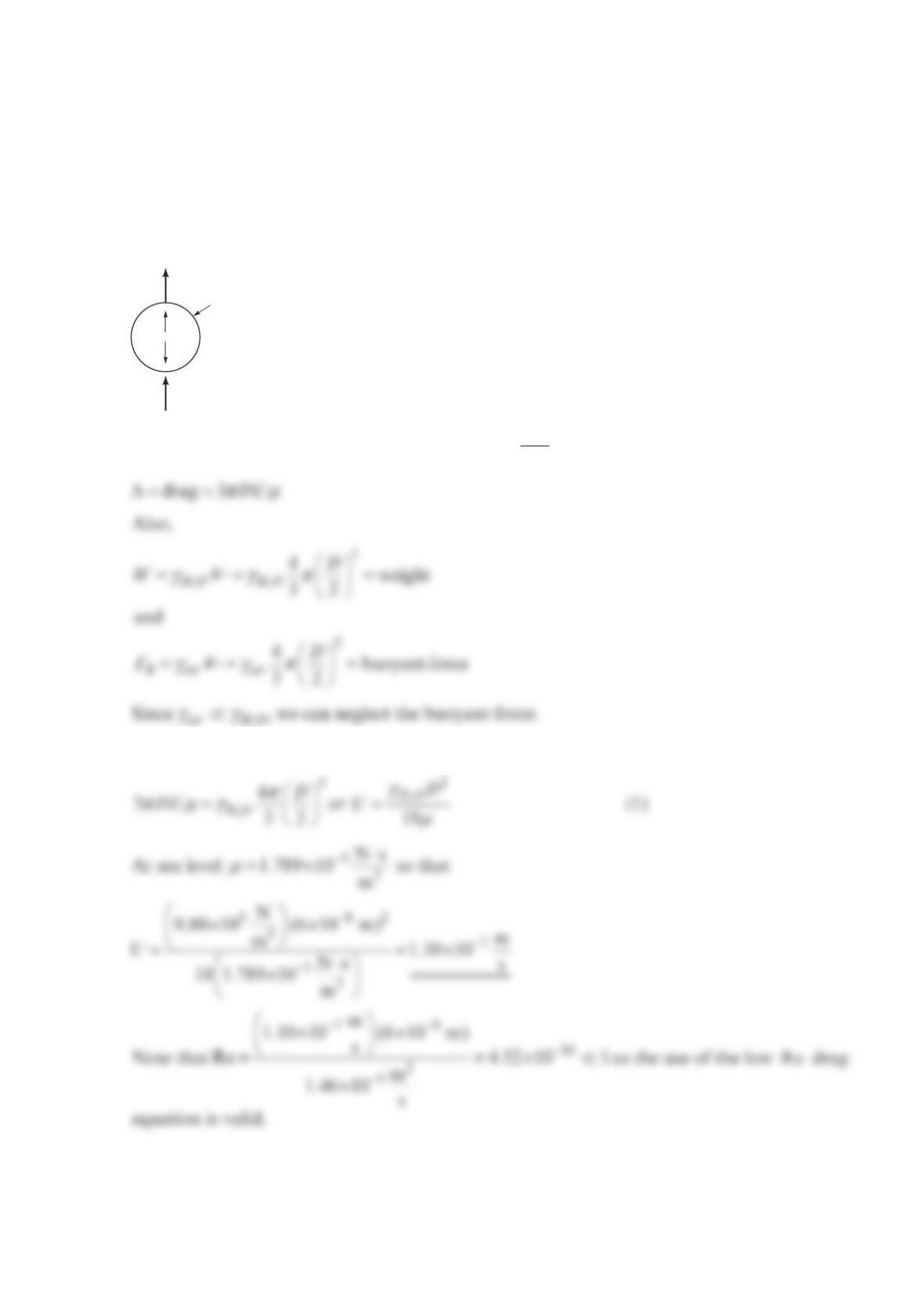
Solution 9.46
(a) Parallel to flow:
Refering to Fig. 9.31, aspect ratio with 0.5 m
D
= and 2m=
is
(b) Perpendicular to flow:
Using Fig. 9.23 with
(c) For both drag coefficients, we must assume that the log is submerged and wave
production is not an important contribution to drag. For the perpendicular log, its actual
Problem 9.47
How fast do small water droplets of 8
0.06- m (6 10 m)
µ
−
× diameter fall through the air
under standard sea-level conditions? Assume the drops do not evaporate. Repeat the
problem for standard conditions at
5
000-m altitude.
Solution 9.47
For steady conditions, B
FW
Δ
+=
, where if
ν
=<Re 1
UD
That is, W
Δ
=, or
U
dia.
=
D
= 6
×
10
–8
m
F
B
W
𝒟
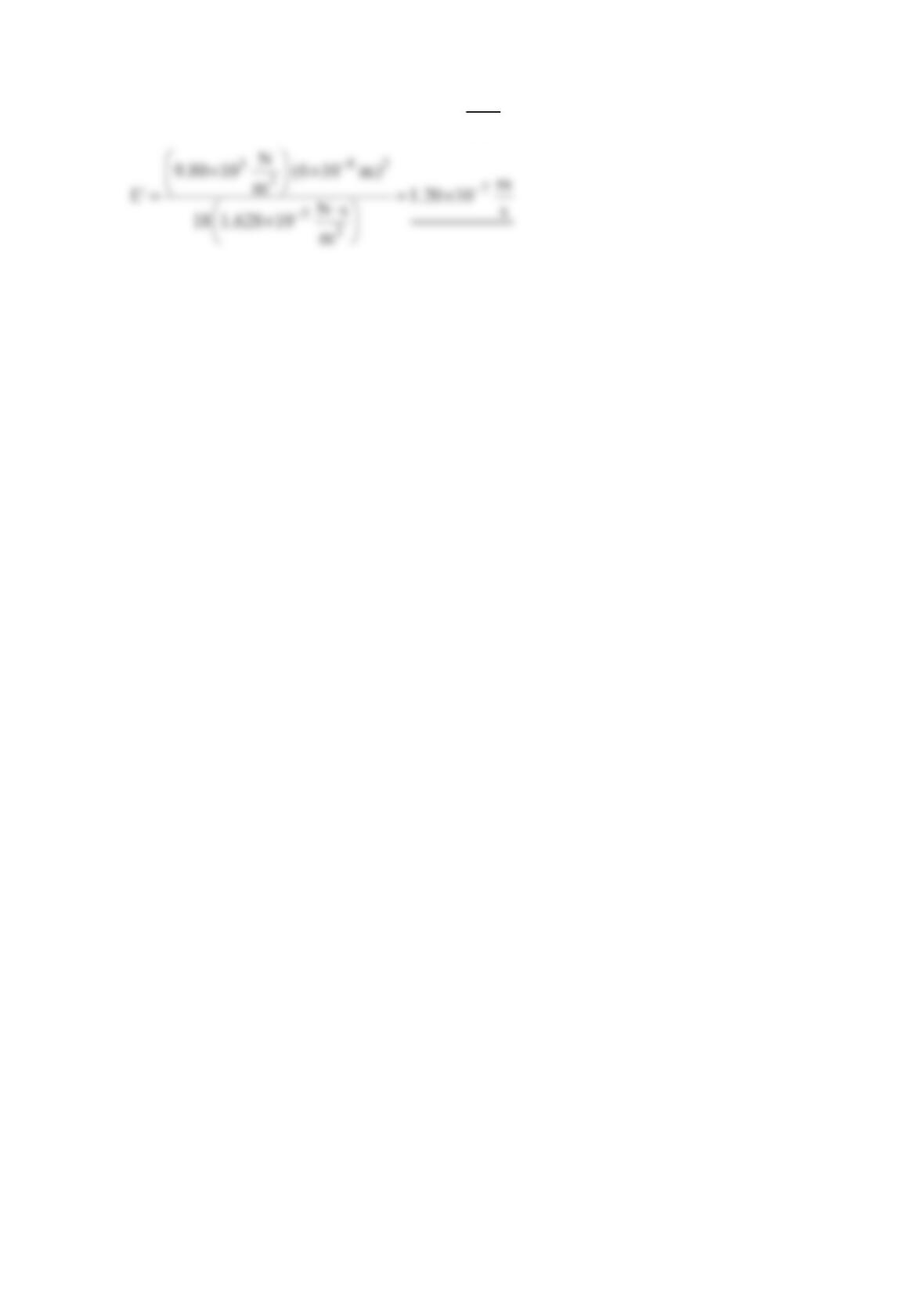
At an altitude of 5000 m ,
µ
−⋅
=×
5
2
Ns
1.628 10 m and from Eq. (1)