Chapter 9
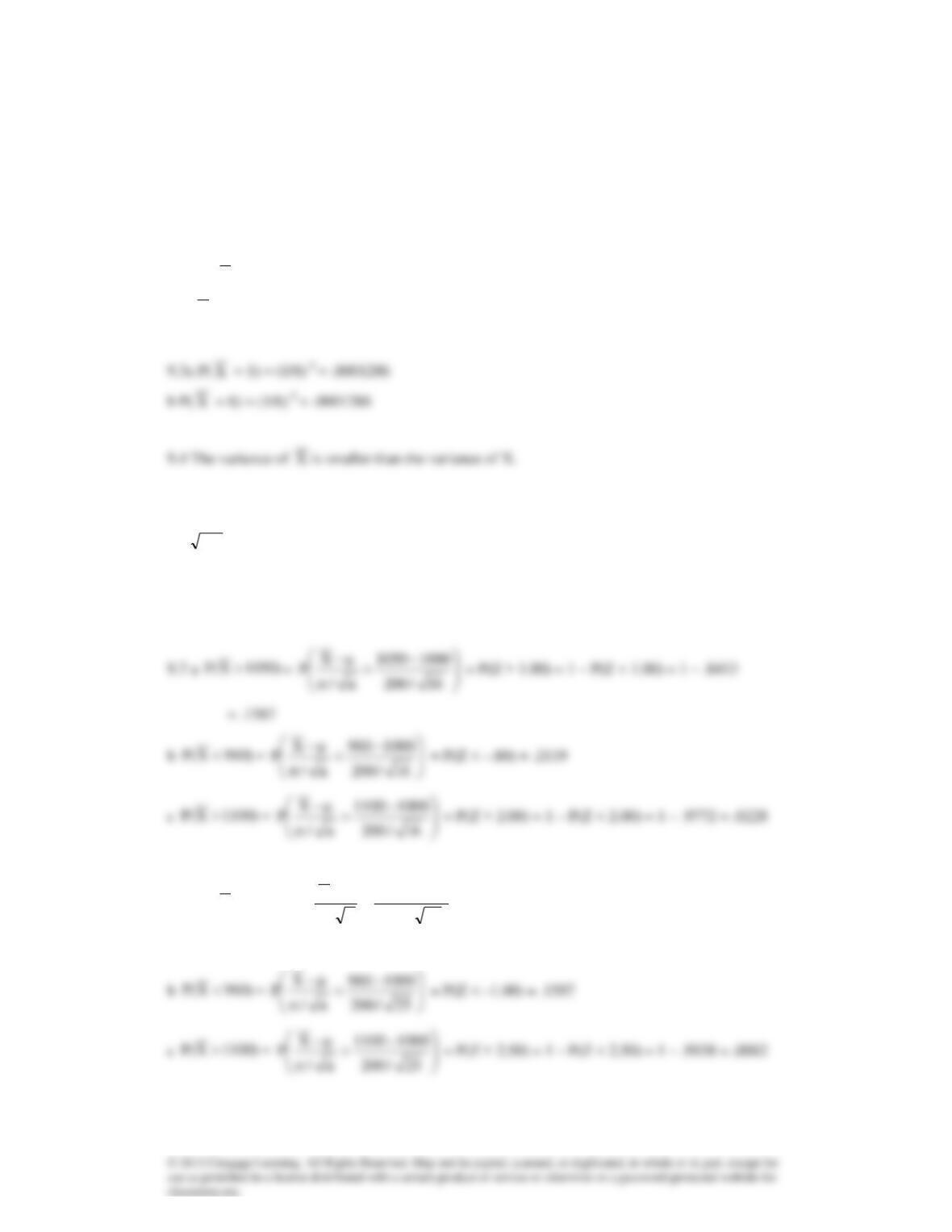
9.1a. 1/6
b. 1/6
9.2 a
)1X(P =
=P(1,1)= 1/36
b
)6X(P =
= P(6,6) = 1/36
9.5 The sampling distribution of the mean is normal with a mean of 40 and a standard deviation of
12/
100
−
−
10001050
n/
X
P
= 1.2.
9.6 No, because the sample mean is approximately normally distributed.
9.8 a
)1050X(P
=
−
−
25/200
10001050
n/
X
P
= P(Z > 1.25) = 1 – P(Z < 1.25) = 1 – .8944
= .1056
9.9 a
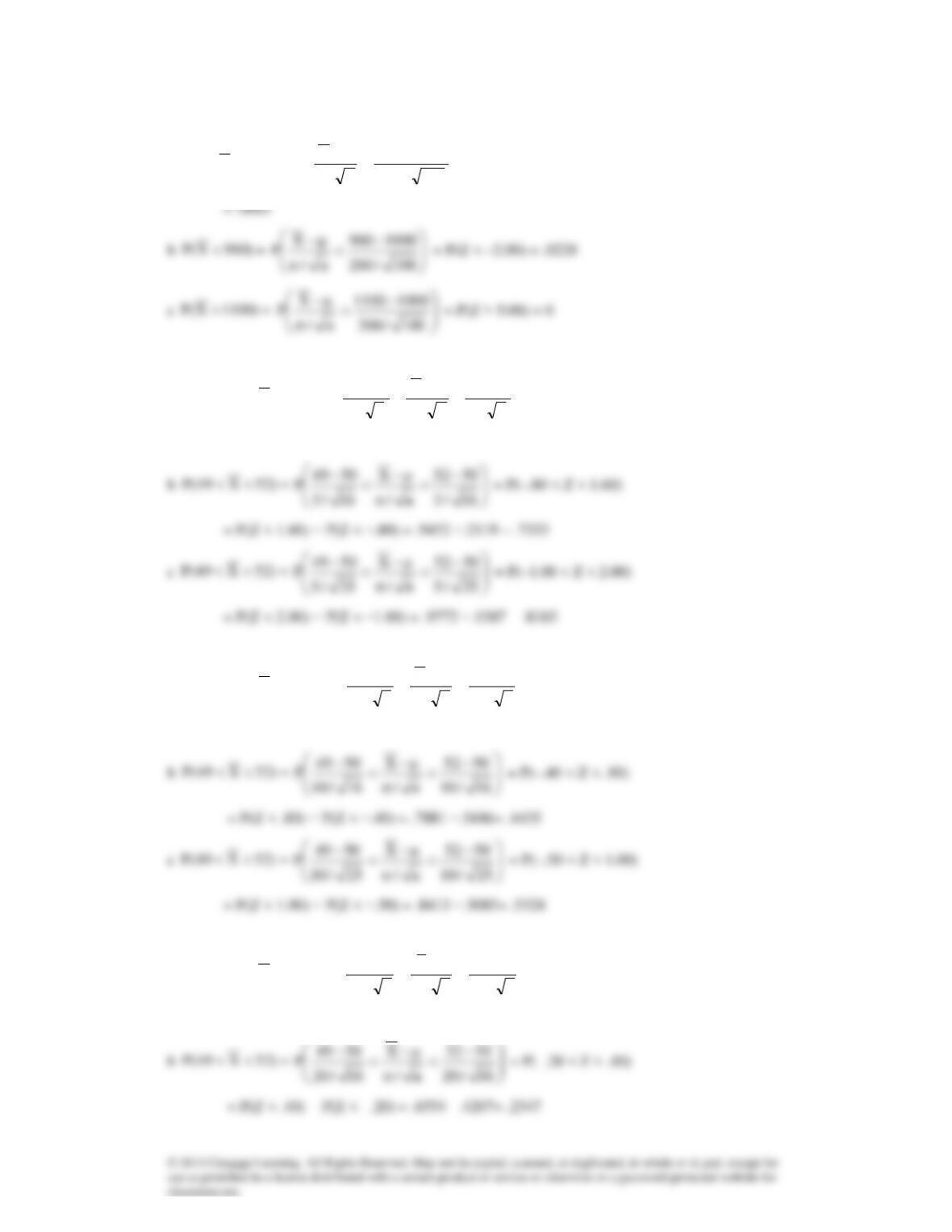
)1050X(P
=
−
−
100/200
10001050
n/
X
P
= P(Z > 2.50) = 1 – P(Z < 2.50) = 1 – .9938
9.10 a
= )52X49(P
−
−
−
4/5
5052
n/
X
4/5
5049
P
= )52X49(P
−
−
5052
n/
X
5049
P
= )52X49(P
= P(–.40 < Z < .80)
= P(Z < .80) − P(Z < −.40) = .7881 −.3446 = .4435
9.11 a
= )52X49(P
−
−
−
4/10
5052
n/
X
4/10
5049
P
= )52X49(P
= )52X49(P
= P(–.20 < Z < .40)
= P(Z < .40) − P(Z < −.20) = .6554 −.4207= .2347
9.12 a
= )52X49(P
−
−
−
4/20
5052
/4/20
5049
n
X
P
= )52X49(P
= P(–.10 < Z < .20)
= P(Z < .20) − P(Z < −.10) = .5793 −.4602= .1191
c
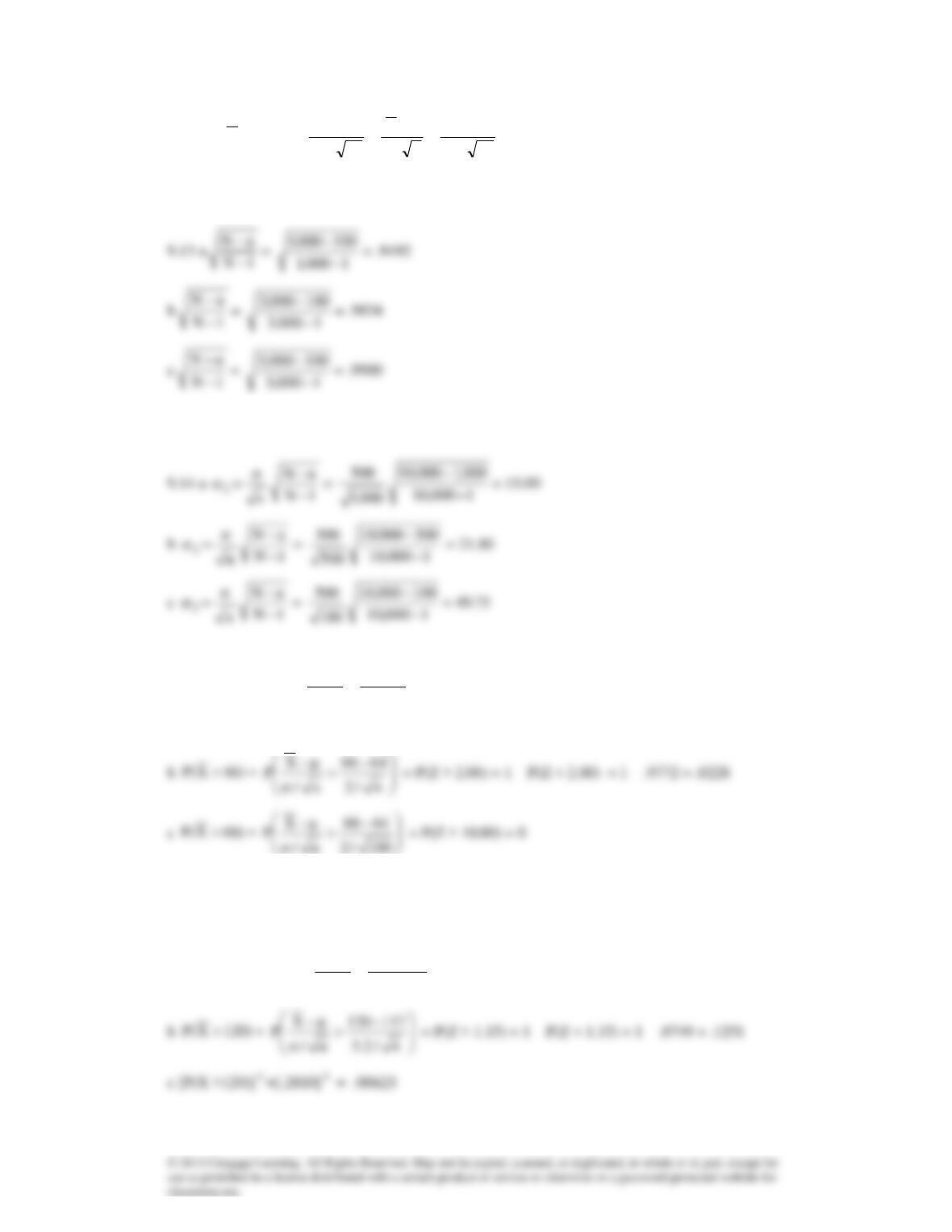
= )52X49(P
−
−
−
25/20
5052
n/
X
25/20
5049
P
= P(–.25 < Z < .50)
= P(Z < .50) − P(Z < −.25) = .6915 −.4013= .2902
d. The finite population correction factor is approximately 1.
9.15 a P(X > 66) =
−
−
2
6466X
P
= P(Z > 1.00) = 1 – P(Z < 1.00) = 1 – .8413 = .1587
9.16 We can answer part (c) and possibly part (b) depending on how nonnormal the population is.
9.17 a P(X > 120) =
−
−
2.5
117120
X
P
= P(Z > 0.58) = 1 – P(Z < .58) = 1 – .7190 = .2810
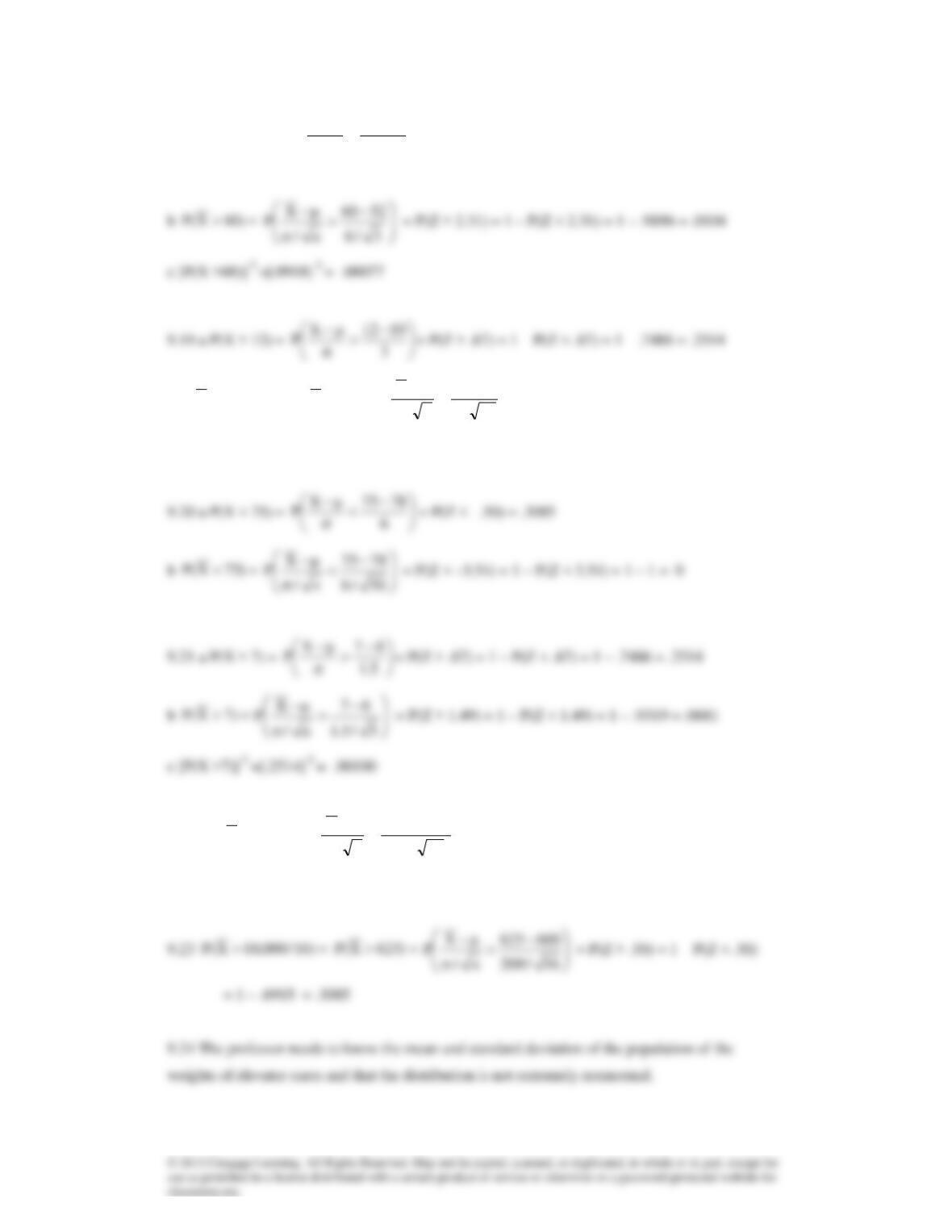
9.18 a P(X > 60) =
−
−
6
5260X
P
= P(Z > 1.33) = 1 – P(Z < 1.33) = 1 – .9082 = .0918
b
= )25/275X(P
= )11X(P
−
−
25/3
1011
n/
X
P
= P(Z > 1.67) = 1 – P(Z < 1.67)
= 1 – .9525 = 0475
9.22 a
= )97.5X(P
−
−
36/18.
05.697.5
n/
X
P
= P(Z < –2.67) =.0038
b It appears to be false.
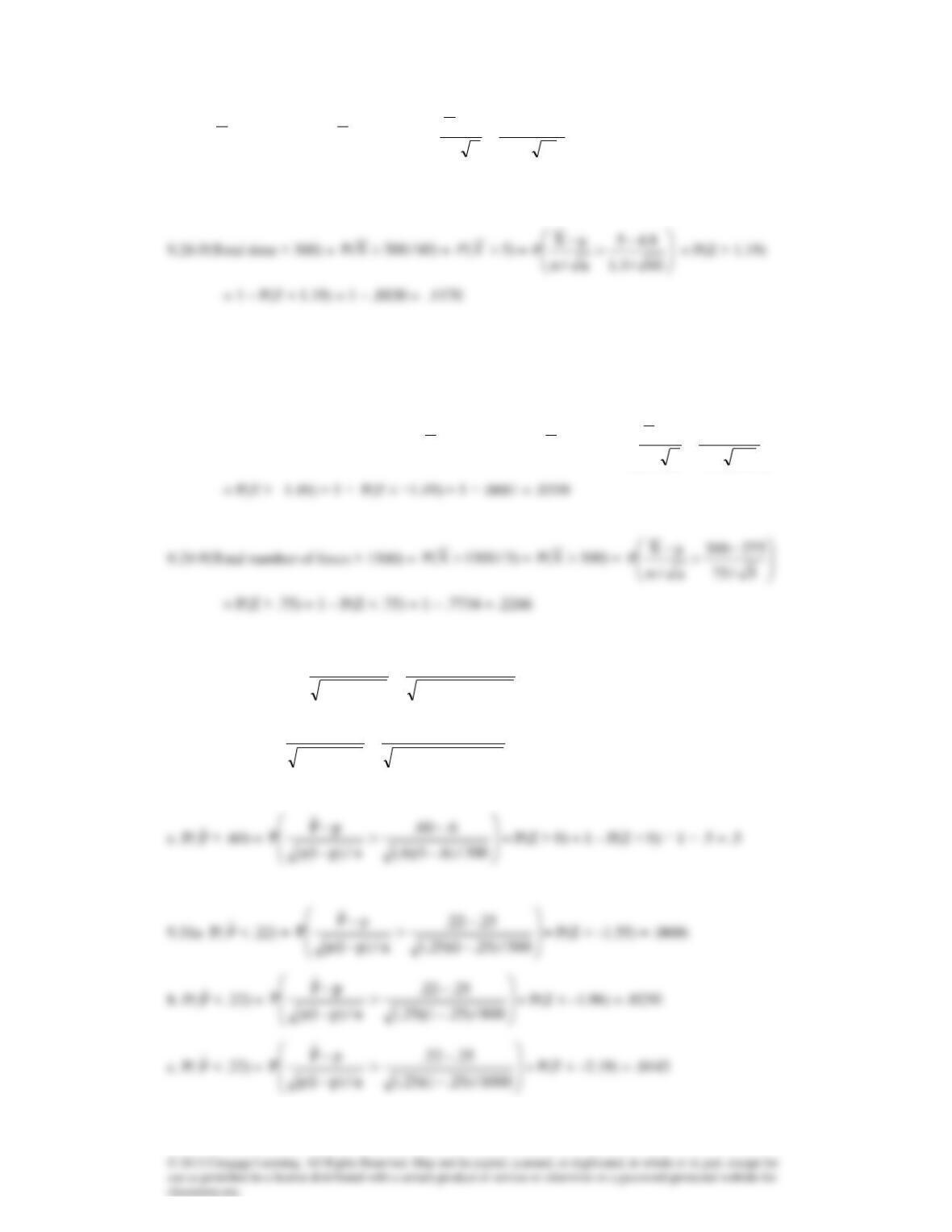
9.25
= )16/140,1X(P
= )25.71X(P
−
−
16/10
7525.71
n/
X
P
= P(Z > –1.50)
= 1 − P(Z < −1.50) = 1 − 0668 = .9332
9.27 No because the central limit theorem says that the sample mean is approximately normally
distributed.
9.28 P(Total number of cups > 240) =
= )125/240X(P
= )92.1X(P
−
−
125/6.
0.292.1
n/
X
P
9.30a P(
P
ˆ
> .60) =
−
−
−
−
300/)5.1)(5(.
5.60.
n/)p1(p
pP
ˆ
P
= P(Z > 3.46) = 0
b. P(
P
ˆ
> .60) =
−
−
−
−
300/)55.1)(55(.
55.60.
n/)p1(p
pP
ˆ
P
P
ˆ
ˆ
P
−
−
−
500/)25.1)(25(.
25.22.
n/)p1(p
pP
P
−
−
−
800/)25.1)(25(.
25.22.
n/)p1(p
pP
P
P
ˆ
= P(Z > 1.74) = 1 – P(Z < 1.74)
= 1 – .9591 = .0409
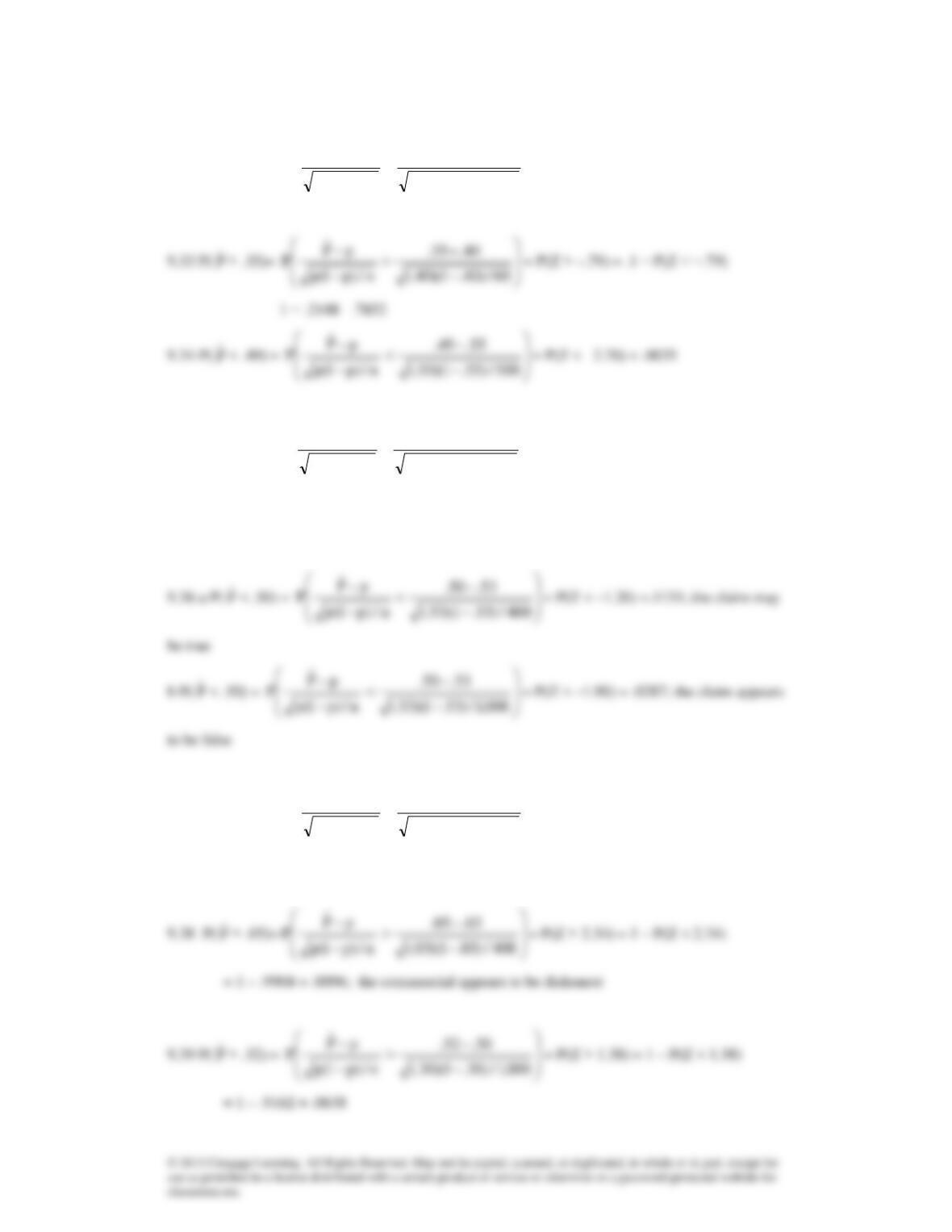
9.32 P(
P
ˆ
< .75) =
−
−
−
−
100/)80.1)(80(.
80.75.
n/)p1(p
pP
ˆ
P
P
ˆ
P
ˆ
−
−
55.49.
n/)p1(p
pP
ˆ
P
= P(Z < –1.25) = .1056
9.35 P(
P
ˆ
> .04)=
−
−
−
−
800/)02.1)(02(.
02.04.
n/)p1(p
pP
ˆ
P
−
−
53.50.
n/)p1(p
pP
ˆ
P
= P(Z > 4.04) = 1 – P(Z < 4.04) = 1 –
1= 0;
The defective rate appears to be larger than 2%.
9.37 P(
P
ˆ
> .10) =
−
−
−
−
100/)14.1)(14(.
14.10.
n/)p1(p
pP
ˆ
P
= P(Z > –1.15) = 1 – P(Z < – 1.15)
= 1 – .1251 = .8749
P
ˆ
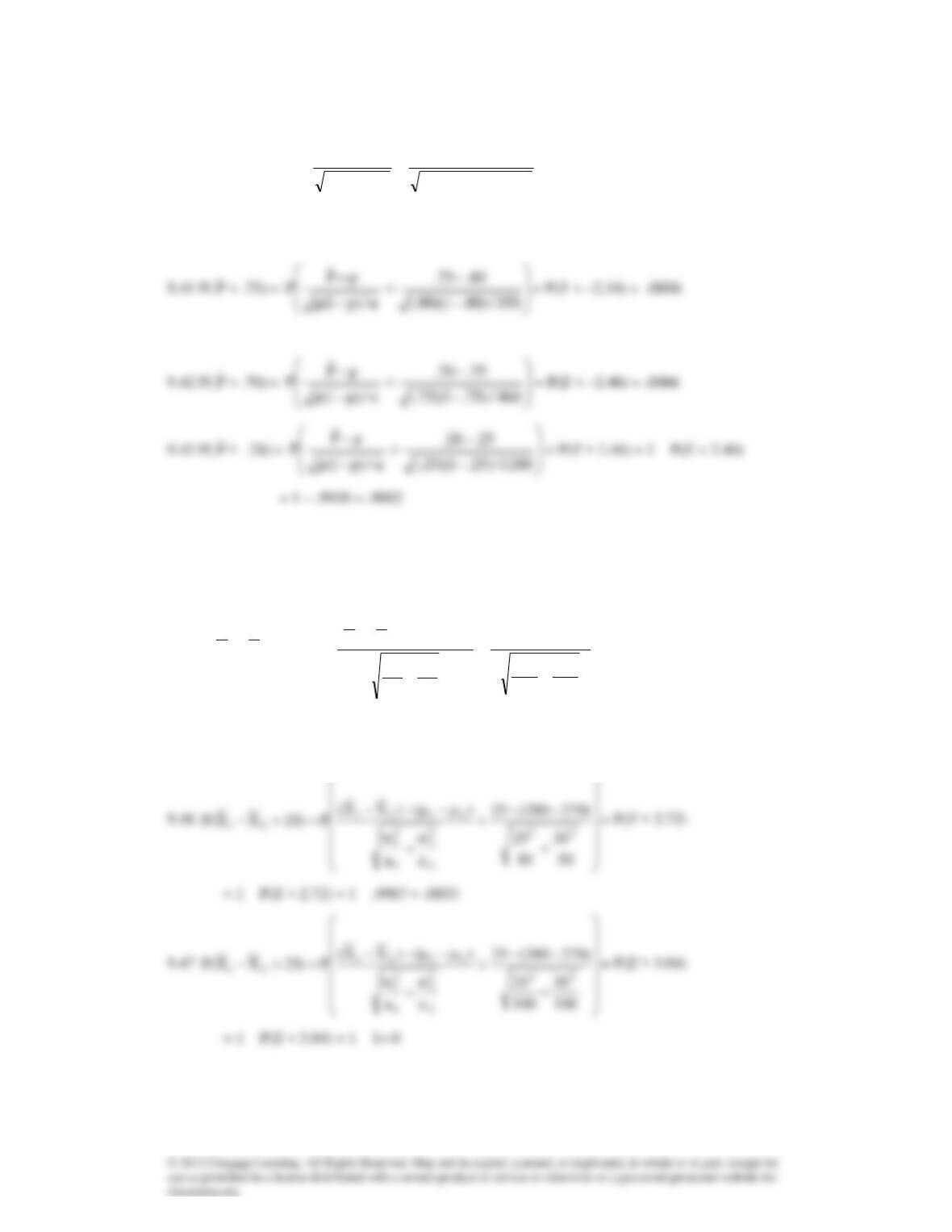
9.40 a P(
P
ˆ
< .45) =
−
−
−
−
600/)50.1)(50(.
50.45.
n/)p1(p
pP
ˆ
P
= P(Z < –2.45) = .0071
b The claim appears to be false.
9.44 The claim appears to be false.
9.45
+
−−
+
−−−
=−
10
30
10
25
)270280(25
nn
)()XX(
P)25XX(P 22
2
2
2
1
2
1
2121
21
= P(Z > 1.21)
= 1 – P(Z < 1.21) = 1 – .8869 = .1131
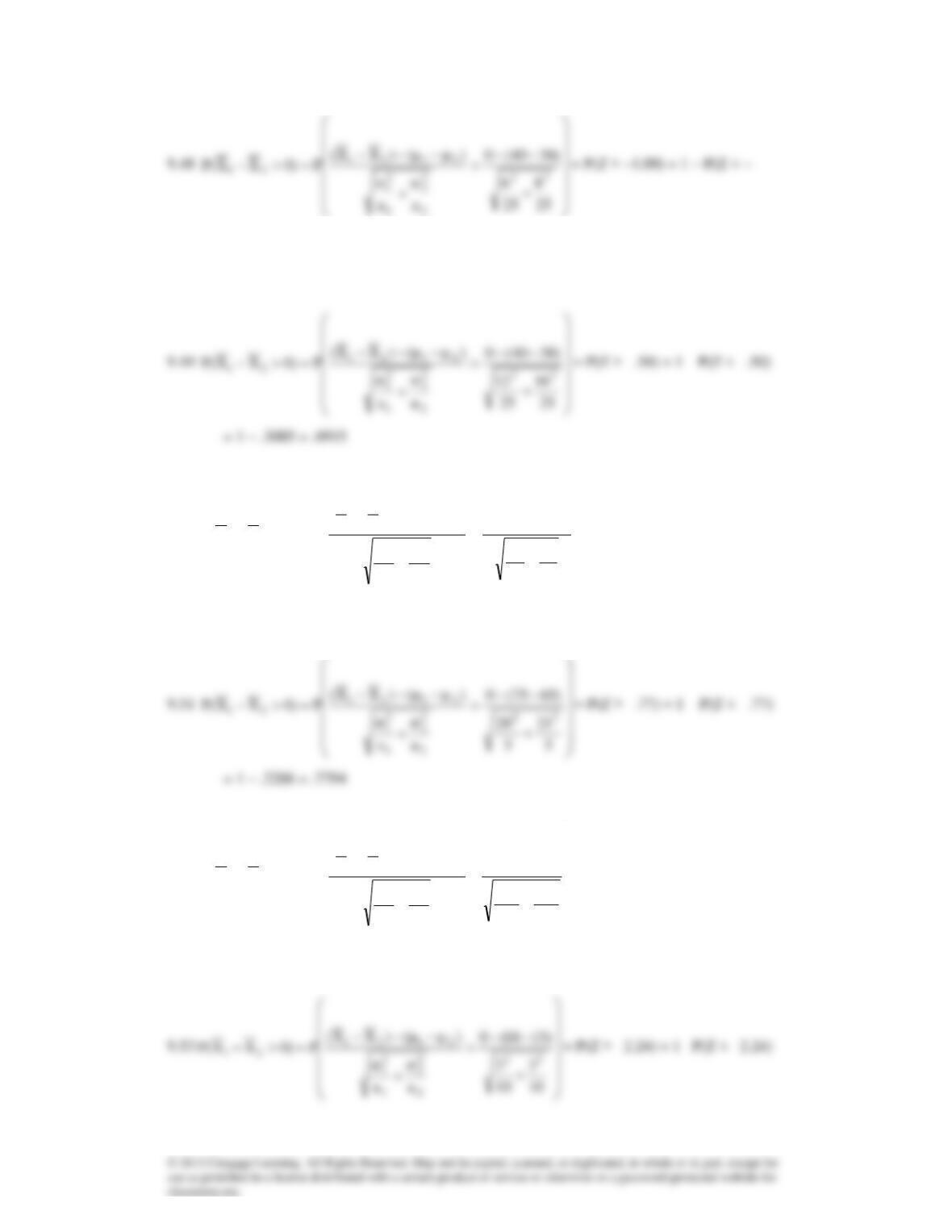
+
−−
+
−−−
=−
16
12
)3840(0
nn
)()XX(
P)0XX(P 22
2
2
2
1
2
1
2121
21
1.00)
= 1 – .1587 = .8413
9.50
+
−−
+
−−−
=−
25
8
25
6
)138140(0
nn
)()XX(
P)0XX(P 22
2
2
2
1
2
1
2121
21
= P(Z > –1.00)
= 1 – P(Z < –1.00) = 1 – .1587 = .8413
9.52
+
−−
+
−−−
=−
4
10
4
12
)7773(0
nn
)()XX(
P)0XX(P 22
2
2
2
1
2
1
2121
21
= P(Z > .51) = 1 – P(Z < .51)
= 1 – .6950 = .3050
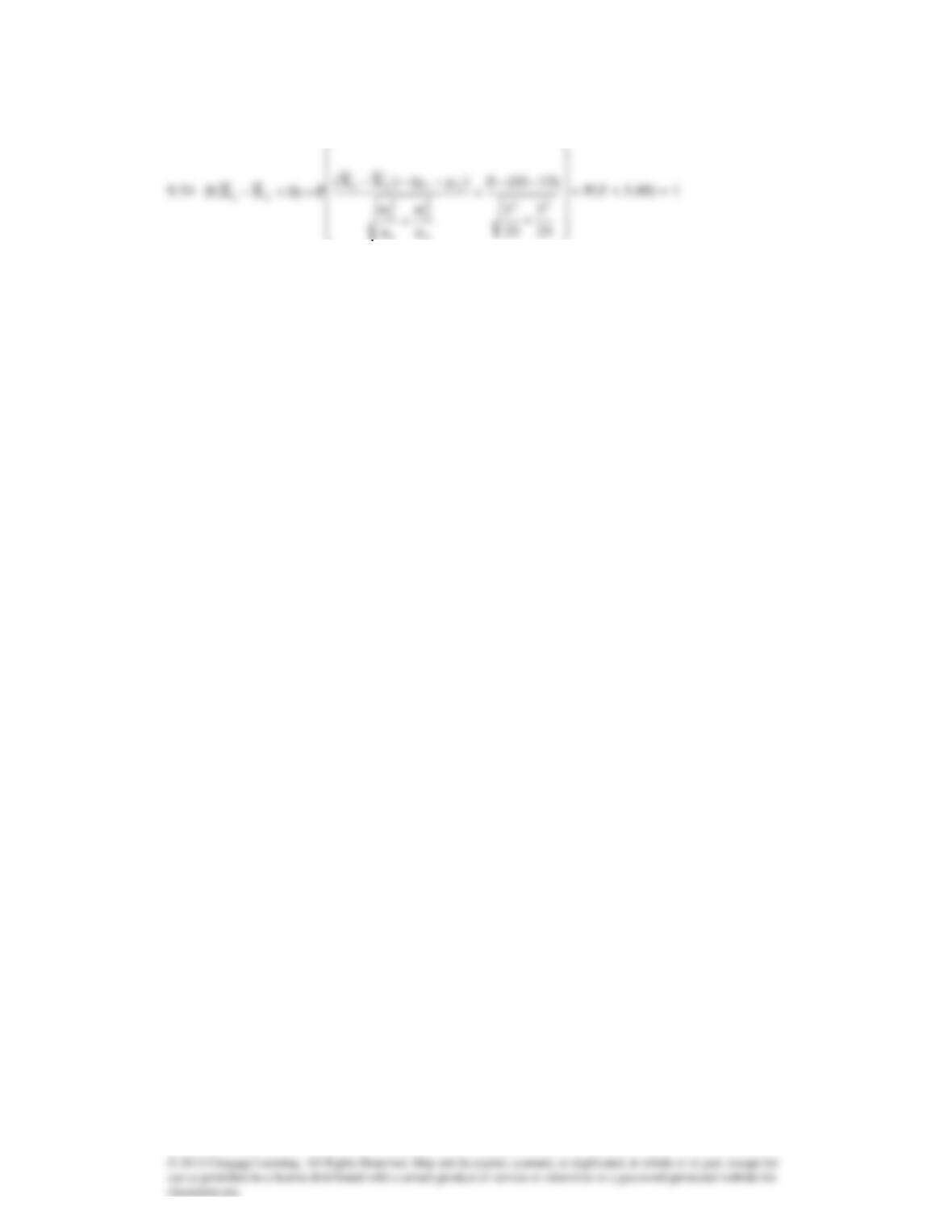
= 1 – .0125 = .9875
2
1