Problem 9.83
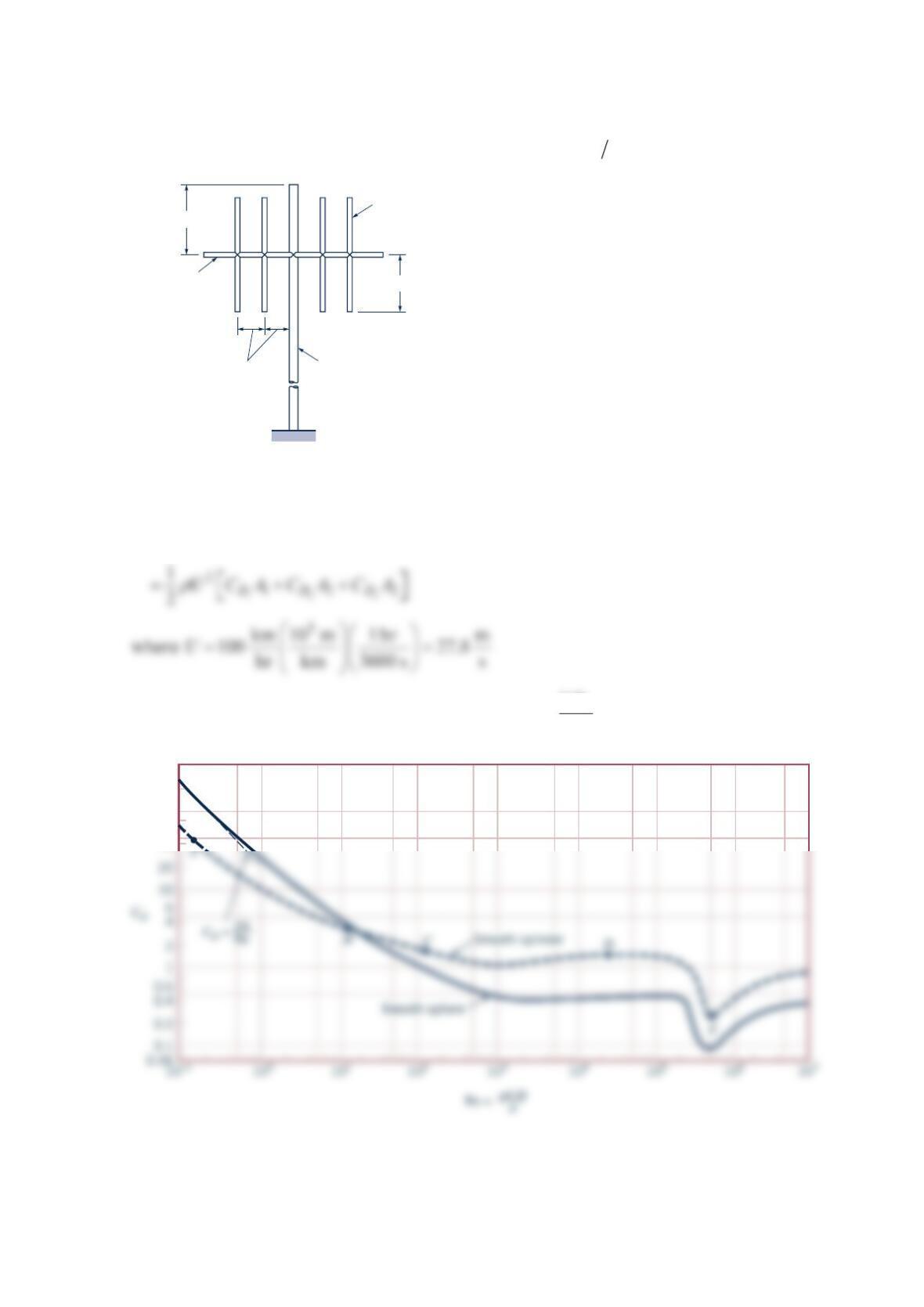
A shortwave radio antenna is constructed from circular tubing, as illustrated in the figure
below. Estimate the wind force on the antenna in a 100- km hr wind.
Solution 9.83
12 3
4
=++
DD D D
Obtain i
D
C from the figure below for the given
ν
=Re i
i
UD .
10-mm diameter
1 m long
(2)
(1)
(3)
40-mm diameter
5 m long
0.25 m
0.6 m
0.5 m
20-mm diameter
1.5 m long
400
200
100
60
40
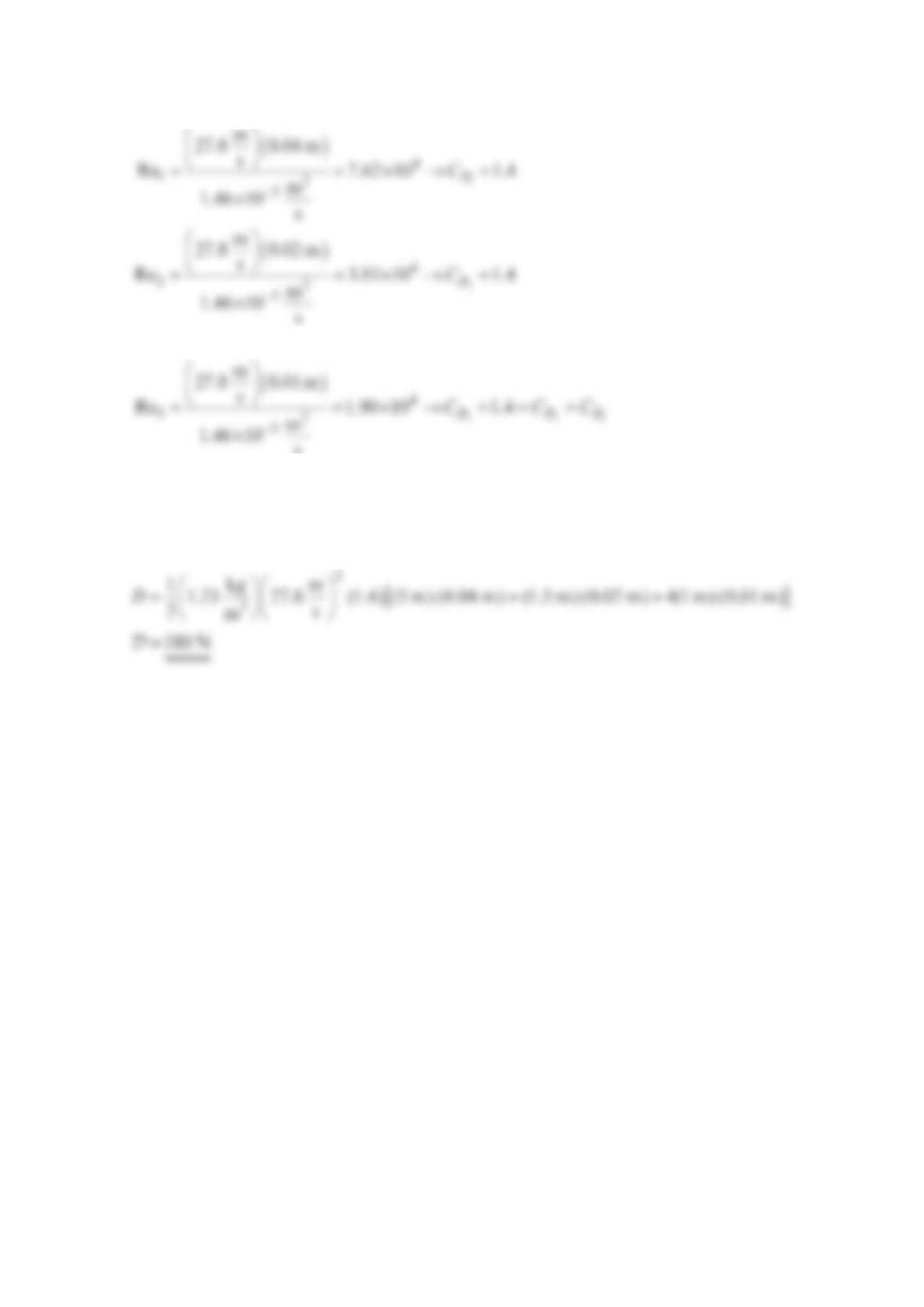
Thus,
and
so that
or
Problem 9.84
Estimate the wind force on your hand when you hold it out of your car window while
driving55 mph . Repeat your calculations if you were to hold your hand out of the window
of an airplane flying 550 mph .
Solution 9.84
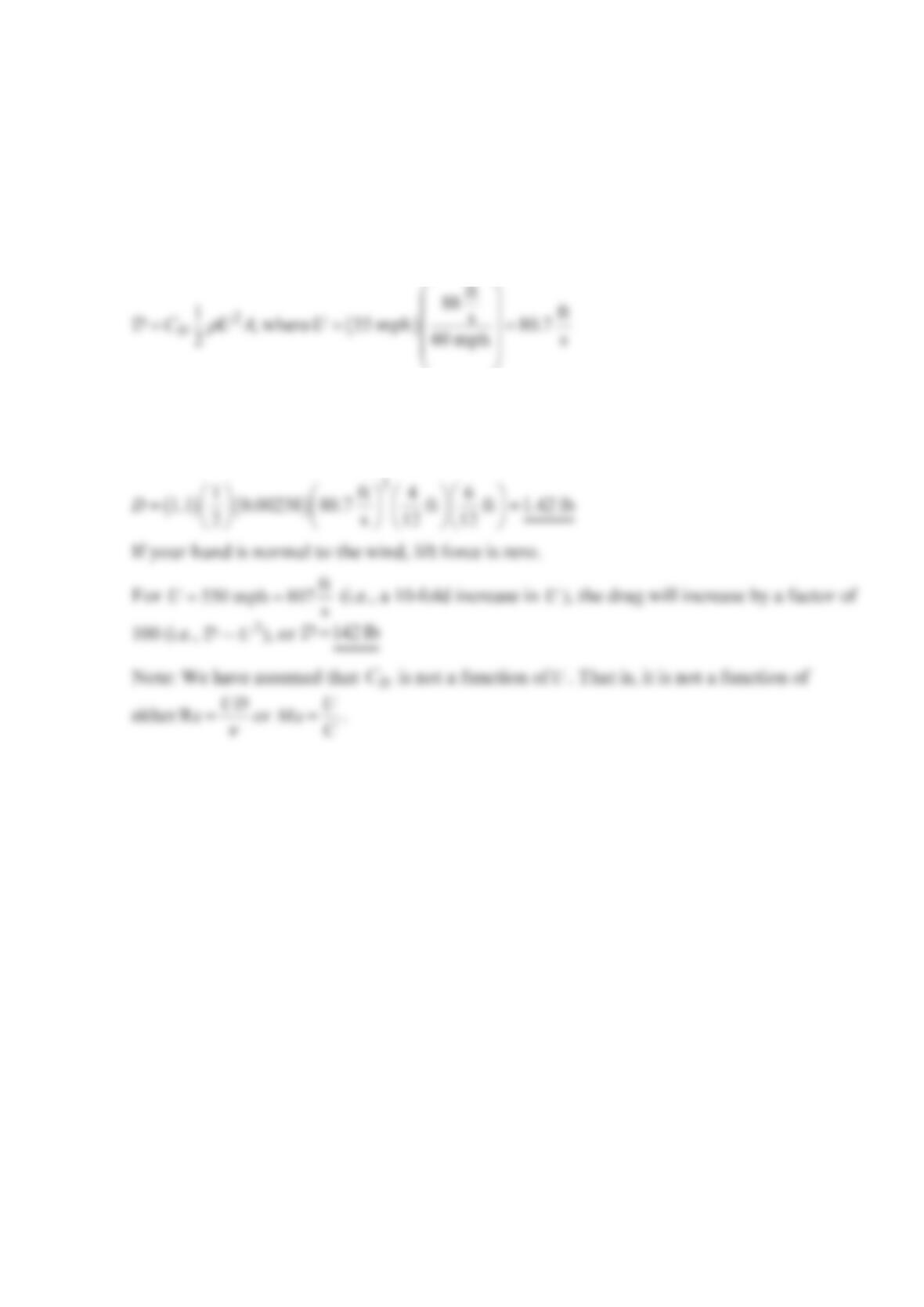
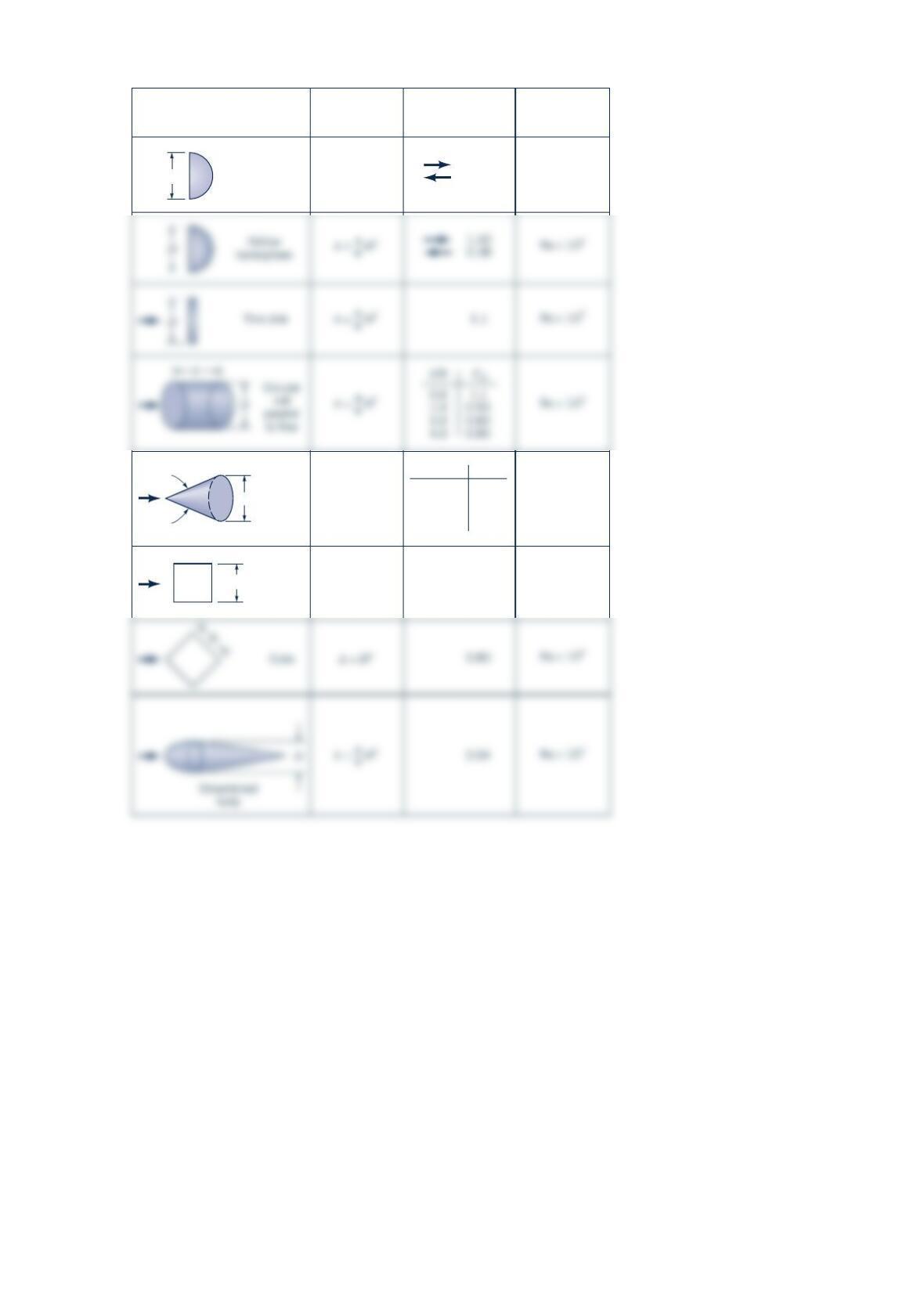
Assume your hand is 4 in. by 6 in. in size and acts like a thin disc with ≈1.1
D
C (see the
figure below).
Thus,
D
Solid
hemisphere
D
Cone
Cube
D
Shape Reference area
A
A
=
D
2
__
4
π
A
=
D
2
__
4
π
A
=
D
2
Drag coefficient
C
D
1.17
0.42
C
D
10
30
60
90
0.30
0.55
0.80
1.15
1.05
Re > 10
4
Re > 10
4
Re > 10
4
Reynolds number
Re =
UD
/
ρμ
θ
(°)
θ
Problem 9.86
A 2-mm-diameter meteor of specific gravity 2.9 has a speed of 6 km s at an altitude of
50,000 m where the air density is 33
1
.03 10 kg m
−
×. If the drag coefficient at this large
Mach number condition is 1.5, determine the deceleration of the meteor.
Solution 9.86
ma=D where
Problem 9.87
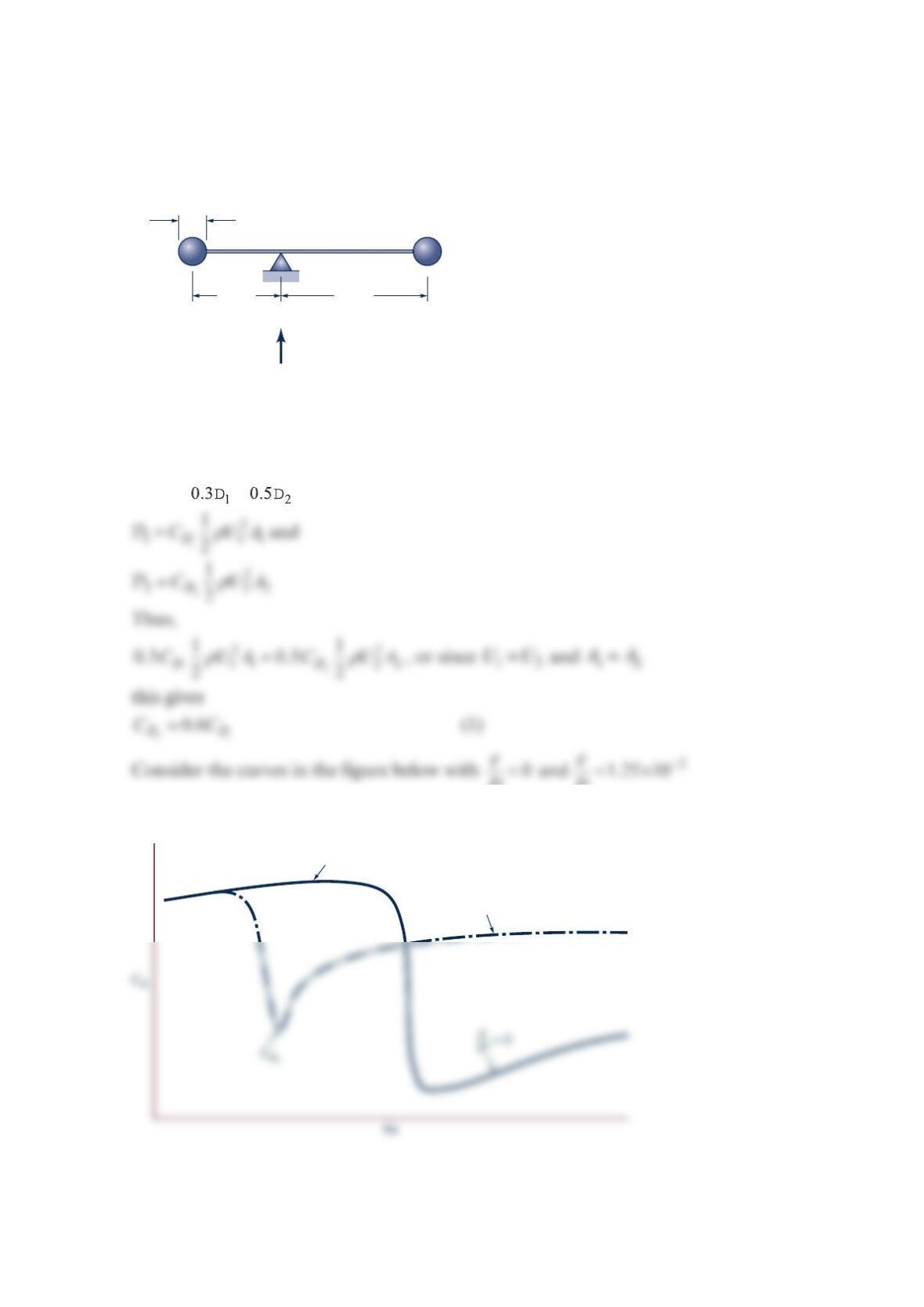
Air flows past two equal sized spheres (one rough, one smooth) that are attached to the arm
of a balance as indicated in the figure below. With 0
U
=, the beam is balanced. What is the
minimum air velocity for which the balance arm will rotate clockwise?
Solution 9.87
For clockwise rotation to start, <
00M
That is ≥, where
DD
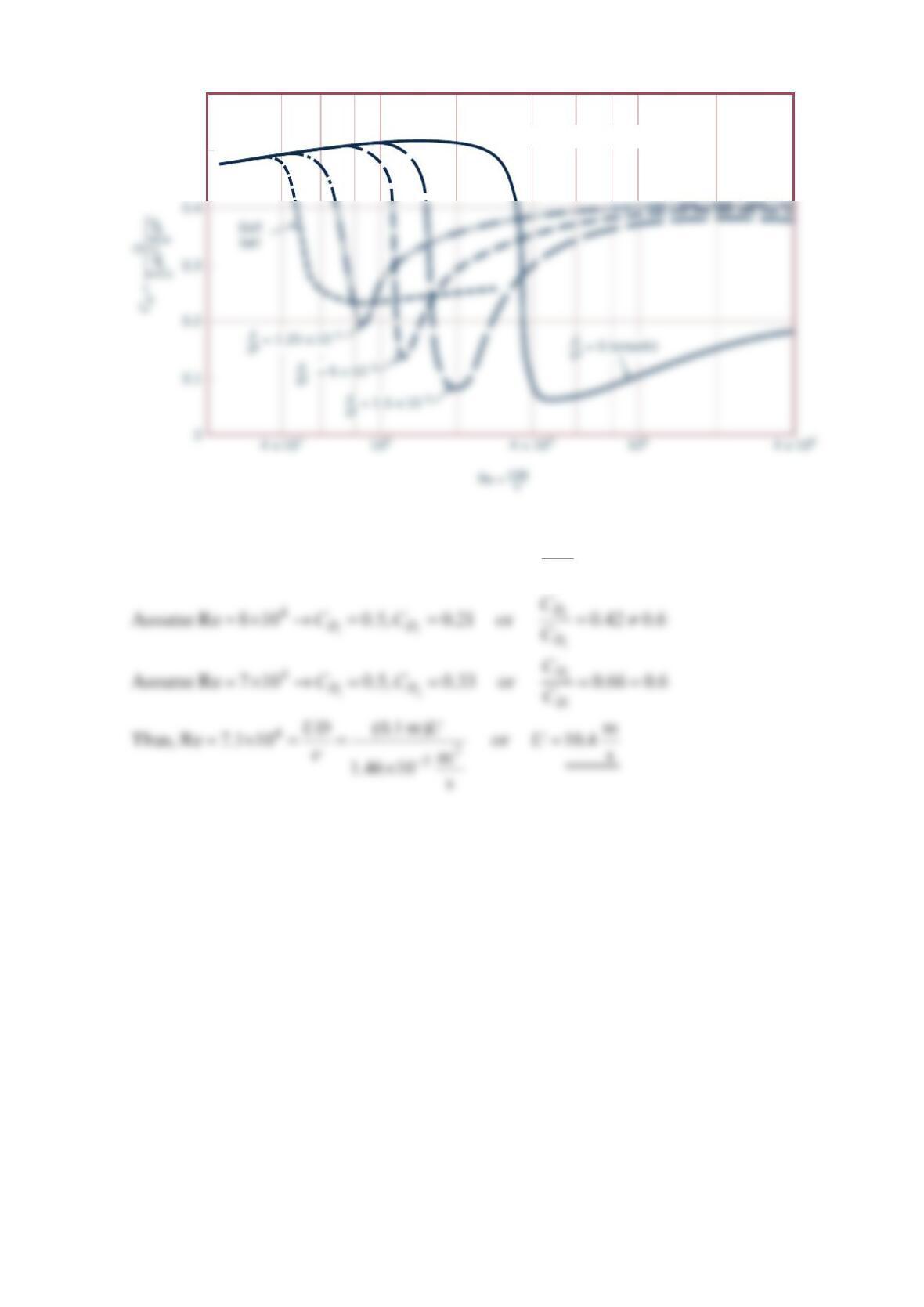
Trial and error solution to find Re so that Eq. (1) is satisfied.
D
= 0.1 m Rough sphere
/
D
= 1.25 × 10
–2
Smooth
sphere
0.5 m0.3 m
(1) (2)
U
ε
C
D1
ε
__
D
= 1.25 × 10⁻²
2
12
1
4
A
ssume Re 6 10 0.5, 0.46 or 0.92 0.6
D
DD
D
C
CC C
=× → = = = ≠
0.6
0.5
ε
__
D
= relative roughness
A
A
T
Problem 9.88
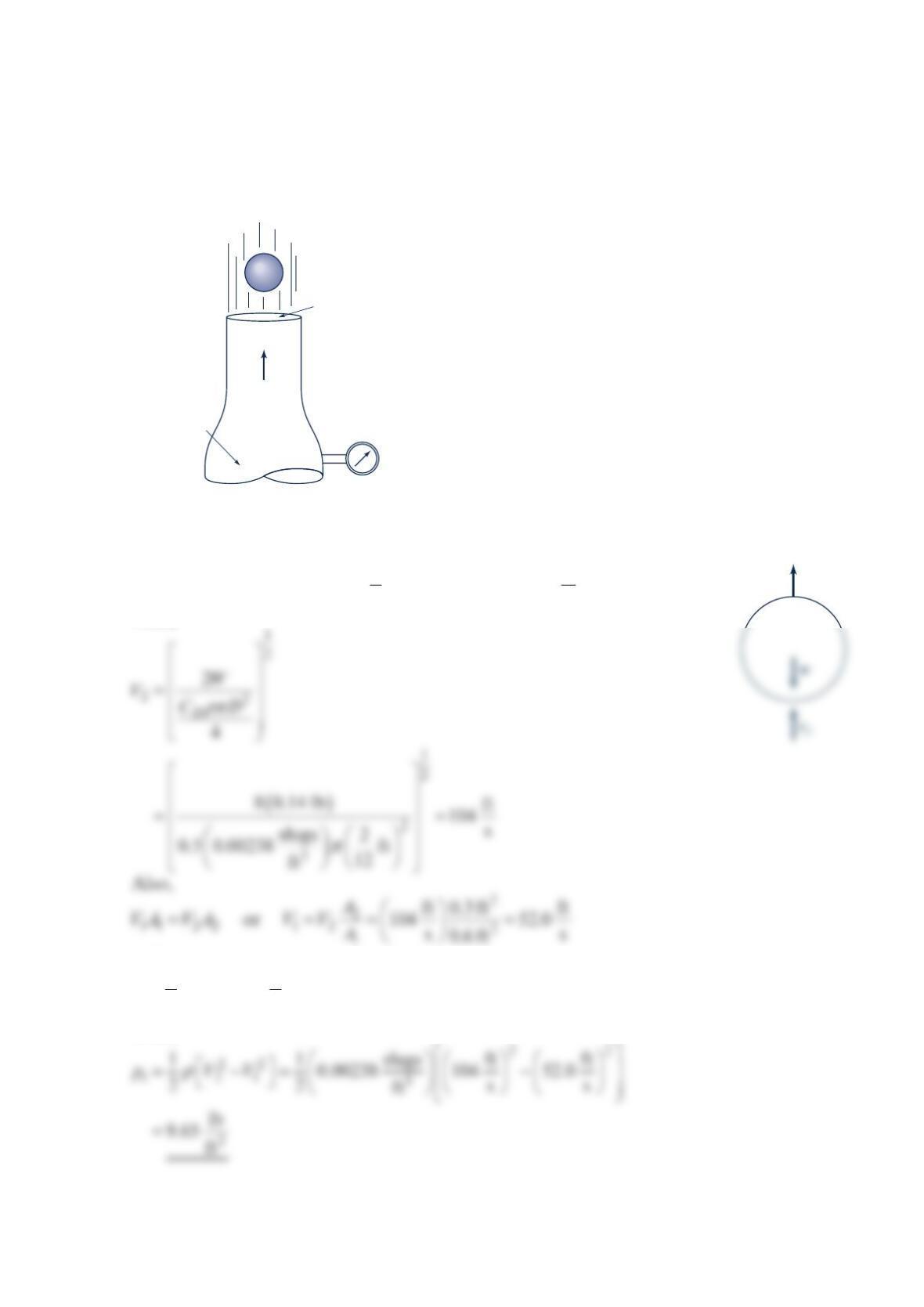
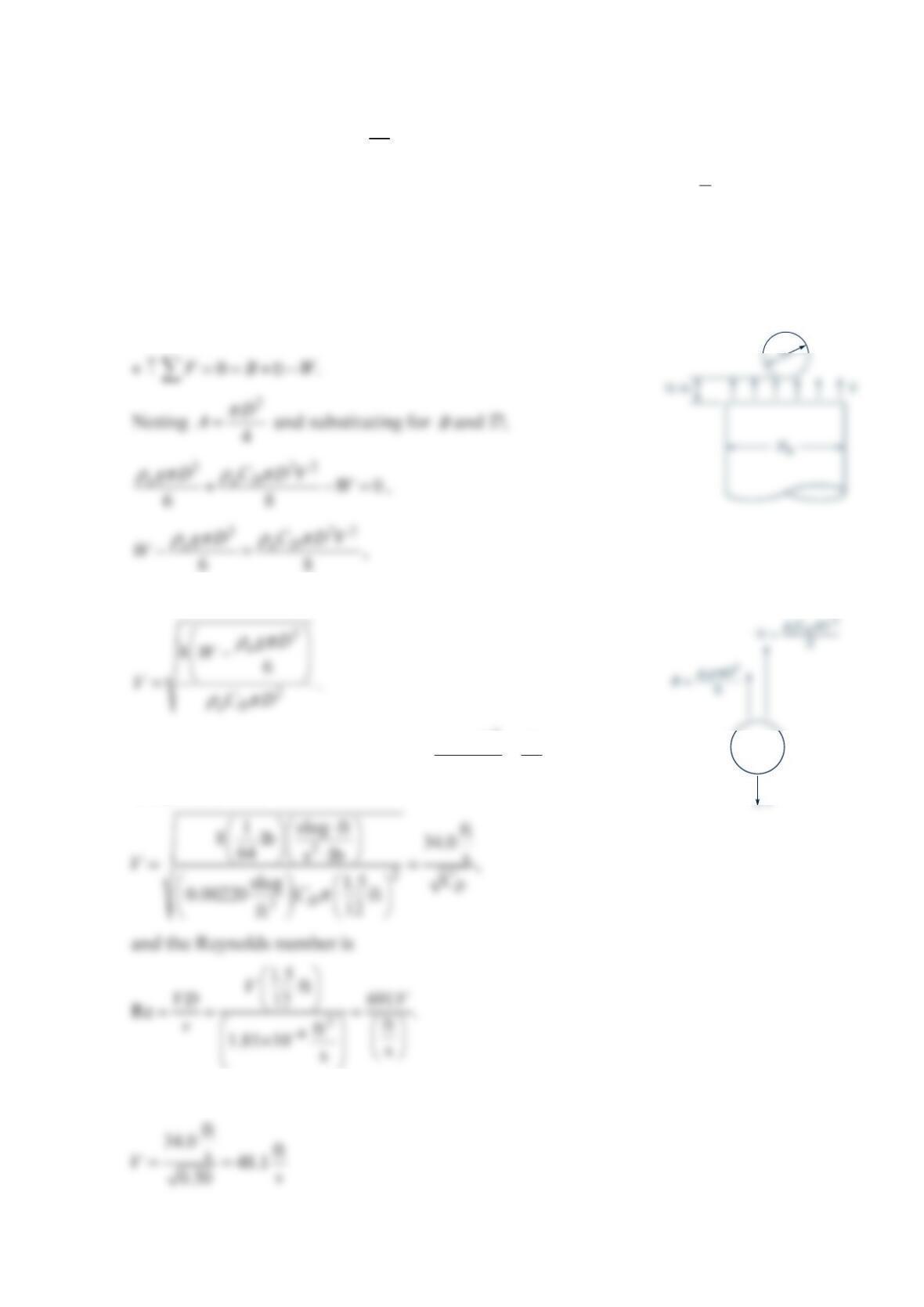
A 2-in.-diameter sphere weighing 0.14 lb is suspended by the jet of air as shown in the
figure below. The drag coefficient for the sphere is 0.5. Determine the reading on the
pressure gage if friction and gravity effects can be neglected for the flow between the
pressure gage and the nozzle exit.
Solution 9.88
For equilibrium, W=Dor 2
1
2
D
C
UA W
ρ
=, where 2
4
A
D
π
=
Thus,
and
22
112 2 2
11
where 0
22
p
Vp V p
ρρ
+=+ =
Thus,
Air
Area = 0.6 ft2
Area = 0.3 ft2
Pressure
gage
𝒟
Problem 9.89
A smooth orange ball weighs 1 lb
64 (at sea level) and has a diameter of 1.5 in. The
discharge of a vacuum cleaner is directed upward and supports the ball 1 in.
2 above the
hose outlet similar to that shown in Video V3.2. If the hose inside diameter is 4.0 in.,
estimate the volume flowrate through the vacuum cleaner. The air temperature is 100 °F .
Solution 9.89
Apply Newton’s second law in the vertical direction to the ball.
or
Since the ball was weighed in air,
ρπ
−=
31lb
664
agD
W so
using Table B.3,
We must now solve for V by trial and error. First, guess =0.50
D
C so
W
and
691 ft
Re 48.1 33200
ft s
s
==
.
Assuming the ball has a smooth surface, Fig. 9.23 gives 0.40
D
C
≈ so
Figure 9.23 gives 0.40
D
C
≈ so ft
53.8 s
V
=. The vacuum cleaner volume flowrate is
3
ft
281 min
Q=.
Comments
Note that
Problem 9.90
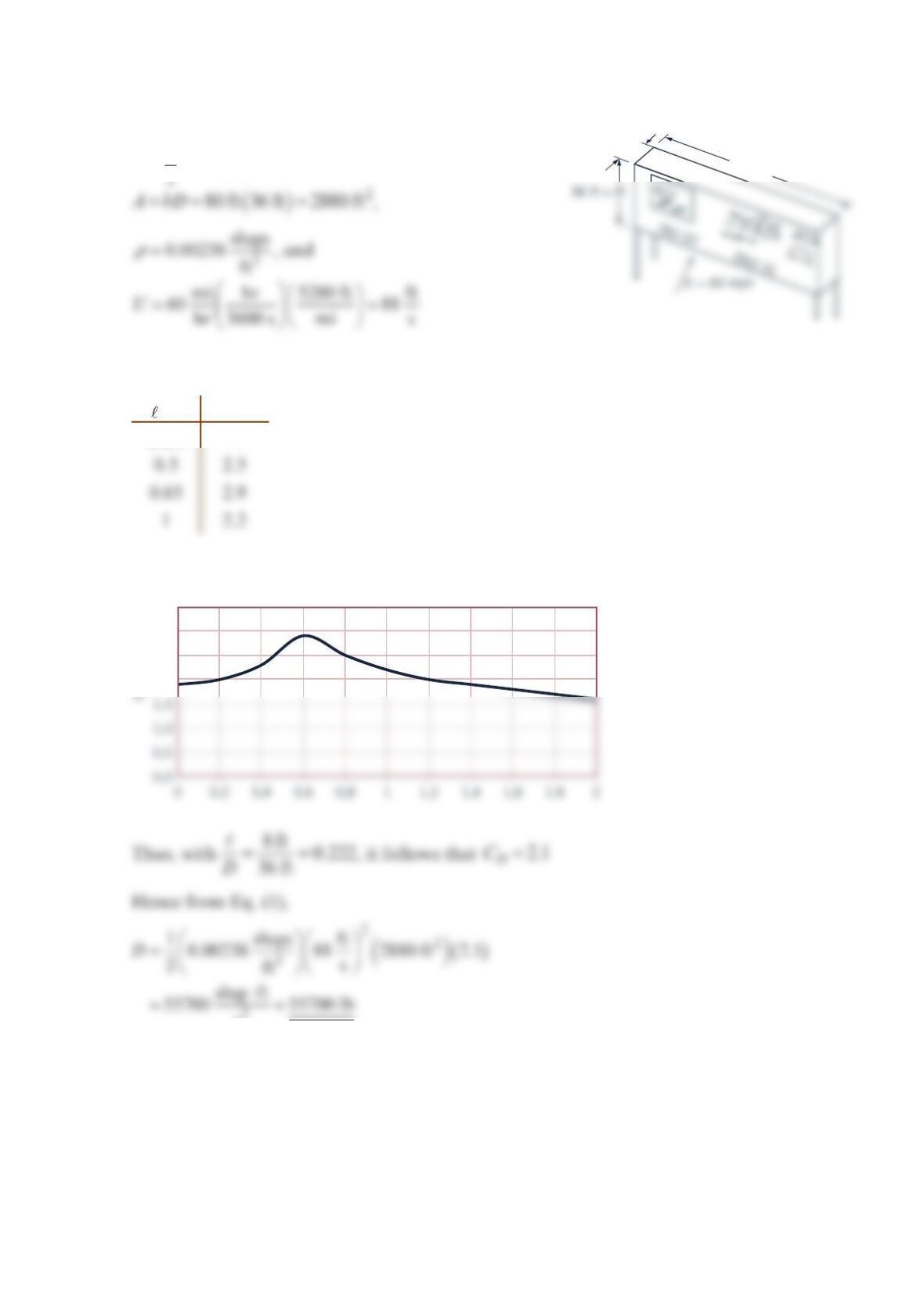
A 60 mph– wind blows against a football stadium scoreboard that is 36 ft tall, 80 ft wide,
and 8 ft thick (parallel to the wind). Estimate the wind force on the scoreboard. See the
figure below for drag coefficient data.
D
R
Square rod
with rounded
corners
Semicircular
cylinder
D
D
T-beam
I-beam
D
Shape
Reference area
A
(
b
= length)
A
=
bD
A
=
bD
A
=
bD
A
=
bD
Drag coefficient
C
D
=
𝒟
________
U2A
1
__
2
ρ
R
/
DC
D
0
0.02
0.17
0.33
2.2
2.0
1.2
1.0
2.15
1.15
1.80
1.65
2.05
Reynolds number
Re =
UD
/
ρ
Re = 10
5
Re > 10
4
Re > 10
4
Re > 10
4
μ
Solution 9.90
2
1
UAC
ρ
=D
The following D
C information is obtained from the figure in the problem:
/D D
C
0.1
≤
1.9
or
s
2,0
2,5
3,0
3,5
b
= 80 ft
8 ft =
ℓ
Problem 9.91
A marine location marker is a smoke-producing device usually dropped from an airplane
and used to mark a reference point in the ocean. One is being tested in a wind tunnel to
determine the drag force when it is carried by an airplane at a velocity of 200 mph. The
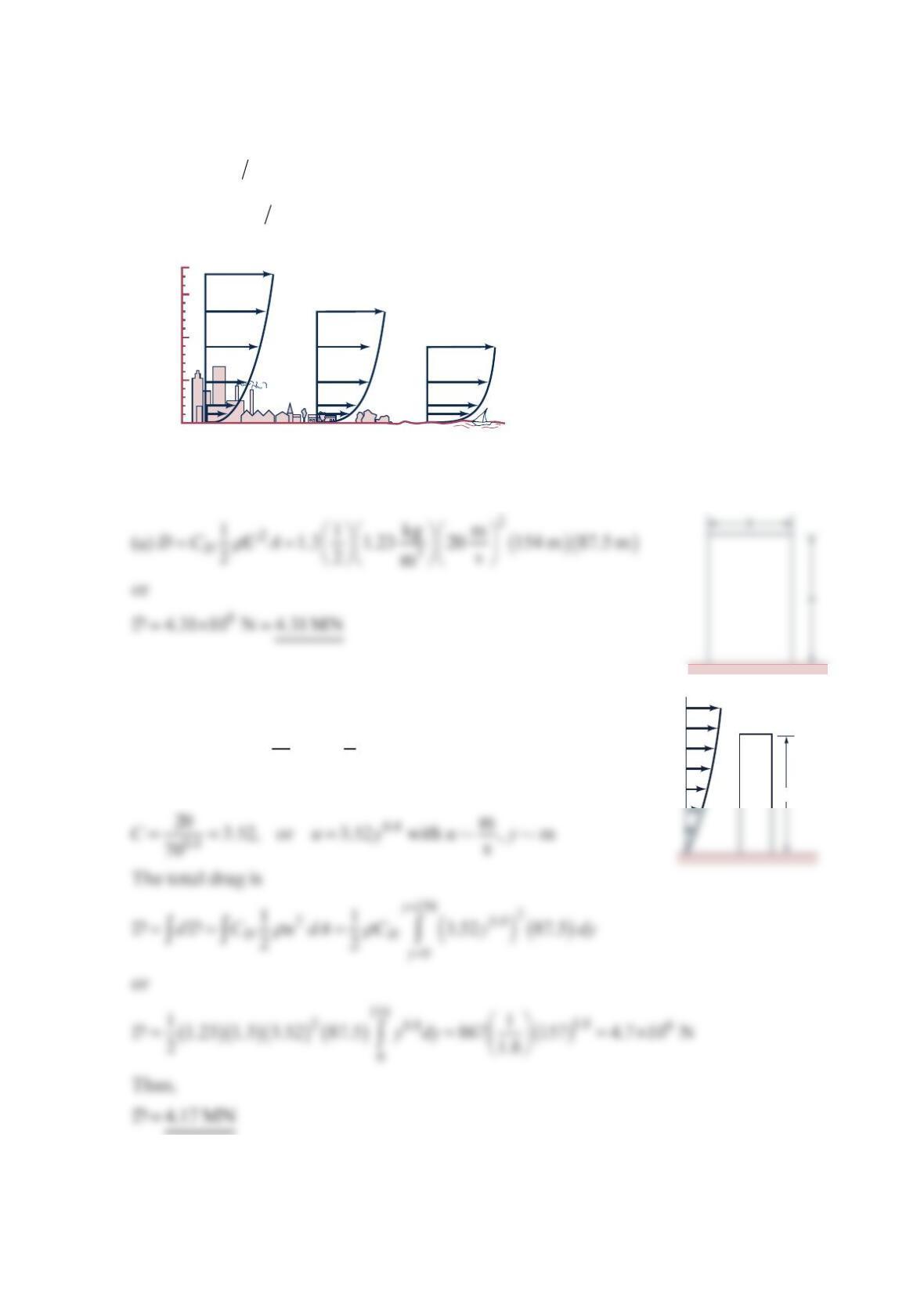
marker is a cylinder with flat ends, has a diameter of 12 in., and is 48 in. long. Calculate
the drag force on the marker in 10 °F air if the air flow is parallel to the cylinder’s axis.
Solution 9.91
Using Table B.3, the Reynolds number is
Problem 9.92
The United Nations Building in New York is approximately 87.5 m wide and 154 m tall.
(a) Determine the drag on this building if the drag coefficient is 1.3 and the wind speed is a
uniform
2
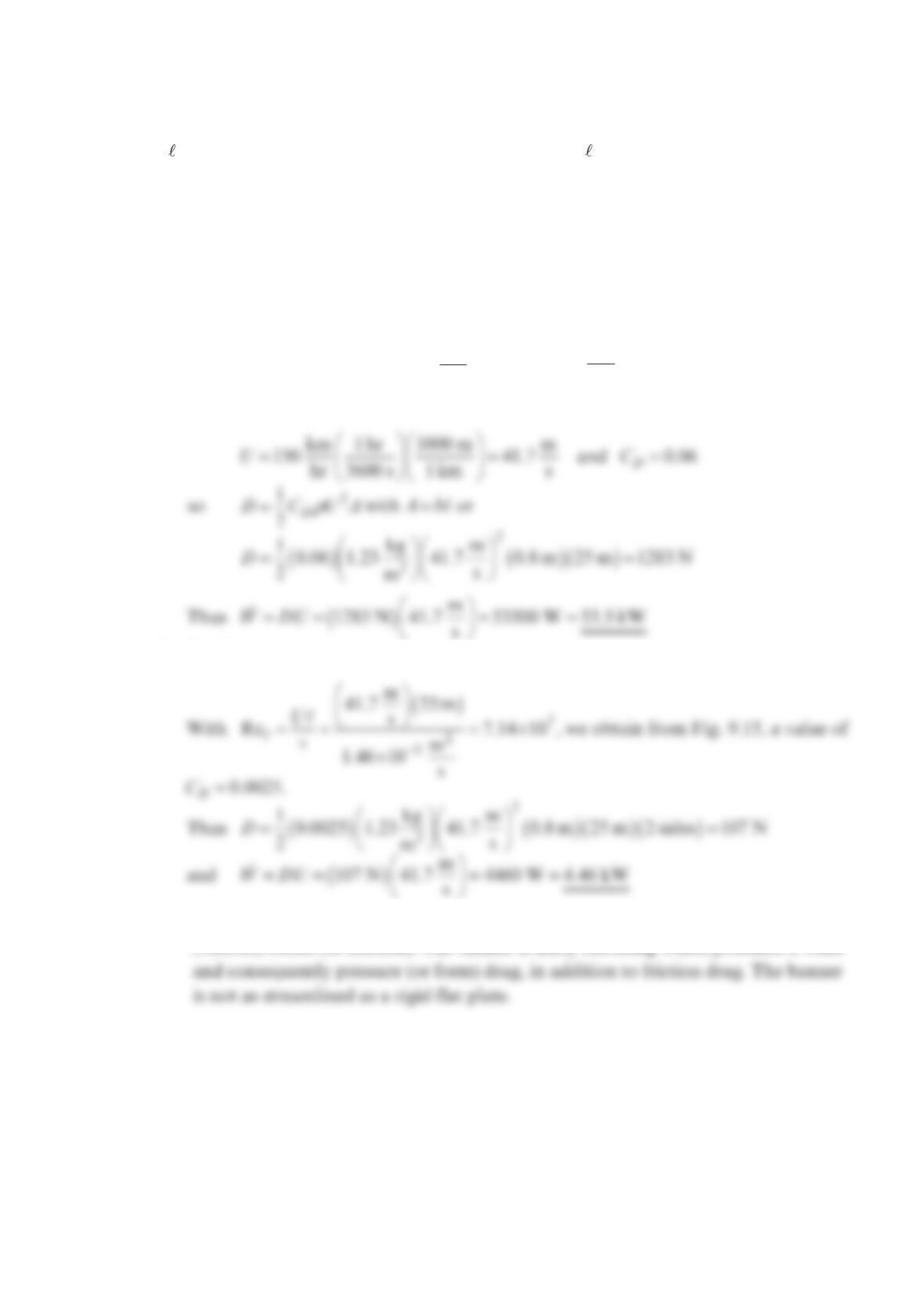
0 m s. (b) Repeat your calculations if the velocity profile against the building is a
typical profile for an urban area (see the figure below) and the wind speed halfway up the
building is 20 m s .
Solution 9.92
(b) For an urban area, =0.4
uCy
Thus, with m
20 at 77 m
s2
h
uy===
we obtain
u ~ y0.40
u ~ y0.28
u ~ y0.16
450
300
150
0
y (m)
y
h
= 154 m
Problem 9.93
An airplane flies at 150 km/hr. (a) The airplane is towing a banner that is =0.8 mb tall
and =25 m long. If the drag coefficient based on area b is =0.06,
D
C estimate the
power required to tow the banner. (b) For comparison, determine the power required if the
airplane was instead able to tow a rigid flat plate of the same size. (c) Explain why one had
a larger power requirement (and larger drag) than the other. (d) Finally, determine the
power required if the airplane was towing a smooth spherical balloon with a diameter
of 2 m.
Solution 9.93
Using standard air properties,
ρ
=3
kg
1.23 ,
m
−
=×
2
5m
1.46 10 .
s
v
(a) Banner
(b) Rigid plate
(c) For the rigid flat plate, the drag is relatively low because it is due entirely to shear
(viscous) forces (or friction). The banner is likely fluttering which produces a wake
(d) Smooth sphere
Problem 9.94
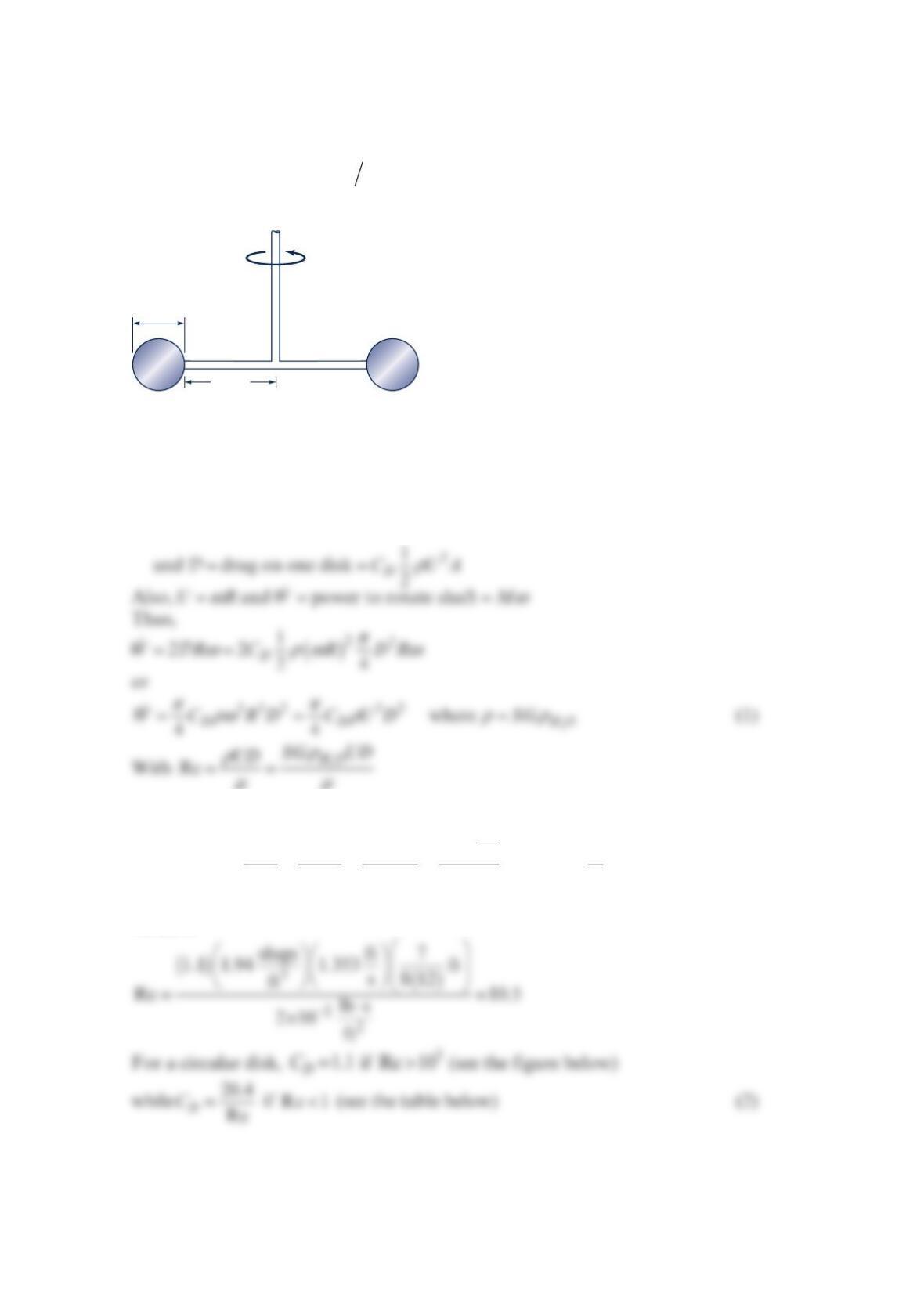
The paint stirrer shown in the figure below consists of two circular disks attached to the end
of a thin rod that rotates at 80 rpm . The specific gravity of the paint is =1.1SG and its
viscosity is 22
210 lbsft
µ
−
=× ⋅ . Estimate the power required to drive the mixer if the
induced motion of the liquid is neglected.
Solution 9.94
If we neglect the effects of the shaft and rod and consider the paint to be stationary, then
2
MR
=D,
w
here torque to rotate shaft
M
=
where
π
ω
+
== =
7
1.5
rev 1 min 2 rad ft
16
80 ft 1.353
min 60 s 1 rev 12 s
UR
we have
80 rpm
7
__
8in.
1.5 in.
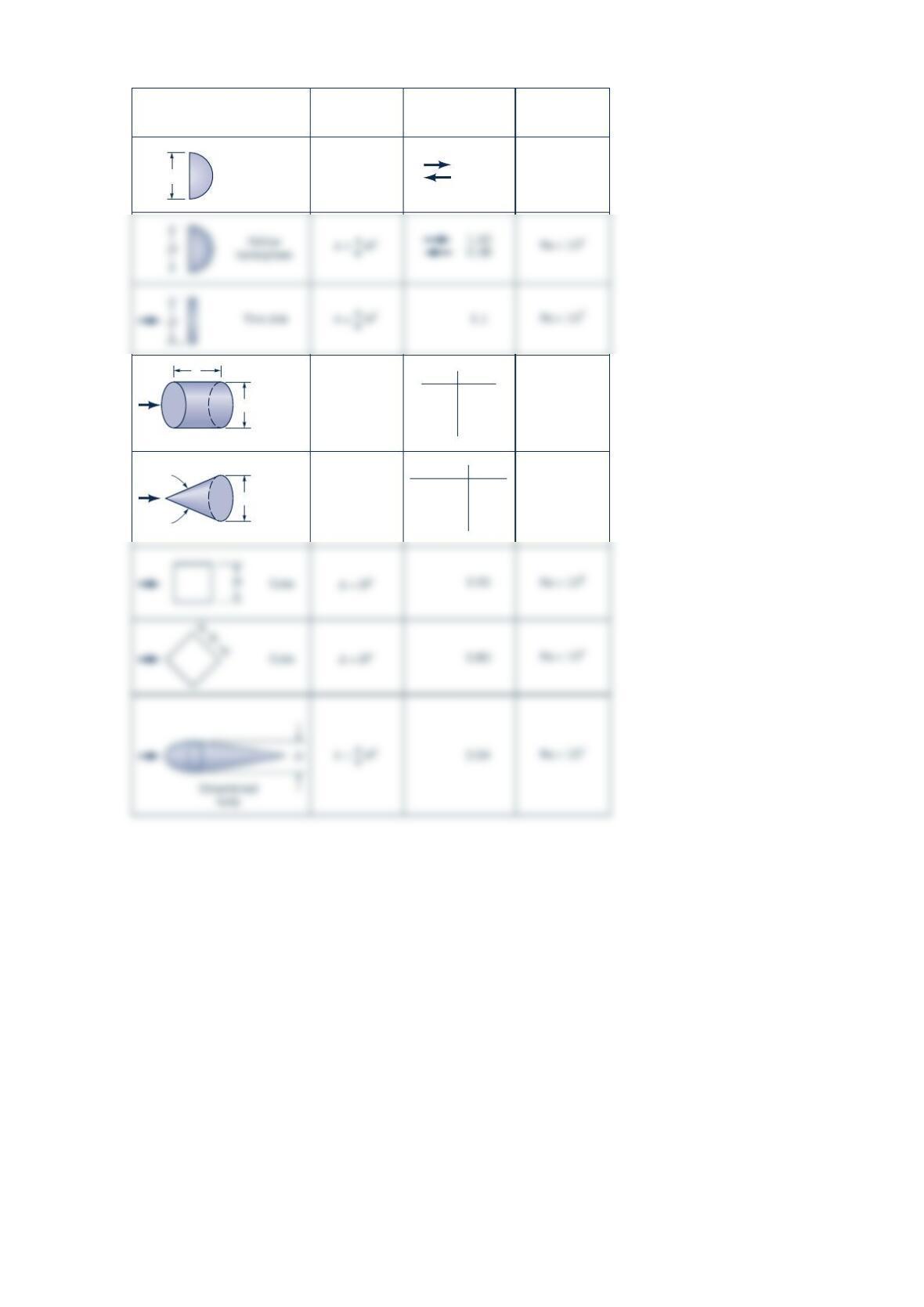
For this particular problem <= <
3
1 Re 10.5 10
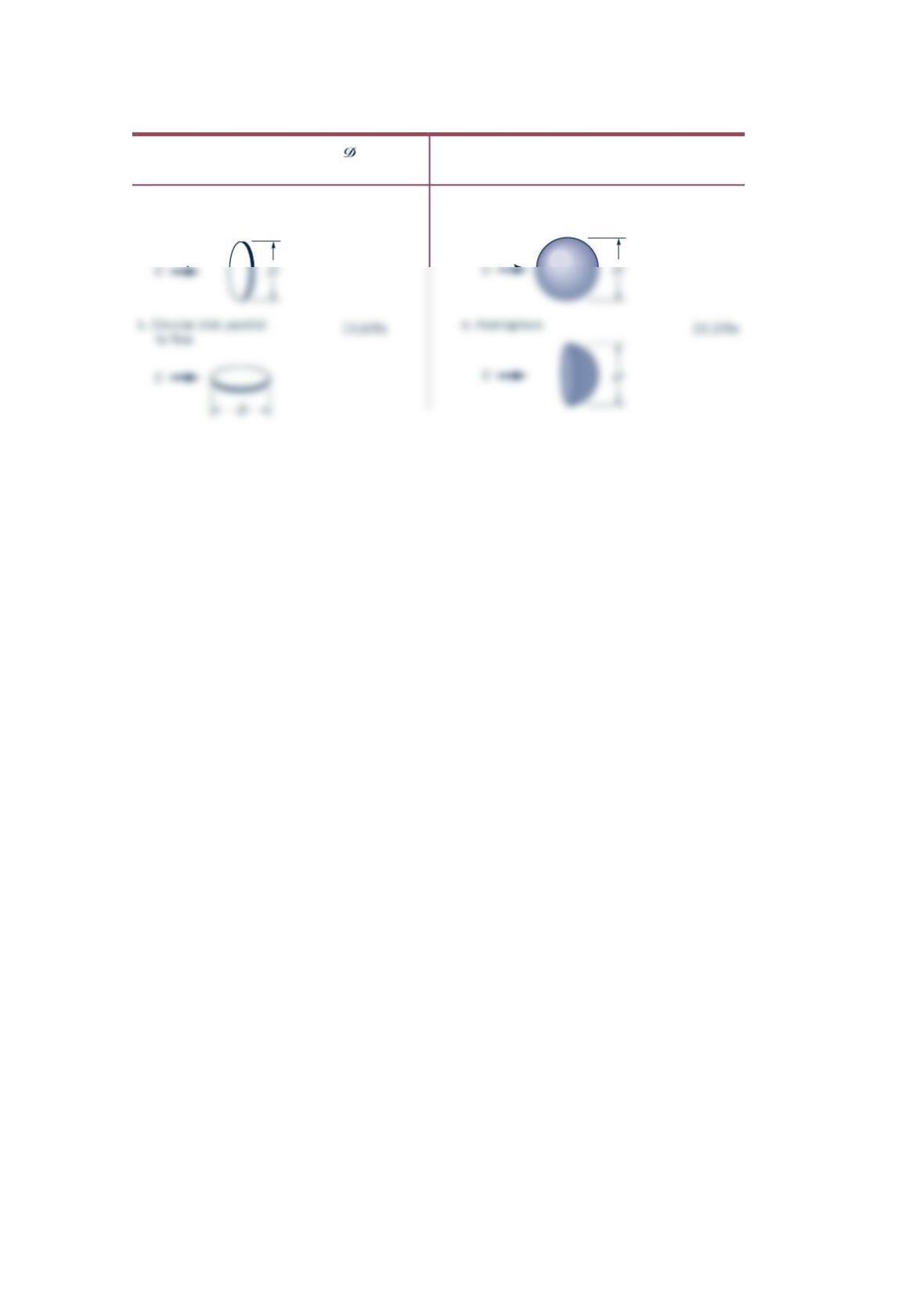
Note: If the low Reynolds number result
[Eq. (2)] is valid up to =Re 10.5 , then
To be on the conservative side (i.e., maximum power),
use the larger D
C=1.94.
D
C
CD
CD
= 20.4/Re
CD
= 1.1
Re
0.1 1 10 10
2
10
3
10
4
D
Solid
hemisphere
𝓵
D
Circular
rod
parallel
to flow
D
Cone
Shape Reference area
A
A
=
D
2
__
4
π
A
=
D
2
__
4
π
A
=
D
2
__
4
π
Drag coefficient
C
D
1.17
0.42
C
D
10
30
60
90
0.30
0.55
0.80
1.15
𝓵/
DC
D
0.5
1.0
2.0
4.0
1.1
0.93
0.83
0.85
Re > 10
4
Re > 10
5
Re > 10
4
Reynolds number
Re =
UD
/
ρμ
θ
(°)
θ
Low Reynolds Number Drag Coefficients (Ref. 7) (Re =
ρ
UD/μ, A = πD2/4)
20.4/Re
24.0/Re
c. Sphere
a. Circular disk normal
to flow
Object Object CD
CD =
/
(ρU2A/2)
(for Re ⱗ 1)