Problem 9.96
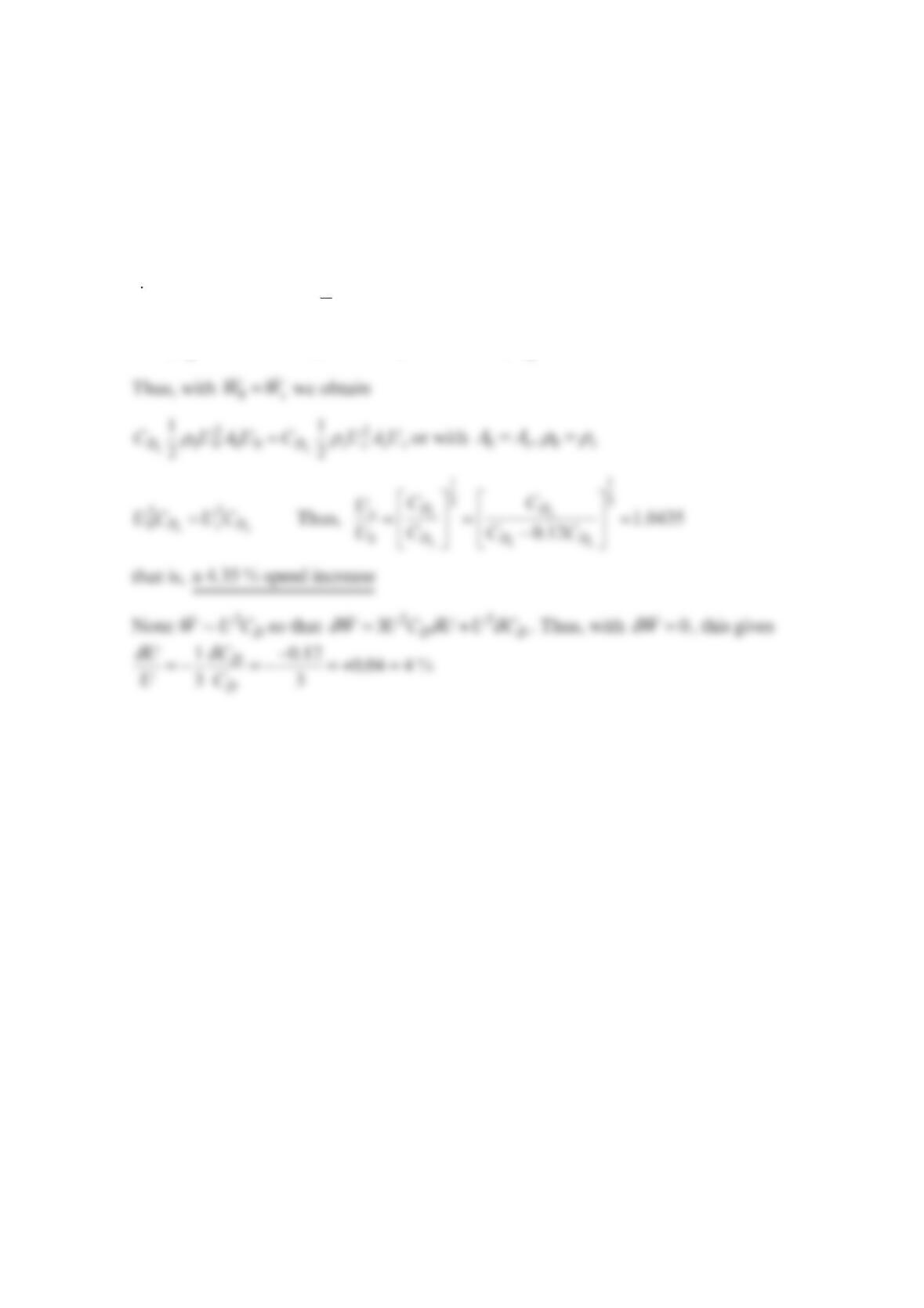
By appropriate streamlining, the drag coefficient for an airplane is reduced by 12 % while
the frontal area remains the same. For the same power output, by what percentage is the
flight speed increased?
Solution 9.96
2
1
,where 2
D
W
UCU
A
ρ
==DD
Let
()
0 denote the original configuration and
()
s the streamlined one.
W
Problem 9.97
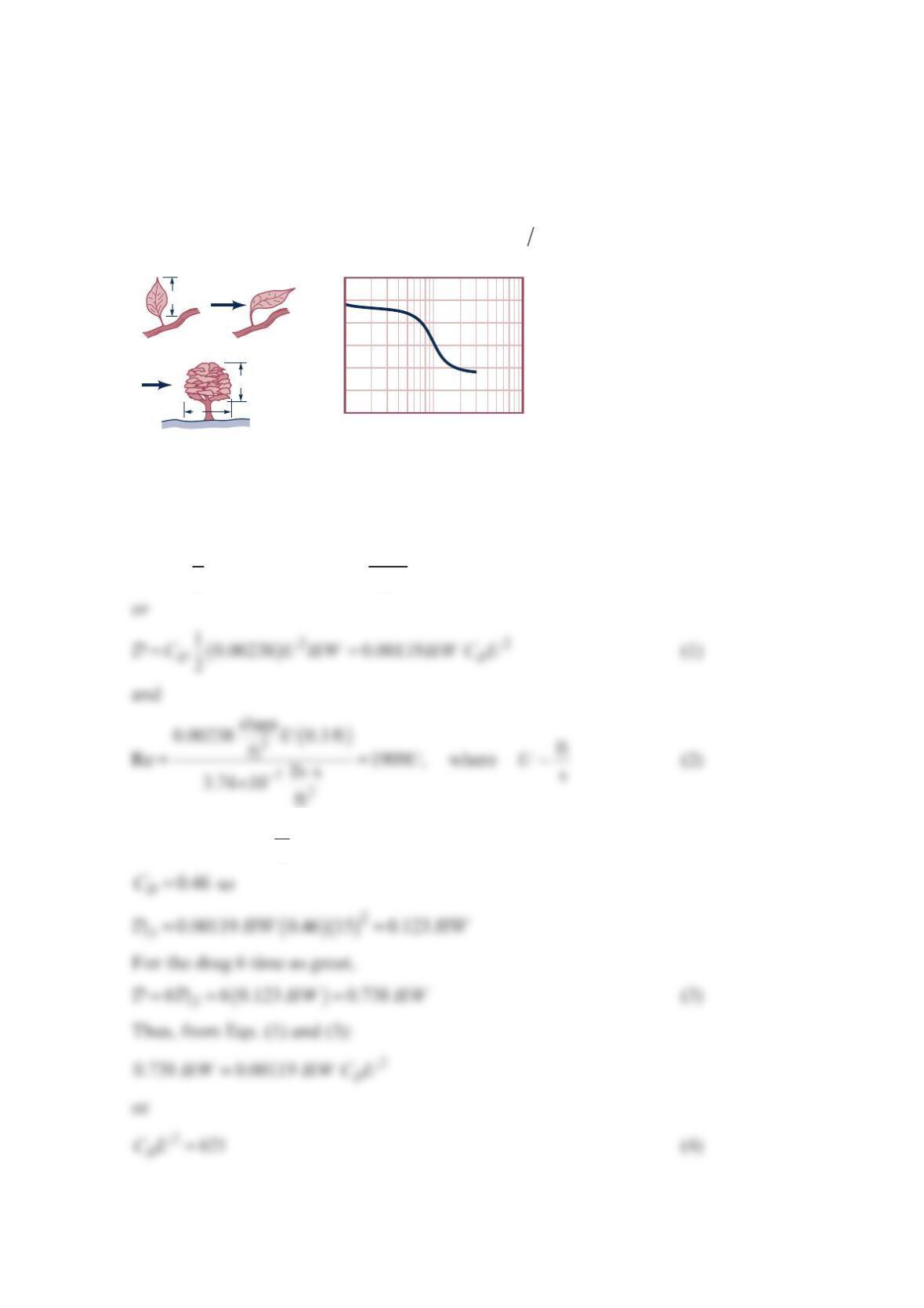
As indicated in the figure below, the orientation of leaves on a tree is a function of the wind
speed, with the tree becoming “more streamlined” as the wind increases. The resulting drag
coefficient for the tree (based on the frontal area of the tree, HW ) as a function of
Reynolds number (based on the leaf length, L) is approximated as shown. Consider a tree
with leaves of length 0.3 ftL=. What wind speed will produce a drag on the tree that is
6 times greater than the drag on the tree in a 15 ft s wind?
Solution 9.97
2
1and Re
2
D
UL
CUA
ρ
ρπ
==D
Thus, with
()
ft
15 , Re 1909 15 28600
s
U===
so that from the figure in the problem,
Calm wind Strong wind
1,000,000100,000
Re = UL/
10,000
0.6
0.5
0.4
0.3
0.2
0.1
0
ρμ
CD
L
H
W
U
U
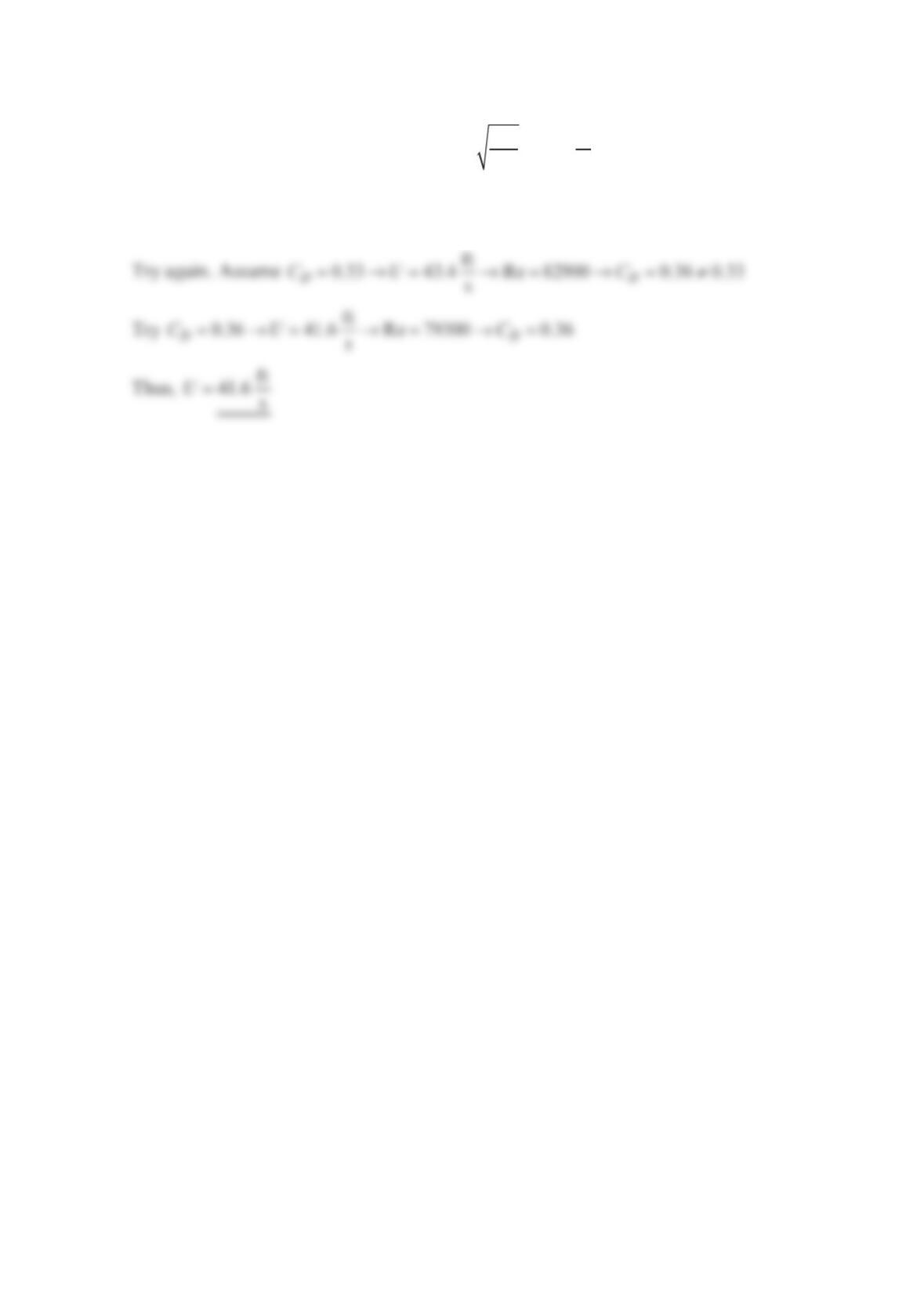
Trial and error solution:
Assume =0.3
D
C so that from Eq. (4), ==
621 ft
45.5
0.3 s
U and from Eq. (2),
()
==Re 1909 45.5 86900 . Thus, from the figure in the problem, =≠0.33 0.3
D
C, the
assumed value.
Problem 9.98
How fast must a 3.5-in.-diameter , dimpled baseball bat move through the air in order to
take advantage of drag reduction produced by the dimples on the bat? Although there are
differences, assume the bat (a cylinder) acts the same as a golf ball in terms of how the
dimples affect the transition from a laminar to a turbulent boundary layer.
Solution 9.98
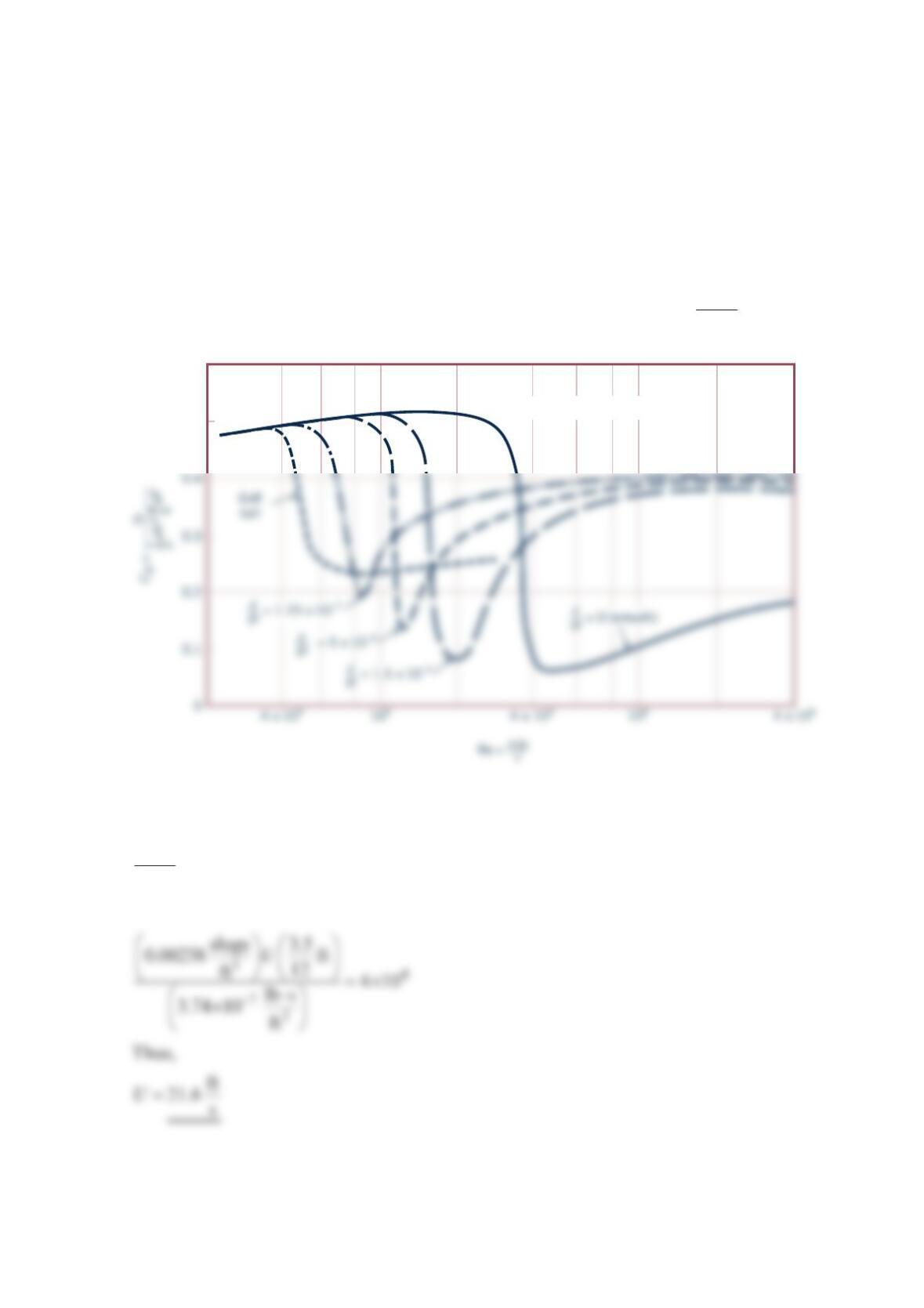
From the figure below, for a golf ball the dimples reduce drag for
ρ
µ
=≥×
4
Re 4 10
UD
Thus, assume =× 4
Re 4 10 for the bat so that
ρ
µ
=× 4
410
UD
or
0.6
0.5
ε
__
D
= relative roughness
Problem 9.99
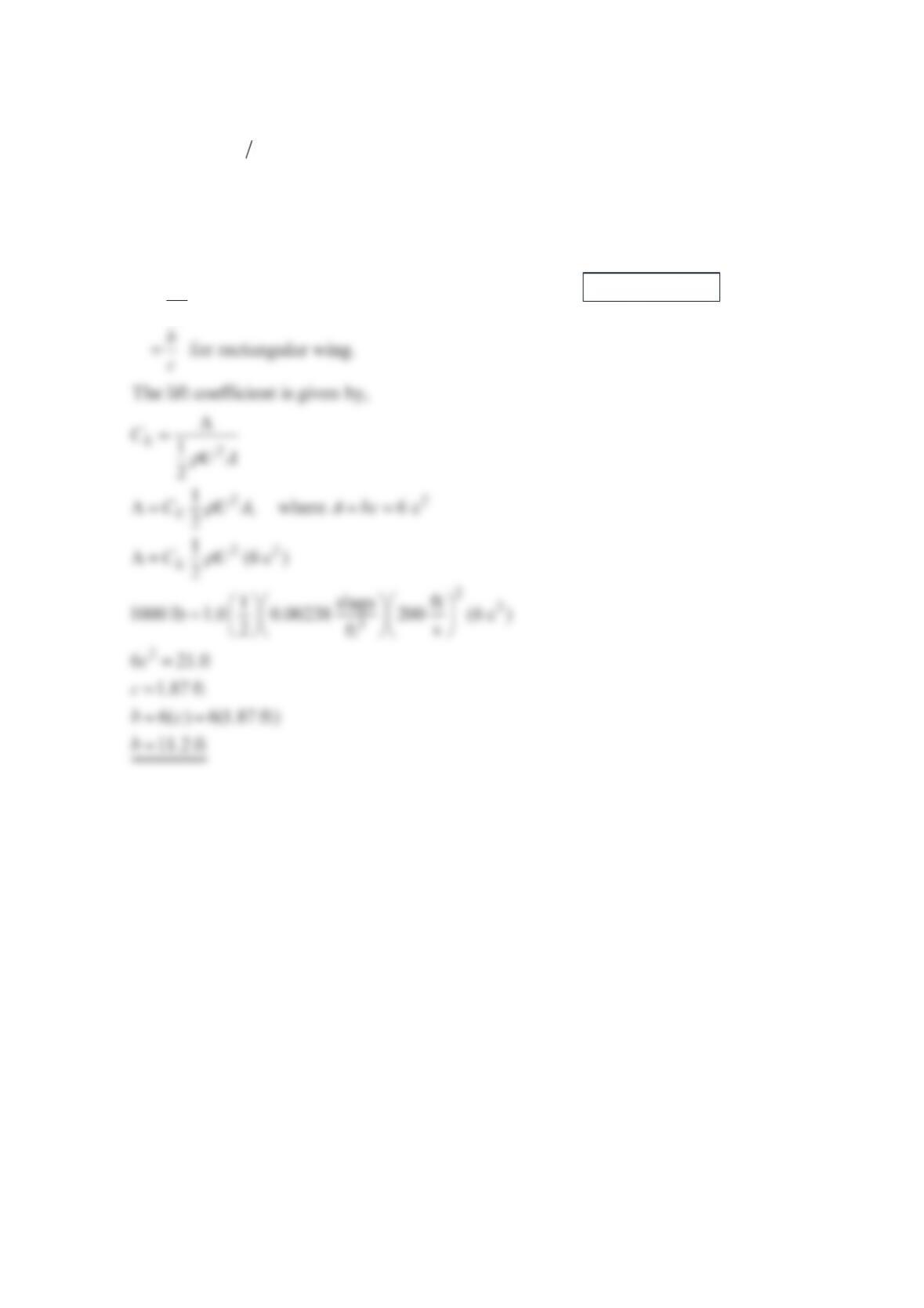
(a) Determine the power it takes to overcome aerodynamic drag on a small ( 2
6 ft cross
section), streamlined ( =0.12
D
C) vehicle traveling 15 mph . (b) Compare the power
calculated in part (a) with that for a large ( 2
36 ft cross-sectional area), nonstreamlined (
=0.48
D
C) SUV traveling 65 mph on the interstate.
Solution 9.99
2
1
power , where 2
D
W
UD C U
A
ρ
== =D
so that
ρ
=3
1
2
D
WC UA
(a)
(b)
Problem 9.100
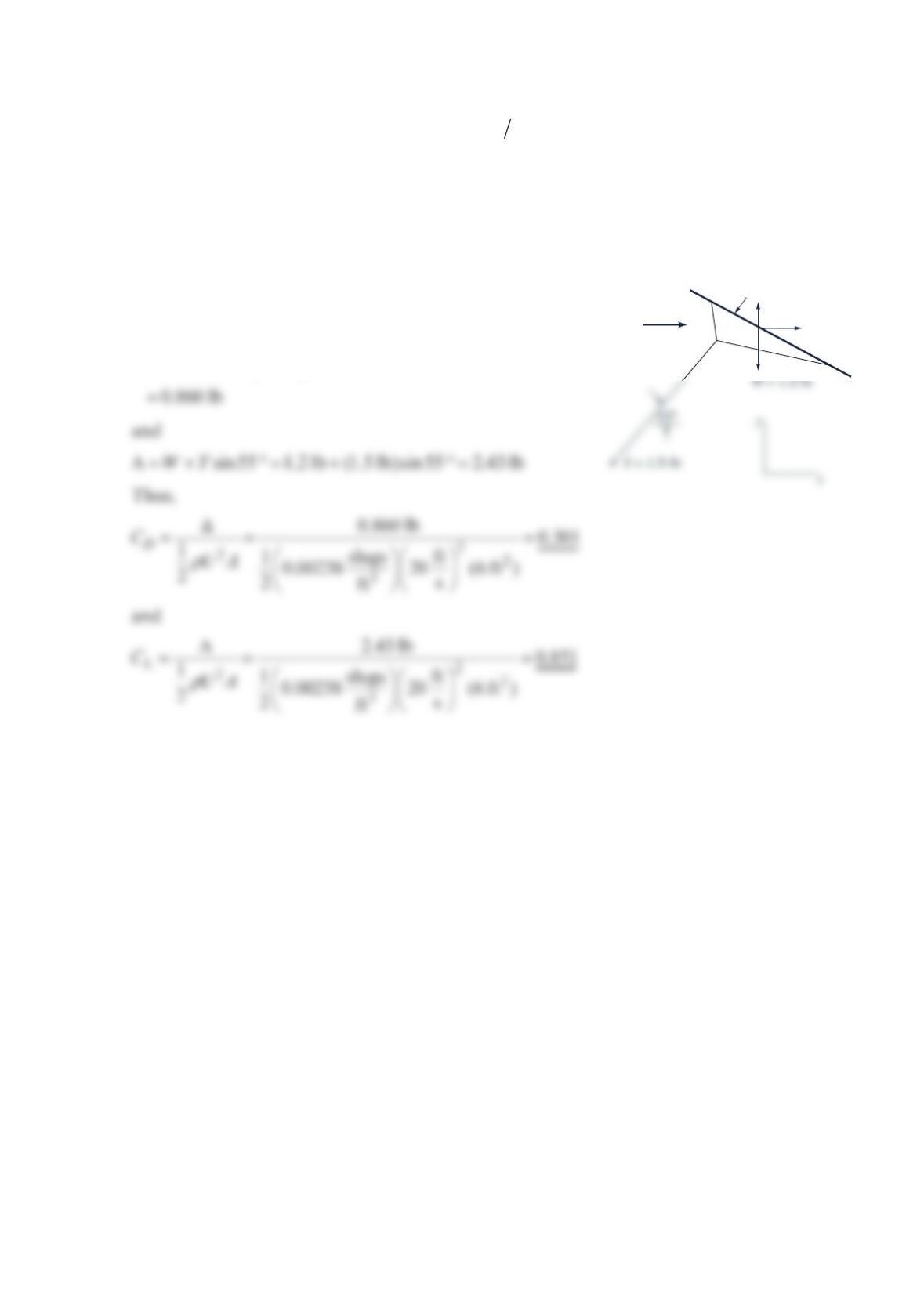
A rectangular wing with an aspect ratio of 6 is to generate 1000 lb of lift when it flies at a
speed of
2
00 ft s. Determine the length of the wing if its lift coefficient is 1.0.
Solution 9.100
Aspect ratio,
2
6
b
A
==
A
b
c
Problem 9.101
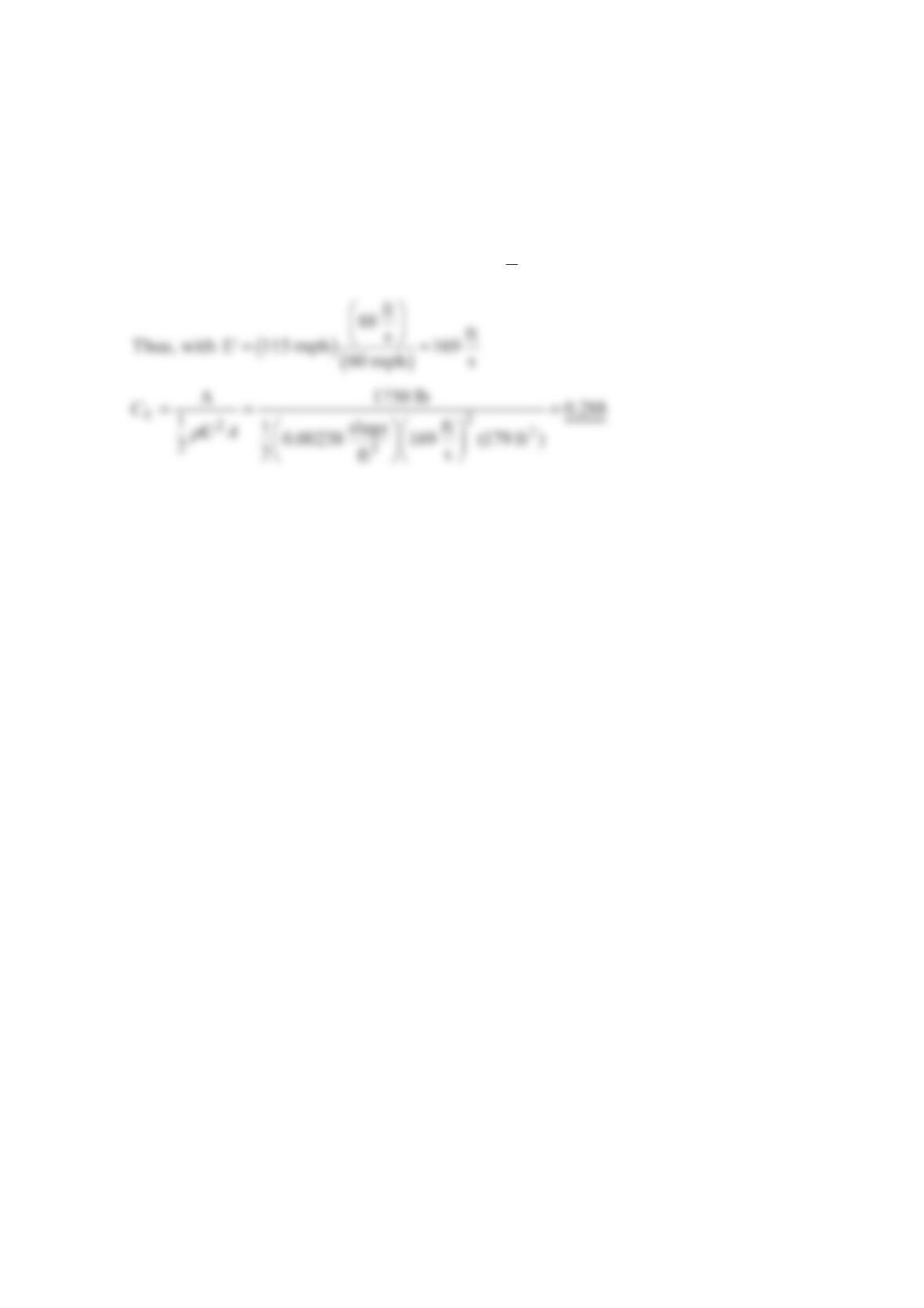
A
1
.2-lb kite with an area of 2
6
ft flies in a
2
0- ft swind such that the weightless string makes
an angle of °55 relative to the horizontal. If the pull on the string is
1
.5 lb, determine the
lift and drag coefficients based on the kite area.
Solution 9.101
For equilibrium conditions ==
0and 0
Xy
FF
or
()
cos55 1.5 lb cos55
T
Δ
=°=
°
U
= 20
ft
––
s
A
= 6 ft2
𝒟
ℒ
Problem 9.102
A Piper Cub airplane has a gross weight of
1
750 lb, a cruising speed of
1
15 mph, and a wing
area of 2
1
79 ft . Determine the lift coefficient of this airplane for these conditions.
Solution 9.102
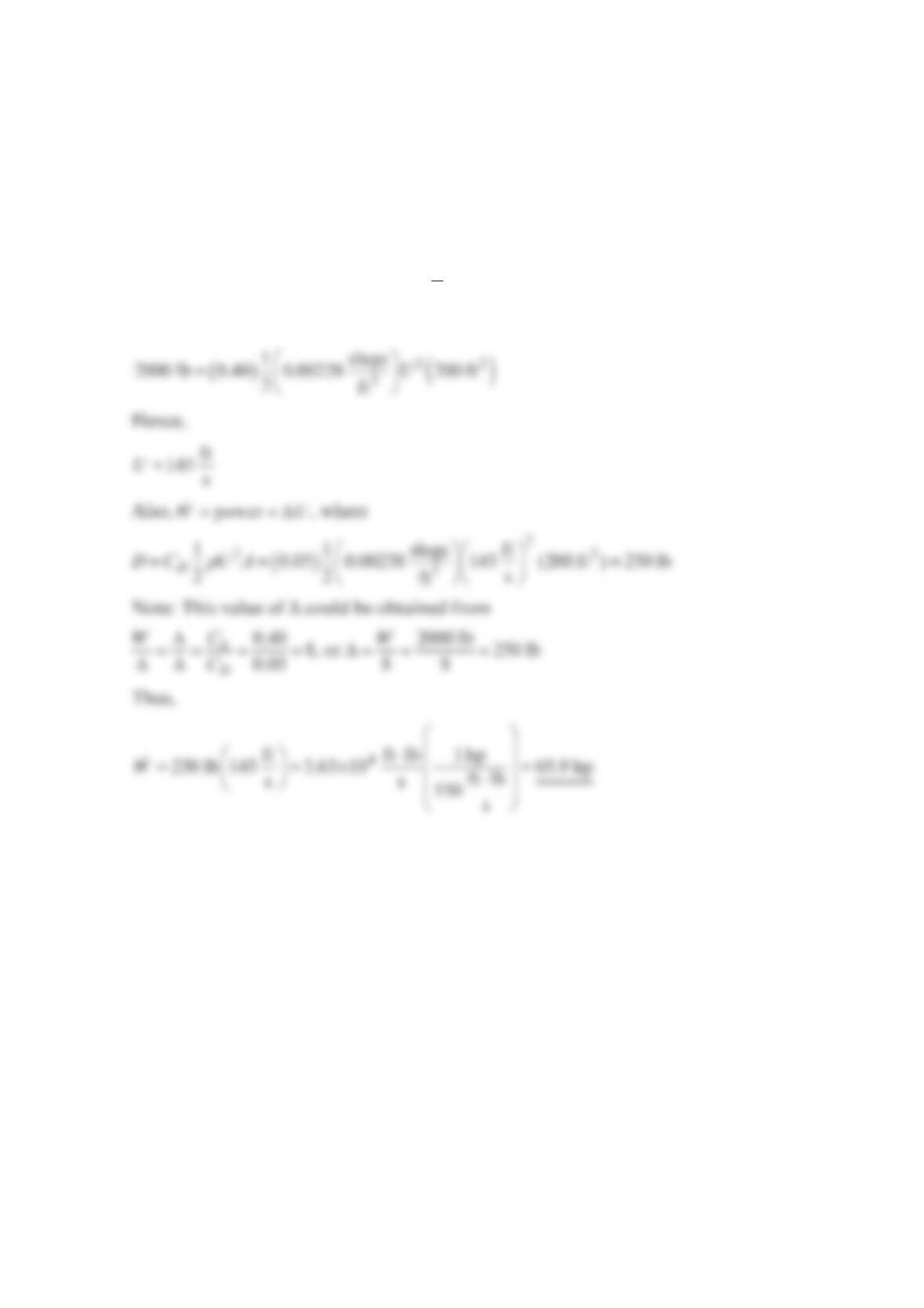
For equilibrium 1750 lbW
Λ
== , where 2
1
2
L
CUA
ρ
Λ
=
Problem 9.103
A light aircraft with a wing area of 2
200 ft and a weight of
2
000 lb has a lift coefficient of
0.40 and a drag coefficient of 0.05. Determine the power required to maintain level flight.
Solution 9.103
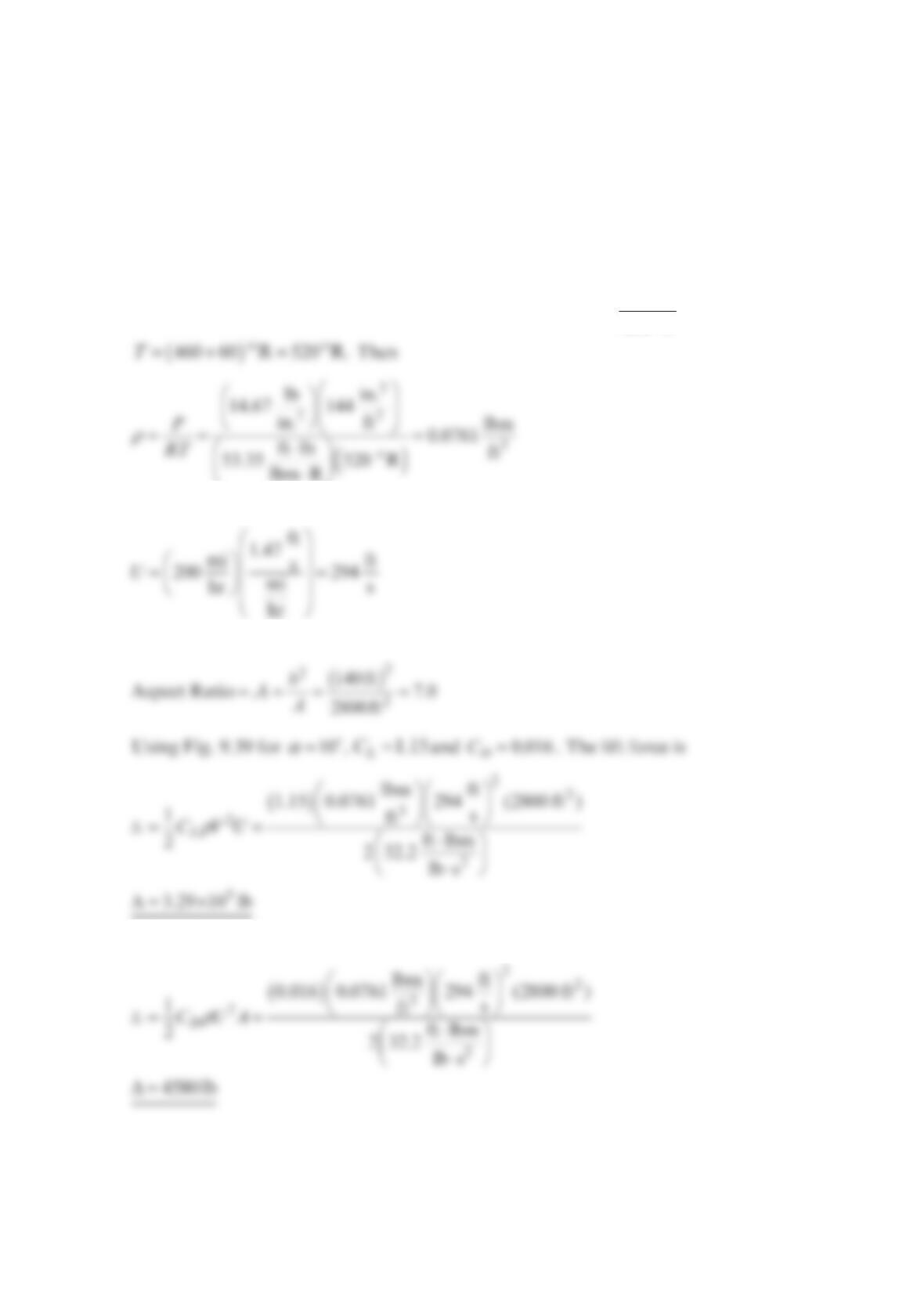
For equilibrium 2
1
2000 lb 2
L
WCUA
ρ
Λ
== =
or
Δ
Problem 9.104
An airplane weighs 320,000 lb, has a wing area of 2
2800 ft , and has a wing length of
140 ft. The atmospheric pressure and temperature are 14.67 psia and 60 °F, respectively.
The airplane is moving along a runway at and the wing has the lift and drag coefficients
given in Fig. 9.39. Find the lift and drag on the airplane wings for an angle of attack of °10 .
Solution 9.104
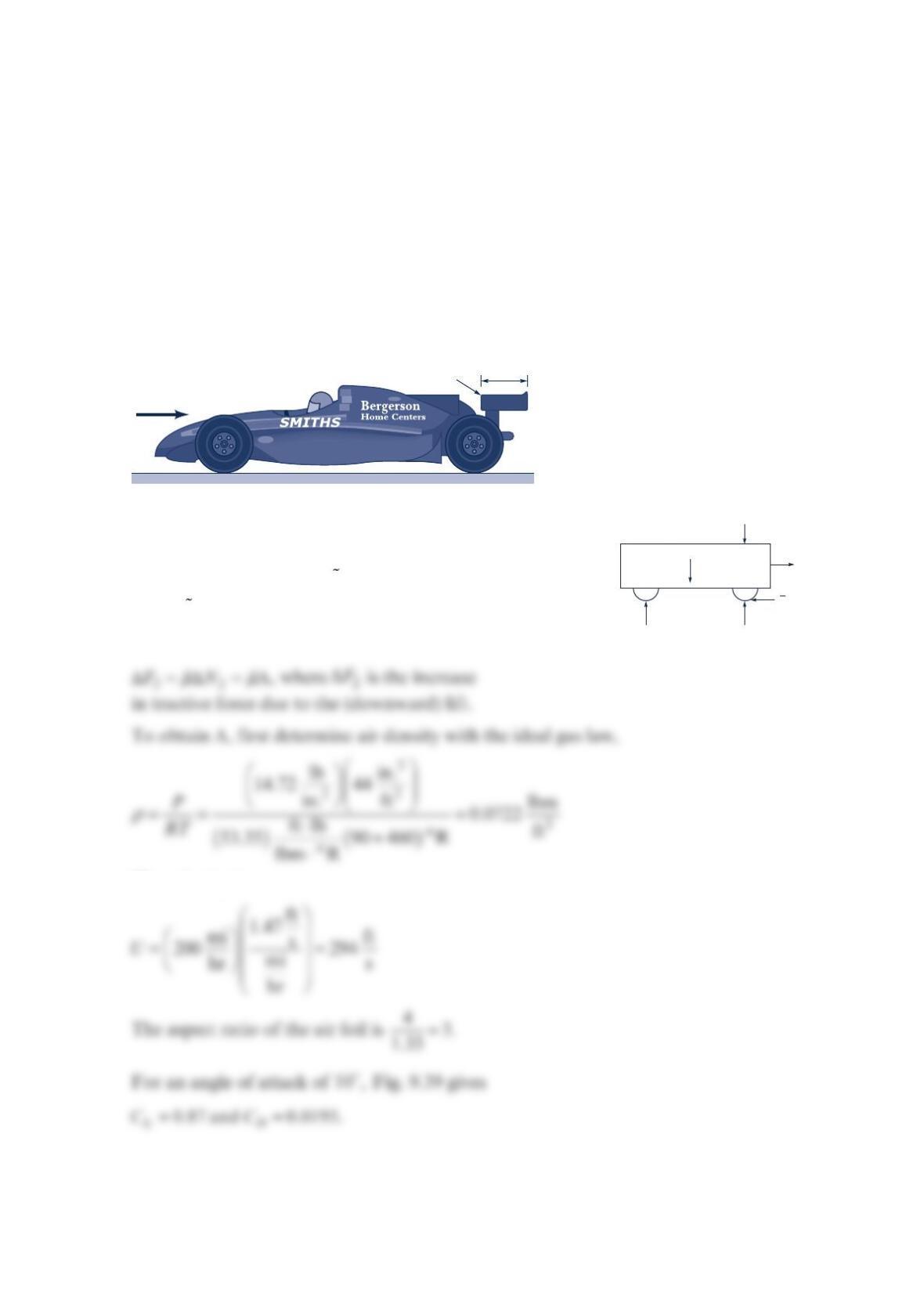
The density is found from the ideal gas law, where R is ⋅
⋅
ft lb
53.35 lbm R and
Now
and
The drag force is
N
1
W
N
2
𝒟
ℒ
μ
N
2
=
F
2
Problem 9.105
As shown in V9.25 and the figure below, a spoiler (i.e., an upside-down airfoil) is mounted
above the rear wheels of a race car to produce negative lift (i.e., downforce), thereby
improving tractive force. The spoiler’s airfoil is angled 10º with the race track and has lift
and drag coefficient characteristics of Fig. 9.39. The race car is traveling at 200 mph in air
at 90 ºF and 14.72 psia. (a) If the coefficient of friction between the wheels and pavement is
0.6, by how much would use of the spoiler increase the maximum tractive force that would
be generated between the wheels and the track? Assume the airspeed past the spoiler equals
the car speed and that the airfoil acts directly over the drive wheels. (b) How much drag is
added to the car with the use of the spoiler’s airfoil?
Solution 9.105
(a) Tractive force = 22
FN
µ
=
where
µ
=coefficient of friction=0.6
Thus,
The velocity is
akkjbgfkgbsgboiabkv
GOOD YEAR
33
sfglfbkjxfdbaerg
200 mph
The Frugal
Hoosier
Spoiler 1
1
⁄
3
ft
b = spoiler length = 4 ft
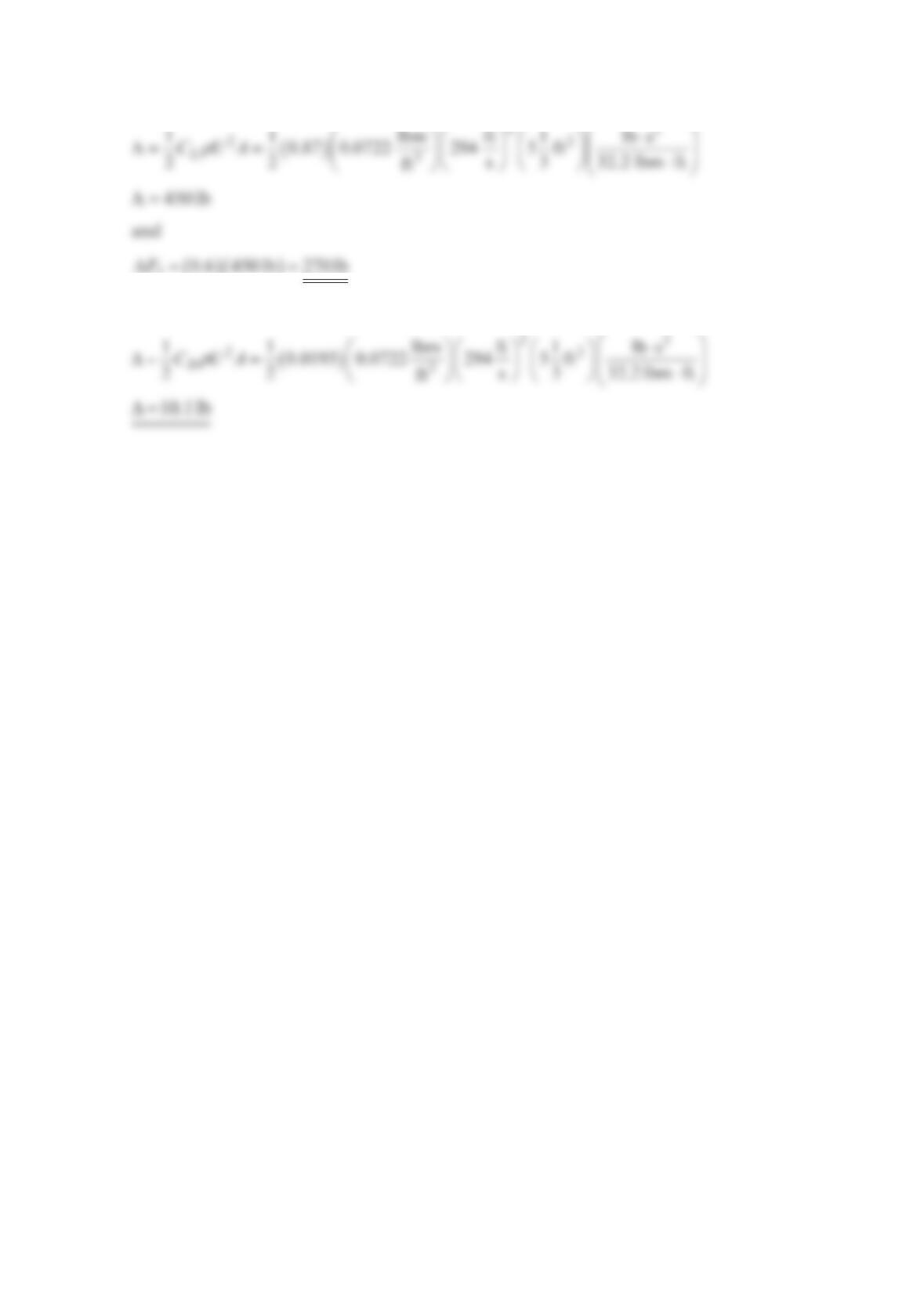
The downward lift is
20.6 450 lb 270 lbF
(b)
Problem 9.106
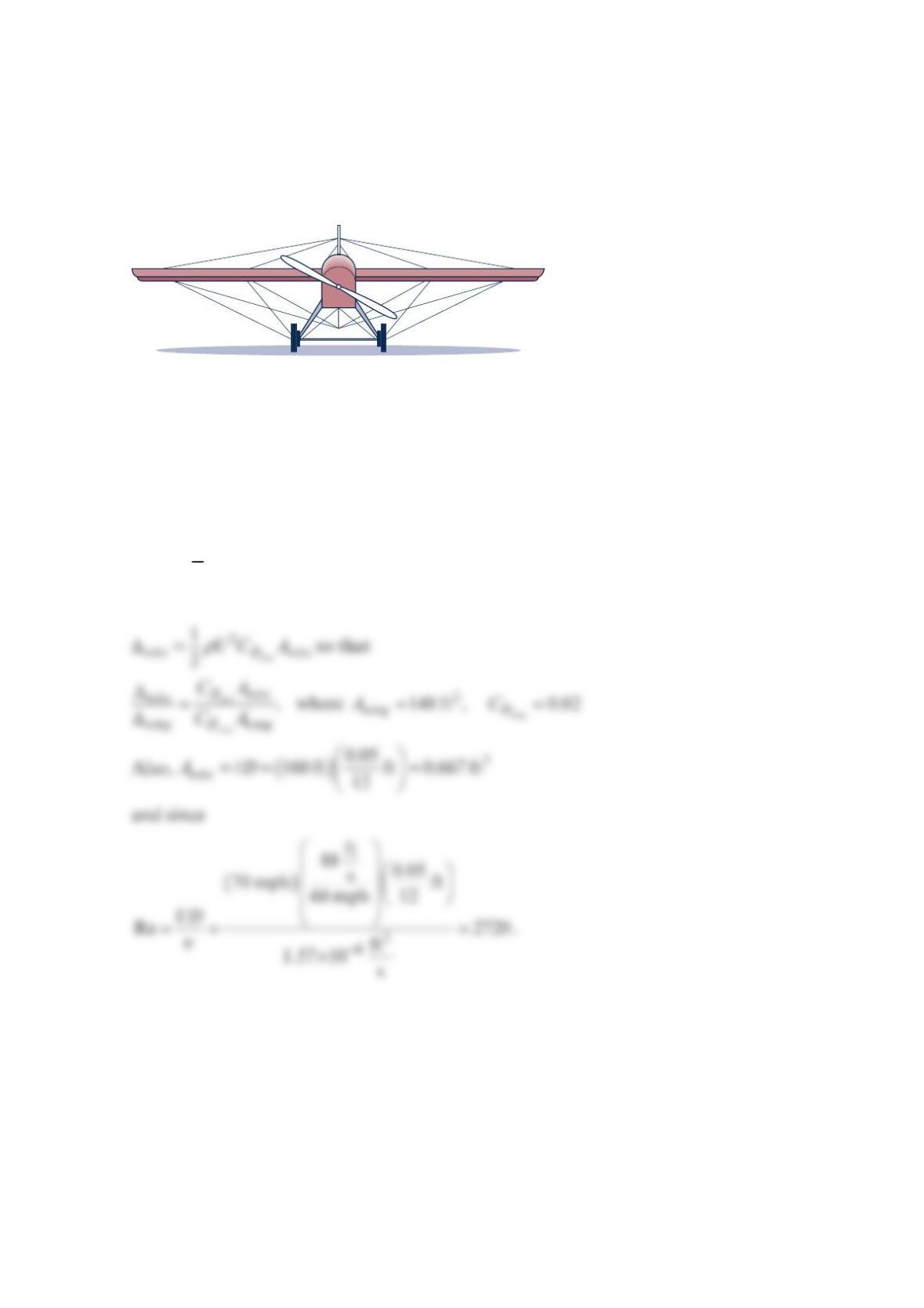
The wings of old airplanes are often strengthened by the use of wires that provided cross-
bracing as shown in the figure below. If the drag coefficient for the wings was 0.020 (based
on the planform area), determine the ratio of the drag from the wire bracing to that from
the wings.
Solution 9.106
2
1
2wing
wing D wing
UC A
ρ
Δ
=
and
Speed: 70 mph
Wing area: 148 ft
2
Wire: length = 160 ft
diameter = 0.05 in.
Δ
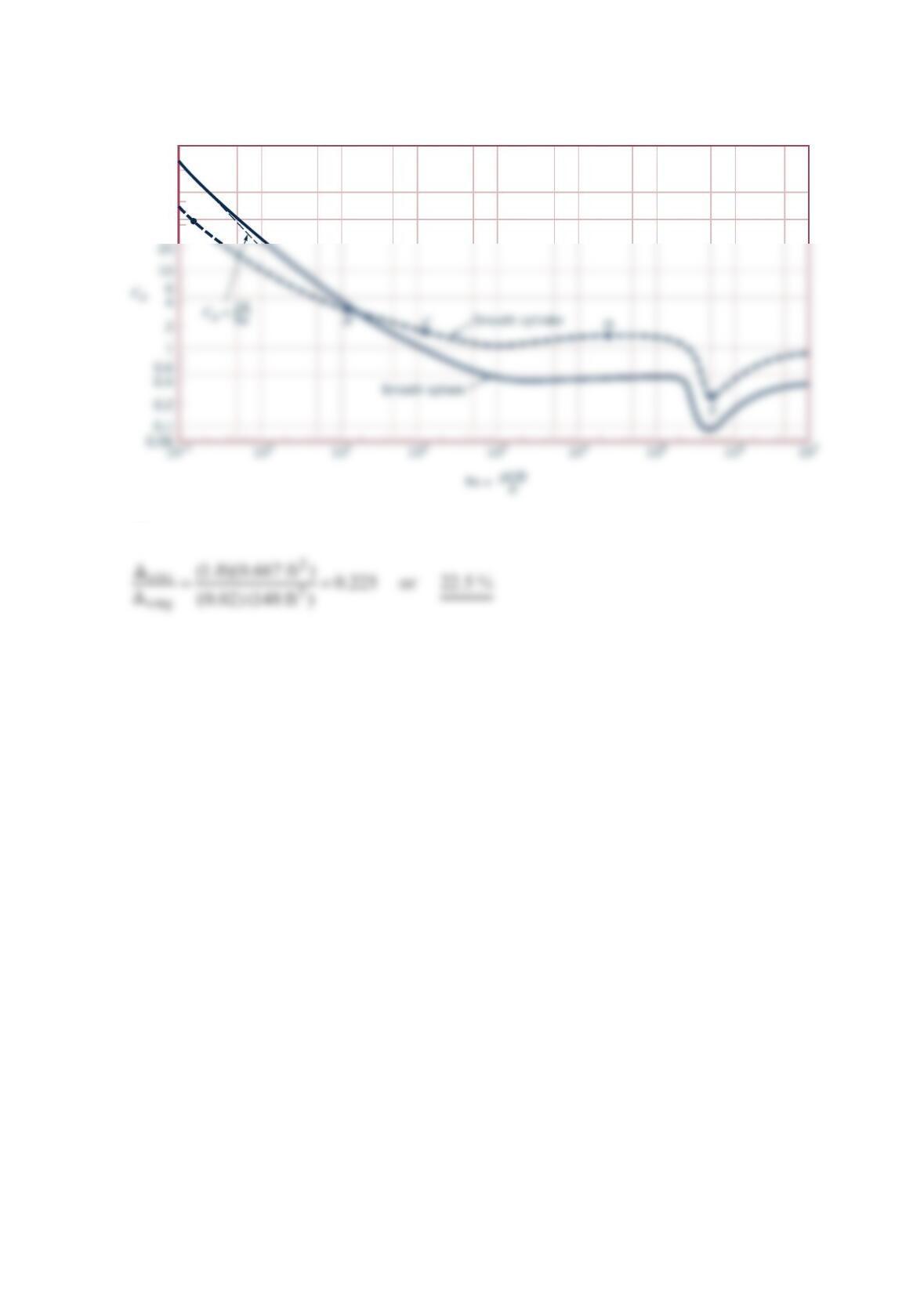
From the figure below, with =Re 2720 we obtain =1.0
D
C
Hence,
A
400
200
100
60
40
Problem 9.107
A wing generates a lift
Λ
when moving through sea-level air with a velocity
U
. How fast
must the wing move through the air at an altitude of 10,000 m with the same lift coefficient
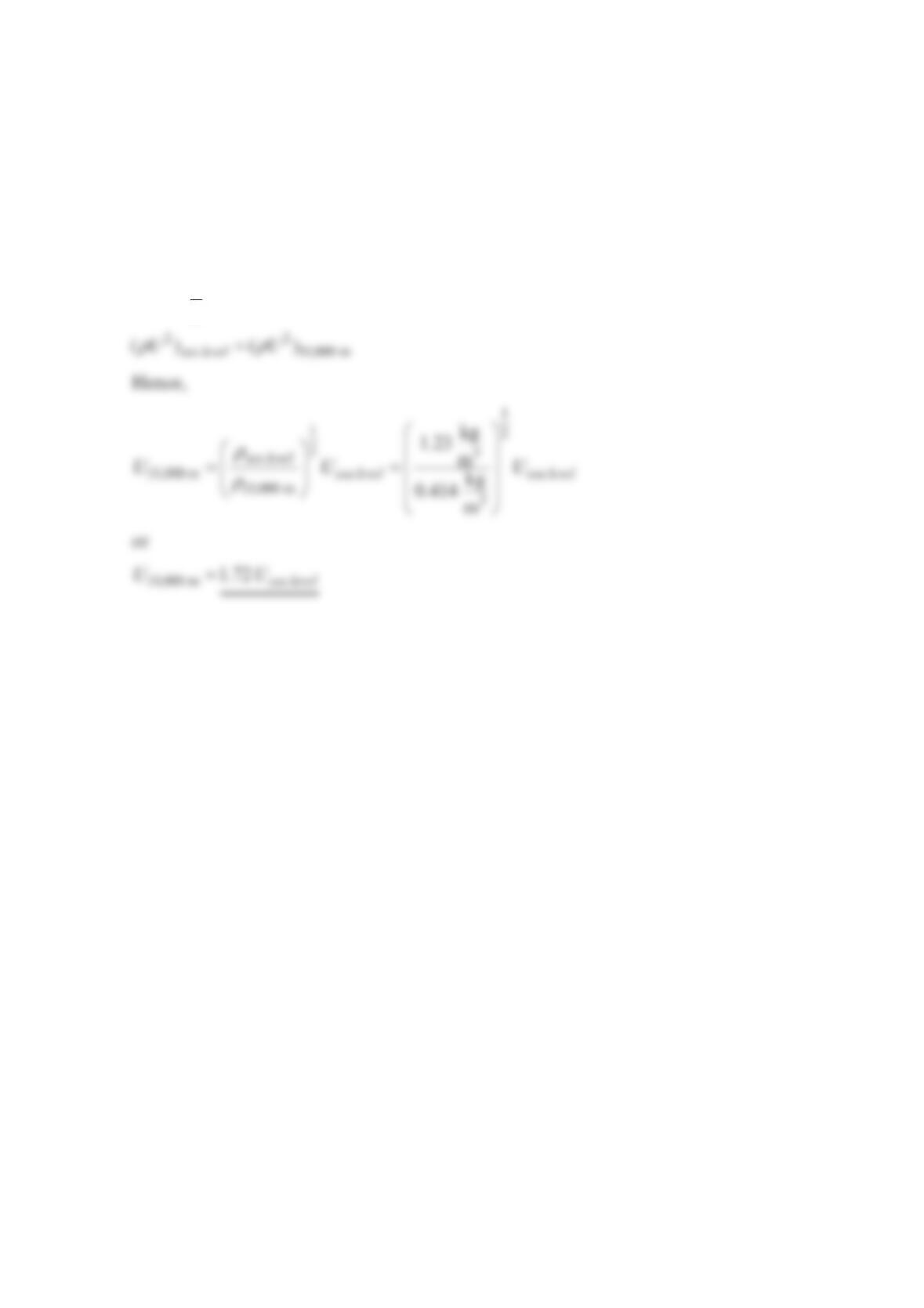
if it is to generate the same lift?
Solution 9.107
2
1
2
L
CU
A
ρ
Λ
= so with
Λ
, L
C
, and A constant
Problem 9.108
A design group has two possible wing designs (
A
and
B
) for an airplane wing. The planform
area of either wing is 2
130 m and each must provide a lift of 1, 55 0, 00 0 N.
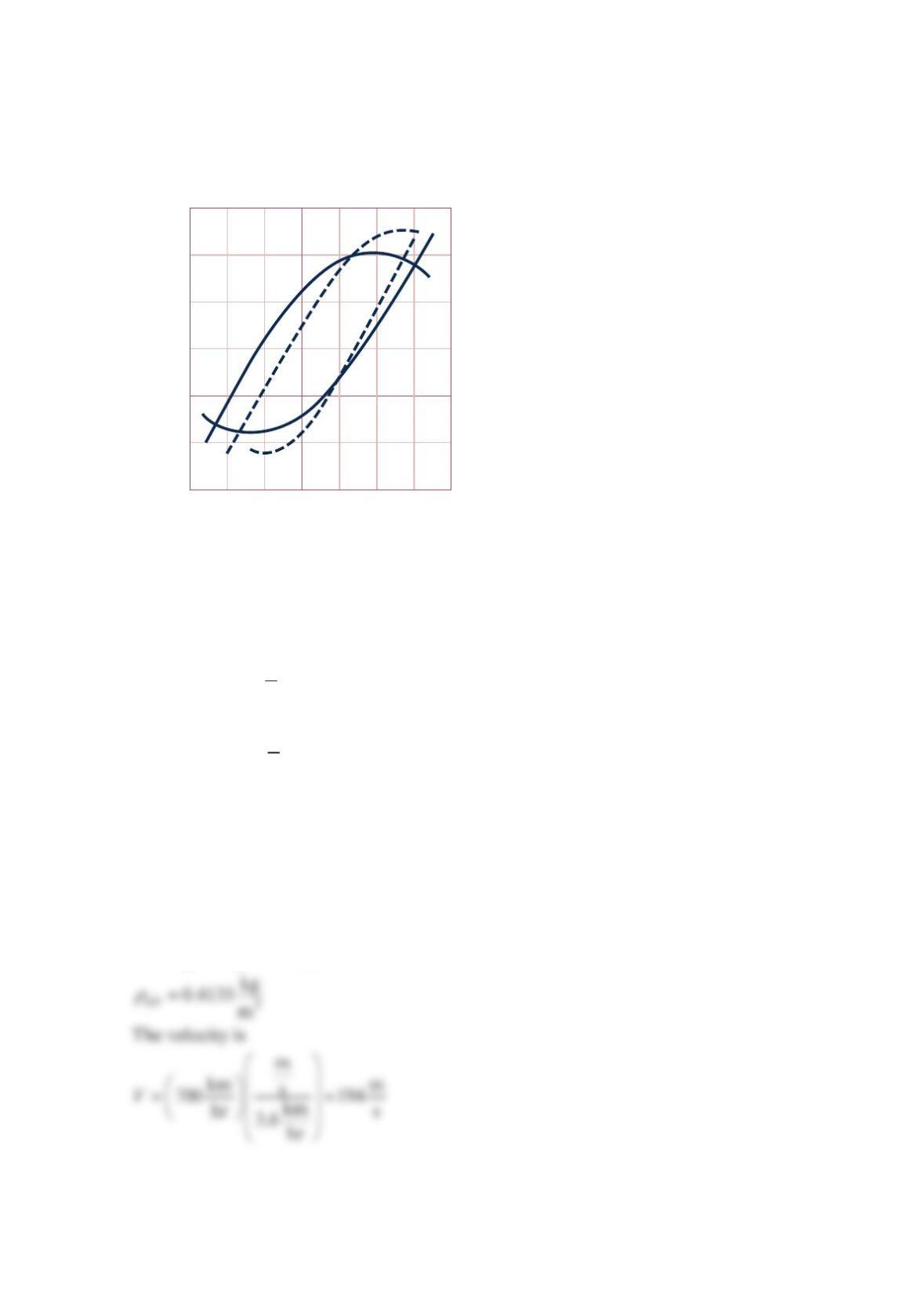
The airplane is to fly at 700 km/hr at an altitude of 10,000 m in the Standard Atmosphere.
The lift and drag coefficients are shown in the figure above. Both sets of lift and drag
coefficients give the total lift
Λ
and the total drag
Δ
on the airplane per unit area of the wing
so that
2
airplane L wing
1
=2CAV
ρ
Λ
and
2
airplane D wing
1
=2CAV
ρ
Λ
where
V
is the airplane velocity. Which wing design would you recommend? Support your
recommendation.
Solution 9.108
The density of air at 10,000 m is found from Table C.2 Properties of the U.S. Standard
Atmosphere (SI Units),
C
L
C
D
C
DA
C
LB
C
LA
–1.0
–12 –8 –4 0 4 8 12 16
–0.5
0
0.5
1.0
1.5
2.0
–0.010
–0.005
0
0.005
0.010
0.015
0.020
C
DB
Angle of attack (degrees)
α
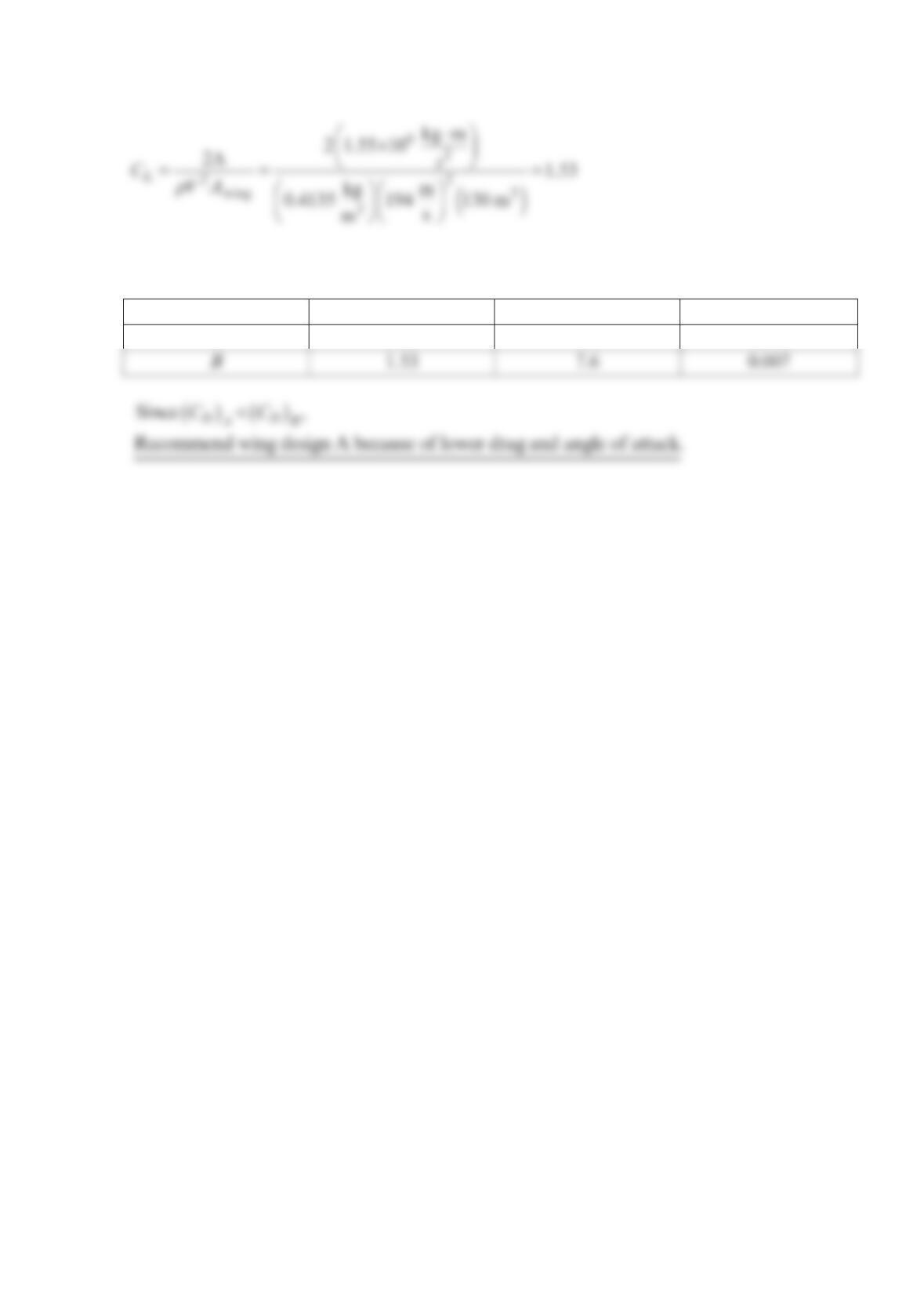
The lift coefficient is
Use the figure in the problem and a lift coefficient of 1.53 to find the angle of attack and
drag coefficient for both designs.
Wing Lift Coeff. Angle of Attack Drag Coeff.
A 1.53 6.1 0.005
Problem 9.109
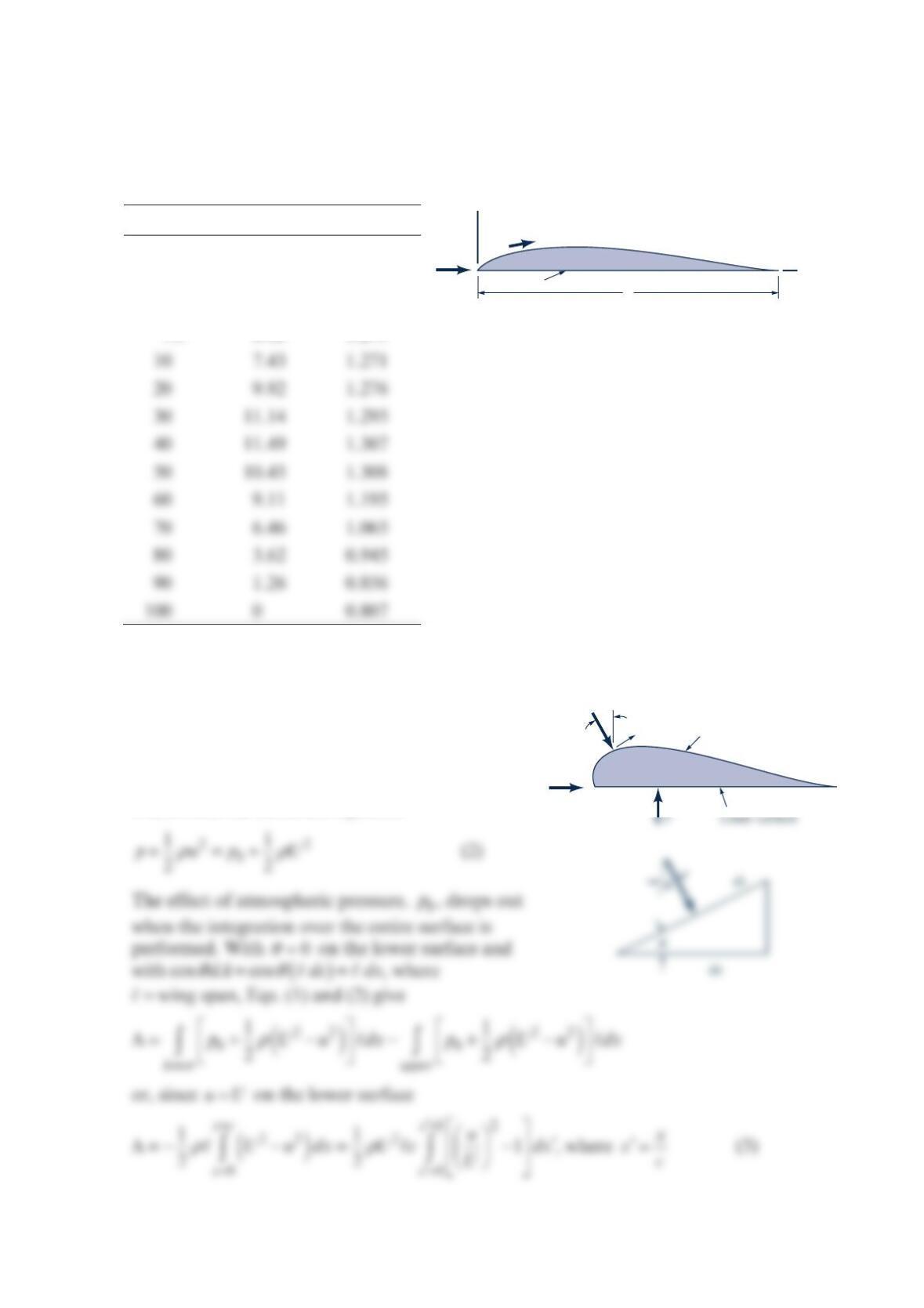
Air blows over the flat-bottomed, two-dimensional object shown in the figure below. The
shape of the object,
()
y
yx=, and the fluid speed along the surface,
()
uux=, are given in
the table. Determine the lift coefficient for this object.
Solution 9.109
If viscous effects are negligible, then
cos cos
lower upper
p
dA p dA
θθ
Λ
=−
(1)
where from the Bernoulli equation
U
y
x
c
u
=
u
(
x
)
u
=
U
x (% c) y (% c) u/U
0 0 0
2.5 3.72 0.971
5.0 5.30 1.232
7.5 6.48 1.273
U
, p
0
u
Upper surface
θ
p