
C H A P T E R 8
INTERNATIONAL STRATEGY
lllustration 8.1
Chinese retail: global or local
1. What are the pros and cons of the different China strategies pursued by Carrefour and Walmart?
You may want to ask any Chinese students in your class for opinions on these questions but
otherwise:
The advantages of Walmarts strategy lie in the potential scale economies that will come
from standardisation of purchasing and distribution systems. This will be consistent with its
2. What might be the dangers for a large Western retailer in staying out of the Chinese market?
One obvious danger for a Western retailer staying out of China is simply the missed growth
opportunity of this huge market. But students should recognise at least two more subtle
points. In the first place, retailers with the vast scale of the Chinese market should be able to
Illustration 8.2
The international Joint Effort Enterprise
1. What internationalisation drivers (Figure8.2) do you think were most important for Blue
Skies decision to enter its specific markets?
112
For the first question on the internationalisation drivers, Section 8.2 and Figure 8.2 provide
some leads. There are several aspects of internationalisation drivers that students may pick
up, but for Blue Skies cost drivers and market drivers are the most prominent. First, there
clearly are cost advantages in locating both purchasing and processing in Africa and South
America. Labour is of course considerably cheaper in these countries and there most
certainly are scale economies in purchasing, production and logistics when supplying large
retailers all over Europe. Second, Blue Skies can take advantage of common international
customer needs and tastes for fresh-cut juice products produced locally based on specific
2. How does Blue Skies strategy fit into a broader international value system including
suppliers, channels and customers (see also Figure 3.5)?
The second question encourages students to attempt an analysis of how Blue Skies fit into a
broader international value system (Section 8.3.2). This refers back to Chapter 3 and how
the value chains of suppliers, channels and customers relate to the organisations own value
chain (Section 3.4.2 and Figure 3.5). Blue Skies build on geographical advantages achieved
through their dispersion across three continents. For example, there are local cost
3. To what extent is JEE key to Blue Skies international strategy and competitive advantage
or rather a social entrepreneurship effort?
This question extends the illustration by asking students to think about the JEE foundation
and philosophy upon which the company is based (see also Section 9.5.3). It highlights the

113
Illustration 8.3
Nordic Industrial Park: bridging distance across international markets
1. Consider NIPs services in light of the CAGE framework and analyse how they may help
reduce distance.
Question 1 concerns international distance and requires students to apply the CAGE
framework and analyse what type of distances the Nordic Industrial Park (NIP) may help to
shrink. Although cooperation with local partners can assist in several ways there are two
2. What might be the drawbacks in being located in an industrial park?
Question 2 extends the illustration by asking students to think about possible drawbacks of
Illustration 8.4
Vale a Brazilian giant in different cultures
1. Suggest three reasons for Vales different reception in Canada and Mozambique.
The following three reasons are suggested for Vales different reception in Canada and
Mozambique:
Cultural reasons: there were historical and linguistic ties between Mozambique and
2. What can Vale do to mitigate the problems the company encounters when expanding
globally?
The point of this question is to encourage students to see and reflect over the downside risks
and problems when expanding globally what Vale might do to mitigate this. In particular,
there are risks even when markets are fast-growing and tempting to enter (such as the
Chinese market).
One way to mitigate the risks of international operations is of course to build presence in
Illustration 8.5
Base of the pyramid strategies
The point of this illustration is to challenge the old life cycle model of internationalisation
where products, especially last-generation products, would be simply dumped in developing
markets. Question 2 indeed suggests a reverse-direction of thinking.
1. Can you imagine any risks or dangers that Western companies might face in pursuing base
of the pyramid strategies?
The main risk might lie in the challenge of maintaining clear market segmentation,
internationally and within countries too. Cheap products designed for the base of the
pyramid in, for example, India could affect the market for more mainstream products
2. Is there anything that Western companies might learn from base of the pyramid strategies in
emerging markets that might be valuable in their home markets?
Jeffrey Immelt (CEO of General Electric) has an interesting article on How GE is
Key Debate
Global, local or regional?
This is a classic debate in international business, where Ted Leavitts extreme position is seen
either as gross exaggeration or prophetic. The nay-sayers may be still right today, but the
question is where are things going? Current empirical evidence points to a compromise
solution where multinational corporations concentrate sales and assets in their home region
(such as Europe, North America or Asia). This is a good issue to explore with an international
class. As for the questions precisely:
1. It is fairly easy to establish a list of increasingly global products: end-chapter case of the
brewing industry in Chapter 2 provides one example; smart phones and Apple iPads are
other examples (though even with the most apparently global products, there will often be
regional variations, and it would be worth asking an international group about these). But

116
2. Most students will have visited many more countries than their parents at the same stage of
life. You can talk about how the mobility of young people helps change local product,
Video assignment
CISCO
Cisco is an IT network and communications corporation founded in the USA in 1984 which has
now grown into a global giant with turnover in excess of $46bn. In the video Iain Kennedy,
Chief Technical Officer at Cisco responsible for Europe, The Middle East, Africa and Russia,
discusses the potential of various international markets and appropriate entry methods.
1. This question addresses issues of market selection (see Section 8.5). In the regions Kennedy
deals with there are big differences in the rate of growth of economies. The video was shot
in 20122013 and came at the end of a global recession with some countries in Europe still
2. This question addresses the drivers of internationalisation (see Section 8.2 and Figure 8.2).
The video provides some insight but students should be encouraged to draw on a wider
knowledge of the IT industry to answer the question. Yip identifies four classes of driver
market, cost, competitive and government drivers. Ciscos experience is mainly about
technologies (market driver) is likely to accelerate the process.
Assignment 8.1
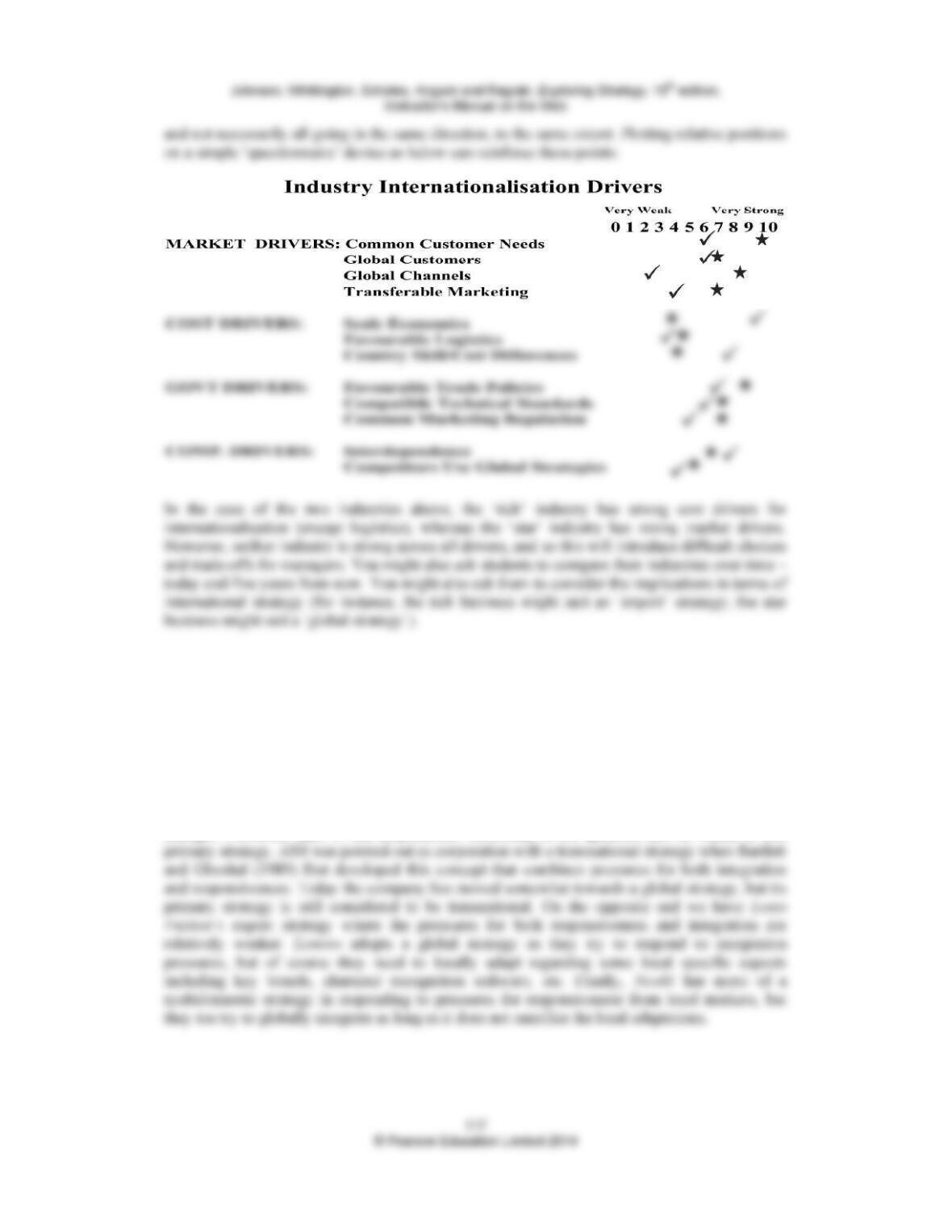
Yips drivers
This assignment should reinforce the points that (i) not all industries or markets face the same
pressures for internationalisation and (ii) that the drivers for such internationalisation are many
Assignment 8.2
International strategies
This will be a somewhat demanding assignment, but likely quite engaging. It should help
reinforce the important idea that there are several forms of international strategy (Section 8.4,
Figure 8.4). Multinational corporations seldom adopt one pure international strategy and they
also commonly gradually shift their international strategies depending on environmental
changes. However, each of the corporations mentioned in the question can be linked to one
Assignment 8.3
CAGE
This assignment should help reinforce the important point that markets are not just attractive for
Assignment 8.4
Entry modes
In this assignment students should be able to identify what diverse international entry modes
Assignment 8.5
This question allows students to discuss globalisation on a more general level in light of the
extensive debate involving globalisation proponents and sceptics. The focus in this question,
however, is if globalisation most often is beneficial specifically for companies. Often
Assignment 8.6
Public and not-for-profit
Many not-for-profit sectors, such as aid charities, are inherently international and others have
been for a very long time. For the public sector (apart from the armed forces and the diplomatic

Integrative assignment 8.7
One important theme in Chapter 13 is that structure should follow strategy, ideally anyway. In
terms of the four international strategies (see Figure 8.4), the following fits are likely (see also
Figure 13.5):
Export strategy: this would generally work with a basic functional structure of some kind,
where production and R&D are centralised in the home country in order to take maximum
advantage of economies of scale and with the international operations organised in a
separate international division.
Note that it is not always possible to find a clear organisation chart. Where these are absent,
there may be clues to the organisational structure in the way the company reports its financial
results (e.g. turnover and profits reported by geographical area suggests a geographical
Case Example
China comes to Hollywood: Wandas acquisition of AMC
Chinese Wandas acquisition of US AMC is a very interesting case of an emerging country
120
1. Considering Yips globalisation framework (Figure 8.2), what drivers of internationalisation
do you think were most important when Wanda entered the US market through its AMC
acquisition?
All internationalisation drivers (see Section 8.2 and Figure 8.2) play some role in the case.
First, market drivers are important as the Chinese increasingly watch foreign movies and
thus share similar customer needs and tastes with American customers. This also suggests
development of commercial property, hotels and shopping malls in the US.
2. What national sources of competitive advantage might Wanda draw from its Chinese base?
What disadvantages derive from its Chinese base?
Apart from access to capital and resources (AMC has been in repeated financial troubles)
there are not many apparent national sources of competitive advantages and some potential
3. In the light of the CAGE framework, what challenges may Wanda meet as it enters the US
market?
According to the CAGE framework, the differences between China and the US seem to be
rather challenging for Wandas entry into the US.
Cultural: language is obviously a key problem, but there are also clear issues with
differences in managerial behaviour (Americans talking more, being wedded to strict

US headquarter managers and administrators being located in the US heartland in
Kansas City. This suggests that there are clear differences in political and administrative
traditions that may prove rather challenging.
The CAGE factors indicate that the most serious challenges are likely to be of a cultural and
political nature and they become particular transparent within a cultural and media business
such as cinema. These problems relate both to the integration of the AMC operations and