Chapter 8
Long-Term (Capital Investment) Decisions
Concept Questions
1. (LO 1—NPV and the cost of capital)
The cost of capital is the average rate of return that the company must pay to its
2. (LO 1 and 2—The relationship between IRR and NPV)
3. (LO 2—NPV and IRR)
When projects are of the same magnitude, investment lives are equal and cash
4. (LO 2—IRR)
When using IRR, projects are accepted when the IRR is greater than or equal to
5. (LO 3—NPV and profitability index)
The profitability index (PI) is a modification of the NPV technique. It is calculated
6. (LO 3—Screening vs. preference decisions)
Screening decisions are those relating to whether a proposed project meets a
Solutions Manual
8-2
7. (LO 4—The depreciation tax shield)
The depreciation tax shield is the tax savings that a company receives from
8. (LO 5—Payback method)
The payback period is the length of time necessary for a long-term project to
Exercises
1. (LO 1—NPV: No salvage value or taxes)
Cash Flow
Year
Present Value
2. (LO 1 and 2—NPV and IRR assumptions)
There are two underlying assumptions:
3. (LO 2—IRR with uneven cash flows)
Since the cash flows are unequal, a financial calculator or Excel must be used to
calculate IRR. Using Excel, the IRR is 9.96 percent.
Chapter 8: Long-Term (Capital Investment) Decisions
8-3
Cash Flow
Year
Value
4. (LO 2—IRR: Even cash flows)
With revenues increasing by $2,000 per year, dividing the machine cost of
4.5 = DFA6,r? r = approx. 9 percent
5. (LO 2 and 4—IRR: Tax effects)
6. (LO 3—Profitability index)
The present value of future cash flows, which is $17,000, is divided by the initial
7. (LO 3—Profitability index)
The profitability index of 1.3 equals the present value of cash inflows divided by
Solutions Manual
8-4
Year 1
$25,000 × DF1,12 percent =
$25,000 × 0.8929* =
$ 22,323
Year 2
$20,000 × DF2, 12 percent =
$20,000 × 0.7972* =
Year 3
$10,000 × DF3, 12 percent =
$10,000 × 0.7118* =
$ 45,385
$45,385/$35,000 = 1.3
8. (LO 4—Depreciation tax shield)
9. (LO 4—After-tax NPV)
After-Tax
Years Cash Flow Present Value
Cost to purchase Now $(1,000,000.00) $(1,000,000.00)
10. (LO 5—Payback method with uneven cash flows)
11. (LO 5—Payback method)
Chapter 8: Long-Term (Capital Investment) Decisions
8-5
Problems
12. (LO 1, 2, and 3—Preference decisions: NPV vs. IRR vs. profitability index)
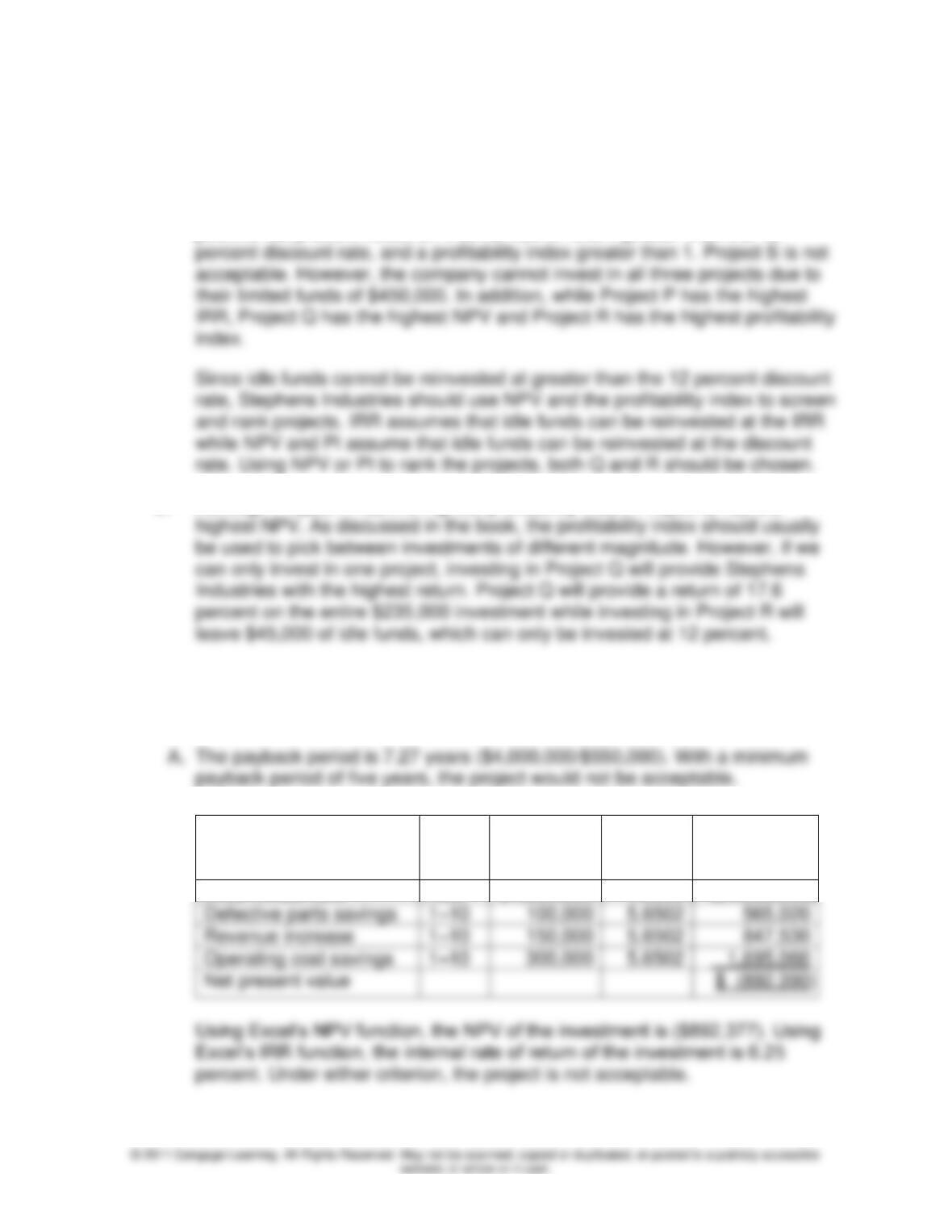
A. Projects P, Q, and R are all acceptable investments because they have
positive net present value, an internal rate of return greater than the 12
B. Although Project R has the highest profitability index, Project Q has the
13. (LO 1, 2, and 5—NPV vs. payback method: Impact of varying cash flow
assumptions)
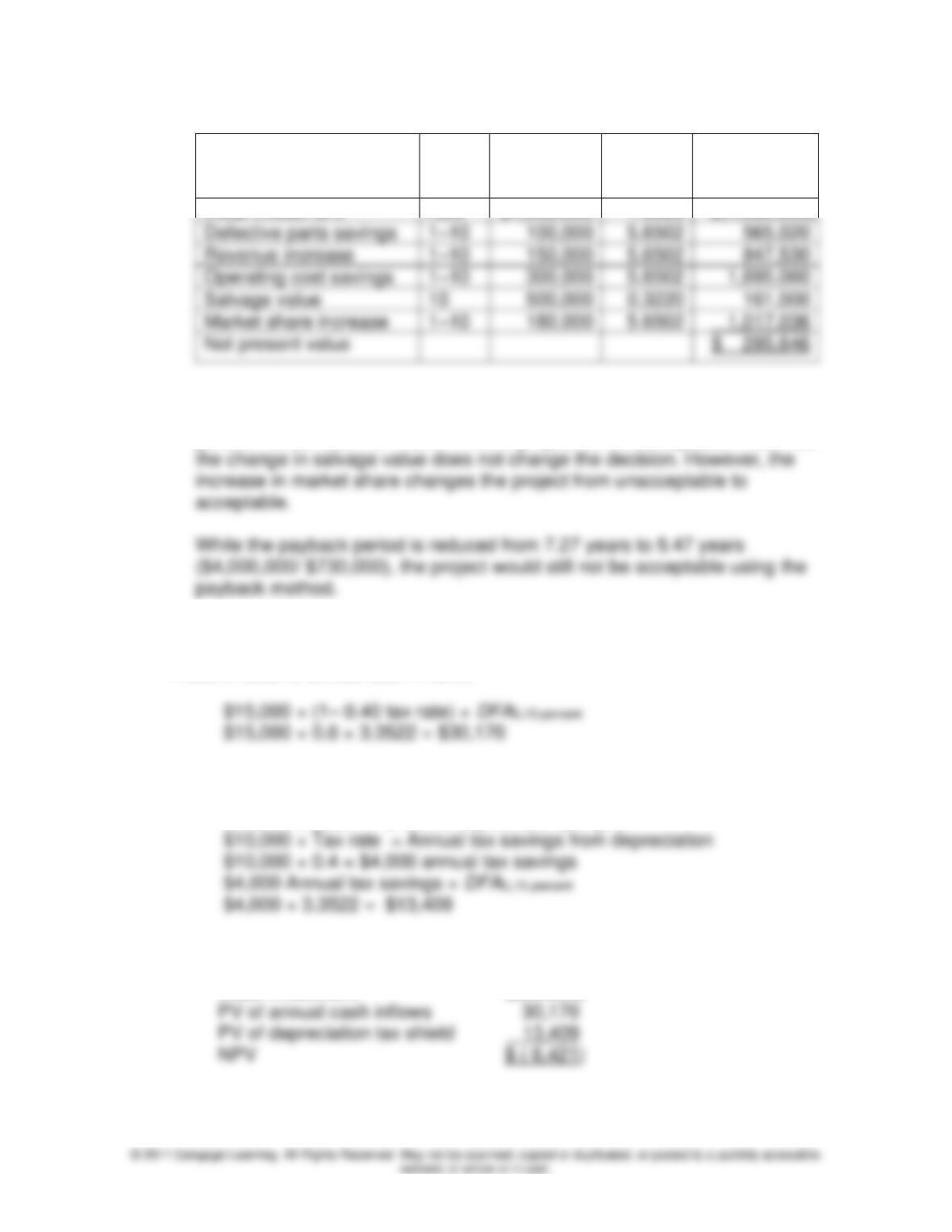
B.
Cash Flow
Year
Amount
12
Percent
Factor
Present
Value
Initial investment
New
$4,000,000
1.0000
$(4,000,000)
Defective parts savings
5.6502
Revenue increase
5.6502
Operating cost savings
5.6502
Solutions Manual
8-6
C.
Cash Flow
Year
Amount
12
Percent
Factor
Present
Value
Initial investment
New
$4,000,000
1.0000
$(4,000,000)
Defective parts savings
5.6502
Revenue increase
5.6502
Operating cost savings
5.6502
Salvage value
Market share increase
5.6502
Using Excel’s NPV function, the NPV of the investment is now $285,649.
Using Excel’s IRR function, the investment’s internal rate of return is 13.65
percent. Under both NPV and IRR, the project is now acceptable. Note that
14. (LO 1 and 4—After-tax NPV)
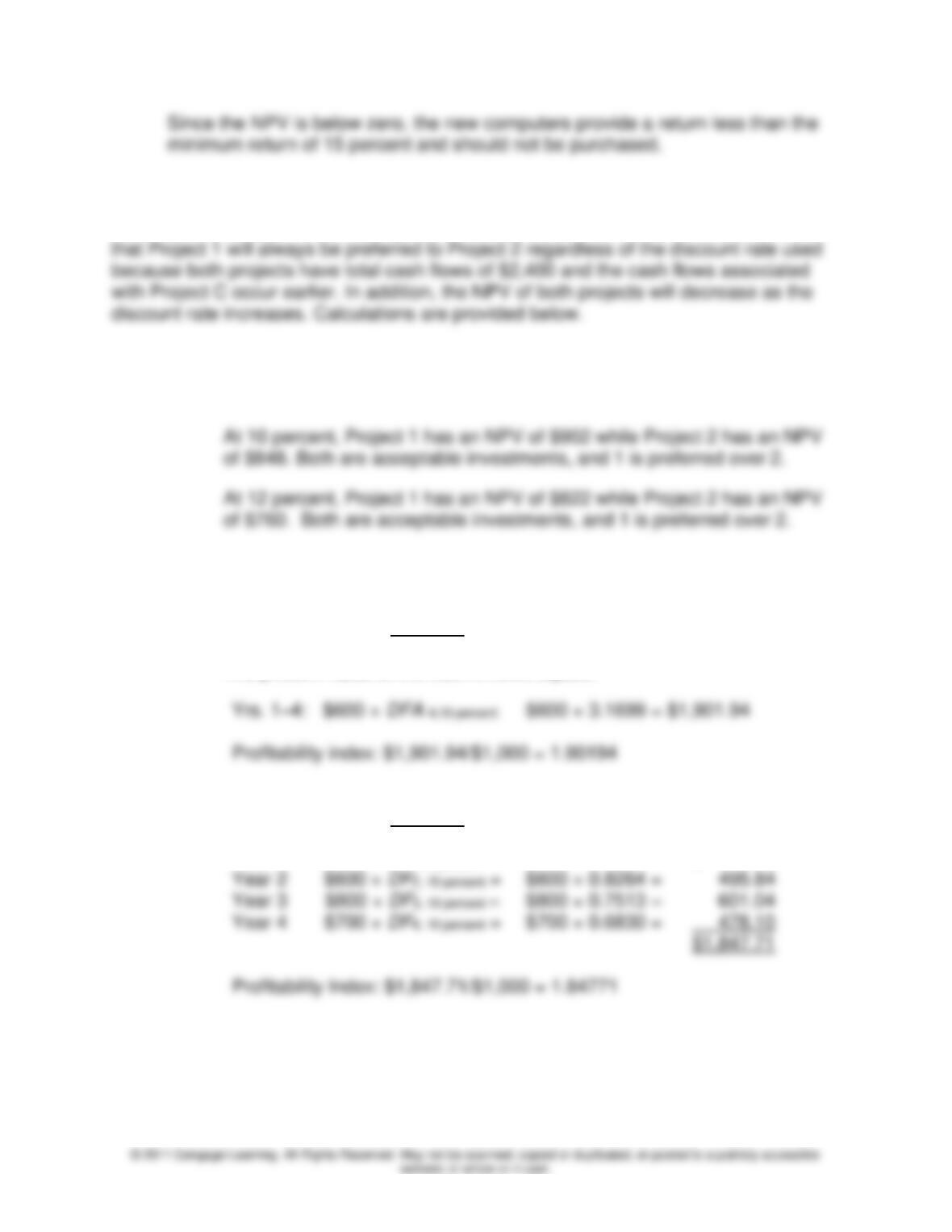
Present value of annual cash inflows:
Present value of the depreciation tax shield:
$50,000/5 years = $10,000 depreciation per year
Compute the NPV as follows:
Initial investment
$(50,000)
PV of annual cash inflows
PV of depreciation tax shield
NPV
$ ( 6,421)
Chapter 8: Long-Term (Capital Investment) Decisions
8-7
15. (LO 1, 3, and 5—NPV vs. payback method vs. profitability index)
Note to Instructors: Without doing any calculations, students should be able to see
A. At 8 percent, Project 1 has an NPV of $987 and Project 2 has an NPV of
$941. Both are acceptable investments, and 1 is preferred over 2.
B. Payback for Project 1 is 1.67 years. Payback for Project 2 is 2.167 years.
Given Alfred’s cautious nature, we would still recommend Project 1.
C. Profitability index of Project 1 is 1.90194, calculated as follows:
The present value of the cash inflows equals:
Yrs. 1–4:
$600 × 3.1699 = $1,901.94
Profitability index: $1,901.94/$1,000 = 1.90194
Profitability index of Project 2 is 1.84771, calculated as follows:
Year 1
$300 × DF1,10 percent =
$300 × 0.9091 =
$ 272.73
Year 2
$600 × 0.8264 =
Year 3
$800 × 0.7513 =
Year 4
$700 × 0.6830 =
Profitability Index: $1,847.71/$1,000 = 1.84771
Alfred should pursue Project 1 based on the profitability index.