
33
Chapter 8: An Equilibrium Business Cycle Model
Chapter Summary:
This chapter provides a “real” business cycle model that will serve as the basis for
constructing each of the alternative theories described in subsequent chapters. The key
assumption here is one of flexible prices so that all markets clear. Fluctuations in GDP and
employment are caused by temporary technological shocks which change the marginal
product of resources. This sets in motion a series of adjustments which matches closely the
real world data on business cycles. A temporary technological improvement leads to
increased marginal productivity of resources, and cause the demand for labor and capital
Chapter Outline:
I. Cyclical Behavior of Real GDP-Recessions and Booms
A. Conceptual Issues
B. The Model
i. The marginal product of labor and the real wage rate
II. Temporary Changes in the Technology Level
III. Variation in Labor Input
A. Labor Supply
i. The Substitution effect for leisure and consumption
ii. Income effects on labor supply

34
Teaching Tips:
1. Review the patterns reviewed by business cycle data with students. Make them aware
that the efforts of economists to develop a model capable of explaining and predicting these
2. One of the interesting aspects of this model is the ability to generate a business cycle
3. A historical perspective would be helpful to students see the logic of the equilibrium
business cycle theory. A discussion of figure 8.4 is useful, but some context for students
4. Students understand positive technological shocks, but find negative shocks difficult to
envision. Emphasize that these “shocks” could have other sources beyond technological
change. The recent example of Hurricane Katrina and its impact on the capital stock of the
5. Real business cycle theory is dynamic- the modeling techniques used are somewhat
beyond the range of students enrolled in the course. But instructors should note that it may
Answers to review questions, pg. 199
1. This year’s labor supplied depends on the leisure consumed. We would expect that
market events would have at least one of 3 potential effects: income effects, substitution
effects, or intertemporal substitution effects.
a. Higher interest rates primarily cause an intertemporal substitution effect: the

35
b. A permanent increase in the real wage rate will have both an income and
substitution effect. On the one hand, people can afford more leisure (income effect) which
B. Problems for discussion, pg. 199-200
2. a. Labor force participation rates should respond to changes in the real wage rate just as
the quantity of labor supplied does. In this case, the real wage was increasing throughout the
period, so we should see an increase in labor supply due to the substitution effect. However,
b. The fact that the average work week did not change implies that the labor supply of
working individuals is inelastic with respect to the real wage. This hard to reconcile with the
data on labor force participation, which indicates a strong substitution effect. However, if we
consider labor supplied by households rather than individuals, the results are more
consistent. In this case, the average two-earner household is supplying more labor in
response to the higher real wage rate.
c. We see that when we consider the labor supply decision of households, rather than
individuals, that we can reconcile the data found in parts a and b. However, this does not
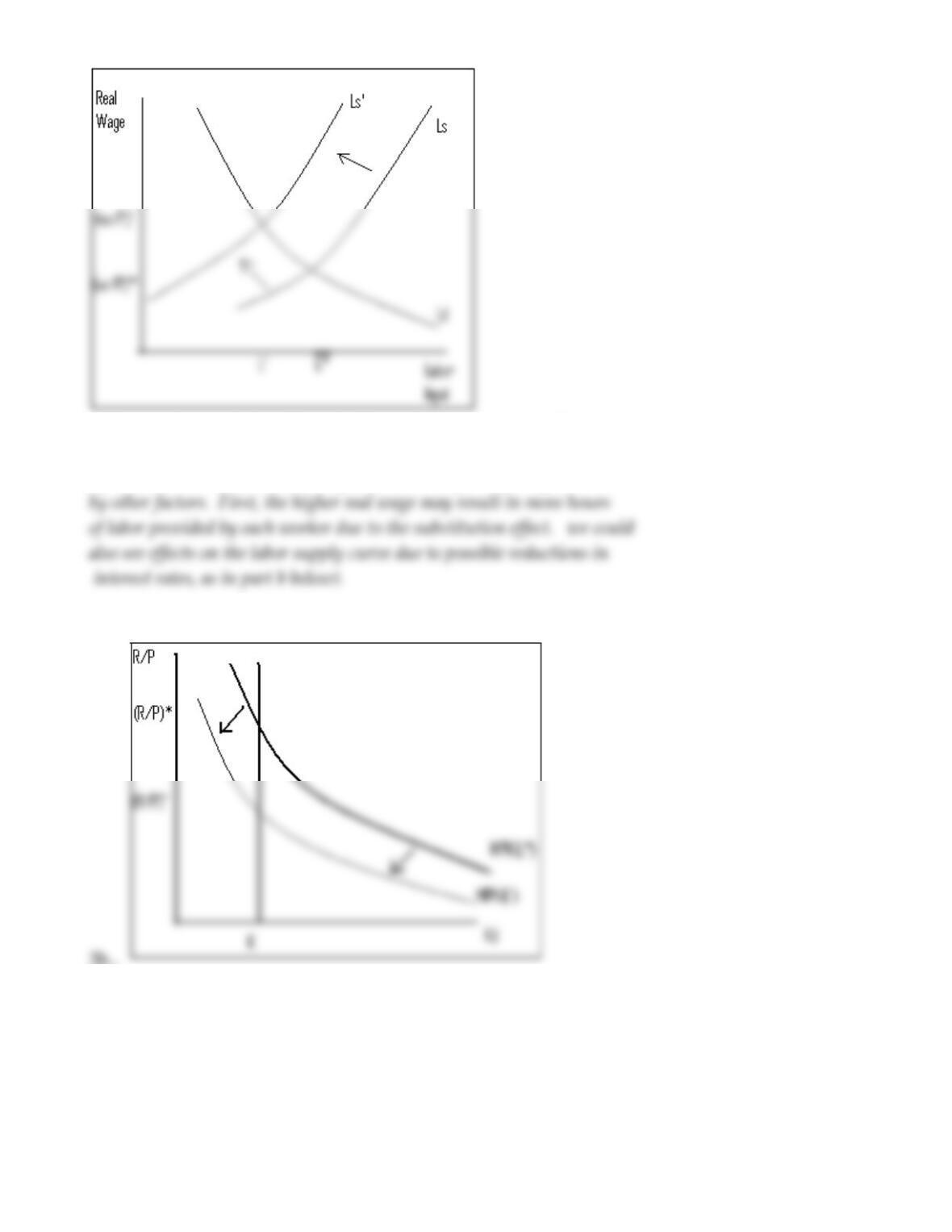
3. A reduction in the labor force:
36
A decrease in population shifts the labor supply curve to the left.
This causes an increase in equilibrium real wages and a decrease in
equilibrium real output. (These effects on the wage may be offset somewhat
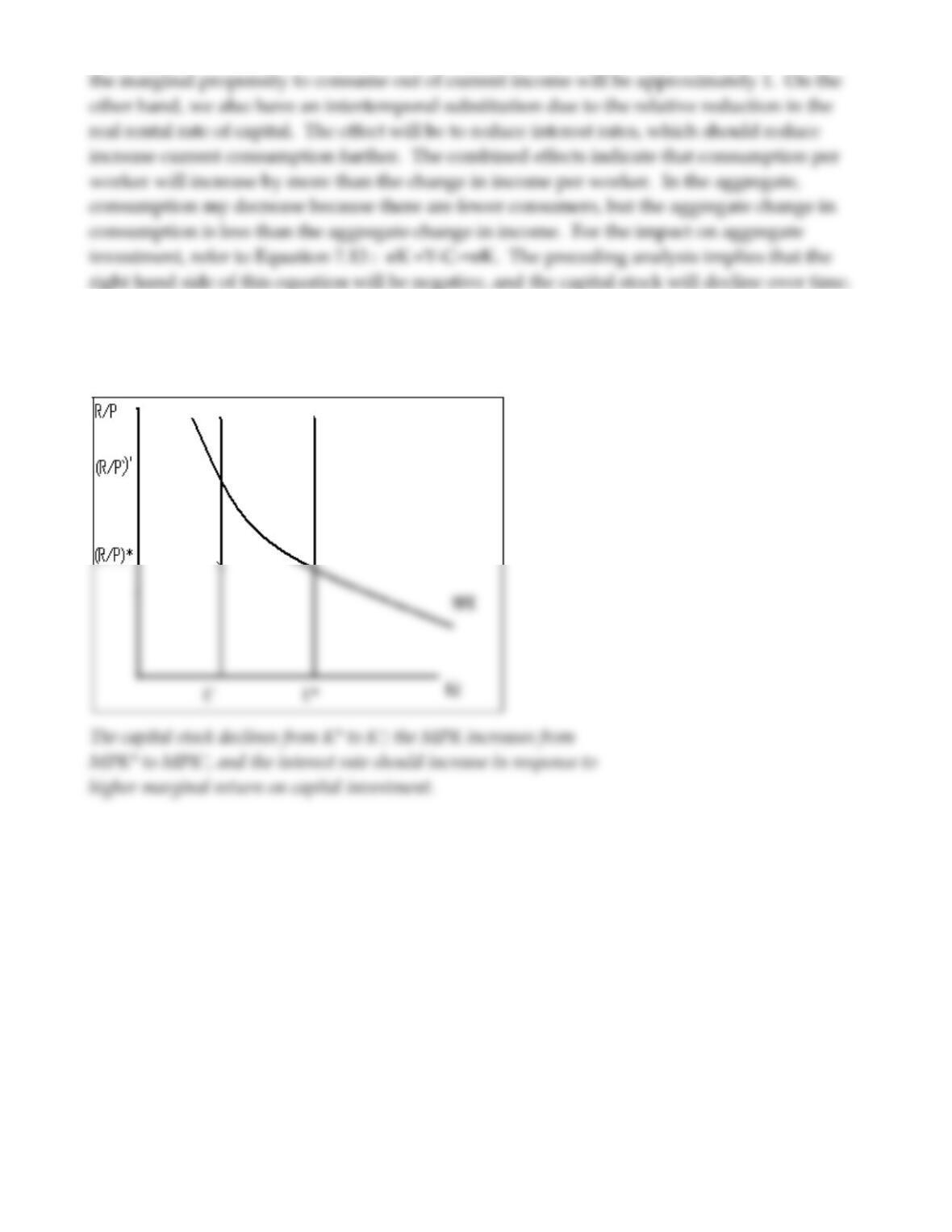
3b..
A reduction in labor per unit of capital reduces the marginal product of
capital and causes the MPK curve to shift left from MPK(L*) to MPK(L’).
The real rental rate of capital falls from (R/P)* to (R/P)’.
3c. If we continue to assume constant returns to scale in the production function, then it can
be shown that output per worker (y) increases as the capital per worker (k) increases. Since
the population reduction is permanent, both current and future incomes are affected, so that
37
4. A reduction in the capital stock:
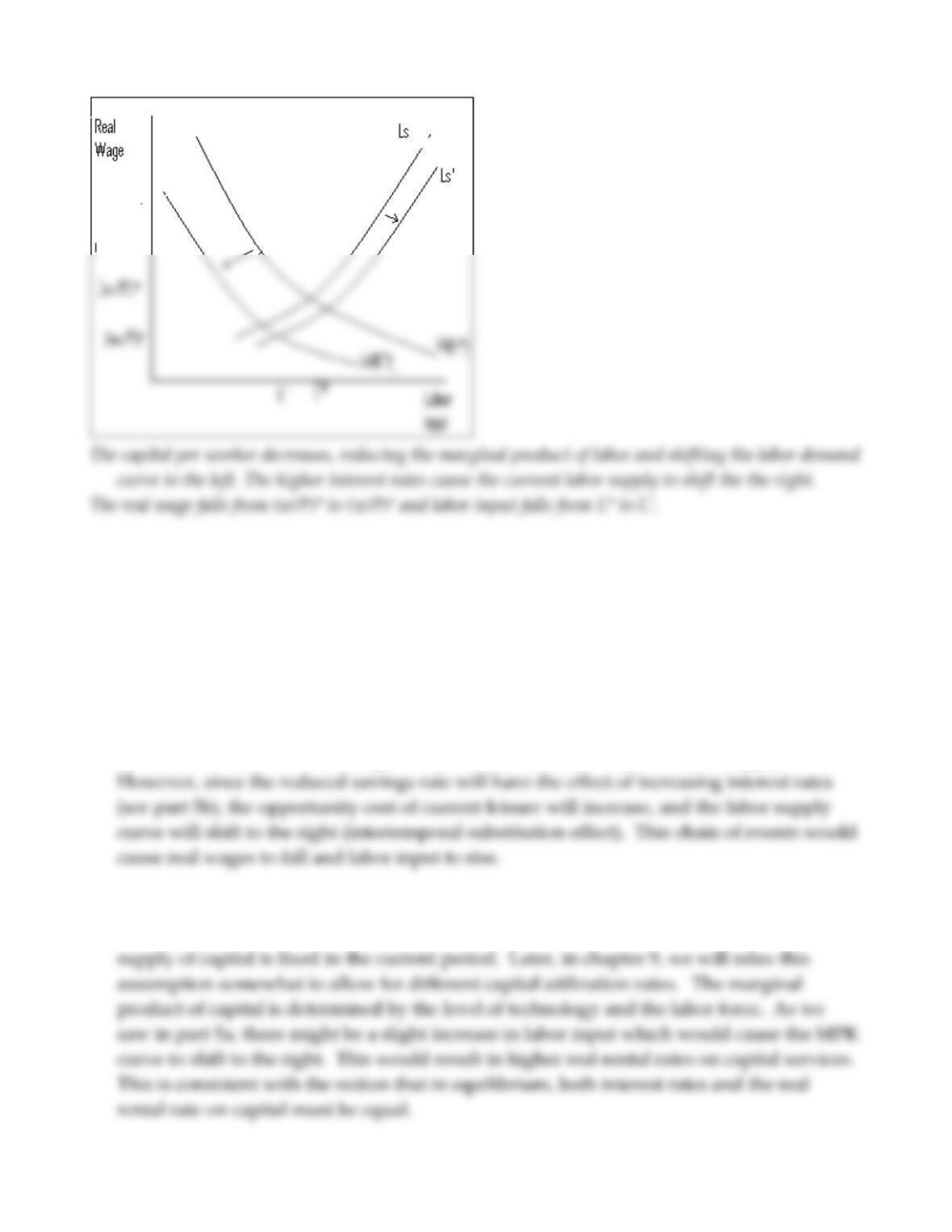
4a.
38
4b.
4c. In this case, we have the opposite effects found in part 3c; income per worker falls, and
consumption per worker will fall for two reasons: the decrease in income as well as the
intertemporal substitution effect. The net effect is a decrease in aggregate consumption
which is greater than the decrease in current income: the capital stock will increase over
time.
5. A Reduction in Desired Saving
5a. Since the reduction in the desired savings rate has no effect on labor productivity, the
demand for labor will not change. There will be no direct effects on labor supply.
5b. A decrease in savings rates would cause an excess supply of bonds in the market, which
would raise interest rates. In the graph for capital services, In we will assume that the

6. A willingness to work more.
6a. The direct effect of this change would be to shift the supply curve of labor to the right;
real wages fall and labor input increases.