CHAPTER 8
Valuation of Inventories: A Cost-Basis Approach
SOLUTIONS TO B PROBLEMS
PROBLEM 8-1B
1. $260,000 – ($260,000 X 0.25) = $195,000;
$195,000 – ($195,000 X 0.10) = $175,500, cost of goods purchased
3. Because no date was associated with the units issued or sold, the
periodic (rather than perpetual) inventory method must be assumed.
FIFO inventory cost:
500 units at $65
$ 32,500
1,000 units at 66
66,000
Total
$ 98,500
LIFO inventory cost:
$ 62,000
500 units at 63
31,500
Total
$ 93,500
Average cost:
1,000 at $62
$ 62,000
3,000 at 63
2,000 at 65
66,000
Totals
Ending inventory (1,500 X $63.86) is $95,790.
PROBLEM 8-1B (Continued)
4. Computation of price indexes:
12/31/2014
$375,440
= 104
$361,000
12/31/2015
$449,080
= 109
Dollar-value LIFO inventory 12/31/2014:
Increase in terms of 104
Base inventory
Dollar-value LIFO inventory 12/31/2015:
Increase $412,000 – $360,000 =
$ 52,000
12/31/2015 price index
Base inventory
5. The inventoriable costs for 2015 are:
Merchandise purchased …………………………...
$2,684,100
Add: Freight-in ………………………………………..
56,100
Deduct: Purchase returns ………………………..
Purchase discounts …………………….
PROBLEM 8-2B
MIAMI FIRE COMPANY
Schedule of Adjustments
December 31, 2014
Inventory
Accounts
Payable
Net Sales
Initial amounts
$2,590,000
$1,900,000
$16,680,000
Adjustments:
1.
NONE
21,500
NONE
2.
NONE
NONE
(34,000)
3.
NONE
4.
NONE
NONE
5.
NONE
(36,000)
6.
NONE
7.
NONE
NONE
8.
15,000
Total adjustments
156,800
81,700
1. The $21,500 of goods received on 12/29/2014 were properly included in
2. The $26,000 of tools on the loading dock were properly included in the
physical count. The sale should not be recorded until the goods are
picked up by the common carrier. Therefore, no adjustment is made to
inventory, but sales must be reduced by the $34,000 billing price.
3. The goods received from a vendor at 6:00 p.m. on 12/31/2014 should be
included in the ending inventory, but were not included in the physical
PROBLEM 8-2B (Continued)
4. The work-in-process inventory sent to an outside processor is Miami
5. The tools costing $21,000 were recorded as sales ($36,000) in 2014.
However, these items were returned by customers on December 31, so
2014 net sales should be reduced by the $36,000 return. Also, $21,000
has to be added to the inventory column since these goods were not
included in the physical count.
6. The $45,200 of goods in transit from a vendor to Miami Fire were
shipped f.o.b. shipping point on 12/26/2014. Title passes to the buyer
7. The $15,600 of Miami Fire’s tools shipped to a customer f.o.b.
destination are still owned by Miami Fire while in transit because title
8. Since one-third of the freight-in cost ($15,000) pertains to merchandise
properly included in inventory as of 12/31/2014, $5,000 should be
(a)
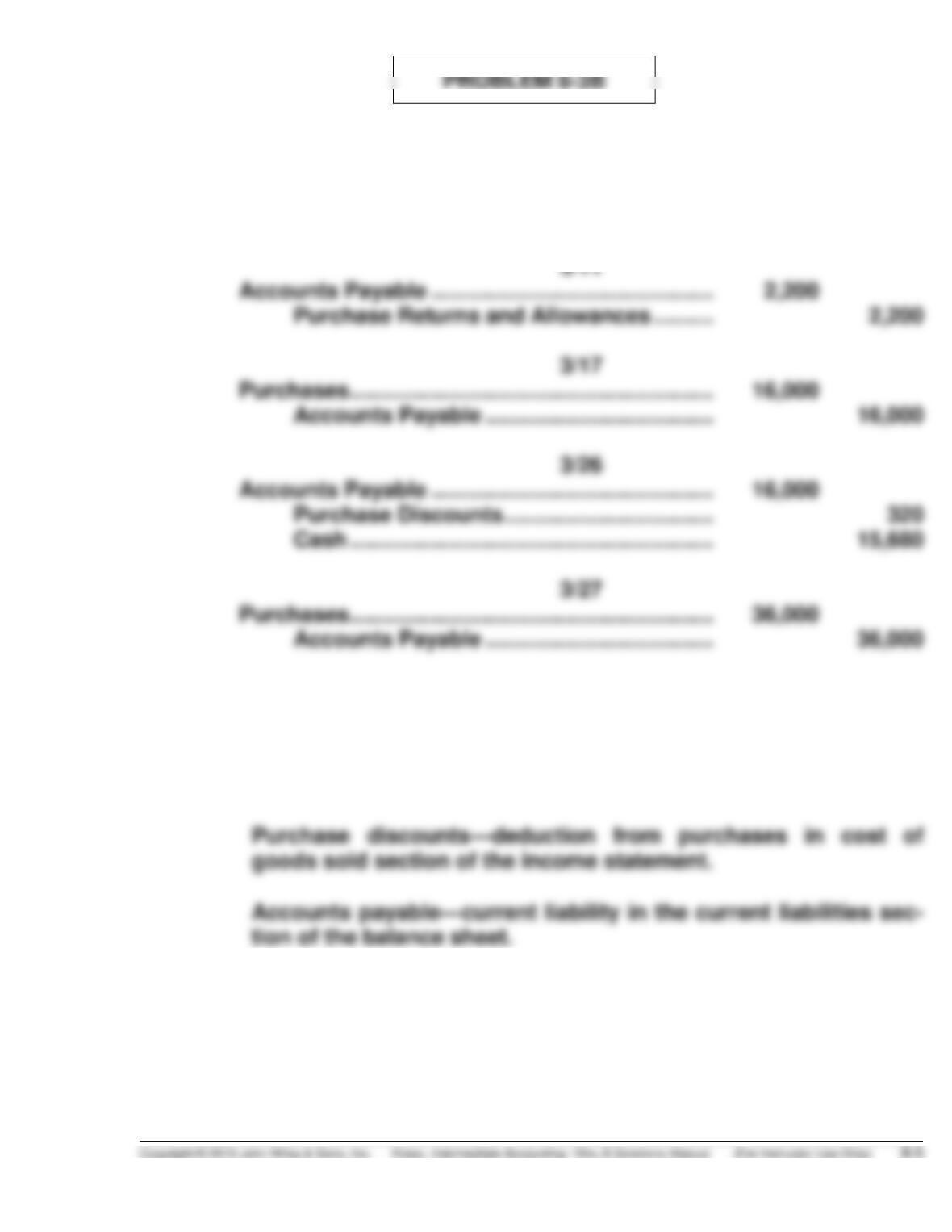
1.
3/8
Purchases ………………………………………………………
15,000
Accounts Payable …………………………………..
15,000
Accounts Payable …………………………………………..
Purchase Returns and Allowances …………..
Purchases ………………………………………………………
16,000
Accounts Payable …………………………………..
Accounts Payable …………………………………………..
Purchase Discounts ………………………………..
Cash ………………………………………………………
15,680
Purchases ………………………………………………………
36,000
2. Purchases—addition to beginning inventory in cost of goods
sold section of income statement.
Purchase returns and allowances—deduction from purchases in
cost of goods sold section of the income statement.
(b)
1.
3/8
Purchases ………………………………………………………
14,850
Accounts Payable ($15,000 X 0.99) …………..
14,850
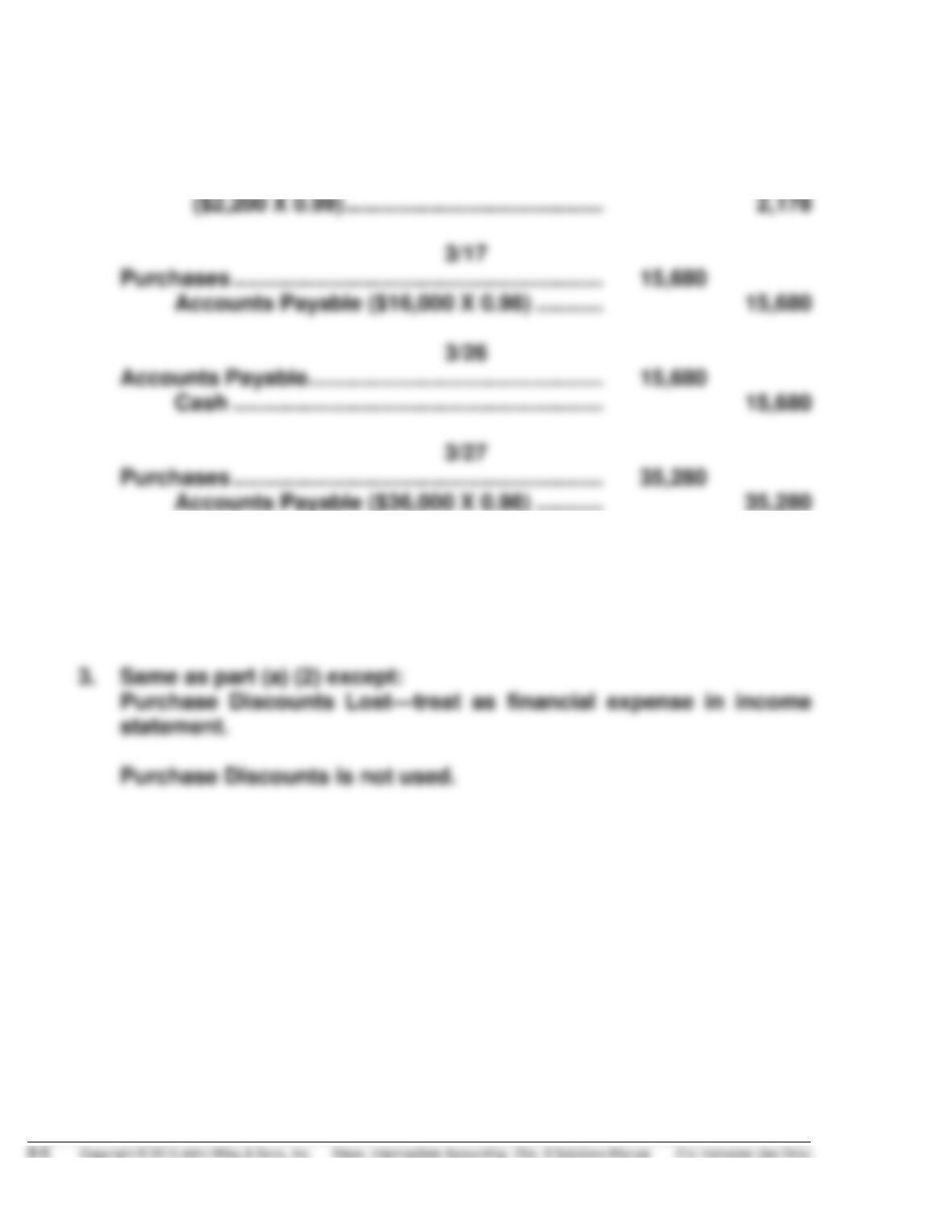
PROBLEM 8-3B (Continued)
3/11
Accounts Payable……………………………………………
2,178
Purchase Returns and Allowances
($2,200 X 0.99) ………………………………………
3/17
Purchases ………………………………………………………
Accounts Payable ($16,000 X 0.98) …………..
Accounts Payable……………………………………………
Cash ………………………………………………………
Purchases ………………………………………………………
Accounts Payable ($36,000 X 0.98) …………..
2.
3/31
Purchase Discounts Lost …………………………………
128
Accounts Payable
(0.01 X [$15,000 – $2,200]) ……………………..
128
Same as part (a) (2) except:
Purchase Discounts is not used.
(c)
The second method is better theoretically because it results in the
inventory being carried net of purchase discounts, and purchase
discounts not taken are shown as an expense. The first method is
normally used, however, for practical reasons.
PROBLEM 8-4B
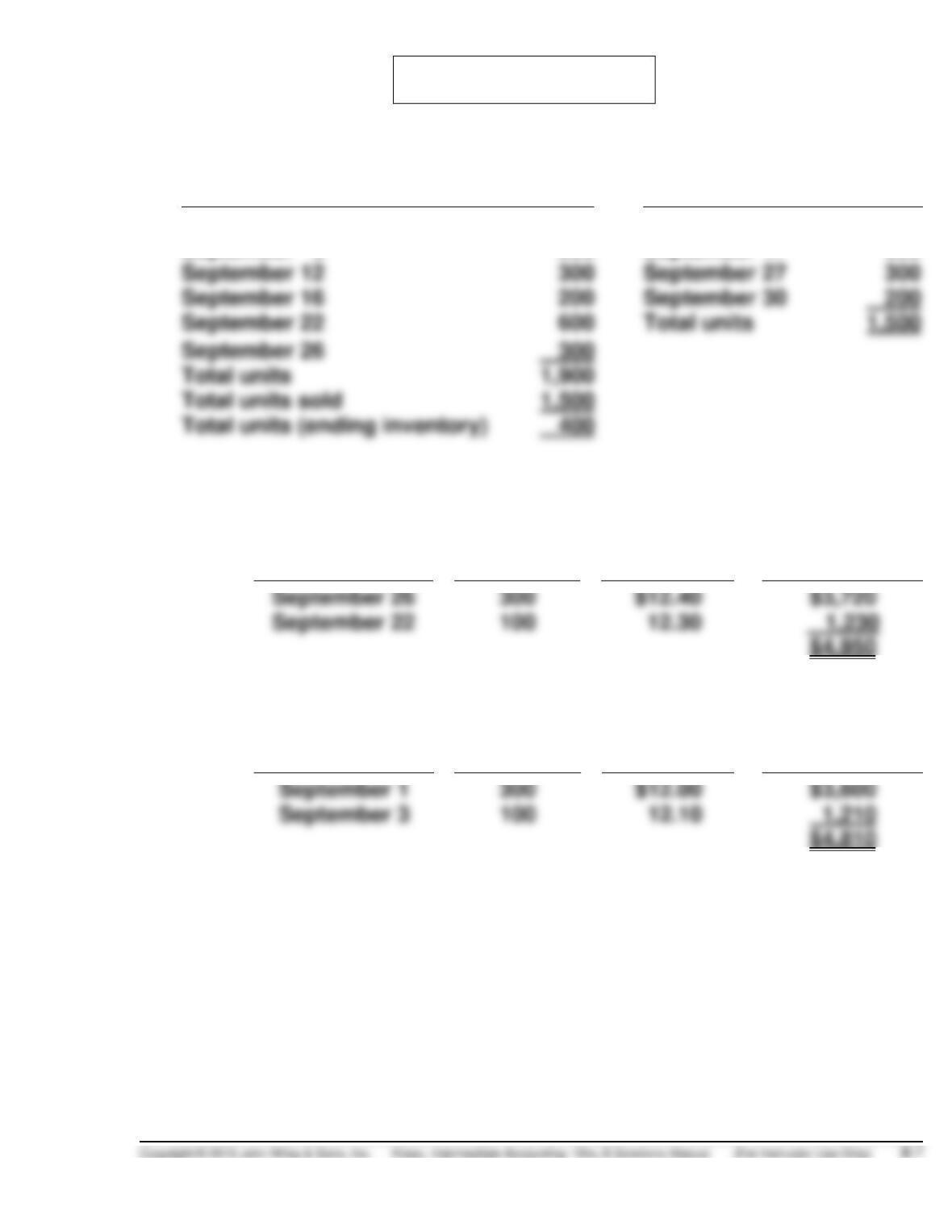
(a)
Purchases
Total Units
Sales
Total Units
September 1 (balance on hand)
300
September 4
400
September 3
200
September 17
600
September 12
300
September 27
300
September 16
200
September 30
September 26
Total units
Total units sold
Assuming costs are not computed for each withdrawal:
1. First-in, first-out.
Date of Invoice
No. Units
Unit Cost
Total Cost
2. Last-in, first-out.
Date of Invoice
No. Units
Unit Cost
Total Cost
PROBLEM 8-4B (Continued)
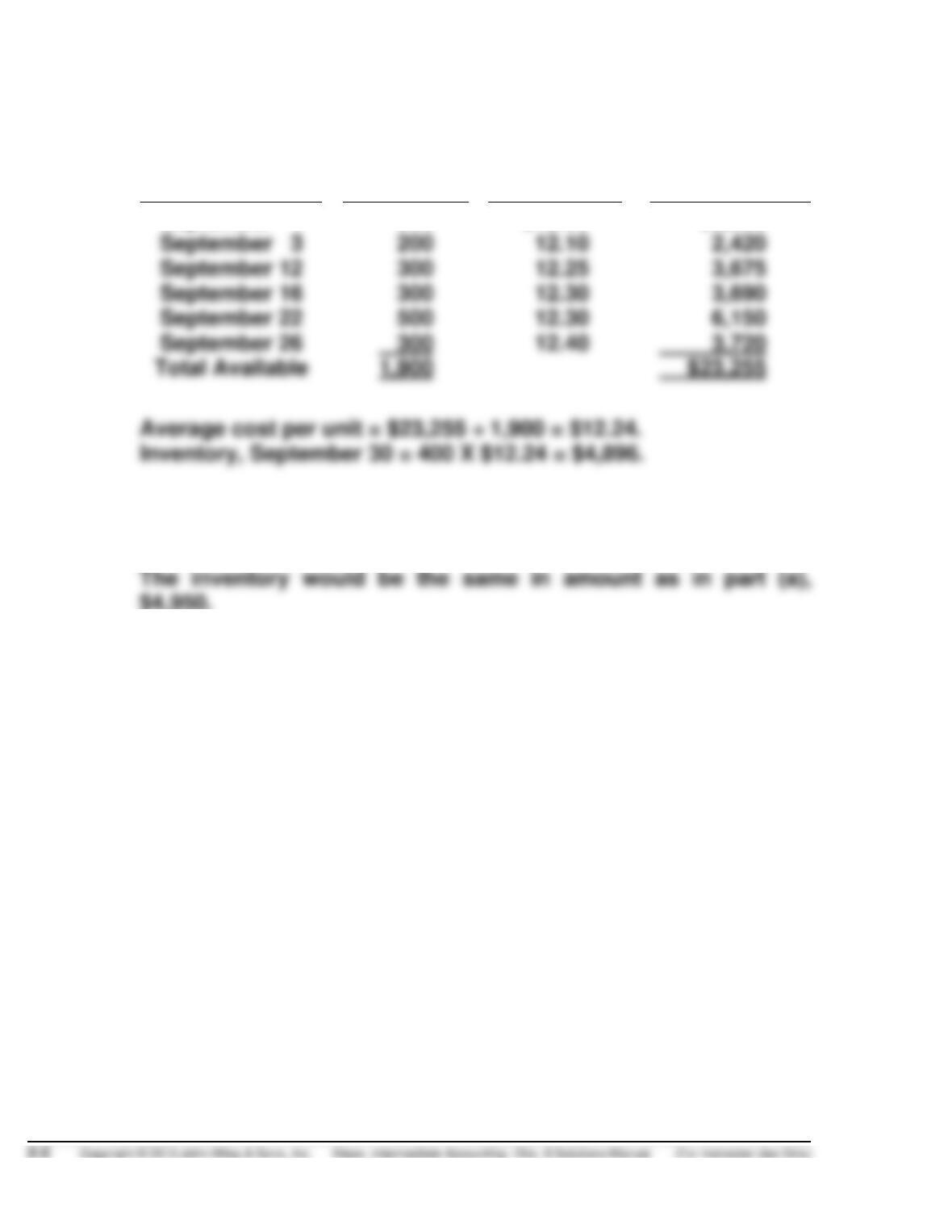
3. Average cost.
Cost of Part X available.
Date of Invoice
No. Units
Unit Cost
Total Cost
September 1
300
$12.00
$3,600
September 3
200
2,420
September 22
500
(b) Assuming costs are computed for each withdrawal:
1. First-in, first out.
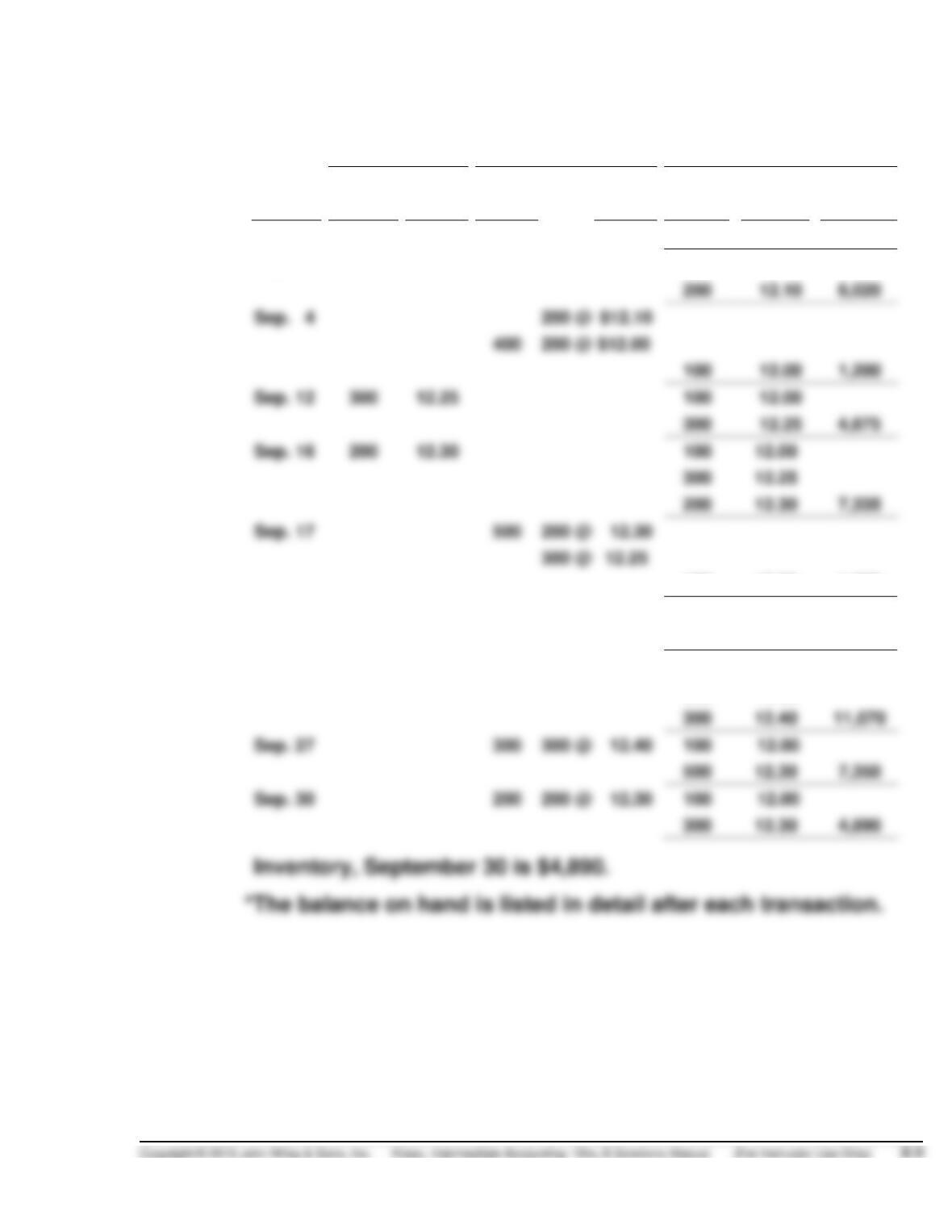
PROBLEM 8-4B (Continued)
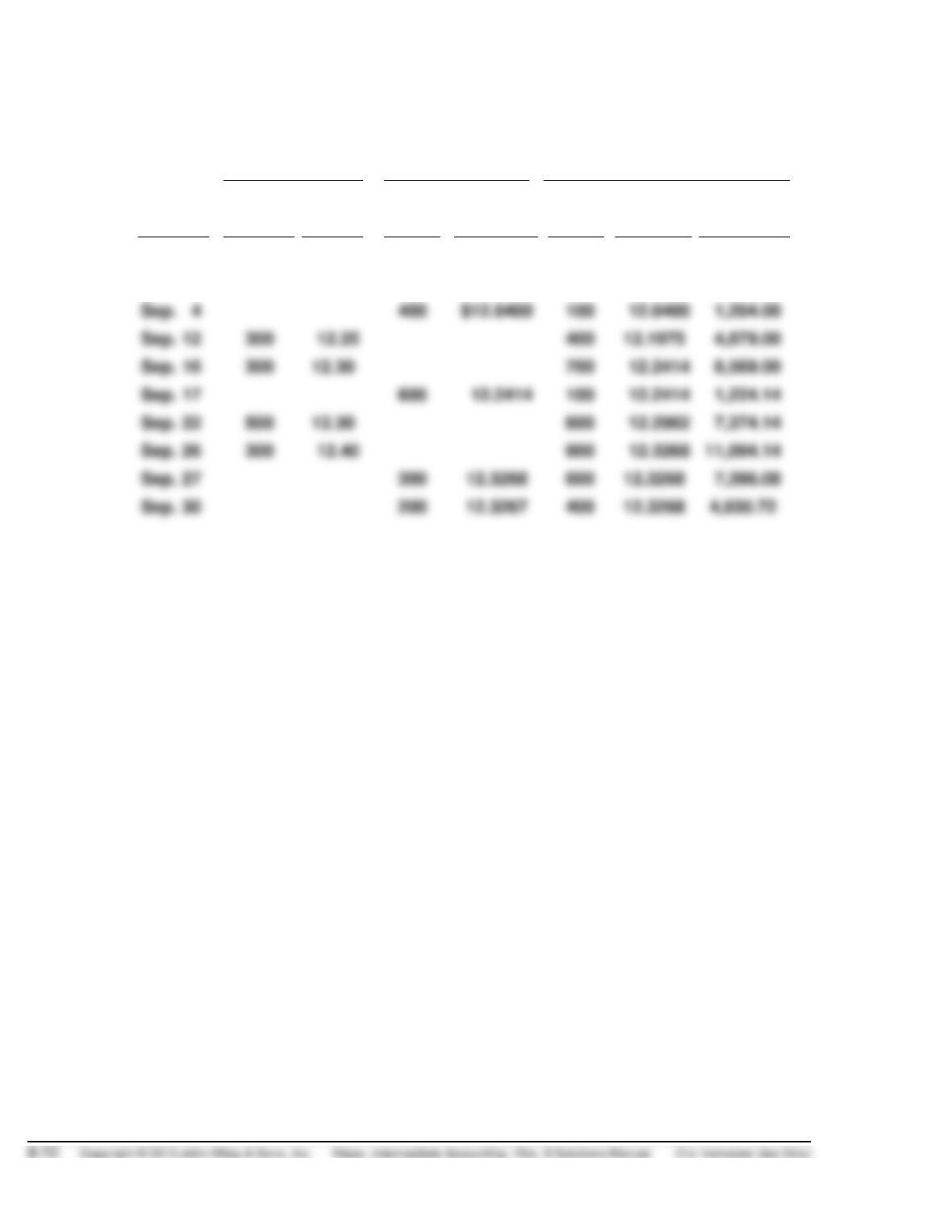
2. Last-in, first-out.
Purchased
Sold
Balance*
Date
No. of
units
Unit
cost
No. of
units
Unit
cost
No. of
units
Unit
cost
Amount
Sep. 1
300
$12.00
300
$12.00
$ 3,600
Sep. 3
200
12.10
300
12.00
200
6,020
Sep. 4
200 @
200 @
$12.00
100
1,200
Sep. 12
300
12.25
100
300
Sep. 16
200
100
12.00
300
12.25
200
12.30
7,335
Sep. 17
200 @
300 @
100
12.00
1,200
Sep. 22
500
12.30
100
12.00
500
12.30
7,350
Sep. 26
300
12.40
100
12.00
500
12.30
300
12.40
11,070
Sep. 27
300 @
12.40
100
12.00
500
12.30
7,350
Sep. 30
200 @
100
12.00
300
12.30
4,890
PROBLEM 8-4B (Continued)
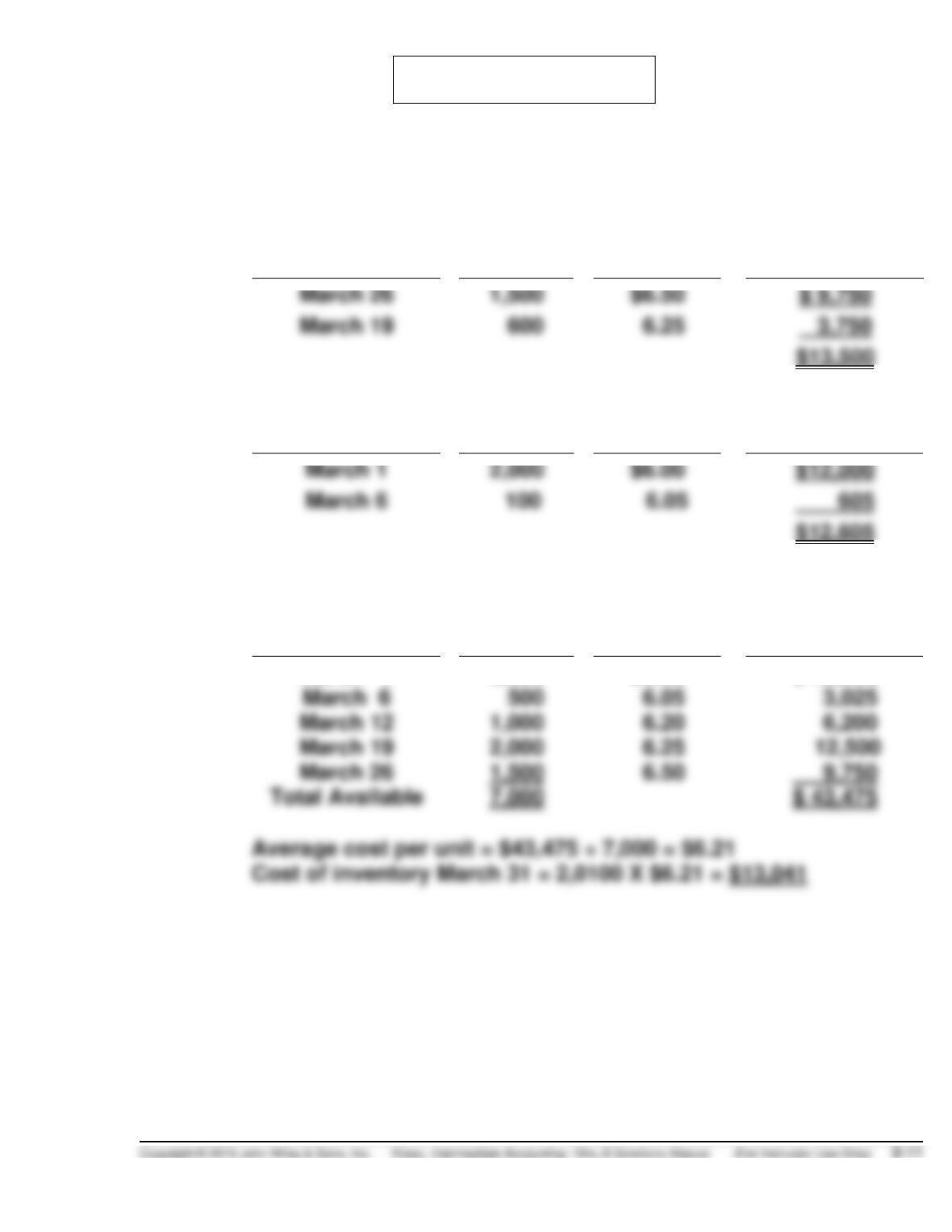
3. Average cost.
Purchased
Sold
Balance
Date
No. of
units
Unit
cost
No. of
units
Unit cost
No. of
units
Unit
cost*
Amount
Sep. 1
300
$12.00
300
$12.0000
$3,600.00
Sep. 3
200
12.10
500
12.0400
6,02000
Sep. 4
100
12.0400
1,204.00
Sep. 12
300
12.25
400
4,879.00
Sep. 16
300
700
12.2414
8,569.00
Sep. 17
100
12.2414
1,224.14
Sep. 22
600
12.2902
7,374.14
Sep. 26
300
12.40
900
12.3268
11,094.14
Sep. 27
600
7,396.08
Sep. 30
400
Inventory, September 30 is $4,930.72
*Four decimal places are used to minimize rounding errors.
PROBLEM 8-5B
(a) Assuming costs are not computed for each withdrawal (units received,
7,000, minus units issued, 4,900, equals ending inventory at 2,100 units):
1. First-in, first-out.
Date of Invoice
No. Units
Unit Cost
Total Cost
2. Last-in, first-out.
Date of Invoice
No. Units
Unit Cost
Total Cost
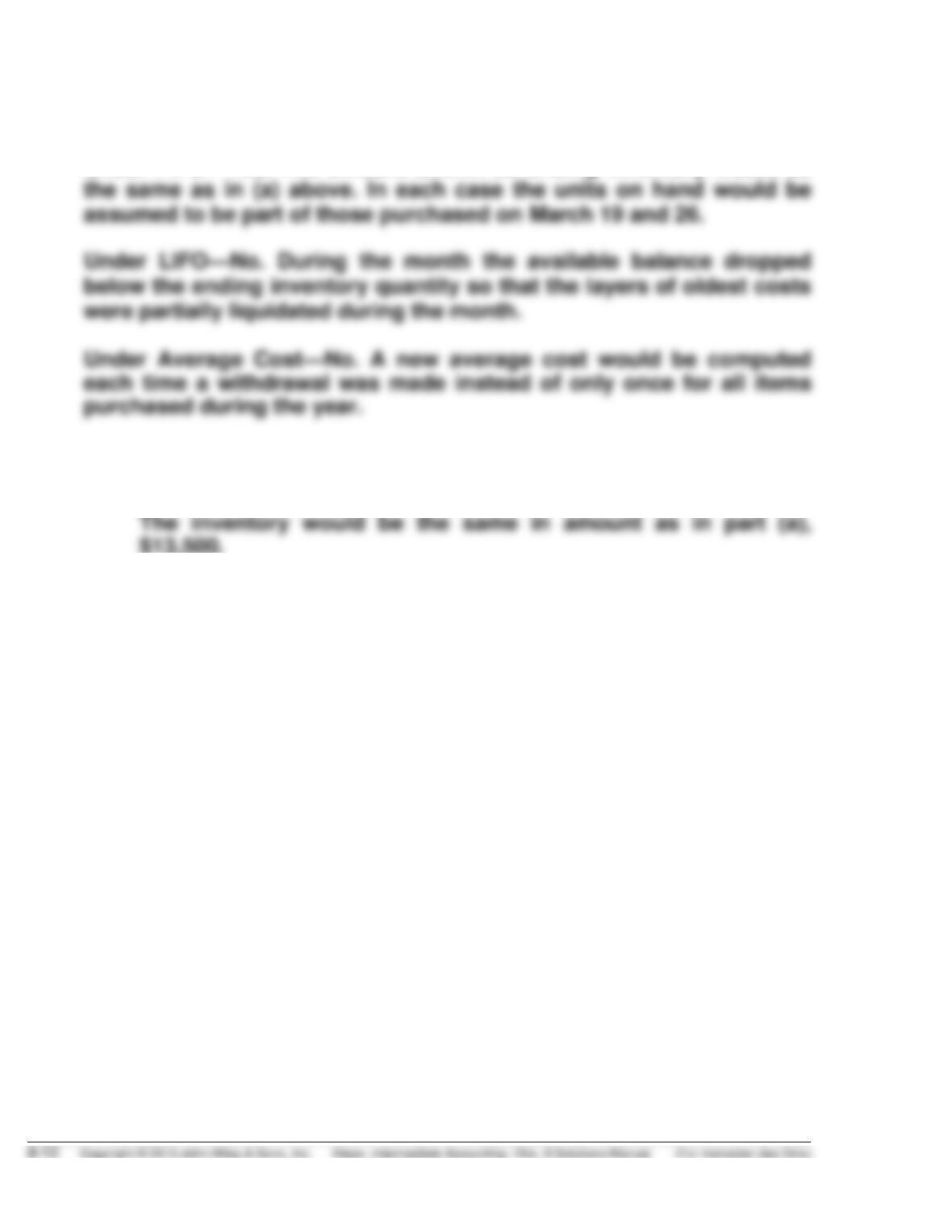
3. Average cost.
Cost of goods available:
Date of Invoice
No. Units
Unit Cost
Total Cost
March 1
2,000
$6.00
$ 12,000
March 12
1,000
6,200
PROBLEM 8-5B (Continued)
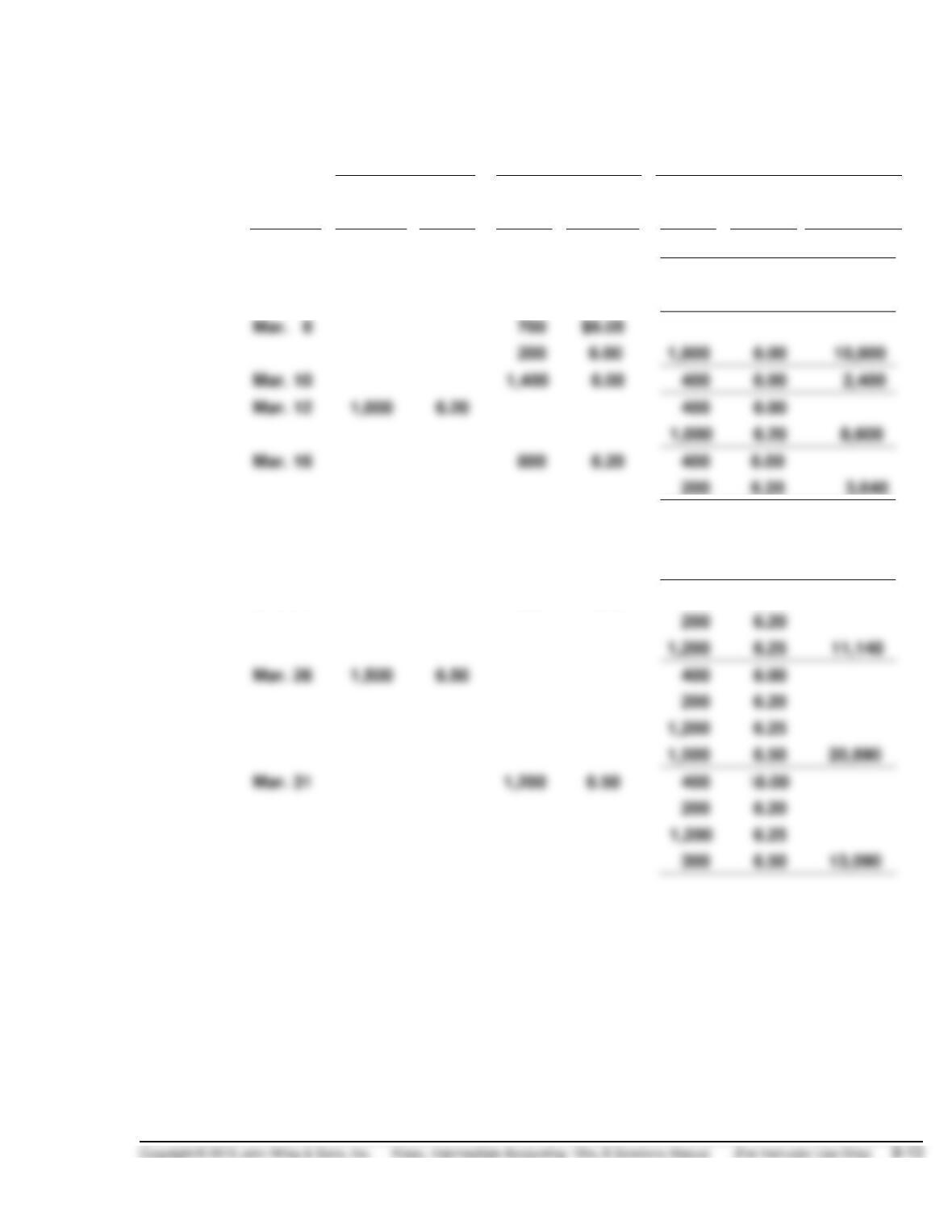
(b) Assuming costs are computed at the time of each withdrawal:
Under FIFO—Yes. The amount shown as ending inventory would be
The calculations to determine the inventory on this basis are given below.
1. First-in, first-out.
PROBLEM 8-5B (Continued)
2. Last-in, first-out.
Received
Issued
Balance
Date
No. of
units
Unit
cost
No. of
units
Unit
cost
No. of
units
Unit
cost*
Amount
Mar. 1
2,000
$6.00
2,000
$6.00
$12,000
Mar. 6
500
6.05
2,000
6.00
15,025
500
6.05
Mar. 8
700
$6.05
200
1,800
6.00
10,800
Mar. 12
1,000
6.20
400
6.00
6.20
Mar. 16
800
400
200
Mar. 19
2,000
6.25
200
6.25
400
6.00
200
6.20
1,800
6.25
14,890
Mar. 22
600
6.25
400
6.00
200
6.20
1,200
6.25
Mar. 26
6.50
400
6.00
200
6.20
6.25
1,500
6.50
Mar. 31
400
\6.00
200
6.20
6.25
300
6.50
Inventory, March 31 is $13,090.