Compressibility of Soil and Rock Chapter 8
CHAPTER 8
COMPRESSIBILITY OF SOIL AND ROCK
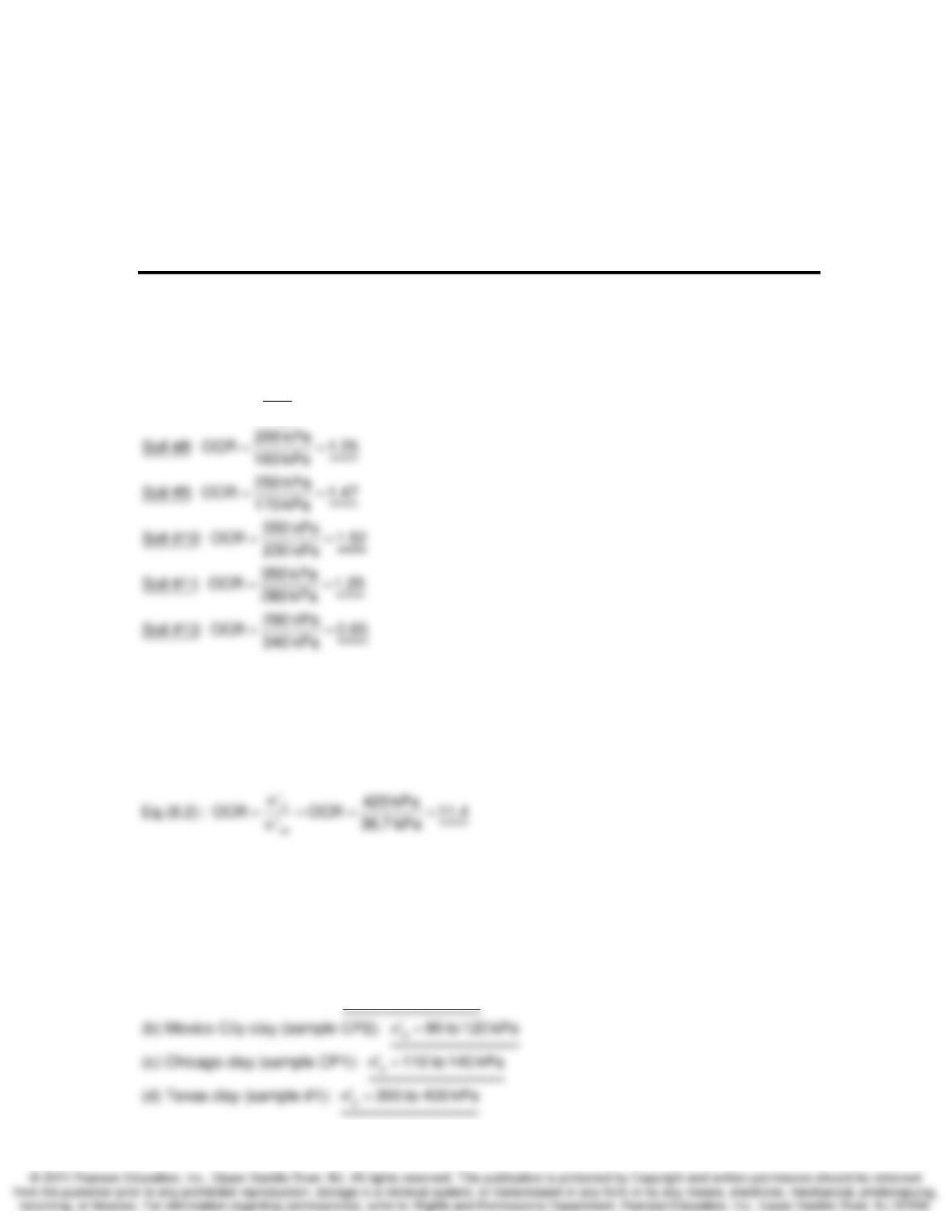
8-3. Determine the overconsolidation ratio (OCR) for the five fine-grained soils of Fig. 8.9a.
SOLUTION:
p
vo
‘
Eq. (8.2) : OCR ‘
σ
=σ
8-5. What is the OCR of the clay till in Fig. 8.9c?
SOLUTION:
8-6. Estimate the preconsolidation stress for: (a) the undisturbed Leda clay in Fig. 8.9d, (b)
undisturbed Mexico City clay in Fig. 8.9e, (c) undisturbed Chicago clay in Fig. 8.9f, and (d) the
swelling clays from Texas in Fig. 8.9g.
SOLUTION:
p
(a) Leda clay (undisturbed): ‘ 220 to 280 kPa
σ=
Compressibility of Soil and Rock Chapter 8
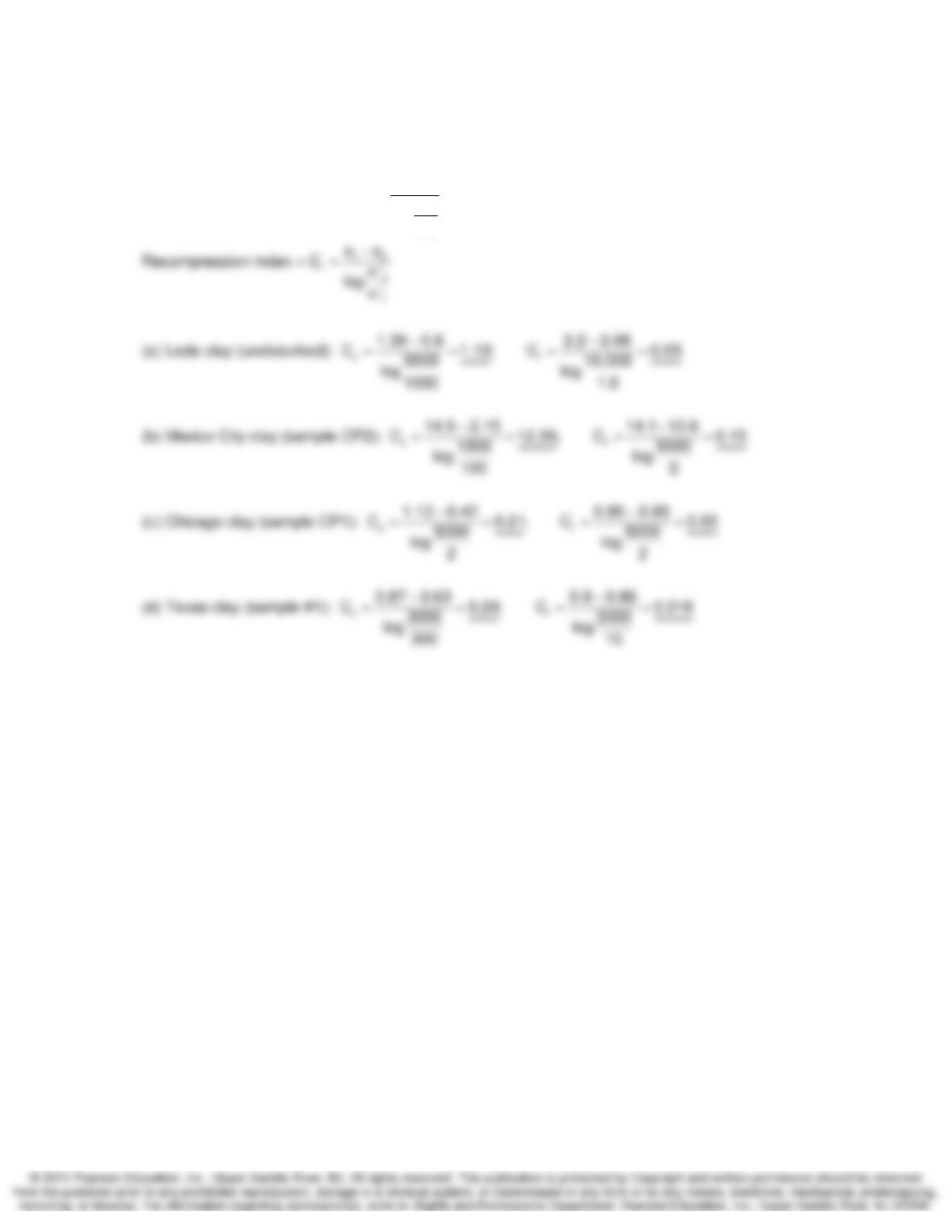
8-7. Determine the compression indices for the four soils of Problem 8.6.
SOLUTION:
12
c
2
1
ee
Eq. 8.7: Compression index = C ‘
log ‘
−
=σ
σ
Compressibility of Soil and Rock Chapter 8
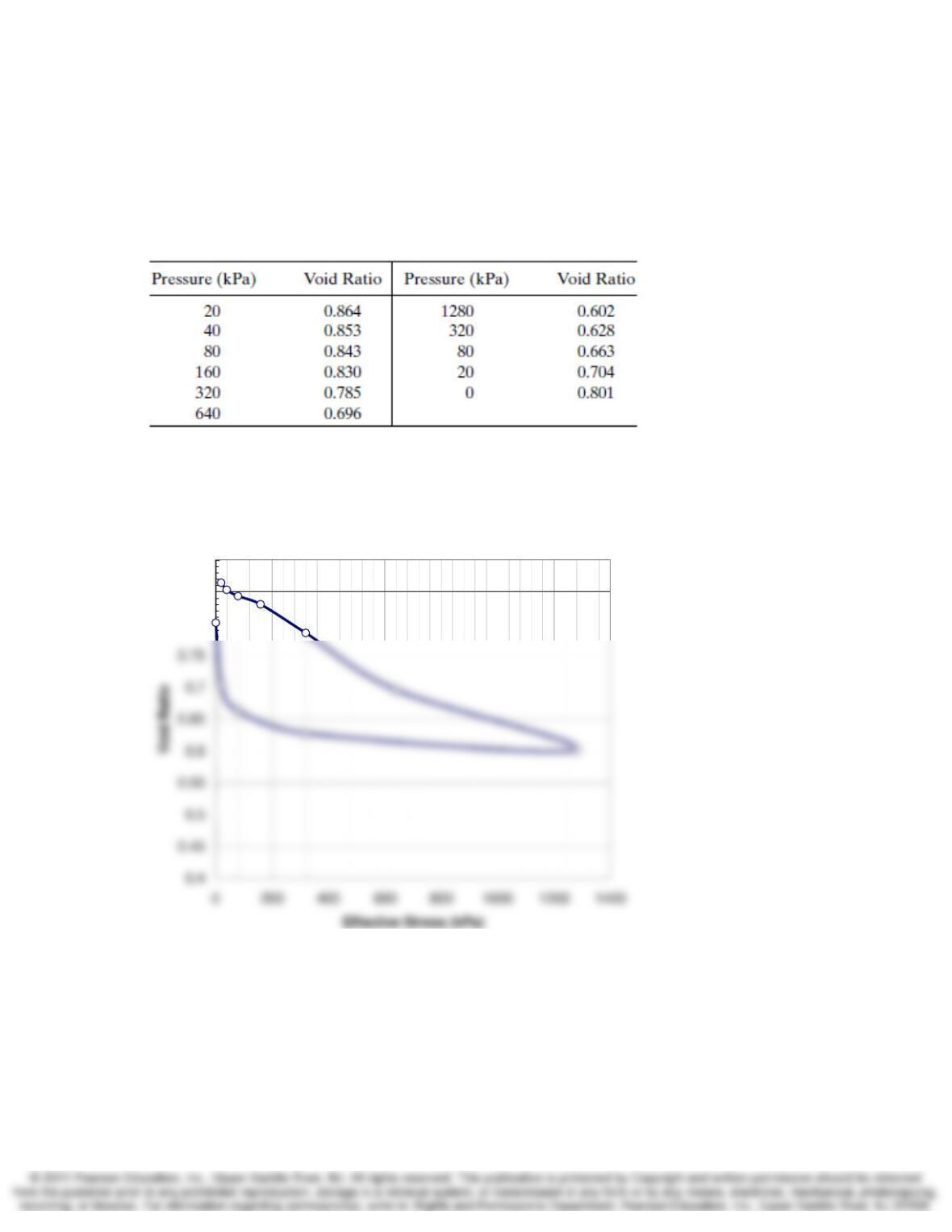
8-8. The pressure versus void ratio data determined from a consolidation test on an undisturbed
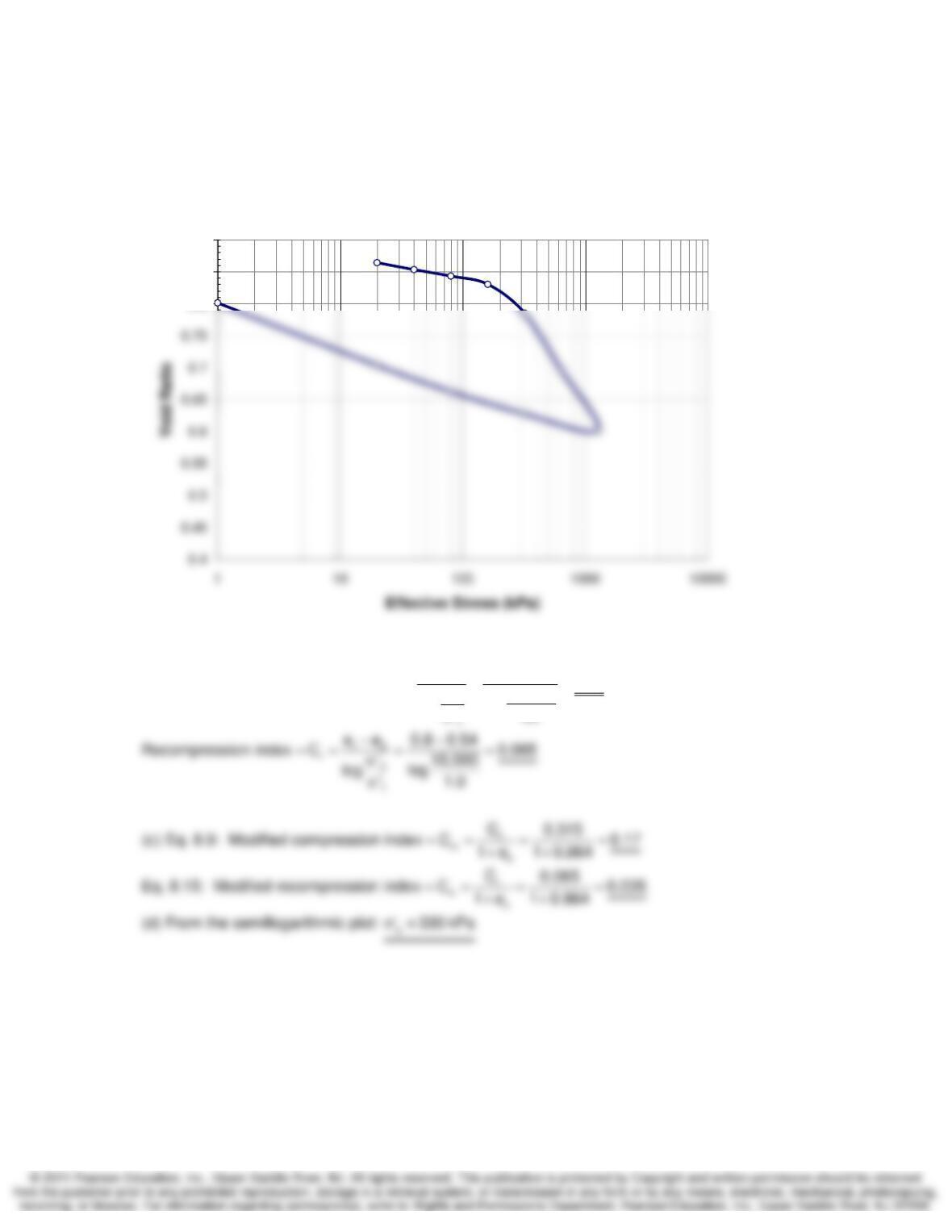
clay specimen are as follows: (a) Plot the pressure versus void ratio curve on both arithmetic and
semilogarithmic graphs. (b) Determine the equations for the virgin compression curve and for the
rebound curve for unloading, starting at 1280 kPa. (c) What are the corresponding modified
compression and recompression indices for this soil? (d) Estimate the stress to which this clay
has been preconsolidated. (After A. Casagrande.)
SOLUTION:
(a) Arithmetic graph.
0.8
0.85
0.9
continued on next page
Compressibility of Soil and Rock Chapter 8
Problem 8-8 continued.
Semilogarithmic graph.
0.8
0.85
0.9
12
c
2
ee 1.0 0.3
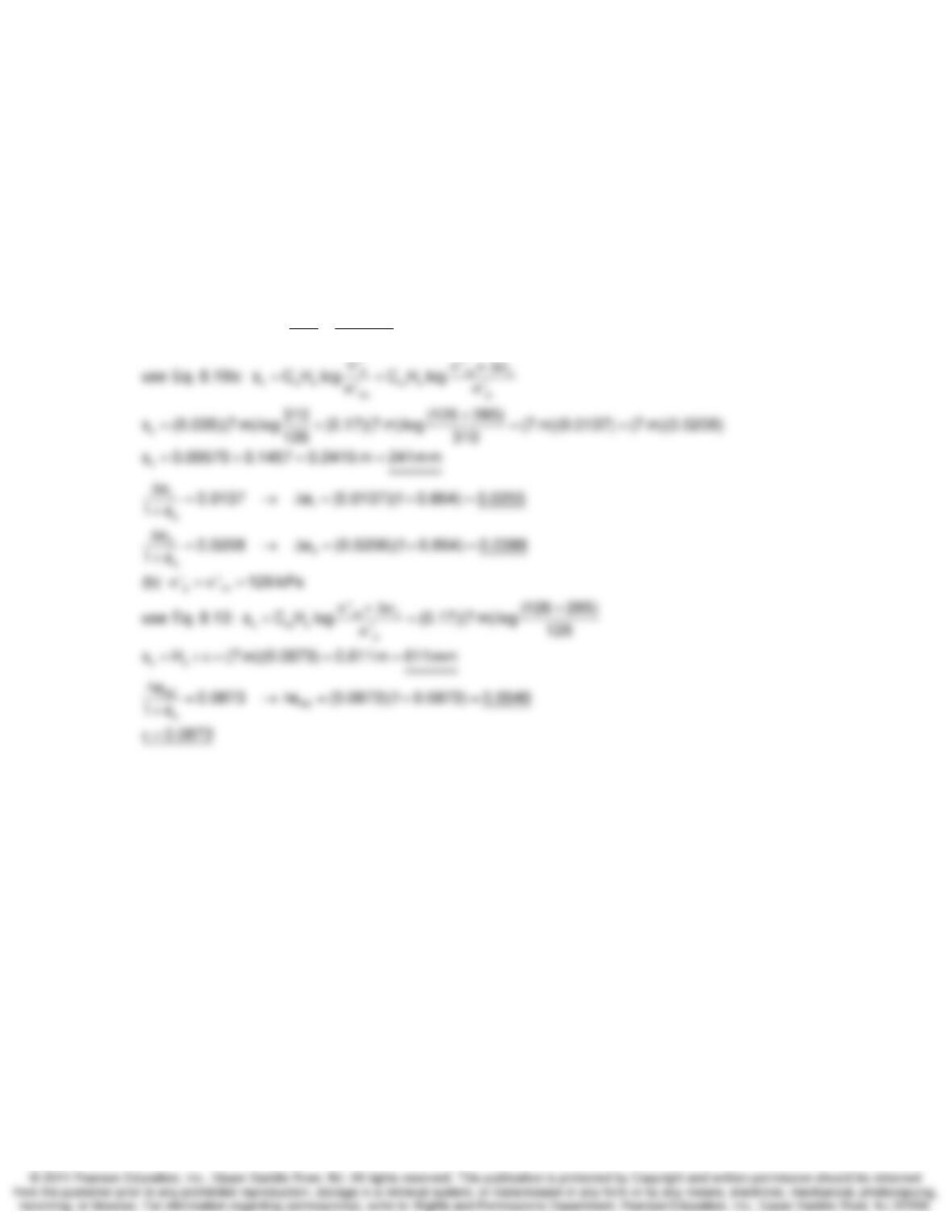
(b) Eq. 8.7: Compression index C 0.32
‘10,000
log
log 60
‘
−−
== = =
σ
σ
Compressibility of Soil and Rock Chapter 8
8-9. A building is to be constructed on a stratum of the clay 7 m thick for which consolidation data
are given in Problem 8.8. The average existing effective overburden pressure on this clay stratum
is 126 kPa. The average applied pressure on the clay after construction of the building is 285
kPa. (a) Estimate the decrease in thickness of the clay stratum caused by full consolidation
under the building load. Estimate the decrease in thickness due to the building load if the clay had
never been preconsolidated under a load greater than the existing overburden. (c) Show on the e
versus log
σ
plot of Problem 8.8 the values of
Δ
e used.
SOLUTION:
p
vo
‘310 kPa
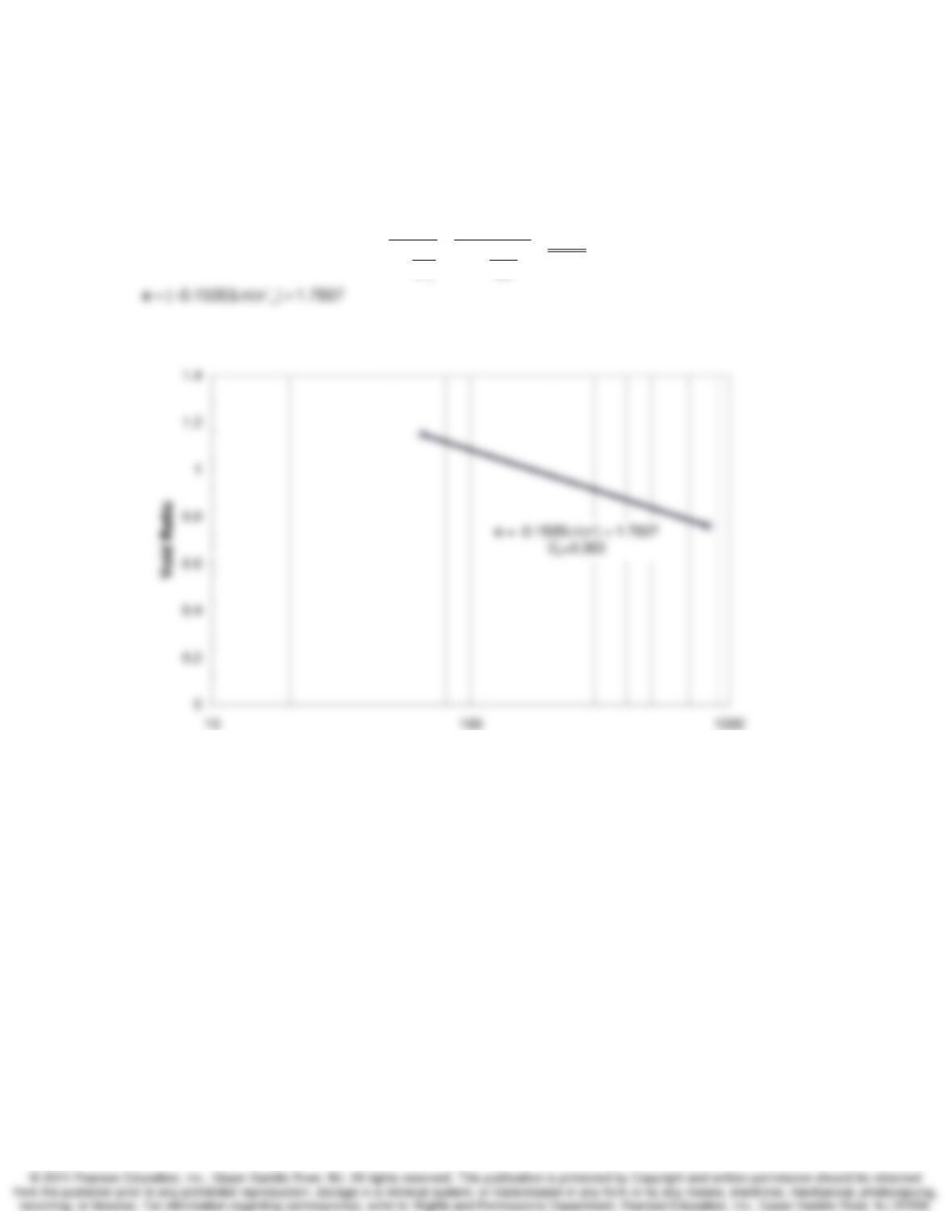
(a) Eq. (8.2) : OCR 2.5
‘ 126 kPa
σ
== =
σ
Compressibility of Soil and Rock Chapter 8
8-10. The compression curve for a certain clay is a straight line on the semilogarithmic plot, and
it passes through the point e = 1.15,
σ
’v = 65 kPa and e = 0.76,
σ
’v = 825 kPa. Determine an
equation for this relationship. (After Taylor, 1948.)
SOLUTION:
12
c
2
ee 1.15 0.76
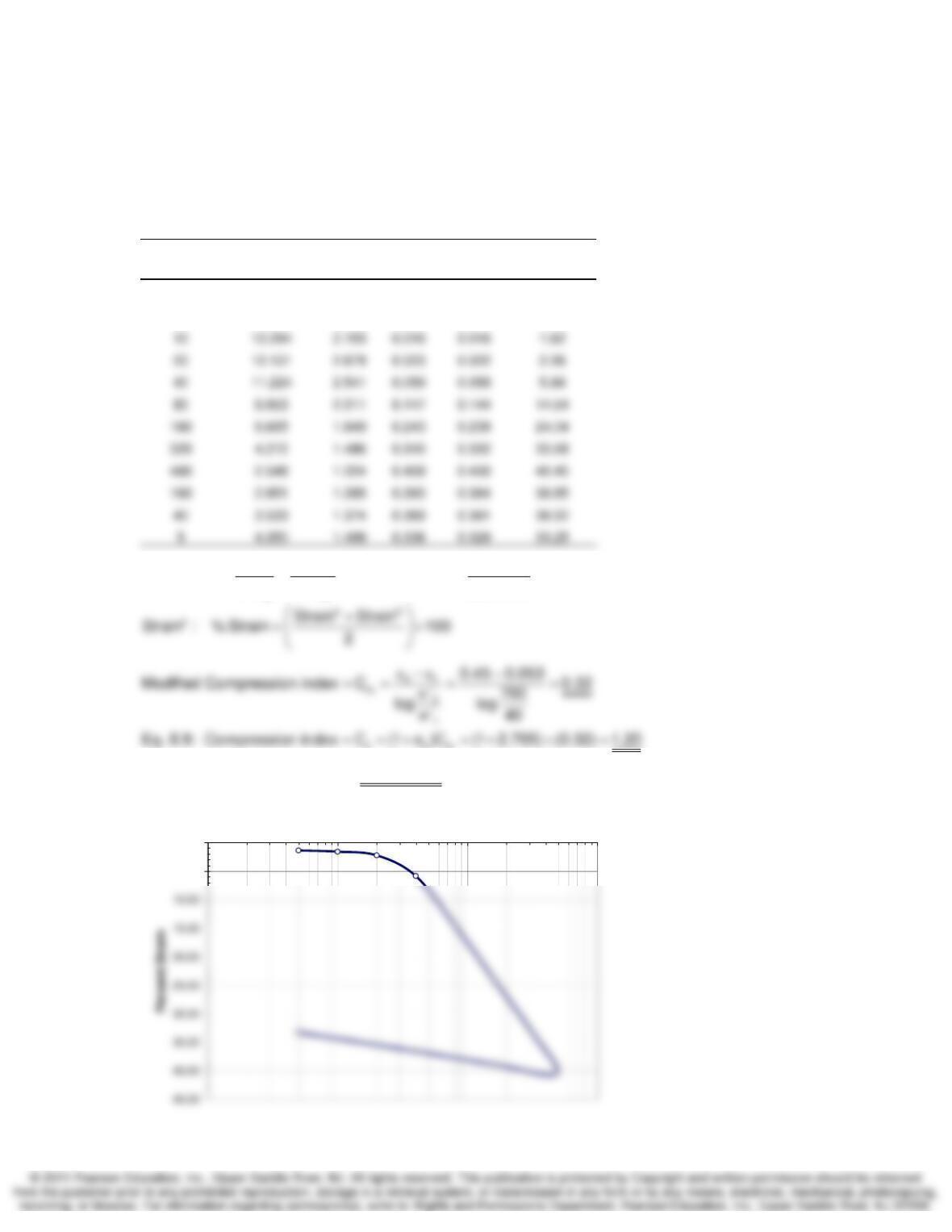
Eq. 8.7: Compression index C 0.353
‘825
log
log 65
‘
−−
== = =
σ
σ
Compressibility of Soil and Rock Chapter 8
8-12. The following consolidation test data were obtained from undisturbed San Francisco Bay
Mud. For this clay, LL = 88, PL = 43,
ρ
s = 2.70 Mg/m3 and w = 105.7%. Initially, the specimen
height was 2.54 cm and its volume was 75.14 cm3. Plot the data as percent consolidation versus
log pressure. Evaluate the preconsolidation pressure and the modified virgin compression index.
SOLUTION:
Stress Dial Reading Void Strain
a
Strain
b
% Strain
c
(kPa) (mm) Ratio
0 12.700 2.765 0.000 0.000 0.00
5 12.352 2.712 0.014 0.014 1.39
ab
oi o i
oo
ee RR
e
Strain : ; Strain :
1 e 1 e 25.4 mm
−−
Δ
ε= = ε=
++
coc
p
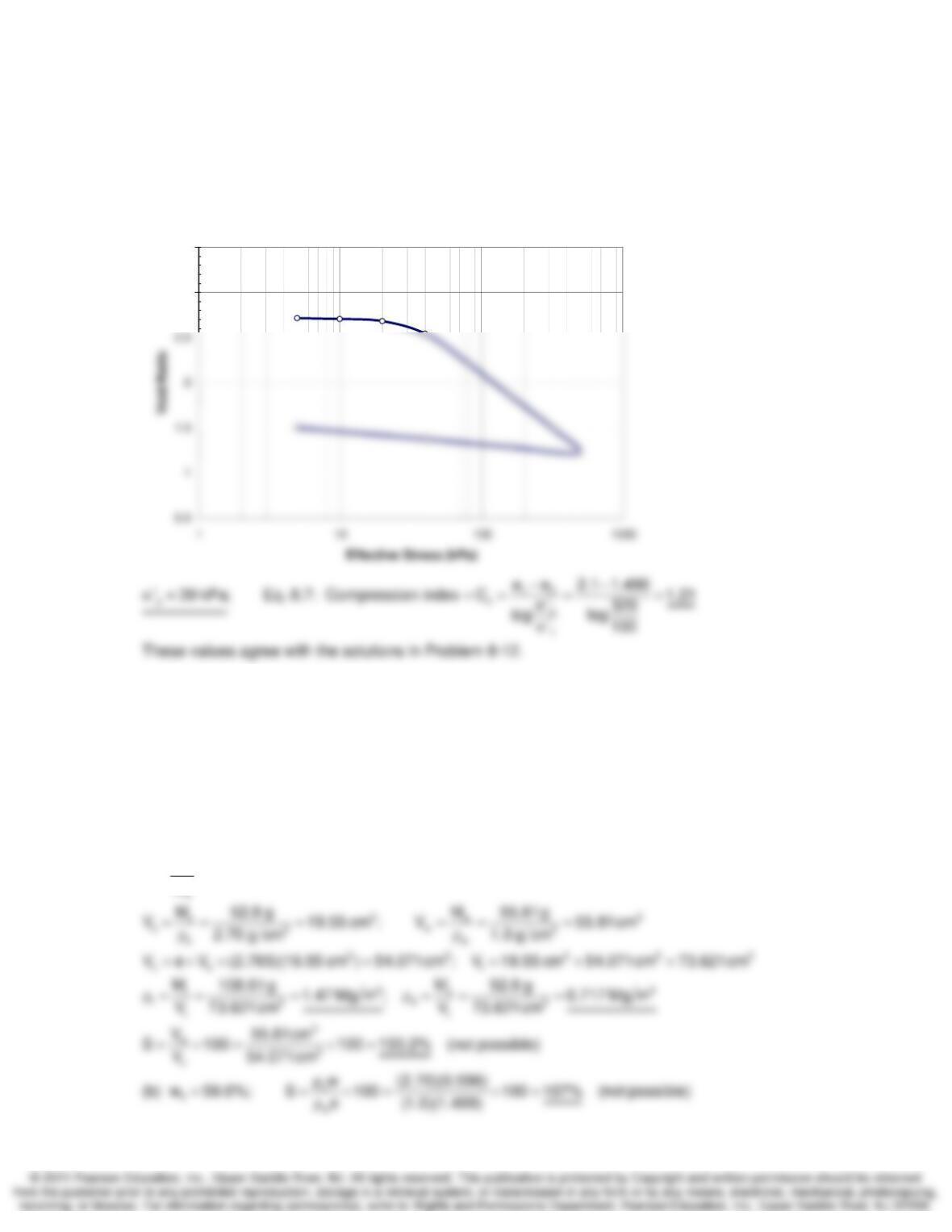
From the semillogarithmic plot: ‘ 38 kPa
ε
σ≈
0.00
5.00
1 10 100 1000
Effective Stress (kPa)
Compressibility of Soil and Rock Chapter 8
8-13. Plot the data of Problem 8.12, on a void ratio versus log pressure graph. Evaluate the
preconsolidation pressure and the virgin compression index. Do these values agree with what
you found in Problem 8.12?
SOLUTIONS:
3
3.5
8-14. The initial water content of the sample in Problem 8.12 is 105.7%, and the density of the
solids
ρ
s = 2.70 Mg/m3. Compute the wet and dry density and degree of saturation of the
consolidation test sample if the dry weight of the sample is 52.8 g. If the final water content is
59.6%, compute the degree of saturation and dry density at the end of consolidation.
SOLUTION:
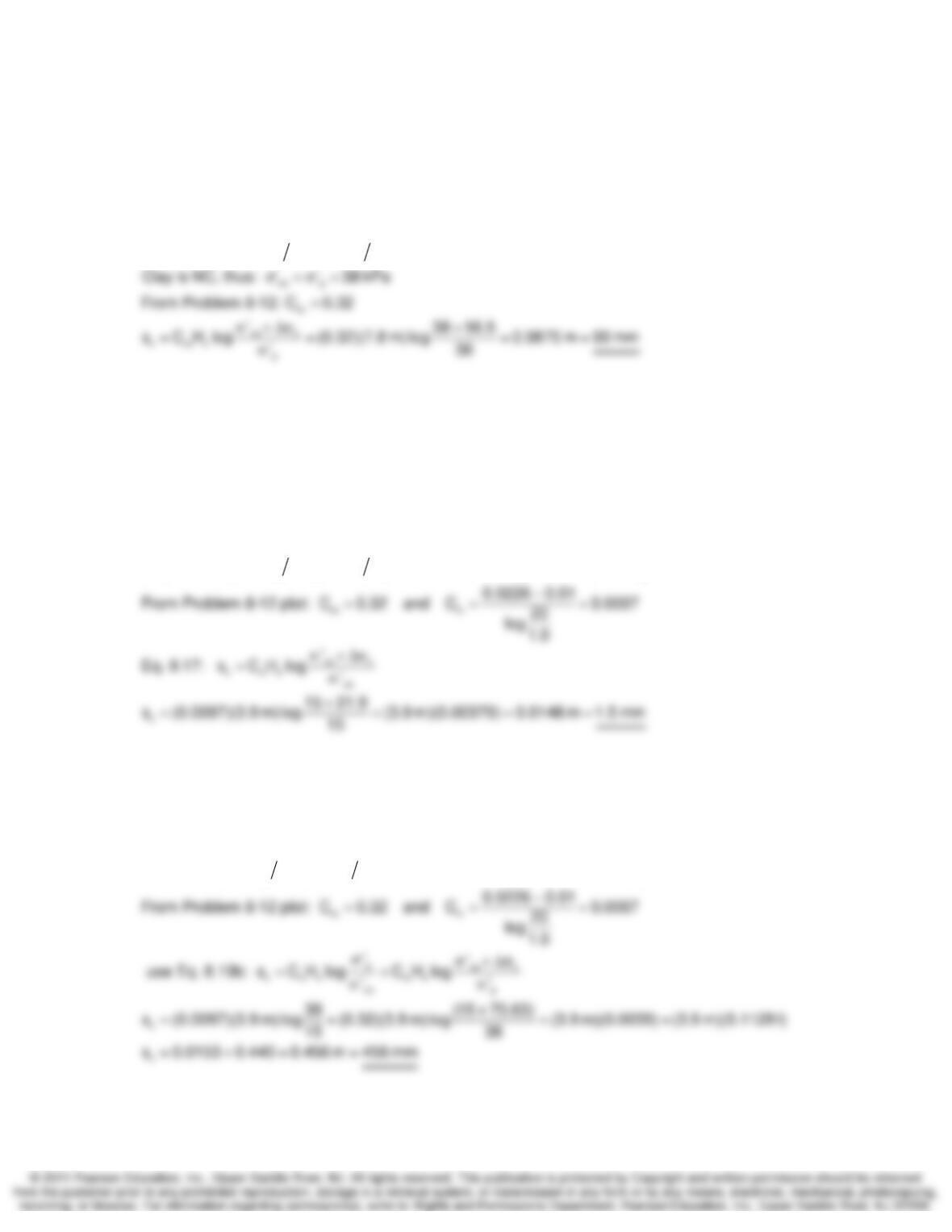
is
w
wt
(a) w 105.7%, M 52.8 g
M
w M (1.057)(52.8 g) 55.81g M 55.81 52.8 108.61g
M
==
=→= = →=+=
Compressibility of Soil and Rock Chapter 8
8-15. A 7.8 m thick layer of soft San Francisco Bay Mud is to be loaded with a granular fill 3.2 m
thick, on the average. The total density of the fill is about 1.8 Mg/m3. Assume that the test data in
Problem 8.12 is typical of the clay layer, and that the layer is normally consolidated. What
consolidation settlement will take place due to the weight of the fill?
SOLUTION:
32
v
(3.2 m)(1.8 Mg m )(9.81m s ) 56.50 kPa
Δσ = =
8-16. Assume the laboratory test results in Problem 8.12 are typical of another San Francisco
Bay Mud site, but where the clay is slightly overconsolidated. The present vertical effective
overburden stress is calculated to be about 15 kPa, and the thickness of the clay is 3.9 m. At this
location, the granular fill (
ρ
= 1.8 Mg/m3) will be only about 1.2 m thick. Estimate the consolidation
settlement due to the weight of the fill.
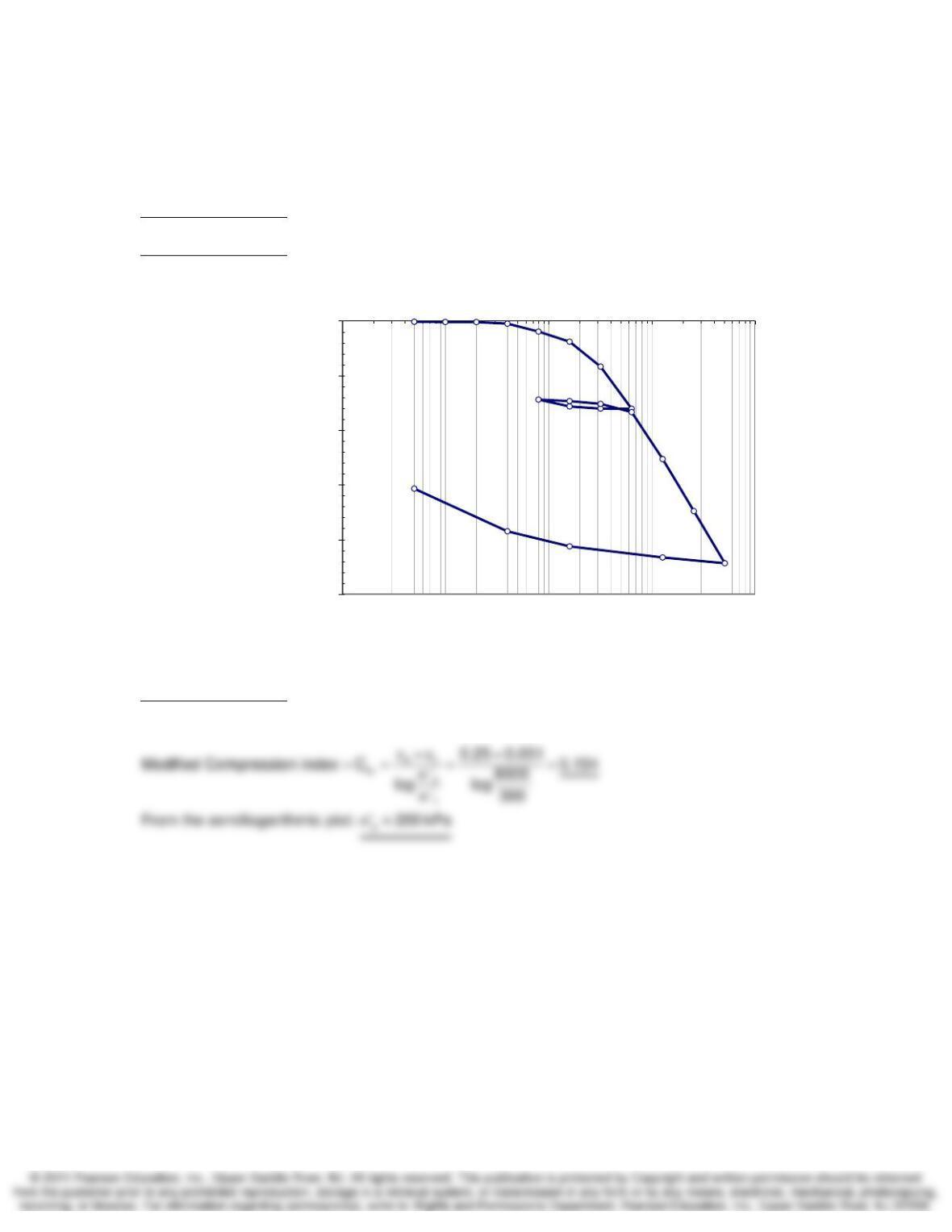
SOLUTION:
32
vvo p
(1.2 m)(1.8 Mg m )(9.81m s ) 21.9 kPa; ‘ 15 kPa; ‘ 38 kPa
Δσ = = σ = σ =
8-17. What settlement would you expect at the overconsolidated site in Problem 8.16 if the fill to
be constructed were 4 m thick?
SOLUTION:
32
vvo p
(4 m)(1.8 Mg m )(9.81m s ) 70.63 kPa; ‘ 15 kPa; ‘ 38 kPa
Δσ = = σ = σ =
Compressibility of Soil and Rock Chapter 8
8-18. Plot the following data and determine the preconsolidation pressure and the modified
compression index. Specimen height is 25.4 mm, wn = 32.5%,
ρ
d = 1.45 Mg/m3. Sample is from a
depth of -11.5 m.
% Strain Pressure
(kPa)
0.09 5
0.11 10
0.12 20
0.26 40
0.98 80
1.91 160
4.19 320
8.05 640
8.03 320
7.83 160
7.21 80
7.34 160
7.60 320
8.35 640
12.65 1280
17.41 2560
22.18 5120
21.65 1280
20.63 160
19.26 40
15.35 5
SOLUTION:
0.00
5.00
10.00
15.00
20.00
25.00
1 10 100 1000 10000
Effective Stress (kPa)
Percent Strain
Compressibility of Soil and Rock Chapter 8
8-19. At the site where the sample of Problem 8.18 was taken, the soil profile consists of about
6.5 m of sand and rubble fill and then 9.1 m of clay. The water table is about 1.8 m below the
ground surface. Average densities of the sand and rubble fill are 1.45 Mg/m3 above the water
table and 1.70 Mg/m3 below the water table. Estimate the consolidation settlement if the average
stress increase in the compressible layer is: (a) 50 kPa, (b) 100 kPa, and (c) 250 kPa.
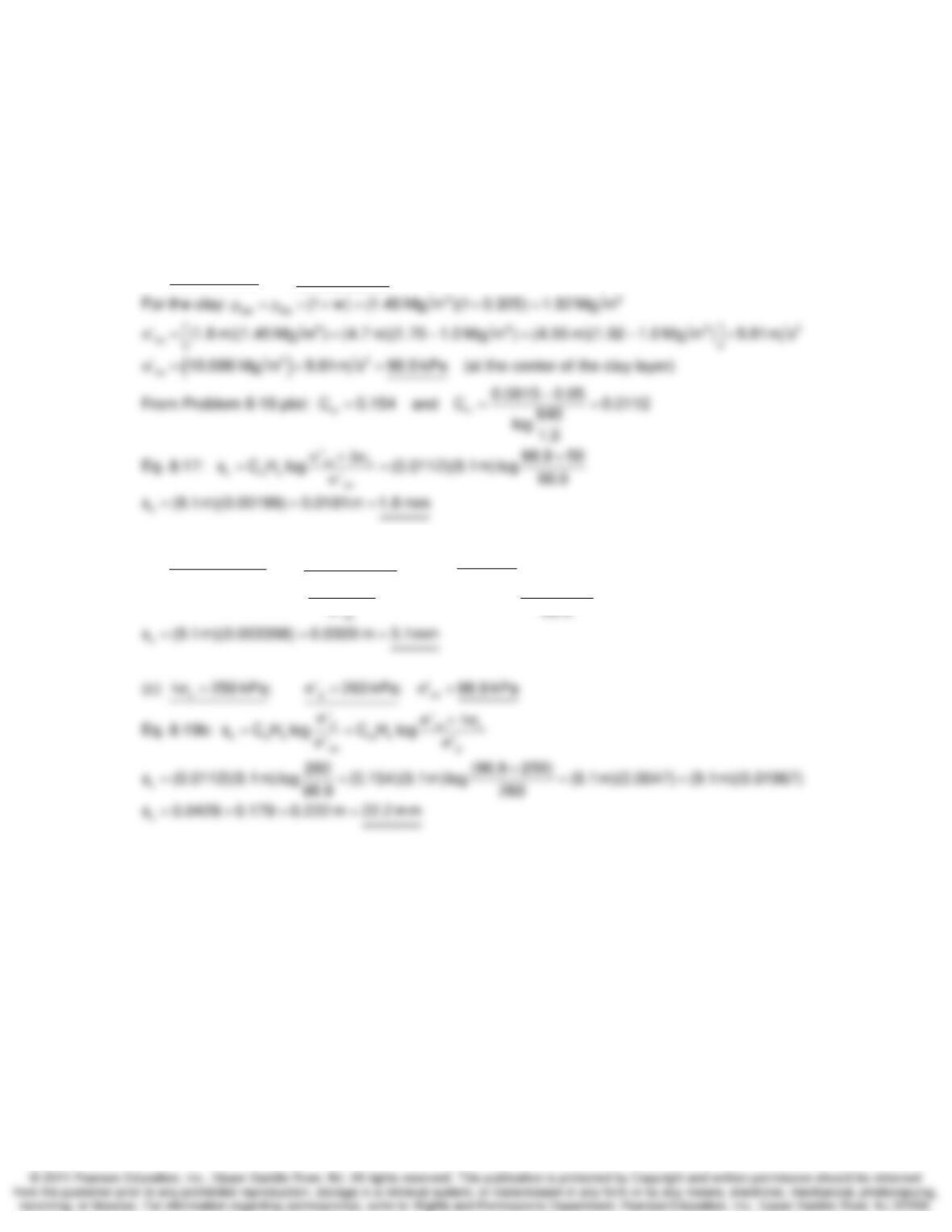
SOLUTION:
vp
(a) 50 kPa; ‘ 260 kPa (from Problem 8-18)
Δσ = σ =
vpvo
vo v
cro
(b) 100 kPa; ‘ 260 kPa; ‘ 98.9 kPa
‘98.9 100
Eq. 8.17: s C H log (0.0112)(9.1m)log
‘ 98.9
ε
Δσ = σ = σ =
σ+Δσ +
==
σ
Compressibility of Soil and Rock Chapter 8
8-20. Plot the following void ratio versus pressure data, and evaluate the compression index and
the recompression index. Determine the preconsolidation stress.
Void Pressure
Ratio (kPa)
1.025 0
1.006 10
0.997 20
0.978 40
0.950 80
0.911 160
0.893 200
0.837 300
0.780 400
0.655 800
0.504 2000
0.542 500
0.589 160
0.681 20
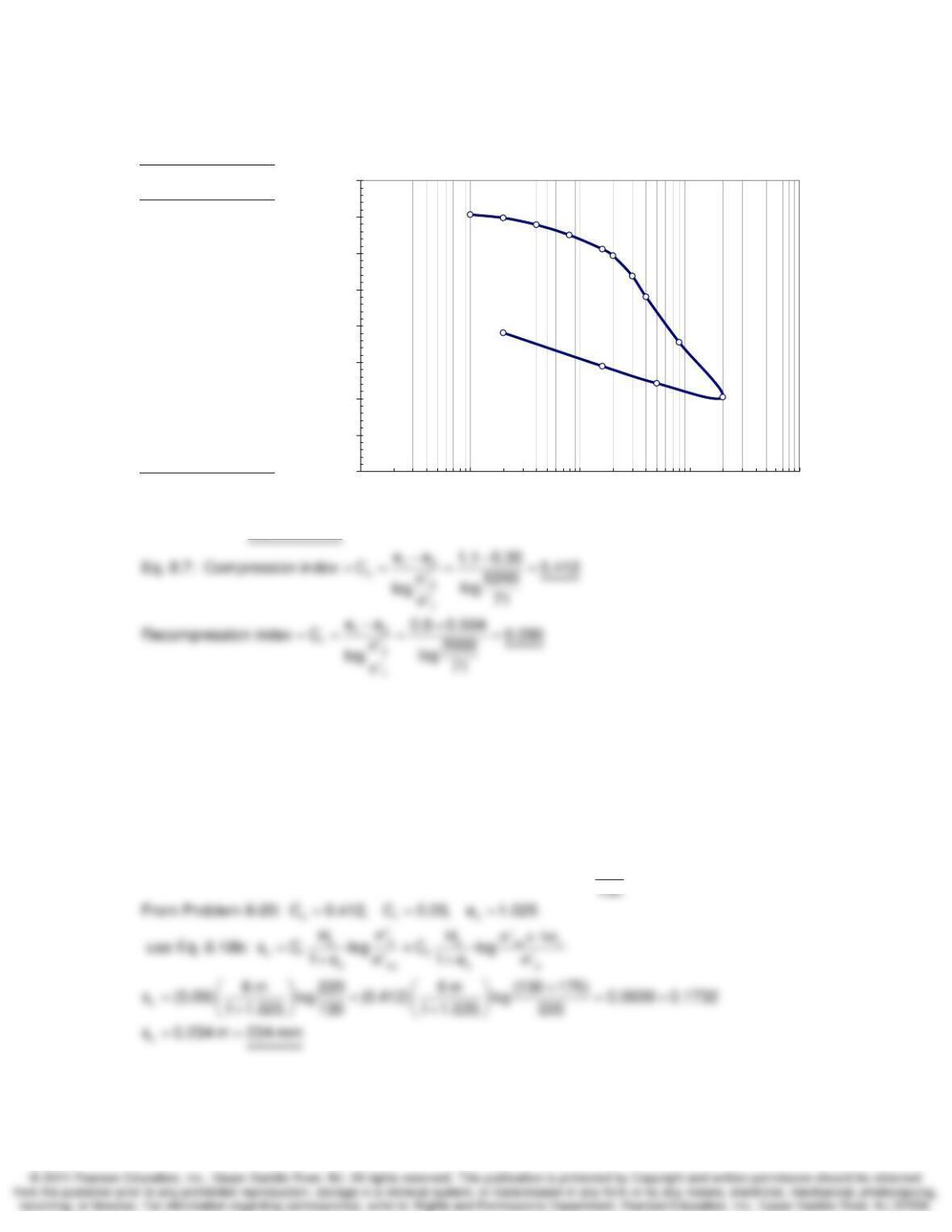
SOLUTION:
p
From the plot: ‘ 220 kPa
σ≈
8-21. Use the consolidation data from Problem 8.20 to compute the settlement of a structure that
adds 175 kPa to the already existing overburden pressure of 130 kPa at the middle of a 6 m thick
layer.
SOLUTION:
vvo p
220
175 kPa; ‘ 130 kPa; ‘ 220 kPa; OCR 1.7
Δσ=σ=σ= ==
0.300
0.400
0.500
0.600
0.700
0.800
0.900
1.000
1.100
1 10 100 1000 10000
Effective Stress (kPa)
Void Ratio