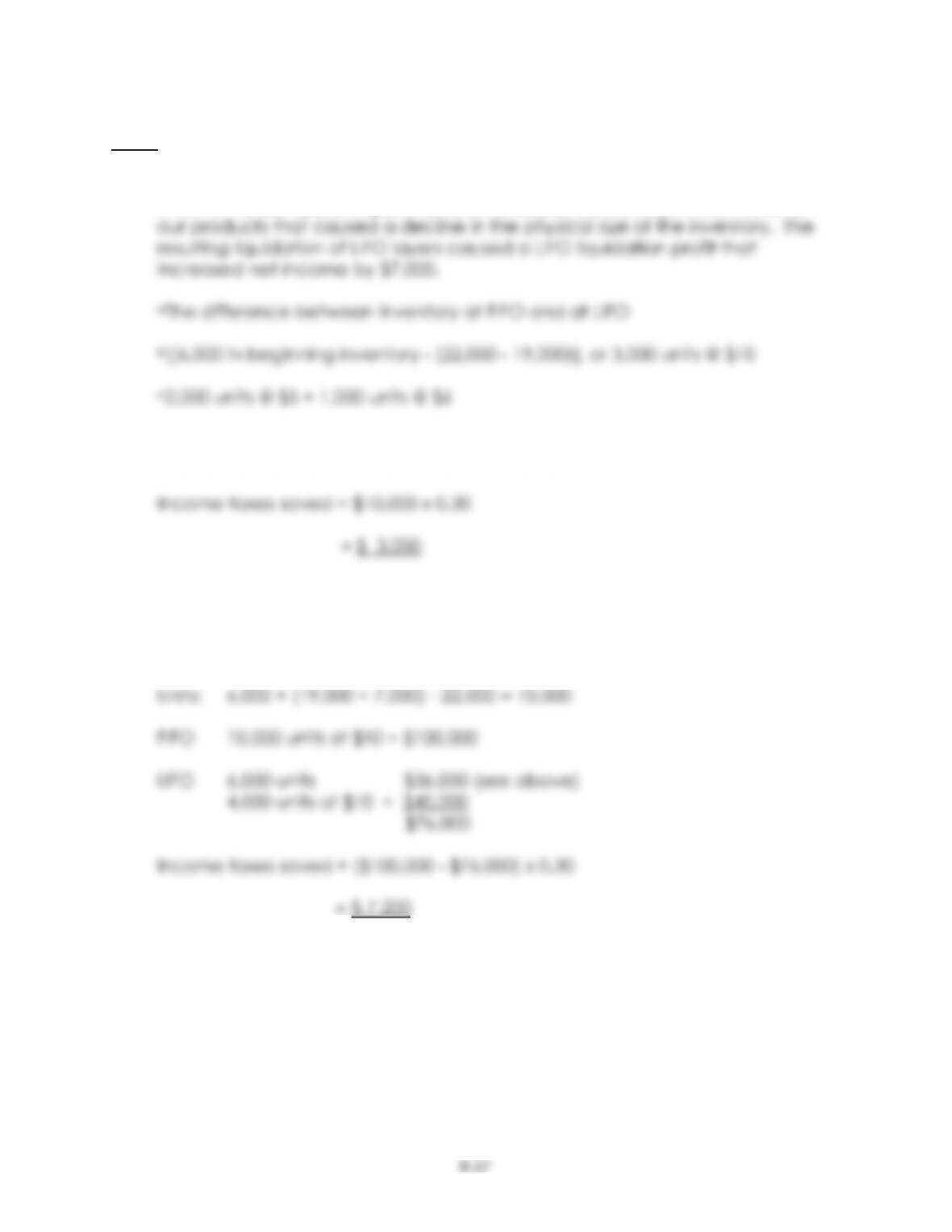
P8-14 (continued)
2. (continued)
In 2011, the company experienced an unexpected increase in demand for
3. Purchase of an additional 7,000 units avoids the LIFO liquidation profit and
therefore saves income taxes on that amount.
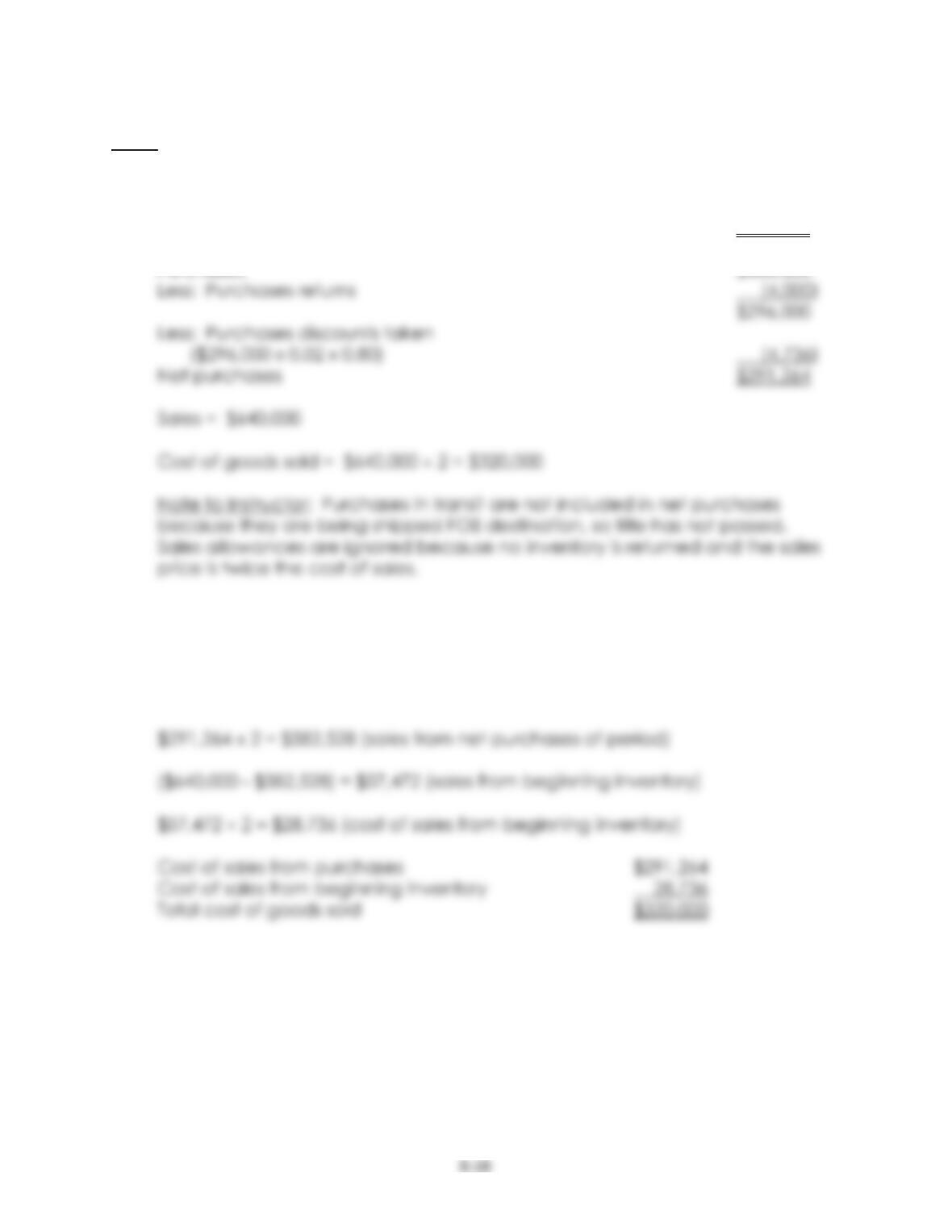
4. The income tax savings over the 4-year period are equal to the difference in
the inventory values times the income tax rate.
Inventory December 31, 2011:
P8-15
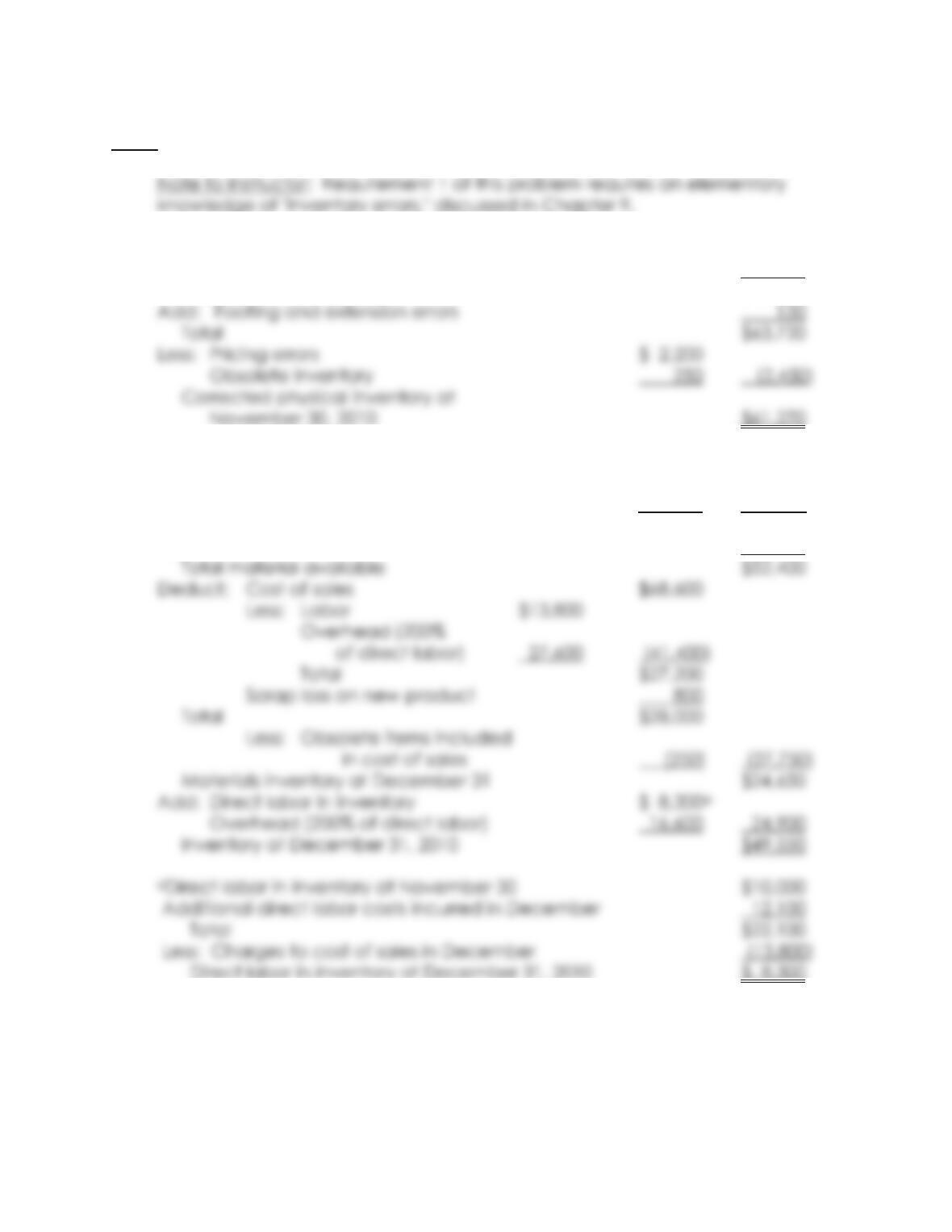
1. MARINO COMPANY
Schedule for Computation of Ending Inventory
Beginning inventory $100,000
Purchases $300,000
Beginning Inventory + Purchases (net) – Cost of Goods Sold = Ending Inventory
$100,000 + $291,264 – $320,000 = $71,264
2. Under the LIFO periodic cost flow assumption, the net purchases for the period
will first be included in cost of goods sold.
8-59
P8-16 (AICPA adapted solution)
1. Inventory per books $60,570
Understatement per client’s computations 3,000
Physical inventory, per client $63,570
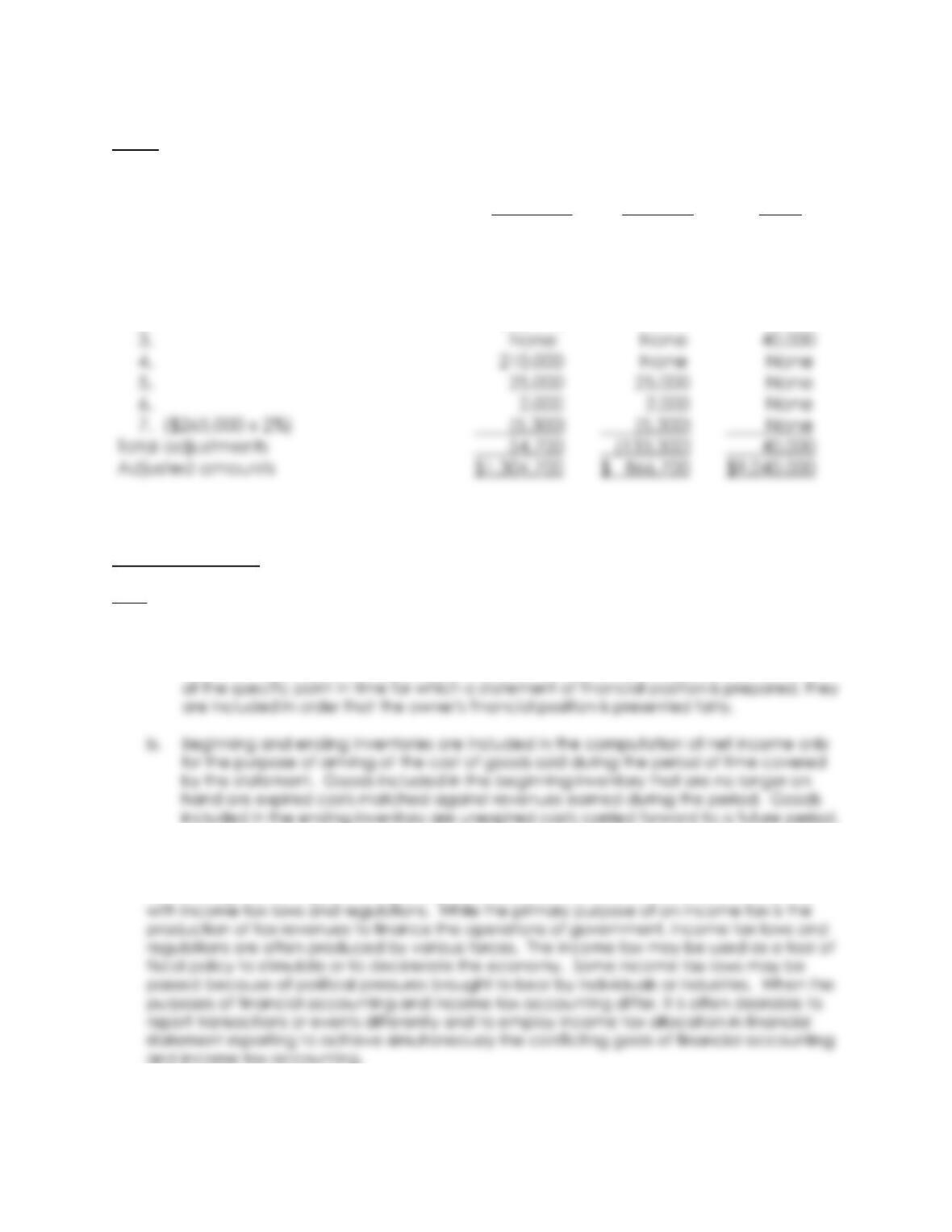
2. Corrected physical inventory at November 30 $57,700
Less: Direct labor included $10,000
Overhead included (200% of direct labor) 20,000 (30,000)
Inventory of materials at November 30 $27,700
Add: Purchases 24,700
8-60
P8-17 (AICPA adapted solution)
Inventory
Accounts
Payable
Sales
Initial amounts
Adjustments:
Increase (decrease)
1.
2.
$1,250,000
(155,000)
(22,000)
$1,000,000
(155,000)
None
$9,000,000
None
None
ANSWERS TO CASES
C8-1 (AICPA adapted solution)
1. a. Inventories are unexpired costs and represent future benefits to the owner. A
statement of financial position includes a listing of unexpired costs and future benefits
as the owner’s assets at a specific point in time. Because inventories are assets owned
2. Financial accounting has as its goal the proper reporting of financial transactions and
events in accordance with generally accepted accounting principles. Income tax
accounting has as its goal the reporting of taxable transactions and events in conformity

C8-1 (continued)
3. FIFO and LIFO are inventory costing methods employed to measure the flow of cost. FIFO
matches the first cost incurred with the first revenue produced whereas LIFO matches the
most recent cost incurred with the first revenue produced after the cost is incurred. (This, of
4. The advantages of the dollar value LIFO method result from the use of a cost index and
inventory pools. The dollar value LIFO method requires less detailed record-keeping,
because it is not necessary to record continuously the value of each item in inventory, or to
C8-2 (AICPA adapted solution)
a. 1. When using LIFO, the most recently incurred costs are included in cost of goods sold on
the earnings statement, and the earlier costs are included in the inventory reported on
the statement of financial position. When using FIFO, the earlier costs are included in
cost of goods sold on the earnings statement, and the later, more current costs are
included in the inventory on the statement of financial position.

C8-2 (continued)
a. 2. The use of FIFO as an inventory method results in recognizing all elements of earnings at
the time of sale. Holding gains (or losses) are combined with the operating (trading)
earnings and are not separately identified. Holding gains arise from holding inventory
during periods of rising prices. Operating earnings result from selling a product at a
price above current cost.
Under FIFO, the operating cycle is viewed as cash to merchandise and back to cash
again; therefore, reported earnings are net of goods (actually) sold. An assumed FIFO
b. The account Reserve for Replacement of LIFO Inventory may also be called Excess of
Replacement Cost over LIFO Cost of Basic Inventory Temporarily Liquidated. The use of
this account arises when there are fewer units in ending inventory than in beginning
inventory for a company using LIFO. This sale of part of the inventory results in
8-63
C8-2 (continued)
b. (continued)
C8-3 (AICPA adapted solution)
1. a. Cash discounts should not be accounted for as financial income when payments are
made. Income should be recognized when the earning process is complete (when
Taylor sells the inventory). Furthermore, cash discounts should not be recorded when
the payments are made because in order to properly match a cash discount with the
2. Inventories would be lower using the LIFO inventory method instead of the FIFO method
over a substantial time period when purchase prices of household appliances are rising
because the inventories are at the oldest (lower) purchase prices instead of the most
C8-4 (AICPA adapted solution)
1. a. The specific identification method requires each unit to be clearly distinguished from
similar units either by description, identification number, location, or other

8-64
C8-4 (continued)
1. (continued)
b. It is appropriate for Happlia to use the specific identification method because each
2. a. Happlia should include in inventory carrying amounts all necessary and reasonable
costs to get an appliance into a useful condition and place for sale. Common (or
joint) costs should be allocated to individual units. Such costs exclude the excess costs
3. The 2010 income statement should report in cost of goods sold all inventory costs
C8-5 (AICPA adapted solution)
Arguments in favor of the procedure of the Atgar Corporation are:
1. The net cash price is all that is “surrendered” by the company in exchange for the goods
and, therefore, is the real cost of the purchases.
Arguments against the procedure are principally those of expediency:
1. The gross amount is always shown on the order and on the supplier’s invoice, but the
discounted amount is rarely shown. It is easier to record the invoice as rendered.
C8-5 (continued)
C8-6
1. The correct inventory cost is the invoice price less all available discounts plus related
acquisition and overhead costs:
2. The correct cost would not change if the discount was not taken. The additional $2,000 is
treated as a finance expense for the period and is not included in inventory cost because
3. According to GAAP, “as applied to inventories, cost means in principle the sum of the
applicable expenditures and charges directly or indirectly incurred in bringing an article to
its existing condition and location.” Even if the storage and handling costs are fixed and not
C8-7 (AICPA adapted solution)
1. The average cost method is based on the assumption that the average costs of the goods
in the beginning inventory and the goods purchased during the period should be used for
both the inventory and the cost of goods sold.

8-66
C8-7 (continued)
2. In an inflationary economy, LIFO provides a better matching of current costs with current
3. Where there is evidence that the utility of goods to be disposed of in the ordinary course of
C8-8
1. In an economy of continuing inflation, the LIFO method provides a better matching of
current costs with current revenue, thereby eliminating effects of holding gains (inventory
profit) from net income. Since the units that are sold are replaced at current costs, the
2. Adoption of the LIFO method results in a lower valuation of inventory on the balance sheet,
which affects the computation and evaluation of current assets, working capital, and any
3. There is a difference between the effect of the change to LIFO on earnings and on the
inventory valuation because of two factors. First, the Ford Motor Company was using the
4. Probably, for a Ford dealer (an automobile retailer), the specific identification method of
inventory valuation would be preferable to LIFO. It is the most relevant and consistent
8-67
C8-9
1. The Kelly Company has continued to use FIFO even though it has experienced rising costs
for the last 5 years and expects that trend to continue. It is likely that the primary reason is
to manipulate income because the policy has some significant negative aspects:
a. The payment of additional income taxes.
However, there are several appropriate reasons for the company‘s use of FIFO:
a. To report higher income, perhaps in order to positively affect ratios or management
compensation.
The decision by the King Company to increase the number of LIFO pools it uses to account
for its inventory is difficult to explain. The use of a larger number of pools means that fewer
types of inventory are included in each pool. Therefore, the advantages of LIFO are more
easily lost as quantities of some items decline in a period. It is most likely a change that is
made to manipulate income through the recognition of LIFO liquidation profits, even
though it would result in paying higher income taxes.
2. Students may raise ethical issues such as:
a. Conflicts between the interests of different stakeholders–particularly management and
stockholders.

8-68
C8-9 (continued)
2. (continued)
C8-10
1. To: Robin Smith
From: Student
1. The adoption of a just-in-time (JIT) inventory system.
In the first situation, the holding gain does represent an increase in the wealth of the
company because the inventory will not be replaced. However, you should exclude it from
income in any trend analysis you do because it cannot occur again. It is likely that there will
also be gains in the next year or two as the company continues to implement the system.
particular company.
2. Students may raise ethical issues, such as:
a. Conflicts between the interests of different stakeholders–particularly management and
stockholders.
8-69
C8-11
Note to the Instructor: The student is required to base the answer on the selection of a
particular business.
To avoid exchange gains and losses entirely, and thereby avoid volatile earnings, the
company would have to specify that all its transactions are expressed in terms of dollars.
C8-12
1. Coca-Cola uses the average cost or FIFO methods (p. 74). The company presumably
based its selection on the cost trends in the various parts of its business. Both average cost
2. 2007: $10,406 ÷ $2,220 = 4.69; 2006: $8,164 ÷ $1,641 = 4.98 (p. 66 and p. 67).
3. Inventory 10,985a
Accounts Payable 10,985

C8-13
Note to Instructor: This case does not have a definitive answer. From a financial reporting
perspective, GAAP is identified and summarized. From an ethical perspective, various issues
are raised for discussion purposes.
From a financial reporting perspective, the issue is the costs that should be included in the
cost of the inventory. GAAP specify that cost includes the price paid or the consideration
From an ethical perspective, the primary stakeholders are the professors, the used book
company and its employees, the publisher of the textbook, the authors of the textbook, the
ANSWERS TO RESEARCH SIMULATIONS
R8-1
Note to Instructor: Students are expected to cite references to GAAP in their research of
this issue. They might use the FARS electronic database, pronouncements listed on the FASB
web site, the FASB Original Pronouncements, the FASB Current Text, or other primary sources
of GAAP to obtain these references. They may also use the FASB Accounting Standards
Codification which is cited in parentheses.
To: President, Philip Morris
From: Student
I have researched the issue of “trade loading.” According to FASB Statement of Concepts

8-71
R8-1 (continued)
Unless there are “hidden” agreements between Philip Morris and the distributors, the
transactions do meet the two general revenue recognition criteria and the six specific
R8-2
Note to Instructor: Students are expected to cite references to GAAP in their research of
this issue. They might use the FARS electronic database, pronouncements listed on the FASB
web site, the FASB Original Pronouncements, the FASB Current text, or other primary sources
of GAAP to obtain these references. They may also use the FASB Accounting Standards
Codification which is cited in parentheses.
To: President, Fenimore Company
From: Student
I have researched the issue of which method of accounting for manufacturing cost
variances is consistent with GAAP. According to ARB 43, Chapter 4, par. 6, fn 3 (FASB Cod.
# 330-10-30), standard costs are acceptable for inventory valuation if they are adjusted at