Section 8.2
It is required that xand zbe positive. This system has the unique solution
8.2.33 Use the formulas for x,y,zderived in Exercise 32.
x=√a=√8 = 2√2
8.2.34 (i) implies (ii): See the hint at the end of the exercise.
(ii) implies (iii): det A(m)is the product of the (positive) eigenvalues.
(iii) implies (iv):
A=A(n−1) ~v
~v Tk=B0
~xT1BT~x
0t=BBTB~x
~xTBT~xT~x +t
8.2.35 Solve the system
4−4 8
−4 13 1
8 1 26
=
x0 0
y w 0
z t s
x y z
0w t
0 0 s
x2= 4,so x= 2
8.2.36 If A=QR, then ATA= (QR)TQR =RTQTQR =RTR=LLT,L=RT.
Chapter 8
8.2.37 ∂q
= 2a,q22 =∂2q
= 2c, and q12 =∂2q
8.2.38 The eigenvalues of Bare p−qand nq +p−q=p+ (n−1)q, so that Bis positive definite if p−q > 0 and
p+ (n−1)q > 0.
8.2.39 If ~v1, . . . ,~vnis such a basis consisting of unit vectors, and we let A= [~v1···~vn], then
1 cos θ··· cos θ
cos θ1...cos θ
8.2.40 Let λbe the smallest eigenvalue of A. If we let k= 1 −λ, then the smallest eigenvalue of the matrix A+kIn
will be λ+k= 1, so that all the eigenvalues of A+kInwill be positive. Thus matrix A+kInwill be positive
definite, by Theorem 8.2.4.
8.2.42 The functions xixjform a basis of Qn, where 1 ≤i≤j≤n. A little combinatorics shows that there are
1 + 2 + 3 + ···+n=n(n+ 1)/2 such functions, so that dim(Qn) = n(n+ 1)/2
8.2.43 Note that T(ax2
1+bx1x2+cx2
2) = ax2
1(we let x2= 0). Thus im(T) = span(x2
1), rank(T) = 1, ker(T) =
span(x1x2, x2
2), nullity(T) = 2.
8.2.45 Note that T(ax2
1+bx2
2+cx2
3+dx1x2+ex1x3+fx2x3) = ax2
1+b+c+dx1+ex1+f(we let x2=
x3= 1). Thus im(T) = P2and rank(T) = 3. The kernel of Tconsists of the quadratic forms with a= 0,
8.2.46 Note that T(ax2
1+bx2
2+cx2
3+dx1x2+ex1x3+fx2x3) = ax2
1+bx2
2+cx2
1+dx1x2+ex2
1+fx1x2(we
let x3=x1). Thus im(T) = Q2and rank(T) = 3. The kernel of Tconsists of the quadratic forms with
396
Section 8.2
8.2.47 T(A+B)(~x) = ~xT(A+B)~x =~xTA~x +~xTB~x equals (T(A) + T(B))(~x)
=T(A)(~x) + T(B)(~x) = ~xTA~x +~xTB~x. The verification of the second axiom of linearity is analogous.
8.2.48 The matrix of Twith respect to the basis x2
1, x1x2, x2
2is A=
0 0 1
0 1 0
1 0 0
, with the eigenvalues 1,1, −1 and
corresponding eigenvectors
0
1
0
,
1
0
1
,
1
0
−1
. Thus x1x2and x2
1+x2
2are eigenfunctions with eigenvalue 1, and
x2
1−x2
2has eigenvalue −1. Yes, Tis diagonalizable, since there is an eigenbasis.
8.2.50 The matrix of Twith respect to the basis x2
1, x1x2, x2
2is A=
0 1 0
2 0 2
0 1 0
, with the eigenvalues 0,2, −2 and
8.2.51 If Bis negative definite, then A=−Bis positive definite, so that the determinants of all principal submatrices
A(m)are positive. Thus det(B(m)) = det(−A(m)) = (−1)mdet(A(m)) is positive for even mand negative for odd
m.
397
Chapter 8
8.2.52 Because aij =~eT
jA~ei, we have q(~ei) = aii. Further, using linearity q(~ei+~ej) = (~ei+~ej)TA(~ei+~ej) =
~eT
iA~ei+~eT
iA~ej+~eT
jA~ei+~eT
jA~ej=q(~ei) + q(~ej) + 2aij . Solving for aij gives aij =1
2(q(~ei+~ej)−q(~ei)−q(~ej)).
8.2.53 a. Because p(x, y) = q(x~ei+y~ej) = (x~ei+y~ej)TA(x~ei+y~ej) = aiix2+aij xy +ajiyx +ajj y2, this is a
8.2.54 The entries a1j=aj1must all be 0. To see that a1j= 0, consider the function p(x, y) = q(x~e1+y~ej) defined
8.2.55 As the hint suggests, it suffices to prove that aij < aii or aij < ajj , implying that for every entry off the
diagonal there exists a larger entry on the diagonal. Now q(~ei−~ej) = (~ei−~ej)TA(~ei−~ej) = aii −2aij +ajj >0,
or, aii +ajj >2aij , proving the claim.
8.2.58 Working in coordinates with respect to an orthonormal eigenbasis of A, we can write the equation q(~x) = 1
as λ1c2
1+λ2c2
2= 1, where the eigenvalues λ1and λ2are positive. This level surface is a cylinder.
8.2.59 Working in coordinates with respect to an orthonormal eigenbasis of A, we can write the equation q(~x) = 1
as λ1c2
1= 1, where the eigenvalue λ1is positive. This level surface is a pair of parallel planes, c1=±1√λ1
8.2.62 Working in coordinates with respect to an orthonormal eigenbasis of A, we can write the equation q(~x) = 0
as λ1c2
1+λ2c2
2+λ3c2
3= 0, where the eigenvalues λ1and λ2are positive, while λ3is negative. This level surface
is a cone.
398
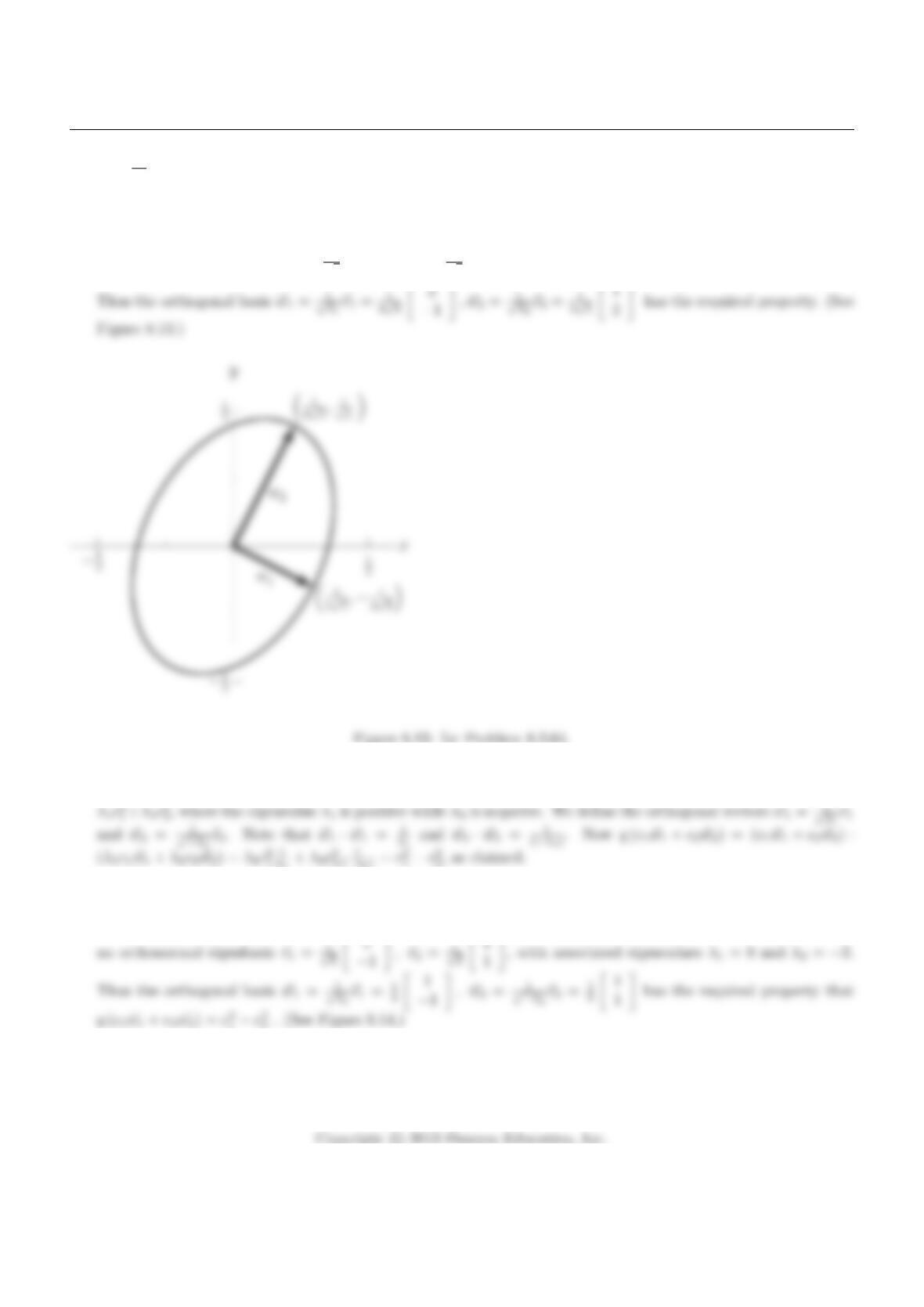
Section 8.2
λnc2
n1
λn=c2
1+… +c2
n, as claimed.
8.2.64 We will use the strategy outlined in Exercise 8.2.63. The symmetric matrix of qis A=8−2
−2 5 , with
an orthonormal eigenbasis ~v1=1
√52
−1, ~v2=1
√51
2, with associated eigenvalues λ1= 9 and λ2= 4.
8.2.65 Working in coordinates c1, c2with respect to an orthonormal eigenbasis ~v1, ~v2for A, we can write q(~x) =
8.2.66 We will use the strategy outlined in Exercise 8.2.65. The symmetric matrix of qis A=3−5
−5 3 , with
8.2.67 Consider an orthonormal eigenbasis ~v1, …, ~vnfor Awith associated eigenvalues λ1, …, λn, such that the
eigenvalues λ1, …, λpare positive, λp+1, …, λrare negative, and the remaining eigenvalues are 0. Define a
399
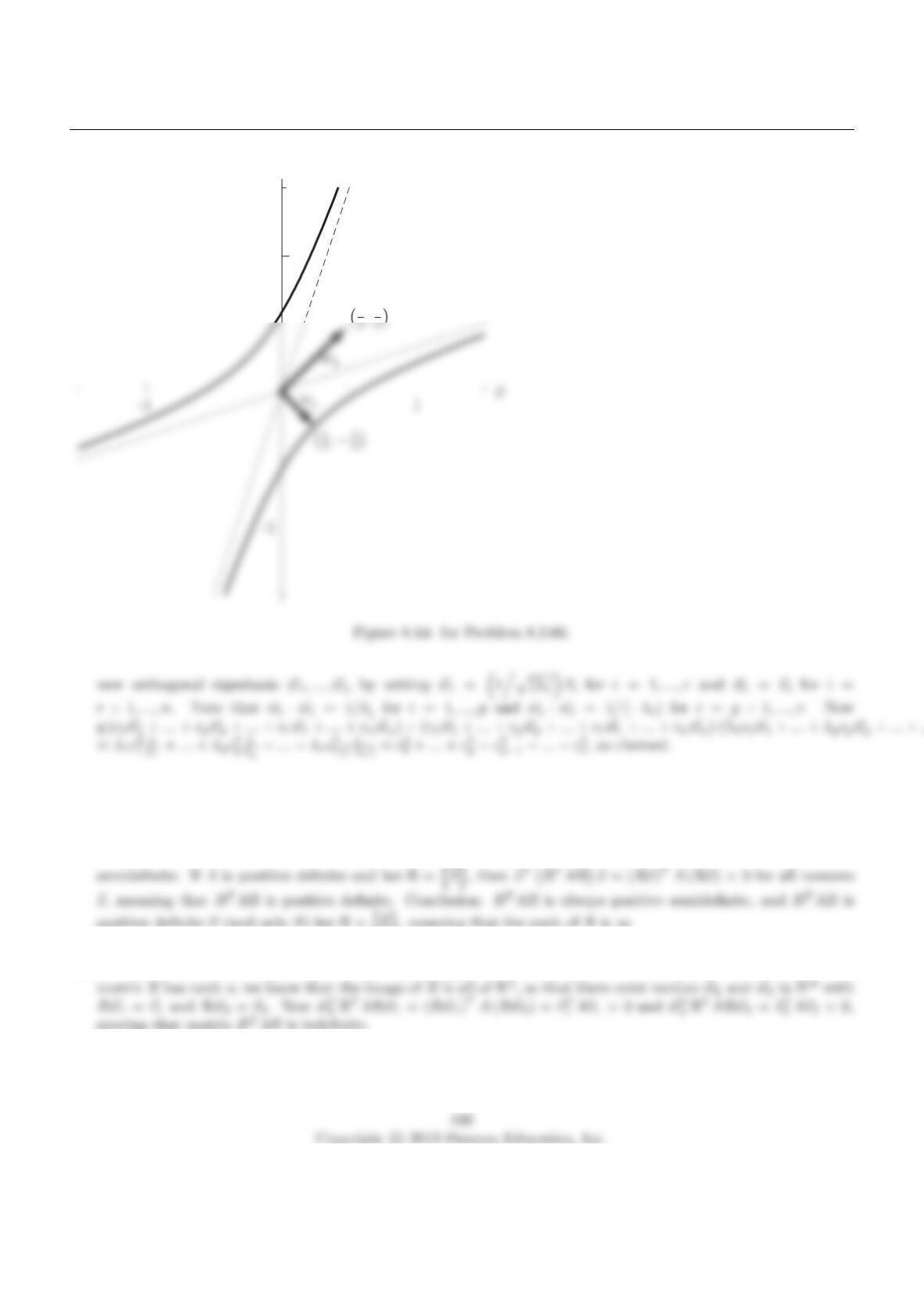
Chapter 8
1
1
, 1
y
8.2.68 p(~x) = q(L(~x)) = q(R~x) = (R~x)TA(R~x) = ~xTRTAR~x, proving that pis a quadratic form with sym-
metric matrix RTAR.
8.2.69 If Ais positive definite, then ~xTRTAR~x = (R~x)TA(R~x)≥0 for all ~x, meaning that RTAR is positive
8.2.70 Since Ais indefinite, there exist vectors ~v1and ~v2in Rnsuch that ~vT
1A~v1>0 and ~vT
2A~v2<0. Since the n×m
8.2.71 Anything can happen. Consider the example A=1 0
0−1,R1=I2,R2=1
0and R3=0
1. Then
Section 8.3
Section 8.3
8.3.1σ1= 2, σ2= 1
8.3.2The image of the unit circle is the unit circle, since the transformation defined by Apreserves length. Thus
σ1=σ2= 1 by Theorem 8.3.2.
8.3.5ATA=p2+q20
0p2+q2, with eigenvalues λ1=λ2=p2+q2. The singular values of Aare σ1=σ2=
pp2+q2.Arepresents a rotation combined with a scaling, with a scaling factor of pp2+q2, so that the image
of the unit circle is a circle with radius pp2+q2.
8.3.6The eigenvalues of ATAare λ1= 25 and λ2= 0, so that the singular values of Aare σ1= 5 and σ2= 0 (these
are also the eigenvalues of A; compare with Exercise 24).
8.3.7ATA=1 0
0 4
λ1= 4, λ2= 1; σ1= 2, σ2= 1
401
Chapter 8
8.3.8ATA=p2+q20
0p2+q2;λ1=λ2=p2+q2;σ1=σ2=pp2+q2
eigenvectors of ATA:~v1=1
0,~v2=0
1,~u1=1
σ1A~v1=1
√p2+q2p
q,~u2=1
σ2A~v2=
1
√p2+q2−q
p, so that U=1
√p2+q2p−q
q p , Σ = (pp2+q2)I2,V=I2.
8.3.9ATA=5 10
10 20 (See Exercise 6)
8.3.10 In Example 4 we found 6 2
−7 6 =1
√51 2
−2 1 10 0
0 5 1
√52−1
1 2 ; now take the transpose of both
sides:
8.3.11 ATA=1 0
0 4 ;λ1= 4, λ2= 1; σ1= 2, σ2= 1 eigenvectors of ATA:
8.3.12 In Example 5 we see that 0 1 1
1 1 0 =1
√21−1
1 1 √3 0 0
0 1 0
1
√6
2
√6
1
√6
1
√20−1
√2
1
√3−1
√3
1
√3
.
Section 8.3
8.3.13 ATA=37 16
16 13 ;λ1= 45, λ2= 5; σ1= 3√5, σ2=√5 eigenvectors of ATA:
8.3.14 ATA=4 6
6 13 ;λ1= 16, λ2= 1; σ1= 4, σ2= 1
8.3.15 If A~v1=σ1~u1and A~v2=σ2~u2, then A−1~u1=1
σ1~v1and A−1~u2=1
σ2~v2, so that the singular values of A−1
are the reciprocals of the singular values of A.
8.3.16 If A=UΣVTthen A−1=VΣ−1UTand (A−1)TA−1=UΣ−12U−1. Thus (A−1)TA−1is similar to
Σ−12, so that the eigenvalues of (A−1)TA−1are the squares of the reciprocals of the singular values of A. It
follows that the singular values of A−1are the reciprocals of those of A.
8.3.18 ~
b=
1
2
3
4
,~u1=1
2
1
1
1
1
,~u2=1
2
1
1
−1
−1
,~v1=1
53
−4,~v2=1
54
3,σ1= 2, σ2= 1, so that
Chapter 8
8.3.19 ~x =c1~v1+···+cm~vmis a least-squares solution if A~x =c1A~v1+···+cmA~vm=c1σ1~u1+···+crσr~ur=
8.3.20 aA=UΣVT=UV TVΣVT=QS, where Q=UV Tand S=VΣVT. Note that Qis orthogonal, being the
product of orthogonal matrices; Sis symmetric as ST= (VT)TΣTVT=VΣVT=S; and Sis similar to Σ, so
that the eigenvalues of Sare the (nonnegative) diagonal entries of Σ.
b Yes, write A=UΣVT=UΣUTU V T=S1Q1where S1=UΣUTand Q1=UV T.
Q
S
8.3.22 a. T1is the orthogonal projection onto the plane perpendicular to the vector ~v.T2scales by the length of the
vector ~v and T3is a rotation about the line through the origin spanned by ~v by a rotation angle π/2. Because
Q=A3is orthogonal and S=A2A1is symmetric this is a polar decomposition: A=QS.
b. Here, A1represents the orthogonal projection onto the xz plane, A2represents a scaling by a factor of 2, and
A3represents a rotation about the yaxis through an angle of π/2, counterclockwise as viewed from the positive
yaxis:
8.3.23 AATU=UΣVTVΣTUTU=UΣSigmaT, since VTV=Imand UTU=In, so that
8.3.24 The eigenvalues of ATA=A2are the squares of the eigenvalues of A, so that the singular values of Aare
the absolute values of the eigenvalues of A.
404
Section 8.3
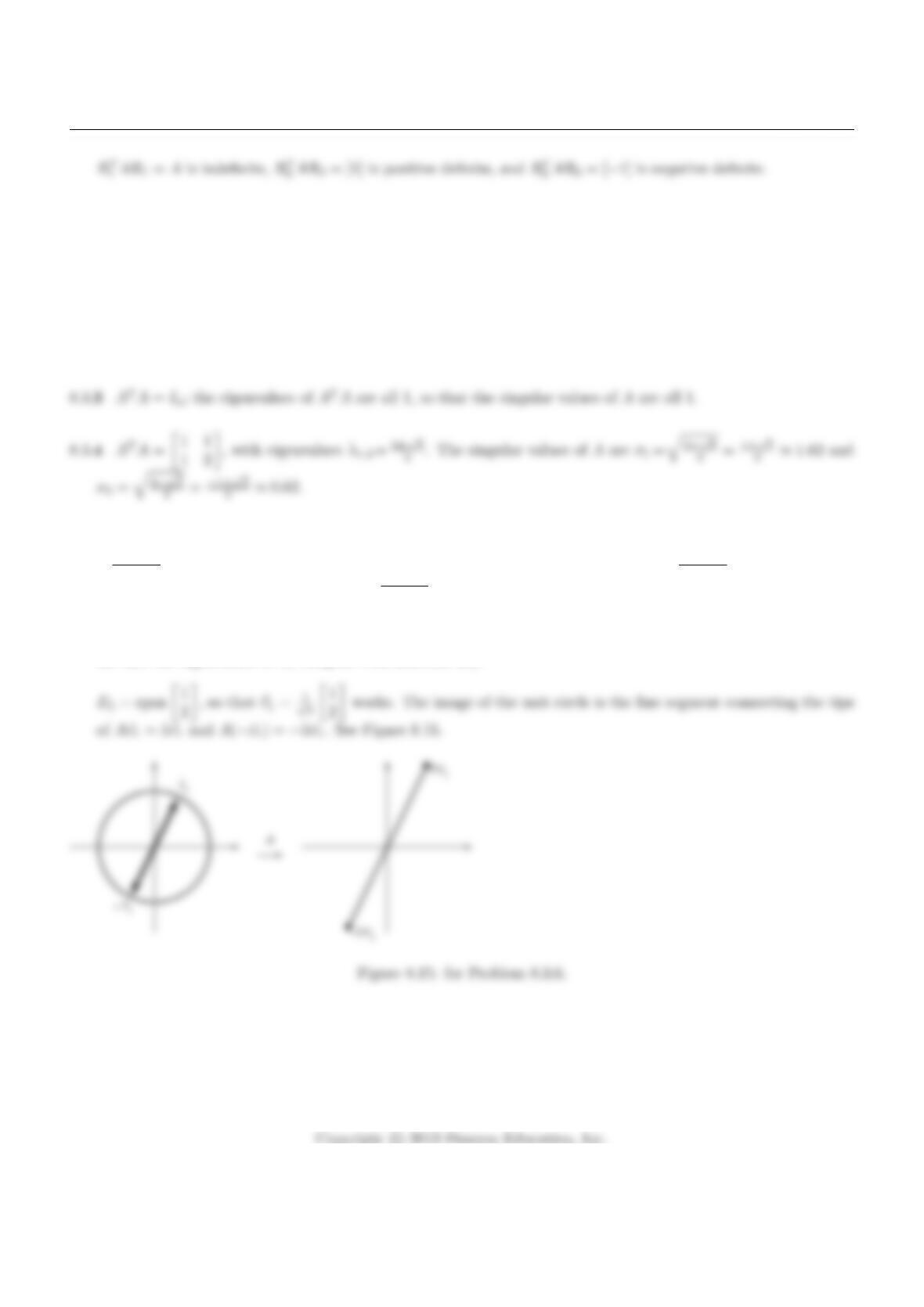
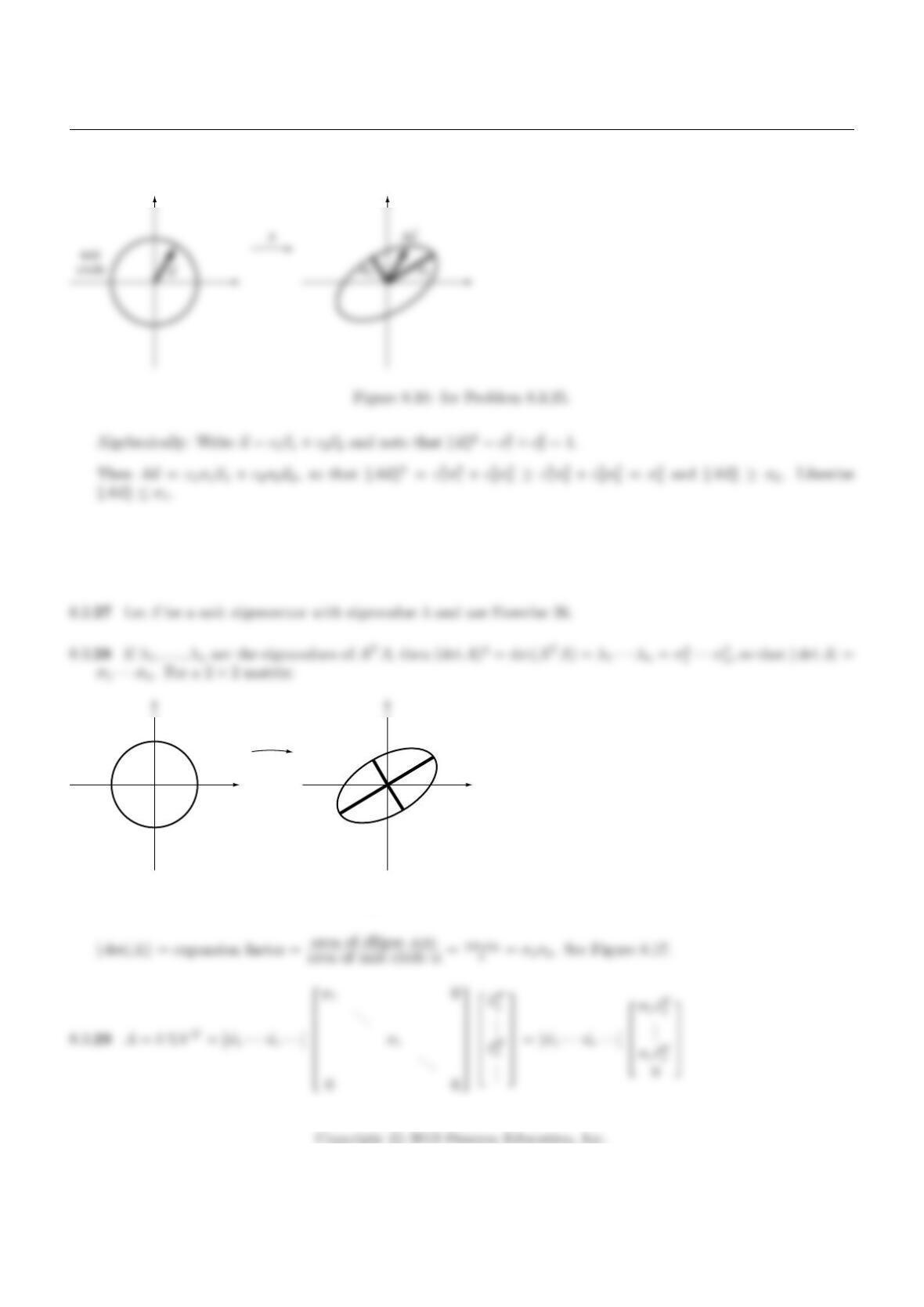
8.3.25 See Figure 8.16.
8.3.26 Write ~v =c1~v1+···+cm~vmand note that k~vk2=c2
1+···+c2
m. Then A~v =c1σ1~u1+···+crσr~urand
kA~vk2=c2
1σ2
1+c2
2σ2
2+···+c2
rσ2
r≤c2
1σ2
1+c2
2σ2
1+···+c2
rσ2
1≤σ2
1kvk2so that kA~vk ≤ σ1k~vk. Likewise,
kA~vk ≥ σmk~vk.
A
A(Ω)
unit
circle σ2
σ1
Ω
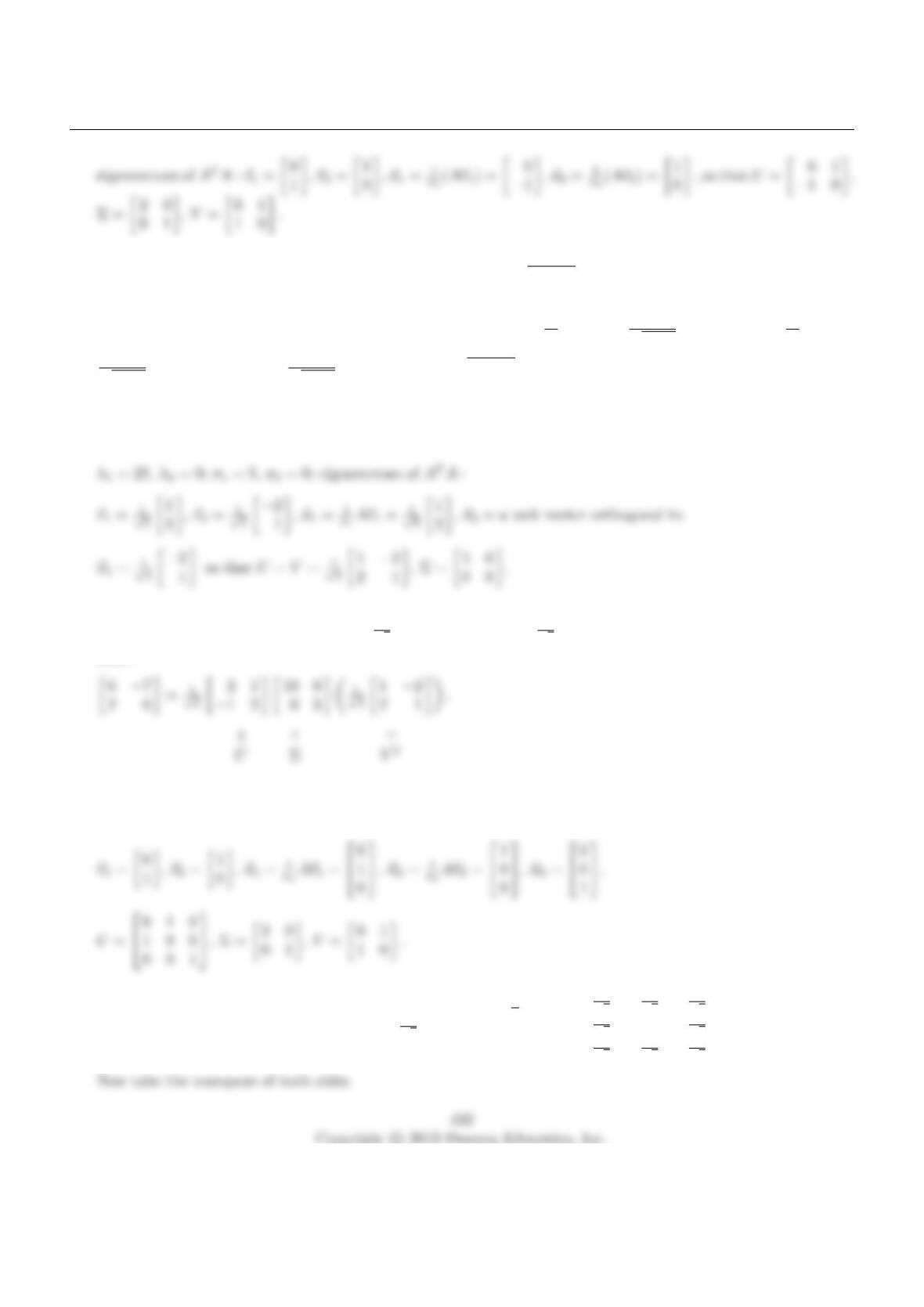
Figure 8.17: for Problem 8.3.28.
405
Chapter 8
=σ1~u1~vT
1+···+σr~ur~vT
r
8.3.31 The formula A=σ1~u1~vT
1+···+σr~ur~vT
rgives such a representation.
8.3.33 Yes; since ATAis diagonalizable and has only 1 as an eigenvalue, we must have ATA=In.
8.3.35 We will freely use the diagram on Page 393 (with r=m). We have ATA~vi=AT(σi~ui) = σ2
i~viand
8.3.36 We will freely use the diagram on Page 411. By construction of the ~vias eigenvectors of ATAwe have
True or False
Ch 8.TF.1T. If D=
λ1.0
. . .
0. λn
, then DTD=D2=
λ2
1.0
. . .
0. λ2
n
. The eigenvalues of DTDare λ2
1,…,λ2
n,
and the singular values of Dare pλ2
1=|λ1|,…,pλ2
n=|λn|.
406
True or False
Ch 8.TF.5F. The orthogonal matrix A=0−1
1 0 fails to be diagonalizable (over R).
Ch 8.TF.9T, by Theorem 8.2.4.
Ch 8.TF.10 T, by Definition 8.2.1
Ch 8.TF.14 T. All four eigenvalues are negative, so that their product, the determinant, is positive.
Ch 8.TF.15 T, by Theorem 8.1.2
Ch 8.TF.19 T, by Theorem 8.2.4: all the eigenvalues are positive.
Ch 8.TF.20 T, since the matrix is symmetric.
Ch 8.TF.21 T. The eigenvalues λ1, . . . , λnof Aare nonzero, since Ais invertible, so that the eigenvalues λ2
1,…,λ2
n
of A2are positive. Now use Theorem 8.2.4.
407
Chapter 8
Ch 8.TF.25 T. By Theorem 7.3.6, matrices Aand Bhave the same eigenvalues. Now use Theorem 8.2.4.
Ch 8.TF.28 T. Consider the singular value decomposition A=UPVT, or AV =UP, where Vis orthogonal (see
Theorem 8.3.5). We can let S=V, since the columns of AS =AV =UPare orthogonal, by construction.
Ch 8.TF.29 T. By the spectral theorem, Ais diagonalizable: S−1AS =Dfor some invertible Sand a diagonal D.
Now Dn=S−1AnS=S−10S= 0, so that D= 0 (since Dis diagonal). Finally, A=SDS−1=S0S−1= 0, as
claimed.
Ch 8.TF.30 F. If kis negative, then kq(~x) will be negative definite.
Ch 8.TF.35 F. Consider A=
−1 0 0
0 1 0
0 0 1
, which is indefinite.
Ch 8.TF.36 T, by Definition 8.2.3: ~xT(A+B)~x =~xTA~x +~xTB~x > 0 for all nonzero ~x.
Ch 8.TF.40 T. If λis the smallest eigenvalue of A, let k= 1 −λ. Then the smallest eigenvalue of A+kInis
λ+k= 1, so that all the eigenvalues of A+kInare positive. Now use Theorem 8.2.4.
408
True or False
Ch 8.TF.42 F. Consider the positive definite matrix A=1−1
−1 2 .
Ch 8.TF.43 F. Consider the indefinite matrix A=1 0
0−1.
Ch 8.TF.44 T. By Theorem 8.3.2., the continuous function f(x) = Acos x
sin xhas the global maximum 5 and the
Ch 8.TF.45 T, since ~xTA2~x =−~xTATA~x =−(A~x)TA~x =−kA~xk2≤0 for all ~x.
Ch 8.TF.46 T. If λ1,…,λnare the eigenvalues of ATA, then λ1λ2. . . λn= det(ATA) = (det A)2. If
σ1=√λ1,…,σn=√λnare the singular values of A, then
σ1σ2. . . σn=√λ1λ2. . . λn=|det A|, as claimed.
Ch 8.TF.50 F. Consider the similar matrices A=0 0
0 3 and B=0 4
0 3 . Matrix Ahas the singular values 0
and 3, while those of Bare 0 and 5.
Ch 8.TF.51 T. Let ~v1, ~v2be an orthonormal eigenbasis, with A~v1=~v1and A~v2= 2~v2. Consider a nonzero vector
~x =c1~v1+c2~v2; then A~x =c1~v1+ 2c2~v2. If c1= 0, then ~x =c2~v2and A~x = 2c2~v2are parallel, and we are all set.
Now consider the case when c16= 0. Then the angle between ~x and A~x is arctan(2c2/c1)−arctan(c2/c1); to see
Chapter 8
Ch 8.TF.52 T. Let A=a b
c d . By Theorem 8.3.2, A1
0=a
c=√a2+c2<5 (since the length of the
semi-major axis of the image of the unit circle is less than 5). Thus a < 5 and c < 5. Likewise, b < 5 and d < 5.
410