PROBLEM 8.60
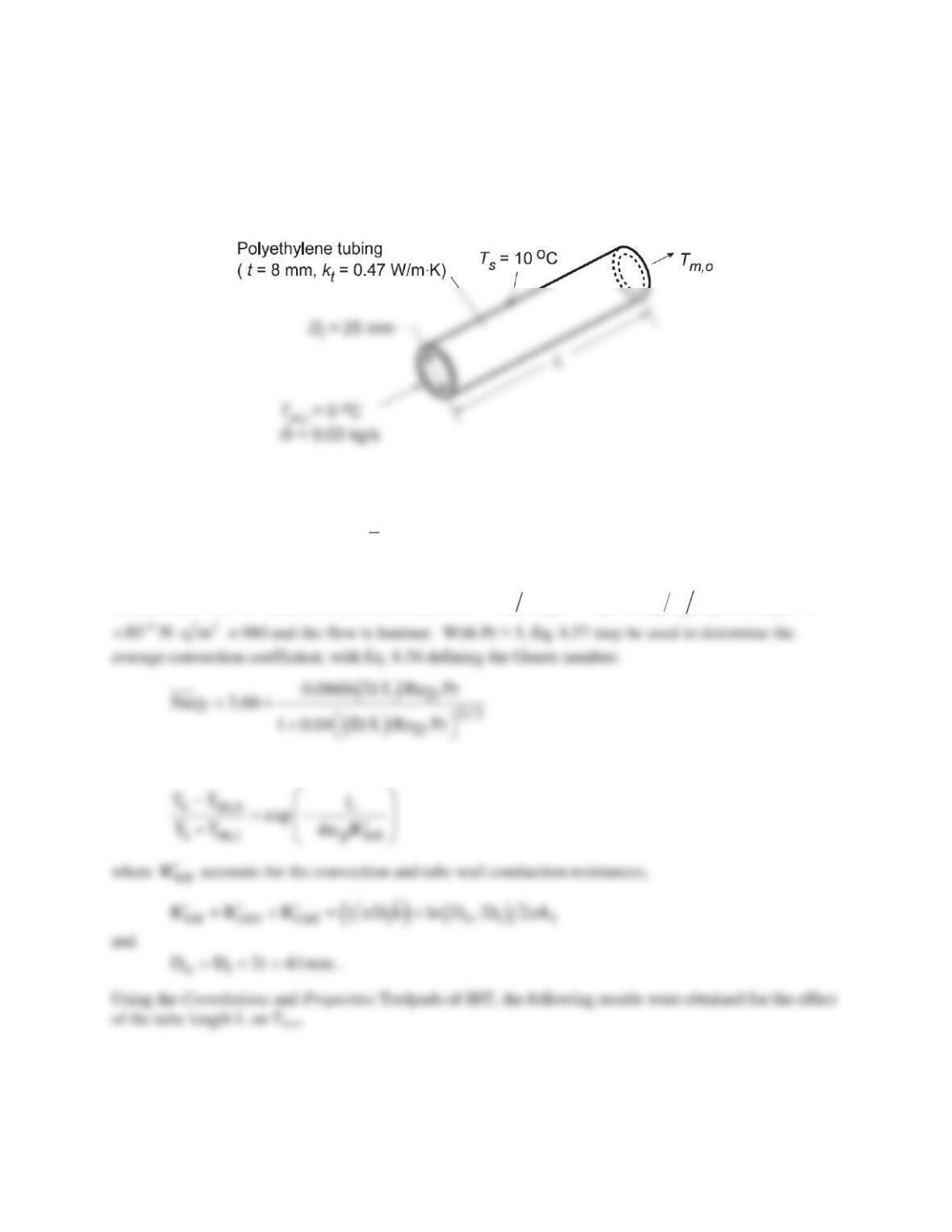
KNOWN: Features of tubing used in a ground source heat pump. Temperature of surrounding soil.
Fluid inlet temperature and flowrate.
FIND: (a) Effect of tube length on outlet temperature, (b) Recommended tube length and the effect of
variations in the flowrate.
SCHEMATIC:
ASSUMPTIONS: (1) Steady–state conditions, (2) Constant properties, (3) Negligible conduction
resistance in soil, (4) Incompressible liquid with negligible viscous dissipation, (5) Fluid properties
correspond to those of water.
PROPERTIES: Table A.6 (assume
m
T
= 277 K): cp = 4206 J/kg⋅K, m = 1560 × 10-6 N⋅s/m2, k = 0.577
W/m⋅K, Pr = 11.44.
ANALYSIS: (a) For the prescribed conditions, ReD =
i
4m D
pm
=
( ) ( )
4 0.03kg s 0.025m 1560
p
With Ts used in lieu of T∞, Eq. 8.45b may be used to determine Tm,o,
Continued…
PROBLEM 8.60 (Cont.)
6
8
10
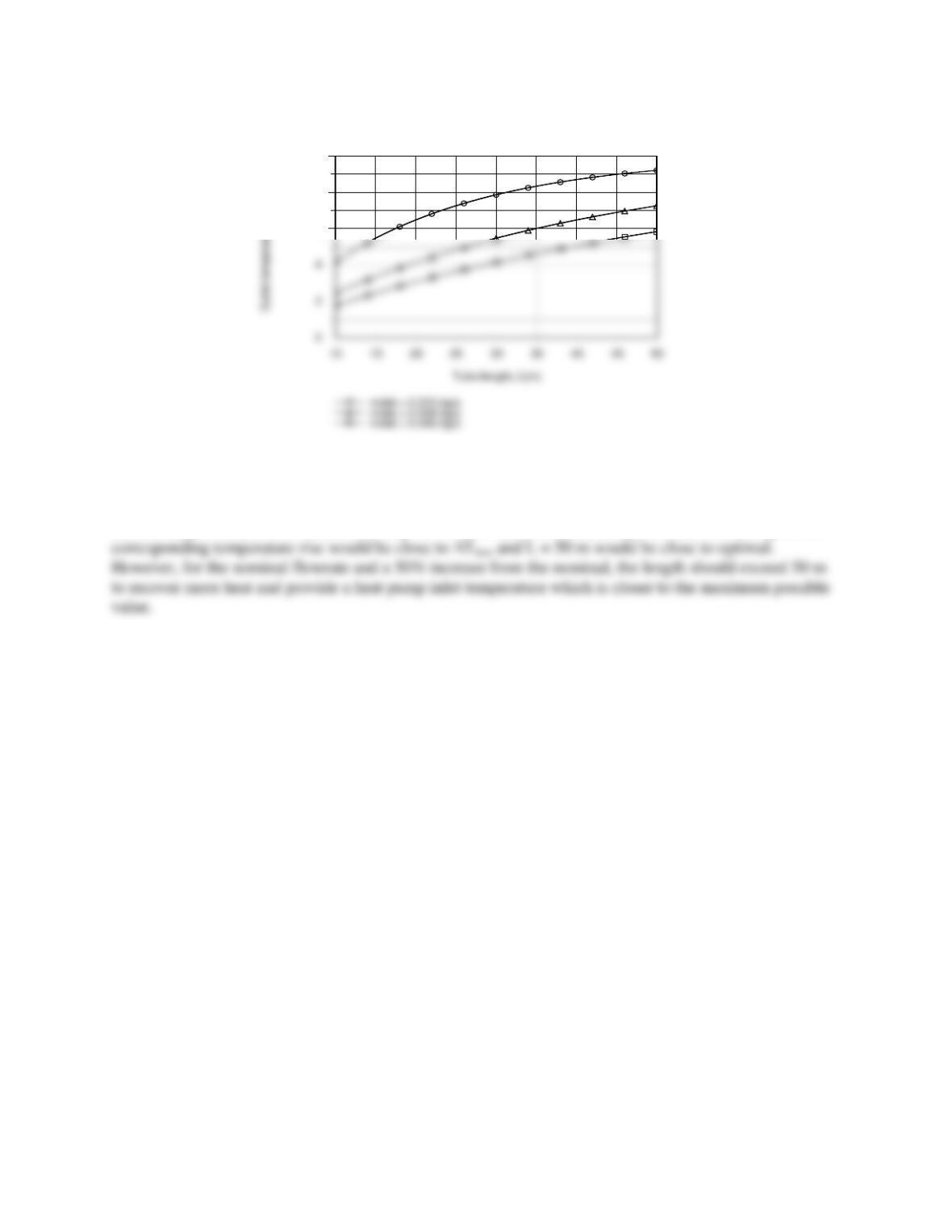
The longer the tube the larger the rate of heat extraction from the soil, and for
m
= 0.030 kg/s, the
temperature rise of DT = (Tm,o – Tm,i) ≈ 7°C is well below the maximum possible value of DTmax = 10°C.
(b) The length should be at least 50 m long. If the flowrate were reduced by 50% (
m
= 0.015 kg/s), the
COMMENTS: In practice, the tube surface temperature would be less than 10°C (if the temperature of
the soil well removed from the tube were at 10°C), thereby reducing the heat extraction rate and Tm,o.
PROBLEM 8.61
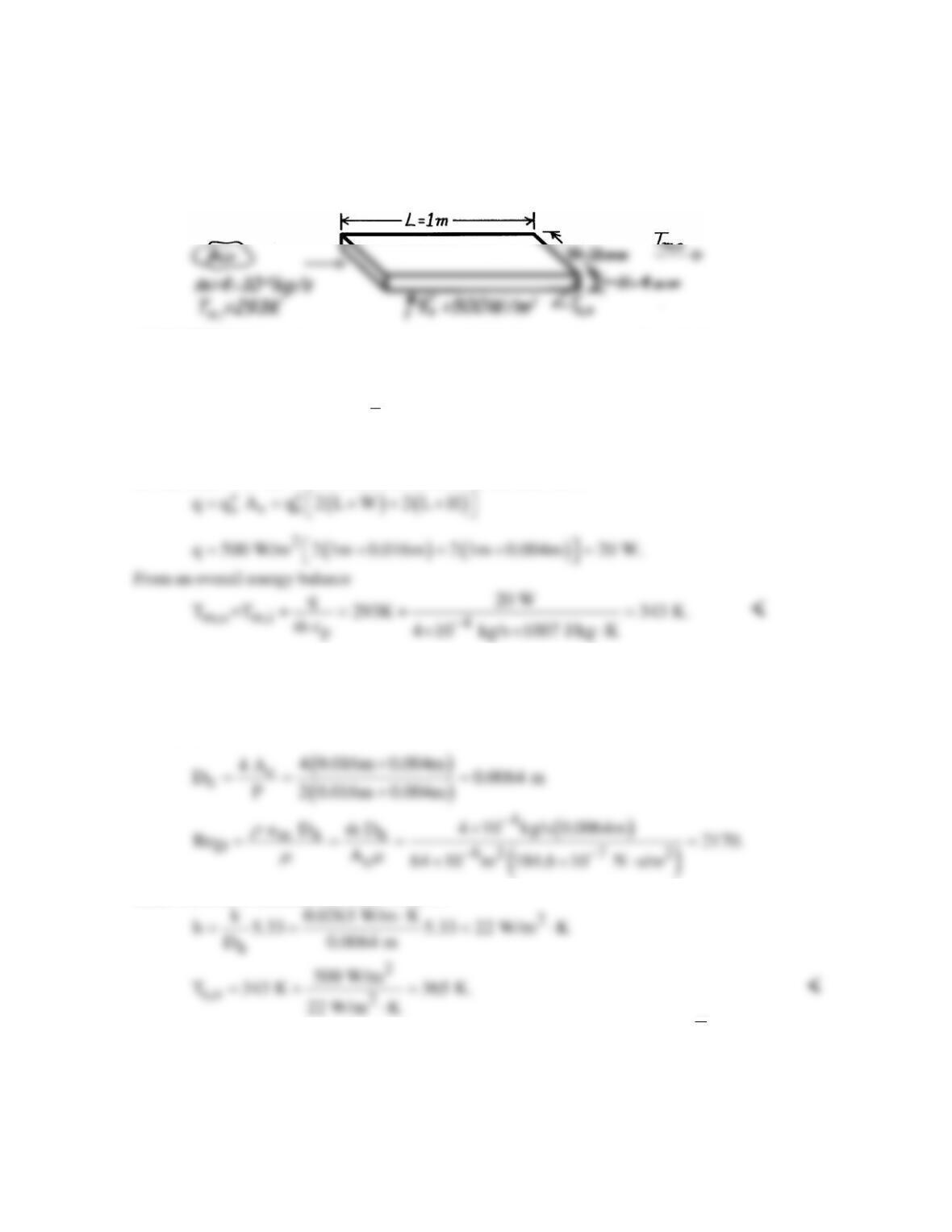
KNOWN: Flow rate and inlet temperature of air passing through a rectangular duct of prescribed
dimensions and surface heat flux.
FIND: Air and duct surface temperatures at outlet.
SCHEMATIC:
ASSUMPTIONS: (1) Steady–state conditions, (2) Uniform surface heat flux, (3) Constant properties,
(4) Atmospheric pressure, (3) Fully developed conditions at duct exit, (6) Ideal gas with negligible
viscous dissipation and pressure variation.
PROPERTIES: Table A-4, Air
( )
m
T 300K, 1 atm :≈
cp = 1007 J/kg⋅K, m = 184.6 × 10⁻⁷ N⋅s/m2,
k = 0.0263 W/m⋅K, Pr = 0.707.
ANALYSIS: For this uniform heat flux condition, the heat rate is
The surface temperature at the outlet may be determined from Newton’s law of cooling, where
s,o m,o
T T q /h.
′′
= +
From Eqs. 8.66 and 8.1
Hence the flow is laminar, and from Table 8.1
COMMENTS: The calculations should be repeated with properties evaluated at
m
T
= 318 K. The
change in Tm,o would be negligible, and Ts,o would decrease slightly.
PROBLEM 8.62
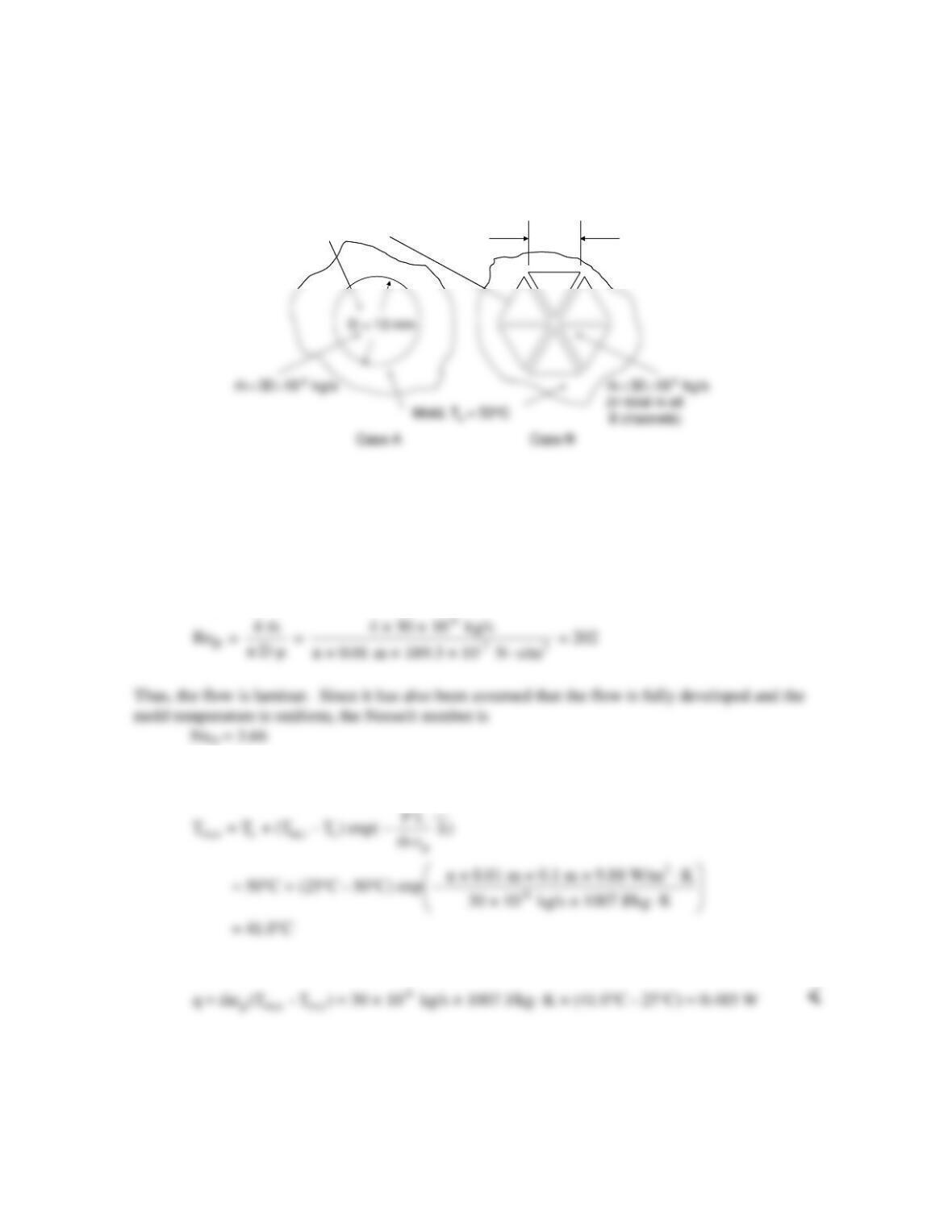
KNOWN: Inlet temperature and mass flow rate of air flow. Geometry and dimensions of channels
through a mold. Mold temperature.
FIND: (a) Rate of heat transfer to the air for case A, (b) Rate of heat transfer to the air for case B,
and (c) pressure drop for both cases.
SCHEMATIC:
ASSUMPTIONS: (1) Flow is hydrodynamically and thermally fully developed, (2) Mold
temperature is uniform. (3) Narrow fins between channels in case B are at the mold temperature.
PROPERTIES: Table A-4, Air (T ≈ 310 K assumed, 1atm): ρ = 1.128 kg/m3, cp = 1007 J/kg∙K, μ =
189.3 × 10⁻⁷ N∙s/m2, k = 0.027 W/m∙K.
ANALYSIS:
(a) The Reynolds number is
Thus h = NuDk/D = 3.66 × 0.027 W/m∙K/0.01 m = 9.88 W/m2∙K.
The outlet temperature can be found from Equation 8.41b,
Thus
(b) We first determine the dimensions of the triangular channels from the requirement that the total
area is the same as case A.
Continued…
a
Air, T
m
= 25°C
a
Air, T
m
= 25°C
PROBLEM 8.62 (Cont.)
22
πD /4 = 6a /2
and the flowrate in one channel is 5 × 10⁻⁶ kg/s.
The hydraulic diameter is Dh = 4Ac/P = 4(a2/2)/3a = 2a/3 = 3.4mm.
The outlet temperature is
Then using the total flowrate to account for all six channels,
(c) The friction factor for case A is f = 64/ReD = 64/202 = 0.317. The pressure drop is, from Equation
8.22a,
COMMENTS: (1) Segmenting the channel into six smaller sections increases the heat transfer by
55%, but at the expense of almost a five-fold increase in the pressure drop. (2) For the circular duct,
the hydrodynamic entry length, is xfd,h = 0.05 ReD D = 0.1 m, so it is not fully developed as assumed.
For the triangular duct, xfd,h = 0.05 ReD Dh = 0.02 m, so the assumption is more appropriate. The
thermal development length is shorter, since Pr = 0.7.
PROBLEM 8.63
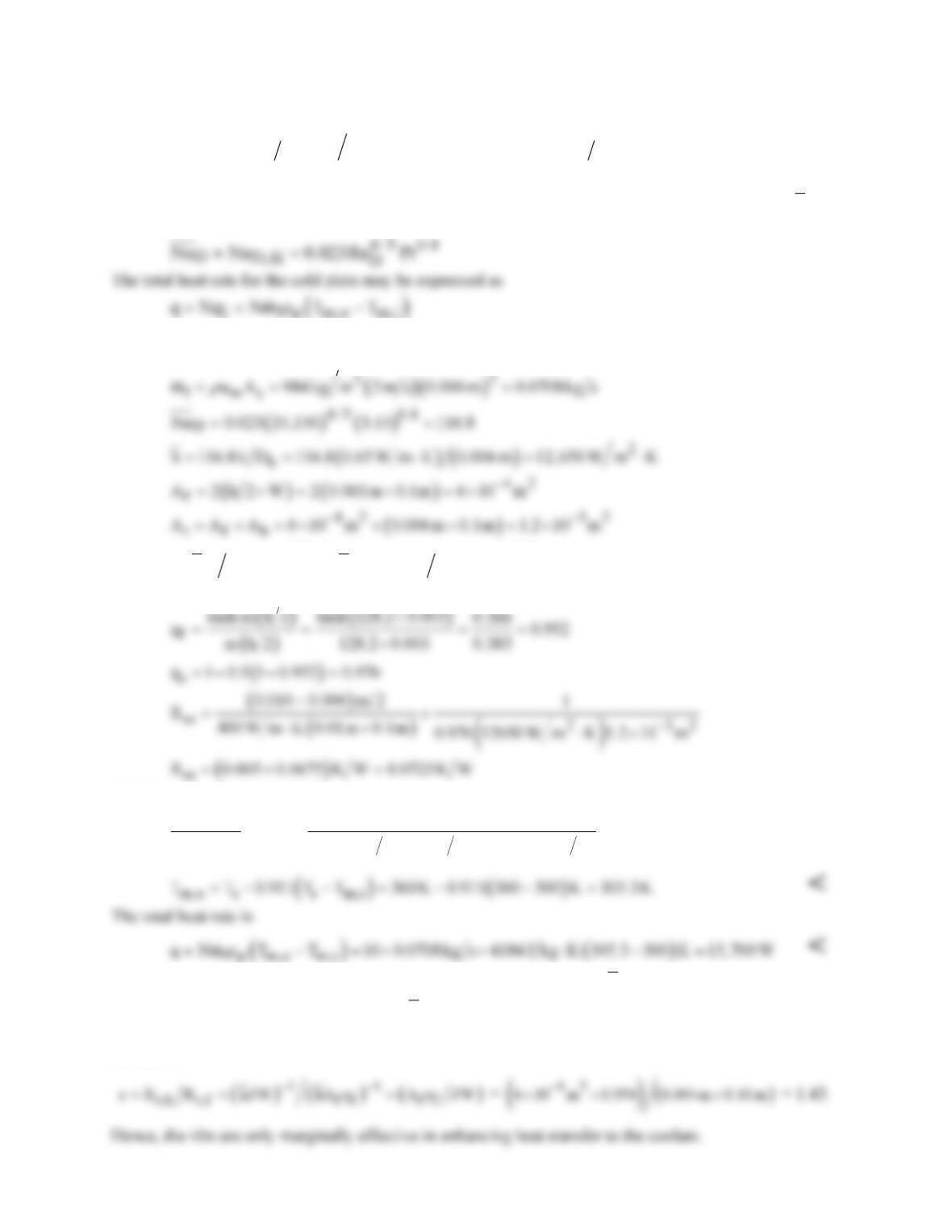
KNOWN: Dimensions, surface temperature and thermal conductivity of a cold plate. Velocity, inlet
temperature, and properties of coolant.
FIND: (a) Model for determining the heat rate q and outlet temperature, Tm,o , (b) Values of q and Tm,o
for prescribed conditions.
SCHEMATIC:
ASSUMPTIONS: (1) Steady-state conditions, (2) Incompressible liquid with negligible viscous
dissipation, (3) Constant properties, (4) Symmetry about the midplane (horizontal) of the cold plate and
PROPERTIES: Water (prescribed): ρ = 984 kg/m3, cp = 4184 J/kg⋅K, m = 489 × 10-6 N⋅s/m2, k = 0.65
W/m⋅K, Pr = 3.15.
ANALYSIS: (a) The outlet temperature, Tm,o , may be determined from the energy balance prescribed by
Eq. 8.45b,
where
m u A
m c1 = ρ
is the flowrate for a single channel and Rtot is the total resistance to heat transfer
between the cold plate surface and the coolant for a particular channel. This resistance may be
determined from the symmetrical section shown schematically, which represents one–half of the cell
associated with a full channel. With the number of channels (and cells) corresponding to N = W/S, there
are 2N = 2(W/S) symmetrical sections, and the total resistance Rtot of a cell is one–half that of a
symmetrical section. Hence, Rtot = Rss/2, where the resistance of the symmetrical section includes the
effect of conduction through the outer wall of the cold plate and convection from the inner surfaces.
Hence,
PROBLEM 8.63 (Cont.)
The efficiency hf corresponds to that of a straight, rectangular fin with an adiabatic tip, Eq. 3.92, and Lc
= w/2. With
2
hc
D 4A P 4w 4w w 0.006 m= = = =
,
h
D mh
Re u D
ρm
=
= 984 kg/m3 × 2 m/s × 0.006
m/489 × 10-6 N⋅s/m2 = 24,150 and the channel flow is turbulent. Assuming fully-developed flow
throughout the channel, the Dittus-Boelter correlation, Eq. 8.60, may therefore be used to evaluate
h
,
where
(b) For the prescribed conditions,
With m =
( )
( ) ( )
1/2 1/2
f cp cf cp
hP k A h 2 2W k W
δδ
= +
= [12,650 W/m2⋅K(0.008 + 0.200)m/400
W/m⋅K(0.004 × 0.100)m2]1/2 = 128.2 m-1.
With Rtot = Rss/2 = 0.0362 K/W,
s m,o
s m,i
TT 1
exp 0.911
T T 0.0708 kg s 4184 J kg K 0.0362 K W
−=−=
− × ⋅×
COMMENTS: (1) The prescribed properties correspond to a value of
m
T
which significantly exceeds
that obtained from the foregoing solution (
m
T
= 302.6 K). Hence, the calculations should be repeated
using more appropriate thermophysical properties. (2) From Eq. 3.90, the effectiveness of the extended
surface is
PROBLEM 8.64
KNOWN: Temperature, pressure and flow rate of air entering a rectangular duct of prescribed
dimensions and surface temperature.
FIND: Air outlet temperature and duct heat transfer rate.
SCHEMATIC:
ASSUMPTIONS: (1) Steady-state conditions, (2) Constant properties, (3) Uniform surface
temperature, (4) Fully developed flow throughout, (5) Ideal gas with negligible viscous dissipation
and pressure variation.
PROPERTIES: Table A-4, Air (assume Tm ≈ 325K, 1 atm): cp = 1008 J/kg⋅K, m = 196.4 × 10⁻⁷
N⋅s/m2, k = 0.0282 W/m⋅K, Pr = 0.707.
ANALYSIS: From Eqs. 8.66 and 8.1,
Hence the flow is turbulent, and from Eq. 8.60
h
D 0.1067 m
From Eq. 8.41b, with P = 2(W + H),
and from Eq. 8.34
COMMENTS: (1) The calculations may be checked by determining q from Eqs. 8.43 and 8.44. We
obtain
m
T 106 CD=
and q = 2487 W.
(2) The average mean temperature is
m
T
= 324 K. The properties were evaluated at an appropriate
temperature.
m=0.09kg/s
T
s
=430K W=0.16m
H=0.080m
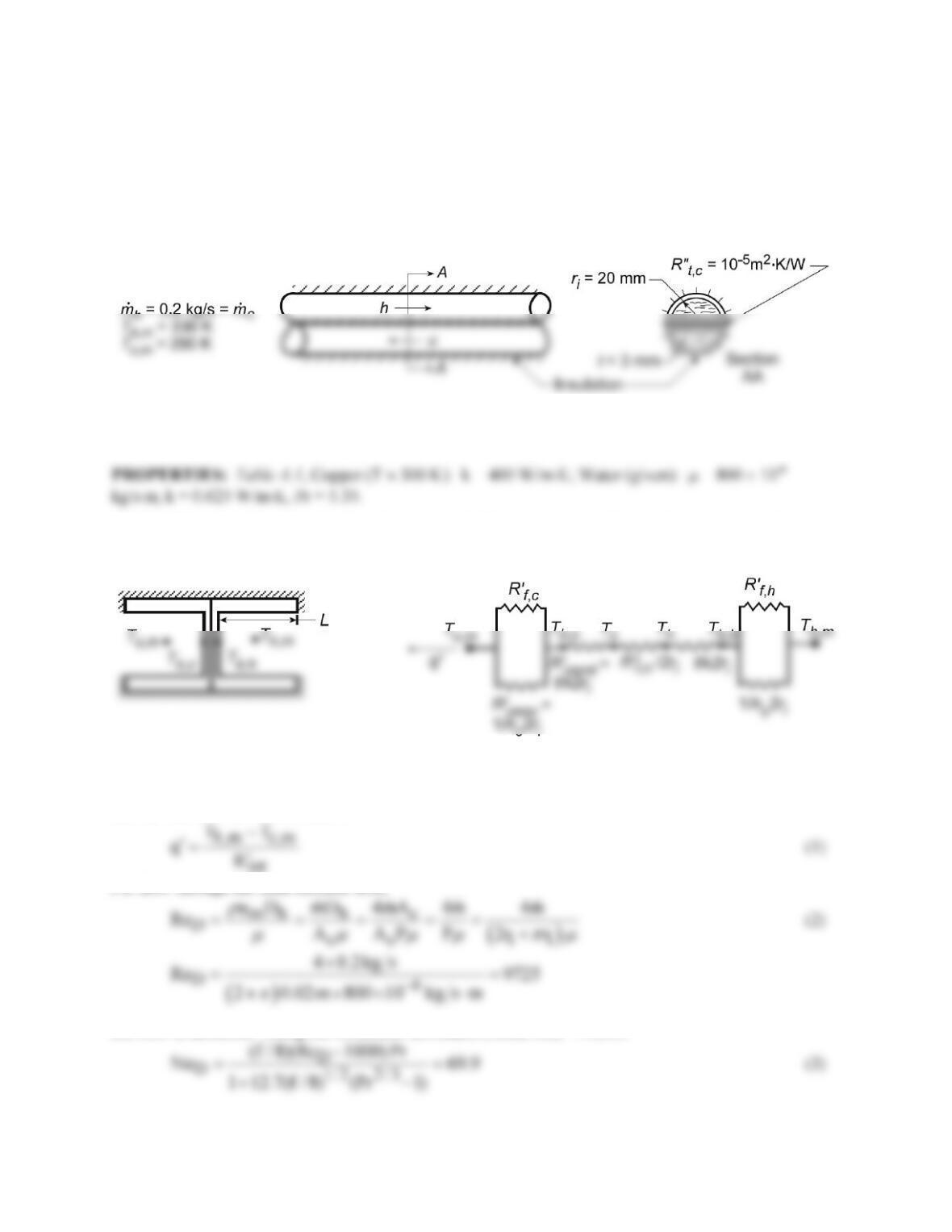
PROBLEM 8.65
KNOWN: Dimensions of semi–circular copper tubes in contact at plane surfaces. Thermal contact
resistance. Tube flow conditions.
FIND: (a) Heat rate per unit tube length, and (b) The effect on the heat rate when the fluids are ethylene
glycol, the exchanger tube is fabricated from an aluminum alloy, or the exchanger tube thickness is
increased.
SCHEMATIC:
ASSUMPTIONS: (1) Steady-state conditions, (2) Constant properties, (3) Adiabatic outer surface, (4)
Fully developed flow, (5) Negligible heat loss to surroundings.
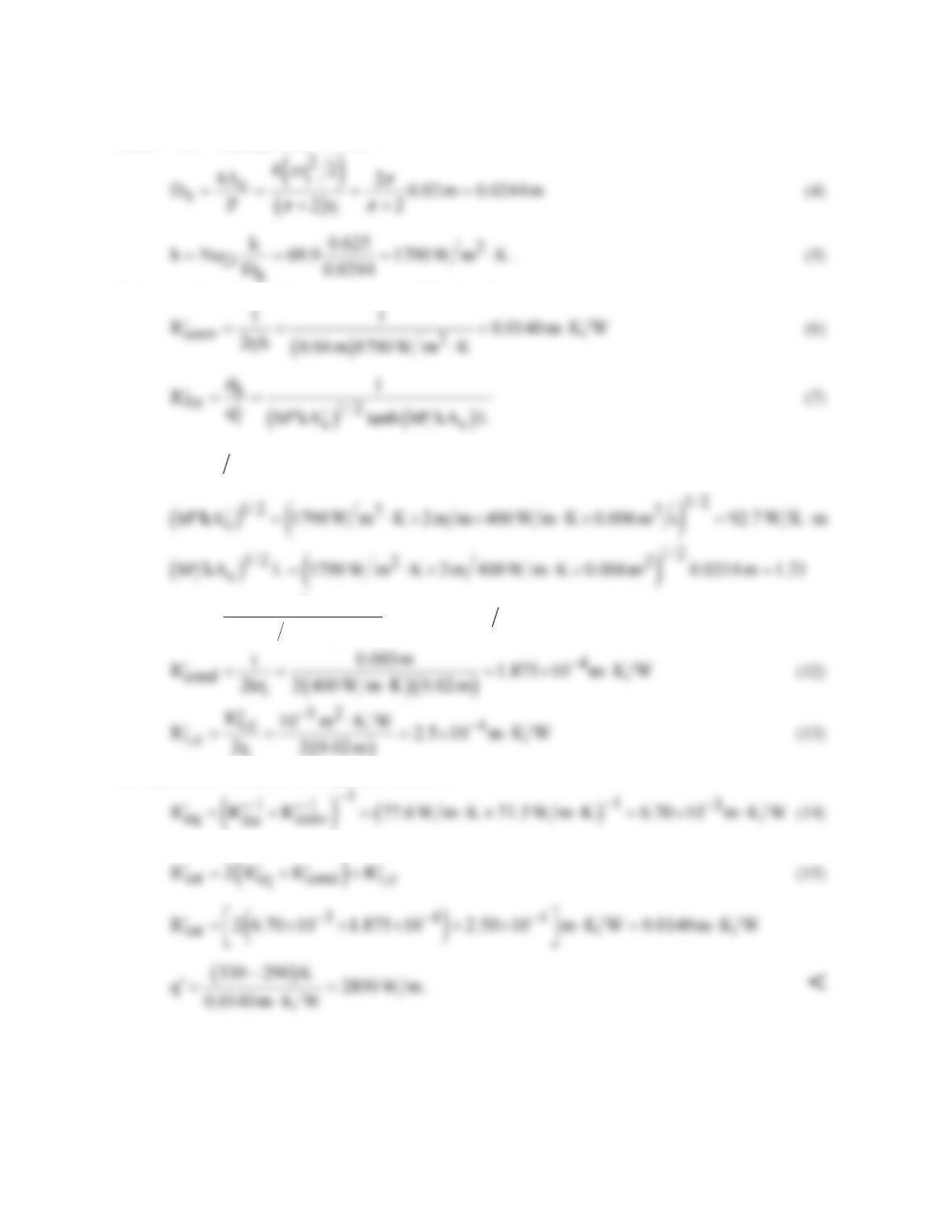
ANALYSIS: (a,b) Heat transfer from the hot to cold fluids is enhanced by conduction through the semi–
circular portions of the tube walls. The walls may be approximated as straight fins with an insulated tip,
and the thermal circuit is shown below.
Note that, since each semi–circular surface is insulated on one side, surfaces may be combined to yield a
single fin of thickness 2t with convection on both sides. Also, due to the equivalent geometry and the
assumption of constant properties, there is symmetry on opposite sides of the contact resistance. From
the thermal circuit, the heat rate is
For flow through the semi-circular tube,
the flow is turbulent. Using the Gnielinski correlation, since ReD < 10,000
Continued…
PROBLEM 8.65 (Cont.)
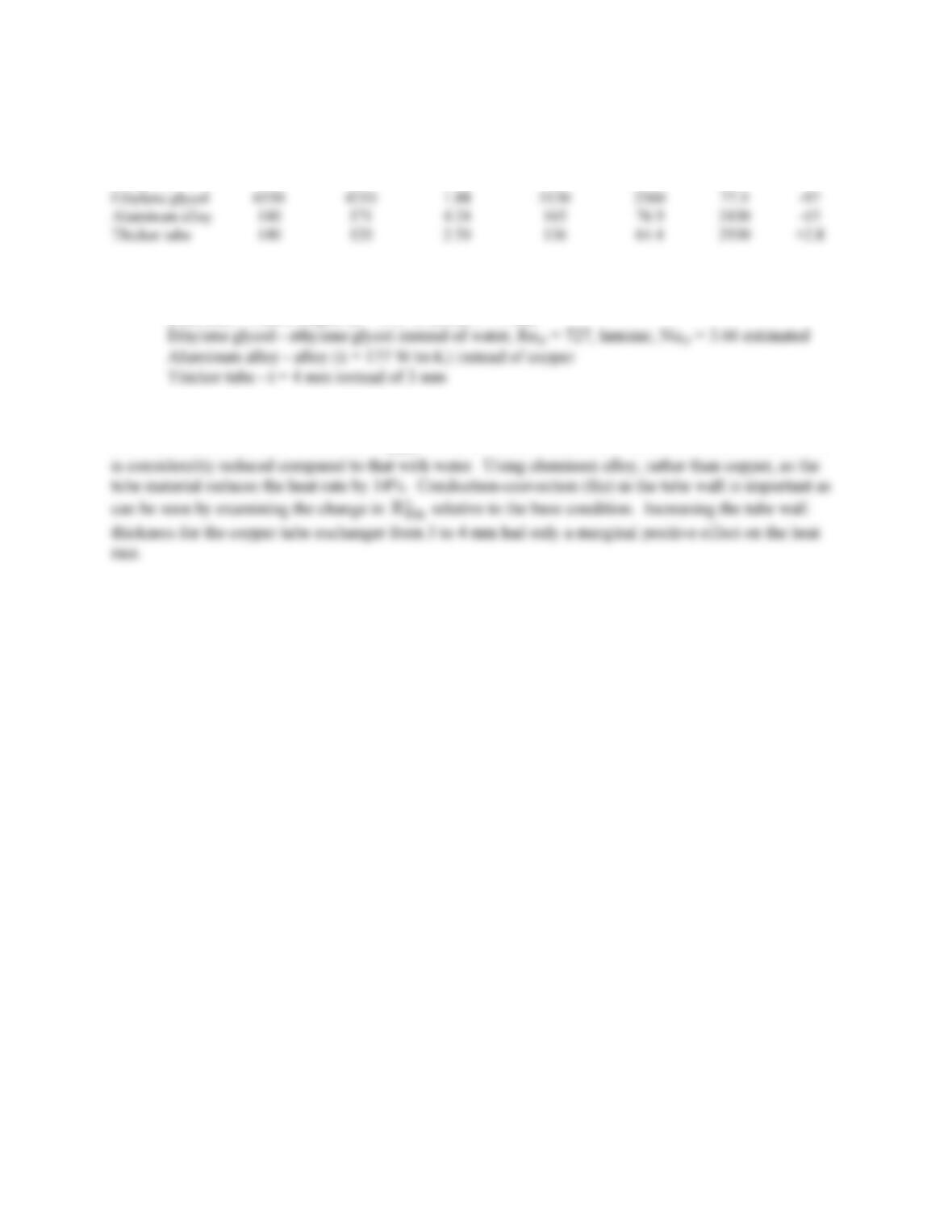
where f = (0.79ln(ReD)-1.64)-2 = 0.0317
Find now values for the thermal resistance of the circuit.
( )
i
L r 2 0.01m 0.0314 m
pp
= = =
2
c
A 2t 1m 0.006 m=⋅=
P ≈ 2.1 m (8,9,10)
( )
fin
1
R 0.0129 m K W
92.7 W m K 0.838
′= = ⋅
⋅
(11)
The equivalent resistance of the parallel circuit is
Hence
(c) Using the IHT Workspace with the foregoing equations, analyses were performed and the results
summarized in the table below. The “Conditions” are described below; the “Change” is relative to the
base case condition.
Continued …
PROBLEM 8.65 (Cont.)
Condition*
conv
R′
× 104
fin
R′
× 104
cond
R′
× 104
tot
R′
× 104
eq
R′
× 104
q′
Change
(m⋅K/W)
(m⋅K/W)
(m⋅K/W)
(m⋅K/W)
(m⋅K/W)
(W/m)
(%)
Base case
140
129
1.88
140
67.0
2850
—
*Conditions: change from base case
Base case – water, copper (k = 400 W/m⋅K), t = 3 mm
As expected, using ethylene glycol as the working fluid would decrease the heat rate, especially because
the flow becomes laminar. Note that
conv
R′
is the dominate resistance since the convection coefficient
COMMENTS: A more accurate calculation would account for the absence of symmetry about the
contact plane. Evaluation of water properties at Th,m = 330 K and Tc,m = 290 K yields hh = 1930 W/m2⋅K
and hc = 1470 W/m2⋅K.
1.88
140
171
4.24
165
76.9
2430
140
120
2.50
136
64.4
2930
PROBLEM 8.66
KNOWN: Rectangular channel with constant surface temperature. Aspect ratio.
FIND: Which aspect ratio channel provides the largest heat transfer rate. Whether this is greater than,
equal to, or less than the heat transfer rate for a circular tube.
SCHEMATIC:
ASSUMPTIONS: (1) Steady–state, (2) Incompressible flow, (3) Laminar, (4) Fully-developed.
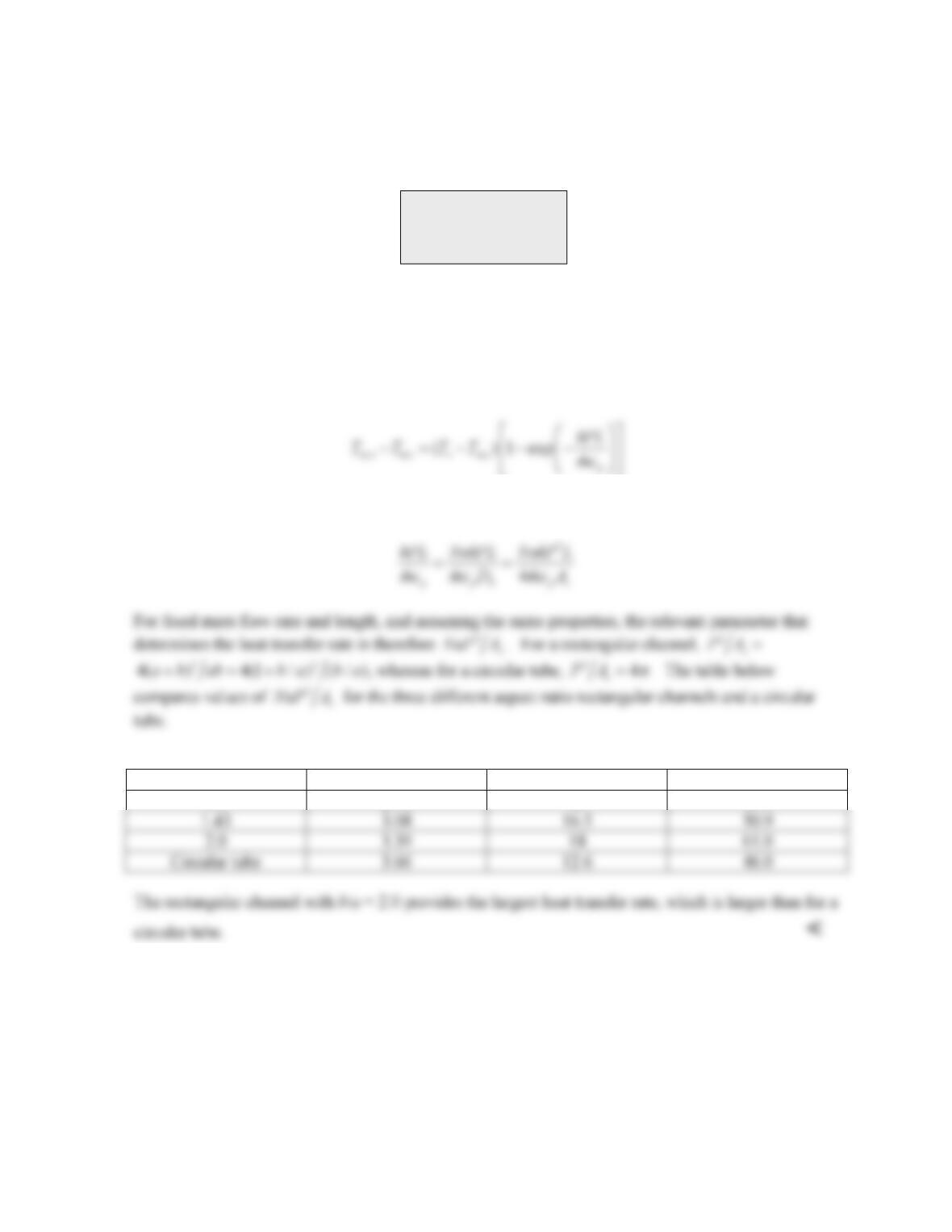
ANALYSIS: The heat transfer rate is given by
,,
( ),
s p mo mi
q mc T T= −
where from Eq. 8.41b with
constant heat transfer coefficient,
Thus, the heat transfer rate increases with increasing values of
b/a
Nu
P2/Ac
NuP2/Ac
1.0
2.98
16
47.7
1.43
3.08
16.5
50.9
3.66
12.6
46.0
COMMENTS: The Nusselt numbers for the rectangular channel are all less than 3.66 for the circular
tube, but their convective heat transfer rates are larger than that of the circular tube because their P2/Ac
values are larger.
b
a
PROBLEM 8.67
KNOWN: Coolant flowing through a rectangular channel (gallery) within the body of a mold.
FIND: Convection coefficient when the coolant is process water or ethylene glycol.
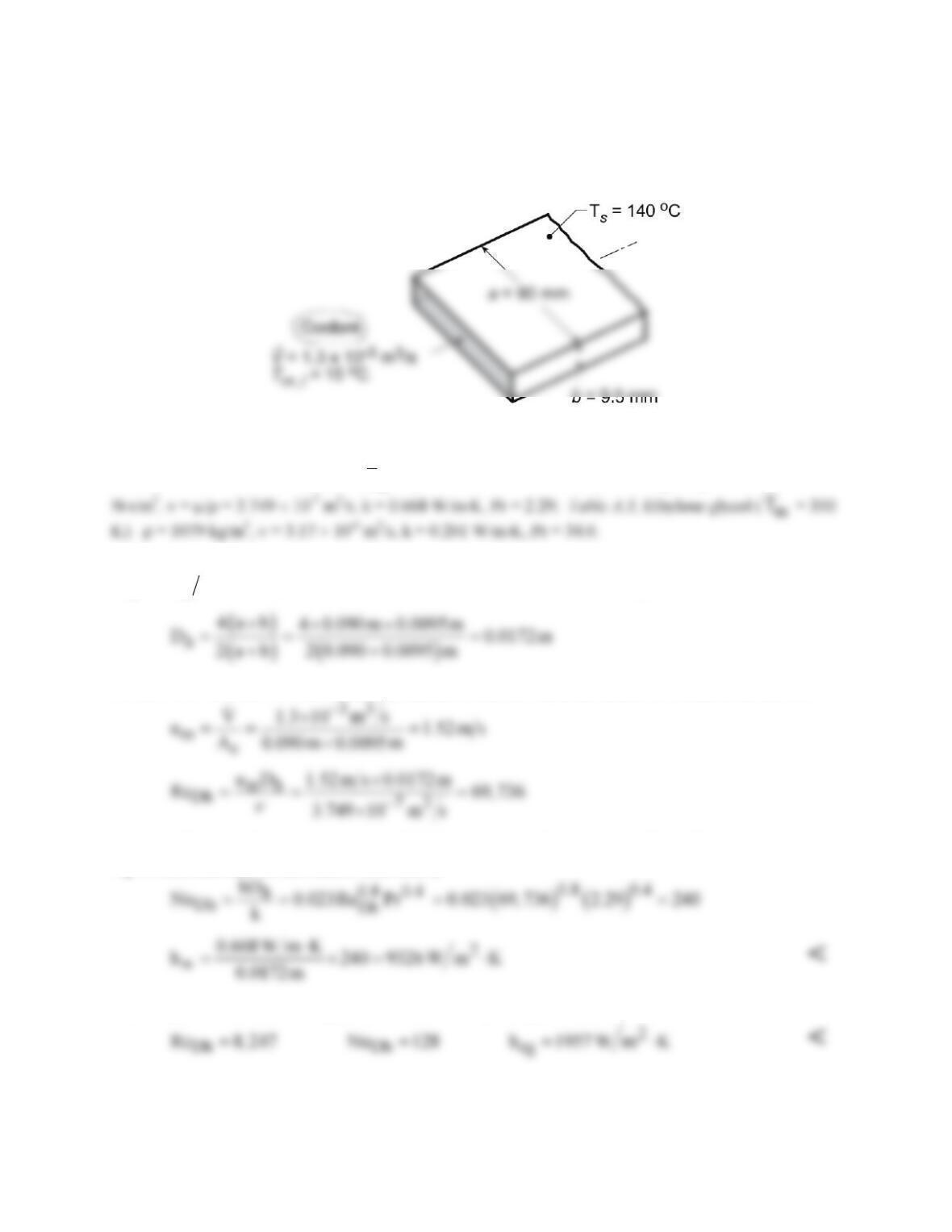
SCHEMATIC:
ASSUMPTIONS: (1) Gallery can be approximated as a rectangular channel with a uniform surface
temperature, (2) Fully developed flow conditions.
PROPERTIES: Table A.6, Water (
m
T
= (140 + 15)°C/2 = 350 K): ρ = 974 kg/m3, m = 365 × 10-6
ANALYSIS: The characteristic length of the channel, the hydraulic diameter, Eq. 8.66, is
hc
D 4A P=
where Ac is the cross–sectional flow area and P is the wetted perimeter. For our channel,
For the water coolant, from the continuity equation, find the Reynolds number to characterize the flow
Since the flow is turbulent, and assuming fully developed conditions, use the Dittus-Boelter correlation,
Eq. 8.60, to estimate the convection coefficient,
Repeating the calculations using properties for the ethylene glycol coolant, find
Continued…
m
T

PROBLEM 8.67 (Cont.)
COMMENTS: (1) The convection coefficient for the water coolant is more than 4 times greater than
that with the ethylene glycol coolant. The corrosion protection afforded by the latter coolant greatly
(2) Recognize that for the ethylene glycol coolant calculation the Reynolds number is slightly below the
PROBLEM 8.68
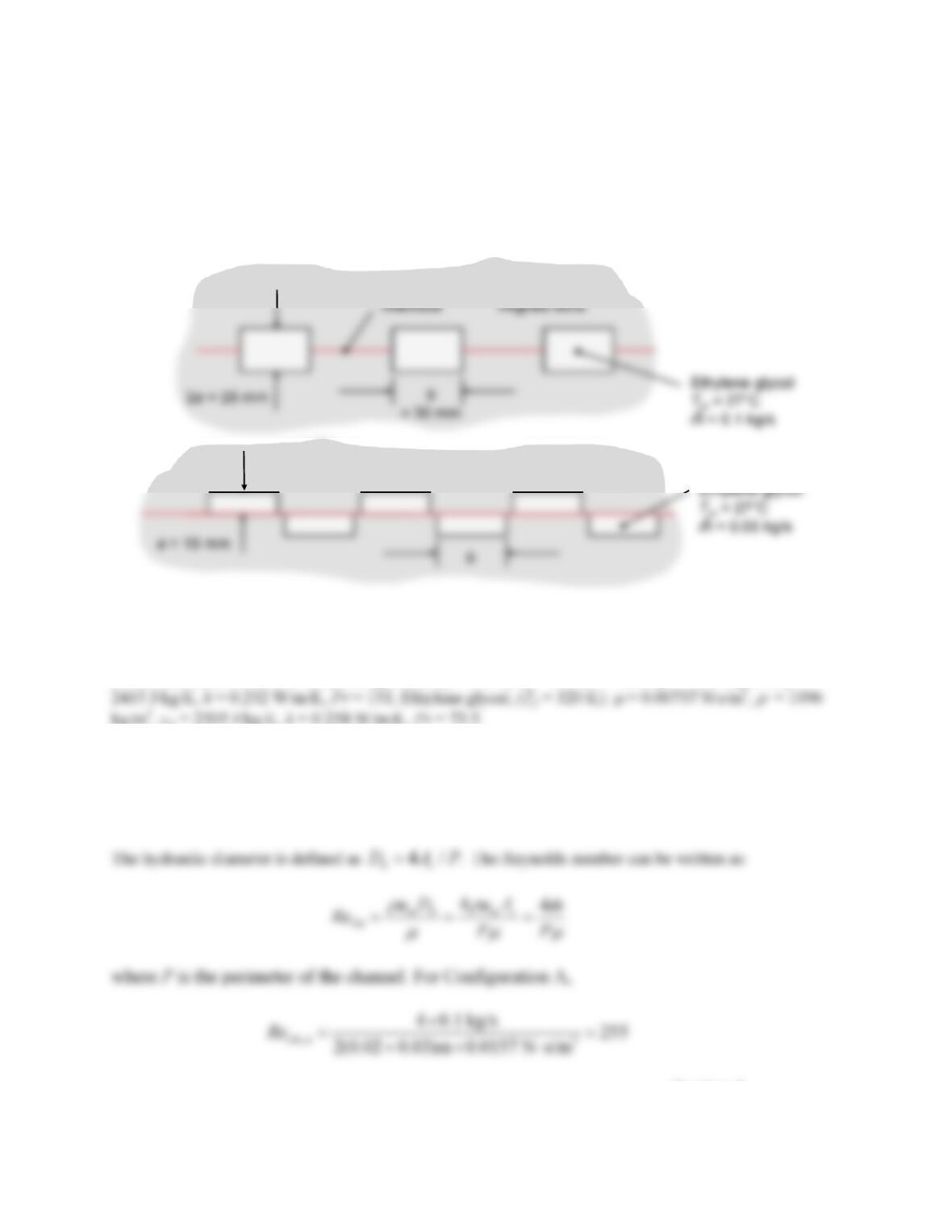
KNOWN: Dimensions and surface temperature of large and small rectangular channels. Mass flow rate
and mean temperature of ethylene glycol.
FIND: Heat transfer rate per unit channel length for one large channel and a pair of smaller channels.
Pressure gradient for both configurations.
SCHEMATIC:
Configuration A
Configuration B
Non-aligned slots
T
s
= 67°C
T
s
= 67°C
ASSUMPTIONS: (1) Steady-state conditions, (2) Constant properties, (3) Incompressible fluid with
negligible viscous dissipation, (4) Fully developed.
PROPERTIES: Table A-5, Ethylene glycol, (Tm = 300 K):
m
= 0.0157 N⋅s/m2,
ρ
= 1114 kg/m3, cp =
kg/m3, cp = 2505 J/kg⋅K, k = 0.258 W/m⋅K, Pr = 73.5.
ANALYSIS: Properties must be evaluated at
m
T
= 300 K for heat transfer quantities, and at
f
T=
0.5( )
ms
TT+
= 320 K for the friction coefficient and other hydrodynamic quantities (see Table 8.4
footnote). We begin with heat transfer quantities.
Continued…
PROBLEM 8.68 (Cont.)
Similarly,
,159.
Dh B
Re =
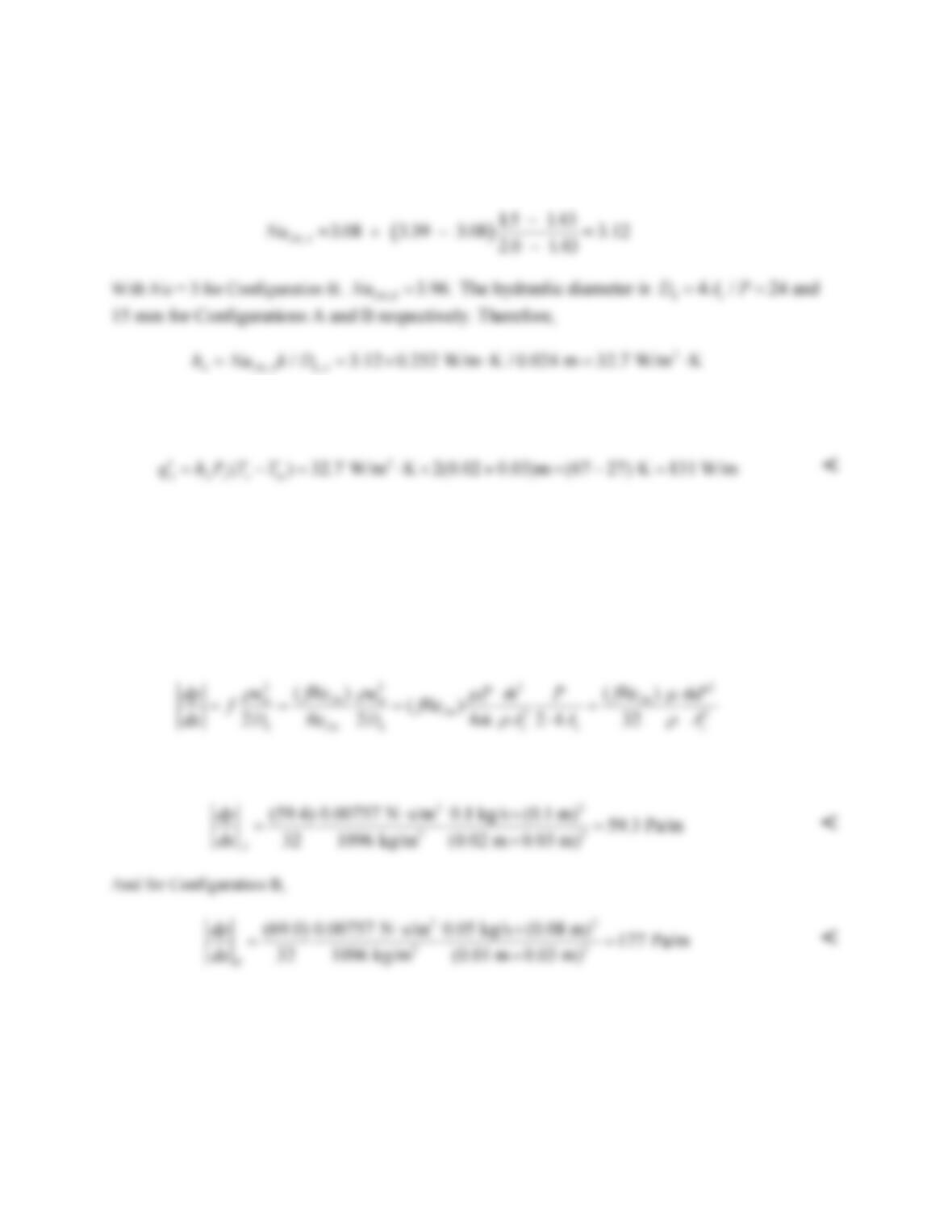
The flows are laminar and are assumed to be fully developed since the channels
are “long.” In Table 8.1, with an aspect ratio of b/2a = 1.5 for Configuration A, using linear interpolation
for the Nusselt number gives:
and
2
66.5 W/m K.
B
h= ⋅
The heat transfer rate per unit length can then be found:
And similarly,
426 W/m
B
q′=
for two smaller channels. <
Now to calculate the pressure gradient, the properties should be evaluated at
f
T=
320 K. The Reynolds
numbers change to
,,
528, 330.
Dh A Dh B
Re Re= =
From Table 8.1,
( ) 59.4, ( ) 69.0.
Dh A Dh B
fRe fRe= =
The pressure gradient can be found from Equation 8.16, and can be rewritten in terms of the mass flow
rate:
For Configuration A,
COMMENTS: (1) Smaller dimensions enhance heat transfer but also increase pressure drop and
consequently the required pumping power. This is a general trend that exists over essentially all types of
flows. (2) The viscosity of ethylene glycol varies significantly between 300 and 320 K and the pressure
drop would have been quite different if the 300 K property values had been used instead of the values at
320 K. This suggests that the results may not be very accurate since the use of properties evaluated at a
single temperature is inherently an approximation.
PROBLEM 8.69
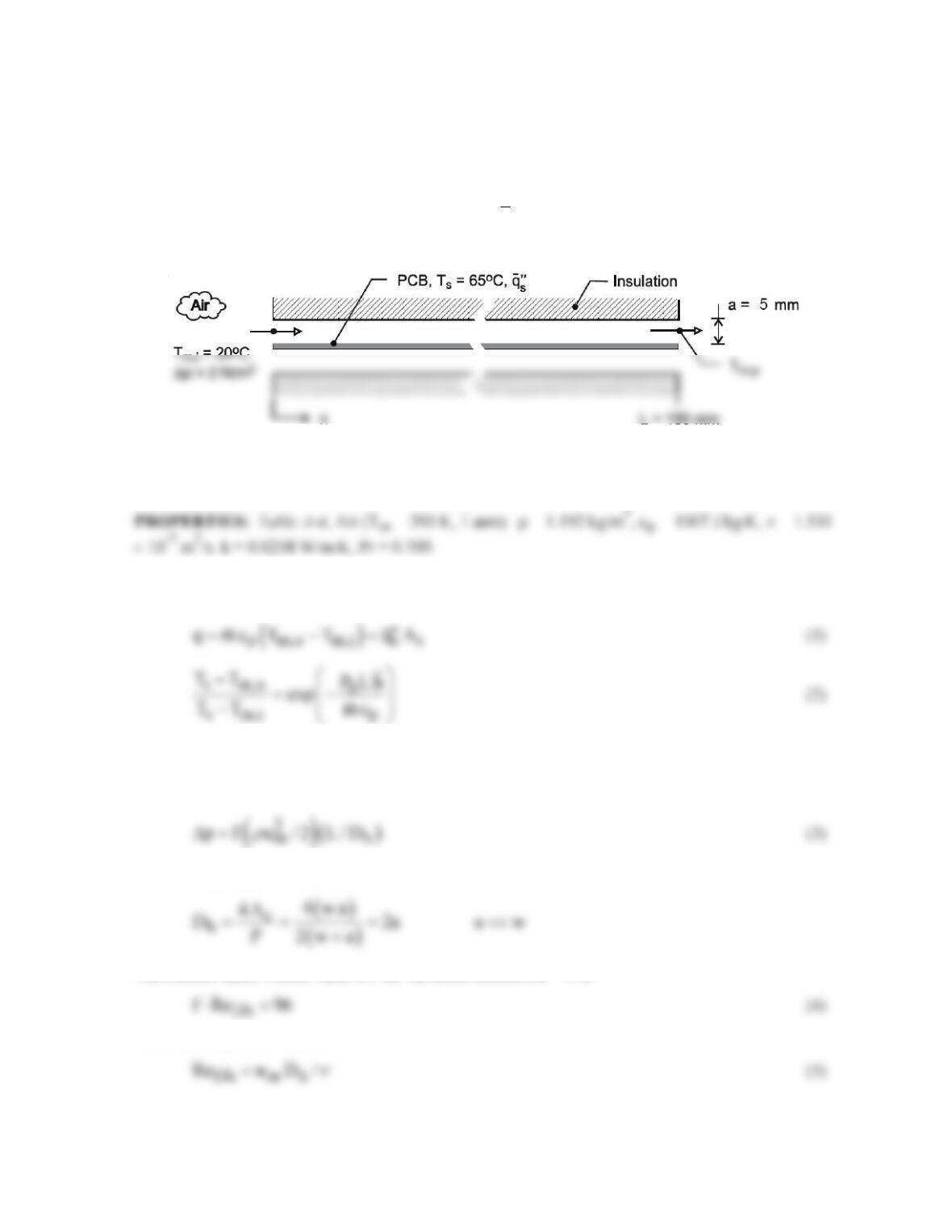
KNOWN: Printed–circuit board (PCB) with uniform temperature Ts cooled by laminar, fully
developed flow in a parallel-plate channel. The air flow with an inlet temperature of Tm,i is driven by
a pressure difference, Dp.
FIND: The average heat removal rate per unit area,
()
2
s
q W/m ,
′′
from the PCB.
SCHEMATIC:
ASSUMPTIONS: (1) Laminar, fully developed flow, (2) Upper and lower walls of the channel are
insulated and of infinite extent in the transverse direction, (3) PCB has uniform surface temperature,
(4) Constant properties, (5) Ideal gas with negligible viscous dissipation.
ANALYSIS: The energy equations for determining the heat rate from one surface of the board are
Eqs. 8.34 and 8.41b
where As = Lw and P = w, since heat transfer is only from one surface, where w is the width in the
transverse direction. For the fully developed flow condition, the velocity is estimated from the
friction pressure drop relation, Eq. 8.22a,
where the hydraulic diameter for the channel cross section is
The friction factor f from Table 8.1 for the cross section b/a = ∞ is
where the Reynolds number is
Continued …
PROBLEM 8.69 (Cont.)
and the flow rate through one channel is
( )
cm m
m A u wa u
ρρ
= =
(6)
For fully developed laminar flow from Table 8.1.
Thus the flow is laminar, as assumed. From Eqs. (6), (7), and (2),
m/w
= ρuma = 1.192kg/m3× 1.52
m/s × 0.005 m = 0.00907 kg/s∙m.
h Nu k / D=
= 4.86 × 0.0258 W/m∙K/0.01m = 12.5 W/m2∙K. Tm,o
COMMENTS: (1) The thermophysical properties of the air are evaluated at the average mean
temperature,
T
m = (Tm,i + Tm,o)/2.
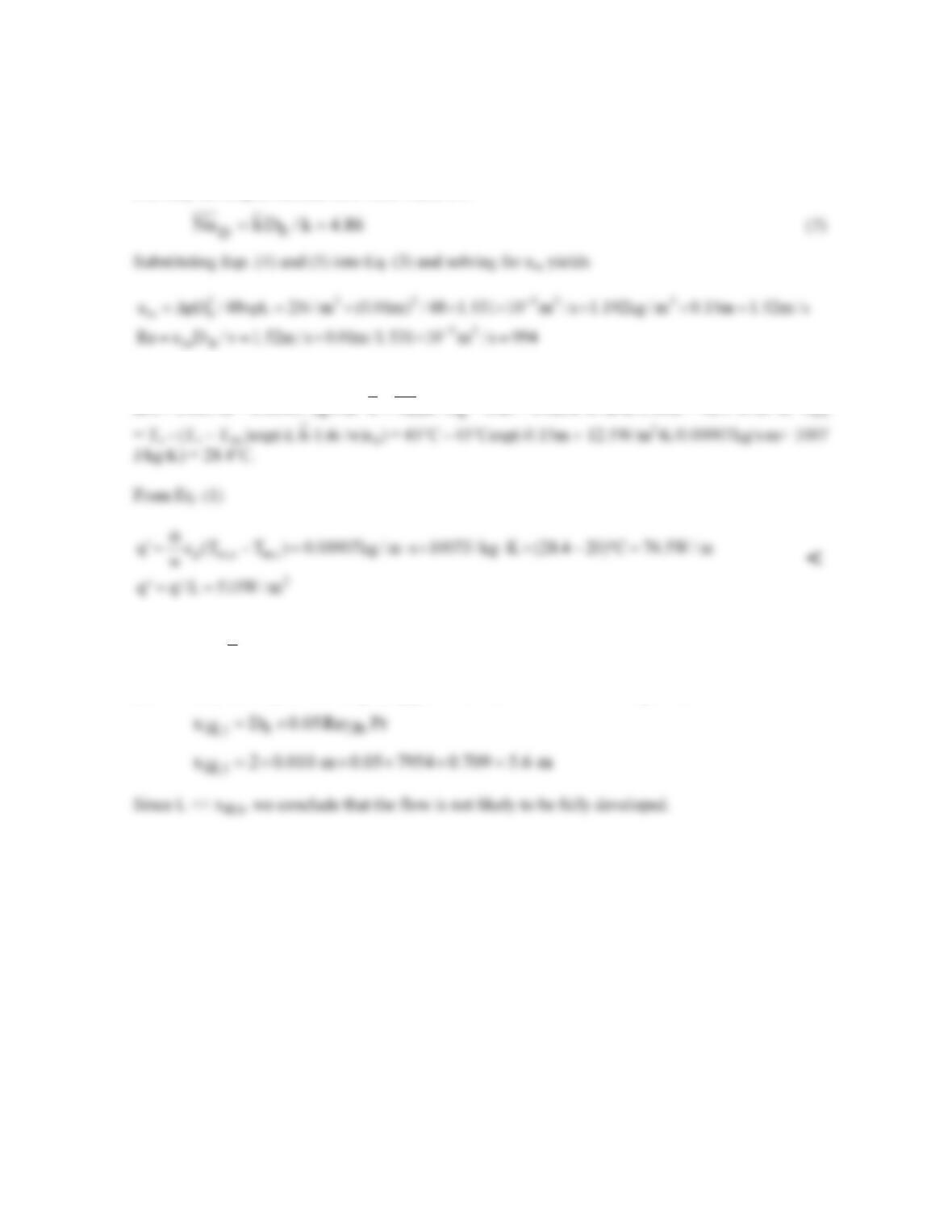
(2) The fully developed flow length, xfd,t, for the channel follows from Eq. 8.23,
PROBLEM 8.70
KNOWN: Surface thermal conditions and diameters associated with a concentric tube
annulus. Water flow rate and inlet temperature.
FIND: (a) Length required to achieve desired outlet temperature, (b) Heat flux from inner
tube at outlet.
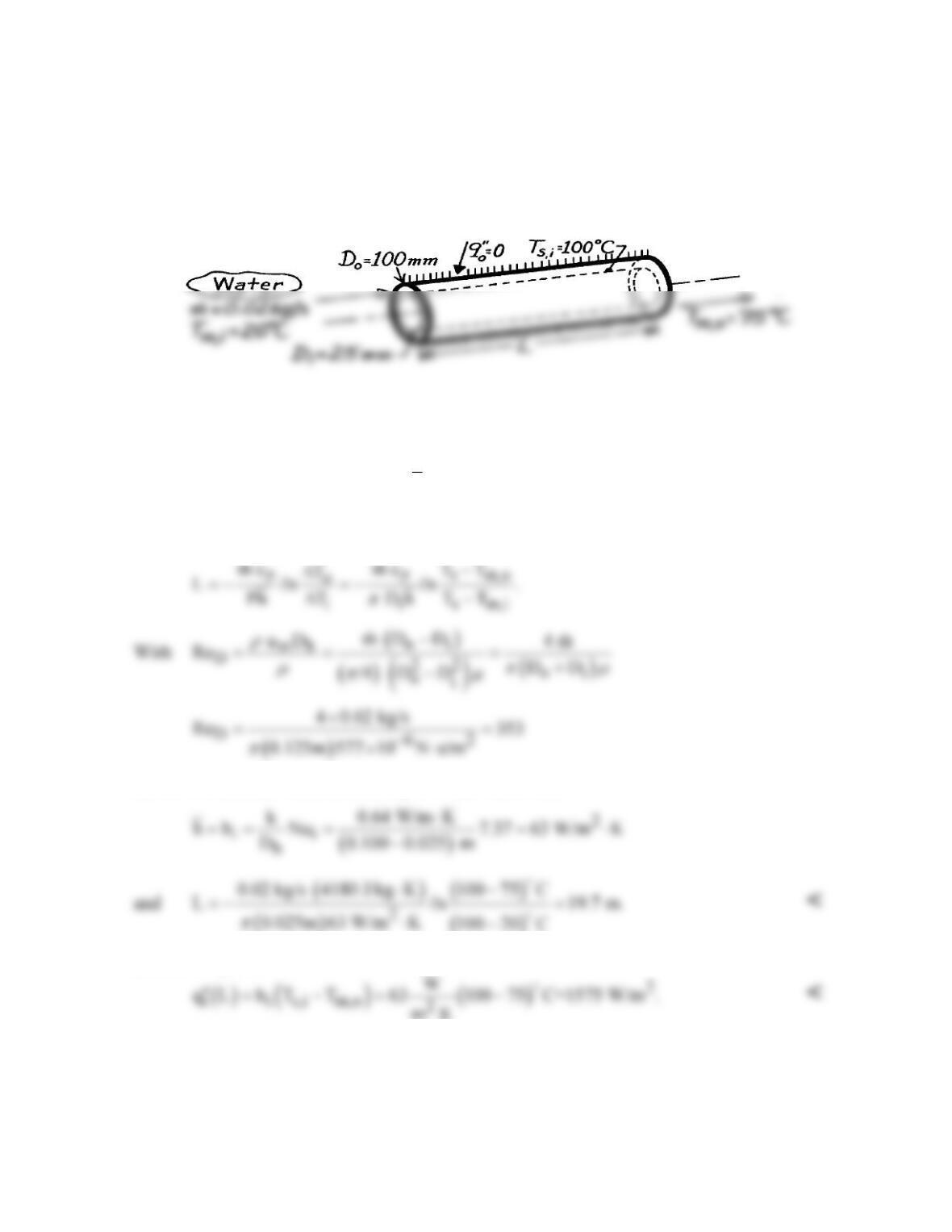
SCHEMATIC:
ASSUMPTIONS: (1) Steady-state conditions, (2) Fully developed conditions throughout, (3)
Adiabatic outer surface, (4) Uniform temperature at inner surface, (5) Constant properties, (6)
Water is incompressible liquid with negligible viscous dissipation.
PROPERTIES: Table A-6, Water
( )
m
T 320K :=
cp = 4180 J/kg⋅K, m = 577 × 10-6 N⋅s/m2,
k = 0.640 W/m⋅K, Pr = 3.77.
ANALYSIS: (a) From Eq. 8.41a,
the flow is laminar. Hence, from Eq. 8.69 and Table 8.2,
( )
(b) From Eq. 8.67
m .K
COMMENTS: The total heat rate to the water is
( )
()
p m,o m,i
q m c T T 0.02 kg/s 4180 J/kg K 55 C 4598 W.= −= × ⋅ =
PROBLEM 8.71
KNOWN: Surface thermal conditions and diameters associated with a concentric tube
annulus. Water flow rate and inlet temperature.
FIND: Length required to achieve desired outlet temperature.
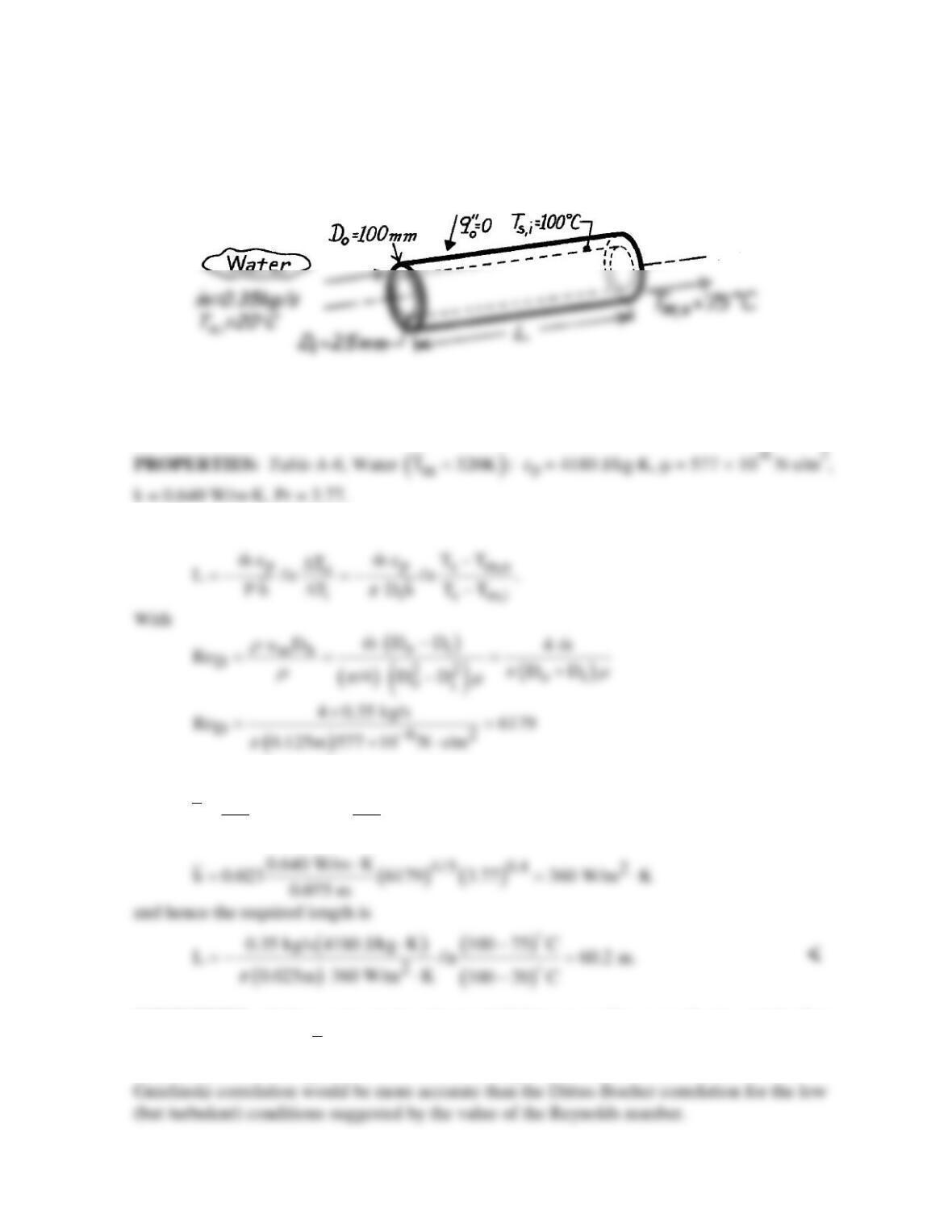
SCHEMATIC:
ASSUMPTIONS: (1) Steady-state conditions, (2) Fully developed conditions throughout, (3)
Adiabatic outer surface, (4) Uniform temperature at inner surface, (5) Constant properties, (6)
Incompressible liquid with negligible viscous dissipation.
ANALYSIS: From Eq. 8.41a,
and the flow is turbulent. Hence, from Eq. 8.60,
4/5 0.4
DD
hh
kk
h Nu 0.023 Re Pr
DD
= =
COMMENTS: (1) Increasing
m
by a factor of 17.5 increases ReD accordingly, and the flow
is turbulent. However,
h
increases by a factor of only 5.7 from the result of Problem 8.70, in
which case the tube length must be a factor of 3 larger than that of Problem 8.70. (2) The