Chap. 8 Spread Footings-Geotechnical Serviceability Limit States
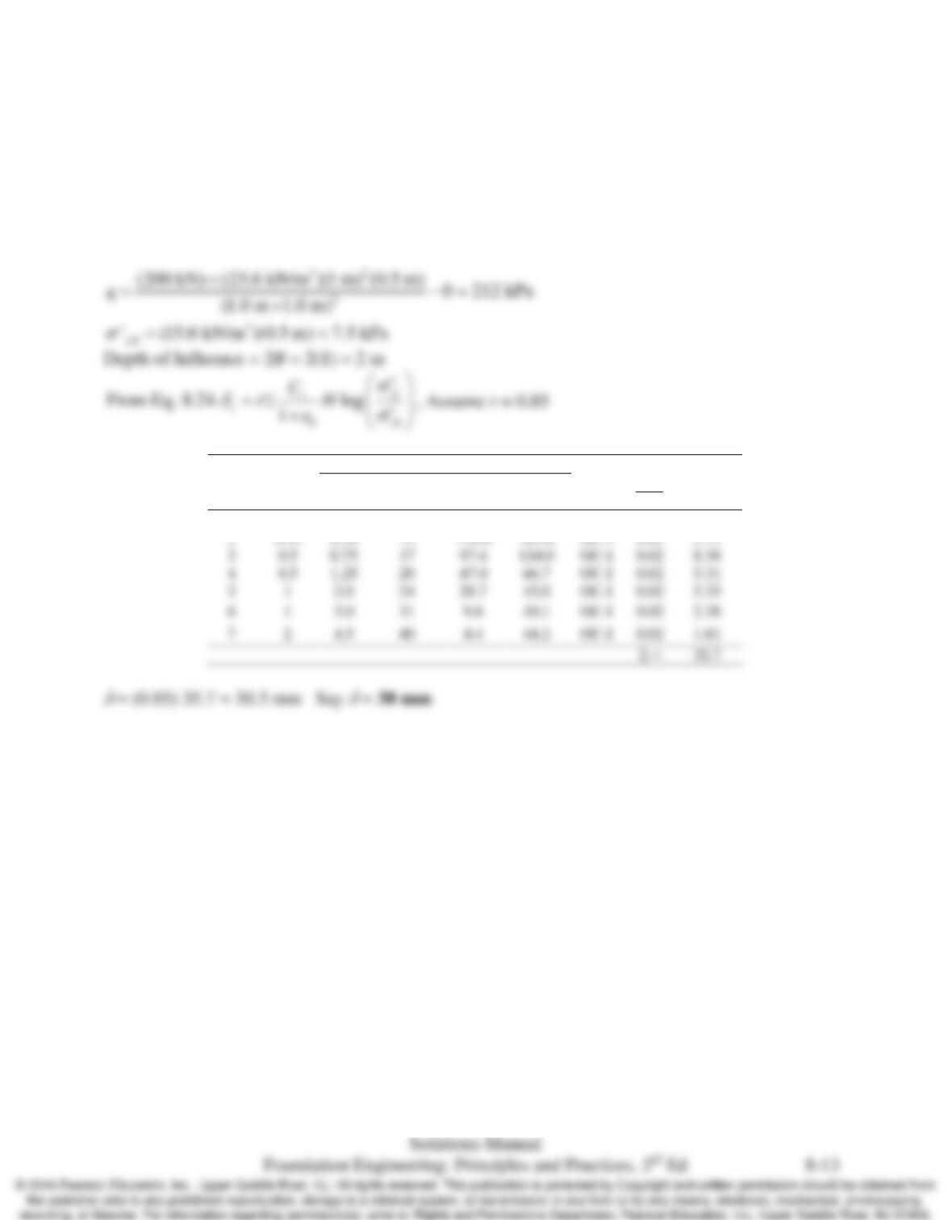
8.12 A 1.0-m square, 0.5-m deep footing carries a downward service load of 200 kN. It is underlain by
an overconsolidated clay (OC case I) with the following engineering properties: Cc = 0.20,
Cr = 0.05, e0 = 0.7, and γ = 15.0 kN/m3 above the groundwater table and 16.0 kN/m3 below. The
groundwater table is at a depth of 1.0 m below the ground surface. Determine the total settlement
of this footing.
Solution
Layer
No.
H
(m)
At midpoint of layer
Case
0
1
r
C
e+
δc
(mm)
zf (m)
σ’z0 (kPa)
Δσ
z
(kPa)
σ’
zf
(kPa)
1
0.25
0.13
9
203.1
212.5
OC-I
0.02
6.78
35.7

Chap. 8 Spread Footings-Geotechnical Serviceability Limit States
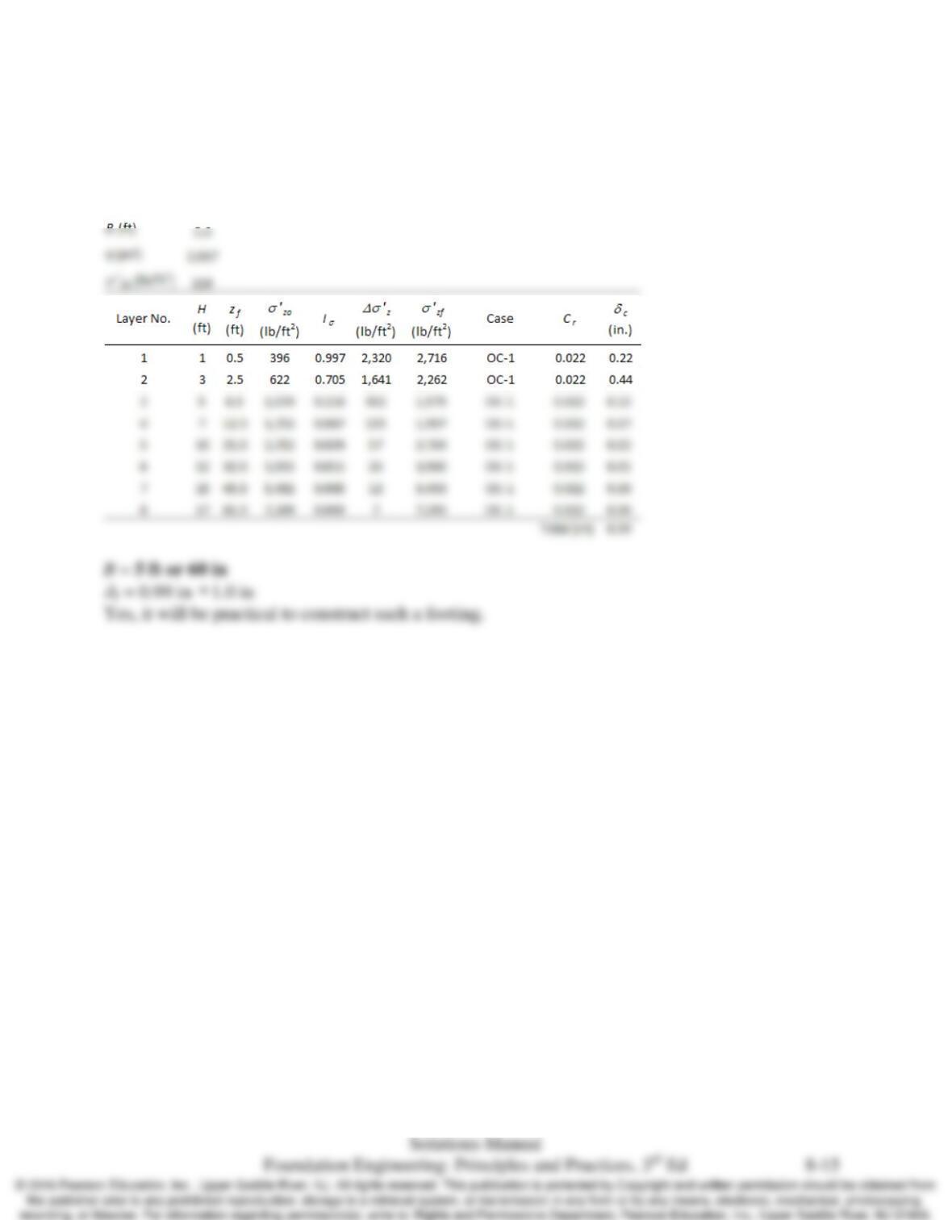
8.13 Prepare a spreadsheet to compute settlement of square footings using the e–LOG–p method. The
spreadsheet should allow input of: footing width, footing depth, ground water depth, column
service load, footing rigidity factor and Cr/(1 + e0), Cr/(1 + e0), σʹm, and g as function of depth.
Check your spreadsheet using a hand solution to Problem 8.12.
Solution
Chap. 8 Spread Footings-Geotechnical Serviceability Limit States
8.14 Using a spreadsheet and the data in Problem 8.11, determine the required footing width to obtain
a total settlement of no more than 1.0 in. Select a width that is a multiple of 3 in. Would it be
practical to build such a footing?
Solution
Chap. 8 Spread Footings-Geotechnical Serviceability Limit States
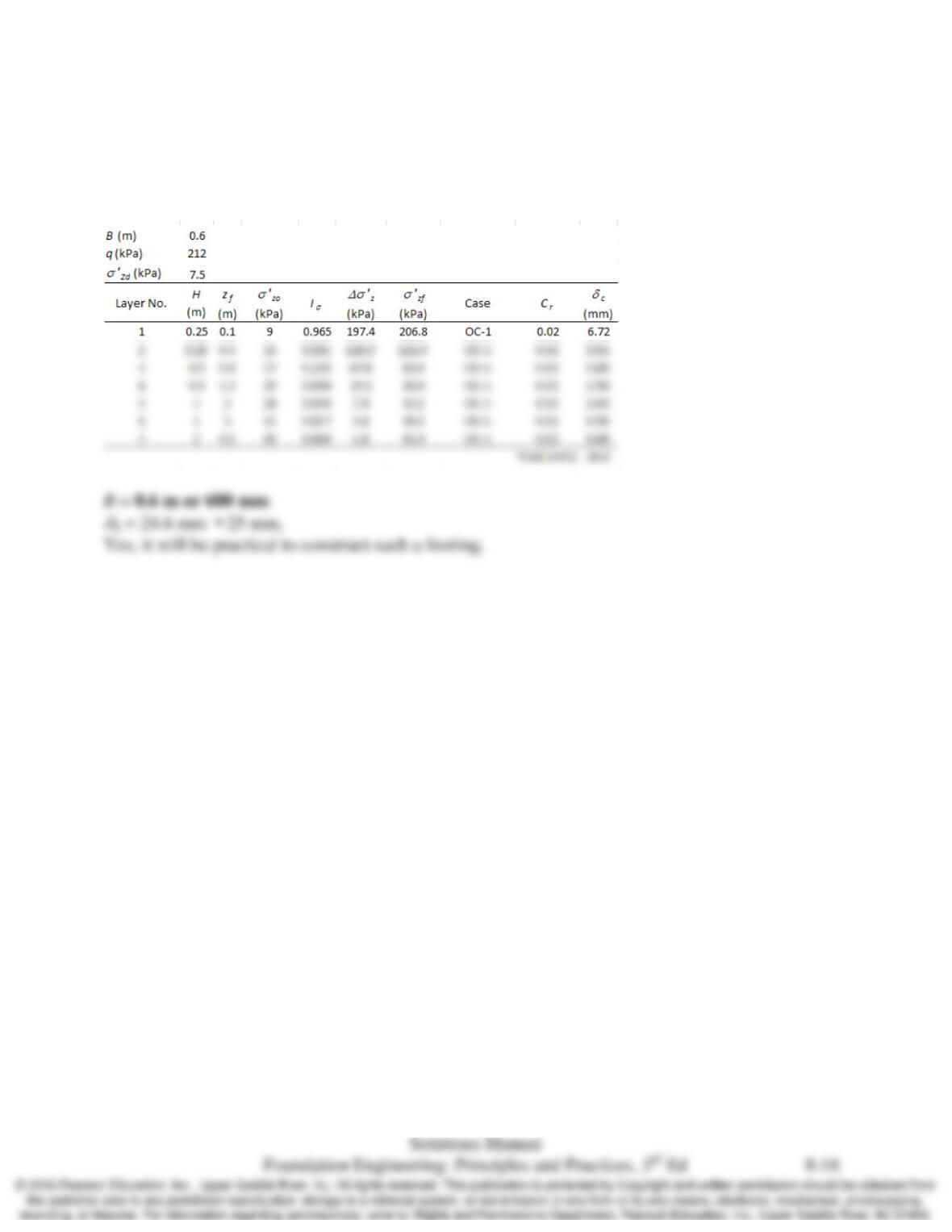
8.15 Using a spreadsheet and the data in Problem 8.12, determine the required footing width to obtain
a total settlement of no more than 25 mm. Select a width that is a multiple of 100 mm. Would it
be practical to build such a footing?
Solution

Chap. 8 Spread Footings-Geotechnical Serviceability Limit States
8.16 A steel frame office building with no diagonal bracing will be supported on spread footings
founded in a natural clay. The computed total settlement of these footings is 20 mm. Compute
the differential settlement.
Solution

Chap. 8 Spread Footings-Geotechnical Serviceability Limit States
8.17 A reinforced concrete building with numerous concrete shear walls will be supported on spread
footings founded in a compacted sand. The computed total settlement of these footings is 0.6 in.
Compute the differential settlement.
Solution
Chap. 8 Spread Footings-Geotechnical Serviceability Limit States
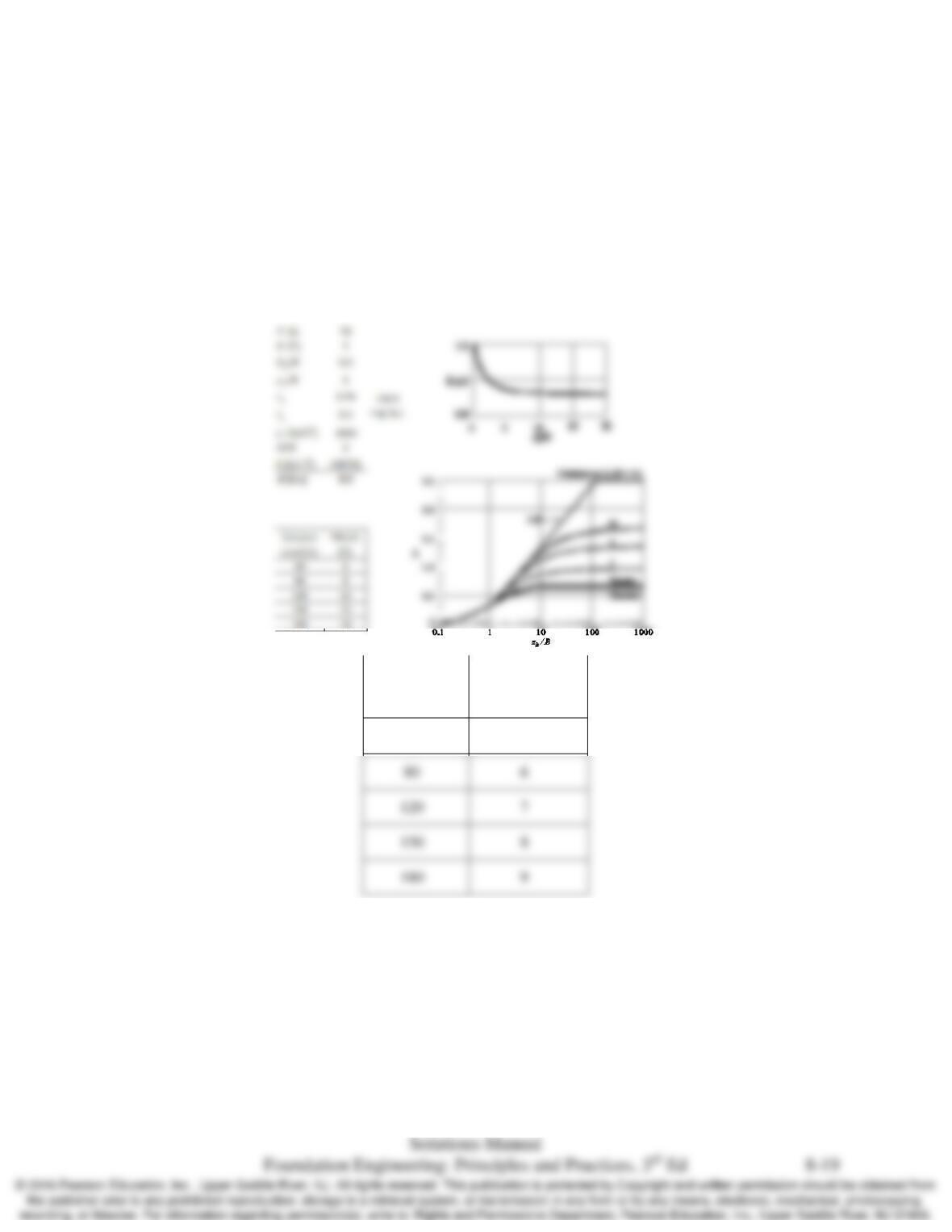
8.18 A proposed building is to be supported on a series of spread footings embedded 36 inches into the
ground. The underlying soils consist of silty sands with N60 = 30, an estimated overconsolidation
ratio of 2, and γ = 118 lb/ft3. This soil strata extends to a great depth and the groundwater table is
at a depth of 10-ft below the ground surface. The allowable settlement is 1.0 in. Using a
spreadsheet, develop a plot of allowable column load vs. footing width.
Solution
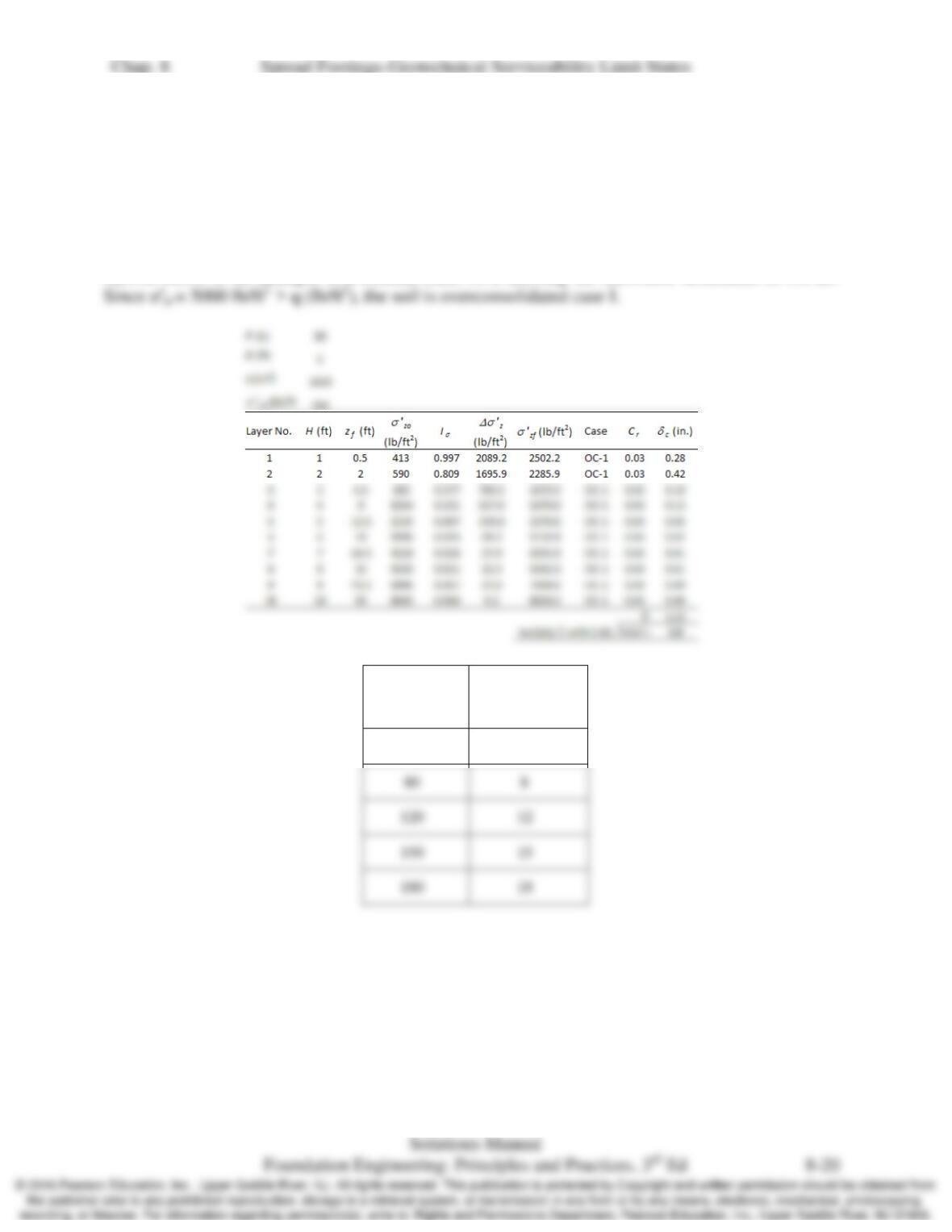
Shown below is an example of a column load, 50-k meeting the allowable settlement of 1.0 in..
Column load
(k)
Footing width
(ft)
50 5
8.19 A proposed building is to be supported on a series of spread footings embedded 36 inches into the
ground. The underlying soils consist of silty clays with Cc/(1 + e0) = 0.12, Cr/(1 + e0) = 0.030,
σ′m = 5000 lb/ft2, and γ = 118 lb/ft3. This soil strata extends to a great depth and the groundwater
table is at a depth of 10 ft below the ground surface. The allowable settlement is 1.0 in. Using a
spreadsheet, develop a plot of allowable column load vs. footing width.
Solution
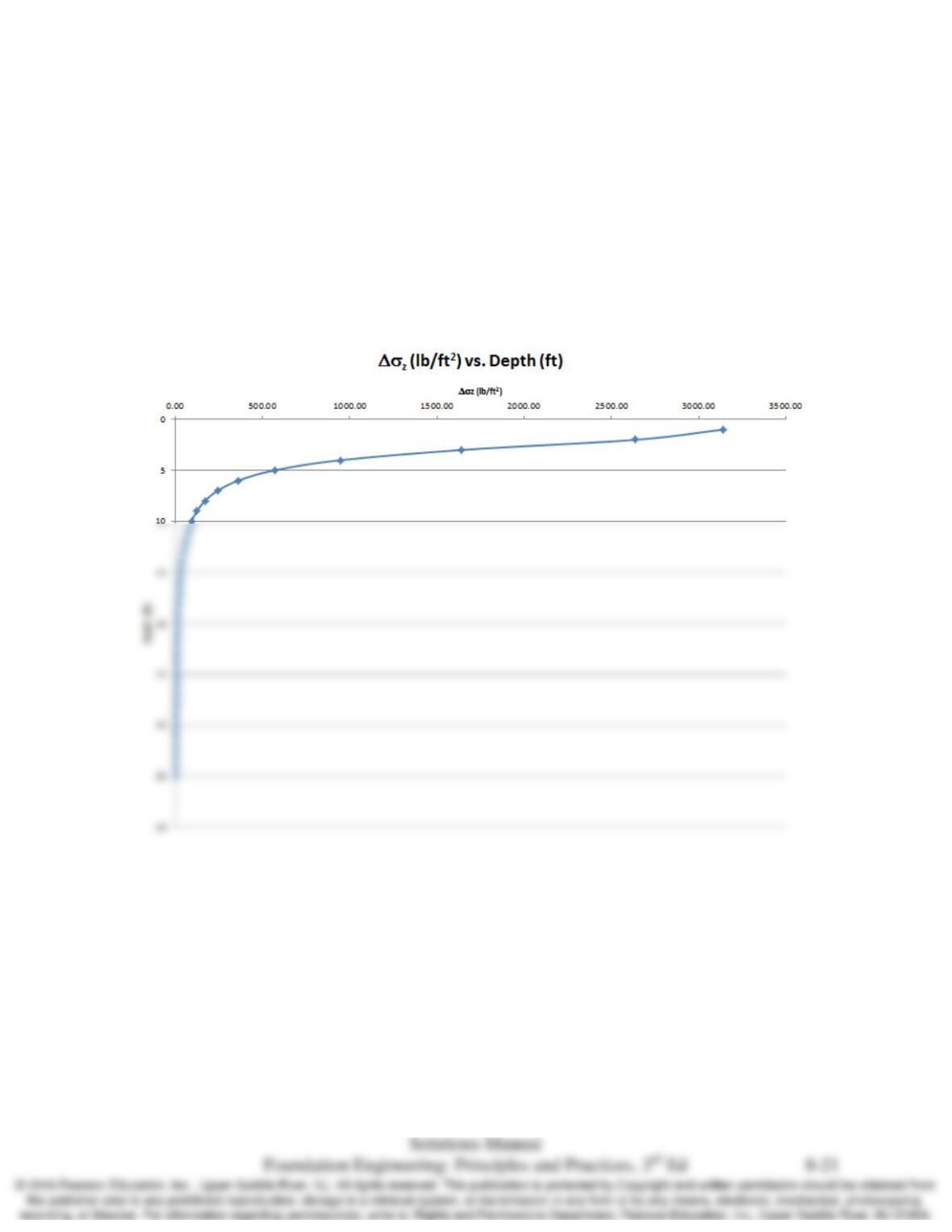
Shown below is an example of a column load, 50-k meeting the allowable settlement of 1.0 in..
Column load
(k)
Footing width
(ft)
50 5
Chap. 8 Spread Footings-Geotechnical Serviceability Limit States
8.20 A 3–ft square, 2-ft deep footing carries a column load of 28.2 k. An architect is proposing to build
a new 4 ft wide, 2 ft deep continuous footing adjacent to this existing footing. The side of the
new footing will be only 6 inches away from the side of the existing footing. The new footing
will carry a load of 12.3 k/ft.
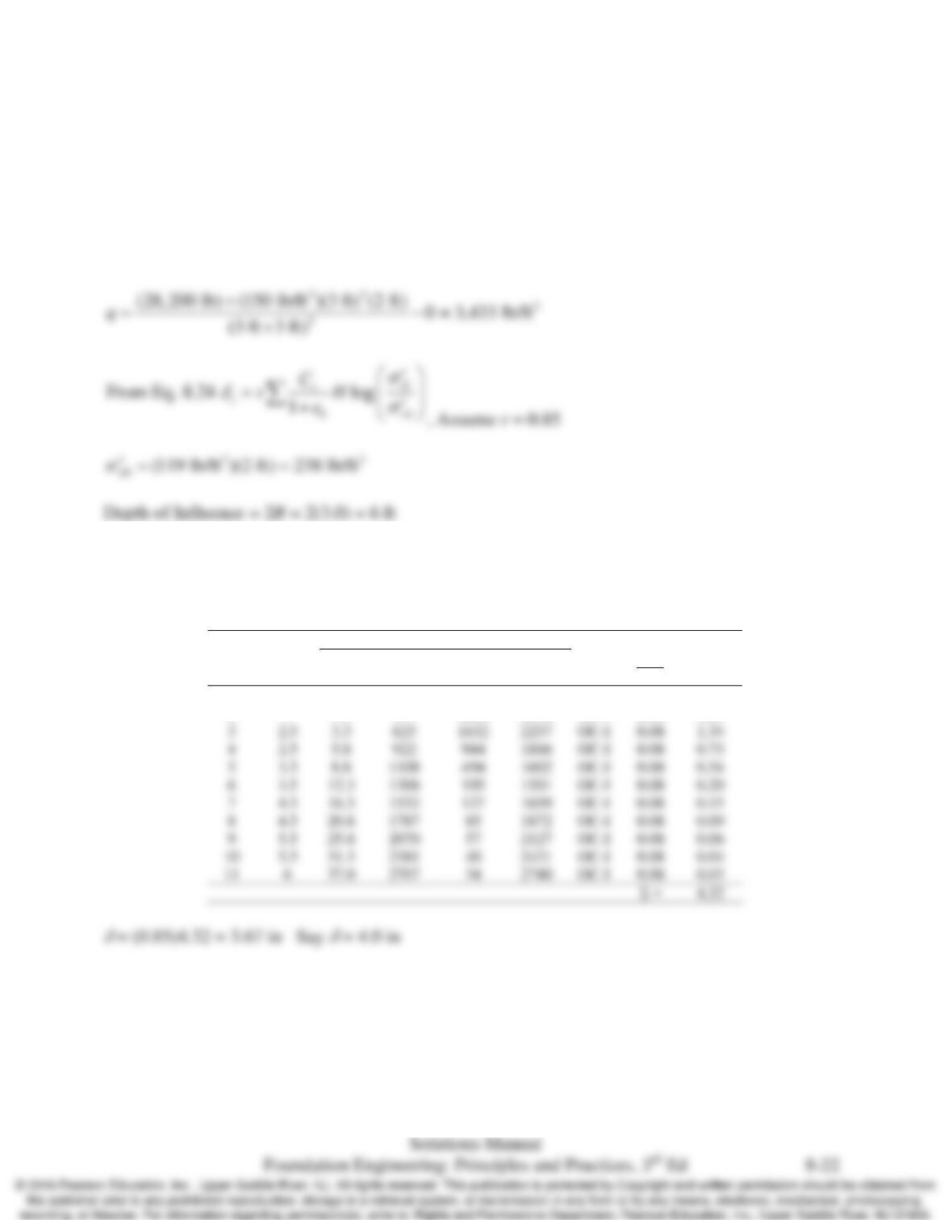
Develop a plot of Δσz due to the new footing vs. depth along a vertical line beneath the center of
the existing footing. This plot should extend from the bottom of the existing footing to a depth of
35 ft below the bottom of this footing.
Solution
Chap. 8 Spread Footings-Geotechnical Serviceability Limit States
8.21 Using the data from Problem 8.20, Cr/(1 + e0) = 0.08 and γ = 119 lb/ft3, compute the consolidation
settlement of the old footing due to the construction and loading of the new footing. The soil is an
overconsolidated (case I) silty clay, and the groundwater table is at a depth of 8 ft below the
ground surface.
Solution
Old Footing due to construction (3 ft square footing)
In order to compute the settlement due to construction and loading of the new footing, increase
the induced vertical stresses (Δσz) based on the new footing (continuous) to the old footing
(square).
At midpoint of soil layer
Layer
No.
H
(ft)
zf (ft)
σ’
z0
(lb/ft
2
)
Δσ
z
(lb/ft
2
)
σ’
zf
(lb/ft
2
)
Case
0
1
r
C
e+
δ
c
(in)
1
1
0.5
298
3122
3419
OC-I
0.08
1.02
2
1
1.5
417
2620
3036
OC-I
0.08
0.83
3
3.3
625
1632
2257
OC-I
0.08
1.34
5
8.8
1602
OC-I
0.08
0.54
6
1501
OC-I
0.08
0.20
7
1659
OC-I
0.08
0.15
8
1872
OC-I
0.08
0.09
9
2127
OC-I
0.08
0.06
6
2740
OC-I
0.08
0.03
4.32

Chap. 8 Spread Footings-Geotechnical Serviceability Limit States
8.22 Using a spreadsheet and the subsurface data from Example 8.5, develop a plot of footing width, B,
vs. column load, P, for square spread footings embedded 3 ft below the ground surface. Develop
a P vs. B curve for each of the following settlements: 0.5 in, 1.0 in, and 1.5 in, and present all
three curves on the same diagram.
Solution