Compressibility of Soil and Rock Chapter 8
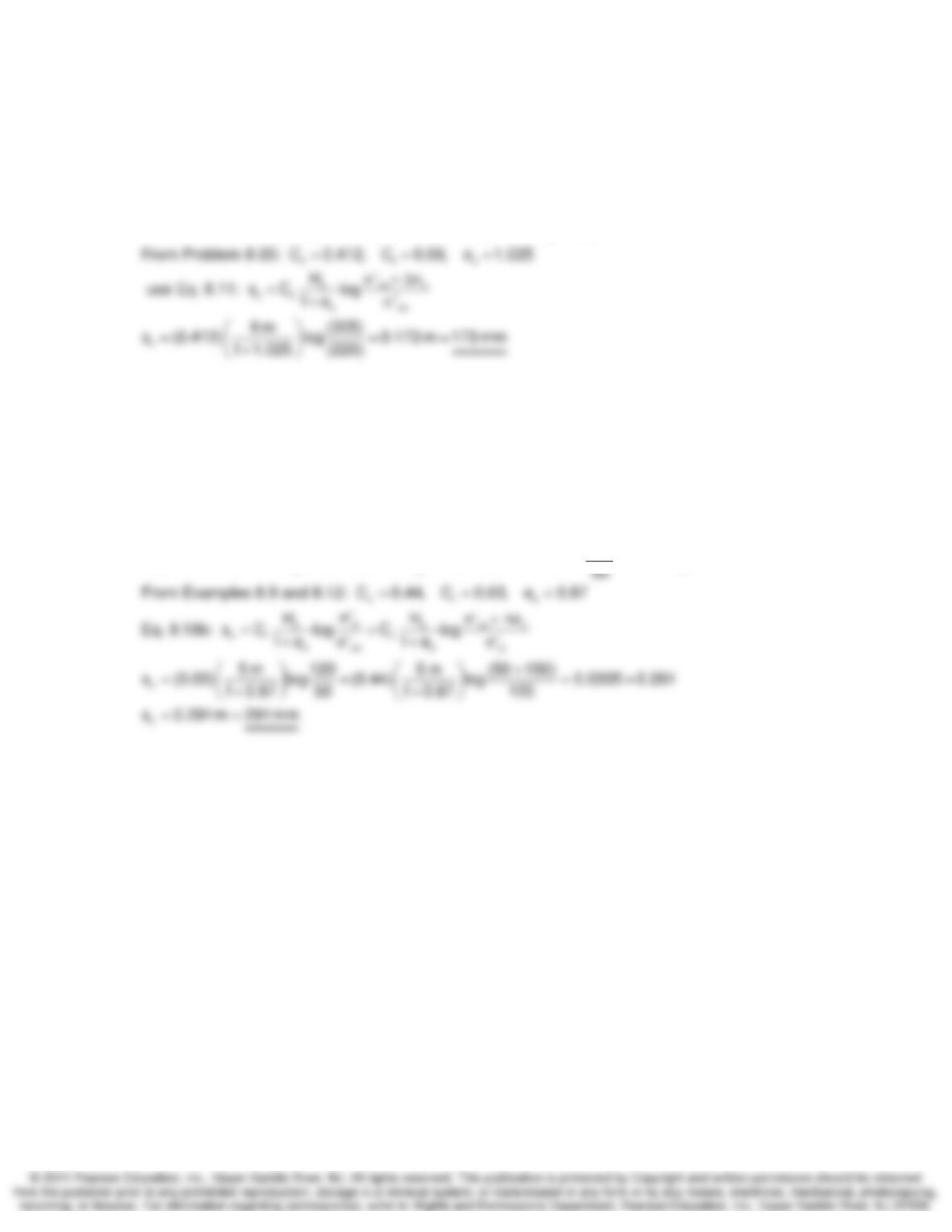
8-22. What would be the settlement of the same structure in Problem 8.21 if the
overconsolidation ratio of the clay were 1.0 and
σ
’vo +
Δσ
v = 305 kPa at the middepth of the clay
layer? Show your work and assumptions on the e versus log s curve of Problem 8.20.
SOLUTION:
vvov pvo
175 kPa; ‘ 305 kPa; OCR 1.0 ‘ ‘ 220 kPa
Δσ = σ + Δσ = = → σ = σ =
8-23. The consolidation curve of Fig. Ex. 8.9 is typical of a compressible layer 5 m thick. If the
existing overburden pressure is 50 kPa, compute the settlement due to an additional stress of
150 kPa added by a structure.
SOLUTION:
vvop o
120
150 kPa; ‘ 50 kPa; ‘ 120 kPa; OCR 1.7; H 5 m
Δσ = σ = σ = = = =
Compressibility of Soil and Rock Chapter 8
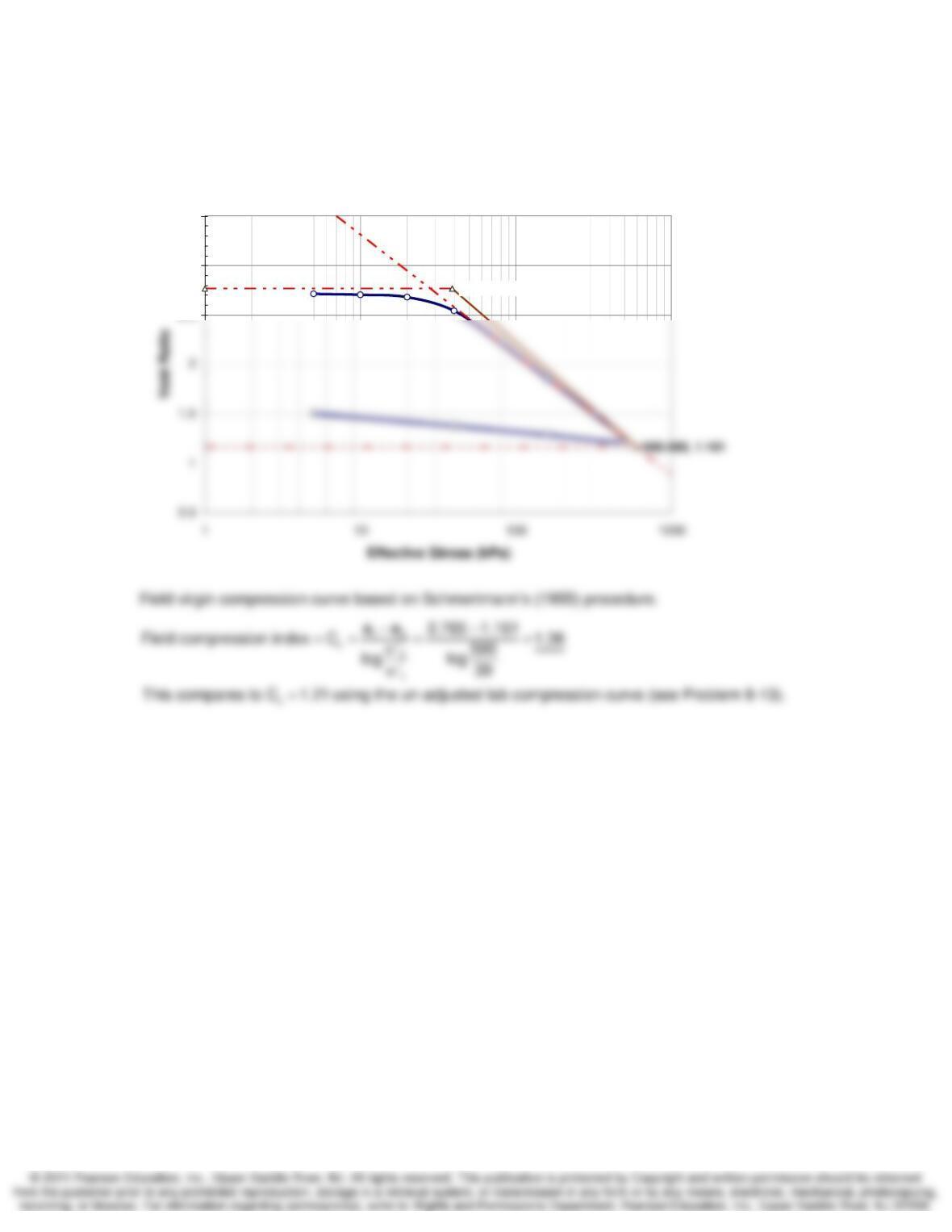
8-24. For the test data of Problem 8.12, construct the field virgin compression curve using the
Schmertmann procedure for an OCR of unity.
SOLUTION:
39.000, 2.765
2.5
3
3.5
Compressibility of Soil and Rock Chapter 8
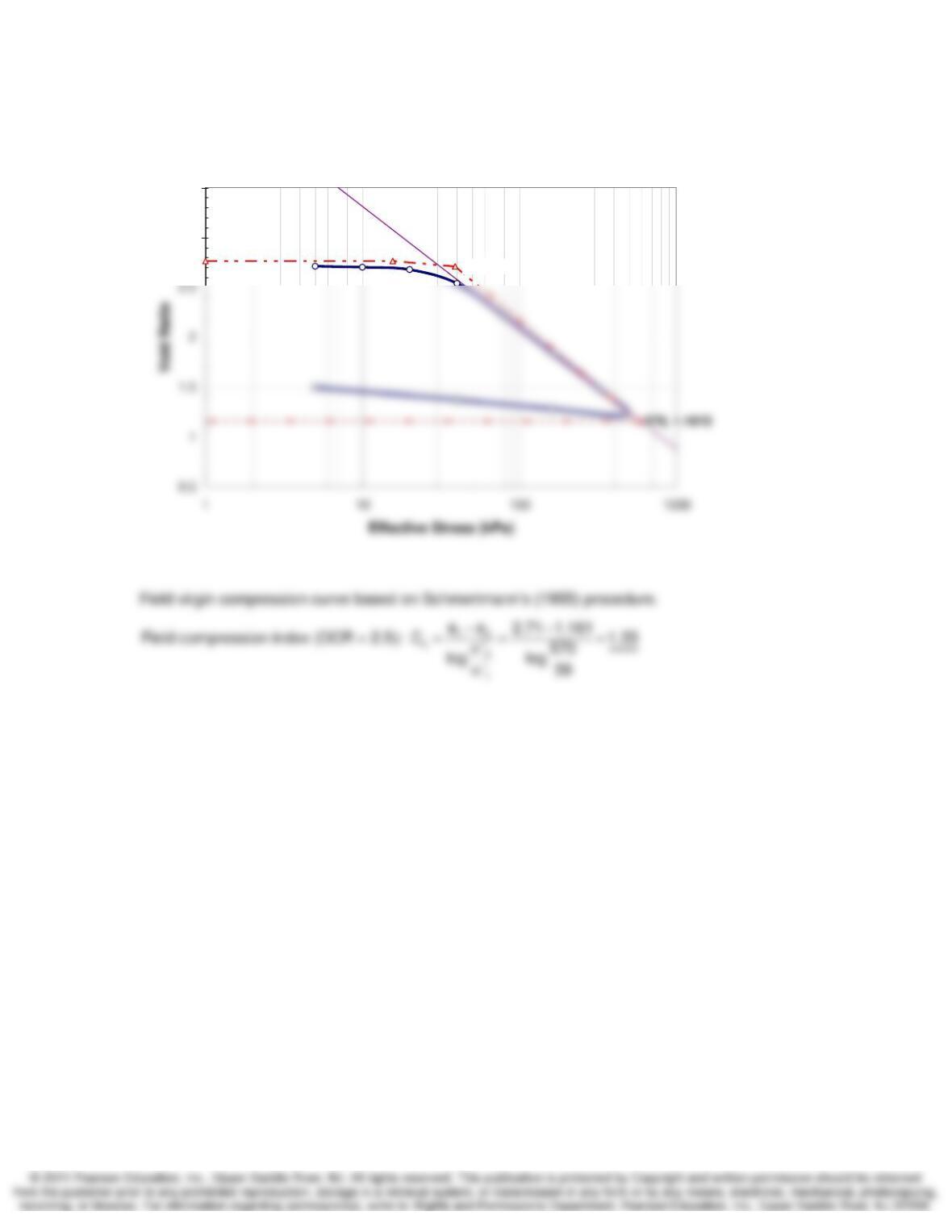
8-25. Do Problem 8.24 for an OCR = 2.5.
SOLUTION:
39, 2.71
3
3.5
Compressibility of Soil and Rock Chapter 8
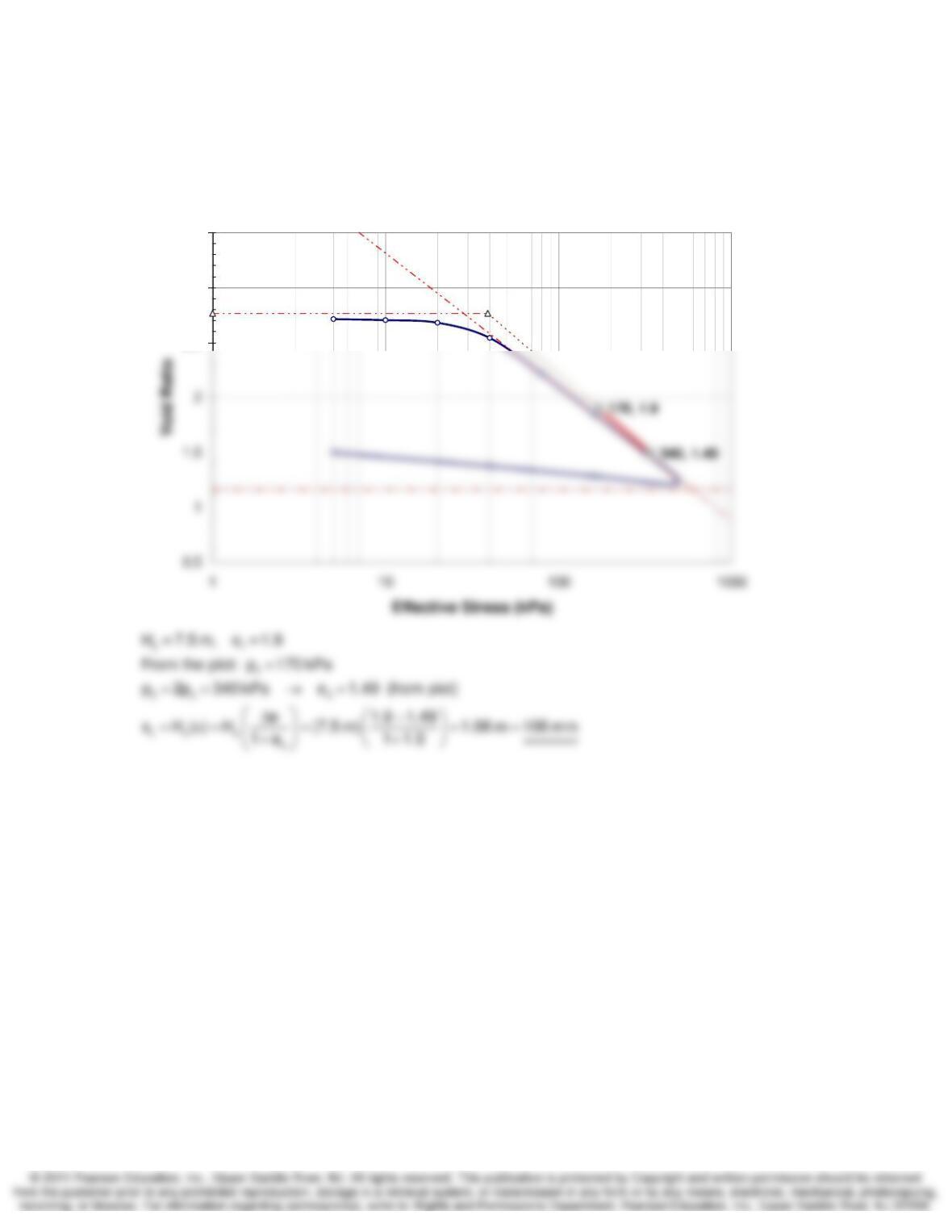
8-26. At the midpoint of a 7.5 m thick soil layer, the void ratio is 1.9. Find this point on the field
virgin compression curve determined in Problem 8.24. What is the corresponding pressure? If this
pressure is doubled over the entire site, compute the consolidation settlement of the layer.
SOLUTION:
2.5
3
3.5
Compressibility of Soil and Rock Chapter 8
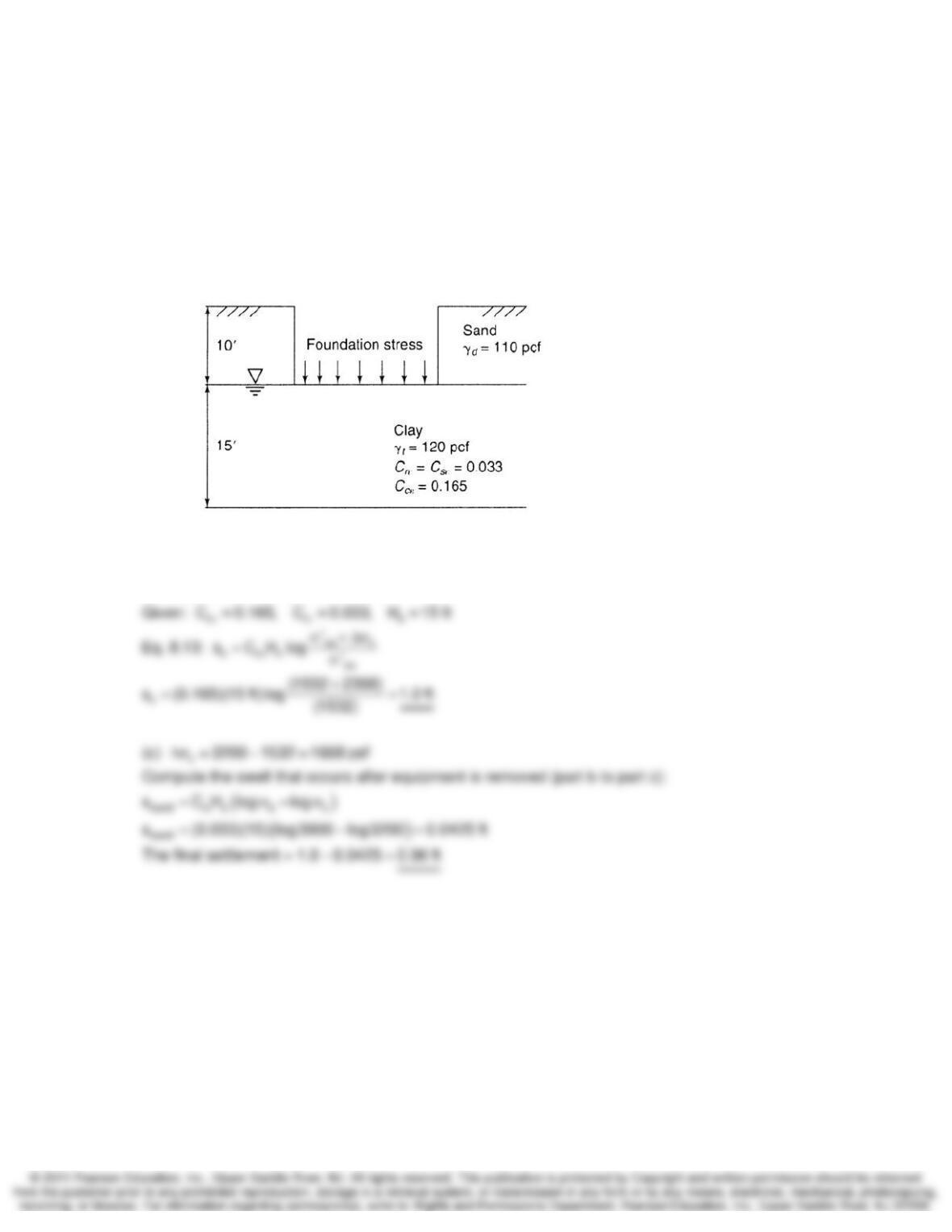
8-31. Figure P8.31 shows a proposed foundation site, with 10 ft of sand overlying 15 ft of clay
with consolidation properties shown. The clay is normally consolidated. Assume 1-D conditions.
(a) Compute the initial
σ
’v at the middle of the clay layer prior to excavation and construction. (b)
After excavation and during construction, the foundation area will be heavily loaded with the
structure and equipment so that
σ
’v at the middle of the clay layer will be increased to 3900 psf.
Determine the settlement that will occur under these conditions. (c) After construction is
completed, the equipment will be removed and the final
σ
’v at the middle of the clay layer will be
3200 psf.
SOLUTION:
vo
v
(a) ‘ (10 ft)(110 pcf) (7.5 ft)(120 62.4 pcf) 1532 psf
(b) 3900 1532 2368 psf
σ= + − =
Δσ = − =
Compressibility of Soil and Rock Chapter 8
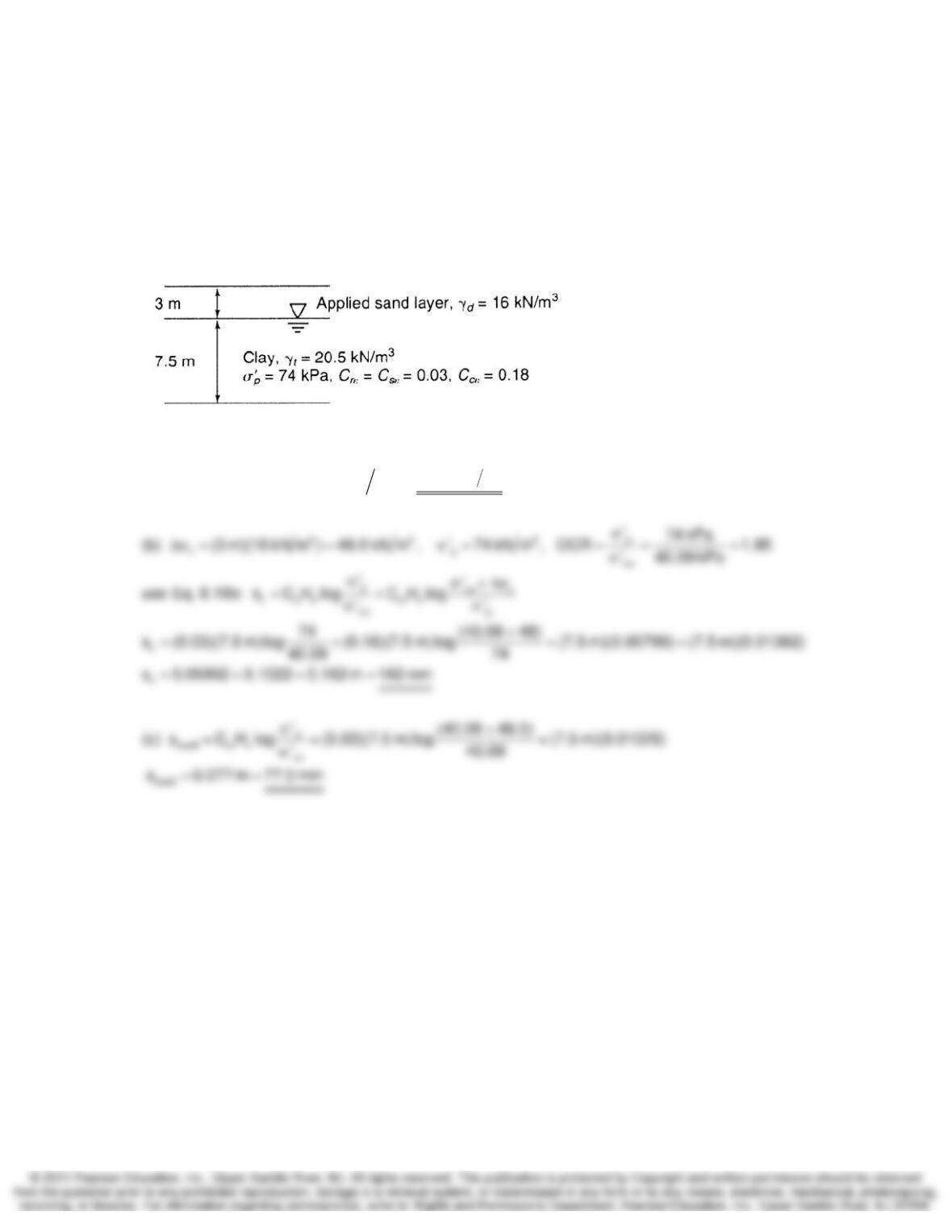
8-32. As part of a construction project, a 7.5 m thick layer of clay is to be loaded with a temporary
3 m thick sand layer (refer to Fig. P8.32).The figure shows the water-table location, soil unit
weights, and the compression curve properties for the clay. Assume the sand layer remains dry.
(a) Calculate the value of
σ
’v in the middle of the clay layer (at 3.75 m below the water table)
before the sand layer is applied, and after consolidation is complete. (b) Based on your answer in
part (a), and the compression curve characteristics, calculate the settlement that will occur under
these conditions. (c) How much will the clay layer heave when the 3 m sand layer is removed?
SOLUTION:
32
vo
(a) ‘ (3.75 m)(20.5 9.81kN m ) 40.09 kN m
σ= − =
Compressibility of Soil and Rock Chapter 8
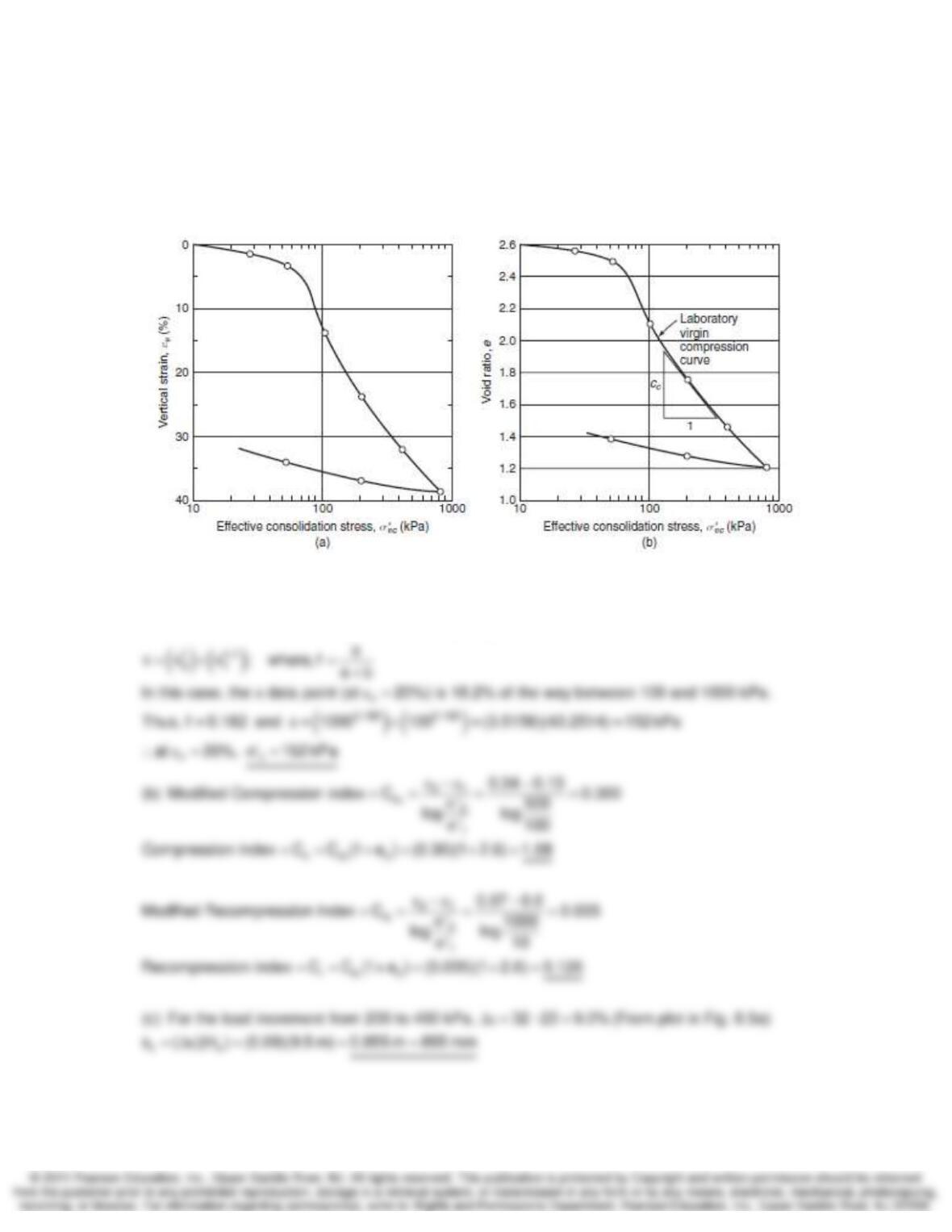
8-33. Refer to Fig. 8.5a. Determine: (a) Using log interpolation between 100 and 1000,
determine the
σ
v value at a vertical strain,
ε
v = 20%. (b) If the initial void ratio, eo = 2.6, determine
Cr and Cc for this soil. For Cc use the portion of the curve between
σ
’v = 100 and 500 kPa. (c) If
the original clay layer thickness is 9.5 m, determine the settlement that occurs in the layer when it
is loaded from 200 to 400 kPa. [Note: You don’t need the results from part (b) to do this.]
SOLUTION:
v
(a) There are various approaches for interpolating logarithmic scales.
One approach for interpolating the desired x (or ‘ ) value is as follows:
σ
Compressibility of Soil and Rock Chapter 8
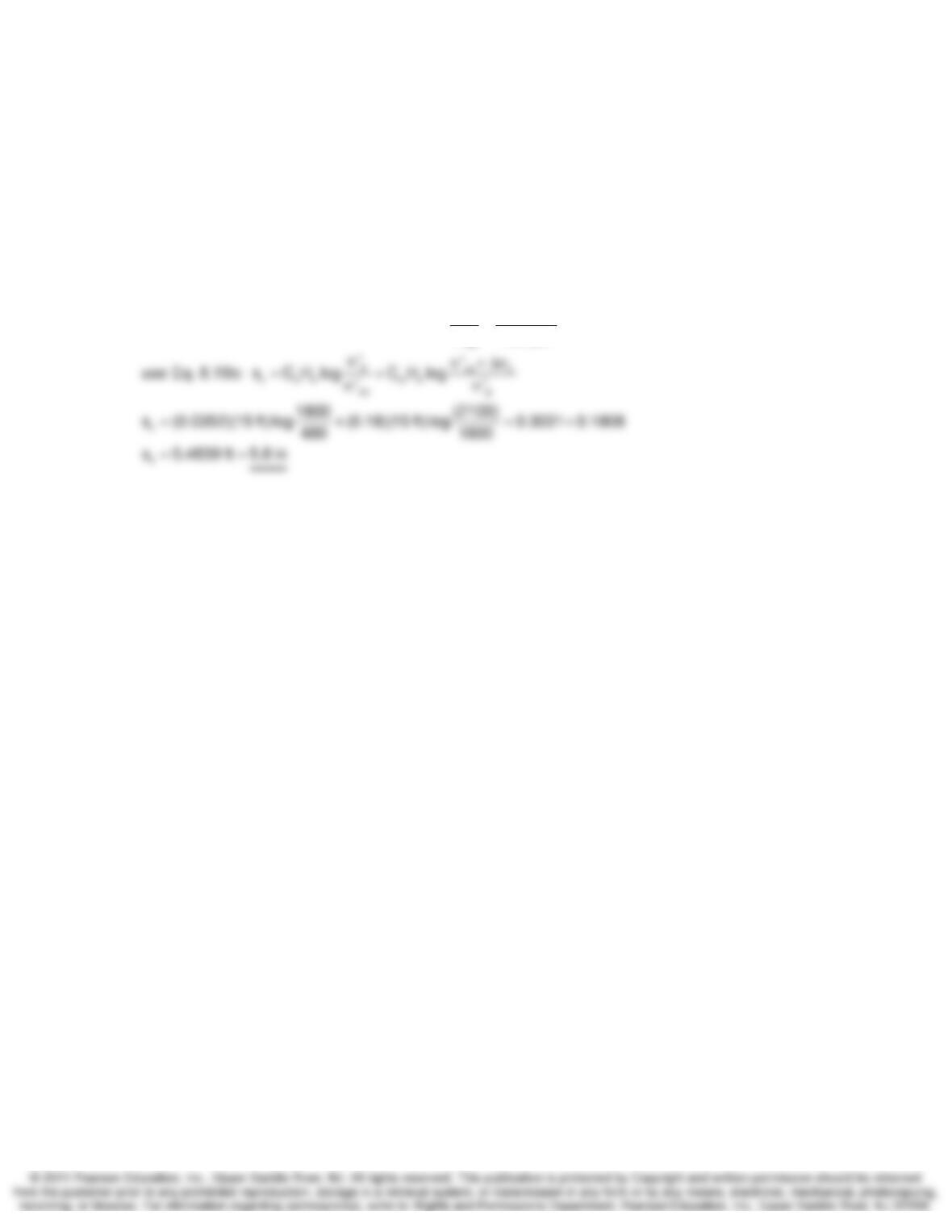
8-34. A large embankment is to be built on the surface of a 15-ft clay layer. Before the
embankment is built, the initial
σ
’v at the middle of the clay layer is 480 psf. The results from a 1-D
consolidation test on the clay from the middle of the layer are as follows:
σ
’p = 1800 psf Cr
ε
= 0.0352 Cc
ε
= 0.180
If the final
σ
’v at the middle of the layer after the embankment loading is 2100 psf, what is the
settlement, in inches, of the clay layer resulting from this loading?
SOLUTION:
p
vo vf
vo
‘1800 psf
(a) ‘ 480 psf, ‘ 2100 psf, OCR 3.75
‘ 480 psf
σ
σ= σ= = = =
σ
Compressibility of Soil and Rock Chapter 8
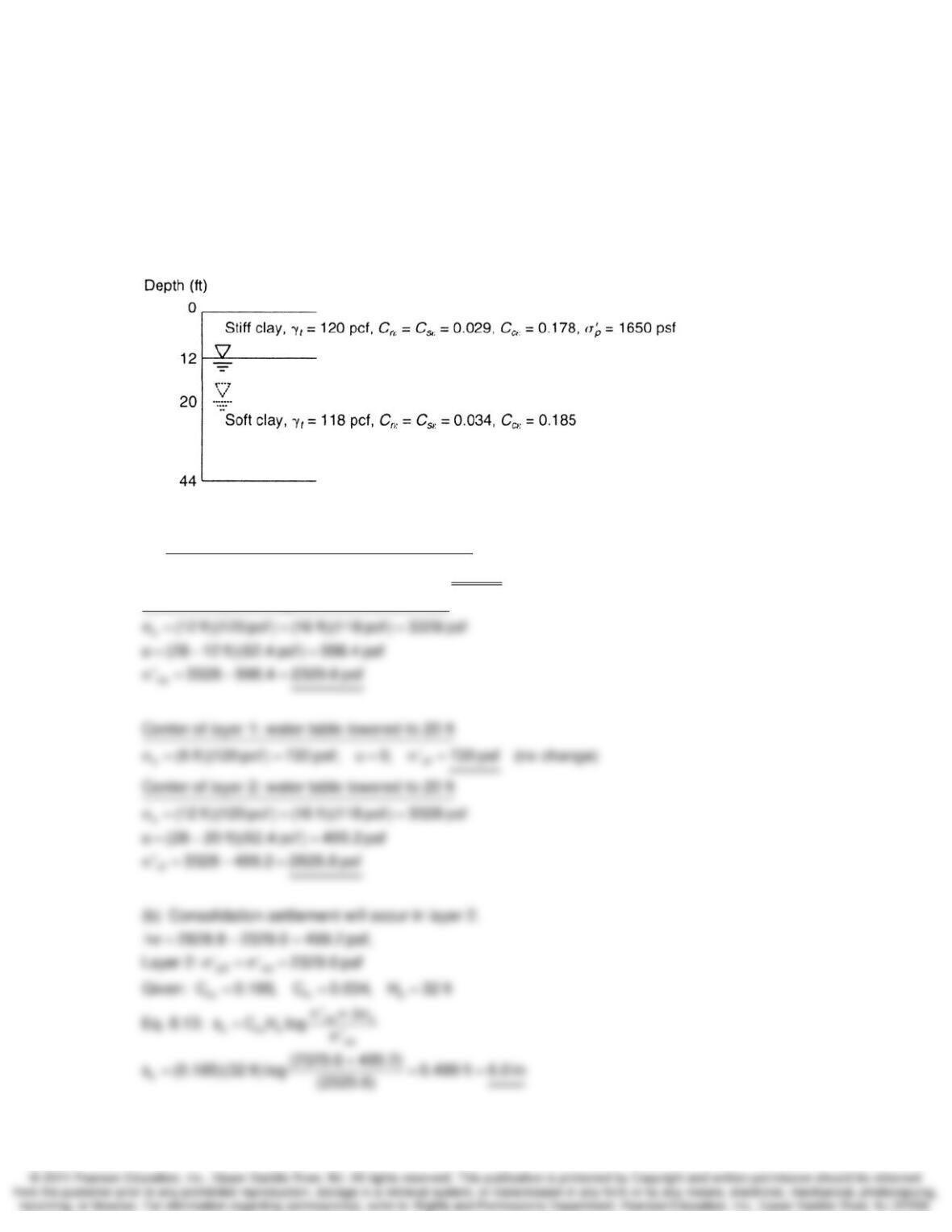
8-35. Figure P8.35 shows a proposed site where an excavation will be made. The 10 ft layer of
sand will be removed, so that the top of the 24 ft normally consolidated clay layer will be exposed.
Assume full capillarity in the clay only. (a) Assume that the water-table location remains the
same during excavation. Compute the
σ
v.
σ
’v, and u values at the middle of the clay layer before
and after the excavation. (b) Assuming 1-D conditions, compute how much the clay layer will
deform due to this excavation, in inches. Specify whether this is settlement or heave.
SOLUTION:
v
(a) Before excavation
(10 ft)(110 pcf) (12 ft)(120 pcf) 2540 psf
σ=+=
Compressibility of Soil and Rock Chapter 8
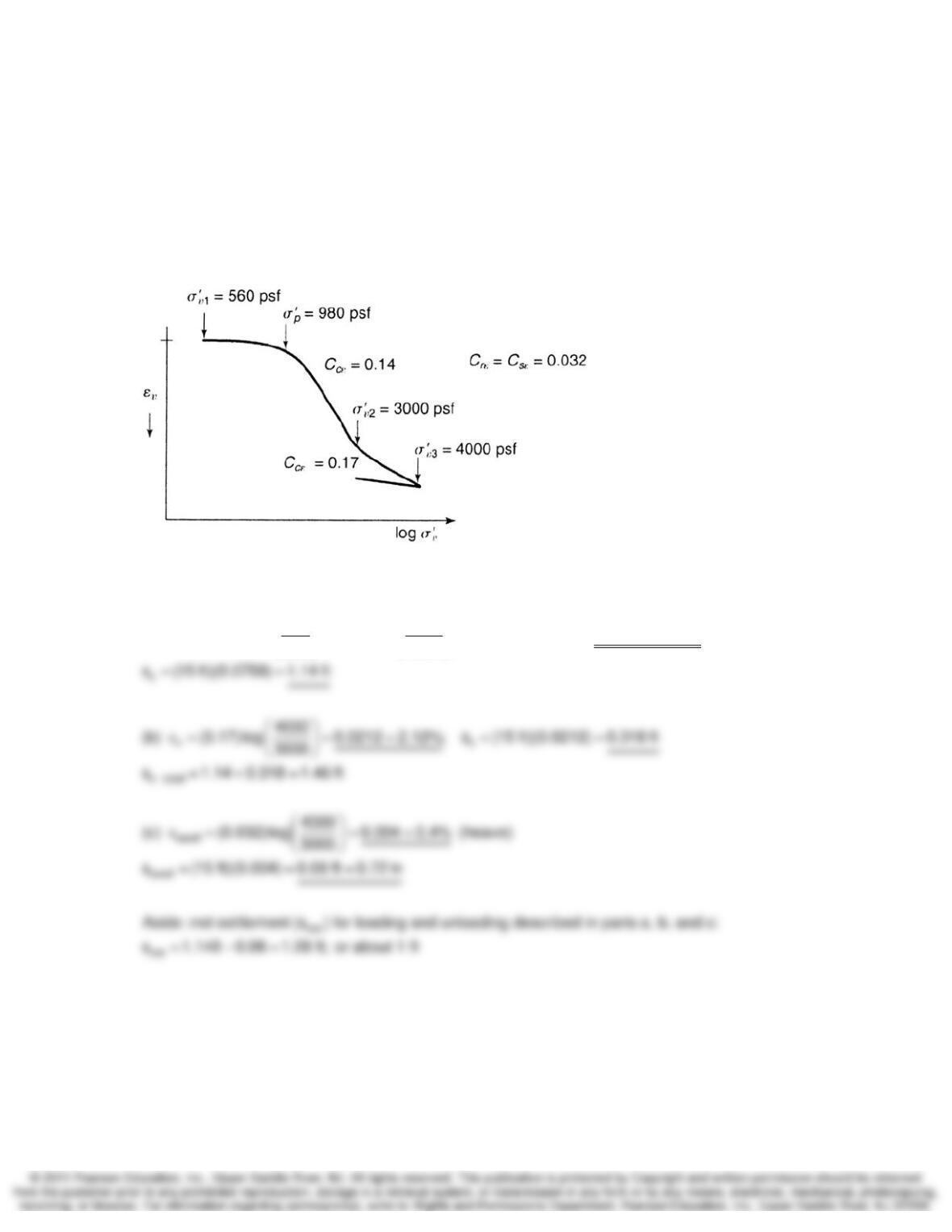
8-36. Figure P8.36 shows the soil profile at a site where you plan to lower the water table. You
have results from two consolidation tests, one from the upper 12 ft thick overconsolidated crust,
and another from the lower 32 ft thick normally consolidated zone. You plan to lower the water
table from its current 12 ft depth to 20 ft below ground surface. The consolidation properties for
each layer are shown. Assume full capillarity. a) Compute the
σ
’v in the middle of each layer
before and after the water table is lowered. (b) Determine the total settlement that will result from
lowering the water table.
SOLUTION:
vvo
(a) Center of layer 1: original water table at 12 ft
(6 ft)(120 pcf) 720 psf; u 0; ‘ 720 psf
Center of layer 2: original water table at 12 ft
σ= = = σ =
Compressibility of Soil and Rock Chapter 8
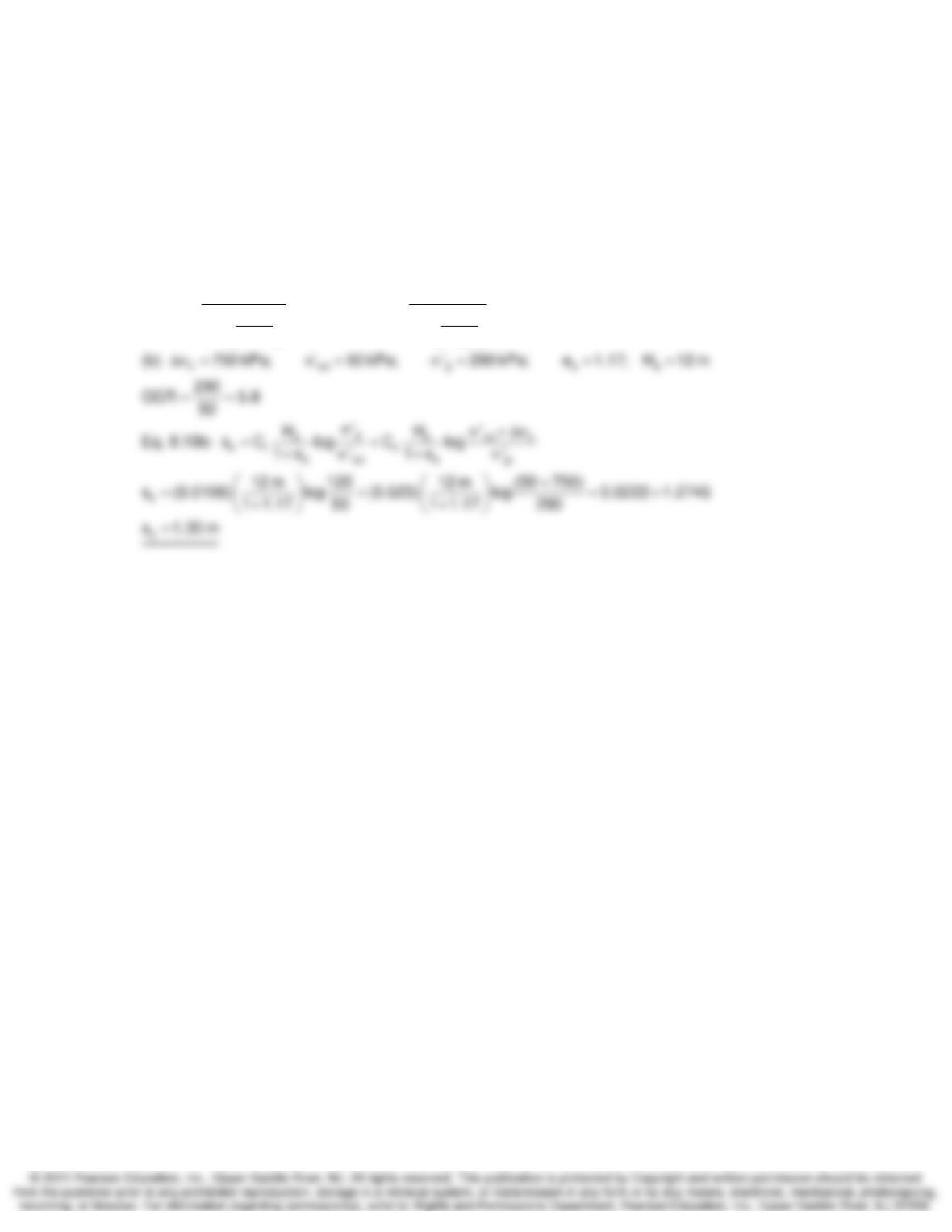
8-37. When a consolidation test is performed on some soils, the virgin compression region is not
linear, but bilinear. Figure P8.37 shows such a compression curve from a 15 ft thick layer.
Required: (a) What vertical strain, occurs when the soil is loaded from an initial
σ
’v1 = 560 psf to
σ
’v2 = 3000 psf? (b) If you load the soil further, to
σ
’v3 = 4000 psf, how much additional settlement
occurs? (c) Finally, if you unload from 4000 psf back to
σ
’v4 = 3000 psf, what additional
deformation (in ft) occurs?
SOLUTION:
v
980 3000
(a) (0.032)log (0.14)log 0.00778 0.068 0.0758 7.58%
560 980
⎛⎞ ⎛ ⎞
ε= + = + = =
⎜⎟ ⎜ ⎟
⎝⎠ ⎝ ⎠
Compressibility of Soil and Rock Chapter 8
8-38. Refer to the compression curve marked Soil 13 in Fig. 8.9a. Disregard the small unloading
cycle in the middle of the curve. The initial void ratio for this soil is 1.17, and the preconsolidation
pressure is 290 kPa. Note: the right-hand vertical boundary of this graph is at
σ
’vc = 2000 kPa.
Required: (a) Determine the Cr and Cc for this soil based on the compression curve. (b) If a layer
of this soil 12 m thick is loaded from 50 to 800 kPa (two of the data points shown on the curve),
what settlement will result, in m?
SOLUTION:
rc
1.17 1.135 1.35 0.67
(a) C 0.0106; C 0.523
2000 2000
log log
1100
−−
== ==
⎛⎞ ⎛⎞
⎜⎟ ⎜⎟
⎝⎠ ⎝⎠