Chapter 8
Lipids and Proteins Are Associated in Biological
Membranes
1
SUMMARY
Section 8.1
Lipids are compounds that consist mostly of nonpolar groups. They have limited
solubility in water, but dissolve freely in organic solvents.
Section 8.2
Lipids are frequently open-chain compounds with a polar head group and a long
Section 8.3
Lipid bilayers are large assemblies of molecules. The polar head groups of the
lipid molecules are in contact with an aqueous environment. The nonpolar tails of
Section 8.4
Proteins combine with lipid bilayers to form membranes.
Section 8.5
The fluid-mosaic model is the most usual description of membrane structure. In
this model, the proteins ―float‖ in the lipid bilayer without extensive interaction
between the two.
2 Chapter 8
Section 8.6
There are several ways in which molecules are transported across cell
membranes, and proteins play a role in most of them.
In simple diffusion, small, uncharged molecules cross the membrane without a
Section 8.7
The structures of the lipid–soluble vitamins—A, D, E, and K—are ultimately
derived from five-carbon isoprene units, which also play a role in lipid
Section 8.8
Prostaglandins are compounds of related structures derived from long-chain fatty
acids. They have a number of physiological roles, including control of smooth
LECTURE NOTES
The material covered by this chapter will easily take up two lectures, and possibly
a third. While there is a fair amount of material, most students do not find the concepts,
transport and the function of receptor proteins may require a third lecture period.
LECTURE OUTLINE
I. Lipid structures
A. Fatty acids
1. Amphipathic nature
2. Consequences of unsaturation
Lipids and Proteins Are Associated in Biological
Membranes 3
D. Waxes
II. Biological membranes
A. Lipid bilayers
1. Importance of hydrophobic interactions
4. Lateral and transverse diffusion in a membrane
B. Membrane proteins
1. Integral and peripheral proteins
2. Transport proteins, membrane–bound enzymes, and receptors
C. The fluid mosaic model
III. Membrane transport
A. Passive transport
1. simple diffusion
IV. Lipid-soluble vitamins
A. Vitamin A
B. Vitamin D
ANSWERS TO PROBLEMS
1. Solubility properties (insoluble in aqueous or polar solvents, soluble in nonpolar
solvents). Some lipids are not at all structurally related.
8.2 The Chemical Natures of the Lipid Types
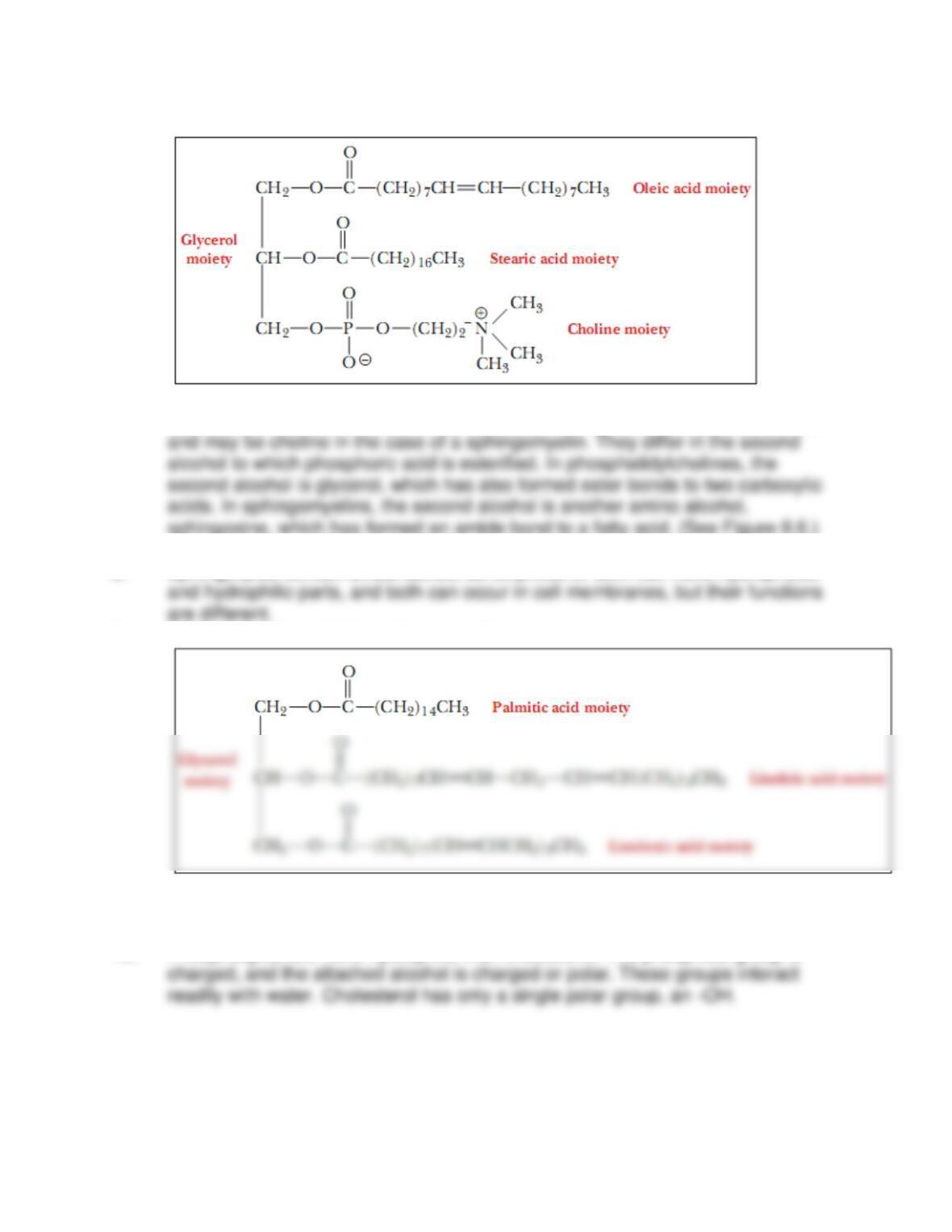
2. In both types of lipids, glycerol is esterified to carboxylic acids, with three such
ester linkages formed in triacylglycerols and two in phosphatidyl ethanolamines.
4 Chapter 8
3.
4. Both sphingomyelins and phosphatidylcholines contain phosphoric acid esterified
to an amino alcohol, which must be choline in the case of a phosphatidylcholine
5. This lipid is a ceramide, which is one kind of sphingolipid.
6. Sphingolipids contain amide bonds, as do proteins. Both can have hydrophobic
7. Any combination of fatty acids is possible.
8. Steroids contain a characteristic fused-ring structure, which other lipids do not.
9. Waxes are esters of long-chain carboxylic acids and long-chain alcohols. They
tend to be found as protective coatings.
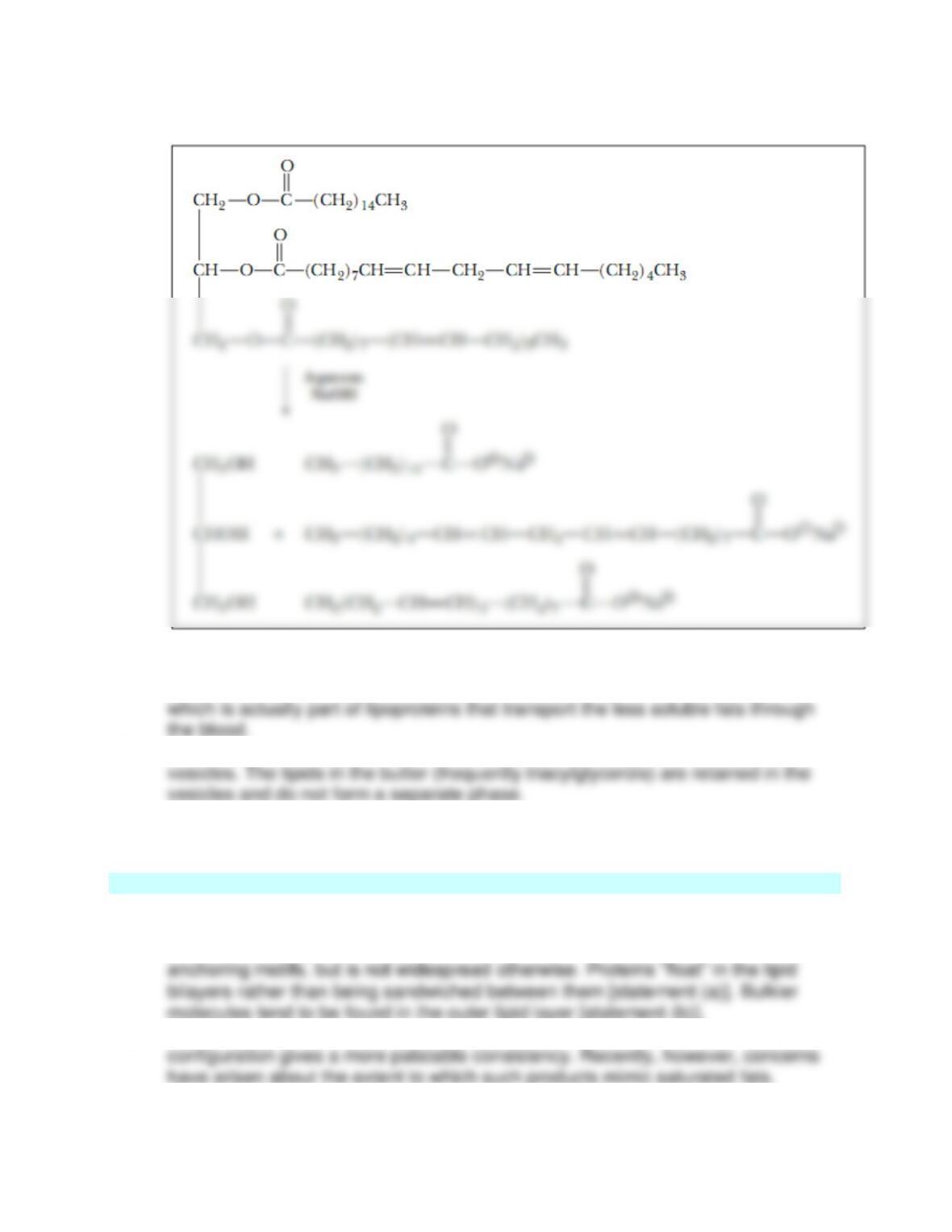
10. Phospholipids are more hydrophilic than cholesterol. The phosphate group is
Lipids and Proteins Are Associated in Biological
Membranes 5
11.
12. The waxy surface coating is a barrier that prevents loss of water.
13. The surface wax keeps produce fresh by preventing loss of water.
14. Cholesterol is not very water–soluble, but lecithin is a good natural detergent,
15. The lecithin in the egg yolks serves as an emulsifying agent by forming closed
16. The removal of the oil also removes the natural oils and waxes on the feathers.
These oils and waxes must regenerate before the birds can be released.
8.3 Biological Membranes
17. Triacylglycerols are not found in animal membranes.
18. Statements (c) and (d) are consistent with what is known about membranes.
Covalent bonding between lipids and proteins [statement (e)] occurs in some
19. The public is attuned to the idea of polyunsaturated fats as healthful. The trans
6 Chapter 8
21. Many of the double bonds have been saturated. Crisco contains ―partially
hydrogenated vegetable oils.‖
22. Less heart disease is associated with diets low in saturated fatty acids.
23. The transition temperature is lower in a lipid bilayer with mostly unsaturated fatty
24. Myelin is a multilayer sheath consisting mainly of lipids (with some proteins) that
insulates the axons of nerve cells, facilitating transmission of nerve impulses.
25. At the lower temperature, the membrane would tend to be less fluid. The
26. The higher percentage of unsaturated fatty acids in membranes in cold climates
is an aid to membrane fluidity.
27. Hydrophobic interactions among the hydrocarbon tails are the main energetic
8.4 The Kinds of Membrane Proteins
29. Lipids can be ―tagged‖ with a fluorescent moiety to observe their motion in
membranes. Proteins have intrinsic fluorescence and can be monitored directly.
30. A glycoprotein is formed by covalent bonding between a carbohydrate and a
32. A 100-g sample of membrane contains 50 g of protein and 50 g of
phosphoglycerides.
33. Nature chooses what works. This is an efficient use of a large protein and of the
energy of ATP.
34. In a protein that spans a membrane, the nonpolar residues are the exterior ones;
8.5 The Fluid-Mosaic Model of Membrane Structure
Lipids and Proteins Are Associated in Biological
Membranes 7
35. Statements (c) and (d) are correct. Transverse diffusion is only rarely observed
37. The action of a number of receptor proteins requires binding of GTP to a specific
subunit, followed by subsequent hydrolysis.
8.6 The Functions of Membranes
38. Biological membranes are highly nonpolar environments. Charged ions tend to
8.7 Lipid-Soluble Vitamins and Their Functions
40. Cholesterol is a precursor of vitamin D3; the conversion reaction involves ring
opening.
41. Vitamin E is an antioxidant.
46. Lipid-soluble vitamins accumulate in fatty tissue, leading to toxic effects. Water–
soluble vitamins are excreted, drastically reducing the chances of an overdose.
47. Vitamin K plays a role in the blood-clotting process. Blocking its mode of action
can have an anticoagulant effect.
8.8 Prostaglandins and Leukotrienes
50. An omega-3 fatty acid has a double bond at the third carbon from the methyl end.
51. Leukotrienes are carboxylic acids with three conjugated double bonds.
52. Prostaglandins are carboxylic acids that include a five-membered ring in their
structure.