8-1
CHAPTER 8
INVENTORIES: COST MEASUREMENT AND FLOW ASSUMPTIONS
CONTENT ANALYSIS OF EXERCISES AND PROBLEMS
Number
Content
Time Range
(minutes)
E8-1
Inventory. (Easy) Manufacturing company. Computation of
ending account balances.
10-15
E8-5
Discounts. (Easy) Gross price and net price methods. Journal
entries.
5-15
E8-6
Discounts. (Moderate) Gross price and net price methods.
Journal entries.
5-15
E8-10
LIFO. (Easy) Perpetual and periodic systems. Ending inventory,
cost of goods sold.
10-15
E8-11
Dollar-Value LIFO. (Easy) Determination of ending inventory at
end of one year.
10-15
8-2
Number
Content
Time Range
(minutes)
E8-15
Inventory Pools. (Moderate) Dollar-value LIFO. Computation of
ending inventory.
20-30
E8-19
(Appendix). Exchange Gains and Losses. (Easy) Record journal
entries for sale and collection.
5-10
P8-4
Discounts. (Moderate) Gross price and net price methods.
Income determination, journal entries.
20-30
P8-5
Inventory Methods. (Challenging) FIFO, LIFO, and average cost
under periodic and perpetual systems. Cost of goods sold,
ending inventory. Reconcile LIFO periodic and LIFO perpetual.
IFRS differences.
25-35
P8-9
Dollar-Value LIFO. (Moderate) Determination of year-end
inventory for five years. Prepare disclosures.
30-40
Number
Content
Time Range
(minutes)
P8-12
Comprehensive: Dollar-Value LIFO. (Challenging) Two pools.
Compute cost indexes. Determine year-end inventory for 4
years.
30-40
determination.
P8-17
(AICPA adapted). Comprehensive: Inventory Adjustments.
(Moderate) Preparation of schedule of adjustments to
compute ending inventory, accounts payable, and sales.
25-35
ANSWERS TO QUESTIONS
Q8-1 A merchandising company purchases goods for resale and does not alter their
physical form, so it needs only one type of inventory account, usually called
Q8-2 Raw materials inventory includes the tangible goods acquired for direct use in the
production process.
Q8-2 (continued)
3. Manufacturing (or factory) overhead, which includes the costs other than raw
materials and direct labor that are part of the production of the product. These
Q8-3 Under a perpetual inventory system, a company keeps a continuous record of the
physical quantities in its inventory. It records every purchase, or production, and use of
each item of inventory in detailed subsidiary records, sometimes in units only and
sometimes with costs attached. A company maintains an Inventory account and a
Q8-4 The general rule for determining whether a company includes an item in inventory is to
include all items that are under the economic control of the company, regardless of
their location or legal ownership. Goods in transit shipped F.O.B. destination are
Q8-5 a. Goods in transit purchased F.O.B. shipping point for which the invoice has been
received are included in the Raw Materials Inventory account since they are in
transit and economic control has been transferred.
8-5
Q8-6 a. Sales commission are not included in the determination of inventory cost.
b. A supervisor’s salary, if directly related to the production of inventory, is included in
the determination of inventory cost.
Q8-7 The gross price method, in which purchases are recorded at their gross price and
discounts are only recorded when they are taken, is the easiest of the two methods to
use. It results in an Accounts Payable balance that reflects the maximum liability
resulting from the purchase. It has the disadvantage of hiding inefficiencies in the
Q8-8 GAAP requires that an inventory cost flow assumption be systematic, based on cost,
and match costs as expenses against revenues appropriately. The assumed flow of
costs does not represent the actual physical flow of goods.
Q8-8 (continued)
When a company using LIFO liquidates inventory during a period (sells some, or all, of
the beginning inventory, which is valued at the costs of previous periods), costs of
goods that may be carried at extremely old and unrealistically low costs are matched
Q8-9 During a period of rising costs, the LIFO cost flow assumption results in a lower gross
profit (income) as compared with the FIFO method. The cost of goods sold amount is
Q8-10 Under the LIFO method, the most recent costs are included in cost of goods sold, while
earlier costs remain in inventory. This results in the matching of the most recently
incurred costs with current revenues in the determination of gross profit (income) and
Q8-11 When a company using the LIFO method sells more units than it has acquired during
the period (liquidates inventory), the cost of units which were purchased in previous
periods are brought into cost of goods sold. Assuming inflation exists, these units have
8-7
Q8-12 A holding gain is the difference between the historical cost and the replacement cost
of the units sold. It is not real income since it cannot be distributed to the owners
without leaving the company worse off. In a company that plans to continue as a
Q8-13 The dollar value LIFO method simplifies some of the technical problems and record-
keeping detail involved in the LIFO method. First, the inventory is grouped into pools of
similar items. The current cost of each inventory pool as of the end of the year is
determined, and this amount is converted into base-year costs by using a cost index to
eliminate the effects of cost changes. This converted ending inventory amount at
Q8-14 The double-extension and link-chain methods are used when a company computes an
internal cost index. Typically, each index is prepared using a sample of the total
inventory. Under the double-extension method, the ending inventory is priced at
Q8-14 (continued)
Q8-15 In a period of rising costs, cost of goods sold is higher and ending inventory is lower
under LIFO than under FIFO. As a result, net income is usually lower when a company
switches to LIFO from FIFO. Working capital (current assets minus current liabilities) is
Q8-16 GAAP requires that interim financial statements do not give effect to the inventory
liquidation if there is expected to be no inventory liquidation by the end of the annual
Q8-17 Under IFRS, companies are permitted to use the specific identification, average cost,
and FIFO cost flow assumptions. IFRS do not allow the use of the LIFO cost flow
Q8-18 An exchange gain or loss is caused by a change in the exchange rate between the
date of a purchase or sale on credit and the date of the payment or receipt. An
cash payment (receipt).
ANSWERS TO MULTIPLE CHOICE
8-9
SOLUTIONS TO REVIEW EXERCISES
RE8-1
Raw materials inventory $ 74,000
RE8-2
Beginning inventory $550,000
RE8-3
Beginning inventory $250,000
RE8-4
July 10 Inventory 50,000
RE8-5
July 10 Inventory 50,000
RE3-6
Oct. 23 Inventory 99,000
RE8-7
Oct. 23 Inventory 99,000
RE8-8
Step One: Calculate ending inventory
RE8-9
Step One: Calculate ending inventory
RE8-10
Step One: Calculate cost of goods sold
8-11
RE8-11
Step One: Calculate cost of goods sold
RE8-12
100
Ending inventory at base-year costs: $33,600
x
120
= $28,000
RE8-13
RE8-14
RE8-15
8-12
SOLUTIONS TO EXERCISES
E8-1
Work in Process
Beginning balance -0-
Finished Goods
Beginning balance $123,500
E8-2
The second purchase for $4,000 shipped F.O.B. shipping point is included in the
E8-3
1. These goods are not included in inventory until they are actually received.
E8-3 (continued)
E8-4
Dec. Purchase Rebate Receivable ($25 x 1,100) 27,500
Inventory (or Purchases) 27,500
To account for rebate claimed on washing
E8-5
1. Inventory (or Purchases) 20,000
Accounts Payable 20,000
8-14
E8-5 (continued)
2. Inventory (or Purchases) 19,600
Accounts Payable [$20,000 – ($20,000 x 0.02)] 19,600
E8-6
1. Inventory (or Purchases) 50,000
Accounts Payable 50,000
To record inventory purchase; gross
price $50,000, terms 2/15, n/60.
2. Inventory (or Purchases) 49,000
Accounts Payable 49,000
To record inventory purchase; gross
price $50,000, terms 2/15, n/60.
8-15
E8-7
1. FIFO: Ending Inventory (500 units):
200 units @ $5 = $1,000
2. LIFO: Ending Inventory (500 units):
500 units @ $3.50 = $1,750
3. Weighted Average:
Goods Available for Sale:
500 units @ $3.50 = $1,750
300 units @ $4.00 = 1,200
8-16
E8-8
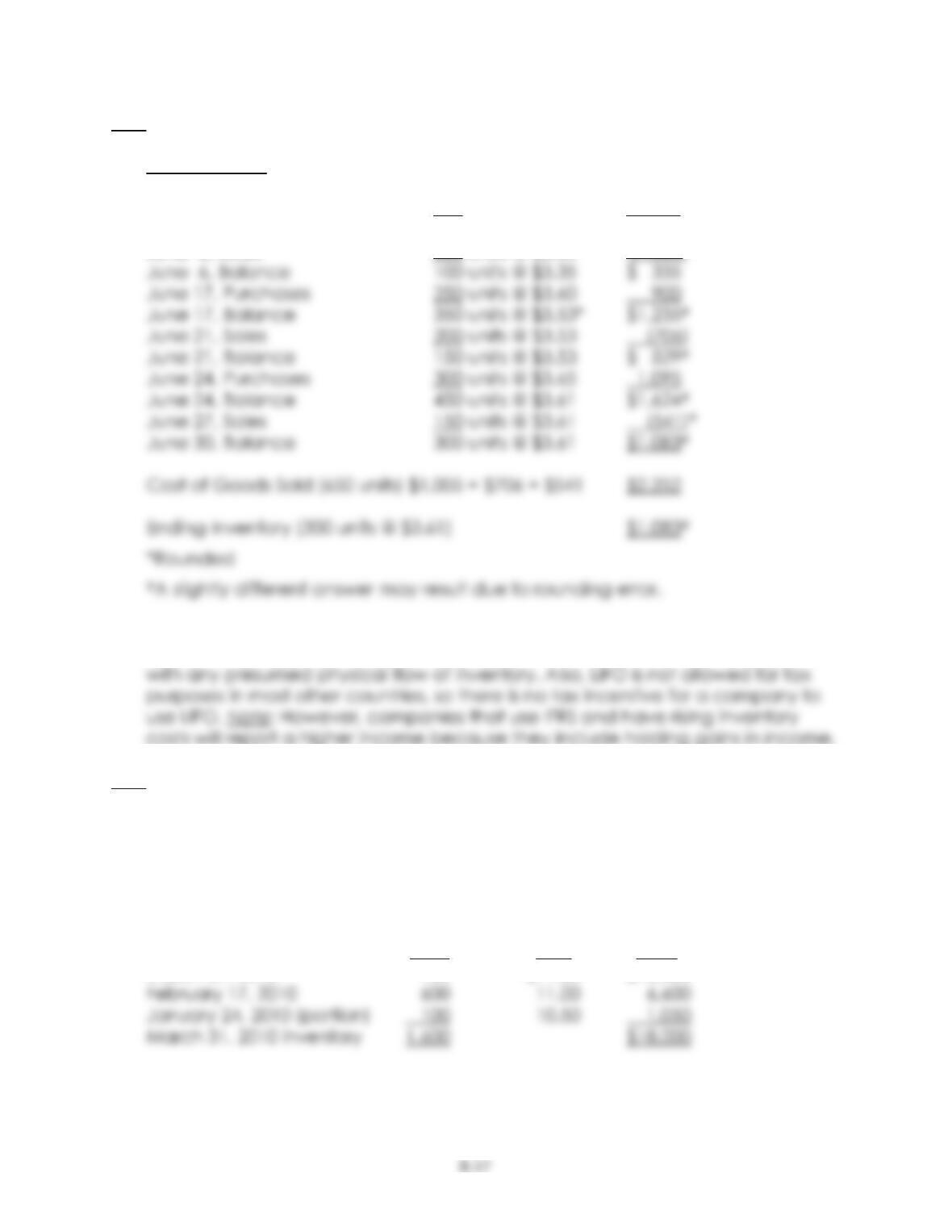
1. FIFO: Cost of Goods Sold (650 units):
June 6 300 units: 200 units @ $3.20 $ 640
100 units @ $3.50 350
2. LIFO: Cost of Goods Sold (650 units):
June 6 300 units: 100 units @ $3.20 $ 320.00
200 units @ $3.50 700.00
E8-8 (continued)
3. Average Cost:
June 1, Beginning Inventory 200 units @ $3.20 $ 640
June 3, Purchases 200 units @ $3.50 700
June 3, Balance 400 units @ $3.35 $1,340
June 6, Sales 300 units @ $3.35 (1,005)
4. If Park Company uses IFRS, it may report its inventory under FIFO, average, or
specific identification. It may not use LIFO under IFRS because it is not consistent
E8-9 (AICPA adapted solution)
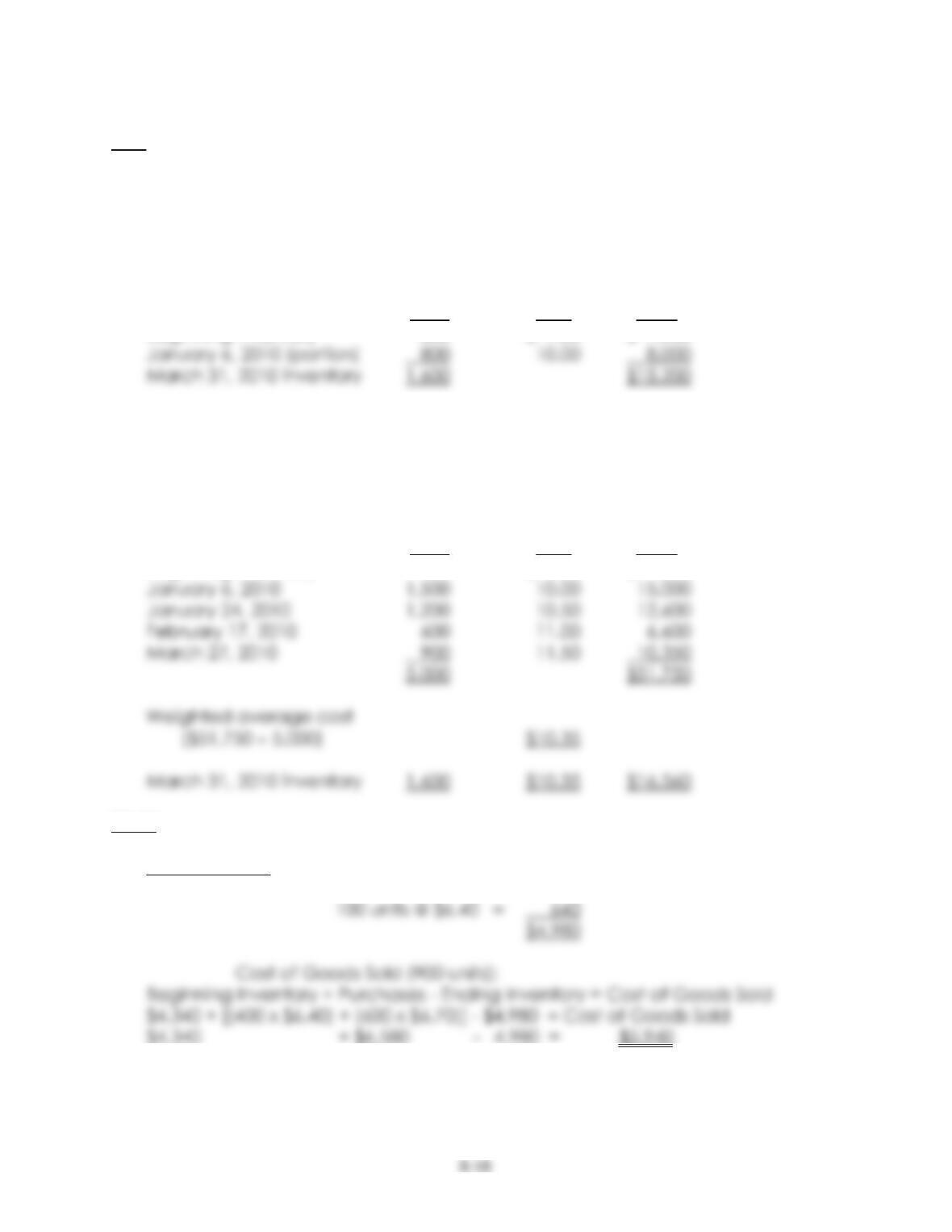
1. FRATE COMPANY
Computation of Inventory for Product
Ply Under FIFO Inventory Method
March 31, 2010
Unit Total
Units cost cost
March 27, 2010 900 $11.50 $10,350
E8-9 (continued)
2. FRATE COMPANY
Computation of Inventory for Product
Ply Under LIFO Inventory Method
March 31, 2010
Unit Total
Units cost cost
Beginning inventory 800 $ 9.00 $ 7,200
3. FRATE COMPANY
Computation of Inventory for Product
Ply Under Weighted Average Inventory Method
March 31, 2010
Unit Total
Units cost cost
Beginning inventory 800 $ 9.00 $ 7,200
E8-10
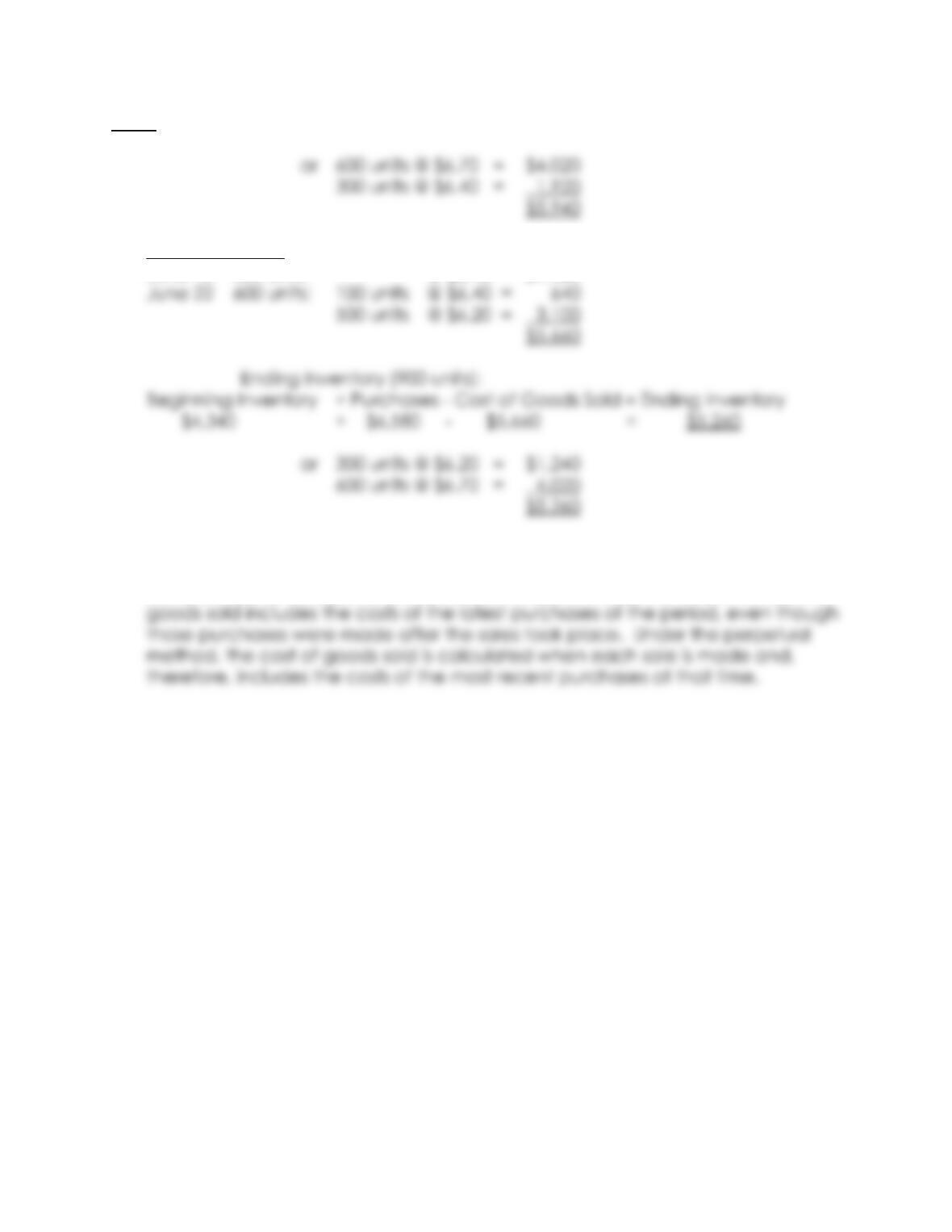
LIFO – periodic: Ending Inventory (800 units):
700 units @ $6.20 = $4,340
8-19
E8-10 (continued)
LIFO – perpetual: Cost of Goods Sold (900 units):
June 15 300 units @ $6.40 = $1,920
The difference in the final inventory valuations results from the difference in the
assumptions about the timing of the sales. Under the periodic method, sales
are assumed to take place at the end of the period and, therefore, the cost of
E8-11
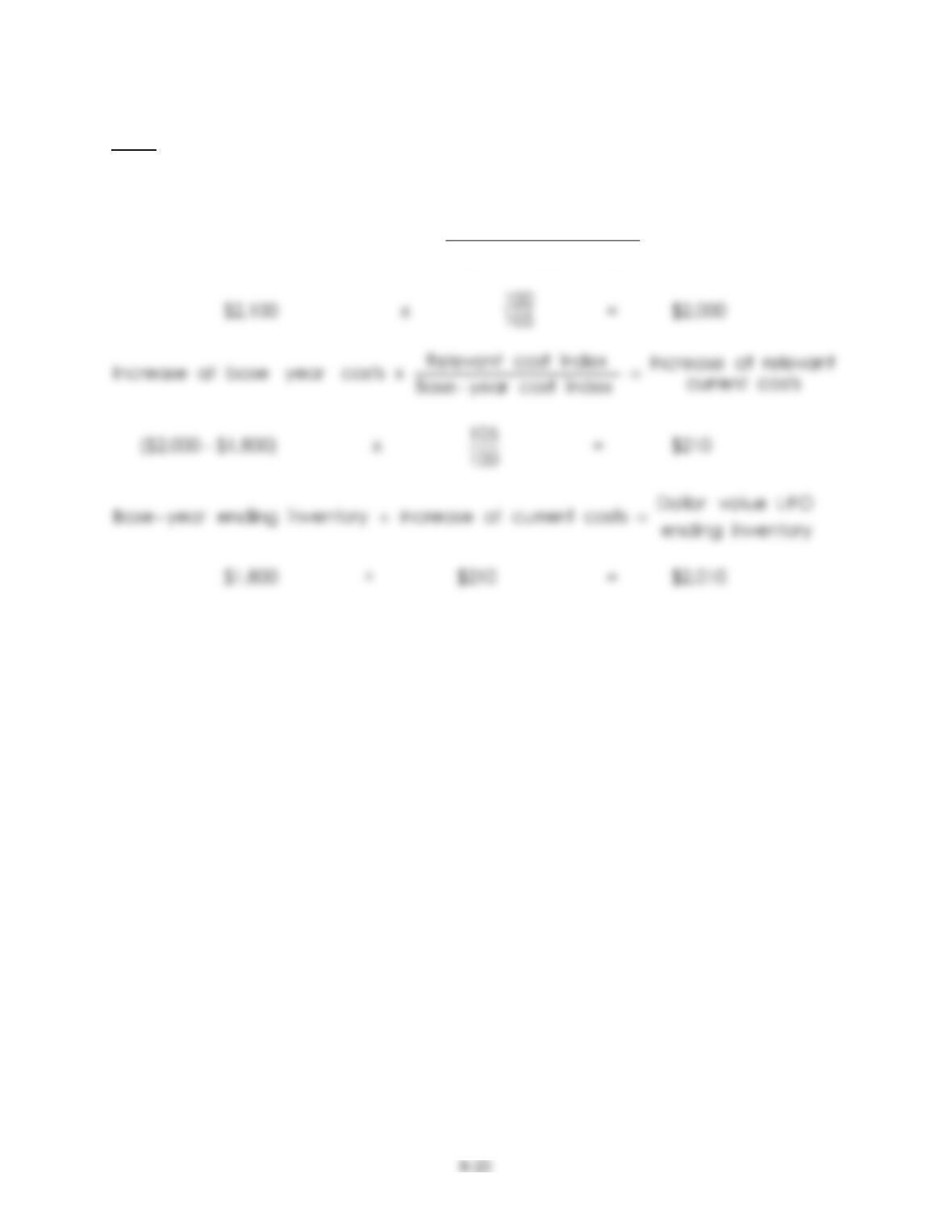
Base-year cost index = 100
Current cost index = 105
costsyear–base
atInventory
index costCurrent
indexcostyear–Base
xcostscurrentatinventoryEnding =