Wellington Chemicals Division
Teaching Commentary
OVERVIEW
This case deals with one of the classic managerial decisions—make versus buy. Most courses in managerial accounting
include at least one “make/buy” problem to illustrate the applicability of “relevant cost analysis” in thinking about such
decisions.
CASE ANALYSIS
The following list includes intermediate calculations/estimates, which can be derived from the case. At Tuck, I
expect the students to be able to derive items such as these on their own. Some instructors prefer to make this list
available to students along with the case to simplify the assignment.
1. The workforce is about fifteen people (£45,000 ÷ £3,000).
2. Wellington uses forty tons of GHL per year (100,000/£500 per ton = 200 tons ÷ 5 years = 40).
3. Wellington uses thirty-six tons of GHL to make new containers (90%). This is twenty-four pounds per container.
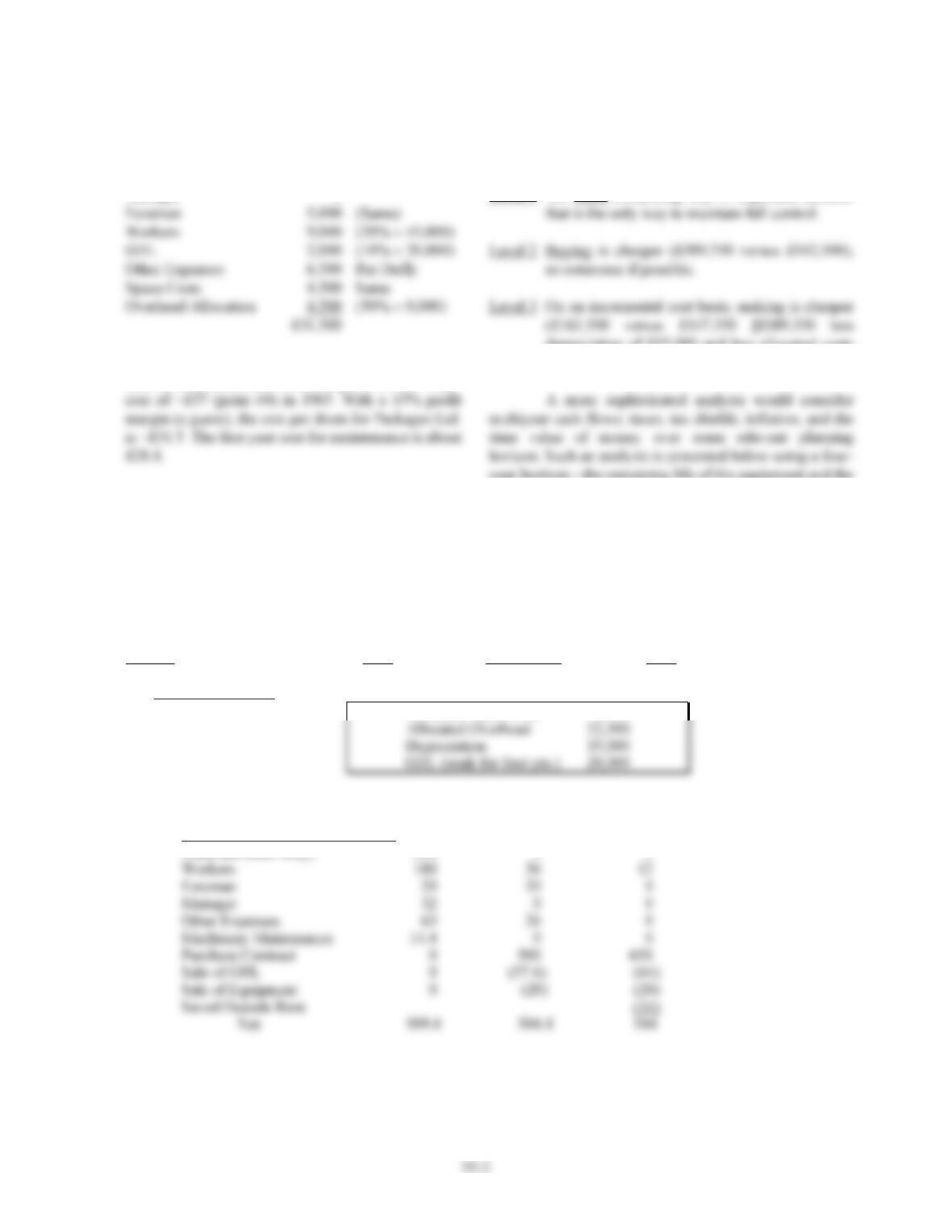
8. The cost at Wellington for “maintenance only” is as
follows, per Duffy’s estimates:
Manager 0
9. Each new drum thus costs £52.6 (189,350 – 31,500 ÷
3,000), fully absorbed. This compares to the “buy”
10. The drums are reused many times, according to the
case, with regular maintenance. Since each drum is
used 12 times and repaired 1.33 times, on average,
the cost per use is only about £5.3, which is less than
1% of the value of the contents (estimated at £625).
Taking a very simple view of the problem, the
following series of arguments can be made:
Level 1 We make everything that is important because
depreciation of £15,000 and less allocated costs
of £4,500 and £22,500]), so do not outsource.
year horizon—the remaining life of the equipment and the
GHL inventory.
1 2 3
Make Buy Containers Buy
Options Both Make Maint. Both
A. Costs Not Relevant
Allocated Space Cost 4,500
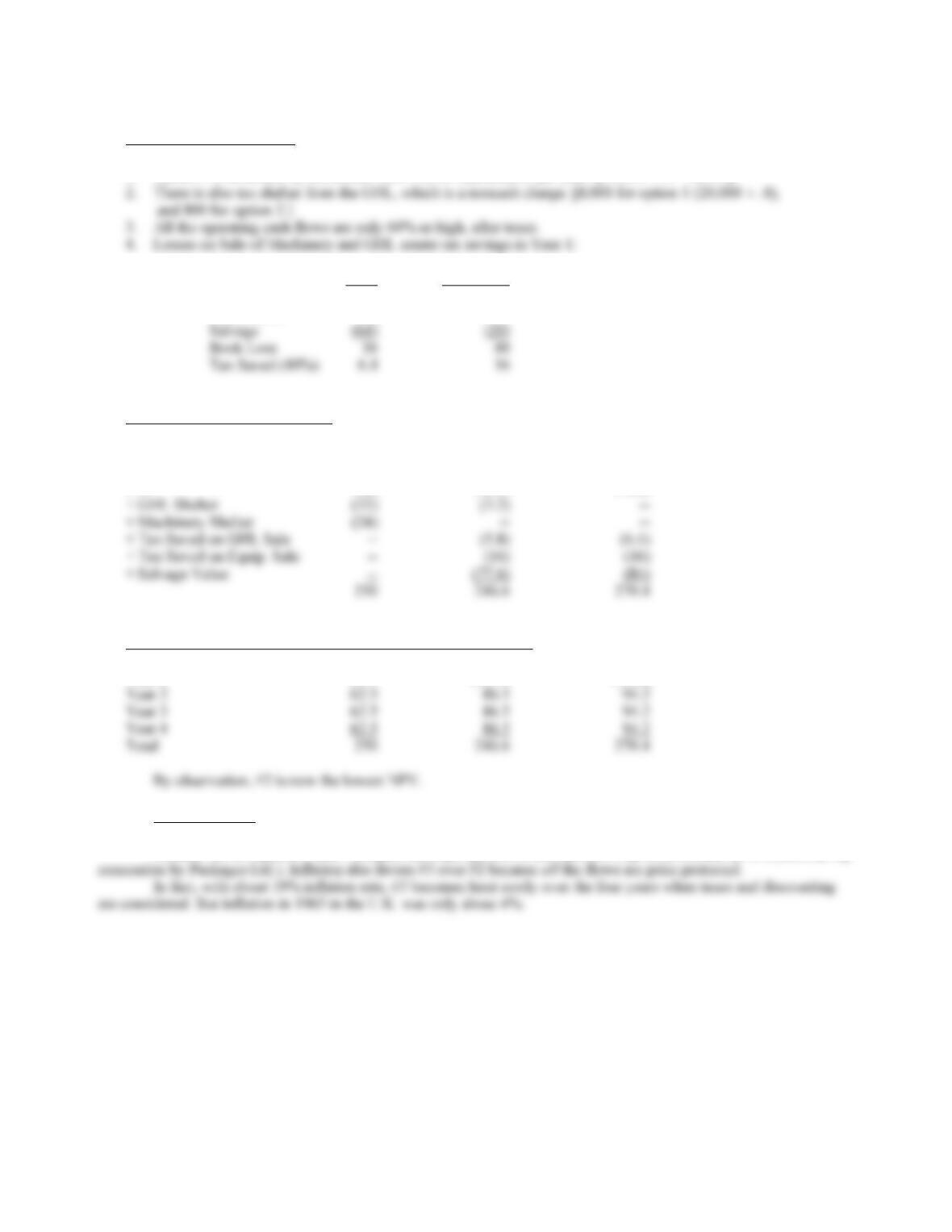
B. Four Year Total Cash Flows (000)
Materials (steel only) 200 0 0
35-3
C. Fold in Tax Considerations
1. Option 1 is enhanced by the shelter from 15,000 depreciation per year. [15,000 .4 = 6,000.]
GHL Machinery
Book Value 80 60
D. After Tax Four-Year Cash Flows
1 2 3
As Above (recurring items) 509.4 582 628
.6 306 349.2 376.8
E. Fold in Time Value of Money—Time phased after tax cash flows
Year 1 62.5 (12.9) (12.2)
F. Fold in Inflation
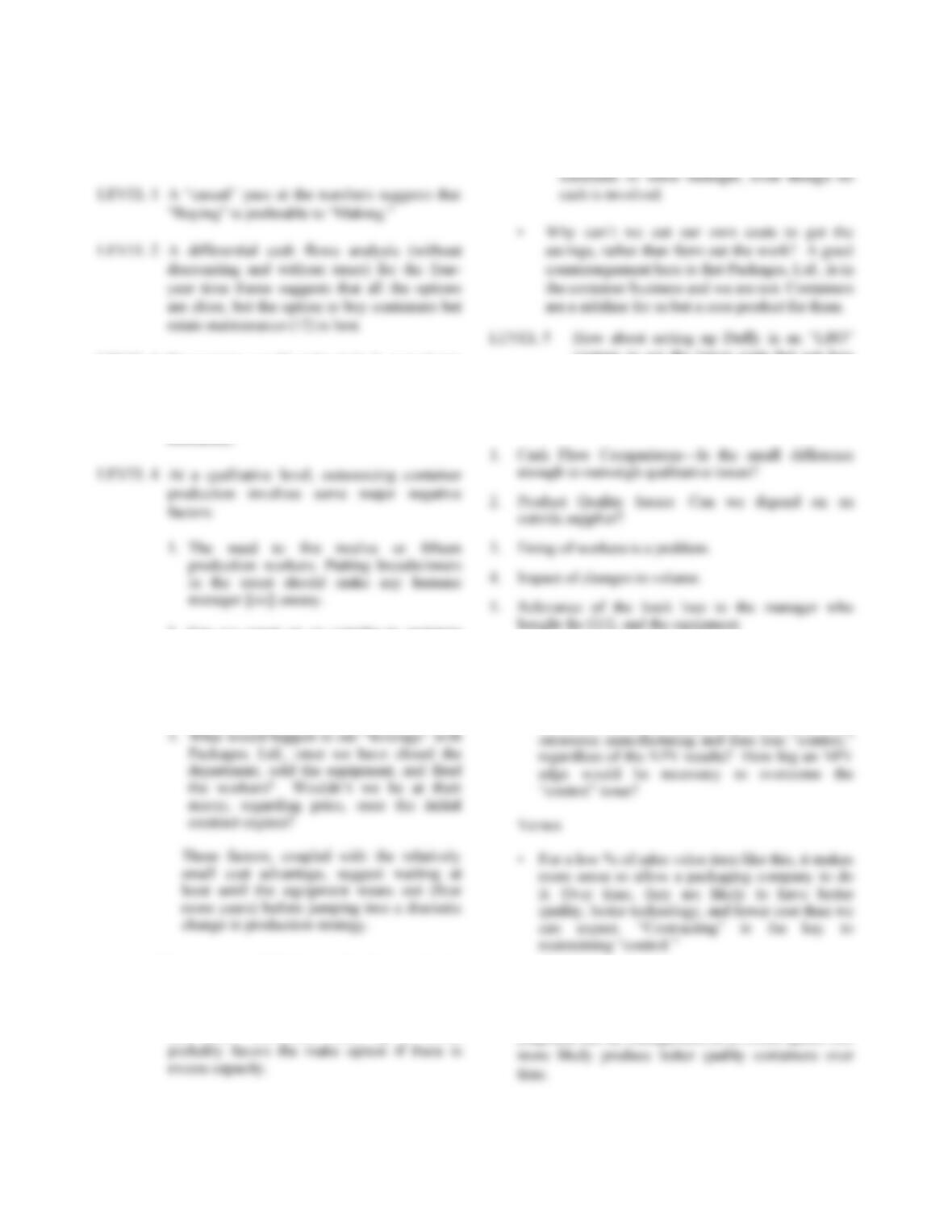
Inflation favors options 2 and 3 because the major portion of the outflows is price protected for five years (a big
35-4
One possible managerial summary of these
issues, level by level, is as follows:
LEVEL 3 Discounting would make it look even better
because of the positive inflows at time zero.
Taxation would also help because of the cash
value of the tax loss on GHL and the
machinery.
2. Can we count on an outsider to maintain
the high quality that appears to be part of
our product strategy? We would lose
“control” over a key element in our
strategy.
Other issues not folded in yet but that need to be
considered:
• Possible impact of deviations from the 3,000-
unit level. Movement either up or down
• Relevance of the book loss on machinery and
GHL that will show up on the income
venture to get the lower costs but not lose
quality or control?
Any final decision must take into account all of
the following factors:
6. Strategic Issues—Differentiated high quality
image/core competencies.
• If the differentiated GHL liner is a key element of
our differentiation strategy, does it make sense to
As is usually the case, there is no “right” answer
here. It depends! The point is to see that in spite of
all the quantitative analysis, in the end the issue is a
judgment call by management as to which option will
35-5
Exhibit A illustrates pretty clearly that Wellington should
at least outsource production of the steel drums (a
commodity?).
TEACHING STRATEGY
There are two distinctly different approaches to teaching
this case. Some instructors prefer to force the students
cost advantage or reinforce it? In this approach, the
complex discounted cash flow comparisons are only
brought in if students feel they are necessary to make the
decision.
Starting this way, students usually see fairly
quickly that complex cost comparisons are not going to
lead to a clear answer. In fact, one can argue that the
complex spreadsheet approach actually gets in the way of
35-6
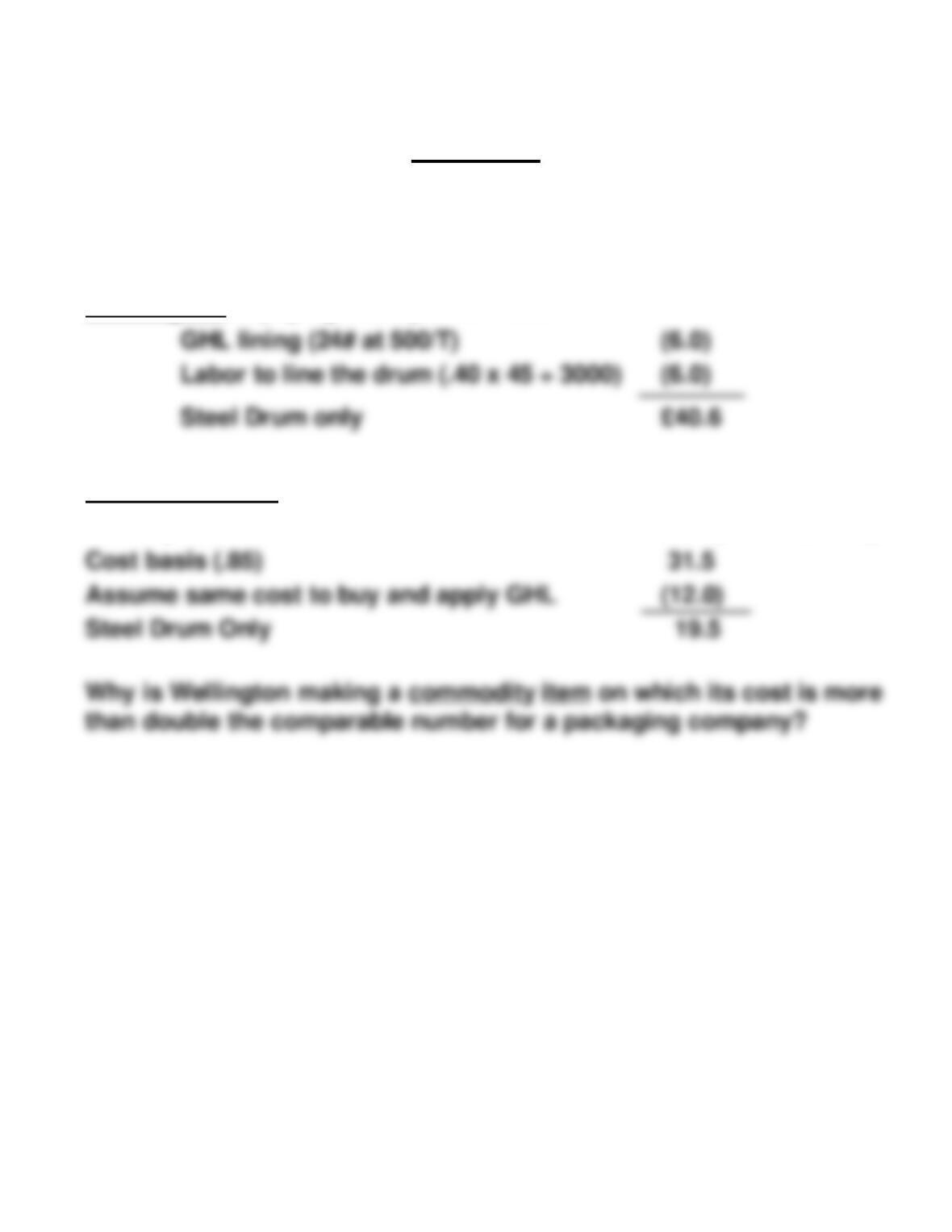
Exhibit A
Wellington –A Less Complex Look at the Numbers
Wellington is paying £52.6 per new drum
Packages, Ltd.
Year 1 price £37. (PV / n=5 / i=4)
AT A MINIMUM, OUTSOURCE STEEL DRUM MANUFACTURING.