Chapter 8
Markup and Markdown
Student Performance Objectives:
Section I Markup Based on Cost
8-1 Understanding and Using the Retailing Equation to Find Cost, Amount of Markup,
and Selling Price of an Item
8-2 Calculating Percent Markup Based on Cost
Section II Markup Based on Selling Price
8-5 Calculating Percent Markup Based on Selling Price
8-6 Calculating Selling Price When Cost and Percent Markup Based on Selling Price Are
Known
Section III Markdowns, Multiple Operations, and Perishable Goods
8-9 Determining the Amount of Markdown and the Markdown Percent
8-10 Determining the Sale Price after a Markdown and the Original Price before a
Chapter Notes, Teaching Tips and Lecture Launchers
• Spotlight: This chapter deals with the business math applications involved in the “pricing” of
goods and services being sold to customers.
• Lecture Launcher: Students often have a negative view of the concept of profit, given
their usually low level of income.
• Explain that “Profit” is not a four-letter word! Ask what would happen to a
company if it consistently sold its products at or below cost. Would the company
be able to pay its employees? If the company is able to sell its products, doesn’t
• Students need to recognize the importance of the basic retailing equation and its relation to
the concept of markup.
• Be sure students understand that there are two ways of expressing markup; markup based on
cost, and markup based on selling price.
• Emphasize that “based on ….” denotes which element represents 100%.
• Point out that manufacturers specify a “list price” on many consumer product lines, such as
automobiles, cosmetics and drug store items.
• Insight: If the retail price is printed as part of the package, it’s probably a price set by
• Spotlight: This chapter’s Business Decision, “Maintained Markup,” at the end of the chapter
asks students to calculate the overall markup on merchandise that has to be discounted from
• Lecture Launcher: Open up for discussion the concept that some types of businesses operate
on low markup with high volume, whereas others use high markup with low volume.
• Ask students to name examples of each. Some typical responses might include
• For quick reference, or testing purposes, remind students that all of the formulas used in this
chapter are listed in the Chapter Summary.
• Show algebraically how each of the formulas in this Chapter is derived.
Section I Markup Based on Cost
• Markup is also called markon or margin.
• Students should know that cost means “total cost,” which includes the price of the item plus
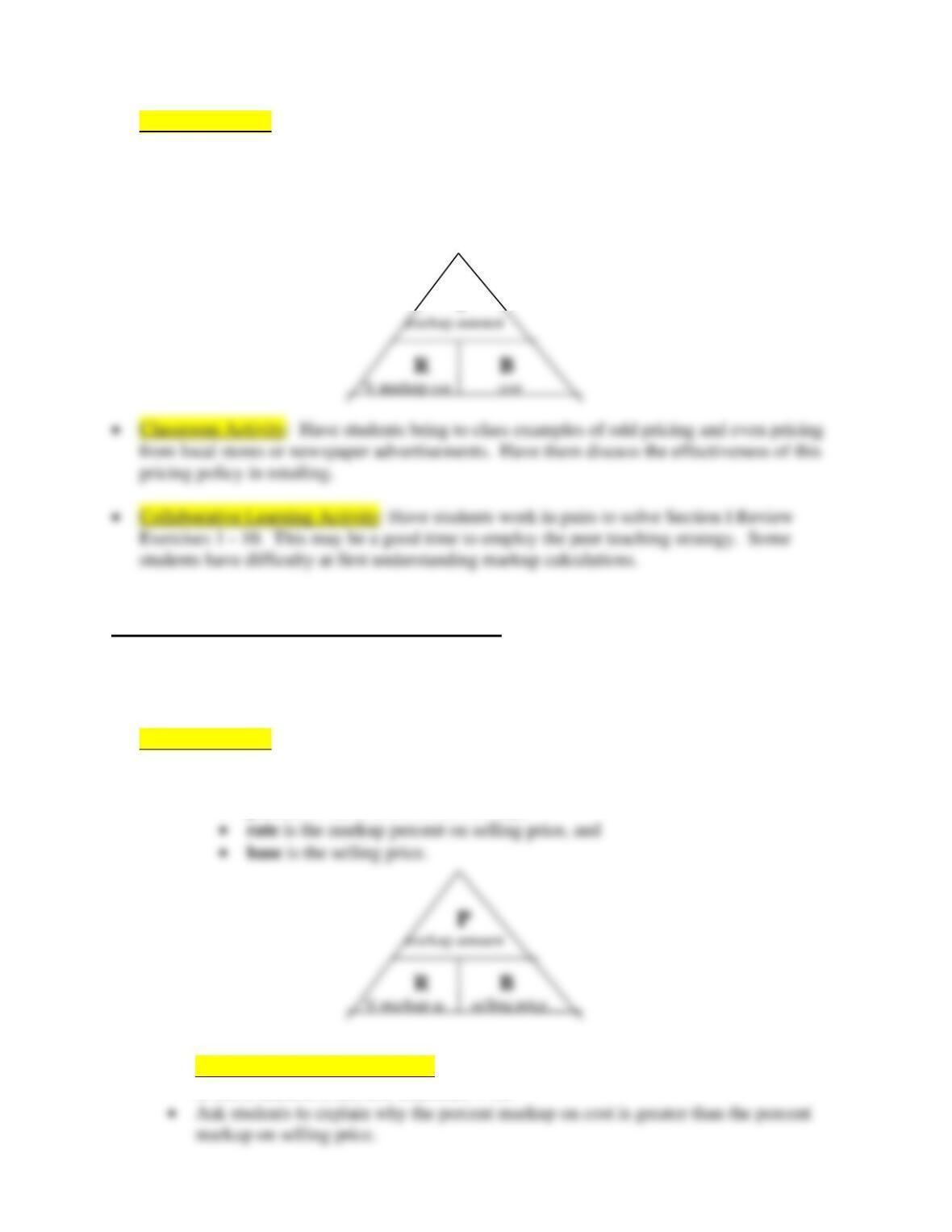
• Lecture Launcher: Students should be made aware that calculations involving markup based
on cost are applications and variations of the percentage formula, where:
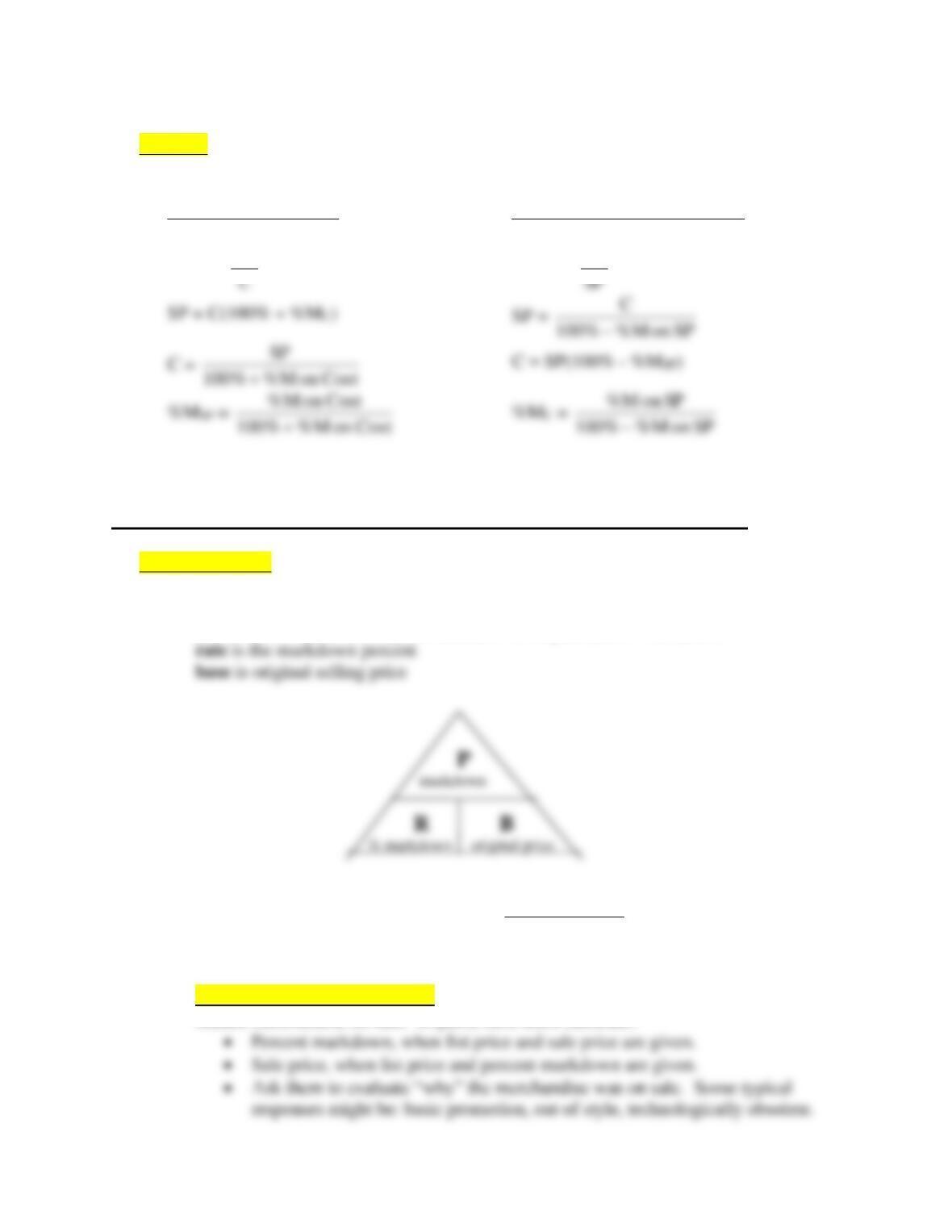
• portion is the amount of the markup,
• rate is the markup percent on cost, and
• base is the cost.
P
Section II Markup Based on Selling Price
• It is important to remind students, once again, that in markup based on selling price, selling
price is the base.
• Lecture Launcher: Students should be made aware that calculations involving markup based
on selling price are applications and variations of the percentage formula,
where:
• portion is the amount of the markup,
• Collaborative Learning Activity: As a Section II review, have students work in pairs
to solve Section II Review Exercises 1-12.
• Answer: Markup on cost uses a smaller base, therefore the rate is larger.
• Spotlight: Note that the equations for markups and markdowns are listed in the Chapter
Summary. Organize the equations with respect to base:
Markup Based on Cost
Markup Based on Selling Price
%MC =
$M
%MSP =
$M
Section III Markdowns, Multiple Operations, and Perishable Goods
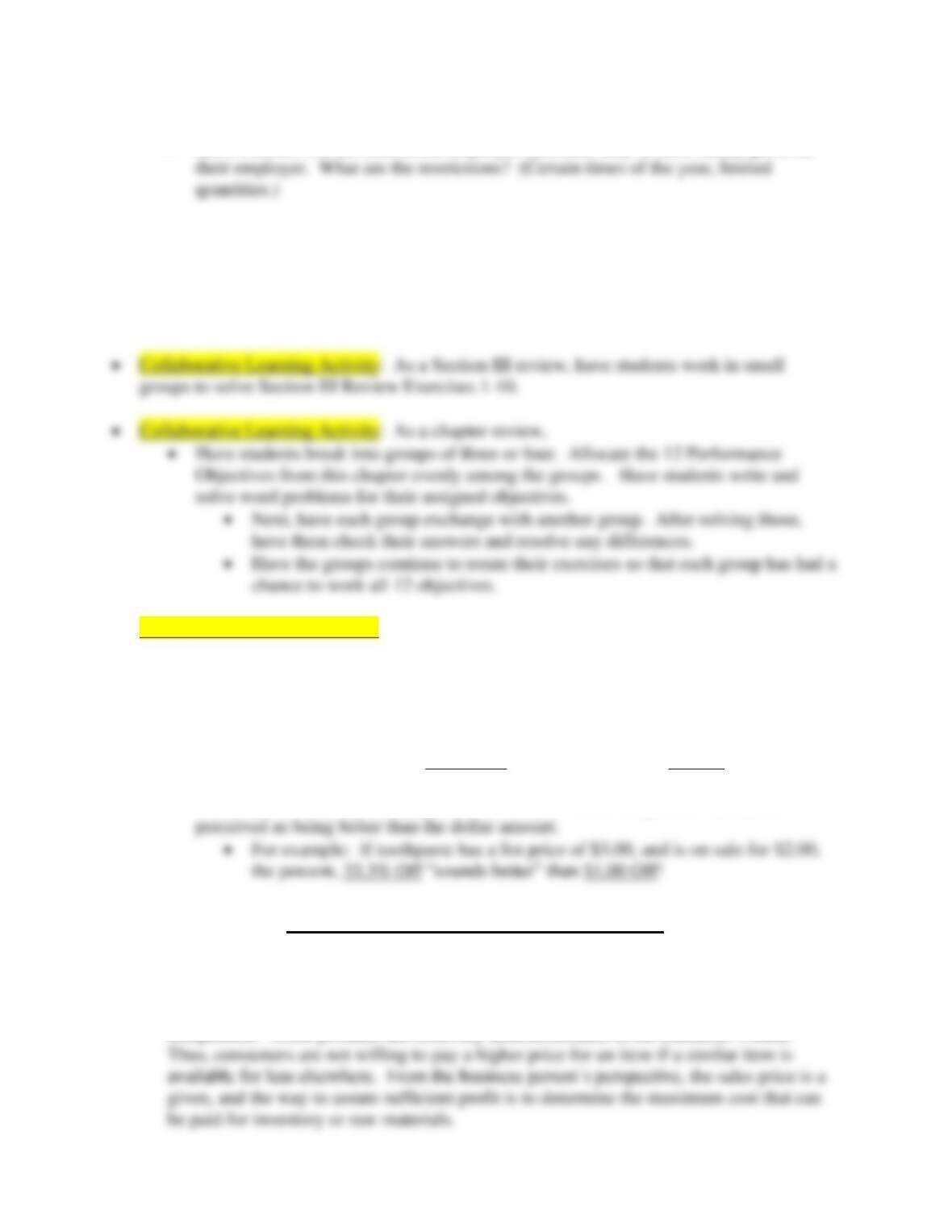
• Lecture Launcher: Students should be made aware that markdown calculations are
applications of percent change (decrease), learned in Chapter 6,
where:
portion is amount of change, or markdown (original price – sale price)
• Be sure students understand that markdowns are price reductions from the original selling
price.
• Point out that when a retail store is having a “sale,” this is an application of
markdown.
• Collaborative Learning Activity: Have students bring newspaper ads to class that
feature merchandise on sale. In pairs, have them calculate:
%MSP =
%MC =
• Call attention to the fact that as a fringe benefit, many retail employers give their employees
a certain percent discount on merchandise purchased in the store.
• Have students tell the class about employee discounts they or their family get from
• Remind students that the base in “multiple markdown” situations is the selling price after the
previous markdown.
• Students often get on a roll marking items down and may not realize that a markup
has been thrown into the mix. Remind them to stop and check which direction the
price is going.
• Collaborative Learning Activity: As a realistic application of what they have learned, have
students assume they are working in an advertising agency.
• In pairs, have students compose and calculate, sample advertisements using numbers
in which the dollar amount of markdown seems “better,” or “more impressive” than
the percent markdown.
• For example, if a $25,000 automobile was on sale for $24,000, an
advertisement offering $1,000 Off “sounds better” than 4% Off.
• Next, have them compose sample advertisements where the percent markdown is
Questions Students Always Ask
“Why do retailers mark up their products on sales price? Why not just use cost?”
• Because a markup based on cost may result in a sales price that is too high given the
competition. Some products are relatively undifferentiated in the consumer’s mind.
“How do I know if the number given is cost or sales price?”
• Read the question carefully. Put yourself in the place of the businessperson. If you, the
“How do I know which equation to use?”
• Ask yourself what three questions:
“Why use such a complicated method to calculate the selling price of perishables?”
• As in all businesses, you have to cover all your costs in order to stay in business. This
“What if I can sell some of the perishables for a lower price, such as day–old bread?”
• Often you can sell some of the “spoiled” items for less, such as day-old bread for half