CHAPTER 8
When Other Firms React
CHAPTER SUMMARY AND TEACHING OBJECTIVES
Many people do not think that the theory of games has much of a role in business. Nevertheless,
understanding game theory on a rudimentary level may be another tool to thinking like an economist.
1. Students should understand how game theory might be useful to business decision making.
IMPORTANT TERMS
game theory models of strategic behavior
players individuals involved in the game
strategies planned decisions or moves of the players
payoffs profit and losses that result from the strategies
simultaneous-move decisions made at the same time
sequential-move decisions made in steps rather than at the same time
one period game game interactions that occur only once
repeated game interactions among individuals or firms that take place more than once
Chapter 8: When Other Firms React 35
TOPICS AND TEACHING SUGGESTIONS
1. Strategy as Game Theory
2. The Prisoner’s Dilemma
The prisoner’s dilemma may be the most often-confronted game situation in business. Its insights
are well worth studying. In particular, how business must act to get out of a dilemma is of
strategic interest.
Teaching Strategy: Have students participate in several “games.” One game is the “ultimatum
game” in which the element of strategy comes to play. Divide the class in half. Inform one half
3. Repeated Games: Cheating and Punishment
4. Sequential Games
These games involve sequential decision-making. With each sequence probabilities or risk must
ANSWERS TO EXERCISES
1. Suppose you are the owner-operator of a gas station in a small town. Over the past twenty years,
you and your rival have successfully kept prices at a very high level. You recently learned that
your rival is retiring and closing his station in two weeks. What should you do today?
2. Which of the following might create first-mover advantages?
a. Maxwell House introduces the first freeze-dried coffee.
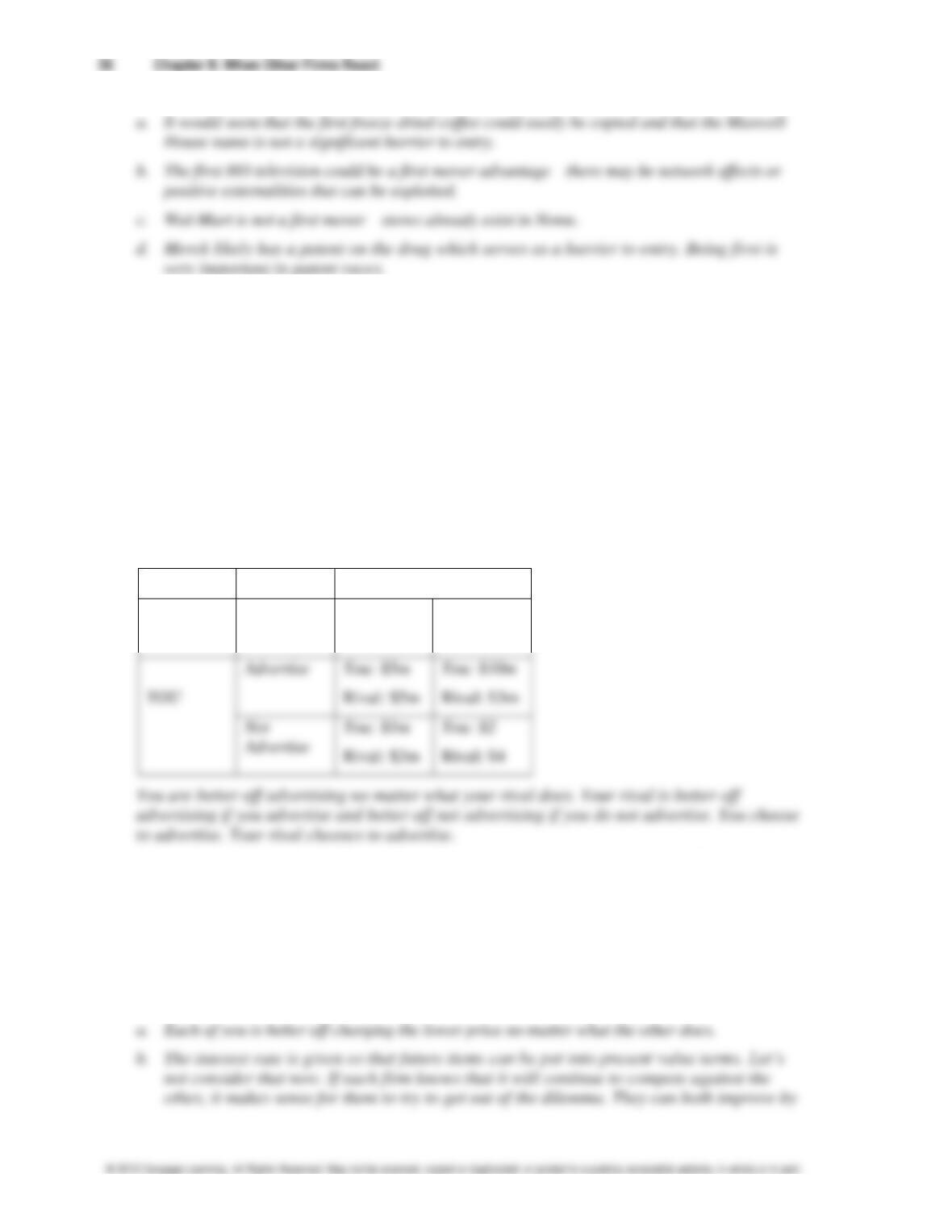
3. In a situation that occurs only once, if you advertise and your rival advertises, you will each earn
$5 million in profits. If neither of you advertises, your rival will make $4 million and you will
make $2 million. If you advertise and your rival does not, you will make $10 million and your
rival will make $3 million. If your rival advertises and you do not, you will make $1 million and
your rival will make $3 million.
a. Set up the situation in a normal form.
b. Do you have a strategy that you will choose no matter what your rival does?
c. Is there a strategy your rival will choose no matter what you do?
d. What is the solution or equilibrium?
e. How much would you be willing to pay your rival not to advertise?
Your payoff is listed first in each matrix cell:
YOUR RIVAL
Advertise
Not
Advertise
4. You and your rival must simultaneously decide what price to advertise in the weekly newspaper.
If you each charge a low price, you each earn zero profits. If you each charge a high price, you
each earn profits of $3. If you charge different prices, the one charging the higher price loses $5
and the one charging the lower price makes $5.
a. Find the equilibrium when there are no repeated transactions.
b. Now suppose there are repeated transactions. If the interest rate is 10 percent, what will be the
outcome?
5. You are considering entering a market serviced by a monopolist. You currently earn $0 economic
profits, while the monopolist earns $5. If you enter the market and the monopolist engages in a
price war, you will lose $5 and the monopolist will earn $1. If the monopolist doesn’t engage in a
price war, you will each earn profits of $2.
a. There are two possible solutions or equilibria. What are they?
a. Your entry is a loss to the monopolist. If the game is a one-period game, the monopolist is
6. Firm 1 and Firm 2 are the only ones that produce and sell good X. Each of them is trying to decide
(independently and simultaneously) how much to spend on advertising. Sales and profits of each
firm depend on its own advertising strategy, and also on its competitor‘s. Each firm can either
choose a low level of expenditures on advertising or a high one; if both choose low, profits for
each firm will be 60 (millions), and if both choose high each of them will make 20 (millions).
However, if one chooses low and the other chooses high, the one that chooses low makes
-40 (millions) and the other one 95 (millions). Using the Nash equilibrium concept, determine
how many and what are the Nash equilibria.
7. Consider the following game between player 1, who chooses among strategies U, M, and D, and
player 2, who chooses among strategies A, B, and C. Why is this normal form representation
different than others in the chapter? The most reasonable prediction in this game is what?
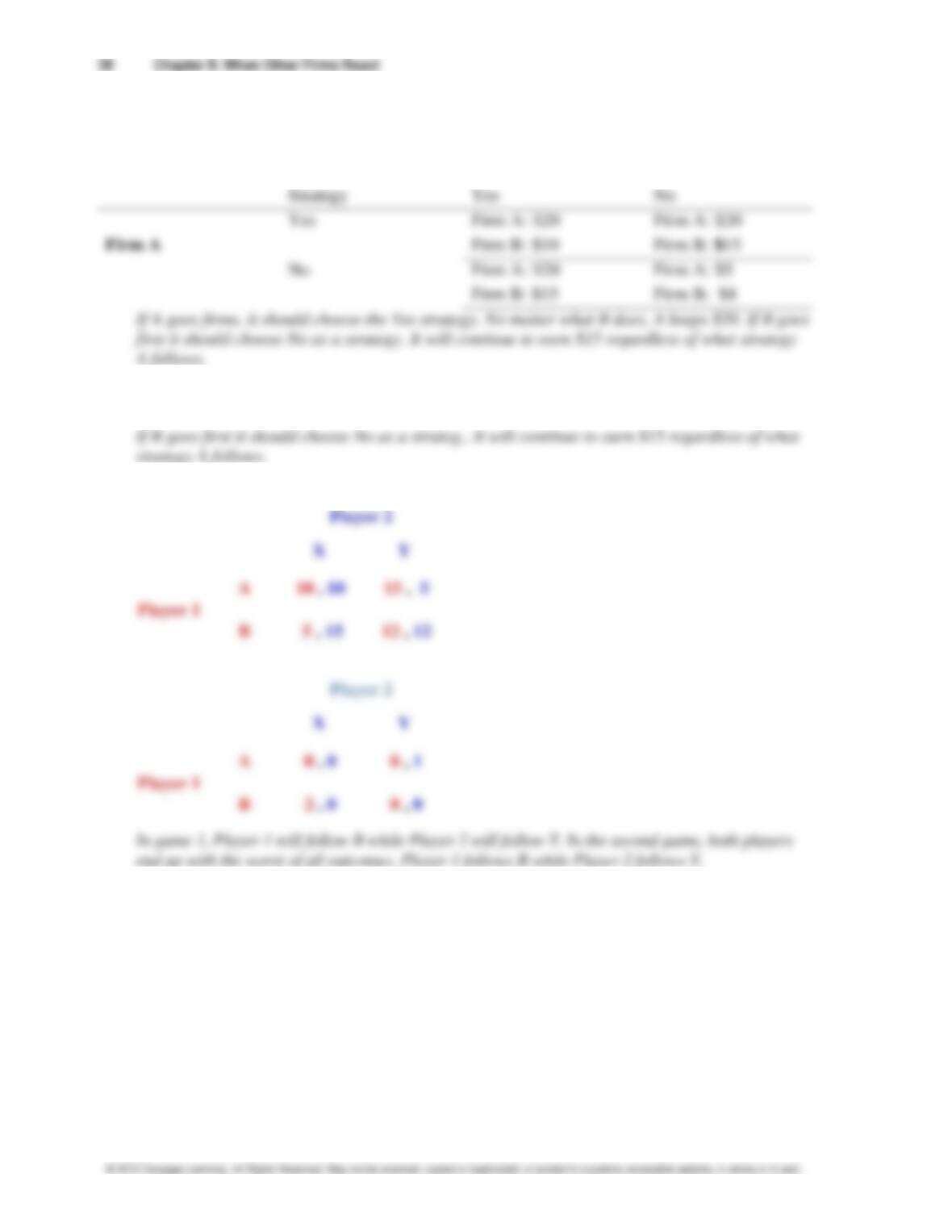
8. Convert the following simultaneous move game to a sequential move game letting Firm A go
first. Demonstrate the value of a first mover. Demonstrate the value of a second mover.
Firm B
Yes
Firm A: $20
Firm A: $20
Firm A: $20
Firm A: $5
9. Convert the normal form in exercise 8 to a sequential move game letting Firm B go first.
What is the value of going first? What is the value of going second?
10. What is the equilibrium/equilibria of the following games?
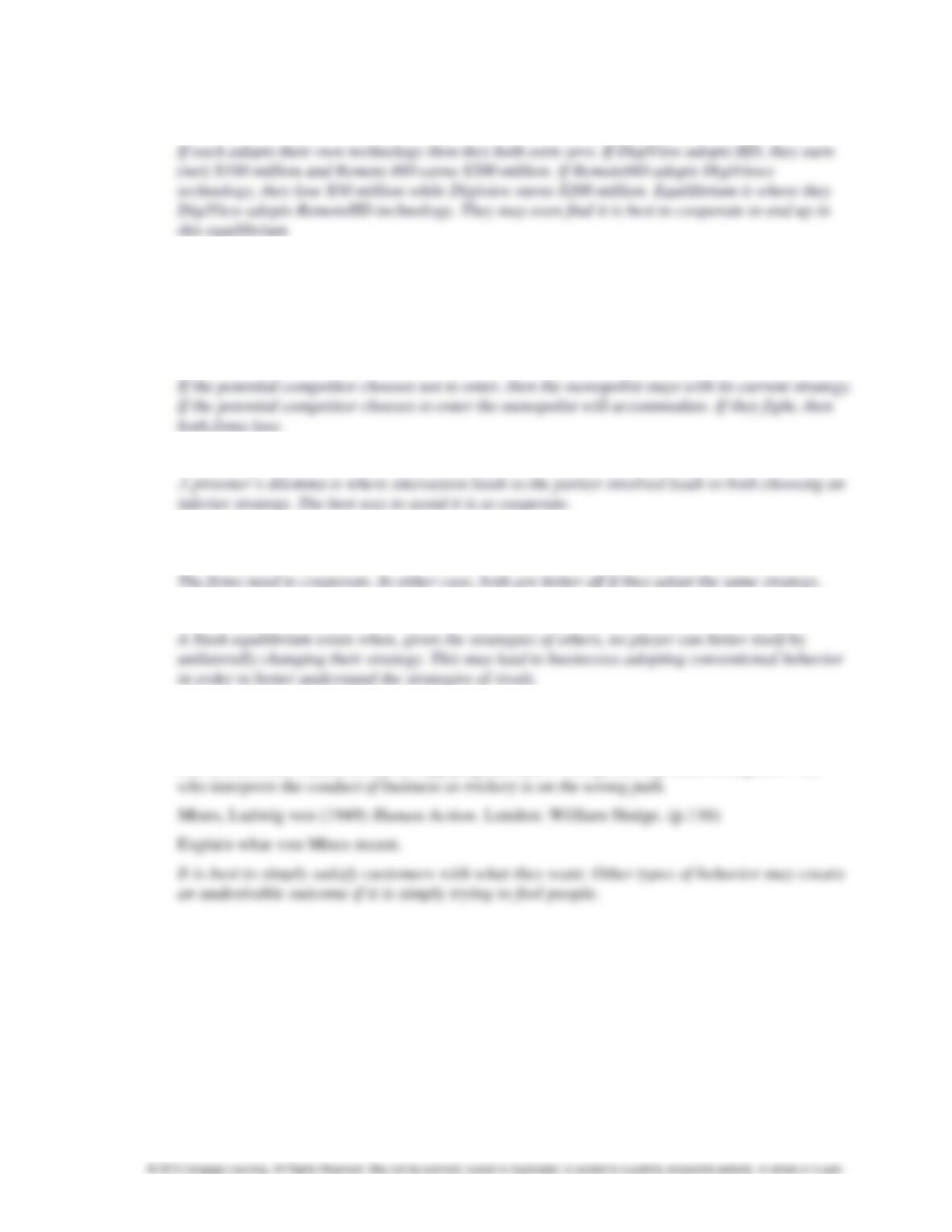
11. Two firms are involved in developing a new technology that will allow consumers to provide the
most incredibly clear picture yet devised on all video sources. Given the risks, compatibility of the
technologies is very important. Firm DigiView is far advanced in developing its RemoteHD
technology. WebView has been expanding into the Internet arena with its incompatible product,
WebHD. The two companies agree that if they both adopt the same technology, they each may
gross $200M from the developing industry. If they adopt different technologies, consumers will
purchase neither product, leading to a gross of $0. Retooling one’s factory to make the competing
(nonproprietary) technology would cost WebView $100M and DigiView $250M. Their
production decisions must be made simultaneously. Set up the above scenario as a normal form
(simultaneous) game.
Chapter 8: When Other Firms React 39
What is the equilibrium outcome?
12. A firm is quite happy monopolizing its industry with profits of $10M. A potential competitor
considers entering the industry. If the competitor elects not to enter, it earns profits of $0 and
the monopolist maintains its profit of $10M. If the competitor enters, the monopolist must
either accommodate the entry or fight. If the monopolist accommodates, both firms earn $5M.
If the monopolist fights, both firms lose $5M. The game is represented by an extensive
representation. What is the equilibrium?
13. Have you ever been in a prisoner’s dilemma situation? Explain. Did you get out of it?
14. In Table 2 the prisoner’s dilemma of two cigarette producers with respect to increased advertising
is discussed. Explain how the two firms could emerge from the dilemma?
15. What is a Nash equilibrium? How might it apply to business strategy?
16. Ludwig von Mises had this to say about game theory in 1949. Game theory had been invented
only a few years before. There is not the slightest analogy between playing games and the conduct
of business within a market society. The card player wins money by outsmarting his antagonist.
The businessman makes money by supplying customers with goods they want to acquire … He