
Chapter 8: Mentoring and Leadership for Professional Development
Summary
Traditional early-childhood values of building trust and respect in relationships are central to the
power of mentoring. Teachers need to be able to feel comfortable communicating their concerns
to the mentor when suggested strategies conflict with their values. Teachers need to be able to
Outline
The chapter supports your growing capacity to
• grow our own effective early childhood professional development (PD) leaders;
Learner outcomes
• Students will be able to describe the characteristics of inclusive groups and organizations
Mentoring &
Leadership for
Professional
Development
growing our
own PD
leaders
planning &
modifying
mentoring
designs
evaluation &
advocacy
striving for
inclusive &
multicultural
organizations
professional
learning
communities

Suggested teaching activities
1. Learning Communities and Striving for Inclusive and Multicultural Organizations
Get the group thinking about the topics of the chapter by diving them into two groups, each with
one of the following questions to discuss.
✓ Recall a time when you were part of a group for which the old adage, ‘The sum is greater
Bring the groups back together and discuss the following graphic. Share that it shows the
foundation for an inclusive PD plan. Notice that the arrow goes both ways because the process is
dynamic, requiring groups to maintain all three areas to plan for PD.
Common agreements……….. Shared Inclusive Vision……..………Collaboration
Next, give a short mini-lecture on the progression of stages through which organizations or
Exclusionary
Organization
The “Club”
Compliant
Organization
Affirming
Organization
Redefining
Organization
Models of multicultural organization development may help a group to keep in mind how
individual members experience their participation (Jackson and Holvino,1988; Jackson, 2005).
Journal

development phases.
Have you ever had to recruit new members to a PD or other type of professional planning team
because the team did not represent the people that it was designed to serve or because the group
needed a perspective that was missing?
If this question does not relate to an experience of the journal writing participant, suggest that
2. Planning for Selecting and Modifying a Mentoring Project Design
Describe the ‘theory of change’ model for planning a mentoring and coaching project. Use Table
8.3 and fill in the blanks to demonstrate how a group might use this process to plan. Share some
initial questions planning groups must address:
Example of a PD Plan:
The problem is: Math
Teachers do not know how to plan effective math learning experiences for children in kindergarten.
Children in kindergarten do not demonstrate expected math competencies. Parents have not been
instructed about everyday math learning opportunities for their children when they are at home.
If the intervention is effective, we hope to see changes or increases in:
(Teacher) Teacher skills and understanding of how children learn math through facilitation of age
appropriate games.
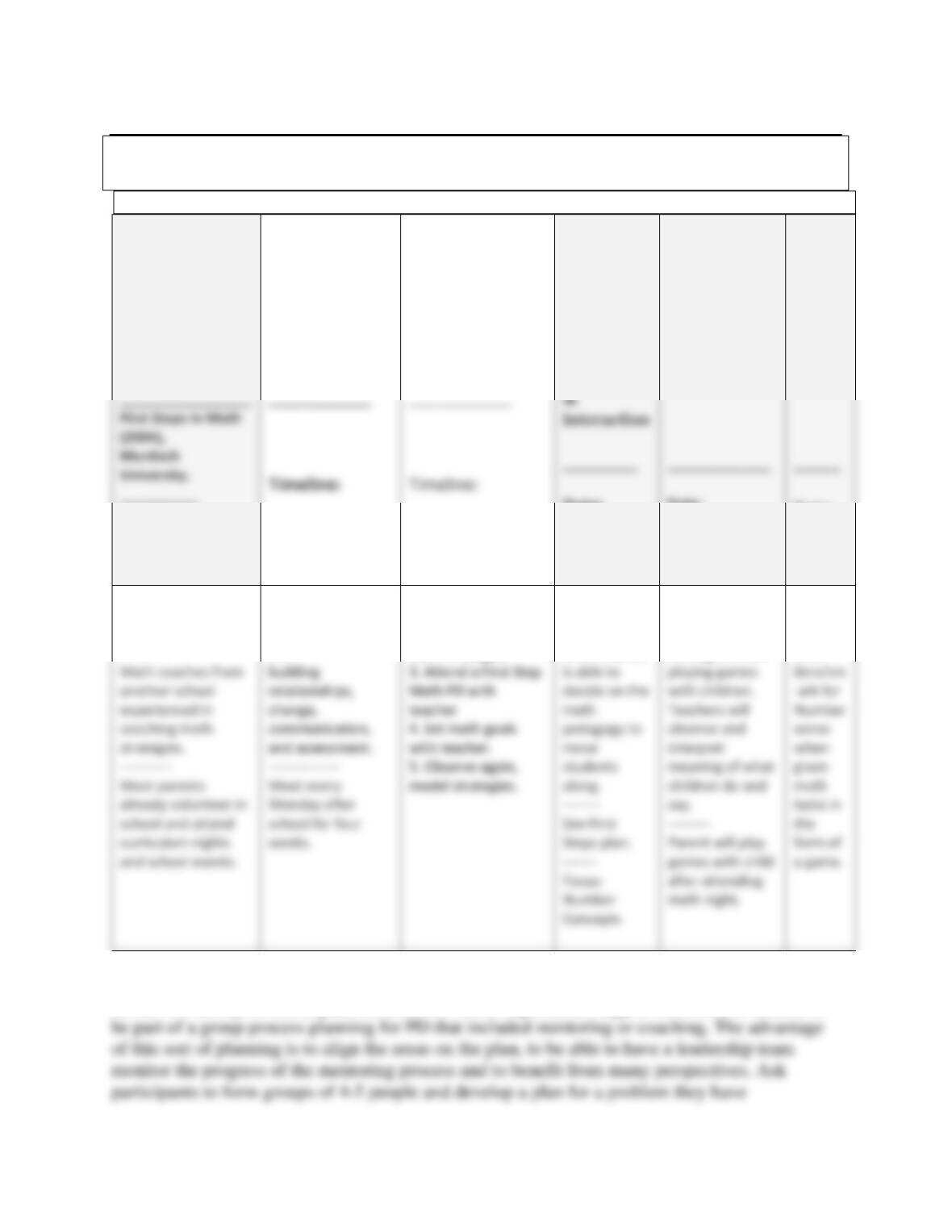
Kindergarten Math Project – Theory of Change Planning Form
INPUTS OUTPUTS OUTCOMES
Activity: Ask participants if they have ever worked with an action plan, a strategic plan, a logic
model or a theory of action plan. Discuss how these experiences support the coach or mentor to
Resources
(time,
money,
partners, etc.)
&
research or
model
Funding
Timeline
Sept – May
Mentor or
coach
education
& support
activities
1 month-
Sept.
Mentor or
coaching
activities
&
processes
1 month-
October
Short-
term
outcomes
or changes
in teacher
skills,
practices,
Date:
Nov.
Intermediate
outcomes or
changes in
teacher
practices &
interactions
Date:
Nov. –
May
Long-
term
child
out–
comes
Date
May
District Grant
for the First Steps
Math Curriculum.
———-
Review mentor
competencies
with math coaches
for –
Each math coach will:
1. Observe teacher
2. Document
math strategies
Teacher-child
interaction
will
Show teacher
Teachers will
consistently use
‘math talk’
strategies while
Children
will
Meet
Math
encountered in their work in educational settings.
Purpose: To understand how to be part of a planning team using a theory of change model.
3. Developing leadership for change
Review the relationship-based competencies in this chapter. Ask participants to self assess and
4. Evaluating Program Conditions for PD
Direct participants to look at Table 8.5 – Reflecting on Conditions Conducive to Reflective
Supervision and Professional Learning. Discuss the importance of a program’s readiness to
Conclude by asking how these conditions might change. Note there are no easy answers but the
first step is recognizing that successful mentoring, coaching and reflective supervision also
requires receptive program conditions.
Does the mentoring process facilitate experiences allowing a teacher to
• observe, implement and receive constructive feedback;
• integrate theory, research, and practice;
5. Document teacher experiences during mentoring over time
Review this form with participants. Ask them to discuss the purpose of each section.

MENTORING VISIT RECORD
Complete each section with brief anecdotal notes.
Mentor____________________ Teacher _______________________ Date: __________
PURPOSE, FOCUS, OR GOAL AREA
• Underline one: Goal negotiated with teacher / mentor suggests goal / goal assigned
FREQUENCY: How often do we meet?
DURATION: How long do we meet for each visit?
MENTORING
and/or COACHING
TOOLS
MENTORING STRATEGIES AND TEACHER RESPONSE
OBSERVE
Observed
interactions
Documented with:
• video
• photos
• Noted purpose of visit
• Watched, listened, sought information, noticed, empathized
REFLECT
Gave feedback about
• Used positive feedback, open-ended or clarification
questions

• Identified new concepts, challenges, and successes
APPLY
• Modeled or
demonstrated
• Co-planned
• Had an instructive conversation and ended with an
affirmation
• Reviewed progress toward goal
PROGRESS TOWARD GOALS: What is going well, and what is challenging?
NEXT TIME: The action steps (including timeline and people responsible) are:
assessment, goal-setting, adult learning strategies, content resources, etc.)
6. Plan for promoting professional development of the mentor
Conclude the class by discussing this question:

Journal
Encourage participants to respond to this question in their journal to keep their learning going.
What do these themes mean to you as person who is passionate about supporting the learning
and development of the adults and children involved in early-childhood education? Choose one
of the areas in Figure 8.5, and make an action plan.
More suggested reading and resources
Brown-Kendall, R., Aubel, C., & Koetje, M. l. (2011). The growth of an affiliate: The
birth of the leadership academy. Young Children, 66(3), pp. 72–73.
Center on the Social and Emotional Foundations for Early Learning (CSEFEL). (2012).
and the self determination of behavior. Psychological Inquiry, 11, 227–268.
Implementation research: A synthesis of the literature. Tampa, FL: University of
South Florida, Louis de la Parte Florida Mental Health Institute, National
Implementation Research Network. (FMHI Publication No. 231).
Fredrickson, B. L. (2004). The broaden-and-build theory of positive emotions.
Philosophical Transactions of the Royal Society, B(359), 1367–1377.
Freire, P. (1985). The politics of education: Culture, power and liberation. New York,
NY: Bergin & Garvey
Galinsky, E. (2012). Learning communities: An emerging phenomenon. Young Children,
67(1), 20–27.

Lutton, A. (Ed.). (2012). Advancing the profession: NAEYC standards and guidelines for
professional development. Washington, DC: NAEYC.
Mattessich, P., Monsey, B., & Murray-Close, M. (2001). Collaboration: What makes it
work (2nd ed.). A review of research and literature on factors influencing
successful collaboration. St. Paul, MN: Amherst H. Wilder Foundation.
Mor Barak, M. E., & Chernin, D. A. (1998). A tool to expand organizational understanding
of workforce diversity. Administration in Social Work, 22, 47–64.
Mor Barak, M. E., & Travis, D. J. (2009). Diversity and organizational performance. In Y.
Hasenfeld (Ed.), Human services as complex organizations (pp. 341–378). Newbury