© 2016 Pearson Education, Inc.
8-41
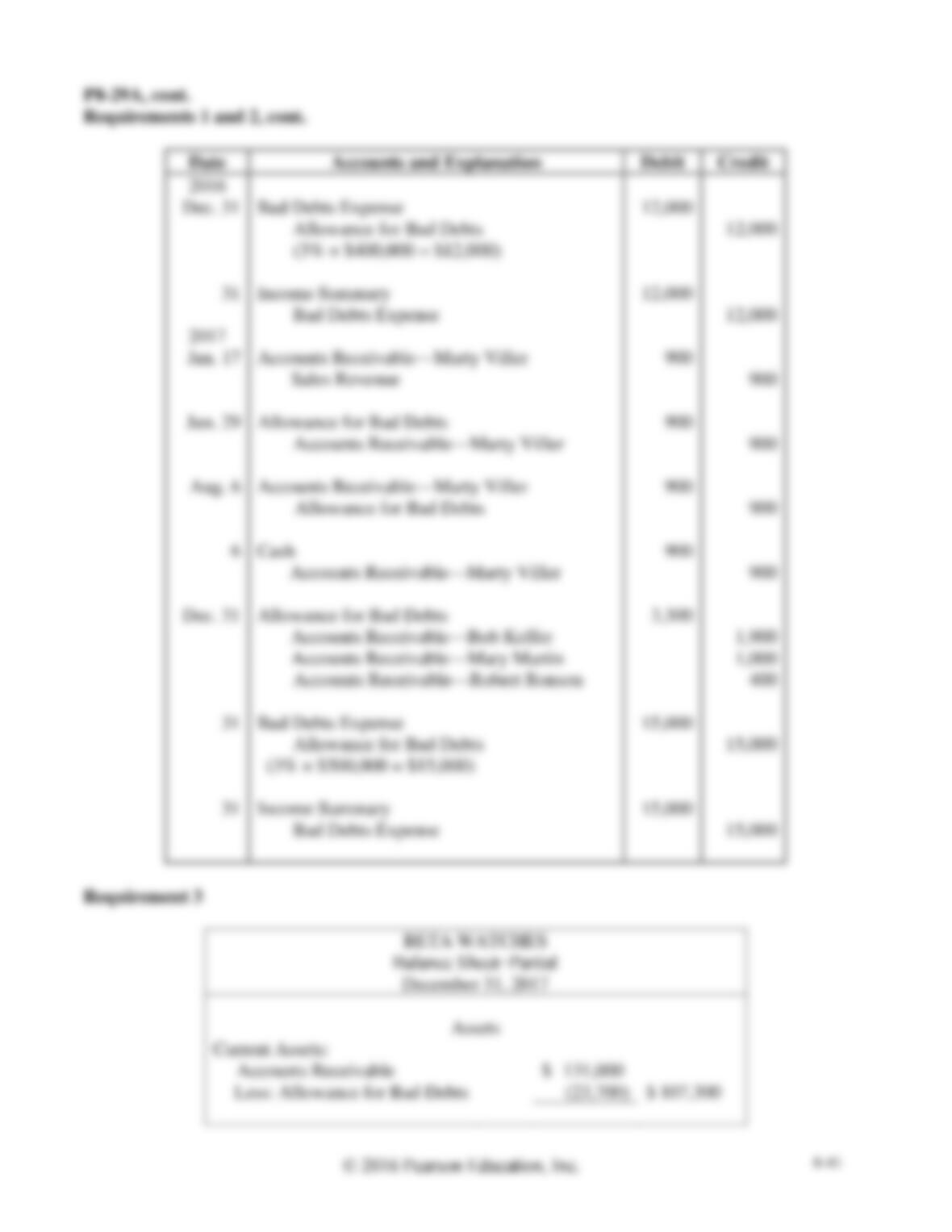
P8-29A, cont.
Requirements 1 and 2, cont.
Date
Accounts and Explanation
Debit
Credit
2016
Dec. 31
Bad Debts Expense
12,000
Income Summary
12,000
2017
Accounts Receivable—Marty Viller
Allowance for Bad Debts
Accounts Receivable—Marty Viller
Allowance for Bad Debts
Cash
Accounts Receivable—Marty Viller
Dec. 31
Allowance for Bad Debts
Bad Debts Expense
15,000
Income Summary
15,000
© 2016 Pearson Education, Inc.
8-42
P8-30A Accounting for uncollectible accounts (aging-of-receivables method), credit card sales,
notes receivable, and accrued interest revenue
Learning Objectives 1, 3, 4
Dec. 31, 2016 Interest Receivable $3,600
Quality Recliner Chairs completed the following selected transactions:
Record the transactions in the journal of Quality Recliner Chairs. Explanations are not required. (For
notes stated in days, use a 360-day year. Round to the nearest dollar.)
© 2016 Pearson Education, Inc.
8-43
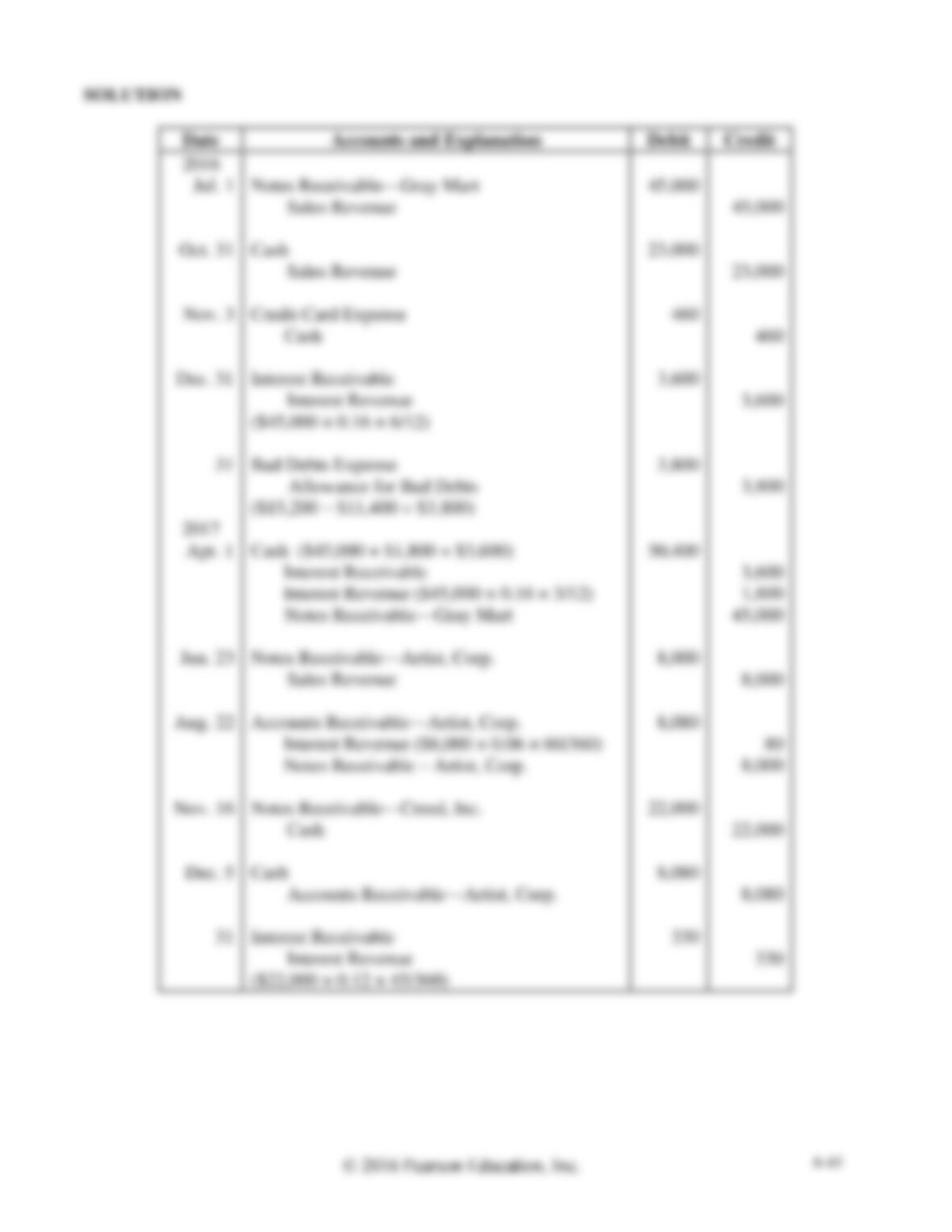
SOLUTION
Date
Accounts and Explanation
Debit
Credit
2016
Jul. 1
Notes Receivable—Gray Mart
45,000
Sales Revenue
45,000
Oct. 31
Cash
23,000
Sales Revenue
23,000
Nov. 3
Credit Card Expense
460
Cash
460
Dec. 31
Interest Receivable
3,600
Interest Revenue
3,600
($45,000 × 0.16 × 6/12)
31
Bad Debts Expense
3,800
Allowance for Bad Debts
3,800
($15,200 – $11,400 = $3,800)
2017
Apr. 1
Cash ($45,000 + $1,800 + $3,600)
50,400
Interest Receivable
3,600
Interest Revenue ($45,000 × 0.16 × 3/12)
1,800
Notes Receivable—Gray Mart
45,000
Jun. 23
Notes Receivable—Artist, Corp.
8,000
Sales Revenue
8,000
Aug. 22
Accounts Receivable—Artist, Corp.
8,080
Interest Revenue ($8,000 × 0.06 × 60/360)
80
Notes Receivable – Artist, Corp.
8,000
Nov. 16
Notes Receivable—Creed, Inc.
22,000
Cash
22,000
Dec. 5
Cash
8,080
Accounts Receivable—Artist, Corp.
8,080
31
Interest Receivable
330
Interest Revenue
330
($22,000 × 0.12 × 45/360)
© 2016 Pearson Education, Inc.
8-44
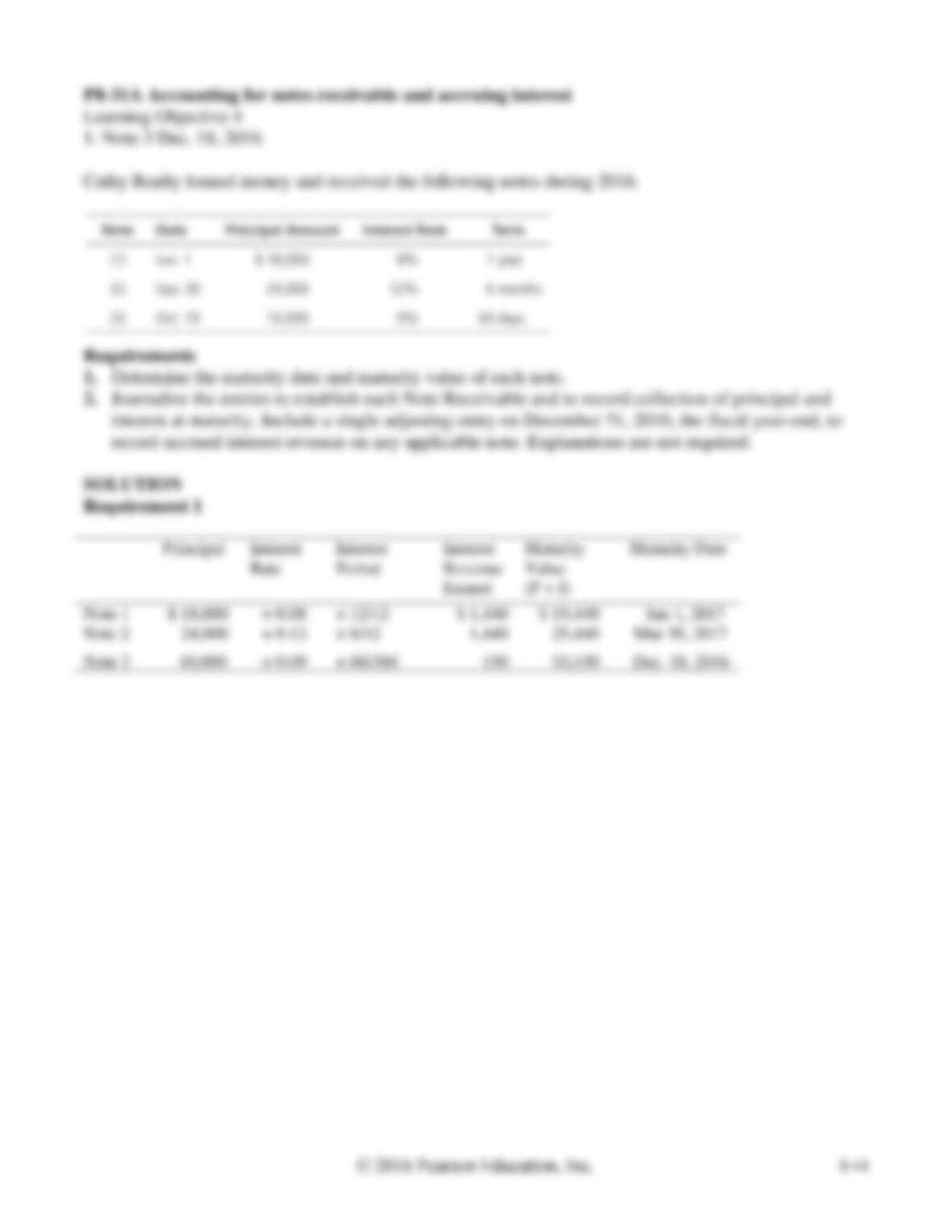
P8-31A Accounting for notes receivable and accruing interest
Learning Objective 4
1. Note 3 Dec. 18, 2016
Cathy Realty loaned money and received the following notes during 2016.
Requirements
1. Determine the maturity date and maturity value of each note.
2. Journalize the entries to establish each Note Receivable and to record collection of principal and
interest at maturity. Include a single adjusting entry on December 31, 2016, the fiscal year-end, to
record accrued interest revenue on any applicable note. Explanations are not required.
SOLUTION
Requirement 1
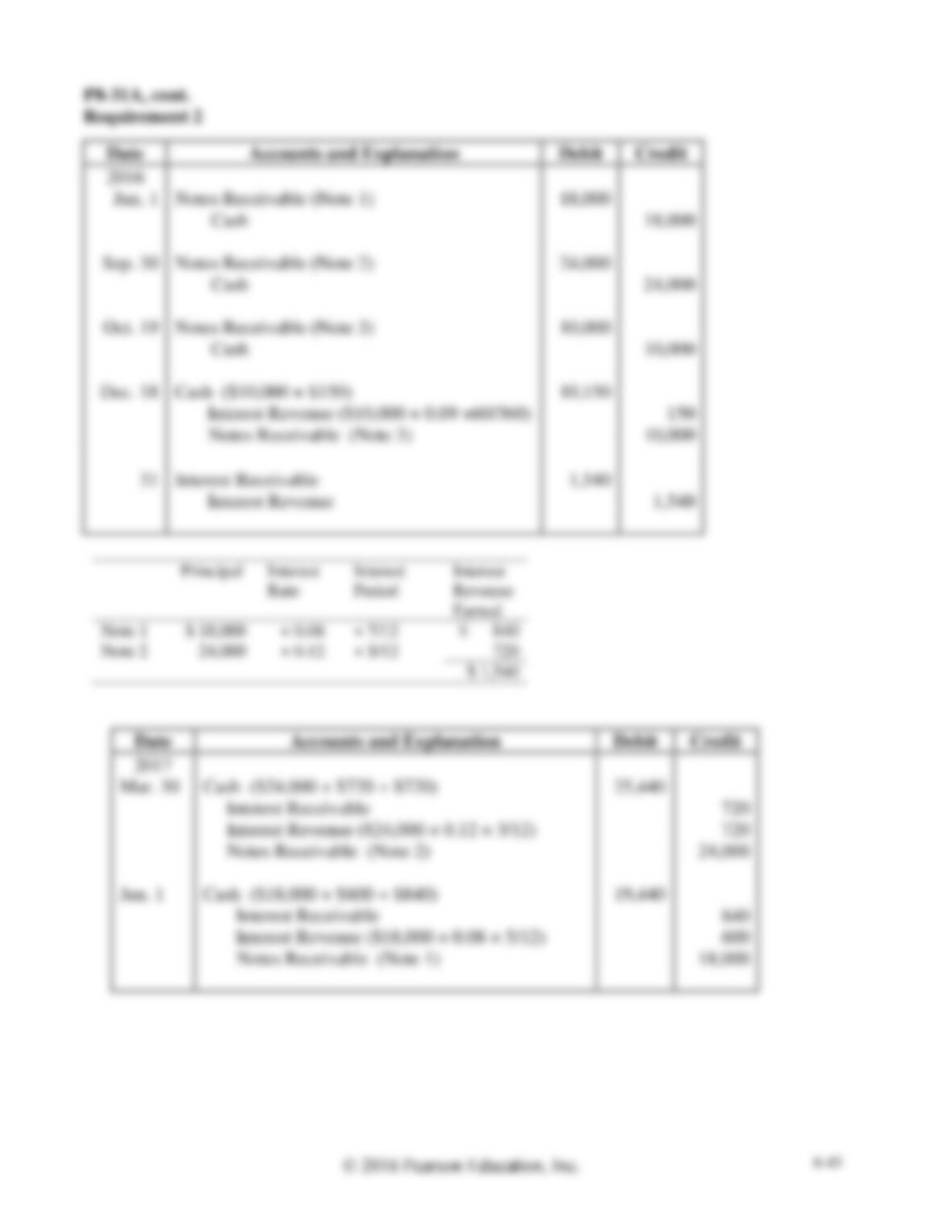
Principal
Interest
Rate
Interest
Period
Interest
Revenue
Earned
Maturity
Value
(P + I)
Maturity Date
Note 1
$ 18,000
× 0.08
× 12/12
$ 1,440
$ 19,440
Jun 1, 2017
Note 2
24,000
× 0.12
× 6/12
1,440
25,440
Mar 30, 2017
Note 3
10,000
× 0.09
× 60/360
150
10,150
Dec. 18, 2016
© 2016 Pearson Education, Inc.
8-45
P8-31A, cont.
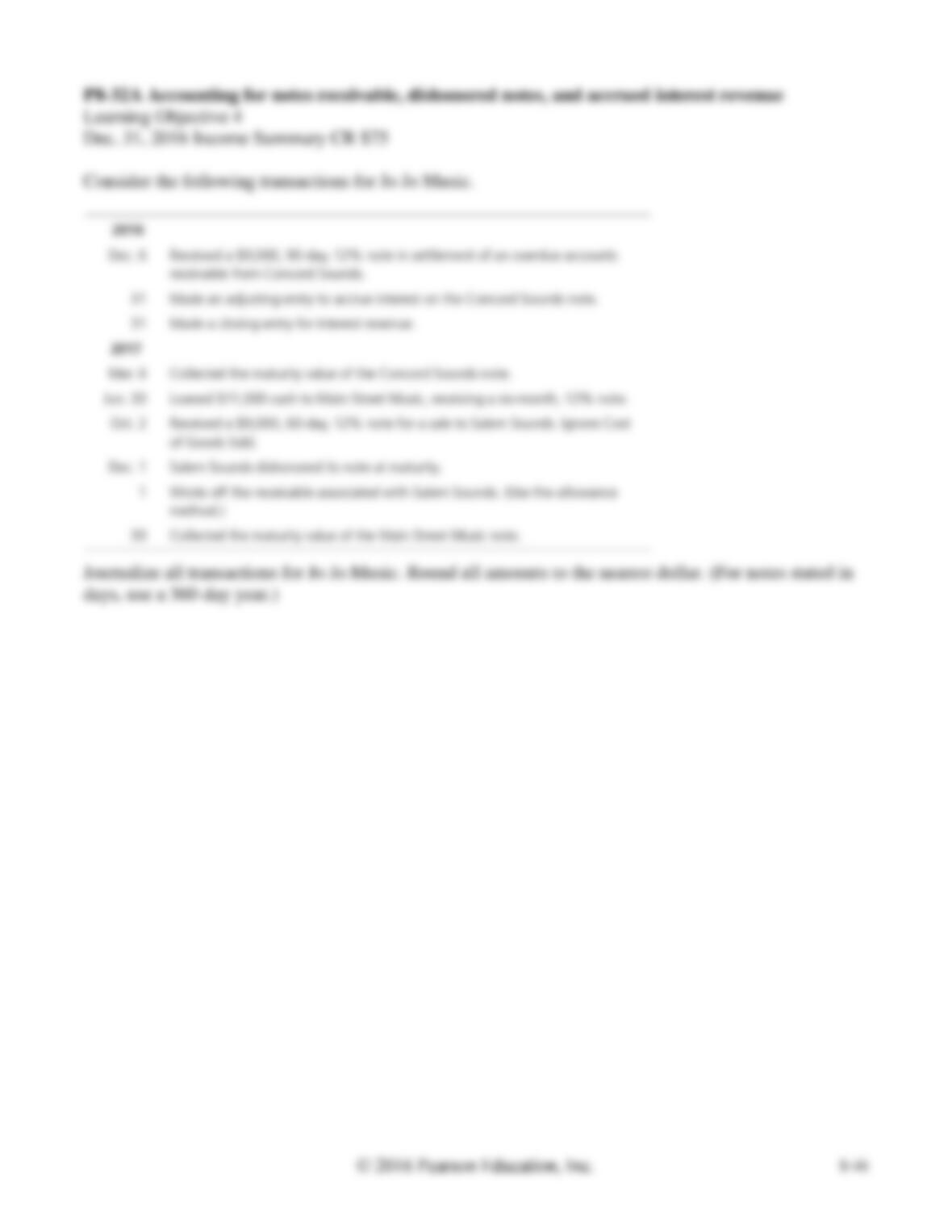
Requirement 2
Date
Accounts and Explanation
Debit
Credit
2016
Jun. 1
Notes Receivable (Note 1)
18,000
Cash
18,000
Sep. 30
Notes Receivable (Note 2)
24,000
Cash
24,000
Oct. 19
Notes Receivable (Note 3)
10,000
Cash
10,000
Dec. 18
Cash ($10,000 + $150)
10,150
Interest Revenue ($10,000 × 0.09 ×60/360)
150
Notes Receivable (Note 3)
10,000
31
Interest Receivable
1,540
Interest Revenue
1,540
Mar. 30
Cash ($24,000 + $720 + $720)
25,440
Interest Receivable
720
Interest Revenue ($24,000 × 0.12 × 3/12)
720
Notes Receivable (Note 2)
24,000
Jun. 1
Cash ($18,000 + $600 + $840)
19,440
Interest Receivable
840
Interest Revenue ($18,000 × 0.08 × 5/12)
600
Notes Receivable (Note 1)
18,000
Date
Debit
Credit
2017
© 2016 Pearson Education, Inc.
8-46
P8-32A Accounting for notes receivable, dishonored notes, and accrued interest revenue
Learning Objective 4
Dec. 31, 2016 Income Summary CR $75
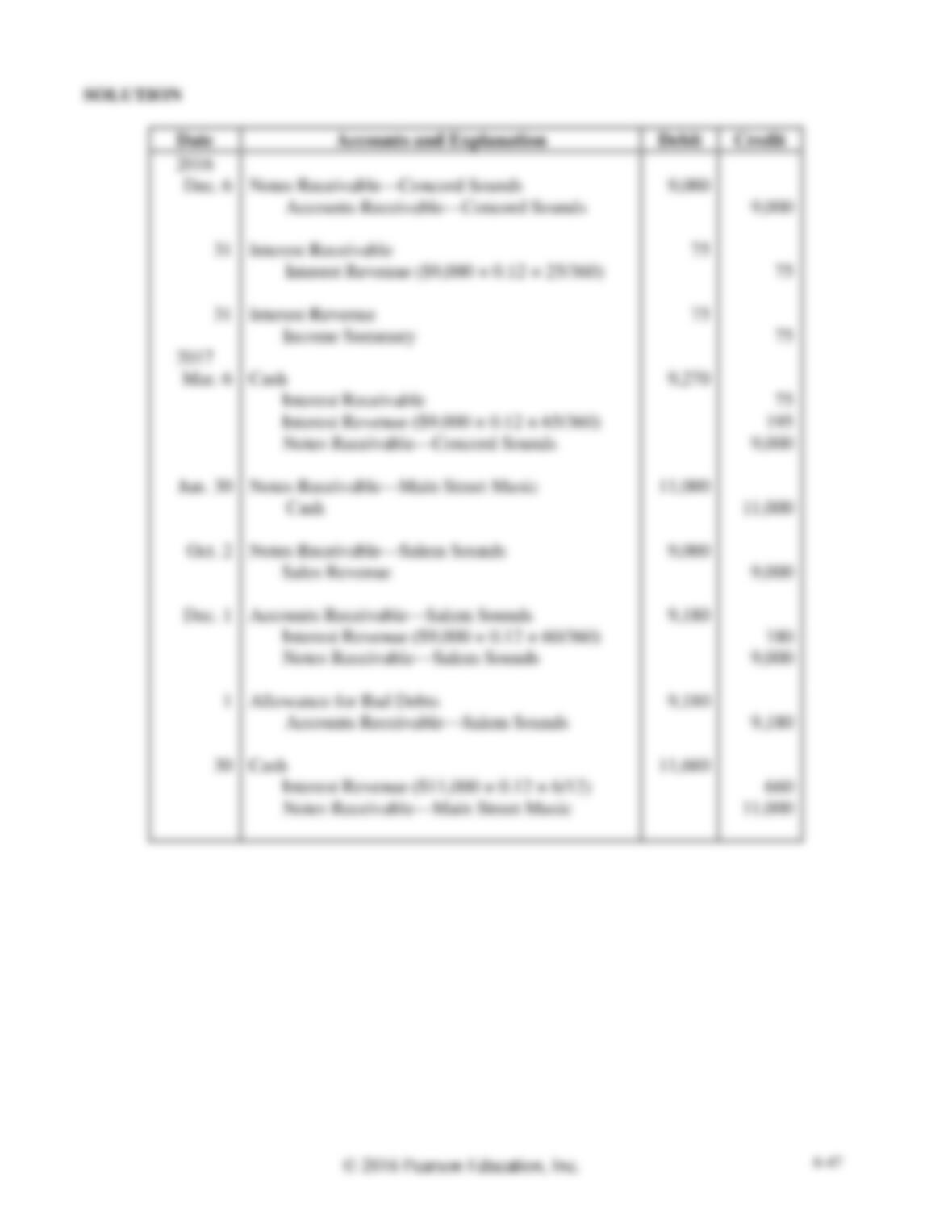
Consider the following transactions for Jo Jo Music.
Journalize all transactions for Jo Jo Music. Round all amounts to the nearest dollar. (For notes stated in
days, use a 360-day year.)
© 2016 Pearson Education, Inc.
8-47
SOLUTION
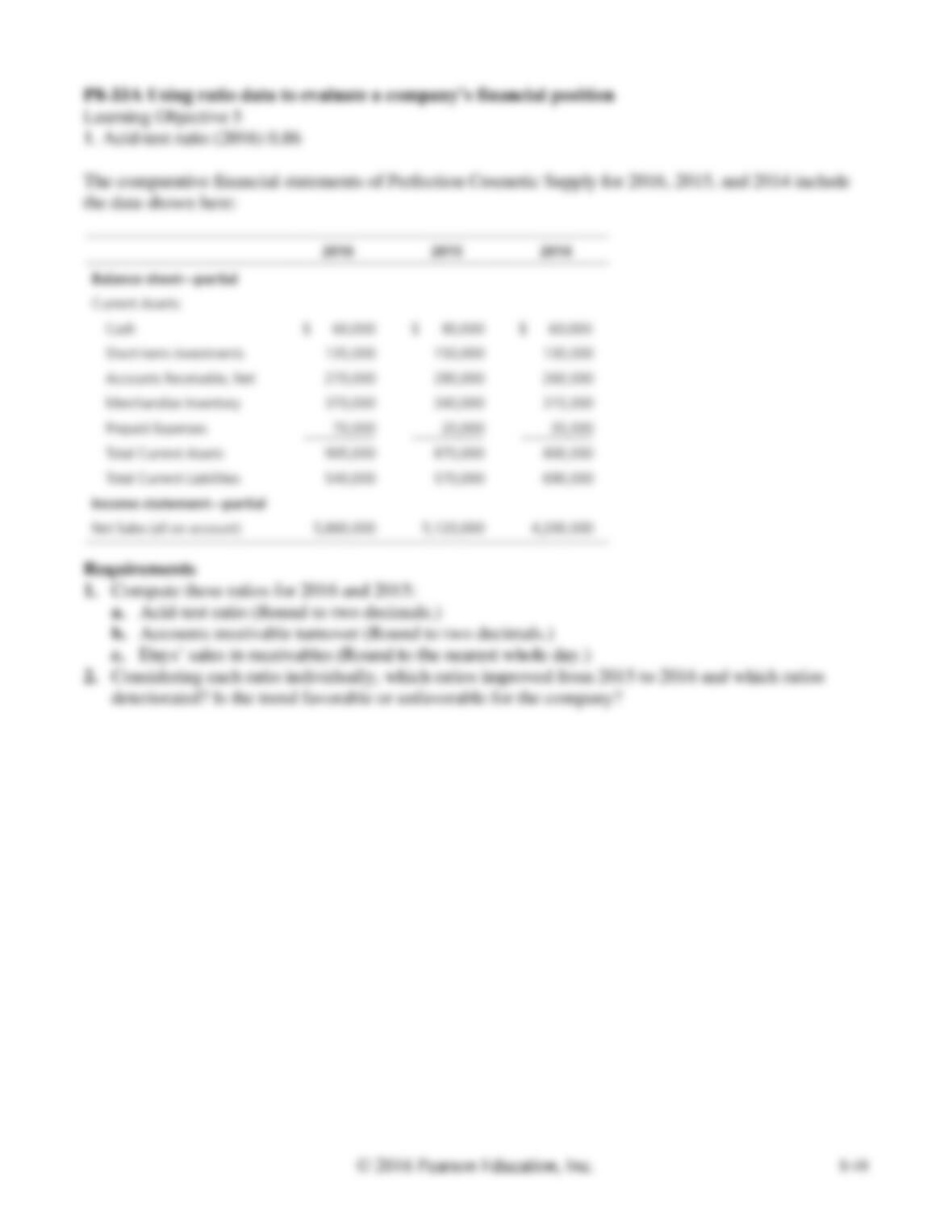
Date
Accounts and Explanation
Debit
Credit
2016
Dec. 6
Notes Receivable—Concord Sounds
9,000
Accounts Receivable—Concord Sounds
9,000
31
Interest Receivable
75
Interest Revenue ($9,000 × 0.12 × 25/360)
75
31
Interest Revenue
75
Income Summary
75
2017
Mar. 6
Cash
9,270
Interest Receivable
75
Interest Revenue ($9,000 × 0.12 × 65/360)
195
Notes Receivable—Concord Sounds
9,000
Jun. 30
Notes Receivable—Main Street Music
11,000
Cash
11,000
Oct. 2
Notes Receivable—Salem Sounds
9,000
Sales Revenue
9,000
Dec. 1
Accounts Receivable—Salem Sounds
9,180
Interest Revenue ($9,000 × 0.12 × 60/360)
180
Notes Receivable—Salem Sounds
9,000
1
Allowance for Bad Debts
9,180
Accounts Receivable—Salem Sounds
9,180
30
Cash
11,660
Interest Revenue ($11,000 × 0.12 × 6/12)
660
Notes Receivable—Main Street Music
11,000
© 2016 Pearson Education, Inc.
8-48
P8–33A Using ratio data to evaluate a company’s financial position
Learning Objective 5
1. Acid-test ratio (2016) 0.86
The comparative financial statements of Perfection Cosmetic Supply for 2016, 2015, and 2014 include
the data shown here:
Requirements
1. Compute these ratios for 2016 and 2015:
a. Acid-test ratio (Round to two decimals.)
b. Accounts receivable turnover (Round to two decimals.)
c. Days’ sales in receivables (Round to the nearest whole day.)
2. Considering each ratio individually, which ratios improved from 2015 to 2016 and which ratios
deteriorated? Is the trend favorable or unfavorable for the company?
© 2016 Pearson Education, Inc.
8-49
SOLUTION
Requirement 1
a. Acid-test ratio = (Cash including cash equivalents + Short-term investments + Net current
receivables) / Total current liabilities
2016
= ($60,000 + $135,000 + $270,000) / ($540,000)
= $465,000 / $540,000
= 0.86
2015
= ($80,000 + $150,000 + $280,000) / ($570,000)
= $510,000 / $570,000
= 0.89
b. Accounts receivable turnover ratio = Net credit sales / Average net accounts receivables
2016
= $5,860,000 / [($270,000 + $280,000) / 2]
= $5,860,000 / $275,000
= 21.31
2015
= $5,120,000 / [($280,000 + $260,000) / 2]
= $5,120,000 / $270,000
= 18.96
c. Days’ sales in receivables = 365 days / Accounts receivable turnover ratio
2016
= 365 days / 21.31
= 17 days (rounded)
2015
= 365 days / 18.96
= 19 days (rounded)
The accounts receivable turnover increased from 2015 to 2016. This trend is favorable to the company.
The days’ sales in receivables decreased from 2015 to 2016. This trend is favorable to the company.
© 2016 Pearson Education, Inc.
8-50
Problems (Group B)
P8-34B Accounting for uncollectible accounts using the allowance (percent-of-sales) and direct
write-off methods and reporting receivables on the balance sheet
Learning Objectives 1, 2, 3
1. Sep. 30 Bal. AR $128,000
On August 31, 2016, Bouquet Floral Supply had a $170,000 debit balance in Accounts Receivable and a
$6,800 credit balance in Allowance for Bad Debts. During September, Bouquet made the following
transactions:
• Sales on account, $550,000. Ignore Cost of Goods Sold.
• Collections on account, $584,000.
• Write-offs of uncollectible receivables, $8,000.
Requirements
1. Journalize all September entries using the allowance method. Bad debts expense was estimated at
2% of credit sales. Show all September activity in Accounts Receivable, Allowance for Bad Debts,
and Bad Debts Expense (post to these T-accounts).
2. Using the same facts, assume that Bouquet used the direct write-off method to account for
uncollectible receivables. Journalize all September entries using the direct write-off method. Post to
Accounts Receivable and Bad Debts Expense, and show their balances at November 30, 2016.
3. What amount of Bad Debts Expense would Bouquet report on its September income statement under
each of the two methods? Which amount better matches expense with revenue? Give your reason.
4. What amount of net accounts receivable would Bouquet report on its September 30, 2016, balance
sheet under each of the two methods? Which amount is more realistic? Give your reason.
© 2016 Pearson Education, Inc.
8-51
SOLUTION
Requirement 1
Date
Accounts and Explanation
Debit
Credit
2016
Sep. 30
Accounts Receivable
550,000
Sales Revenue
550,000
30
Cash
584,000
Accounts Receivable
584,000
30
Allowance for Bad Debts
8,000
Accounts Receivable
8,000
30
Bad Debts Expense
11,000
Allowance for Bad Debts
11,000
(2% × $550,000 = $11,000)
Accounts Receivable
8/31 Bal 170,000
584,000 collected
revenue 550,000
8,000 wrote off
9/30 Bal 128,000
Allowance for Bad Debts
6,800 8/31 Bal
wrote off 8,000
11,000 expense
9,800 9/30 Bal
Bad Debts Expense
expense 11,000
Bal 11,000
© 2016 Pearson Education, Inc.
8-52
P8-34B, cont.
Requirement 2
Date
Accounts and Explanation
Debit
Credit
2016
Sep. 30
Accounts Receivable
550,000
Sales Revenue
550,000
30
Cash
584,000
Accounts Receivable
584,000
30
Bad Debts Expense
8,000
Accounts Receivable
8,000
Bad Debts Expense under the allowance method better matches expense with revenue because the
expense is recorded in the same period the sales are made.
Accounts Receivable
8/31 Bal 170,000
584,000 collected
revenue 550,000
8,000 wrote off
9/30 Bal 128,000
Bad Debts Expense
expense 8,000
Bal 8,000
© 2016 Pearson Education, Inc.
8-53
P8-34B, cont.
Requirement 4
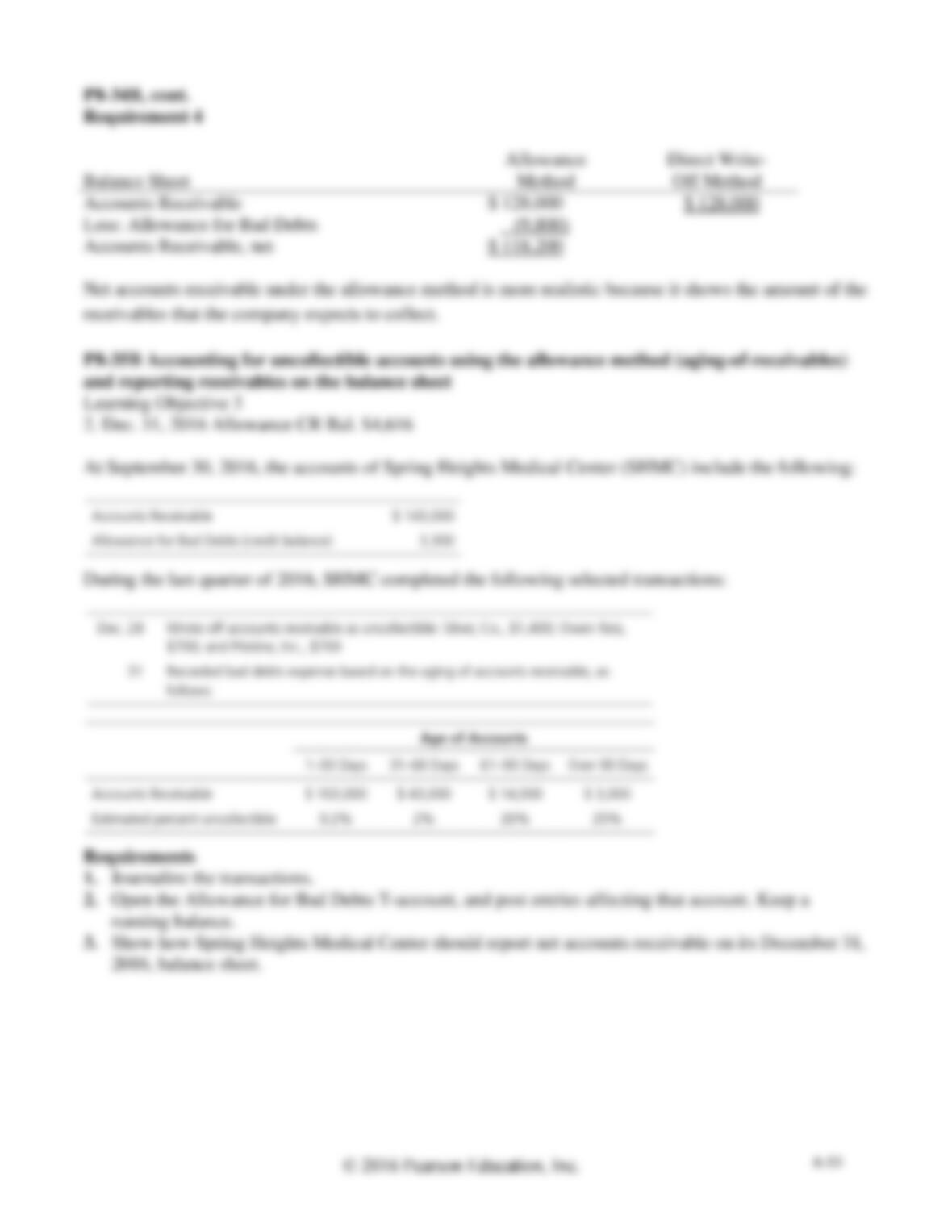
Balance Sheet
Allowance
Method
Direct Write-
Off Method
Accounts Receivable
$ 128,000
$ 128,000
Less: Allowance for Bad Debts
(9,800)
Accounts Receivable, net
$ 118,200
Net accounts receivable under the allowance method is more realistic because it shows the amount of the
receivables that the company expects to collect.
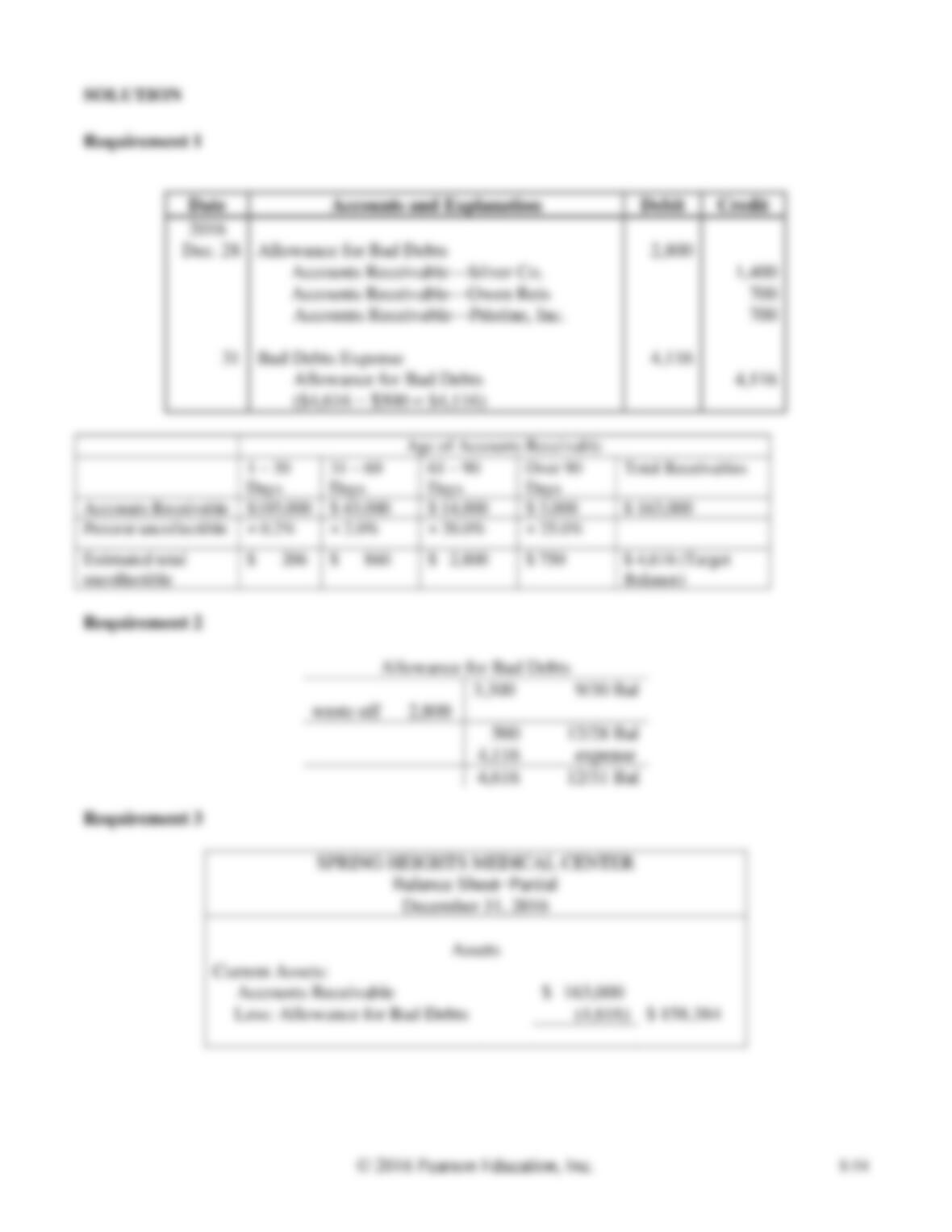
Requirements
1. Journalize the transactions.
2. Open the Allowance for Bad Debts T-account, and post entries affecting that account. Keep a
running balance.
3. Show how Spring Heights Medical Center should report net accounts receivable on its December 31,
2016, balance sheet.
© 2016 Pearson Education, Inc.
8-54
SOLUTION
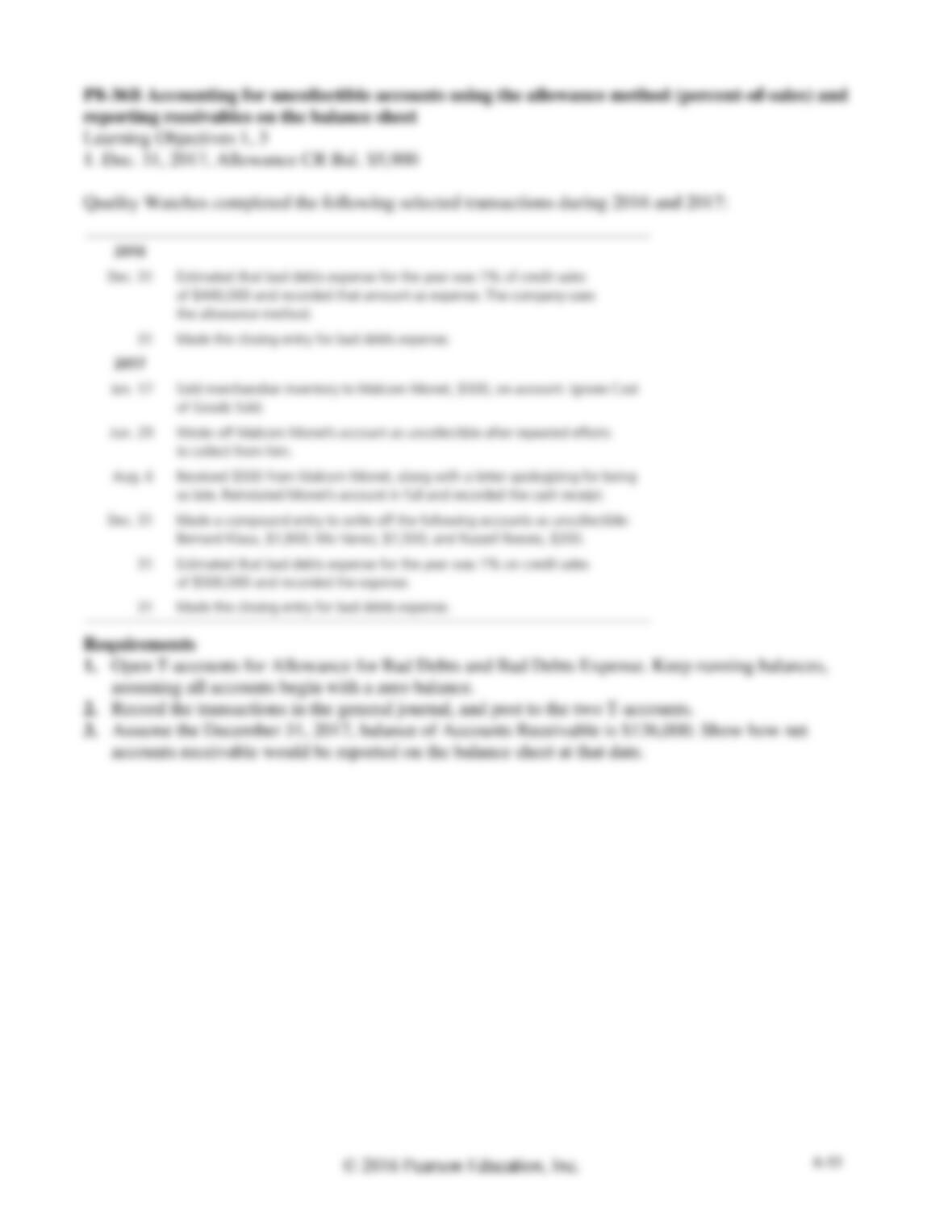
Requirement 1
Date
Accounts and Explanation
Debit
Credit
2016
Dec. 28
Allowance for Bad Debts
2,800
Accounts Receivable—Silver Co.
1,400
Accounts Receivable—Owen Reis
700
Accounts Receivable—Pristine, Inc.
700
31
Bad Debts Expense
4,116
Allowance for Bad Debts
4,116
($4,616 − $500 = $4,116)
Age of Accounts Receivable
1 – 30
Days
31 – 60
Days
61 – 90
Days
Over 90
Days
Total Receivables
Accounts Receivable
$103,000
$ 43,000
$ 14,000
$ 3,000
$ 163,000
Percent uncollectible
× 0.2%
× 2.0%
× 20.0%
× 25.0%
Estimated total
uncollectible
$ 206
$ 860
$ 2,800
$ 750
$ 4,616 (Target
Balance)
Assets
Current Assets:
Accounts Receivable
$ 163,000
Less: Allowance for Bad Debts
(4,616)
$ 158,384
wrote off 2,800
500 12/28 Bal
4,116 expense
4,616 12/31 Bal
3,300 9/30 Bal
© 2016 Pearson Education, Inc.
8-55
P8-36B Accounting for uncollectible accounts using the allowance method (percent–of-sales) and
reporting receivables on the balance sheet
Learning Objectives 1, 3
1. Dec. 31, 2017, Allowance CR Bal. $5,900
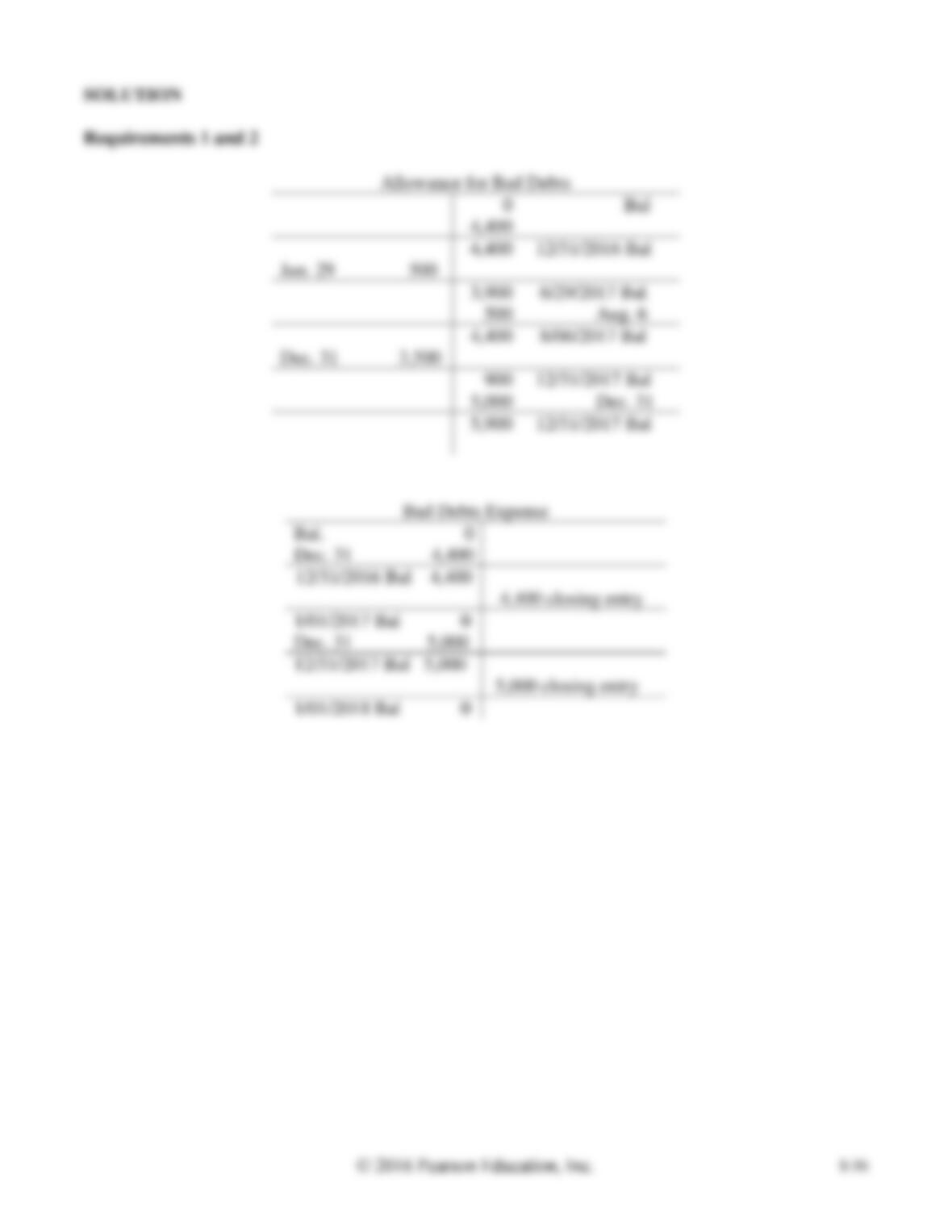
Quality Watches completed the following selected transactions during 2016 and 2017:
Requirements
1. Open T-accounts for Allowance for Bad Debts and Bad Debts Expense. Keep running balances,
assuming all accounts begin with a zero balance.
2. Record the transactions in the general journal, and post to the two T-accounts.
3. Assume the December 31, 2017, balance of Accounts Receivable is $136,000. Show how net
accounts receivable would be reported on the balance sheet at that date.
© 2016 Pearson Education, Inc.
8-56
SOLUTION
Requirements 1 and 2
Allowance for Bad Debts
0 Bal
4,400
4,400 12/31/2016 Bal
Jun. 29 500
3,900 6/29/2017 Bal
500 Aug. 6
4,400 8/06/2017 Bal
Dec. 31 3,500
900 12/31/2017 Bal
5,000 Dec. 31
5,900 12/31/2017 Bal
Bad Debts Expense
Bal. 0
Dec. 31 4,400
12/31/2016 Bal 4,400
4,400 closing entry
1/01/2017 Bal 0
Dec. 31 5,000
12/31/2017 Bal 5,000
5,000 closing entry
1/01/2018 Bal 0
© 2016 Pearson Education, Inc.
8-57
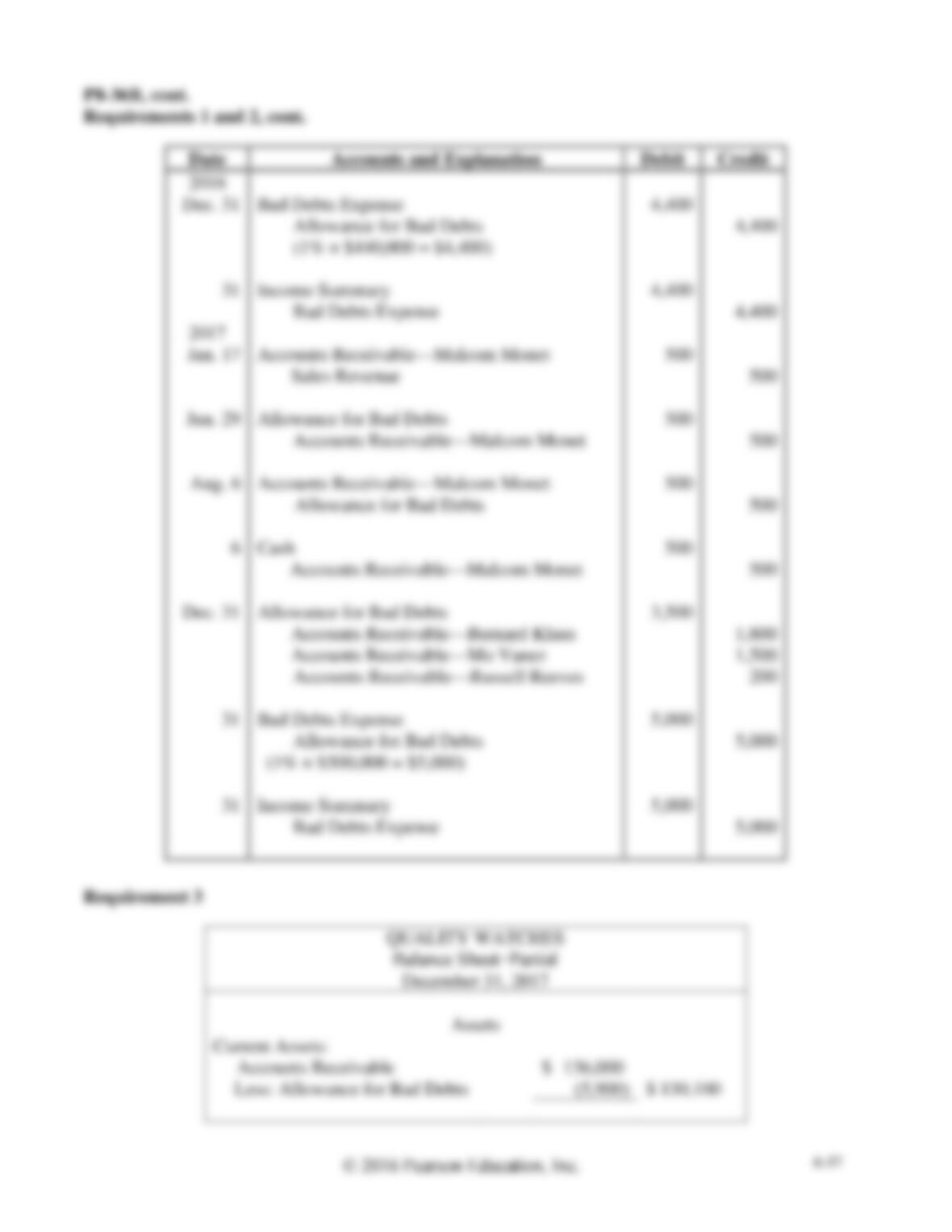
P8-36B, cont.
Requirements 1 and 2, cont.
Date
Accounts and Explanation
Debit
Credit
2016
Dec. 31
Bad Debts Expense
4,400
Allowance for Bad Debts
4,400
(1% × $440,000 = $4,400)
31
Income Summary
4,400
Bad Debts Expense
4,400
2017
Jan. 17
Accounts Receivable—Malcom Monet
500
Sales Revenue
500
Jun. 29
Allowance for Bad Debts
500
Accounts Receivable—Malcom Monet
500
Aug. 6
Accounts Receivable—Malcom Monet
500
Allowance for Bad Debts
500
6
Cash
500
Accounts Receivable—Malcom Monet
500
Dec. 31
Allowance for Bad Debts
3,500
Accounts Receivable—Bernard Klaus
1,800
Accounts Receivable—Mo Vanez
1,500
Accounts Receivable—Russell Reeves
200
31
Bad Debts Expense
5,000
Allowance for Bad Debts
5,000
(1% × $500,000 = $5,000)
31
Income Summary
5,000
Bad Debts Expense
5,000
Assets
Current Assets:
Accounts Receivable
$ 136,000
Less: Allowance for Bad Debts
(5,900)
$ 130,100