
CHAPTER 8
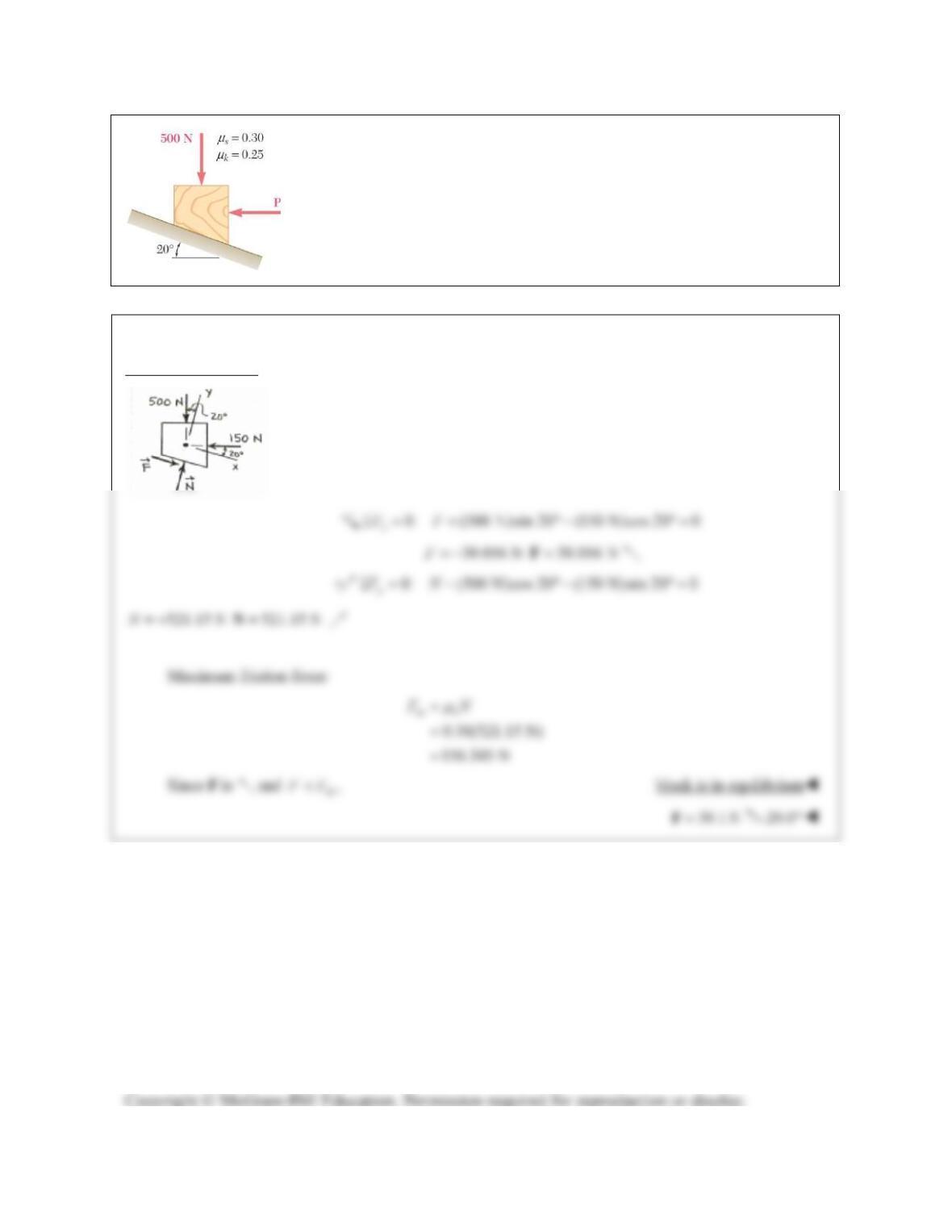
PROBLEM 8.1
Determine whether the block shown is in equilibrium and find the magnitude
and direction of the friction force whenP 150 N.
SOLUTION
Assume equilibrium:
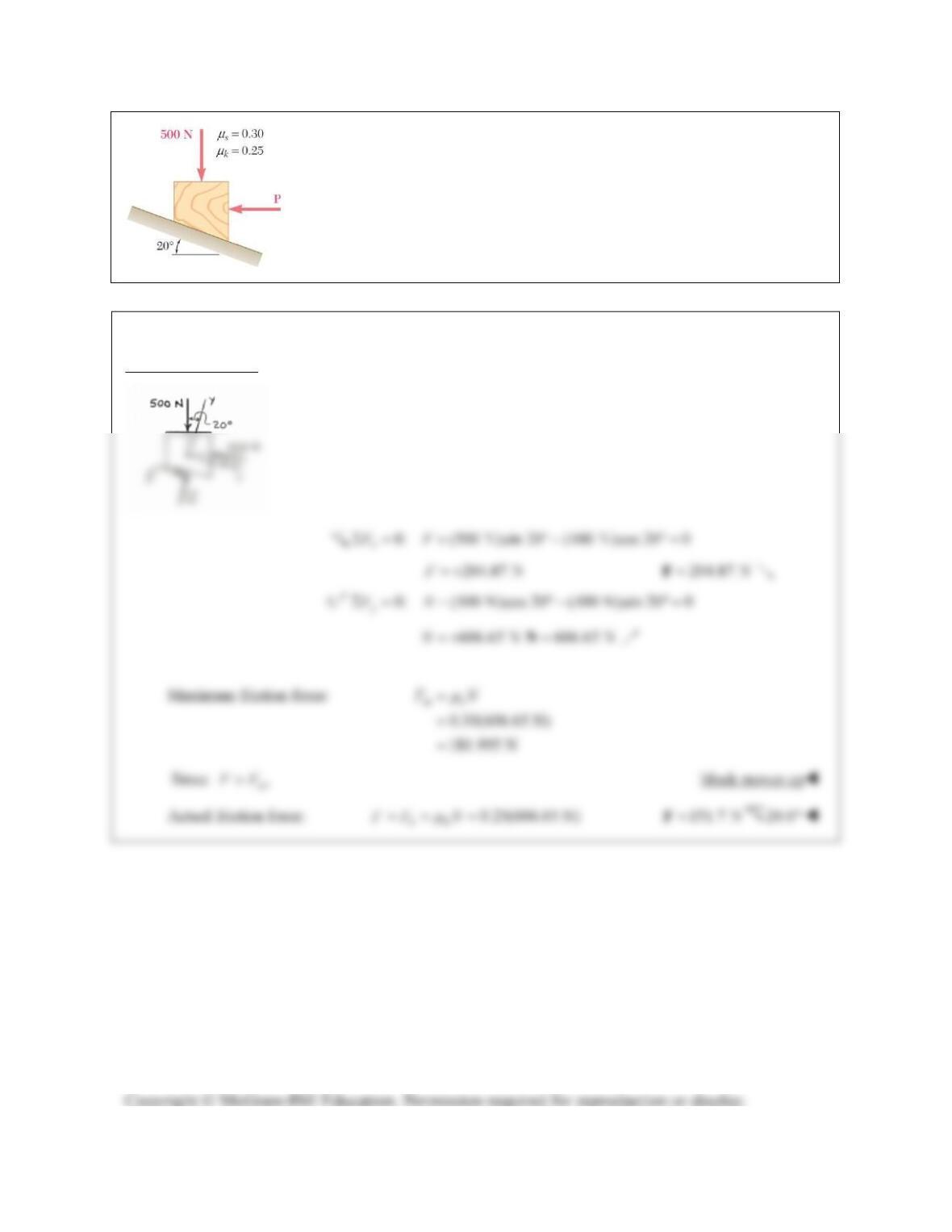
PROBLEM 8.2
Determine whether the block shown is in equilibrium and find the magnitude
and direction of the friction force when P 400 N.
SOLUTION
Assume equilibrium:
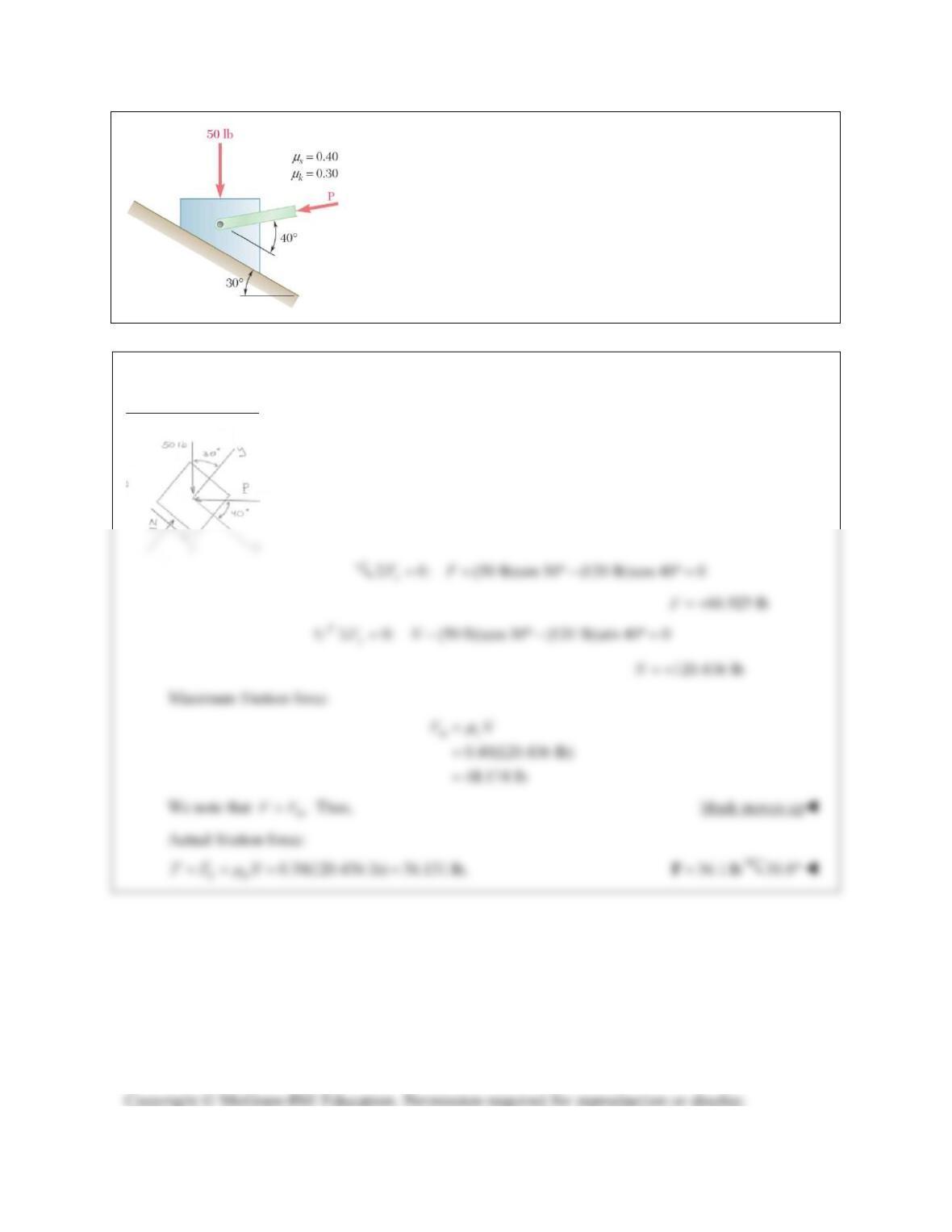
PROBLEM 8.3
Determine whether the block shown is in equilibrium and find the
magnitude and direction of the friction force when P 120 lb.
SOLUTION
Assume equilibrium:
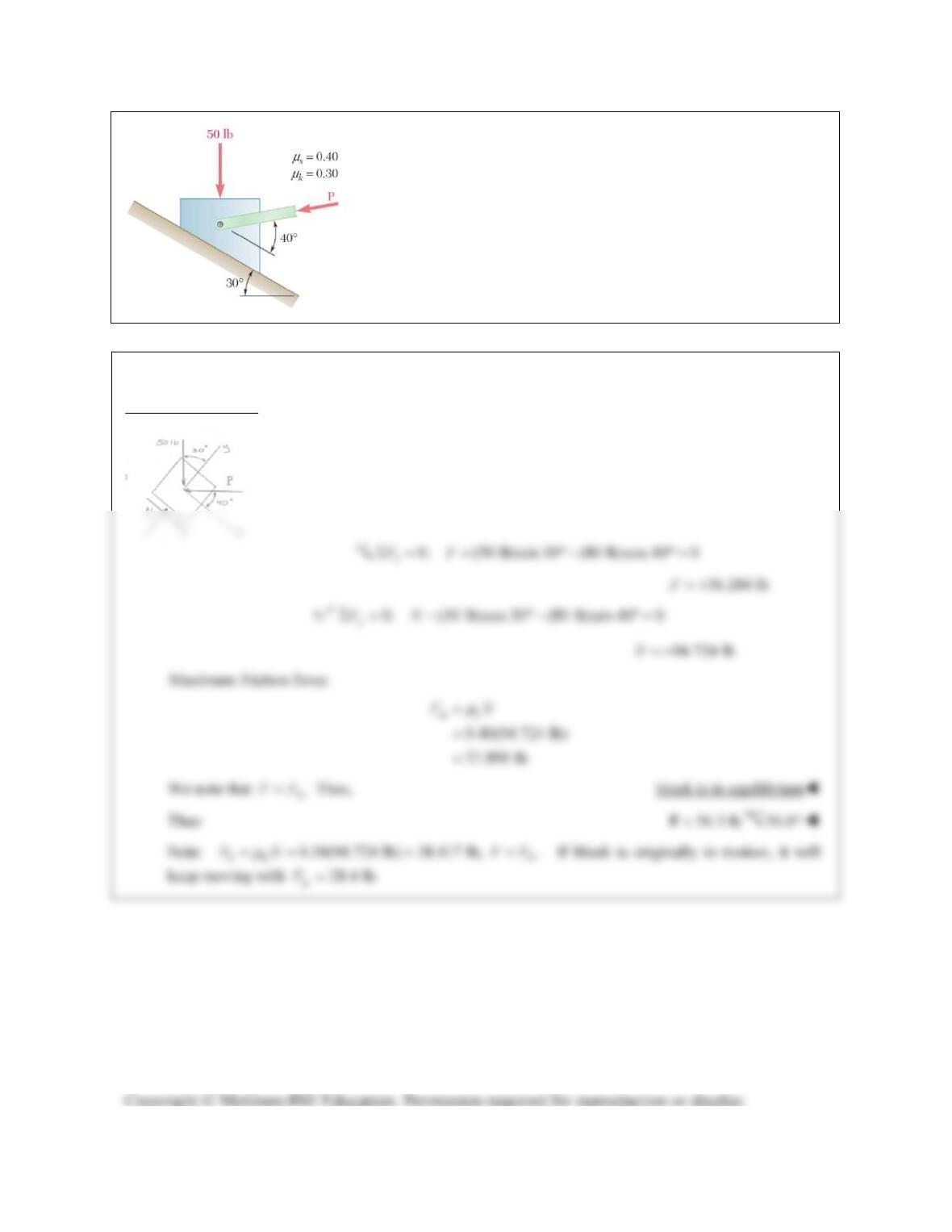
PROBLEM 8.4
Determine whether the block shown is in equilibrium and find the
magnitude and direction of the friction force when P 80 lb.
SOLUTION
Assume equilibrium:
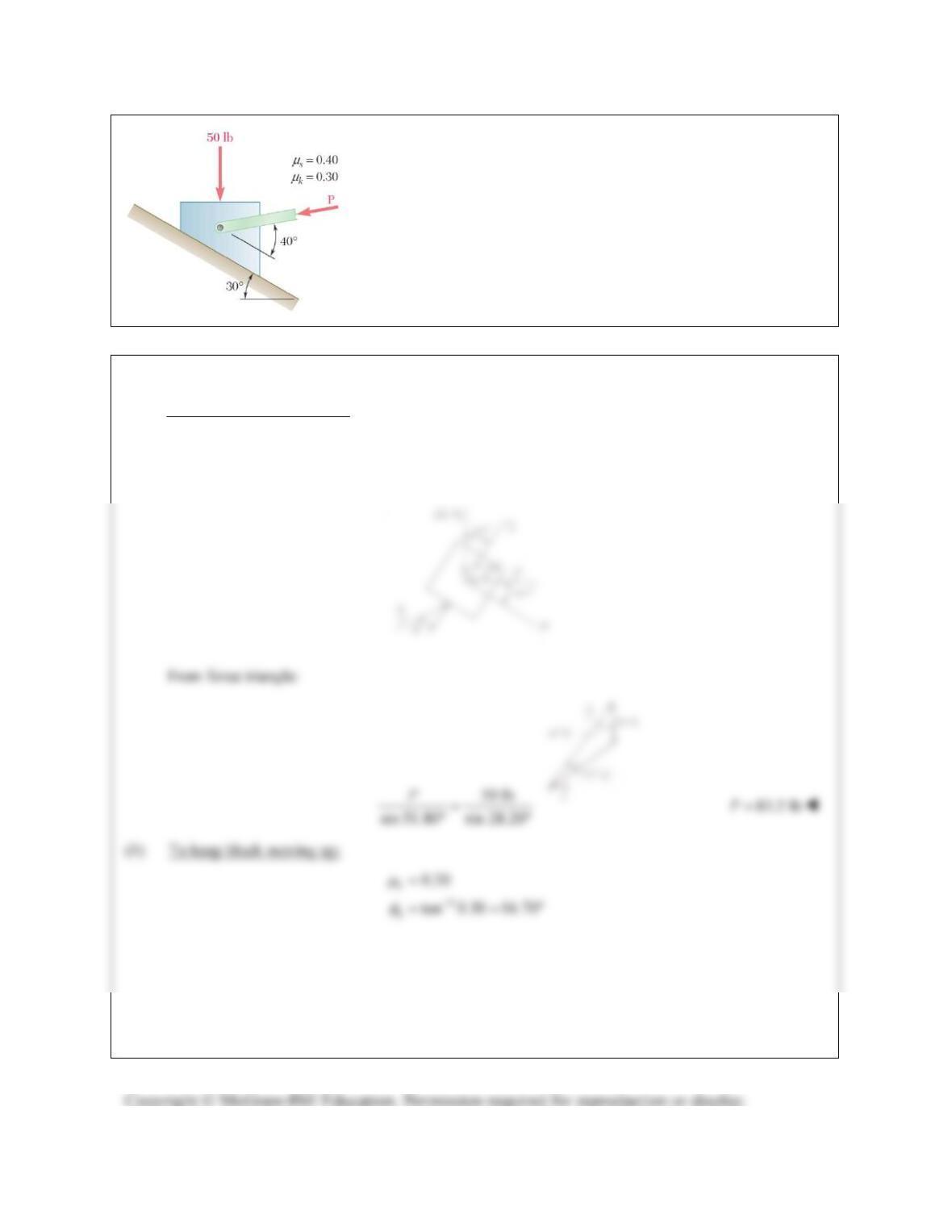
PROBLEM 8.5
Determine the smallest value of P required to (a) start the block up the
incline, (b) keep it moving up.
SOLUTION
(a) To start block up the incline:
1
0.40
tan 0.40 21.80
s
s
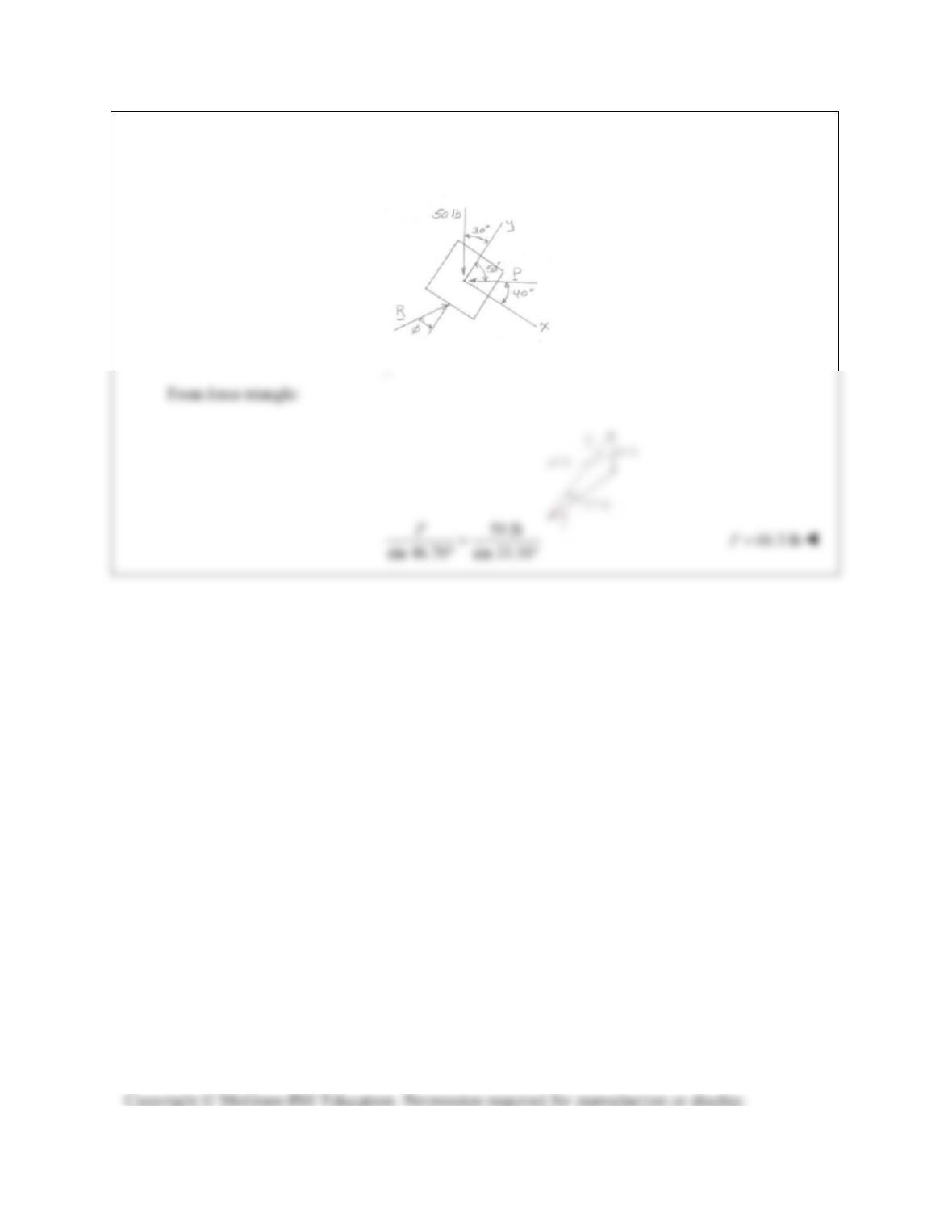
PROBLEM 8.5 (Continued)
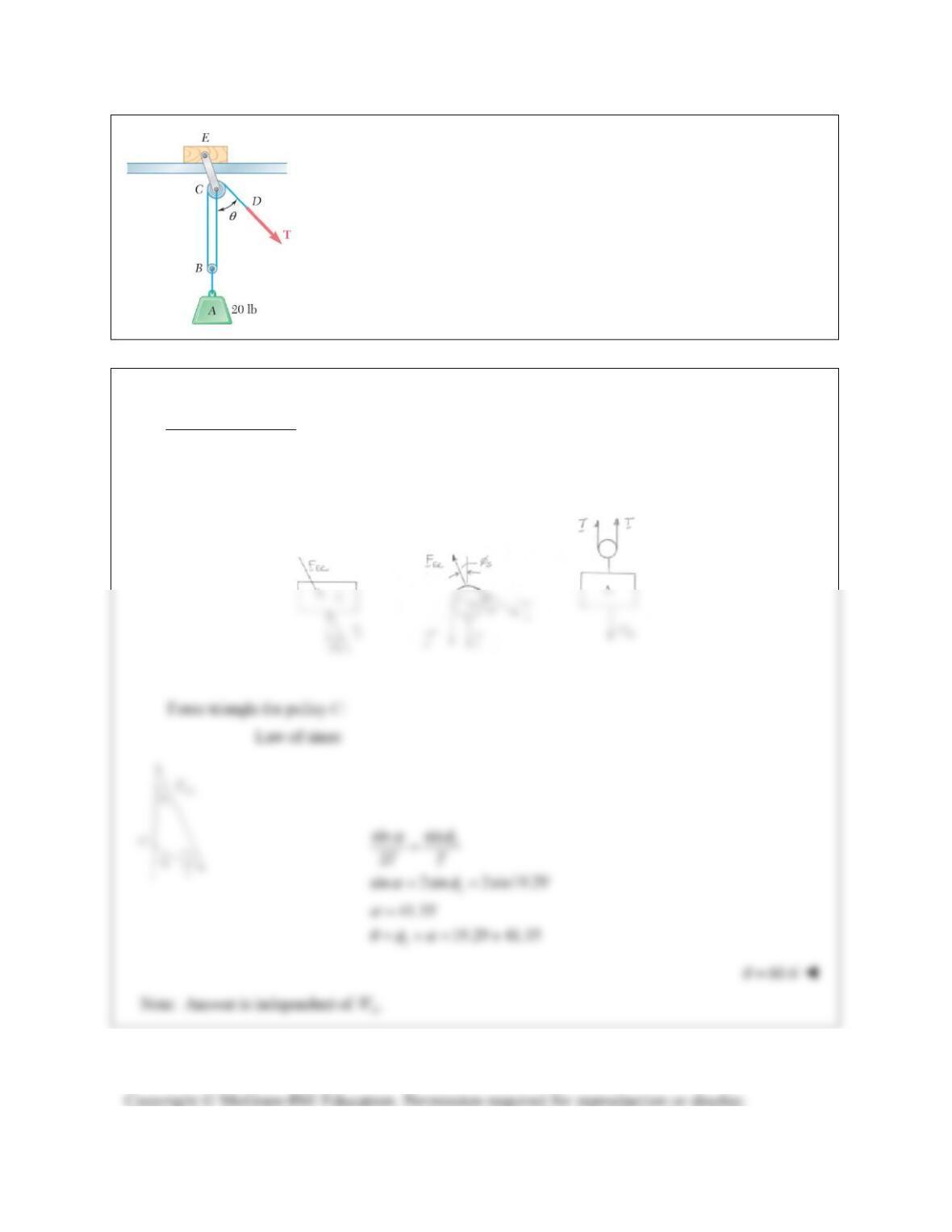
PROBLEM 8.6
The 20-lb block A hangs from a cable as shown. Pulley C is connected by a
short link to block E, which rests on a horizontal rail. Knowing that the
coefficient of static friction between block E and the rail is s = 0.35 and
neglecting the weight of block E and the friction in the pulleys, determine
the maximum allowable value of θ if the system is to remain in equilibrium.
SOLUTION
Free-body diagrams:
1
0.35
tan 0.35 19.29
s
s
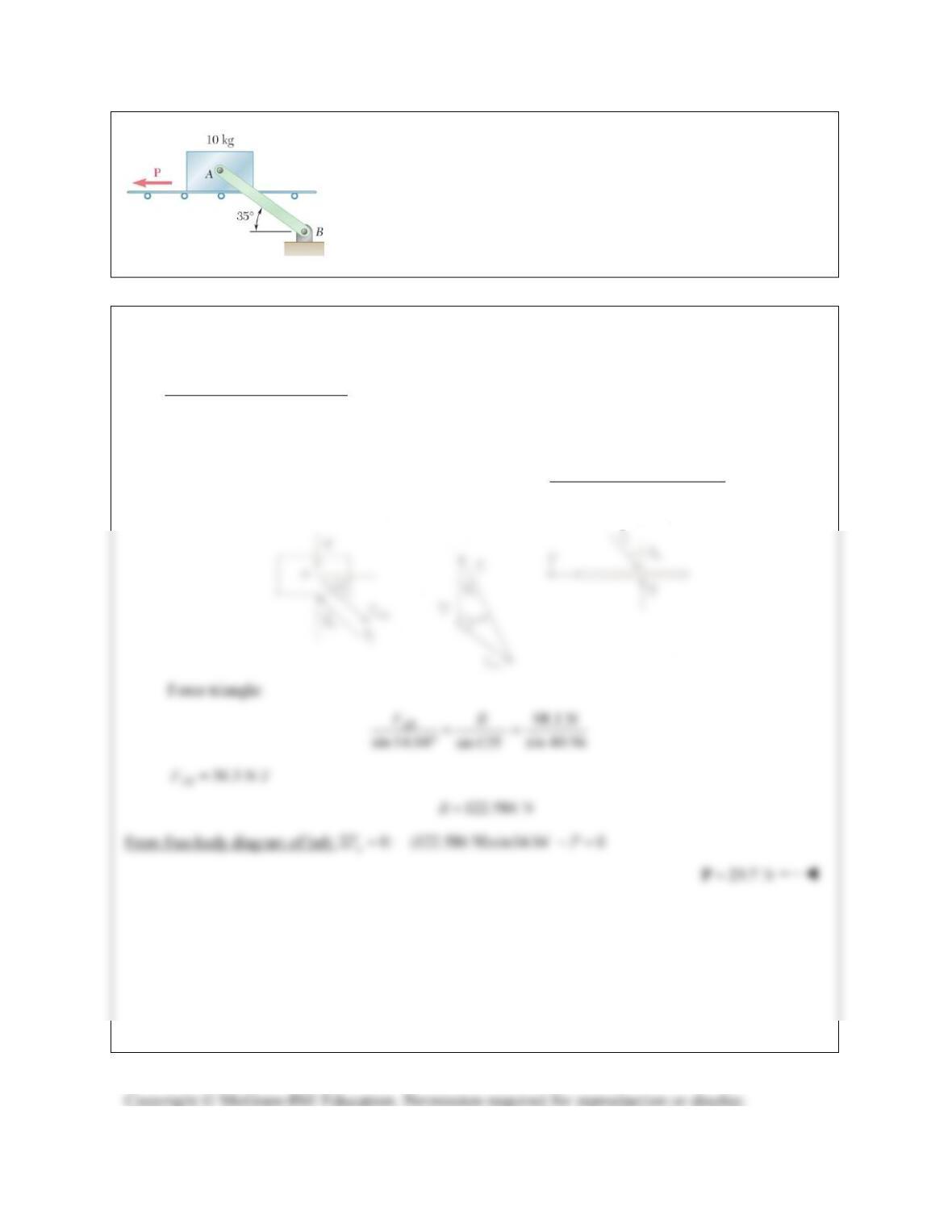
PROBLEM 8.7
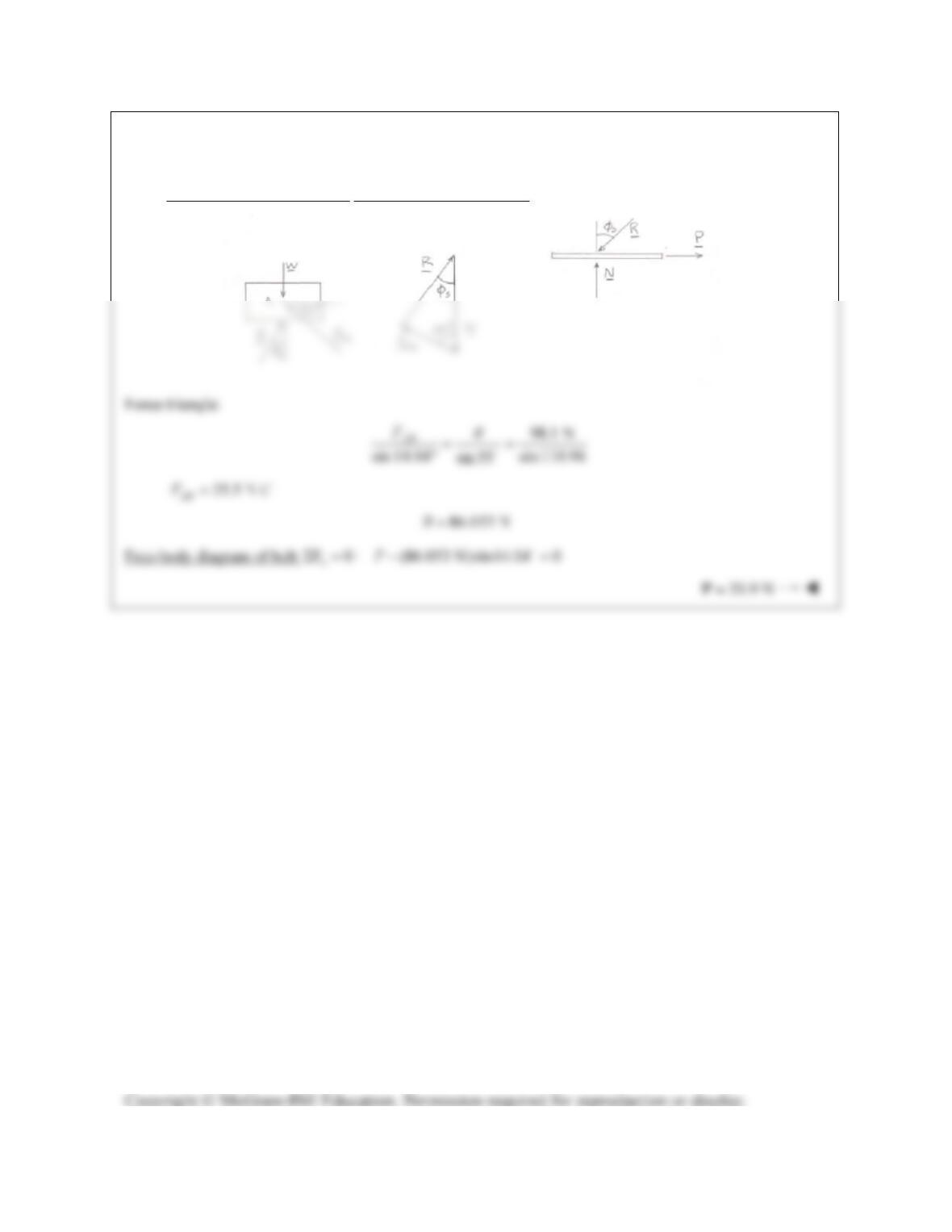
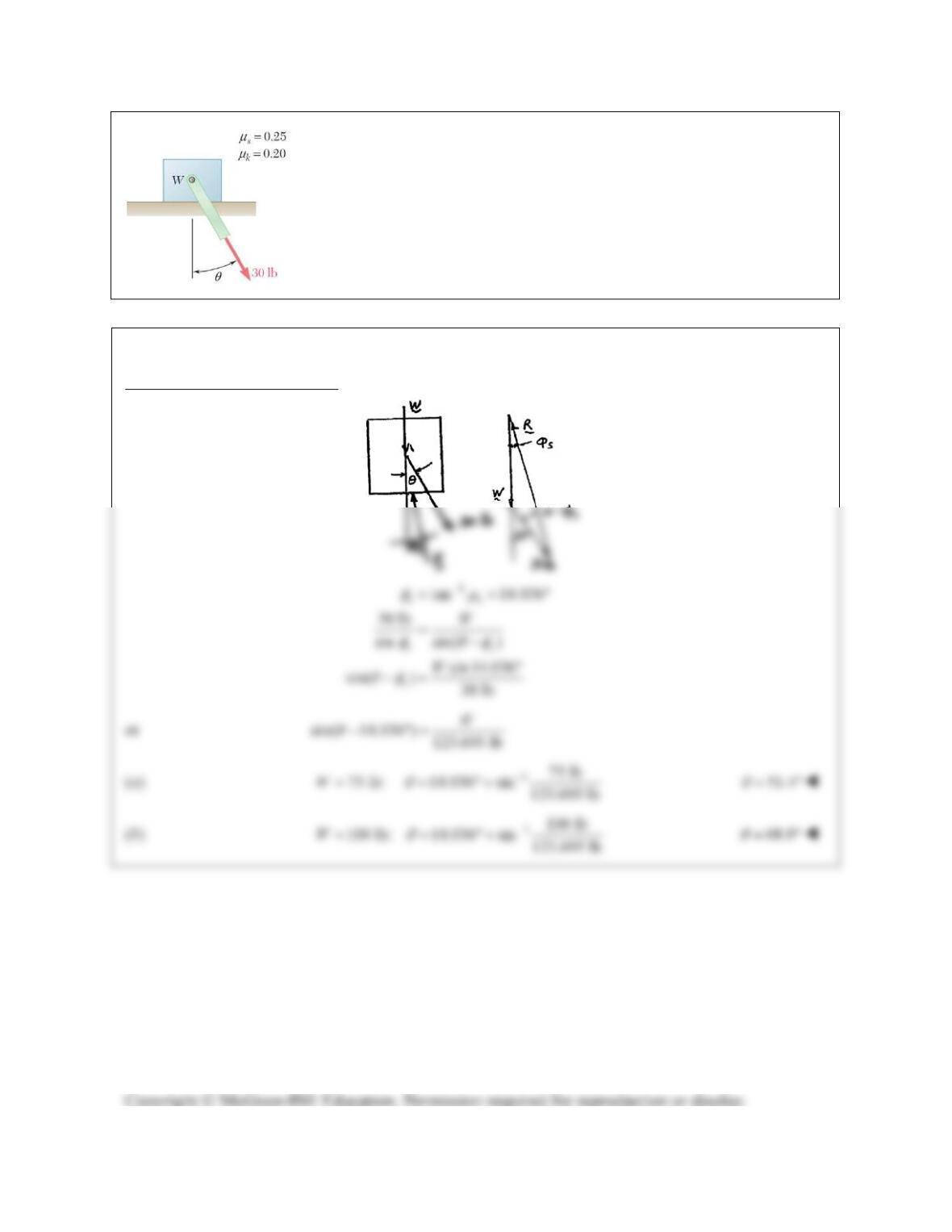
The 10-kg block is attached to link AB and rests on a moving belt.
Knowing that
s
= 0.30 and
k
= 0.25 and neglecting the weight of the
link, determine the magnitude of the horizontal force
P
that should be
applied to the belt to maintain its motion (a) to the left as shown, (b) to
the right.
SOLUTION
Link AB is a two-force member.
(a)
Free-body diagram of block:
Since there is motion between block and belt, use
1
0.25
tan 0.25 14.04
98.1 N
k
k
W
Free-body diagram of belt:
PROBLEM 8.7 (Continued)
(b) Free-body diagram of block:Free-body diagram of belt:
PROBLEM 8.8
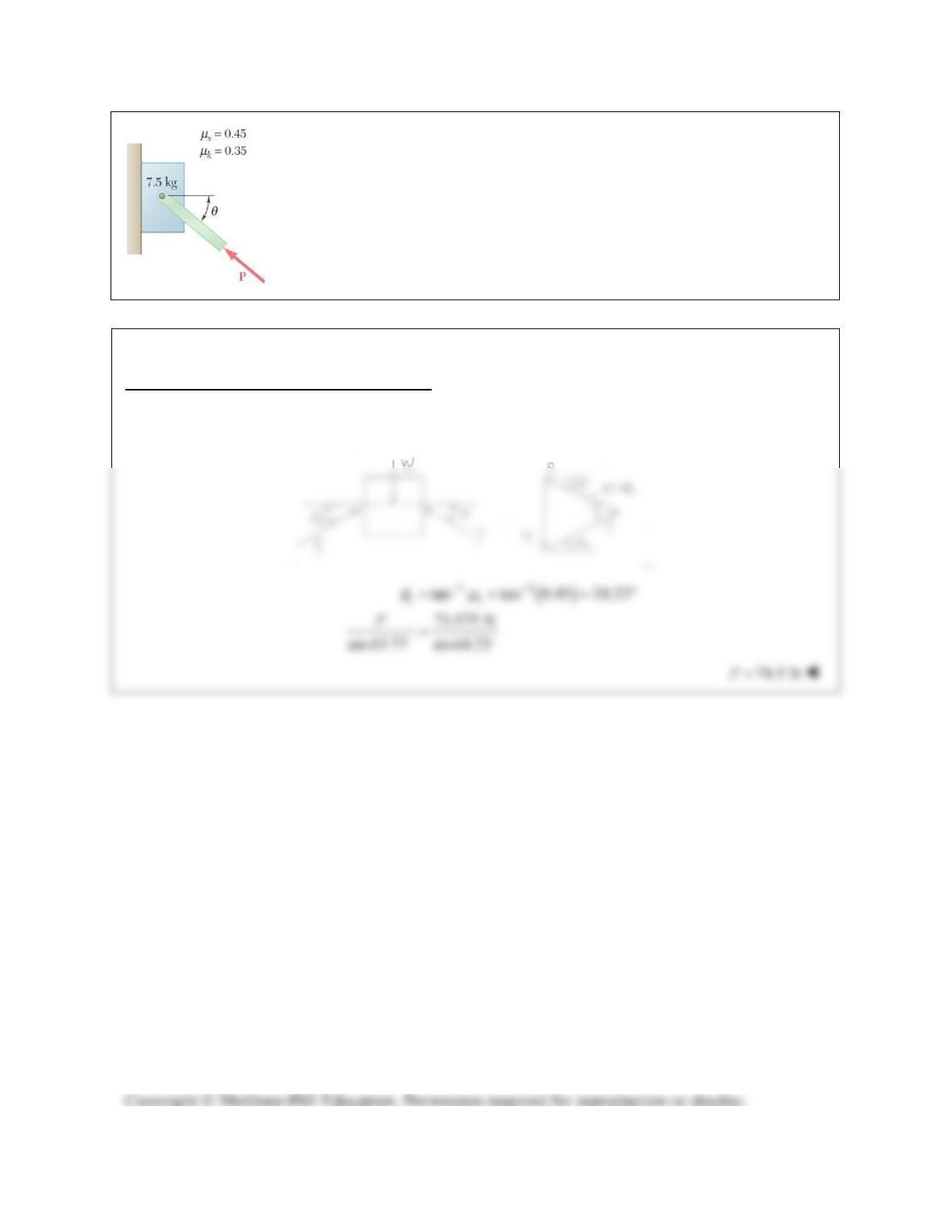
Considering only values of
less than 90, determine the smallest value of
required to start the block moving to the right when (a) 75 lb,W
(b) 100 lb.W
SOLUTION
FBD block (Motion impending):
PROBLEM 8.9
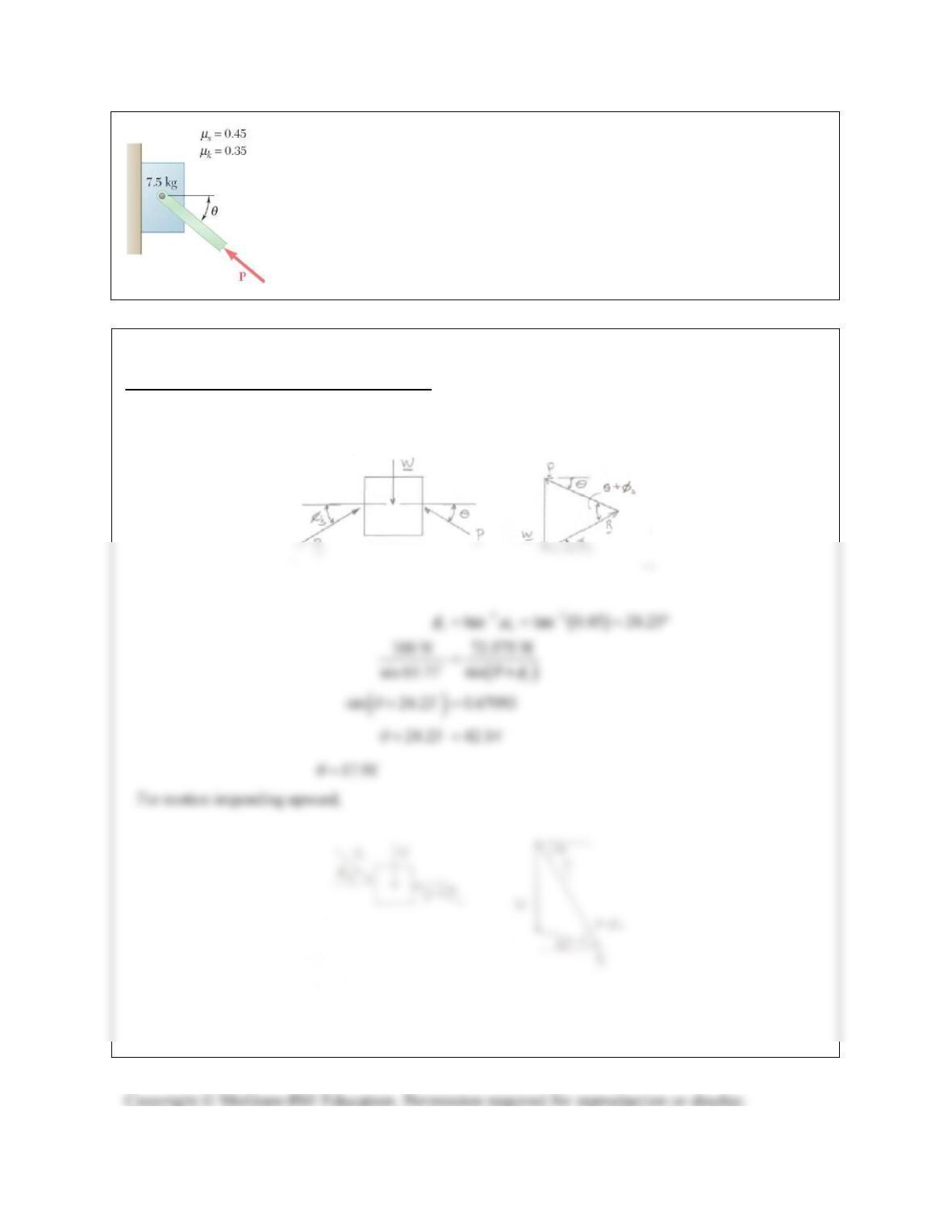
Knowing that θ = 40°, determine the smallest force
P
for which equilibrium of the
7.5-kg block is maintained.
SOLUTION
Free-body diagram of block and force triangle:
Since we seek smallest P downward motion impends.
2
7.5 kg 9.81 m/s 73.575 NW
PROBLEM 8.10
Knowing that P = 100 N, determine the range of values of θ for which equilibrium
of the 7.5-kg block is maintained.
SOLUTION
Free-body diagram of block and force triangle:
For motion impending downward,
2
7.5 kg 9.81 m/s 73.575 NW
PROBLEM 8.10 (Continued)
100 N 73.575 N
sin
sin 114.23
s
PROBLEM 8.11
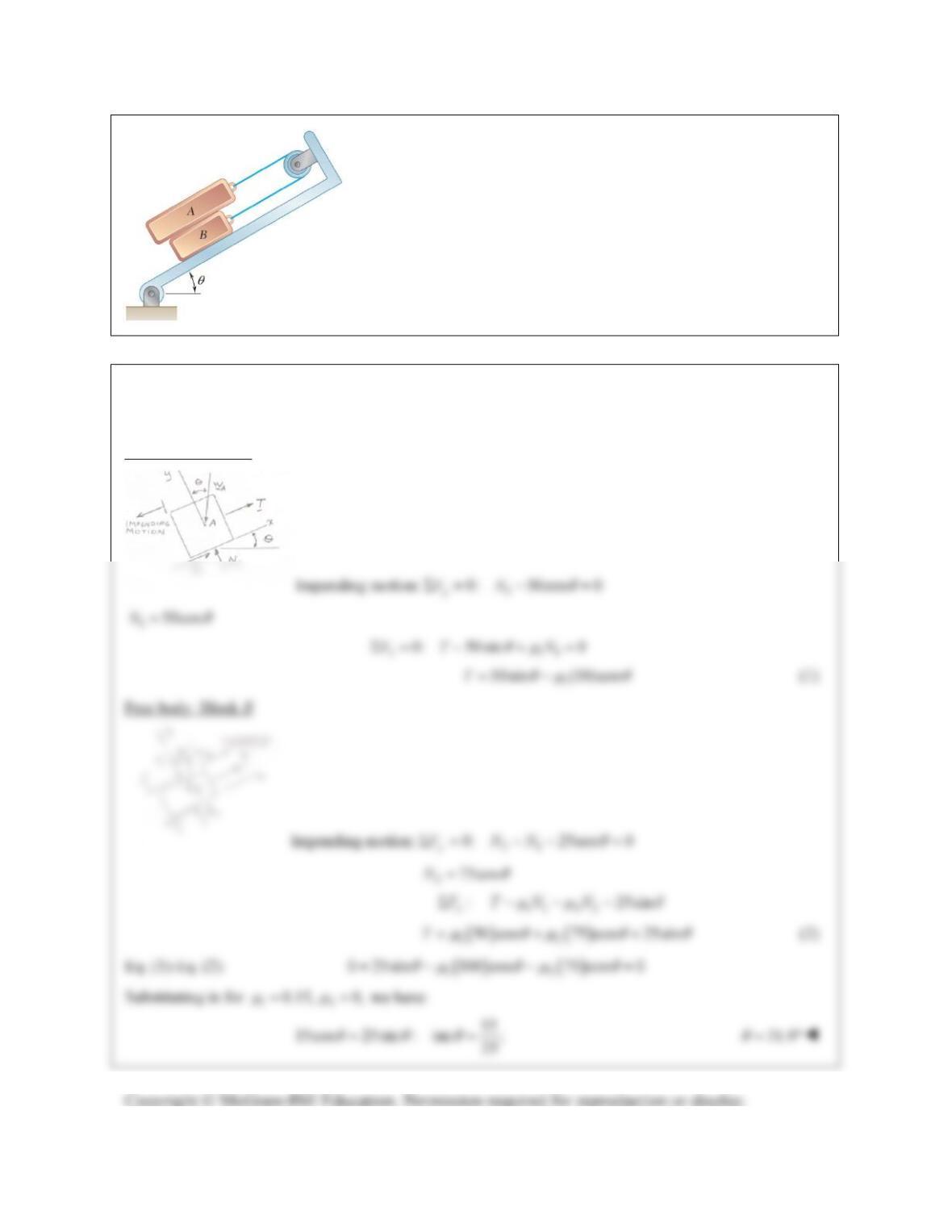
The 50-lb block A and the 25-lb block B are supported by an incline
that is held in the position shown. Knowing that the coefficient of
static friction is 0.15 between the two blocks and zero between block
B and the incline, determine the value of
for which motion is
impending.
SOLUTION
Since motion impends,
s
FN
between AB
Free body: Block A
PROBLEM 8.12
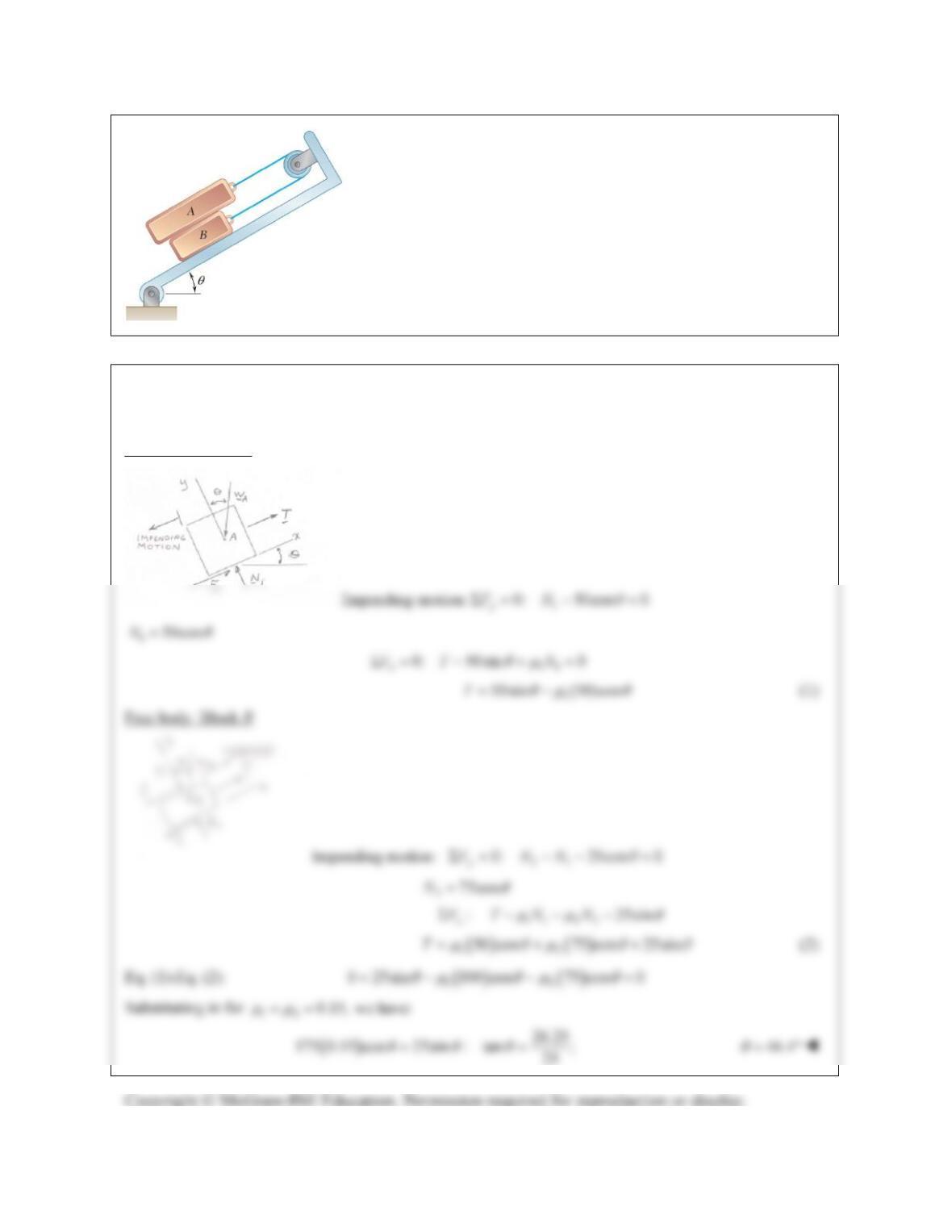
The 50-lb block A and the 25-lb block B are supported by an incline
that is held in the position shown. Knowing that the coefficient of
static friction is 0.15 between all surfaces of contact, determine the
value of
for which motion is impending.
SOLUTION
Since motion impends,
s
FN
between AB
Free body: Block A
PROBLEM 8.13
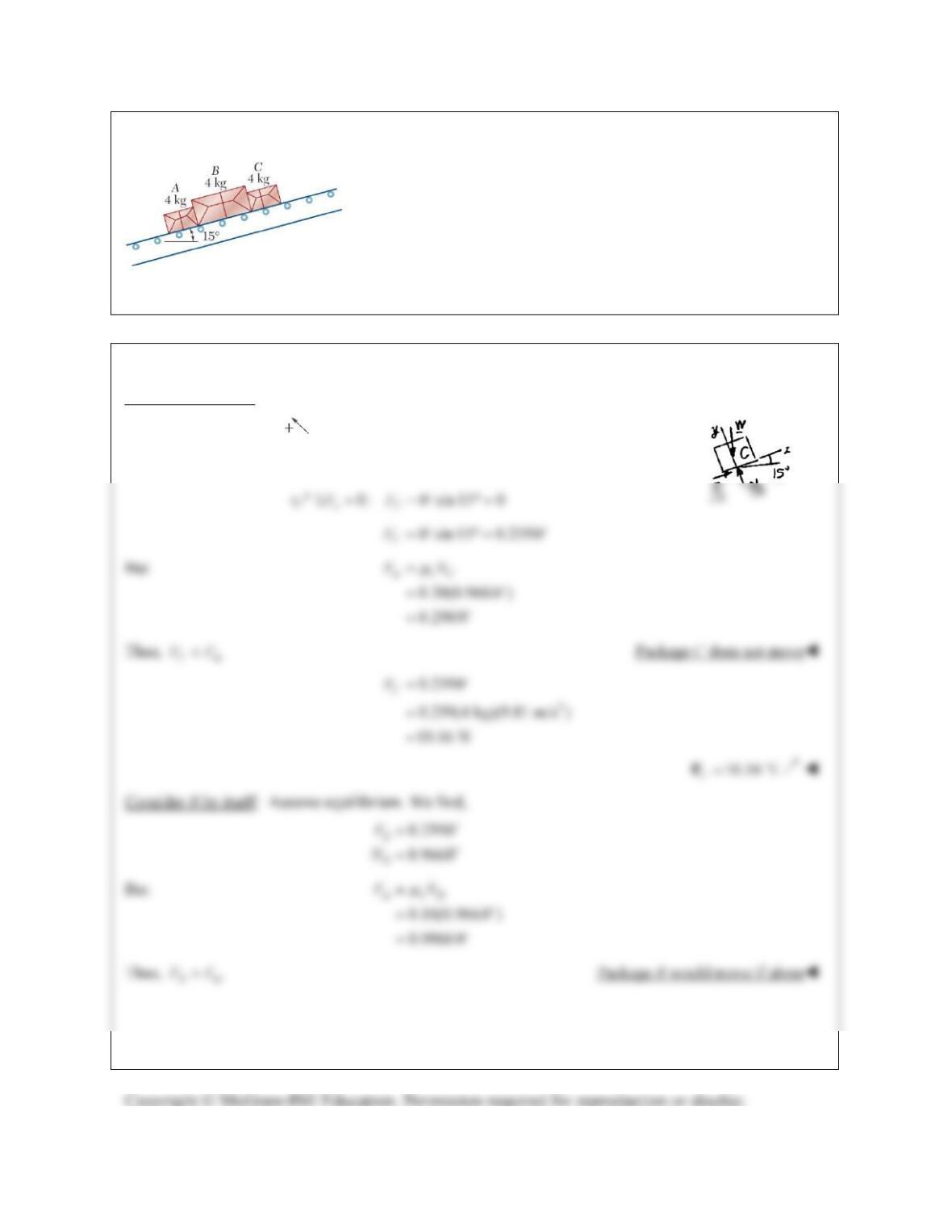
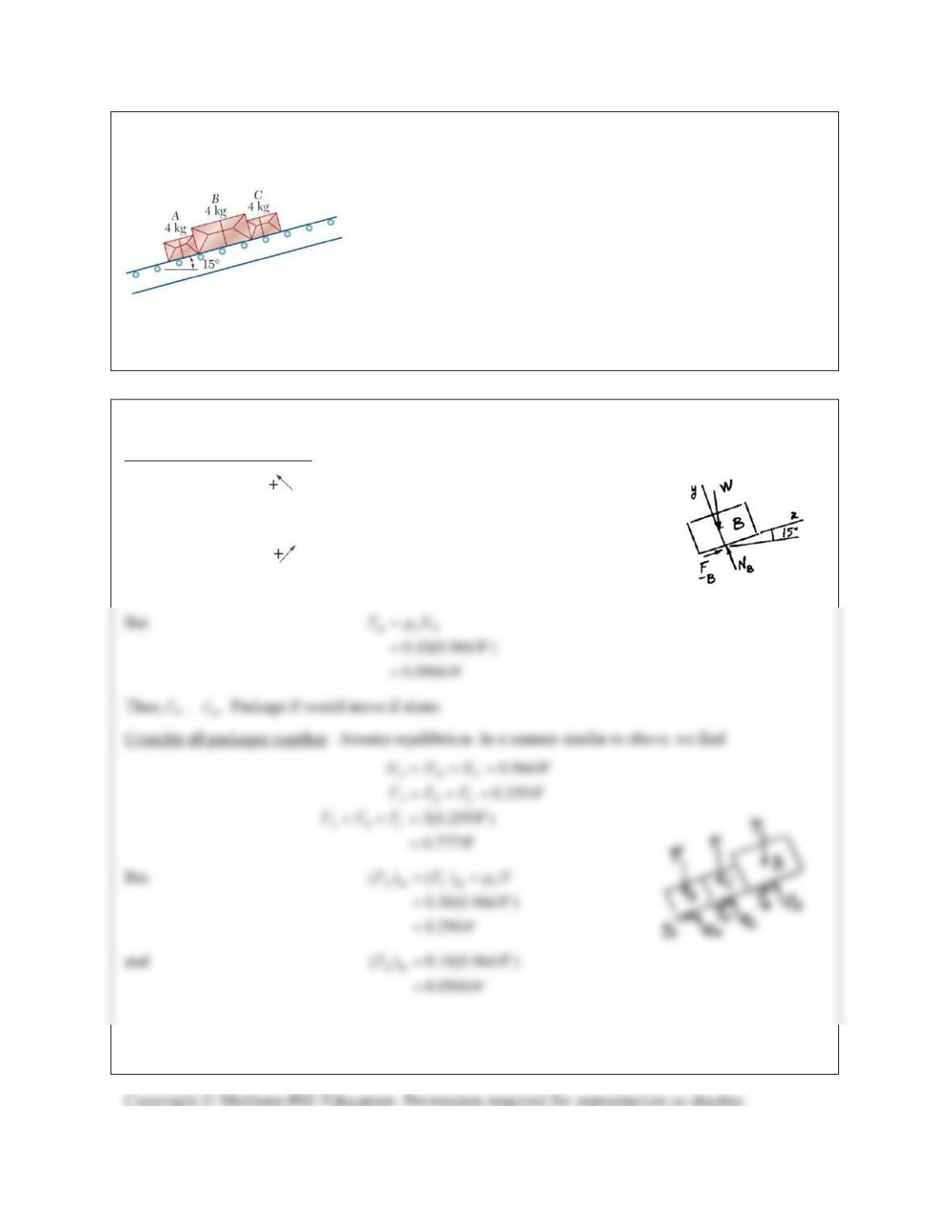
Three 4-kg packagesA, B, and C are placed on a conveyor belt that
is at rest. Between the belt and both packages A and C the
coefficients of friction are
0.30
s
and
0.20;
k
between
package B and the belt the coefficients are
0.10
s
and
0.08.
k
The packages are placed on the belt so that they are in contact with
each other and at rest. Determine which, if any, of the packages will
move and the friction force acting on each package.
SOLUTION
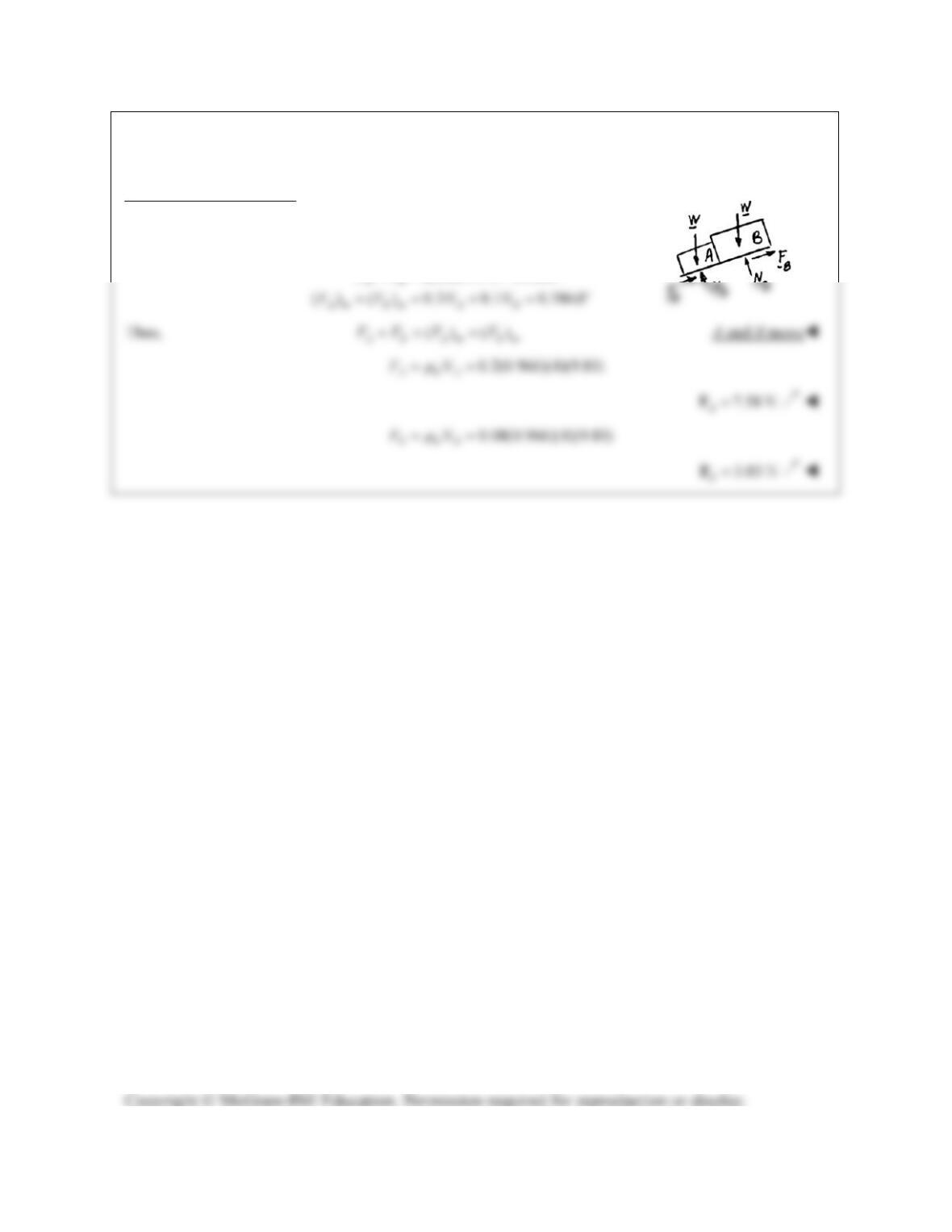
Consider C by itself: Assume equilibrium
0: cos15 0
yC
FNW
cos 15 0.966
C
NW W
PROBLEM 8.13 (Continued)
Consider A and B together: Assume equilibrium
0.259
0.966
2(0.259 ) 0.518
AB
AB
FF W
NN W
FF W W
PROBLEM 8.14
Solve Problem 8.13 assuming that package B is placed to the right of
both packages A and C.
PROBLEM 8.13
Three 4-kg packagesA, B, and C are placed on a
conveyor belt that is at rest. Between the belt and both packages A
and C the coefficients of friction are
0.30
s
and
0.20;
k
between package B and the belt the coefficients are
0.10
s
and
0.08.
k
The packages are placed on the belt so that they are in
contact with each other and at rest. Determine which, if any, of the
packages will move and the friction force acting on each package.
SOLUTION
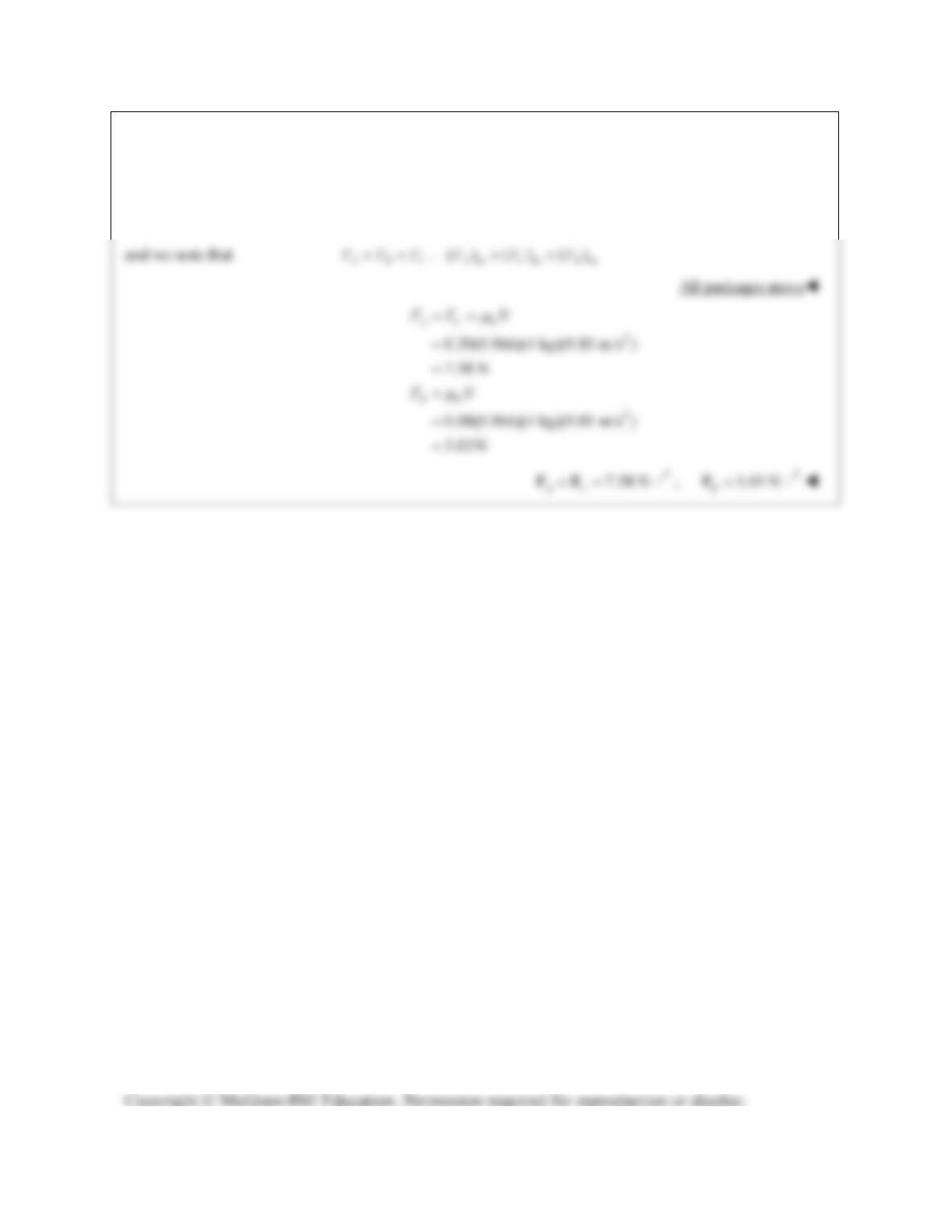
Consider package B by itself: Assume equilibrium
0: cos15 0
yB
FNW
cos 15 0.966
B
NW W
0: sin 15 0
xB
FFW
sin 15 0.259
B
FW W
PROBLEM 8.14 (Continued)
Thus, ( ) ( ) ( ) 2(0.290 ) 0.0966
0.677
Am Cm Bm
FFF W W
W