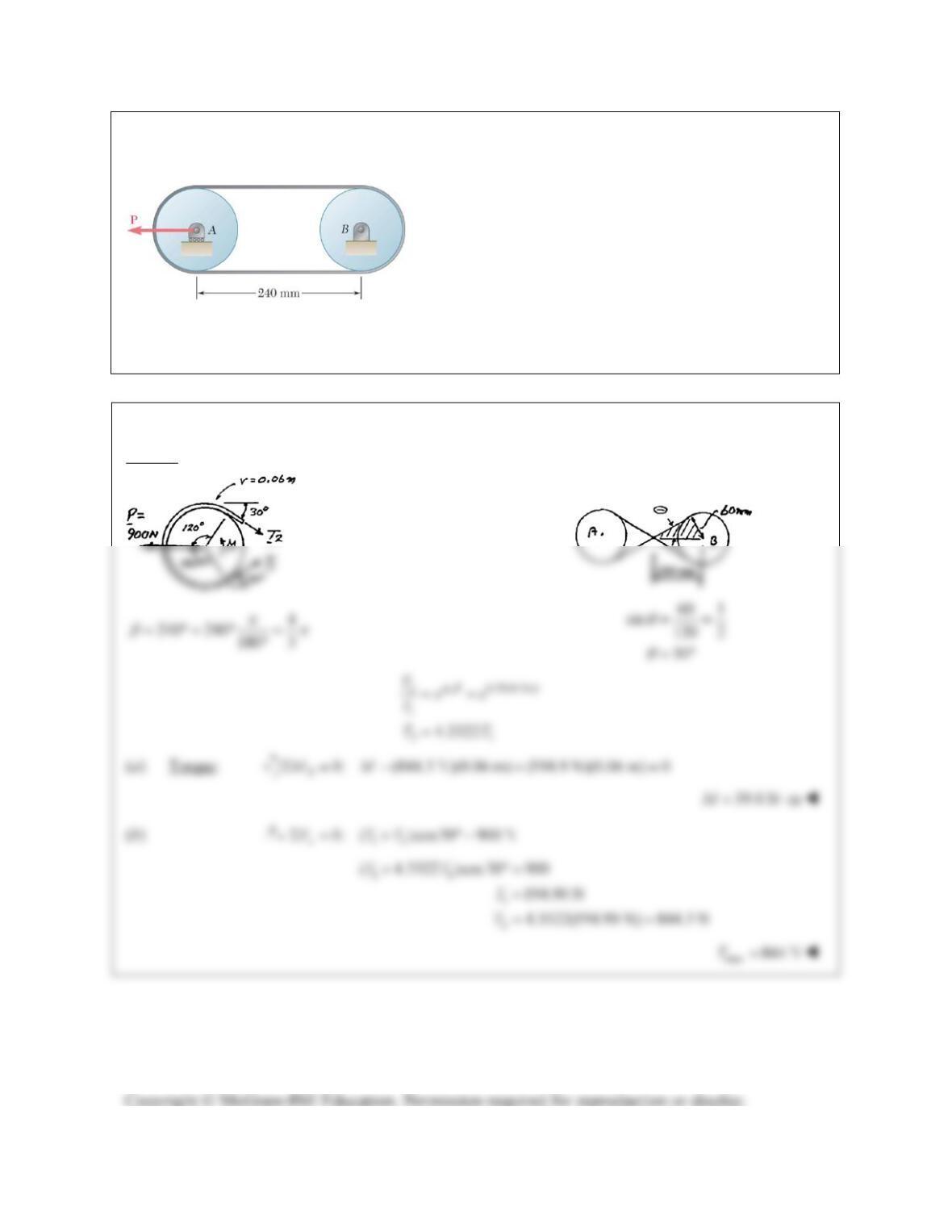
PROBLEM 8.114
Solve Problem 8.113 assuming that the belt is looped
around the pulleys in a figure eight.
PROBLEM 8.113
A flat belt is used to transmit a couple
from pulley A to pulley B. The radius of each pulley is 60
mm, and a force of magnitude P 900 N is applied as
shown to the axle of pulley A. Knowing that the coefficient
of static friction is 0.35, determine (a) the largest couple
that can be transmitted, (b) the corresponding maximum
value of the tension in the belt.
SOLUTION
Drum A:
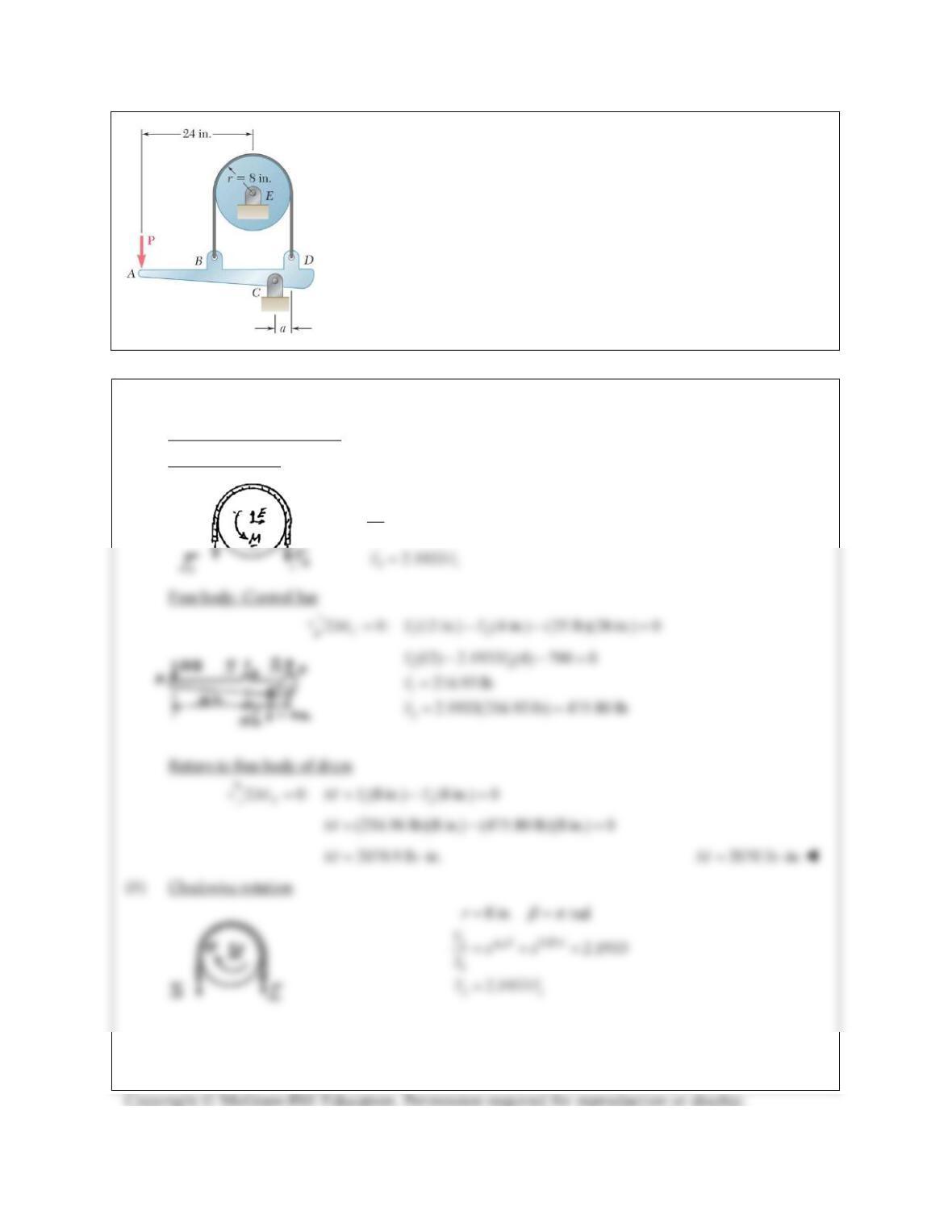
PROBLEM 8.115
The speed of the brake drum shown is controlled by a belt attached to the
control bar AD. A force
P
of magnitude 25 lb is applied to the control bar
at A. Determine the magnitude of the couple being applied to the drum,
knowing that the coefficient of kinetic friction between the belt and the
drum is 0.25, that a 4 in., and that the drum is rotating at a constant
speed (a) counterclockwise, (b) clockwise.
SOLUTION
(a) Counterclockwise rotation
Free body: Drum
0.25
2
1
8 in. 180 radians
2.1933
k
r
Tee
T
PROBLEM 8.115 (Continued)
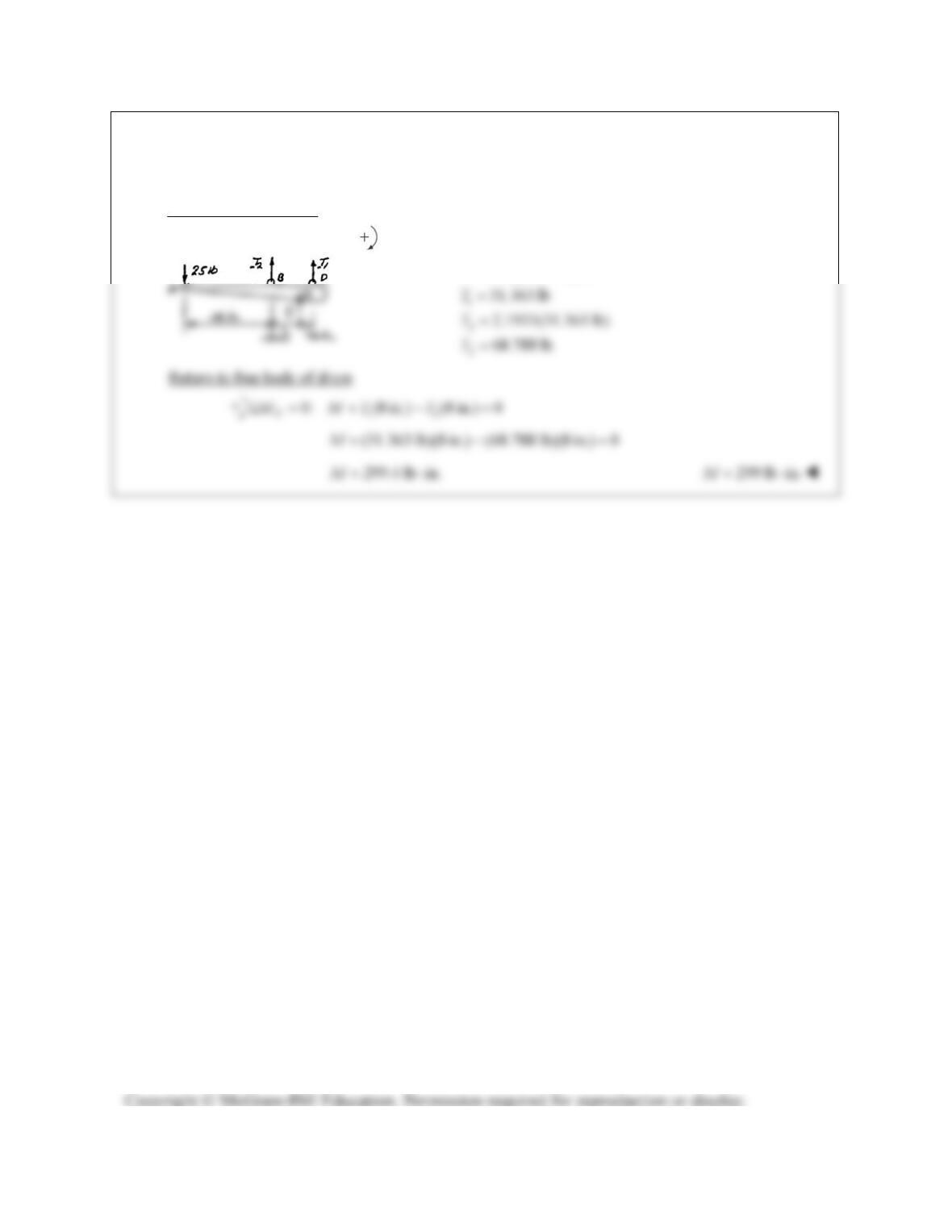
Free body: Control rod
21
0: (12 in.) (4 in.) (25 lb)(28 in.) 0
C
MT T
11
2.1933 (12) (4) 700 0
TT
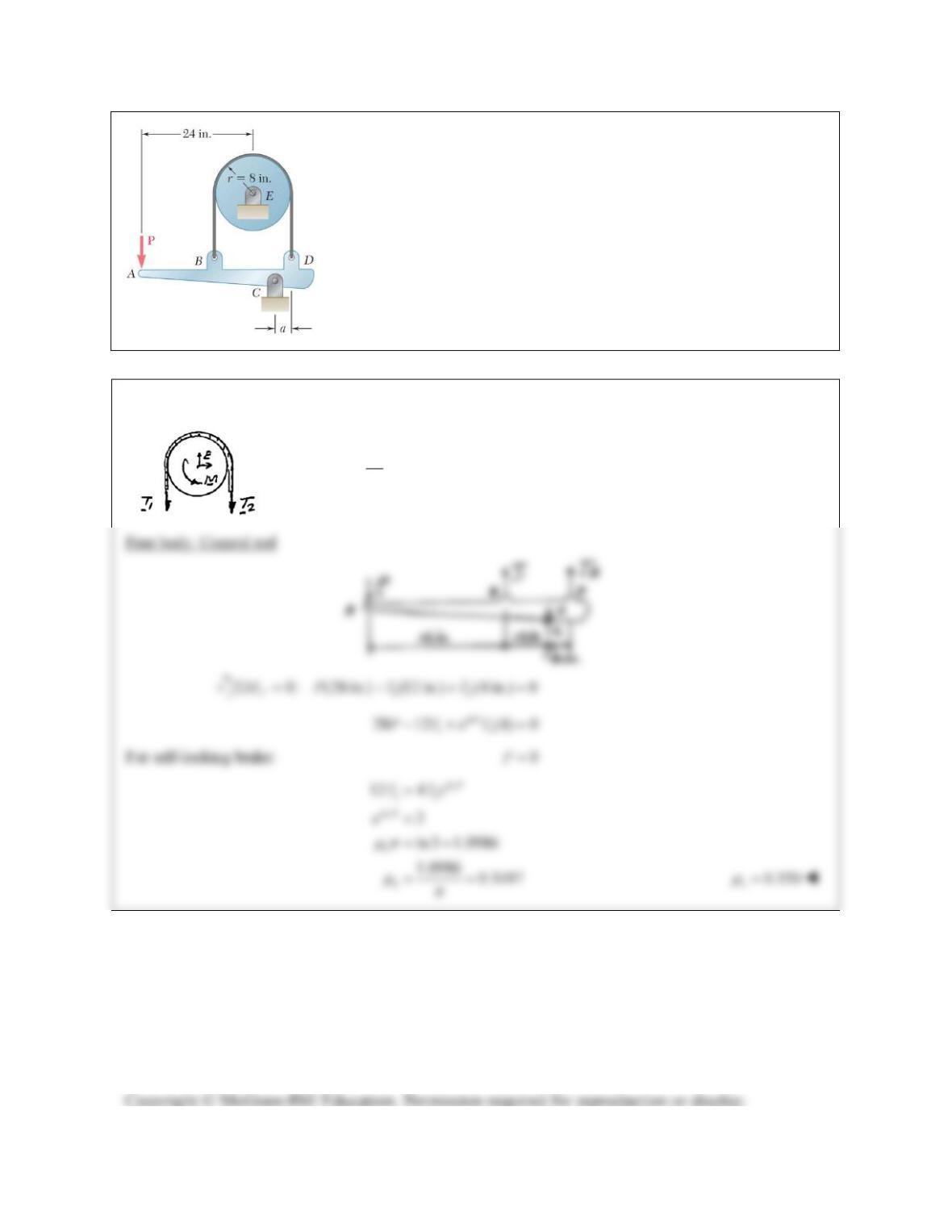
PROBLEM 8.116
The speed of the brake drum shown is controlled by a belt attached to the
control bar AD. Knowing that a 4 in., determine the maximum value of
the coefficient of static friction for which the brake is not self-locking
when the drum rotates counterclockwise.
SOLUTION
2
1
21
8 in., 180 radians
ss
s
r
Tee
T
TeT
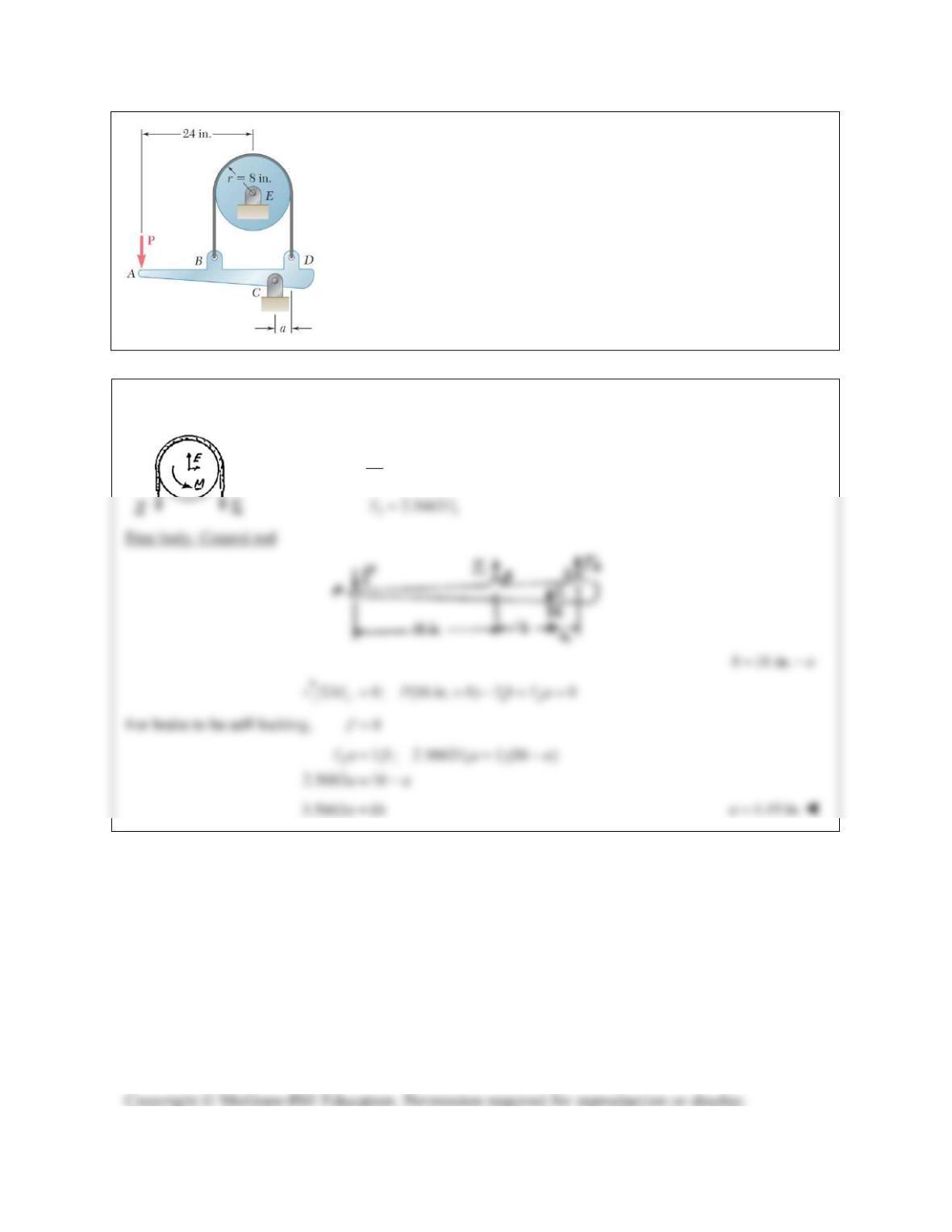
PROBLEM 8.117
The speed of the brake drum shown is controlled by a belt attached to the
control bar AD. Knowing that the coefficient of static friction is 0.30 and
that the brake drum is rotating counterclockwise, determine the minimum
value of a for which the brake is not self-locking.
SOLUTION
0.30
2
1
8in., radians
2.5663
s
r
Tee
T
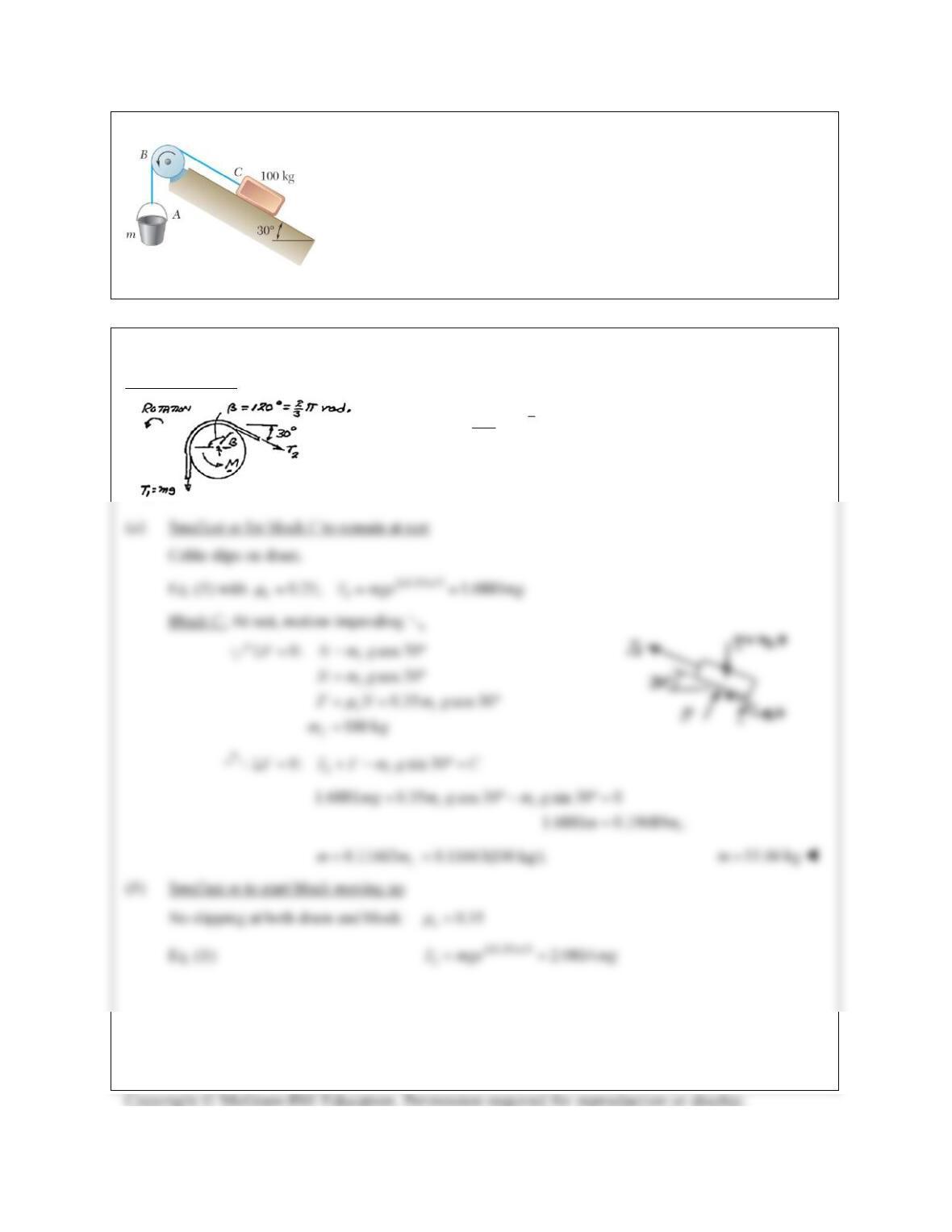
PROBLEM 8.118
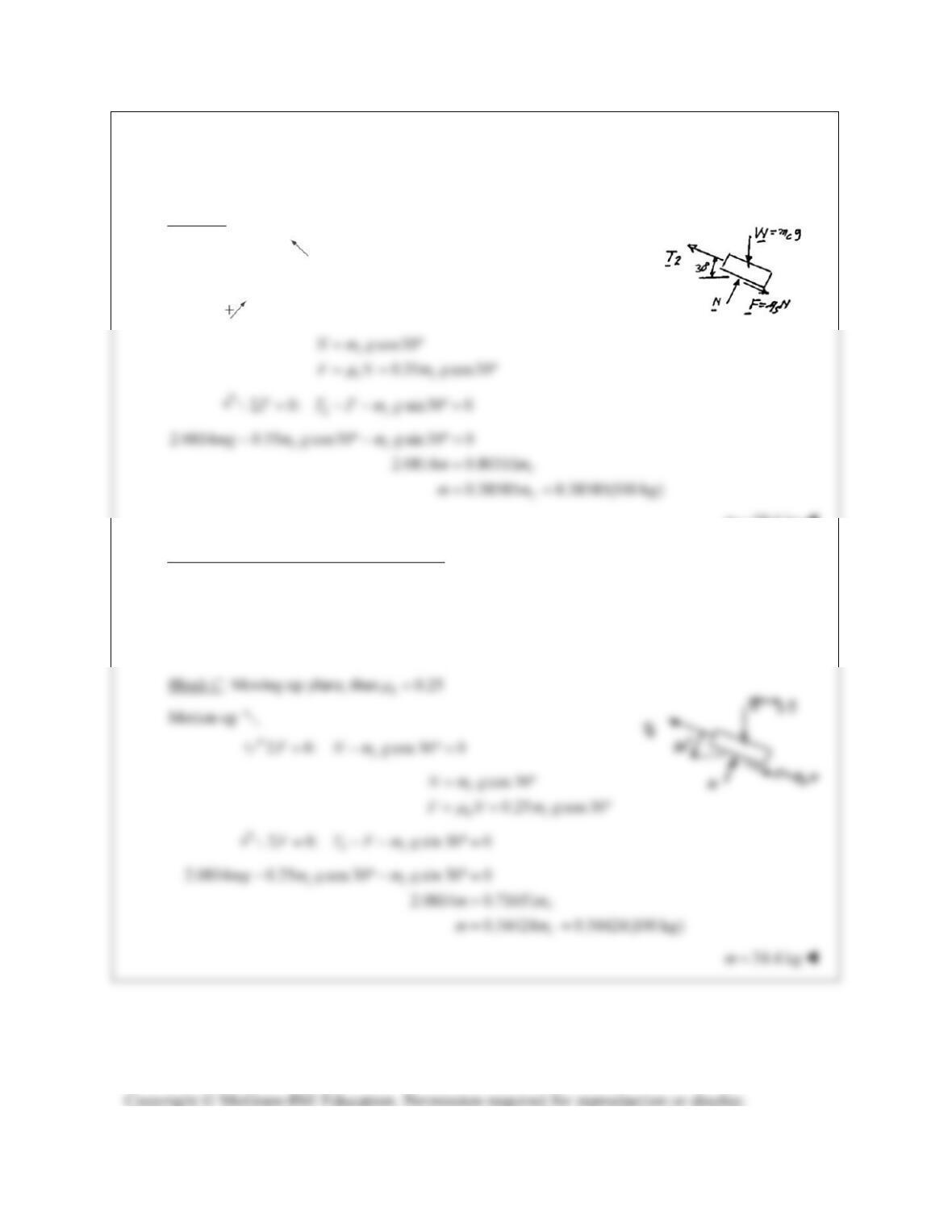
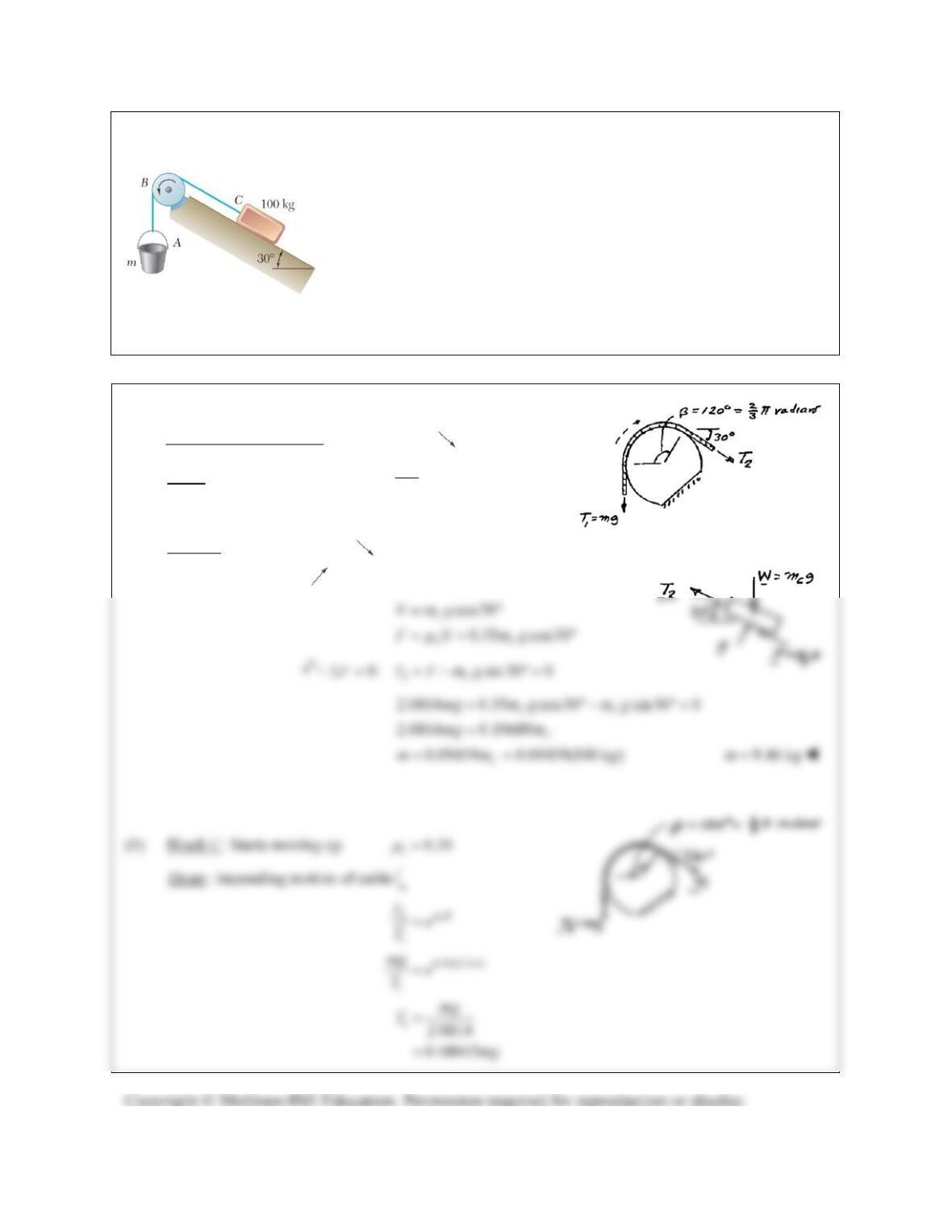
Bucket A and block C are connected by a cable that passes over drum B.
Knowing that drum B rotates slowly counterclockwise and that the
coefficients of friction at all surfaces are
s
0.35 and
k
0.25,
determine the smallest combined mass m of the bucket and its contents
for which block C will (a) remain at rest, (b) start moving up the incline,
(c) continue moving up the incline at a constant speed.
SOLUTION
Free body: Drum
2
23
2/3
2
Te
mg
Tmge
(1)
PROBLEM 8.118 (Continued)
Block C:
Motion impending
100kg
C
m
0: cos30FNmg
38.6 kgm
(c) Smallest m to keep block moving up drum: No slipping:
0.35
s
Eq. (1) with
0.35
s
2/3 2(0.35) /3
2
2
2.0814
s
Tmg mge
Tmg
PROBLEM 8.119
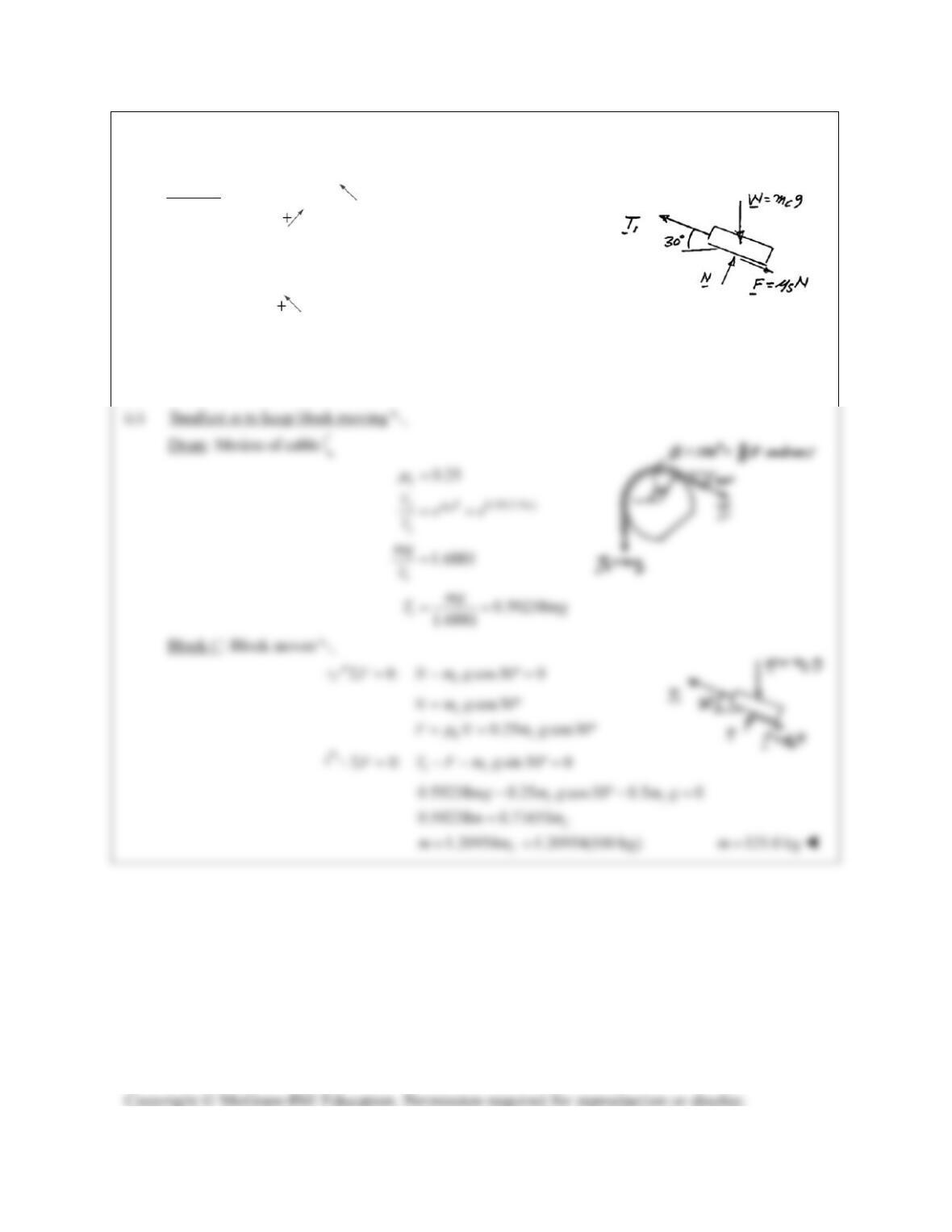
Solve Problem 8.118 assuming that drum B is frozen and cannot rotate.
PROBLEM 8.118
Bucket A and block C are connected by a cable that
passes over drum B. Knowing that drum B rotates slowly
counterclockwise and that the coefficients of friction at all surfaces are
0.35
s
and
0.25,
k
determine the smallest combined mass m of
the bucket and its contents for which block C will (a) remain at rest,
(b) start moving up the incline, (c) continue moving up the incline at a
constant speed.
SOLUTION
(a) Block C remains at rest: Motion impends
Drum:
0.35(2 /3)
2
2
2.0814
k
Tee
mg
Tmg
Block C: Motion impends
0: cos30 0
C
FNmg
PROBLEM 8.119 (Continued)
Block C: Motion impends
0: cos30
C
FNmg
cos 30
0.35 cos30
C
sC
Nmg
FN mg
1
0: sin30 0
C
FTFmg
0.48045 0.35 cos30 0.5 0
0.48045 0.80311
1.67158 1.67158(100 kg)
CC
C
C
mg m g m g
mm
mm
167.2 kgm
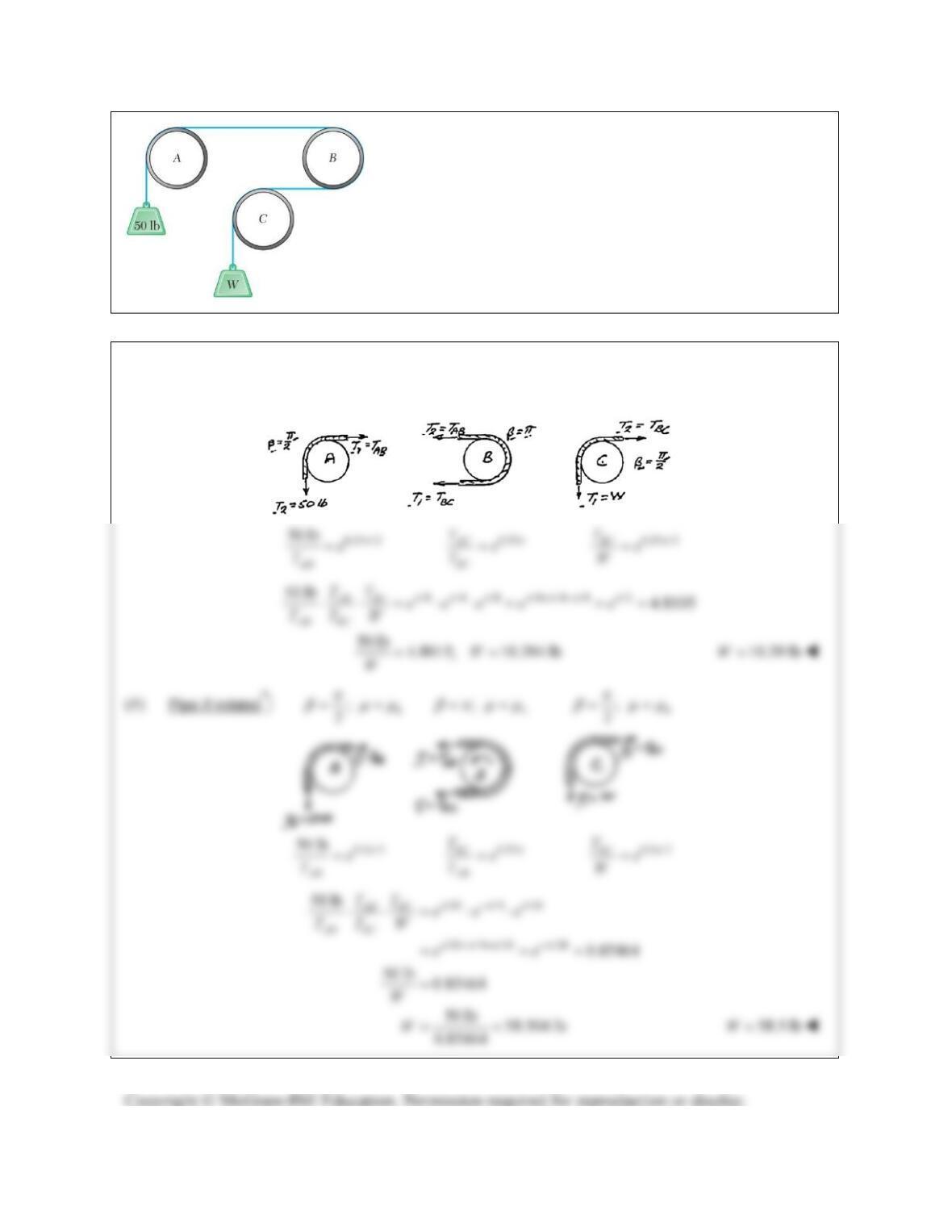
PROBLEM 8.120
A cable is placed around three parallel pipes. Knowing that the
coefficients of friction are
0.25
s
and
0.20,
k
determine
(a) the smallest weight W for which equilibrium is maintained,
(b) the largest weight W that can be raised if pipe B is slowly
rotated counterclockwise while pipes A and C remain fixed.
SOLUTION
(a)
0.25
s
at all pipes.
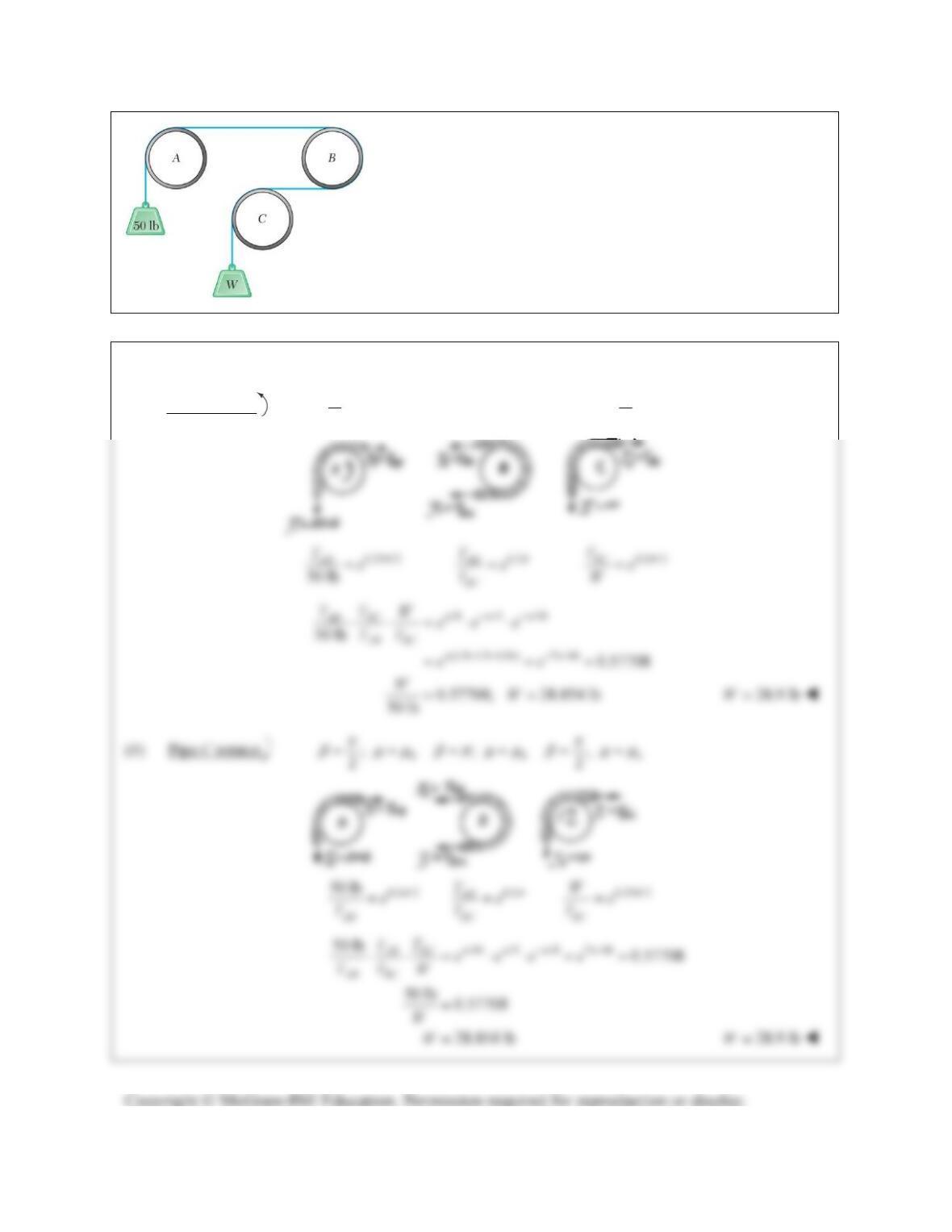
PROBLEM 8.121
A cable is placed around three parallel pipes. Two of the pipes are
fixed and do not rotate; the third pipe is slowly rotated. Knowing
that the coefficients of friction are
0.25
s
and
0.20,
k
determine the largest weight W that can be raised (a) if only pipe
A is rotated counterclockwise, (b) if only pipe C is rotated
clockwise.
SOLUTION
(a) Pipe A rotates
;, ;
22
sk k
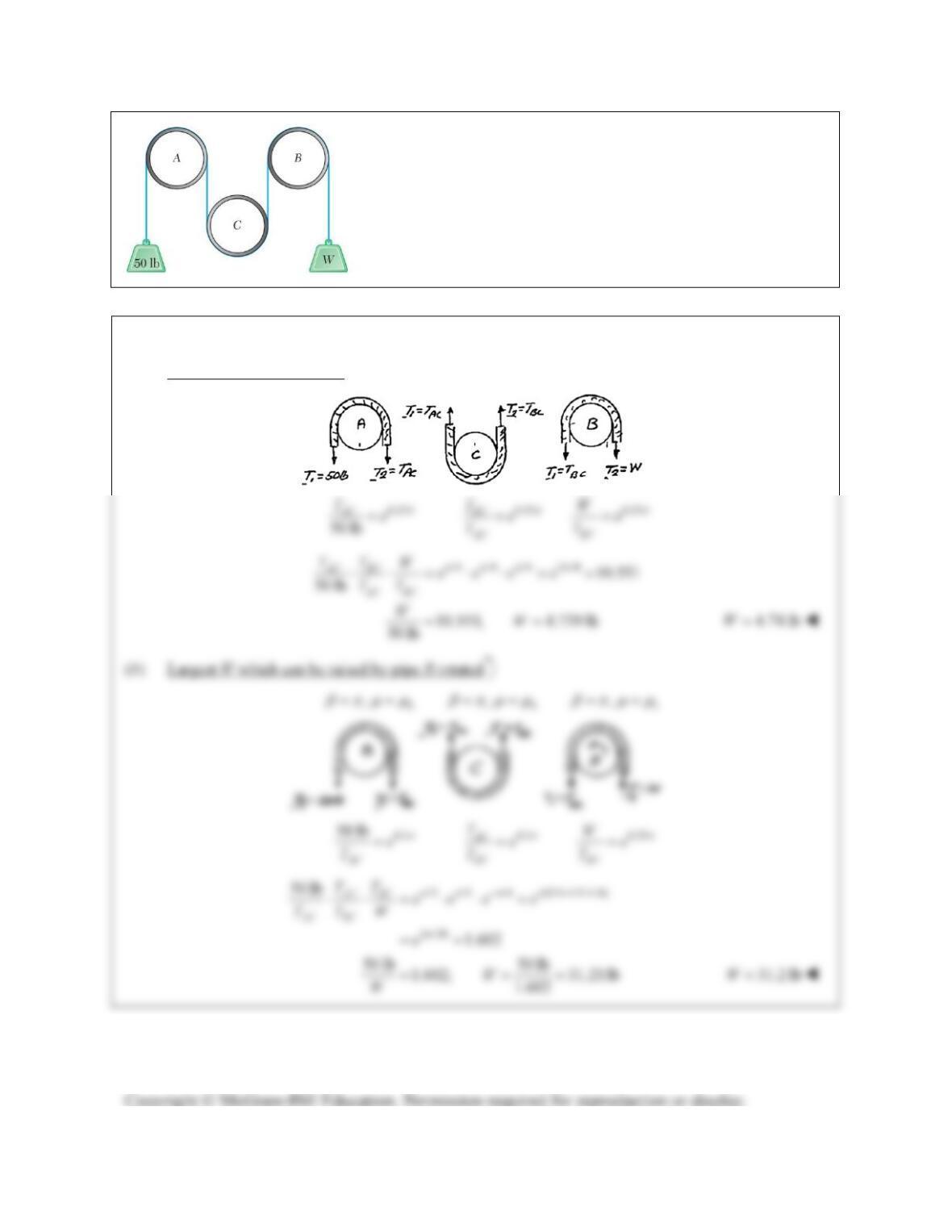
PROBLEM 8.122
A cable is placed around three parallel pipes. Knowing that the
coefficients of friction are
0.25
s
and
0.20,
k
determine
(a) the smallest weight W for which equilibrium is maintained,
(b) the largest weight W that can be raised if pipe B is slowly
rotated counterclockwise while pipes A and C remain fixed.
SOLUTION
(a) Smallest W for equilibrium
,
s
B
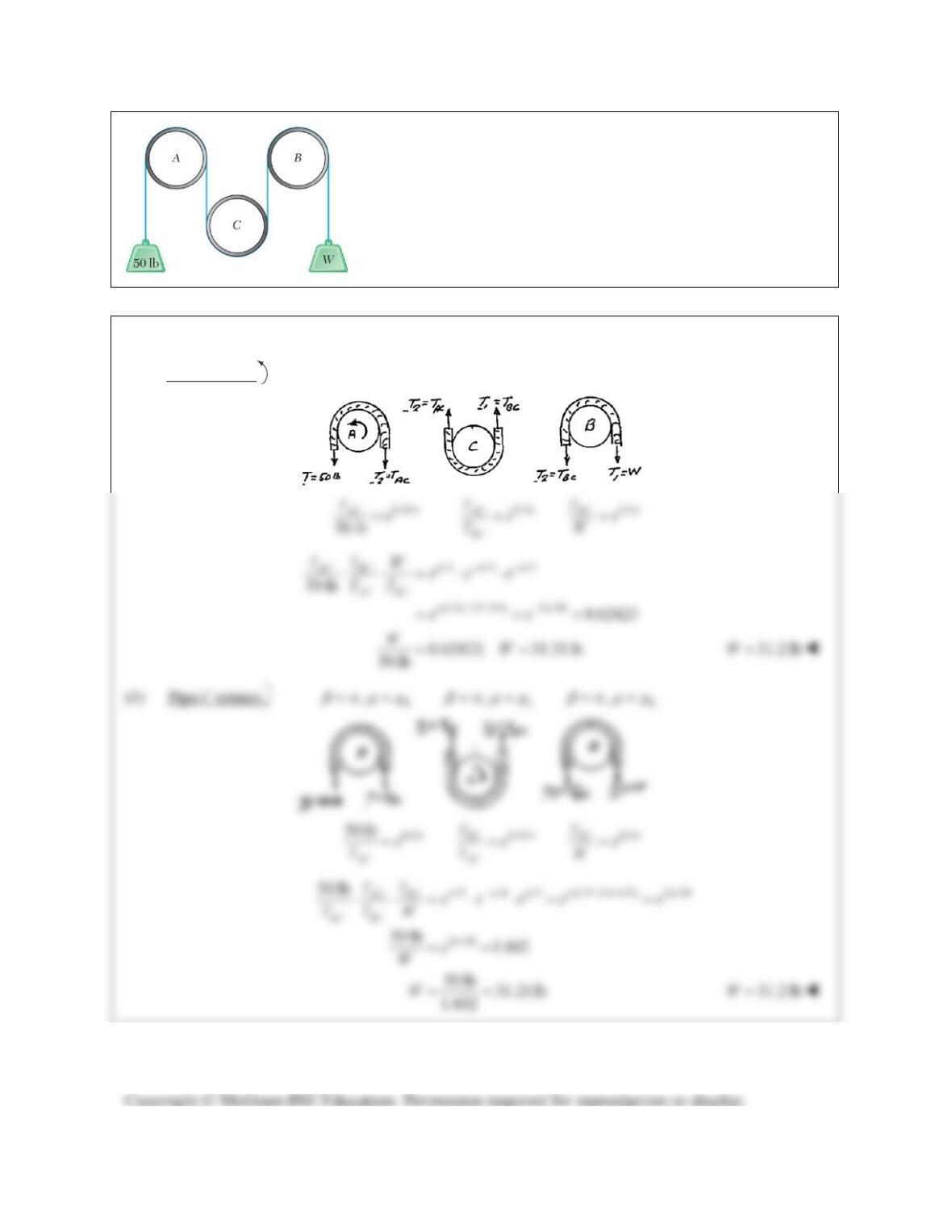
PROBLEM 8.123
A cable is placed around three parallel pipes. Two of the pipes are
fixed and do not rotate; the third pipe is slowly rotated. Knowing
that the coefficients of friction are
0.25
s
and
0.20,
k
determine the largest weight W that can be raised (a) if only pipe A
is rotated counterclockwise, (b) if only pipe C is rotated clockwise.
SOLUTION
(a) Pipe A rotates
,,,
skk
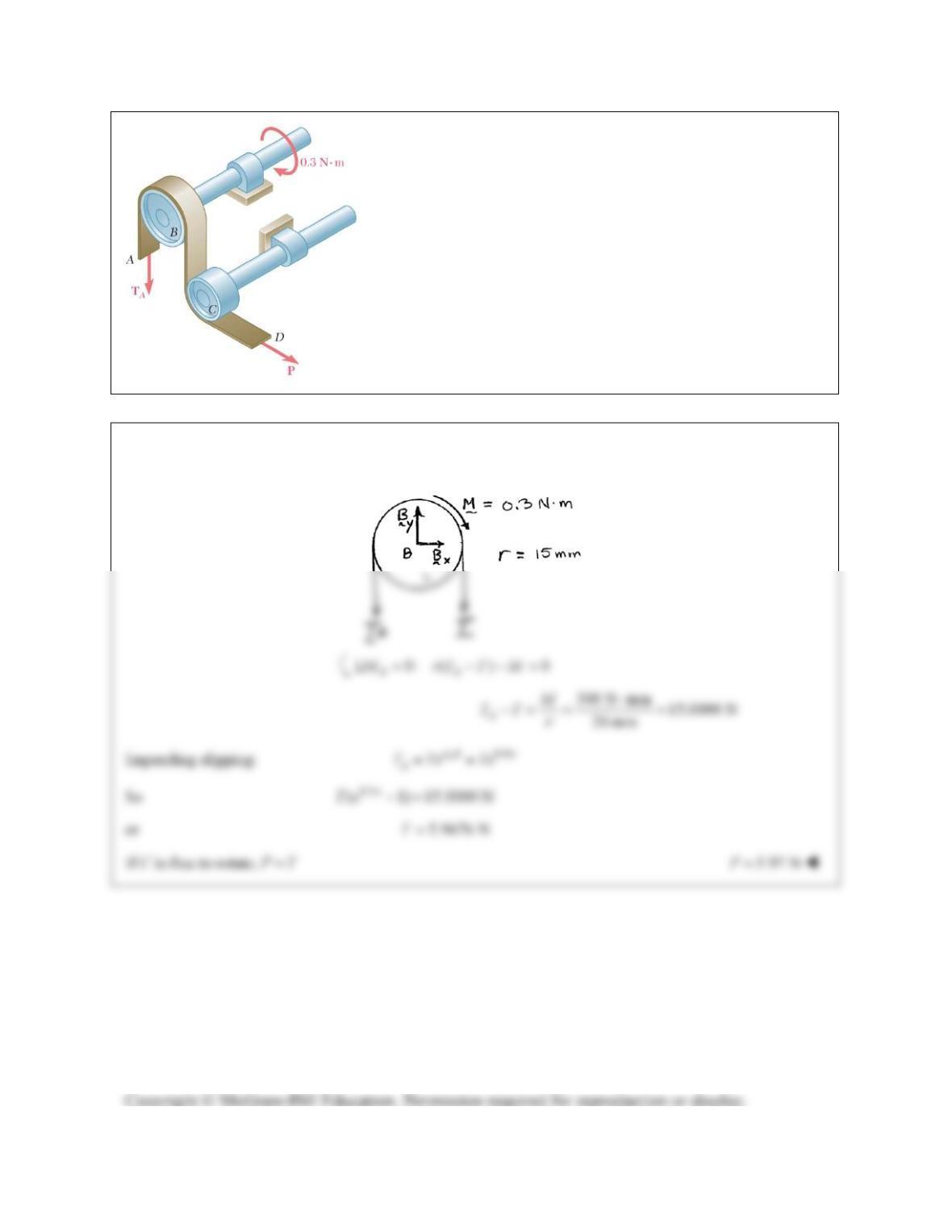
PROBLEM 8.124
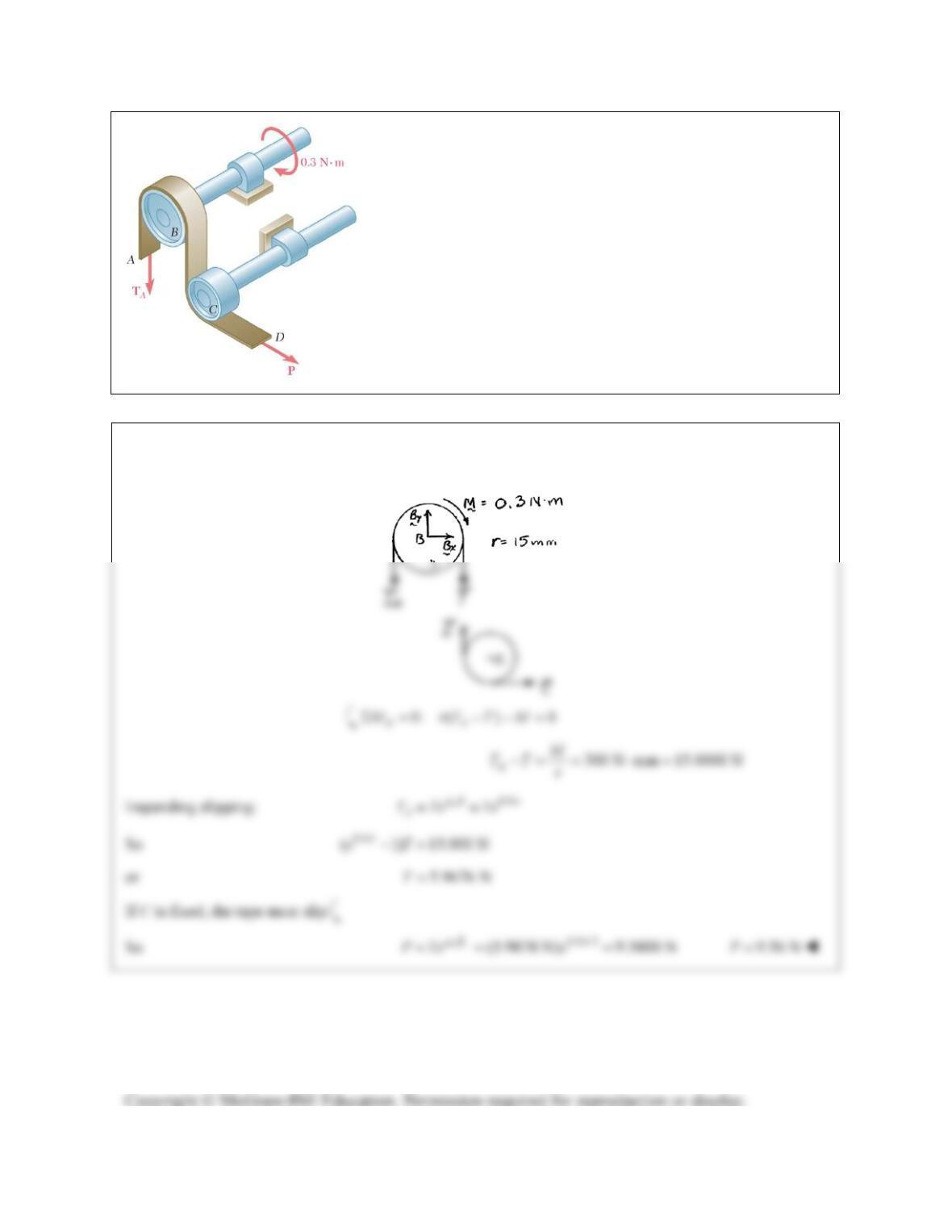
A recording tape passes over the 20-mm-radius drive drum B and
under the idler drum C. Knowing that the coefficients of friction
between the tape and the drums are
0.40
s
and
0.30
k
and
that drum C is free to rotate, determine the smallest allowable value
of P if slipping of the tape on drum B is not to occur.
SOLUTION
FBD drive drum:
PROBLEM 8.125
Solve Problem 8.124 assuming that the idler drum C is frozen and
cannot rotate.
PROBLEM 8.124 A recording tape passes over the 20-mm-radius
drive drum B and under the idler drum C. Knowing that the
coefficients of friction between the tape and the drums are
0.40
s
and
0.30
k
and that drum C is free to rotate,
determine the smallest allowable value of P if slipping of the tape
on drum B is not to occur.
SOLUTION
FBD drive drum:
PROBLEM 8.126
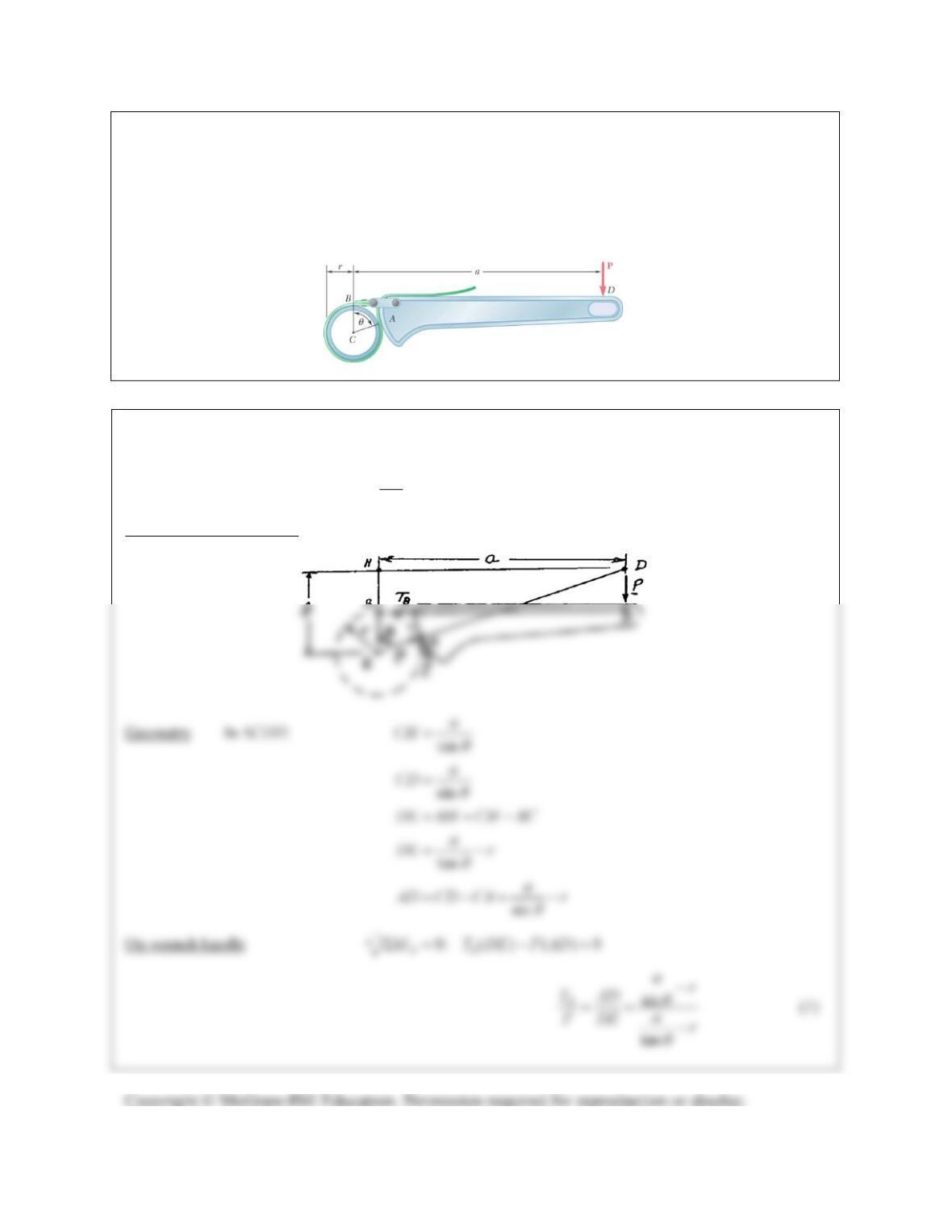
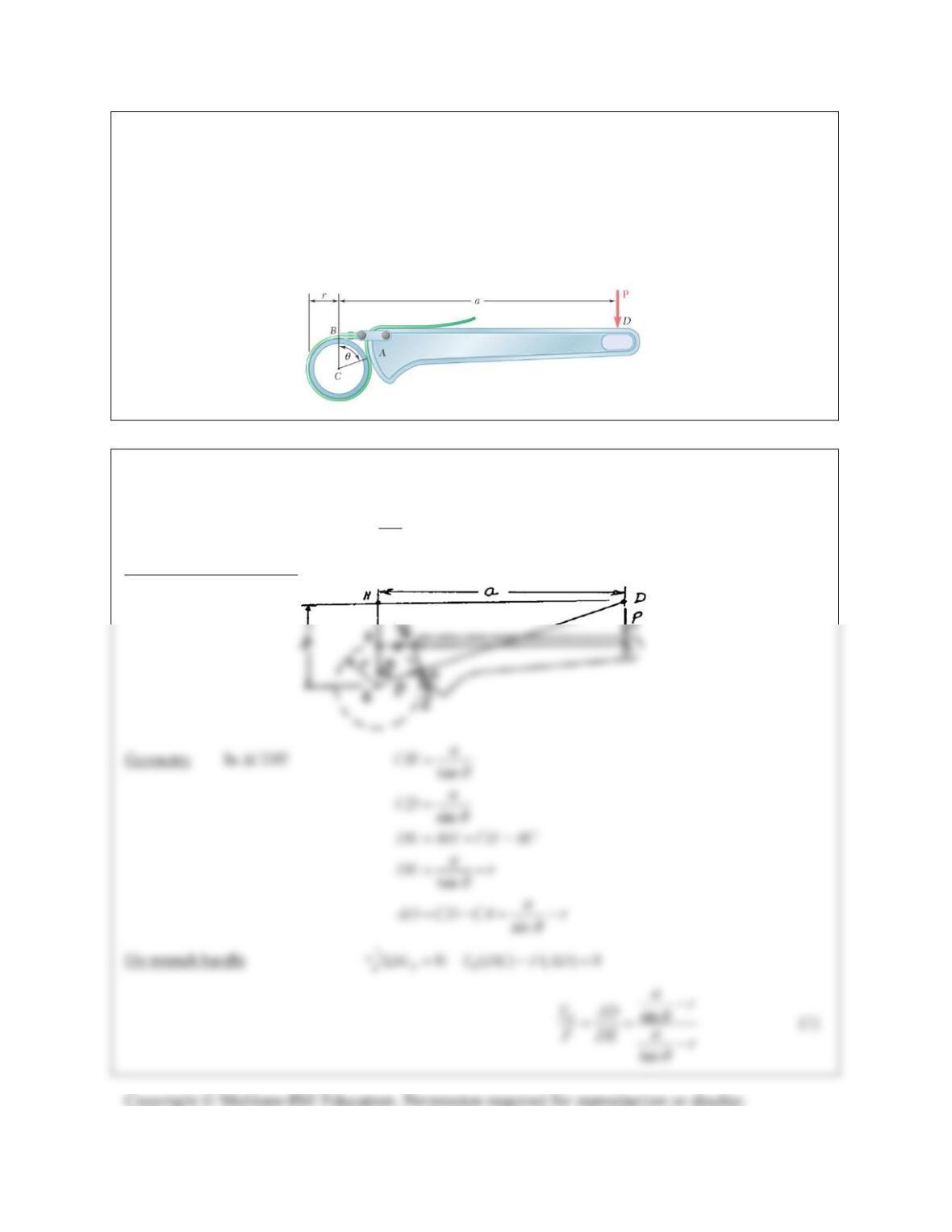
The strap wrench shown is used to grip the pipe firmly without marring the external surface of the pipe.
Knowing that the coefficient of static friction is the same for all surfaces of contact, determine the
smallest value of
s
for which the wrench will be self-locking when
200 mm, 30 mm,ar
and
65 .
SOLUTION
For wrench to be self-locking
(0),P
the value of
s
must prevent slipping of strap which is in contact
with the pipe from Point A to Point Band must be large enough so that at Point A the strap tension can
increase from zero to the minimum tension required to develop “belt friction” between strap and pipe.
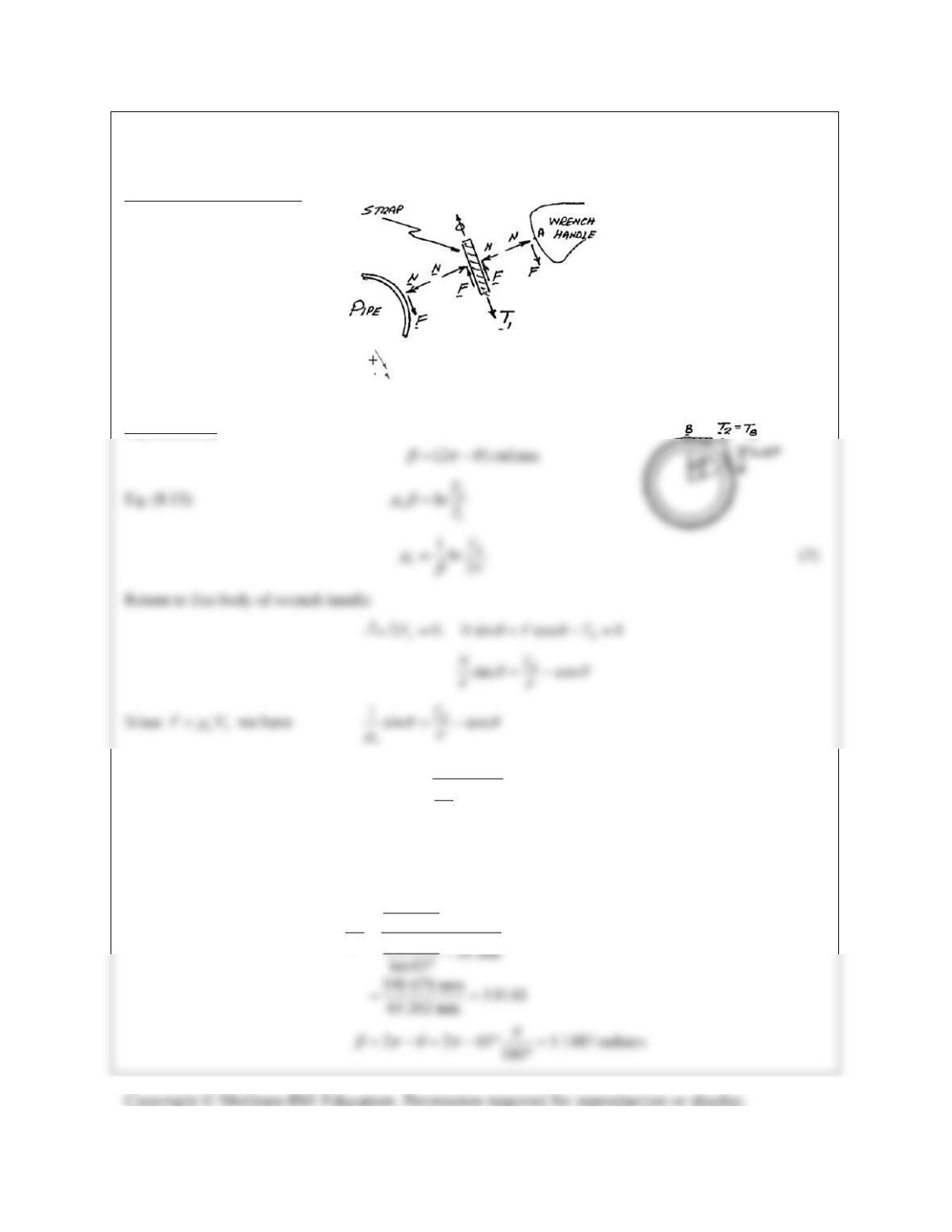
Free body: Wrench handle
PROBLEM 8.126 (Continued)
Free body: Strap at Point A
1
0: 2 0FTF
1
2TF
(2)
Pipe and strap
or
sin
cos
s
B
T
F
(4)
(Note: For a given set of data, we seek the larger of the values of
s
from Eqs. (3) and (4).)
For
200 mm, 30 mm, 65°ar
Eq. (1):
200 mm 30 mm
sin 65
200 mm 30 mm
B
T
F
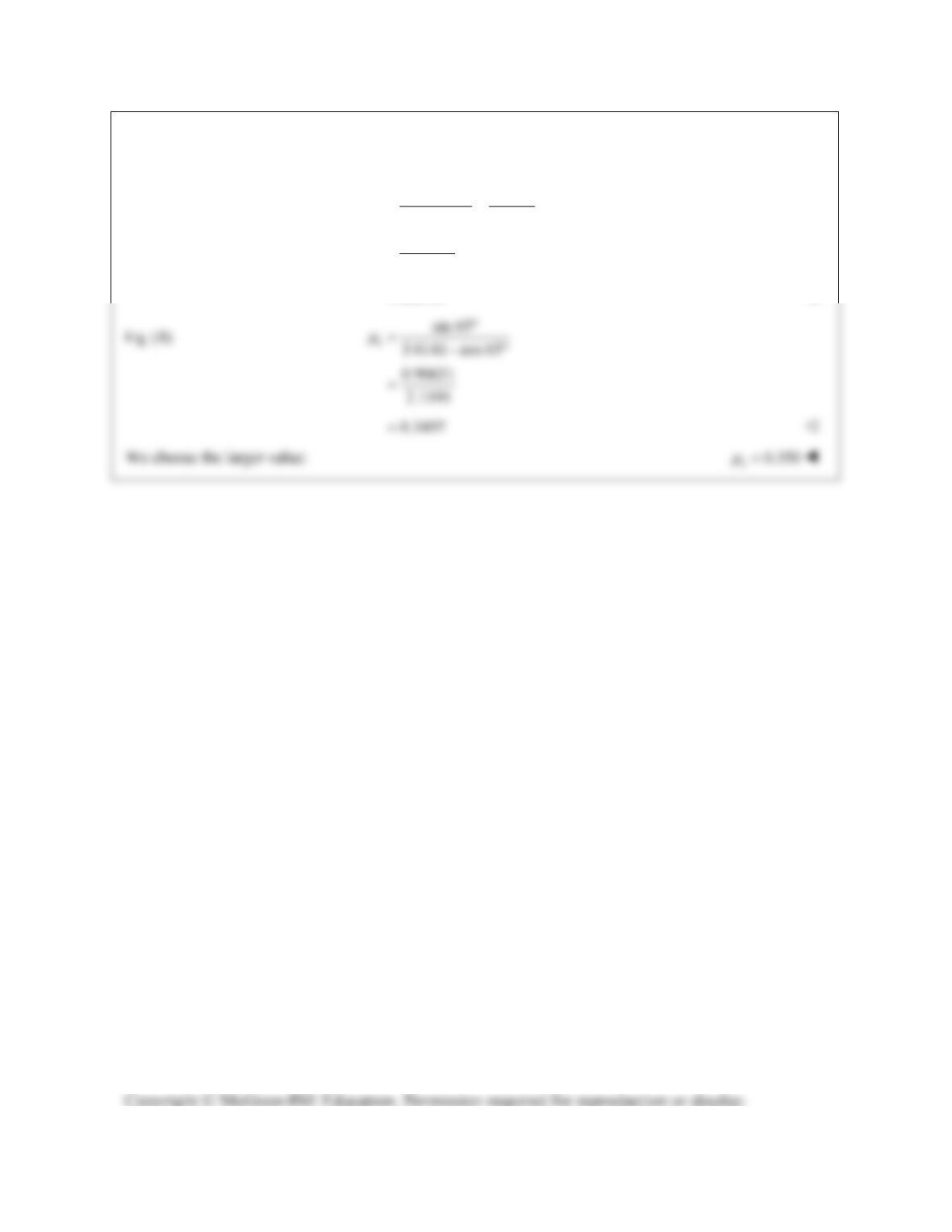
PROBLEM 8.126 (Continued)
Eq. (3): 13.0141
ln
5.1487 rad 2
0.41015
5.1487
s
0.0797
PROBLEM 8.127
Solve Problem 8.126 assuming that
75 .
PROBLEM 8.126 The strap wrench shown is used to grip the pipe firmly without marring the external
surface of the pipe. Knowing that the coefficient of static friction is the same for all surfaces of contact,
determine the smallest value of
s
for which the wrench will be self-locking when
200 mm, 30 mm,ar
and
65 .
SOLUTION
For wrench to be self-locking
(0),P
the value of
s
must prevent slipping of strap which is in contact
with the pipe from Point A to Point Band must be large enough so that at Point A the strap tension can
increase from zero to the minimum tension required to develop “belt friction” between strap and pipe.
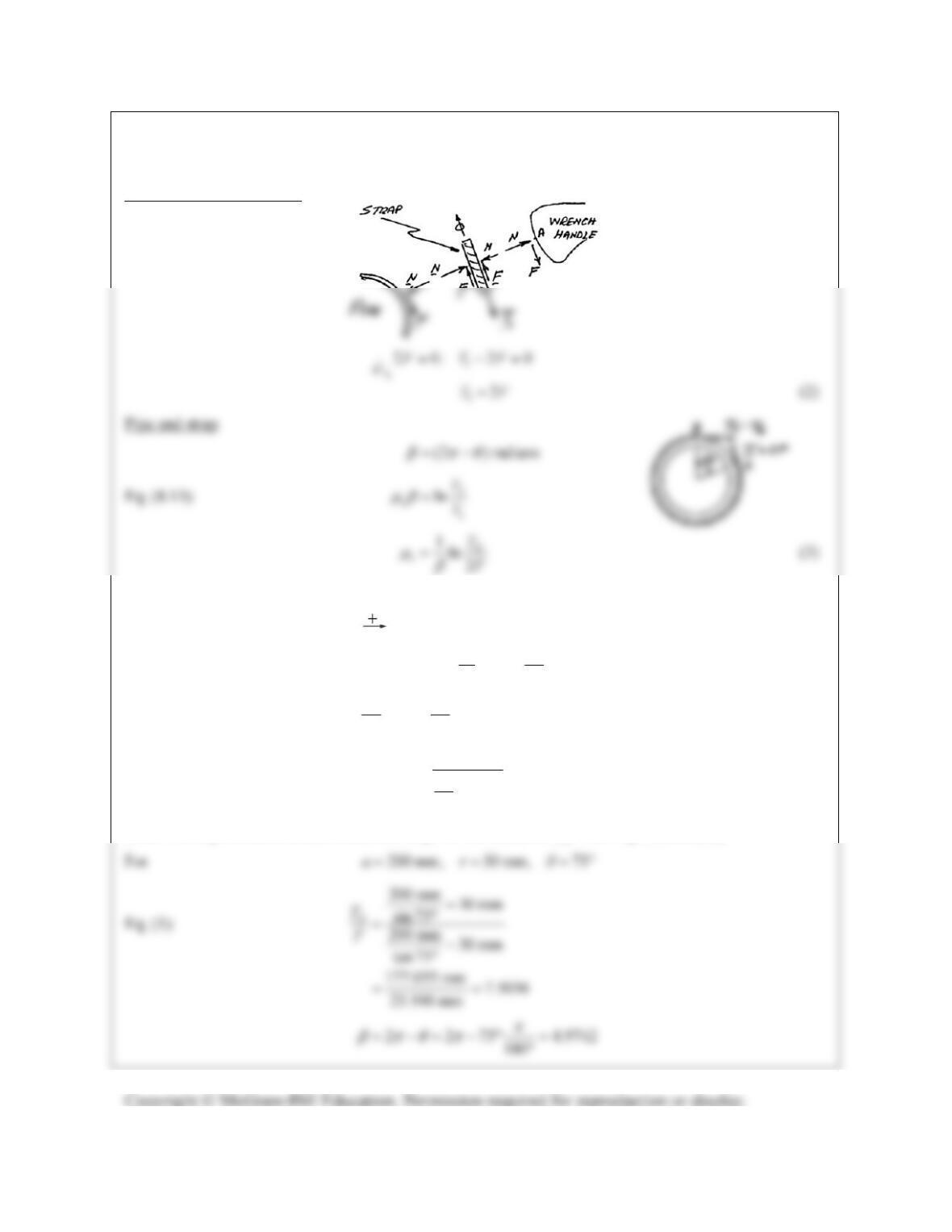
Free body: Wrench handle
PROBLEM 8.127 (Continued)
Free body: Strap at Point A
Return to free body of wrench handle
0: sin cos 0
xB
FNFT
sin cos
B
T
N
FF
Since
,
s
FN
we have
1sin cos
B
s
T
F
or
sin
cos
s
B
T
F
(4)
(Note: For a given set of data, we seek the larger of the values of
s
from Eqs. (3) and (4).)