Chapter 8
Receivables
Review Questions
1. What is the difference between accounts receivable and notes receivable?
Accounts receivable represent the right to receive cash in the future from customers for goods sold
2. List some common examples of other receivables, besides accounts receivable and notes receivable.
3. What is a critical element of internal control in the handling of receivables by a business? Explain
how this element is accomplished.
A critical element of internal control is the separation of cash-handling and cash-accounting duties.
4. When dealing with receivables, give an example of a subsidiary account.
5. What type of account must the sum of all subsidiary accounts be equal to?
The balance in all the subsidiary accounts receivable accounts must equal the total balance of the
control account, Accounts Receivable.
6. What are some benefits to a business in accepting credit cards and debit cards?
7. What are two common methods used when accepting deposits for credit card and debit card
transactions?
Two common methods for deposits of proceeds from credit card sales are the net method and the
8. What occurs when a business factors its receivables?
When a business factors its receivables, it sells its receivables to a finance company or bank (often
9. What occurs when a business pledges its receivables?
In a pledging situation, a business uses its receivables as security for a loan. The business borrows
10. What is the expense account associated with the cost of uncollectible receivables called?
Bad Debts Expense is the account associated with the cost of the uncollectible receivables.
11. When is bad debts expense recorded when using the direct write-off method?
12. What are some limitations of using the direct write-off method?
13. When is bad debts expense recorded when using the allowance method?
Under the allowance method, bad debts expense is estimated and recorded in the same period as the
14. When using the allowance method, how are accounts receivable shown on the balance sheet?
Under the allowance method, accounts receivable are shown at the net realizable value. Net
15. When using the allowance method, what account is debited when writing off uncollectible accounts?
How does this differ from the direct write-off method?
16. When a receivable is written off under the allowance method, how does it affect the net realizable
value shown on the balance sheet?
17. How does the percent-of-sales method compute bad debts expense?
The percent-of-sales method computes bad debts expense as a percentage of net credit sales.
18. How do the percent-of-receivables and aging-of-receivables methods compute bad debts expense?
In both the percent-of-receivables method and aging-of-receivables method, the business determines
19. What is the difference between the percent-of-receivables and aging-of-receivables methods?
20. What is the formula to compute interest on a note receivable?
The formula for computing interest is as follows: Amount of interest = Principal × Interest rate ×
Time.
21. Why must companies record accrued interest revenue at the end of the accounting period?
The interest revenue earned on the note up to year-end is part of that year’s earnings. Interest
22. How is the acid-test ratio calculated, and what does it signify?
23. What does the accounts receivable turnover ratio measure, and how is it calculated?
24. What does the days’ sales in receivables indicate, and how is it calculated?
Days’ sales in receivables, also called the collection period, indicates how many days it takes to
Short Exercises
S8-1 Ensuring internal control over the collection of receivables
Learning Objective 1
Consider internal control over receivables collections. What job must be withheld from a company’s
credit department in order to safeguard its cash? If the credit department does perform this job, what can
a credit department employee do to hurt the company?
SOLUTION
The company’s credit department should not take customer payments or have any other cash-handling
S8-2 Recording credit card and debit card sales
Learning Objective 1
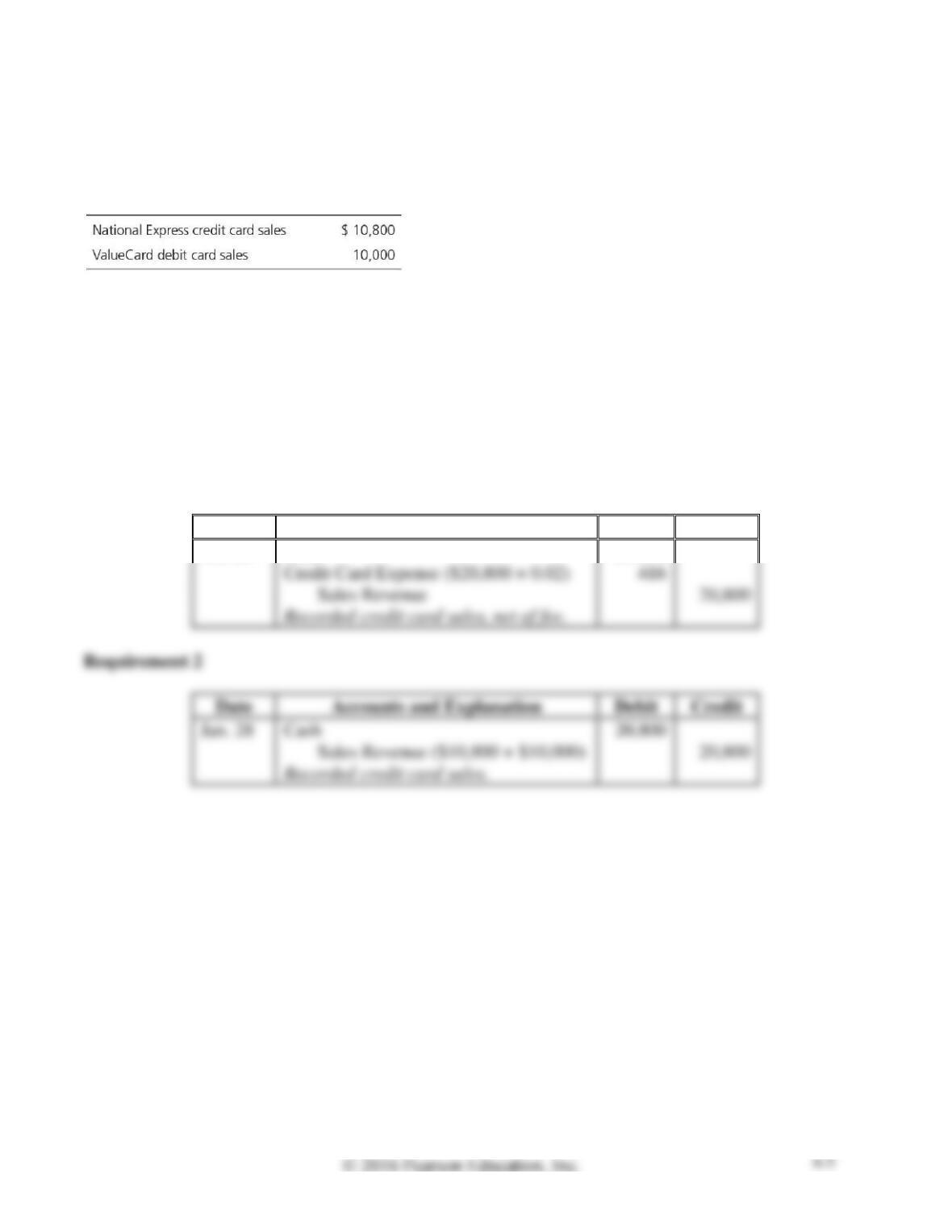
Restaurants do a large volume of business by credit and debit cards. Suppose Summer, Sand, and
Castles Resort restaurant had these transactions on January 28, 2016:
Requirements
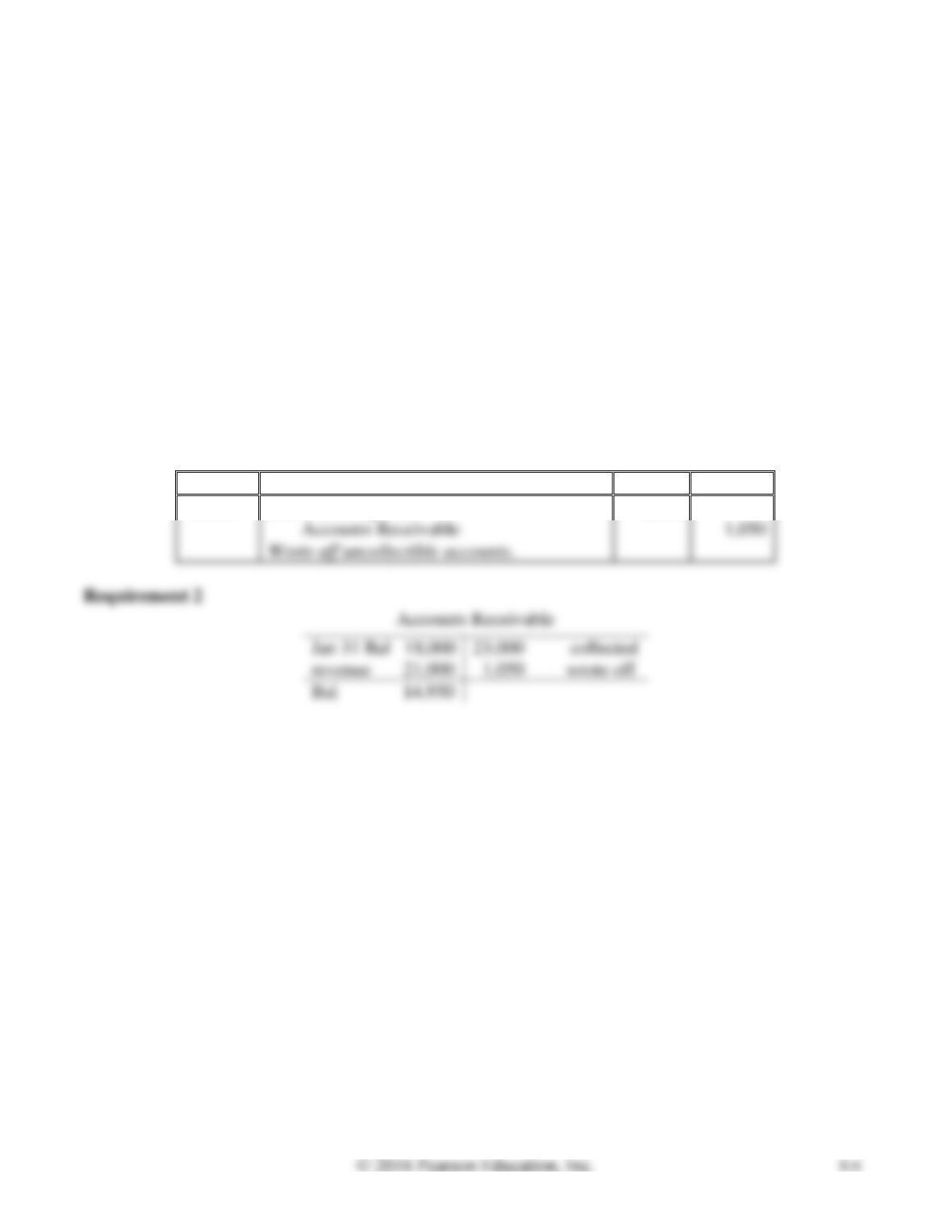
1. Suppose Summer, Sand, and Castles Resort’s processor charges a 2% fee and deposits sales net of
the fee. Journalize these sales transactions for the restaurant.
2. Suppose Summer, Sand, and Castles Resort’s processor charges a 2% fee and deposits sales using
the gross method. Journalize these sales transactions for the restaurant.
SOLUTION
Requirement 1
Date
Accounts and Explanation
Debit
Credit
Jan. 28
Cash
20,384
Credit Card Expense ($20,800 × 0.02)
Date
Accounts and Explanation
Debit
Credit
Jan. 28
Cash
20,800
S8-3 Applying the direct write-off method to account for uncollectibles
Learning Objective 2
Susan Knoll is an attorney in Los Angeles. Knoll uses the direct write-off method to account for
uncollectible receivables.
At January 31, 2016, Knoll’s accounts receivable totaled $18,000. During February, she earned revenue
of $21,000 on account and collected $23,000 on account. She also wrote off uncollectible receivables of
$1,050 on February 29, 2016.
Requirements
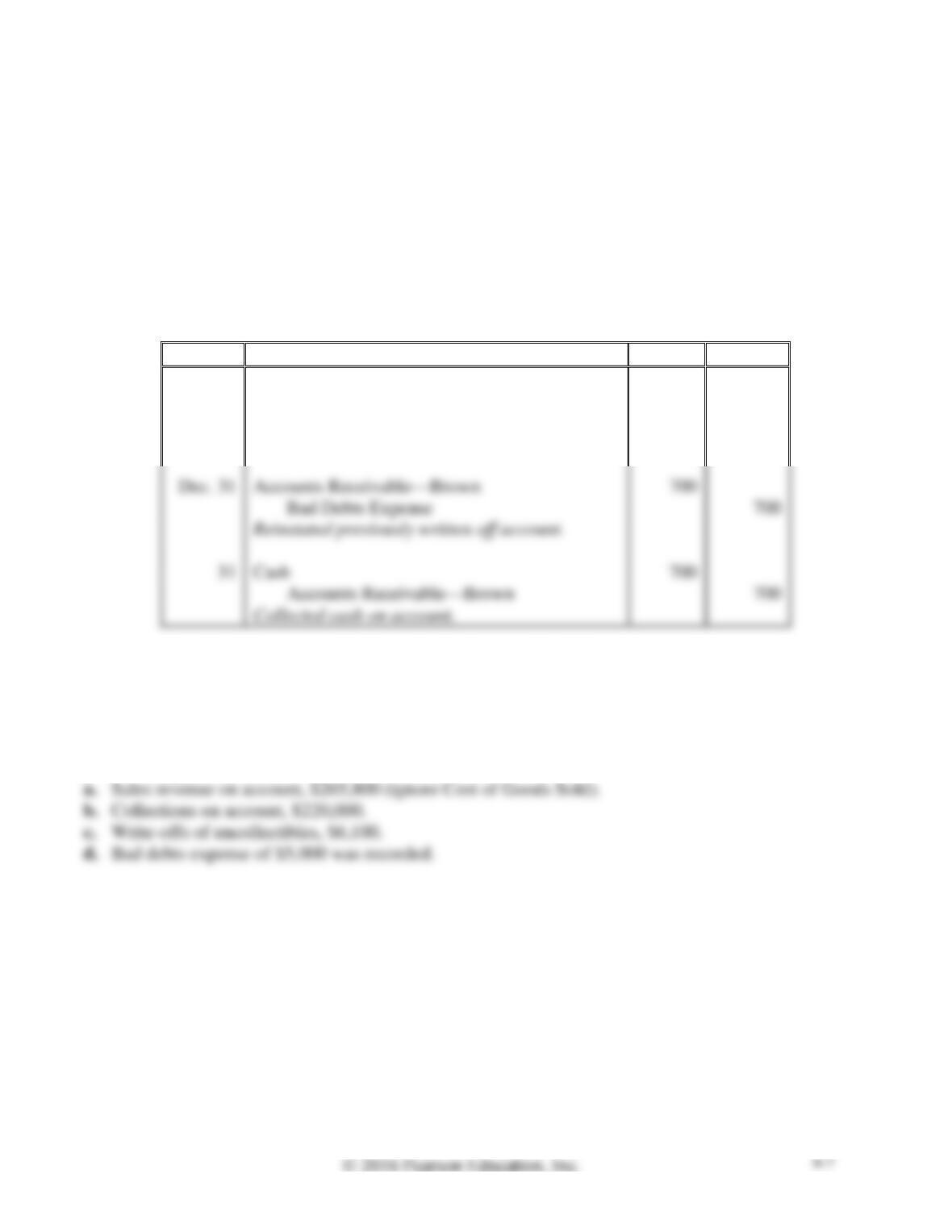
1. Use the direct write-off method to journalize Knoll’s write-off of the uncollectible receivables.
2. What is Knoll’s balance of Accounts Receivable at February 29, 2016?
SOLUTION
Requirement 1
Date
Accounts and Explanation
Debit
Credit
Feb. 29
Bad Debts Expense
1,050
23,000 collected
S8-4 Collecting a receivable previously written off—direct write-off method
Learning Objective 2
Gate City Cycles had trouble collecting its account receivable from Shawna Brown. On June 19, 2016,
Gate City finally wrote off Brown’s $700 account receivable. On December 31, Brown sent a $700
check to Gate City.
Journalize the entries required for Gate City Cycles, assuming Gate City uses the direct write-off
method.
SOLUTION
Date
Accounts and Explanation
Debit
Credit
2016
Jun. 19
Bad Debts Expense
700
Accounts Receivable—Brown
700
Wrote off receivable.
Accounts Receivable—Brown
700
Bad Debts Expense
700
Cash
700
Accounts Receivable—Brown
700
S8-5 Applying the allowance method to account for uncollectibles
Learning Objective 3
The Accounts Receivable balance and Allowance for Bad Debts for Turning Leaves Furniture
Restoration at December 31, 2015, was $10,800 and $2,000 (credit balance). During 2016, Turning
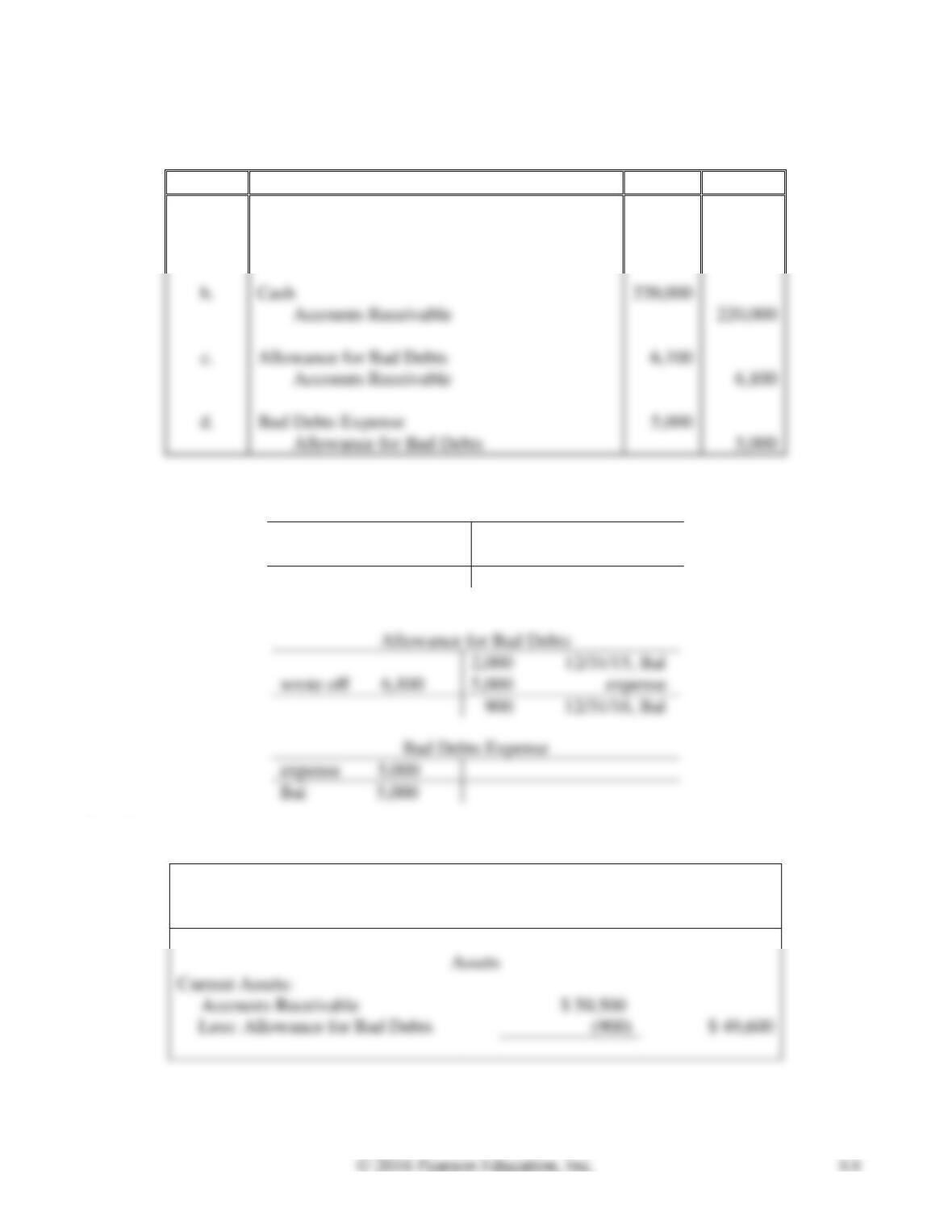
Leaves completed the following transactions:
Requirements
1. Journalize Turning Leaves’s transactions for 2016 assuming Turning Leaves uses the allowance
method.
2. Post the transactions to the Accounts Receivable, Allowance for Bad Debts, and Bad Debts Expense
T-accounts, and determine the ending balance of each account.
3. Show how accounts receivable would be reported on the balance sheet at December 31, 2016.
SOLUTION
Requirement 1
Date
Accounts and Explanation
Debit
Credit
2016
a.
Accounts Receivable
265,800
Sales Revenue
265,800
Cash
220,000
220,000
c.
Allowance for Bad Debts
Bad Debts Expense
Requirement 2
2,000 12/31/15, Bal
wrote off 6,100
5,000 expense
900 12/31/16, Bal
expense 5,000
Requirement 3
TURNING LEAVES FURNITURE RESTORATION
Balance Sheet−Partial
December 31, 2016
Current Assets:
Accounts Receivable
$ 50,500
(900)
$ 49,600
Accounts Receivable
12/31/15, Bal 10,800
220,000 collected
revenue 265,800
6,100 wrote off
12/31/16, Bal 50,500
S8-6 Applying the allowance method (percent-of-sales) to account for uncollectibles
Learning Objective 3
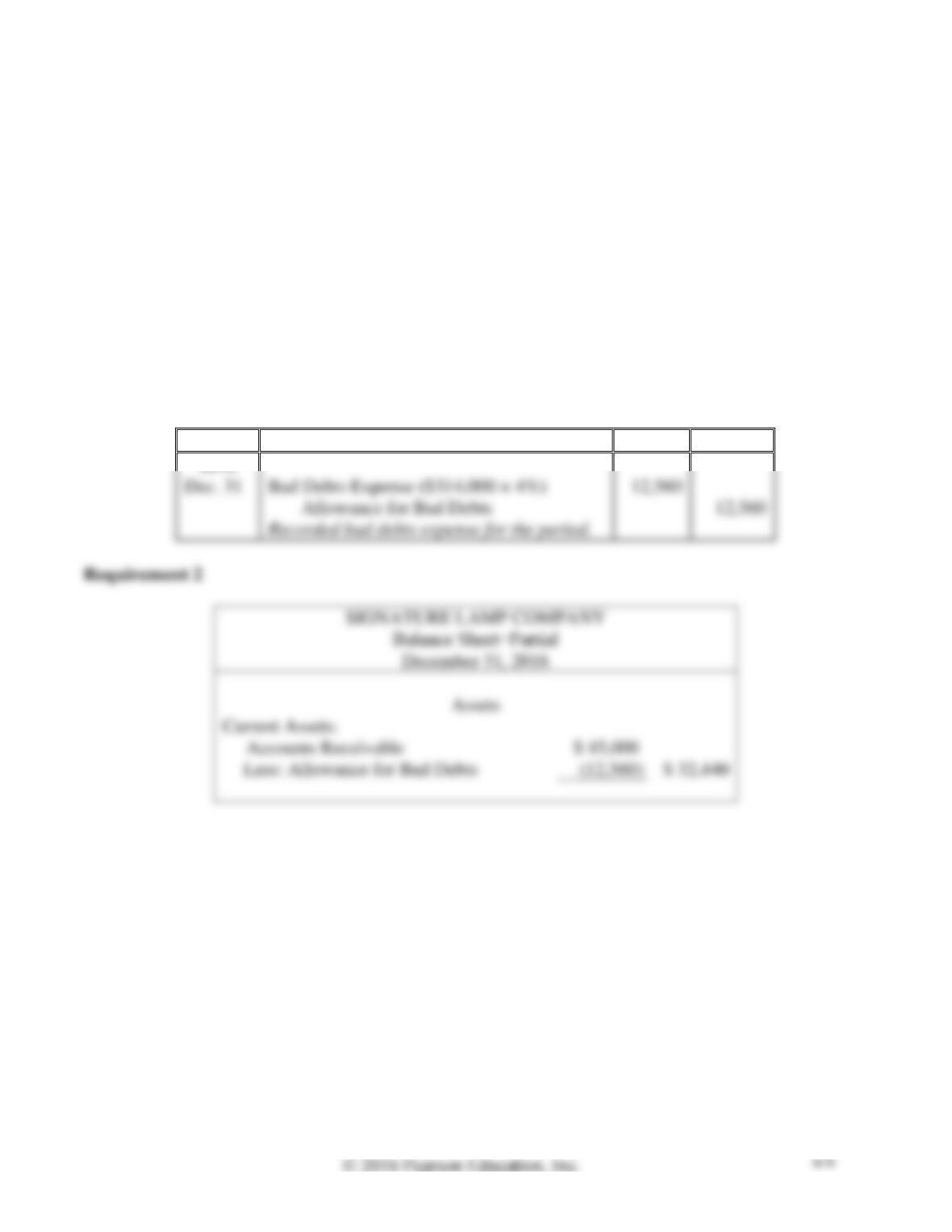
During its first year of operations, Signature Lamp Company earned net credit sales of
$314,000. Industry experience suggests that bad debts will amount to 4% of net credit sales. At
December 31, 2016, accounts receivable total $45,000. The company uses the allowance method to
account for uncollectibles.
Requirements
1. Journalize Signature’s Bad Debts Expense using the percent-of-sales method.
2. Show how to report accounts receivable on the balance sheet at December 31, 2016.
SOLUTION
Requirement 1
Date
Accounts and Explanation
Debit
Credit
S8-7 Applying the allowance method (percent-of-receivables) to account for uncollectibles
Learning Objective 3
The Accounts Receivable balance for Field, Inc. at December 31, 2015, was $25,000. During 2016,
Field earned revenue of $457,000 on account and collected $326,000 on account. Field wrote off $5,900
receivables as uncollectible. Industry experience suggests that uncollectible accounts will amount to 4%
of accounts receivable.
Requirements
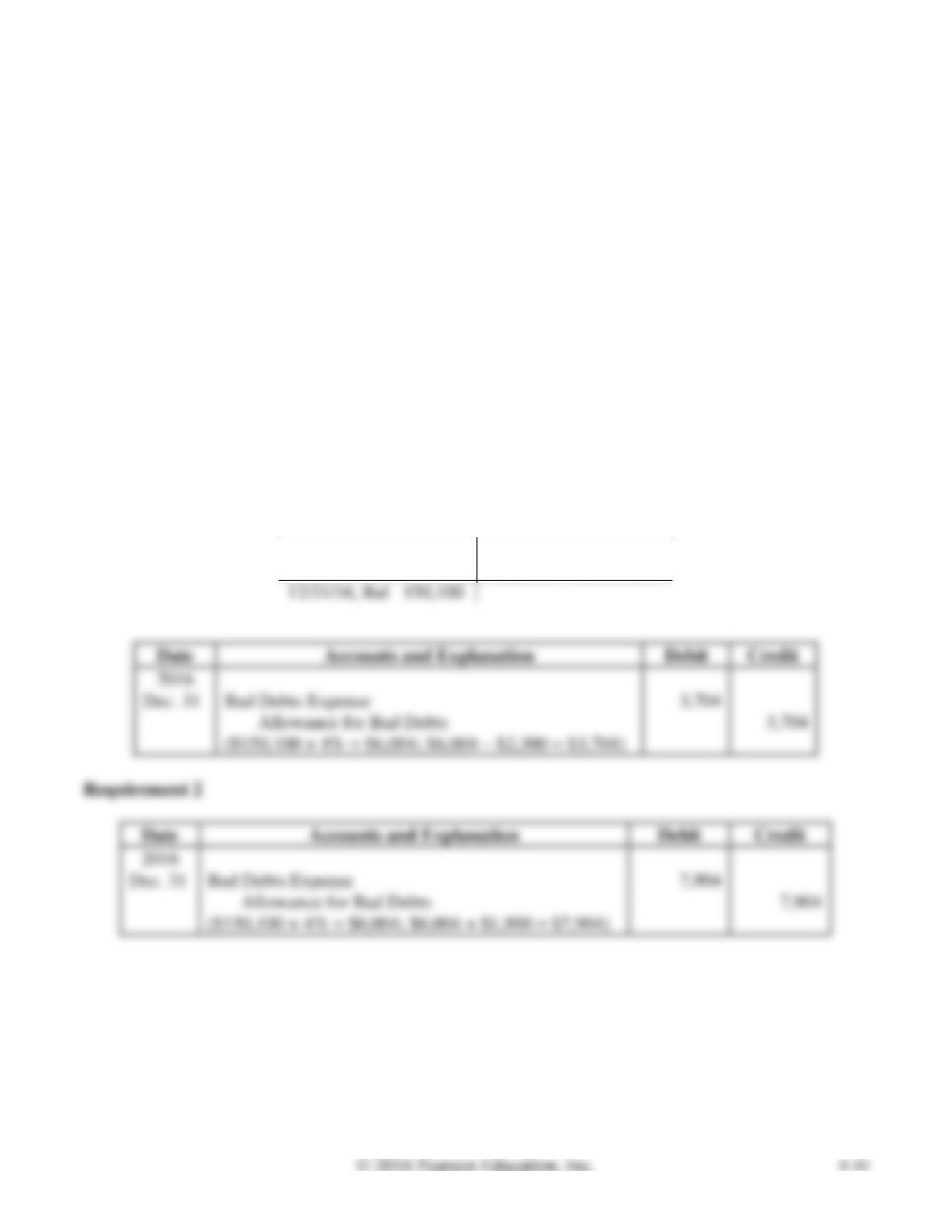
1. Assume Field had an unadjusted $2,300 credit balance in Allowance for Bad Debts at December 31,
2016. Journalize Field’s December 31, 2016, adjustment to record bad debts expense using the
percent-of-receivables method.
2. Assume Field had an unadjusted $1,900 debit balance in Allowance for Bad Debts at December 31,
2016. Journalize Field’s December 31, 2016, adjustment to record bad debts expense using the
percent-of-receivables method.
SOLUTION
Requirement 1
Dec. 31
Bad Debts Expense
($150,100 × 4% = $6,004; $6,004 – $2,300 = $3,704)
Dec. 31
Bad Debts Expense
($150,100 × 4% = $6,004; $6,004 + $1,900 = $7,904)
12/31/16, Bal 150,100
Accounts Receivable
12/31/15, Bal 25,000
326,000 collected
revenue 457,000
5,900 wrote off
S8-8 Applying the allowance method (aging-of-receivables) to account for uncollectibles
Learning Objective 3
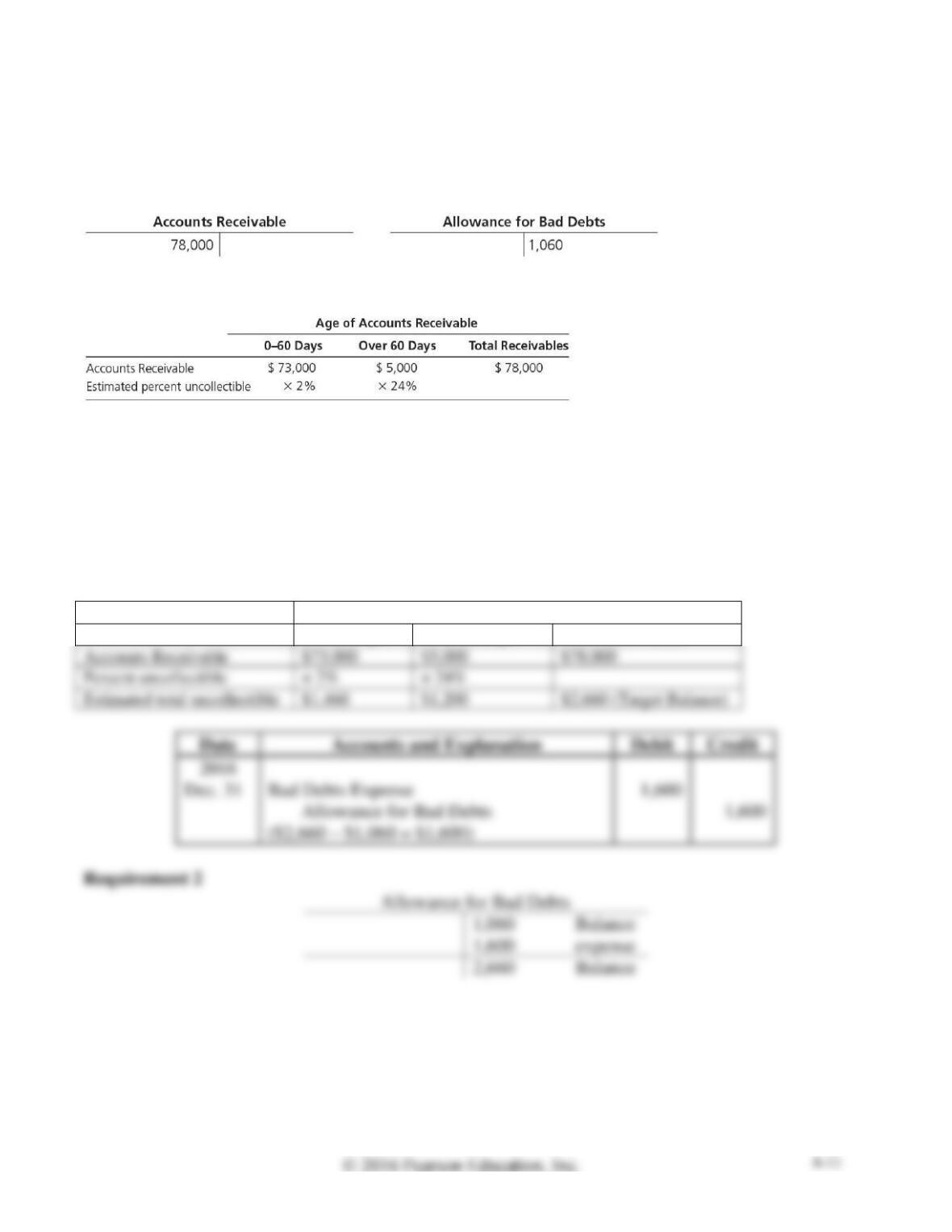
World Class Work Shoes had the following balances at December 31, 2016, before the year-end
adjustments:
The aging of accounts receivable yields the following data:
Requirements
1. Journalize World Class’s entry to record bad debts expense for 2016 using the aging-of-receivables
method.
2. Prepare a T-account to compute the ending balance of Allowance for Bad Debts.
SOLUTION
Requirement 1
Age of Accounts Receivable
0 – 60 Days
Over 60 Days
Total Receivables
Percent uncollectible
× 24%
Dec. 31
Bad Debts Expense
1,060 Balance
1,600 expense
2,660 Balance
S8-9 Computing interest amounts on notes receivable
Learning Objective 4
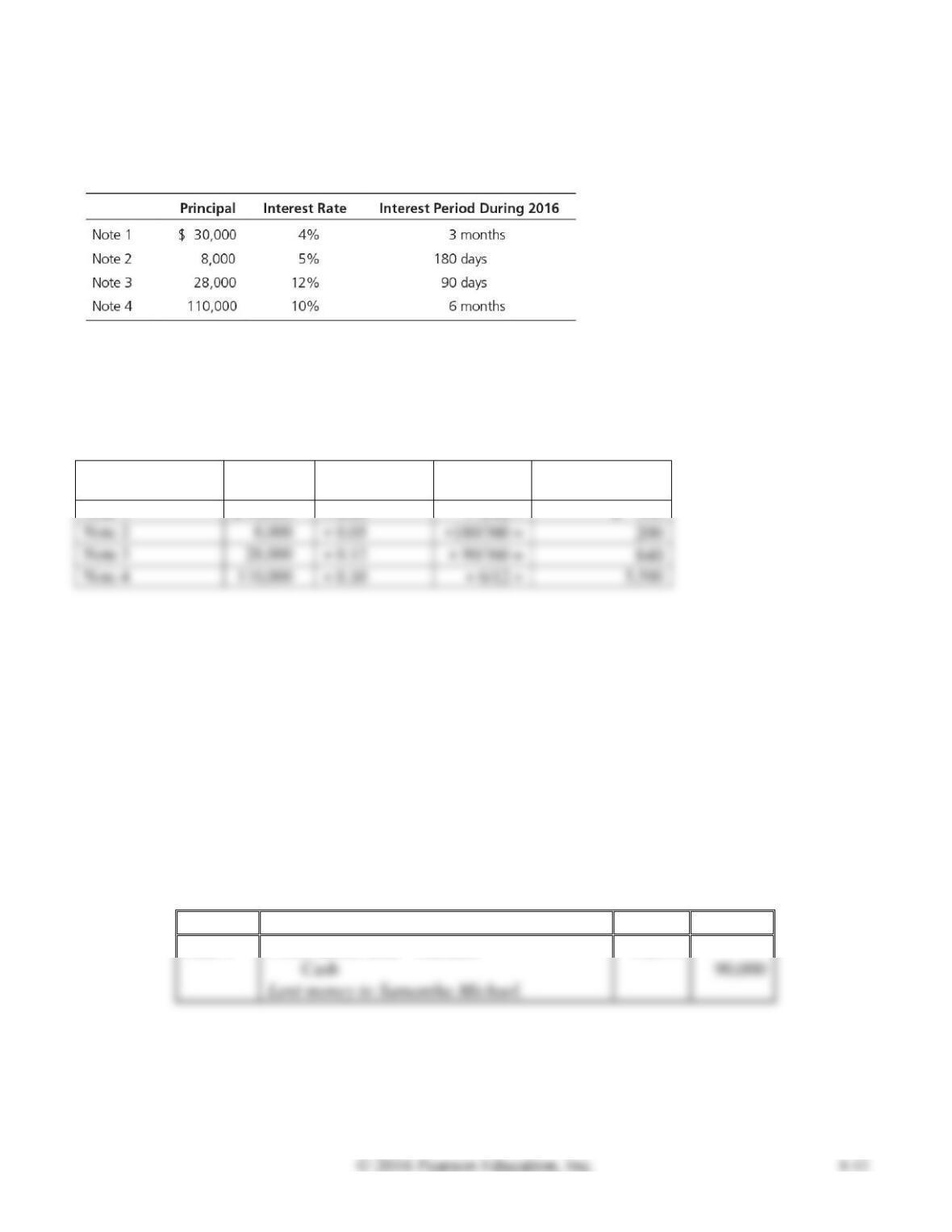
A table of notes receivable for 2016 follows:
For each of the notes receivable, compute the amount of interest revenue earned during 2016. Round to
the nearest dollar.
SOLUTION
Principal
Interest Rate
Interest
Period
Interest Revenue
Earned
Note 1
$ 30,000
× 0.04
× 3/12 =
$ 300
S8-10 Accounting for a note receivable
Learning Objective 4
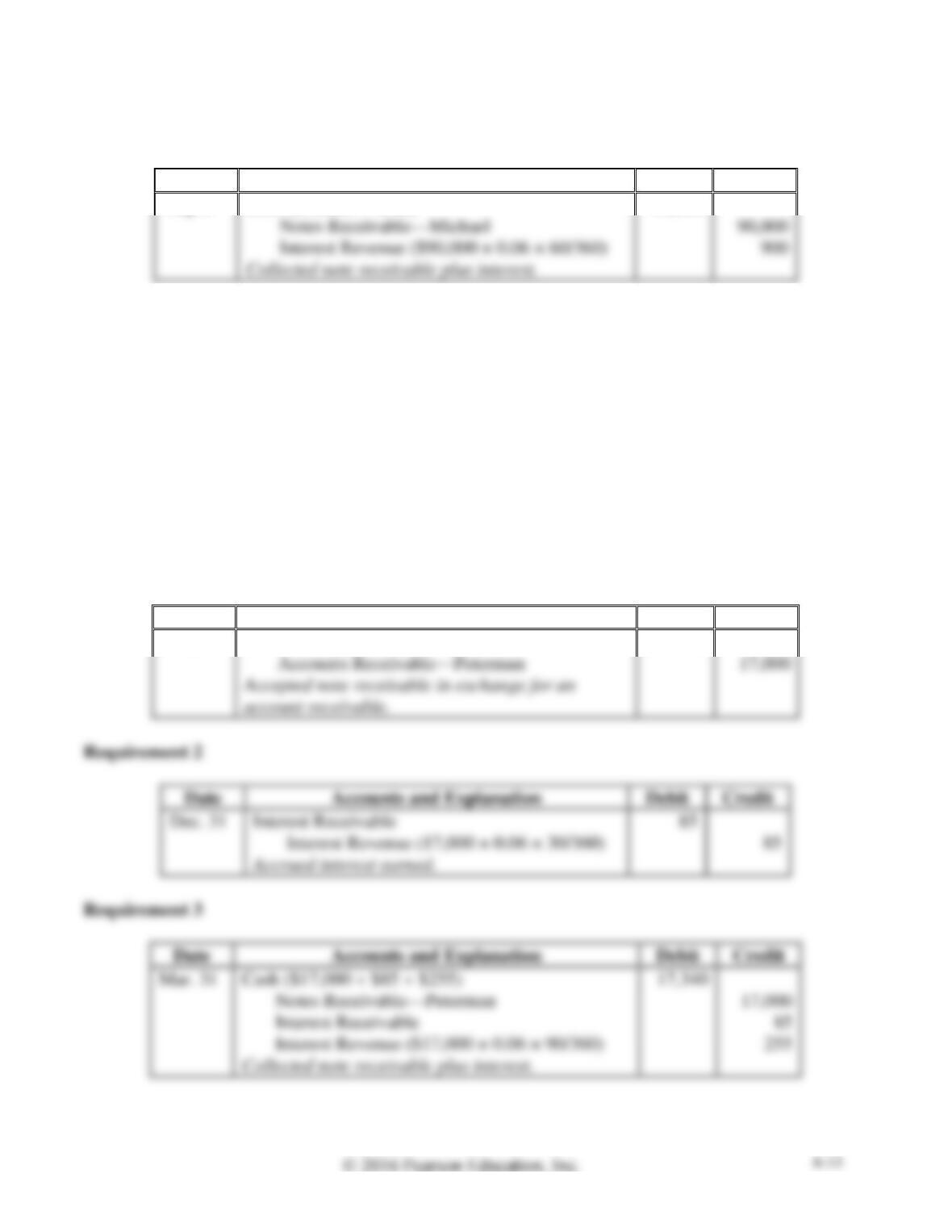
On June 6, Southside Bank & Trust lent $90,000 to Samantha Michael on a 60-day, 6% note.
Requirements
1. Journalize for Southside the lending of the money on June 6.
2. Journalize the collection of the principal and interest at maturity. Specify the date.
SOLUTION
Requirement 1
Date
Accounts and Explanation
Debit
Credit
June 6
Notes Receivable—Michael
90,000
S8-10, cont.
Requirement 2
Date
Accounts and Explanation
Debit
Credit
Aug. 5
Cash ($90,000 + $900)
90,900
S8-11 Accruing interest revenue and recording collection of a note
Learning Objective 4
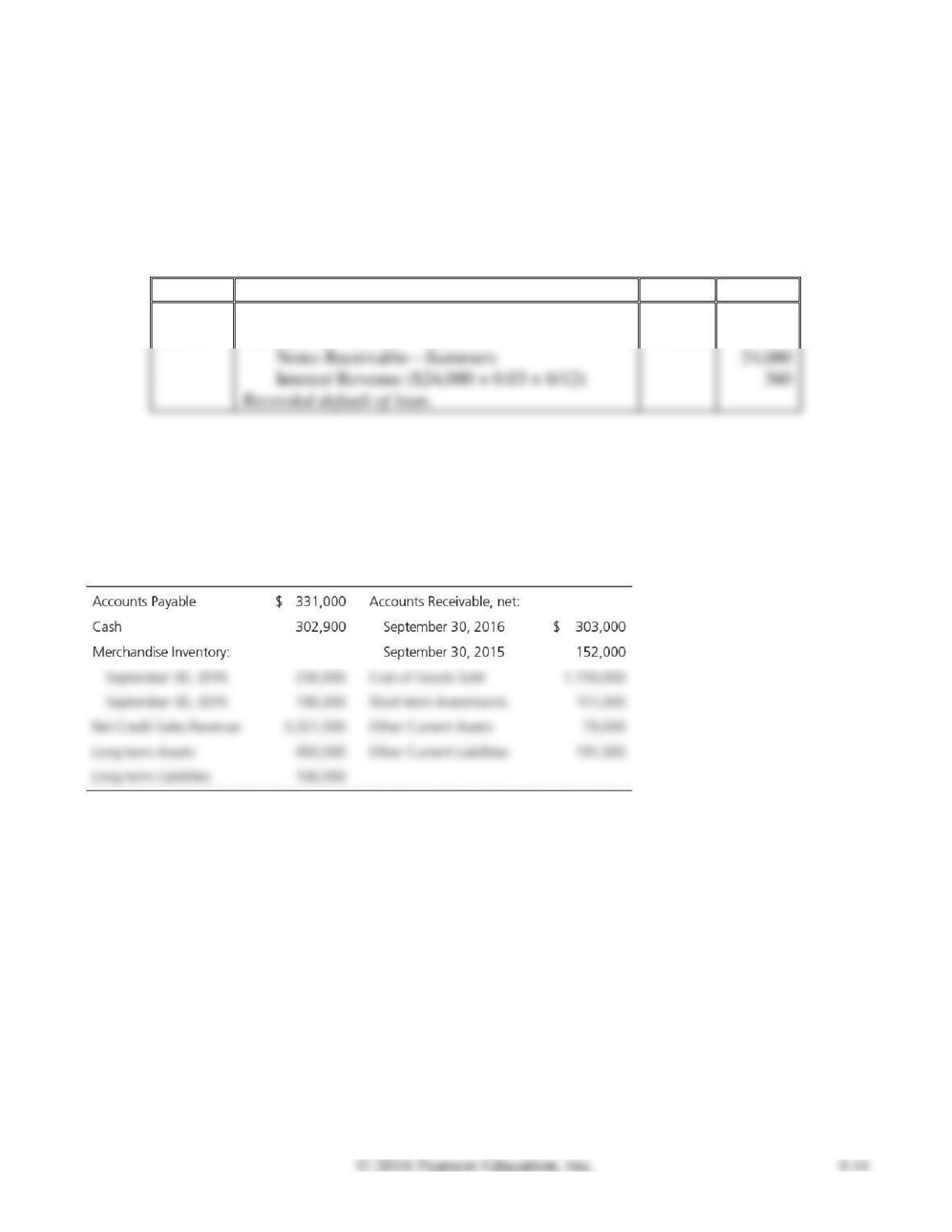
On December 1, Kole Corporation accepted a 120-day, 6%, $17,000 note receivable from J. Peterman in
exchange for his account receivable.
Requirements
1. Journalize the transaction on December 1.
2. Journalize the adjusting entry needed on December 31 to accrue interest revenue.
3. Journalize the collection of the principal and interest at maturity. Specify the date.
SOLUTION
Requirement 1
Date
Accounts and Explanation
Debit
Credit
Dec. 1
Notes Receivable—Peterman
17,000
Date
Debit
Credit
Dec. 31
Interest Receivable
Date
Debit
Credit
Mar. 31
Cash ($17,000 + $85 + $255)
17,340
S8-12 Recording a dishonored note receivable
Learning Objective 4
Midway Corporation has a six-month, $24,000, 3% note receivable from L. Summers that was signed on
June 1, 2016. Summers defaults on the loan on December 1.
Journalize the entry for Midway to record the default of the loan.
SOLUTION
Date
Accounts and Explanation
Debit
Credit
2016
Dec. 1
Accounts Receivable—Summers
24,360
S8-13 Using the acid-test ratio, accounts receivable turnover ratio, and days’ sales in receivables to
evaluate a company
Learning Objective 5
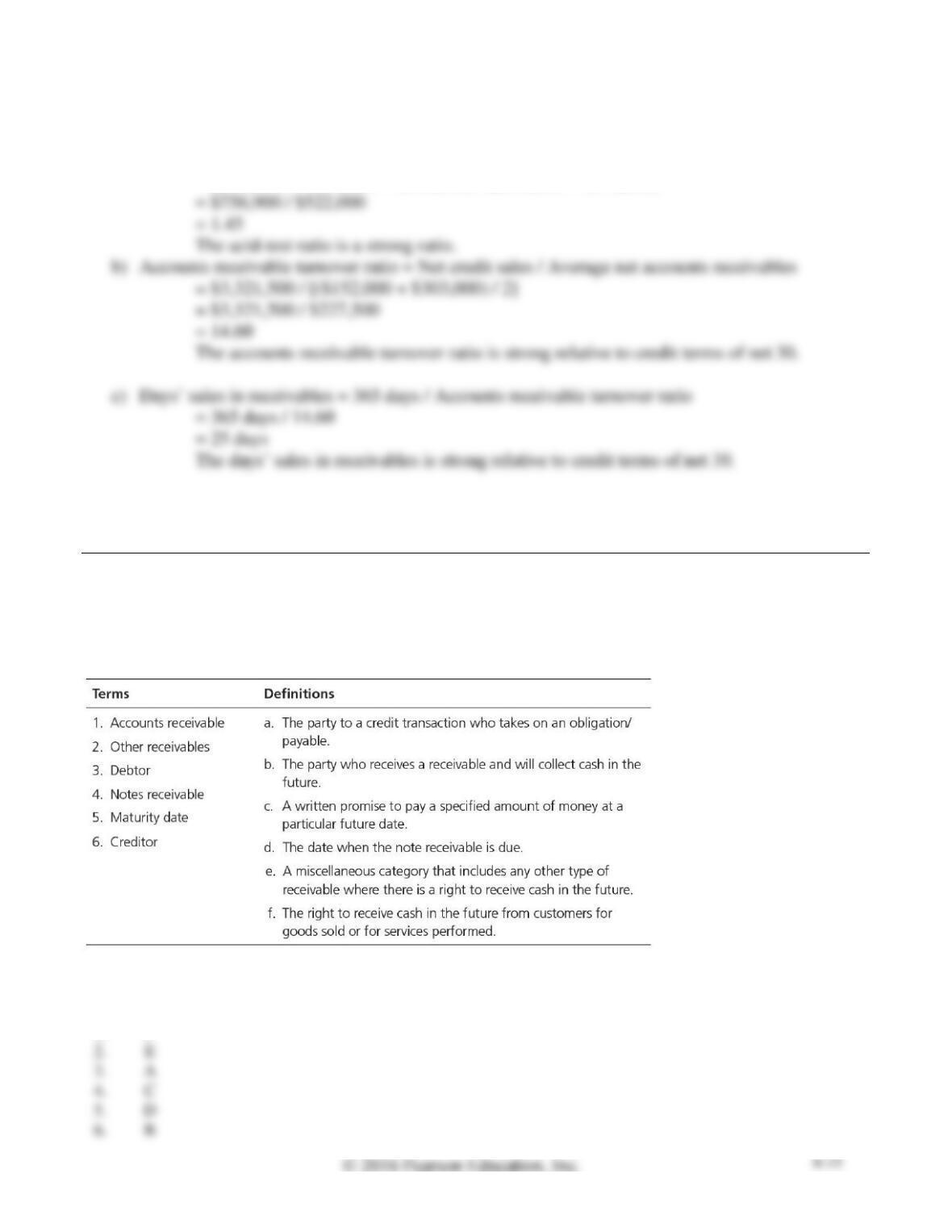
Gold Clothiers reported the following selected items at September 30, 2016 (last year’s—2015—
amounts also given as needed):
Compute Gold’s (a) acid–test ratio, (b) accounts receivable turnover ratio, and (c) days’ sales in
receivables for 2016. Evaluate each ratio value as strong or weak. Gold sells on terms of net 30. (Round
days’ sales in receivables to a whole number.)
SOLUTION
a) Acid-test ratio = (Cash including cash equivalents + Short-term investments + Net current
receivables) / Total current liabilities
= ($302,900 + $151,000 + $303,000) / ($331,000 + $191,000)
Exercises
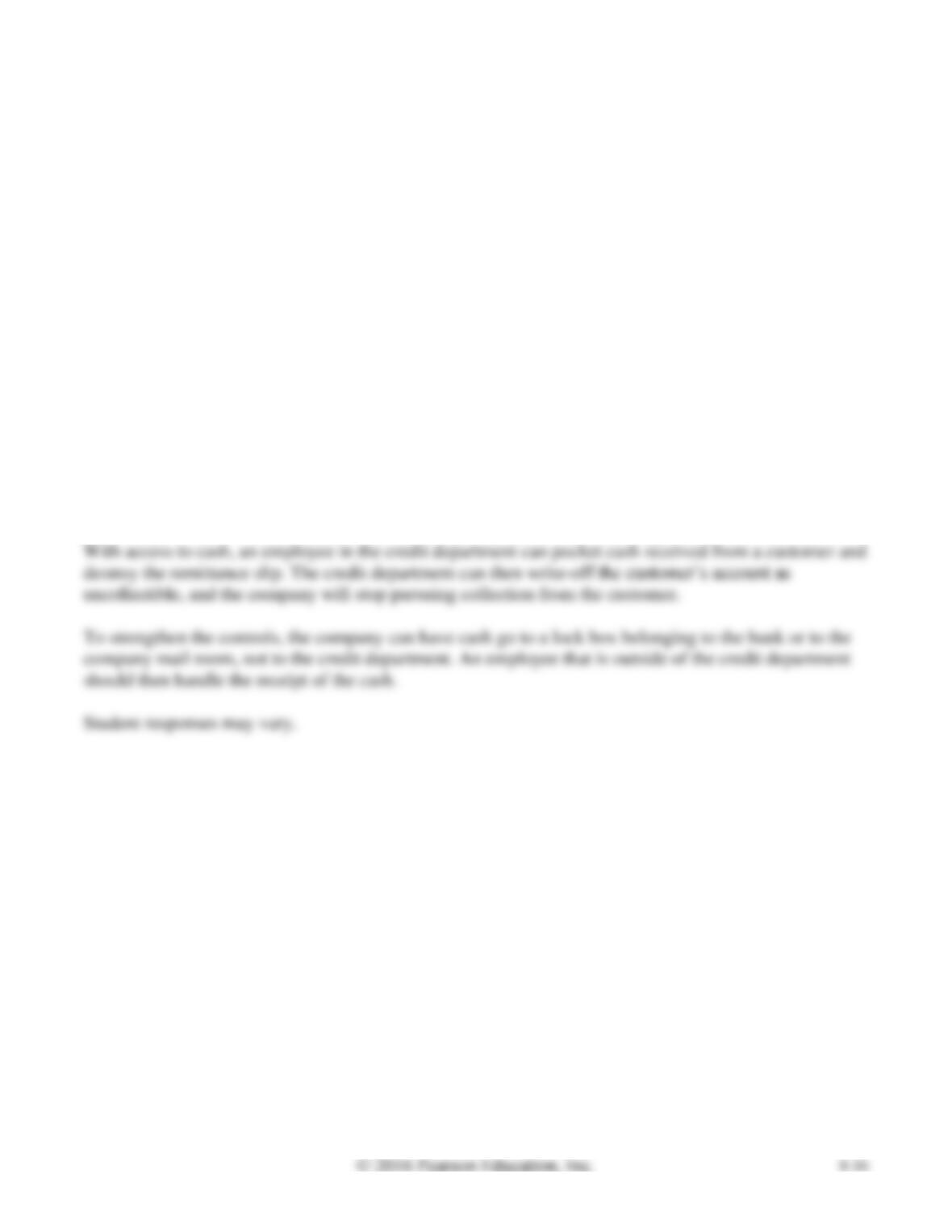
E8-14 Defining common receivables terms
Learning Objective 1
Match the terms with their correct definition.
SOLUTION
1.
F
2.
E
4.
C
6.
B
E8-15 Identifying and correcting internal control weakness
Learning Objective 1
Suppose The Right Rig Dealership is opening a regional office in Omaha. Cary Regal, the office
manager, is designing the internal control system. Regal proposes the following procedures for credit
checks on new customers, sales on account, cash collections, and write-offs of uncollectible receivables:
• The credit department runs a credit check on all customers who apply for credit. When an account
proves uncollectible, the credit department authorizes the write-off of the accounts receivable.
• Cash receipts come into the credit department, which separates the cash received from the customer
remittance slips. The credit department lists all cash receipts by customer name and amount of cash
received.
• The cash goes to the treasurer for deposit in the bank. The remittance slips go to the accounting
department for posting to customer accounts.
• The controller compares the daily deposit slip to the total amount posted to customer accounts. Both
amounts must agree.
Recall the components of internal control. Identify the internal control weakness in this situation, and
propose a way to correct it.
SOLUTION
The internal control weakness is that the credit department receives incoming cash from customers.
E8-16 Journalizing transactions using the direct write-off method
Learning Objectives 1, 2
On June 1, High Performance Cell Phones sold $19,000 of merchandise to Andrew Trucking Company
on account. Andrew fell on hard times and on July 15 paid only $7,000 of the account receivable. After
repeated attempts to collect, High Performance finally wrote off its accounts receivable from Andrew on
September 5. Six months later, March 5, High Performance received Andrew’s check for $12,000 with a
note apologizing for the late payment.
Requirements
1. Journalize the transactions for High Performance Cell Phones using the direct write-off method.
Ignore Cost of Goods Sold.
2. What are some limitations that High Performance will encounter when using the direct write-off
method?
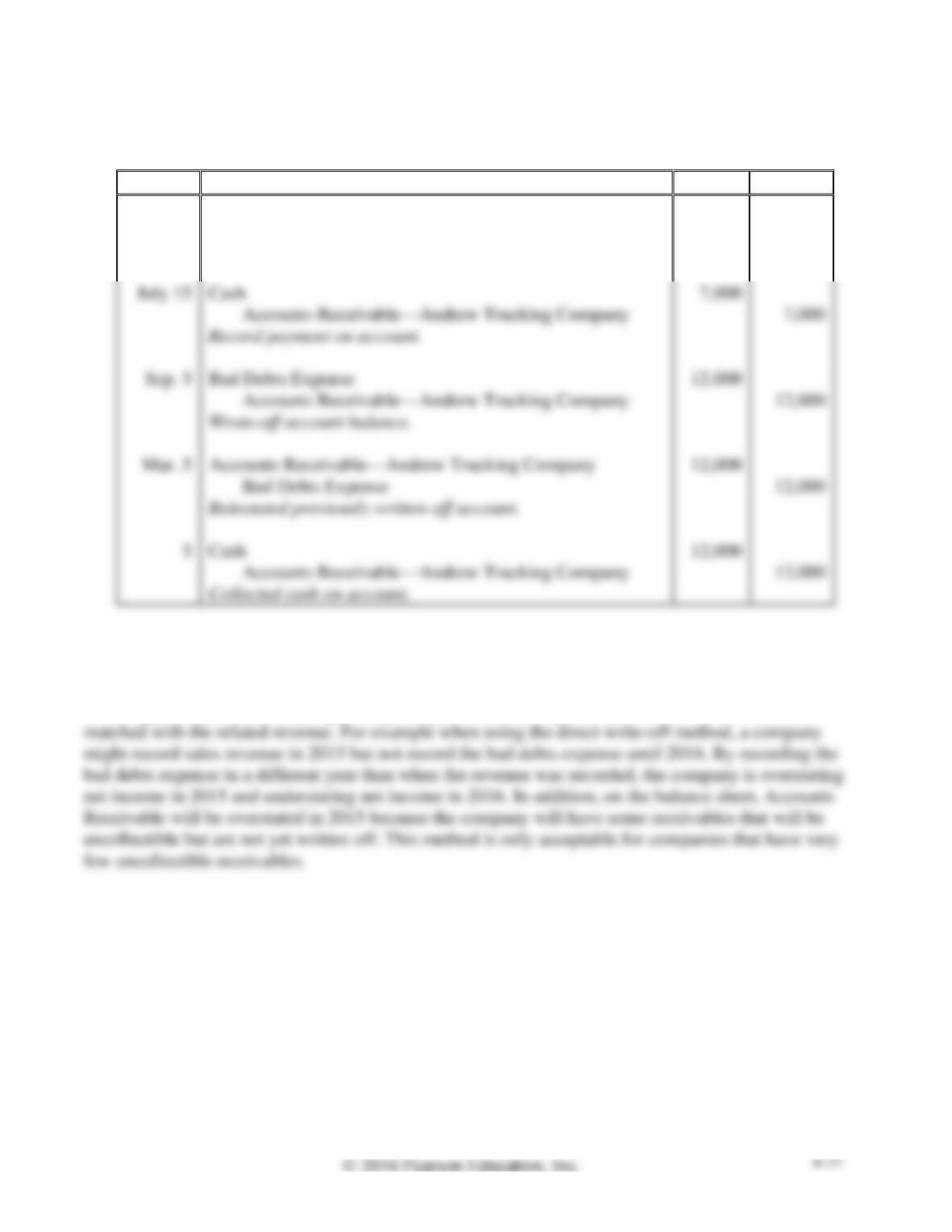
SOLUTION
Requirement 1
Date
Accounts and Explanation
Debit
Credit
June 1
Accounts Receivable—Andrew Trucking Company
19,000
Sales Revenue
19,000
Record sales on account.
Cash
7,000
Accounts Receivable—Andrew Trucking Company
Record payment on account.
Bad Debts Expense
12,000
Accounts Receivable—Andrew Trucking Company
12,000
Wrote-off account balance.
Mar. 5
Accounts Receivable—Andrew Trucking Company
12,000
Bad Debts Expense
12,000
Reinstated previously written off account.
Cash
12,000
Accounts Receivable—Andrew Trucking Company
12,000
Collected cash on account.
Requirement 2
High Performance will encounter limitations with the direct write-off method because it violates the
matching principle. The matching principle requires that the expense of uncollectible accounts be
Use the following information to answer Exercises E8-17 and E8-18.
At January 1, 2016, Hilly Mountain Flagpoles had Accounts Receivable of $31,000, and Allowance for
Bad Debts had a credit balance of $3,000. During the year, Hilly Mountain Flagpoles recorded the
following:
a. Sales of $174,000 ($157,000 on account; $17,000 for cash). Ignore Cost of Goods Sold.
b. Collections on account, $131,000.
c. Write-offs of uncollectible receivables, $2,200.
E8-17 Accounting for uncollectible accounts using the allowance method (percent-of-sales) and
reporting receivables on the balance sheet
Learning Objectives 1, 3
2. AR, Dec. 31 $54,800
Requirements
1. Journalize Hilly’s transactions that occurred during 2016. The company uses the allowance method.
2. Post Hilly’s transactions to the Accounts Receivable and Allowance for Bad Debts T-accounts.
3. Journalize Hilly’s adjustment to record bad debts expense assuming Hilly estimates bad debts as 4%
of credit sales. Post the adjustment to the appropriate T-accounts.
4. Show how Hilly Mountain Flagpoles will report net accounts receivable on its December 31, 2016,
balance sheet.
SOLUTION
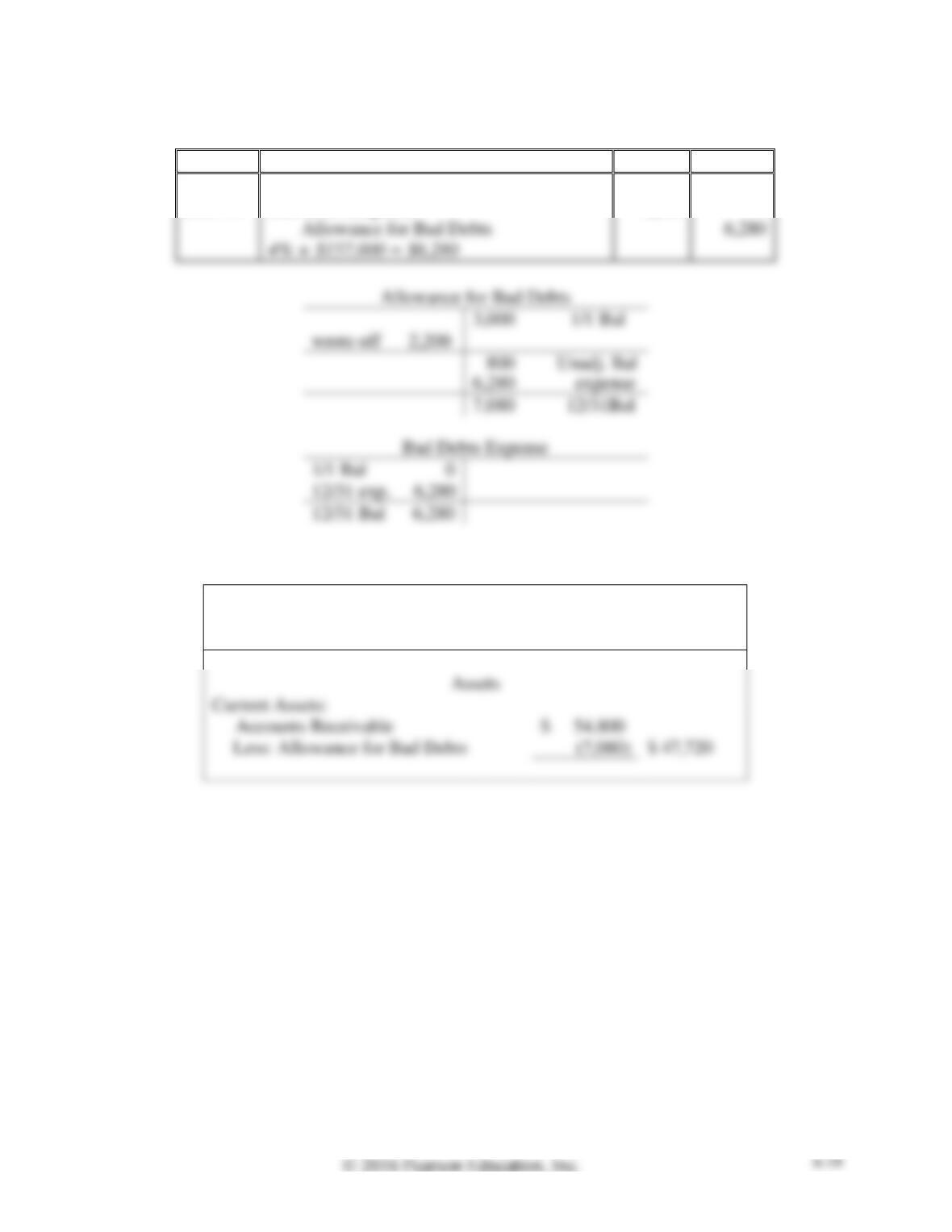
Requirement 1
Date
Accounts and Explanation
Debit
Credit
2016
a.
Accounts Receivable
157,000
Cash
17,000
Sales Revenue
174,000
Cash
131,000
131,000
c.
Allowance for Bad Debts
Requirement 2
revenue 157,000
2,200 wrote off
Accounts Receivable
1/1 Bal 31,000
131,000 collected
E8-17, cont.
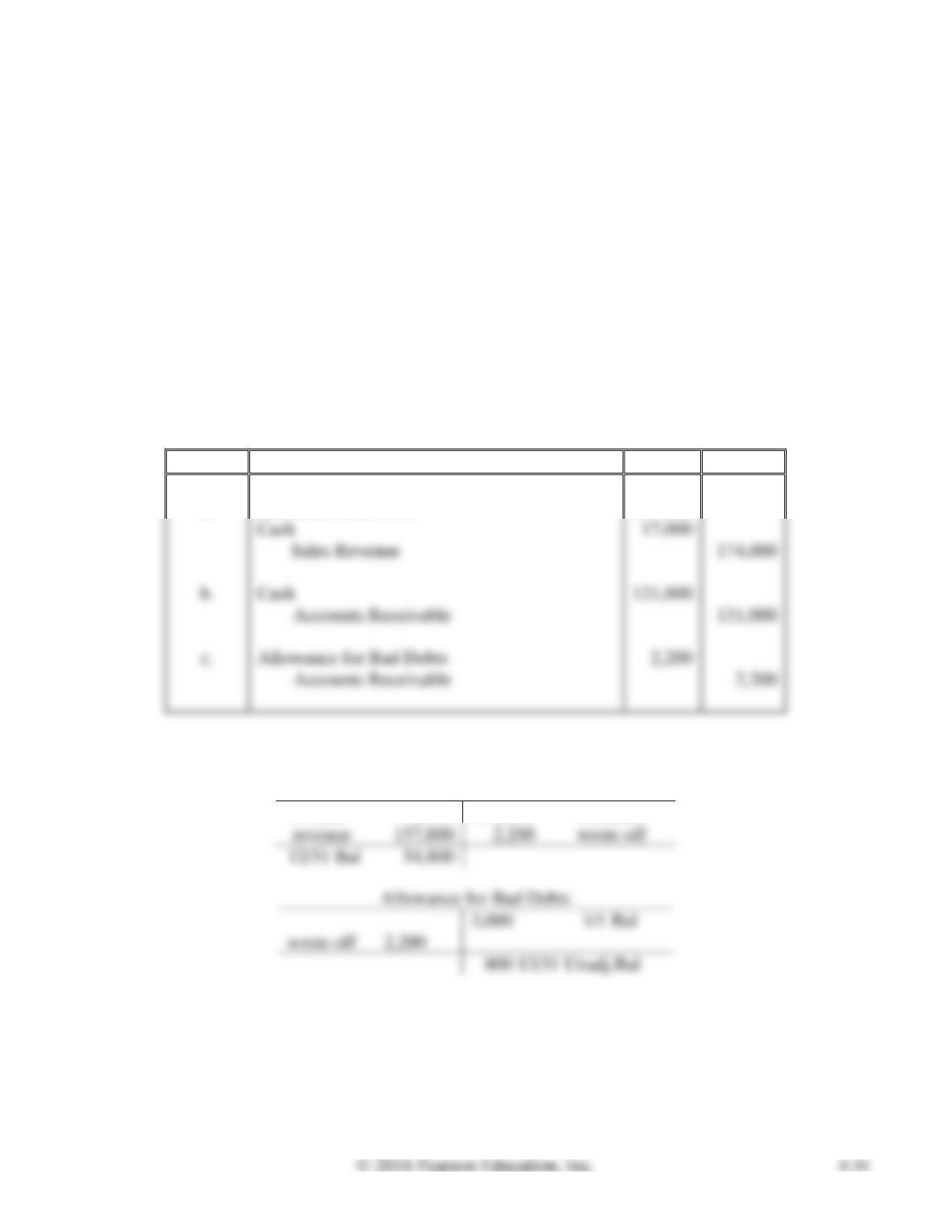
Requirement 3
Date
Accounts and Explanation
Debit
Credit
2016
Dec. 31
Bad Debts Expense
6,280
3,000 1/1 Bal
wrote off 2,200
800 Unadj. Bal
7,080 12/31Bal
1/1 Bal 0
12/31 exp. 6,280
12/31 Bal 6,280
Requirement 4
HILLY MOUNTAIN FLAGPOLES
Balance Sheet−Partial
December 31, 2016
Current Assets:
Accounts Receivable
$ 47,720
E8-18 Accounting for uncollectible accounts using the allowance method (percent-of-receivables)
and reporting receivables on the balance sheet
Learning Objectives 1, 3
3. Bad Debts Expense $844
Requirements
1. Journalize Hilly’s transactions that occurred during 2016. The company uses the allowance method.
2. Post Hilly’s transactions to the Accounts Receivable and Allowance for Bad Debts T-accounts.
3. Journalize Hilly’s adjustment to record bad debts expense assuming Hilly estimates bad debts as 3%
of accounts receivable. Post the adjustment to the appropriate T-accounts.
4. Show how Hilly Mountain Flagpoles will report net accounts receivable on its December 31, 2016,
balance sheet.
SOLUTION
Requirement 1
Date
Accounts and Explanation
Debit
Credit
2016
a.
Accounts Receivable
157,000
Cash
Cash
131,000
c.
Allowance for Bad Debts
Requirement 2
3,000 1/1 Bal
800 12/31 Unadj.Bal
Accounts Receivable
1/1 Bal 31,000
131,000 collected