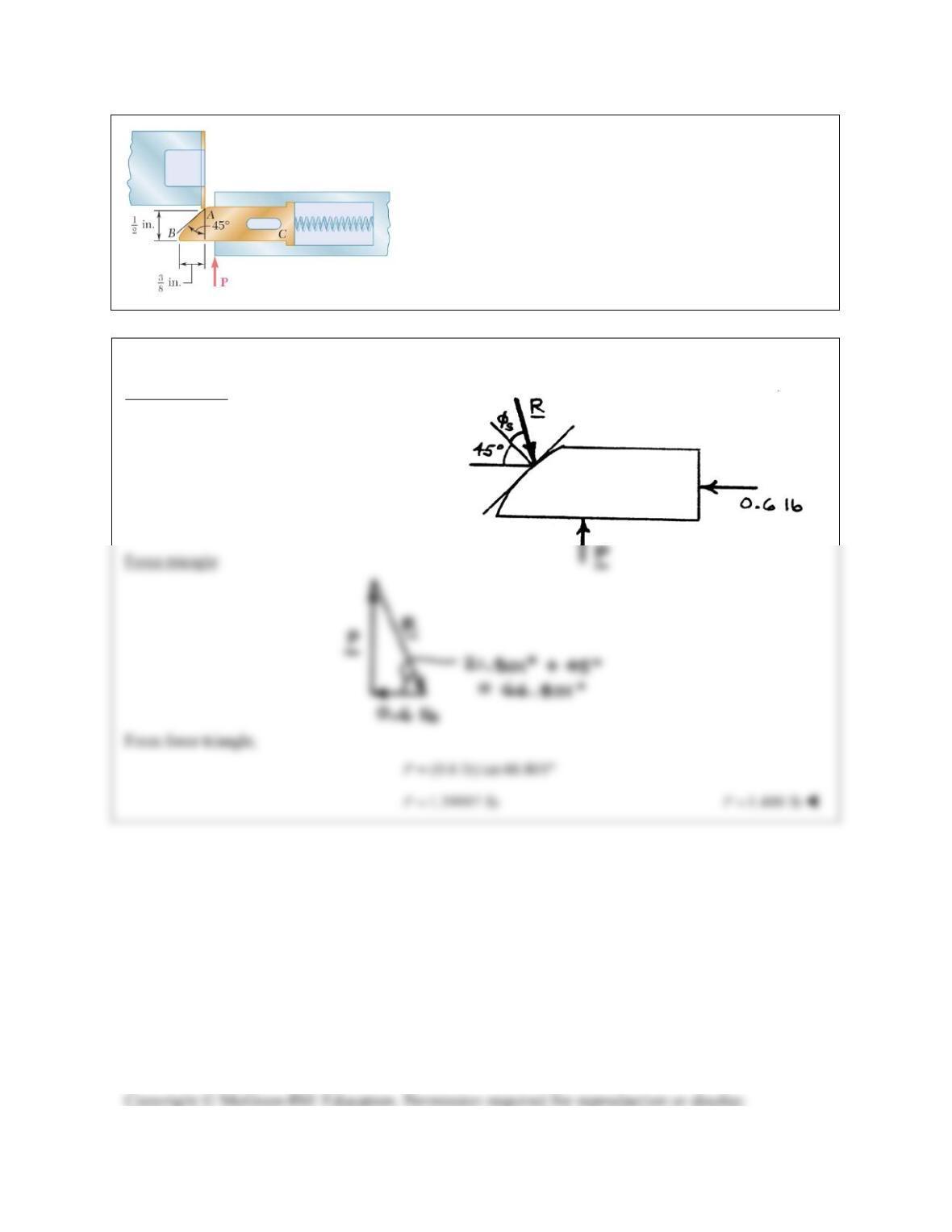
PROBLEM 8.60
The spring of the door latch has a constant of 1.8 lb/in. and in
the position shown exerts a 0.6-lb force on the bolt. The
coefficient of static friction between the bolt and the strike
plate is 0.40; all other surfaces are well lubricated and may be
assumed frictionless. Determine the magnitude of the force P
required to start closing the door.
SOLUTION
Free body: Bolt
1
0.40
tan 0.40
21.801
s
s
––
PROBLEM 8.61
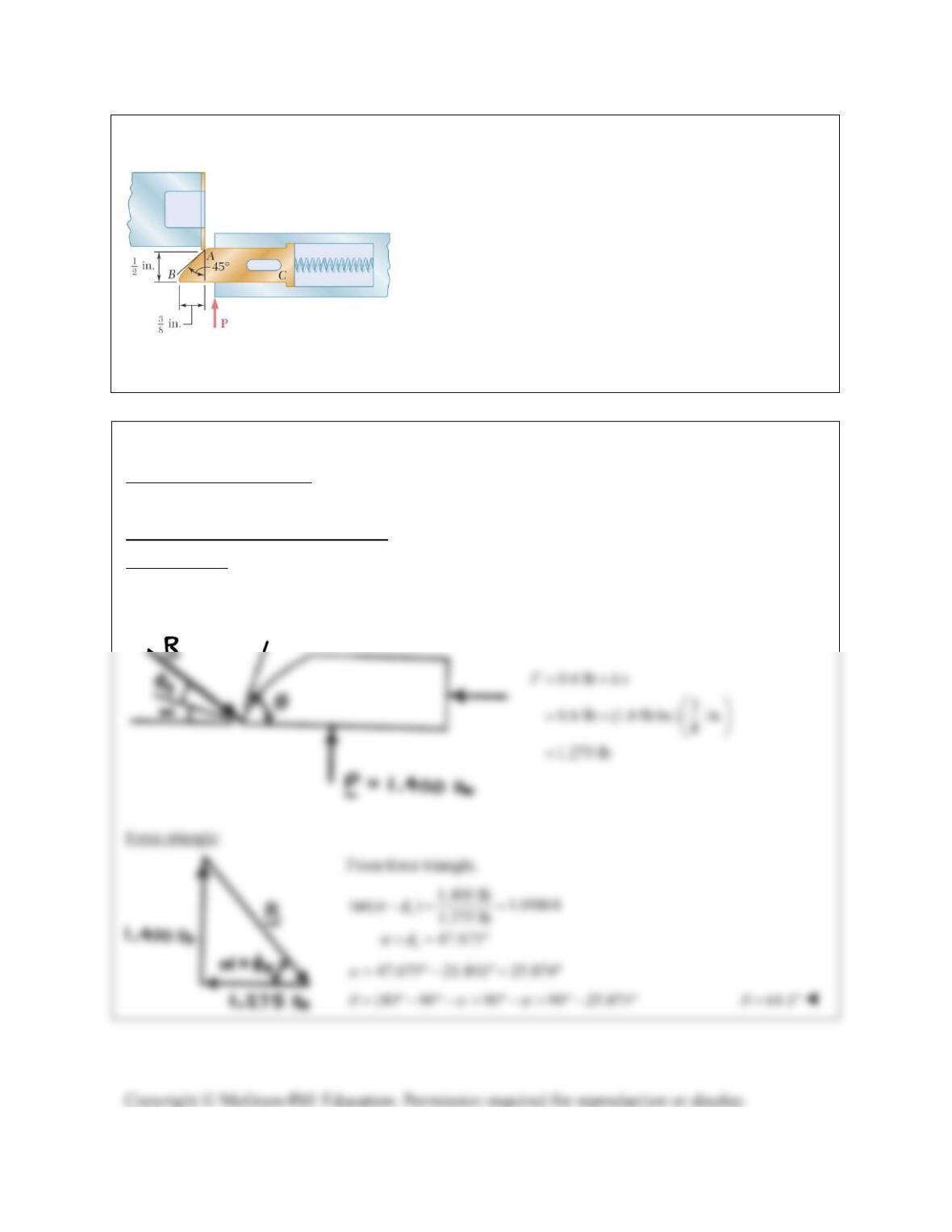
In Problem 8.60, determine the angle that the face of the bolt
should form with the line BC if the force P required to close
the door is to be the same for both the position shown and the
position when B is almost at the strike plate.
PROBLEM 8.60 The spring of the door latch has a constant
of 1.8 lb/in. and in the position shown exerts a 0.6-lb force on
the bolt. The coefficient of static friction between the bolt and
the strike plate is 0.40; all other surfaces are well lubricated
and may be assumed frictionless. Determine the magnitude of
the force P required to start closing the door.
SOLUTION
For position shown in figure:
From Prob. 8.60: 1.400 lbP
For position when B reaches strike plate:
Free body: Bolt
1
0.40
tan 0.40 21.801
s
s
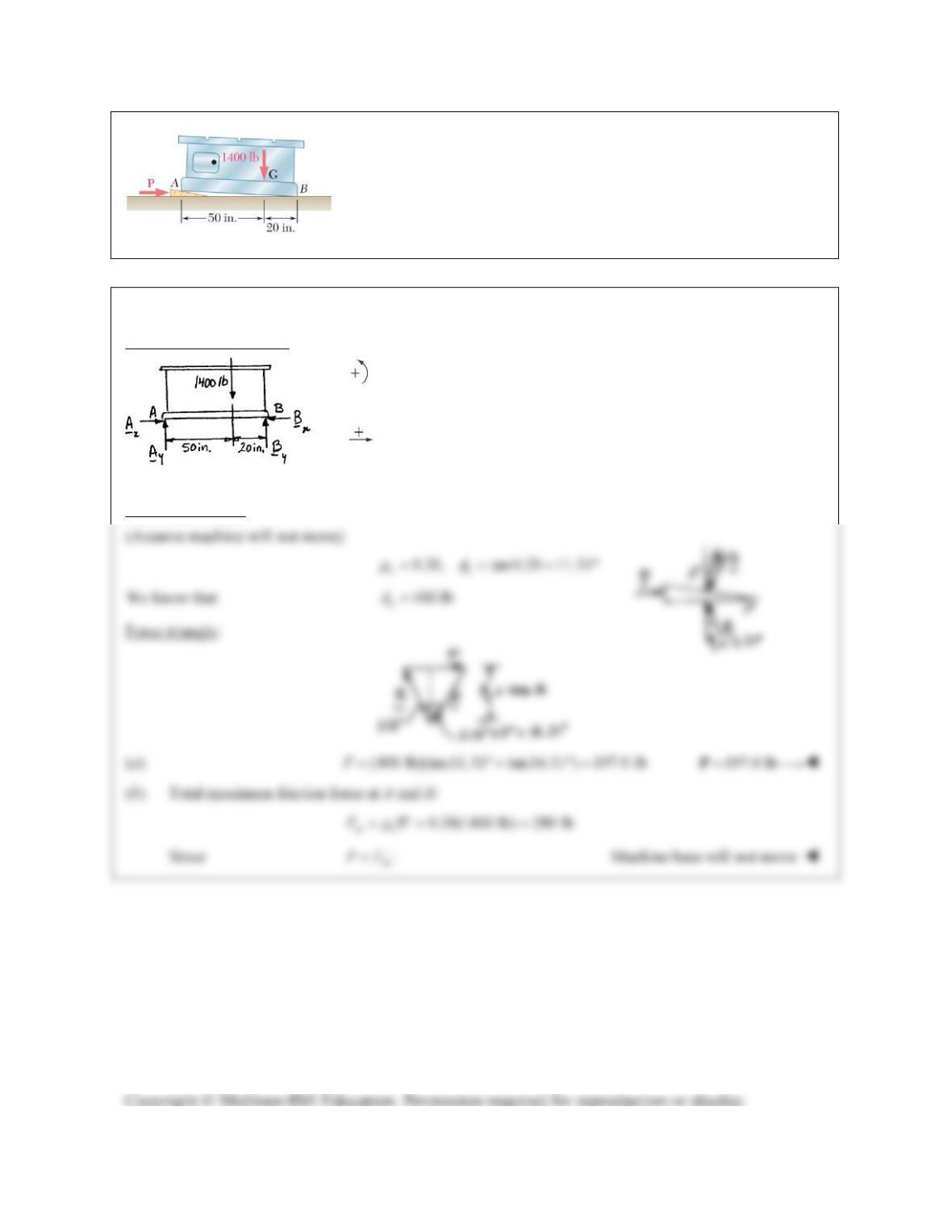
PROBLEM 8.62
A 5 wedge is to be forced under a 1400-lb machine base at A.
Knowing that the coefficient of static friction at all surfaces is 0.20,
(a) determine the force
P
required to move the wedge, (b) indicate
whether the machine base will move.
SOLUTION
Free body: Machine base
0: (1400 lb)(20 in) (70 in) 0
400 lb
By
y
MA
A
0: 1400 lb 0
yyy
FAB
1400 400 1000 lb
y
B
Free body: Wedge
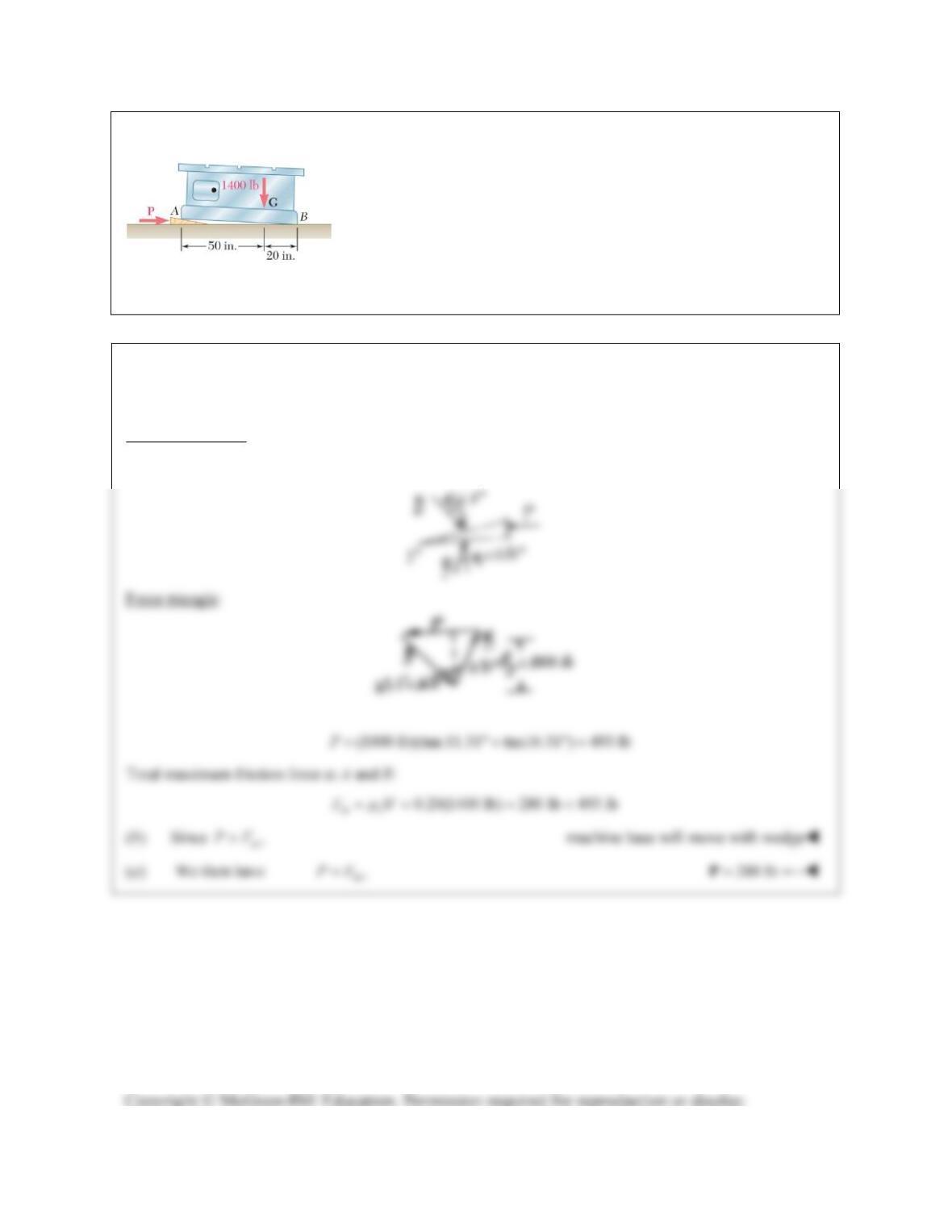
PROBLEM 8.63
Solve Problem 8.62 assuming that the wedge is to be forced under the
machine base at B instead of A.
PROBLEM 8.62 A 5 wedge is to be forced under a 1400-lb machine
base at A. Knowing that the coefficient of static friction at all surfaces
is 0.20, (a) determine the force P required to move the wedge,
(b) indicate whether the machine base will move.
SOLUTION
See solution to Prob. 8.62 for F.B.D. of machine base and determination of 1000 lb.
y
B
Free body: Wedge (Assume machine will not move)
1
0.20 tan 0.20 11.31
ss
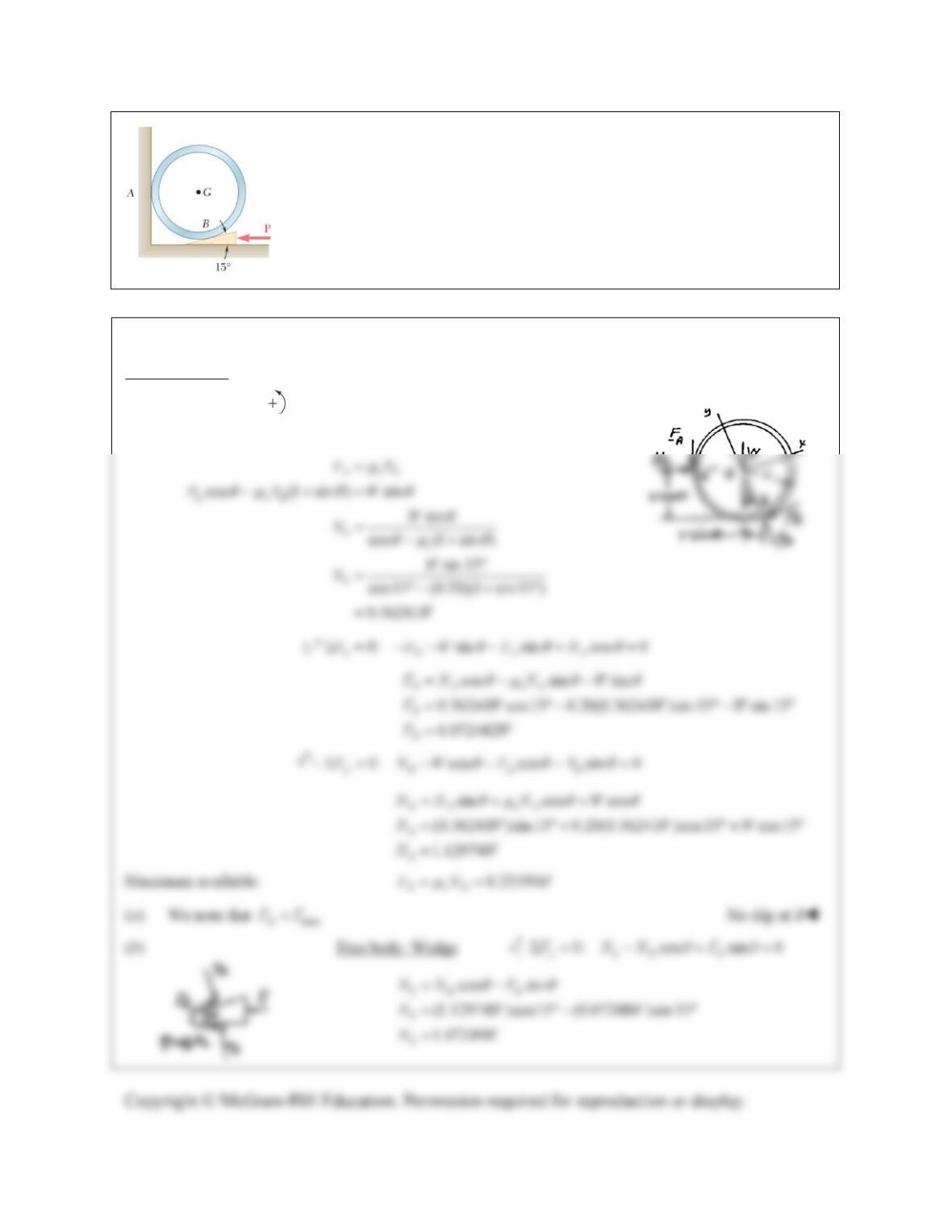
PROBLEM 8.64
A 15 wedge is forced under a 50-kg pipe as shown. The coefficient of static
friction at all surfaces is 0.20. (a) Show that slipping will occur between the
pipe and the vertical wall. (b) Determine the force
P
required to move the
wedge.
SOLUTION
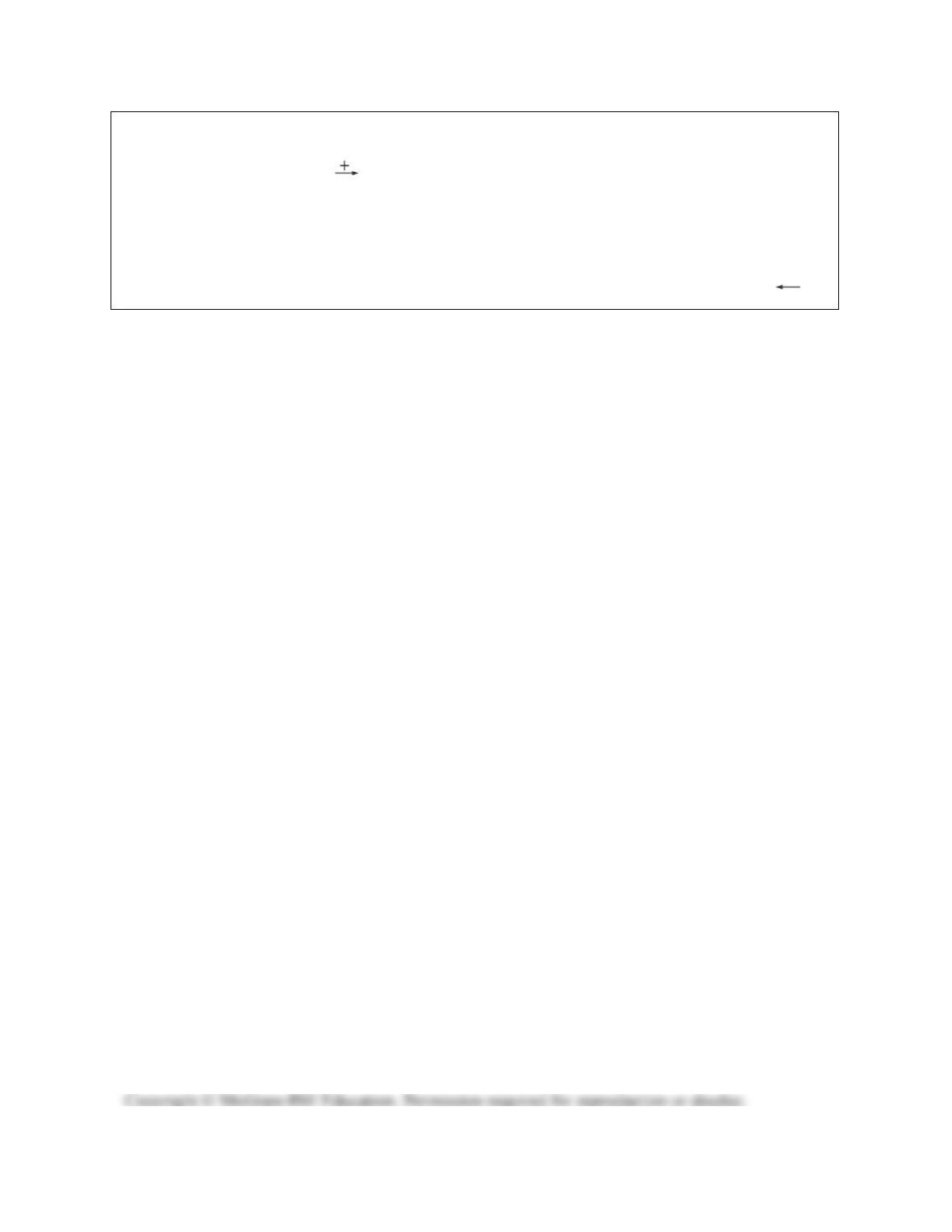
Free body: Pipe
0: sin (1 sin ) cos 0
BAA
MWrFr Nr
Assume slipping at A:
PROBLEM 8.64 (Continued)
2
0: cos sin 0
xB B s
FF N NP
2
cos sin
(0.07248 ) cos 15 (1.12974 )sin 15 0.2(1.07249 )
0.5769
BBs
PF N N
PW W W
PW
2
: 0.5769(50 kg)(9.81 m/s )Wmg P
283 N
P
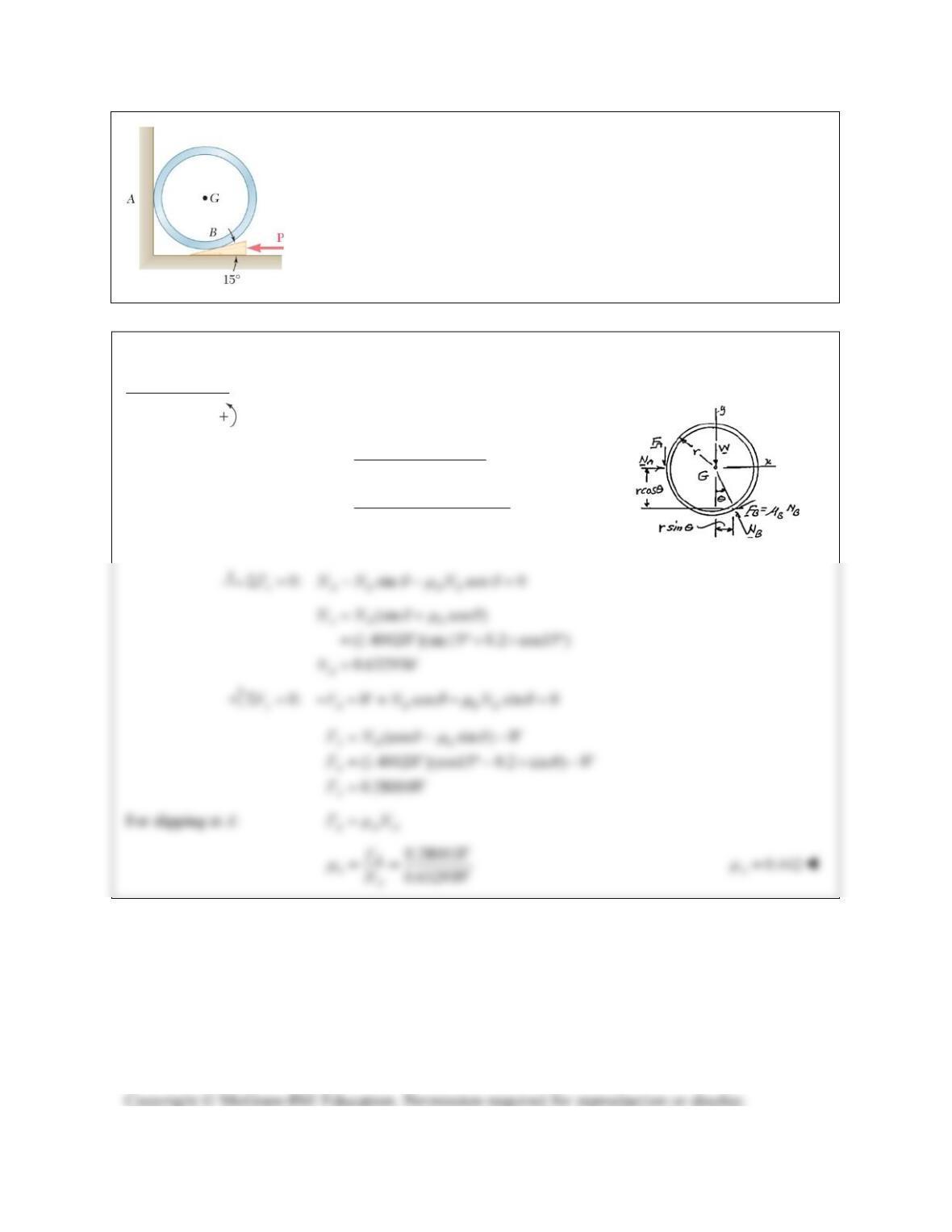
PROBLEM 8.65
A 15 wedge is forced under a 50-kg pipe as shown. Knowing that the
coefficient of static friction at both surfaces of the wedge is 0.20, determine
the largest coefficient of static friction between the pipe and the vertical wall
for which slipping will occur at A.
SOLUTION
Free body: Pipe
0: cos ( sin ) 0
A B BB BB
MNr NrNrWr
cos (1 sin )
cos15 0.2(1 sin15 )
1.4002
B
B
B
B
W
N
W
N
NW
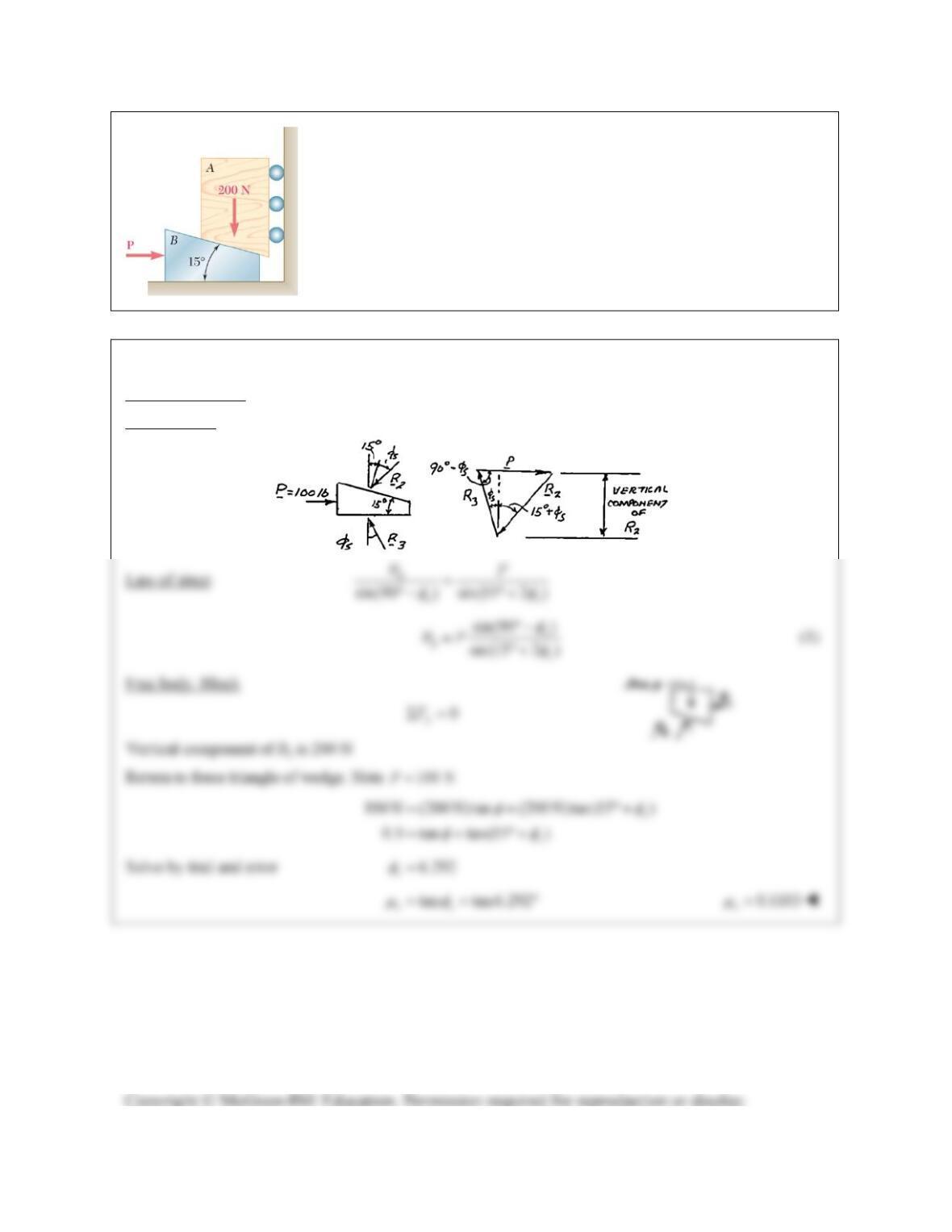
PROBLEM 8.66*
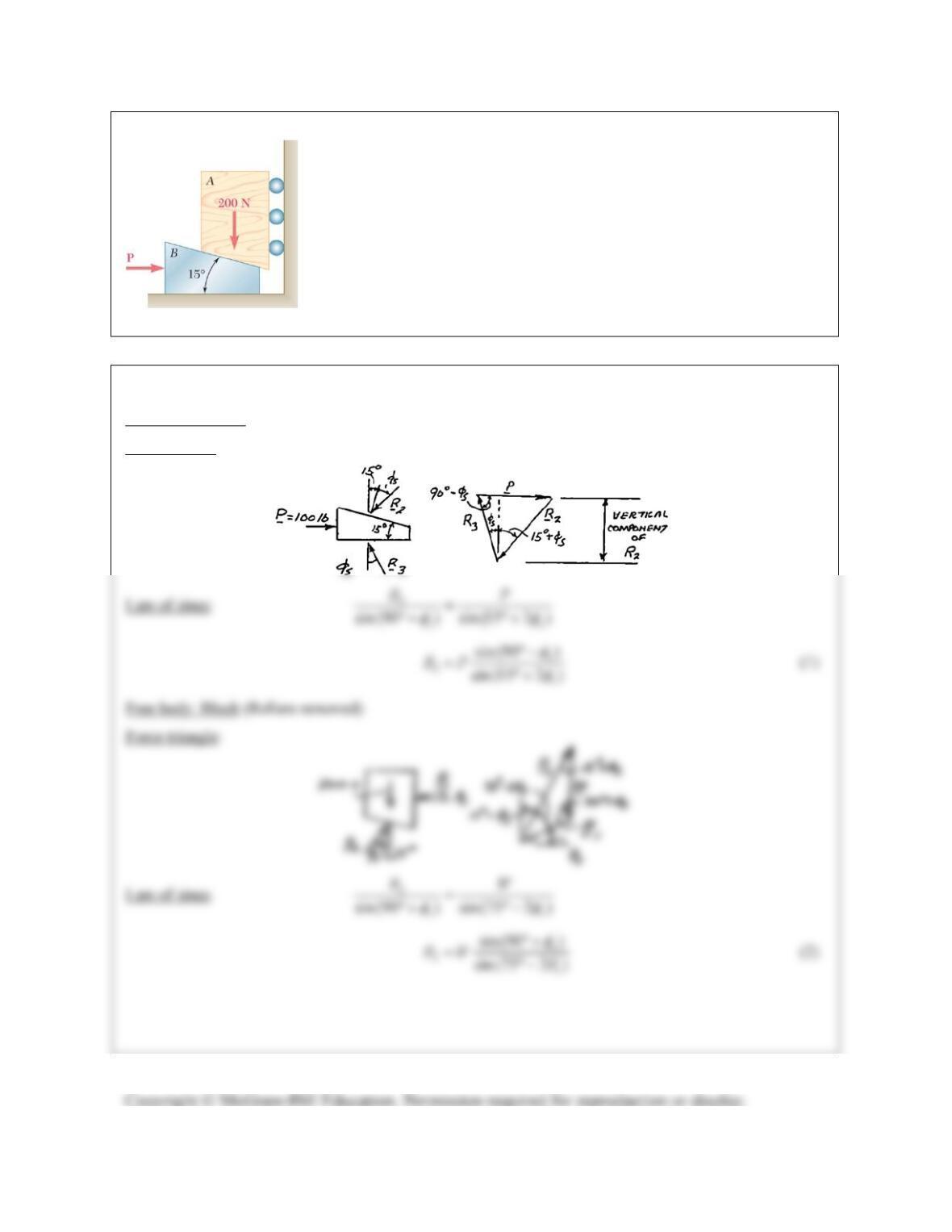
A 200-N block rests as shown on a wedge of negligible weight. The
coefficient of static friction
s is the same at both surfaces of the wedge, and
friction between the block and the vertical wall may be neglected. For
P 100 N, determine the value of
s for which motion is impending.
(Hint: Solve the equation obtained by trial and error.)
SOLUTION
Free body: Wedge
Force triangle:
PROBLEM 8.67*
Solve Problem 8.66 assuming that the rollers are removed and that
s
is the
coefficient of friction at all surfaces of contact.
PROBLEM 8.66* A 200-N block rests as shown on a wedge of negligible
weight. The coefficient of static friction
s
is the same at both surfaces of
the wedge, and friction between the block and the vertical wall may be
neglected. For P 100 N, determine the value of
s
for which motion is
impending. (Hint: Solve the equation obtained by trial and error.)
SOLUTION
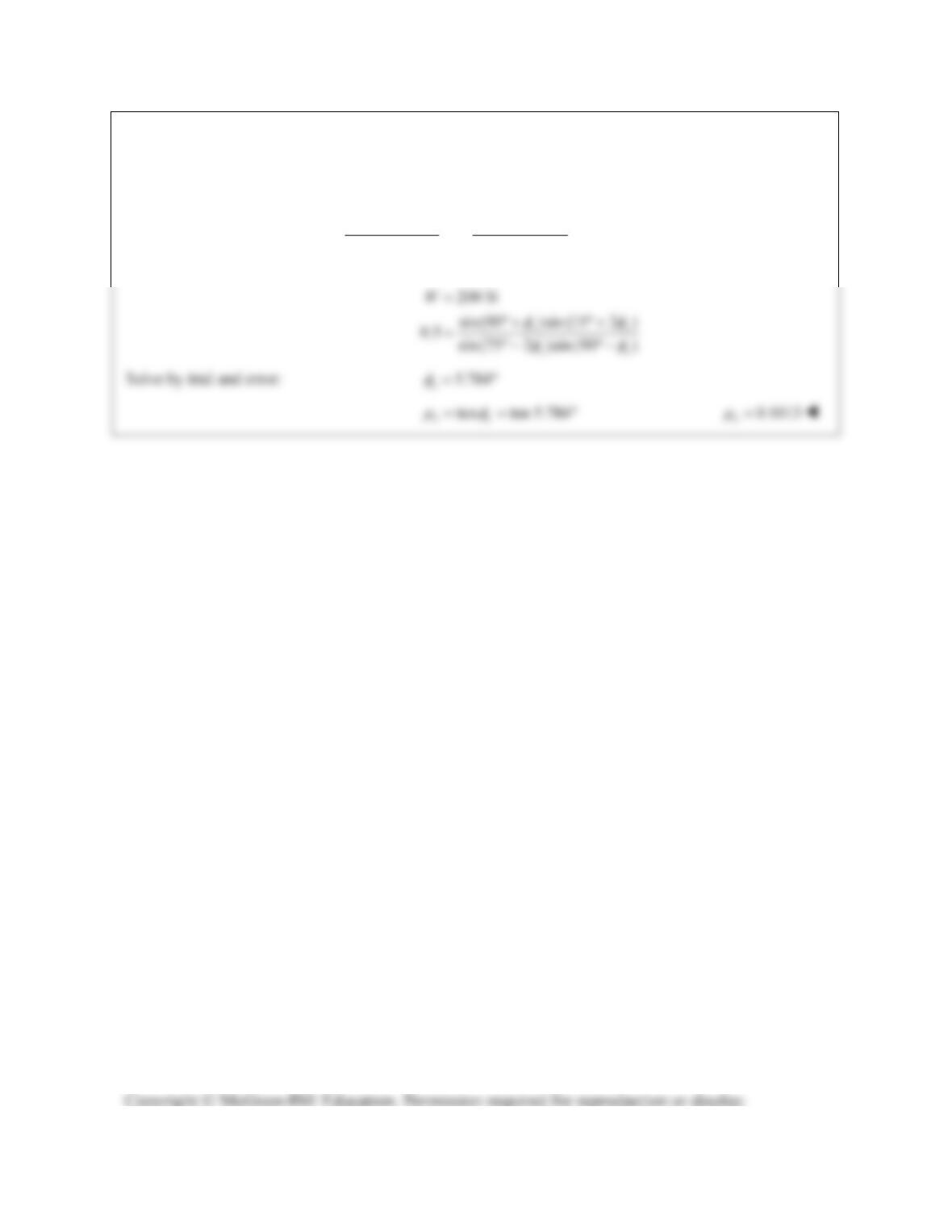
Free body: Wedge
Force triangle:
PROBLEM 8.67* (Continued)
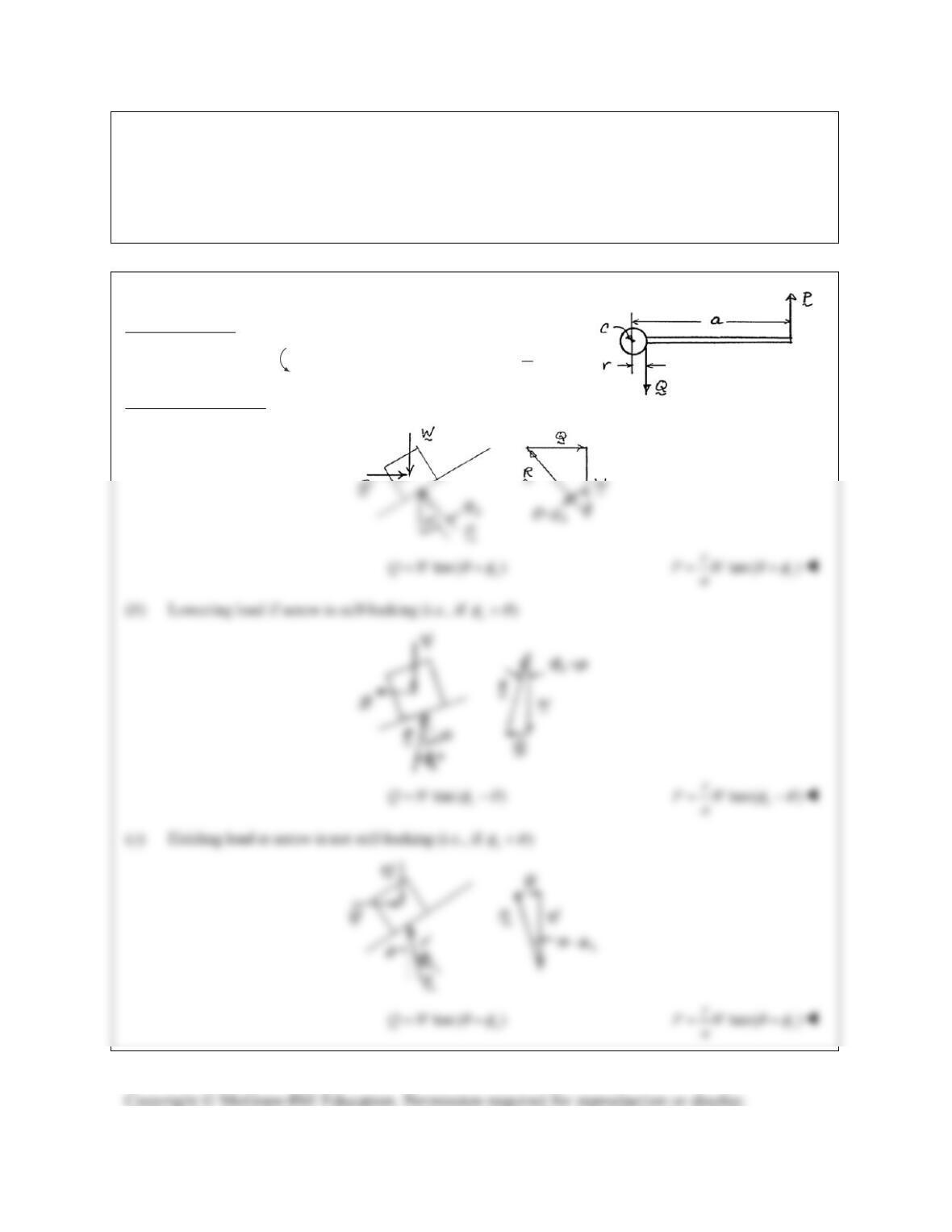
Equate R2 from Eq. (1) and Eq. (2):
sin (90 ) sin (90 )
sin (15 2 ) sin (75 2 )
100 lb
ss
ss
PW
P
PROBLEM 8.68
Derive the following formulas relating the load W and the force P exerted on the handle of the jack
discussed in Section 8.6. (a) P (Wr/a) tan (
s
), to raise the load; (b) P (Wr/a) tan (
s
), to lower the
load if the screw is self-locking; (c) P (Wr/a) tan (
s
), to hold the load if the screw is not self-locking.
SOLUTION
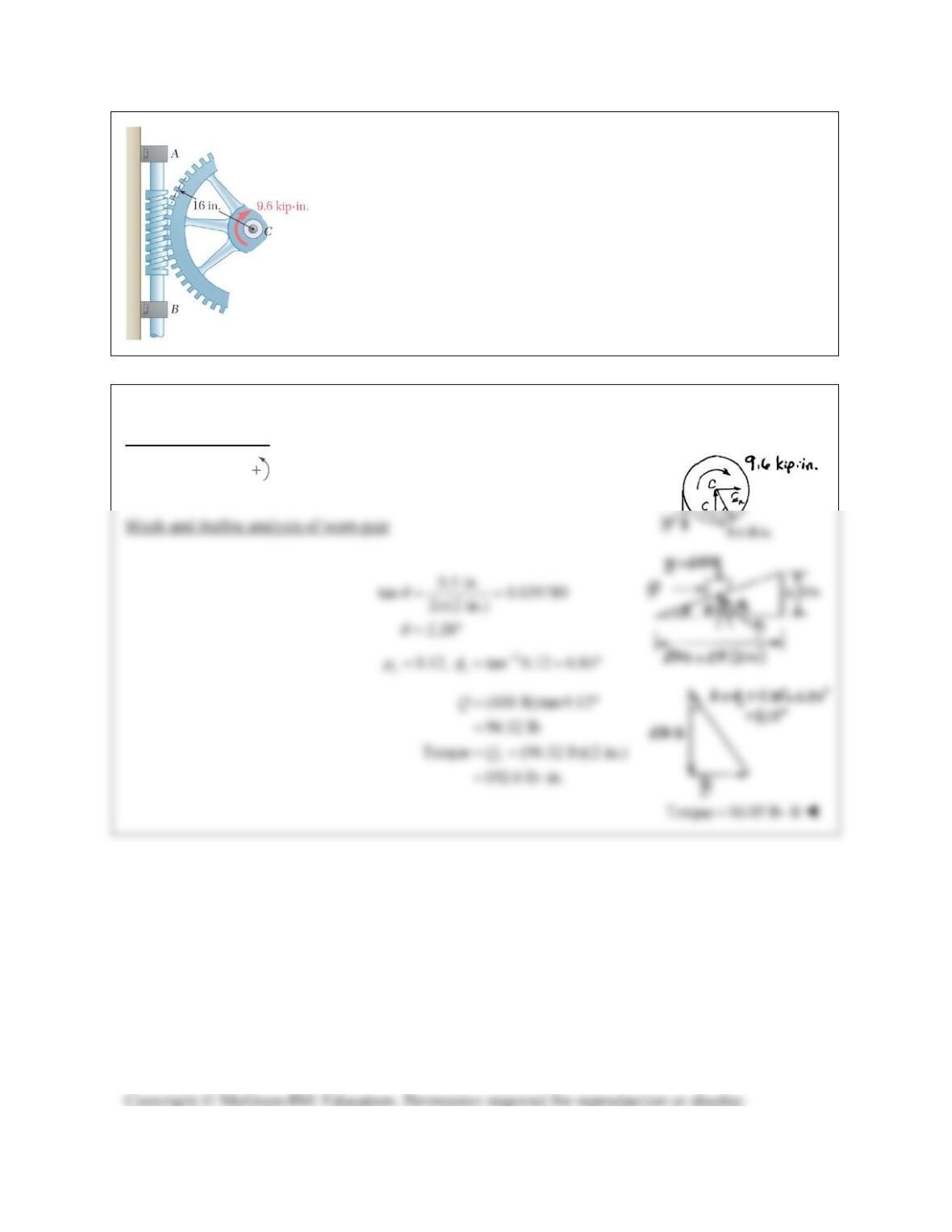
FBD jack handle:
See Section 8.6.
0: 0 or
C
r
MaPrQ PQ
a
FBD block on incline:
(a) Raising load
PROBLEM 8.69
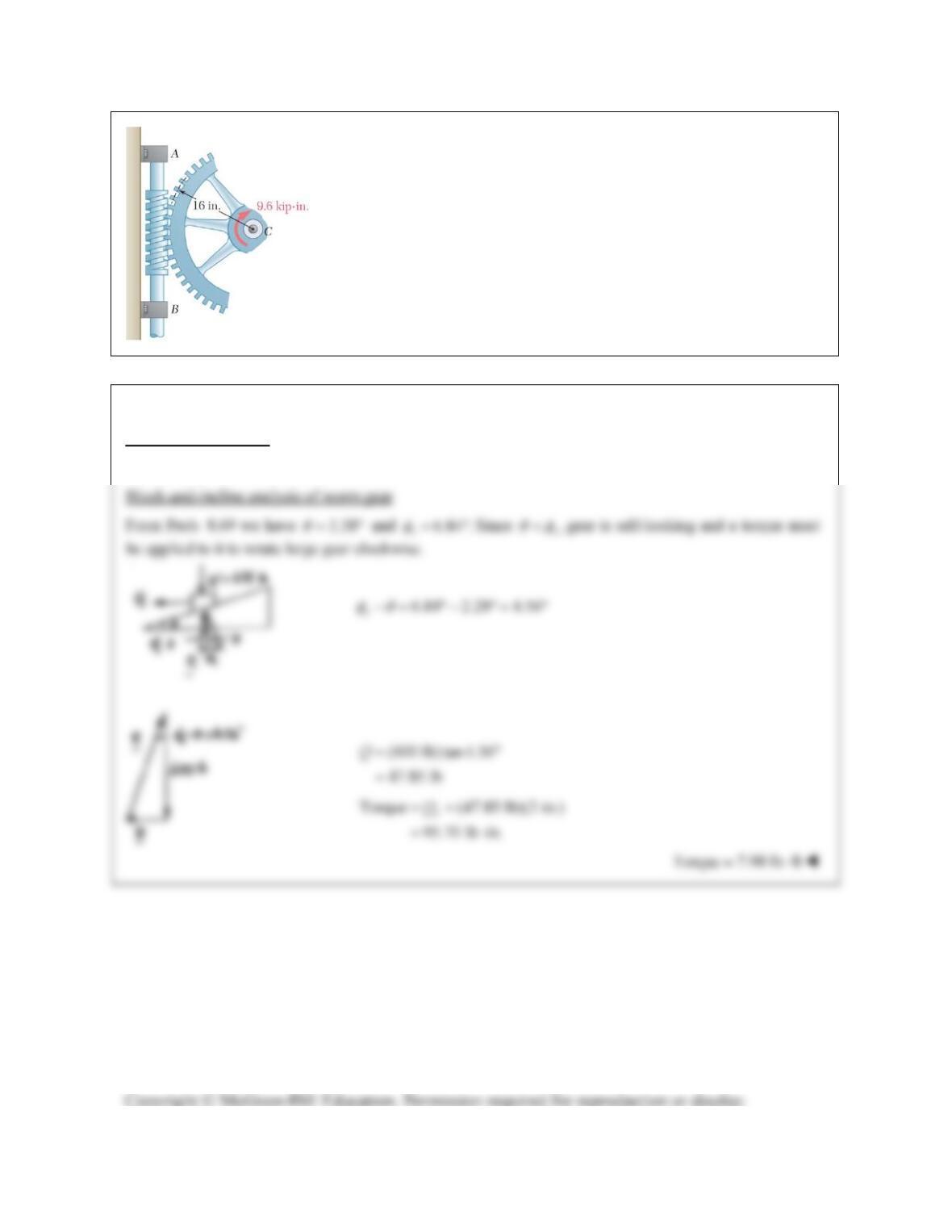
The square-threaded worm gear shown has a mean radius of 2 in. and a
lead of 0.5 in. The large gear is subjected to a constant clockwise couple of
9.6 kip · in. Knowing that the coefficient of static friction between the two
gears is 0.12, determine the couple that must be applied to shaft AB in
order to rotate the large gear counterclockwise. Neglect friction in the
bearings at A, B, and C.
SOLUTION
Free body: Large gear
0: (16 in.) 9.6 kip in. 0
0.6 kip 600 lb
C
MW
W
PROBLEM 8.70
In Problem 8.69, determine the couple that must be applied to shaft AB in
order to rotate the large gear clockwise.
PROBLEM 8.69 The square-threaded worm gear shown has a mean
radius of 2 in. and a lead of 0.5 in. The large gear is subjected to a constant
clockwise couple of 9.6 kip in. Knowing that the coefficient of static
friction between the two gears is 0.12, determine the couple that must be
applied to shaft AB in order to rotate the large gear counterclockwise.
Neglect friction in the bearings at A, B, and C.
SOLUTION
Free body: Large gear
See solution to Prob. 8.69. We find 600 lbW
PROBLEM 8.71
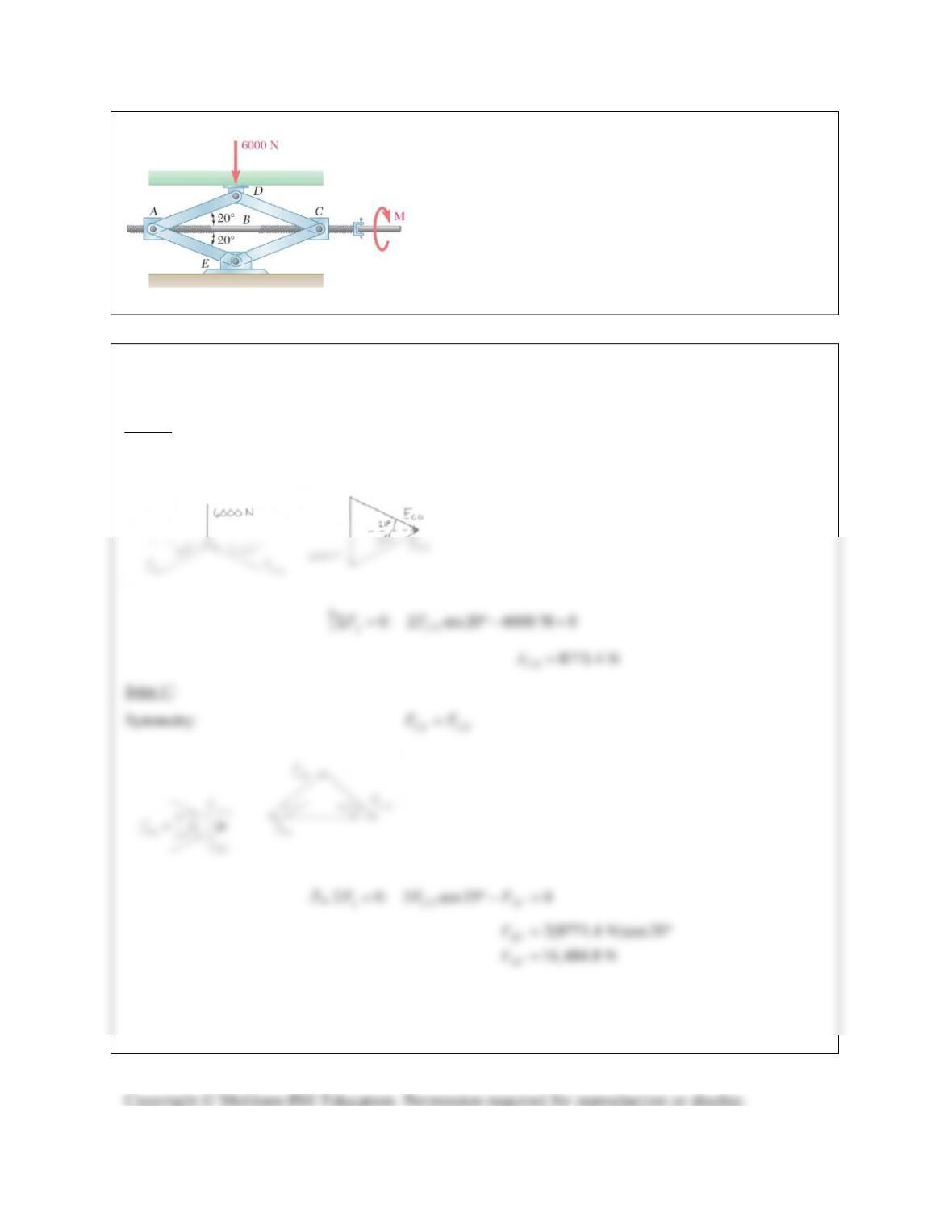
High-strength bolts are used in the construction of many steel structures. For a 1-in.-
nominal-diameter bolt, the required minimum bolt tension is 51 kips. Assuming the
coefficient of friction to be 0.30, determine the required couple that should be applied to
the bolt and nut. The mean diameter of the thread is 0.94 in., and the lead is 0.125 in.
Neglect friction between the nut and washer, and assume the bolt to be square-threaded.
SOLUTION
Block-and-incline analysis of bolt and nut:
PROBLEM 8.72
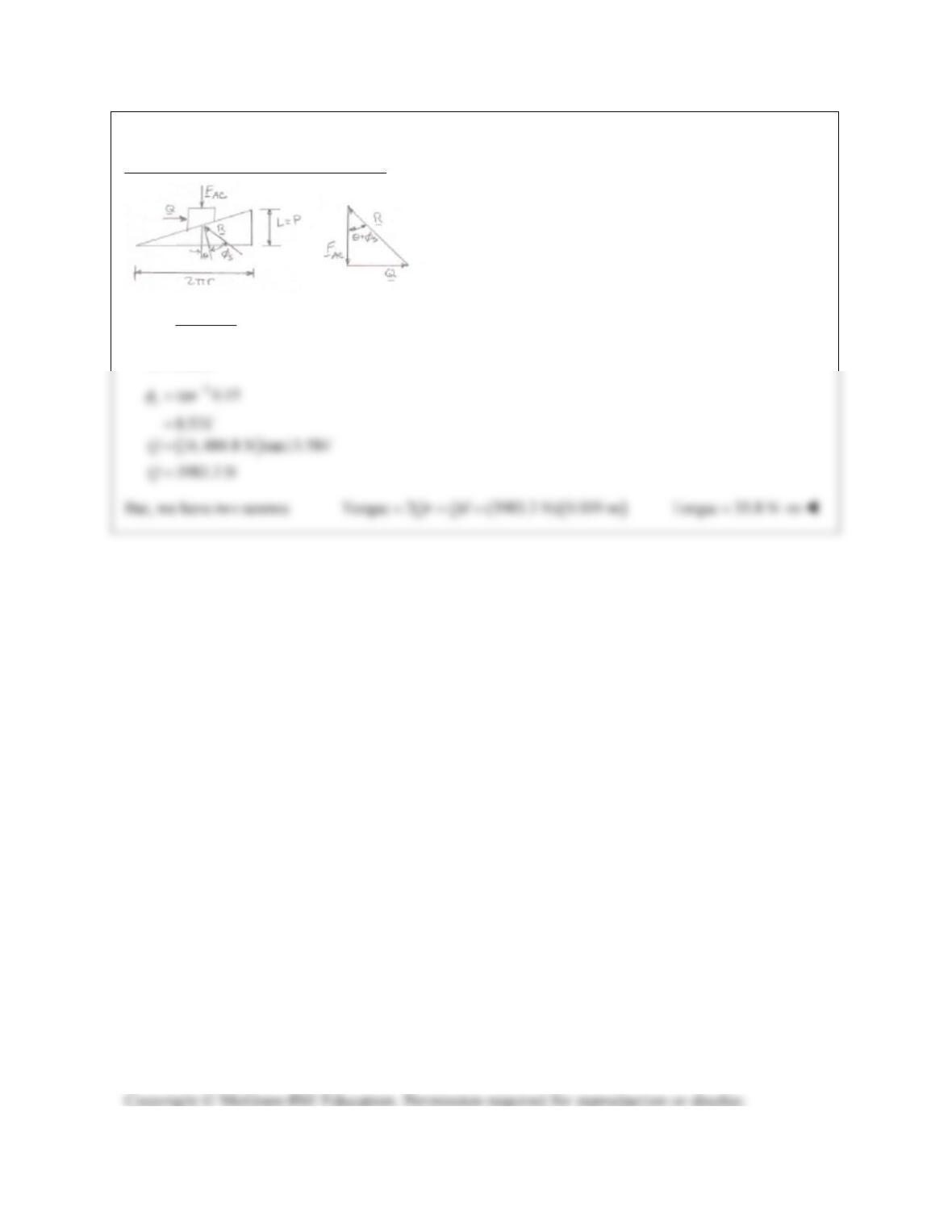
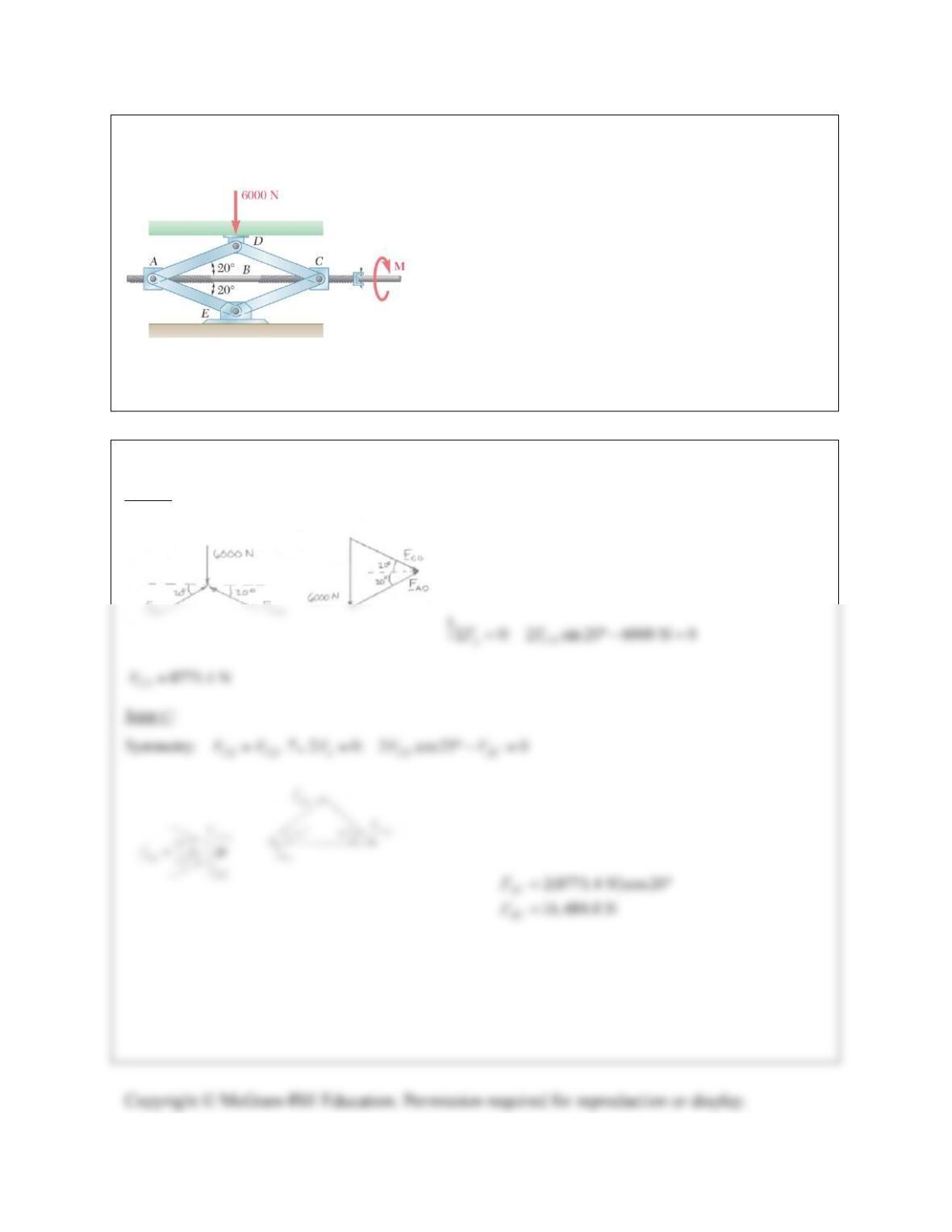
The position of the automobile jack shown is controlled by
a screw ABC that is single-threaded at each end (right-
handed thread at A, left-handed thread at C). Each thread
has a pitch of 2.5 mm and a mean diameter of 9 mm. If the
coefficient of static friction is 0.15, determine the
magnitude of the couple
M
that must be applied to raise
the automobile.
SOLUTION
All members of jack are two-force members; analyze joint equilibrium at C and D.
Joint D:
Symmetry:
AD CD
FF
PROBLEM 8.72 (Continued)
Block-and-incline analysis of one screw:
2.5 mm
tan (9 mm)
5.053
PROBLEM 8.73
For the jack of Prob. 8.72, determine the magnitude of the
couple
M
that must be applied to lower the automobile.
PROBLEM 8.72
The position of the automobile jack shown is controlled by
a screw ABC that is single-threaded at each end (right-
handed thread at A, left-handed thread at C). Each thread
has a pitch of 2.5 mm and a mean diameter of 9 mm. If the
coefficient of static friction is 0.15, determine the
magnitude of the couple
M
that must be applied to raise the
automobile.
SOLUTION
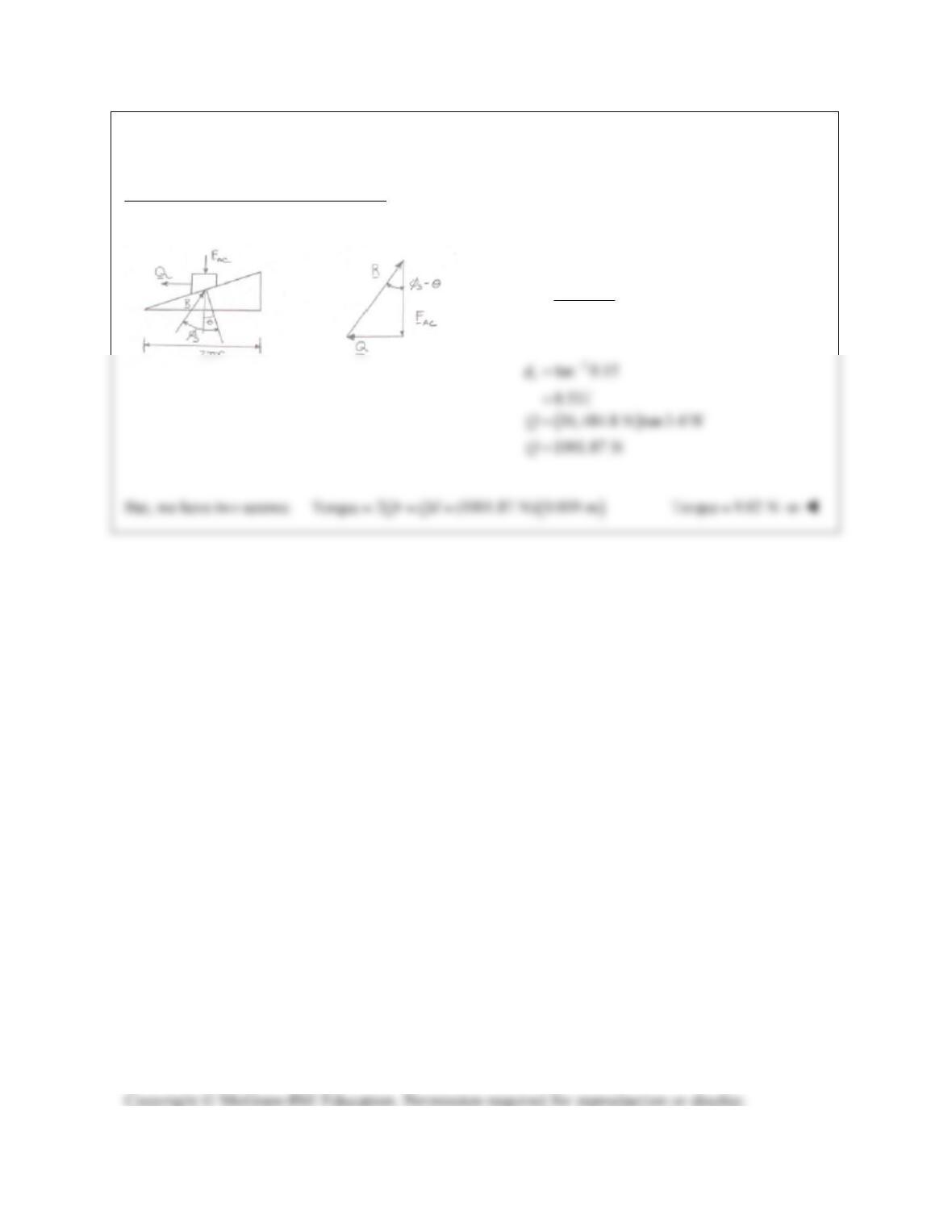
All members of jack are two-force members; analyze joint equilibrium at C and D
Joint D:Symmetry:
AD CD
FF
PROBLEM 8.73 (Continued)
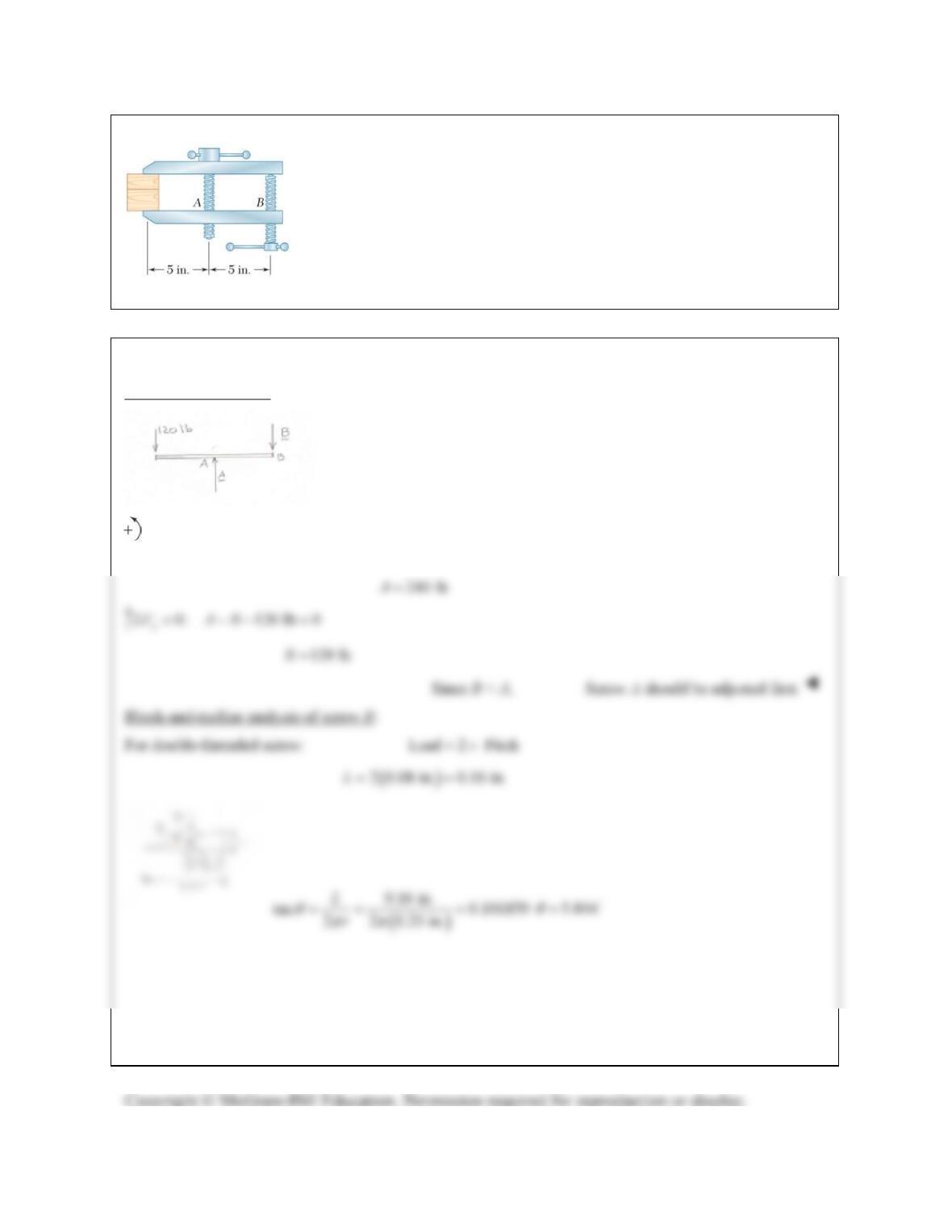
Block-and-incline analysis of one screw:
2.5 mm
tan (9 mm)
5.053
PROBLEM 8.74
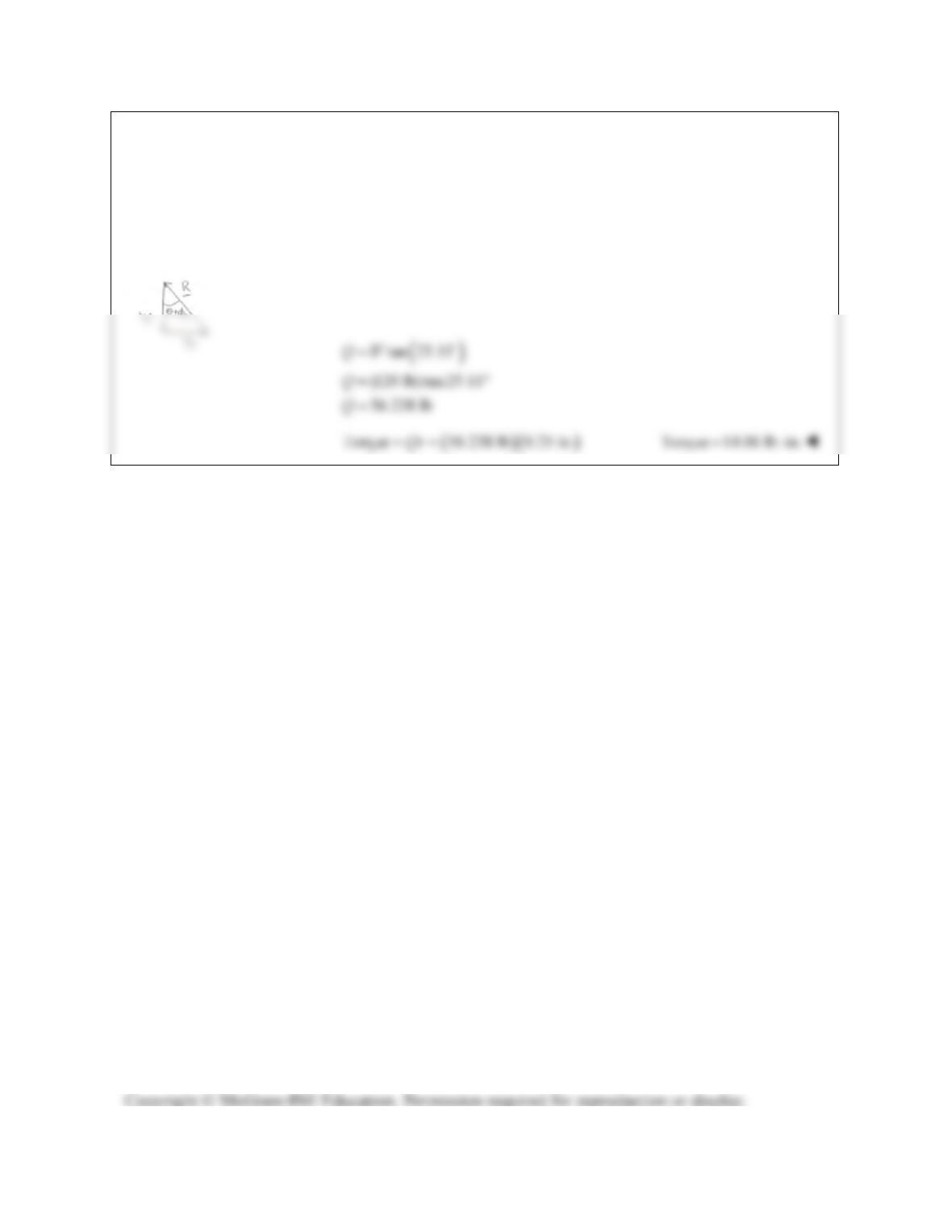
The vise shown consists of two members connected by two double-threaded
screws with a mean radius of 0.25 in. and pitch of 0.08 in. The lower member
is threaded at A and B (
s = 0.35), but the upper member is not threaded. It is
desired to apply two equal and opposite forces of 120 lb on the blocks held
between the jaws. (a) What screw should be adjusted first? (b) What is the
maximum couple applied in tightening the second screw?
SOLUTION
Free body: Lower Jaw
0: 120 lb 10 in. 5 in. 0
B
MA
PROBLEM 8.74 (Continued)
11
tan tan 0.35
ss
19.29
s
25.11
s