Chapter 8
8-1 A budget is a detailed quantitative plan
for the acquisition and use of financial and other
8-2
1. Budgets communicate management’s
plans throughout the organization.
2. Budgets force managers to think about
and plan for the future. In the absence of the
necessity to prepare a budget, many managers
would spend all of their time dealing with day-
8-3 Responsibility accounting is a system in
which a manager is held responsible for those
items of revenues and costs—and only those
items—that the manager can control to a
significant extent. Each line item in the budget is
made the responsibility of a manager who is
then held responsible for differences between
budgeted and actual results.
plans are to be accomplished. The master
budget is composed of a number of smaller,
cash budget.
8-5 The level of sales impacts virtually every
other aspect of the firm’s activities. It
determines the production budget, cash
collections, cash disbursements, and selling and
administrative budget that in turn determine the
having responsibility over revenues or costs
should prepare the budget data against which
his or her subsequent performance will be
measured. As the budget data are
communicated upward, higher-level managers
should review the budgets for consistency with
the overall goals of the organization and the
plans of other units in the organization. Any
issues should be resolved in discussions
8-8 A self-imposed budget is one in which
persons with responsibility over cost control
prepare their own budgets. This is in contrast to
a budget that is imposed from above. The major
advantages of a self-imposed budget are: (1)
Individuals at all levels of the organization are
recognized as members of the team whose
8-9 The direct labor budget and other
budgets can be used to forecast workforce
staffing needs. Careful planning can help a
company avoid erratic hiring and laying off of
employees.
8-10 The principal purpose of the cash
Exercise 8-1 (20 minutes)
1.
July
August
September
Total
May sales:
$430,000 × 10% …….
$ 43,000
$ 43,000
June sales:
$540,000 × 70%,
10% …………………….
378,000
$ 54,000
432,000
July sales:
120,000
420,000
600,000
August sales:
September sales:
$500,000 × 20% …….
100,000
Total cash collections ….
$541,000
$654,000
Notice that even though sales peak in August, cash collections peak in
September. This occurs because the bulk of the company’s customers
pay in the month following sale. The lag in collections that this creates is
even more pronounced in some companies. Indeed, it is not unusual for
a company to have the least cash available in the months when sales
are greatest.
2. Accounts receivable at September 30:
From August sales: $900,000 × 10% ………………….
From September sales: $500,000 × (70% + 10%) ..
400,000
Total accounts receivable …………………………………
Exercise 8-2 (10 minutes)
July
August
Sept.
Quarter
Budgeted sales in units …………
30,000
45,000
60,000
135,000
Add desired ending inventory* .
4,500
6,000
5,000
5,000
Total needs ………………………..
Less beginning inventory……….
Required production …………….
Exercise 8-3 (15 minutes)
Quarter—Year 2
Year 3
First
Second
Third
Fourth
First
Required production of calculators ………..
60,000
90,000
150,000
100,000
80,000
Number of chips per calculator …………….
× 3
× 3
× 3
× 3
× 3
Total production needs—chips ……………..
180,000
270,000
450,000
300,000
240,000
Second
Third
Fourth
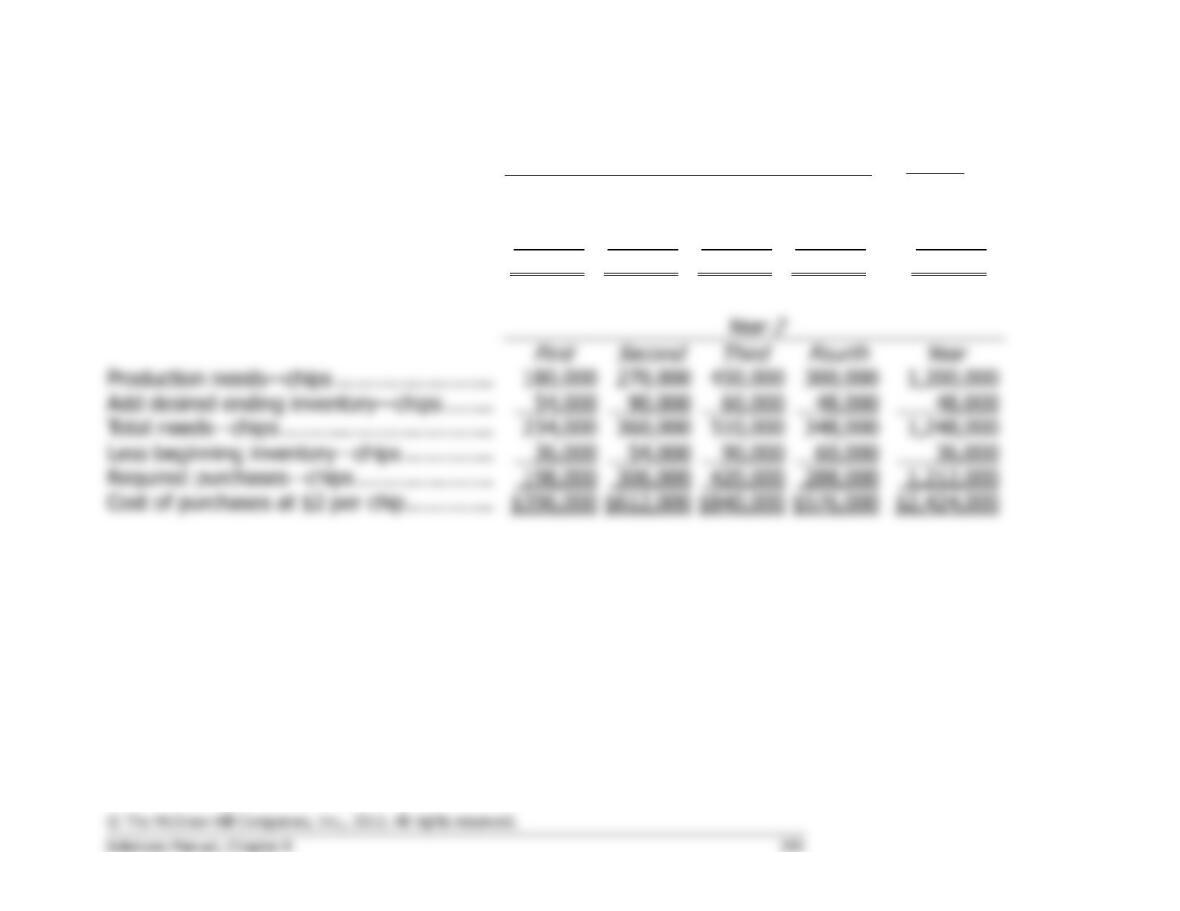
Production needs—chips …………………….
270,000
450,000
300,000
Add desired ending inventory—chips ……..
90,000
60,000
48,000
Total needs—chips …………………………….
360,000
510,000
348,000
Less beginning inventory—chips …………..
Required purchases—chips ………………….
Cost of purchases at $2 per chip …………..
Exercise 8-4 (20 minutes)
1. Assuming that the direct labor workforce is adjusted each quarter, the direct labor budget would be:
1st
Quarter
2nd
Quarter
3rd
Quarter
4th
Quarter
Year
Units to be produced ……………….
5,000
4,400
4,500
4,900
18,800
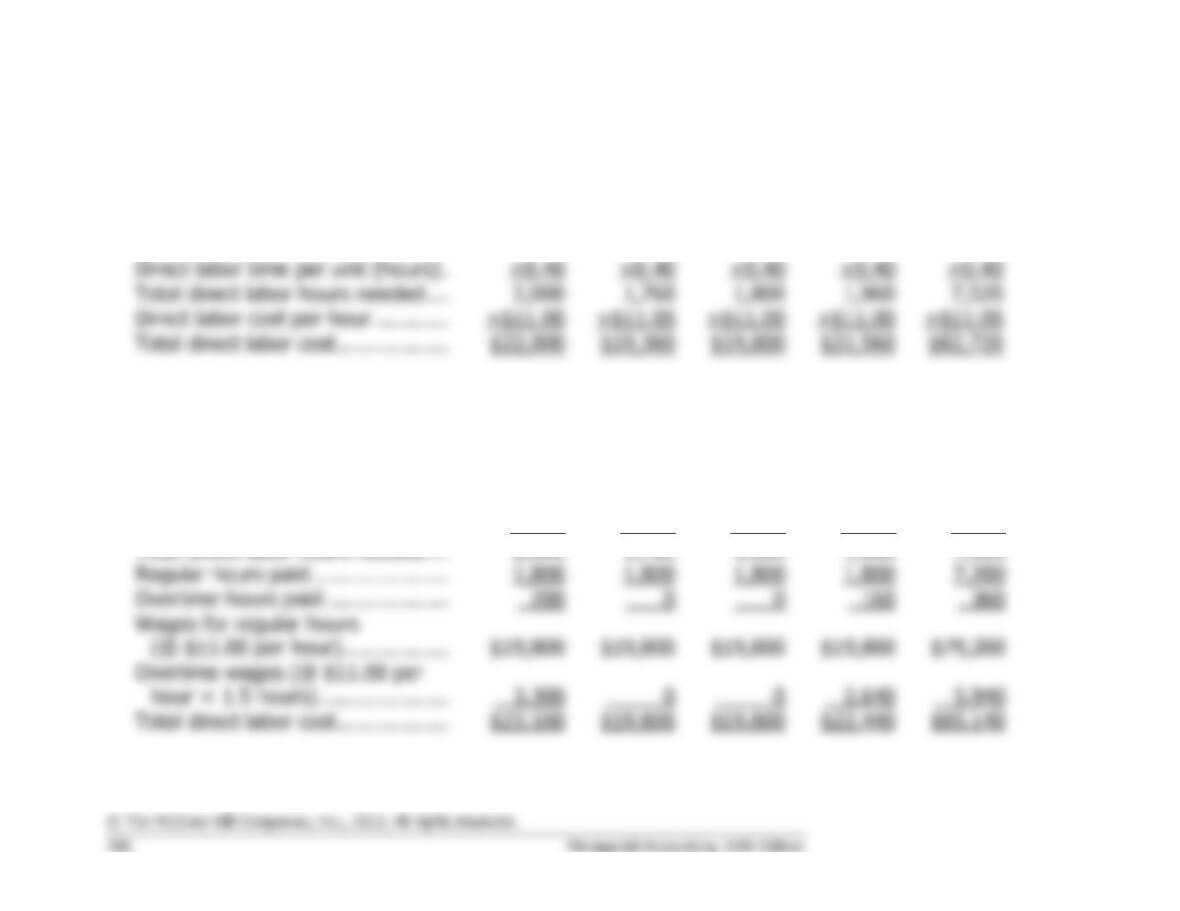
Direct labor time per unit (hours) .
×0.40
×0.40
×0.40
×0.40
Total direct labor hours needed ….
Direct labor cost per hour …………
Total direct labor cost ………………
2. Assuming that the direct labor workforce is not adjusted each quarter and that overtime wages are
paid, the direct labor budget would be:
1st
Quarter
2nd
Quarter
3rd
Quarter
4th
Quarter
Year
Units to be produced ……………….
5,000
4,400
4,500
4,900
18,800
Direct labor time per unit (hours) .
×0.40
×0.40
×0.40
×0.40
×0.40
Total direct labor hours needed ….
Regular hours paid ………………….
Overtime hours paid ………………..
Total direct labor cost ………………
Exercise 8-5 (15 minutes)
1.
Krispin Corporation
Manufacturing Overhead Budget
1st
Quarter
2nd
Quarter
3rd
Quarter
4th
Quarter
Year
Budgeted direct labor-hours ………
5,000
4,800
5,200
5,400
20,400
Variable overhead rate …………….
× $1.75
× $1.75
× $1.75
× $1.75
× $1.75
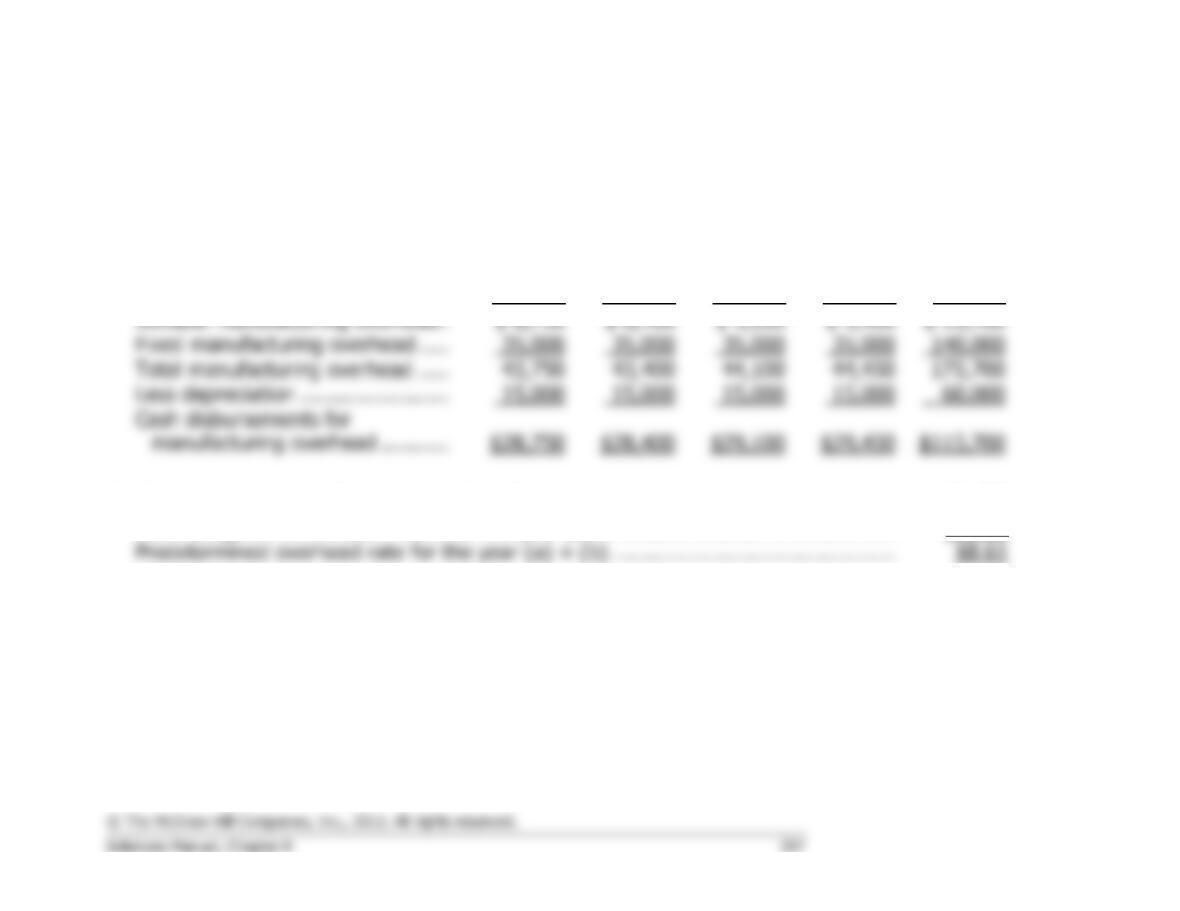
Variable manufacturing overhead .
Fixed manufacturing overhead …..
Total manufacturing overhead …..
Less depreciation ……………………
$115,700
2.
Total budgeted manufacturing overhead for the year (a) ………………………………..
$175,700
Total budgeted direct labor-hours for the year (b) …………………………………………
20,400
Predetermined overhead rate for the year (a) ÷ (b) ………………………………………
$8.61
Exercise 8-6 (15 minutes)
Haerve Company
Selling and Administrative Expense Budget
1st
Quarter
2nd
Quarter
3rd
Quarter
4th
Quarter
Year
Budgeted unit sales …………………………….
12,000
14,000
11,000
10,000
47,000
Variable selling and administrative expense
per unit ………………………………………….
× $2.75
× $2.75
× $2.75
× $2.75
× $2.75
Variable expense ………………………………..
$ 33,000
$ 38,500
$ 30,250
$ 27,500
$129,250
Fixed selling and administrative expenses:
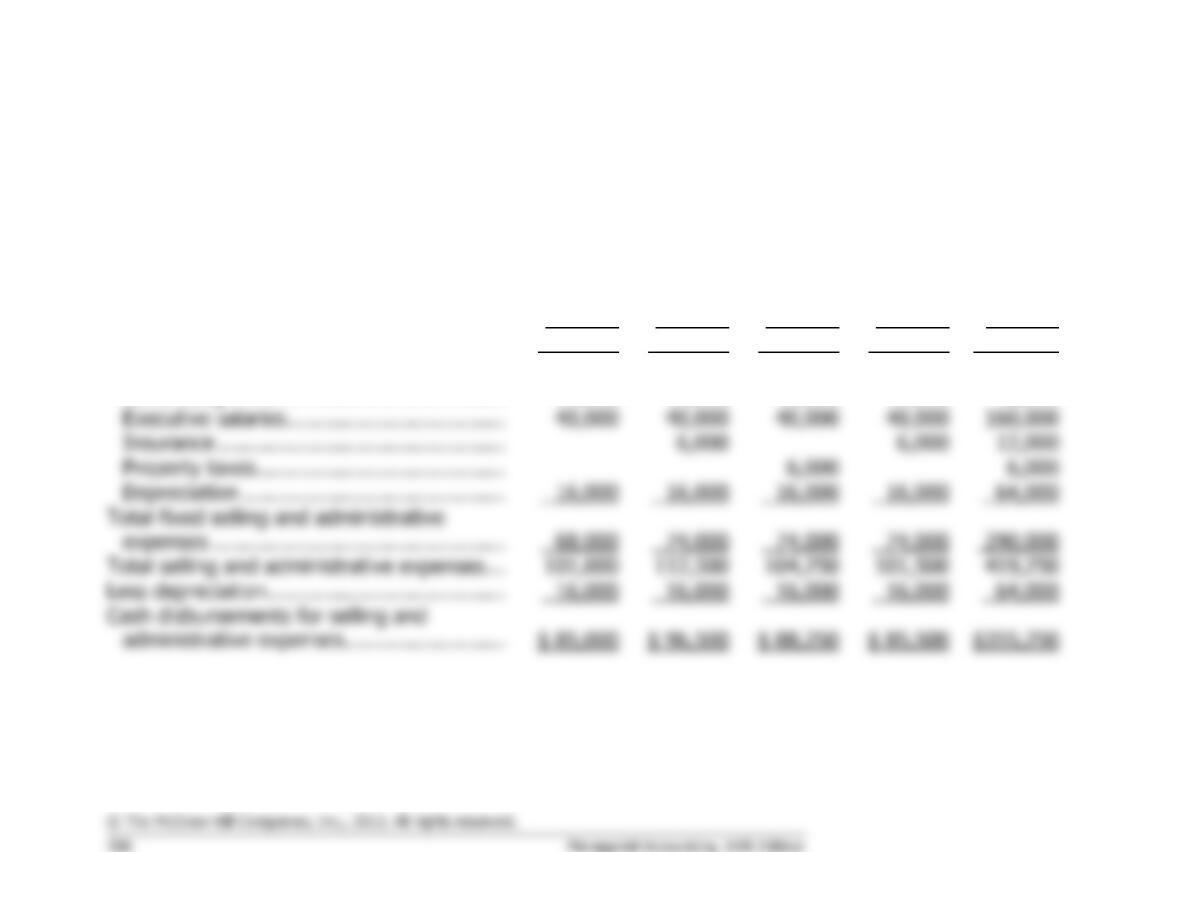
Advertising………………………………………
12,000
12,000
12,000
12,000
48,000
290,000
Total selling and administrative expenses …
Less depreciation ………………………………..
$ 85,000
$ 96,500
$ 88,250
$ 85,500
$355,250
Exercise 8-7 (20 minutes)
Forest Outfitters
Cash Budget
1st
Quarter
2nd
Quarter
3rd
Quarter
4th
Quarter
Year
Cash balance,
beginning …………
$ 50,000
$ 30,000
$ 69,800
$ 49,800
$ 50,000
Total cash receipts ..
340,000
670,000
410,000
470,000
1,890,000
Total cash available
disbursements ……
530,000
450,000
430,000
480,000
1,890,000
over
disbursements ……
(140,000)
250,000
49,800
39,800
50,000
Financing:
Borrowings (at
beginning)* …….
170,000
170,000
Repayments (at
ending) ………….
(170,000)
(170,000)
Total financing ……..
Cash balance,
$ 30,000
$ 69,800
$ 49,800
$ 39,800
$ 39,800
Exercise 8-8 (10 minutes)
Seattle Cat
Budgeted Income Statement
Sales (380 units @ $1,850 each) ……………………..
$703,000
Cost of goods sold (380 units @ $1,425 each) …….
541,500
Gross margin ……………………………………………….
161,500
Selling and administrative expenses* ………………..
Net operating income …………………………………….
Interest expense …………………………………………..
Net income …………………………..……………………..
Exercise 8-9 (20 minutes)
Academic Copy
Budgeted Balance Sheet
Assets
Current assets:
Cash* …………………………………………
$ 4,400
Accounts receivable ……………………….
6,500
Supplies inventory …………………………
Total current assets …………………………
Plant and equipment:
Equipment …………………………………..
Accumulated depreciation ……………….
Plant and equipment, net ………………….
Total assets ……………………………………
Liabilities and Stockholders’ Equity
Current liabilities:
Accounts payable ………………………….
$ 1,900
Stockholders’ equity:
Common stock ……………………………..
$ 4,000
Retained earnings# ……………………….
26,100
Total stockholders’ equity ………………….
Total liabilities and stockholders’ equity ..
Retained earnings, beginning balance ..
Add net income …………………………….
8,600
Deduct dividends …………………………..
Retained earnings, ending balance ……
Exercise 8-10 (30 minutes)
1.
Graber Corporation
Sales Budget
1st
Quarter
2nd
Quarter
3rd
Quarter
4th
Quarter
Year
Budgeted unit sales ……………
16,000
15,000
14,000
15,000
60,000
Selling price per unit …………..
× $22.00
× $22.00
× $22.00
× $22.00
× $22.00
Total sales ……………………….
$352,000
$330,000
$308,000
$330,000
$1,320,000
Schedule of Expected Cash Collections
Total cash collections ………….
Exercise 8-10 (continued)
2.
Graber Corporation
Production Budget
1st
Quarter
2nd
Quarter
3rd
Quarter
4th
Quarter
Year
Budgeted unit sales ……………
16,000
15,000
14,000
15,000
60,000
Add desired ending inventory .
3,000
2,800
3,000
3,400
3,400
Total units needed …………….
19,000
18,400
63,400
Less beginning inventory …….
3,200
3,000
2,800
3,000
3,200
Required production …………..
1.
Priston Company
Direct Materials Budget
1st
Quarter
2nd
Quarter
3rd
Quarter
4th
Quarter
Year
Required production ………………………..
6,000
7,000
8,000
5,000
26,000
Raw materials per unit ……………………..
× 3
× 3
× 3
× 3
× 3
Production needs …………………………...
18,000
21,000
24,000
15,000
78,000
Add desired ending inventory …………….
Total needs ……………………………………
Less beginning inventory ………………….
Raw materials to be purchased ………….
$2.50 per pound …………………………..
$46,500
$54,000
$55,500
$39,250
$195,250
Schedule of Expected Cash Disbursements for Materials
Accounts payable, beginning balance ….
$11,775
$ 11,775
1st Quarter purchases ……………………..
32,550
$13,950
46,500
2nd Quarter purchases …………………….
37,800
$16,200
54,000
3rd Quarter purchases ……………………..
38,850
$16,650
55,500
4th Quarter purchases ……………………..
Total cash disbursements for materials ..
$44,325
$51,750
$55,050
$44,125
Exercise 8-11 (continued)
2.
Priston Company
Direct Labor Budget
1st
Quarter
2nd
Quarter
3rd
Quarter
4th
Quarter
Year
Units to be produced ……………………..
6,000
7,000
8,000
5,000
26,000
Direct labor time per unit (hours) ……..
× 0.50
× 0.50
× 0.50
× 0.50
× 0.50
Total direct labor-hours needed………..
3,000
3,500
4,000
2,500
13,000
Direct labor cost per hour ……………….
Total direct labor cost …………………….
$156,000
Exercise 8-12 (30 minutes)
1.
Harveton Corporation
Direct Labor Budget
1st
Quarter
2nd
Quarter
3rd
Quarter
4th
Quarter
Year
Units to be produced ……………….
16,000
15,000
14,000
15,000
60,000
Direct labor time per unit (hours) .
0.80
0.80
0.80
0.80
0.80
Total direct labor-hours needed….
Direct labor cost per hour …………
Total direct labor cost ………………
$147,200
$138,000
$128,800
$138,000
$552,000
2.
Harveton Corporation
Manufacturing Overhead Budget
1st
Quarter
2nd
Quarter
3rd
Quarter
4th
Quarter
Year
Budgeted direct labor-hours ………
12,800
12,000
11,200
12,000
48,000
Variable overhead rate …………….
$2.50
$2.50
$2.50
$2.50
$2.50
Variable manufacturing overhead .
$ 32,000
$ 30,000
$ 28,000
$ 30,000
$120,000
Fixed manufacturing overhead …..
360,000
Total manufacturing overhead …..
Less depreciation ……………………
$ 88,000
$ 86,000
$ 84,000
$ 86,000
$344,000
Exercise 8-13 (45 minutes)
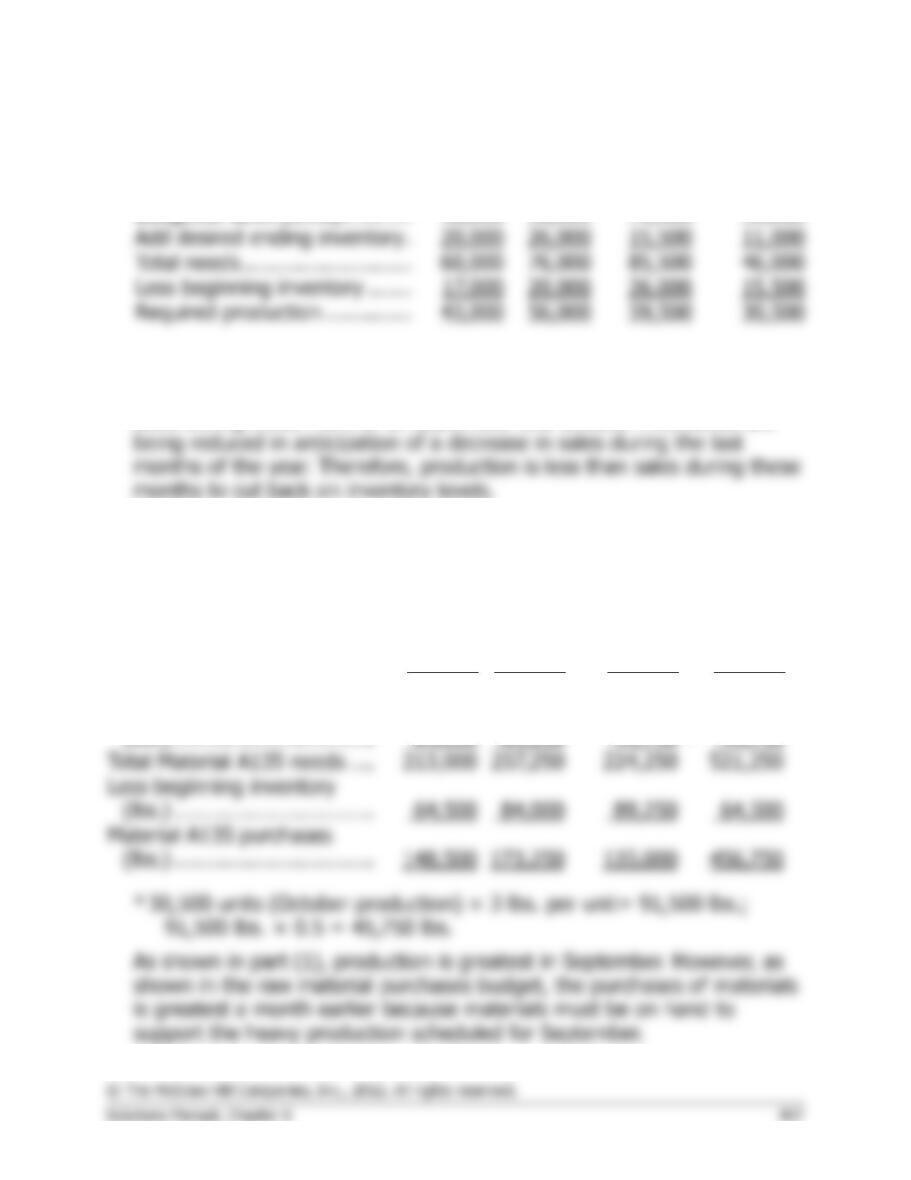
1. Production budget:
July
August
September
October
Budgeted sales (units) ………..
40,000
50,000
70,000
35,000
Add desired ending inventory .
20,000
26,000
15,500
11,000
Total needs ………………………
60,000
76,000
85,500
46,000
Less beginning inventory …….
17,000
20,000
26,000
15,500
Required production …………..
2. During July and August the company is building inventories in
anticipation of peak sales in September. Therefore, production exceeds
sales during these months. In September and October inventories are
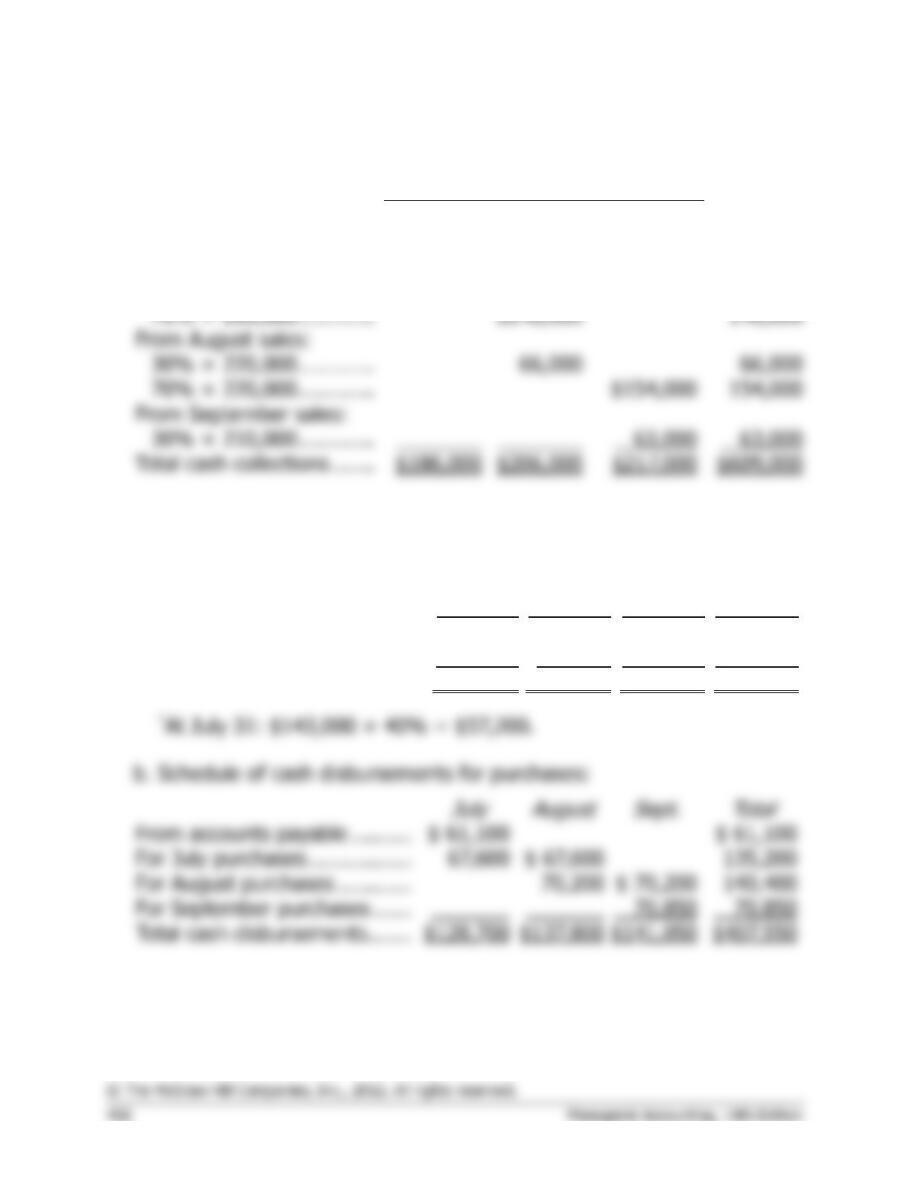
3. Direct materials budget:
July
August
September
Third
Quarter
Required production (units) ..
43,000
56,000
59,500
158,500
Material A135 needed per
unit …………………………….
× 3 lbs.
× 3 lbs.
× 3 lbs.
× 3 lbs.
Production needs (lbs.) ……..
129,000
168,000
178,500
475,500
Add desired ending inventory
(lbs.) …………………………..
84,000
89,250
45,750
*
45,750
Total Material A135 needs ….
257,250
Less beginning inventory
Material A135 purchases
*
30,500 units (October production) × 3 lbs. per unit= 91,500 lbs.;
91,500 lbs. × 0.5 = 45,750 lbs.
Exercise 8-14 (30 minutes)
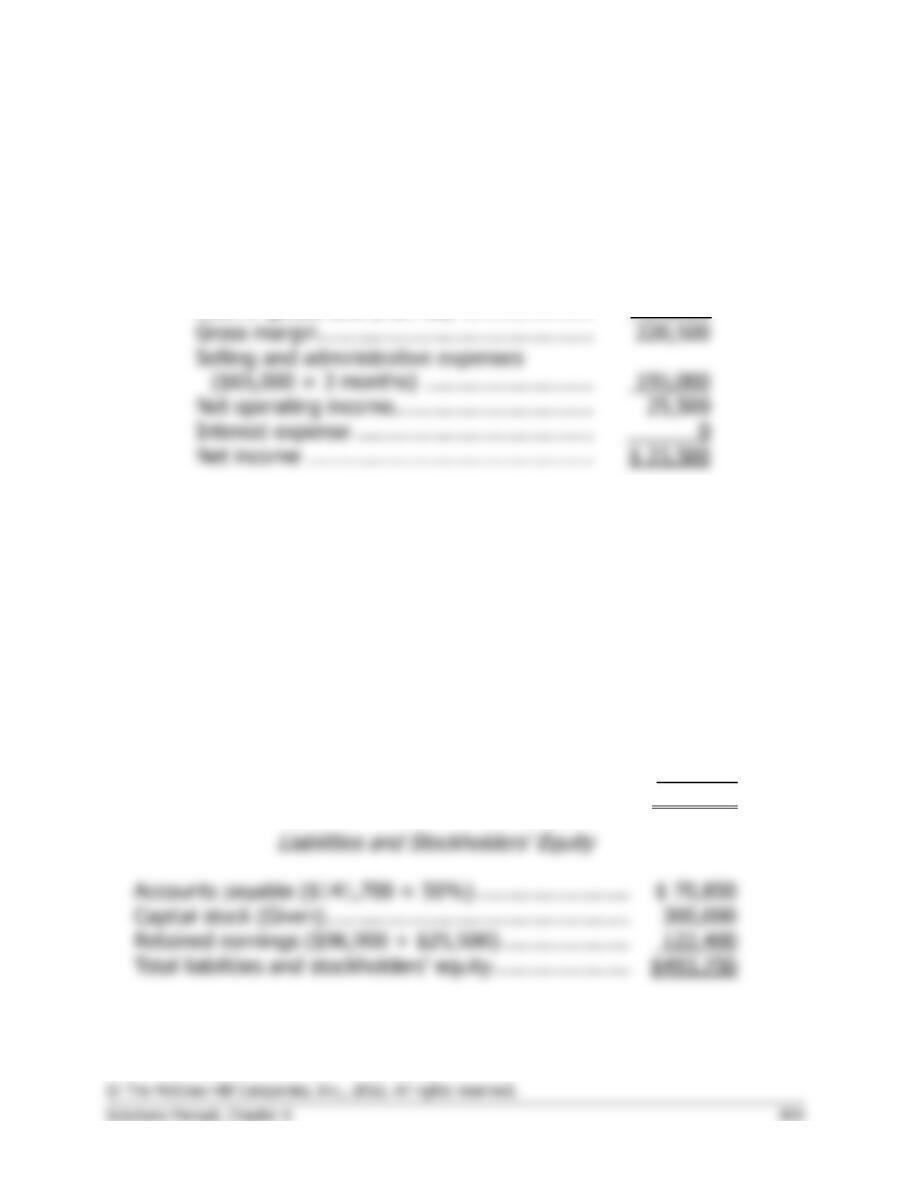
1. Schedule of expected cash collections:
Month
July
August
September
Quarter
From accounts receivable .
$126,000
$126,000
From July sales:
30% × 200,000 …………
60,000
60,000
70% × 200,000 …………
From August sales:
From September sales:
30% × 210,000 …………
63,000
Total cash collections …….
2. a. Merchandise purchases budget:
July
August
Sept.
Total
Budgeted cost of goods sold ….
$130,000
$143,000
$136,500
$409,500
Add desired ending inventory* .
57,200
54,600
59,800
59,800
Total needs ………………………..
187,200
197,600
196,300
469,300
Less beginning inventory ………
52,000
57,200
54,600
52,000
Required purchases ……………..
$135,200
$140,400
$141,700
$417,300
July
Sept.
From accounts payable ……….
$ 61,100
$ 61,100
For July purchases ……………..
For August purchases …………
For September purchases ……
70,850
Total cash disbursements …….
$128,700
$141,050
Exercise 8-14 (continued)
3.
Colerain Corporation
Income Statement
For the Quarter Ended September 30
Sales ($200,000 + $220,000 + $210,000) ..
$630,000
Cost of goods sold (Part 2a) …………………
409,500
Gross margin ……………………………………..
Net operating income…………………………..
Interest expense ………………………………..
Net income ……………………………………….
$ 25,500
4.
Colerain Corporation
Balance Sheet
September 30
Assets
Cash
($80,000 + $609,000 – $407,550 – ($60,000 × 3))
$101,450
Accounts receivable ($210,000 × 70%) …………………
147,000
Inventory (Part 2a) ……………………………………………
59,800
Plant and equipment, net ($200,000 – ($5,000 ×3)) …
185,000
Total assets ……………………………………………………..
$493,250
Accounts payable ($141,700 × 50%) …………………….
$ 70,850
Capital stock (Given)………………………………………….
Retained earnings ($96,900 + $25,500) …………………
Total liabilities and stockholders’ equity ………………….
$493,250
Exercise 8-15 (20 minutes)
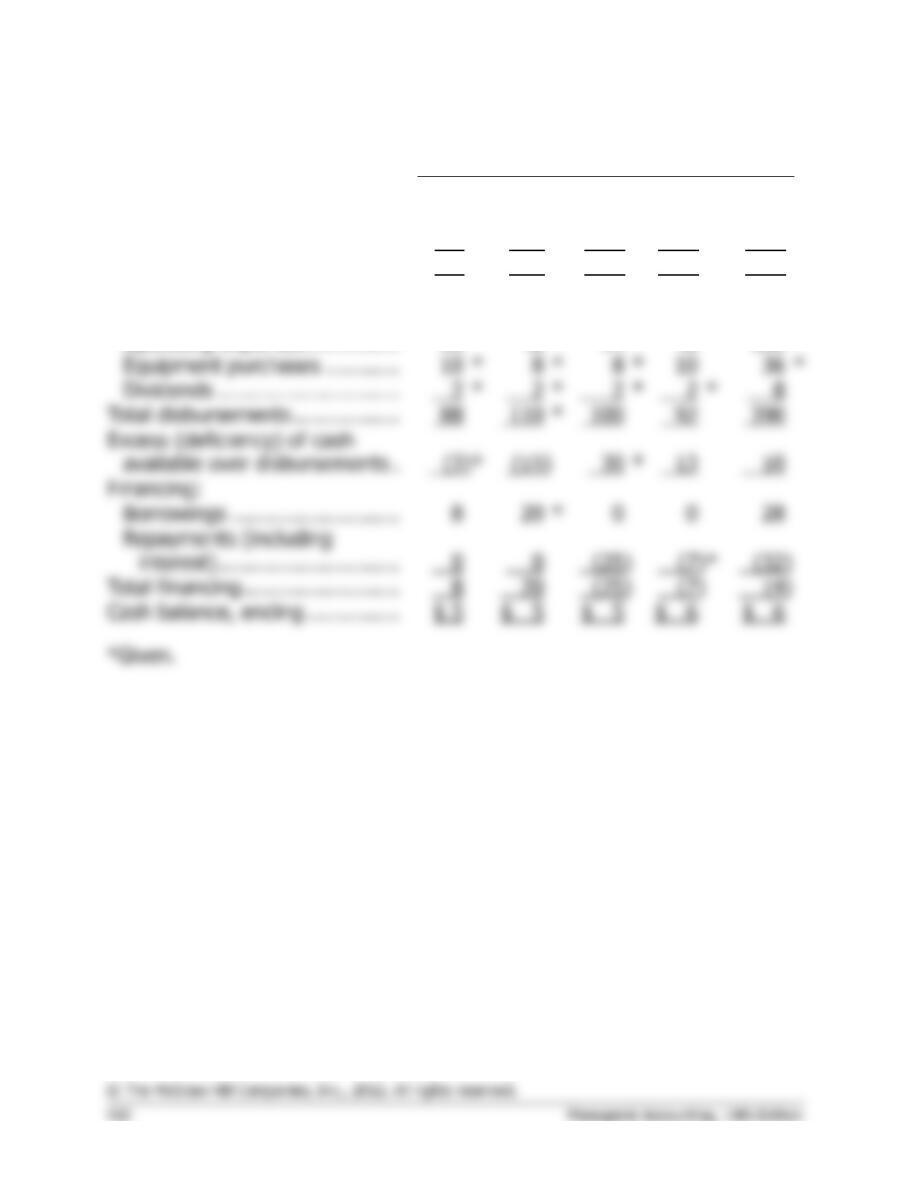
Quarter (000 omitted)
1
2
3
4
Year
Cash balance, beginning ……….
$ 9
*
$ 5
$ 5
$ 5
$ 9
Add collections from customers
76
90
125
*
100
391
*
Total cash available ………………
85
*
95
130
105
400
Less disbursements:
Purchase of inventory …………
40
*
58
*
36
32
*
166
Operating expenses ……………
36
42
*
54
*
48
180
*
*
*
*
*
8
Total disbursements ……………..
88
110
*
100
92
390
*
*
10
Financing:
*
*
Total financing …………………….
20