
8-60
Time and Purposes of Concepts for Analysis (Continued)
CA 8-10 (Time 30–35 minutes)
Purpose—to provide the student with an opportunity to analyze the effect of changing from the FIFO
method to the LIFO method on items such as ending inventory, net income, earnings per share, and
year-end cash balance. The student is also asked to make recommendations considering the results
from computation and other relevant factors.
CA 8-11 (Time 20–25 minutes)
Purpose—to provide the student with an opportunity to analyze the ethical implications of purchasing
decisions under LIFO.
8-61
SOLUTIONS TO CONCEPTS FOR ANALYSIS
CA 8-1
(a) Purchased merchandise in transit at the end of an accounting period to which legal title has
passed should be recorded as purchases within the accounting period. If goods are shipped f.o.b.
shipping point, title passes to the buyer when the seller delivers the goods to the common carrier.
CA 8-2
(a) If the terms of the purchase are f.o.b. shipping point (manufacturer’s plant), Strider Enterprises
should include in its inventory goods purchased from its suppliers when the goods are shipped.
For accounting purposes, title is presumed to pass at that time.
CA 8-3
(a) According to FASB ASC 330-10–30–1:
“As applied to inventories, cost means in principle the sum of the applicable expenditures and
charges directly or indirectly incurred in bringing an article to its existing condition and
location.”
In theory, warehousing costs are considered a product cost because these costs are incurred to
maintain the product in a salable condition. However, in practice, warehousing costs are most fre–
quently treated as a period cost.
Under the Tax Reform Act of 1986, warehousing and off-site storage of inventory, including finished
goods, are specifically included in the “production and resale activities” that are to be capitalized
for tax purposes.
specific prices, it appears clear that the company has the liability and not the trust.
CA 8-4
(a) Cash discounts should not be accounted for as financial income when payments are made.
Income should be recognized when the earnings process is complete (when the company sells the
inventory). Furthermore, cash discounts should not be recorded when the payments are made
because in order to properly match a cash discount with the related purchase, the cash discount
should be recorded when the related purchase is recorded.
8-63
CA 8-4 (Continued)
CA 8-5
(a) 1. Inventories are unexpired costs and represent future benefits to the owner. A balance sheet
2. Beginning and ending inventories are included in the computation of net income only for
the purpose of arriving at the cost of goods sold during the period of time covered by the
statement. Goods included in the beginning inventory which are no longer on hand are expired
costs to be matched against revenues earned during the period. Goods included in the ending
inventory are unexpired costs to be carried forward to a future period, rather than expensed.
CA 8-6
(a) Inventory profits occur when the inventory costs matched against sales are less than the replace–
ment cost of the inventory. The cost of goods sold therefore is understated and net income is con–
sidered overstated. By using LIFO (rather than some method such as FIFO), more recent costs
are matched against revenues and inventory profits are thereby reduced.
CA 8-6 (Continued)
(b) As long as the price level increases and inventory quantities do not decrease, a deferral of income
CA 8-7
(a) The average-cost method assumes that inventories are sold or issued evenly from the stock on
hand; the FIFO method assumes that goods are sold or used in the order in which they are
purchased (i.e., the first goods purchased are the first sold or used); and the LIFO method
matches the cost of the last goods purchased against revenue.
CA 8-8
(a) 1. The LIFO method (periodic) allocates costs on the assumption that the last goods purchased
are used first. If the amount of the inventory is computed at the end of the month under a
periodic system, then it would be assumed that the total quantity sold or issued during the
month would have come from the most recent purchases, and ordinarily no attempt would be
made to compare the dates of purchases and sales.
2. The dollar-value method of LIFO inventory valuation is a procedure using dollars instead of
units to measure increments or reductions in inventory. The method presumes that goods in
the inventory can be classified into pools or homogenous groups. After the grouping into pools
the ending inventory is priced at the end–of-year prices and a price index number is applied to
8-65
CA 8-8 (Continued)
(b) The advantages of the dollar-value method over the traditional LIFO method are as follows:
1. The application of the LIFO method is simplified because, under the pooling procedure, it is not
necessary to assign costs to opening and closing quantities of individual items. As a result,
companies with inventories comprised of thousands of items may adopt the dollar-value
method and minimize their bookkeeping costs.
pools may be difficult and may be based upon arbitrary management decisions.
(c) The basic advantages of LIFO are:
1. Matching—In LIFO, the more recent costs are matched against current revenues to provide a
better measure of current earnings.
The major disadvantages of LIFO are:
1. Reduced earnings—Because current costs are matched against current revenues, net income
is lower than it is under other inventory methods when price levels are increasing.
2. Inventory understated—The inventory valuation on the balance sheet is ordinarily outdated
because the oldest costs remain in inventory.
8-66
CA 8-9
(a) A LIFO pool is a group of similar items which are combined and accounted for together under the
LIFO inventory method.
(b) It is possible to use a LIFO pool concept without using dollar-value LIFO. For example, the specific
goods pooled approach utilizes the concept of a LIFO pool with quantities as its measurement
basis.
CA 8-10
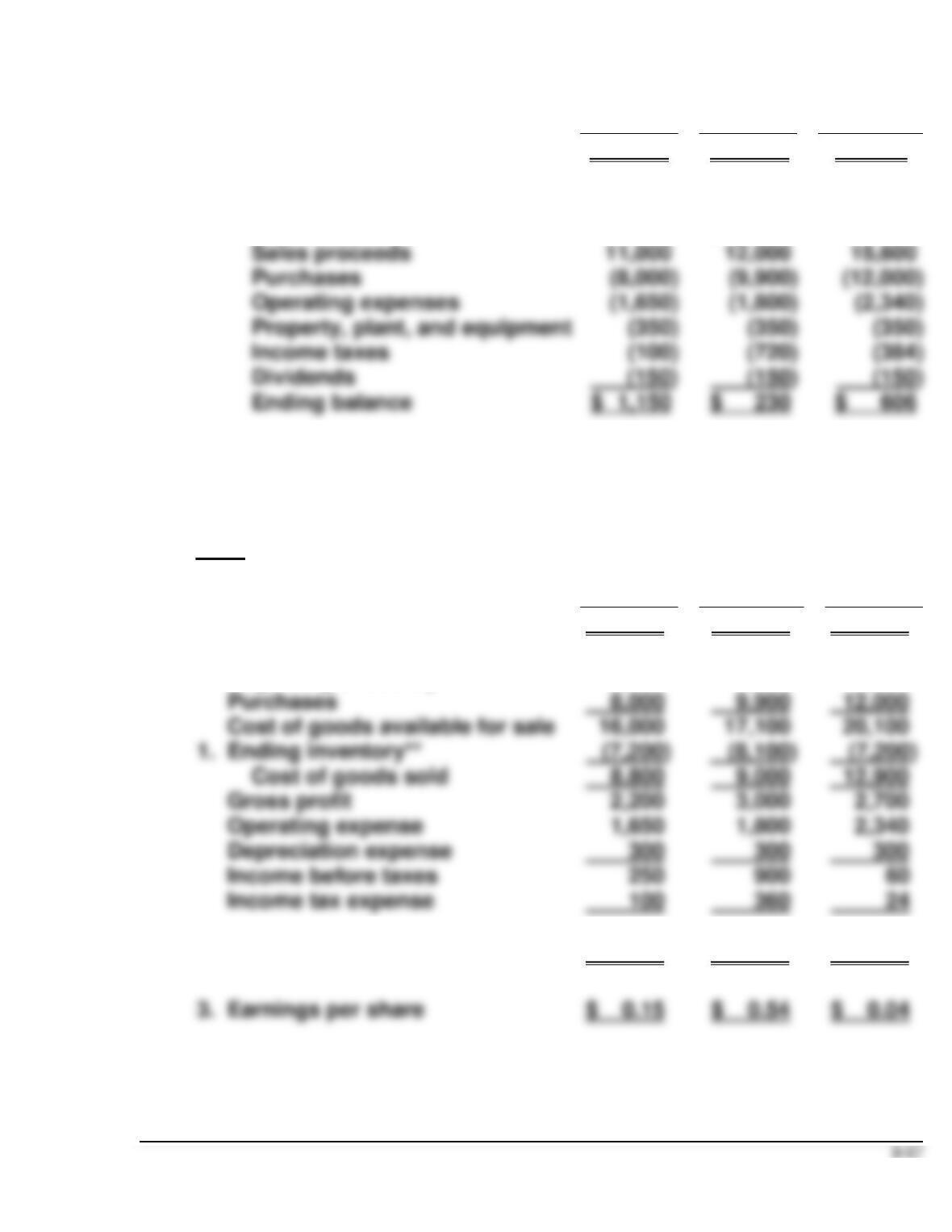
(a) FIFO (Amounts in thousands, except earnings per share)
2012
2013
2014
Sales revenue
$11,000
$12,000
$15,600
Cost of goods sold
Beginning inventory
8,000
7,200
9,000
Purchases
8,000
9,900
12,000
Cost of goods available for sale
1. Ending inventory*
(7,200)
Cost of goods sold
8,800
8,100
12,000
Gross profit
2,200
3,900
3,600
Operating expense (15% of sales)
(2,340)
Depreciation expense
Income before taxes
250
1,800
Income tax expense (40%)
100
720
384
2. Net income
$ 150
$ 1,080
CA 8-10 (Continued)
2012
2013
2014
3. Earnings per share
$ 0.15
$ 1.08
$ 0.58
4. Cash balance
Beginning balance
$ 400
$ 1,150
$ 230
Sales proceeds
Purchases
Operating expenses
Property, plant, and equipment
Income taxes
(100)
(720)
Dividends
(150)
Ending balance
*2012 = $ 8 X (1,000 + 1,000 – 1,100) = $7,200.
2013 = $ 9 X ( 900 + 1,100 – 1,000) = $9,000.
2014 = $10 X (1,000 + 1,200 – 1,300) = $9,000.
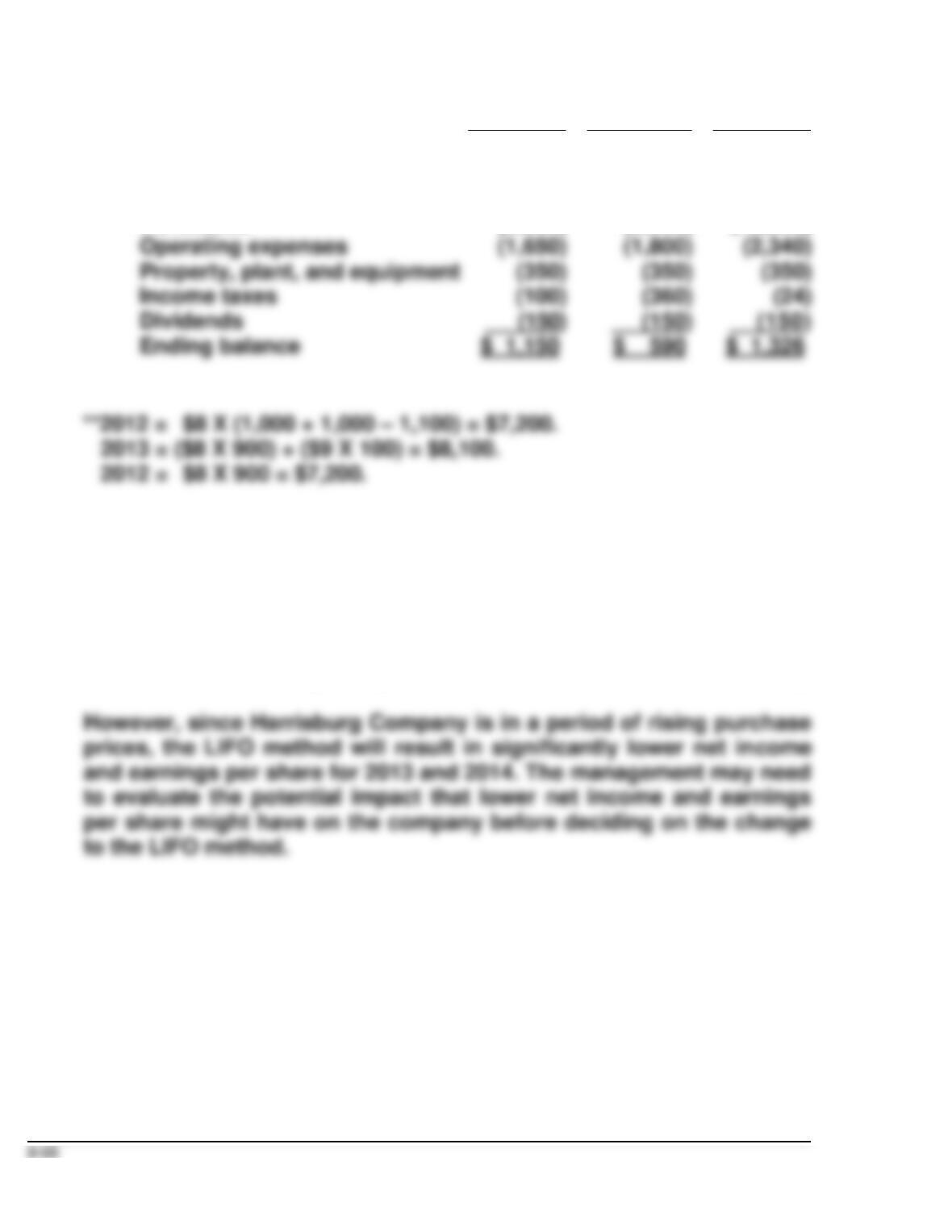
LIFO (Amounts in thousands, except earnings per share)
2012
2013
2014
Sales revenue
$11,000
$12,000
$15,600
Cost of goods sold
Beginning inventory
8,000
7,200
8,100
Purchases
Cost of goods available for sale
1. Ending inventory**
(7,200)
Cost of goods sold
Gross profit
Operating expense
Depreciation expense
Income before taxes
2. Net income
$ 150
$ 540
$ 36
3. Earnings per share
$ 0.15
$ 0.54
$ 0.04
CA 8-10 (Continued)
2012
2013
2014
4. Cash balance
Beginning balance
$ 400
$ 1,150
$ 590
Sales proceeds
11,000
12,000
15,600
Purchases
(8,000)
(9,900)
(12,000)
Operating expenses
Property, plant, and equipment
(350)
(350)
Income taxes
Dividends
(b) According to the computation in (a), Harrisburg Company can achieve
the goal of income tax savings by switching to the LIFO method. As
shown in the schedules, under the LIFO method, Harrisburg will have
lower net income and thus lower income taxes for 2013 and 2014 (tax
savings of $360,000 in each year). As a result, Harrisburg will have a
better cash position at the end of 2013 and especially 2014 (year-end
cash balance will be higher by $360,000 for 2013 and $720,000 for 2014).
8-69
CA 8-11
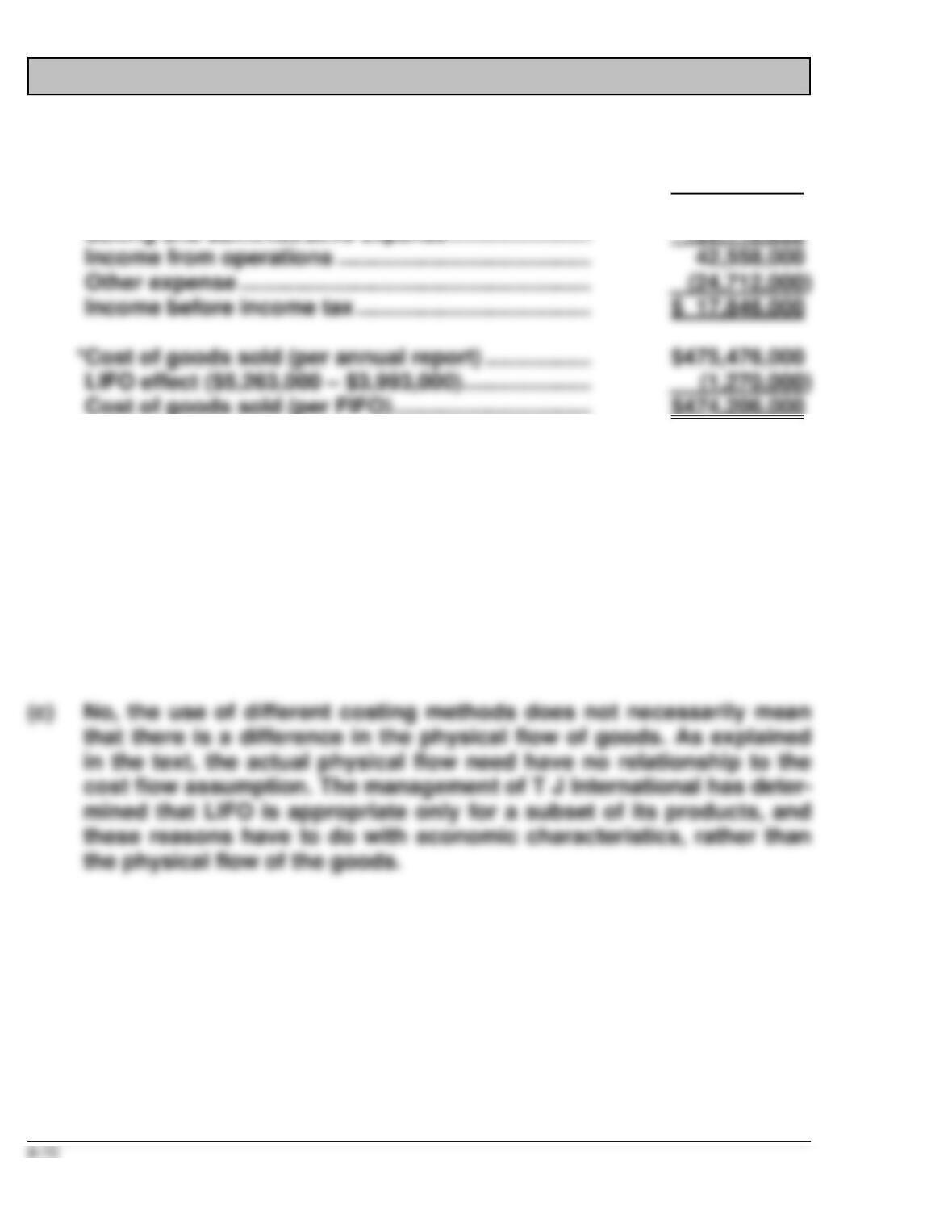
(a) Major stakeholders are investors, creditors, Wilkens’ management
(including the president and plant accountant), and other employees
of Wilkens Company. The inventory purchase in this instance reduces
FINANCIAL STATEMENT ANALYSIS CASE 1
(a)
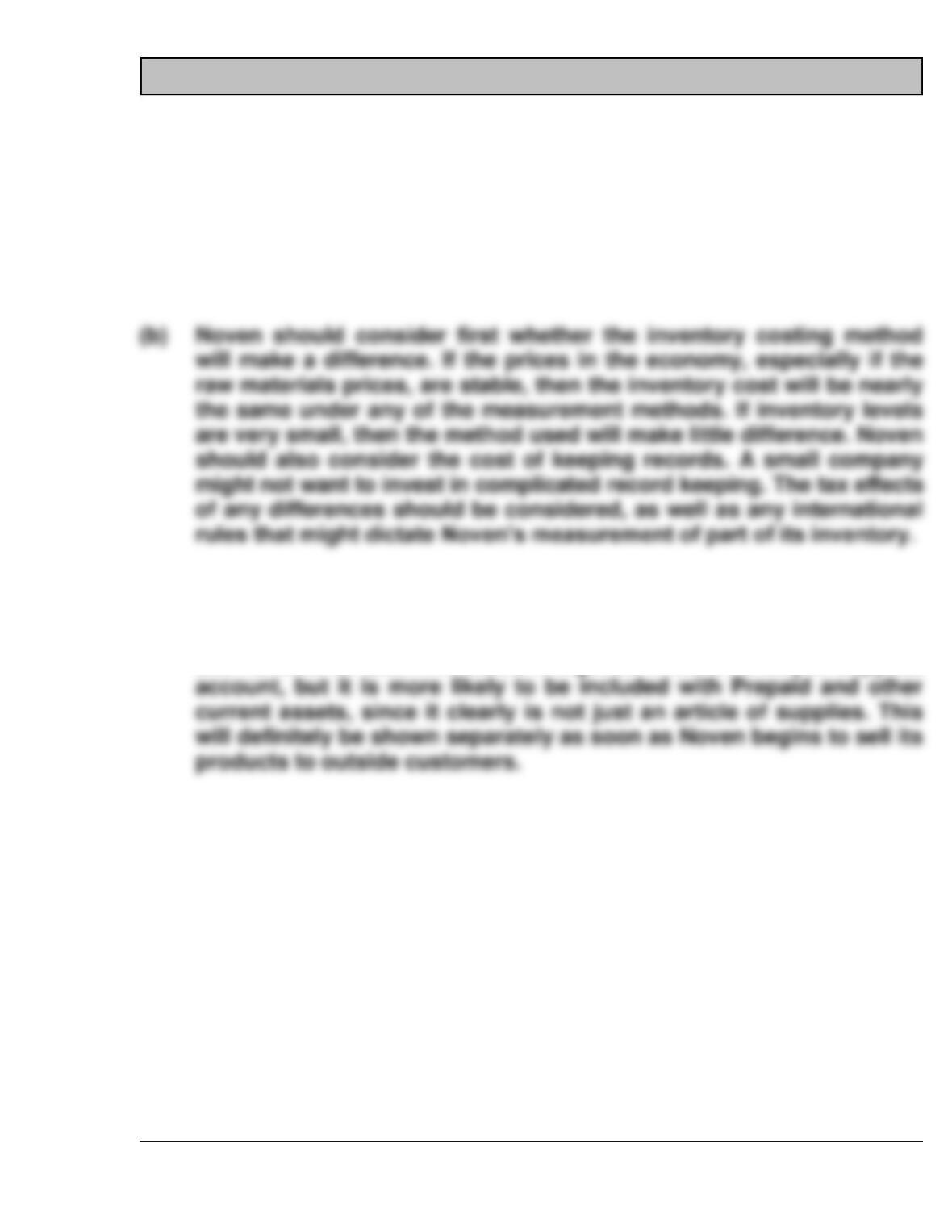
Sales ………………………………………………………………
$618,876,000
Cost of goods sold* …………………………………………
474,206,000
Gross profit …………………………………………………….
144,670,000
Selling and administrative expense …………………..
Income from operations …………………………………..
Other expense …………………………………………………
Income before income tax ………………………………..
$ 17,846,000
$475,476,000
Cost of goods sold (per FIFO) …………………………..
$474,206,000
(b) $17,846,000 income before taxes X 46.6% tax = $8,316,236 tax;
$17,846,000 – $8,316,236 tax = $9,529,764 net income as compared to
$8,848,000 net income under LIFO. This is $681,764 or about 8%
different. The question as to materiality is to allow the students an
opportunity to judge the significance of the difference between the
two costing methods. Since it is less than 10% different, some students
may feel that it is not material. An 8% change in net income, however,
is probably material, but this would depend on the industry and
perhaps on the company’s own past averages.
8-71
FINANCIAL STATEMENT ANALYSIS CASE 2
(a) The most likely physical flow of goods for a pharmaceutical manufac-
turer would be FIFO; that is, the first goods manufactured would be the
first goods sold. This is because pharmaceutical goods have an expi–
ration date. The manufacturer would be careful to ship the goods made
earliest first and thereby reduce the risk that outdated goods will
remain in the warehouse.
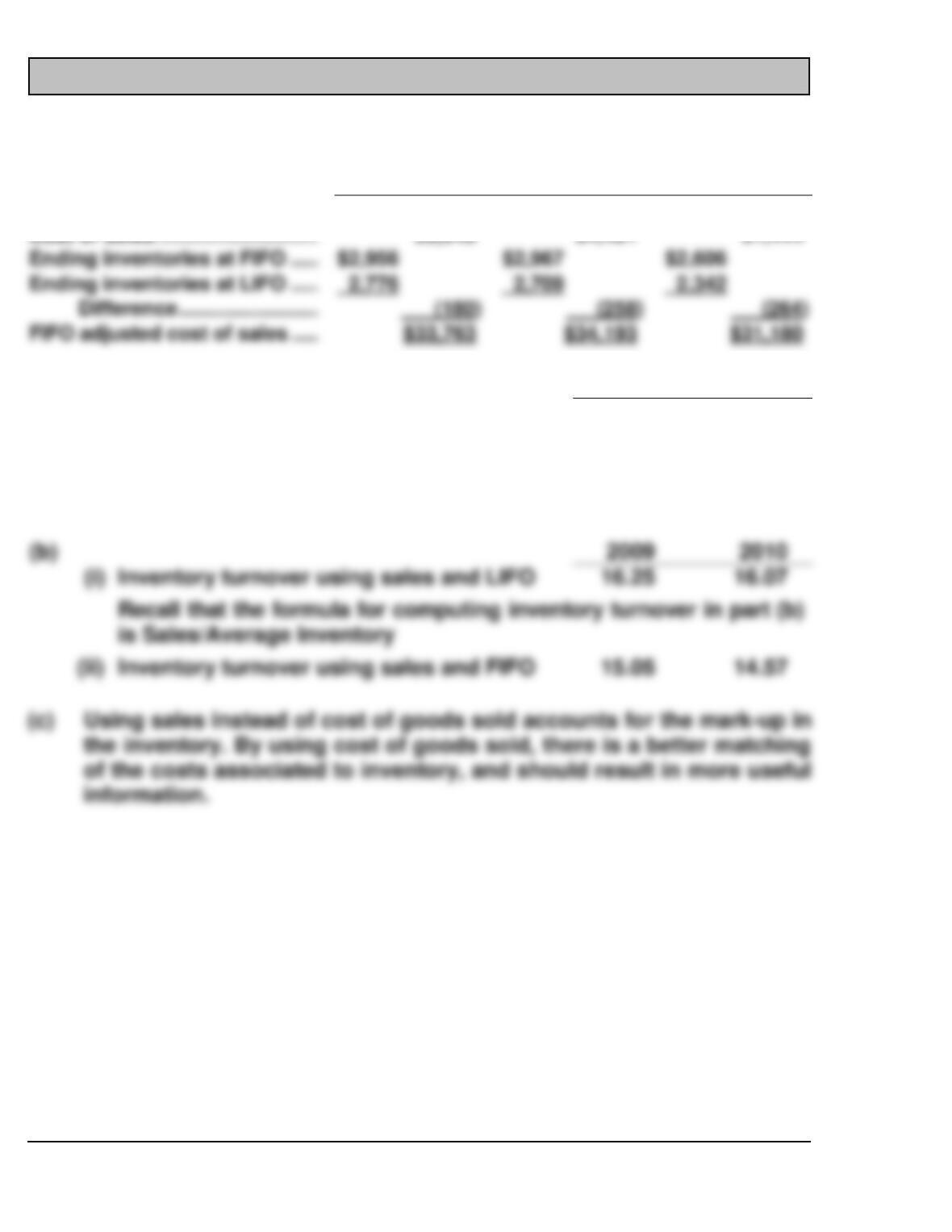
(c) This amount is likely not shown in a separate inventory account
because it is immaterial; that is, it is not large enough to make a differ-
ence with investors. Another possible reason is that no goods have yet
been offered for sale. This amount might be in the Inventory of supplies
8-72
FINANCIAL STATEMENT ANALYSIS CASE 3
Feb. 23
Feb. 28
Feb. 27
2008
2009
2010
Revenues ……………………………..
$44,048
$44,564
$40,597
(a)
2009
2010
(i)
Inventory turnover @LIFO
12.56
12.45
(ii)
Inventory turnover @FIFO
11.55
11.19
Recall that the formula for computing inventory turnover is Cost
of Sales/Average Inventory
(b)
(i)
Inventory turnover using sales and LIFO
16.25
16.07
(ii)
Inventory turnover using sales and FIFO
15.05
14.57
(264)
FIFO adjusted cost of sales ……
8-73
ACCOUNTING, ANALYSIS, AND PRINCIPLES
Accounting
(a) FIFO
Commercial pumps:
Ending inventory at cost = (500 X $1,000) = $ 500,000
Beginning inventory at cost = (600 X $800) = $ 480,000
Purchases = $540,000 + $285,000 + $500,000 = $1,325,000
Cost of goods sold = $480,000 + $1,325,000 – $500,000 = $1,305,000
Total ending inventory at cost = $245,000 + $500,000 = $ 745,000
Current
Inventory at
base cost
Conversion
price index
Inventory at
LIFO cost
Ending inventory
Base inventory ($80,000 + $480,000)
$560,000
1.000
$560,000
Layer ($600,000 – $560,000)
40,000
1.242
49,680
Total
$600,000
$609,680
8-74
ACCOUNTING, ANALYSIS, AND PRINCIPLES (Continued)
Analysis
(a) The purpose of a current ratio is to provide some indication of the
(b) The U.S. Securities and Exchange Commission requires companies
using LIFO to disclose the current cost of their inventories. Many
companies disclose the FIFO cost of their inventories since that
Principles
Companies can change from one inventory accounting method to
another, but not back and forth. Changes in accounting method (when
not mandated by a regulatory body such as the FASB) should be to
8-75
PROFESSIONAL RESEARCH
(a) According to FASB ASC 605-15-15:
15-2 The guidance in this Subtopic applies to the following
transactions:
a. Sales in which a product may be returned, whether as a
matter of contract or as a matter of existing practice, either
by the ultimate customer or by a party who resells the
b. Sales by a manufacturer who repurchases the product subject
to an operating lease with the buyer.
(b) The guidance in this subtopic (FASB ASC 605-15-15) does not apply to
the following transactions:
a. Revenue in service industries if part or all of the service revenue
may be returned under cancellation privileges granted to the buyer.
8-76
PROFESSIONAL RESEARCH (Continued)
> Right of Return (FASB ASC 605-15)
05-3 It is the practice in some industries for customers to be given the
right to return a product to the seller under certain circumstances.
(c) Yes, different industries should be allowed to make different types of
policies. (FASB ASC 605-15-05).
05-4 Sometimes, the returns occur very soon after a sale is made, as
(d) According to FASB ASC 605-15-25:
25-3 The ability to make a reasonable estimate of the amount of future
returns depends on many factors and circumstances that will vary
from one case to the next. However, any of the following factors
may impair the ability to make a reasonable estimate:
8-77
PROFESSIONAL RESEARCH (Continued)
d. Absence of a large volume of relatively homogeneous
transactions.
25-4 The existence of one or more of the factors in the preceding
paragraph, in light of the significance of other factors, may not
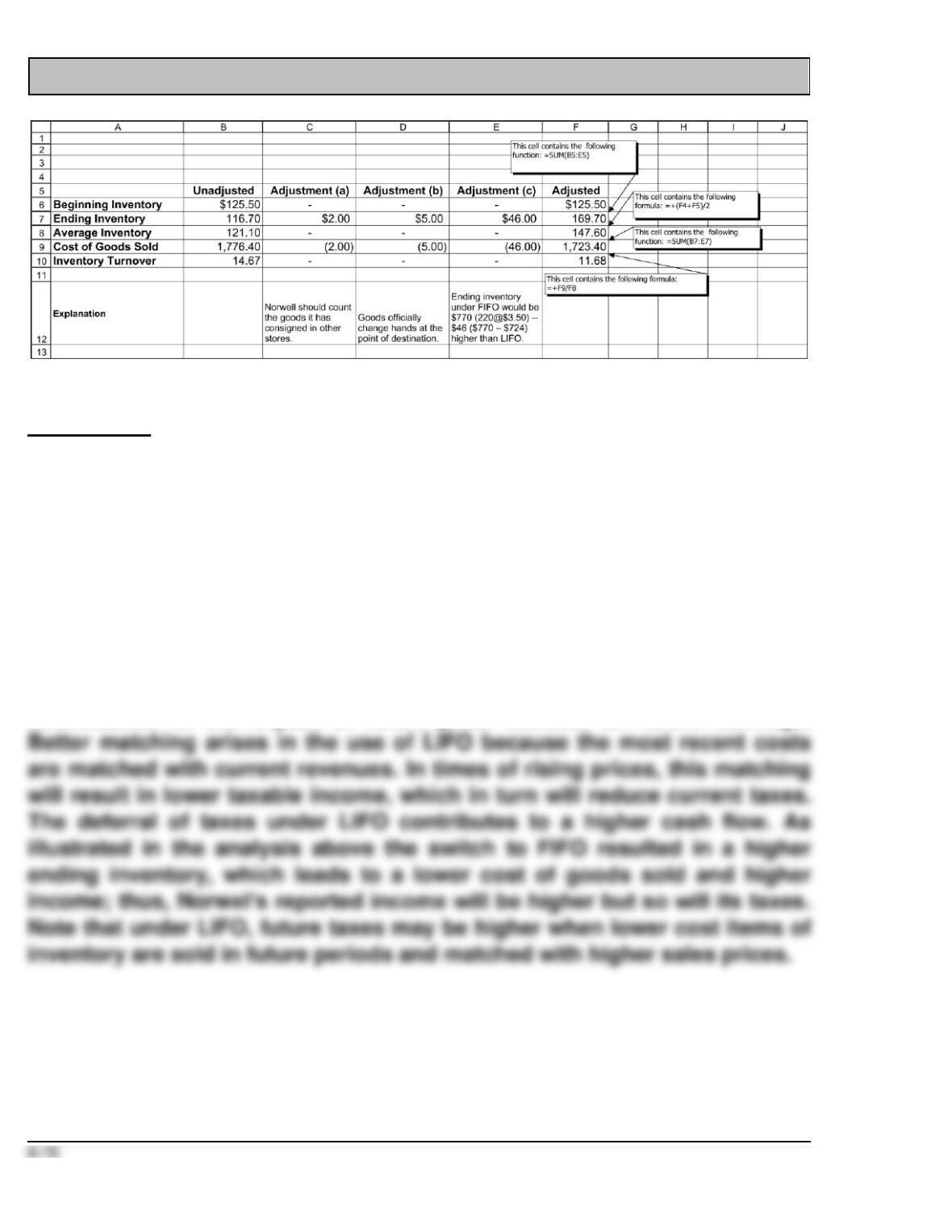
PROFESSIONAL SIMULATION
Explanation
To: Norwel Management
From: Student
Re: Advantages of LIFO
The major advantages of the LIFO inventory method include better matching
of costs with revenues, deferral of income taxes, improved cash flow, and
minimization of the impact of future price declines on future earnings.