1
Chapter 8: Native Americans and Multi-racial Group Members
Chapter 8
Native Americans and Multi-racial Group
Members
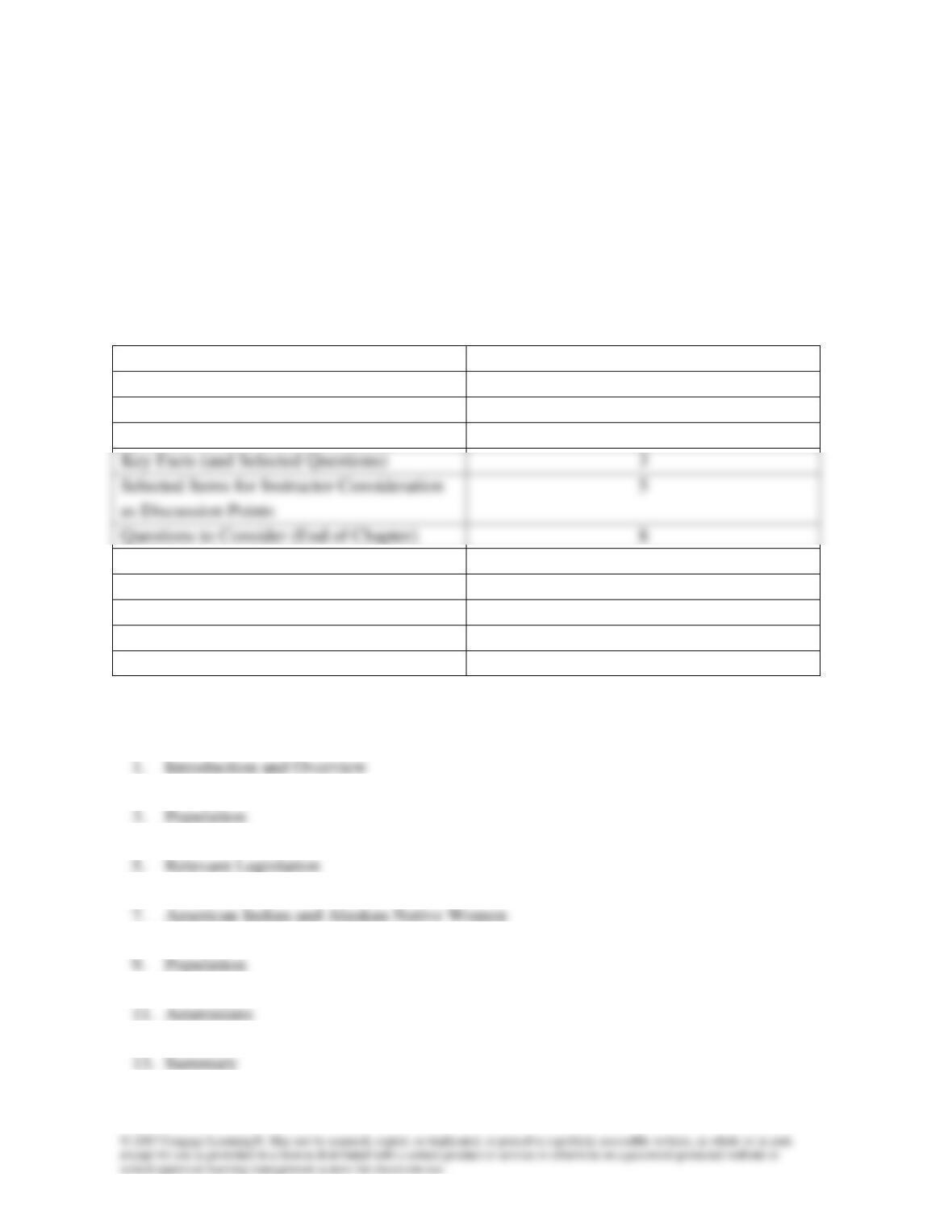
Table of Contents
Page No. in the IM
Chapter Outline
1
Chapter Objectives
2
Lecture Notes and Teaching Suggestions
2
Key Facts (and Selected Questions)
3
as Discussion Points
Questions to Consider (End of Chapter)
8
Actions and Exercises
10
Suggested Readings
11
Suggested Video
12
Suggested Test Questions
12
Chapter Outline
2. History of American Indians in North America
4. Education, Employment, and Earnings
6. Research on American Indians at Work
8. Multi-racial Group Members
10. Relevant Legislation
12. Recommendations for Individuals and Organizations
14. Key Terms
15. Questions to Consider
16. Actions and Exercises
Chapter Objectives
After completing this chapter, readers should have a greater understanding of Native
Americans, including American Indians and Alaska Natives, and multi-racial group
members in the United States. Specifically, they should be able to:
• Explain the historical background and current status of Native Americans and multi-
racial group members in the United States
• Discuss education, workforce participation rates, employment, and income levels of
Native Americans in the United States
• Explain the diversity among multi-racial group members and issues unique to them
• Identify similarities in experiences of native people in the United States and New
Zealand
• Explain legislation related to employment experiences of Native Americans and
multi-racial group members
• Make recommendations for inclusion of these groups in diversity efforts
Lecture Notes and Teaching Suggestions
This chapter focuses on American Indians, Alaska Natives, and multi-racial group
members. Although a very small proportion of the population, American Indians/Alaska
Natives (AI/AN) are integral to the study of diversity, given their position as the original
inhabitants of the United States and their negative experiences with newcomers to the
Many people have very limited knowledge of AI/IN, except for representations in the media
(e.g., movies, “Cowboys and Indians” television shows) and as school mascots and sports
symbols (Kansas City Chiefs, Atlanta Braves, and Cleveland Indians). Misperceptions
about AI/AN are exacerbated by their relatively small representation in the population.
AI/AN have lower education levels than all other groups. AI/AN men and women both
participate in the workforce at slightly lower rates than the rest of the population. Poverty
rates for AI/AN are higher than all groups. For a summary picture, AI/AN have some of the
lowest education levels, lowest workforce participation rates, and highest poverty and
unemployment rates than any other racial or ethnic group. When identifiable, AI/AN face
some of the same diversity issues faced by others of color in the U.S.
3
Chapter 8: Native Americans and Multi-racial Group Members
There are nearly 7 million people in the U.S. who self-identify as having more than one
racial background, and this population is expected to grow in the future. The invisibility (or
Key Facts (and Associated Questions)
Questions following each “Key Fact” are helpful in stimulating class discussion. (Selected
key facts include discussion points in this Instructors’ Manual. Instructors may choose to
emphasize different ones depending on the needs/interests of students and instructors).
Instructors may wish to have students formulate questions of their own that are relevant to
the key facts and use them for class discussion.
• The 5.2 million people of American Indian and Alaska Native descent comprise about
2% of the U.S. population; 2.9 million people identify as American Indian and Alaska
Native alone.
Question: Were you surprised by this percentage being so low?
Students’ answers will vary.
• The American Indian and Alaska Native population increased by nearly 40% between
2000 and 2010, largely as a result of changes in self-identification as being Native
American in combination with some other race.
Question: What are the other factors that have contributed to the growth of the
American Indian population?
Students’ answers will vary. Some of them may mention declining mortality rates and
• About 33% of people who are Native American alone live on reservations or trust
lands.
4
Chapter 8: Native Americans and Multi-racial Group Members
Students’ answers will vary.
• Fourteen percent of single race Native Americans have at least a bachelor’s degree.
Question: Why are the education levels of Native Americans so low?
• American Indians and Alaska Natives have the worst or nearly the worst
unemployment, poverty, and health insurance rates in the United States.
Question: Why do AI/AN have the worst unemployment, poverty, and health
insurance rates?
• In the 2000 Census, for the first time, people could report belonging to two or more
races, and nearly 7 million people did so. In 2010, 9 million people did so, a 32%
increase.
Question: How were these people counted prior to 2000?
• Ninety-three percent of multi-racial people are of two races and six percent are of
three races.
Question: Mention the relevant legislation that protects multi-racial group members
against discrimination.
5
Chapter 8: Native Americans and Multi-racial Group Members
• Multi-race people are younger than single-race people; over 40% of multi-racials are
under 18, compared with 25% of single-race people.
Question: How do the younger ages of multi-racial people affect diversity issues?
Selected Items for Instructors’ Consideration as Discussion
Points
1. Feature 8.1: American Indians as Sports Symbols and Mascots
This feature discusses the problems and controversies associated with the use of American
Indians as mascots by schools and sports teams. It begins by listing some schools that have
discontinued using Indian mascots, the U.S. Civil Rights Commission’s statement about
such use, and the National Collegiate Athletic Association’s (NCAA) controversial decision
Questions to Consider:
1. Colleges and schools are unique organizations, with diverse students, alumni, and
faculty, and the general public as customers and constituents. How might the use of an
American Indian name and mascot affect individuals from these groups of customers
and constituents? What should be done to effectively address disputes that will
inevitably arise when a decision is made to continue using or to discontinue using a
particular mascot?
2. Compare the use of the Seminole and other American Indian mascots to the use of the
“Fighting Irish” mascot at the University of Notre Dame.
3. How might the size of the American Indian population be related to continued use of
AI images and mascots? How might AI images and mascots affect such people?
4. What factors make elected officials introduce laws calling for continued use of certain
mascots? What do you think about this practice?
2. International Feature 8.1 Māori: Native New Zealanders
This international feature focuses on the Māori, the indigenous people of New Zealand.
Similarities between the Māori and American Indians are apparent: their being native
7
Chapter 8: Native Americans and Multi-racial Group Members
inhabitants, decline of the population upon European contact, currently faster birthrates,
higher unemployment, lower education levels, and governmental and societal recognition of
their status.
Questions to Consider:
1. How do the past and current experiences of Māori in New Zealand compare with
those of American Indians in the United States?
2. How effective is the New Zealand Human Rights Act? Investigate.
3. Table 8.1: Educational Attainment of Population 25 Years and Over and Table 8.2:
Selected Socio-Demographic Characteristics of Population: 2012
4. Individual Feature 8.1: Wilma Mankiller, Chief of the Cherokee Nation, 1985–1995
This feature presents Wilma Mankiller (previously chief of the Cherokee Nation) who
managed a $75 million budget, comparable to budgets of major corporations. Wilma noted
that Blacks, Latinos, and American Indians were targets of prejudice and discrimination,
and it was in San Francisco that Mankiller’s pursuit of justice began. Mankiller participated
in the occupation of Alcatraz prison in 1969 where American Indians from numerous tribes,
along with celebrities and activists, occupied the prison to draw attention to the history of
abuses, broken treaties, and current discrimination and inequity faced by Indians.
8
Chapter 8: Native Americans and Multi-racial Group Members
Questions to Consider (End of Chapter)
1a. If you are not American Indian or Alaska Native, what has your exposure to them
been? Do you know any personally? If so, how do you know them? How well? What
beliefs about Native Americans were you aware of prior to reading this chapter?
1b. If you are Native American, how do your work experiences compare with those
presented in the chapter?
2a. If you are not multi-racial, what has your exposure been to multi-racial people? Do
you know anybody who is multi-racial? Have you talked with them about being multi-
racial and about their diversity-related experiences?
Students’ answers will vary. However, they may mention some of the following
points in their answers. Multi-racial people are often overlooked in studies of diversity
9
Chapter 8: Native Americans and Multi-racial Group Members
2b. If you are multi-racial, is being so an important part of your identity? Did any section
of the chapter have particular resonance for you?
3. Professional golfer Tiger Woods emphasizes his White, Asian, Black, and Native
American heritage. Were Woods unknown as a professional golfer, what assumptions
would likely be made about his race by (a) a police officer prone to racial profiling, or
to (b) a Black, (c) an Asian, (d) a White, or (e) a Native American person?
4. The chapter listed several other fairly well-known multi-racial people. Are you
familiar with any of them? If so, were you aware that they are multi-racial? Were you
aware of their particular multi-racial heritage? If not, what was your impression of the
racial or ethnic group to which each belongs? If they were not famous, speculate on
the racial or ethnic group to which they would be perceived to belong based on their
identifiability (e.g., Dworkin & Dworkin) and on their experiences based on people’s
perceptions. If they are partnered (married or in a long-term relationship), what is the
racial background of the person with whom they are partnered?
Students’ answers will vary. Students may be well aware of personalities like Halle
Berry, Lynda Carter, Ann Curry, Cameron Diaz, Derek Jeter, Norah Jones, Alicia
1. Excluding American Indian schools, find a college or university not identified in this
chapter that is known for the diversity of its students. What are the demographic
characteristics of the student body (e.g., race, ethnicity, sex, and age)? What are the
characteristics of the school (e.g., size of student body, location, and any other
relevant factors)?
2. Investigate the demographic characteristics of the student body at the university in
which you are studying or once studied. Do you know of any AI/AN students who
attend or attended school with you? If so, is their AI/AN background visible? Do they
“pass” at times? If this person is a close friend or acquaintance, discuss their heritage
and experiences with them.
3. Investigate the history of American Indians in your state and their current status
(including population, workforce participation, education levels, income, and poverty
rates).
4. Estimates suggest that 70% of Blacks in the United States are of multi-racial heritage.
Were you aware of this? Begin noticing the variation in skin color, features, and hair
texture among Blacks. Choose five Blacks whom you know, with whom you come in
contact, or who are well-known people and document the visible variations in their
skin tone, features, and hair texture. What do you observe?
5. Choose an indigenous people in a particular country (except the United States and
11
Chapter 8: Native Americans and Multi-racial Group Members
New Zealand). Document their original and current population, education level,
employment, and workforce participation. How do their education, employment, and
participation levels compare to those of the dominant group in that country?
6. If you have access to the film In Whose Honor? American Indian Mascots in Sports
by Jay Rosenstein, watch it. What are your thoughts about American Indians as
mascots after having watched the film?
Suggested Readings
Dworkin, A.G. & Dworkin, R.J. (Eds.). (1999). The minority report: An introduction to
racial, ethnic and gender relations (3rd ed.). New York: Harcourt & Brace.
Mankiller, W. & Wallis, M. (1993). Mankiller: A Chief and Her People. New York: St.
Martin’s Press.
Muller, H. (1998). “American Indian Women Managers: Living in Two Worlds.” Journal of
Management Inquiry, 7(1): 4–28.
Obama, B. (1995). Dreams from My Father: A Story of Race and Inheritance, New York:
Times Books.
Suggested Video
“In Whose Honor? American Indian Mascots in Sports”
12
Chapter 8: Native Americans and Multi-racial Group Members
Suggested Test Questions
1. How many people of American Indian/Alaska Native descent and multi-racial
ancestry are currently in the United States? Why are the populations of the people of
American Indian/Alaska Native and multi-racial ancestry increasing?
3. Discuss the education, employment, and work experiences of American Indian and
Alaska Native women. What particular strengths do AI/AN women bring to
organizations?
4. Discuss the current population of people who are multi-racial and factors affecting the
growth of this group in the future.
5. Discuss Amerasians as a particular multi-racial group of Americans. What have their
experiences been in Asia and the U.S.? What are their current education and income
levels in the U.S.?
6. What are some of the organizational recommendations to ensure the contributions of
American Indian applicants and employees are recognized?