93
CASE 8
SUGGESTED ANSWERS TO DISCUSSION QUESTIONS
(1)
A number of reasons could explain a difference between the physical inventory
count and a company’s perpetual inventory records. When faced with any
discrepancy such as this, the auditor should consider all possible causes.
The perpetual records may be in error. A large volume of transactions are
processed during the course of a year, and some amount of human error is
to be expected in the recording.
Damaged or obsolete inventory may have been disposed of by the
company without recording a reduction in the subsidiary ledger.
Goods in transit could have been incorrectly handled in either the perpetual
records or the physical inventory.
The question as to whether the $6,000 difference warrants further attention is
subject to the auditor’s judgment. Since the financial records are adjusted to
agree with the physical inventory, the auditor is primarily interested in potential
errors contained in the counted figure. If Mitchell has appropriately observed the
taking of the physical count, the possibility of errors in the quantity of inventory
should be at a minimum. Additional testing, such as verifying the costing, the
extensions, and the footings will further reduce the risk of a material error in the
figure to be reported.
The presence of perpetual records adds another dimension to the inventory
verification. By comparing the ending figures from the physical count with the
perpetual records, the auditors can determine whether differences are connected
(2)
An overcount of inventory leads to a decrease in cost of goods sold and, thus, an
increase in reported net income. In any situation in which the company desires a
(3)
An undercount of ending inventory leads to an increase in cost of goods sold and
a decrease in reported net income for the current year. The most obvious reason
for a company to undercount ending inventory is to defer payment of income
(4)
In the engagement letter prepared by Abernethy and Chapman (see Exhibit 3-1),
the firm stated that it expected “to obtain reasonable but not absolute assurance
that major misstatements do not exist.” When a material misstatement goes
(5)
A decision to observe less than 100% of the ending inventory always exposes
the auditor to some degree of risk. This risk is based on the possibility that a
material misstatement exists in the inventory not being observed. Three factors
(6)
One method of manipulating net income is to record sales in one year with
recognition of any subsequent returns being delayed until the following period.
(7)
As indicated in Question (2), above, overcounting of inventory is a potential
(8)
This question can generate debate among students who often expect the
auditors to perform extensive auditing procedures in regard to damaged and
obsolete merchandise. In reality, Mitchell’s role is that of an observer; damaged
or obsolete inventory is the client’s responsibility. The Lakeside memorandum
97
(9)
Lakeside’s procedures for taking its physical inventory seem well designed
SUGGESTED ANSWERS TO EXERCISES
(1)
An audit program designed to verify the inventory listing and the reconciling items
would include steps such as the following:
a. Trace the tags recorded by the auditor (Exhibit 8-3) to the physical
c. For each of the inventory items recorded by the auditor, compare the unit
d. For each of the inventory items recorded by the auditor, mathematically
verify the extensions on the physical inventory list.
e. Refoot the inventory listing.
98
(2)
One technique for approaching this case is to assign Question (1) for one class
period, with the working paper to be prepared only after review of the students’
audit programs. This procedure helps to stress the connection between preparing
an audit program, evidence gathering, and developing a working paper. It
demonstrates a continuum from:
establishing the audit procedures to be performed, to
In reviewing the audit documents prepared by the students, the instructor should
insist that each specific audit procedure be spelled out along with the results of
99
Lakeside Company WP # F-3 p. 1
Tests of Inventory Listing Warehouse Prepared by: PR 1/12/13
12/31/12 Reviewed by:
Inventory Item Tag No. Serial Number Quantity Audit
Procedures
Amplifiers 116 BC76-W 22
Component Systems 124 JB45-M 69
Beepers 102 CB21-S 80
Stereo Systems 138 FU87-R 60
Audit Objectives:
To verify that the physical count she observed agrees with the inventory
Scope: Items that were selected during the inventory observation. See WP F-1 and F-2.
Audit Procedures:
Traced items to inventory listing noting agreement as to description and quantity.
No exceptions noted.
Other Procedures:
Agreed last tag (#152) on inventory listing to WP F-1.
Audit Conclusion: The inventory listing is fairly stated.
100
Lakeside Company WP # F-3 p. 2
Tests of Inventory Counts–Warehouse Prepared by: PR 1/12/13
12/31/12 Reviewed by:
Receiving Reports (January 1-2, 2013)
Date and Item Rec. Rep. Qty. Unit Cost Total Cost Audit Proc.
Jan. 1, 13 Televisions JB45-H 3988 22 481.87 10,601.14
Bills of Lading (January 1-2, 2013)
Bill # Qty. Unit Cost Total Cost Audit Proc.
Jan. 1, 13 Amplifier XY76-R 6015 20 219.95 4,399.00
Jan. 1, 13 Televisions BM09-H 6015 10 812.35 8,123.50
Jan. 2, 13 Stereo Systems AB15-M 6016 20 256.98 5,139.60
Scope:
All reconciling items to the inventory listing.
Audit Procedures:
Agreed quantity and description to WP F-1. No exceptions noted.
Other Procedures:
Recomputed discounts on inventory reconciliation without exception.
101
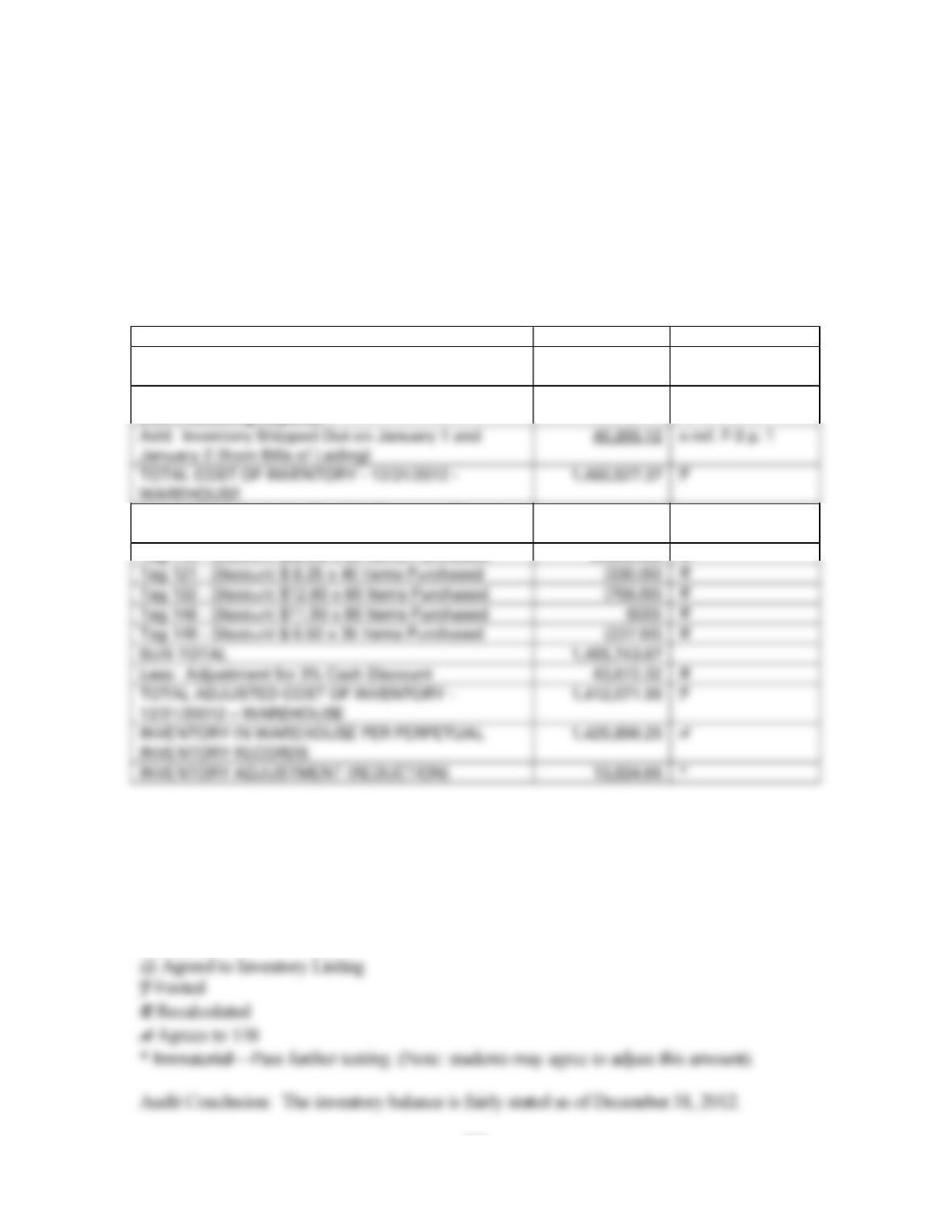
WP # F-1, p. 3
Prepared by: PR 1/12/13
Reviewed by:
Lakeside Company
RECONCILIATION OF PHYSICAL INVENTORY – WAREHOUSE
December 31, 2012
Item Amount Procedures
TOTAL COST OF INVENTORY – 1/3/2013 –
WAREHOUSE
$1,434,101.69
@
Less: Inventory Received on January 1 January 2
(from Receiving Reports)
(13,779.44)
x-ref. F-3 p. 1
Less: Adjustments for Monthly Discounts Given by
Cypress
Tag 113 – Discount $30.00 x 85 Items Purchased (2,550.00)
R
Audit Objective:
To verify that the inventory balance is valid and reasonable.
Scope:
The listing to the inventory balance reconciliation.
Procedures: